707
© 2017 by the Serbian Biological Society How to cite this article: Venkataravanappa V, Narasimha Reddy LRC, Polam S, Subbanna SK, Manem Krishna R. Detection and characterization of ‘Candidatus Phytoplasma asteris’ associated with littleleaf disease of bitter gourd from India by 16S rRNA phylogenetic and RFLP (in vitro and virtual) analysis. Arch Biol Sci. 2017;69(4):707-14.
Detection and characterization of ‘
Candidatus
Phytoplasma asteris’ associated with
littleleaf disease of bitter gourd from India by 16S rRNA phylogenetic and RFLP
(
in vitro
and virtual) analysis
Venkataravanappa Venkataravanappa1,*, Lakshminarayana Reddy C. Narasimha Reddy3, Swarnalatha Polam2, Shankarappa K. Subbanna4 and Krishna Reddy Manem2,#
1CHES, Chettalli, Indian Institute of Horticultural Research, Hessaraghatta Lake PO, Bangalore, India 2Indian Institute of Horticultural Research, Hessaraghatta Lake PO, Bangalore-560089, Karnataka, India
3Department of Plant Pathology, College of Sericulture, University of Agricultural Sciences(B), Chintamani- 563125,
Karnataka, India
4Department of Plant Pathology, College of Horticulture, Bangalore-560065, University of Horticultural Sciences, Bagalkot,
Karnataka, India
Corresponding authors: *[email protected], *[email protected]; #[email protected]
Received: February 23, 2017; Revised: May 7, 2017; Accepted: May 10, 2017; Published online: June 12; 2017
Abstract: Bitter gourd plants showing symptoms of little leaf disease are prevalent in farmers’ fields in the Bangalore rural district, Karnataka state, India. Twenty leaf samples from different locations were collected to determine the etiology of the disease. Using PCR and phytoplasma 16S rRNA gene-specific universal primers, we observed positive amplification for the phytoplasma specific primers in five out of twenty samples. The amplified products were cloned, sequenced and nucleotide (NT) sequence comparisons were made with the available phytoplasmas’ 16S rRNA gene NT sequences in the NCBI database. The 16S rRNA gene NT sequence of bitter gourd phytoplasma shared highest identity of 81.7-96.0% with ‘Candidatus Phytoplasma asteris’ (Ca. P. asteris) 16Sr I group isolates from different parts of the world. This was supported by close clustering of phytoplasma of the current study with the Ca. P. asteris 16Sr I subgroup by phylogenetic analysis. The virtual restriction fragment length polymorphism (RFLP) pattern generated for the Phytoplasma from bitter gourd was in congruence with the in vitro RFLP pattern for the six enzymes. This was typical to Ca. P. asteris from the 16Sr I group. Further, virtual RFLP analysis with 11 more enzymes used for RFLP pattern prediction revealed differences only in the Mse I RFLP pattern, with a similarity coefficient of 0.91, which is less than the threshold similarity coefficient for a new subgroup. We propose that the phytoplasma detected in the present study that infects bitter gourd and causes littleleaf disease should be considered as a new subgroup of group 16Sr I(Ca. P. asteris). This is the first report of phytoplasma associated with littleleaf disease of bitter gourd from India.
Key words: bitter gourd, phytoplasma, group 16SrI, PCR, in silico analysis
INTRODUCTION
Bitter gourd (Momordica charantia L.) belongs to the family Cucurbitaceae. This plant is one of the most important vegetables grown in tropical and subtropi-cal regions of Southeast Asia, Africa and Caribbean countries [1]. It is extensively cultivated in all states of India [2]. The fruits are consumed as vegetables that are very low in calories and provide an excellent source of vitamins, minerals and high dietary fiber.
Areas under cultivation of this crop are decreasing worldwide due to many abiotic and biotic stresses. Among the different biotic factors, major constraints resulting in crop loss are due to viral [10] and phy-toplasma diseases [11, 12]. Different phyphy-toplasma groups associated with bitter gourd disease include witches’ broom phytoplasma, described for the first time by electron microscopy [13], X disease caused by
‘Candidatus Phytoplasma pruni’ and Ca. P. asteris in
Taiwan [11], phyllody disease caused by aster yellows phytoplasma (AYP) identified by RFLP analysis in Thailand [14], andlittleleaf phytoplasma in Myanmar caused by Ca. P. asteris and identified based on 16S rRNA, ribosomal protein (RP), protein translocase subunit (secY) gene and RFLP analysis [12].
Phytoplasma have an uneven distribution in a plant’s system, normally inhabiting the phloem at low concentrations. This characteristic makes their detection and identification difficult [15], and was a major concern until the use of PCR assays with uni-versal primers derived from conserved 16S rRNA gene sequences [16-18,38]. PCR has proven to be a more sensitive and convenient method for the diagnosis of phytoplasma than other methods, such as electron microscopy, serology and nucleic acid hybridization assays. An effective approach to detect and classify phytoplasma was by targeting a highly conserved region of 16S rRNA and the spacer region between the 16S and 23S rRNA genes [19,20-22]. Computer-simulated RFLP analysis of the 16S rRNA gene was used as a marker for the classification of phytoplasma into different groups and subgroups [23,24]. Based on the analysis of 16S rRNA gene sequences, 31 groups and 100 subgroups of diverse phytoplasmas were identified [25-27]. From India, 16SrI, 16SrII, 16SrV, 16SrVI, 16SrIX, 16SrXI and 16SrXIV groups were re-ported. The aster yellow group (16SrI) was reported in northeastern parts of India, either alone or associated with more than 31 diseases of different crop plants [28]. However, there are no reports of phytoplasma associated with bitter gourd in India. Here we report on the symptoms, describe molecular detection and characterize the 16Sr I Ca. P. asteris group associated with bitter gourd littleleaf (BitLL) disease in India.
MATERIALS AND METHODS
Disease incidence and plant material
The systematic roving survey was conducted dur-ing 2014-2015 in ten different farmers’ fields in the Bangalore rural district, Karnataka state, to estimate the incidence of littleleaf phytoplasma disease on bitter gourd. The number of infected plants (plants showing littleleaf, mosaic, leaf curl, vein thickening, shorter internal length, perfuse flowering and bushy appearance) and total plants were counted by moving diagonally across rows in the fields in order to obtain the disease incidence. Twenty infected leaf samples were collected; one leaf sample from each location was without any symptoms and served as the nega-tive control.
Phytoplasma detection
PCR
were separated by electrophoresis (1 h at 80 V) in 0.8% agarose gels in Tris-borate-EDTA buffer, pH 8. Gels were stained with ethidium bromide (10 mg/mL) and viewed in a gel documentation system (Alpha Inno-tech, USA). The amplified nested PCR product (1.2 kbp) was purified from agarose gels using the Qia-quick Gel Extraction kit (Qiagen, Hilder, Germany) and cloned into a pTZ57R/T cloning vector according to the manufacturer’s instructions (MBI Fermentas, Germany). The transformation was performed using
Escherichia coli (DH5α) cells. The transformed
plas-mid was isolated using the Qiagen Plasplas-mid Miniprep kit (Qiagen, Hilder, Germany) and sequenced using the automated DNA sequencing facility at Eurofins Genomics India Pvt. Ltd, Bangalore, India.
RFLP analysis
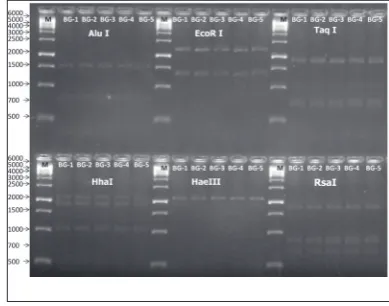
The 16Sr RNA gene products of five BitLL phytoplas-ma samples amplified with R16F2n/R2 primer pairs (~1.2 kbp) were digested with different restriction enzymes (AluI, EcoRI, HhaI, HaeIII, RsaI and TaqI) separately, according to the manufacturer’s instruc-tions (Fermentas, Germany). The digested DNA prod-ucts were analyzed by electrophoresis in a 2% agarose gel with 0.5xTBE as running buffer. DNA bands were visualized with a UV transilluminator after gels were stained with ethidium bromide.
Sequence analysis
To assess the taxonomic position of BitLL phyto-plasma, the ~1.2 kbp PCR product of 16S rRNA gene NT sequence (the conserved motifs) that correspond to the annealing sites of universal 16S rRNA primer pair R16F2n/R16R2 derived from BitLL phytoplasma was subjected to the iPhyClassifier online tool (http:// www.plantpathology.ba.ars.usda.gov/cgibin/resource /iphyclassifier.cgi) [31,32]. Further, the sequence was subjected to a BLASTN (https://blast.ncbi.nlm.nih. gov/Blast.cgi?PROGRAM=blastn) NCBI search for similar sequences in the database (January 10, 2017). The related sequences obtained from the database were aligned using the MUSCLE (Multiple Sequence Comparison by Log-Expectation) method implement-ed in the SEAVIEW program [33]. The NT sequence identity matrices for the bitter gourd phytoplasma
were generated using Bioedit Sequence Alignment Editor (version 5.0.9) [34]. The phylogenetic tree was constructed by the neighbor-joining method using MEGA ver. 6.01 software [35] with 1000 bootstrapped replications to estimate evolutionary distances be-tween all pairs of sequences simultaneously.
Computational virtual RFLP analysis
In silico restriction analysis and virtual RFLP plotting
of the R16F2n/R2 fragment of BitLL phytoplasma were carried out using pDRAW32 [36] and iPhyClassifier software [31]. The sequence of the R16F2n/R2 frag-ment of BitLL phytoplasma was digested with 17 dif-ferent restriction enzymes (AluI, BamHI, BfaI, BstUI (ThaI), DraI, EcoRI, HaeIII, HhaI, HinfI, HpaI, HpaII, KpnI, Sau3AI (MboI), MseI, RsaI, SspI and TaqI) used for the classification of phytoplasma and were plotted in a virtual 3.0% agarose gel. The phytoplasmas were differentiated based on the 16S rRNA gene by RFLP analysis using endonuclease restriction enzymes [36] as the RFLP pattern of each phytoplasma is conserved. The virtual RFLP patterns with the enzymes that can be distinguished from previously recognized group/ subgroup patterns were made in iPhyClassifier (http:// www.ba.ars.usda.gov/data/mppl/).
RESULTS
Detection of phytoplasma
By visual inspection, the most commonly observed symptoms at the flowering stage are mosaic and leaf curl, with a few plants exclusively showing littleleaf disease symptoms. The leaves were reduced in size and closely arranged on the top of the stem with very short intermodal length giving the appearance of a broom (Fig. 1). All floral parts were converted into dark green leaf-like structures, floral proliferation, floral virescence and shortened petioles. A disease incidence of 10-15% was recorded.
from five phytoplasma infected bitter gourd samples were cloned and sequenced. All five sequences (BG1, BG2, BG3, BG4, BG5) of the 16S rRNA gene were identical. One representative sequence (BG1) was de-posited in the GenBank (Accession No. KX179474).
16S rRNA gene sequence analysis
Sequence alignment
The 16S rRNA gene sequence of BitLL phytoplasma from Karnataka (BG1) obtained in the study was compared with 74 16S rRNA gene sequences of Ca. P. asteris (16SrI) and 38 16S rRNA gene sequences of different phytoplasmas available in the database on the date of search (January 10, 2017). The 16S rRNA gene sequence of BitLL-1 phytoplasma shared a max-imum NT identity ranging from 81.8% (Periwinkle
virescence, EU371934) to 96.0% (periwinkle
prolifera-tion, FJ008869), with phytoplasma belonging the Ca. P. asteris group (16SrI). Within the 16SrI group, the 16S rRNA gene of BitLL phytoplasma shared NT iden-tity of 94.4-95.8% with the following phytoplasmas: Brinjal littleleaf (JQ518317, JQ518318), sandal spike (EF198362) and Withania somnifera (DQ151998), all identified in India. Based on the classification of phytoplasma groups and subgroups, the 16S rRNA gene NT identity between two distinct groups of phy-toplasma should range from 88 to 94% [20,37]. Since the 16S rRNA gene NT sequence similarity of BitLL phytoplasma with members of 16SrI (Ca. P. asteris) was above the 94% threshold level, we propose that BitLL phytoplasma is regarded as a member of Ca. P. asteris (16Sr I group).
Phylogeny
The phytoplasma 16S rRNA gene sequence identified from bitter gourd was compared with 74 sequences of phytoplasma that belong to the Ca. P. asteris (16SrI) group. The analysis showed that bitter gourd little-leaf (BitLL) phytoplasma was closely grouped with black-eyed Susan phyllody 16SrI-A (DQ855286) and black pepper phyllody 16Sr I (AY823413) of Ca. P. asteris (16SrI) (Fig 2). The Indian bitter gourd infect-ing phytoplasma form a monophyletic cluster with phytoplasmas of Asian-Iran origin and established a close relationship with 16Sr I-A.
RFLP analysis of 16Sr RNA gene
The PCR amplified F2n/R2 fragments of five BitLL phytoplasma samples were digested with restriction endonucleases used previously in the classification of phytoplasma and differentiation of the Ca. P. as-teris 16Sr I group and subgroup (AluI, EcoRI, HhaI, HaeIII, RsaI and TaqI) [23,32,36]. The restriction patterns of the five BitLL phytoplasma samples were the same for all six enzymes (Fig. 3) and were typical for the Ca. P. asteris 16Sr I group, indicating that the phytoplasma associated with bitter gourd belongs to this group
Virtual RFLP analysis
The virtual RFLP pattern with 17 enzymes was ob-tained for the BitLL phytoplasma and compared with the earlier reported virtual RFLP patterns for phyto-plasma. The result revealed that 16 enzymes produced
a virtual RFLP pattern that was similar to the
Ca.P. asteris 16Sr I group of phytoplasma. The six enzymes, AluI, EcoRI, HhaI, HaeIII, RsaI and TaqI, commonly used in in vitro
and virtual RFLP analysis, also produced the same pattern. Although BitLL phytoplasma showed maximum NT identity (96%) with periwinkle proliferation (FJ008869) of the
Ca. P. asteris (16SrI) group, the results of in
silico restriction digestion and gel plotting
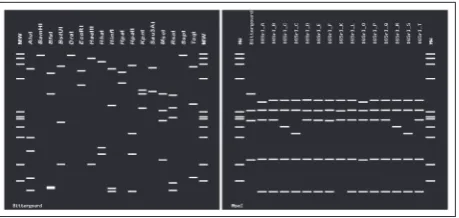
separated this group with respect to MseI. This was further supported by the restric-tion map of BitLL phytoplasma obtained from pDRAW32 (AcaClone Software; http:// www.acaclone.com) analysis that showed sig-nificant differences in MSeI with periwinkle proliferation (FJ008869) and other 9 repre-sentatives of subgroups (16Sr I – A, B, C, D, E, F, M, P, Q, R, T) (Fig. 4).
Fig 2. Phylogenetic tree based on nucleotide sequences of the 16S rRNA gene belonging to the phytoplasma 16SrI group with other phytoplasma by the neighbor-joining algorithm. Horizontal distances are proportional to sequence distances, vertical distances are arbitrary. The trees are unrooted. A bootstrap analysis with 1000 replicates was performed and the bootstrap percentage values for more than 50 are numbered along the branches.
Fig 4. Comparative analysis of virtual restriction sites in the 16S rRNA gene. 16S rRNA gene sequences of phy-toplasma from bitter gourd (Accession No. KX179474), Aster yellow phytoplasma (AY265209), periwinkle pro-liferation phytoplasma (FJ008869). * highlights the im-portant difference in the restriction site.
The BitLL phytoplasma yielded adistinct RFLP profile with MseI (similarity coefficient was 0.91) when compared with closely related (on the basis of NT) phytoplasmas, periwinkle proliferation and aster yellow of group 16Sr I (Fig 5). The similarity coef-ficients of 16S rRNA gene RFLP patterns were used to classify phytoplasma into groups and subgroups, with the threshold similarity coefficient for new sub-group delineation set at 0.97. A strain is treated as new if its virtual 16S rRNA gene RFLP pattern similarity coefficient is less than or equal to 0.97 with all exist-ing representative strains of the given group [23, 36]. Since the strain under investigation showed a similar-ity coefficient of 0.91, this BitLL phytoplasma can be considered as a new subgroup within the 16Sr group I. This is the first report of a 16Sr I phytoplasma af-fecting bitter gourd in India.
DISCUSSION
The diseases caused by phytoplasma are emerging as a major constraint for the production of several crops across the globe [44]. Phytoplasma belonging to the 16S rRNA that infects bitter gourd has been well docu-mented in Asia [11,12,14]. However, from India there were no reports about its prevalence on bitter gourd. A survey for littleleaf disease of bitter gourd based on the visual symptoms revealed its presence in Kar-nataka. Investigations based on PCR detection using universal primers specific to phytoplasma confirmed
its association in 25% of analyzed plants that showed disease symptoms, indicating expansion of the host range of Ca.P. asteris, in addition to the already re-ported expansion to host plants, Luffa and cotton [39], brinjal [40], sandalwood and Withania somnifera in India, Cucumis sativus L. in Taiwan, carrot, cabbage, beetroot and tomato in Cuba [1,41,42] and Sechium
edule (Jacquin) Swartz in Costa Rica [43].
The 16S rRNA gene sequence and virtual RFLP analysis suggests that BitLL phytoplasma from Kar-nataka that was associated with Ca. P. asteris belongs to the 16Sr I group, based on existing classification criteria [17]. This was well supported by phyloge-netic analysis that showed a close clustering of phy-toplasma with the Ca. P. asteris 16Sr I group. The NT sequences of unique regions of the 16S rRNA gene, 5’-GGGAGGA-3’ (positions 226-232), 5’-CTGACG-GTACC-3’ (positions 476-485) and 5’-CACAGTG-GAGGTTATCAG TTG-3’ (positions 1008- 1028) of BitLL phytoplasma are identical to Ca. P. asteris 16Sr I group [17].
The RFLP patterns of each phytoplasma are con-served and unknown phytoplasmas are identified by comparing the patterns of unknown with available RFLP patterns of known phytoplasmas, without co-analyses of all reference representative phytoplasmas [24,36]. This provides a reliable means for the dif-ferentiation of a broad array of phytoplasmas and has become the most comprehensive and widely accepted phytoplasma classification system [44].
In vitro restriction analysis of five BitLL
phyto-plasma samples collected from different farmers’ fields obtained by digesting the F2n/R2 fragment using six restriction enzymes that are used to classify phytoplas-ma into groups and subgroups [36] produced a similar pattern, typical to Ca. P. asteris, which belongs to the 16Sr I group. The virtual RFLP pattern generated for the phytoplasma from bitter gourd was also congruent with the in vitro RFLP patterns obtained by the six en-zymes. This suggests that computer-simulated RFLP analysis of the 16S rRNA gene and the calculation of similarity coefficients can serve as a tool for the de-lineation and finer differentiation of members of Ca. P. asteris from the 16Sr I group into subgroups [24]. In addition, virtual RFLP analysis was conducted for 11 more enzymes. It revealed differences only for the
MseI RFLP pattern (a similarity coefficient of 0.91) and 16Sr I phytoplasma associated with brinjal little-leaf, sandal spike and Withania somnifera phytoplasma from India [1,41,42].
This study provides the first evidence that BitLL disease from Karnataka is related to Ca. P. asteris be-longing to 16Sr I. The outcome of the study with re-spect to symptomatology, detection, diversity analysis,
in vitro and virtual restriction analysis will provide
invaluable basic knowledge and improved under-standing of the diseases of various crops caused by phytoplasmas. This should pave the way for a better understanding of disease resistance, epidemiology and host-vector interactions, and lead to the design of novel disease management strategies.
Acknowledgments: The research was supported by the project “Consortium platform on Vaccines and diagnostics”, funded by Indian Council of Agricultural Research, Government of India, New Delhi, India.
Authors’ contribution: We declare that all authors participated in the research and article preparation. VV design of the experiments and drafted the article. CNLR designed the study, participated in the acquisition and analysis of the data and revision of the manu-script, PS participated in the collection of data. KSS revised the manuscript. MKR guided and designed the study and revised the article. All authors approved the submitted version of the article.
Conflict of interest disclosure: The authors declare that they have no competing interests.
REFERENCES
1. Arocha Y, Pinol B, Almeida R, Acosta K, Quinones M, Zayas T, Varela M, Marrero Y, Boa E, Lucas JA. First report of phy-toplasmas affecting organoponic crops in central and eastern Cuba. Plant Pathol. 2009;58:793.
2. Yadav RK, Yadav DS, Sarma P. Diversity of Cucurbitaceous crops in north eastern region, Himalayan ecology. ENVIS Bull. 2004;13:2.
3. Zhang QC. Bitter melon: a herb warranting a closer look. PWA Coalition Newsline. 1992;81:48-49.
4. Giron LM, Freire V, Alonzo A, Caceres A. Ethnobotanical survey of the medicinal flora used by the Caribs of Guate-mala. J Ethnopharmacol. 1991;34:173-87.
5. West ME, Sidrak GH, Street SP. The antigrowth properties of extracts from Momordica charantia L. West Indian Med J. 1981;20:25-34.
6. Mossa JS. A study on the crude antidiabetic drugs used in Arabian folk medicine. Int J Crude Drug Res. 1985;23:137-45.
7. Hudson JB, Anani K, Lee MK, De Souza C, Arnason JT, Gbeassor M. Further investigations on the antiviral activi-ties of medicinal plants of Togo. Pharm Biol. 2000;38:46-50. 8. Tan MJ, Ye JM, Turner N, Cordula HB, Ke CQ, Tang CP,
Chen T, Weiss HC, Gesing ER, Rowland A, James DE, Ye Y. Antidiabetic activities of triterpenoids isolated from Bit-ter Melon associated with activation of the AMPK Pathway. Chem Biol. 2008;15:263-73.
9. Raj SK, Khan MS, Singh R, Nisha K, Prakash D. Occur-rence of yellow mosaic geminiviral disease on bitter gourd (Momordica charantia) and its impact on phytochemical contents. Int J Food Sci Nutr. 2005;56:185-92.
10. Tiwari AK, Sharma PK, Khan MS, Snehi SK, Raj SK, Rao GP. Molecular detection and identification of Tomato leaf curl New Delhi virus isolate causing yellow mosaic disease in Bit-ter gourd (Momordica charantia), a medicinally important plant in India. Medicinal Plants. 2010;2(2):117-23.
11. Win NKK, Jung HY. The distribution of phytoplasmas in Myanmar. J Phytopathol. 2012; 160:139-45.
12. Win NKK, Kim YH, Jung HY. Bitter gourd little leaf disease associated to ‘Candidatus Phytoplasma asteris’. Trop Plant Pathol. 2014;39(1):82-8.
13. Chou TG, Yang SJ, Huang PY. Mycoplasma-like bod-ies observed in the plants of bottle gourd, chayote and balsam-pear with witches’ broom in Taiwan. Pl Dis Reptr. 1976;60:378-80.
14. Spoodee R, Schneider BL, Padovan AC, Gibb KS. Detec-tion and genetic relatedness of phytoplasmas associated with plant diseases in Thailand. J Biochem Mol Biol Biophys. 1999;3:133-40.
15. Seemuller EC, Marcone UA, Lauer A, Ragozzino, Goschl M. Current status of molecular classification of the phyto-plasma. J Plant Pathol. 1998;80:3-26.
16. Harrison NA, Womack M, Carpio. Detection and character-ization of a lethal yellowing (16SrIV) group phytoplasma in Canary Island date palms affected by lethal decline in Texas. Plant Dis. 2002;86:676-81.
17. Lee IM, Gunderson DE, Davis RE, Botter KD, Seemuller E. Candidatus phytoplasma asteries, a novel phytoplasma taxon associated with aster yellows and related diseases. Int J Syst Evol Microbiol. 2004;54:1037-48.
18. Samuitiene M, Navalinskiene M. Molecular detection and characterization of phytoplasma infecting Celosia argentea plants in Lithuania. Agron Res. 2006;4:345-8.
19. Deng S, Hiruki C. Genetic relatedness between two non-culturable mycoplasma like organisms revealed by nucleic acid hybridization and polymerase chain reaction. Phyto-pathol. 1991;81:1475-9.
20. Lee IM, Hammond RW, Davis RE, Gundersen DE. Universal amplification and analysis of pathogen 16S rDNA for clas-sification and identification of mycoplasma like organisms. Phytopathol. 1993;83:834-42.
22. Gundersen DE, Lee IM. Ultrasensitive detection of phyto-plasmas by nested PCR assays using two universal primer pairs. Phytopathol Mediterr. 1996;35:144-51.
23. Wei W, Davis RE, Lee IM, Zhao Y. Computer simulated RFLP analysis of 16S rRNA genes: identification of ten new phyto-plasma groups. Int J Syst Evol Microbiol. 2007;57:1855-67. 24. Wei W, Lee IM, Davis RE, Suo X, Zhao Y. Automated RFLP
pattern comparison and similarity coefficient calculation for rapid delineation of new and distinct phytoplasma 16Sr sub-group lineages. Int J Syst Evol Microbiol. 2008;58:2368-77. 25. Martini M, Lee IM. PCR and RFLP analyses based on the
ribo-somal protein operon. Methods Mol Biol. 2013;938:173-88. 26. Marcone C. Molecular biology and pathogenicity of
phyto-plasmas. Ann App Biol. 2014; 165(2):199-221.
27. Franova J, Bertaccini A, Duduk B. Molecular tools in COST FA0807 Action. In: Bertaccini A, editor. Phytoplasmas and phytoplasma disease management: how to reduce their eco-nomic impact. IPGW; 2014. p. 179-84.
28. Mall S, Chaturvedi Y, Rao GP, Barnwal VK. Phytoplasma’s diversity in India. Bull Insectol. 2011;64(Supplement):S77-S78.
29. Doyle JJ, Doyle JL. Isolation of plant DNA from fresh tissue. Focus. 1990;12:13-15.
30. Smart CD, Schneider B, Blomquist CL, Guerra LJ, Harri-son NA, Ahrens U, Lorenz KH, Seemuller E, Kirkpatrick BC. Phytoplasma-specific PCR primers based on sequences of 16S-23SrRNA spacer region. Appl Env Microbiol. 1996;62:2988-93.
31. Zhao Y, Wei W, Lee IM, Shao J, Suo X. Davis RE. Construc-tion of an interactive online phytoplasma classificaConstruc-tion tool, iPhyClassifier, and its application in analysis of the peach X-disease phytoplasma group (16SrIII). Int J Syst Evol Microbiol. 2009;59:2582-293.
32. Lee IM, Bottner-Parker KD, Zhao Y, Davis RE, Harrison NA. Phylogenetic analysis and delineation of phytoplasmas based on secY gene sequences. Int J Syst Evol Microbiol. 2010;60:2887-97.
33. Galtier N, Gouy M, Gautier C. Sea View and Phylo Win, two graphic tools for sequence alignment and molecular phylog-eny. Comput Appl Biol Sci. 1996;12:543-8.
34. Hall TA. BioEdit: a user-friendly biological sequence align-ment editor and analysis program for Windows 95/98/NT. Nucl Acids.f 1999;41:95-8.
35. Tamura K, Peterson D, Filipski A, Kumar S. MEGA6: Molec-ular Evolutionary Genetics Analysis Version 6.0. Mol Biol Evol. 2013;30:2725-9.
36. Lee IM, Gundersen DE, Davis RE, Bartoszyk IM. Revised classification scheme of phytoplasmas based on RFLP analy-sis of 16S rRNA and ribosomal protein gene sequences. Int J Syst Bacteriol. 1998;48:1153-69.
37. Lee IM, Davis RE, Gundersen-Rindal DE. Phytoplasma: phy-topathogenic mollicutes. Annu Rev Microbiol. 2000;54:221-55.
38. Lee IM, Bottner KD, Munyaneza JE, Secor GA, Gudmes-tad NC. Clover proliferation group (16SrVI) subgroup A (16SrVI-A) phytoplasma is a probable causal agent of potato purple top disease in Washington and Oregon. Pl Dis. 2004;88:429.
39. Kumar S, Singh V, Lakhanpaul S. First report of ‘Candidatus Phytoplasma asteris’ (16SrI) associated with littleleaf of cotton and luffa in India. Australasian Pl Dis Notes. 2010;5:117-9. 40. Kumar J, Gunapati S, Singh SP, Lalit A, Sharma NC, Tuli
R. First report of a ‘Candidatus Phytoplasma asteris’ (16SrI group) associated with little leaf disease of Solanum melon-gena (brinjal) in India. New Dis Reports. 2012;26:21. 41. Arocha Y, Pinol B, Picornell B, Almeida R, Jones, P. Broad
bean and sweet pepper: two new hosts associated with ‘Can-didatus Phytoplasma asteris’ (16SrI phytoplasma group) in Cuba. Plant Pathol. 2007;56:345.
42. Zamora L, Acosta K, Pinol B, Quinones M, Bertaccini A. First report of ‘Candidatus Phytoplasma asteris’ (16SrI group) causing stunt of tomato in Cuba. New Dis Reports. 2014;30:10
43. Villalobos W, Moreira L, Rivera C, Bottner KD, Lee IM. First report of an aster yellows subgroup 16SrIB phytoplasma infecting chayote in Costa Rica. Pl Dis. 2002;86:330. 44. Bertaccini A, Duduk B. Phytoplasma and phytoplasma