ISSN-L: 2501 - 1235 Available on-line at: www.oapub.org/edu
doi: 10.5281/zenodo.3678635 Volume 6 │ Issue 2 │ 2020
SUCESSFUL PERFORMANCE OF THE GYMNASTICS ELEMENT
NECK OR HEAD SPRING ON THE FLOOR IN RELATION TO THE
ANTHROPOMETRIS, MOTOR AND PSYCHOLOGICAL FACTORS
Katerina Spasovskai, Aleksandar Aceski Faculty of Physical Education, Sport and Health,
University “Sc.Cyril and Methodius”,
Skopje, Republic of North Macedonia
Abstract:
For the scope of this research, many other researches have been done with the participation of 143 male students from the Faculty of Physical Education, Sport and Health in Skopje, Macedonia. By doing 17 anthropometric measures, 29 motor tests and 8 helping tests to recognize the psychological characteristics, the structure of this element is analyzed by the three important tests that we mentioned them earlier and the successful technical performance of this element, the neck or head spring on the floor. There are three anthropometric dimensions, eight motor factors and five psychological factors with analysis of the motor placement. A regressive analysis is used to define the relations between the isolated factors. From the used regressive analysis where the anthropometric system, system of motor factors and the system of psychological factors are used as predictors. The main criterium is the performance of the gymnastic element the neck or head spring on the floor while the predictors show important influence on the criterion. Many isolated factors of the three subspaces: morphological, motor and psychological influence the criterion.
Keywords: anthropometric, motor, psychological, regressive, factorial, sports-gymnastics
1. Introduction
In other gymnastic elements, the impact of the anthropometric variables is quite large (Mitevski O. (2006), Pop Petrovski V. (2005), Spasovska K. (2013)) while those with more demanding elements by their structure, besides the offered factors, the cognitive abilities and the conjugal abilities have a big impact (Petkovic D. (1989), Todorovski D. (2010), Lopes G. O. & Postigo B. S. (2013)). Probably, in many complex gymnastic elements, besides the influence of factors from the subgroups mentioned earlier, impact will have the other abilities and human qualities also, keeping in mind that the factors that impact of success in sports gymnastics are located in somehow mutual interrelationship and as such they would have impact of the results in sports gymnastics. The analysis of the so far researches has resulted in the researches in sports-gymnastics. Most often the problem is threated on the structure and relations between the elements in one or two subplaces and it is very often between the motor abilities and the anthropometric characteristics (Mitevski O. (1984) and (2000), Pop Petrovski (1998), Babaik (1981), Spasovska K. (2008) and (2013)). For the needs of this investigation, the psychological characteristics were also examined.
The purpose of this research is to determine the impact of isolated and latent dimensions in the morphological, motor and psychological space of the successful technical performance of the gymnastics element the neck or head spring on the floor.
2. Methodology
2.1 Example of Variables and Respondents
For the scope of this research, many other researches have been done with the participation of 143 male students from the Faculty of Physical Education, Sport and Health in Skopje, Macedonia. The example of variables contains 17 anthropometric measures, 29 motor variables for giving the right motor abilities, 8 tests for measuring of the psychological properties and the evaluation of the technical performance of the gymnastic element the neck or head spring on the floor.
2.2.1 Variables for Measuring the Anthropometric Characteristics
By the suggestions of the international biological program, many measurements have been done on the anthropometric measures which cover the hypothetical four-dimensional morphological space (Kurelik and Sor, 1975).
The following anthropometric variables are applied: appraisal of the longitudinal dimensionality of the body– 3 variables, appraisal of the transverse dimensionality of the body – 6 variables, appraisal of the circular dimensionality of the body – 5 variables and 3 variables for appraisal of the subcutaneous fatty tissue.
2.2.2 Variables for the Assessment of the Motor Skills
who have researched this problem among the respondents from the same or similar age like in this research.
The tests for assessment of coordination: 3 variables for evaluating the coordination of the entire body, coordination of rapid complex movements and reorganization of the dynamical stereotype.
The test for assessment of explosive power: 3 variables for estimating the type of leaps and thetype of ejection.
Тhe tests for the assessment of repetitive power: 4 variables To assess flexibility: 3 variables.
The tests for the estimation of frequency of movements: 4 variables and or the assessment of rhythmic movements.
2.2.3 Variables for Assessing of Psychological Characteristics
Variables for examining the cognitive (intellectual) abilities
For the assessment of general intellectual abilities, the following variables are applied: 1. D 48, 2. PM
For the study of specific intellectual abilities, the following variables are applied: 3. F1, 4. F2, 5. S1
Variables for examining the conative (emotional) abilities: 6. TAI – anxiety, 7. MOP - the test of the motive for general achievement and 8. EPQ - a modified version of the previous personality tests that measure every person's dimension with three scales (psychotism, extroversion, neuroticism).
3. Results and Discussion
To determine the lateral structure of the applied variables from the researched subspaces, a transformation of data with coefficients of correlation and factor analysis was made (the results of the factor analysis are kept by the author).
From the analysis of these methods in the motor space, three anthropometric dimensions have been examined and determined:
1) Under the skin fat tissue factor;
2) Factor for transversal and circular dimensionality, and 3) Factor of longitudinal dimensionality.
Eight motor factors are isolated and defined in the motor space 1) Factor for performing fast and coordinated movements;
2) Explosive power factor – type of ejection;
3) Factor of repetitive power on the front of the trunk; 4) Factor of rhythmic movements;
5) Flexibility factor;
Five psychological factors are isolated and defined in the psychological space 1) factor of motive for general achievement;
2) a factor of neuroticism or emotional instability mended by anxiety changes and significant negative emotional engagement in conditions of general attainment; 3) extroversion factor accompanied by a low degree of social acceptability of the
environment or dissemination;
4) factor of positive emotional engagement in conditions of general attainment accompanied by reactions to doubts;
5) factor of general and specific intellectual abilities or factor of the congenital psychological space.
Picture 1: The neck or head spring on the floor
According to the results of the regressive analysis (Table 1), it can be noted that the prediction system of the anthropometric characteristics is statistically and significantly related to the criterion, the neck or head spring on the floor. Significantly, the negative and low individual influence of -20 on the criterion of the neck or head spring on the floor switch was determined by the isolated anthropometric factor 1 (subcutaneous tissue), while statistically significant, low and positive 24 is associated with the anthropometric factor 3 (longitudinal dimensionality).
The presence of fatty tissue in the body appears as a passive mass that further complicates the performance of the gymnastic elements. Probably from the above, the predictors identified as subcutaneous fat tissue have a negative effect on the successful performance of the already mentioned gymnastic element.
Table 1: Regressive analysis of the anthropometric system and isolated anthropometric factors with the latent gymnastic criterion – neck or head spring on the floor
Beta Part - R Tolerance t(139) P -level
A F A K 1 -,20 -,20 1,00 -2,44 ,01
A F A K 2 -,13 -,14 1,00 -1,63 ,10
A F A K 3 ,24 ,24 1,00 2,95 ,00
Delta PO DF1 DF2 F L
.09 .33 3 139 5.78 .00
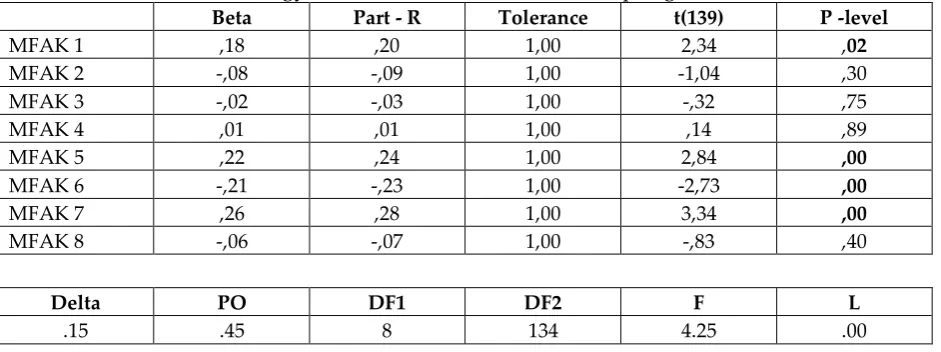
According to the results of the regression analysis (Table 2), it can be noted that the predictor system of motor factors is significantly and moderately related to the criterion variable (RO 45).
Table 2: Regressive analysis of the motor system and isolated motor factors with the latent gymnastic criterion- neck or head spring on the floor
Beta Part - R Tolerance t(139) P -level
MFAK 1 ,18 ,20 1,00 2,34 ,02
MFAK 2 -,08 -,09 1,00 -1,04 ,30
MFAK 3 -,02 -,03 1,00 -,32 ,75
MFAK 4 ,01 ,01 1,00 ,14 ,89
MFAK 5 ,22 ,24 1,00 2,84 ,00
MFAK 6 -,21 -,23 1,00 -2,73 ,00
MFAK 7 ,26 ,28 1,00 3,34 ,00
MFAK 8 -,06 -,07 1,00 -,83 ,40
Delta PO DF1 DF2 F L
.15 .45 8 134 4.25 .00
It can be noted that in the regression analysis, the isolated motor factors MFAK 1 (fast and coordinated movements), and MFAK 5 (frequency of movements) have positive influence and a significant, negative and low individual impact of -21 has on the successful performance of this elimination which is determined by IFAC 6 (explosive power - jump type). It is possible to predict the successful performance of the gymnastic element from the neck or head spring on the floor with the usage of these motor factors. To show the partial impact of motor predictors that have a significant impact on the technical performance, we will try to analyze the technique of performing the element.
parabolically moves forward. This is the moment when the fifth factor, MFAK 5 flexibility has its significant impact.
Simultaneously, after the vertical, it is reflected by the hands that enable the movement of the body to the top and the front. At this stage, the hands and the head are stretched back to the final position, position on two legs. When dealing with the hands, the seventh factor, MFAK 7, has frequent movements. All these movements should be performed quickly and coordinated, which is confirmed by the regression analysis, whereas the first factor, MFAK 1 fast and coordinated movements, has a statistically significant and positive influence on the criterion, i.e., the gymnastic element the neck or head spring on the floor.
Under the conditions where the technique is not sufficiently carried out, by adding new tasks (elongating the body forward, placing the head in front of the hands and forming a triangle between the arms and the body), the basic technique is overlooked, even more attention is paid to the swing with the legs up and up. All this contributes to the technique to be performed with a reduced amplitude, slowly, uncertainly and without rhythm, which, at the same time, will bring the body to the position of quenching or falling backwards. This can be noted in Table 3, where the results obtained from the frequency of the grades are shown. Out of a total of 143 students, 20.27% or 29 respondents failed to master the technique of this gymnastic element and were disappointed with the grades from 5.00 to 6.00.
If all these movements were performed timely and coordinated, and with their legs opened, the gymnastics element the neck or head spring on the floor would be enabled successfully.
Table 3: Frequency of grades
Evaluation F % Cumulative %
= 5.0000 3 2.09790 2.0979
5.0000 < x <= 6.0000 29 20.27972 22.3776
6.0000 < x <= 7.0000 27 18.88112 41.2587
7.0000 < x <= 8.0000 28 19.58042 60.8392
8.0000 < x <= 9.0000 32 22.37762 83.2168
9.0000 < x <= 10.000 24 16.78322 100.0000
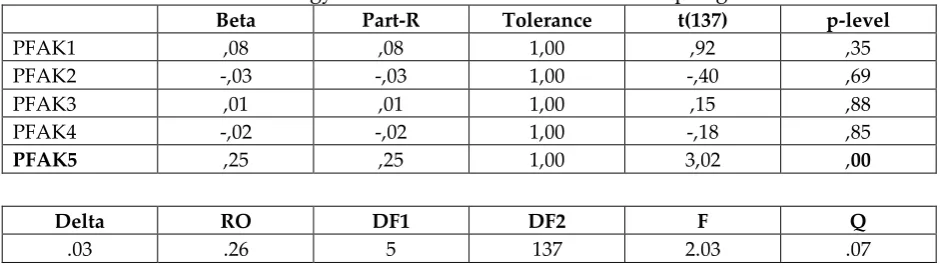
From the review of the regression analysis in Table 4, it can be noted that the predictor system of psychological factors is statistically not related to the criterion variable- neck or head spring on the floor.
relevant empirical research shows that they are very important for the success or failure of sports or other different activities and situations, and in our case for the subject of sports gymnastics.
Table 4: Regression analysis of the psychological system and isolated psychological factors with the latent gymnastics’ criterion – neck or head spring on the floor
Beta Part-R Tolerance t(137) p-level
PFAK1 ,08 ,08 1,00 ,92 ,35
PFAK2 -,03 -,03 1,00 -,40 ,69
PFAK3 ,01 ,01 1,00 ,15 ,88
PFAK4 -,02 -,02 1,00 -,18 ,85
PFAK5 ,25 ,25 1,00 3,02 ,00
Delta RO DF1 DF2 F Q
.03 .26 5 137 2.03 .07
The results obtained in this research only confirm the results obtained by Mejovsek M. (1976). Namely, he examined the relations between the intellectual and motor skills, in which he established that the simple and rapidly accomplished motor task does not require intellectual activity, while in the motoring tasks where they represent the problem (problem situation) he includes the general intellectual activity (the general factor) and concludes that there is a positive connection between the intellectual and motor skills. The author indirectly reinforced the theory of Galton, Spearman. Thomson and others, in which they say: "The healthy and physically powerful and capable man is also a point-sensitive". As well as the recommendations of Ancuta, R. N. (2013) on the need for choosing a program for emotional development and emotional preparation of gymnasts in the programs of psychological incentive for the purpose of improving the sporting performance.
4. Conclusions
Based on the results obtained and analyzed, it can be concluded that in the morphology of the first year of FFK in Skopje, three anthropometric dimensions were extracted and defined (1. subcutaneous fatty tissue factor, 2. factor on transverse and circular dimensionality, and 3. factor on longitudinal dimensionality). In the engine compartment, eight motor factors were isolated and defined (1st factor for carrying out
fast and coordinated movements, 2nd factor of explosive power - type of escape, 3rd
repetitive power factor on the front of the carcass, 4th factor for rhythmic movements, 5th
factor for flexibility, 6th factor for explosive power - type of jumps, 7th factor, speed factor of movements and 8th factor for carrying out fast and explosive movement). In the
and achievement in general conditions, the third extrovertiveness factor accompanied by a low degree of social acceptance of the environment or dislocation, the fourth factor of positive emotional engagement in conditions of general attainment accompanied by the reaction of somnolence and the fifth factor on the general and specific and intellectual abilities or a factor on the cognitive psychological space).
At the same time, the positive or negative impact of certain anthropometric, motor and psychological (characteristics, abilities, properties) of those elements will have to be pointed out on the elements of this element the neck or head spring on the floor.
The obtained results will enable proper guidance to the students, teachers and trainers in planning and preparing for the lesson or during the training process. In doing so, they will take into account the level of their motor skills, the anthropometric characteristics and psychological abilities and features when mastering this gymnastic element. As regards, the development of these motor skills and psychological characteristics which are most needed for the conformity of the technique of the gymnastic elements were applied in this research.
References
Ancuta, R. N. (2013). Opinion study of Romanian coach is the emotional intelligence in gymnastics training and competition. STUDIA UBB Educatio Artis Gymnastiae, LVIII, 4.
Aleksovska L. (2002). Establishment and differences in the psychological structure of the person with athletes from different sports disciplines and non-sportsers, Faculty of Physical Culture Skopje, doctoral dissertation.
Babiak J. (1981). Relations between motor skills and success in sports gymnastics, physical culture, no. 5, year XXXV, Belgrade.
Lopes, G. O., & Postigo, B. S. (2012). Relationship between physical prowess and cognitive function. The Spanish Journal of Psychology Vol. 15, Núm. 1, 29-34. Madić, D. (2000). Connection of anthropological dimensions of students of physical
culture with their performance on the devices. Doctoral dissertation, Novi Sad. Mitevski O. (1984). Dependence on pupils' success in teaching sports gymnastics from
their biomotor skills, Faculty of Physical Education of the University of Belgrade, Master thesis.
Mitevski O. (2000). Latent connection of the anthropometric and motor factors with the successful implementation of gymnastic elements in the students of 17 years of age, Faculty of Physical Culture Skopje, doctoral dissertation, Skopje.
Mitevski O. (2003). Practicum for Sports Gymnastics, Skopje.
Petkovic, J., Muratovic, A., & Tanase, D. G. (2013). Correlations of motor dimensions of students of the Faculty of Sport and Physical Education with the teaching contents of sports gymnastics. Sport Mont.Jul 2013 - br. 37-39 / XI, 74-79.
Spasovska K. (2008). Certain ralations between motor tests for assessment of coordination and explosive force with the measures for the successful implementation of gymnastic elements in the first year students of FFK, Faculty of Physical Education culture Skopje, master thesis, Skopje.
Spasovska K. (2013). Structure of the anthropometric characteristics, motor skills and psychological characteristics and their influence on the successful technical implementation of the elements of sports gymnastics in the students of the first year of FFK, Faculty of physical culture Skopje, doctoral dissertation, Skopje. Todorovski, D., Mitevski, O., Popeska, B. (2011). Relationships of conjective properties
Creative Commons licensing terms