Eur. Chem. Bull. 2012, 1(6), 184-187 DOI: 10.17628/ECB.2012.1.184
184
HALOGEN-FREE IONIC LIQUID FOR EXTRACTION AND
SIMULTANEOUS DETERMINATION OF Cu(II), Pb(II), Cd(II),
AND Hg(II)
Adel F. Shoukry
[a]*, Nadia M. Shuaib
[a], Rana M. Melhas
[a]Keywords: Halogen-free ionic liquid; Heavy metals, Solvent extraction, Inductively coupled plasma
A halogen-free ionic liquid, tetraoctylammonium dodecylbenzene sulfonate was used to extract Cu2+, Pb2+, Cd2+, and Hg2+ from their aqueous solutions by using dithizone as chelating agent. Inductively coupled plasma-mass spectrometry (ICP-MS) was applied, at different pH-values, to simultaneously measure the metal content in the aqueous phase, both before and after extraction. At the optimum pH value, extraction of the four metal cations from pure solution and marine water samples was successfully accomplished and their concentrations were simultaneously determined.
Corresponding Authors
Tel: +965-24987374; Fax: +965-24816482
E-Mail:[email protected]; [email protected] [a] Chemistry Department, Faculty of Science, Kuwait
University, B.O. Box 5969-Safat, 13060
Introduction
Liquid-liquid extraction has been extensively employed for recovery and separation of metal ions. The extraction is normally achieved by contacting the aqueous phase with a lipophilic organic liquid containing a metal-selective chelating agent. The organic liquids used in this extraction are generally volatile organic compounds (VOCs). The use of VOCs always faces environmental and safety problems such as emission loss and fire hazard. Therefore, finding alternative materials to replace these solvents has always been of particular interest in providing potential solutions to reduce these problems. Room-temperature ionic liquids (ILs) are a novel class of salts that have engaged exponential attention in recent years due to their negligible vapour pressure. So they have been proposed as environmentally friendly alternatives for the ordinary VOCs. Ionic liquids of imidazolium [C4MIM]+ cation with tetrafluoroborate [BF4] -and hexafluorophosphate [PF6]- anions have, so far, been the focus of numerous publications dealing with extraction of metal ions from aqueous samples.1-10 Nevertheless, classification of such ILs as green solvents has not taken into account the entire life cycle of these solvents, especially those containing [BF4]- and [PF6]- anions. These fluorine-based anions have been the subject of extensive debates about the possible eventual decomposition, under certain circumstances, into toxic hydrofluoric acid.11-16 Further, single-crystal X-ray diffraction studies17 proved the formation of 1-butyl-3-methylimidazolium fluoride monohydrate complex, [C4MIM]F.H2O, during preparation and drying of [C4MIM][PF6]. It has also been reported18 that in drastic acid medium, [PF6]- may be converted to [PO4]3-. This has raised the need for investigating metal-solvent extraction with halogen-free ionic liquids. In the present application, Cu2+, Pb2+, Cd2+, and Hg2+ cations are extracted as their lipophilic neutral chelates with dithizone into the halogen-
free room temperarure ionic liquid, tetraoctylammonium- dodecylbenzene sulfonate ([TOA][DBS]).19 This ionic liquid is very easy to prepare and, besides being non-expensive; it is also highly lipophilic in nature because of its chemical structure which contains long chains of carbons. The proposed method involves use of a broad spectrum chelating agent and inductively coupled plasma spectroscopy which allow for simultaneous determination of several metals without interference. The method has been applied to determination of Cu2+, Pb2, Cd2+, and Hg2+ in pure solution and in marine water samples taken from Kuwait coastal area that is exposed to high anthropogenic activity.
Experimental
Reagents
Chloroform, acetonitril (ACN, Merck); dithizone (DT) (Fluka); nitrate salts of Cu(II), Pb(II), Cd(II) and Hg(II) (Merck); tetraoctylammonium bromide (TOABr) (Aldrich); and sodium dodecylbenzenesulfonate (NaDBS) (Aldrich) were used. The chemical composition of the ionic liquid was checked by using proton NMR. [1H-NMR (CDCl
3, C42H97NO3S), 7.76(d, 2H, J 8.0 Hz), 7.09(d, 2H, H 8.0), 2.91(m, 8H), 1.63 - 0.79 (m, 85 H)].
Borate, phosphate and ammoniacal buffers were used to adjust the PH-value of the solutions.
Preparation of the ionic liquid
Halogen-free ionic liquid for extraction and determination of Cu(II), Pb(II), Cd(II) and Hg(II) Section A - Research Paper
Eur. Chem. Bull. 2012, 1(6), 184-187 DOI: 10.17628/ECB.2012.1.184
185
2.3. Sampling and sample preparation of seawater
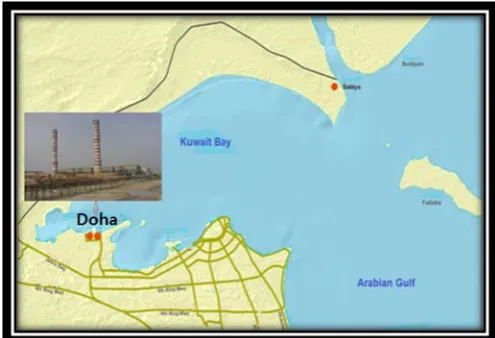
A mechanized boat with a towing speed maintained at 0.3 m s-1 was employed to collect samples from Doha coastal area (Fig. 1). The samples were collected in sterile (5 L) plastic bottle from 5-m depth using Vandorn water sampler. The water was filtered in a 0.45 µm membrane filter and eluted. To about one liter of the filtrate, 25 mL ammonium pyrrolidinedithiocarbamate, 10 mL 3M HCl, and 25-mL methyl isobutyl ketone, were added in a separating funnel. The mixture was shaken for 2 minutes, and then left undisturbed for 20 minutes. Two separate phases, namely, upper and lower solutions (A, and B, respectively) were built. Solution (A) was added with one liter seawater and the above chemicals, and then the process was repeated. Likewise, the lower solution (B) was treated in another separating funnel and eluted. The resultant upper solutions from both (A) and (B) were collected in a 50-mL volumetric flask and the lower solutions were discarded. The resultant upper solution was analyzed by inductively coupled plasma-mass spectrometry (ICP-MS) to obtain the extract content of the concerned metals, both before and after extraction with the halogen-free ionic liquid.
Figure 1. Map of Kuwait with sampling station (Doha village) indicated.
Apparatus
Inductively coupled plasma-mass spectrometric measurements were performed with a Varian 820-MS spectrophotometer. UV-visible spectra were measured with a Cary-5 spectrophotometer. The pH value of the extraction systems was measured with an Orion, Model 420A pH/mV meter.
Liquid-liquid extraction of metal-dithizone complex
Acurately weighed amount of dithizone (DT) was dissolved in a 100 mLof ACN : water mixture (10:90, v/v) to form a 3.4 x 10⁻⁴ M dithizone solution. In two separating funnels, 10 mL each, the following mixtures were prepared:
1) 0.50 mL of the DT solution 8.4x10⁻⁴ M + 2.25 mL bidistilled water + 4.5 mL of the buffer solution + 1.0 mL of [TOA][DBS].
2) 0.50 mL of the DT solution 8.4x10⁻⁴ M + 2.25 mL metal ion solution (25 ppm) or metal ion solution mixture + 4.5 mL of the buffer solution + 1.0 ml of [TOA][DBS].
Each of the two mixtures was shaken for 15 minutes and then left to stand for 10 minutes. Visible spectra were run for each of the two ionic liquid layers. Different volumes of acid solution were then added to the ionic liquid to strip the metal ion(s) from it. The acid solution was then removed, diluted (if necessary), and measured with ICP-MS to determine the metal ion(s) content. The recovery factor was calculated after correcting for dilution.
2.6. Effect of pH- value on the Extraction efficiencies of metal ions with [TOA][DBS]
The efficiency rates of the extraction of each of Cu(II)-, Pb(II)-, Cd(II)- and Hg(II)-dithizone chelates using the halogen-free ionic liquid were determined at different pH-values of the aqueous layer. This was done by mixing 0.50 mL of 8.4x10⁻⁴ M DT solution + 2.25 mL metal ion solution (25 ppm) or metal ion solution mixture + 4.5 mL of the buffer solution + 1.0 ml of [TOA][DBS]. The biphasic system was shaken to ensure complete mixing and then centrifuged to separate the two phases after extraction. The upper aqueous phase was taken out and measured with inductively coupled plasma spectrometry to determine the concentration of metal ions that were left in the aqueous phase. Extraction coefficients (E) were calculated by:
(1)
where (Ci)aq and (Cf)aq are the concentration of metal ions in aqueous phase before and after extraction, respectively.
For each of the metal cations, a parallel experiment was performed by using the traditional solvent, chloroform.
Results and discussion
Spectrophotometric investigation of the extraction process
Dithizone was chosen as organic extractant because of its known efficiency in the field of quantitative chemical analysis.20-23 Moreover it has been used previously for solvent extraction with imidazolium-based ionic liquid.24 Spectra of dithizone and the complexes of dithizone with Hg(II), Pb(II), Cd(II), and Cu(II) in the ionic liquid [TOA][DBS] are shown in Fig. 2. The results indicate that the characteristic absorption peak of dithizone in [TOA][DBS] (Fig.2a) suffers hyperchromicity associated with a shift of bands to shorter wavelengths (hypsochromic shift) (Fig. 2 b-e). This clearly reveals the efficiency of the employed halogen-free ionic liquid as extracting agent for the concerned metals.
( )
(
)
(%)
100
( )
i aq f aq
i aq
C
C
E
C
Eur. Chem. Bull. 2012, 1(6), 184-187 DOI: 10.17628/ECB.2012.1.184
186
Figure 2. Absorption spectra of dithizone (a) and its chelates withdivalent Cu (b), Cd (c), Pb (d), and Hg (e) in [TOA][DBS] ionic liquid after extraction from aqueous solutions buffered at pH 7.0.
Figure 3. Effect of pH value of the aqueous layer on the extraction percentage of Pb(II).
Extraction of metal ion with [TOA][DBS] in comparison to chloroform
The extraction percentage of Pb(II), at different pH values was calculated by inductively coupled plasma spectrometric analysis of the aqueous phase before and after extraction. Fig. 3 shows the variations of this percentage for Pb(II) as a function of pH on using the ionic liquid (Fig. 3a) and on using the traditional solvent, chloroform (Fig. 3b). The results indicate that the extraction of lead was better using ionic liquid than chloroform. Similar trend was shown in case of Cu(II), Cd(II) and Hg(II).
From Fig. 3, it is evident that the extraction is most efficient at pH 7-9 on using either chloroform or the ionic liquid. Moreover the extraction of Pb(II) with the ionic liquid [TOA][DBS] is distinctly more efficient than with the traditional solvent, chloroform. Figures with similar trends were obtained for extraction of Hg(II), Cu(II) and Cd(II) with extraction exceeding 95% within the pH range 7 to 9. This is due to formation of dithizonate at these pH values which are fairly above the pKa of dithizone (5.77 ± 0.25).25
The various equilibrium reactions that govern the extraction of M(II)-dithizonates are shown in the following:
H2Dzorg ↔ H2Dzaq (2)
H2Dzaq ↔ H+aq + HDz-aq (3)
M2+
aq + 2HDz-aq ↔ M(HDz)2aq (4)
M(HDz)2aq ↔ M(HDz)2org (5)
The overall extraction equilibrium is the sum of the above four reactions:
2H2Dzorg + M2+aq ↔ M(HDz)2org + 2H+aq (6)
The equilibrium constant for this reaction is:
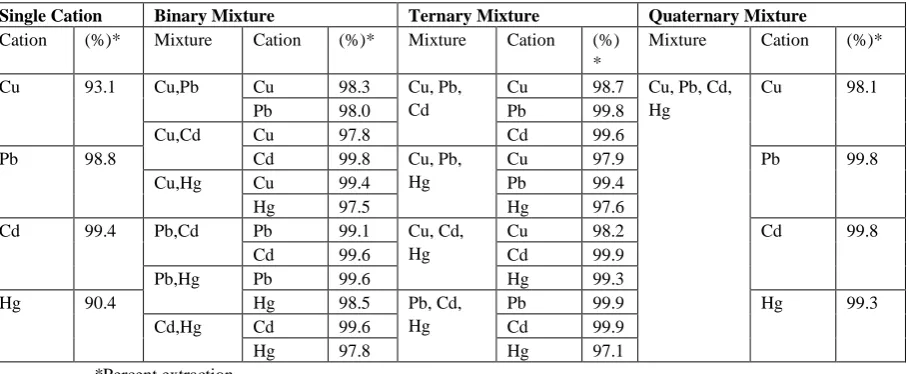
It is evident from equation (8) that the ratio of concentration of the metal species in the two layers is directly proportional to K and [H2Dz]2org and inversely proportional to [H+]2aq. The equilibrium constant K varies widely from one metal ion to another; these differences often make it possible to selectively extract one cation from another by buffering the aqueous phase at a level where one of them is extracted nearly completely and the second remains largely in the aqueous phase. In the present work sufficiently high pH value buffering was applied so that all metals can be determined simultaneously by using the ICP-MS technique (Table 1). This offers a rapid and highly precise method for analysis of metal ions matrix.
Extraction of the metals from their mixtures and from marine water sample
The feasibility for the simultaneous determination of cations in binary, ternary, and quaternary mixtures by ICP-MS spectrometry following liquid/liquid extraction with halogen-free IL was examined. For this purpose binary, tertiary, and quaternary mixtures of Cu2+, Pb2+, Cd2+, and Hg2+ have been prepared in which concentration of each of the cations in the mixture was 20 ppm. The results shown in Table 1 reveal high reovery rates for individual metal cations; this efficiency of the method does not decrease for the analysis of the metals in their binary, ternary or quaternary mixture. The method was then applied to marine water sampled from El-Doha coastal area (Fig. 1) which is an industrial area where desalination and power plants are located. The results revealed extraction percentages of 99.3, 97.8, 97.5, and 99.6 % of Cu(II), Pb(II), Cd(II), and Hg(II), respectively, from the sample.
2
2
2 2
( )
(7) org aq
org aq
M HDz H
K
H Dz M
2
2 2
2
( )
(8)
org org
aq aq
M HDz H Dz
K
M H
Halogen-free ionic liquid for extraction and determination of Cu(II), Pb(II), Cd(II) and Hg(II) Section A - Research Paper
Eur. Chem. Bull. 2012, 1(6), 184-187 DOI: 10.17628/ECB.2012.1.184
187
Table 1. ICP determination of Cu(II), Pb(II), Cd(II), and Hg(II) single and in mixtures after extraction with the halogen-free ionic liquid.
Single Cation Binary Mixture Ternary Mixture Quaternary Mixture Cation (%)* Mixture Cation (%)* Mixture Cation (%)
*
Mixture Cation (%)*
Cu 93.1 Cu,Pb Cu 98.3 Cu, Pb,
Cd
Cu 98.7 Cu, Pb, Cd, Hg
Cu 98.1
Pb 98.0 Pb 99.8
Cu,Cd Cu 97.8 Cd 99.6
Pb 98.8 Cd 99.8 Cu, Pb,
Hg
Cu 97.9 Pb 99.8
Cu,Hg Cu 99.4 Pb 99.4
Hg 97.5 Hg 97.6
Cd 99.4 Pb,Cd Pb 99.1 Cu, Cd,
Hg
Cu 98.2 Cd 99.8
Cd 99.6 Cd 99.9
Pb,Hg Pb 99.6 Hg 99.3
Hg 90.4 Hg 98.5 Pb, Cd,
Hg
Pb 99.9 Hg 99.3
Cd,Hg Cd 99.6 Cd 99.9
Hg 97.8 Hg 97.1
*Percent extraction
Conclusion
The use of inductively coupled plasma-mass spectrometry technique enables simultaneous determination of Cu(II), Pb(II), Cd(II), and Hg(II) cations both in their aqueous solution and in marine water. The application requires extraction of the concerned metals with the halogen-free room temperature ionic liquid [TOA][DBS] in presence of dithizone as chelating agent.
Acknowledgment
The support of Kuwait University received through the Research Administration (project no. 02/10) is gratefully acknowledged. We also thank the Science Analytical Facilities (SAF), Kuwait University, Faculty of Science, for the analyses of our samples using ICP-Ms (GS01/05) and NMR (GS01/01)
References
1 Dai, S., Ju, Y. H., Barnes, C. E., J. Chem. Soc. Dalton Trans., 1999, 1201.
2 Visser, A. E., Swatloski, R. P., Griffin, S. T., Hartman, D. H., Rogers, R. D., Sep. Sci. Technol. 2001, 36, 785.
3 Visser, A. E., Swatloski, R. P., Reichert, W. M., Griffin, S. T., Hartman, D. H., Rogers, R. D., Ind. Eng. Chem. Res., 2001, 39, 4596.
4 Wei, G. T., Yang, Z., Chen, C. J., Anal. Chim. Acta, 2003, 488, 183.
5Dietz, M. L., Sep. Sci. Technol., 2006, 41, 2047.
6Luo, H., Dai, S., Separation of metal ions based on ionic liquids. In: Ionic Liquids in Chemical Analysis. Taylor & Francis, USA, 2008.
7Domanska, U., Rekawek, A., J. Solution Chem., 2009, 38, 739. 8 Germani, R., Mancini, M. V., Savelli, G., Spreti, N.,
Tetrahedron Lett. 2007, 48, 1767.
9 Zhao H., Xia, S., Ma, P., J. Chem. Technol. Biotechnol. 2005, 80, 1089.
10 Liu, J., Jonsson, J. A., Jiang, G., Trends in Anal. Chem.,2005, 24, 20.
11 Huddleston, J. G., Visser, A. E., Reichert, W. M., Willauer, H. D., Broker, G. A., Rogers, R. D., Green Chem., 2001, 3, 156. 12 Gubicza, L., Nemestoyhy, N., Frater, T., Belafi-Bako, K., Green
Chem., 2003, 5, 236.
13 Tseng, M., Liang, Y., Chu, Y., Tetrahedron Lett., 2005, 46, 6131. 14 Nikitenko, S. I., Berthon, C., Moisy, P.C. R., Chimie, 2007, 10,
1122.
15 Archer, D. G., Widegreen, J. A., Kirklin, D. R., Magee, J. W., J Chem. Eng. Data, 2005, 50, 1484.
16 Najdanovic-Visak, V., Esperanca, J. M. S. S., Rebelo, L. P. N., Nunes da Ponte, M., Guedes, H. J. R., Seddon, K. R., Szydlowski, J., J. Phys. Chem. Chem. Phys., 2002, 4, 1701. 17 Swatloski, R. P., Holbery, J. D., Rogers, R. D., Green Chem.,
2003, 5, 361.
18 Visser, A. E., Swatloski, R. P., Reichert, W. M., Griffin, S. T., Rogers, R. D., Ind. Eng. Chem. Res., 2000, 39, 3596. 19 Tsukatani, T., Katano, H., Tatsumi, H., Deguchi, M., Hirayama,
N., Anal. Sci., 2006, 22, 199.
20 Kolthoff, J. M., Sandell, E. B., Mechan, E. J., Bruckenstein, S., Quantitative Chemical Analysis, 4th edition, The Macmillan Company, NY. 1969.
21 Marczenko, Z., Spectrophotometric Determination of Elements, John Wiley and Sons Inc., USA. 1976.
22 Onishi, H., Photometric Determination of Traces of Metals – Part IIB: Individual Metals, Magnesium to Zirconium”, 4th edition, John Wiley& Sons, Inc., USA. 1989.
23 Harris, D., Quantitative Chemical Analysis, 5th Edn., p.644, Freeman, NY. 1998.
24 Domanska, U., Rekawek, A., J. Solution Chem., 2009, 38, 739-751.
25 Irving, H., Cooke, S. J. H., Woodger, S. C., William, R. J. P., J. Chem. Soc., 1949, 1847.
Received: 15.09.2012.
![Figure 2. Absorption spectra of dithizone (a) and its chelates with divalent Cu (b), Cd (c), Pb (d), and Hg (e) in [TOA][DBS] ionic liquid after extraction from aqueous solutions buffered at pH 7.0](https://thumb-us.123doks.com/thumbv2/123dok_us/7838664.2090689/3.595.58.278.68.217/figure-absorption-dithizone-chelates-divalent-extraction-solutions-buffered.webp)