International Journal of Advances in Management and Economics
Available online at:
www.managementjournal.info
RESEARCH ARTICLE
The Influence of Organizational Commitment, Loyalty to Ethical
Work Climate in Realizing Group Responsible Satisfaction
Evy Nahdia Zuliastuti Nugraheni
1*, Jun Surjanti, Sri Setyo Iriani
2-31. Master of Management Student, Universitas Negeri Surabaya, Indonesia.
2. Departement of Management Faculty of Economic, Universitas Negeri Surabaya, Indonesia.
*Corresponding Author: Email: [email protected]
Abstract: This Study aims to examine the influence of organizational commitment, loyalty to the ethical work climate to realize satisfaction of the Group Responsible of the Koperasi Setia Bhakti Wanita Jatim. That is quantitative research carried out in two stages; the first is to have a validity test and reliability test and the second is to distribute the questionnaire. The population is the Group Responsible of Koperasi Setia Bhakti Wanita Jatim from several regions, namely: Surabaya, Sidoarjo, Gresik, Bojonegoro; consists of 211 people. The analysis was conducted using Structural Equation Modeling (SEM) with AMOS 22 software. The results showed that there was a significant relationship between organizational commitments, loyalty to the ethical work climate to realize the satisfaction of the Group Responsible of the Koperasi Setia Bhakti Wanita Jatim.
Keywords: Organizational commitment, Loyalty, Ethical work climate, Satisfaction.
Article Received: 01 June 2019 Revised: 20 June 2019 Accepted: 28 June 2019
Introduction
The role of cooperatives is to make economic life prosperous for its members quite large, especially promoting the position of the people with limited capabilities. The growth and development of cooperatives is considered by the Indonesian Government. Cooperatives can earn assets of 7.03 trillion and business volume of Rp. 4.6 trillion (Irsyad). According to Irsyad, the Kemenkop database has around 75,000 healthy SMEs, 75,000 needs to be fostered, and approximately 45,000 disbanded.
Data as of December 2017 total cooperatives totaling 153,171 units and SMEs 59.70 units, with active member’s 26.54 million people[1].The focus of SMEs is to form a management system for financial and non-financial performance perspectives. According to Cosenz, sustainable SME development is supported by a combination of management system performance and dynamic models. Any performance in the form of services to others does not mean ownership [2]. Performance affects a person's pleasure or disappointment.
The existence and development of the performance of women's cooperatives in terms of organization and business as well as the consistency of the principles and values carried out attracts the attention of both the Government and the Trustees. According to Susanto, active women's cooperatives have reached 13,212 NIK certified units.
In East Java, we have the best cooperatives in terms of quantity and quality that can be used as a reference, including Setia Bhakti Wanita Jatim and Setia Budi Malang. The success of cooperatives such as Setia Bhakti Wanita Jatim won the best award was inseparable from the big role of the Group Responsible. Groups Responsible are required to commit in their organizations, be loyal, maintain an ethical climate in the work so that satisfaction can be realized.
Literature Review
The company's CSR practices in order to get commitment, loyalty, ethical work climate that influence satisfaction need to be improved [3] organizational commitment is a state of employee siding with one particular organization and its purpose and intention to maintain membership. There are 3 categories of commitment measures according to [4] affective commitment, namely the strong sense of a person surviving in his organization, continuity commitment, namely consideration of individuals if the organization is abandoned, normative commitment that is the obligation of employees to remain in the organization [5].
Loyalty is the awareness of employees that is shown through a sense of loyalty to the company even in good and bad conditions. Some indicators of loyalty according to [6] are obedient to the rules, responsible for the company, willing to cooperate, ownership, interpersonal relationships, and preference for work [7]. An ethical work climate is part of the thinking of members of the organization about good ethical behavior and the handling of issues that are influenced by perception.
According to Moon, there are 3 moral classifications of ethical work climate, namely personal interests, shared interests, and obedience to duties, rules, laws, norms that apply [8]. Satisfaction is self-awareness owned by employees, sincerity of commitment and responsibility is carried out, and trying to do the best performance for the company. Antoncic's indicators of satisfaction are general satisfaction, relationships with colleagues, benefits and organizational culture, loyalty.
Organizational commitment influences one of the factors, namely the work climate or organization. The results found a positive relationship between organizational commitment, loyalty to the ethical work climate to achieve satisfaction similar to research conducted by [9, 7, 10, 11]. The company seeks improvement and satisfaction through systematic monitoring of employee satisfaction, continually using standard questionnaires [12]. Team work is a significant positive predictor of employee satisfaction [11]. It is hoped that through teamwork can be built trust relationships and good communication between managers and employees.
This phenomenon makes researchers interested in conducting research on the influence of organizational commitment, loyalty to the ethical work climate and satisfaction. The object of research is Groups Responsible of Setia Bhakti Wanita Jatim. The cooperative was chosen because Setia Bhakti Wanita Jatim was one of the best in East Java in quantity, the quality of the number of members increased, the volume of business and the remaining operating income in the largest asset.
Another reason is that the Group Responsible has a very big role as a milestone because it can motivate its members to always be committed and loyal in Setia Bhakti Wanita Jatim. This study aims to examine the effect of organizational commitment, loyalty to satisfaction of the Group Responsible through an ethical work climate as an intervening variable.
These were hypotheses of study:
H1: There is a significant positive effect on organizational commitment to the ethical work climate.
H2: There is a significant positive effect on the loyalty of the Group Responsible for the ethical work climate.
H3: There is a significant positive effect on organizational commitment to the satisfaction of the Group Responsible.
H4: There is a significant positive effect on the loyalty of the Group Responsible towards the satisfaction of the Group Responsible.
H5: There is a significant positive effect on the ethical work climate on the satisfaction of the Group Responsible.
H6: There is a significant positive effect on organizational commitment to the satisfaction of Group Responsible through an ethical work climate.
H7: There is a significant positive influence on the loyalty of the Group Responsible towards the satisfaction of the Group Responsible through an ethical work climate.
Methodology
Population and Sampling
regions, namely: Surabaya, Sidoarjo, Gresik, Bojonegoro. In this study, samples were taken 211 respondents with a Population of 426 Group Responsible based on the creativity table 0.05 significance level. The sampling used is Proportional Random Sampling in each region by means of the sampling technique that draws each Group Responsible to be sampled.
Research Variables
Organizational commitment is a positive force and commitment from the Group Responsible of Setia Bhakti Wanita Jatim that is useful for increasing existence, high dedication to work, trust and pride in the organization. Indicator called [4]. Employee loyalty is a sense of loyalty of the Group Responsible of Setia Bhakti Wanita Jatim, who is still able to solve work problems and pressure from the family environment.
Indicator called [6]. Ethical work climate is the behavior of each Group Responsible of the Koperasi Setia Bhakti Wanita Jatim to interact ethically and interact with colleagues to motivate the internal strength of the organization. Indicator called [7]. Employee satisfaction is a feeling of satisfaction with the work of each Group Responsible of the Koperasi Setia Bhakti Wanita Jatim with different levels of satisfaction. Indicator called [8].
Data Analysis Technique
Structural Equation Model (SEM) with AMOS software was used to analyze the data.
Result and Conclusion
Result
Based on the analysis, it resulted as:
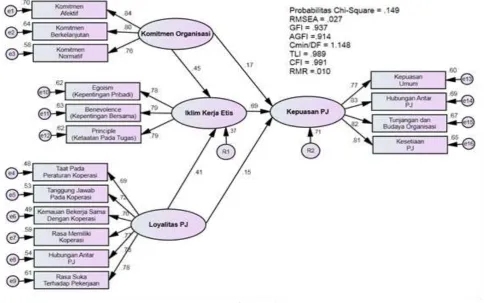
Figure 1: SEM Model
From assumption test, normality test
resulted on univariate and multivariate outlier fulfilling the model requirement.
Table: 1Goodness of fit and cut off value structural model
CRITERIA Model Test Result Crisis Information
Probabilitas Chi-Square 0,149 0,05 Fit
Cmin/DF 1,148 2,00 Fit
RMSEA 0,027 0,08 Fit
GFI 0,937 0,90 Fit
AGFI 0,914 0,90 Fit
TLI 0,989 0,95 Fit
CFI 0,991 0,95 Fit
Table I shows further analysis through Goodness of Fit by comparing Structural Cut-Off Value models with the results of model testing.
The results indicate that the Goodness of Fit shows the recommended consideration index. Then proceed with the SEM model reliability test and hypothesis.
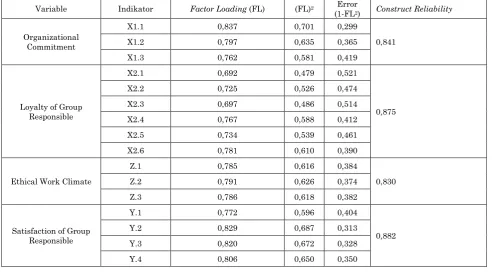
Table 2: Research reliability variables construct
Variable Indikator Factor Loading (FL) (FL)2 Error
(1-FL2) Construct Reliability
Organizational Commitment
X1.1 0,837 0,701 0,299
0,841
X1.2 0,797 0,635 0,365
X1.3 0,762 0,581 0,419
Loyalty of Group Responsible
X2.1 0,692 0,479 0,521
0,875
X2.2 0,725 0,526 0,474
X2.3 0,697 0,486 0,514
X2.4 0,767 0,588 0,412
X2.5 0,734 0,539 0,461
X2.6 0,781 0,610 0,390
Ethical Work Climate
Z.1 0,785 0,616 0,384
0,830
Z.2 0,791 0,626 0,374
Z.3 0,786 0,618 0,382
Satisfaction of Group Responsible
Y.1 0,772 0,596 0,404
0,882
Y.2 0,829 0,687 0,313
Y.3 0,820 0,672 0,328
Y.4 0,806 0,650 0,350
Table II shows that organizational commitment, Group Responsibility loyalty, ethical work climate, and Group Responsibility satisfaction have a reliability
value of total constructs of more than 0.70 (> 0.70), which means that the variable can be relied upon as a model to be developed in this research.
Table 3: Hypothesis test results
Hyp Causality Relationship Std. Estimate CR p-value Information
H1 Commitment (X1) Organizational Ethical Work Climate (Z) 0,450 5,610 0,000 Significant
H2 Responsible (X2) Loyalty Group Ethical Work Climate (Z) 0,412 5,234 0,000 Significant
H3 Commitment (X1) Organizational Satisfaction Group Responsible (Y) 0,171 2,498 0,012 Significant
H4 Responsible (X2) Loyalty Group Satisfaction Group Responsible (Y) 0,147 2,226 0,026 Significant
H5 Ethical Work Climate (Z) Satisafction Group Responsible(Y) 0,687 7,186 0,000 Significant
Tabel4: The results of testing hypothesis of indirect influences
Hyp Causality Relationship Std. Estimate CR p-value Information
H6
Organizational Commitment (X1)
Ethical Work Climate (Z) Satisfaction
Group Responsible(Y)
0,309 3,928 0,000 Significant
H7
Loyalty Group Responsible (X2) Ethical
Work Climte (Z) Satisfaction Group
Responsible(Y)
0,283 3,644 0,000 Significant
Table IV shows that the ethical work climate is able to mediate organizational commitment, Group Responsible loyalty and satisfaction of the Group Responsible.
Conclusion
The results showed that the variable organizational commitment, Group
Wanita Jatim cooperative for more than 10 years.
Figure 2: Commitment Organization Diagram
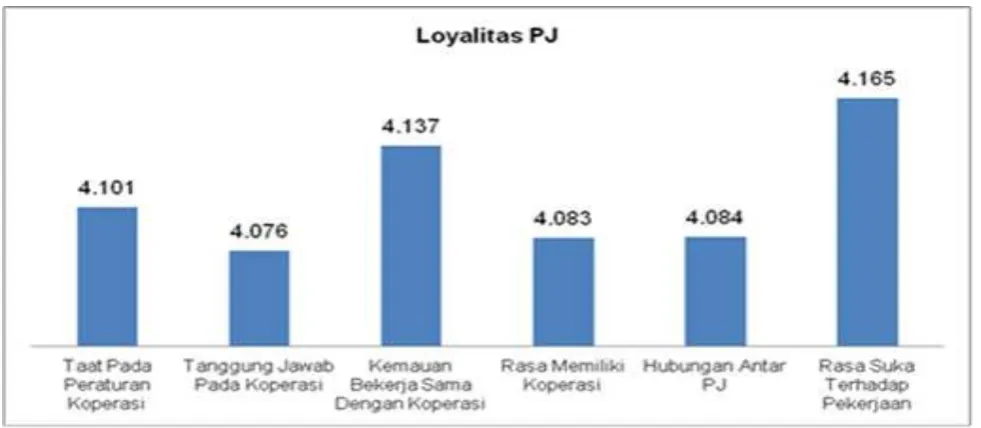
The biggest value for the loyalty of the Group Responsible is the feeling of love for work seen from the increase in the number of
members that reached 13,389 people and an increase in turnover an average of 15 billion per month.
Figure 3: Loyalty Group Responsible Diagram
The biggest value for the ethical work climate variable is personal interest, seen from the sense of togetherness of the Group Responsible likes to take part in social
activities such as compensation for members and members' families, and members who experience disaster.
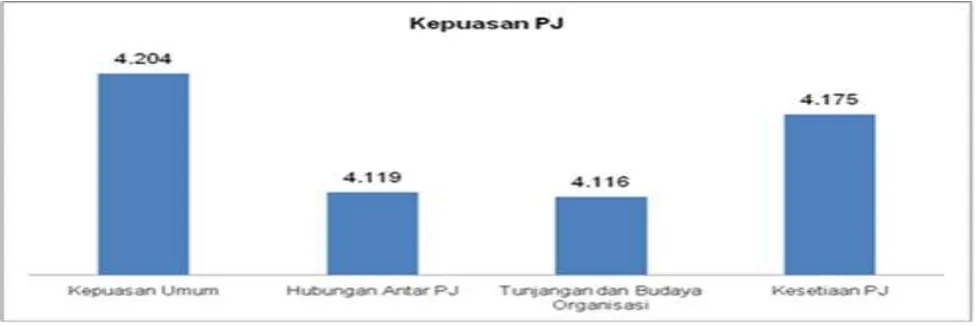
The largest value for the satisfaction of the Group Responsible variable is general satisfaction because the Group Responsible likes the activities held by the Koperasi Setia
Bhakti Wanita Jatim such as personality training, leadership, outbound and economic business skills training held every year.
Figure 5: Satisfaction Group Diagram
The results showed that all hypotheses proved to have positive-positive effects both directly and indirectly. The biggest influence on organizational commitment to the ethical work climate is 0.450 where indicators for organizational commitment have been shown to influence the ethical work climate similar to research conducted by [9, 7, 10, 11]. The variable that has the lowest significance level is the loyalty of the Group Responsible.
Many respondents stated that activities to improve self quality were highly preferred, such as personality training, leadership, outbound and economic business skills training, but more importantly was the responsibility of cooperatives by showing loyalty to stay in the East Java Setia Bhakti Wanita organization. The results obtained indicate that organizational commitment and loyalty of the Group Responsible influence
the ethical work climate and satisfaction of the Group Responsible. Thus, emphasizing organizational commitment and loyalty of the Group Responsible is the right way to influence the satisfaction of the Group Responsible. Therefore it is recommended for cooperatives to further improve the welfare of their members and further promote coaching and training.
However, the loyalty of the Group Responsible becomes a variable that is not significantly influencing the ethical work climate and satisfaction of the Group Responsible. Like a sense of responsibility, the Group Responsible is still there who runs away from responsibility, so it can add more allowances so that the Group Responsible remains faithful to the Koperasi Setia Bhakti Wanita Jatim.
References
1. Marinkovi Milica, Via Ugo, Antonio Amico(2015) Designing Dynamic Performance Management Systems to Foster SME Competitiveness According to a Sustainable Development Perspective :
Empirical Evidences from a Case-Study Carmine Bianchi , Federico Cosenz. Int. J. Business Performance Management, 16(1): 84-108.
2. Risqonadhimi (2011) Analisis Dampak Kualitas Layanan Dalam Membentuk Kepuasan Pelanggan Precious Studio Semarang, E-Journal Undip, Semarang. 3. Robbins, Stephen (2006) Perilaku
Organisasi. Jakarta: PT.Indeks Kelompok
Gramedia.
4. Suliman M, Abubakr, Iles A, Paul(2013) The Multi-Dimensional Nature of Organisational Commitment in a Non-Western Context, Journal of Management Developmet, 71-82.
5. Andini Yulia, Wardhana Aditya(2018) Analysis Of Employee Loyalty Factors On The Kiri Social Bar Bandung, e-Proceeding of Managemet, 5.
Jurnal Fakultas Psikologi Universitas Setia Budi, Surakarta.
7. Moon, Hyoung Koo Choi, Kwon Byoung. How the Perceptions of Five Dimensions of Corporate Citizenship and Their Inter-Inconsistencies Predict Affective Commitment. European Journal of Innovation Management, 2014, 85-106. 8. Auer Antoncic, Jasna, Bostjan Antoncic
(2011) Employee Satisfaction, Intrapreneurship and Firm Growth: A Model. Industrial Management & Data Systems, 111(4):589-607.
9. Kim JI, Sung, Sangyub Ryu (2017)Employee Satisfaction With Work-Life Balance Policies And Organizational Commitment : A Philippine Study. Public
Administration and Development,
260-276.
10. Aisyatur Rahmah dan, Meylia Elizabeth Ranu (2013) Peran Budaya Kerja dan Iklim Kerja terhadap Loyalitas Pegawai Bagian Umum Sekretariat Daerah Kabupaten Lamongan. Journal Administrasi Perkantoran, 1-3 Lamongan. 11. Chang CC, CM Chiu, CA Chen (2010) The
Effect of TQM Practices on Employee Satisfaction and Loyalty in Government. Total Quality Management and Business Excellence, 21(12):1299-1314.