International Journal Advances in Social Science and Humanities
Available Online at: www.ijassh.com
RESEARCH ARTICLE
Updating in Management Skills for the Gastronomy Career
Mendoza Derling Jose
1, Mendoza Derling Isaac
2, Flores Luz Marina
31. Mathematics, Investigation/ Universidad Iberoamericana del Ecuador, Ecuador.
2. Student, Investigation / Giordano Bruno, Ecuador.
3. Pneumology / Instituto Ecuatoriano de Seguridad Social, Ecuador.
*Corresponding Author: Mendoza Derling Jose
Abstract
The general objective of this research was to analyze, describe and update the management skills of the students of the Universidad Iberoamericana del Ecuador (UNIB.E). To carry out the study, field research was adopted, with a non-experimental cross-sectoral design. The population was made up of twelve (42) students and ten (10) teachers, both of whom were attached to the gastronomic career, making up a census-type sample. To collect the information, the survey was used as a technique and as a tool; the questionnaire consisted of 30 Items. It underwent a content validity process, carried out through the review of five (5) experts. Cronbach's Alpha coefficient was used for reliability. Where 0.797 was obtained as a result, considered a high level of correlation value. The results showed deficiencies in relation to the management training skills acquired by the students. To this end, a series of skills are proposed to strengthen the quality of the professional performance of graduates in gastronomy.
Keywords:Higher education, University profile, Updating, management skills, Research management.
Introduction
Currently, the university student is exposed to a number of variables. These variables influence their student education. The variables cause a series of disorientations,
which require accompaniment within
university life. Both teachers and other members of the educational community must
be fully convinced of the integral
development of the participant. Based on principles, values and resources for full training in higher education. This reality obliges us to deal with the issue of the integral development of university students.
This obligation, found in the vocation of higher education, is related to the human being. Highlighting its susceptibility to be formed in an integral way. From this overall viewpoint, there is the possibility of talking about a common university profile. Where it allows the participant to live his or her
identity, transcendence, physical
development and social commitment. All of these are necessary for today's society. This vision, if it is to become a reality, must be
concretely translated into institutional development plans. In administrative and academic structures, there must be the formation and updating of academic and managerial bodies. As well as the publication of the educational policy of higher education, since society demands an unprecedented demand for professionals. These precedents,
based on awareness, provide the
fundamental importance of education for socio-cultural and economic development, facilitating the construction of the future.
This element constitutes the raison d'être of this research. The objective of this course is to update the management skills of students of the Gastronomy course at the Universidad Iberoamericana del Ecuador (UNIB.E) located in Quito. Higher education in Latin America interprets social relevance. As an indicator of efficiency that implies demands for graduate competencies and reforms in the university education system. In line with [1], "they must be permanent reforms, both of structures and operations, and that is why the universities of the 21st century must be flexible to change without undermining their essence".
These reforms do not have a monopoly on teaching or research. Because knowledge is not only generated in your premises. Much of the knowledge is produced outside them; hence, many of them have research and extension units within them. From this perspective, the authors argue that reforms can be of a structural and attitudinal nature.
Thus, the structural reform focuses on institutional, legal and administrative aspects. Also the strengthening of academic, extensionist and research functions, the creation of higher education laws with new references. Similarly, university autonomy, the processes of evaluation and accreditation, the system of degrees, the creation of incentives for research teachers, the search for strategic alliances.
All, through inter-institutional agreements, through inclusion with information systems and technology, the problem of budget and funding of research, restructuring of physical infrastructure and administrative policies. In addition, in the area of management competencies, the raison d'être of this research, the adoption of a permanent updating system for university graduates implies flexibility.
The research supports the academic recognition of knowledge, which certifies the learning acquired and the skills developed by students in their professional practice. The
researcher considers the transfer of
knowledge and the learning of skills to be important. What could be translated into the capacity of university teaching to develop competencies. These skills, based on the experience of the participants, must be
continuously updated. Not only must they be able to instruct an individual with the knowledge and skills to perform efficiently.
What is fundamental is that the university be enabled to learn, relearn and unlearn permanently. Based on the spirit of systemic thinking and in the epistemic sense, [2] when he limits order, disorder and organization.
Within this frame of reference, the consequences of a lack of management skills would limit an educational action for the development of three basic skills in university graduates. The first is the ability to constantly innovate. This involves imagination and creativity to predict and face the challenges of change. The second is the capacity to adapt, which implies a dizzying adaptation to the changes imposed by technology and markets. And the third is the capacity to learn, in a systematic way that allows you to develop the previous capacities.
Therefore, the research aims to analyse the competences exposed by teachers and acquired by students. To then describe and present new skills, which will enable the strengthening of the demands of the current productive sector to be sustained.
Justification
The dynamism of the market forces those who make a managerial career or aspire to occupy positions of greater organizational responsibility to adapt their skills in quantity and quality. These include administration, organization, working under pressure and communication. Employability, understood as the ability to find work. It is conditioned by the interaction of two variables that act as driving elements of the process. On the one hand, the labour market situation itself. On the other hand, the adjustment of the candidate's skills to the candidate's needs. As described above, the present research is justified because it constitutes for the
students of gastronomic business
administration at UNIBE, to adopt new ways to update themselves.
As well as implementing teaching and learning processes that increase knowledge, especially in the practical aspect. To this end, it is necessary to strengthen management skills through new strategies. All of these are based on techniques and methods of programming, teaching, learning and evaluation.
Within this frame of reference, the present study is openly justified, because they are aimed not only at updating the management skills of university graduates. They also seek to guarantee the processes that generate a quality of general and specific competences. These are necessary and useful for each work environment where the professional student needs to improve his/her performance.
Objectives of the research
Objective General To provide general and specific skills to
strengthen the work performance of the students of the gastronomy career of UNIBE.
Objectives specifics
• Identify the managerial skills acquired by
the graduates of the gastronomy career for their performance.
• Describe the practical aspects to be
considered in the updating of the management skills of the university
graduate in gastronomy of the
aforementioned university.
• To propose new management skills to
strengthen the work performance of the students of the gastronomy career at UNIBE.
Methodology
Nature of StudyResearch corresponds to the quantitative paradigm. Quantitative methodology is one that allows data to be examined in a scientific way, or more specifically in numerical form, usually with the help of tools in the field of statistics.
To this end, [3], states that the quantitative paradigm "uses quantifiable techniques, data collection and analysis..., is said to be objective oriented to hypothetical-deductive verification..., emphasizes the reliability of the data, replicability; it attempts to
generalize the study of many cases and assumes reality as it establishes".
This means that this quantitative
methodology requires that among the elements of the research problem there be a relationship whose nature can be represented by some numerical model, whether linear, exponential or similar. In this sense, research on the updating of management skills in students graduating from the gastronomy career is immersed in the nature of quantitative study.
Because there is clarity among the research elements that make up the problem. Where it is possible to define it, limit it and know exactly where the problem starts, in which direction it goes and what type of incident exists between its variables.
Type of Research
Similarly, the research was carried out assuming the field modality, which in the opinion of [4], defines it as “the systematic analysis of problems in reality, with the
purpose of either describing them,
interpreting them, understanding their nature and constituent factors, explaining their causes and effects”, or predicting their occurrence, using methods characteristic of any of the known or developing paradigms or research approaches.
In relation to the above, the field research seeks to provide guidance according to the needs detected in the study environment by the researcher. With the aim of providing alternative solutions to the problem posed. Hence, the need to frame this study under this modality. In which a descriptive analysis of the weaknesses found in the management
competencies developed by university
graduates is conceived. A study aimed at
resolving the situation by updating
management skills.
Research Design
As well as its repercussion on the presentation of competences, for the strengthening of the managerial competences of the graduates of the gastronomy career of the UNIBE. With respect to transactional studies, [5] point out that they "collect data in a single moment, in a single time."That is, they are those that propose the description of the variables, as they are manifested and the analysis of them, taking into account their interrelation and incidence. In transactional designs, data collection is done only once.
In this sense, the researcher specifies that the data were taken using a survey instrument, applied to both 42 students and 10 teachers, where the data were obtained in a single moment of the research process. The questionnaire applied to students and teachers. 30 Items structured it. Their questions were coupled to three study variables to provide answers to the objectives of the research.
In order to provide answers to the questions in the questionnaire, options were scaled up. As first option "Almost Always" (AA), second place "Always" (A), third place "Sometimes (ST), fourth place "Almost Never" (AN) and lastly "Never" (N).
The validity of the instruments and techniques employed were supported by the review of five (5) quantitative research experts, who participated in conjunction with the research author. For reliability purposes, [6] state that for a quantitative study "the first thing to be done is a pilot test" to assess the level of reliability. The results were analyzed using the Statistical Package for the Social Sciences (SPSS) software, current version, giving a coefficient of 0.797 considered an appropriate value for the study [7].
Analysis of the Results
At the end of the discussion and analysis of the results, to respond to the objectives formulated in the study.
A series of final reflections and suggestions are put forward for the updating of management skills aimed at participants who have graduated from UNIBE in the area of gastronomy. By identifying the main variables of the study. They provide a significant and necessary construct to strengthen the managerial competencies of the graduates of the UNIBE gastronomy career. The discussions of results with varying trends are shown below:
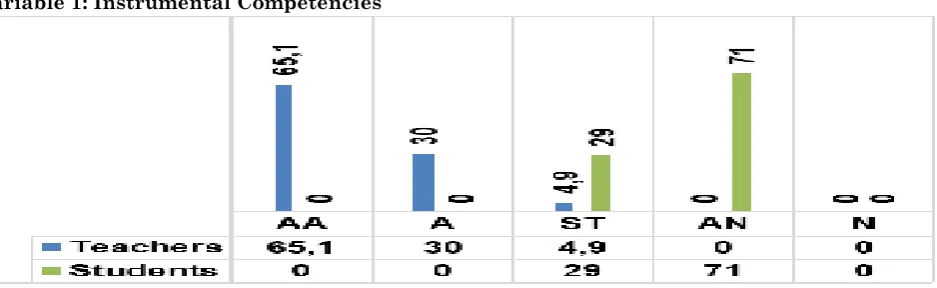
Variable 1: Instrumental Competencies
Figure 1: Variable instrumental competencies
Instrumental competences as a
representative variable among the items established in the information search tool are considered generic. Because they allow the identification of cognitive, methodological, technological and linguistic abilities that enable a basic academic development of the university student.
These are Competences that Have an Instrumental Function and among them it is Possible to Point Out
Cognitive: ability to understand and use ideas and thoughts.
Methodological: ability to organize time and strategies for learning, making decisions or solving problems.
Linguistics, such as oral and written communication or knowledge of a second language.
The capacities issued by the research professors indicated that 65.1% of them had and knew "almost always" the instrumental competences in their work and academic performance. Next, a 30% that I indicate on the scale "always" in having technological
capabilities, which are among the
instrumental competencies. And finally, 4.9%
of teachers as "sometimes" possess or perform methodological research skills. In contrast to the students, who "almost never" broadcast having received instrumental skills in their academic training, with a percentage of 71%. In sum, 29% of the students who expressed in their items that they sometimes develop their cognitive abilities, especially those of research.
Variable 2: Interpersonal skills
Figure 2: Interpersonal skills
From [9], conceptualizes interpersonal
competencies as skills related to
interpersonal understanding, built on the subject's recognition of the surrounding relational environment; the establishment of appropriate and relevant interpersonal relationships with the context in which they are mobilized; the possibilities of acting in a particular situation that gives the subject the understanding of interpersonal relationships at the cognitive, behavioral and affective levels.
Interpersonal skills are necessary for the adaptation of the institutional work
environment. Also to achieve
interrelationships in the same, in a coordinated way, through labor groups, avoiding conflicts and increasing proactivity. In terms of the results obtained, the majority of teachers expressed that they were able to
manage inter-relational skills, focused on emotional expression skills, by 44%. Subsequently, 28% of the teachers indicated that they sometimes use critical and self-critical skills. At the same time, 26%, which I almost never visualize optimal conditions for teamwork. Unlike the 2% of teachers who reported, they almost always use their interrelated skills.
Accordingly, for 51% of the students surveyed, they almost never state that they use interrelated skills, especially leadership skills. Likewise for 29% of the students who pointed out, on applying sometimes, the relationships or teamwork, in reference to academic activities. And finally, with the remaining 20% of the student population, it was clear that they had never been educated or applied the competences of the second variable.
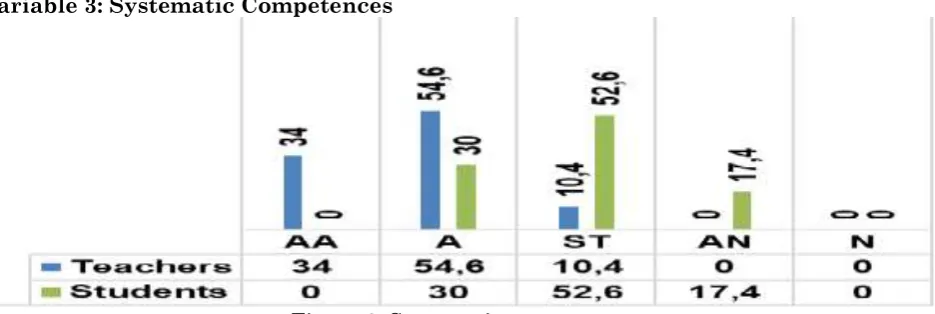
Variable 3: Systematic Competences
Systematic competencies as the third variable allows approaching reality in its complexity of relationships and not as a set of isolated events. They concern the systems as a whole. They involve a combination of understanding, sensitivity and knowledge that allows the person to see how the parts of a whole relate and are grouped together. These include the ability to plan changes so that improvements can be made to systems. It is important to note that systemic or integrative competencies require the prior acquisition of instrumental and interpersonal competencies [8].
For teachers as professional trainers. They acquire the ethics of andragogy and orientation, which can be reflected in the statistical results in Figure 3. Where 54.6% of the teachers surveyed indicate that they always carry out academic planning of the contents programmed in the degree course. Adding up 34% that as an optimization, always applies systematic skills. In contrast to the 10.4% who I categorically indicate only occasionally have to use these skills. On the contrary, for students of gastronomy.
The results issued show that 52.6% use systematic competencies. In addition to 30% of the students who are placed on the "always" scale in applying these qualities of organization and integration. Finally, 17.4% said they never applied systematic skills. The deficiencies in the training of the graduate professional for the development of skills and/or abilities related to managerial, personal and humanistic aspects are demonstrated in an unfavorable manner. As well as cognitive, professional and technical; of achievement and action, of help and service, of administrative influence and of personal effectiveness.
Conclusions and Recommendations
Conclusion
Based on the statistical data obtained, by teachers and students in the description of practical aspects. Among the competencies acquired by the students, the management training of this career should be considered. The analysis of the information collected through the survey reflected the higher presence of percentages for the "Almost
Never" alternative. This indicates
weaknesses in the inclusion of practical aspects of graduate learning, which are
presented for the development of managerial competencies. In addition, these weaknesses are also manifested by a lack of research skills. Insufficiency of knowledge to hold
gastronomic management positions.
Disinterest in the acquisition of greater skills and abilities for an effective performance of the career. Little independent will to acquire new learning. Inability to identify the skills they possess, to complement their training accordingly.
Recommendations
Based on the conclusions obtained, it is pertinent to update the management skills formulated for the students of the gastronomy course at UNIBE. Where the purpose of updating the management skills of the graduate of this career, seeks the optimization of their work development. It is also recommended to provide university graduates with knowledge, skills and attitudes useful for developing in the professional field of gastronomy.
It is a set of skills, necessary for the students. And these skills will be developed throughout your university life. They will also serve to familiarize you with the professional environment. Considering the updating of competencies. The objectives proposed by the university can be met. In instilling critical thinking, ethical responsibility, information
management, conflict resolution and
communication in other languages.
Therefore, it is recommended that the following basic competencies for UNIB.E., students be explored and exercised.
General Competencies Instrumental
Capacity for analysis and synthesis Organization and planning
Oral and written communication in the mother tongue (s)
Communication in a foreign language Use of ICT in the field of study and professional context
Information management
Problem solving and decision making
Interpersonal
Ability to integrate and communicate with experts from other areas and in different contexts
Recognition of and respect for diversity
and multiculturalism
Interpersonal skills
Ethical commitment
Systemic
Learning autonomy
Adaptation to new situations
Creativity
Leadership - Leadership
Initiative and entrepreneurship
Openness to lifelong learning
Commitment to identity, development and
professional ethics
Management by processes with quality
indicators
Elements: to distinguish the essential from
the accessory or superficial.
Differentiate the various elements and their
dependency interrelationships. To
discriminate between the different aspects, components, levels or factors that make up a given reality.
Elements of the synthesis: seeks the
relationship, interaction and conjunction of the parts.
Elements: setting priorities for objectives
and tasks; working in a systematic and orderly manner; forecasting the timing of each activity; setting feasible deadlines; identifying indicators of control; awareness that excessive planning can destroy creativity.
Elements: express concepts and ideas both
orally and in writing, in a clear and comprehensible way, express the student's own understanding of a subject, develop communication skills and present ideas.
Elements: knowledge of basic vocabulary,
grammatical rules and regulations,
technical/scientific vocabulary of the subject, relation of the linguistic and cultural dimension, ability to deal with subjects of the discipline in that language.
Elements: computer management at the
user level, knowledge and use of audiovisual
media, multimedia, use of the Internet to communicate and work cooperatively.
Elements: ability to search for bibliographic information, ability to distinguish between primary and secondary sources, making good use of the library (traditional and electronic), searching for information on the Internet, awareness of the different value of different types of information.
Elements: Ability to precisely define the problem. Analyze it from different points of view. Ask questions and find out for yourself what information is needed. If it is susceptible to fragmentation of problems, do so. Think rationally. Think creatively. Analysis of the causes of the problem and its prioritization is another step in problem solving. Search for alternatives to the solution of a problem.
Elements: Objectivity, use of criteria, capacity for analysis and self-analysis, emotional distance, discernment.
Elements: accepting ideas from other areas without clinging to the use of the terms you master. Works well in open problem-solving contexts, not just focused on your discipline. Appreciates the value of other people's ideas
to enrich a project, is aware of the improvement in results after planning and
developing teamwork. Openness to
interdisciplinary.
Elements: ability to listen, verbal and non-verbal communication, ability to deal appropriately with people of very different origins and backgrounds.
Elements: Knowledge of the code of ethics. It
acts with integrity and rectitude in any situation, even in situations that are detrimental to its own interests.
Elements: development of their capacity for
personal, academic and professional
autonomy, ability to manage their time, select their priorities, meet deadlines, accountability for what they have agreed.
Elements: ability to recognize and adapt to
new situations.
Elements: modify and improve processes.
Ability to produce original work, ability to identify problems.
Elements: Set goals and follow up on them.
Commitment to the personal and group development of the members of your team To have the necessary vision to establish a direction with future projection of the team's actions. Know how to delegate and encourage the development of the leadership qualities of other team members.
Elements: Search for new opportunities,
overcoming past situations.
Elements: it keeps its knowledge up to date
through its permanent updating. He values any activity that helps him to develop personally and professionally.
Elements: show interest in up-dating, be up
to date with the progress of knowledge and techniques specific to the profession.
Elements: it uses indicators to evaluate its
progress and results. Plan and carry out activities correctly.
Specific Competencies
To understand the theoretical, historical,
cultural, comparative, political,
environmental and legal references that
constitutes the human being as the main character of the gastronomic management.
Identify and make reasoned judgements
about socio-educational problems in order to improve professional practice.
Understand the trajectory of the
administration of gastronomic companies and the configuration of their field and professional identity.
Diagnose complex situations that support
the development of socio-community actions.
To design plans, programmes, projects,
social actions and resources in both face-to-face and virtual modalities.
Design and develop processes of social
participation and community development.
To elaborate and manage means and
resources for social and community intervention.
To apply specific methodologies for
social-community action.
Intervene in social and community projects
and services.
Promote processes of cultural and social
dynamization.
Mediate in situations of risk and conflict.
To design and implement evaluation
processes of programs and strategies of social-community intervention in different contexts.
Manage and coordinate entities, equipment
and groups, according to the different contexts and needs. social
Direct, coordinate and supervise
administrative plans, programmes and projects.
Advising on the preparation and
implementation of plans, programmes,
projects and activities.
Reference
1.Lanz R, Fergusson AY, Marcuzzi A (2006) Procesos de la Educación Superior en América Latina. Informe sobre la Educación Superior en América Latina y el Caribe 2000-2005. UNESCO-IESALC [Documento en línea]. Disponible:http://www.Iesalc.unesco.org.veprueb aobservatorioINFORME%20RAMA%20ESLATIn formeES-2000-2005.pdf. [Consulta: 2013, febrero 12].
2.Hurtado J (2000) Paradigmas en investigación social. Caracas: Tropykos.
3.Morin E (1981) Introducción al pensamiento complejo. Barcelona: GEDISA.
5.Hernández S, Fernández CY, Baptista P (2014) Metodología de la Investigación. México: McGraw-Hill.
6.Artigas W, Robles M (2010) Metodología de la investigación: Una discusión necesaria en Universidades Zulianas. Journal Digital Universitaria. 11 (11):3-17.
7.Cronbach J, Schoneman P, Mckie D (1965) Alpha coefficient for stratified-parallel test. Educ Psychol Meas.25: 291 - 312.
8.Área M (2004) De la biblioteca al Centro de Recursos para el Aprendizaje e Investigación. Dirección General de Universidades. Madrid, Ministerio de Educación y Ciencia.