This is a self-archived version of an original article. This version
may differ from the original in pagination and typographic details.
Author(s):
Title:
Year:
Version:
Copyright:
Rights:
Rights url:
Please cite the original version:
CC BY-NC 4.0
https://creativecommons.org/licenses/by-nc/4.0/
Depicting signs and different text genres : Preliminary observations in the corpus of
Finnish sign language
© ELRA.
Accepted version (Final draft)
Takkinen, Ritva; Keränen, Jarkko; Salonen, Juhana
Takkinen, R., Keränen, J., & Salonen, J. (2018). Depicting signs and different text genres :
Preliminary observations in the corpus of Finnish sign language. In M. Bono, E. Efthimiou, S.-E.
Fotinea, T. Hanke, J. Hochgesang, J. Kristoffersen, . . . , & Y. Osugi (Eds.), Proceedings of the LREC
2018 Workshop : 8th Workshop on the Representation and Processing of Sign Languages :
Involving the Language Community (pp. 189-194). Paris: European Language Resources
Association (ELRA). Retrieved from
http://lrec-conf.org/workshops/lrec2018/W1/pdf/18038_W1.pdf
2018
Depicting Signs and Different Text Genres: Preliminary Observations in the
Corpus of Finnish Sign Language
Ritva Takkinen, Jarkko Keränen, Juhana Salonen
University of Jyväskylä, Department of Language and Communication Studies, Sign Language Centre P.O. Box 35, FI-40014 University of Jyväskylä, Finland
E-mail: [email protected], [email protected], [email protected]
Abstract
In this article we first discuss the different kinds of signs occurring in sign languages and then concentrate on depicting signs, especially on their classification in Finnish Sign Language. Then we briefly describe the corpora of Finland's sign languages (CFINSL). The actual study concerns the occurrences of depicting signs in CFINSL in different text genres, introductions, narratives and free discussions. Depicting signs occurred most frequently in narratives, second most frequently in discussions and least frequently in introductions. The most frequent depicting signs in all genres were those that depicted the whole entity moving or being located. The second most frequent were those signs that expressed the handling of entities. The least frequent depicting signs were those with size- and shape-tracing handshapes. The proportion of depicting signs of all the signs in each genre was 17.9% in the narratives, 2.9% in the discussions and 2.2% in the introductions. In order to deepen the analysis, depicting signs will have to be investigated from the perspective of movement types and the use of one or two hands.
Keywords: Depicting sign, handshape, text genre, corpus, Finnish sign language
1. Introduction
1.1. Sign Types
Sign languages include several kinds of vocabulary. Not all signs are lexicalised (e.g. Brennan, 1992; Wallin, 1994; Brentari & Padden, 2001; Liddell, 2003; Johnston and Schembri, 2007, Takkinen, 2008). The visual-gestural modality that sign languages use to mediate linguistic information enables them to use space to gradually (analogously) convey visual content. The handshapes and movements in some signs can be motivated by inherent visual features and the movement or location of the entities in question.
According to Cogill-Koez, (2000), iconic signs or expressions of this kind are not linguistic but they are template visual representations that are on the continuum of analogous and schematic visual representations. Tolar et al. (2008) proposed that iconic signs can be pantomimic, perceptual, or both. Pantomimic signs primarily depict action-based features like KEY (open with a key). Perceptual signs depict static features like GLASSES. A sign like CAMERA can include both features, the action of taking a photograph and the size and shape of a camera. DeMatteo already in 1977 argued that morphemic analysis, which e.g. Supalla (1982) defended, is not suitable for these kinds of non-lexicalised signs. Liddell (2003) considers handshapes and some movement types lexical units, and other parameters (some movement types, articulation place, orientation and non-manual elements) gestural (analogous). Thus, in
these signs lexical structure and depiction together create the meanings (also Emmorey & Herzig, 2003; Erlenkamp, 2009).
Johnston and Schembri (2010) divided the lexicon of Auslan into content signs and function signs, on the one hand, and to fully-lexical and partly-lexical signs, on the other. Fully-lexical signs constitute a listable lexicon in a sign language, and they may be either content signs or function signs. Fully-lexical signs include fully specified signs and partly specified (see also Johnson & Liddell, 1986; Johnston & Schembri, 2007). According to Johnston and Schembri (2010), the distinction between the two types of signs is more gradient than categorical.
1.2. The Corpora of Finland’s Sign Languages (CFINSL)
In Finland there are two national sign languages, Finnish Sign Language (FinSL), with about 4000-5000 deaf users, and Finland-Swedish Sign Language (FinSSL), which has less than 100 deaf users. The CFINSL project aims to gather language data and create a machine-readable corpus of both sign languages. By the end of 2017, 92 FinSL users and 12 FinSSL users had been filmed in dialogue settings in a professional studio. The raw data were edited to video clips according to tasks and participants. The annotation process is going on with the ELAN program (Crasborn & Sloetjes, 2008) and annotation conventions have been (and will be) refined in the course of work.
In the CFINSL project, lexicalised signs are annotated on the ID tier without any additional code, and depicting, gestural, numeral, and fingerspelled signs with the following codes:
Lexicalised signs HORSE
Depicting signs (_ds) _dswe/_dshd/_dsss
Gestural signs (_g) PALM-FORWARD_g
Numeral signs (_num) TWO-WEEKS-AGO_num Fingerspelling (_fs) h-a-r-r-y_fs
Depicting signs are annotated following the classification of depicting verbs put forward by Takkinen (2008). The handshapes in these verbs are divided into three classes: 1) handshapes representing the whole entity, 2) handshapes representing handling an entity, and 3) handshapes depicting the size and shape of an entity (cf. Schembri, 1996; Cormier et al. 2012). Some researchers, e.g. Liddell & Johnson (1987) and Engberg-Pedersen (1993), have proposed a more detailed classification of handshapes depicting surfaces and extents of entities but Takkinen (2008) has combined them into one class of size- and shape-tracing handshapes. The movements are also divided into three categories according the classification proposed by Liddell & Johnson (1987): 1) a process movement represents the movement of an entity or the movement of an agent who is moving or touching an entity, 2) a contact movement indicates that an entity is located at a particular place, and 3) a tracing movement represents the surface or extent of an entity. The contact movement is a fixed type consisting of a short movement ending in a hold (MH type, see Liddell & Johnson, 1989; Liddell, 2003), and it occurs only with a whole entity handshape. Additionally, the tracing movement occurs only with a tracing handshape. Table 1 shows how handshape types and movement types can be combined.
Handshape Movement Whole entity (we) Handling (hd) Size- and shape-tracing (ss)
Process A car ran on a hilly road. The sun is rising.
I picked up a leaf from the ground. The decorator smoothed the wallpaper. Contact There is a car
parked. There are apples on the tree. Tracing There are cars
in lines in the car park
The lake is still. The door has broad frames.
Table 1. Combinations of handshape classes and movement classes.
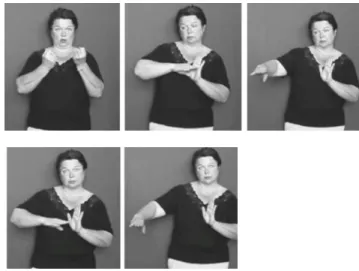
Figures 1a-1e illustrate the examples presented in Table 1. There is one example of the different combinations of a handshape class and a movement class.
Figure 1a. A car ran on a hilly road. (Combination of a whole entity handshape and a process movement: an
entity is moving.)
Figure 1b. There is a car parked. (Combination of a whole entity handshape and a contact movement: an entity is
located.)
Figure 1c. There are cars in lines in the car park. (Combination of a whole entity handshape and a tracing movement: several
Figure 1d. I picked up a leaf from the ground. (Combination of a handling handshape and a process
movement: an agent is moving an entity.)
Figure 1e. The door has broad frames. (Combination of a size- and shape-tracing handshape and a tracing 1.3. Corpus-based Research on Depicting Signs Until now there has been little corpus-based research on depicting signs – the prevalence of different types of depicting signs or functions – in sign languages. One notable study, however, has been by Ferrara (2012) who, in her doctoral thesis, examined depicting signs in naturalistic Auslan conversation and narratives, concentrating on their function within clause-like units, their sign-level characteristics and their interaction with constructed action.
Ferrara (2012) compared conversation and narrative data and found that the narratives contained twice as many depicting signs as did the conversation data. Ferrara pointed out that the elicitation material may have influenced the results. In the conversation data there was no visual or other material but in the narrative data the material was visual, not linguistic. Purely visual material may motivate signers to use more depicting signs in their signing. In addition, in Ferrara’s study 82.2% of the depicting signs were produced with two hands, either two-handed symmetrical or asymmetrical. Most often the non-dominant hand was in the background participating in the depicted action being carried out by the dominant hand. (Ferrara 2012.)
In this analysis, our research question was to what extent depicting signs occur in different text genres: introductions, narratives and discussions.
2. Data and Methods
The data of this analysis consist of the signing of 22 informants who are all early signers, i.e. they are the deaf or hearing children of deaf signing parents or they are deaf children who have acquired sign language as their first language in early childhood (or some older deaf persons at school age). The informants are between 18 and 84 years of age. Table 2 shows the age groups and the number of informants in each group. Twelve of the informants are men and ten are women.
Age group Number of informants
18-29 4 30-39 5 40-54 1 55-69 7 70 - 5 Total 22
Table 2. The number of informants in different age groups.
Most of the informants are from the central part of Finland, one is from eastern Finland and one from southern Finland.
The data were filmed in a professional studio setting with six cameras; one camera recording a general view, two recording the complete picture, two a closer picture of each interlocutor, and one recording the interlocutors from above. Two informants were interacting with each other in each session, led by a native signer.
The sign language data were gathered by giving the informants seven different language tasks: 1) an introduction, 2) a discussion of work or hobbies, 3) narrating about cartoon strips (Ferd’nand), 4) narrating about a video, 5) narrating a story from a picture book (The Snowman, and Frog, where are you?), 6) discussing a topic related to the deaf world, and 7) free discussion (e.g. on travelling, TV programmes, sports). Tasks 1–2 and 6–7 are discussions, and tasks 3–5 are narrative monologues, but the other interlocutor was able to put comments or questions during the narration.
For this research tasks 1) introduction, 5) narrating a story from a picture book, and 6) discussing a topic related to the deaf world were analysed. The introduction data includes talking about the participants’ name signs, their
childhood, where each of the participants was born and where they went to school, as well as their family background. Before narrating from the picture books the participants had time to go through the books and gather their thoughts. When narrating they no longer looked at the book. Discussing a topic related to the deaf world was a free discussion without any elicitation material. The total length of the data is seven hours: task 1 is 3 hours, task 5 is 1.5 hours, and task 6 is 2.5 hours. The total number of tokens is 43,532.
In our corpus project we have decided to code depicting signs on the ID tier according to the handshape classes presented above. Depicting signs are annotated with the code _ds (_kv in Finnish). The different classes of handshapes are separated with the codes we (whole entity), hd (handling), and ss (size and shape) (See Figure 1)1. In order to explore depicting signs according to the movement types, an extra annotation tier will have to be added; this is easy to create later because, the depicting signs are already identified on the ID tier. In the Auslan corpus, for example, depicting signs are grouped into four sub-types: signs depicting movement, location, handling and size and shape (Johnston 2016; Ferrara 2012).
Figure 1. A snapshot of the ELAN screen. In the annotation process every sign is estimated as to whether it has a lexicalised form or not and what kind of function it serves in the signing text. If it cannot be glossed with a fixed gloss and it serves a depicting (predicative) function in the text, it is annotated as a depicting sign.
To support annotation, a web-based lexical database, Signbank, originally created for the Auslan corpus2,3, was created for the CFINSL (Salonen et al. 2016). The glosses
1 Cf. Johnston (2016) Auslan Corpus Annotation Guidelines: type-like information precedes token-like infor- mation. 2
Auslan Signbank http://www.auslan.org.au
3 CFINSL Signbank has been developed on the basis of the NGT Signbank http://signbank.science.ru.nl
in Signbank are exported to ELAN via ECV (externally controlled vocabulary). This helps to keep the annotation conventions consistent and makes the annotation easier and quicker.
3. Results
In our data, depicting signs occurred most frequently in narratives (1413), second most frequently in discussions (500) and least frequently in introductions (413). Table 3 shows the frequencies in detail.
DS types Introduction Narrative Discussion Total
dswe 146 658 253 1057
dshd 135 479 128 742
dsss 132 278 119 529
Total 413 1413 500 2328
Table 3. The number of depicting signs in different genres.
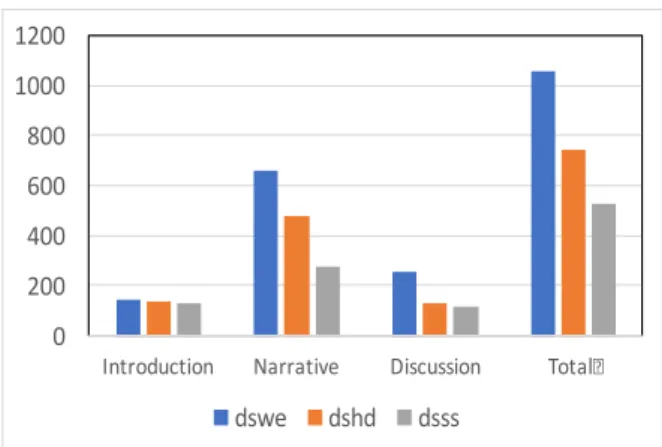
If we look at the frequencies of different types of depicting signs, those that depicted the whole entity moving or being located were the most frequent in all genres (dswe). The second most frequent were those signs that expressed the handling of entities (dshd). The least frequent depicting signs were those with size- and shape- tracing handshapes (dsss). The difference between the two groups dshd and dsss was largest in the narratives. On the other hand, in the introduction and the discussion data they occurred almost equally often.
Figure 3 shows the prevalence of the different classes of handshapes in a more visual form.
Figure 3. Occurrences of different handshape types in depicting signs in different genres.
Figure 4 displays the percentages of depicting signs in different genres. Depicting signs occurred most often in the narratives (17.9%) in relation of all signs in this genre. In the discussion only 2.9% and in the introductions only
0 200 400 600 800 1000 1200
Introduction Narrative Discussion Total
2.2% of all signs were depicting signs. In the corpus-based study of de Breuzeville et al. (2009) the proportion of depicting signs in narratives was 9%. In BSL conversation data the prevalence of classifier signs was 2.3% (Fenlon et al. 2014) and in Auslan casual free conversation it was 7.3 % (Johnston 2012).
a b c
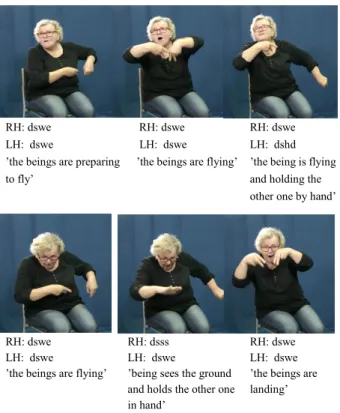
Figure 4. The percentages of depicting signs in a) the introductions, b) the narratives, c) the discussions. An example from the FinSL corpus of depicting signs including different handshape classes is presented in Figure 5. This clip is from the Snowman story. The signer uses both hands while depicting how the Snowman (RH:dswe) and the boy (LH:dswe) are about to leave the ground and then they fly upwards (dswe). The Snowman (RH:dswe) is holding (LH:dshd) the boy’s hand. While flying (dswe) they look down and the Snowman sees the surface (RH:dsss) of the earth, and he holds (LH:dshd) the boy’s hand until they come down again (dswe).
RH: dswe RH: dswe RH: dswe
LH: dswe LH: dswe LH: dshd
’the beings are preparing ’the beings are flying’ ’the being is flying
to fly’ and holding the
other one by hand’
RH: dswe RH: dsss RH: dswe
LH: dswe LH: dswe LH: dswe
’the beings are flying’ ’being sees the ground ’the beings are and holds the other one landing’ in hand’
Figure 5. Example of depicting signs including different handshape types.
4. Discussion
The results show that the prevalence of depicting signs is highest in narratives. That was shown also by Ferrara (2012) and in other earlier studies (e.g. Morford & Macfarlane, 2003; Johnston, 2012), and it is similar to everyday experience in sign language use. The introduction and discussion data showed a low number of depicting signs even though the duration of their data was twice as long as that of the narratives. On the other hand, the signing speed may have been quicker and the production smoother in narratives compared to introductions and discussions, which were interrupted by the interlocutor’s comments and questions.
The visual elicitation material – as Ferrara (2012) noted – may have affected the notably higher number of depicting signs in narratives. The topic of the discussion may also affect how much and what kinds of depicting signs appear there (e.g. Keränen, 2017). It is an interesting and still open question whether the quality of the narrative in terms of whether it is about a private experience or talking about other people affects the frequencies of different types of depicting signs.
The classification of depicting signs – and even the terms used for that kind of sign – varies from one researcher to another, which affects the annotation conventions. Additionally, whatever kind of classification is created, the decision about what is annotated as a depicting sign is not always easy. All this makes it more difficult to make comparisons between different datasets or corpora. The comparison of frequencies can only be approximate. Nevertheless, corpora will make it much more efficient to carry out cross-linguistic studies than it has been with separate small datasets.
In order to study depicting signs in FinSL (or in FinSSL) in more detail we need to create additional tiers, e.g. from the perspective of the movement of the depicting signs, as well as to analyse the use of one or two hands and their functions. It would be interesting to study the contexts and iconicity (pantomimic, perceptual or both) of depicting signs in different genres, i.e. what is behind the frequencies. A more detailed analysis of depicting signs as well as of other partly-lexical signs is important in the description of sign languages. The more we know about the structural potential and function of these signs, the better we can contribute to knowledge about human languages and the better we can teach sign language as a mother tongue to early signers and as a foreign language to foreign language learners, e.g. to the hearing parents of deaf children.
5.
Acknowledgements
The authors wish to thank the informants, the S. and A. Bovallius Foundation, The Swedish Cultural Foundation
in Finland and the Ministry of Education and Culture for financial support for the CFINSL project as well as the reviewers for the comments on the manuscript.
6.
Bibliographical References
Brennan, M. (1992). The visual world of BSL. In D. Brien (Ed.) Dictionary of British sign language / English. London, Boston: Faber and Faber, pp. 1–133. Brentari, D. & Padden, C. (2001). Native and Foreign Vo-
cabulary in American Sign Language. In D. Brentari (ed.), Foreign Vocabulary in Sign Languages. Mahwah, NJ: Lawrence Erlbaum, pp. 87–119.
de Beuzeville, L., Johnston, T. & Schembri, A. (2009). The use of space with indicating verbs in Auslan. A corpus-based investigation. Sign Language & Linguistics 12:1, 53–82. doi 10.1075/sl&l.12.1.03deb Cogill-Koez, D. (2000). A model of signed language
‘classifier predicates’ as templated visual representation. Sign language & linguistics 3, pp. 209– 236.
Crasborn, O. & Sloetjes, H. (2008). Enhanced ELAN functionality for sign language corpora. In Construction and Exploitation of Sign Language Corpora. 3rd Workshop on the Representation and Processing of Sign Languages. Paris: ELRA, pp. 39– 43.
DeMatteo, A. (1977). Visual imagery and visual analogues. In L Friedman (Ed.), On the other hand: Resent perspectives on American sign language. New York: Academic Press, pp. 109–136.
Emmorey, K. & Herzig, M. (2003). Categorical versus gradient properties of classifier constructions in ASL. In K. Emmorey (Ed.), Perspectives on Classifier Constructions. Mahwah, New Jersey: Lawrence Erlbaum Associates, Inc., pp. 199–220.
Erlenkamp, S. (2009) “Gesture verbs”. Cognitive-visual mechanism of "classifier verbs" in Norwegian Sign Language. CogniTextes, Volume 3/2009. DOI : 10.4000/cognitextes.250
Ferrara, L. (2012). The grammar of depiction: Exploring gesture and language in Australian Sign Language (Auslan). Doctoral thesis. Department of Linguistics, Macquarie University, Sydney, Australia.
Johnston, T. & Schembri, A. (2007). Australian Sign Language (Auslan): An introduction to sign language linguistics. Cambridge: Cambridge University Press. Johnston, T. & Schembri, A. (2010). Variation,
lexicalization and grammaticalization in signed languages. Langage et société, 131, 19–35. DOI: 10.3917/ls.131.0019
Johnston, T. (2012). Lexical frequency in signed languages. The Journal of Deaf Studies and Deaf Education, 17(2), 163–193.
Johnston, T. (2016). Auslan Corpus Annotation Guidelines.
http://www.academia.edu/29690332/Auslan_Corpus_ Annotation_Guidelines_November_2016_revision_ Keränen, J. (2017). Käsiotteen ja viittomakielisen
käsimuodon välinen ikonisuus
kognitiivis-semioottisesta näkökulmasta. (Iconicity of hand grasp and handshape of signed language from the
cognitive-semiotic perspective.) Master’s thesis. Jyväskylän yliopisto, Kieli- ja viestintätieteiden laitos. https://jyx.jyu.fi/dspace/bitstream/handle/123456789/5 2903/URN%3aNBN%3afi%3ajyu-201701301315.pdf ?sequence=1
Liddell, S. & Johnson, R. (1987). An analysis of spatial-locative predicates in American sign language. Paper presented at the fourth international conference on sign language research, 15–19 July, Lappeenranta, Finland.
Liddell, S. (2003). Grammar, gesture, and meaning in American sign language. Cambridge: Cambridge University Press.
Morford, J. P. & Macfarlane, J. (2003). Frequency Characteristics of American Sign Language. Sign Language Studies, 3 (2), 213–225.
Salonen, J., Takkinen, R., Puupponen, A., Nieminen, H. & Pippuri, O. (2016). Creating Corpora of Finland??s Sign Languages. In E. Efthimiou, F. Stavroula-Evita, T. Hanke, J. Hochgesang, J. Kristoffersen & J. Mesch (Eds.), Proceedings of the 7th Workshop on the Representation and Processing of Sign Languages: Corpus Mining [organized as a part of LREC'16 at Portoroz, Slovenia, May 28, 2016]. Paris: European Language Resources Association (ELRA), pp. 179– 184.
Schembri, A. (1996). The structure and formation of sign in Auslan (Australian sign language). Renwick College Monograph No. 2.
Supalla, T. (1982). Structure and acquisition of verbs of motion and location in American Sign Language. P.h.D. thesis, University of. California.
Takkinen, R. (2008). Kuvailevat verbit suomalaisessa viittomakielessä. (Depicting verbs in Finnish Sign Language.) Puhe ja kieli 28:1, 17–40.
Tolar, T. D., Lederberg, A. R., Gokhale, S. & Tomasello, M. (2008). The Development of the Ability to Recognize the Meaning of Iconic Signs. Journal of Deaf Studies and Deaf Education, 13, 225–240. Wallin, L. (1994). Polysyntetiska tecken i svenska
teckenspråket (Polysynthetic signs in the Swedish Sign Language). Doctoral dissertation. Institutionen för lingvistik, Avdelningen för teckenspråket, Stockholms universitet.
7. Language Resource References
ELAN. Max Planck Institute for Psycholinguistics, The Language Archive, Nijmegen, The Netherlands. URL: http://tla.mpi.nl/tools/tla-tools/elan.