JOURNAL OF THEORETICAL AND APPLIED MECHANICS 43, 2, pp. 405-425, Warsaw 2005
SOME REMARKS ON DYNAMIC RESULTS FOR AVERAGED AND EXACT MODELS OF THIN PERIODIC PLATES
JAROSLAW JJ;;DRYSIAK BOHDAN MICHALAK
Department of Structural Mechanics, f,6di University of Technology e-mail: jarek@p. lodz. pl; bmichala@p. lodz. pl
The aim of the paper is to show certain justification of the new non-asymptotic model of thin periodic plates, derived using the tolerance averaging (Woiniak and Wierzbicki, 2000). The model describes the ef-fect of periodicity cell size on overall plate behaviour, on the contrary to known homogenised models. Results obtained from those models will be compared to solution to and from the "exact" discrete model. It is shown that for long-wave propagation problems, results obtained for a special case of a periodic plate strip (weightless but covered by a perio-dically distributed system of two concentrated masses) within the non-asymptotic model arc close results calculated from the known "exact" solutions based on the method used to analyse longitudinal vibrations of one-dimensional diatomic lattice (Brillouin, 1953). Similar conformity, taking place in special cases of short waves, is also presented.
Key words: periodic plate, effect of periods lengths, travelling wave
1. Introduction
In order to show conformity of results by the proposed averaged model and the "exact" model, the problem of a travelling wave, propagating in a homogeneous weightless and unbounded thin plate strip along the x1 -axis, with a periodically distributed system of two concentrated masse::; M1 , M2 (M1
>
M2) (Fig. 1; j = 0, ±1, ±2, ... ) will be analysed in this contribution. The strip is assumed to have constant thickness h and to be made of a material with constant Young's modulus E and Poisson's ratio 11. In the plate strip, a small repeated element can be distinguished, which is called the cell. The cell is treated as a thin plate strip with a span l along the x1 -direction. Thus,406 J. JF,DRYSIAK, B. MICHALAK
the plate strip under consideration can be analysed as a plate with an internal periodic structure.
. l
Mi
CM,
• ' 6=--·-l-!---... -r--~1-
I
-I
X•X1
Fig. 1. Plate strip with periodically distributed system of two concentrated mru>se:o M1,M2
To analyse periodic plates, many 2D averaged plate models were formula-ted. Models based on the asymptotic homogenisation can be mentioned, e. g. those using the effective plate stiffnesses, Kohn and Vogelius (1984). However, these models neglect the effect of element length (called the length-scale ef -fect or the effect of periods lengths) on the overall plate behaviour in the first approximation which is usually employed.
In this note, an alternative treatment of dynamic phenomena for periodic structures, called the tolerance averaging technique, is applied. This approach, presented for periodic composites and structures by Woiniak and Wierzbicki (2000), leads to models taking into account the effect of periods lengths on dynamic response of a plate. Those averaged models, called the length-scale models, were applied to analyse certain dynamic problems of periodic structu-res, e. g. for Hencky-Bolle periodic plates by Baron and Wozniak (1995), for Kirchhoff's periodic plates by J~drysiak (200la,b), for periodic wavy-plates by Michalak (2000, 2001). A list of papers related to investigations of periodic composites was shown in the book Woiniak and Wierzbicki (2000). Using the tolerance averaging to partial differential equations of periodic structures, the governing equations with constant coefficients are obtained. They describe the effect of period lengths by means of certain extra unknowns.
The main aim of this contribution is to show that re8ults obtained by the new non-asymptotic model are very close to re8ults found from the "exact" solution (the discrete model - Brillouin (1953)) for long-wave propagation problems. Moreover, similar results of both models will also be presented for special short-wave problems. In order to show the justification of the non-asymptotic model, frequencies of the travelling wave in the considered plate strip with an internal periodic structure calculated within the new model,
J~drysiak (2001b), a certain homogenised model and the one obtained from the "exact" solution, Brillouin (1953), will be compared.
SOME REMARKS ON DYNAMIC RESUJ:rs ... 407
2. The modelling approach
In our considerations, the governing equations of the non-asymptotic model of periodic plates derived and applied in J~drysiak (2001b) are used. These equations and an outline of the procedure leading to them will be recalled in this section.
2.1. Foundations
Denote an orthogonal Cartesian co-ordinate system by Ox1x2x3 and defi-ne
t
as the time co-ordinate. The plate midplane is denoted by ll and the plate thickness by h. The mesostructure parameter is defined by l, which describes the size of the periodicicity cell, and is large compared to the plate thickness and small compared to the minimum characteristic length dimension of the plate midplane. For the plate strip under consideration the mesostruc-ture parameter l is the length of the cell (L1=
IO,
l] x{O})
along the xi-axis. Moreover, denote by aijkl, p, p components of the elastic moduli tensor, mass density, loading in the x3-a.xis direction acting on the plate, respectively. The horizontal planes (x3 = const) are assumed to be the planes of elastic sym-metry. Denote by x=
(x1, x2) a point on II and by w(x, t) a plate midplane deflection at the point x Ell. Throughout the paper, the subscripts a,(3, ...run over 1, 2 and indices A, B, ... run over 1, ... , N. The summation conven -tion holds for all aforementioned indices.
The considerations are based on the well-known Kirchhoff plate theory assumptions: kinematic constraints, strain-displacement relations, stress-strain relations, equations of motion. We use the following notations for periodic functions
h/2 µ
=
./
p dz-h/2
h/2
daf3'yo
=
./
Caf3-yo z2 dz-h/2
(2.1)
describing plate properties as the mass density per unit area, bending stiffnes-ses, respectively; where Caf3-ro
=
aa/3-yo - a0,e33a-yo33 ( a3333 )-1
. The assumptions of the Kirchhoff plate theory for periodic plates lead to the known differen-tial equation of the fourth order for the plate midplane deflection w(-, t) with highly oscillating periodic coefficients
(da/3-yoW,-yo),a,B
+
µw
=
p (2.2) The governing equations with constant coefficients can be derived usingthe
tolerance averaging technique, Woiniak and Wierzbicki (2000). This procedu-re for thin periodic plates was shown in JEtdrysiak {2001b) and for periodic408 J. J~DRYSIAK, B. MICHALAK
wavy-plates in Michalak (2001). In the new modelling method, we use some additional concepts as: an averaging operator given by
(cp) = (cp)(x)
=
l-1 / cp(y) dyLi(x)
x E flLi
y E Ll(x)
for the one-dimensional cell (Ll
=
[O,l] x {O}) along the x1-axis and fora.n arhitrary integrable function cp defined on
n,
where Ll(x) :::: x+
Ll,lltl
=
{x :
x E fl, Ll(x) C fl}; tolerance system, slowly varying function, periodic-like function and oscillating function, which were defined in the book by Wozniak and Wierzbicki (2000). Below, they will be reminded. Let F, G be functions defined onn
andf
be a Ll-periodic function. If the approximation(! F)(x) 2:! (f)F(x) (2.3)
holds for every
J
(with the required accuracy. which depends on /) then Fiscalled a slowly-varying function. If for every x E llLl there exists a Ll-periodic function
Gx
such that the approximation(JG)(x) ~ (JG'1:)(x) x E flLi (2.4)
holds as above, then G is referred to as a periodic-like function. In this case
Gx
is termed a Ll-periodic approximation ofG at
x.Formulae (2.3)-(2.4) were called the tolerance averaging approximations in the aforementioned book. The dependency of these formulae on Ll and on a certain tolerance system T was shown. We shall write F E SV(T)
for the function F, which is slowly-varying together with its derivatives and r. E P L(T) for a periodic-like function G.
The periodic-like function G with the condition (µG)(x) 2:! 0 for every
x
E llLl, where µ(-)is a positive-valued Ll-periodic function defined by (2.1)1, is called an oscillating periodic-like function. The set of oscillating periodic-like functions with the weight µis denoted by P JJ'(T).Bearing in mind the assertions given in the book by Woiniak and Wierz-bicki (2000), we recall that if G E P L(T) and
f
is a Ll-periodic function then(G/}(·) E SV(T).
Detailed discussion of the above concepts was shown in the aforesaid book, in which the assertions of the tolerance averaging were formulated and proved. 2.2. Outline of the modelling procedure
An additional assumption called the Conformability Assumption (CA), cf. Wozniak and Wierzbicki (2000), J~drysiak (200Ib), is formulated. It states
SOME REMARKS ON DYNAMIC RESULTS ... 409
that the midplane deflection w(-, t) of the periodic plate has to conform to a plate structure, i.e. it can be represented by a periodic-like function, w(·, t) E PL(T). This condition may be violated only near the plate boun-dary.
The modelling procedure of the tolerance averaging can be divided into
four steps.
1) The deflection w is a periodic-like function, w(-, t) E PL(T), thus, the
decomposition can be obtained
w(-,
t)
=
W(·,t)
+
f(-, t) (2.5)where W is the averaged part of the deflection defined by W(·,t) ::::: (µ)-1(µw)(-,t) (µistheplatemassdensity); f(-,t) E PLµ(T) is fluctuation of the deflection and holds the condition (µf(-, t)) = 0. Because w(·, t) E P L(T) we have that W(·,
t)
E SV(T). Hence, it is called macrodeflection.2)
The periodic problem is formulated on a cell Ll(x) for fx, which is aLl-periodic approximation of the fluctuation f on Ll(x) at x E Il,tJ.
This problem is described by the condition (µfx) = 0 and variational equation
(cf.
Woiniak and Wierzbicki, 2000; J~drysiak, 200lb)U,;
0daf3-yofx,af3)(x,t)+
(µf*fx)(x,t)=
(f*p) -U,;
0da13'·yo)W,af3 (2.6)which has to hold for every test function
f*,
(µf*)=
0.3) A solution fx(-, t) to Eq. (2.6) is looked for. For every x E IJd, Eq.
(2.6) describes vibrations fx(x, t) of the cell Ll(x) with the periodic boundary conditions on the cell edges. The right-hand side of (2.6) can be interpreted as certain time dependent loadings on the cell Ll(x). Hence, general solutions to periodic problem (2.6) can be obtained using the method applied to dynamics of structures with an arbitrary time dependent loading. After neglecting the loadings in (2.6), we have a periodic problem on Ll(x) given by
(2.7) Assuming fx(Y, t) = g(y) cos(wt), y E Ll(x), from (2.7) we obtain pe-riodic eigenvalue problems of finding Ll-periodic functions g satisfying in Ll( x) the following equation
[daf3-yo(Y)9,a,8(Y)l,-yo - µ(y)>.2g(y)
=
0 y E Ll(x)410 J. J~DRYSIAK, B. MICHALAK
where .A are eigenvalues. From averaging (2.8) on Ll(x) we have (µg) = 0. The functions g have to satisfy the periodic boundary con-ditions on the edges of Ll(x) and the same regularity conditions as the deflection. An approximate solution fx(y, t) to problem (2.7), which may be obtained by the orthogonalisation method, will be assumed in the form gA(y)QA(x,
t),
where gA(-), A=
1, 2, ... , is a sequence of eigenfunctions defined on Ll(x) for the above eigenvalue problem and related to the sequence of eigenvalues AA. The fluctuation of the deflec-tion
f
C
t), being a solution to the periodic problem on Ll(x) given by variational condition {2.6), as every function can be written in the form of Fourier series. The infinite series can be approximated by a trunca-ted series (cf. Woiniak and Wierzbicki, 2000; J~drysiak, 2001b) in the following form(2.9) where y E Ll(x), x E IJLl; A = 1, ... , N and N determines different degrees of the approximation; gA stands for the system of N linear-independent Ll-periodic functions, such that (µgA) = 0 and l-1 gA (-), g;t(-), lg~
13
(-) E O(l); QA(·,t)
E SV(T) are new kinematic unknowns. Functions gA are called mode-shape functions. These functions approxi-mate the expected form of the oscillating part of free vibration modes of the Ll-periodic structure of the plate, cf. (Woiniak and Wierzbicki, 2000; J~drysiak, 2001b).4) After some Lrarn;formaLiuns, using Lhe Lukram;e averaging aµµruxima-tions, we obtain equations for the macrodeflection W and equations for the kinematic unknowns QA. These equations are written in the subse
-quent Section.
2.3. Governing equations of the non-asymptotic model
The aforementioned modelling procedure leads to the following equations of the non-asymptotic model of plates with an internal periodic structure (J~
drysiak, 2001b)
(2.10)
(daf31'89~o)W,of3
+
(dof31'89~(39~o)Q
8+
(µgAg8
)Q
8 = (pgA) where the underlined terms depend on the mesostructure parameter l. All co-efficients in brackets ( ·) are constant. The functions W, QA, A = 1, ... , N, areSOME REMARKS ON DYNAMIC RESULTS ... 411
basic unknowns which have to be slowly varying functions. The function W is
called the plate macrodefiection; functions QA are called the internal variables.
Summarizing, the non-asymptotic model is defined by:
1° Equations (2.10) for N+l unknowns, W(·, t) and QA(-. t), A= 1, ... , N
2° Conditions of applicability of the model, i.e. Eqs. (2.10) have physical
sense for the unknowns W, QA being slowly varying functions for every
t
(it is a certain a posteriori criterion of physical reliability for this model of periodic plates)
3° The plate deflection can be approximated by means of the formula
w(., t) '.:::'. W(., t)
+ gA(-)QA(., t)
where the approximation " '.:::'. " is related to the assumption that the
fluctuation of the deflection is defined in the form of the truncated series
gA(-)QA(·, t), A= 1, ... , N.
It is easy to see that in order to obtain the above equations, we must
pre-viously derive the mode-shape functions gA, A
=
1, ... , N, for every periodicplate under consideration as solutions to a certain eigenvalue problem on the
periodicity cell, given by Eq. (2.8). In practice, derivation of these exact solu-tions is possible only for celts with a structure which is not too complicated.
In papers by J~drysiak (2001a,b), such solutions were shown for a plate strip
with periodically varied but piece-wise constant thickness, Young's modulus
and mass density of the plate. But in most cases we have to look for an
ap-proximate form of these solutions, which is sufficient from the computational point of view. However, in order to obtain exact solutions to that problem
for cells with a more complicated structure, the finite clement method can be
applied. We also restrict our considerations to a small number N of mode s
ha-pes. For the analysed structure, which will be presented in Section 3.1.l(b), we have only one mode-shape function, and hence N = 1 and g
=
g1. Inthe subsequent Sections both solutions to the eigenvalue problem, Eq. {2.8), i.e. exact and approximate, will be shown and applied. Equations (2.10) are
derived in the paper by J~drysiak (2001b).
At the end of this Section, let us observe that neglecting the underlined
terms in Eqs. (2.10), we obtain governing equations of the homogenised model
in the form
.. A A
{da,B-y.S) W,a,8-y6
+
{µ) W+
{da,B-y69,"(6)Q,a.B =IJ>)
(2.11)
(da,8"(69:1ap9,~6)
Q
8=
-(dalh69~6)
W,a/3412 J. J~DRYSIAK, B. MICHALAK
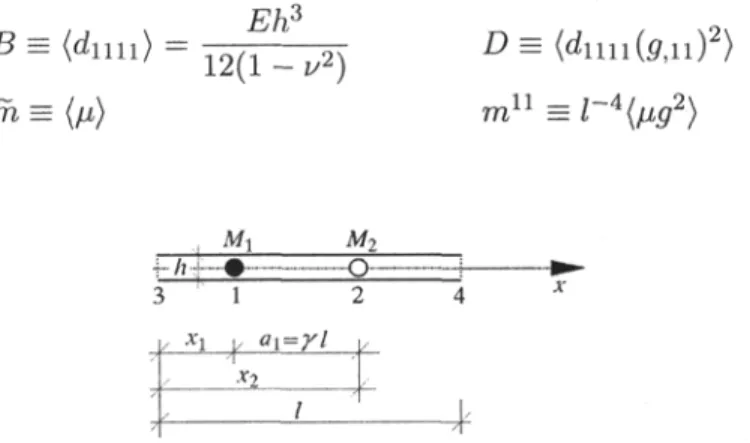
3. A travelling wave in a weightless unbounded plate strip with a periodically distributed system of two concentrated masses
3.1. Averaged models 3.1.1. Non-asymptotic model
(
a
)
Frequencies of travelling waveLet us consider a homogeneous unbounded plate strip along the x
=
x1axis, whose periodicity is related to a periodically distributed system of two
concentrated masses Mi and M2 (Fig. 2). The distance between masses Mi
and M2 is denoted by ai and the distance between masses M2 and Mi by a2
(hence a2
=
l - a1 ). It is assumed that Young's modulus E, Poisson's ratio 11and also thickness h of the plate are constant. Moreover, the plate mass is negligibly small compared with the concentrated masses M1 and M2. Loads p are neglected. In our considerations, only one mode-shape function g is assumed. Denote Q
=
Q1 as well asEh3
B
=
(d1111) = 12(1 - v2)m
=
(µ)D
=
(duu (g,11 )2) mll=
z-4(µg2)-
~
·
/~r
·
t-1.f
~
-
~
=====-~Ot::::=:::T~~
·
~
3 I 2 4
·~
x,
.
r
•1=r1·
~
: , Xz I :
Fig. 2. Periodicity cell of plate strip under consideration
(3.1)
Moreover, for the homogeneous plate is (duu9,11) = 0. For A = N = 1 from (2.1) we arrive at
BW,i11i
+mW=
O (3.2)It can be observed that we obtain two independent differential equations of the plate strip under consideration. The first of them describes vibrations of the plate strip for the "macro" scale, and the second equation determines
SOME REMARKS ON DYNAMIC RESULTS .•. 413
Introduce now a wave number k (e. g. k = 27r / L). Solutions to equations (3.2) will be assumed as
W(x, t) = Aw exp[i(kx - wt)] Q(x, t) = AQ exp[i(kx - wt)] (3.3)
where Aw, AQ are amplitudes, w is a frequency. After some transforma-tions we arrive at formulae for the lower w_ and higher w+ frequency of the travelling wave within the non-asymptotic model for the plate strip under con-sideration
(w_)2 =
B~4
m2 D
(w+)
=
L4m11 (3.4)In this case, only the higher frequency w+ explicitly depends on the
mesostruc-ture parameter l. This frequency is related to the internal periodic structure of the plate strip.
(b) Eigenvalue problem of the periodicity cell
Denote by x a coordinate on a certain axis of the cell; x E
[O, l];
and the derivative by (-)'=
0,1·
Eigenfunctions for the periodicity cell will beobtained by solving eigenvalue problem (2.8), which takes the form
Bgrv (x) - µ(x)..\2g(x)
=
0 (3.5)with periodic boundary conditions on the cell edges; B is the stiffness defined by {3.1)1; g are l-periodic functions related to eigenvalues ,\
=
al (a is thewave number); and (µg) = 0. In the case uu<ler consideration, after neglecting
the plate mass when compared with the concentrated masses, the exact form of
eigenfunctions g(x) can be found. Functions g describe forms of free vibrations of the cell. From structural dynamics, it is known that for the considered cell (with two degrees of freedom) we have two eigenfunctions satisfying Eq. (3.5).
Under the condition (µg) = 0, we obtain only one eigenfunction g.
In the following considerations, the deflection of the cell can be described
similarly to deflections of the beam with the stiffness B defined by {3.1)1. In
order to find the function g, methods of structural mechanics will be applied.
Introduce the following functions r(~) = 1 - 3(2
+
2eu(~) = ~ - 2(2
+
~3r(~) = 3(2 - 2~3
u(~)=e-e (3.6)
where { E [O, lJ. Joints of masses M1 and
M2
are described by 1 and 2,respectively; and joints of the left and right ends of the cell by 3 and 4 (see
414 J. J~DRYSIAK, B. MICHALAK
x1, x2) are denoted by v1, <p1, v2, <p2, respectively, and of the joints of the left and right ends by: v3, <p3, and V4, <p'1· Deflections of parts 3-1, 1-2, 2-4 will be described by
v31 (~) = r(Ov3
+
u(~)<p3l31+
r(~)v1 - u(O<p1 l311112(~) = r(~)v1
+
u(~)<p1li2+
r(~)v2 - u(~)<p2l12 (3.7)v24(~) = r(~)v2
+
u(()<p2l24+
r(Ov4 - u(O<p4l24where lik
=
Xk - Xi is the length of the part i - k (i=
3, 1, 2, 4; k=
1, 2, 4); Xi, Xk are coordinates of the joints i, k; x E [xi,xk]; ~ = (x - xi)(lik)- 1. The function g has to satisfy periodic boundary conditions on the cell ends, i.e.g(O) = g(l) = V3
=
V4g"(O) = g"(l)
g'(O)
=
g'(l)=
<p3 = <p4 9111(0)
=
9111 ( l)(3.8)
From the equilibrium equations of known from structural mechanics formulae for transversal forces and moments and inertia forces and moments related to the concentrated masses, which are depended on the aforesaid displa<:ements of the joints, and from boundary conditions (3.8) and the normalizing condition (µg) = 0, we arrive at the characteristic equation for eigenvalues ), =al (a is the wave number) in the form of a determinant equaled to zero
detLpr = O where
p,r= l, ... ,4
2l
L24 =
-x2 - X1
(3.9)
SOME REMARKS ON DYNAMIC RESULTS ... 415
) 3 3 4
£31
=
-(>.4 + 12(1 + ( l + l2l + (>. . (x2 - x1)3 (l - x2)3 2(l - x2)2{2 3 3 2 2 }
· y[(x2 - l) - (x1 - l) ]
+
3[(x2 - l) - (x1 - l) J+
(xz - xi)l12l3 6l2
L32 = L33
= ---.,..
(l - x2)3 (x2 - x1)2
L34 = -6l2 ( 1 - 1 ) (l - x2)2 (x2 - xi)2
6(1
+
()l2 6l2 (>.4 { 2 3 3 L41 = (x2 - xi)2 - (l - Xz)2+
6(l - x2) z2 [(x1 - l) - (x2 - l)l
+
3[
2 2 }+y (x1-l) - (x2-l) ]+x1-x2
6l2 2l
L42 = - (l - x2)2 L43 = x2 - x1 L44 = 4 l ( -1-
+
1 )l-x2 x2-x1
and ( ~ 0 is defined by
(3.11) From Eq. (3.9), we can derive one eigenvalue A (hence A= N = 1) dependent
of the quotient (. Introduce notations
Yi1 = L22(L33L44 - L43L34)
+
L32(L43L24 - L23L44)+
L42(L23L34 - L33L24) Yi2 = L22(L41L34 - L31L44)+
L32(L21L44 - L41L24)+
L42(L31L24 - L21L34) Yi3 = L22(L31L43 - L41L33)+
L32(L41L23 - L21L43)+ L42(L21L33 - L31L23)
E = L21 (L43L34 - £33£44)
+
L31 (L23L44 - L43L24)+
L41 (L33L24 - L23L34) Formulae for needed deflections and rotations of joints 1, 2, 3, 4 take the following forml,T, - -1
V1
=
~l.:; <,01 = ,!1'2.::: 7, --1416 J. J~DRYSIAK, B. MICHALAK
Bearing in mind formulae (3.12), (3.10), (3.6)-(3.7), the exact form of the
mode-shape function g, related to the eigenvalue
>.
obtained from (3.9), can be written asg(x) = {
Al2Bo if x E
[
O,xi]
Al2B1 if xE(x1,x2] (3.13)
Al2B2 if x E (x2,l]
where A is a constant and
Bo= r(~) v3
+
u(~)<p3x1
+
r(~)v1
-
u(~)<p1x1
X1 l X1 l X1 l X1 l
B
1
=
r ( X - XJ ) -VJ+
u ( X - X1 )<p1
X2 - XJ+
- ( r X - X1 ) Vz -+
X2 - X1 l X2 - X1 l X2 - XJ l- ( X - X1 ) X2 - X1
- u
<p2
x2 - ::i;1 l
B
2=r - -
(X- X2)V2 -+u (X- -- X2)<p2
- - +
l- x2r
-(X-X2) -(X-X2)- -
- u - - <p3- -l-x2l - X2 l l - X2 l l - X2 l - X2 l
.'1.1.2. Homogenised model
In order to compare the calculated results, the homogenised model will also be applied. Equations (2.11) of the considered plate strip, under assumption
A = N
=
1, take the formBW1111+mW=O
' (3.14)
Assuming the solution to Eq. (3.14) in the form of (3.3)1 , after some
trans-formations we arrive at the following formula of only one frequency of the travelling wave within the homogenised model
Bk4
w2
=
--.:::-m (3.15)
The above formula is identical with the lower frequency, (3.4)1 for the non-asymptotic model.
3.2. "Exact" solution - discrete model
To verify the obtained results, the above problem of the plate strip will be analysed within the discrete model, which is similar to that applied by Brillouin (1953) to investigate longitudinal vibrations of a one-dimensional structure in which a repeatable element was related to a system of two concentrated masses
SOME REMARKS ON DYNAMIC RESULTS ... 417
M1 and M2 (Fig. 1). In the aforementioned paper, this model was treated as
the "exact" solution to the problem under consideration.
Let us now consider cells of the periodic structure numbered by j - 1, j, j + 1. Denote by
w:1
1,
ip:1
1 andw:1
2,<p:1
2 deflections and rotations of theconcentrated masses M1 and M2, respectively, at cell s = j - 1,j,j
+
1.Using the known formulae from structural mechanics for forces and moments
of the weightless unbounded plate strip (treated as a beam with stiffness B -·
( 3.1)1 ) and taking into account inertia forces and moments for the concentrated masses, the equilibrium equations could be written for both masses. After some transformations, we arrive at the following system of equations for deflections and rotations
MrwJ'1
1+ 6B[2(a}3
+
a2
3)wj11- 2(a}3wf2 +
a2
3w~
21
)
++(a}2 - a22)ipf I + (a}2<pr2 - a22<p~2l)J = 0
M2wj
-
6B[2(a}3wf' + a23wj'~:\)-
2(aj3 +a2
3)wj12 +( -2 M1 -2 M1 ) ( -2 -2) M2j Q
+
a1 'Pj - a2 'Pj+l+
al - a2 <pj=
(3.16)2B[3(a}2 - a22)wj11 - 3(a}2wf2 - a22w~21) + 2(a}I + a21 )cpf1 + +(a11'Pf2 + a21'P~1)J = 0
2B[3(a}2wf1 - a22w_j':!\) - 3(a}2 - a22)wJ'12 + (a}1cpf 1 + a21cp_j':!\) + +2(a}l + a21)cpf2J = 0
where a1 and a2 are distances between the masses M 1, M2 and M2, M1.
Solutions to the above equations will be found in the form
wJ'11 =
AwM
1 exp[i(kjl - wt)J
cpf1 = A'PMi exp[i(kjl -
wt)J
wJ'12
=
AwM2 exp{ i [ k(j +~
1)t
-
wt]}
cpf1
2= A'PM2 exp{i[k(j +
~
1)z -
wt]}
(3.17)
where AwM
1, AwM2, A'PMi , A'PM2 are amplitudes, k is the wave number (e.g. k = 2rr / L, and L is the wave length), l is the mesostructure parameter (cell
length), w is a frequency. Substituting the right-hand sides of (3.17) to Eqs.
(3.16), we obtain a system of four algebraic homogeneous equations for ampli
418 J. J~DRYSIAK, B. MICHAL/\!(
is equal to zero. From this condition, we obtain a characteristic equation for
the frequency w in the form
with coefficients defined by
a=
((M2)2!'2(1 - !')2{3+
2!'[1 - cos(kl)](l - !')}(3
=
12BM2 ((+
1)[2+
cos(kl)]6
=
72B2[3+
cos(2kl) - 4cos(kl)](3.18)
(3.19)
where B is stiffness of the plate strip (3.l)i; I'= aifl. Solutions to (3.18),
being the "exact" formulae for frequencies of the travelling wave in the
frame-work of the exact discrete model, have the following forms
tvi =
2
~l
3
((3+
J
f32 - 4ao) {3.20) where tv1 and tv2 are the lower and higher frequencies, respectively.It can be observed that only the exact discrete and the new length-scale model make it possible to investigate higher frequencies related to the periodic
structure of the plate strip. The homogenised model is not able to describe
higher vibrations.
4. Special case - short-wave propagation problem
Applications of the new length-scale model (and also the homogenised
mo<lcl) are related to long-wave propagation problems (in which kl
«
1).This re:;triction is caused by conditions of applicability of the proposed model, i.e. unknowns W, QA which have to be slowly varying function:;. However,
the "exact" solution (the discrete model) can be used to analyse not only long "'I.I.Yes but also short waves (kl
>
1).In this Section, it will be presented that special cases of short-wave pro-blems can be investigated also in the framework of the non-asymptotic model. In order to show such application, we will consider a travelling wave
propaga-ting in the plate strip, in which the periodicity cell has two pairs of concen-trated masses M1, M2 and span 2l. To analyse that problem, the mode-shape
function in the exact form, derived as in Subsection 3.1.lb, can be used, but this procedure leads to determinant {3.9) in which p, r = 1, ... , 8. Hence,
SOME REMARKS ON DYNAMIC RESULTS ... 419
simplifying our investigations, we will apply only approximate forms of mode-shape functions.
Let us consider a special plate strip with equal distances between the mas-ses Mi, M2, ai
=
a2 = l/2, where l is the mesostructure parameter (cf. Fig. 2). For the long-wave propagation problem, it will be shown that the application of approximate forms of mode-shape functions is sufficient from the calcula-tional point of view. Analysing free vibrations of that plate strip (the cell with span l), we will apply the exact form, (3.13), of the mode-shape function g and also the following approximate formx E
[O,l]
where the constant c derived from (µg) = 0 is
1 ( 2nx1 . 2nx2)
c =
-1
+
(
(sin - l -+
sm - l-( 4.1)
and x1, x2 are coordinates of the masses M1 , M2; ( is defined by (3.11).
Function (4.1) stands for an approximate solution to eigenvalue problem (3.5) for the cell with periodic boundary conditions. Assuming x 1 = l/4, x2 = 3l/4, we have
1 - (
C =
-1+( (4.2)
Correctness of applications of the approximate forms of mode-shape func-tions for cells with a simple structure was shown in J~drysiak (200la,b) for plate strips, whose masses were not negligibly small compared to concentrated masses.
For the short-wave propagation problem, i.e. in analysis of free vibrations of the plate strip in which a cell has two pairs of concentrated masses M1 ,
M2 and span 2l, the mode-shape function g, satisfying equation (3.5), will be assumed only in an approximate form given by
x
E
[O,
2l] (4.3) where d is a constant; the constant c = 0 from the condition (µg)=
0 for every d. Consider two cases of function ( 4.3):- the first for d = l/4
420 J. J~DRYSIAK, B. MICHALAK
which has roots at the joints with masses M2, i.e. at x2
=
3l/4, :i:2=
7l/4--the second for d = - l/4
(4.5) which has roots at the joints with masses M1 , i.e. at x1
=
l/4, x1=
5l/4.Analysing the travelling wave, the following formulae for frequencies will be used: (3.4) for the non- asymptotic model, (3.15) for the homogenised model and {3.20) for the discrete ("exact") model.
Now, certain coefficients will be calculated. For the discrete model, for ai
=
a2=
l/2 {hence /=
aifl=
1/2) the coefficients defined by {3.19)1,2 takethe form
a =
1
16
((M2)
2{3+~[1-cos(kl)J}
{3
=
12BM2(( + 1)[2 + cos{kl)](4.6)
Moreover, we can calculate from {3.1) coefficients for each of the three above approximate forms of mode-shape functions. Hence, we obtain for these three cases that
Eh3 B =
-12{1 - v2 ) (4.7)
where by applying ( 4.6)2 the concentrated masses M1 , M2 will be equally
"scattered" equally along the cell length l. Using {4.1) from {3.1)2 and (3.1)4, we have
m,11=mu=4M2_(_
l (
+
1 (4.8)However, using the mode-shape functions (4.4) or (4.5), the coefficient in (3.1)2 takes the form
~ 1 4
D
=
D=
-71' B2 and coefficient (3.1)4 for function (4.4) is
and for function ( 4.5)
m,11 = - m11 --
M2~
l~11 11 1
m
=
m
=Mr[
(4.9)
(4.10)
(4.11)
In the subsequent Section, some calculation results of the above problems will be presented.
SOl\1E REMARKS ON DYNAMIC RESULTS ... 421
5. Calculation results
In this Section, comparison between the frequencies of the travelling wa-ve obtained for three models: non-asymptotic model, homogenised model and
exact discrete model in the above Sections, will be shown. Introduce a
di-mensionless wave number: q
=
kl, and dimensionless frequency parameters describing frequencies of the travelling wavefL
=
JX.w-A1=
JX.w1f2+
=
JX.w+A2::: JX.w2
il=JX.w
where
x
=
12{1 - v2)M2/E; Eis Young's modulus; vis Poisson's ratio; w_,w+ arc frequencies {3.4) of the non-asymptotic model; w is frequency (3.15) of
the homogenised model; w1, w2 are frequencies (3.20) of the discrete model; k is the wave number; l is the mesostructure parameter {the cell length).
In calculations, we assume that the thickness of the plate strip is equal
h
=
0.ll, the ratio between masses M1 and M2 is given by the parameter(
=
2 {defined by {3.11)), i.e. M1=
2M2.Results are shown in Fig. 3 and Fig. 4. In Fig. 3 dispersion curves of para-meters
n_,
f2+, f2, Ai, A2 {describing frequencies) versus the dimensionlesswave number q E
[-7r, 7r]
are presented (for both the cases: long-wave and short-wave propagation problems). These plots are made, using exact form(3.13) of the mode-shape function g, for the concentrated masses M1, M2 located at points: x 1
=
0.ll, x 2=
0.9l - lines l; x 1=
0.25l, x2=
0.75l -lines 2. In this Figure, a part between the vertical dashed lines is related tolong waves, q E
[
-
0.l7r, 0.b].
The results illustrating the short-wave propagation problem are presented
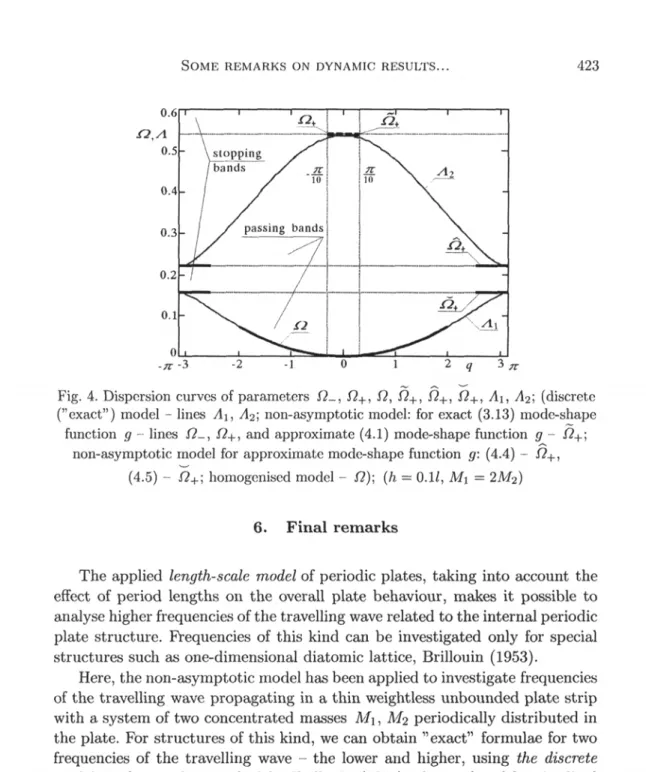
~
in Fig. 4. Dispersion curves of f2_, il+, f2, ii+, fl+, f2 +, A 1, A2 versus the dimensionless wave number q
E
[-7r,
7r}
for the plate strip with equal distancesbetween the masses M1, M2, i.e. a 1
=
a2=
l/2 are shown. By higherfrequen-cies are denoted il+,
ii+,
fl+, f2+. They are obtained, respectively, for exact mode-shape function g {3.13), for approximate form {4.1) of the mode-shape function g, for approximate form (4.4) and for approximate form (4.5).By analysing the obtained calculation results, one can conclude that:
• lower frequencies of the travelling wave of the considered plate strip calculated within the non-asymptotic model are identical with the
fre-quencies from the homogenised model and also with the frequencies from the discrete model not only for long-wave propagation problems
422 J. J~ORYSIAK, B. MICHALAK
1.0~--....---~--~--~--~-~
il,A
-2 -1 0 2 q 31Z'
Fig. 3. Dispen;ion curves of parameters [L, ft+, ft, A1 , A2; (lines A1 , A2 - discrete
("exact") model, lines ft_, ft+ - non-asymptotic model, lines ft - for homogenised model); (h
=
O.ll; M1=
2M2; x1, x2 -coordinates of masses M1 , M2 )(q E [-0.br, O.br]) but also in a wider range of the dimensionless wave
number q (Fig. 3 and Fig. 4);
• higher frequencies of the travelling wave from the non-asymptotic model
stand for the upper limit of higher frequencies calculated within the
discrete model (Fig. 3 and Fig. 4); the differences between frequencies for both models are less than 2% (for long waves: q E [-0.br, 0.br], i.e.
k = 27r/L, l/L E [-0.05,0.05]);
• differences between higher frequencies for long-wave propagation pro-blems, q E [-O.l7r,O.l7r], obtained from the non-asymptotic model with
exact (3.13) or approximate (4.1) form of the mode-shape function g,
are less than 23 (Fig. 4);
• frequencies of the travelling wave can be investigated in the framework of the proposed length-scale model also for special cases of short-wave propagation problems by using special approximate forms of mode-shape functions, e.g. (4.4) and (4.5); higher frequencies calculated from the non-asymptotic model stand for lower limits of higher frequencies from the discrete model (for mode-shape function (4.4)) or upper limits of lower frequencies from the discrete model (for mode-shape function (4.5)).
.O,A
0.5
0.4
0.3
0.2
0.1
SOME REMARKS ON DYNAMIC RESULTS ...
stopping band-s
-423
Fig. 4. Dispersion curves of parameters SL, D+, D, D+,
n+,
D+, Ai, A2; (discrete("exact") model - lines A1 , A2; non-asymptotic model: for exact (3.13) mode-shape
function g - lines D_, D+, and approximate (4.1) mode-shape function g - fl+;
non-asymptotic model for approximate mode-shape function g: (4.4) -
fl+,
(4.5) - D+; homogenised model - D); (h = O.ll, M1 = 2M2)
6. Final remarks
The applied length-scale model of periodic plates, taking into account the effect of period lengths on the overall plate behaviour, makes it possible to analyse higher frequencies of the travelling wave related to the internal periodic plate structure. Frequencies of this kind can be investigated only for special structures such as one-dimensional diatomic lattice, Brillouin (1953).
Here, the non-asymptotic model has been applied to investigate frequencies of the travelling wave propagating in a thin weightless unbounded plate strip with a system of two concentrated masses M1 , M2 periodically distributed in
the plate. For structures of this kind, we can obtain '1 exact1
' formulae for two
frequencies of the travelling wave - the lower and higher, using the discrete model similar to that applied by Brillouin (1953) who analysed longitudinal vibrations of one-dimensional diatomic lattice. In the paper, comparison of the results obtained within the new length-scale model, the homogenised model and the discrete model has been presented.
Summarizing all considerations, one can formulate the following conclu-sions regarding periodic plates, in particular a weightless unbounded plate
424 J. J~DRYSIAK, B. MICHALAK
• The presented examples confirm that the effect of period lengths plays a crucial role in vibrations of periodic plates, and can also be analysed within the new length-scale model. In the paper it has been that the non-asymptotic model can be applied in under to obtain frequencies of higher order vibrations, similarly as in the exact models.
• The non-asymptotic model can be applied, first of all, to long-wave pro-blems (compared with t!he mesostructure parameter l describing the cell size), leading to results conformable with those found from "exact" so-lutions to special problems.
• Some special short waves, whose lengths arc of the order of the cell size, can also be investigated within the framework of the non-asymptotic model by using proper forms of mode-shape functions.
• Higher frequencies, calculated within the non-asymptotic model using those mode-shape functions, define so called passing and stopping bands of lower and higher order vibrations of periodic plates, i.e. ranges of frequencies in which vibrations of plates take place.
• In special cases of periodic plates, approximate forms of mode-shape functions can be used instead of the exact forms of those functions, yielding sufficiently precise results from the calculational point of view.
References
1. BARON E., WOZNIAK C., 1995, On the micro-dynamics of composite plates, Arch. Appl. Mech., 66, 126-133
2. BRILLOUIN L., 1953, Wave Propagation in Periodic Structures, Dover Pub.,
Inc.
3. J~DRYSIAK J., 2001a, A contribution to the modelling of dynamic problems for
periodic plates, Engng. TI-ans., 49, 65-87
4 . .J~DRYSIAK J., 2001b, Dispersion models of thin periodic plates. Theory and applications, Habilitation Thesis, Sci. Bull. of L6di Techn. Univ., 872, series: Transactions, 289, t6dz, (in Polish)
5. KOHN R.V., VOGELIUS M., 1984, A new model for thin plates with rapidly