Earthquakes and Data Centers
Andrew W. Taylor, Ph.D., S.E., FACI
7x24 Exchange Fall Symposium
September 11, 2013 Hilton Bellevue
Earthquakes and Data Centers
3 September 11, 2013
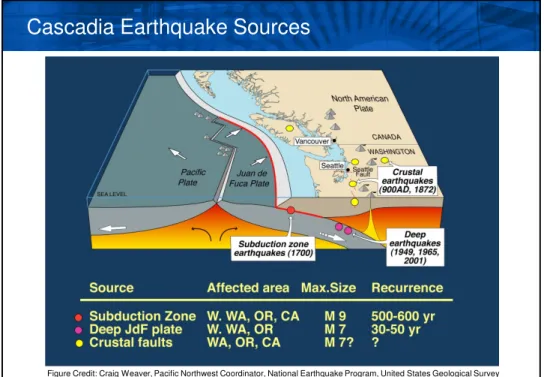
Cascadia Earthquake Sources
Figure Credit: Craig Weaver, Pacific Northwest Coordinator, National Earthquake Program, United States Geological Survey
Earthquakes and Data Centers
4 September 11, 2013
Figure Credit: Craig Weaver, Pacific Northwest Coordinator, National Earthquake Program, United States Geological Survey Seattle Fault
Earthquakes and Data Centers
5 September 11, 2013
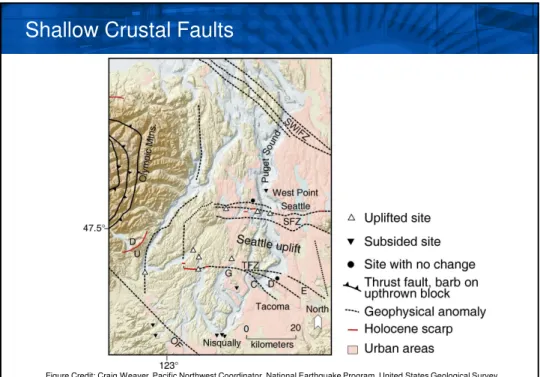
Figure Credit: Craig Weaver, Pacific Northwest Coordinator, National Earthquake Program, United States Geological Survey Shallow Crustal Faults
Earthquakes and Data Centers
7 September 11, 2013
Average return interval 300 to 600 years Last 4 events: 710, 1150, 1500 and 1700
Last megathrust event: January 26,1700, Magnitude 8.7 to 9.2
Megathrust Events in the Pacific Northwest
Earthquakes and Data Centers
Earthquakes and Data Centers
9 September 11, 2013
Richter Magnitude: Not used by engineers for design. Richter Magnitude only describes the energy released by an earthquake, not the ground shaking at a particular building site
“Seismic Zones”: The building code stopped using seismic zones in 2000. The Seattle area was in “Zone 3”, but this designation is no longer in the code, or accepted by building officials.
Seismic Hazard Maps: These are “contour maps” that show ground shaking intensity for any location in the United States. The maps provide a much more accurate characterization of seismic hazard than the old “seismic zone” system.
Engineering Coefficients for Design
Engineering Coefficients for Design
“Seismic Zones” no longer exist in the building code. Earthquake design coefficients are now obtained from USGS maps.
Earthquakes and Data Centers
11 September 11, 2013
Effects of Earthquakes on Buildings
Fundamental Approach -0.25 -0.20 -0.15 -0.10 -0.05 0.00 0.05 0.10 0.15 0.20 0.25 0 5 10 15 20 25 Time, seconds A c c e le ra ti o n , g
a
maxF = M
xa
Max EQ Force = Building mass x a
max?
Analyzing Earthquake Effects
Earthquakes and Data Centers
-0.25 -0.20 -0.15 -0.10 -0.05 0.00 0.05 0.10 0.15 0.20 0.25 0 5 10 15 20 25 Time, seconds A c c e le ra ti o n , g
a
maxMax EQ Force = Building mass x a
max?
Analyzing Earthquake Effects
F = M
xa
Earthquakes and Data Centers
13 September 11, 2013
F = Mxa would be the right
answer only if the building were completely rigid, and elastic… Analyzing Earthquake Effects on Structures
Earthquake engineering is more complicated
than F = Mxamax because seismic design must
account for
1. Dynamic response of the flexible building - Distribution of stiffness
- Distribution of mass
- Multiple modes of vibration 2. Inelastic response of the building
- Yielding - Cracking - Friction
Analyzing Earthquake Effects
Earthquakes and Data Centers
15 September 11, 2013
Both structural and nonstructural systems are damaged by racking of the structural frame:
Shear Walls Exterior Cladding & Windows
Columns Interior Partitions
Beams Doors
Cross Braces MEP Systems
Foundations HVAC Systems
UPS Systems Fire Suppression Interstory Drift (Structural Racking) What Causes Earthquake Damage?
Earthquakes and Data Centers
Cracking
Photos: Andy Taylor/NIST
What Causes Earthquake Damage?
Earthquakes and Data Centers
17 September 11, 2013
Cause damage to non-structural components: Equipment Racks (tipping)
Generators, Chillers, Compressors, Pumps Battery Racks
Suspended Ceilings, Light Fixtures Raised Floors
Furniture and Cabinets Elevators
Accelerations
0.54g
0.45g
0.36g
0.30g
Examples of Floor Accelerations
0.65g
What Causes Earthquake Damage?
0.24g
Earthquakes and Data Centers
19 September 11, 2013
Earthquakes and Data Centers
20 September 11, 2013
What Causes Earthquake Damage?
Figure Credit: FEMA, courtesy of Wiss, Janney, Elstner Associates
Mechanical System - 1971 San Fernando Earthquake What Causes Earthquake Damage?
Earthquakes and Data Centers
21 September 11, 2013
Retail Stock - 1971 San Fernando Earthquake What Causes Earthquake Damage?
Earthquakes and Data Centers
23 September 11, 2013
Olive View Medical Center Story •1971 San Fernando earthquake •1994 Northridge earthquake
Earthquakes and Data Centers
1971 San Fernando earthquake Olive View Medical Center Story
Earthquakes and Data Centers
25 September 11, 2013
1994 Northridge earthquake Olive View Medical Center Story
Fire sprinkler pipe broken 1994 Northridge earthquake Olive View Medical Center Story
Earthquakes and Data Centers
27 September 11, 2013
Earthquakes and Data Centers
28 September 11, 2013
The current U.S. building code is the 2012
International Building Code, and ASCE 7-10.
The general goal of the code is to preserve the life safety function of a building: prevent injuries and allow safe egress from the structure.
The building code does not generally provide for continued functionality of a building, or even
reparability. For certain important structures, extra strength is provided, and structural racking is
limited.
What Are the Goals of the Building Code?
Earthquakes and Data Centers
29 September 11, 2013
The Seismic Importance Factor Ie, is based on Risk
Category. It is applied to earthquake design forces.
Risk Category I
e
I or II – Normal Hazard 1.0 III – High Hazard 1.25 IV – Essential Facility 1.5
Earthquakes and Data Centers
31 September 11, 2013
The maximum allowed story drift, ∆a, is reduced for
higher risk structures
Risk Category Relative∆a I or II – Normal Hazard 100 %
III – High Hazard 80 % IV – Essential Facility 60 %
What Are the Goals of the Building Code?
Earthquakes and Data Centers
32 September 11, 2013
Make explicit choices about how
we want a building to behave in a
specific “size” of earthquake
Earthquakes and Data Centers
33 September 11, 2013
Performance Based Seismic Design
Performance Based Seismic Design (PBSD) is an approach to earthquake design of facilities that
targets specific performance goals in specific “sizes” of earthquakes. Operational Immediate Occupancy Life Safety Collapse Prevention Frequent 43 years Occasional 72 years Rare 475 years Very Rare
Seismic Performance Goal
Performance Based Seismic Design
Earthquakes and Data Centers
35 September 11, 2013
Detailed Performance Goals for Each System
Operational Level Immediate Occupancy Level Life Safety Level Collapse Prevention Level Overall Damage Very Light Light Moderate Severe Personnel Safety No injuries Minor injuries Minor injuries Major injuries or deaths Structural Frame Minor or no damage to structural frame. Since repair is
not required, operations are not interrupted.
Minor, repairable damage to structural frame. Does not interfere with immediate use, but may interfere with long-term use.
Structural frame is permanently damaged and may not be repairable.
Structural frame is near collapse
Cladding Little or no cladding damage. Operations not interrupted for repair.
Minor cladding damage. Does not interfere with immediate operations, but may require future repair or replacement
Damage to cladding, but cladding remains on building. Cladding may have to be replaced.
Extensive loss of cladding
Windows No window damage Minor or no window damage A few windows may be broken Extensive broken windows
Doors No jamming of doors. Some doors jammed. Requires immediate repair.
Some doors jammed. No exits blocked.
Extensive jamming of doors and blocking of exits
Walls Little or no damage to walls. Operations not interrupted for repair.
Minor damage to walls. Requires repair in future
Extensive damage to walls, many not repairable
Extensive damage to walls, many not repairable
Mechanical and Electrical Systems
No damage to mechanical and electrical systems. Operations continue uninterrupted. Power and utilities available from auxiliary sources.
Minor damage of mechanical and electrical systems. Repairable in 24 hours or less if repair services are available. Power and utilities may be unavailable.
Moderate damage of mechanical and electrical systems. May not be repairable
Extensive damage of mechanical and electrical systems, not repairable
Elevators Elevators functional Moderate damage of elevators. May not be functional for several days, if repair services are not available
Extensive damage of elevators, may be repairable
Extensive damage of elevators, not repairable
Computers and Data Storage Fully functional. No loss of data. Minor damage, requiring repairs. Data may be lost. Down time depends on availability of repair services
Extensive damage, may not be repairable
Extensive damage, not repairable
Sensitive Equipment No damage to sensitive equipment Moderate damage, requiring repairs. Experiments lost. Down time depends on availability of parts and repair services.
Extensive damage, not repairable Extensive damage, not repairable Operational Immediate Occupancy Life Safety Collapse Prevention Frequent 43 years Occasional 72 years Rare 475 years Very Rare 975 years
Seismic Performance Goal
CUP Labs
CUP Labs
Corporate
HeadquartersPed Bridge Corporate Headquarters Corporate
Headquarters
Warehouse
Earthquakes and Data Centers
36 September 11, 2013
Performance Based Seismic Design
Earthquakes and Data Centers
37 September 11, 2013
Practical Considerations for Design
Make explicit choices about how
we want a building to behave in a
specific “size” of earthquake
Structural Rehab for “Operational” Performance •Modifying an “ordinary” structure to achieve
“Operational” performance in a code-level earthquake is possible, but it is challenging and expensive.
•Similarly, modifying part of an existing “ordinary” structure to create an “Operational” data center usually requires structural and system modifications outside the footprint of the data center.
Make explicit choices about how
we want a building to behave in a
specific “size” of earthquake
Earthquakes and Data Centers
39 September 11, 2013
Preservation of Safety Systems
ASCE 7-10, 13.1.3 – Non-structural components All components must be assigned an Importance
Factor Ip= 1.5 if
• “The component is required to function for life-safety purposes after an earthquake, including fire
protection sprinkler systems and egress stairways.” • The component is required for continuous operation of a Risk Category IV structure
• Component is related to a high-hazard material
Make explicit choices about how
we want a building to behave in a
specific “size” of earthquake
Earthquakes and Data Centers
40 September 11, 2013
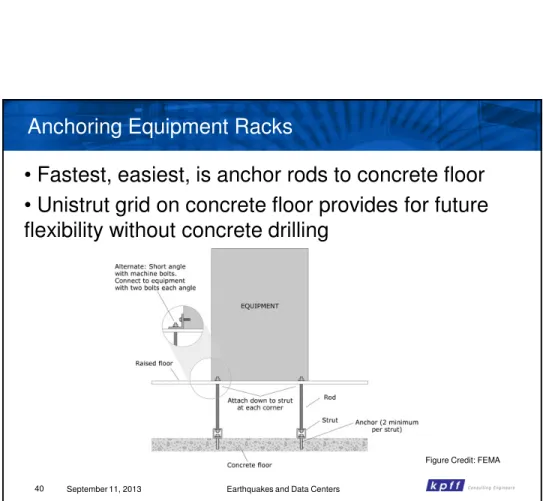
Anchoring Equipment Racks
• Fastest, easiest, is anchor rods to concrete floor • Unistrut grid on concrete floor provides for future flexibility without concrete drilling
Make explicit choices about how
we want a building to behave in a
specific “size” of earthquake
Earthquakes and Data Centers
41 September 11, 2013
Anchoring Equipment Racks
• For very heavy equipment, consider independent support on a steel frame.
Figure Credit: FEMA
Make explicit choices about how
we want a building to behave in a
specific “size” of earthquake
“The 400 Pound Rule” ASCE 7-10, Section 13.1.4
Mechanical and electrical components: structural engineering design of seismic bracing is not required in a high Seismic Design Category (SDC D, E, F) if
a) Weight ≤ 400 lbs., mass center ≤4 ft. above floor
b) Weight ≤ 20 lbs., mass center at any height
c) Weight ≤ 5 lbs./ft. (pipes, conduits), any height
c) Importance factor = 1.0
Technically, all other M & E components require
Make explicit choices about how
we want a building to behave in a
specific “size” of earthquake
Earthquakes and Data Centers
43 September 11, 2013
Raised Access Floors
Two types of raised access floors defined in code: ASCE 7-10,13.5.7.1 = “Ordinary” Access Floor ASCE 7-10,13.5.7.2 = “Special” Access Floor In high Seismic Design Categories (SDC D, E, F) recommend specifying only Special Access Floors
Make explicit choices about how
we want a building to behave in a
specific “size” of earthquake
Earthquakes and Data Centers
44 September 11, 2013
Seismic Qualification of MEP Equipment
ASCE 7-10, 13.2.1 – Contains requirements for seismic qualification of mechanical and electrical
components with importance factor Ip > 1.0, by
a) Engineering analysis
b) Qualification testing on a shake table
c) “Experience data” (i.e., documented performance in a previous earthquake).
Earthquakes and Data Centers
45 September 11, 2013
Trademark Attribution
The KPFF logo is a registered trademark of KPFF Consulting Engineers, in the United States and/or other jurisdictions. Other names used in this presentation are for identification purposes only and may be trademarks of their respective owners.
©2013 KPFF, Inc. All rights reserved. Confidential agreement: