econstor
www.econstor.eu
Der Open-Access-Publikationsserver der ZBW – Leibniz-Informationszentrum Wirtschaft The Open Access Publication Server of the ZBW – Leibniz Information Centre for EconomicsNutzungsbedingungen:
Die ZBW räumt Ihnen als Nutzerin/Nutzer das unentgeltliche, räumlich unbeschränkte und zeitlich auf die Dauer des Schutzrechts beschränkte einfache Recht ein, das ausgewählte Werk im Rahmen der unter
→ http://www.econstor.eu/dspace/Nutzungsbedingungen nachzulesenden vollständigen Nutzungsbedingungen zu vervielfältigen, mit denen die Nutzerin/der Nutzer sich durch die erste Nutzung einverstanden erklärt.
Terms of use:
The ZBW grants you, the user, the non-exclusive right to use the selected work free of charge, territorially unrestricted and within the time limit of the term of the property rights according to the terms specified at
→ http://www.econstor.eu/dspace/Nutzungsbedingungen By the first use of the selected work the user agrees and declares to comply with these terms of use.
zbw
Leibniz-Informationszentrum Wirtschaft Leibniz Information Centre for Economicsvan den Brink, Rene
Working Paper
Efficiency and Collusion Neutrality of Solutions for
Cooperative TU-Games
Tinbergen Institute Discussion Paper, No. 09-065/1
Provided in Cooperation with:
Tinbergen Institute, Amsterdam and Rotterdam
Suggested Citation: van den Brink, Rene (2009) : Efficiency and Collusion Neutrality of Solutions for Cooperative TU-Games, Tinbergen Institute Discussion Paper, No. 09-065/1
This Version is available at: http://hdl.handle.net/10419/86953
TI 2009-065/1
Tinbergen Institute Discussion Paper
Efficiency and Collusion Neutrality of
Solutions for Cooperative TU-Games
René van den Brink
Tinbergen Institute
The Tinbergen Institute is the institute for economic research of the Erasmus Universiteit Rotterdam, Universiteit van Amsterdam, and Vrije Universiteit Amsterdam.
Tinbergen Institute Amsterdam Roetersstraat 31
1018 WB Amsterdam The Netherlands
Tel.: +31(0)20 551 3500 Fax: +31(0)20 551 3555 Tinbergen Institute Rotterdam Burg. Oudlaan 50
3062 PA Rotterdam The Netherlands
Tel.: +31(0)10 408 8900 Fax: +31(0)10 408 9031
Most TI discussion papers can be downloaded at http://www.tinbergen.nl.
Efficiency and Collusion Neutrality
of Solutions for Cooperative TU-Games
∗
Ren´e van den Brink
Department of Econometrics
and Tinbergen Institute
VU University
De Boelelaan 1105
1081 HV Amsterdam
The Netherlands
E-mail: [email protected]
July 21, 2009
∗This research is part of the Research Program “Strategic and Cooperative Decision Making”. I thank
Abstract
Three well-known solutions for cooperative TU-games are the Shapley value, the Banzhaf value and the equal division solution. In the literature various axiomatizations of these solutions can be found. Axiomatizations of the Shapley value often use efficiency which is not satisfied by the Banzhaf value. On the other hand, the Banzhaf value satisfies
collusion neutrality which is not satisfied by the Shapley value. Both properties seem desirable. However, neither the Shapley value nor the Banzhaf value satisfy both. The equal division solution does satisfy both axioms and, moreover, together with symmetry these axioms characterize the equal division solution. Further, we show that there is no solution that satisfies efficiency, collusion neutrality and the null player property. Finally, we show that a solution satisfies efficiency, collusion neutrality and linearity if and only if there exist exogenous weights for the players such that in any game the worth of the ‘grand coalition’ is distributed proportional to these weights.
Keywords: Efficiency, Collusion neutrality, Shapley value, Banzhaf value, Equal division solution, Impossibility.
1
Introduction
A situation in which a finite setN ={1, . . . , n}ofnplayers can generate certain payoffs by cooperation can be described by a cooperative game with transferable utility (or simply a TU-game), being a pair (N, v) wherev: 2N →IR is acharacteristic function onN satisfying v(∅) = 0. For any coalition S ⊆ N, v(S) is the worth of coalition S, i.e. the members of coalition S can obtain a total payoff of v(S) by agreeing to cooperate.
A payoff vector x∈IRN of an n-player TU-game (N, v) is an n-dimensional vector
giving a payoff xi ∈ IR to any player i ∈ N. A (single-valued) solution for TU-games
is a function that assigns a payoff vector to every TU-game (N, v). Three well-known solutions for TU-games are the Shapley value, the Banzhaf value and the equal division solution. In the literature various axiomatizations of these solutions can be found. Most axiomatic characterizations of the Shapley value use efficiency. For example, the original characterization of the Shapley value characterizes it by efficiency, linearity, symmetry and the null player property, see Shapley (1953). Various characterizations of the Banzhaf value use some collusion neutrality axiom, see for example, Lehrer (1988), Haller (1994) and Malawski (2002) who characterize the Banzhaf value by linearity, symmetry, the null player property, the inessential game property and some collusion neutrality property. Collusion neutrality properties state that the sum of payoffs of two players does not change if these two players in some way ‘collude’ and act as one player. Both efficiency and collusion neutrality seem to be desirable properties. Clearly, by the above mentioned characterizations of the Shapley value and Banzhaf value, there does not exist a solution satisfying efficiency, collusion neutrality, linearity, symmetry and the null player property. A solution that does satisfy both efficiency and collusion neutrality is the equal division solution. In fact, we show that together with symmetry these axioms characterize the equal division solution if there are at least three players. Since the equal division solution does not satisfy the null player property, the next question is whether there is a solution that satisfies efficiency, collusion neutrality and the null player property. It turns out that such a solution does not exist for games with at least three players. Finally, we show that a solution satisfies efficiency, collusion neutrality and linearity if and only if there exist exogenous weights for the players such that in any game the worth of the ‘grand coalition’ is distributed proportional to these weights. Note that this implies that together with symmetry these axioms characterize the equal division solution but, as argued above, these axioms are not logically independent because we do not need linearity.
The paper is organized as follows. In Section 2 we discuss some preliminaries on TU-games. In Section 3 we show that there is a unique solution satisfying efficiency, collusion neutrality and symmetry, which is the equal division solution. In Section 4 we show that there is no
solution satisfying efficiency, collusion neutrality and the null player property. In Section 5 we characterize a class of proportional solutions by efficiency, collusion neutrality and linearity. Finally, in Section 6 we make some concluding remarks.
2
Preliminaries
In this paper we take the set of playersN ={1, . . . , n} to be fixed, and therefore denote a TU-game (N, v) just by its characteristic functionv. We assume that the game has at least three players2. The collection of all characteristic functions (which we will thus refer to as games) on N is denoted by GN. The increase in worth when player i∈ N joins coalition S ⊆ N \ {i} is called the marginal contribution of playeri to coalition S in game v ∈ GN
and is denoted by
mSi(v) = v(S∪ {i})−v(S).
Assuming that the ‘grand coalition’N forms in a way such that the players enter the coali-tion one by one, the Shapley value assigns to every player its expected marginal contribucoali-tion to the coalition of players that enter before him given that all orders of entrance have equal probability. Thus, the Shapley value (Shapley (1953)) is the solution Sh:GN →IRN
given by Shi(v) = S⊆N\{i} (n− |S| −1)!(|S|)! n! m S i(v) for all i∈N.
On the other hand, the Banzhaf value (introduced by Banzhaf (1965) to measure voting power in voting games and generalized by Owen (1975) and Dubey and Shapley (1979) to general TU-games) is the solution Ba:GN → IRN
that assigns to every player its ex-pected marginal contribution given that every combination of the other players has equal probability of being the coalition that is already present when that player enters. Thus, it assigns to every player in a game its average marginal contribution, i.e.
Bai(v) = 1 2n−1 S⊆N\{i} mSi(v) for all i∈N.
Playersi, j ∈N are symmetric in game vif v(S∪ {i}) =v(S∪ {j}) for allS ⊆N\ {i, j}. Player i ∈ N is a null player in game v if v(S ∪ {i}) = v(S) for all S ⊆ N \ {i}. For
v, w∈ GN, the game (v+w)∈ GN is defined by (v+w)(S) =v(S) +w(S) for all S ⊆N.
For v∈ GN and α ∈ IR, the game αv ∈ GN is defined by (αv)(S) =αv(S) for all S ⊆N.
Haller (1994) introduces some collusion neutrality properties which state that the sum
2
We make some remarks on two-player games in the final section.
of payoffs of two players does not change if they ‘collude’. He used these properties to axiomatize the Banzhaf value. Later, Malawski (2002) showed that several other collusion neutrality properties can be used. In this paper we consider collusion between two players where they agree to ‘act as one’ in the sense that they contribute to a coalition only when they both are present. So, when players i, j ∈ N, i = j, collude in game v ∈ GN, then
instead of gamev we consider the game vij ∈ GN given by vij(S) =
v(S\ {i, j}) if {i, j} ⊆S
v(S) if {i, j} ⊆S. (2.1)
Finally, a game v is called inessential if v(S) = i∈Sv({i}) for all S ⊆ N, i.e. for every player its marginal contribution to any coalition is the same. Various axiomatizations of the Shapley value and the Banzhaf value have been given in the literature. Some axioms that are used in these axiomatic characterizations are the following. A solution f:GN → IRN
satisfies
• efficiency if i∈Nfi(v) = v(N) for all v∈ GN;
• linearity if f(αv+βw) =αf(v) +βf(w) for all v, w∈ GN and α, β ∈IR;
• symmetry if fi(v) = fj(v) whenever i and j are symmetric players inv∈ GN;
• the null player property if fi(v) = 0 whenever i is a null player inv∈ GN;
• the inessential game property if fi(v) =v({i}) for alli∈N and inessential games v;
• collusion neutrality if fi(vij) +fj(vij) = fi(v) +fj(v) for all i, j ∈ N and v ∈ GN,
with vij given by (2.1).
Most axiomatic characterizations of the Shapley value use efficiency. For example, the original characterization in Shapley (1953) characterizes it by efficiency, linearity, symmetry and the null player property3. The Banzhaf value satisfies linearity, symmetry and the null player property, but it is not efficient. Malawski (2002) characterized the Banzhaf value by linearity, symmetry, the null player property, the inessential game property and collusion neutrality4.
3
This axiomatization is more often presented in this way although Shapley (1953) combines efficiency and the null player property into acarrier axiom.
4
As mentioned, other collusion neutrality properties that are used to axiomatize the Banzhaf value are stated in Haller (1994). The results in this paper also can be stated in terms of those neutrality properties. An axiomatization of the Banzhaf value with collusion properties in terms of inequalities can be found in Lehrer (1988).
In van den Brink (2007) it is shown that in several axiomatizations of the Shapley value, replacing an axiom about null players (such as the null player property) by a similar axiom about nullifying players (being players whose presence in a coalition implies that the worth of the coalition is zero) yields axiomatic characterizations of the equal division solution
ED:GN →IRN which is given by EDi(v) =
v(N)
n for all i∈N.
In this paper we find another axiomatization of the equal division solution by combining axioms that characterize the Shapley value and the Banzhaf value. The proof of this axiomatization uses the unanimity basis for TU-games. The unanimity game of coalition
T ⊆ N, T = ∅, is the game uT ∈ GN given by uT(S) = 1 if T ⊆ S, and uT(S) = 0
otherwise. It is well-known that the set of unanimity games form a basis ofGN: every game v ∈ GN can be written as a linear combination of unanimity games v =
T⊆N
T=∅∆v(
T)uT
with ∆v(T) =S⊆T(−1)|
T|−|S|v(S) being the Harsanyi dividends, see Harsanyi (1959).
3
Dropping the null player property: an
axiomatiza-tion of the equal division soluaxiomatiza-tion
Both efficiency and collusion neutrality seem to be desirable properties. Clearly, by axiom-atizations of the Shapley value and the Banzhaf value mentioned before, there does not exist a solution satisfying efficiency, collusion neutrality, linearity, symmetry and the null player property. It turns out that for games with at least three players, dropping the null player property yields a characterization of the equal division solution. We can even state a stronger characterization result without linearity.
Theorem 1 A solution f:GN →IRN satisfies efficiency, collusion neutrality and
symme-try if and only if it is the equal division solution.
Proof
It is easy to verify that the equal division solution satisfies the three properties. To show uniqueness, we proceed by induction on the smallest cardinality of the coalitions with non-zero dividend in a game. Before starting to show uniqueness, we introduce the following notation. For any game v ∈ GN, define H(v) = {T ⊆ N | ∆
v(T) = 0} as the set
of coalitions with non-zero dividend, d(v) = minT∈H(v)|T| as the smallest cardinality of coalitions with non-zero dividend, and h(v) =|{T ∈H(v)|d(v) =|T|}| as the number of coalitions of smallest cardinality with non-zero dividend.
Next we start the proof of uniqueness. Consider game v ∈ GN. First, if d(v) = |N| then v is a scaled unanimity game of the ‘grand coalition’, i.e. v= ∆v(N)uN with ∆v(N)= 0.
(Note that in this case ∆v(N) =v(N).) Symmetry implies that all players earn the same
payoff. Efficiency then determines that fi(v) = ∆
v(N)
n =
v(N)
n =EDi(v) for all i∈N.
Proceeding by induction, assume that f(v′) is uniquely determined for all v′ ∈ GN with d(v′)> d(v).
In order to use collusion neutrality, we use the following result from Malawski (2002) concerning collusion between two players in unanimity games. For every coalition R ⊆N
and two playersi, j ∈N, i=j, it holds that (uR)ij =
uR if either [i, j ∈R] or [i, j ∈N \R] uR∪{i,j} otherwise.
(3.2) We now start induction on h(v). First, assume that h(v) = 1. Then there is a unique
T ∈ H(v) with |T| = d(v), i.e. T is the (unique) smallest cardinality coalition with non-zero dividend. Take a specific j ∈T and h∈N\T. Collusion neutrality implies that
fi(v) +fj(v) =fi(vij) +fj(vij) for alli∈N \T, (3.3)
and
fh(v) +fg(v) =fh(vhg) +fg(vhg) for all g ∈T \ {j}, (3.4)
while efficiency requires that
i∈N
fi(v) =v(N). (3.5)
By (3.2) it follows that
(i) (uT)ij =uT∪{i} for all i∈N \T,
(ii) (uR)ij is either equal to uR or uR∪{i,j} for every R ⊆N and i∈N \T,
(iii) (uT)hg =uT∪{h} for all g ∈T \ {j}, and
(iv) (uR)hg is either equal to uR or uR∪{h,g} for every R⊆N and g ∈T \ {j}.
Therefore, d(vij)> d(v) for alli ∈N \T, and d(vhg)> d(v) for all g ∈T \ {j}, and thus
by the induction hypothesis, the equations (3.3) and (3.4) become
fi(v) +fj(v) =EDi(vij) +EDj(vij) = 2vij(N) n = 2v(N) n for all i∈N \T, (3.6) 5
and fh(v) +fg(v) =EDh(vhg) +EDg(vhg) = 2vhg(N) n = 2v(N) n for all g ∈T \ {j}. (3.7)
Since the 1 + (n− |T|) + (|T| −1) = n equations given by (3.5), (3.6) and (3.7) are linearly independent5, the values f
i(v), i ∈ N, are uniquely determined and given by fi(v) = v(nN) =EDi(v).
Next, proceeding by induction on h(v), assume that the result holds for every v′ ∈ GN
with d(v′) ≥ d(v) and h(v′) < h(v). Similar as above, take a T ∈ H(v) with |T| = d(v). (Note that now there are h(v) >1 of such coalitions.) Collusion neutrality, the induction hypothesis and efficiency yield the same equations (3.5), (3.6) and (3.7), and it can be similarly shown that f(v) is uniquely determined byf(v) =ED(v) whenever H(v)=∅. Finally, we have to consider game v ∈ GN with H(v) = ∅. Then, v is the null game, i.e. v(S) = 0 for all S ⊆ N. Symmetry implies that all players earn the same payoff. With efficiency it then follows that fi(v) = 0 =EDi(v) for all i∈N.
Logical independence of the axioms of Theorem 1 is shown by the following solutions. 1. The Shapley value satisfies efficiency and symmetry. It does not satisfy collusion
neutrality.
2. The Banzhaf value satisfies collusion neutrality and symmetry. It does not satisfy efficiency.
3. The solution f:GN →IRN
that assigns all payoff to player 1, i.e. f1(v) = v(N) and
fi(v) = 0 for all i∈ N\ {1}, satisfies efficiency and collusion neutrality. It does not satisfy symmetry.
4
Dropping symmetry: an impossibility
In the previous section we saw that dropping the null player property from our set of desirable properties yields an axiomatization of the equal division solution. The next question is what happens if we drop symmetry instead of the null player property. It turns out that there is no solution satisfying efficiency, collusion neutrality and the null player property. Note that for this impossibility result we do not need linearity.
Theorem 2 There is no solution on GN satisfying efficiency, collusion neutrality and the
null player property.
5
This follows from some easy but tedious computations.
Proof
By contradiction, suppose that solutionf:GN →IRN satisfies efficiency, collusion neutrality
and the null player property.
Consider unanimity games uT,∅ =T ⊆N. The null player property implies that
fk(uT) = 0 for all k ∈N \T, (4.8)
and with efficiency it then follows that
k∈T
fk(uT) = 1. (4.9)
Thus, if |T| = 1, i.e. T ={i} for some i ∈N, then the null player property and efficiency determine the payoffs fj(uT) = 0 for j ∈N \ {i}and fi(uT) = 1.
If |T|= 2, i.e. T ={i, j} for some i, j ∈N with i= j, then the null player property and efficieny imply that fh(uT) = 0 forh∈N \ {i, j}, andfi(uT) +fj(uT) = 1. (Note that the
same is implied by collusion neutrality and the case|T|= 1 considered above.)
Next consider the case |T| = 3, i.e. T = {i, j, h} with i, j and h being three different players. (Recall that we only consider classes of games with at least three players.) By (4.9) we have that fi(uT) +fj(uT) +fh(uT) = 1. In order to apply collusion neutrality,
notice that u{i,j}
hi = u{i,j} hj = u{i,h} ji = u{i,h} jh = u{j,h} ij = u{j,h} ih = uT.
Then, collusion neutrality implies that
fi(uT) +fj(uT) =fi(u{i,h}) +fj(u{i,h}) =fi(u{j,h}) +fj(u{j,h}) (4.10)
fi(uT) +fh(uT) =fi(u{i,j}) +fh(u{i,j}) =fi(u{j,h}) +fh(u{j,h}) (4.11)
and
fj(uT) +fh(uT) =fj(u{i,j}) +fh(u{i,j}) =fj(u{i,h}) +fh(u{i,h}). (4.12)
By (4.8) we have that this system of equations can be reduced to
fi(uT) +fj(uT) =fi(u{i,h}) = fj(u{j,h}) (4.13)
fi(uT) +fh(uT) =fi(u{i,j}) = fh(u{j,h}) (4.14)
and
fj(uT) +fh(uT) =fj(u{i,j}) =fh(u{i,h}). (4.15)
It follows that fi(uT) +fj(uT) = fi(u{i,h}) = 1−fh(u{i,h}) = 1−fj(uT)−fh(uT), where
the first equality follows from (4.13), the second equality follows from (4.9) and the third equality follows from (4.15). By (4.9) we then have thatfj(uT) = 0.
Similar we can derive from the other equations thatfi(uT) =fh(uT) = 0, which contradicts
efficiency. So, there does not exist a solution satisfying efficiency, collusion neutrality and
the null player property6.
5
Dropping the null player property and symmetry: a
characterization of a class of proportional solutions
From the original axiomatization of the Shapley value given by Shapley (1953) combined with collusion neutrality, we might still consider what solutions are left if we drop both the null player property and symmetry. It turns out that in that case we are left with a class of
proportional solutions for which there exist exogenous weights for the players such that in any game the worth of the ‘grand coalition’ is distributed proportional to these weights7. DefineXN :={λ∈IRN |
i∈Nλi = 1}. For λ∈X
N we define
fiλ(v) =λiv(N) for all i∈N. (5.16)
Theorem 3 A solution f:GN →IRN
satisfies efficiency, collusion neutrality and linearity if and only if there exists a vector of weights λ∈XN such that f =fλ.
Proof
It is easy to verify that fλ, λ ∈ XN, satisfies the three properties. To show uniqueness,
assume that solution f:GN →IRN satisfies the three properties. We first prove uniqueness
for unanimity games uT, ∅ = T ⊆ N. We do this by induction on |T|. If |T| = n, i.e. T = N, then efficiency implies that there exists a vector λ ∈XN such that f(u
N) = λ = fλ(u
N).
Proceeding by induction, suppose that f(uT′) = λ for all T′ ⊆ N with |T′| >|T|. Take a
specific j ∈ T and h ∈N \T. Since (uT)ij =uT∪{i} when i ∈N \T, collusion neutrality
implies that
fi(uT) +fj(uT) =fi(uT∪{i}) +fj(uT∪{i}) for all i∈N \T (5.17)
and since (uT)hg =uT∪{h} when g ∈T \ {j}, collusion neutrality also implies that
fh(uT) +fg(uT) =fh(uT∪{h}) +fg(uT∪{h}) for all g ∈T \ {j}. (5.18) 6
One also obtains the impossibility by showing directly that the system of six equations (4.10), (4.11) and (4.12) together with the four efficiency equalitiesfi(uT) +fj(uT) +fh(uT) =fi(u{i,j}) +fj(u{i,j}) =
fi(u{i,h}) +fh(u{i,h}) =fj(u{j,h}) +fh(u{j,h}) = 1 has no solution.
7
Although we use linearity, this theorem also can be stated by using the weaker additivity axiom.
With the induction hypothesis the above two equations yield fi(uT) +fj(uT) =λi+λj for all i∈N \T (5.19) and fh(uT) +fg(uT) =λh+λg for all g ∈T \ {j}. (5.20) Then i∈N fi(uT) = g∈T\{j} fg(uT) +fj(uT) + i∈N\(T∪{h}) fi(uT) +fh(uT) = g∈T\{j} (λh+λg −fh(uT)) +fj(uT) + i∈N\(T∪{h}) (λi+λj−fj(uT)) +fh(uT) = g∈T\{j} λg + (|T| −1)(λh −fh(uT)) +fj(uT) + i∈N\(T∪{h}) λi+ (n− |T| −1)(λj −fj(uT)) +fh(uT) = i∈N λi+ (|T| −2)(λh−fh(uT)) + (n− |T| −2)(λj −fj(uT)),
where the second equality follows from (5.19) and (5.20). With efficiency it follows that
i∈Nfi(uT) = 1 =i∈Nλi, and thus
(|T| −2)(λh−fh(uT)) + (n− |T| −2)(λj−fj(uT)) = 0. (5.21)
For j ∈T and h∈N \T, (5.19) yields that
fj(uT) +fh(uT) =λj+λh. (5.22)
Solving (5.21) and (5.22) yields fj(uT) =λj, fh(uT) =λh, and with (5.19) and (5.20) this
yields thatfi(uT) =λi for all i∈N.
Since every game v ∈ GN can be written as a linear combination of unanimity games v = T⊆N
T=∅∆v(
T)uT, with ∆v(T) = S⊆T(−1)|T|−|S|v(S) being the Harsanyi dividends,
uniqueness for arbitrary v ∈ GN then follows since linearity of f implies that f i(v) = fi(T⊆N T=∅∆v( T)uT) = T⊆N T=∅∆v( T)fi(uT) = T⊆N T=∅ λi∆v(T) = λiT⊆N T=∅∆v( T) = λiv(N) for all i∈N.
Note that as a corollary it follows that adding symmetry to the axioms of Theorem 3 yields that all weights λi should be equal, and thus characterizes the equal division solution.
However, these axioms are not logically independent. In Section 3 we showed that for this characterization linearity is not necessary since it is sufficient to require efficiency, collusion neutrality and symmetry.
Also note the difference between the solutions characterized in this section for TU-games and the (unique) proportional solution for bankruptcy problems. In that solution the total estate is distributed proportionally to the claims of the agents, while in the pro-portional solutions defined by (5.16) for TU-games, the weights that are used are exogenous and need not be related to the game.
Logical independence of the axioms of Theorem 3 is shown by the following solu-tions.
1. The Shapley value satisfies efficiency and linearity. It does not satisfy collusion neutrality.
2. The Banzhaf value satisfies collusion neutrality and linearity. It does not satisfy efficiency.
3. The solution f:GN → IRN given by f(v) = f(v) if v(N)≤ 10 and f(v) = ED(v) if v(N)>10, with f as given at the end of Section 3, satisfies efficiency and collusion neutrality. It does not satisfy linearity.
A final question we consider is what solutions satisfy efficiency and collusion neutrality. The answer is that these are kind of proportional solutions, but the weights λ that determine what share in the worth of the grand coalition the players get depends on the worth of the grand coalition.
Theorem 4 A solution f satisfies efficiency and collusion neutrality if and only if there is a function L: IR→XN such thatf =fL(v(N)).
So, in two gamesv, w∈ GN withv(N) =w(N) the payoff distributions are the same. The
proof of this theorem goes along similar lines as the proof of Theorem 1 and is therefore omitted.
6
Concluding remarks
In this paper we have studied the possibilities of having solutions for TU-games that satisfy efficiency and collusion neutrality. We have seen that for games with at least three players, additionally requiring the symmetry property characterizes the equal division solution. So, the equal division solution is the unique symmetric solution that satisfies these two properties (that distinguish the Shapley value and Banzhaf value from each
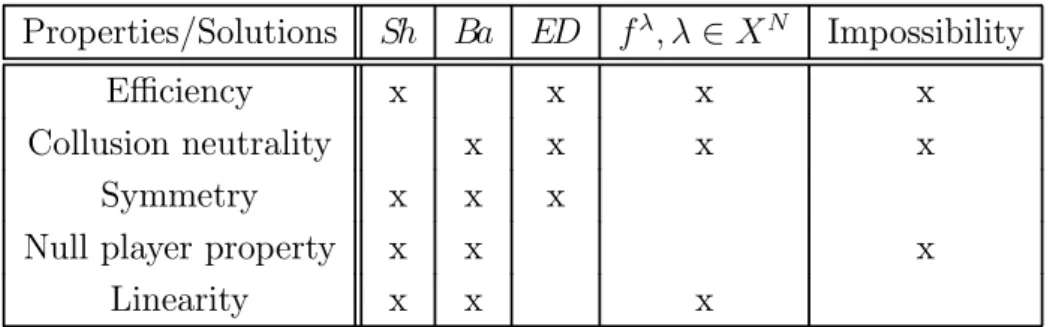
other). Additionally requiring the null player property instead of symmetry yields an impossibility. In both results linearity of the solution is not necessary. Other relations between the Shapley value and equal division solution are given in van den Brink (2007). Finally, we showed that a solution satisfies efficiency, collusion neutrality and linearity if and only if there exist exogenous weights for the players such that in any game the worth of the ‘grand coalition’ is distributed proportional to these weights. We summarize these results in Table 1.
Properties/Solutions Sh Ba ED fλ, λ∈XN Impossibility
Efficiency x x x x
Collusion neutrality x x x x
Symmetry x x x
Null player property x x x
Linearity x x x
Table 1: Characterizing properties of solutions
We remark that collusion neutrality can be replaced by other (but similar) axioms that reflect collusion between two players going to ‘act’ as one, see also Footnote 4.
Note that the multiplicative normalization of the Banzhaf value (i.e. dividing the worth of the ‘grand coalition’ proportional to the Banzhaf values of the players) as axiom-atized in van den Brink and van der Laan (1998) does not satisfy collusion neutrality nor linearity, while the additive normalization of the Banzhaf value (i.e. adding or subtract-ing from the Banzhaf value of every player the same amount to obtain an efficient payoff vector) as considered in Ruiz, Valenciano and Zarzuelo (1998) does not satisfy collusion neutrality nor the null player property.
In the proofs of Theorems 1 and 2 we needed the player set to contain at least three players. For two-player games there are more solutions satisfying efficiency, collusion neutrality and symmetry (and linearity). An example is the Shapley value which on the class of one- and two-player games is equal to the Banzhaf value. Moreover, for two player games there exist solutions satisfying efficiency, collusion neutrality and the null player property (and linearity), which is again illustrated by the Shapley value.
References
Banzhaf, J.F. (1965), “Weighted Voting Doesn’t Work: A Mathematical Analysis”,
Rut-gers Law Review, 19, 317-343.
Brink, R. van den (2007), “Null players or nullifying players: the difference between the Shapley value and equal division solutions”, Journal of Economic Theory, 136, 767-775.
Brink, R. van den, and G. van der Laan (1998) “Axiomatizations of the
Normal-ized Banzhaf Value and the Shapley Value”, Social Choice and Welfare, 15, 567-582.
Dubey, P., and LS. Shapley (1979), “Mathematical Properties of the Banzhaf Power
Index”,Mathematics of Operations Research, 4, 99-131.
Haller, H. (1994), “Collusion Properties of Values”,International Journal of Game
The-ory, 23, 261-281.
Harsanyi, J.C. (1959), “A Bargaining Model for Cooperative n-Person Games,” in
Con-tributions to the Theory of Games IV (A.W. Tucker and R.D. Luce, Eds.), pp. 325-355. Princeton: Princeton UP.
Lehrer, E. (1988), “An Axiomatization of the Banzhaf Value”,International Journal of
Game Theory, 17, 89-99.
Malawaski, M. (2002), “Equal Treatment, Symmetry and Banzhaf Value
Axiomatiza-tions”, International Journal of Game Theory, 31, 47-67.
Owen G. , (1975), “Multilinear Extensions and the Banzhaf Value”, Naval Research
Lo-gistics Quarterly, 22, 741-750.
Ruiz, L., F. Valenciano, and J.M. Zarzuelo (1998) “The family of least-square
val-ues for TU games”, Games and Economic Behavior 24, 109-30.
Shapley, L.S. (1953), “A Value forn-Person Games”,Annals of Mathematics Studies28
(Contributions to the Theory of Games Vol.2) (eds. H.W. Kuhn and A.W. Tucker), Princeton University Press, 307-317.