Mathematics Learning Activity Types
1, 2The purpose of presenting an activity types taxonomy for mathematics is to introduce the full range of student learning activities for teachers to consider when building lessons that strive to effectively integrate technology, pedagogy, and content. In doing so, we attempt to scaffold teachers’ thinking about how to best structure their learning activities, best support those activities with educational technologies, and to spark their creativity during instructional planning.
Essentially, these mathematics activity types are designed to be catalysts to thoughtful and creative instruction by teachers. We have conceptualized seven genres of activity types for mathematics that are derived from the National Council of Teachers of Mathematics’ (NCTM’s) process standards. To encourage active engagement by all students, these activity types are expressed using active words (verbs) to focus instructional planning on student rather than teacher actions. Many of these words are drawn directly from the NCTM standards. Each of the seven genres is presented in a separate table that names the activity types for that genre, briefly defines them, and then provides some example technologies that might be selected by a teacher while undertaking each activity. Please note that the specific software titles referenced in the Possible Technologies columns are meant to be illustrative. The taxonomy’s authors do not specifically endorse any of the listed products.
The "Consider" Activity Types
When learning mathematics, students are often asked to thoughtfully consider new concepts or information. This request is a familiar one for the mathematics student, and is just as familiar to the teacher. Yet, although such learning activities can be very important contributors to student understanding, the "Consider" activity types also often represent some of the lower levels of student engagement, and typically are manifested using a relatively direct presentation of foundational knowledge.
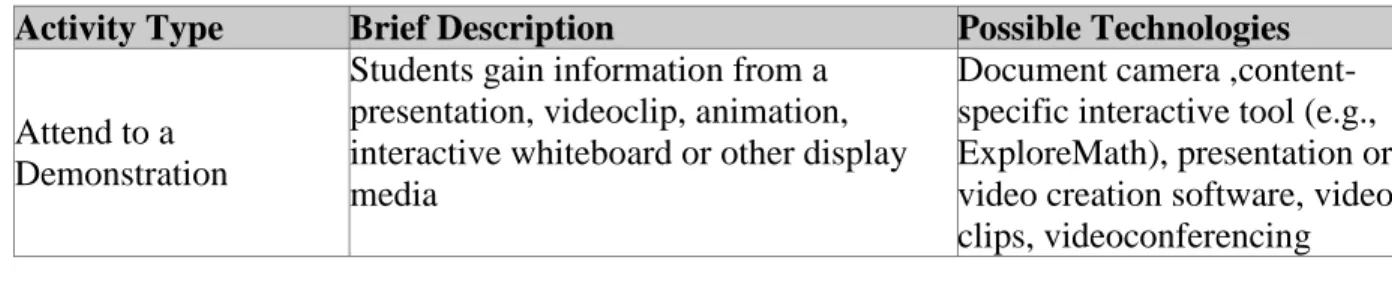
Table 1: The "Consider" Activity Types
Activity Type Brief Description Possible Technologies
Attend to a Demonstration
Students gain information from a presentation, videoclip, animation, interactive whiteboard or other display media
Document camera ,content-specific interactive tool (e.g., ExploreMath), presentation or video creation software, video clips, videoconferencing
1
Suggested citation (APA format, 6th ed.):
Grandgenett, N., Harris, J., & Hofer, M. (2011, February). Mathematics learning activity types. Retrieved from College of William and Mary, School of Education, Learning Activity Types Wiki:
http://activitytypes.wmwikis.net/file/view/MathLearningATs-Feb2011.pdf
2 “Mathematics Learning Activity Types” by Neal Grandgenett, Judi Harris and Mark Hofer is licensed
under a Creative Commons Attribution-Noncommercial-No Derivative Works 3.0 United States License. Based on a work at activitytypes.wmwikis.net.
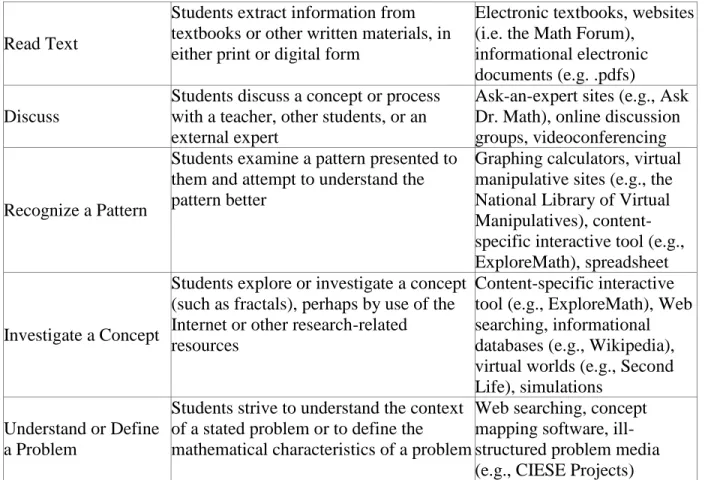
Read Text
Students extract information from textbooks or other written materials, in either print or digital form
Electronic textbooks, websites (i.e. the Math Forum),
informational electronic documents (e.g. .pdfs) Discuss
Students discuss a concept or process with a teacher, other students, or an external expert
Ask-an-expert sites (e.g., Ask Dr. Math), online discussion groups, videoconferencing
Recognize a Pattern
Students examine a pattern presented to them and attempt to understand the pattern better
Graphing calculators, virtual manipulative sites (e.g., the National Library of Virtual Manipulatives), content-specific interactive tool (e.g., ExploreMath), spreadsheet
Investigate a Concept
Students explore or investigate a concept (such as fractals), perhaps by use of the Internet or other research-related resources
Content-specific interactive tool (e.g., ExploreMath), Web searching, informational databases (e.g., Wikipedia), virtual worlds (e.g., Second Life), simulations
Understand or Define a Problem
Students strive to understand the context of a stated problem or to define the mathematical characteristics of a problem
Web searching, concept mapping software, ill-structured problem media (e.g., CIESE Projects)
The "Practice" Activity Types
In the learning of mathematics, it is often very important for a student to be able to practice computational techniques or other algorithm-based strategies, in order to automate these skills for later and higher-level mathematical applications. Some educational technologies can provide valuable assistance in helping students to practice and internalize important skills and
techniques. This table provides some examples of how technology can assist in these important student practice efforts.
Table 2: The "Practice" Activity Types
Activity Type Brief Description Possible Technologies
Do Computation
Students undertake computation-based strategies using numeric or symbolic processing
Scientific calculators, graphing calculators, spreadsheet, Mathematica Do Drill and Practice
Students rehearse a mathematical strategy or technique, and perhaps uses computer-aided repetition and feedback in the practice process
Drill and practice software, online textbook supplements, online homework help websites (e.g., WebMath).
Solve a Puzzle
Students carry out a mathematical strategy or technique within the context of solving an engaging puzzle, which may be facilitated or posed by the technology
Virtual manipulatives, Web-based puzzles (e.g., magic squares), mathematical brainteaser Web sites (e.g., CoolMath)
The "Interpret" Activity Types
In the discipline of mathematics, individual concepts and relationships can be quite abstract, and at times can even represent a bit of a mystery to students. Often students need to spend some time deducing and explaining these relationships to internalize them. Educational technologies can be used to help students investigate concepts and relationships more actively, and assist them in interpreting what they observe. This table displays activity types that can support this
thoughtful interpretation process, and provides some examples of the available technologies that can be used to support forming the interpretations.
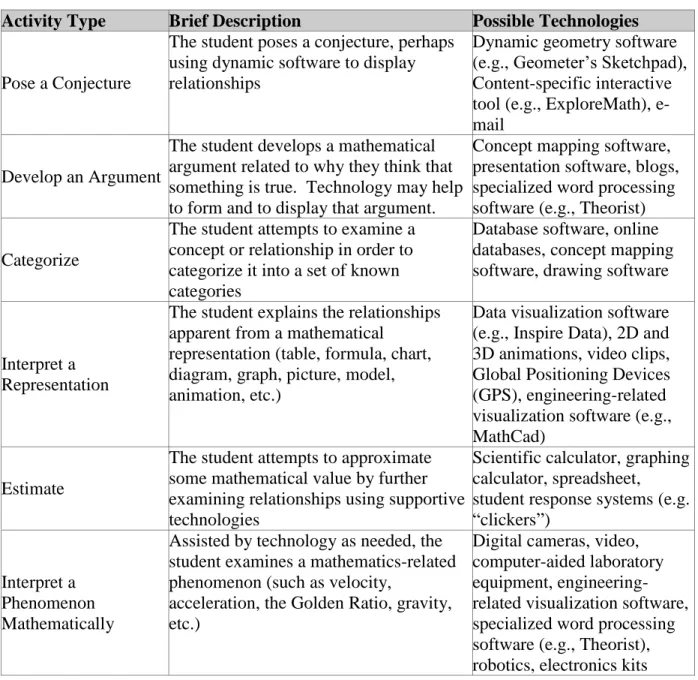
Table 3: The "Interpret" Activity Types
Activity Type Brief Description Possible Technologies
Pose a Conjecture
The student poses a conjecture, perhaps using dynamic software to display relationships
Dynamic geometry software (e.g., Geometer’s Sketchpad), Content-specific interactive tool (e.g., ExploreMath), e-mail
Develop an Argument
The student develops a mathematical argument related to why they think that something is true. Technology may help to form and to display that argument.
Concept mapping software, presentation software, blogs, specialized word processing software (e.g., Theorist)
Categorize
The student attempts to examine a concept or relationship in order to categorize it into a set of known categories
Database software, online databases, concept mapping software, drawing software
Interpret a Representation
The student explains the relationships apparent from a mathematical
representation (table, formula, chart, diagram, graph, picture, model, animation, etc.)
Data visualization software (e.g., Inspire Data), 2D and 3D animations, video clips, Global Positioning Devices (GPS), engineering-related visualization software (e.g., MathCad)
Estimate
The student attempts to approximate some mathematical value by further examining relationships using supportive technologies
Scientific calculator, graphing calculator, spreadsheet, student response systems (e.g. “clickers”)
Interpret a Phenomenon Mathematically
Assisted by technology as needed, the student examines a mathematics-related phenomenon (such as velocity,
acceleration, the Golden Ratio, gravity, etc.)
Digital cameras, video, computer-aided laboratory equipment, engineering-related visualization software, specialized word processing software (e.g., Theorist), robotics, electronics kits
The "Produce" Activity Types
When students are actively engaged in the study of mathematics, they can become motivated producers of mathematical works, rather than just passive consumers of prepared materials. Educational technologies can serve as excellent “partners” in this production process, aiding in the refinement and formalization of a student product, as well as helping the student to share the fruits of their mathematical labors. The activity types listed below suggest technology-assisted efforts in which students become “producers” of mathematics-related products.
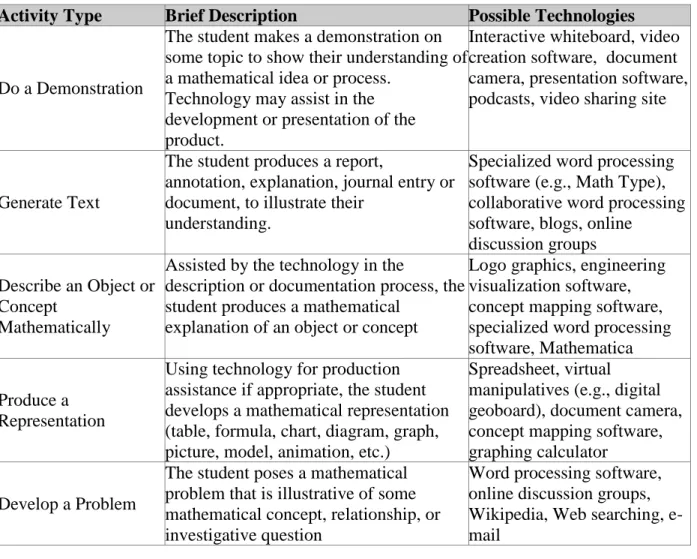
Table 4: The "Produce" Activity Types
Activity Type Brief Description Possible Technologies
Do a Demonstration
The student makes a demonstration on some topic to show their understanding of a mathematical idea or process.
Technology may assist in the development or presentation of the product.
Interactive whiteboard, video creation software, document camera, presentation software, podcasts, video sharing site
Generate Text
The student produces a report,
annotation, explanation, journal entry or document, to illustrate their
understanding.
Specialized word processing software (e.g., Math Type), collaborative word processing software, blogs, online
discussion groups Describe an Object or
Concept
Mathematically
Assisted by the technology in the
description or documentation process, the student produces a mathematical
explanation of an object or concept
Logo graphics, engineering visualization software, concept mapping software, specialized word processing software, Mathematica Produce a
Representation
Using technology for production assistance if appropriate, the student develops a mathematical representation (table, formula, chart, diagram, graph, picture, model, animation, etc.)
Spreadsheet, virtual manipulatives (e.g., digital geoboard), document camera, concept mapping software, graphing calculator Develop a Problem
The student poses a mathematical problem that is illustrative of some mathematical concept, relationship, or investigative question
Word processing software, online discussion groups, Wikipedia, Web searching, e-mail
The "Apply" Activity Types
The utility of mathematics in the world can be found in its authentic application. Educational technologies can be used to help students to apply their mathematical knowledge in the real world, and to link specific mathematical concepts to real world phenomena. The technologies essentially become students’ assistants in their mathematical work, helping them to link the mathematical concepts being studied to the reality in which they live.
Table 5: The "Apply" Activity Types
Activity Type Brief Description Possible Technologies
Choose a Strategy
The student reviews or selects a mathematics-related strategy for a particular context or application.
Online help sites (e.g., WebMath, Math Forum), Inspire Data, dynamic geometry/algebra software (e.g., Geometry Expressions), Mathematica, MathCAD Take a Test
The student demonstrates their mathematical knowledge within the context of a testing environment, such as with computer-assisted testing software.
Test-taking software, Blackboard, online survey software, student response systems (e.g. “clickers”) Apply a
Representation
The student applies a mathematical representation to a real life situation (table, formula, chart, diagram, graph, picture, model, animation, etc.).
Spreadsheet, robotics, graphing calculator,
computer-aided laboratories, virtual manipulatives (e.g., electronic algebra tiles)
The "Evaluate" Activity Types
When students evaluate the mathematical work of others, or self-evaluate their own mathematical work, they engage in a relatively sophisticated effort to try to understand
mathematical concepts and processes. Educational technologies can become valuable allies in this effort, assisting students in the evaluation process by helping them to undertake concept comparisons, test solutions or conjectures, and/or integrate feedback from other individuals into revisions of their work. The following table lists some of these evaluation-related activities.
Table 6: The "Evaluate" Activity Types
Activity Type Brief Description Possible Technologies
Compare and Contrast
The student compares and contrasts different mathematical strategies or concepts, to see which is more appropriate for a particular situation.
Concept-mapping software (e.g., Inspiration), Web searches, Mathematica, MathCad
Test a Solution
The student systematically tests a
solution, and examines whether it makes sense based upon systematic feedback, which might be assisted by technology.
Scientific calculator, graphing calculator, spreadsheet, Mathematica, Geometry Expressions
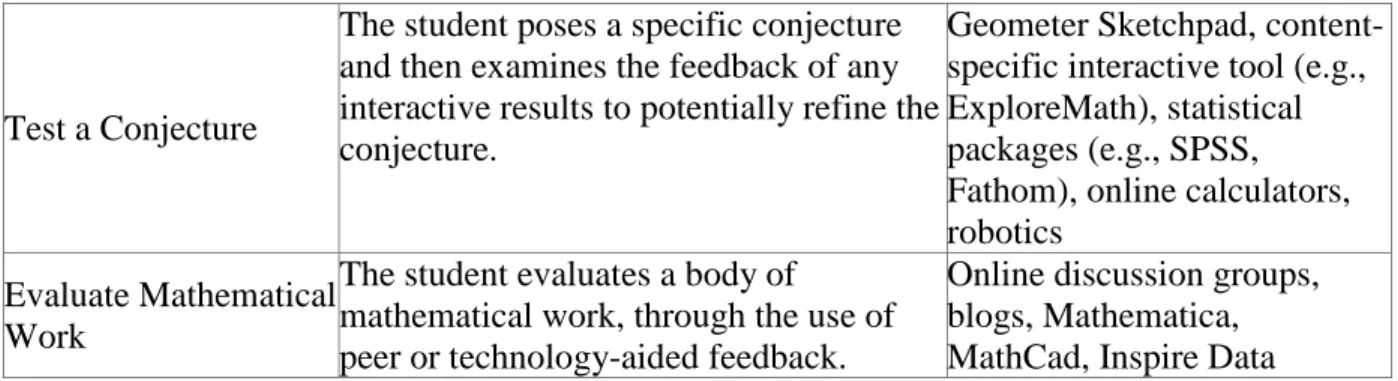
Test a Conjecture
The student poses a specific conjecture and then examines the feedback of any interactive results to potentially refine the conjecture.
Geometer Sketchpad, content-specific interactive tool (e.g., ExploreMath), statistical packages (e.g., SPSS, Fathom), online calculators, robotics
Evaluate Mathematical Work
The student evaluates a body of mathematical work, through the use of peer or technology-aided feedback.
Online discussion groups, blogs, Mathematica, MathCad, Inspire Data
The "Create" Activity Types
When students are involved in some of the highest levels of mathematics learning activities, they are often engaged in very creative and imaginative thinking processes. Albert Einstein once suggested that “imagination is more important than knowledge.” It is said that this quote represents his strong belief that mathematics is a very inventive, inspired, and imaginative endeavor. Educational technologies can be used to help students to be creative in their
mathematical work, and even to help other students to deepen their learning of the mathematics that they already understand. The activity types below represent these creative elements and processes in students’ mathematical learning and interaction.
Table 7: The "Create" Activity Types
Activity Type Brief Description Example Technologies
Teach a Lesson
The student develops and delivers a lesson on a particular mathematics concept, strategy, or problem.
Document camera, presentation software, videoconferencing, video creation software, podcasts
Create a Plan
The student develops a systematic plan to address some mathematical problem or task.
Concept mapping software, collaborative word processing software, MathCad,
Mathematica
Create a Product
The student imaginatively engages in the development of a student project,
invention, or artifact, such as a new fractal, a tessellation, or another creative product.
Word processing software, videocamera, animation tools, MathCad, Mathematica, Geometer Sketchpad
Create a Process
The student creates a mathematical process that others might use, test or replicate, essentially engaging in mathematical creativity.
Computer programming, robotics, Mathematica, MathCad, Inspire Data, video creation software