G. ANKAMMA RAO
Java Evolution
How Java is Differ from C and C
++Java and Internet
Java and WWW, Web Browsers
Hardware and Software Requirements
James Gosling
Java Environment
Java Evolution
History of Java
Java is a general purpose object oriented programming language developed by Sun Microsystems of USA. Java was designed for the development of software for consumer electronic devices like TVs, VCRs, and such other electronic machines.
Some important milestones in the development of java are as follows;
Year Development
1990 Sun Microsystems decided to develop special software that could be used to manipulate consumer electronic devices.
1991 After exploring the possibilities of using the most popular object- oriented language C++, the team
announced a new language named “Oak” (a tree name)
1992 The team formed to accomplish Oak language called as Green Team, and project is called as Green Project by Sun Microsystems. And the team consist five members. The team leader is James
Gosling and members are Mike Sheridan, Patric Naughtier, Chrriswarth, Ed Prank.
1993 The WWW gaining more popularity. The Green Project team came up with the idea of developing Web applets (Tiny programs) for internet.
1994 The team developed a Web Browser called “HotJava” to locate and run applet programs on
Internet.
1995 Oak was renamed as“Java”, due to legal snags. Java is not an acronym. Many popular companies
including Netscape and Microsoft announced their support to Java. 1996 Sun Microsystems releases Java Development Kit 1.1 (JDK 1.1)
Note: Java refers to Coffee Beans produced in the Indonesian Java Island. The symbol of java is tea cup
saucer.
Chapter
The most striking feature of java is a Platform-Neutral. Java is the first programming language that is not tied to any particular hardware or operating system. The programs developed in java can be executed anywhere on any system.
JAVA released to the market in three categories:
a) J2SE (JAVA 2 Standard Edition) - J2SE deals with developing standalone applications and applications for network and also exploring java library. J2SE is basically used for developing client side applications/programs.
b) J2EE (JAVA 2 Enterprise Edition) - J2EE deals with developing business solutions for a network or internet. J2EE is used for developing server side applications/programs.
c) J2ME (JAVA 2 Micro/Mobile Edition) - J2ME deals with developing embedded systems and wireless applications. J2ME is used for developing server side applications/programs.
Features or Buzzwords of JAVA
The inventors of java wanted to design a language which could offer solutions to some of the problems encountered in modern programming. They wanted the language to be not only reliable, portable and distributed but also simple, compact and interactive.
The following are the features of the JAVA language. 1. Compiled and Interpreted
2. Platform Independent 3. Portable
4. Object Oriented 5. Robust
6. Secure 7. Distributed
8. Simple, Small and Familiar 9. Multithreaded
10. High Performance 11. Dynamic and Extensible These are explained as follows;
Usually a computer language is either compiled or interpreted. Java combines both these approaches thus Java is a two-stage system. First, Java compiler translates source code into what is known as byte code instructions. Byte codes are not machine instructions.
In the second stage, the Java interpreter generates machine code from byte code that can be directly executed by the system. Thus Java is both compiled and interpreted language.
2. Platform Independent
A program or technology is said to be platform independent if and only if which can run on all available operating systems. The language JAVA will have a common data types and the common memory spaces on all operating systems and the JAVA software contains the special programs which converts the format of one operating system to another format of other operating system. Hence JAVA language is treated as platform independent language.
3. Portable
The most significant contribution of java over other languages is its portability. Java programs can be easily moved from one computer to another, anywhere and anytime.
A portable language is one which can run on all operating systems and on all processors irrespective of their architectures and providers. The languages like C, C++ are treated as non-portable languages whereas the language Java is called Portable language.
4. Object Oriented
Java is a true object oriented language. Almost everything in Java is an object. Any programming language that satisfies all the principles of OOP is called as an Object Oriented Programming Language. The Java language satisfies all the principles of OOP. Hence it is called an Object Oriented Programming Language. Java is a true object oriented language. Almost everything in java is an object.
5. Robust
Java is Roust programming language. It provides many safeguards to ensure reliable code. Since java programming language effectively addresses the run time errors. Java also incorporates the concept of exception handling which captures series errors and eliminates any risk of crashing the system. Robust is
nothing but it doesn’t allow to crashthe system.
Note: Compile time errors are occurring when the programmer is not following syntax rules of the
programming language.
6. Secure
To provide the security to our java real time applications, we need not write our own security code. Since java library (API) contains readily available security programs for protecting confidential information from unauthorized users.
7. Distributed
Java is designed as a distributed language for creating the applications on networks. It has the ability to share both data and programs. Java programs can open and access remote objects on Internet as easily as they can do in a local system. This enables multiple programmers at multiple remote locations to collaborate and work together on a single project.
8. Simple, Small and Familiar
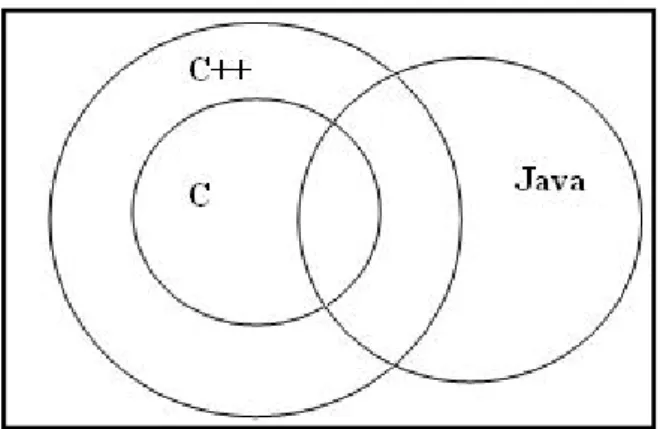
Java is small and simple language. Many features of C and C++ that are either redundant or unreliable code are not part of Java. For example, Java does not use pointers, pre-processor header files, goto statement and many others. It also eliminates operator overloading and multiple inheritance.
Familiar is another striking feature of Java. To make the language familiar to the existing programmers, it was modelled on C and C++ languages. Java code looks like a C++ code. In fact, java is a simplified version of C++.
9. Multithreaded
Multithreaded means handling multiple tasks simultaneously. Java supports multithreaded programming. This means that we need not wait for the application to finish one task before beginning to another task. For example, we can listen to an audio clip while scrolling a page and at the same time download an applet from a remote computer.
10. High Performance
Java is one of the High Performance programming language because of the following reasons.
Java architecture is also designed to reduce overheads during runtime.
Automatic memory management (Garbage Collector).
Magic of byte code (Execution of the java application is very faster compared to other programming language applications).
According to industry experts java programmer performance is high because java programming environment is free from pointers. Hence development of an application takes less time.
11. Dynamic and Extensible
Architectural Neutral
A language or technology is said to be architectural neutral which can run on any available processors in the real world. The languages like C, C++ are treated as architectural dependent. The language Java can run on any of the processor irrespective of their architecture and vendor.
Differences between Java and C
The major difference between Java and C is that Java is an Object Oriented Programming Language whereas the C is a Procedure Oriented Programming Language.
The following are some of the C features those does not include in the Java 1. Java does not include the sizeof and typedef keywords.
2. Java does not contain the data types struct and union.
3. Java does not define the type modifier keywords auto, extern, register, signed, and unsigned. 4. Java does not support an explicit pointer type.
5. Java does not have a pre-processor and then we cannot use #define, #include, and #ifdef statements. 6. Java requires that the functions with no arguments must be declared with empty paranthesis and not
with the void keyword.
7. Java adds new operators such as instanceof and >>> 8. Java adds labelled break and continue statements.
9. Java adds many features required for object oriented programming.
Differences between Java and C++
The major difference between the Java and C++ is that, Java is a pure object oriented programming language whereas C++ is a partially object oriented programming language.
The following are some of the C features those does not include in the Java 1. Java does not support operator overloading.
2. Java does not have template classes as in C++.
3. Java does not support multiple inheritances of classes. This is accomplished using a new feature called
“interface”.
4. Java does not support global variables. Every variable and method is declared within a class and forms part of that class.
5. Java does not use pointers.
7. There are no header files in Java.
Fig. Overlapping of C, C++, and Java
Java and Internet
Java is strongly associated with the Internet because of the fact that the first application program written in Java was HotJava a web browser to run applets on Internet. Internet users can use Java to create the applet programs and run them locally by using a web browser. Internet users can also download the applet from a remote computer as shown in below.
Fig: Downloading of applets via internet
Due to this, Java is popularly known as Internet Language.
Java and World Wide Web
Before Java the WWW was limited to display the images and texts. However, the incorporation of Java into Web pages made it capable of supporting animation, graphics, games, and a wide range of special effects. Java communicates with a Web page through a special tag called <APPLET>.
The following are the steps that illustrate the communication steps.
The user sends a request for an HTML document to the remote computer`s Web server. The Web server is a program that accepts a request, processes the request, and sends the requested document.
The HTML document is returned to the user`s browser. The document contains the APPLET tag, which identifies the applet.
The corresponding applet byte code is transferred to the user`s computer. This byte code had been previously created by the Java compiler using the Java source code file for that applet.
The Java enabled browser on the user`s computer interprets the byte codes and provide output.
Fig. Java’s interaction with the web
Web Browsers
Web browsers are used to navigate through the information found on the net. They allow us to retrieve the information across the Internet and display it using the Hypertext Markup Language (HTML). Examples for Web browsers are as follows.
Netscape Navigator
Internet Explorer
These are explained as follows;
HotJava
HotJava is the web browser form the Sun Microsystems. Hot java is written entirely in Java. When the Java language was first developed and ported to the Internet, no browsers were available that could run Java applets.
HotJava is currently available for the SPARC/Solaris platform as well as Windows 95, Windows NT and Windows XP.
Netscape Navigator
Netscape Navigator, from Netscape Communications Corporation, is a general-purpose browser that can run Java applets.
Netscape Navigator has many useful features such as visual display about downloading process and indication of the number of bytes downloaded. Windows 95, NT, Solaris and Apple Macintosh, Netscape navigator is one of the most widely used web browsers today.
Internet Explorer
Internet Explorer is another popular browser developed by Microsoft for Windows 95, NT and XP Workstations. Both the Navigator and Explorer use toolbars, icons, menus and dialog boxes for easy navigation. Explorer uses a Just-In-Time (JIT) compiler which greatly increases the speed of execution.
Java Environment
Java Environment includes a large number of development tools and hundreds of classes and methods. The development tools are part of the system known as Java Development Kit (JDK) and the classes and methods are part of the Java Standard Library (JSL), also known as the Application Programming Interface (API).
a. Java Development Kit (JDK)
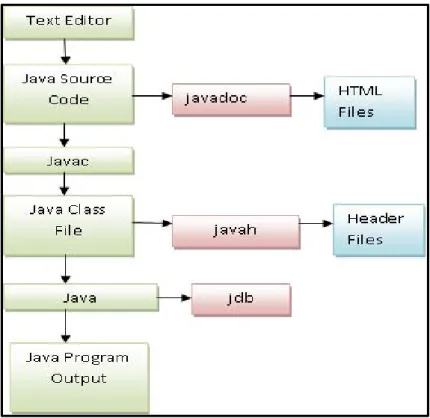
The Java Development Kit comes with a collection of tools that are used for developing and running Java programs. They include
appletviewer : Enables us to run Java applets.
javac (Java Compiler) : The Java Compiler, which translates Java source code to bytecode files that
the interpreter can understand.
javadoc (for creating HTML documents): Creates HTML- format documentation from Java source
code files.
javah (for C header files): Produces header files for native methods.
javap (Java disassemble): Which enables us to convert byte code files into a program description.
jdb ( Java debugger) : Which helps us to find errors in our programs.
Fig. Process of building and running java application program
b. Application Programming Interface (API)
The Java Standard Library includes hundreds of classes and methods grouped into several functional packages. Most commonly used packages are
Language Support Package: A collection of classes and methods required for implementing basic
features of java.
Ex: java.lang.*
Utility Package: A collection of classes to provide utility functions such as date and time functions.
Ex: java.util.*
Input/Output Package: A collection of classes required for input/output manipulations.
Ex: java.io.*
Networking Package: A collection of classes for communicating with other computers via Internet.
Ex: java.net.*
AWT Package: The Abstract Window Tool Kit package contains classes that implements platform
Ex: java.AWT.*
Applet Package: This includes a set of classes that allows us to create Java applets.
Ex: java.applet.*
Java Runtime Environment
The Java Runtime Environment (JRE) facilitates the execution of java programs. It primarily comprises of the following:
Java Virtual Machine (JVM): It is a program that interprets the intermediate Java byte code and
generates the desired output.
Runtime Class Libraries: These are a set of core class libraries that are required for the execution of
java programs.
User Interface Tool Kit: AWT and Swing are example of toolkits that support varied input methods
for the users to interact with the application program.
Deployment Technologies: JRE comprises the following key deployment technologies.
Java plug-in: Enables the execution of a Java applet on the browser.
Java Web Start: Enables remote-deployment of an application. With Web Start, users can launch