G. ANKAMMA RAO
Trees and Graphs
About Trees
Applications of Trees
About Graphs
Applications of Graphs
Trees and Graphs
Tree
It is defined as finite set of elements. These elements are stored in the form of nodes. There would be
one node under which the elements would be present. That node is termed as root node. The root node has
various nodes present under it. These nodes are called as child nodes. A tree can contains any number of
Childs. There is no restriction in number of child’s.
Ex:
Binary Tree
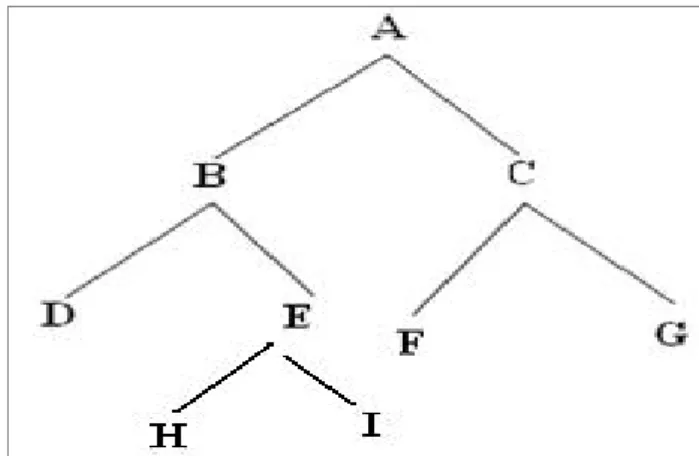
It is a tree with a finite set of nodes which is either empty or consists of a root with two sub trees i.e.,
left sub tree and right sub tree. For example consider the following tree.
Chapter
Root node
FIGURE: BINARY TREE
Here A is a root node, B and C are the Childs of A i.e., A is a parent of B and C. Here B and C are
called as Siblings.
Sibling is nothing but two Childs contains the same parent. Here B and C contain the parent A.
Therefore, Binary tree contains zero children or one child or twochildren’s. Trees concept can be implemented
by using Double linked list.
Leaf Node
A node with zero children’s is called as a leaf node. In the above tree (example of binary tree) the
nodes D, H, I and G are called as leaf nodes.
Level of a Tree
Root node is also termed as parent node. The root node is assigned to level 0.The numbering of level starts
From the above tree
Level of A is 0.
Level of B and C is 1.
Level of D, E, F and G is 2.
Level of H and I is 3.
The maximum level of a tree is called as Depth of the tree.
Strictly Binary Tree
It is a binary tree; each node can contain 0 or two children.
Example
The strictly binary tree with n leaf nodes always contains 2n-1 nodes.
Complete Binary tree
It is aBinary tree with each node contains zero children’s or two children’s and also each leaf node
has to lie in the same level.
Applications of Trees
1. Tree Traversals
One of the important feature of a Binary tree is tree traversal. Tree traversal means processing each
node exactly once without leaving any node. This is used to point the node values in a binary tree. There are
three types of the transversals in a tree. They are
In-Order (left, root, right).
Pre-Order (root, left, right)
Post-Order (left, right, root).
In Order:
1. Traverse the left sub tree of root R in In Order.
2. Traverse the root node R
3. Traverse the Right sub tree of root R in In Order
Pre Order:
1. Process the root R.
2. Traverse the left sub tree of root R in Pre Order.
3. Traverse the Right sub tree of root R in Pre Order.
Post Order:
1. Traverse the left sub tree of root R in Post Order.
2. Traverse the Right sub tree of root R in Post Order.
3. Traverse the root R.
For example, consider thefollowing binary tree…..
In-Order: B, A, C
Pre-Order: A, B, C
Post-Order: B, C, A
A A
Consider a binary tree
In-Order: D, B, E, A, F, C, G
Pre-Order: A, B, D, E, C, F, G
Post-Order: D, E, B, F, G, C, A
2. Expression trees:
A tree is constructed by using infix or postfix expression is called Expression tree.
Constructing expression tree from infix expression:
In this select middle operator as root for expression tree, left and right operands are inserted as left
child and right child for the root.
Ex: A + B
Expression tree for the above infix expression
Ex: (A + B) * (C - D)
Expression tree for the above infix expression.
B A
+
* + A B - C
+ A B D A C B G
3. Binary Search Tree
Binary Search tree is a binary tree in which each internal node x stores an element such that the element
stored in the left sub tree of x are less than or equal to x and elements stored in the right sub tree of x are
greater than or equal to x. This is called binary search-tree property.
Example: 50, 40, 35, 65, 55, 45, 70, 68, 66
GRAPHS
A graph is nothing but set of nodes or vertices and set of lines or edges or arcs that connect two vertices.
More formally, we define a graph G as an ordered pair G = (V,E) where
V is a set of nodes (vertices).
E is a set of edges (links).
Each edge is a pair of vertices. In other words, each element of E is a pair of elements of V. +
+
Example: The picture above represents the following graph:
V = {1,2,3,4,5,6}
E = {{1,2},{1,5},{2,3},{2,5},{3,4},{4,5},{4,6}}
G = (V,E)
Undirected Graph
A Graph that does not contain any direction is called as undirected graph.
Directed Graph
A pair of vertices between the edges must be ordered then that graph is known as directed graph.
The following figure gives a brief description about the both direct and undirected graphs.
Loop
In a directed graph some edges may connect to itself then such type of edges are called as a loop. This
In the above figure, (A, A) is a loop.
Path
A path in a graph represents a way to get from an origin to a destination by traversing edges in the
graph. For example, in the undirected graph G=(V,E) drawn below, there are many paths from node 6 to node
1. One such path is highlighted with red:
We write a path P as an ordered list of directed edges: P = ((v1,v2),(v2,v3),...,(vk,vk+1)). The first vertex
of the first edge of a path is the origin and the second vertex of the last edge is the destination. Both origin and
destination are called endpoints of the path.
Examples:
The red path above is ((6,4), (4,3), (3,2), (2,5), (5,1)); it is a path in G from node 6 to node 1
The blue path below is ((6,4), (4,5), (5,1)); it is also a path in G from node 6 to node 1
Weighted Graph
Some graphs contain weights on their edges, such type of graphs is called as weighted graph and the
number associated with an edge is called as weight.
General Example for a Graph:
A graph is nothing but set of bus stops as vertices and edges are nothing but the bus route between the
bus stops and weight is nothing but the distance between the bus stops in kilometers.
In-degree of a node
The In-degree of a node n is nothing but the number of edge coming to that node. For example consider
the following figure,
In this the In-degree of node A is 0, in-degree of node B is 2 and the in-degree of node C is 2.
Out-Degree of a node
The out-degree of a node n is nothing but the number of edges that are move away from that node.
Consider the following graph,
In this the out-degree of node A is 2, out-degree of node B is 1 and the out-degree of node C is 1.
Isolated Node
In a graph if a node that does not adjacent to any other node then that node is called as an isolated node.
Example:
Cyclic Graph
A path from a node to itself is called as a cyclic graph. In other words, a graph containing a cycle in it
is called as a cyclic graph.
Example:
Acyclic Graph
The graph does not contain the cycle is called as an acyclic graph and the directed graph that does not
contain any cycle is called as directed acyclic graph. This is shown in below.
Graph Traversals
Graph traversal means visiting each vertex in a graph without leaving any vertex. There are two ways
to traverse a graph.
DFS (Depth First Search).
BFS (Breadth First Search).
DFS (Depth First Search)
Consider a graph G and its starting vertex is V. In this DFS, first we visit the vertex V after that we
visit the adjacent vertices of V.
For example consider a graph G with the starting vertex V and its adjacent vertices w1, w2, w3, ….. wk.
Therefore in DFS, first we visit the vertex V after that we visit the vertex w1. After visiting the vertex w1we
visit the adjacent vertices of w1in depth first manner before visiting w2, w3, ….wk. The search is completed
once all the nodes are processed.
Let us consider the starting vertex as 1, then the DFS traversal is : 1, 2, 4, 8, 5, 3, 6, 7
Another possible DFS traversal is: 1, 3, 6, 8, 7, 2, 4, 5
BFS (Breath First Search)
It is different from DFS. Here the starting vertex V is visited first then the adjacent vertices of V are
visited in the next step, then after that the adjacent vertices of those nodes are traversed and so on. This process
will be continued until all the nodes are processed.
This algorithm uses the queue and stores vertices of each level when they are visited. They had taken
out one by one when their adjacent vertices are processed. This process is continued until queue is empty.
For example consider the following undirected graph,
Applications of Graphs
Minimum Spanning tree
The sum of weights of edges of tree as small as possible then it is called as the minimum spanning
tree.
Spanning tree: It is a tree it contains all the nodes in the graph.To find minimum spanning tree we use Prism’s
Algorithm.
Prism’s Algorithm:
Consider the graph ‘G’. Initially the vertices of graph contains the nodes in spanning tree and it edges
not contain edges. In the next step we add minimum cost edge from the starting vertex. And then we add an
edge with minimum cost adjacent to any node in the trees. This process is repeated until all the nodes are
connected. We ensured that whenever we are adding an edge it does not contain any cycle in the spanning
tree.
Consider the following graph:
Let vertex 1 is the starting vertex.
Step 3: Add an edge from vertex 1 to 2 because vertex 2 is adjacent to vertex 1 and also the minimum cost.
Step 4: Add an edge from vertex 4 to 3.
Step 5: Add edge from vertex 4 to7.
Step 7: Add edge from vertex 7 to 5.