AUSTRALIAN JOURNAL OF BASIC AND
Open Access Journal
Published BY AENSI Publication
© 2016 AENSI Publisher All rights reserved
This work is licensed under the Creative Commons Attribution International License (CC BY).
http://creativecommons.org/licenses/by/4.0/
To Cite This Article: R.Kanniga Devi and G.Murugaboopathi Placement in Cloud Environment. Aust. J. Basic & Appl. Sci.,
An Energy-efficient Tree
Placement in Cloud Environment
1R.Kanniga Devi and 2G.Murugaboopathi
1 Kalasalingam University, Department of Computer
2 Kalasalingam University, Department of Computer Science and Engineering,
Address For Correspondence:
R.Kanniga Devi, Kalasalingam University, Department of Computer Science Tel: +91-9750123659; E-mail: [email protected]
A R T I C L E I N F O Article history:
Received 04 December 2015 Accepted 22 January 2016 Available online 14 February 2016
Keywords:
Cloud Computing, Tree-based structure, kd-tree, Optimal resource allocation, Optimal VM placement, Energy conservation.
Cloud service providers provision resources of desired configurat Machines (VM) on the underlying physical infrastructure
virtualization technology. The VMs
retain them as their valuable customers and provide the expected quality of service which will increase their revenue. At the same time, keeping
energy, leading to higher operating costs. Hence identifying physical machines w
migrating its load to some other physical machines and then shutting them down save Conservation of energy may be better achieved through optimal placement of V
energy consumption may be maintained at desira VM placement is the process of mapping V
the VM. Placement problem is a kind of combinatorial search problem and Non
The process involves categorizing the VMs resource requirements and the anticipated usage of resources and placement goal.
Generally, the placement goal can be:
1) Maximizing the usage of available resources
2) Saving the power by being able to shutdown some servers (Power Both the approaches support migration
AUSTRALIAN JOURNAL OF BASIC AND
APPLIED SCIENCES
ISSN:1991-8178 EISSN: 2309-8414 Journal home page: www.ajbasweb.com
© 2016 AENSI Publisher All rights reserved
This work is licensed under the Creative Commons Attribution International License (CC BY).
http://creativecommons.org/licenses/by/4.0/
R.Kanniga Devi and G.Murugaboopathi., An Energy-efficient Tree-based approach for Optimal Virtual Machine Aust. J. Basic & Appl. Sci., 10(2): 307-314, 2016
efficient Tree-based approach for Optimal Virtual Machine
Placement in Cloud Environment
Department of Computer Science and Engineering,Krishnankoil-626126, India Department of Computer Science and Engineering, Krishnankoil-626126, India
Kalasalingam University, Department of Computer Science and Engineering,Krishnankoil-626126, India [email protected]
A B S T R A C T
The monetary costs of Cloud data centers are continuously growing due to its underlying physical infrastructure which always need great operating and m
costs in addition to the purchase of hardware equipments. Most of the operating costs incur due to the enormous amount of power consumption by the Physical Machines (PM) and Virtual Machines (VM) present in the data centers. Lot of research wo going on to conserve energy which can be better achieved through optimal placement of VMs on the PMs so that energy consumption can be maintained at desirable level. Mapping between VMs and PMs can be achieved through lot of techniques. As the placement has a direct impact on the performance of the whole system, we have made an attempt to optimize VM placement using a tree-based structure known as one dimensional (1d) Binary Search Tree (BST) for PMs in data center and extending this work to a multidimensional kd-tree BST structure. This proposal provides an optimal resource allocation for VMs, VM placement and also reduces energy consumption.
INTRODUCTION
Cloud service providers provision resources of desired configuration to the clients by on the underlying physical infrastructure called Physical Machines (PM)
VMs need to be provisioned to the clients without much delay in order to stomers and provide the expected quality of service which will increase their revenue. At the same time, keeping the lot of PMs and VMs running in the datacenter consume energy, leading to higher operating costs. Hence identifying physical machines w
migrating its load to some other physical machines and then shutting them down save be better achieved through optimal placement of VM
be maintained at desirable level.
VM placement is the process of mapping VMs to PMs. It is the process of selecting suitable PM for the VM. Placement problem is a kind of combinatorial search problem and Non-deterministic in nature. The process involves categorizing the VMs resource requirements and the anticipated usage of resources
Generally, the placement goal can be:
1) Maximizing the usage of available resources (Application QoS-based approach) 2) Saving the power by being able to shutdown some servers (Power-based approach)
Both the approaches support migration of VMs. Migration can be categorized into cold/static
based approach for Optimal Virtual Machine
based approach for Optimal Virtual Machine
626126, India.
The monetary costs of Cloud data centers are continuously growing due to its underlying physical infrastructure which always need great operating and maintenance costs in addition to the purchase of hardware equipments. Most of the operating costs incur due to the enormous amount of power consumption by the Physical Machines (PM) and Virtual Machines (VM) present in the data centers. Lot of research works are going on to conserve energy which can be better achieved through optimal placement of VMs on the PMs so that energy consumption can be maintained at desirable level. Mapping between VMs and PMs can be achieved through lot of techniques. As the ement has a direct impact on the performance of the whole system, we have made based structure known as one dimensional (1d) Binary Search Tree (BST) for PMs in data center and extending this tree BST structure. This proposal provides an optimal resource allocation for VMs, VM placement and also reduces energy consumption.
ion to the clients by creating Virtual called Physical Machines (PM) with the help of need to be provisioned to the clients without much delay in order to stomers and provide the expected quality of service which will increase and VMs running in the datacenter consumes more energy, leading to higher operating costs. Hence identifying physical machines with least load and migrating its load to some other physical machines and then shutting them down saves energy. Ms on the PMs so that
t is the process of selecting suitable PM for deterministic in nature. The process involves categorizing the VMs resource requirements and the anticipated usage of resources
based approach)
migration and live/dynamic migration. Static migration which is generally easy to perform, produces much higher downtimes than dynamic migration. But in dynamic, the cost of migration increases as the number of migration increases. Migration leads to some of the problems like business interruption, increase in network traffic, and Service Level Agreement (SLA) violations where SLA mentions about the quality of service provided by cloud service provider to cloud service consumer.
The underutilized servers is the major problem in cloud data centers due to their power consumption. Even to run small jobs they need to be powered up all the times, hence migration of VMs can be a better choice in these situations. Reducing the number of physical servers by migrating VMs running on it to other servers can lead to energy conservation and cost cutting. But migration is the costly affair since it involves large bandwidth consumption, heavy network traffic, its associated network overhead, and unavailability of server or services. So there is a need to design an efficient VM placement strategy which maps set of VMs to minimum number of physical machines so that placement would be optimal with less energy consumption.
Some approaches for VM placement are found in Sameer Kumar Mandal et al. (2011) namely Constraint programming, Bin packing, Stochastic Integer programming and Genetic algorithms. Existing VM placement approaches either optimize physical server resources utilization or optimize network resource utilization.
The main objective of this paper is to propose a theoretical power-based approach to develop a tree based structure known as 1d-Binary Search Tree (BST) and applying a kd-tree (multidimensional) BST concept for PMs in a data center to perform optimal VM to PM mapping which may further be tuned to minimize energy consumption with the help of migrations. Optimizing both physical server and network resource utilization generally provides good results, but this paper tries to optimize only physical resource utilization. The rest of this paper is organized as follows: Related work is followed by the problem statement and the proposed work. Next, the time complexity of algorithm is analyzed and it ends with the conclusion.
Related Work:
Sameer Kumar Mandal et al. (2013) have discussed about various VM placement strategies in cloud such as constraint programming, Stochastic integer programming, bin packing approach, and Genetic algorithm. It also discusses about the VM placement strategies followed by open source computing solutions like Xen cloud platform, Nimbus, Open Nebula and Eucalyptus. It proposes a BST based placement of VMs where VMs and PMs are fit into a BST. It achieves optimal mapping of VMs to PMs, improved resource utilization and reduced SLA violations, but VM migration and energy conservation are not considered during VM placement.
Grant Wu et al. (2012) have proposed that existing approaches to the VM placement problem consider only the energy consumption by PMs in a data center, but not the communication network in the data center. This proposes a Genetic Algorithm for a new VM placement problem that considers the energy consumption in both the servers and the communication network in the data center. Genetic Algorithm performs well and scales up well when the input size increases. It just focuses on simple energy consumption model to calculate the energy consumption in the physical servers and in the communication network of the data center. More accurate energy consumption models need to be used.
Makhlouf Hadji et al. (2014) have proposed an optimal VM repacking algorithms in physical infrastructures of Clouds to reduce overall cost at the same time improving utilization. They have developed b-matching algorithms and a greedy algorithm resolution of a graphic matroid representation of the repacking problem and compared with Bin-Packing algorithm. This technique minimizes SLA violations, scales well, converges reasonably fast, but only one resource requirement namely CPU is considered.
Ofer Biran et al. (2012) have focused on network resource utilization in addition to physical resource requirements during VM placement. This complex problem involves many factors beyond the PMs and network structures. Placement that satisfies the predicted communication demand and also resilient to demand time-variations gives rise to a new optimization problem, called Min Cut Ratio-aware VM Placement (MCRVMP). As it is NP Hard, several heuristics are introduced to solve it and provide good results for medium size data centers, however MCRVMP can further be extended to reduce the amount of dropped packets when multiple VMs present and to prevent high local overhead due to communications.
Ajith Singh et al. (2014) have focused to reduce the VM migration, improve SLA and energy consumption using a reservation method. They have proposed an algorithm called Reservation Technique Bin BECK Entropy for assigning threshold with entropy method, a new overload detection method called Polynomial Regression and a VM selection policy called Minimum Utilization Rank. It reduces the energy consumption, SLA violation and VM migration.
the Infrastructure-as-a-Service cloud, and VMs can be scaled to accommodate the dynamically changing resource demand of virtual CDN services.
Kamakshi R et al. (2015) have proposed a VM migration algorithm to minimize power consumption. They have proposed a hotspot detector, a migration manager and have constructed resource usage profiles for each physical server. If the hotspots are identified, then the VM is switched off or migrated to other physical server.
It has been observed that the above mentioned works have considered only the single dimensional resource requirements during VM placement and have failed in finding least loaded PMs easily. It is necessary to consider multiple dimensions such as CPU usage, memory, storage together as the resource requirement instead of a single dimension while allocating VMs to PMs which increases the balance between resource usages. Hence, developing a structure is necessary to easily identify the least loaded PMs so that VMs running in that may be migrated to other PMs to conserve energy.
Problem Statement:
Both the VM and PM require resources of different types such as processing power, memory, storage. Each resource type is referred to as a dimension. A VM must be placed in a PM that provides enough resources in all dimensions. However, the criterion to choose a PM to place a VM can be based on any of the dimension where the resource type is mostly available. The standard Binary Search Tree (BST) is a 1d-tree where search operation involves a single dimensional key. The PMs in a data center are represented as a 1d-BST called 1d-PM tree. Each client request implies creating a new VM in a PM. Given a set of n VMs, a set of m PMs which already host n1 VMs, where both set of VMs and PMs are heterogeneous with
respect to machine dimensions. The VM placement algorithm gives a mapping of that n+n1 machines on
the m PMs under a set of constraints.
Proposed Work: Case I: 1d-PM tree:
Let VM represent list of VMs VM={vm1,vm2,...vmn}
and PM represent list of PMs PM={pm1,pm2...pmm}
Each vmi and pmj is a triplet/three dimensional tuple vmi=(Ci,Ri,Bi) and pmj=(Cj,Rj,Bj) where Ci,Ri,Bi
denotes the resources of ith vm's and jth pm's CPU, RAM, Bandwidth respectively, where 1 ≤ i ≤ n and 1 ≤ j ≤ m.
The VM scheduler performs mapping based on any of the selected dimension (here it is CPU) which is denoted as
VM(vmiCPU)→PM-Tree(pmjCPU) , ∀: vm in the VM set.
Proposed algorithms for optimal mapping with energy efficiency: 1) Construction of 1d-PM tree :
For the PM list, construct a PM tree using 1d-BST technique, where the node's value (v) is based on any of the values present in the triplet of PM ie., three dimensional values (Here it is CPU, where residual percentage of CPU is considered).
To place a pm zj for which zj.CPU = v in 1d-PM tree T and zj.left =NIL, zj.right=NIL and it's parent is
p.
Input : PM ={ zj } for 1≤ j ≤ m , where zj is the jth pm's residual percentage of CPU and j!=0
Output: 1d-PM tree Algorithm :
1d-PM tree-Construct (T, zj)
1: y← NIL 2: x ← T. root 3: if x= = NIL 4: then x ← zj
5: else
6: while x ≠ NIL 7: do y ← x
8: if zj.CPU < x.CPU
9: then x ← x. left 10: else x ← x. right 11: zj.p ← y
14: elseif zj.CPU < y.CPU
15: then y.left ← zj
16: else y.right ← zj
Structure for optimal mapping:
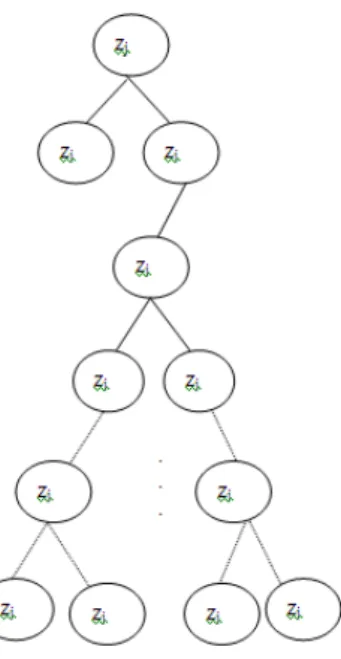
Fig. 1: Placement of PMs in 1d-PM tree.
2) VM placement Algorithm:
When a new VM request (wi.) with certain percentage of CPU processing requirement comes in, it has to be mapped to one of the PMs (zj) available in the tree structure in fig.1.
The value which determines traversal through the tree to locate a PM is determined by the following calculation:
val=wi..CPU/ zj .CPU (1) If the value of equation (1) is equal to 1, then VM can be placed in that PM itself. If the value is lesser than 1, then take traversal to the left subtree, else take traversal to the right subtree. Traversal ends when it reaches leaf node .
if (val = = 1) then zj← wi else if val < 1 then zj.left ← wi else zj.right ← wi
Now choose the PM (zj) which provided the highest value during traversal, and its considered to be the
best place for VM placement. Update PM's residual capacity after a VM placement on it. Repeat the process till no more VM requests are there.
Input: VM ={ wi } for 1 ≤ i ≤ n , where wi is the ith vm's requested CPU percentage, 1d-PM tree T of zj, where zj is the jth pm's residual CPU percentage.
Output: Optimal Mapping of VM to PM Algorithm :
Mapping (T, wi)
1: while T ≠ NIL and vali = wi.CPU / zj.CPU
2: if vali = =1
3: then zj ← wi
4: elseif vali < 1
5: then zj ← zj.left
6: else zj ← zj. right
7: zj =max(vali)
8: return zj
10:if zj.CPU= = 0
11:then PM ← PM- {zj}
12: if zj.CPU> 0 , PM ← PM ∪ {zj}
13: if no such zj , PM ← PM ∪ {znew}
14: 1d-PM tree-Construct (T, z)
15: Repeat the algorithm until VM ={ϕ }
3) VM Migration algorithm for energy saving:
The observation after applying above two algorithms (1 & 2) reveals that the underloaded PMs are always present in the deepest right leaf node. Hence, migrating the VM running in the deepest right leaf node to its immediate parent and powering off the leaf nodes conserve energy. The process is repeated till no other possible migrations.
Input : 1d-PM tree
Output : Energy-efficient 1d-PM tree Algorithm :
Migration(T,wi)
1: while T.root ≠ NIL
2: do zj← deepestRightLeaf(T.root)
3: zj.p ← zj.wi
4: PM ← PM - {zj}
Case II: 2d-PM tree:
As the VM placement has a direct impact on the performance of the whole system, this work makes an attempt to further optimize VM placement using a multidimensional tree-based structure known as kd-BST (where k is the number of dimensions) (Ibraheem Al-furaih, 2000). This is useful structure when search involves a multidimensional search key and it is known as associative search. The PMs in a data center are represented as a 2d-BST.
kd-BST is a hierarchical structure where each node is a k-dimensional value and the search operation in the tree is decided in the following way: every node is associated with one of the k-dimensions. So, for a particular node, if the x axis is chosen, all the values lesser than this node will appear in the left subtree and all the points larger than this node will appear in the right subtree.
Each PM and VM is a k-tuple (v1,v2...vk-1) of values which are the resource dimensions. If the data
center is represented as a kd-tree, then each PM in the data center is stored as a node in the tree. In addition to the k resource dimensions of the PM, each node contains two pointers, which are either null or point to another node in the kd-tree ie) subtrees.
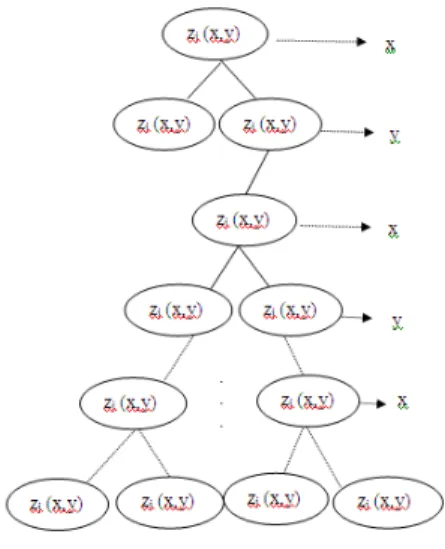
The idea of kd-tree is, it splits the data set alternatively by coordinate and y-coordinate. split by x-coordinate: split by a vertical line that has half the values left and half right split by y-x-coordinate: split by a horizontal line that has half the values below and half above At each step one of the coordinate is chosen as a basis of placing the successive data values.
For example, at the root choose x as the basis. All items to the left of root will have the x-coordinate less than that of the root. All items to the right of the root will have the x-coordinate greater than (or equal to) that of the root. Choose y as the basis for discrimination for the root's children and choose x again for the root's grandchildren.
When the VM scheduler performs mapping based on any of the two selected dimensions (here it is CPU and RAM) which is denoted as
VM(vmi
CPU,RAM
)→PM-Tree(pmj CPU,RAM
) , ∀: vm in the VM set.
Proposed algorithms for optimal mapping with energy efficiency: 1) Construction of 2d-PM tree:
For the PM list, construct a PM tree using 2d-BST technique where the node's value is based on two values present in the triplet of PM (Here it is CPU and memory, where residual percentage of CPU and memory are considered).
Input : PM ={ zj (x,y) } for 1≤ j ≤ m , where x & yare the jth pm's residual percentage of CPU and RAM
respectively, cd-cutting dimension Output: 2d-PM tree
Algorithm :
2d-PM tree construct (resource dimensions d, 2d-PMnode T, int cd ) 1: if ( T = = null )
4: else if ( d.cd < T.data.cd )
5: T.left ← 2d-PM tree construct (d , T.left, cd+1); 6: else T.right ← 2d-PM tree construct(d,T.right, cd+1); 7: return T ;
Here the (CPU, RAM) are the two resource dimensions and at each step one of these resource dimensions act as a splitting point to place the nodes either in left or right subtree. It is depicted in fig.2.
Structure for optimal mapping:
Fig. 2: Placement of PMs in 2d-PM tree.
PM tree is balanced if all the VM requests are known in advance, but it is hard to make such prediction.
2) VM placement Algorithm:
When a new VM request with certain percentage of CPU processing and memory requirement comes in, it has to be mapped to one of the PMs available in the tree structure. The value which determines traversal through the tree to locate a PM is determined by the following criteria:
At the root choose CPU requirement as the basis. Choose memory requirement as the basis for discrimination for the root's children and choose CPU requirement again for the root's grandchildren.
During such traversal can find best place for VM placement. Update PM's residual capacity after a VM placement on it. After the updation, if the residual capacity becomes 0, it means, the PM is fully loaded, with no room to accommodate further VMs . Remove such PMs from the list and reconstruct the tree with the new list of updated PMs. When a new VM request cannot be accommodated in the tree structure, add a new PM to the rightmost subtree as it's initial residual capacity is 100%. If addition of new PMs are not possible, simply reject the incoming request. Repeat the process till no more VM requests is there.
Input : VM ={ wi (x,y)} for 1≤ i ≤ n , where x and y are the with vm's requested percentage of CPU and
memory, 2d-PM tree T of zj(x,y), where x and y are the zjth pm's residual CPU and RAM
percentage.
Output: Optimal Mapping of VM to PM Algorithm :
Mapping (T , wi(x,y))
1: while T ≠ NIL 2: if (zj(x,y) = = wi (x,y))
3: then zj(x,y) ← wi (x,y)
4: do if wi (x,y) < zj(x,y)
5: then wi (x,y) ← zj(x,y).left
6: else wi (x,y) ← zj(x,y).right
7: return zj(x,y)
8: zj(x,y)← zj(x,y) - wi (x,y)
9: if zj(x,y)= = 0
10: then PM =PM - {zj(x,y)}
11: if zj(x,y)> 0 , PM = PM ∪ {zj(x,y)}
13: 2d-PM tree construct ( .... )
14: Repeat the algorithm until VM ={ϕ }
3) VM Migration algorithm for energy saving:
The observation after applying above two algorithms (1 & 2) reveals that the underloaded PMs are always present in the deepest right leaf node. Hence, Migrating the VM running in the deepest right leaf node to its grandparent and powering off the leaf nodes conserve energy and the process is repeated till no other possible migrations.
Input : 2d-PM tree
Output : Energy-efficient 2d-PM tree Algorithm :
Migration(T, wi (x,y))
1: while T.root ≠ NIL
2: do zj(x,y)← deepestRightLeaf(T.root)
3: zj(x,y).p.p ← zj(x,y) . wi (x,y)
4: PM =PM - zj(x,y)
Case III: 3d-PM tree:
When the VM scheduler performs mapping based on all of the dimensions (here it is CPU ,RAM and Storage) which is denoted as
VM(vmiCPU,RAM,storage)→PM-Tree(pmjCPU,RAM,storage) , ∀: vm in the VM set.
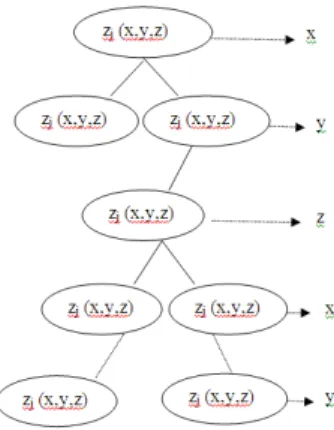
Here the (CPU,RAM,Storage) are the three resource dimensions and at each step one of these resource dimensions act as a splitting point to place the nodes either in left or right subtree. It is depicted in fig.3.
Structure for optimal mapping:
Fig. 3: Placement of PMs in 3d-PM tree.
The algorithms used for 2d-PMtree can be used for 3d-PMtree by extending the dimensions and the algorithms are scalable to n-dimensions.
Time Complexity Analysis:
The running time of the most of the operations in BST is proportional to the height of the tree. For a BST with height ‘h’ has log(n). The number of nodes in the tree is the sum of the number of nodes at each level. n=2h+2h-1+2h-2+...+21+20 =2h+1 -1
n=2h+1 -1 n+1 = 2h+1
taking log on both side log(n+1)=log(2h+1) log(n+1)=h+1 h = log(n+1) – 1 h= O(logn)
=3 O(log n) = O(log n)
The proposed approaches have O(log n) time complexity compared to O(n) for other VM placement approaches such as bin packing and the one based on Genetic Algorithms (Sameer Kumar Mandal, 2013).
Conclusion:
This paper proposes a tree-based structure known as 1d and kd-BST for the underlying physical resources, technically called PMs in cloud data center which not only help in optimal VM placement and also in energy conservation. In future, the proposed method can be implemented and tested in any of the cloud data center models running open source solutions by considering some more physical resource dimensions namely network and its associated resources. This VM placement technique can be extended to optimize both physical resource utilization and network resource utilization simultaneously to further improve its performance. Further, load balancing can also be achieved through efficient migration of VMs which can lead to a kind of Green Computing.
ACKNOWLEDGMENT
The authors would like to thank Kalasalingam University for supporting this work through TIFAC-CORE in Network Engineering.
REFERENCES
Ajith Singh, N. and M. Hemalatha, 2014.Reservation Resource Technique for Virtual Machine Placement in Cloud Data Centre, Research Journal of Applied Sciences, Engineering and Technology, 7(14): 2954-2960.
Grant Wu, Maolin Tang, Yu-Chu Tian, and Wei Li, 2012. Energy-Efficient Virtual Machine Placement in Data Centers by Genetic Algorithm, LNCS 7665, Springer-Verlag Berlin Heidelberg, 315–323.
Ibraheem Al-furaih, Srinivas Aluru, Sanjay Goil, Sanjay Ranka, 2000. Parallel Construction of Multidimensional Binary Search Trees, IEEE Transactions on Parallel and Distributed Systems, 11(2): 136-148.
Kamakshi, R., A. Sakthivel, 2015. Dynamic Scheduling of Resource Based on Virtual Machine Migration, WSEAS Transactions on Computers, 14: 2224-2872.
Makhlouf Hadji, Paul Labrogere, 2014. A Virtual Machine Repacking in Clouds: Faster Live Migration Algorithms, ACM 978-1-4503-2992-7/14/08.
Ofer Biran, Antonio Corradi, Mario Fanelli, Luca Foschini, Alexander Nus, Danny Raz, Ezra Silvera, 2012. A Stable Network-Aware VM Placement for Cloud Systems,12th IEEE/ACM International Symposium on Cluster, Cloud and Grid Computing, 499-506.
Sameer Kumar Mandal and Pabitra Mohan Khilar, 2013. Efficient Virtual Machine Placement for On-Demand Access to Infrastructure Resources in Cloud Computing, International Journal of Computer Applications, 68(12): 0975–8887.