Facial Expressions Recognition Based On Dimensionality
Reduction Techniques
Y.Hrushikesh*, M.Koteswara Rao+, K.Veeraswamy#
*PG Student, ECE Department, QIS College of Engineering & Technology, ONGOLE. [email protected] +Associate Professor, ECE Department, QIS College of Engineering & Technology, ONGOLE.
#Professor, ECE Department, QIS College of Engineering & Technology, ONGOLE. [email protected]
Abstract— Interest in image retrieval has increased in large part due to the rapid growth of the World Wide Web. The traditional text based search and retrieval has its own limitations and hence we move to a facial expressions images are search and retrieval system. In this paper we present a facial expression retrieval system that takes an image as the input query and retrieves images based on image content. Face recognition system is recognizing based on dimensionality reduction derived image features. Facial expressions recognition is the application of computer vision to the image retrieval problem. In this recognition context might refer colours, shapes, textures, or any other information that can be derived from the image itself.
Index Terms—PCA, ICA, LDA and distance measures
I. INTRODUCTION
The facial expression recognition system is a popular technique for security purpose which is recognizes images from a large database of digital images. On behalf of the system need to collect the features from the database which is need to be required as minimum as possible features from the database. So far so many research papers are covered global feature extraction from the database but now to do practical dimensionality reduction techniques for extract the less number of features from digital images. In this paper concentrated on some dimensionality reduction techniques such as principal component analysis, independent component analysis, linear discriminate analysis, and locality preserving projection. In this paper these facial expression technique are mainly depends on eigenvalue and eigenvectors from covariance method for reduce the feature extraction from the images.
Basics concepts of principal component analysis (PCA), independent component analysis (ICA), linear discriminate analysis (LDA), and Locality Preserving Projection (LPP) are discussed in section II. Proposed method is discussed in section III. Experimental results are presented in section IV. Concluding remarks are discussed in section V.
II. PCA, ICA, LDAANDLPP
The objective of the proposed work it to study the use of edge and texture orientation as face image features in face image retrieval. The basic architecture of Face recognition system is shown in figure. The facial expression recognition based on dimensionality reduction techniques system is proposed in this work. There are two issues in building a face recognition system. Every face image in the face image data base is to be represented efficiently by extracting significant feature. Relevant face images are to be recognized using similarity measure between query and every face image in the face image data base. The performance of the proposed face recognition system can be tested by retrieving the desired number of face images from the database. The advantage recognition rate and recognition time is the main performance measures in the proposed face recognition system. The average recognition rate is known as the average percentage number of images belonging to the same face image as the query face image in the top ‘N’ matches. ‘N’ indicates the number of recognized images.
A. Principal component analysis (PCA)
Principal Components Analysis (PCA) is a statistical technique for data reduction which is taught to students mostly with a pure mathematical approach. This paper describes how teachers can introduce students to the concepts of principal components analysis by means of letter recognition. The described approach is one of an active learning environment (with hands-on exercises can be implemented in the classroom), a platform to engage students in the learning process and may increase student/student and student/instructor interaction. The activities require use of some basic matrix algebra and Eigen-value/eigenvector theory. As such they build on knowledge students have acquired in matrix algebra classes.
Hahn (Dassonville, 2000). They developed a CD-ROM geared to the teaching of PCA for business school students. The test of this pedagogical tool showed that this new approach, based on dynamic graphical representations, eased the introduction to the field, yet did not foster more effective appropriation of those concepts. Besides, when the program was used in self tuition mode, the students felt disconnected from the class environment, as Dassonville and Hahn claim themselves. Provides real world data with their analysis stories about various topics, PCA included. Since only applications are presented, without any background information about the method itself, students unfamiliar to PCA, will not reach a deeper understanding about PCA and will keep stabbing at a recipe approach
B. Independent component analysis (ICA)
To rigorously define ICA we can use a statistical “latent variables” model. Assume that we observe n linear mixturesx1...xnofnindependent components. Let
us denote byAthe matrix with elements aij . Generally,
bold lower case letters indicate vectors and bold upper-case letters denote matrices. All vectors are understood as column vectors; thus xT, or the transpose of x, is a row
vector. Using this vector-matrix notation, the above mixing model is written asx=As.The statistical model is called independent component analysis, or ICA model. The ICA model is a generative model, which means that it describes how the observed data are generated by a process of mixing the components si. The independent
components are latent variables, meaning that they cannot be directly observed. Also the mixing matrix is assumed to be unknown. All we observe is the random vector x, and we must estimate bothAandsusing it. This must be done under as general assumptions as possible. However, in the basic model we do not assume these distributions known (if they are known, the problem is considerably simplified.) For simplicity, we are also assuming that the unknown mixing matrix is square, but this assumption can be sometimes relaxed. Then, after estimating the matrixA, we can compute its inverse, sayW, and obtain the independent component.
C. Linear discriminate analysis (LDA)
PCA performs dimensionality reduction by projecting the original n-dimensional data onto the k<<n dimensional linear subspace spanned by the leading eigenvectors of the data's covariance matrix. Thus PCA builds a global linear model of the data. Classical MDS finds an embedding that preserves pair wise distances between data points, and it is equivalent to PCA when those distances are Euclidean. Both PCA and MDS are unsupervised learning algorithms. LDA is a supervised
learning algorithm. LDA searches for the projective axes on which the data points of different classes are far from each other (maximize between class scatter), while constraining the data points of the same class to be as close to each other as possible (minimizing within class scatter).
D. Locality preserving projection (LPP)
The locality preserving quality of LPP is likely to be of particular use in information retrieval applications. If one wishes to retrieve audio, video, text documents under a vector space model, then one will ultimately need to do a nearest neighbour search in the low dimensional space. For example, the popular latent semantic indexing (LSI) method projects the high dimensional data onto a low dimensional space obtained from a singular value decomposition (SVD; closely related to PCA) on the original data matrix. Since LPP is designed for preserving local structure, it is likely that a nearest neighbour search in the low dimensional space will yield similar results to that in the high dimensional space. This makes for an indexing scheme that would allow quick retrieval. LPP is linear. This makes it fast and suitable for practical application. While a number of non linear techniques have properties. we know of no other linear projective technique that has such a property.
LPP is defined everywhere. Recall that nonlinear dimensionality reduction techniques. LPP defined only on the training data points and it is unclear how to evaluate the map for new test points. In contrast, the Locality Preserving Projection may be simply applied to any new data point to locate it in the reduced representation space.
III. PROPOSEDALGORITHM Proposed method is presented below:
1. There are N face images belonging to M persons in the training set; N = N1+N2+N3+…NM. Images size is represented as no. of rows and columns (A1×A2). By using sub-pattern method Each face image is first partitioned into S equally sized, these sub-pattern images are transformed into corresponding column vectors with dimensions of d = (A1×A2)/S using non-overlapping method.
2. In the first step calculate mean value of sub-pattern images. Each of them can be expressed in the form of a d by-N Column data matrix. 3.Similarly same procedure for independent
4. Each of them can be expressed in the form of d-by-L
Eigenvector matrix.
5. Afterwards, S extracted local sub feature weights of an individual vertically are synthesized into a global feature.
6. At final stage necessary to identify a new test image, this image also partitioned into S sub-pattern images. Each of them is represented as C test i and it’s vertically centered.
7. Finally, the identification of the test image is done by using nearest neighbor classifier with cosine measure, in which the cosine of the angle between the test image and each training image in the database.
IV. EXPERIMENTAL RESULTS
Recognition performance in terms of average recognition rate and recognition time of the proposed face recognition system is tested by conducting an experiment on hybrid approach face database. A face database [6] test set was constructed by selecting 100 images of 10 individuals, ten images per person. These images of a person used for training and testing. the experimental results are tabulated in Table 1. Since the recognition accuracy of the sub-pattern
image, several sizes of sub-pattern images were used in our experiments as shown below: 56×46(S=4),
28×23(S=16), 14×23(S=32), 7×23(S=64), and 4×23(S=112). Result has been presented in hybrid approach with S<64.
A. Feature selection
Figure2: Sample image
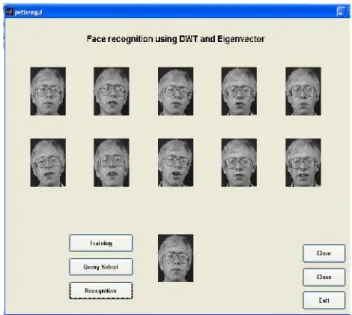
A sample image from face database and by using sub-pattern technique it can be divided by equal parts. Feature of the query image size is (64×1) by using sub-pattern method. Some of the recognized results when all the 10 images (N=10) in one subject of the image database are recognized are shown in figure 3. From the query image feature is taken based on sub-pattern method .After that in this paper we take only 64 feature of this query image.
That may be depends up on the sub-parts of this image(S=16). For each sub-pattern we consider four positive eigenvectors that is largest eigenvector of the subpart. It is represented as only local feature of the query image. After that combination of all sub-parts local feature it can be represented as global feature of the query image. Comparative performance of all training global feature with this query image finally recognized results images with top left image as query image.
Figure 3. Recognized images.
Subpattern method and principal component analysis [8] can significantly improve the recognition accuracy of sub pattern vertically centered method. Since the vertical centering process centers the data by removing the mean of each image, it can be used to eliminate the effect of the values. In other words, the property of vertical centering process [9] can be helpful in eliminating the shifted values of original-pixels.
vertical centering may benefits for the recognition in varying illumination.
Now, we have confirmed this possible forecast and strongly increased the efficiency of the vertical centering process by sub-pattern technique in this paper.
From the total experimental results, it can also be seen that for expression variant test, sub-pattern technique and Eigen vector can slightly improve weighted angle based approach classifier, the similarity between a test image and training image is defined as In the weighted angle based approach method cosine measurement.
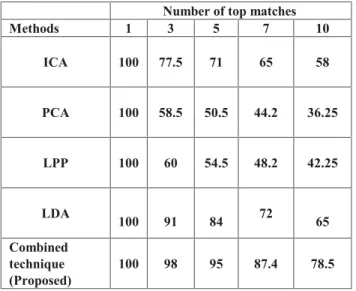
counting the number of images from the same category which are found in the top ‘N’ matches.
Table 1. Recognized rate on face database. (1, 3, 5,7,10 are Top ‘N’ recognized images)
Figure 4. Comparative recognition rates.
C. Recognized Time
Face recognition system with weighted angle based approach technique for largest four eigenvector recognized time is 50.42 seconds (training time is 50 seconds and recognitized time is 0.42 seconds), hybrid approach technique for all positive eigenvector recognized time is 51.20 seconds, Existing method in PCA recognized time is 1.65 seconds, LDA time is 2.90 seconds and LPP method recognized time is 2.72 seconds.
V. CONCLUSIONS
Facial expressions recognition based on dimensionality reduction technique. Global feature vector is generated and used for face recognition. Horizontal and vertical variations are considered in feature vector. Facial expression recognition based on dimensionality reduction techniques gives better performance in terms of average recognized rate and retrieval time compared to existing methods.
ACKNOWLEDGMENT
Authors would like to thank the Dr.S.Srinivas Kumar, Director Research, JNTU, Kakinada for his valuable suggestions. Authors thank the Dr.CH.Srinivasa rao, Professor, JNTUK, College of engineering vizayanagaram. for his support to finish this work.
REFERENCES
[1]. Arnold. W. M. Smeulders, M. Worring, S. Satini, A. Gupta, R. Jain. Content – Based Image Retrieval at the end of the Early Years, IEEE Transactions on Pattern analysis and Machine Intelligence, Vol. 22, No. 12, pp 1349-1380 , 2000.
[2]. Gupta. A. Visual Information Retrieval Technology: A Virage respective, Virage Image Engine. API Specification, 1997.
[3] Ping-Cheng Hsieh,Pi-Cheng Tung,A Novel Hybrid Approach Based On Sub pattern Technique and Whitened PCA for Face Recognition, Pattern Recognition 42 (2009) 978-984.
[4] Vytautas Perlibakas Distance measures for PCA based face recognition, Pattern Recognition letters 25 (2004) 711-724
[5] S.I. Choi, C. Kim, C.H. Choi, Shadow compensation in 2D images for face recognition, Pattern Recognition 40 (2007) 2118–2125.
[6] M. Turk, A. Pentland, Eigenfaces for recognition, J. Cognitive Neurosci.3 (1) (1991) 71–86.
[7] Yalefacedatabase
http://cvc.yale.edu/projects/yalefaces/yalefaces.html.
Number of top matches
Methods 1 3 5 7 10
ICA 100 77.5 71 65 58
PCA 100 58.5 50.5 44.2 36.25
LPP 100 60 54.5 48.2 42.25
LDA 100 91 84 72 65
Combined technique
[8] J. Yang, D. Zhang, J.Y. Yang, Is ICA significantly better than PCA for face recognition? in: Proceedings of IEEE International Conference on Computer Vision, vol. 1, 2005, pp. 198–203.
[9] A.J. Bell, T.J. Sejnowski, The independent components of natural scenes are edge filters, Vision Res. 37 (23) (1997) 3327–3338.
[10] M.S. Bartlett, H.M. Lades, T.J. Sejnowski, Independent component representation for face recognition, in: Proceedings of SPIE Symposium on Electronic Imaging: Science and Technology, 1998, pp. 528–539.
[11] S. Chen, Y. Zhu, Subpattern-based principle component analysis, Pattern Recognition 37 (2004) 1081–1083.
[12] K.Tan and S.Chen. Adaptively weighted sub-pattern pca for face recognition. Neurocomputing, 64:505–511, 2005.
[13] R. Gottumukkal and V.K. Asari. An improved face recogntion
technique based on modular pca approach. Pattern Recogn.
Lett., 25(4):429–436, 2004.
[14] Yang J and Zhang D. Two-dimensional pca:a new approach to
appearance-based face representation and recognition. IEEE
Transactions on Pattern Analysis and Machine Intelligence,
26(1):131–137, 2004.
[15] S. H. Ou, Q. L. Wang, and Z. Y. Zhu. The Application
and Technology of Digital Image Processing(In Chinese).
Tsinghua Press, Beijing, China, 2004.
[16] Vytautas Perlibakas “distance measure for PCA-based face recognition. Pattern Recognition Letters 25 (2004) 711–724
[17] Gupta Navarrete, P., Ruiz-del-Solar, J., 2001. Eigenspace-based recognition of faces: Comparisons and a new approach. In: International Conference on Image Analysis and Processing
ICIAP2001. pp. 42–47.
[18] Graham, D.B., Allinson, G.N.M., 1998. Characterizing virtual
eigensignatures for general purpose face recognition. Face
recognition: From theory to applications. NATO ASI Series
F, Computer and Systems Sciences 163, 446–456. [19] Swets, D.L., Pathak, Y., Weng, J.J., 1998. An image database system with support for traditional alphanumeric queries and content-based queries by example. Multimedia Tools Appl. (7), 181–212.
[20] Yilmaz, A., Gokmen, M., 2001. Eigenhill vs. eigenface and eigenedge. Pattern Recognition 34, 181– 184.
[21] D.Q. Zhang, S.C. Chen, J. Liu, Representing image matrices: eigenimages vs. eigenvectors, in: Proceedings ofthe Second International Symposium on Neural Networks (ISNN’05), Lecture Notes in Computer Science, vol. 3497, Chongqing, China, 2005, pp. 659– 664.