S T U D Y P R O T O C O L
Open Access
The DEsire to DIe in Palliative care:
Optimization of Management
(DEDIPOM)
–
a study protocol
Kerstin Kremeike
1*†, Maren Galushko
1†, Gerrit Frerich
1, Vanessa Romotzky
1, Stefanie Hamacher
2, Gary Rodin
3,4,5,
Holger Pfaff
6and Raymond Voltz
1,7,8,9Abstract
Background:A desire to die (DD) is frequent in palliative care (PC). However, uncertainty remains as to the appropriate therapeutic response. (Proactive) discussion of DD is not usually part of standard care. To support health practitioners' (HPs) reactions to a patient’s DD, a training program has been developed, piloted and evaluated. Within this framework, a first draft of a semi-structured clinical interview schedule with prompts (CISP) has been developed, including recommendations for action to support HPs’ self-confidence. The aim of this study is the further development of the CISP to support routine exploration of death and dying distress and proactive addressing of a DD.
Methods: This observatory, prospective health services study comprises a three step study design: 1. Revision of the CISP and consensus finding based on semi-structured interviews with patients and a Delphi process with (inter-)national experts, patient representatives and relatives; 2. Increasing confidence in HPs through a 2 day-training program using the consented CISP; 3. A formative quantitative evaluation of conversations between HPs and patients (300 palliative patients at three time points) and a qualitative evaluation based on interview triads of patients, relatives and HPs. The evaluation of conversations will include patient-oriented outcomes, including perceived relationships with HPs and death and dying distress. We will also consider aspects of social inequality and gender. Discussion:The intervention can provide a framework for open discussion of DD and a basis for enhancing a trustful HP-patient relationship in which such difficult topics can be addressed. The benefits of this study will include (a) the creation of the first consented semi-structured approach to identify and address DD and to respond therapeutically, (b) the multi-professional enhancement of confidence in dealing with patients’DD and an intervention that can flexibly be integrated into other training and education programs and (c) an evaluation of effects of this intervention on patients, relatives and HPs, with attention to social inequality and gender.
Trial registration:The study is registered in the German Clinical Trials Register (DRKS00012988; registration date: 27.9. 2017) and in the Health Services Research Database (VfD_DEDIPOM_17_003889; registration date: 14.9.2017).
Keywords:Desire to die, Suicide, Suicidal ideation, Assisted dying, Wish towards hastening death, Relationship, Multi-professional, General and specialized palliative care, Training, Communication
* Correspondence:[email protected] †Equal contributors
1
Department of Palliative Medicine, Medical Faculty of the University of Cologne, Cologne, Germany
Full list of author information is available at the end of the article
Background
A desire to die (DD) is reported by up to half of all termin-ally ill patients [1–4]. Patients’expressions concerning the end of their lives can differ in form, intensity and function [5–9]. DD may include an acceptance of death, a desire that the end would come earlier than it would otherwise occur during the course of the illness but without taking any direct action to hasten death, but also includes desires for hastened death, requests for assisted dying, or suicidal idea-tion/action plans [5,6,8,10]. We use the term“DD”for a broad concept of wanting to die that can occur with a sim-ultaneous will to live [9], has various meanings [10,11], and many underlying factors [8,12,13].
Studies have shown that 12–30% of physicians are confronted with DD [14–16]. Still, DD is not routinely assessed in clinical practice in general and specialist pal-liative care. Although DD is prominent in palpal-liative care, even health practitioners in specialized palliative care re-ported feeling uncertain about how to respond to DD [17]. This insecurity can lead to neglecting or insuffi-ciently discussing the issue.
A DD is connected with physical and psychological distress [18]. It can be the beginning of a suicidal process [19], but studies have shown that communica-tion concerning therapeutic opcommunica-tions can prevent suicides [20]. Experience from psychiatry shows that starting a conversation on suicide may ease patient’s distress, bur-den, and may even prevent suicides [21]. This may be done in a manualized way (see Managing Cancer and Living Meaningfully; CALM) [22,23]. Although the Ger-man National Ethics Advisory Board 2014 has suggested suicide prevention programs as countermeasures to assisted suicide [24], psychiatry is rarely involved in pal-liative care. Proactively addressing DD may be positively perceived by patients [25], opens emotional communica-tion even in absence of DD [2], and contributes to build-ing a trustbuild-ing relationship, which can help to preserve the will to live [26]. According to a previous study, health practitioners (HPs) perceive establishing and maintaining a helpful relationship as absolutely essential in addressing patients’DD [27].
Patients can express a DD in different ways. They often affirm their wish to go on living and appreciate their positive experiences, but nevertheless refuse to live under the current conditions [12]. A DD may also be a manifestation of letting go [16]. Ohnsorge et al. [10] dif-ferentiated DD into three categories. First, a hope or longing for dying, but without a desire for hastened death. In a second category, a desire for hastened death (DHD) is a hypothetical option, such as in the case of an increase in symptoms. Third, the DD may occur in the way of an explicit desire to be killed, a desire for with-drawal of life-sustaining measures in order to hasten death or in the form of (desire for assisted) suicide.
Moreover, patients with DD can simultaneously express a will to live [1,28].
Although patients’gender and social inequality distribu-tion in palliative care are important to take into account [29], these variables have not been well explored in regard to DD. It is known that individuals with a low socio-economic status are more likely to be affected by mental disorders such as depression than others [30–32]. Further-more, a lower socio-economic status is significantly associ-ated with higher risk of suicide [33] and negatively influences patients’access to health care services, including specialist palliative care services [34,35]. This may result in a greater likelihood of DD and the need for greater cultural awareness and sensitivity of HPs [36]. In addition, there are gender differences in DD [37] and the will to live [38]; women score higher on the Schedule of Attitudes towards Hastened Death (SAHD) than men, express a significantly weaker will to live, and less desire to prolong life by medical interventions. Some studies report being female as a risk factor for developing a DD in older people [39,40]. Other studies showed that men have lower rates of attempted sui-cide compared to women but a higher rate of completed suicides because of their more lethal suicidal behavior [41]. These findings underline that HPs need to be aware of socio-economic aspects and gender bias in regard to DD.
Proactively exploring DD may clarify its underlying mo-tivation at an early stage and improve the HP-patient rela-tionship through such open conversation, thereby reducing distress and possible requests for assisted suicide. A recent study showed that HPs could benefit from a training to further improve skills and confidence with re-gard to dealing with DD [27]. Therefore a training pro-gram has been developed, piloted, and evaluated to support HPs in addressing a patient’s DD [42]. Within this framework, the content of a 2 day-training program and a first draft of a clinical interview schedule with prompts (CISP) to deal with a DD have been developed. The CISP is a semi-structured guideline for highly individual situa-tions and includes recommendasitua-tions for action in order to ease patient’s suffering. It can help HPs to focus on what is important to address in such conversations (e.g. in order to not avoid it). Since it may be a significant experi-ence of patients with advanced disease at some time [43], exploring death and dying distress and allowing emotional expression can be helpful. A special focus of the CISP is on establishing and maintaining a helpful relationship, as this was found to be essential to address DD [27]. The im-pact of the CISP on patient-relevant outcomes has not yet been examined.
This study aims to
strengthen confidence of HPs in dealing with patient’s DD through the evaluated 2 day-training program using the consented CISP. This is intended to reduce HPs uncertainties and deepen the HP-patient relationship so that such difficult topics can be addressed.
quantitatively and qualitatively evaluate conversations between HPs and patients to test the outcome of the intervention (primarily, improvement of HP-patient relationship and decrease of death and dying distress) in a broad range of clinical situations considering social inequality and gender aspects.
Methods/ Design
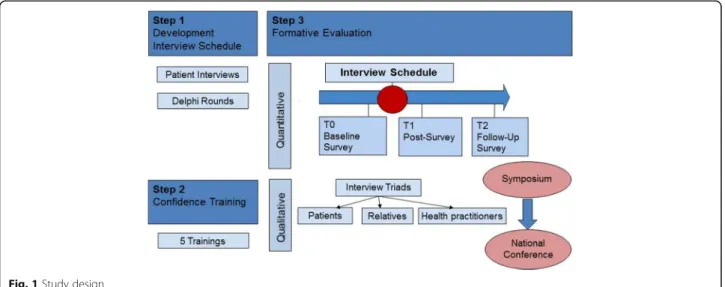
This health services research study aims at designing and testing an intervention to proactively assess DD and routinely addressing death and dying distress. It consists of three steps (see Fig. 1):
1. The revision of and consensus finding on an existing first draft of a clinical interview schedule with prompts (CISP) to deal with a DD by a) semi-structured interviews with patients, and b) a Delphi process with international experts, patient representatives and relatives.
2. Increasing confidence in HPs through a piloted and evaluated 2 day-training program using the consented CISP. The training course and HPs’knowledge, skill and self-confidence gain due to the training as well as their personal experience in using the CISP will be evaluated.
3. An evaluation of conversations about possible DD between HPs and patients: quantitatively using a baseline survey followed by two follow-ups with pa-tients; qualitatively by interviews with triads of patients, relatives and HPs (10–15 each).
Step 1: Revision of and consensus finding on the inter-view schedule to deal with a desire to die.
Objective /research questions
An existing first draft of the CISP to deal with a DD and its possible benefits for clinical practice shall be dis-cussed, reflected, revised and consented.
Participants
Participants will be palliative patients, professional ex-perts, patient representatives and relatives.
Data collection/procedures and sample Semi-structured interviews with patients
Semi-structured interviews with patients will be con-ducted to strengthen the appropriateness of the CISP. An interview guideline will be used to ensure that all relevant hypothesis-directed and theory-driven topics of the CISP will be covered [44], and that open answers will be obtained in order to gain and reconstruct the pa-tients’ subjective perspective. As palliative patients are often limited in their capacities (e.g. because of their lim-ited ability to concentrate or decreased mobility), one-on-one interviews are most appropriate and feasible (in contrast to e.g. focus groups).
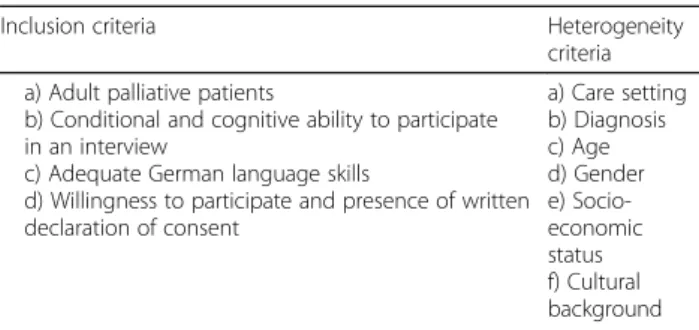
We aim to include a heterogeneous sample of 10–15 patients receiving general or specialist palliative care in different inpatient and outpatient care settings (e.g. pal-liative, oncological, neurologic/psychiatric and geriatric wards, senior residences, palliative home or outpatient care). For patients’ inclusion and heterogeneity criteria see Table1.
Interviews will take place at the desired location of the patient, e.g. the care setting. The interviews will be re-corded and have an estimated duration of 30 to 60 min. Interviewees are free to take a break or interrupt the
interview at any time. Even though we have found in previous studies that patients appreciate conversations on death and dying and do not typically experience dis-cussion of DD as burdensome [28, 45], we will observe whether talking about these existential issues triggers emotional distress and/or the need to modify the con-versation or to provide support. To this end, we will check in with the patients the day following the inter-view if possible (or the next possible time the patients are available) to ask how they feel and if there is any-thing they want to talk about. The patients health care teams will also be informed that the interviews are being conducted and optional psychological support for the interviewer and the interviewees in case of need will be ensured.
Delphi procedure with professional experts, patient representatives and relatives
In addition to the adaption of the CISP based on the pa-tient interviews, a Delphi procedure will be conducted to consent content and structure of the CISP. The Delphi technique is used for the formation of consensus on exist-ing knowledge and the current conceptual world [46,47]. For our Delphi we will apply the criteria presented in Table 2 for selection of 50–70 (inter-) national experts after taking“panel mortality”into account. To include pal-liative patients themselves would of course be valuable but we cannot expect severely ill patients with typically short life expectancy [48] to take part in a Delphi process with several rounds of inquiry over a period of time.
An online tool will be used for the iterative process of administering two to three rounds of surveys to the Delphi panel. Panel members will respond to statements using rating scales to express their agree-ment or disagreeagree-ment regarding the relevance of sev-eral aspects in dealing with DD. Text boxes for panel comments will be provided. A priori criterion for consensus will be defined [49]. All material provided to the expert panel at the outset of the project and
throughout the Delphi process will be carefully
reviewed and piloted in advance in order to examine the effect on experts’judgements.
Data analysis
The interviews will be transcribed verbatim and analyzed according to qualitative content analysis [50–52]. In-ductive and deIn-ductive categories will be derived and ap-plied with the aid of the qualitative data analysis software MAXQDA 12.
Quantitative statistical analysis of the experts’ ratings will be undertaken using SPSS Statistics 22 (or higher) (IBM Corp., Armonk, NY, USA). Thresholds and defini-tions of consensus will be based on values used in previ-ous studies [53–56].
Step 2: Increasing confidence in health practitioners by a 2 day-training program using the consented clinical interview schedule (CISP) developed in step 1.
Objective /research questions
Following the revision of and consensus finding on the CISP, multi-professional training courses will be con-ducted using the consented CISP to increase HPs’ self-confidence in dealing with DD.
Participants
Participants will be multi-professional HPs in specialist but also general palliative care from various disciplines (oncology, neurology, geriatrics, palliative care). This broad approach takes into account that most palliative care patients are cared for in general palliative care set-tings rather than in specialized setset-tings [57].
Procedure and sample
In implementing the training courses, the results of our preliminary work can be referred to (Frerich G*, Romotzky V*, Galushko M, Perrar KM, Montag T, Doll A, Kremeike K, Golla H, Strupp J, Voltz R. How to deal with a patient´s desire for hastened death: Development of a teaching course for health professionals in palliative care, submitted; Romotzky V*, Frerich G*, Galushko M, Hamacher S, Kremeike K, Voltz R. Let’s talk about the desire to die - evaluation of a training course for health professionals, in preparation). Within a previous project, the training concept was developed, piloted and evaluated. Based on the evaluation, the curriculum was revised. The CISP will be applied continuously during the training.
Table 1Criteria for inclusion and heterogeneity in patient interviews
Inclusion criteria Heterogeneity
criteria
a) Adult palliative patients
b) Conditional and cognitive ability to participate in an interview
c) Adequate German language skills
d) Willingness to participate and presence of written declaration of consent
a) Care setting b) Diagnosis c) Age d) Gender e) Socio-economic status f) Cultural background
Table 2Criteria for including professional experts in the Delphi process
Inclusion criteria
a) Occupational group (multi-professional plus ethical experts, patient representatives)
•Experience with DD and/or suicidality
•High scores in self-assed confidence and expertise in DD b) Patient representatives
Five training courses will be conducted, each with 12 health care professionals from various professions and disciplines as well as hospice staff members. HPs will be purposefully sampled; eligibility criteria for participating in the course are presented in Table3.
Course participants will be recruited from the Cologne region. This geographical limitation allows an evaluation of the training impact by personal face to face interviews with HPs, patients, and relatives in step 3. Taking part in the training course is voluntary and free of charge for HPs. Following the courses, participants will be asked to use the CISP in addition to the competences learned in the training course, when discussing DD in routine con-sultations. By participating in the training course, HPs explicitly agree to recruit patients they will discuss a DD with to be enrolled in step 3 of this study.
Training courses will be evaluated based on changes in the HPs’ self-confidence in dealing with DD as well as their knowledge, skills and attitudes related to the topic. Self-confidence will be assessed at three measurement times (3 weeks before the course, directly following the course and 12 months after the course; see Fig. 2). At the third time point, additional follow-up questions will be asked regarding practical applicability of the learned competences and the use of the CISP. To this end, a standardized questionnaire developed in the preliminary project will be used [42]. Additionally, health profes-sionals will be asked to reflect upon their consultations with patients with DD taking part in step 3 of this study. This reflection will also include an inquiry of the specific content discussed with patients and potential burden for the HPs and patients while talking about DD. Due to the HPs’ training, an increase of self-confidence in HPs for such conversations is expected, which will be measured using the confidence scale developed in the course of the preliminary project.
Step 3: Formative evaluation of conversations on de-sire to die between health practitioners and patients.
Objective /research questions
Qualitative and quantitative evaluation of conversations on DD between patients and HPs using the CISP devel-oped in step 1 and the training course content provided in step 2.
Participants
Participants will be palliative patients, their relatives and HPs from the Cologne region.
Procedure and sample
As combining qualitative and quantitative methods pro-vides a more complete view on the research topic than including only one type of data [58, 59], we will use semi-structured interviews as well as standardized and validated questionnaires to evaluate conversations on DD between HPs and palliative care patients. Given how the intervention is still under development, this study is prospective and observatory. The study will investigate whether there is no harm caused by the intervention and will set the ground for a future randomized con-trolled trial (RCT).
Criteria for patient inclusion and sample heterogeneity are similar to those applied in step 1 (see Table1) supple-mented by one inclusion criterion: a life expectancy of 3 to 12 months (surprise question). Each of the 60 HPs trained in step 2 will be asked to recruit about 5 patients for the evaluation of conversations on DD. A total of 300 patients for quantitative analysis will enable us to detect even small within-group effects (withα= 5% and 1–β= 80%, i.e. < 0.2 Cohen’s d for the whole group; in subgroups ofn= 40 < 0.5“moderate”). Patient sampling will be con-secutive including every eligible patient fulfilling the inclu-sion criteria from different care settings (inpatient and outpatient, palliative, oncological, neurologic/psychiatric and geriatric wards, senior residences).
Data collection Quantitative
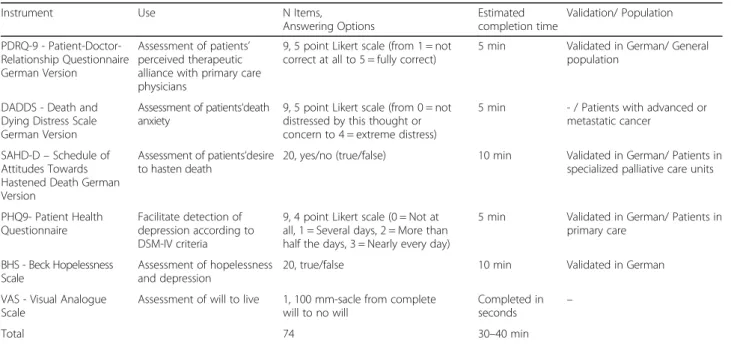
As patient relevant outcomes of an open conversation about possible DD we consider primarily the improve-ment of relationship-quality and the decrease of death and dying distress. These outcomes will be measured by the Patient-Doctor-Relationship Questionnaire German Version (PDRQ-9) [60, 61] and the Death and Dying Distress Scale (DADDS) [62–64]. The PRDQ-9 was de-veloped as a short assessment of the relationship be-tween primary care physicians and patients from the patient’s perspective (9 items on a five-point Likert-scale) and is validated in German [60,61]. The DADDS assesses specific concerns of advanced cancer patients with regard to insecurity about ones end of life, being a burden to others, as well as lost time and opportunities [62–64]. The German adaptation includes 9 instead of 15 items [65]. Additionally, the Likert-scale was short-ened from a six-point to a five-point Likert-scale with mild and moderate distress put together to one label.
As secondary outcomes, DHD and suicidal thoughts are expected to decrease. A DHD as one aspect of DD can be measured by the SAHD [6, 66], which was also
Table 3Criteria for course participation
Participation Criteria
a) Belonging to one of the multi-professional occupational groups in palliative care (e.g. physicians, nurses, social workers, psychologists, hospice staff members)
b) Involvement in direct in- or outpatient specialist or general palliative care for at least 3 years
validated in German with patients in specialized pallia-tive care units [6,66]. The clinical course of patients’ de-pression (Patient Health Questionnaire; PHQ9) [67–69]; hopelessness (Beck Hopelessness Scale) [70] and the will to live (Visual Analogue Scale; VAS) [71,72] will also be documented. Table4gives an overview about the instru-ments that will be used for the quantitative evaluation with patients.
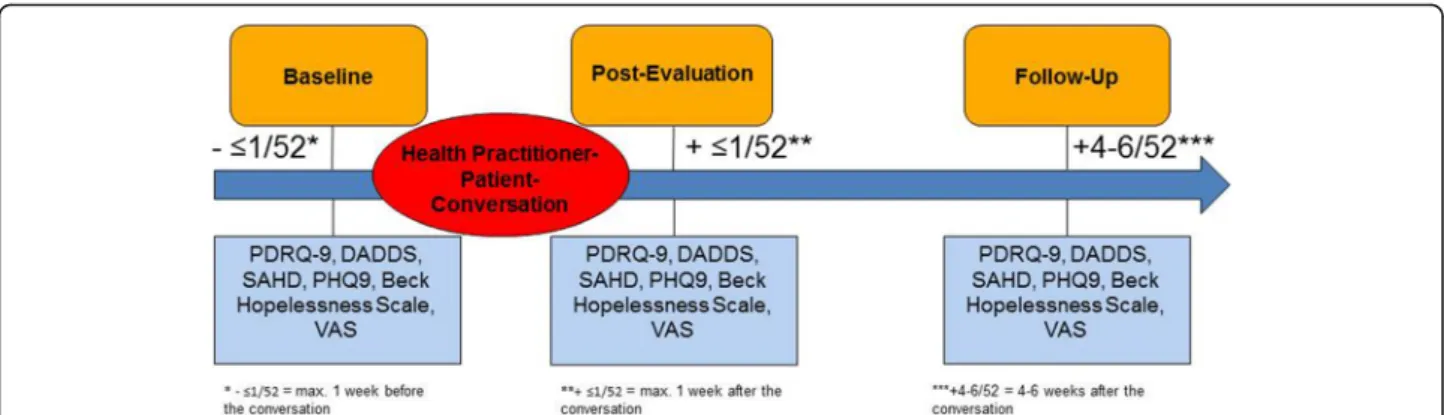
To complete the aforementioned questionnaires, the research team will conduct personal quantitative inter-views with each patient at three measurement times (1. max. 1 week before the HP-patient-conversation on DD, 2. max. 1 week following the conversation, and 3. four to 6 weeks after the conversation; see Fig.3). At the second measurement time, patients will additionally be asked to name the content discussed during the consultation.
After patients have been recruited by the HP to partici-pate in step 3, the research team will inform them about the study. Only after these patients have signed a declar-ation of consent, interviews will take place at the desired
location of the patient, e.g. within the care setting. A copy of the questionnaire’s response categories will be handed out to the interviewees. The interviewer will note the pa-tients’answers for them. Each quantitative interview will have an estimated duration of 30 to 40 min. Interviewees are free to take a break or interrupt the interview at any time. As the interview might raise emotional disturbance and/or the need for discussing some issues in more detail, we will check in with the patient the day following the interview if possible (if not, the next possible time) to ask how they feel and if there is anything they want to talk about. The patient’s health care team will also be informed that the interview is conducted. At all three measurement times, it will be checked before conducting the inquiry, whether patients are conditionally and cognitively able to participate in an interview.
Qualitative
In addition to the quantitative evaluation, semi-structured qualitative interviews [73,74] with 10–15 sets Fig. 2Training course evaluation
Table 4Instruments for the quantitative patient survey to evaluate conversations between palliative care patients and health practitioners
Instrument Use N Items,
Answering Options
Estimated completion time
Validation/ Population
PDRQ-9 - Patient-Doctor-Relationship Questionnaire German Version
Assessment of patients’ perceived therapeutic alliance with primary care physicians
9, 5 point Likert scale (from 1 = not correct at all to 5 = fully correct)
5 min Validated in German/ General population
DADDS - Death and Dying Distress Scale German Version
Assessment of patients‘death anxiety
9, 5 point Likert scale (from 0 = not distressed by this thought or concern to 4 = extreme distress)
5 min - / Patients with advanced or metastatic cancer
SAHD-D–Schedule of Attitudes Towards Hastened Death German Version
Assessment of patients‘desire to hasten death
20, yes/no (true/false) 10 min Validated in German/ Patients in specialized palliative care units
PHQ9- Patient Health Questionnaire
Facilitate detection of depression according to DSM-IV criteria
9, 4 point Likert scale (0 = Not at all, 1 = Several days, 2 = More than half the days, 3 = Nearly every day)
5 min Validated in German/ Patients in primary care
BHS - Beck Hopelessness Scale
Assessment of hopelessness and depression
20, true/false 10 min Validated in German
VAS - Visual Analogue Scale
Assessment of will to live 1, 100 mm-sacle from complete will to no will
Completed in seconds
–
of patients, their relatives and their HP trained in step 2 will be conducted to gain a deeper insight into their per-ception of the conversation about DD between patients and HPs [44, 75]. As one of the main outcomes is the quality of the relationship between patients and the HPs, we chose triads to account for interactional aspects. Moreover, this will allow us to obtain three perspectives on the identical care situation [76]. Criterion sampling [77] will be conducted to depict the variance of patients’ characteristics and settings.
After patients have participated in the quantitative sur-vey, 10 to 15 of them, and in each case one of their rela-tives, will be asked to participate in an additional semi-structured qualitative interview. The request to attend a qualitative interview will be placed by a HP trained in step 2, who is also willing to participate in a qualitative interview. If HP, patients and relatives agree to partici-pate, the research team will inform them about the study. Only after HP, patient and relative all have signed a declaration of consent for the triads individual inter-views will be conducted at the desired location of the in-terviewees, e.g. within the care setting. The interviews will be recorded on tape and will have an estimated dur-ation of 30 to 60 min. Interviewees are free to take a break or interrupt the interview at any time. As the interview might raise emotional disturbance and/or the need for discussing some issues in more detail, we will check in with the HP, patient and relative the day follow-ing the interview, if possible (if not the next possible time) to ask how they feel and if there is anything they want to talk about. The patient’s health care team will also be informed that the interviews are being conducted and optional psychological support for the interviewer and the interviewees in case of need will be ensured.
Data analysis Quantitative
The full quantitative analysis set as derived from the intention-to-treat (ITT) principle includes all patients
with a valid assessment at t0 (baseline survey) and t1 (post-survey). The primary outcome“change in PDRQ-9 from t0 to t1” is analyzed by a two-sided paired t-test with a significance level of 5%. The corresponding null hypothesis is “H0: The Patient-Doctor-Relationship (measured with PDRQ-9) does not change from t0 to t1” and the alternative hypothesis “H1: There is a change in Patient-Doctor-Relationship from t0 to t1”. Additional explorative subgroup analyses (ANCOVA) are done by sex, age, socio-economic status, social inequalities and setting. The secondary outcomes and sensitivity analyses for change in PDRQ-9 from t0 to t2 are essentially ana-lyzed along the same lines as the primary outcome, i.e. using paired t-tests. Moreover, single and multiple im-putation methods are applied to analyze the impact of competing events (i.e. ADD, ADI, AaR) assuming not-at-random missing-patterns [78, 79]. Adverse events are aggregated by category and listed. Time-to-event (e.g. survival) distributions are summarized by the Kaplan-Meier method and subgroups are compared by the (strati-fied) log-rank test. For descriptive analyses qualitative data are summarized by count (percentage), quantitative data by mean, standard deviation and percentiles (0, 25, 50, 75, 100). To pay attention to the interrelation of various per-sonal characteristics (intersectional theory) [80], the ana-lysis of results will include testing the correlation of these diverse characteristics including socio-economic and cul-tural background as well as gender and CISP outcomes.
Qualitative
and HP concerning for example age, gender, socioeco-nomic status or type of DD.
Results will be discussed in an expert meeting for finalization of the CISP and the corresponding training. Findings of the formative evaluation will be considered in order to better deal with different kinds of DD and in order to disseminate the CISP and corresponding train-ing. If analyses indicate that no harm is inflicted by pro-actively addressing DD as suggested by the CISP, further research including a RCT could follow.
Discussion
We propose that proactively addressing a DD can build a solid basis for open discussion and enhancing a trust-ing HP-patient relationship in which such difficult topics can be addressed. Furthermore, patients can express a wish to die in different ways and proactively addressing DD as well as managing it may clarify reasons more openly and at an earlier stage.
As previous studies have shown, end-of life research with patients is not only feasible, but also welcomed by patients [28, 45]. We do not expect harm when initiating careful discussion on DD with patients. Patients and relatives mostly want to discuss end-of-life issues and often hope this to be initiated by their HPs [81–84]. They also wish for a HP who is comfortable in such discussions [85–87].
The potential benefits of this study are: 1. The inter-national creation of the first semi-standardized approach for a proactive assessment of a DD and the optimal therapeutic response to it, 2. the multi-professional en-hancement of confidence in dealing with DD by a train-ing course which can be integrated into other traintrain-ing programs, and 3. the improvement of managing DD for patients, relatives and HPs considering aspects of social inequality and gender.
Abbreviations
AaR:Attrition at random; ADD: Attrition due to death; ADI: Attrition due to illness; BHS: Beck Hopelessness Scale; DADDS: Death and Dying Distress Scale; DD: Desire to Die; DHD: Desires for hastened death; HP: Health practitioners; PDRQ-9: Patient-Doctor-Relationship-Questionnaire German Version; PHQ9: Patient Health Questionnaire; RCT: Randomized Controlled Trial; SAHD: Schedule of Attitudes towards Hastened Death; SAHD-D: Schedule of Attitudes towards Hastened Death German Version; VAS: Visual Analogue Scale
Acknowledgements
The authors would like to thank the BMBF for funding this study as well as our field access partners and the international experts for their support. We also thank our advisory board members Prof. Gunnar Duttge (University Göttingen), Dr. Margit Gratz (University Münster), Prof. Frank Jessen (University Hospital Cologne; UKK), Dr. Klaus Kobert (Bethel), PD Dr. Reinhard Lindner (University Hamburg), Vera Lux (UKK), Prof. Barbara Schneider (UKK), Prof. Kirsten Schlüter (UKK).
Funding
The study is funded by the German Federal Ministry of Education and Research (BMBF; Funding code 01GY1706).
Availability of data and materials
The datasets generated and/or analyzed during the current study are available from the corresponding author on reasonable request.
Authors’contributions
KK is Principal Investigator, responsible for the study design, project management, recruitment, data collection, data analysis and dissemination. MG is responsible for the study design, data analysis and dissemination. GF is responsible for the study design, recruitment, data collection, data analysis and dissemination. VR is responsible for the study design, recruitment, data collection, data analysis and dissemination. SH is responsible for the study design and data analysis. GR contributes to the study design, data analysis and dissemination. HP contributes to the study design, data analysis and dissemination. RV is Principal Investigator and responsible for the study design, project management and dissemination. All authors read and approved the final manuscript.
Ethics approval and consent to participate
Ethical approval for this study was obtained from the Ethics Committee of the University of Cologne (#17–265; 4th September 2017). All study information and patient consent forms are approved by the Ethics committee.
Consent for publication
Not applicable.
Competing interests
The authors declare that they have no competing interests.
Publisher’s Note
Springer Nature remains neutral with regard to jurisdictional claims in published maps and institutional affiliations.
Author details
1Department of Palliative Medicine, Medical Faculty of the University of
Cologne, Cologne, Germany.2Institute of Medical Statistics and Computational Biology, University of Cologne, Cologne, Germany. 3Department of Supportive Care, Princess Margaret Cancer Centre, University
Health Network, Toronto, Canada.4Institute of Medical Science, University of Toronto, Toronto, Canada.5Department of Psychiatry, University of Toronto, Toronto, Canada.6Institute of Medical Sociology, Health Services Research, and Rehabilitation Science (IMVR), The University of Cologne, Medical Faculty, Cologne, Germany.7University of Cologne, Center for Integrated Oncology Cologne / Bonn (CIO), Cologne, Germany.8University of Cologne, Center for Health Services Research Cologne (ZVFK), Cologne, Germany.9University of Cologne, Clinical Trials Center Cologne (ZKS), Cologne, Germany.
Received: 17 January 2018 Accepted: 25 January 2018
References
1. Chochinov H, Wilson K, Enns M. Desire for death in the terminally ill. Am J. Psychiatry. 1995;152:1185–91.
2. Rodin G, Zimmermann C, Rydall A, Jones J, Shepherd FA, Moore M, Fruh M, Donner A, Gagliese L. The desire for hastened death in patients with metastatic cancer. J Pain Symptom Manage. 2007;33:661–75.
3. Mystakidou K, Parpa E, Katsouda E, Galanos A, Vlahos L. The role of physical and psychological symptoms in desire for death: a study of terminally ill cancer patients. Psycho-Oncology. 2006;15:355–60.
4. Kelly B, Burnett P, Pelusi D, Badger S, Varghese F, Robertson M. Factors associated with the wish to hasten death: a study of patients with terminal illness. Psycholical Med. 2003;33:75–81.
5. Hudson PL, Schofield P, Kelly B, Hudson R, O'Connor M, Kristjanson LJ, Ashby M, Aranda S. Responding to desire to die statements from patients with advanced disease: recommendations for health professionals. Pall Med. 2006;20:703–10. 6. Breitbart W, Rosenfeld B, Pessin H, Kaim M, Funesti-Esch J, Galietta M,
Nelson CJ, Brescia R. Depression, hopelessness, and desire for hastened death in terminally ill patients with cancer. JAMA. 2000;284(22):2907–11. 7. Ohnsorge K, Gudat H, Rehmann-Sutter C. What a wish to die can mean:
8. Balaguer A, Monforte-Royo C, Porta-Sales J, Alonso-Babarro A, Altisent R, Aradilla-Herrero A, Bellido-Perez M, Breitbart W, Centeno C, Cuervo MA, et al. An international consensus definition of the wish to hasten death and its related factors. PLoS ONE. 2016;11:e0146184.
9. Voltz R, Galushko M, Walisko J, Karbach U, Ernstmann N, Pfaff H, Nauck F, Radbruch L, Ostgathe C. Issues of“life”and“death”for patients receiving palliative care–comments when confronted with a research tool. Support. Care in Cancer. 2011;19:771–7.
10. Ohnsorge K, Gudat H, Rehmann-Sutter C. Intentions in wishes to die: analysis and a typology - a report of 30 qualitative case studies of terminally ill cancer patients in palliative care. Psychooncology. 2014;23(9):1021–6. 11. Coyle N, Sculco L. Expressed desire for hastened death in seven patients
living with advanced cancer: a phenomenologic inquiry. Oncol Nurs Forum. 2004;31:699–709.
12. Monforte-Royo C, Villavicencio-Chavez C, Tomas-Sabado J, Mahtani-Chugani V, Balaguer A. What lies behind the wish to hasten death? A systematic review and meta-ethnography from the perspective of patients. PLoS ONE. 2012;7:e37117.
13. Ohnsorge K: Intentions, motivations, and social interactions regarding a wish to die. In The Patient's wish to die: research, ethics, and palliative care. Rehmann-Sutter C, Gudat, H., Ohnsorge, K,. Oxford: Oxford University Press; 2015: 81-96. 14. Back AL, Wallace JI, Starks HE, Pearlman RA. Physician-assisted suicide and euthanasia in Washington state. Patient requests and physician responses. JAMA. 1996;275:919–25.
15. Craig A, Cronin B, Eward W, Metz J, Murray L, Rose G, Suess E, Vergara ME. Attitudes toward physician-assisted suicide among physicians in Vermont. J Med Ethics. 2007;33:400–3.
16. Nissim R, Gagliese L, Rodin G. The desire for hastened death in individuals with advanced cancer: a longitudinal qualitative study. Soc Sci Med. 2009;69:165–71. 17. Georges JJ, The AM, Onwuteaka-Philipsen BD, van der Wal G. Dealing with
requests for euthanasia: a qualitative study investigating the experience of general practitioners. J Med Ethics. 2008;34:150–5.
18. Jones JM, Huggins MA, Rydall AC, Rodin GM. Symptomatic distress, hopelessness, and the desire for hastened death in hospitalized cancer patients. J Psychosom Res. 2003;55:411–8.
19. Lapierre S, Boyer R, Desjardins S, Dubé M, Lorrain D, Préville M, Brassard J. Daily hassles, physical illness, and sleep problems in older adults with wishes to die. Int Psychogeriatr. 2012;24:243–52.
20. Lindner R, Foerster R, von Renteln-Kruse W. Physical distress and relationship problems : exploring the psychosocial and intrapsychic world of suicidal geriatric patients. Z Gerontol Geriatr. 2014;47(6):502–7. 21. Rombold F, Lauterbach E, Felber W, Mueller-Oerlinghausen B, Ahrens B,
Bronisch T, Kilb B, Lewitzka U, Richter K, Broocks A, et al. Adjunctive lithium treatment in the prevention of suicidal behavior in patients with depression and comorbid personality disorders. Int J Psychiatry Clin Pract. 2014;18:300–3. 22. Lo C, Hales S, Chiu A, Panday T, Malfitano C, Jung J, Rydall A, Li M, Nissim R,
Zimmermann C, Rodin G. Managing cancer and living meaningfully (CALM): randomised feasibility trial in patients with advanced cancer. BMJ Support Palliat Care. 2016.https://doi.org/10.1136/bmjspcare-2015-000866. [Epub ahead of print].
23. Scheffold K, Philipp R, Engelmann D, Schulz-Kindermann F, Rosenberger C, Oechsle K, Harter M, Wegscheider K, Lordick F, Lo C, et al. Efficacy of a brief manualized intervention managing cancer and living meaningfully (CALM) adapted to German cancer care settings: study protocol for a randomized controlled trial. BMC Cancer. 2015;15:592.
24. Ethikrat D: Zur Regelung der Suizidbeihilfe in einer offenen Gesellschaft: Deutscher Ethikrat empfiehlt gesetzliche Stärkung der Suizidprävention.2014. 25. Voltz R, Galushko M, Walisko-Waniek J, Pfaff H, Nauck F, Radbruch L,
Ostgathe C. End-of-life research on patients’attitudes in Germany: a feasibility study. Support Care Cancer. 2010;18(3):317–20.
26. Khan L, Wong R, Li M, Zimmermann C, Lo C, Gagliese L, Rodin G. Maintaining the will to live of patients with advanced cancer. Cancer J. 2010;16:524–31. 27. Galushko M, Frerich G, Perrar K, Golla H, Radbruch L, Nauck F, Ostgathe C,
Voltz R. Desire for hastened death: how do professionals in specialized palliative care react? Psychooncology. 2016;25(5):536–43.
28. Voltz R, Galushko M, Walisko J, Pfaff H, Nauck F, Radbruch L, Ostgathe C. End-of-life research on patients’attitudes in Germany: a feasibility study. Support Care Cancer. 2010;18:317–20.
29. Tanuseputro P, Budhwani S, Bai YQ, Wodchis WP. Palliative care delivery across health sectors: a population-level observational study. Palliat Med. 2017;31:247–57.
30. Koch-Institut R: RKI. Gesundheit in Deutschland. Gesundheitsberichtserstattung des Bundes. Gemeinsam getragen von RKI und Destatis. 2015.
31. Lampert T, Schneider S, Klose M, Jacobi F. Schichtspezifische Unterschiede im Vorkommen psychischer Störungen. Public Health Forum. 2005;13:7–8. 32. Dohrenwend BP, Levav I, Shrout PE, Schwartz S, Naveh G, Link BG, Skodol AE, Stueve A. Socioeconomic status and psychiatric disorders: the causation-selection issue. Sci. 1992;255:946–52.
33. Lorant V, Kunst AE, Huisman M, Costa G, Mackenbach J. Socio-economic inequalities in suicide: a European comparative study. Br J Psychiatry. 2005; 187:49–54.
34. Burt J, Plant H, Omar R, Raine R. Equity of use of specialist palliative care by age: cross-sectional study of lung cancer patients. Palliat Med. 2010;24:641–50. 35. Gisquet E, Julliard S, Geoffroy-Perez B. Do social factors affect the place of
death? Analysis of home versus institutional death over 20 years. J Public Health. 2016;38:e472–9.
36. Schim SM, Doorenbos AZ. A three-dimensional model of cultural congruence: framework for intervention. J soc work end life Palliat Care. 2010;6:256–70.
37. Villavicencio-Chávez C, Monforte-Royo C, Tomás-Sábado J, Maier MA, Porta-Sales J, Balaguer A. Physical and psychological factors and the wish to hasten death in advanced cancer patients. Psycho-Oncology. 2014;23:1125–32. 38. Carmel S. The will to live: gender differences among elderly persons. Soc Sci
Med. 2001;52:949–58.
39. Rurup ML, DJH D, Poppelaars JL, AJFM K, Onwuteaka-Philipsen BD. Wishes to die in older people: a quantitative study of prevalence and associated factors. Crisis: The Journal of Crisis Intervention and Suicide Prevention. 2011;32:194–203.
40. Raue PJ, Morales KH, Post EP, Bogner HR, Have TT, Bruce ML. The wish-to-die and five-year mortality in elderly primary care patients. Am J Geriatr Psychiatry. 2010;18:341–50.
41. Mergl R, Koburger N, Heinrichs K, Székely A, Tóth MD, Coyne J, Quintão S, Arensman E, Coffey C, Maxwell M, et al. What are reasons for the large gender differences in the lethality of suicidal acts? An epidemiological analysis in four European countries. PLoS ONE. 2015;10:e0129062. 42. Frerich G, Romotzky V, Galushko M. How to deal with patients’desire to die:
evaluation of two pilot courses. Psycho-Oncology. 2017;26:22–3.
43. Vehling S, Malfitano C, Shnall J, Watt S, Panday T, Chiu A, Rydall A, Zimmermann C, Hales S, Rodin G, Lo C. A concept map of death-related anxieties in patients with advanced cancer. BMJ Support Palliat Care. 2017;7:427–34.
44. Flick CL. An introduction to qualitative research. Los Angeles; 2014. 45. Galushko M, Strupp J, Walisko-Waniek J, Hahn M, Loffert S, Ernstmann N,
Pfaff H, Radbruch L, Nauck F, Ostgathe C, Voltz R. Validation of the German version of the schedule of attitudes toward hastened death (SAHD-D) with patients in palliative care. Palliat Support Care. 2015;13:713–23.
46. Iqbal S, Pipon-Young L. The Delphi method. A step-by-step guide. Psychologist. 2009;22:598–601.
47. Jünger S. Die Delphi-Methode: Teil 1. Zeitschrift für Palliativmedizin. 2011;12: 245–8.
48. Ostgathe C, Alt-Epping B, Lindena G, Radbruch L, Voltz R. Palliative Care for non-Cancer Patients in specialised palliative Care in Germany - data from the German hospice and palliative care evaluation (HOPE) 2002-2005. Eur J Intern Med. 2014; 25(2):187–92.
49. Jünger S, Payne SA, Brine J, Radbruch L, Brearley SG. Guidance on conducting and REporting DElphi studies (CREDES) in palliative care: recommendations based on a methodological systematic review. Palliat Med. 2017;31(8):684–706. 50. Mayring P: Qualitative content analysis. In A companion to qualitative
research volume 266–269. Flick U, Kardorff Ev, Steinke I. London: Sage; 2004. 51. Schreier M. Qualitative content analysis in practice. Thousand Oaks: Sage
Publications Ltd; 2012.
52. Kuckartz U. Qualitative text analysis. A guide to methods, practice and software programs. Thousand Oaks: Sage Publications Ltd; 2014. 53. Jünger S, Brearley S, Payne S, Mantel-Teeuwisse AK, Lynch T, Scholten W,
Radbruch L. Consensus building on access to controlled medicines: a four-stage Delphi consensus procedure. J Pain Symptom Manage. 2013;46(6):897–910. 54. Haggerty J, Burge F, Lévesque J-F, Gass D, Pineault R, Beaulieu M-D, Santor
D. Operational definitions of attributes of primary health care: consensus among Canadian experts. Ann Fam Med. 2007;5:336–44.
56. Engels Y, Campbell S, Dautzenberg M, van den Hombergh P, Brinkmann H, Szécsényi J, Falcoff H, Seuntjens L, Kuenzi B, Grol R. Developing a framework of, and quality indicators for, general practice management in Europe. Fam Pract. 2005;22:215–22.
57. GKV-Spitzenverband: Empfehlungen des GKV-Spitzenverbandes nach §132d Abs. 2 SGB V für die spezialisierte ambulante Palliativversorgung. 2012. 58. Creswell JW, Plano Clark VL. Designing and conducting mixed methods
research. Third ed. Thousand Oaks: SAGE Publications Ltd; 2017.
59. Ingleton C, Davies S. Mixed methods for evaluation research. In: Addington-Hall JM, Bruera E, Higginson IJ, Payne S, editors. . New York: Oxford University Press; 2007. p. 191–209.
60. Van der Feltz-Cornelis CM, Van Oppen P, Van Marwijk HWJ, De Beurs E, Van Dyck R. A patient-doctor relationship questionnaire (PDRQ-9) in primary care: development and psychometric evaluation. Gen Hosp Psychiatry. 2004;26:115–20. 61. Zenger M, Schaefert R, van der Feltz-Cornelis C, Brähler E, Häuser W. Validation
of the patient-doctor-relationship questionnaire (PDRQ-9) in a representative cross-sectional German population survey. PLoS One. 2014;9:e91964. 62. Krause S, Rydall A, Hales S, Rodin G, Lo C. Initial validation of the death and
dying distress scale for the assessment of death anxiety in patients with advanced cancer. J Pain Symptom Manag. 2015;49:126–34.
63. Tong E, Deckert A, Gani N, Nissim R, Rydall A, Hales S, Rodin G, Lo C. The meaning of self-reported death anxiety in advanced cancer. Palliat Med. 2016;30(8):772–9.
64. Lo C, Hales S, Zimmermann C, Gagliese L, Rydall A, Rodin GM. Measuring death-related anxiety in advanced cancer: preliminary psychometrics of the death and dying distress scale. J Pediatr Hematol Oncol. 2011;33:140–5. 65. Engelmann D, Scheffold K, Friedrich M, Hartung TJ, Schulz-Kindermann F,
Lordick F, Schilling G, Lo C, Rodin G, Mehnert A. Death-related anxiety in patients with advanced cancer: validation of the German version of the death and dying distress scale. J Pain Symptom Manag. 2016;52:582–7. 66. Galushko M, Golla H, Strupp J, Karbach U, Kaiser C, Ernstmann N, Pfaff H,
Ostgathe C, Voltz R. Unmet needs of patients feeling severely affected by multiple sclerosis in Germany: a qualitative study. J Palliat Med. 2014;17(3): 274–81.
67. Chilcot J, Rayner L, Lee W, Price A, Goodwin L, Monroe B, Sykes N, Hansford P, Hotopf M. The factor structure of the PHQ-9 in palliative care. J Psychosom Res. 2013;75(1):60–4.
68. Petersen JJ, Paulitsch MA, Hartig J, Mergenthal K, Gerlach FM, Gensichen J. Factor structure and measurement invariance of the patient health Questionnaire-9 for female and male primary care patients with major depression in Germany. J Affect Disord. 2015;170:138–42.
69. Spangenberg L, Brähler E, Glaesmer H. Wie gut eignen sich verschiedene Versionen des Depressionsmoduls des Patient Health Questionnaires zur Identifikation depressiver Personen in der Allgemeinbevölkerung? Z Psychosom Med Psychother. 2012;58:3–10.
70. Krampen G. Skalen zur Erfassung von Hoffnungslosigkeit (H-Skalen). Deutsche Bearbeitung und Weiterentwicklung der H-Skala von Aaron T. Beck. Testmappe. Göttingen: Hogrefe; 1994.
71. Tataryn D, Chochinov HM. Predicting the trajectory of will to live in terminally ill patients. Psychosomatics. 2002;43:370–7.
72. Chochinov HM, Tataryn D, Clinch JJ, Dudgeon D. Will to live in the terminally ill. Lancet. 1999;354:816–9.
73. Dalton J. Client-caregiver-nurse coalition formation in decision-making situations during home visits. J Adv Nurs. 2003;52:291–9.
74. Smebye KL, Kirkevold M, Engedal K. How do persons with dementia participate in decision making related to health and daily care? A multi-case study. BMC Health Serv Res. 2012;12:241. https://doi.org/10.1186/1472-6963-12-241
75. Legard R. In-depth interview. In: Ritchie J, Lewis L, editors. Qualitative research practice. Los Angeles: SAGE Publications; 2010. p. 138–69. 76. Flick U. Triangulation in qualitative research. In: UvK F, Von Kardorff E,
Steinke I, editors. A companion to qualitative research. 3rd ed. London: Sage Publications; 2010. p. 178–83.
77. Palinkas LA, Horwitz SM, Green CA, Wisdom JP, Duan N, Hoagwood K. Purposeful sampling for qualitative data collection and analysis in mixed method implementation research. Adm Policy Ment Health Ment Health Serv Res. 2015;42(5):533–44.
78. White IR, Horton NJ, Carpenter J, Pocock SJ. Strategy for intention to treat analysis in randomised trials with missing outcome data. BMJ. 2011;342:d40. 79. Preston NJ, Fayers P, Walters SJ, Pilling M, Grande GE, Short V, Owen-Jones
E, Evans CJ, Benalia H, Higginson IJ, Todd CJ. Recommendations for
managing missing data, attrition and response shift in palliative and end-of-life care research: part of the MORECare research method guidance on statistical issues. Palliat Med. 2013;27:899–907.
80. Hankivsky O. Women’s health, men’s health, and gender and health: implications of intersectionality. Soc Sci Med. 2012;74:1712–20. 81. Fallowfield LJ, Jenkins VA, Beveridge HA. Truth may hurt but deceit hurts
more: communication in palliative care. Palliat Med. 2002;16:297–303. 82. Emanuel LL, Barry MJ, Stoeckle JD, Ettelson LM, Emanuel EJ. Advance
directives for medical care—a case for greater use. N Engl J Med. 1991;324: 889–95.
83. Emanuel LL. Advance directives: do they work? JACC. 1995;25:35–8. 84. Balaban RB. A physician's guide to talking about end-of-life care. J Gen
Intern Med. 2000;15:195–200.
85. Steinhauser KE, Christakis NA, Clipp EC, McNeilly M, McIntyre L, Tulsky JA. Factors considered important at the end of life by patients, family, physicians, and other care providers. JAMA. 2000;284:2476–82.
86. Steinhauser KE, Christakis NA, Clipp EC, McNeilly M, Grambow S, Parker J, Tulsky JA. Preparing for the end of life: preferences of patients, families, physicians, and other care providers. J Pain Symptom Manag. 2001;22:727–37. 87. Wenrich MD, Curtis JR, Shannon SE, Carline JD, Ambrozy DM, Ramsey PG.
Communicating with dying patients within the spectrum of medical care from terminal diagnosis to death. Arch Intern Med. 2001;161:868–74.
• We accept pre-submission inquiries
• Our selector tool helps you to find the most relevant journal
• We provide round the clock customer support
• Convenient online submission
• Thorough peer review
• Inclusion in PubMed and all major indexing services
• Maximum visibility for your research
Submit your manuscript at www.biomedcentral.com/submit