R E S E A R C H
Open Access
Process evaluation of the implementation
of the
Unplugged
Program for drug use
prevention in Brazilian schools
Pollyanna F. P. Medeiros
1, Joselaine I. Cruz
1, Daniela R. Schneider
2, Adriana Sanudo
1and Zila M. Sanchez
1*Abstract
Background:Most Brazilian schools do not have a continuous program for drug use prevention. To address this gap, the Ministry of Health adapted the European evidence-based programUnpluggedto improve the drug use prevention efforts of Brazilian public schools. The aim of this study was to evaluate the process of program implementation in three Brazilian cities among middle school students between 6thand 9thgrade (11 to 14 years old).
Methods:Mixed methods were used in this process evaluation study, including focus groups, fidelity forms, and satisfaction questionnaires. Study participants included 36 teachers, 11 school administrators, 6 coaches, 16 stakeholders, and 1267 students from 62 classes in 8 schools.
Results:The 12Unpluggedlessons were all implemented in 94 % of the classes. However, only 57 % of the classes were completed as described in the program's manual. The decision to exclude activities because of time constraints was made without a common rationale. Teachers reported difficulties due to the amount of time necessary to plan the lessons and implement the activities. In addition, they mentioned that the lack of support from school administrators was an obstacle to proper program implementation. The majority of students and teachers responded positively to the program, reporting changes in the classroom environment and in personal skills or knowledge.
Conclusions:TheUnpluggedprogram can be feasibly implemented in Brazilian public schools. However, it is necessary to reduce the number of activities per class and to restructure the format of the standard teaching schedule to ensure that the normal academic content is still taught whileUnpluggedis being implemented.
Keywords:Process evaluation,Unplugged, Prevention program, School, Students
Background
Universal prevention in the school environment is a ne-cessary strategy to control substance use among teen-agers, particularly because the incidence of initiation of alcohol and other drug use increases significantly be-tween the beginning and the end of adolescence [1]. In Brazil, the average age of initial consumption among stu-dents is 13 years old for alcohol and between 13 and 14 years old for other drugs [2], with alcohol and to-bacco being the most consumed substances among teens [3]. Based on this data, it is necessary to consolidate in-terventions to prevent the initiation of substance use
and avoid the development of disorders associated with drug use, as highlighted in the three existing United Nations International Drug Control Conventions. In Brazil, there is still a gap in the implementation of drug prevention programs [4], often due to either a lack of teachers who are trained to discuss drug use in the class-room [5] or the lack of support by the school adminis-tration [6].
Given the current situation in Brazil, the Unplugged Program for drug prevention in the school environment [7] was selected by the Brazilian Ministry of Health to be adapted, implemented, and evaluated in the Brazilian setting. This program is based on a theoretical model of social influence [8] and promotes life skills, provides in-formation on drugs, and develops critical thinking to-ward social and normative beliefs [9]. The program was * Correspondence:[email protected]
1Department of Preventive Medicine, Escola Paulista de Medicina,
Universidade Federal de São Paulo, Rua Botucatu, 740, 4° andar, São Paulo, SP, Brazil
Full list of author information is available at the end of the article
selected because of the results obtained in eight coun-tries, which provided evidence of the program’s effective-ness in delaying initiation of tobacco, cannabis, and alcohol use among students between 12 and 14 years of age [10–12].
Despite the program’s proven effectiveness in other contexts, it is still essential to evaluate the implementa-tion process of a program that has been culturally adapted [13]. Process evaluation is an important proced-ure that assesses the factors affecting program imple-mentation and how the program is received by those involved; the results of process evaluation enable the de-velopment of adaptations to enhance the reach and ac-ceptability of the program [14]. In recent years, a large number of studies have noted the importance of evaluat-ing the implementation of preventive interventions in the school environment [15, 16].
Moreover, the use of process evaluations has grown in complexity and importance to now provide a clear definition of what interventions offered to participants based on program fidelity, feasibility, and acceptability [13, 17, 18].
Fidelity determines whether the planned content was implemented effectively and whether the program was accurately administered [19]. Another component ana-lyzed in process evaluation is feasibility, which primarily addresses whether the context and the operational pro-cesses involved in program implementation are achiev-able within the given setting. Finally, acceptability (or satisfaction) is also evaluated, which refers to how the implementation of the intervention met the participants' aspirations and expectations and their satisfaction with the program [20].
This study advances previous studies by assessing all the parties involved in the program implementation and decision-making: government health and education stakeholders, school administrators, program coaches, teachers, and students. Additionally, it uses a mixed methods approach to triangulate data from focus groups and quantitative questionnaires. Finally, this is the first process evaluation study of the Unpluggedprogram in a developing country. Evaluating the implementation process of an evidence-based drug school prevention program that was created for use in developed countries will provide invaluable information regarding the imple-mentation ofUnpluggedin a middle-income, developing country. The results can help policy makers understand what elements are essential for the successful adaptation of Unplugged in a new context (i.e., from developed to in development countries).
We used three axis of analysis (fidelity, acceptability and viability) as proposed by Rohrbach et al. [16] instead of focusing on only one of the factors. Analyzing mul-tiple implementation variables is necessary because a
program with high fidelity but low acceptability by the target population would not be sustainable. We also opted to include the feasibility axis to obtain data on the difficulties faced during the implementation that could or could not be easily resolved, as proposed by Beasley et al. [21] and Goenka et al. [22].
In addition to the process evaluation described in this study, it is important to note that the efficacy of Unplugged in Brazil was also evaluated in a non-randomized controlled trial conducted with 2185 stu-dents in 16 public schools in 3 Brazilian cities. Multilevel analyses stratified by age were used to evaluate the changes in the consumption of each drug over time (baseline and 4 months follow up) and between groups (control and experimental). The results indicated that the program seems to have stimulated a decrease in re-cent marijuana use among students 13 to 15 years old. In addition, students in this age range who received the Unplugged program in the classroom maintained drug consumption levels that were similar to those observed before the beginning of the program. On the other hand, students who did not participate in the program showed a tendency to increase their consumption of alcohol, marijuana, and inhalants over the year of the study [23].
The objective of this study was to evaluate the imple-mentation process ofUnplugged in three Brazilian cities considering its fidelity, feasibility, and acceptability and to analyze how the program activities were implemented, thus providing tools to monitor program quality and generating information needed to adjust the program’s implementation.
Methods
This study was an evaluation research study that ana-lyzed an implementation process [19]. The research strategy adopted for the analysis was a mixed-methods approach, as proposed by Creswell [24], using quantita-tive and qualitaquantita-tive instruments to obtain a more holistic understanding [25].
The intervention
Unplugged is an interactive school program based on the Comprehensive Social Influence approach that combines teaching life skills and normative contents in a 50-min weekly lesson that is taught by the school’s current teachers over 12 weeks (Table 1). The design of this inter-vention has been described by van der Kreeft [7] and is available on the EU-Dap [11] website–www.eudap.net.
In Brazil, the English versions of these materials were translated into Portuguese, including the adaptation of idioms and the modification of information to be more appropriate to the Brazilian context. Teachers attended a 16-h training session that was facilitated by coaches from the Ministry of Health who had been trained by the European developers of the program [7].
At the end of each lesson, the teachers completed a fi-delity form (monitored class by class) to assess the dose of the program offered (quantity of program activities performed), following the structure of the EU-Dap mon-itoring [26]. To ensure fidelity, teachers were supervised every three weeks by the Ministry of Health coaches through in-person meetings. During these meetings, the coaches confirmed that the fidelity forms were being completed, helped teachers plan the lessons, checked the delivery of lessons, and solved potential challenges that the teachers might be facing, thus standardizing the im-plementation throughout all the participating schools.
Participants in the program
In Brazil, the implementation of theUnpluggedProgram included 5 stages: establishment of the state- and municipal-level policies with health and educational stakeholders to enable implementation in public schools; selection of the schools; training of the coaches by the program developers; training of the teachers by the
coaches; and monitoring and evaluation of the program implementation in schools.
During the second school semester of 2013, eight Brazilian schools used the Unplugged Program in the classrooms of 6th to 9th grade students. The program was implemented in 3 Brazilian cities: São Paulo, São Bernardo do Campo (both in São Paulo state, southeast-ern region of Brazil) and Florianópolis (Santa Catarina state, southern region of Brazil). Overall, the program reached 1833 students in 62 classes and was taught by 36 teachers. The distribution by region was 1210 students, 40 classes, and 15 teachers in São Paulo state and 623 students, 22 classes, and 21 teachers in Santa Catarina state.
The participating schools were selected and nominated by the State and Municipal Departments of Education in the regions involved based on the lack of an active pro-gram for drug use prevention for 6th to 9th grade stu-dents and the absence of explicit problems with drug trafficking. Each school principal recommended the teachers who would participate in the program, and each teacher could apply the program in up to 3 of their clas-ses. The program was applied weekly in each of the se-lected classes to all the students present in the classroom.
It is important to note that Unplugged is a universal prevention program that is indicated for groups in which Table 1Description of the 12Unpluggedlessons by title, activities, and goals, Brazil, 2013
Lesson Title Activities Goals
1 OpeningUnpluggedProgram Presentation, group work, contract management
Introduction to the program, setting of rules for the lessons, reflecting on knowledge on drugs
2 Where do I fit in? Situation play, game discussion Clarification of group influences and group expectations
3 Choices–alcohol, risk, and protection
Discussion and work in small groups, collage and drawing
Information on the different factors influencing drug use
4 Does what you think reflect reality?
Presentation, percentage estimates, group work, plenary discussion
Fostering the critical evaluation of information, reflection on differences between own opinion and actual data, correction of norms
5 What we know and what we don’t know about cigarettes
Test, plenary discussion, court Information on the effects of smoking, differentiation between expected and real effects and short-term vs. long-term effects
6 Express yourself Game, plenary discussion, group
work
Adequate communication of emotions, distinguishing between verbal and nonverbal communication
7 Position yourself in the world and in your life
Plenary discussion, group work, role play
Fostering assertiveness and respect for others
8 New in the area! Role play, game, plenary discussion Recognition and appreciation of positive qualities, acceptance of positive feedback, practicing and reflecting on getting into contact with others
9 Drugs–Get informed Group work, quiz Information on the positive and negative effects of drug use
10 Coping strategies Presentation, plenary discussion, group work
Expression of negative feelings, coping with challenges
11 Problem solving and decision making
Presentation, plenary discussion, group work, homework
Structured problem solving, fostering creative thinking and self-control
12 Goal setting Game, group work, plenary
discussion
Distinguishing between long-term and short-term objectives, feedback on the program and the process during the program
the prevalence of initial drug experimentation is low [27]. The schools were selected due to their "normal profile," meaning they did not have a noticeable presence of drug consumption by the students nor explicit drug traffic. Furthermore, the schools did not have an on-going formal drug use prevention program to avoid any contamination of the results. As the program had not been evaluated in groups with a high prevalence of drug use, it did not make sense to choose schools with a high drug profile for the first implementation and evaluation in Brazil. This decision to select normal profile schools was made by the health and education governmental secretariats as the Brazilian schools that were vulnerable to drug trafficking would have presented more chal-lenges to the adaptation of the program to Brazilian culture.
Study participants
The results of this study describe the process evaluation of the classroom intervention. The sample of partici-pants for this study was selected from the group of par-ticipants in the program.
Five groups of people who were involved in different stages of the program implementation process partici-pated in the study: students, teachers, stakeholders (members of the state and municipal departments of health and education), school administrators (principals and pedagogical coordinators), and coaches (Table 2).
The participants in the focus groups were 54 students (6 groups), 13 teachers (2 groups), 16 stakeholders (2 groups), 11 school administrators (2 groups), and 6
coaches (1 group) divided by category and by Brazilian State. The participants were randomly selected from the entire population of participants and consisted of those who were available on the day and time scheduled by the research team. Ten participants were invited to each focus group, and an average of seven agreed to partici-pate in each group. The refusals to participartici-pate were mainly due to scheduling conflicts on the days when the focus groups were scheduled.
Students and teachers completed the satisfaction ques-tionnaires anonymously one week after the end of the program. Only the students and teachers who were present in the school that day responded to the instru-ments; therefore, the questionnaires were not completed by all the participants in the program (participation rate: 75 % for teachers and 71 % for students).
Techniques for data collection and instruments
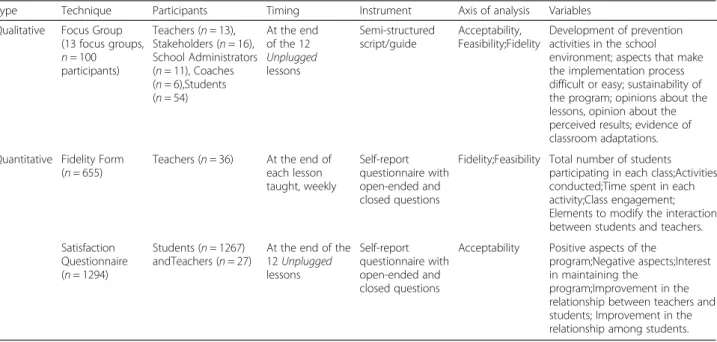
Qualitative and quantitative (questionnaires) methods were used to collect the data for this study. Further de-tails on the techniques, instruments, variables, axis of analysis and the participants involved are presented in Table 2. The instruments used in the quantitative ana-lysis were the Portuguese versions of the same instru-ments used by the EU-Dap team in their process evaluation of the Unplugged program in Europe [28]; these instruments are available at www.eudap.net. The Brazilian research team created the qualitative guides for the focus group interviews.
We opted to use a fidelity model based on dosage that was proposed by the Unplugged developers. Fidelity was
Table 2Data collection techniques, number of respondents, type of participants, instruments, axis and variables used in the process evaluation of theUnpluggedProgram implementation, Brazil, 2013
Type Technique Participants Timing Instrument Axis of analysis Variables
Qualitative Focus Group (13 focus groups,
n= 100 participants)
Teachers (n= 13), Stakeholders (n= 16), School Administrators (n= 11), Coaches (n= 6),Students (n= 54)
At the end of the 12
Unplugged
lessons
Semi-structured script/guide
Acceptability, Feasibility;Fidelity
Development of prevention activities in the school environment; aspects that make the implementation process difficult or easy; sustainability of the program; opinions about the lessons, opinion about the perceived results; evidence of classroom adaptations.
Quantitative Fidelity Form (n= 655)
Teachers (n= 36) At the end of each lesson taught, weekly
Self-report questionnaire with open-ended and closed questions
Fidelity;Feasibility Total number of students participating in each class;Activities conducted;Time spent in each activity;Class engagement; Elements to modify the interaction between students and teachers.
Satisfaction Questionnaire (n= 1294)
Students (n= 1267) andTeachers (n= 27)
At the end of the 12Unplugged
lessons
Self-report questionnaire with open-ended and closed questions
Acceptability Positive aspects of the
program;Negative aspects;Interest in maintaining the
defined by the number of lessons taught, the time spent per lesson, the number of activities taught per lesson and the number of the potential participants present in each class as outlined in the EU-Dap process monitoring manual and dissemination guide [26, 27].
Data analysis
Quantitative data analysis
Three sets of data were analyzed using descriptive statis-tics: the student satisfaction questionnaire, teacher satis-faction questionnaire and the fidelity form (monitoring of each lesson). Each of the questionnaires used in the process evaluation was submitted to a specific database through an online system. Qualitative variables were de-scribed by number, percentage and 95 % confidence interval, whereas the quantitative variables were de-scribed by the mean and minimum and maximum values. The distribution of the students’ and teachers’ perceptions of the Unplugged program’s immediate re-sults were evaluated by Chi-square test.
Qualitative data analysis
The recordings of the focus groups were fully tran-scribed and underwent content analysis using the Grounded Theory approach [29] as the theoretical refer-ence. In this approach, categories are developed from the results of the data, avoiding “a priori” theories to generate explanations that are based in reality. Study data were then categorized conceptually using codes, a process that organizes data into an applicable under-standing of the investigated phenomenon [30]. Data cod-ing creates data segments that are defined by the most concise and objective categories to summarize and rep-resent the meaningful components of the transcribed text [31].
After the content analysis, the focus group materials were classified into five broad themes; this article fo-cuses on the results of the difficult and easy aspects of the program and the immediate results of the implemen-tation process. The qualitative analysis was conducted with the support of the computer program NVivo ver-sion 10 [32]. Quotes from the focus groups are pre-sented in the results section with a reference to the group from which they were extracted.
The data were analyzed separately, and then the re-sults of the focus groups, the fidelity forms, and the sat-isfaction questionnaires were triangulated to address the fidelity, acceptability, and feasibility of the program’s implementation.
Ethics
This study was approved by the Ethics in Research Committees at the University of São Paulo (#473.498) and the Federal University of Santa Catarina (#711.377);
all the project stages were compliant with the Declar-ation of Helsinki. Informed consent to participate in the study was obtained from all the participants.
Results
Fidelity
Of the 744 lessons planned (12 lessons in 62 classes), 698 lessons were actually taught and 655 had the corre-sponding fidelity form completed by the teachers after the end of the lesson. Based on this data, we generated a fidelity index (dose) of 94 % (CI 95 % 92%–95 %) for the number of lessons implemented (698/744) and 94 % (CI 95 % 92 %–95 %) for the monitoring of the implementa-tion (655/698).
Although the vast majority of the lessons were taught in the 62 classes, only a small percentage of the lessons included all the activities proposed in the teacher's hand-book. Lesson 11 was completed by only 21.7 % of the classes. Moreover, Table 3 shows that the lessons reached an average of 80 % of the expected students.
Another important aspect of fidelity is the compari-son between the actual time spent by the teacher ap-plying each Unplugged lesson and the expected lesson time. The orientation provided during the teacher training stated that all the program lessons should be performed within the time allotted for one lesson, which in São Paulo corresponds to 50 min and in Santa Catarina to 45 min. According to the data from the fidelity forms (n= 655), 56.9 % of the lessons were performed in the time allocated for one lesson; 11.5 % of the lessons lasted for one and a half les-sons; 23.9 % of the Unplugged lessons lasted for the duration of two lessons; and 7.7 % of them lasted more than two full lessons.
Furthermore, data from the focus groups reinforced the notion that it was not feasible to implement a completeUnpluggedlesson as proposed in the handbook in the time allocated for one lesson. This conclusion was unanimous among the teachers.
“This issue of having only 45 minutes, I've already told the coach several times; it is not feasible.”(Teacher)
Many of the activities in the program were not used or were only briefly performed with the students, indicating that the objectives of the lessons and the program may not have been reached.
School administrators and teachers thought that the increased time necessary to cover theUnplugged lessons was perhaps due to the Brazilian culture and the learn-ing conditions of several students, which affected the program activities. This finding indicates a need for the program to be better adapted to the Brazilian school setting.
“T1- [50 minutes] is how long students in Europe take to complete the activity. Here, maybe because of our culture, until we arrive, until we organize the classroom, until students are seated…
T2- (…) Here, a 50-minute lesson ends up taking an hour and a half, an hour and forty minutes.”(School administrators)
“Then, there is also our students' difficulties in writing. Our students cannot write. In the 6thgrade there are students who are almost illiterate. There are questions that they need to answer, and if you let them do it at their own pace, it would take a long time for them to answer.”(Stakeholder)
Feasibility
The main difficulties and successes of the program ac-cording to the teachers, school administrators, and coa-ches were identified through the focus groups.
Most of the difficulties experienced in the program implementation process were described by the teachers, who identified 3 main obstacles that affected the feasibil-ity of the implementation: time spent planning lessons,
lack of material resources, and the undermining of the students’standard curriculum content.
The lack of time dedicated to preparing the program activities and to appropriately implement them was strongly highlighted by the teachers because they added a classroom activity to their previous ones, and there was no reduction in their other responsibilities.
“[Unplugged] is not something that you can start applying right away. The teacher needs to study these lessons, to prepare them. For certain lessons, they need materials, even some of the energizers need it, so they need preparation. In this sense, I notice that [the teachers] are a bit overloaded because in addition to Unplugged they need to cover the curriculum, and their time is limited.”(School Administrator)
The analysis of the coaches’responses clearly showed that the teachers were overwhelmed with the excessive amount of program protocols required. The teachers themselves also mentioned this issue:
“This moment of having a meeting with everyone is impossible because at this time of the year we don't have the time to do that. Sometimes someone in the school asks 'can you talk to me now?', [and I say] 'no, I can't'! It’s impossible.”(Teacher)
There was a discrepancy between the teachers and the school administrators regarding the support provided by the school. School administrators highlighted more than Table 3Results on the fidelity and reach of theUnpluggedprogram based on the 655 completed fidelity forms, Brazil, 2013
Fidelity (dose) Reach
Applied lessons Students present at the lesson
N % Full lesson(a)(43) Mean (minutes) Min-Max(minutes) Mean Min-Max %(b)
Lesson 1 62 100.0 59.7 [46.4–71.9] 68 40–120 27 13–40 91.7
Lesson 2 62 100.0 54.0 [40.1–66.0] 63 40–95 27 15–40 91.5
Lesson 3 61 98.4 64.4 [50.6–75.8] 69 40–95 27 12–40 92.7
Lesson 4 61 98.4 48.2 [34.6–60.7] 64 40–105 26 14–40 85.8
Lesson 5 61 98.4 39.7 [27.1–52.7] 69 40–115 27 17–40 80.1
Lesson 6 62 100.0 24.6 [14.2–36.7] 62 40–95 26 18–40 84.9
Lesson 7 58 93.5 42.9 [30.2–56.8] 60 30–95 26 14–40 83.1
Lesson 8 55 88.7 61.5 [47.7–74.6] 64 40–110 25 15–40 75.8
Lesson 9 59 95.2 45.1 [32.7–59.2] 60 20–105 25 15–40 72.4
Lesson 10 54 87.1 42.3 [29.2–56.8] 61 40–105 26 17–40 74.4
Lesson 11 50 80.6 21.7 [11.5–36.0] 62 40–105 25 16–40 62.9
Lesson 12 53 85.5 52.9 [38.6–66.7] 61 20–105 25 12–40 69.9
Mean Unplugged 58 93.8 46.4 [33.3–60.1] 64 20–120 26 12–40 80.4
once that they offered full support in terms of peda-gogical materials for the development of the program, whereas the teachers mentioned that a lack of peda-gogical materials and resources to make copies of the material was a barrier to the feasibility of the program. According to the teachers, not all the school administra-tors offered support for the implementation of the program.
The content of the normal academic curriculum deliv-ered was also affected in the students whose teachers taught Unplugged because the teachers had to replace the curriculum lessons with the Unplugged lessons. Teachers unanimously felt that their academic curricu-lum was not fully covered, with parts of it being only superficially taught to the students during the semester; this may have led to gaps in the students’ education. Teachers feared being blamed by the students for these gaps.
“Another important aspect is that they [teachers] had to stop teaching the content of their subjects, and that is it. If something is added, something else has to be removed, and that is what happened.”(Coach)
However, the stakeholders did not mention the press-ing need to adapt the logistics of the program for it to be sustained in the schools, demonstrating a clear dis-crepancy between the practical perceptions of the imple-mentation by the stakeholders, school administrators, and teachers. Nevertheless, the stakeholders did high-light the need to incorporateUnpluggedinto the regular classroom curriculum.
“Usually the school project always includes prevention actions (…) in this sense, I think that somehow (…) we
can think of structuring [Unplugged] to be a part of the regular classroom curriculum.”(Stakeholder)
Teachers highlighted the need to make basic adapta-tions to the program for it to become part of the school curriculum. According to them, the training they re-ceived, the support by the school administration, and the presence of coaches were the main factors that facili-tated the implementation ofUnplugged.
Acceptability
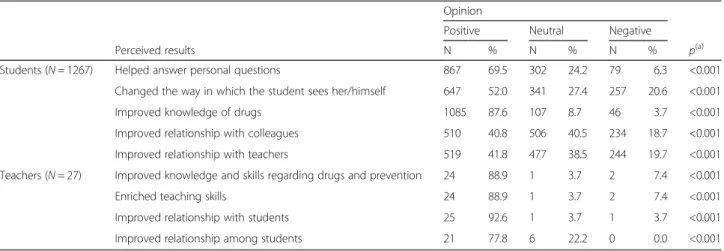
The results obtained in this study showed a satisfactory acceptability of the program based on the triangulation of data from the focus groups, fidelity forms, and satis-faction questionnaires, although there were some dis-crepancies between the data from the students and from the teachers. For 69.4 % of the students, the program helped them answer personal questions. Of the teachers, 88.9 % said that it improved their knowledge and skills on drugs and prevention. The program satisfaction in the school setting was clearly observed, as shown in Table 4. Thepvalue indicates that for all the questions, both teachers and students tended to choose the positive answer option.
One of the study’s notable findings was the improve-ment in the relationship both between teachers and stu-dents and between stustu-dents in the classroom. This result was identified from qualitative and quantitative data, namely teachers’and students’focus groups discus-sions and satisfaction forms (Table 4).
According to the teachers' opinions in the fidelity forms, the level of students' interest in the 12Unplugged lessons in the 62 classes was, on average, very high or high in 48.2 % of the lessons (n= 316), moderate in 46.5 % (n= 304), and absent/very low in 5.2 % (n= 34).
Table 4Students’and teachers’perceptions of the immediate results ofUnpluggedbased on data from the satisfaction questionnaire, Brazil, 2013
Opinion
Positive Neutral Negative
Perceived results N % N % N % p(a)
Students (N= 1267) Helped answer personal questions 867 69.5 302 24.2 79 6.3 <0.001
Changed the way in which the student sees her/himself 647 52.0 341 27.4 257 20.6 <0.001
Improved knowledge of drugs 1085 87.6 107 8.7 46 3.7 <0.001
Improved relationship with colleagues 510 40.8 506 40.5 234 18.7 <0.001
Improved relationship with teachers 519 41.8 477 38.5 244 19.7 <0.001
Teachers (N= 27) Improved knowledge and skills regarding drugs and prevention 24 88.9 1 3.7 2 7.4 <0.001
Enriched teaching skills 24 88.9 1 3.7 2 7.4 <0.001
Improved relationship with students 25 92.6 1 3.7 1 3.7 <0.001
Improved relationship among students 21 77.8 6 22.2 0 0.0 <0.001
An indirect assessment of the acceptability of the pro-gram by the teachers was obtained from their reported level of comfort in teaching the lessons. Teachers pro-vided this information at the end of each lesson on the fidelity form. Based on the data from these forms, most of the teachers described, on average, a high to very high comfort level (51 %, n= 334). In 45 % (n= 295) of the cases, there was a moderate level of comfort, and no comfort was reported in 4 % of the cases (n= 26).
Finally, the teachers and students were asked the dir-ect question,“how satisfied have you felt with participat-ing in the program?” The responses to that question demonstrated a positive picture for maintaining the pro-gram in schools. Almost all the teachers (92.6 %) said that they were “satisfied or very satisfied” with the pro-gram. Students had a similar positive perspective, al-though a smaller proportion of them were “satisfied or very satisfied”(77.9 %).
When asked which lessons they liked the most, the students said that their interest in the lessons depended on the topic discussed. Although their interest was usu-ally high, their responses showed that the lessons with information on drugs and making choices in groups were the ones that generated the most interest.
“I liked the one [lesson] in which we either followed a group's decision or not because you don't have to do what the group does to join it, to be like them.”(6th and 7thgrade students)
“I liked the exercise where there were two groups and there were also judges. One was about defending alcohol and tobacco and what alcohol and tobacco did.”(6thand 7thgrade students)
Because the students enjoyed the Unplugged activ-ities, they suggested that there should be a specific class for the program with more time allocated to it than what was planned in the pilot phase. They also supported the continuation of the program in the fol-lowing year.
“I think that there should be more time for the lessons; there was a lesson we started and then the bell rang, and we had to finish it in the following class. We should have a specific class for Unplugged.”(8thand 9thgrade students)
Finally, 76.5 % (CI95% 74.0; 78.8 %) of the students re-ported that they would like to have a program similar to Unpluggedin the following school years.
Discussion
This study presents the process evaluation of a European evidence-based drug use prevention program that was
created in developed countries and implemented in Brazil, a Latin American, middle-income, developing country. The process evaluation results of this study, in addition to the outcome results, will inform stake-holders’ decisions regarding the program’s maintenance and expansion in Brazilian public schools by providing data on the program’s feasibility and acceptability as well as possible adaptations to increase its fidelity.
Researching the acceptability of the program in the different groups involved in Unplugged was essential for its appropriate implementation in schools, as a better understanding of the acceptability is an important tool in the development of management strategies to expand drug prevention interventions. User satisfaction is a component of social acceptability and is necessary for a program to be successful [18]. Acceptability represents the approval of a service by its target population, and the acceptability of Unplugged was evident in the find-ings of this process evaluation.
The assessment of the feasibility of the program indi-cated that its implementation was possible despite the difficulties highlighted by the teachers. The teachers em-phasized that the program required time to plan the ac-tivities and to prepare the classroom, which was not incorporated into the schools' regular curriculum. This affected the teachers' regular curricular activities and overburdened them with new activities. The data showed that the time per lesson and, consequently, the total time needed to apply the program in a school year were ele-ments that had to be factored into the regular classroom schedule as only 57 % of the lessons were effectively taught within the expected time. We found that the teachers randomly excluded activities when they realized that they would not able to teach the complete lesson, which suggests that it would be useful for the program developers to identify the core elements of a lesson that should be taught by the teacher even when time is constrained.
countries, almost half of the classes were not delivered to the experimental group, and despite this fact, the pro-gram revealed effectiveness in reducing alcohol and to-bacco consumption among students [11]. Although several authors have argued that implementation fidelity guarantees the non-mischaracterization of a program and also its effectiveness [33], in our case, we can as-sume that the program fidelity ensured dosage control. Furthermore, we found that this study showed greater fi-delity than the European studies that demonstrated the program’s success.
The only way to guarantee the sustainability of the program would be to incorporate it into the school cur-riculum; this would ensure that the program activities would not interrupt the time allocated for teachers' regular subjects. However, it is important to note that the lack of time reported by the teachers to implement the normal school program is not unique to this setting. A study evaluating the process of implementation of a depression prevention program for teenagers in class-rooms showed similar conflicting demands of teachers' time between the program and the regular curriculum. In addition, it revealed a culture in which exclusively academic activities were more important than the per-sonal, social, and health-related activities of the students, which negatively affected the implementation of the pro-gram in schools in England [34].
According to Sloboda et al. [35], when there is a lack of a structural and curricular program, the intuitive develop-ment of drug prevention activities in the classroom or de-bates with former drug users are often what is observed. These types of interventions contradict the current scien-tific evidence, which shows the ineffectiveness of these models when used in isolation and out of context. Un-plugged was adopted to fill this organizational gap as it also aligned with the guidelines described in the “ Inte-grated Policy of Attention toward Alcohol and Drug Users" written by the Brazilian Ministry of Health [36]. These guidelines define prevention as a process of planning and implementing multiple strategies geared towards reducing specific vulnerability and risk factors and strengthening protective factors. However, initia-tives integrating health and education are still being developed. According to Deschesnes et al. [37], for a prevention program to become part of the school structure, it is necessary to include it in the school’s yearly planning; this requires a systematic coordin-ation by school administrators as well as integrated and intersectional actions and a political and financial commitment by the decision makers. Once these stages are established, the evaluation process begins with the goal of identifying potential adaptations to the initial program that could facilitate the improve-ment of the intervention.
Unplugged has proved to be an intervention that is well accepted among the participants directly involved (students and teachers) in addition to being effective in European countries. Furthermore, the program is struc-tured using interactive techniques, which allows for the development of life skills. In a meta-analysis that evalu-ated school prevention programs, Tobler et al. [38] found that interactive prevention models were more ef-fective than non-interactive ones. An interactive ap-proach provides contact and opportunities for the exchange of ideas among participants, strengthening the skills needed to refuse drugs through group dynamics. Moreover, according to a study conducted by Sanchez et al. [39], information about drugs is also a necessary form of prevention. However, if the school provides in-formation that is not reinforced by the parents, the knowledge gained can lose its preventive effects; infor-mation in isolation that is disconnected from activities that reinforce protective factors and reduce risk factors is not effective in preventing drug consumption [40].
Unplugged provided a distinct form of intervention in the school environment. It also influenced the perceived relationship between the teachers and the students as well as between students in the same classroom, inde-pendent of the results on drug use prevalence (which were not the focus of this article). These results suggest that it would be important to include classroom envir-onment outcomes as secondary outcomes in the next randomized controlled trial ofUnplugged.
This is the first study of the Unplugged program that focuses on the implementation process and not on the program’s effectiveness results. This research expands the program’s literature on transcultural adaptation as Unplugged was designed for developed European com-munities and not for developing countries. Considering the unique nature of the public schools in one of the most unequal countries in the world, the absence of ac-ceptance among stakeholders, school directors, teachers and students would have resulted in the quick termin-ation of the program in schools despite the federal gov-ernment’s support for its implementation.
There is no way to conclude whether the schools in-cluded in this study differed from those not inin-cluded. What we can confirm is that the schools included had a similar drug use pattern to the ones described in the last national survey on drug use by middle and high school students in Brazilian capitals [2, 23], which seems to suggest that the participating schools exhibited the na-tional average consumption for the selected age. Data on drug use in our sample were not presented in this art-icle, but that data have been submitted for publication in another article, as previously mentioned.
Conclusion
The relevance of this study is that it deepened the avail-able scientific knowledge on drug use prevention pro-grams in the school environment; in particular, it generated results that can inform decision-making re-garding the implementation of Unplugged in schools in developing countries.
The dose of Unplugged that was offered in the class-rooms was satisfactory as almost all the classclass-rooms re-ceived 12 lessons. However, the number of activities completed in each class was inadequate; almost half of the lessons were not completed during the 45- to 50-min class period. All the studied groups described positive perceived results on school environment, and teachers and students mentioned an improvement in their relationships. How-ever, a significant challenge reported by the study partici-pants was the inability of the teacher to provide the same quality teaching of their normal curricula; teachers had to deliver the Unplugged lessons during their regular class time and did not have additional hours to teach the sub-jects that were replaced by theUnpluggedactivities.
Based on the analyzed results, we suggest three adap-tations that could improve the implementation of the program. The first recommendation is to adapt the number of activities per class with the support of the de-velopers to allow each class to be fully executed and to prevent teachers from having to randomly exclude activ-ities. Second, we recommend restructuring the general workload of the teachers who implement theUnplugged program to avoid using the regularly scheduled class time for the Unplugged activities. Finally, a randomized controlled trial that includes school environment out-comes in the analysis, such as the relationship between teachers and students, is recommended.
Competing interests
The authors report no conflicts of interest.
Authors’contributions
PFM wrote the first draft of the manuscript and made substantial contributions to the data analysis and interpretation. JIC was responsible for the data collection and interpretation in the city of São Paulo and for manuscript writing. AS was responsible for the quantitative data analysis and the description of the results. DRS were responsible for study coordination,
data collection and interpretation in Santa Catarina. ZMS was responsible for the conception and design of the study and was involved in all steps of this manuscript preparation. All the authors have critically reviewed the final version of this manuscript and helped improve it. All authors read and approved the final manuscript.
Acknowledgements
This study was funded by the Brazilian Ministry of Health through the UNODC (United Nations Office for Drugs and Crime) Technical Cooperation Agreement, PRODOC BRA/K47.
Author details
1Department of Preventive Medicine, Escola Paulista de Medicina,
Universidade Federal de São Paulo, Rua Botucatu, 740, 4° andar, São Paulo, SP, Brazil.2Department of Psychology, Universidade Federal de Santa Catarina, School of Psychology, Florianopolis, Brazil.
Received: 24 June 2015 Accepted: 23 December 2015
References
1. Kandel D, Yamaguchi K. From beer to crack: developmental patterns of drug involvement. Am J Public Health. 1993;83(6):851–5.
2. Carlini E, Noto A, Sanchez Z, Carlini C, Locatelli D, Amato T. VI Levantamento nacional sobre o consumo de drogas psicotrópicas entre estudantes do ensino fundamental e médio das redes públicas e privadas de ensino nas 27 capitais brasileira. São Paulo: CEBRID - Centro Brasileiro de Informações sobre Drogas Psicotrópicas; 2010.
3. Laranjeira R, Madruga C, Pinsky I, Caetano R, Ribeiro M, Mitsuhiro S. II Levantamento Nacional de Álcool e Drogas - Consumo de Álcool no Brasil: Tendências entre 2006/2012. São Paulo: INPAD–Instituto Nacional de Ciência e Tecnologia para Políticas Públicas de Álcool e Outras Drogas; 2013.
4. Ribeiro W. Drogas na escola: Prevenir educando. Belo Horizonte: Annablume; 2005.
5. Ferreira TCD, Sanchez ZM, Ribeiro LA, Oliveira LG, Nappo SA. Perceptions and attitudes among public school teachers towards the topic of drugs. Interface-Comunicação, Saúde, Educação. 2010;14(34):551–62. 6. Moreira FG, Silveira DX, Andreoli SB. Situations related to drug misuse in
public schools in the city of Sao Paulo, Brazil. Rev Saude Publica. 2006;40: 810–7.
7. Kreeft PVD, Wiborg G, Galanti MR, Siliquini R, Bohrn K, Scatigna M, et al. 'Unplugged': A new European school programme against substance abuse. Drugs: Education, Prevention, and Policy. 2009;16(2):167–81.
8. Tobler NS. Drug prevention programs can work: research findings. J Addict Dis. 1992;11(3):1–28.
9. Sussman S, Arriaza B, Grigsby TJ. Alcohol, tobacco, and other drug misuse prevention and cessation programming for alternative high school youth: a review. J Sch Health. 2014;84(11):748–58.
10. Gabrhelik R, Duncan A, Miovsky M, Furr-Holden CDM, Stastna L, Jurystova L.
“Unplugged”: A school-based randomized control trial to prevent and reduce adolescent substance use in the Czech Republic. Drug Alcohol Depend. 2012;124(1):79–87.
11. Faggiano F, Galanti MR, Bohrn K, Burkhart G, Vigna-Taglianti F, Cuomo L, et al. The effectiveness of a school-based substance abuse prevention program: EU-Dap cluster randomised controlled trial. Prev Med. 2008;47(5): 537–43.
12. Faggiano F, Vigna-Taglianti F, Burkhart G, Bohrn K, Cuomo L, Gregori D, et al. The effectiveness of a school-based substance abuse prevention program: 18-month follow-up of the EU-Dap cluster randomized controlled trial. Drug Alcohol Depend. 2010;108(1–2):56–64.
13. Saunders RP, Evans MH, Joshi P. Developing a process-evaluation plan for assessing health promotion program implementation: a how-to guide. Health Promot Pract. 2005;6(2):134–47.
14. Cook T, Campbell D. Quasi-Experimentation. Design & Analysis Issues for Field Settings. Boston: Houghton Mifflin Company; 1979.
15. Orwin RG. Assessing program fidelity in substance abuse health services research. Addiction. 2000;95 Suppl 3:S309–27.
16. Rohrbach LA, Dent CW, Skara S, Sun P, Sussman S. Fidelity of
17. Contandriopoulos A-P, Champagne F, Denis J-L, Pineault R. Avaliação em Saúde: Dos Modelos Conceituais à Prática na Análise da Implantação de Programas. A avaliação na área de saúde: Conceitos e Métodos. Rio de Janeiro: Editora FioCruz; 1997. p. 29–47.
18. Hartz Z, Vieira-da-Silva L. Avaliação em saúde: dos modelos teóricos à prática na avaliação de programas e sistemas de saúde. Salvador: EDUFBA/ Rio de Janeiro: FIOCRUZ; 2005. p. 275.
19. McDavid JC, Huse I, Hawthorn LR. Program evaluation and performance measurement: An introduction to practice. Thousand Oaks: Sage Publications; 2013.
20. Donabedian A. The seven pillars of quality. Arch Pathol Lab Med. 1990; 114(11):115–8.
21. Beasley LO, Silovsky JF, Owora A, Burris L, Hecht D, DeMoraes-Huffine P, et al. Mixed-methods feasibility study on the cultural adaptation of a child abuse prevention model. Child Abuse Negl. 38. England: Published by Elsevier Ltd; 2014. p. 1496–507.
22. Goenka S, Tewari A, Arora M, Stigler MH, Perry CL, Arnold JP, et al. Process evaluation of a tobacco prevention program in Indian schools–methods, results and lessons learnt. Health Educ Res. 2010;25(6):917–35.
23. Sanchez Z, Sanudo A, Schneider D. Efficacy evaluation of the school program Unplugged for drug use prevention among Brazilian adolescents: a quasi-experimental study. 6th International Conference and Members’Meeting of the European Society for Prevention Research. Liubliana; 2015. p. 56. 24. Creswell J. Research design: Qualitative, Quantitative, and mixed methods
approaches. USA: SAGE Publications, Incorporated; 2009.
25. Patton MQ. Qualitative research and evaluation methods. 3rd ed. Thousand Oaks: Sage Publications; 2002.
26. EU-Dap. EU-Dap Consortium - European Drugs Addiction Prevention Trial Study Group. Study Instruments - Process Monitoring. 2004.
27. EU-Dap. EU-Dap Consortium - Preventing Substance Abuse among Students: A guide to successful implementation of Comprehensive Social influence curricula in schools. Turin: OED - Observatorio Epidemiologico Delle Dipendenze; 2008.
28. Kreeft PVD, Jongbloet J, Van Havere T. Factors Affecting Implementation: Cultural Adaptation and Training. Defining Prevention Science: Springer; 2014:315–34.
29. Glaser BG, Strauss AL, Strutzel E. The discovery of grounded theory: strategies for qualitative research. New York: Aldine de Gruyter; 1967. 364 p. 30. Strauss AL, Corbin J. Pesquisa qualitativa: técnicas e procedimentos para o
desenvolvimento de teoria fundamentada. Porto Alegre: Brasil: Artmed; 2008. 31. Charmaz K. A construção da teoria fundamentada: guia prático para análise
qualitativa: Bookman. 2009.
32. Gibbs G. Qualitative Data Analysis: Explorations with NVivo New York Open University Press. 2009.
33. Monroe-DeVita M, Teague GB, Moser LL. The TMACT: a new tool for measuring fidelity to assertive community treatment. J Am Psychiatr Nurses Assoc. 2011;17:17–29.
34. Taylor JA, Phillips R, Cook E, Georgiou L, Stallard P, Sayal K. A qualitative process evaluation of classroom-based cognitive behaviour therapy to reduce adolescent depression. Int J Environ Res Public Health. 2014;11(6): 5951–69.
35. Sloboda Z, Bukoski WJ. Handbook of drug abuse prevention: Theory, Science and Practice. New York: Springer; 2006.
36. Brasil. Política de Atenção Integral aos usuários de álcool e outras drogas. [Policy for the attention of alcohol and Drug users], 2003.
37. Deschesnes M, Martin C, Hill AJ. Comprehensive approaches to school health promotion: how to achieve broader implementation? Health Promot Int. 2003;18(4):387–96.
38. Tobler NS, Roona MR, Ochshorn P, Marshall DG, Streke AV, Stackpole KM. School-based adolescent drug prevention programs: 1998 meta-analysis. J Prim Prev. 2000;20(4):275–336.
39. Sanchez ZM, Oliveira LG, Ribeiro LA, Nappo SA. O papel da informação como medida preventiva ao uso de drogas entre jovens em situação de risco. Ciência & Saúde Coletiva. 2010;15(3):699–708.
40. Spooner C, Hall W. Preventing drug misuse by young people: we need to do more than 'just say no'. Addiction. 2002;97(5):478–81.
• We accept pre-submission inquiries
• Our selector tool helps you to find the most relevant journal • We provide round the clock customer support
• Convenient online submission • Thorough peer review
• Inclusion in PubMed and all major indexing services • Maximum visibility for your research
Submit your manuscript at www.biomedcentral.com/submit