STUDIES ON THE HARMFUL ENTOMOFAUNA OF SOME
OF THE VEGETABLE CROPS IN THE SOUTH OF OLTENIA
Bîrzanu Felicia1, Mitrea Ion2 PhD University of Craiova, e-mail : [email protected] 2University of Craiova, Faculty of Horticulture
Key words: harmful entomofauna, vegetable cultures
ABSTRACT
Vegetable products have an essential role in regulating the concentration of hydrogen ions in the body, and are greatly diversified, being cultivated on large areas, which also leads to the emergence of pests, and results in high production losses.
The purpose of this paper is to bring a high intake of scientific data on the harmful entomofauna.
The researches have been conducted in the private stationary unit in Amarastii de Jos, using three methods of collecting the entomofauna and namely the Barber type soil trap, the method of striking and method of capture by using the entomological net.
The entomofauna collected from the vegetable ecosystem was subject to the detailed analysis regarding the systematic group which each individual species is part of.
As a result of the researches, 390 species were identified that belong to 7 orders with 15 families. The most numerous species belong to the Scarabaeidae families (5 species), followed by the Chrysomelidae family with 4 species, the families Acrididae, Aphididae, Pentatomidae, Cetoniidae, Pieridae and Noctuidae with 3 species each, the remaining families having 1-2 species each. The most abundant harmful species in some vegetable crops were: Leptinotarsa decemlineata with 23 specimens collected, followed by the Phyllotreta nemorum L., Pieris brassicae L. And Pieris napi L. species each with 16 specimens, the lowest number of individuals collected in a number of 3 belong to the species Cassida nebulosa L. and Canthars fusca L.
INTRODUCTION
In the current context of increased food consumption, vegetables have an important role, so that their culture was one of the first practical activities of man.
Brought to the New World, except for the aubergines, Solanaceae vegetables have rapidly conquered Europe, becoming today basic vegetables occupying relatively large fields, greenhouses and solariums.
The introduction into the culture of some new varieties of vegetables, in order to provide types of vegetables as diverse as possible, the presence of harmful species was also observed, which affect not only the foliage, but also their fruit.
The researches were carried out in Dolj County, in the Stationary Unit in the Amarastii de Jos Township, a place where vegetables are cultivated on widely spread areas and with rich crops.
Worldwide, researches on the harmful entomofauna in some vegetable crops were carried out by: Cameron P.J and collab., 2001, Balliu A., Cota A., 2007, Baysal F., Cinar A., 2007, Boucher Jude and collab., 2003, etc.
collab. regarding the the entomofauna encountered on the vegetable species. 2002, Georgescu T., and collab., 2003, Tălmaciu M., and collab., 2004, Rotari Elena and collab., 2011, etc.
Every year, the production losses caused by pests and pathogens rise up to 25-30%, maybe even more, most often resulting in compromised crops.
The importance of entomology and integrated control in vegetable growing derives from here.
MATERIAL AND METHOD
The purpose of this paper is to bring a significant contribution of scientific data obtained as a result of carrying out the researches that refer to the harmful entomofauna of some vegetable crops in the South of Oltenia.
The researches have been carried out in some private vegetable crops in the area of Amarastii de Jos - Dolj County.
In 2015, three methods for collecting the entomofauna (the method of Barber type soil traps, the method of striking and method of capture by using the entomological net) under production conditions.
Chemical treatments were carried out in the studied stationary units, according to the plan of controlling the harmful organisms, which was planned and conducted by the management of the farm.
Sampling was done regularly depending on the research method used, during the crop growing season.
In the internship units studied, 6 traps were placed on a row of plants from the side inwards in a straight line, at a distance of 20 m from the edge and 6 – 8 m between traps per row.
For the Barber method, plastic boxes were used, with a volume of 500 ml, with a 10 cm diameter and an 8 cm height, and the securing fluid used was a salt solution with a concentration of 25%.
The material collected was brought to the entomology laboratory within the Faculty of Horticulture and determined using a magnifying glass and specialised determining devices: Bobîrnac B. and collab. 1994, Stănoiu I. Năstase A, 1998, Chimişliu Cornelia, 2002 and 2005,etc.
The entomofauna collected from the vegetable ecosystem was subject to the detailed analysis regarding the systematic group which each individual species is part of.
The harmful species have been selected from all the species identified and treated separately.
The representatives have been identified and sorted by families and order to a level of species.
RESULTS AND DISCUSSIONS
By analysing the data obtained in 2015 from some vegetable crops regarding the structure of the harmful entomofauna in the South of Oltenia, 37 harmful species have been identified that belong to the Insecta class, totalling a number of 390 specimens collected.
The sampled insects were systematically classified into 7 orders (Orthoptera – 6 species, Homoptera – 3 species, Hetroptera – 3 species, Thysanoptera - 1 species,
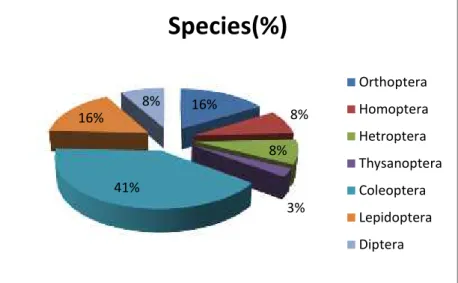
After analysing the data obtained on the structure of the entomofauna collected from some vegetable crops in the South of Oltenia, the area of Amărăştii de Jos, it results that the largest share of 41% ist hat of the Coleoptera order, followed by the Orthoptera and Lepidoptera orders each with a share of 16%, the Homoptera and Hetroptera Diptera
orders with 8% each, and the last place being occupied by the Thysanoptera order with 3% (fig.1).
Fig. 1. Structure of the harmful entomofauna sampled from some vegetable crops of the Stationary of Amărăştii de Jos – Dolj County
Regarding the structure of the species sampled by families, it is observed that the largest number of species belongs to the Scarabaeidae family (5 species), followed by the Chrysomelidae family with 4 species, the families Acrididae, Aphididae, Pentatomidae, Cetoniidae, Pieridae and Noctuidae each with 3 species, the remaining families having 1-2 species (fig.1-2).
Fig.2 The number of sampled species classified by families from some vegetable crops in the Stationary Unit of Amărăştii de Jos – Dolj Country
By analysing the results regarding the abundance of the harmful species sampled from some vegetable crops, it is observed that after the 3 aphid species that are quite numerous, the Leptinotarsa decemlineata species represented the largest number of sampled specimens (23), followed by the Phyllotreta nemorum L., Pieris brassicae L. and
Pieris napi L. species, each with 16 specimens, Helicoverpa armigera Hbn. With 15
16% 8%
8%
3% 41%
16% 8%
Species(%)
Orthoptera Homoptera Hetroptera Thysanoptera Coleoptera Lepidoptera Diptera
5
18 23 66
27
1 56
3 14
40
20 51
39
13 6 0
specimens, Pieris rape L. with 14 specimens, Mamestra brassicae L. with 13 specimens,
Phyllotreta atra L. with 12 specimens, Autographa gamma L. with 11 and a group of 3 species of Gryllus desertus L, Eurydema ornata L, Polyphylla fullo L., with 10 specimens each, and the lowest number of individuals sampled in a number of 3 belong to the species ofCassida nebulosa L.andCanthars fusca L(Table 1).
Structure of the harmful entomofauna sampled from some vegetable crops in 2015 (The Stationary Unit of Amărăştii de Jos – Dolj County)
No. Order Family Name of the species Abundance
1 Orthoptera Gryllotalpidae Gryllotalpa gryllotalpaL. 5
2 Gryllidae Grylluscam pestrisL. 8
3 Gryllus desertusL. 10
4 Acrididae Acrida hungaricaHerbst 8
5 Dociostaurus maroccanusThunberg 9
6 Calliptamus italicusL. 6
7 Homoptera Aphididae Brevicorine brassicaeL. 30
8 Myzodes perisicaeSulzer 22
9 Aphis fabaeScopoli 24
10 Hetroptera Pentatomidae Graphysoma lineatumL. 9
11 Eurydema ornateL. 10
12 Eurydema oleraceaeL. 8
13 Thysanoptera Thripidae Frankliniella occidentalisPergande 6 14
Coleoptera
Chysomelidae Leptinotarsa decemlineataSay 23
15 Cassida nebulosaL. 3
16 Phyllotreta atraL. 12
17 Phyllotreta nemorumL. 16
18 Cantharidae Canthars fuscaL. 3
19 Elateridae Agriotes lineatusL. 6
20 Agriotes ustulatusL.) 8
21 Scarabaeidae Melolontha melolonthaL. 9
22 Anoxia vilosaL. 9
23 Rhizotrogus aeqinoctialisOlivier 8
24 Polyphylla fulloL. 10
25 Oryctes nasicornisL. 4
26 Cetoniidae Tropinota hirtaPoda 8
27 Oxythyrea funestaPoda 7
28 Cetonia aurataL. 5
29 Lepidoptera Pieridae Pieris BrassicaeL. 16
30 Pieris rapeL. 14
31 Pieris napiL. 16
32 Noctuidae Mamestra brassicaeL. 13
33 Autographa gammaL. 11
34 Helicoverpa armigeraL. 15
35 Diptera Anthomyiidae Delia brassicaeL. 8
36 Delia antiquaMeigen 5
37 Heleomyzidae Suillia luridaMeigen 6
Nr. exemplare 390
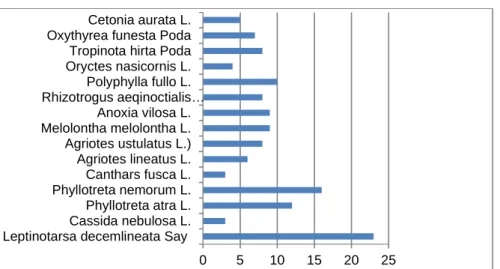
Regarding the abundance of the harmful sampled species classified by order, it is observed that the Coleoptera order has the share of 12 species (fig. 3), followed by the
Fig. 3. Structure of the harmful species in the Coleoptera order sampled from some vegetable crops.
Fig. 4. Harmful species sampled from some vegetable crops belonging to the Orthoptera order.
Fig. 5. Harmful species in the Lepidoptera order sampled from some vegetable crops.
0 5 10 15 20 25
Leptinotarsa decemlineata Say Cassida nebulosa L.
Phyllotreta atra L. Phyllotreta nemorum L. Canthars fusca L. Agriotes lineatus L. Agriotes ustulatus L.) Melolontha melolontha L. Anoxia vilosa L. Rhizotrogus aeqinoctialis…
Polyphylla fullo L. Oryctes nasicornis L. Tropinota hirta Poda Oxythyrea funesta Poda Cetonia aurata L.
5 8 10 8 9 6 0 2 4 6 8 10 12 Gryllotalpa
CONCLUSIONS
The natural conditions for growing vegetables (climate and soil), their specificity (succulent and savoury plants), which the technical and organisational steps add to (focus, profiling and specialisation) are a framework favourable for the installation and multiplication of a complex of animal pests that can cause significant damages in the absence of judicial control measures.
The entomofauna identified so far in the South of Oltenia belongs to 15 families and 7 orders.
The most numerous species belong to the Scarabaeidae families (5 species), followed by the Chrysomelidae family with 4 species, the families Acrididae, Aphididae, Pentatomidae, Cetoniidae, Pieridae and Noctuidae with 3 species each, the remaining families having 1-2 species each.
The most abundant harmful species in some vegetable crops were: Leptinotarsa decemlineata with 23 specimens collected, followed by the Phyllotreta nemorum L., Pieris brassicae L. And Pieris napi L. species each with 16 specimens, Helicoverpa armigera Hbn. with 15 specimens, Pieris rape L. with 14 specimens, Mamestra brassicae L.with 13 specimens, Phyllotreta atra L. with 12 specimens, Autographa gamma L. with 11, the lowest number of individuals collected in a number of 3 belong to the species Cassida nebulosa L.andCanthars fusca L.
BIBLIOGRAPHY
1. Balliu A., Cota E.,2007 - Biological control of main greenhouse pets in Albania.Acta Horticulturae,vol. 729,p.489-492.
2. Baysal F.,Cinar A., 2007 - Determination of phytopathologicaal and entomological problems and using plant protection methods in organic tomato growing in Turkey.Acta Horticulturae,vol,729,p.459-462.
3. Bobîrnac B., Stănoiu I., Năstase A., pag. 1- 49, 1994 - „Determinator pentru Coleopterele din România”.Muzeul Olteniei Craiova.
4.Bobîrnac, și Matei Iulia 1983, - Contribuții la studiul entomofaunei unor culturi horticole din Oltenia. Lucr.Șt.A III Conf.Naț.Entomologie, Iași.
5. Boucher Jude,Ashley R., Durgy R.,Sciabarassi M.,Calderwood W., 2003 – Managing the papper maggot(Diptera: Tephritidae) using perimeter trap cropping. Journal of Economic Entomology, vol.96. no. 2, p. 420- 432.
6. Cameron P.J.,Walker G.P.,Herman T.J.B.,Wallace A.R., 2001 – Development of economic thresholds and monitoring systems for Helicoverpa armigera ( Lepidoptera: Noctuidae) in tomatoes. Journal of Economic Entomology,vol 94, no.5, p. 1104-1112. 7. Chimişliu Cornelia, 2002 – Colectarea, prepararea şi conservarea materialului biologic. Editura Sitech, Craiova.
8. Chimişliu Cornelia,2005 - „Contribuţii la cunoaşterea istoricului cercetărilor faunei de Coleoptere ( Insecta: ) din România”, Muzeul Olteniei Craiova. Studii şi comunicări. Vol. XXI. Craiova.
9. Costache M., Roman T., - Ghid pentru recunoaşterea şi combaterea bolilor şi dăunătorilor la plantele floricole şi ornamentale. Editura Geea, 2001.
10. Georgescu T., Tălmaciu M., Alexa C., 2003 – Dăunătorii plantelor horticole. Prevenire şi combatere.Editura PIM, Iaşi.
12. Roman T., Neamţu Maria, 2000 – Tratamente recomandate pentru combaterea dăunătorilor la înfiinţarea culturilor de legume în câmp. Revista Horticultura, nr. 4, p. 21-24.
13. Rotari Elena, Tălmaciu M., Tălmaciu Nela, 2011 – Comparative research on useful entomofauna from vegetable crops. Lucrări ştiinţifice, U.Ş.A.M.V. Iaşi, seria Agronomie, vol. 54, supliment, p. 69-72.
14.Stanoi I., Nastase A., 1998. Insecte din Romania, Ed. Dova, Craiova