77
EVALUATION OF SOME STRAWBERRY VARIETIES IN THE SOUTHERN
AREA OF THE COUNTRY
Cichi M. University of Craiova, Faculty of Agronomy
Keywords: variety, precocity, quality.
ABSTRACT
The variety is supplemented annually with new foreign or indigenous varieties, so it is necessary to study the varieties in a region for the observation of the qualities, the defects and the restraint for the respective area only of those of quality, productive and very adaptable to the conditions in the area . Of the eight varieties studied, the earliest proved to be the Vibrant variety -12 days, followed by the Premial variety - 13 days, referring to the precocity index.
In the first year of fructification, we mention that none of the eight varieties of strawberry has been affected by mildew. In the first year of fructification, the strawberries obtained in the eight varieties presented fruits of over 20.0 g / fruit. The following varieties of strawberry distinguish for their special colour: Vibrant, Premial, Elegance, Pegasus, Florence.
In terms of fruit quality, most varieties have accumulated a score of over 30 points, which qualifies them as category I varieties.
INTRODUCTION
Among the species of fruit of great economic interest a special place is occupied by strawberry with very new varieties, for the establishment of new plantations. Numerous researchers have dealt with the study of strawberry growing, so Voiculescu N. et al (2006) state the following: the place where strawberries are obtained is important to the buyer because the composition of the fruit in the mineral elements must be optimal.
Teodorescu A. et al., (1989) state that it is necessary to obtain quality varieties resistant to diseases and with very good adaptation to the climatic conditions in the area.
Efforts of breeders to obtain new varieties are also mentioned in the work of authors Branişte N. et al, (2007).
Mihăescu Gr. (1998) specifies that: the average daily temperature below 5°C for one month during the biological rest period satisfies the need for cold of strawberry.
Strawberry is a tree species in which most varieties show indifference to daylight, (Botu I. et al, 2003).
Popescu A. et al., (1997) suggested that the type of variation in plants regenerated by organogenesis is related to the type of explant.
Laugale V. et al., (2009) studies 10 strawberry varieties suitable for the biological culture in Latvia, and in this preliminary study, the best results were given by the Induka, Jonsok, Dukat and Korona varieties, following some aspects and namely the size of the fruit, the sensitivity to diseases and pests, etc.
Daugovish O. et al, (2009) studies strawberry varieties cultivated in protected areas (tunnels) and in fields in California, respectively. They mentioned the productivity of varieties, the degree of attack to Botrytis cinerea.
MATERIAL AND METHODS
78
between the rows and 20 cm between the plants on row. The number of plants per band was 80, i.e. 4 rows x 20 plants per row, and the band space was 70 cm.
The experience in the southern area of the country consisted of eight old and new varieties, these being the following:
- Elsanta, Vibrant, Elegance, Matis, Pegasus, Senga Sengana, Florence, Premial.
RESULTS AND DISCUSSIONS
Regarding the phenology of flowering and fructification of strawberry varieties, in the first year of fructification the phenophase of inflorescence occurred between 9 April - 14 April. Regarding the other varieties we can notice that the phenophase of the inflorescence occurred after one day after the witness variety as compared to varieties Elegance, Pegasus, Senga Sengana, 3 days as compared to varieties Elsanta and Florence and 4 days in the Matis variety. The beginning of the blooming was recorded
between 9th and 19th of April, and the Premial variety began to blossom on April 14th.
Before this variety began to blossom: Elegance and Senga Sengana one day, and 5 days earlier the Vibrant variety.
Early maturation has been proven to be the Vibrant (II.V) and Premial (III.V) varieties. With the semilate maturation, the Elsanta and Elegance varieties were noted in the first decade of June (I.VI), then the Pegasus varieties (II-III.VI) and Senga Sengana (III.VI).
With maturation a little later (by 10 days) we have varieties Matis (II.VII) and Florence (II.VII). The climatic conditions in the area most influence the moment of fruit ripeness.
In order to specify the order of earliness of strawberry varieties and the grouping of maximum harvest required for harvesting schedule, the earliness index was calculated. The precocity index highlights the number of days necessary for harvesting starting May
10th. From the data obtained we note that the precocity index is between 12 and 20 days in
year I and 13 - 20 days in year II. Of the eight varieties studied, the earliest proved to be the Vibrant variety (12 days) followed by the Premial variety - 13 days.
With a semi-late precocity distinguish Elsanta, Elegance, Pegasus, Senga Sengana varieties (14 - 15 days) and later the Florence and Matis varieties (19 - 20 days), Figure 1.
Fig. 1 – Earlines varieties of strawberries
In respect of the attack to leaves caused by Sphaerotheca maculariae in the first year of fructification, we mention that none of the eight varieties has been affected. The resistance to the attack on the fruits of Botrytis cinerea manifested itself differently in the eight varieties.
Precocity index Year I
79
Thus, in year I, the frequency of the attack ranged between 1.8 and 5.8%. More than 5.0% were attacked by Senga Sengana - 5.8% and Premial - 5.6%. However, the intensity of the attack was not high and depending on the frequency and intensity we can classify varieties in resistance group I Vibrant, Elsanta, Elegance, Pegasus, Matis and Florence.
In group II of resistance are the varieties Premial and Senga Sengana.
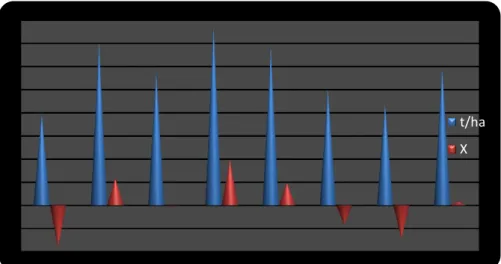
Net superior production was achieved in the first year of fructification in all varieties, the average was 29.2 t/ha. All varieties showed yields of over 20 tons/ha, but above average yields produced Elegance varieties - 39.0 t/ha and Premial - 35.0 t/ha where the values are significantly and distinct significantly positive. Values higher than average were recorded by the varieties Pegasus - 34.0 t/ha and Florence - 30.0 t/ha.
Production values below average were found in Senga Sengana varieties - 25.0 t/ha, Elsanta - 28.9 t/ha, Matis - 22.0 t/ha and Vibrant variety - 20.1 t/ha, the last two varieties registering statistically significant negative values relative to the average X, (figure 2).
Fig. 2 - Fruit production in some varieties of strawberry and difference from the mean (2015) - (t/ha)
In the first year of fructification, the strawberries obtained in the eight varieties presented fruits of over 20.0 g/fruit, the only ones with fruits of 20.0 g/fruit were the varieties Premial and Elsanta. The other six varieties have a fruit weight of 30.0 g/fruit such as Matis and over 30.0 g/fruit varieties: Pegasus - 31.0 g/fruit, Senga Sengana - 33.0 g/fruit, Vibrant and Elegance - 35.0 g/fruit.
The largest fruit was observed in the Florence variety of 40.0 g/fruit in the first year of fructification but also in the second year (42.0 g/fruit). The average of two years has large and very large fruit varieties such as Florence - 41.0 g/fruit, Vibrant - 35.7 g/fruit, Elegance - 35.5 g/fruit, Senga Sengana - 33.2 g/fruit, Pegasus - 32.0 g/fruit.
Taste and organoleptical determinations were carried out on the fruits, giving score for each characteristic, and fruit colour had the same score in the two years of fructification.
The varieties Vibrant, Premial, Elegance, Pegasus, Florence are remarkable for their special colour. The shape of the fruit had a maximum score in both years of production for the Vibrant, Matis and Florence varieties. By the size of the fruits are evidenced the varieties Florence, Vibrant, Elegance, Pegasus, Senga Sengana. Resistance to transport is of great importance for fresh fruit, distinguishing as superiority the Senga Sengana and Florence varieties - maximum mark 5. The other varieties showed good resistance, receiving the mark 4. The colour of the pulp is a basic attribute in the appreciation of production for industrialization, are especially highlighted the varieties Vibrant, Elsanta, Pegasus, Senga Sengana and Matis who received the mark 5.
t/ha
80
As for the consistency of pulp, the mark 5 received the varieties Matis and Vibrant, the mark 4 received the varieties Premial, Elegance, Pegasus, Florence. Senator Senga and Elsanta received the mark 3.
The taste and the flavour, elements of primary importance in the appreciation of the quality of the varieties for fresh consumption, distinguish the varieties as follows: mark 5 Vibrant, Elsanta and Florence varieties, and the rest of varieties with mark 4.
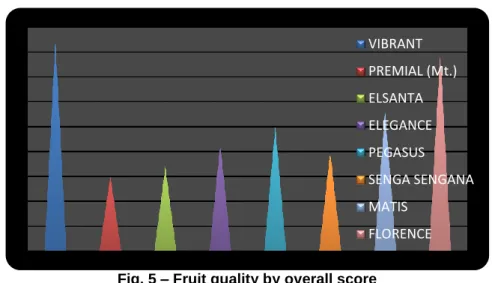
The overall score points first, in terms of fruit quality, the varieties: Vibrant - 33.5, then Florence 33.0, Matis - 30.6, Pegasus - 30.0. And the other varieties gained a very good score, namely: Elegance - 29.3, Senga Sengana - 29.0, Elsanta - 28.4 and Premial - 28.0.
The fruit quality by colour and shape is also seen in Figure 3.
Fig. 3 - Fruit quality in color and form
Concretizing the qualities of the fruits accumulated in the studied varieties, we can distinguish varieties for fresh consumption and also varieties for industrialization such as:
- Fresh consumption: Matis, Elegance, Vibrant, Elsanta, Premial, Florence. - consumption for industrialization: Senga Sengana, Pegasus.
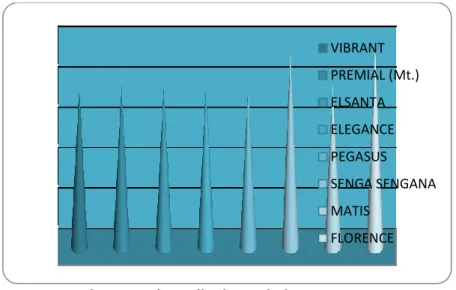
The quality of the fruit by transport is also shown in figure 4.
Fig. 4 - Fruit quality by resisting transport
Most varieties have accumulated a score of over 30 points, which falls within the category of varieties of quality I, and in figure 5 is presented this aspect.
Fruit color
Fruit shape
VIBRANT
PREMIAL (Mt.)
ELSANTA
ELEGANCE
PEGASUS
SENGA SENGANA
MATIS
81
Fig. 5 – Fruit quality by overall score
CONCLUSIONS
The growing of strawberry through the studied varieties in the southern area of the country is favourable to climatic conditions. For the southern area of the country can be retained in assortment together with varieties such as Premial and Senga Sengana and new varieties Matis, Florence, Elegance, Vibrant, Pegasus. These new varieties are characterized by very large and high quality fruit.
We recommend the Florence variety for use in breeding programs to create very good quality varieties.
REFERENCES
1. Botu, I., Botu, M., 2003. ”Pomicultura modernă și durabilă”. Editura Conphys, Rm. Vâlcea.
2. Branişte, N., Budan, S., Mădălina Butac, Mădălina Militaru, 2007. ”Soiuri de pomi, arbuști fructiferi și căpșuni create în România”. Lucrarea este elaborată şi finanţată în cadrul proiectului sectorial 320/2006 al Ministerului Agriculturii şi Dezvoltării Rurale.
3. Daugovish, O., Larson, K., 2009. Strawberry production with protected culture in southern California. ISHS - Acta Horticulturae 842 : VI International Strawberry Symposium, Vol. 2. Pag. 163 – 166.
4. Laugale, V., A. Bite, 2009. ”Evaluation of strawberry cultivars for organic production in Latvia”. ISHS - Acta Horticulturae 842 : VI International Strawberry Symposium, Vol. 2. Pag. 373-376.
5. Mihăescu, Gr., 1998. ”Cultura căpşunului”. Editura Ceres, București.
6. Popescu, A., Isac V., Coman M., Rădulescu M., 1997. Somaclonal variation in plants regenerated by organogenesis from callus culture of strawberry (Fragaria x Ananassa). ISHS - Acta Horticulturae 439 :III International Strawberry Simposium, Pag. 89 – 96.
7. Teodorescu, A., Coman, M., Teodorescu, G., Chiriac, St., 1989. ”Preliminary results in romanian strawberry breeding program”. ISHS - Acta Horticulturae 265, International Strawberry Symposium.
8. Voiculescu, N., Hoza, D., Spiță, V., 2006. ”Elemente minerale din fructe”. Partea
a II-a. Editura Elisavaros. București.
VIBRANT
PREMIAL (Mt.)
ELSANTA
ELEGANCE
PEGASUS
SENGA SENGANA
MATIS