
THE EFFECT OF REAP STRATEGY ON READING COMPREHENSION OF THE EIGHT GRADE STUDENTS
9
0
0
Full text
(2) ISSN: 2549-4287. Vol. 3, No. 3, August 2019. comprehending the text precisely. It means besides being able to pronounce and decode written words provided, students need to understand the text. Therefore, it is important to note that reading and comprehension are tied together. Comprehension is a process of understanding the passage. Comprehension can be defined as the readers’ understanding of what is being read (Zarrilio, 2007). In other words, comprehension is the understanding of the readers about the text that they read. In addition, reading comprehension is a complex process. Snow (2002) states that reading comprehension is a process of extracting and constructing the meaning of the text at the same time through an interaction with the text. In line with that Grabe (2009) states reading is centrally a comprehending process; in which reader understand what the writer intended to convey in writing. It means that in reading, comprehension is really important to be known in order to catch the intended information provided by the writers in form of written text In primary and secondary education, reading activity in Junior High School in Indonesia covers some activity that ask the students to read the text such as descriptive, recount, narrative, procedure, and report text. Then, the standard of reading competence in syllabus in the first semester of the eighth grade is to learn the simple meaning of interaction and interpersonal skill from the text, in formal and informal situation. The students have to understand the meaning of the text that they read related to the types of text in junior high school. Many students found difficulties in comprehending and understanding reading passage. According to observation which was conducted in SMP N 3 Tabanan, it was showed that students were not actively engage during reading activity in the classroom. There were only few students were willing to read and share their reading text. In consequence, they have no idea about text that they have been brought to the classroom. They only bought the text to the classroom because it is told by the teacher a day before the lesson begins. Moreover the students thought it was hard to comprehend the text because they did not get any information from the text after reading the text. Based on the preliminary interview with English teacher who teach the eighth grade student in SMP N 3 Tabanan, the researcher found that most of the eight grade students had problem in reading. It was proven by the students who were lazy to read when the teacher asks them to read the text. The teacher was providing the text for the students after that they have to read it first one by one. After that teacher asked the students to find difficult words in the text. After that the teacher ask the students to answer some questions provided and discussed the answer together. In the end the teacher ask the students to review the lesson. According to the explanation before it can be said that the strategy that is used by the teacher was reading guide strategy. Thus, a reading strategy is needed to help students in comprehending the reading passage. One of promising strategy is REAP strategy. REAP strategy is one of strategy that can helps student easier to understand the reading passage. REAP strategy helps students to participate in summarizing ideas of the text given (Eanet & Manzo, 1976). It means by the use of REAP strategy students can participate in giving summarization of ideas of the text that can give impact on their comprehension. REAP strategy has some advantages in its applications. Clark & Yallop (2006) explains that REAP strategy could develop students greater understanding of author’s role in written text. In addition, this strategy helps students to build a bridge between their own word and the text. It means through REAP strategy students will develop greater understanding of the text by finding out what is intended by the writer. International Journal of Language and Literature │ 113.
(3) ISSN: 2549-4287. Vol. 3, No. 3, August 2019. such as information stated in the text. Moreover, in the end, students will build their understanding of the text by using their own words which convey the meaning of the text. Thus, this strategy is appropriate to be used in teaching and learning process since we can find some advantages that make students easier in learning. There are some researchers that already conduct research on REAP strategy on students ability in reading comprehension. Rahmawati, Supardi, & Bunau (2015) found that REAP strategy significantly improve students reading comprehension. Cahyaningtyas & Mustadi (2018) found that REAP strategy give positive and significant effect on reading comprehension of fifth grade students in Kotagede Yogyakarta. According to these 2 researchers, REAP strategy can be used as teaching strategy in order to teach students especially in reading. Based on the explanation and preliminary observation above, REAP strategy expected to be appropriate to be used in teaching. It is because this strategy expected to be appropriate in helping students to understand the text easier by the use of guidance. Theoretically, this strategy is appropriate to help students that have difficulties in reading comprehension. Empirically, the implementation of this strategy is limited in Bali. Moreover, researcher found that students in SMP N 3 Tabanan faced some problems in reading as well as in comprehension of reading passage. Thus, this research is needed because there are limited evidence about this strategy especially in Bali. Regarding to the previous explanation, theoretically REAP strategy can help the students to comprehend the text. This strategy implemented in order to help students in comprehending the text by the use of guidance given by the teacher. Thus, in this study was investigated whether or not the REAP has significant difference on reading comprehension of eighth grade students in SMP Negeri 3 Tabanan. METHOD This study was an experimental research which aimed to investigate whether or not there was significant difference of students’ reading achievement who are taught by using REAP strategy on eight grade students in SMP N 3 Tabanan on academic year 2018/2019. The research design of this study was quasi experiment post-test only control group design. In line with that, Best & Kahn (2014) state that post – test only control group design is one of the effective design in the experimental research. The treatment was implemented only on experimental group. In this research the sample was chosen randomly. From 10 classes, there were 2 classes chosen as one experimental group that was taught by using REAP strategy and control group was taught by using conventional strategy. There were two instruments used in this study, namely: lesson plan and multiple choice test (post – test). The data gained in this study was the students’ reading comprehension. The data were taken in the end of treatments. The data were analyzed by using two form of statistical analysis, namely descriptive statistic (mean, median, mode, range, variance, and standard deviation) and inferential statistic namely normality test and group equality of variance test. The descriptive analysis was used for measuring of central tendency (mean, median, and mode), measure of dispersion (range, variance, and standard deviation). Besides that, it was also analyzed the highest and lowest score based on the students’ post – test score of two groups of this study.. International Journal of Language and Literature │ 114.
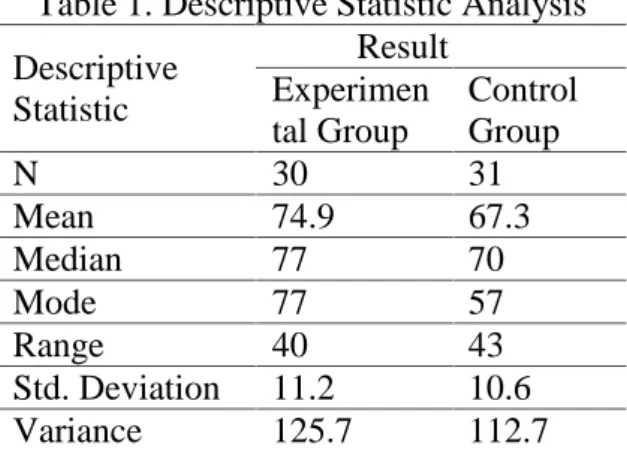
(4) ISSN: 2549-4287. Vol. 3, No. 3, August 2019. FINDING AND DISCUSSION After the post – test was conducted, it gained vary score between control group and experimental group. Table below was descriptive statistical analysis. It was provided with mean, median, mode, range, standard deviation and variance that were analyzed previously. Table 1. Descriptive Statistic Analysis Result Descriptive Experimen Control Statistic tal Group Group N 30 31 Mean 74.9 67.3 Median 77 70 Mode 77 57 Range 40 43 Std. Deviation 11.2 10.6 Variance 125.7 112.7 Table 1. shows that the mean score of experimental group which was taught by using REAP strategy was 74.9. The mean score of control group was 67.3. From the gained data, it can be concluded that the mean score of experimental group was higher than control group. Median is the midpoint of the gained scores both in experimental and control group. From the table above, the median score of experimental group was 77 meanwhile the median score of the control group was 70. It can be assumed that the median or the midpoint of the experimental group is higher than control group. The mode of experimental group score was 77 and the mode score of control group score was 57. It showed that, the most frequently score appeared in experimental group was 77 and the most frequently score appeared in control group was 57. As what stated in table 1 above, range involves two most extreme scores which are the highest and the lowest score. It can show a rough estimate of variability. The calculation of range of experimental group was 40 which was calculated by the highest score 90 minus 50. On the other hand the range of control group was 43 which calculated by the highest score 83 minus the lowest score 40. From table 1., the standard deviation of the experimental group was 11.2. Meanwhile, the standard deviation of control group was 10.6. it showed that the experimental group had higher standard deviation than the control group, which meant that the students who were taught by using REAP strategy produced better score than control group score. Variance shows the spread of the gained data. From table 4.1, the variance of experimental group was 125.7 and the variance of control group was 112.7. It indicated that the score in experimental group were more spread out then the score in control group. After the descriptive analysis gained, the normality and equality test was administered. Normality test was administered to know whether the data were normal distributed or not. The table below was the result of normality test. In that table provided the significant level of Kolmogorov Smirnova and Shapiro – Wilk. Thus, significant level of Kolmogorov Smirnova was administered.. International Journal of Language and Literature │ 115.
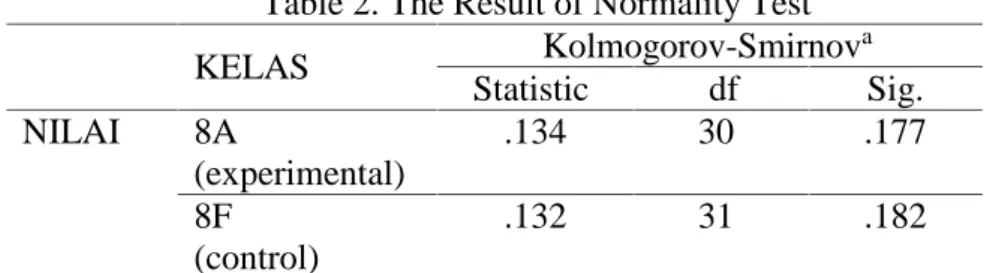
(5) ISSN: 2549-4287. Vol. 3, No. 3, August 2019. NILAI. Table 2. The Result of Normality Test Kolmogorov-Smirnova KELAS Statistic df Sig. 8A .134 30 .177 (experimental) 8F .132 31 .182 (control). Based on table 2, the result of Kolmogorov – Smirnova was found the significant value of experimental group was 0.177 and the significant value of control group was 0.182. The result above indicated that the significant value (sig.) of those groups had exceeded the significant value of 0.05. Therefore, it could be concluded that the data distribution in both group were normally distributed. The group equality test of variance was administered after the normality score had gained. This test was aimed to know whether both groups were equal or not. In Levene statistic, the variance of the groups was assumed equal if the significant value (sig.) exceeded 0.05. The score were analyzed by using SPSS program. The result of group equality variance test was as follows.. NILAI. Table 3. The Result of Group Equality Test of Variance Levene Statistic df1 df2 Sig. Based on Mean .107 1 59 .744. Based on table 3, the result of Levene statistic indicated that the significant value of both group had exceeded significant level of 0.05. The significant value of based on mean was 0.107. Based on the result of Levene statistic above, it indicated that the variances between two groups were already equal. After the variances of experimental group and control group had been normally distributed and equal, the analysis could be continued to the t – test in order to test the hypothesis that had been formulated. Independent sample test was administered to determine whether the hypothesis was rejected or failed to reject. It could be seen from the significant value of Sig.(2tailed) and comparing the value of T (tobs) with Df (tcv). As the table 4.6 of independent sample test that was showed below. Table 4. The Result of Independence Sample (t – test) Levene's Test for Equality of Variances t-test for Equality of Means Sig. F Sig. T Df (2-tailed) NI Equal .107 .74 2.6 59 .010 LAI variances 4 79 assumed. International Journal of Language and Literature │ 116.
(6) ISSN: 2549-4287. Vol. 3, No. 3, August 2019. Based on the table 4., the value of Sig. (2 – tailed) was 0.010. It indicated that the observed level of significant (Sig. (2- tailed)) was less than the significant level (α = 0.05). This indicated that there was a significant mean difference between groups who were taught by using REAP strategy and group who were taught by using conventional teaching. Thus, the null hypothesis was rejected and the alternative hypothesis was accepted. It showed that there were significant difference on students reading comprehension ability between students who were taught by using REAP strategy and students who were taught by using conventional teaching strategy. Furthermore, effect size also administered to know the meaning of the mean between experimental group and control group. The formula to measure the effect size can be seen in figure below. The formula that was used to find the effect size was Eta squared. The formula and calculation of Eta squared to measure the effect size can be seen below. t Eta Squared = t + (N1 + N2 − 2) =(. .. = 0.11. ( .. ). (. ). ). To interpret the result of effect size, a guideline was proposed by Cohen. According to the calculation, the effect size of this study was 0.11 which was considered as moderate effect. It can be concluded that the effect of REAP strategy on reading comprehension ability of eight grade student in SMP N 3 Tabanan was moderate size. Based on the findings above, it was found that there was a significant difference between classes who was taught by using REAP strategy and class who was taught by using conventional strategy. In terms of mean score, the mean score of experiment group was 74.9 and the mean score of control group was 67.3. It was clear that the mean score of experimental group was higher than the mean score of control group. The students who were taught by REAP strategy achieved better score rather than students who were taught by using the conventional strategy. By following the steps of REAP strategy which were more concerned on students active learning, step by step learning, independent work, discussion and presentation, it led the students to learn more. Meanwhile the control group received the traditional teaching strategy which emphasized teacher guidance with instruction. By the use of REAP strategy, students can get the information behind the text easier because they already marked the text for the important things while reading. It led students into better and deeper learning by taking notes and marking on something important especially in annotate process. In line with that, Flippo (2000), as cited in Supriyantini (2015), states that REAP is a popular strategy that involved complex elaborative study – reading strategy, taking notes from a textbook which aimed to give the students or reader fresh way to think while reading to get the message of the text. By the use of REAP strategy students could understand and comprehend the text easier. Students in experimental group found easier way in understanding and comprehending the text. The students comprehended the reading passage by reading the text actively. REAP was developed to stress the use of writing as a means of improving thinking and reading which lead students to think precisely and deeply about what the read by active summarizing into their own word. Besides that, the students were also. International Journal of Language and Literature │ 117.
(7) ISSN: 2549-4287. Vol. 3, No. 3, August 2019. marking or writing something in order to give simple summary which make them easier in comprehending the text given. REAP strategy was very helpful in giving better understanding of the text given because the students were given time to focus on specific activity. In line with that, Fadhli (2015) states that this strategy can motivate the students to focus while reading the text or passage given. In each steps students were conducing specific activities such as giving marks and note on specific words or even sentences which they did not understand or the answer of the guided question given, which can make the students more focus. By the use of each step in REAP strategy students can understand the content of the text easier. As one of strategy instruction for reading, REAP can help students in comprehending the text easier. REAP is another comprehensive strategy instruction that can help student interact with the text and construct the meaning. This strategy can help students in developing their understanding trough the practice which considered as the easiest way for them to understand the text. In addition, Brevik (2017) states that learning about reading comprehension strategy can promote and repair students’ reading comprehension. After the reading activity already finished, students were communicating the content of the text related to what they have learnt before. It was very important since they were showing their comprehension of the text orally. The essence of reading is comprehension because the goal of written language is communication of language (Duffy, 2009). In this case, REAP could help students to comprehend the text they have read and also communicating the text that already read. By listing the mean idea, difficult word, information and other supporting details of the text the students tried to build their own comprehension of the text that help them to comprehend and communicate the text better. The students in experimental group noted some keywords in read and encode steps which were very helpful to give a general picture of the reading passage Besides that, students were given time to know the text better by understanding the structure of the text with the supporting details in annotating process. Moreover, the last stage also gave impact on students reading comprehension. In ponder stage, students were asked to discuss the text which can help them to get more understanding of the text from the discussion. In ponder text students are encourage the students thinking by concluding the text .It means that all of the steps were affecting each other by the sequent. In line with that. Tiruneh (1983) states that the steps in REAP strategy are consecutive, in which each stage contributes to the achievement of students comprehension. Students in experimental group were put as the central of the learning process. It means that the students – centered learning is applied in this strategy. When students found or faced difficulties they would ask the teacher for help after trying to solve their problem themselves. By putting and listing some difficult word in REAP board, they tried to solve their problem before asking to the teacher. The aim of students – centered learning) is to create learning environment where knowledge is constructed by the teacher and the students rather than transmitted directly by the teacher. It was different from the control group which was treated by using conventional strategy. In control group, the teacher became the central of the learning. Besides that, it was confirmed that in conventional teaching strategy, the teacher spends quite lot of class time using the board and explaining things (Scrievener, 2005). International Journal of Language and Literature │ 118.
(8) ISSN: 2549-4287. Vol. 3, No. 3, August 2019. The effect size of this research was considered as moderate effect. Based on the calculation of Eta Squared formula used, the effect size of this research was 0.11. According to Cohen’s guideline, 0.11 was considered as moderate effect which was caused by plausible reason from the difficulty faced during teaching and learning process. According to the strategy that had applied, the reason was the complex activity that faced by the students. It is also proved by a study done by Rahmawati et al. (2015) in which they found a time consuming when the students need to find the information and read while writing and find conclusion. This might be the plausible reason why the effect size was still in moderate level. In conclusion, the use of REAP strategy significantly affect students’ reading comprehension. It was proved by the significant difference of students’ reading comprehension score. In terms of reading comprehension ability, the students who learn with REAP strategy were able to determine the main idea of the text and had better understanding on the reading passage given better than students in control group environment. The use of REAP strategy put the students as the central of learning process in which the students are motivated to participate actively during teaching and learning process. In line with that Tiruneh (1983) states that REAP strategy instruction created an environment for students who highly engaged during the learning process. Thus, they had a lot of chances to learn English when they are motivated in learning. Besides that, the effect size was showed that REAP strategy give impact on students reading comprehension. It is proved by the size effect which was considered as moderate effect according Eta Squared formula CONCLUSION AND SUGGESTION The result of descriptive statistic showed that the mean score of experimental group (74.9) was higher than the mean score of control group (67.3). The value of the sig (2- tailed) was 0.009 which was lower than 0.05. It indicated that there was a significant mean difference between groups who were taught by using REAP strategy and students who were taught by using conventional strategy. Thus, the null hypothesis (H0) was rejected and alternative hypothesis (Ha) was failed to reject or accepted. The effect size was 0.11 which considered as high effect. Finally, it could be concluded that there were significant effect of REAP strategy on eight grade students reading comprehension in SMP N 3 Tabanan academic year 2018/2019. REFERENCES Best, J.W., & Kahn, J. V. (2014). Research in Education. Pearson. Brevik, L. M. (2017). Strategy and shoes: Can we ever have enough? Teaching and Using Reading Comprehension Strategy in General and Vocational Programs. Scandinavian Journal of Educational Research, 76–94. Cahyaningtyas, A. P., & Mustadi, A. (2018). The Effect of fREAP Strategy on Reading Comprehension. In SHS Web of Conferences 42. https://doi.org/10.3758/BF03332276 Clark, J., & Yallop, C. (2006). An Introduction to Sociolinguistics Blackwell Textbooks in Linguistics. Religion. https://doi.org/10.1353/lan.2003.0268 Duffy, G. G. (2009). Explaining Reading: A Resource for Teaching Concept, Skills, and Strategies. New York: The Guilford Press.. International Journal of Language and Literature │ 119.
(9) ISSN: 2549-4287. Vol. 3, No. 3, August 2019. Eanet, M. G., & Manzo, A. V. (1976). REAP - A Strategy for Improving Reading/Writing/Study Skills. Journal of Reading, 19(8), 647–652. Fadhli, M., & Effect, T. (n.d.). [Muhammad Fadhli, Suhaimi, Musdizal: The Effect of …], 13(02), 7–19. Grabe, W. (2009). Reading in a Second Language: Moving from Theory to Practice . England: Cambridge University Press. (2009), 2009. Grabe, W. (2009). Reading in a Second Language: Moving from Theory to Practice. England: Cambridge University Press. Jatmiko, K. (2014). No Title, 6, 2014. Rahmawati, R., Supardi, I., & Bunau, E. (2015). Using Read, Encode, Annotate and Ponder (REAP) Strategy in Teaching Reading Comprehension. Jurnal Pendidikan Dan Pembelajaran Khatulistiwa, 4(6), 1–12. Scrievener. (2005). Learning Teaching. Oxford: Macmillan. Snow, C. E. (2002). Reading for Understanding: Toward an R&D Program in Reading Comprehension . Santa Monica: RAND Education. (2002), 2002. Supriyantini, S. (2015). Using Read Encode Annotate And Ponder (REAP) Technique to Increase Reading Comprehension: a Case of the Eleventh Grade Students of SMA Negeri 6 Semarang in Academic Year 2014/2015, 6(2). Tiruneh, D. T. . (1983). Strategies of Discourse Comprehension. New York: Accademic Press. Zarrilio, J. (2007). Are You Prepared to Teach Reading? A Pratical Tool for SelfAssessment. New Jersey: Pearson Eduaction.. International Journal of Language and Literature │ 120.
(10)
Figure
Related documents
human acOvity is “extremely likely” to be the dominant cause • More concerning, it stated with “high confidence” that:.. – conOnued unchecked, warming would lead
(c) Temporal evolution of maximum value point of difference in ensemble spread of Z300 between CTLf and OSEf (MVP D Z300) for East Asia (closed circles) and North America
• Order individual curves with respect to some univariate characteristic of the curves, e.g., the average level, the median level, the variability of the curve, and the slope of
As well as external technical acquisition (for digital records and digital surrogates) and environment metadata (for digital records only) The National Archives requires a variety
For the late eighteenth century Pérez Moreda and Reher (2003: 129) observe that most urban day labourers were employed outside agriculture and, according to their estimates from
Suggested ICD-10-CM Diagnosis Code(s) K02.51 Dental caries on pit and fissure surface limited to enamel K02.52 Dental caries on pit and fissure surface penetrating into dentin
doi:10.1210/clinem/dgz279 J Clin Endocrinol Metab, April 2020, 105(4):1–11 https://academic.oup.com/jcem 1 Abbreviations: AO, adulthood onset; BMD, bone mineral density;
