An Innovative Self-assurance Methodology for Challenging
AI Problems in graphical passwords
Rajesh Bunga1,Mr.K.Rajesh2
M.Tech(Software Engendering)1,Asst. Prof & HOD Of MCA2in Dept. of computer science & engineering. Kakinada Institute of Engineering and Technology, Kakinada
Abstract:
Numerous security primitives depend on hard numerical issues. Utilizing hard AI issues for security is rising as an energizing new worldview, however has been under-investigated. In this paper, we show another security primitive taking into account hard AI issues, to be specific, a novel group of graphical watchword frameworks based on top of Captcha development, which we call Captcha as graphical passwords (CaRP). CaRP is both a Captcha and a graphical mystery key arrangement. CaRP is both a Captcha and a graphical secret key plan. CaRP addresses various security issues out and out, for example, internet speculating assaults, hand-off assaults, and, if joined with double view advances, shoulder-surfing assaults. Eminently, a CaRP secret word can be discovered just probabilistically via programmed web speculating assaults regardless of the fact that the watchword is in the hunt set. CaRP also offers a novel approach to manage area the doubtlessly comprehended picture hotspot issue in understood graphical mystery word structures, for instance, Pass Points that regularly prompts frail watchword decisions. CaRP is not a panacea, but rather it offers sensible security and convenience and seems to fit well with some handy applications for enhancing online security. In this venture we proposes a numerical network based blueprint, it goes about as the best client verification and vital thing in this is aggressors not able to hack. No other speculating assaults conflict with on our undertaking, with this diagram our task turned out to be more secured, I trust this strategy must be executed on any place the verification procedures is utilized as a part of constant.
Key Words: CAPTCHA, graphical password, CaRP,
dictionary attacks, techniques.
I. Introduction
The most widely recognized PC validation technique is for a client to present a client name and content secret key. The vulnerabilities of this technique have been surely understood. One of the primary issues is the trouble of recalling passwords. Studies have demonstrated that clients tend to pick short passwords or passwords that are anything but
CaRP include: 1) CaRP can be joined on touch-screen devices whereon composing passwords is cumbersome, esp. for secure Internet applications, for instance, e-banks. Various ebanking systems have associated Captcha in customer logins. Case in point, ICBC (www.icbc.com.cn), the greatest bank on the planet, requires unwinding a Captcha challenge for each online login attempt. CaRP grows spammer's working cost and in this way reduces spam messages. For an email organization supplier that sends CaRP, a spam bot can't sign into an email record paying little mind to the way that it knows the mystery key. Maybe, human affiliation is important to get to a record. In case CaRP is united with a procedure to throttle the amount of messages sent to new recipients per login session, a spam bot can send only a set number of messages before drawing nearer human help for login, inciting reduced outbound spam action.
II. Related Work
The primary notice of thoughts identified with "Robotized Turing Tests" appears to show up in an unpublished original copy by Moni Naor [10]. This fabulous composition contains a percentage of the essential thoughts and instincts, yet gives no proposition for an Automated Turing Test, nor a formal definition. The principal functional case of an Automated Turing Test was the framework created by Altavista [8] to anticipate "bots" from naturally enlisting site pages. Their framework depended on the trouble of perusing marginally bended characters and functioned admirably practically speaking, yet was just intended to annihilation off-the-rack Optical Character Recognition (OCR) innovation. (Coates et al [5], motivated by our work, and Xu et al [14] created comparative frameworks and gave more solid examinations.) In 2000 [1], we presented the idea of a captcha and additionally a few functional proposition for Automated Turing Tests. This paper is the first to direct a thorough examination of Automated Turing Tests and to address the issue of demonstrating that it is hard to compose a PC program that can breeze through the tests. This, thusly, prompts an exchange of utilizing AI issues for security purposes, which has never showed up in the writing. We likewise present the initially Automated Turing Tests not taking into account the trouble of Optical Character Recognition. A related general interest paper [2] has been acknowledged by Communications of the ACM. That paper covers our work, without formalizing the ideas or giving security ensures.[3]
III. CAPTCHA AS GRAPHICAL PASSWORD
CaRP is a new way to thwart a guessing attacks. In a guessing attack, a password guess tested in failed trial is determined wrong and excluded from subsequent trials. The number of undetermined password guesses
decreases with more trials, leading to a better chance of guessing the password [4]. Mathematically, let P
be the set of password guesses before any trial, ρ be
the password to find, A denote the attempts whereas An denote the n-th trial, and p(A = ρ) be the probability that ρ is tested in attempt A. Let Sn be the
set of password guesses tested in trials up to An. The password guess to be tested in n-th attempt An is from set P|Sn−1, i.e., the relative complement of
Sn−1 in P. If ρ ε P, then we have p (A = ρ|A1 != ρ, . .
. , An−1 != ρ) > p(A = ρ) (i) and Sn → P p(A = ρ|A1 _= ρ, . . , An−1 _= ρ) →1 with n → |P| (ii) CaRP falls
for following two types of guessing attacks: i. Automatic Guessing Attacks apply an automatic attempt and error process but P can be manually constructed. ii. Human Guessing Attacks apply a manual attempt and error process. CaRP adopts a completely different approach to counter automatic guessing attacks. It aims at realizing the following equation in an automatic guessing attack. p(A = ρ|A1,
a sequence of some invariants points of objects. An invariant points of object is a point that has a fixed relative value in different fonts. User must identify the object image and then use identified objects as a cues to locate a password within a tolerance range. TextPoints and TextPoint4CR techniques are used in recognition recall CaRP [6].
III. Architecture diagram
Fig. Architecture
The working model of proposed system is shown in figure. As the figure says when user requested to register or login to specific pages request is sent to server and server generates the CaRP images. This step consists of converting the Captcha to CaRP and generating graphical images. There are multiple types of images are generated like text images, 2D and 3D images. Generated CaRP images are displayed to user and user clicks on displayed images. Those resulting images are acts as user ID. Server matches the result obtained by the user. If the block matches then user logged in to specified page. Otherwise login or register attempt will failure.[5]
IV. PROPOSED SYSTEM
In this paper, we are proposing a CaRP system which is based on hard AI problem for network security. CaRP provide a better Internet Security Technique to prevent online services such as email and so more from being misuse by bots. In this, we are introducing CaRP which is a combination of both text based Captcha as well as image-recognition Captcha. CaRP is a click based graphical password where the series of clicks on an image is used to gain a password. Nowadays, numbers of graphical password schemes have been proposed and these schemes are classified in three categories based on the task involved in memorizing and entering password such as recognition, recall and cued recall. In recognition based scheme, a user is presented with a set of images and the user passes the authentication by recognizing and identifying the images he/she selected during the registration stage. In the recall based scheme, a user is asked to reproduce something that he/she created or selected earlier during the registration stage. In cued recall based scheme, the hint is provided for the user to memorize the password and then user can enter the password. Graphics-based Captcha are challenge-tests in which the users have to guess those images that user entered
at the time of registration therefore, it is difficult to break this test using pattern recognition technique.
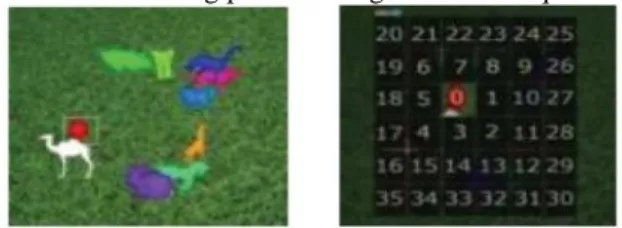
Fig. : A ClickAnimal image (left) and 6 × 6 grid (right) determined by red turkey’s bounding
rectangle. Fig. shows a ClickAnimal image with an alphabet of 10 animals. Note that different views applied in mapping 3D models to 2D animals,
produce many different shapes for the same animal’s
instantiations in the generated images. Combined with the additional anti-recognition mechanisms applied in the mapping step, these make it hard for computers to recognize animals in the generated image, yet humans can easily identify different instantiations of animals. In this we proposes a numerical grid based schema, it acts as the best user authentication and important thing in this is attackers unable to hack. No other guessing attacks work against on our project, with this schema our project became more and more secured, I hope this technique must be implemented on where ever the authentication processes is used in real time.[8]
V. DISCUSSION
• Are CaRP as secured as graphical passwords and
text based passwords?
A. the Underlying CAPTCHA Security
Usually a CAPTCHA challenge might contain about 5 to 8 characters. A CaRP image on the other hand might contain about 30 or more characters. The complexity to break a Click-Text image is about α 30 P(N)/(α 10P(N)) = α 20 times the complexity to break
a CAPTCHA challenge generated by its underlying CAPTCHA scheme[1]. Thus we can get to the conclusion that the CaRP ClickText image is much harder to break than its underlying CAPTCHA scheme. As a framework of graphical passwords, CaRP does not rely on any specific CAPTCHA scheme. If one CAPTCHA scheme is broken, a new and more robust CAPTCHA scheme may appear and be used to construct a new CaRP scheme. [9]
B. Online Guessing Attacks
than the online guessing attacks on existing deterministic graphical passwords where each trial can determine if the tested password guess is the correct password or not. Also, with targeted passwords in the dictionary, attacking existing graphical passwords is successful for brute-force or dictionary attacks. [7]
C. Shoulder-Surfing Attacks
If graphical passwords are used in public places there are chances of shoulder-surfing attacks taking place. CaRP is not robust to shoulder-surfing attacks by itself. However, combined with certain dual-view technology, CaRP can thwart shoulder-surfing attacks.
• 4.2. Is CaRP vulnerable to relay attacks? There are
various ways to carry out relay attacks. Considering CAPTCHA challenges on websites to be hacked, one way of attack is to have human surfers solve the challenges to continue surfing the Website. Another way is having relayed to sweatshops where humans are hired to solve CAPTCHA challenges given small payments. The task to perform and the image used in CaRP are very different from those used to solve a CAPTCHA challenge. This noticeable difference makes it hard for a person to mistakenly help test a password guess by attempting to solve a CAPTCHA challenge. Therefore it would be unlikely to get a large number of unwitting people to mount human guessing attacks on CaRP. In addition, human input obtained by performing a CAPTCHA task on a CaRP image is useless for testing a password guess [10].
VI. BALANCE OF SECURITY AND USABILITY
Some configurations of CaRP offer acceptable usability across common device types, e.g. our usability studies used 400×400 images, which fit displays of smart phones, iPads, and PCs. While CaRP may take a similar time to enter a password as other graphical password schemes, it takes a longer time to enter a password than widely used text passwords. We discuss two approaches for balancing
CaRP’s security and usability. A. Alphabet Size
Increasing alphabet size produces a larger password space, and thus is more secure, but also leads to more complex CaRP images. When the complexity of CaRP images gets beyond a certain point, humans may need a significant amount of time to recognize the characters in a CaRP image and may get frustrated. The optimal alphabet size for a CaRP scheme such as ClickText remains an open question. B. Advanced Mechanisms The CbPA-protocols described in Section II-C require a user to solve a Captcha challenge in addition to inputting a password under certain conditions. For example, the scheme described in [16] applies a Captcha challenge when the number of failed login attempts has reached a
threshold for an account. A small threshold is applied for failed login attempts from unknown machines but a large threshold is applied for failed attempts from known machines on which a successful login occurred within a given time frame. This technique can be integrated into CaRP to enhance usability: 1. A regular CaRP image is applied when an account has reached a threshold of failed login attempts. As in [16], different thresholds are applied for logins from known and unknown machines. 2. Otherwise an
“easy” CaRP image is applied. An “easy” CaRP
image may take several forms depending on the application requirements. It can be an image generated by the underlying Captcha generator with
less distortion or overlapping, a permuted “keypad”
wherein undistorted visual objects (e.g. characters)
are permuted, or even a regular “keypad” wherein
each visual object (e.g., character) is always located at a fixed position. These different forms of “easy”
CaRP images allow a system to adjust the level of difficulty to fit its needs. With such a modified CaRP, a user would always enter a password on an image for both cases listed above. No extra task is required. The only difference between the two cases is that a hard image is used in the first case whereas an easy image is used in the second case
VII. CONCLUSION
The paper conducts a comprehensive survey of CAPTCHA as Graphical Password schemes. CaRP is a combination of both a CAPTCHA and a graphical password scheme. CaRP schemes are classified as Recognition-Based CaRP and Recognition-Recall CaRP. We have discussed Recognition Based CaRP which include ClickText, ClickAnimal and AnimalGrid techniques in this paper. Current graphical password techniques are an alternative to text password but are still not fully secure. As a framework, CaRP does not rely on any specific CAPTCHA scheme. When one CAPTCHA scheme is broken, a new and more secure one may appear and be converted to a CaRP scheme. Due to reasonable security and usability and practical applications, CaRP has good potential for refinements. The usability of CaRP can be further improved by using images of different levels of difficulty based on the login history of the user and the machine used to log in.
REFERENCES
[1] R. Biddle, S. Chiasson, and P. C. van Oorschot,
“Graphical passwords: Learning from the first twelve years,”ACM Comput. Surveys, vol. 44, no. 4, 2012.
[2] (2012, Feb.). The Science Behind Passfaces [Online]. Available: http://www.realuser.com/published/ScienceB
[3] I. Jermyn, A. Mayer, F. Monrose, M. Reiter, and
A. Rubin, “The design and analysis of graphical passwords,” in Proc. 8th USENIX Security Symp.,
1999, pp. 1–15.
[4]H. Tao and C. Adams, “Pass-Go: A proposal to
improve the usability of graphical passwords,”Int. J.
Netw. Security, vol. 7, no. 2, pp. 273–292, 2008. [5] S. Wiedenbeck, J. Waters, J. C. Birget, A.
Brodskiy, and N. Memon, “PassPoints: Design and
longitudinal evaluation of a graphical password
system,”Int. J. HCI, vol. 63, pp. 102–127, Jul. 2005.
[6] P. C. van Oorschot and J. Thorpe, “On predictive models and userdrawn graphical passwords,”ACM
Trans. Inf. Syst. Security, vol. 10, no. 4, pp. 1–33, 2008.
[7] K. Golofit, “Click passwords under investigation,” in Proc. ESORICS, 2007, pp. 343–
358.
[8] A. E. Dirik, N. Memon, and J.-C. Birget,
“Modeling user choice in the passpoints graphical password scheme,” inProc. Symp. Usable Privacy
Security, 2007, pp. 20–28.
[9] J. Thorpe and P. C. van Oorschot, “Humanseeded
attacks and exploiting hot spots in graphical
passwords,” in Proc. USENIX Security, 2007, pp.
103–118.
[10] P. C. van Oorschot, A. Salehi-Abari, and J.
Thorpe, “Purely automated attacks on passpoints
-style graphical passwords,” IEEE Trans. Inf.
Forensics Security, vol. 5, no. 3, pp. 393–405, Sep. 2010.
Authors:
Rajesh Bunga is a student of M.Tech(Software engineering) in Kakinada Institute of Engineering and Technology, Kakinada. Presently he is pursuing his M.Tech [SE] from this college.His area of interest includes wireless networks and Big data.
Mr.K.RAJESH is working as an