140
RESULTS ON THE INFLUENCE SPACE NUTRITION ON GROWTH AND
DEVELOPMENT OF SWEET POTATO PLANT UNDER SANDY SOILS IN
SOUTHERN OLTENIA
Reta Draghici*, Aurelia Diaconu, Draghici Iulian, Milica Dima, Mihaela Croitoru, Marieta Ploae, Coteț Gheorghe, Alina Paraschiv Development Research Center for Field Crops on Sandy Soils, Dabuleni, Dolj County, Romania,
Phone: +40251334402, Fax: +40251334347,
E-mail [email protected]; http://www.ccdcpndabuleni.ro/
*Corresponding author: [email protected]
Keywords: psamo-pelitic soils, Ipomoea batatas, physiological processes, tubers production
ABSTRACT
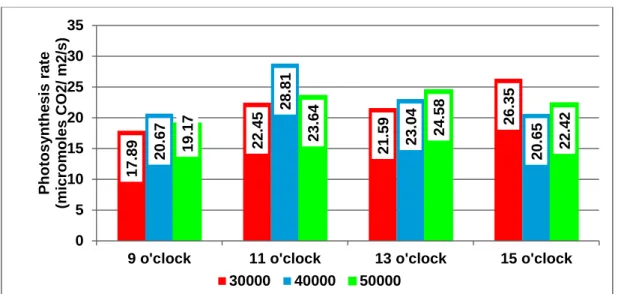
Microclimate created in the psamo-pelitic soils in southern Oltenia, offers great conditions for growth and development of sweet potato (Ipomoea batatas) which is a thermophilic plant specific tropical and subtropical areas. The results obtained during 2013-2015 from Dabuleni, Development Research Center for Plants Crops on Sands, emphasizes productions between 19221 -21634 kg / ha, depending on the size space nutrition and variety cultivated. Those two factors in the study have significantly influenced the conduct from plant physiological processes. The highest value from plant photosynthesis rate (28.81 micromoles CO2 / m2 / s) was recorded at 11 am, at a density of 40,000 plants / ha,
when sweet potato plant has lost through sweating about 5.69 millimoles H2O / m2 / s.
INTRODUCTION
141
the highest quality, using cut sprouts and planted immediately in the field is crucial to achieving a successful system in sweet potato production (Srisuwan, Saranya et al., 2006,Kenneth VA Richardson, 2010, Cioloca Mihaela et al., 2013). Determinations in a culture of sweet potato located in the sandy soils of southern Oltenia, reported the presence of 50 species or genera of arthropods (Iamandei Maria et al., 2014). To improve food security in areas affected by stress thermal-hydr in Romania, it is appropriate to identify new species of plants, less cultured, but the biological potential can best capitalize on the microclimate created in these areas. In this regard the climatic conditions recorded in the south of Romania, provide an optimal microclimate for growth and development of sweet potato (Ipomoea batatas) which is a thermophilic plant specific tropical and subtropical areas.
MATERIAL AND METHOD
Research for sweet potato crop were conducted during 2013-2015 in Development Research Center for Plants Crops on Sands, Dabuleni, located in southern Oltenia, Romania. They were carried out under the Bilateral Cooperation Protocol between Kyungpook National University (KNU) in South Korea and the Academy of Agricultural and Forestry Sciences "Gheorghe Ionescu Sisesti, Bucharest”. The experiment was nestled on
a psamo-pelitic soil with low natural fertility (0.39 to 0.92% humus) and pH (H2O) = 5.9 to
6.9 and aimed behavior of two varieties Korean, Pumpkin (KSP1 ) and Chestnut (KSC1) by planting at three densities (30,000 plants / ha, 40,000 plants / ha and 50,000 plants / ha). The culture was established in the field by seedling produced in solar doubly protected. Planting sweet potato tubers in the solar, it was conducted in the last decade of March (20-25 March). At the age of 35-40 days vegetation sprouts were cut, keep 24 hours at room temperature and then the 2nd day, after 17 hours, were planted in the field in ground mulch foil PPE and irrigation dripping. Harvesting was carried out 120 days after planting. During the growing season, at the stage of root tubers was to determine the rate of photosynthesis and transpiration plant at the level of the leaf, with the device LCpro+ Portable Photosynthesis System, in 4 times of the day (Photo 1). At harvest, was determined in the field, the production of tubers and analyzed in terms of the number and the diameter of the tuber. In laboratory was determined the quality characteristics of tubers at harvest, as follows: Water content and total solids (%) by gravimetric method; Soluble solids content (%), by refractometry; Total carbohydrate content (%), by the method Fehling Soxhlet method; Vitamin C content (mg / 100g fresh substance) by iodometric method; Starch content (%) by gravimetric method.
RESULTS AND DISCUSSIONS
In the period from May to September 2013-2015 (calendar period of ongoing cycle
of vegetation sweet potato) were registered an average air temperature of 21.25 0C, with
0.92 0C more than the annual average (Table 1 ). The amount of degrees of temperature
recorded in the air during the growing of the plant was in the range of 3133.44 to 3332.34
o
142
sweet potato as a result of rainfall during the maturing of tubers, preventing the accumulation of dry matter and increased weight of tubers per plant.
Table 1
Climate characterization of sweet potato vegetation period (2013-2015 Dabuleni)
Climatic element 2013
Year
2014 Year
2015 Year
Average 2013-2015
Period
Multiannual average
(1956-2015) Air temperature average during the
growing sweet potato 01.05– 30.09 ( 0
C) 21.5 20.48 21.78 21.25 20.33
∑ 0
C in air during the growing sweet potato
01.05– 30.09 3292.6 3133.44 3332.34 3252.79 3110.49
Rainfall average during the growing
sweet potato 01.05– 30.09 (mm) 269.2 516.9 330.8 372.3 269.38
Relative humidity average during the
growing sweet potato 01.05– 30.09 (%) 72.4 77.12 71,04 73.52 -
In the competition plants for vegetation factors, competition for sunlight plays an important and has direct implications for the accumulation of dry matter through photosynthesis process. Measurements of plant physiology studies in sweet potato (rate of photosynthesis and plant transpiration rate) are designed to control stress thermal-hydric by establishing of technological parameters, depending on weather conditions. The results obtained in phase of root tubers, show a diurnal variation in the physiological processes of sweet potato, according the temperature of surface leaf and active photosynthetic radiation registered with the device LCpro+ Portable Photosynthesis System, at the time of determination (Table 2). The rate of photosynthesis in the sweet potato used varies depending on the density of planting and the time of day (Figure 1). The maximum photosynthesis was recorded at a density of 40,000 plants / ha at 11th o'clock (28.81 micromols CO2/ m2/s, and the minimum was recorded at 15th o'clock, the same density
planting. For storing this amount of CO2 the plant sweet potato loses 5.69 mmol H2O /m2/s
(Figure 2). Accentuation thermal stress by increasing the photosynthetic active radiation and temperature on the leaf surface, reduces the intensity of photosynthesis, so starting at 13, it recorded a decline compared to values at 11 o'clock. At 15th o'clock, when it recorded a maximum temperature of 43.10 C, the best behaved sweet potato at a density of 30,000 pl / ha. The increase in temperature and photosynthetic active radiation led to increased intensity of plant transpiration process. Sweet potato loses through perspiration between 2.73 -10.03 milimols H2O/ m2 /s, depending on planting density and climatic
conditions on the leaf surface. To ensure planting densities of 40,000 plants / ha, sweet potato has used efficiently water lost through perspiration, accumulating a greater amount of CO2.
Table 2
Values in photosynthetic active radiation (PAR) and temperature registered in the device's camera Lcpro+ Portable Photosynthesis System
Time PAR (micromoles /m2/s) Temperature (0 C)
Minimum Maximum Minimum Maximum
9th o'clock 1067 1467 30.6 34.5
11th o'clock 1378 1622 33.6 40.7
13th o'clock 1405 1707 40.1 42.1
143
Figure 1. Sweet potato plant photosynthesis rate (micromoles CO2/ m2/s) in the phase root tubers, depending on planting density
Photo 1. Physiological determinations of the sweet potato plant
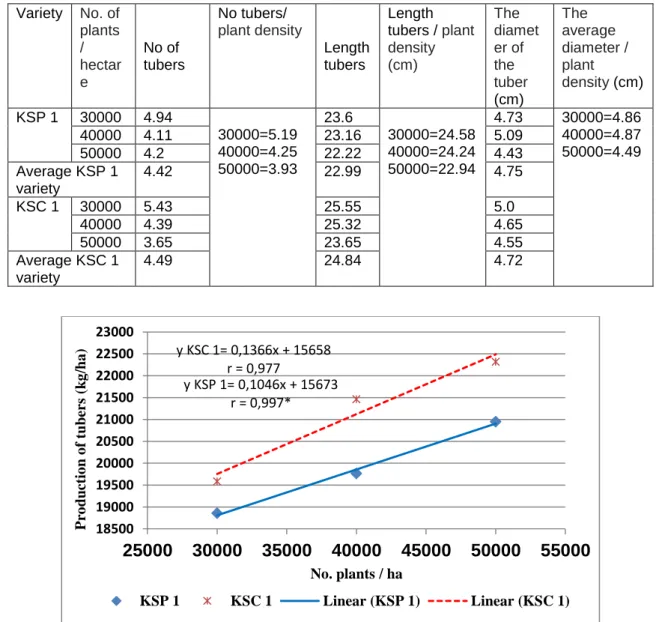
Sweet potato plant productivity is differentiated depending on variety and planting density (Table 3). At harvest, for the variety of sweet potato KSP 1, has averaged 4.42 tubers / plant, with a length of 22.99 cm and a diameter of 4.75 cm, and for KSC 1 variety was recorded 4.49 tuber / plant with a length of 24.84 cm and a diameter of 4.72 cm. These parameters productivity were negatively correlated with the increase in the number of plants per unit area.
Figure 2. Sweet potato plant transpiration rate (milimol H2O/m2/s) in the phase root tubers, depending on planting density
17 .89 22 .45 21 .59 26 .35 20 .67 28 .81 23 .04 20 .65 19
.17 23.64 24
.58 22 .42 0 5 10 15 20 25 30 35
9 o'clock 11 o'clock 13 o'clock 15 o'clock
P ho tosy nt hes is r a te (micr o mo les CO 2/ m2/s)
30000 40000 50000
2 .73 4 .67 10 .03 8 .2 3 .81 5 .69 9 .7 7 .1 3 .3 5 .3 10 .3 9 .18 0 2 4 6 8 10 12
9 o'clock 11 o'clock 13 o'clock 15 o'clock
P la nt t ra nspir a tion ra te ( mmol H2O /m2/s)
144
Production of tubers obtained from sweet potato was influenced by variety and nutrition space size, fluctuating between 19585.12 and 22317.57 kg / ha for the variety KSC 1 and 18857.72 to 20950.14 kg / ha for the variety KSP 1 (Figure 3). Both varieties were established positive correlation between the increase of density and production of tubers obtained, but the connection is closer to the variety KSP 1, where the correlation coefficient is significant (r = 0.997 *). If analyzed the average density influence on tuber production, be noticed production of about 19221 kg/ha (density of 30,000 plants / ha) and 21634 kg/ha (density of 50,000 plants / ha). The results obtained in Cameroon in varieties: 1112, Tib1 and This 2498, have shown that the they gave very good yields (29.6 and 18.7 t / ha) at a density of 20000 pl / ha (J. T. Ambe, 2008).
Table 3
The influence of variety and planting density on the process of the sweet potato tuberization
Variety No. of plants / hectar e
No of tubers
No tubers/ plant density
Length tubers
Length tubers / plant density (cm)
The diamet er of the tuber (cm)
The average diameter / plant density (cm)
KSP 1 30000 4.94
30000=5.19 40000=4.25 50000=3.93
23.6
30000=24.58 40000=24.24 50000=22.94
4.73 30000=4.86 40000=4.87 50000=4.49
40000 4.11 23.16 5.09
50000 4.2 22.22 4.43
Average KSP 1 variety
4.42 22.99 4.75
KSC 1 30000 5.43 25.55 5.0
40000 4.39 25.32 4.65
50000 3.65 23.65 4.55
Average KSC 1 variety
4.49 24.84 4.72
Figure 3. The relationship between plant density per hectare and the production of sweet potato tubers obtained from sweet potato varieties KSP 1 and KSC 1
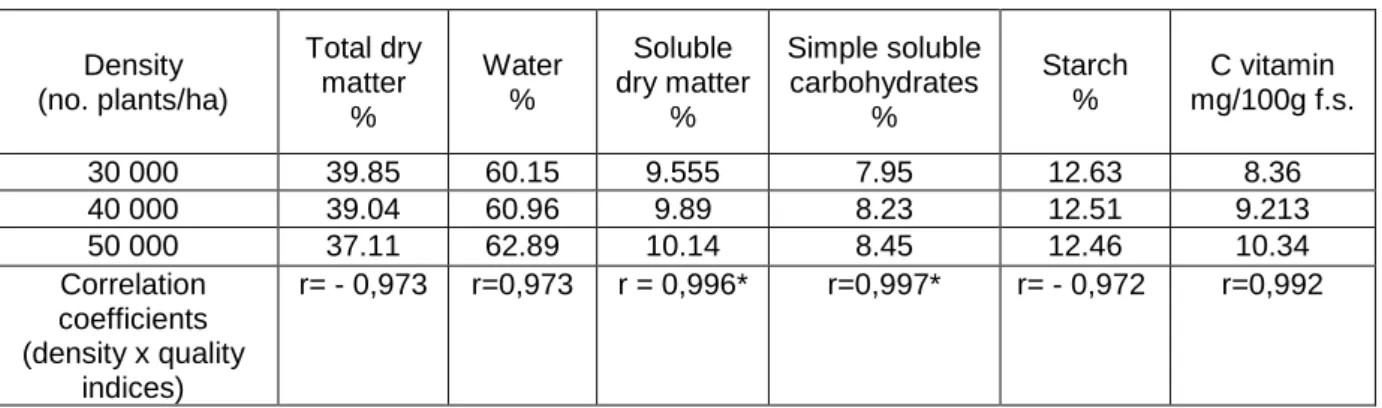
Planting density influenced the quality of sweet potato tubers (Table 4). Increasing the density planting has led to decreasea total dry matter and starch and increasing the amount of soluble dry matter, Simple soluble carbohydrates and C vitamin in tubers harvested at maturity. They noted a significant positive correlations between planting density and soluble dry matter (r = 0.996 *) and between density and simple soluble
y KSP 1= 0,1046x + 15673 r = 0,997* y KSC 1= 0,1366x + 15658
r = 0,977
18500 19000 19500 20000 20500 21000 21500 22000 22500 23000
25000 30000 35000 40000 45000 50000 55000
P
ro
du
ct
io
n o
f
tub
er
s
(k
g
/ha
)
No. plants / ha
145
carbohydrates (r = 0.997 *). By analyzing the chemical composition of the variety (Table 5) is observed that the KSC 1 variety, was distinguished by higher values of total dry matter, starch and C vitamin and theKSP 1 variety, was highlighted by values higher in soluble dry matter and soluble carbohydrates simple
Table 4
Biochemical composition of fruits sweet potato depending on planting density
Density (no. plants/ha)
Total dry matter
%
Water %
Soluble dry matter
%
Simple soluble carbohydrates
%
Starch %
C vitamin mg/100g f.s.
30 000 39.85 60.15 9.555 7.95 12.63 8.36
40 000 39.04 60.96 9.89 8.23 12.51 9.213
50 000 37.11 62.89 10.14 8.45 12.46 10.34
Correlation coefficients (density x quality
indices)
r= - 0,973 r=0,973 r = 0,996* r=0,997* r= - 0,972 r=0,992
Table 5
Biochemical composition of fruits sweet potato depending on variety
Variety
Total dry matter
%
Water
%
Soluble solids
%
Simple soluble carbohydrates
%
Starch
%
C vitamin
mg/100g f.s.
KSP 1 38.41 61.59 10.00 8.33 12.55 7.99
KSC 1 38.93 61.07 9.72 8.09 12.69 10.56
CONCLUSIONS
The sandy soils in southern Oltenia area offers a favorable microclimate for growth and development of sweet potato.
The results obtained show a diurnal variation sweet potato physiology processes. depending on the temperature of the leaf surface and in the photosynthetic active radiation. The highest value of plant photosynthesis rate (28.81 micromoles CO2/ m2/s / s)
was recorded at 11 o'clock. at a density of 40.000 plants / ha, when sweet potato plant lost by transpiration about. 5.69 mmol H2O/m2/s.
The two varieties of sweet potato Korean origin, which we have studied in Romania, behaved well, recording productions between 19585.12 kg / ha and 22317.57 kg / ha (variety KSC 1) and 18857.72 to 20,950 14 kg / ha (variety KSP 1).
Between the planting density and the production of tubers obtained from the two varieties, there is a positive correlation, maximum production being achieved in variant in which were planted 50,000 plants / ha.
146
BIBLIOGRAPHY
1. Ciofu Ruxandra,Batata or sweet potatoes, Horticulture, no.5-6, p: 6-8.
2. Cioloca Mihaela, Andreea Nistor, Nicoleta Chiru, Monica Popa, 2013 - Sweet potato - an alternative under climate change. Results of the in vitro multiplication. Potato in Romania, publication of technical information for potato growers, vol 22. no 1, p:50-53 3. Draghici Reta, Diaconu Aurelia, Draghici Iulian, Toma Vasile, Croitoru Mihaela, Ploae Marieta, Dima Milica, Eun-Gi, CHO, Jong-Sang KIM, 2013 - Preliminary results on sweet potato (Ipomoea batatas) on sandy soils. Annals of Univ. Craiova, Series: Biology, Horticulture, Agricultural Products Processing Technology, Environmental Engineering,Vol. XVII (LIV), I.S.S.N. 1453 – 1275. Editura Universitaria.
4. Iamandei Maria, Draghici Reta, Diaconu Aurelia, Draghici I., Dima Milica, Cho Eun-Gi, 2014 - Preliminary data on the arthropod biodiversity associated with sweet potato (Ipomoea batatas) crops under sandy soils conditions from southern Romania. Romanian Journal for Plant Protection, Vol. VII, 2014. ISSN 2248 – 129X; ISSN-L 2248 – 129X 5. J. T. Ambe, 2008 - Effect of plant population density of sweet potato (Ipomoea batatas (L.) LAM) on weed incidence and severity in Cameroon. International Journal of Pest
Management. Volume 41, Issue 1, 1995, p. 27-30, publicat on line 2008.
DOI:10.1080/09670879509371917
6. Kareem I., 2013 - Fertilizer Treatment Effects on Yield and Quality Parameters of Sweet potato (Ipomoea batatas). Research Journal of Chemical and Environmental Sciences Res. J. Chem. Env. Sci., Volume 1 Issue 3 (August 2013): 40-49, Available
Online, ©2013 AELS, India, Online ISSN 2321-1040 http://www.aelsindia.com
7. Kenneth VA Richardson, 2010 - Evaluation of two different types of planting material for sweet potato production. Gladstone road agricultural centre crop research report no. 3 8. Ladokum, O.A., Aderemi, F.A., Tewe O.O., 2007 - Sweet potato as a feed resource for layer production in Nigeria. African Crop Science onference Proceeding 8, p: 585-588 9. Laurie, S.M. and Magoro, M.D. 2008 - Evaluation and release of new sweet potato varieties through farmer participatory selection. African Journal of Agricultural Research
Vol. 3 (10), pp. 672-676, October, 2008. Available online at
http://www.academicjournals.org/AJAR ISSN 1991- 637X © 2008 Academic Journals
10. Muşat Cosmin, 2010 - Research on some technological defining sequence for
culture of sweet potatoes (Ipomoea batatas Poir.). Annals of Univ. Craiova, Series: Biology, Horticulture, Agricultural Products Processing Technology, Environmental Engineering. Vol. XV (XLXI) - 2010, p: 354-359. ISSN: 1453-1275;
11. Srisuwan, Saranya, Darasinh Sihachakr, and Sonja Siljak-Yakovlev, 2006 - The
origin and evolution of sweet potato (Ipomoea batatas Lam.) and its wild relatives throughout the cytogenetic approaches. Plant Science, Volume 171, Issue 3, p. 171:424–
433, ISSN: 0168-9452
12. Teshome Abdissa, Amenti Chali, Kassaye Tolessa, Fiseha Tadese and Geremew
Awas, 2011 - Yield and Yield Components of Sweet Potato as Influenced by Plant Density: In Adami Tulu Jido Kombolcha District, Central Rift Valley of Ethiopia. American Journal of Experimental Agriculture, ISSN: 2231-0606,Vol.: 1, Issue.: 2 (April-June), p. 40-48, 2011