RESEARCH CONCERNING ACHIEVEMENT OF A MULCH AND MOWING
EQUIPMENT USED IN ORCHARDS
ALEXANDRU TUDOR1, VASILE CRISTIAN1, GLODEANU MIHNEA1, GANEA IOAN2
(1) University of Craiova, Faculty of Agriculture (2) INMA Bucharest
Keywords: mowing, mulching, unbalanced equipment, cutting device
ABSTRACT
For increased mechanization and labor productivity in the current orchards Romania (where the majority of maintenance is performed manually or imported machinery), specific equipment required to carry out certain tasks, such as mulching.
Mulch and mowing equipment can run in a single pass mowing and material moving towards rows of trees, ensuring increasing mechanization of tasks, while increasing labor productivity and considerable decrease in physical effort of operators.
INTRODUCTION
Population growth and changing numerical ratio between producers and consumers, increasing industrialization of agricultural products as raw materials, continuous development of economic exchanges between countries, are the main reasons that led to the intensification of agricultural mechanization processes.
Current changes occurring in respect of the ownership of agricultural land, and transition to market economy, triggering the development of new production structures, including the individual farms of different sizes. Mechanization in these farms is a new field, very topical for scientific research concerning the problems of mechanization in our country.
Maintenance performed on the intervals between rows of fruit are differentiated by technology maintenance of these spaces. For example, if these intervals are maintained as grass surfaces, then maintenance work is in operation mulch and mowing.
Mulching operation can be achieved naturally or artificially, the artificial being of particular topical in frame of organic production systems orchards. As the origin, the used material may be obtained from the land of the plantation, or on other land.
As artificial layer of mulch can be used artificial black polyethylene film, and as a natural layer can be used any plant debris that whole or comminuted can cover the ground as a uniform layer thickness of 15-20 mm (Alexandru T., Glodeanu M., 2009; Alexandru T., 2005).
Mulch layer allows water and heat penetration into the soil, but prevents light penetration, which has the consequence the reduction of the growth of weeds. This layer acts as a barrier to gas exchange, contributing to the destruction of weeds by smothering. material may be obtained by repeated cuts of perennial or annual herbs. From the materials which are produced in other fields, frequent are use: straw, leaves, sawdust, hay of low quality (Ciulu Gh., 2000; Cristea M., 1997).
Mulching can be achieved over the entire surface, or only on one row of 1,5-2,0 m wide. The main advantages conferred by operation of mulch are (Cristea M., 1997):
- prevents soil erosion;
- maintain soil humidity, because evaporation is much lower and weeds can not grow;
- reduce temperature fluctuations (summer under the mulch layer being with aprox 8 colder, and in winter with 2-3 C warmer);
- increasing content of the phosphorus, potassium, magnesium and calcium;
- mulch layer attenuates hit produced from falling fruit;
- ensure high yields and fruit quality;
- reducing the amount of fertilizer because mulch rots, rich in macro and micronutrients;
- clean method compared to traditional technologies;
- the presence on the interval between rows of the grassy layer facilitates access for maintenance machinery, at any time, regardless of time.
MATERIAL AND METHODS
Presentation of experimental variant
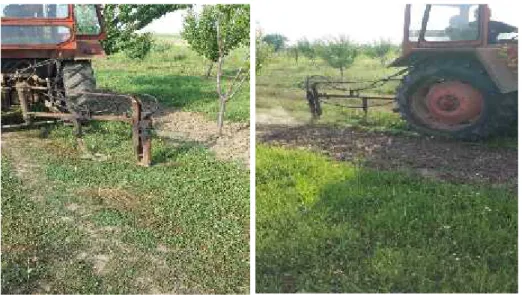
Absence in exploatation of a specialized equipment simultaneously executing booth operations imposed design and implementation of a such equipment, carried on the tractor and with hydraulically actuated (fig. 1).
Fig. 1 Experimental equipment.
The equipment consists of a coupling device on the tractor, to which it is attached to the side the frame of the equipment. It has the possibility of moving left and righ, from the axis of symmetry of the tractor.
At the end of the frame is fixed the rotary cutting device, which is provided with two cutting blades. Actuating the cutting device is achieved by hydraulic motor, coupled to the hydraulic system othe tractor. By operating the hydraulic distributor, can be selected direction of rotation of the rotor with blades, so that the material is directed to the side.
To limit the working height of a cutting device, the equipment is provided with a support which is able to rotate in contact with the ground (regardless of the arrangement of the center or side of the cutter).
The main technical data of the equipment are presented in table 1.
Table 1
Main technical data of the equipment
Technical data Value
Power supply (HP) tractor 45 HP- 45 HP
lateral displacement (mm) 1600
Cutting height (mm) 20
Number of rotors 1
Rotor diameter (mm) 800
Test methods
To establish working conditions were determined agro-features of these crops of herbs, different from a fruit tree plantation to another.
For each determination have established a number of parameters, among which the most important were: the amount of green mass; plant height; plant density; the average height of the mowing layer.
The amount of plant mass cutted and displaced laterally was determined as the average value of the mowing material on five work areas. These areas were chosen on the same interval between rows of trees, spaced at 20 m between them.
The average height of the plants was determined as an average value of measurements carried out on the surface of 1 m2, area bounded by a metric frame. Metric frame was
divided into100 squares of side of 10 cm. It was rated as satisfactory measurement of plant height in the center of squares, resulting 100 values (Ciulu Gh., Bârcă Gh., 2002).
Determinations on setting the average value of the diameter of plants were made following the same procedure as the establishment of the average height.
Plant density was determined by counting the plants located on a surface of 0,25 m2, located in the center of the surface of 1m2. Five repetitions were performed, calculating
the average of the measured values.
Average height mowing layer is established as a average value of measurements achieved on the same surface of 1 m2. For effective measuring the area of 1 m2 was
divided in 16 squares (4x4),with side of 25 cm (measuring the layer height in the centre of each square (Ciulu Gh., Bârcă Gh., 2002; Ruxandu C., 1979).
They were determined following energy indicators (Bădescu M., Alexandru T., Glodeanu M., Boruz S., 2005; Ciulu Gh., Bârcă Gh., 2002):
- effective work speed (ve) was calculated with relation:
t s
Ve 3,6 [ km/h ] (1)
where: s is a linear space, in m and t – the travel time of the space, in s.
- fuel consumption at hectare (q) was calculated with relation:
ef
W
Q
q
[ l/ha ] (2)where: Q is the hourly fuel consumption, in l/ha and Wef– hourly work capacity at the
effective time, in ha/h,
- hourly work capacity at the effective time (Wef):
Wef=0,1 ·Bm·v [ ha/h ] (3)
where: Bmis the average work width, in m and v – real work speed, in km/h.
Determining laboratory indices was made in aggregate with tractor U 650 M, in a orchard located on an area of 5000 m2, in the village Ghercesti, Dolj District.
RESULTS AND DISCUSIONS
Percentage distribution of plant mass on groups of height is presented in table 2. Table 2
Percentage distribution of plant mass on groups of height
Test
Green mass production
[t/ha]
Plants height (cm)
to 10 1 0 - 2 0 2 0 - 3 0 30-40 Up to 40
Percentage distribution %
1 1,677 52 29 7 9 3
-Equipment experimentation was done under the following conditions, shown in table 3.
Table 3
Test conditions Work speed
(km/h)
Adjusted work height (mm)
The number of blades on the rotor
Speed of cutting device (rot/min)
3,2 20 2 1200
4,6 20 2 1200
The spreading degree of cutting plants it was determined by dividing the plants on different widths of lateral arrangement, which is presented in the table 4.
Table 4
The spreading degree of cutting plants Range lateral
arrangement (cm)
Test
1 2
Mass (g) % Mass (g) %
1 2 3 4 5
0-10 27,94 16,66 35,82 30.04
10,1-20,0 53,60 31,96 33,84 28,38
20,1-30,0 22,96 13,69 17,12 14,36
30,1-40,0 16,68 9,94 12,15 10,19
40,1-50,0 12,56 7,49 7,10 5,95
50,1-60 8,96 5,34 5,30 4,45
60,1-70 11,5 6,85 2,20 1,84
70,1-80 5,74 3,43 1,30 1,09
80,1-100 5,83 3,47 3,20 2,68
>100 1.93 1,15 1,20 1,00
TOTAL 167,7 100 119,23 100
Analyzing the arrangement side of cutting plants it appears that on the distance of 10-20 cm (from the first test) we have the highest percentage of the material (31.96%). On the distance 0 -50 cm the percentage of distribution plants is 79.68%.
It also notes that for the second test (in the first two intervals) we have a roughly equal percentage, 30.04%, respectively 28.28%. On the range of 0-50 cm the percentage of thrown sideways plants was 88.89%.
As it increases the range of lateral arrangement of plants it can observed a decrease in plants and a lower percentage (1,00-1,15%) exceeding the length of 100 cm.
In order to achieve an increase in the distance of scattering of the plants it is necessary to mount on the arms of the rotor additional blades to dispose of cutting plants (especially for subsequent passes).
Productivity and consumption index
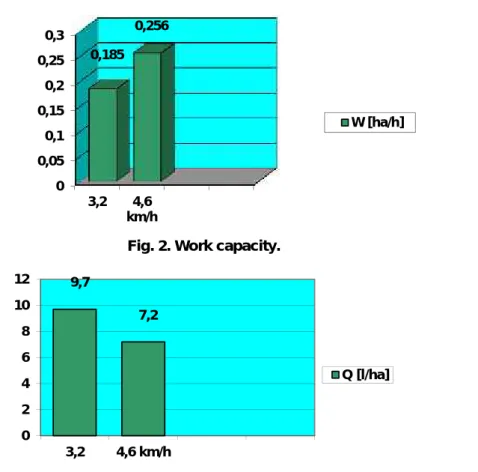
Main productivity and consumption indices were determined for the two working speed of the experienced unit. Data obtained from the tests are presented in table 5.
Table 5
Productivity and consumption indices
Work speed Vl(km/h) Productivity W (ha/h) Specific fuel consumption Q (l/ha)
3,2 0,185 9,7
4,6 0,256 7,2
Fig. 2. Work capacity.
Fig. 3. Fuel consumption per unit area.
Operating indices
Data concerning operating coefficients obtained at endurance tests are shown in table 6.
The analysis of operating coefficients shown, that they have appropriate values, because of the simplicity of equipment and technology flow achieved.
Technological safety coefficient has a high value (0,989), mulch and mowing equipment working without clogging.
Appropriate technical safety coefficient has adequate values (0.964), shortcomings in service being few in number, and the time to address them has been reduced.
Shortcomings in service being few in number, and the time to address them has been reduced.
Table 6
Operating indices
Specification Symbol Averages determined values
The coefficient of operative use of time K02 0.810
The coefficient of use of production time K04 0.754
Exchange coefficient use of time K07 0.650
The coefficient of technological service K23 0.905
Coefficient technical of care K31 0.956
Technological safety coefficient K41 0.989
Technical safety coefficient K42 0.964
Operational reliability coefficient K4 0.950
As a consequence of the high values of the technical and technological safety coefficients, the coefficient of safety in operation of the equipment has the proper value of 0,95.
0 0,05 0,1 0,15 0,2 0,25 0,3
3,2 4,6
km/h 0,185
0,256
W [ha/h]
9,7
7,2
0 2 4 6 8 10 12
3,2 4,6 km/h
CONCLUSIONS
- for increased mechanization degree and labor productivity in orchards, specific equipment required to carry out certain tasks, such as mulching.
- mulch and mowing equipment can perform in a single pass mowing and moving the material toward the rows of trees bring great efficiency of this activity; the technical solution offered will have the effect of increasing the degree mechanization of work in plantations of fruit trees, while labor productivity growth and the considerable decrease in physical effort of operators.
- in assessing the qualityof mulch and mowing operation carried out with experimental equipment (compared to classic operation performed in two passes) it is necessary to specify the need for further intervention to rectify the operation performed mechanically (due to uneven spreading on a relatively extended surface of the mowing material).
BIBLIOGRAPHY
1. Alexandru T., Glodeanu M., 2009, Operation of farm machinery, SITECH Publishing House, Craiova.
2. Alexandru T., 2005, Horticultural machines, SITECH Publishing House, Craiova. 3. Bădescu M., Alexandru T., Glodeanu M., Boruz S., 2005, Agricultural and
horticultural machinery, SITECH Publishing House, Craiova.
4. Ghenea N. and collab., 1997, General and special pomiculture, DIDACTIC AND PEDAGOGICAL Publishing House,Bucharest.
5. Cristea M., 1997, Contributions to Improving the working process of cutting systems and distribution of plant mass at mulch and mowing machines used in orchards, Phd. Thesis. 6. Ciulu Gh., 2000,Optimizing exploitation of agricultural units-first part, Printing of University
of Craiova.
7. Ciulu Gh., Bârcă Gh., 2002, Optimizing exploitation of agricultural units-second part, Printing of University of Craiova.