Volume I, Issue II, June - 2014
Certain Investigations of Tunneling Effects on
Structures for Development of Design Methods
P.Narasimhan,
PhD Scholar, Techno Global University, Meghalaya Mail Id:[email protected]
Abstract— The subject of this research paper is the verification of a three-dimensional numerical modeling approach for the prediction of settlement damage to masonry buildings due to tunnelling in soft ground. The modeling approach was developed by previous researchers at Oxford, and was applied to three sites, representative of a range of practical configurations. The first involved the excavation of a shaft close to the corner of an eighteenth century church. The second involved tunnelling with very low cover beneath the foundations of a terrace of cottages. The third was the relatively well-known case of tunnelling beneath the House. The demand on computing resources was high, stimulating many enhancements to the software, the most important of which was parallelization of the analysis program for use on the Oxford Supercomputer. To obtain optimum results, larger model sizes are required. The computing resources to enable this should become more commonly available within the next few years, enabling the modeling techniques to be used routinely.
Index Terms— numerical modeling, Supercomputer, computing, modeling techniques, tunnelling.
I. INTRODUCTION
Tunnelling is increasingly being seen as an environmentally preferable means of providing infrastructure such as transportation and utilities to densely populated urban areas. It is often most- effective as an alternative to over-ground solutions, when the risk and cost of disruption during construction is taken into account. The number of tunnelling schemes in cities under construction or being planned worldwide is increasing. The September 1999 issue of the journal Tunnels and Tunnelling International reported on major metro projects in Bogota, Cairo, Copenhagen, Hong Kong, Kuala Lumpur, London, Madrid, Nanjing City, Rio de Janeiro, Rome, Singapore, Tel Aviv, Tehran and WashingtonD.C.It is common for major cities, especially in coastal or estuarial locations, to be founded on alluvial deposits of clays, silts and sands, usually classified as soft ground. Ground movements in response to the excavation of the tunnel will be transmitted to the surface. If there are surface structures founded on either shallow or deep foundations, these may be affected.
Tunnels of 2m diameter and upwards are usually constructed by tunnel boring machine (TBM), depending on the precise ground conditions. A typical example would be running tunnels for a metro. The TBM comprises a rotating cutter head powered by a motor contained within a cylindrical advancing shield. Behind the shield, a lining, either of precast concrete or cast iron, is erected. For shorter lengths and awkward shapes, for example junctions and underground stations tunnels are typically excavated by hand with or without a shield and a sprayed concrete primary lining is
often cost effective.
The amount of surface settlement that results depends partly on what methods, if any, are being applied to control the ground movements ahead of or around the excavation. In closed-face machine, the pressure on the face is maintained as close as possible to the overburden pressure thus reducing g r o u n d movements into the face. In an open-faced machine, the face is effectively unsupported. Grouting the annulus behind the completed lining serves to reduce radial movements of the surrounding soil. Other methods may also be applied for limiting the spread of ground movements to the surface, for example ground improvement by soil nailing or permeation grouting. Compensation grouting may be used to compensate directly for the effects of the ground movements upon specific surface structures.
Risk of damage to surface structures
due to soft ground tunnelling
Volume I, Issue II, June - 2014 damage may in extreme cases lead to a loss of
strength or stability of the building leading to structural failure. It is more likely, however, to have a less catastrophic effect and to be repairable, but at a cost. It is this cost, and the accompanying disruptions to the function of the building, which may be an important impact of the tunnelling, scheme, and therefore needs to be estimated by the civil engineers. The cost will be greater for high value buildings of historical and national importance.
Design approaches for acceptable
risk
The distribution of damage in a building, particularly one of masonry construction, exhibits characteristics of a stochastic rather than deterministic phenomenon. Therefore design philosophies have employed techniques of classifying buildings according to the probability of a certain threshold of damage being experienced. This leads to a staged assessment process in which buildings under consideration are eliminated when they are shown, by progressively more complex analyses, to lie within acceptable risk levels (Lakeet al., 1996, Mair et al., 1996).
This staged approach was used for the design of the Jubilee Line Extension in London (Linney, 1999). Three stages of assessment were performed. The first two assumed that the ground displacements experienced by the building were the same as those expected in the’ green field’ situation, i.e. without the building present. In the first stage, buildings that are expected to experience a maximum settlement less than 10mm or a maximum ground slope less than 1 in 500 were eliminated. In the second stage, the maximum tensile strain in the building was calculated, based on the imposed ground movements and certain simplifying Assumptions about structural behaviour. If it fell within a certain threshold, the building could then be eliminated at that stage. The fact that the damage level calculated is probably a conservative estimate, as the ground and structure will in reality interact, is borne in mind at this stage but the actual interaction effects are not quantified.
II. LITERATURE SURVEY
The basic elements of the numerical modeling procedure to be used in this project were implemented in the first phase of a research programmed at the University of Oxford, commencing in 1993. The approach uses a non-linear finite element method in three dimensions, modeling a building coupled to the ground and the incremental excavation of a tunnel heading. A key aspect of the work at Oxford is to model the building together with the
ground and tunnel, in a combined or “fully coupled” analysis. The first phase is described in detail in the theses of Chow (1994), Augarde (1997) and Liu (1997), and summarized in the paper by Burd et al. (2000). This project forms part of a second phase of research and development, which looks more towards the industrial application of the methods developed in the first phase.
The planned activities for this project were as follows: Firstly, case history data of building responses to tunnel excavation would be obtained. Approximately three to four well-documented sites, involving tunnelling in soft ground under or near masonry buildings but without any intervention measures such as compensation grouting, were sought. At the outset, the Mansion House case history, the subject of three published papers in 1994, was considered a good example. Three-dimensional finite element models of the sites would then be assembled and analyzed. The results would be compared with the field data and reasons for any differences would be explored. Experience gained from each analysis would be applied to the next, any useful enhancements to the analysis software made, and the performance of the existing software and hardware examined. A base of experience of carrying out three-dimensional a n a l y s e s , and overcoming practical difficulties in the process, would be obtained.
The incorporation of protective measures that may be used on site into the analyses, such as compensation grouting, was deemed to be beyond the scope of this project. A parallel research project at Oxford was given the brief of exploring this area. Although case history data from any site could be considered, there was a preference for sites on over-consolidated clays similar to London clay, and for masonry structures
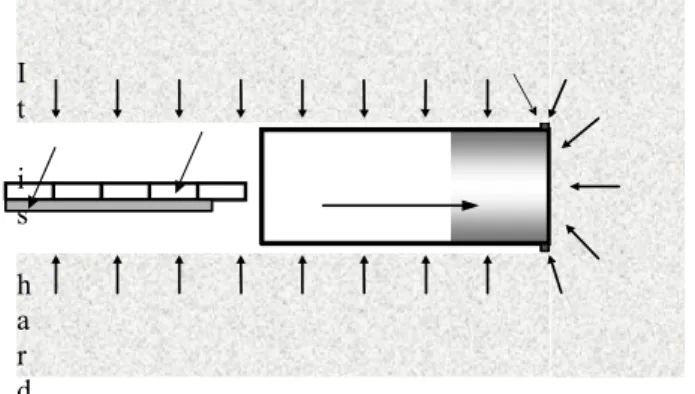
I
t i s h a r d
Figure 1: Sources of ground losses during the shield tunneling process to make general assertions about the relative magnitudes of the face and radial components of the volume loss, as there is limited case history data of sufficient detail.
Volume I, Issue II, June - 2014 2.8m diameter tunnel in London clay. They were
able to relate changes in lateral earth pressure and surface settlement to the position of the advancing tunnel heading. In that case, about 70% of the surface settlement at a particular section took place after the tail of the shield had passed, during lining installation and grouting.
Short, medium and long term ground movements Time dependency in the mechanical behaviour of soil influences ground movements resulting from tunnelling, leading to the classification of short, medium and long-term movements. Each of these regimes of behaviour is itself a steady-state response of the ground to changes in internal or external conditions. The true transient behaviour – the part of the response in each regime that is dependent on the initial conditions – is beyond the scope of this and other studies of tunnelling-induced ground behaviour, although it might be an interesting subject for further study Short-term ground movements are identified to occur during at most the first four days after excavation in London clay. This is a timescale that is shorter than, or comparable with, the time taken by the advance of the tunnel heading that is the cause of ground movements. Macklin and Field (1999) reported short-term settlements taking place at section over a period of 24 hours before and after the passage of the shield. There is evidence that the movements start and stop almost instantaneously with advance of the tunnel heading. The response of the ground is at constant volume to the suddenly imposed new stress regime, which is essentially one of unloading at the tunnel boundary. Rowe and Lee (1989) proposed that it was the extension modulus in clays that was particularly relevant to tunnelling problems. The response may be entirely elastic or include irrecoverable strains. Apart from very locally to the tunnel, strains are small (say less than0.1%) and not enough to cause failure or alter the structure of the soil significantly. Thus the constitutive model for the soil can be assumed unchanged during this phase.
Medium and long-term settlements are thought to be t h e result of creep, ageing and consolidation (Mitchell et al., 1997), i.e. alterations in the properties of the soil at constant load. The timescale over which they occur depends on the ground conditions, ranging from weeks or months for sands and soft clays two years for stiff clays.
The relative magnitude of short and long-term movements depends on many factors and it is hard to generalize. Case histories suggest that
for a typical site on stiff clay, around 60% of the total settlement occurs in the short term (Simons and Som, 1970;Morton and Au, 1975). Tazewell and Selby (1989) observed long-term settlements up to2.5 times the short term, but also that the long-term trough widths tended to be wider. This meant that the curvature of the trough, the factor most likely to cause damage to structures, was similar to that in the short term. In addition, surface structures are more able to accommodate long-term settlements by creep and stress redistribution. Thus it is the short-term movements that remain the chief issue of concern for engineers, and are the subject of this study.
The prediction of ground movements due to tunneling more detailed understanding of the mechanisms by which ground movements occur at tunnel excavations could be beneficial in predicting the volume loss, deducing the mechanisms of interaction with surface structures, and designing countermeasures against settlement. Empirical methods based on case history data, analytical methods (upper and lower bound and closed-form), laboratory 1g model testing, centrifuge modeling and numerical analysis have all been employed. For the potential value of numerical analysis to be realized, a sufficiently accurate constitutive model for the soil in the appropriate stress/strain range is required. Any modeling technique, either laboratory or numerical, must represent the tunnelling process to an acceptable degree of accuracy.
III. EXPERIMENTAL APPARATUS AND MATERIALS REQUIRED
Volume I, Issue II, June - 2014
EXPERIMENTAL PROGRAME AND RESULTS
A comprehensively reported case history of tunnelling under buildings that led to significant damage dates from the 1970’s (Breth and Chambosse, 1975). A 6.7m diameter tunnel was constructed with sprayed concrete lining at a low cover of only 10 – 12m in stiff Frankfurt clay beneath buildings. The C/D ratio was thus only 1.5 – 1.8 and interaction with the surface could be expected. The behaviour of three buildings, two of reinforced concrete framed construction with masonry infill panels and one of load-bearing masonry, was described.
There is no explicit information given on soil properties. If a typical London clay strength profile of su = 60 + 6z is assumed, then the
stability number N is 2.8. The stability number at collapse, NTC, based on P/D = 0, is 7.2. Hence
the load factor is estimated as 0.35, implying that significant plasticity in the ground would be expected. The concrete framed buildings responded to the settlement trough with relatively high stiffness, tilting with hardly any angular distortion. Damage occurred, however, where there was an abrupt change in stiffness, for example between a building and its annex, and was concentrated in one or two large cracks. The possibility of damage occurring and affecting the structure properties was not considered. Data from the field was not offered in support of the numerical analyses. There is also a major problem of selection of an appropriate stiffness for the building in a two- dimensional analysis.
The building was only modeled as weightless, contrasting with the work of Liu (1997)who allowed for buildings of various weights. A weightless building has the advantage of not increasing the stability number in the
ground in a two-dimensional analysis, and therefore allowing reasonable representation of the ground, particularly closer to the tunnel. However, the stress field in the building and in the soil just under the building will not be realistic, and therefore effects such as stress arching, noted by Liu as being important to the structural behaviour, will be missed.
The results from the first series showed that as the shear stiffness of the building decreases, the trough shape approaches the ‘Greenfield’, with a trough width parameter approximately 0.5z0 (in agreement with the empirically
predicted value). As the relative bending stiffness increases, the trough width is increased, up to maximum of 1.5z0depending
Volume I, Issue II, June - 2014 upper bound envelope on the modification factor
against bending stiffness could be drawn. Similar envelopes could be drawn for different values of e/B, and are presented as a design chart in the paper.
Often the volume loss can be predicted based on experience of previous sites in similar ground conditions with similar tunnelling processes. Researchers have also demonstrated more rational techniques for prediction, based on a correlation of volume loss with load factor (a measure of the factor of safety of the tunnel heading against collapse) together with an allowance for workmanship effects. These in turn can often only be assessed with reference to previous experience. The short-term settlement response of the ground is regarded as the most important for its effects on surface structures. During this phase, the soil properties may be assumed unchanged and it responds with small strain behaviour. Medium and long-term settlements due to consolidation and other effects tend to be more widely distributed, and many structures can accommodate them by creep.
The model therefore backs up the experimental results in terms of pH change and contaminant behaviour, with the hypothesis of pH affecting the state of PCP (and therefore its sorption) being confirmed.
Figure 5.1: Cracking and arching behaviour of a masonry façade with openings
As the building weight increased, N increased and the proportion of yielded soil in the ground increased. This caused larger settlements on excavation of the tunnel. The arching forces and the magnitude and extent of damage in the façade increased. Although it could be argued
that variation of soil self-weight has little significance in practice, increasing it increased
N, the magnitude of settlements and the resulting
building damage. An interesting conclusion of Liu’s 2-D work was that the settlement trough could be
Described in terms of changes in settlement over short length scales under the building (“local” settlement effects) superimposed on an overall “global” settlement trough. The “global” trough shape and size was more affected by variation in building weight than by building stiffness within the practical ranges of these parameters considered.
Volume I, Issue II, June - 2014
were examined. Increased building weight increased the magnitude of settlements and damage, and if the building was positioned in a location such that it interacted with the mechanism of shear planes in the ground above the tunnel, even larger settlements and rotations of the building took place. It is likely however that the effects of building weight were exaggerated, because in a 2-D analysis the vertical stress due to the weight of the building is transferred down to the tunnel, increasing the load factor at the excavation and therefore the amount of plasticity generated in the soil. This is an inherent disadvantage of any 2-D analysis. Similar arguments apply to the building stiffness, which is hard to estimate for a 2-D analysis.
IV. CONCLUSION
It is well understood that tunnelling in soft ground causes settlements, due to the volume loss that occurs when the sides of the bore move in as the tunnel advances. These settlements may in turn cause damage to surface structures, in particular to vulnerable types, such as old masonry structures. Although it is unlikely that the damage will cause structural failure, repairs could entail significant cost. Case history data has been, and will continue to be, important in gaining an understanding of this problem. However, it is not possible to develop design methods for prediction of settlement damage effects from field data alone. Laboratory and centrifuge modeling have been tried, but numerical techniques, as used in this project, appear to show the most promise. Other researchers have also used numerical modeling, but have tended to simplify the problem too much, for example by idealizing it as two-dimensional, reducing the building to a simple beam, or expressing the building response as a function of the ‘Greenfield’ settlement behaviour.
The original objective of this project was to obtain case history data from three to four sites involving tunnelling beneath a masonry
building, and carry out verification analyses. It is difficult to obtain good data of this type, because protective measures are often applied in the field, to avoid building damage. In the event, good quality data was obtained from three sites. Further data was obtained from other sites that did not exactly fit the project criteria, but which perhaps could be used in future research. In addition, it was found that the Mansion House site could be considered as containing three tunnelling events, only one of which was analyzed for this project, leaving scope for further research. Data from two of the three sites reported in this thesis had not been published prior to this project. The sites chosen all met the project criteria and had the advantage that Between them they captured a wide range of configurations of the tunnelling excavation and building. The excavations consisted of a shaft, a shallow tunnel and a relatively deep tunnel, positioned off the corner of the building, under the middle of the building and under one end of the building respectively. Two of the buildings were large, prestigious buildings, which both responded in a stiff manner to the tunnelling settlements. The third was a long building that was relatively flexible transverse to the tunnel. Thus the capability of the three-dimensional modeling in representing a wide range of situations has been demonstrated.
VI.FUTURE WORK
The increasing move towards object-orientated programming and more flexible data structures is to be encouraged, as it improves program structure and the efficiency of coding and maintenance. It is even more important to maintain standards of coding when a program is under a continuous and long-term development by many different researchers. Investment in providing some of the features of standard commercial packages within OXFEM, for example temperature loading, would make the possible transition to a commercial program in the future, should the need and opportunity arise, more viable. On balance an in-house program is probably essential to a research institution seriously engaged in numerical analysis, but needs careful management. Computing resources available to a project of this type will continue to increase due to advances in computing technology.
REFER ENC ES
1.Anagnostou, G., Kostikas, Ch., Iakovides, G. and Vasilakopoulou, G. (1997). Athens Metro – design and construction of shallow tunnels to control settlements of surface structures. In: Proc. Int. Symposium Tunnelling ’97, London, 2-4 September. London: Institution of Mining and Metallurgy, 709-720.
Volume I, Issue II, June - 2014 and structure response to a hand driven decline in
London clay. In: Proc. Int. Sympos. on Geotechnical Aspects of Underground Construction in Soft
Ground, Tokyo, 21-23 July 1999.
Rotterdam:Balkema, 75-80.
3.3. W.-K. Chen, Linear Networks and Systems (Book
style). Belmont, CA: Wadsworth, 1993, pp.
123–135.
4.Collins, I.F. and Houlsby, G.T. (1997). Application of thermo mechanical principles to the modeling of geotechnical materials. Proc. Royal Society, Series A, 453, 1975-2001.
5.Eisenstein, Z., Heinz, H. and Negro, A. (1994). On three-dimensional ground response to tunnelling. In: Tunnelling in Soil and Rock, Proc. GEOTECH ’84, Atlanta, May. New York: ASCE, 107-127.
6.Grant, R.J. and Taylor, R.N. (1996). Centrifuge modeling of ground movements due to tunnelling in layered ground. In: Proc. Int. Sympos. on Geotechnical Aspects of Underground Construction in Soft Ground, London, April. Rotterdam: Balkema, 507-512.
7.Jeffery, S. (2003). The Mansion House. London: Phillimore & Co. Ltd.
8.Liu, G. (2007). Numerical modeling of damage to masonry buildings due to tunnelling.
9.Potts, D.M. (2006). Behaviour of lined and unlined
tunnels in sand. Thesis (PhD).University of
Cambridge.
10. H. Poor, An Introduction to Signal Detection and
Estimation. New York: Springer-Verlag, 1985, ch. 4.
11. B. Smith, “An approach to graphs of linear forms
(Unpublished work style),” unpublished.
12. Skempton, A.W. and MacDonald, D.H. (1956).
Allowable settlement of buildings. Proceedings ICE Part III, 5, 727-768.
13. Verruijt, A. and Booker, J.R. (1996). Surface settlements due to deformation of a tunnel in an elastic half plane. Géotechnique, 46 (4), 753-756.
14. E. H. Miller, “A note on reflector arrays
(Periodical style—Accepted for publication),” IEEE Trans. Antennas Propagat., to be published.
15. J.Wang, “Fundamentals of erbium-doped fiber
amplifiers arrays (Periodical style—Submitted for
publication),” IEEE J. Quantum Electron.,