The Middle Ground between Peace and War: Sanctions
Are economic sanctions more effective in a non-cooperative
authoritarian state or a cooperative authoritarian state?
Claire Daniëls s.1486225 Supervisor: Dr. M.S. Spirova Second reader: Dr. A.W. Chalmers
Table of Contents
Chapter 1: Introduction ... 3
Chapter 2: Economic sanctions: a short background ... 5
2.1 Types of economic sanctions and how to utilize them ... 5
2.2 Economic sanctions in an authoritarian state ... 7
Chapter 3: Cooperative theory ... 10
3.1 the definition of the cooperative-authoritarian state ... 10
3.2 Testing the cooperative theory ... 12
Chapter 4: Methodology ... 18
4.1 Data collection ... 18
4.2 Case study selection ... 18
Chapter 5: Economic sanctions and their effectiveness ... 22
5.1 Iran ... 22
5.2 China ... 24
Chapter 6: Domestic factors: budget and opposition ... 27
6.1 Budget ... 27
6.2 Opposition ... 35
Chapter 7: International factors: type of sanctions, commitment, and dependence .... 42
7.1 Type of sanctions ... 42
7.2 Commitment ... 51
7.3 Dependence ... 61
Chapter 8: Conclusion ... 72
8.1 Theoretical and empirical conclusions ... 72
8.2 Further research ... 75
Appendix ... 76
9.1 Economic sanctions to Iran ... 76
9.2 Economic sanctions to China ... 78
Chapter 1: Introduction
Why do states go to war? Issues regarding non-proliferation, terrorism, human rights violations and many more can provide some answers. However, one of the main reasons to go to war is to elicit behavioral change in the receiver state. Military intervention has a lot of drawbacks with (civilian) casualties as the main drawback. An alternative option for eliciting coercive behavioral change in the receiver state is economic sanctions. These sanctions, if utilized correctly, put pressure on a state to change its behavior without requiring military intervention. Even though its
effectiveness is marginal, and has been questioned by many researchers, there is some effectiveness, because states often utilize this option.
Economic sanctions theory suggests that these sanctions are more likely to work in a democratic state, yet they are far more often imposed on a non-democratic state. It is therefore logical that a lot of research has been conducted on the types of non-democratic states and their difference in the responses to economic sanctions. However, something this type of research has not taken into account is that economic sanctions are an international mechanism of coercion. Yet, the receiver states are only classified by their domestic policies, not by their international attitudes. Therefore, this thesis shall find a link between the effectiveness of economic sanctions, in two specific non-democratic states that are classified by their international attitudes. The research question driving this thesis is: are economic sanctions more effective in a non-cooperative authoritarian state or a cooperative authoritarian state? This thesis shall analyze this question via two case studies in which one target state meets the criteria of being a non-cooperative authoritarian state, and the other meets the criteria of a cooperative authoritarian state.
its assessment for the effectiveness of economic sanctions. Deriving from the existing theory this thesis shall outline the framework in which it tests the new cooperative theory, which is outlined in chapter 3. Chapter 4, the final chapter before the empirical findings, outlines the data collection and case study selection. Chapter 5 introduces the sanctions put on the target states, the type of sanctions, and the effectiveness of the sanctions. Chapters 6 and 7 are comprised of the empirical research regarding the research question. The cooperative theory shall test five mechanisms: budget, opposition, type of sanction, commitment to the sanction, and dependence. Chapter 6 outlines the first two mechanisms that are domestic to the target state. Chapter 7 outlines the latter three mechanisms that are international and may also affect the sender state. Each mechanism shall be outlined by an expectation of how the mechanism works, the two case studies (Iran and China), followed by an assessment of the impact of the sanctions via this mechanism. While the theoretical aspect of the thesis expects that economic sanctions are more effective in the cooperative authoritarian state for each mechanism, apart from commitment, the empirical findings through the mechanisms actually show a stronger link to the international factors. The domestic mechanisms do not contribute to the effectiveness of the economic sanctions as the theory would expect. The international mechanisms show a stronger link to effective economic sanctions and the cooperative authoritarian state. Chapter 8 concludes the thesis by answering the research question after all the mechanisms have been analyzed. The expectation is mostly met because the
Chapter 2: Economic sanctions: a short background
2.1 Types of economic sanctions and how to utilize them
Economic sanctions consist of two main types of sanctions: trade sanctions and financial sanctions; other sanctions entail travel, military, diplomatic and cultural sanctions (Bossuyt, 2000). Trade sanctions limit and restrict the imports and exports of the target state. Trade sanctions can be selective (limited to trade concerning the dispute) or comprehensive (Bossuyt, 2000). Trade sanctions can range from import and export controls on a certain product, or a complete embargo against a certain industry or state. Financial sanctions on the other hand are concerned with monetary issues. According to Bossuyt financial sanctions can include: “restricting government assets held abroad, limiting access to international financial markets, restricting international payments, and lowering the sale and trade of property abroad” (Bossuyt, 2000). Trade and financial sanctions may be comprehensive (targeting more than one sector) or selective (targeting only the sector causing/facilitating the unwanted behavior).
Aside from the classical terms of comprehensive and selective sanctions there are also two “modern” (surfaced and utilized mostly in the past decade) types of sanctions: smart sanctions and facilitative sanctions. Smart sanctions target a
coercion against “unwanted” behavior, which has been termed as ‘the inversion of the usual sanction model (Targeted Financial Sanctions Project, 2004).
States utilize economic sanctions as a way to alter the target state’s policy. Economic sanctions are used to pressure civilians who in turn pressure the
government for change (Bossuyt, 2000). Much of the literature however claims that economic sanctions do not work, or are difficult to implement and reinforce. Hovi, Huseby and Sprinz expect nearly impossible favorable conditions: goals are limited, relations between states are friendly, sanctions are implemented in one action, significant cost for the target, and few states needed for implementation (2005). Drezner argues that the low cost to sender and target state is a reason to choose sanctions over military conflict (Drezner, 1998). The relative low cost could explain why states are willing to utilize economic sanctions even if the probability that the economic sanctions target the intended change is low. Despite the low effectiveness states do utilize them, therefore there are factors in the target state and/or the sender state that facilitate a positive outcome when utilizing economic sanctions.
2.2 Economic sanctions in an authoritarian state
There are a few important concepts to be noted from prior research on the effectiveness of economic sanctions in an authoritarian state: a general model for effective economic sanctions, international aspects, and place and timing of economic sanctions.
Wallensteen has outlined the “double grip solution” for effective economic sanctions in an authoritarian state: the target state faces external pressure from the international arena by the imposing sanctions and the target state faces internal
pressure from strong opposition (Wallensteen, 2000). Opposition has often been noted as an important factor for effective economic sanctions (e.g. Kaempfer and
Lowenberg, 1999; Gebert, 2013). Mertens dictatorship model uses opposition as well. The model is based on Wintrobe’s dictator model which analysis includes how
merely expressing concern for this type of behavior by way of non-damaging economic sanctions might be enough (Mertens, 2000).
Contrary to Mertens, Grauvogel and von Soest (2013) take on a more narrow view of effective economic sanctions; they analyze why economic sanctions in
authoritarian regimes have not caused these states to become democracies. Interesting from their research is that they take into account a “density of ties” where they
analyze economic, social and geographic linkages (Grauvogel and von Soest, 2013). However, economically Grauvogel and von Soest (2013) only look at the five most important European trade relations and those of the United States and not at trading partners in other parts of the world, as authoritarian states are likely to have.
Geographical linkages show that economic sanctions are more likely to work the closer the target state is to the sender state (Grauvogel and von Soest, 2013). Finally, social linkages are only monitored through the extend of internet access per 1000 inhabitants (Grauvogel and von Soest, 2013). The study finds that claims of
legitimacy of the regime are important in assessing why economic sanctions have not been effective in turning these regimes into democracies (Grauvogel and von Soest, 2013). What is missing from the research is that not all economic sanctions are sent for the purpose of democratization or overthrowing the current regime. Furthermore, while the study takes the international arena into account, it does not look at the dependence of a target state upon the international arena.
Finally, it is important to note where and when sanctions should be imposed upon an authoritarian regime. Kirshner contributes to the notion of smart sanctions that target the central government or responsible parties by stating that economic sanctions may also target core groups whose support is essential for the regime to remain in power (1997). “The essential question is not just who is hurt by which sanctions, but whether the afflicted groups matter politically to a leaders support coalition” (Brooks, 2010). Major (2012) further argues that timing is the greatest importance when assessing the effectiveness of economic sanctions. Economic sanctions can be effective if there is some sort of domestic disturbance of the status quo (Major, 2012). Interesting about Major’s work is the notion that sender states should seize an opportunity when it arises (2012). Yet, Major’s argument should also have assessed the following question: do sender states have full access to information about the ongoing of the domestic status quo of the target state? Finally, Hovi,
Huseby, and Sprinz conclude that threats of economic sanctions are a very effective tool for coercive diplomacy.
Chapter 3: Cooperative theory
3.1 the definition of the cooperative-authoritarian state
Prior research demonstrates a link between the type of regime and the effectiveness of economic sanctions. This link however, is solely based on the domestic level. Geddes’ classification of authoritarian regimes distinguishes three types of regimes:
personalist, single-party, and military regimes, that all focus on domestic
characteristics of the state (1999). This thesis looks at the difference in the type of authoritarian state by its international actions; non-cooperative authoritarian state and cooperative authoritarian state. The difference between the cooperative authoritarian state and the non-cooperative authoritarian state lies in the international arena: how much does the authoritarian state contribute to international affairs and cooperates internationally.
First, both types of states share the basic domestic features of an authoritarian state. An authoritarian state is by nature non-democratic. Linz’ definition of an authoritarian state is still very accurate today:
“Political systems with limited, not responsible, political pluralism, without elaborate and guiding ideology, but with distinctive mentalities, without extensive nor intensive political mobilization, except at some points in their development, and in which a leader or occasionally a small group exercises power within formally ill-defined limits but actually quite predictable ones”
(Linz, 1964, p.225).
Therefore, an authoritarian state is ruled by a concentrated political power that is not freely elected by the people. Political interests groups are highly limited and there is little to no free press and media.
above. The non-cooperative authoritarian state is only active in the international arena in a limited way: it only has a few international partners and participates a little in the international arena along the lines of international organizations. Therefore, overall the non-cooperative authoritarian state is limited in its influence on the international arena.
The cooperative authoritarian state has similar domestic elements of an
authoritarian state, but is much more focused on normalization with democratic states. A cooperative authoritarian state is cooperative only in the international arena: it is focused on engaging in relations with other nations, assisting in development of other nations, and it is active in high politics on an international level. Although most domestic elements are similar to the non-cooperative authoritarian state, the
international aspect of the cooperative authoritarian state may lead to slightly higher levels of democracy as an ‘international by-product’. This international distinction may cause some domestic changes as well for the cooperative authoritarian state. Domestically the perception of corruption and rule of law are likely to be better but do not necessarily have to be so. The rule of law entails the “extent to which agents have confidence in and abide by the rules of society, and in particular the quality of
In conclusion, the main difference between the non-cooperative authoritarian state and the cooperative authoritarian state therefore lies in the international arena. A cooperative authoritarian state will be present in many international organizations and will contribute to international actions such as those of the United Nations. The
cooperative authoritarian state furthermore strives to be competitive on a global scale.
3.2 Testing the cooperative theory
This thesis applies the mechanisms1 from the model of the “double grip solution” (Wallensteen, 2000) and the Dictatorship model of Mertens (2000) to analyze and compare the effectiveness of economic sanctions in a non-cooperative authoritarian state and a cooperative authoritarian state.
The two mechanisms that need to be included in this model are the level of commitment from the sender’s state, and how dependent the target state is on the international arena. First, the “double grip solution” (Wallensteen, 2000) lingers on the commitment of the sender state by the external threat (economic sanctions), and Mertens (2000) also deals with this in his conclusion. The commitment of the sender needs to be further factored in. If the sender is unwilling or incapable of committing to the sanctions the target state feels no pressure to comply. The second factor that needs to be included is how dependent the target state is on the international arena. States that are more dependent on the international arena should feel more pressure when that international arena utilizes economic sanctions and the costs of non-compliance should be higher.
Furthermore, the thesis only looks at economic sanctions placed upon target
1 It does not apply the models for empircal testing set out by Wallensteen and Mertens as they discuss
states by the United States and the European Union. This study analyzes one cooperative authoritarian state and one non-cooperative authoritarian state. The cooperative authoritarian state by definition may have more influence in the United Nations. To limit this bias this thesis will focus on the sanctions by the United States and the European Union.
Dependent variable: effectiveness of economic sanctions.
The effectiveness of the economic sanctions is assessed by a theory set out by
Guimelli and Ivan (2013): coercive, constraining, or signaling. However, in the theory set out by Guimelli and Ivan (2013) two important situations are left out: the
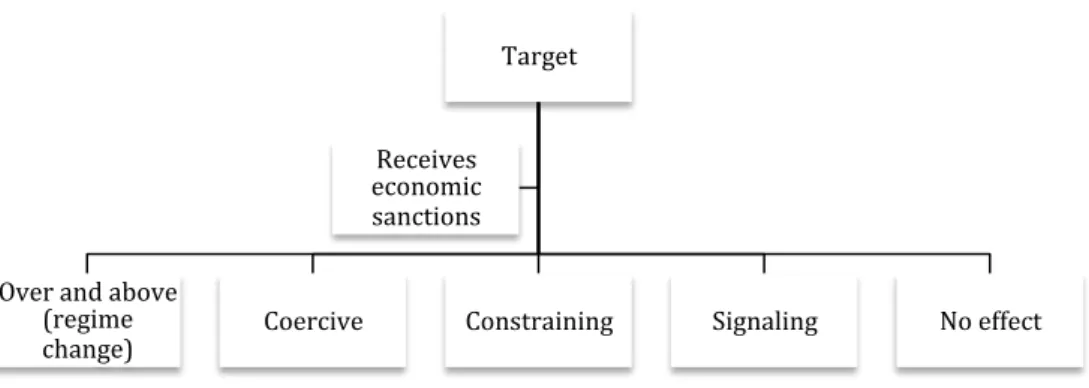
sanctions have no effect whatsoever, or the sanctions go over and above what the sender intended to do. These two factors shall be added (see figure 1).
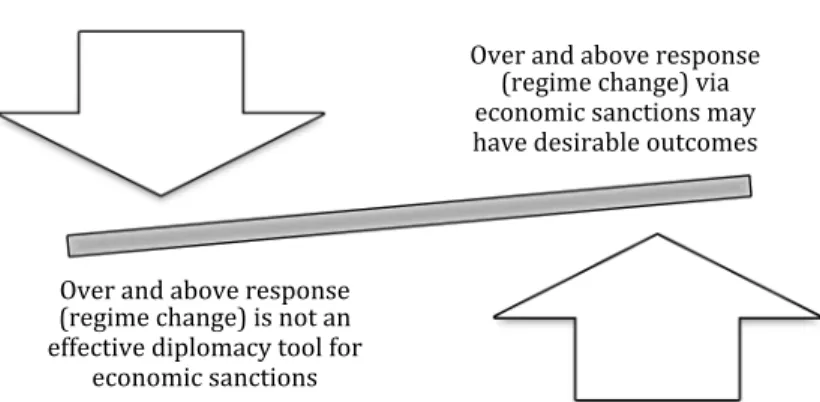
The economic sanctions will be perceived as effective if coercive measures lead to the target state altering its policy. Partially effective would entail the target state to be constrained in its practices. Neither a signaling response or a no-effect response will be considered effective economic sanctions (see figure 2). Over and above is not considered effective nor not effective (see figure 3). Over and above will in all cases mean that the sender state did not have enough control over the economic
Target
Over and above (regime
change) Coercive Constraining Signaling No effect
Receives economic sanctions
sanctions, nor about what happened once they were in place. Although the outcome of over and above may not show negative (less democracy) reactions it is not considered effective economic sanctions because the sender state has not gained the desired outcome, and has lost control.
Figure 2: Ranking the measures of effectiveness of economic sanctions
Independent variable: non-cooperative authoritarian state or a cooperative authoritarian state.
Independent variables (domestic/ target state): budget of the state, level of loyalty to the government, level of repression, and level of opposition. The budget is measured in terms of GDP. The level of opposition is measured by number of opposition, and their acts against the government. Loyalty to the government and level of repression
Effective:
Coercive response
Partially effective:
Constraining
response
Not effective:
Signaling response
No effect
Over and above response (regime change) via economic sanctions may have desirable outcomes
Over and above response (regime change) is not an effective diplomacy tool for
economic sanctions
are secondary independent variables. Loyalty to the government and level of oppression fall under the mechanism opposition.
Independent variables (international/sender states): type of the economic sanctions, commitment of the sender state to the economic sanctions, and level of dependence of the target state. Type of economic sanction is analyzed by economic sanctions that the sender state implements, and whether those sanctions are the proper ones. The
commitment of the sender state is assessed by the actions of the sender state following the sanctions including potential costs and opportunities to keeping the sanctions in place, reinforcing them, or removing them. Finally, dependence of the target state looks at dependence on trade relations, and strategic partnerships with other states.
Hypothesis
The hypothesis for this study is that economic sanctions are more effective in a cooperative authoritarian state. The mechanisms testing the hypothesis are the two domestic independent variables (budget and opposition) and the three international independent variables (type of sanction, commitment, and dependence). All
mechanisms are expected to work together. While they are outlined reported as separate entities, they work together in the effectiveness of the economic sanctions. Mechanisms that impact each other are referred to each other within the text.
This hypothesis is based upon prior research that shows that democratic states are more likely to cooperate when they are under pressure of economic sanctions. The cooperative authoritarian state is likely to show slightly higher levels of
reason for this expectation comes from the expectation that the cooperative
authoritarian state behaves more like a democratic state on an international level than a non-cooperative authoritarian state does (Kim’s argument on high-structural
network power fits into this argument). Due to the international participation of the cooperative authoritarian state it is likely the cooperative authoritarian state is more dependent on the sender states of the sanctions, as well as the sanctions are more likely to negatively impact the target state due to dependence on the sender state. The expectation is that all variables show a more favorable outcome to effectiveness in the cooperative authoritarian state; all except for the commitment mechanism. Commitment will most likely be lower towards the cooperative
authoritarian state: due to generally friendly pre-existing relations between target state and sender state the sender state may even show very few signs of commitment in fear of damaging that generally friendly relation (and benefits that follow that i.e. trade, investments, and military support). All other variables are expected to work along the same lines of prior research, and show that they lead to more effectiveness of
because there are trade and financial relations between the states, and due to the generally open relation between the two states the sender state is able to assess where (which sector of the receiver state) and when (timing argued by Major) will most likely lead to an effective (coercive) outcome. Finally, since the cooperative state is more dependent on the international community, due to its international cooperation, it will be easier for the sender states to use economic sanctions as a coercive tool for change.
Chapter 4: Methodology
4.1 Data collection
The data collection for the proposed theoretical methods comes from academic papers, academic working papers, and scholarly books. The majority of sources were found by using the online library of Leiden University by making use of online research databases such as EBSCO host, JSTOR, and other large databases for academic works. Scholarly books were retrieved through the library of Leiden. Other academic works such as academic papers and academic working papers were
retrieved through the use of Google scholar. The data collection on the variables tested also looks at European Union and United States sanction reports, European Union council decisions, freedom reports within the target country, economic prosperity reports (GDP), and newspaper reports.
Most of the data collection comes from secondary literature, although certain calculations and analysis comes from primary literature. These types of data
collection can be found in parts of the thesis such as the budget and the dependence mechanisms in which factors such as trade and GDP are analyzed.
4.2 Case study selection
The case studies have to consist of two states where economic sanctions were imposed by the European Union and the United States upon one non-cooperative authoritarian state and one cooperative authoritarian state. The consistent factor is the sender. The target state changes by the case study. The methodology for the
Iran as the non-cooperative authoritarian state
As outlined above there will be a small difference in the domestic factors between the non-cooperative authoritarian state and the cooperative authoritarian state, but most differences will be noticeable on the international level.
First, the non-cooperative authoritarian state will show low scores
internationally on indexes such as global innovation, economic freedom, involvement in UN peacekeeping operations, and involvement in international organizations. For global innovation Iran scores low, scoring as number 120 of the 143 (Global
Innovation Index, 2014). Iran’s economic freedom falls into the repressed section and has a low economic freedom index of 43.2 (Miller, Holmes, Feulner, 2013).
In the democracy index Iran scores a 0 on electoral process, 2.86 on functioning of government, 2.78 on political participation, and a 2.5 on political culture2 (Economist Intelligent Unit, 2013).
China as the cooperative authoritarian state
Like Iran, China also has a small proportion of the qualities of a cooperative
authoritarian state that are evident from the domestic factors while the rest is evident from the international factors.
First, it is important that China strives for international cooperation through higher marks on indexes such as global innovation, economic freedom, involvement in UN peacekeeping operations, and involvement in international organizations. First, China scores high on global innovation, 29 out of 143 (Global Innovation Index, 2014). Secondly, in terms of economic freedom China rests in the mostly unfree section under economic freedom, with an economic freedom index of 51.9 (Miller, Holmes, Feulner, 2013). Moderately free to mostly unfree are applicable to the cooperative authoritarian state because it wants to prosper in international business, yet wants to retain certain control over which businesses. Furthermore, China
currently has 172 policemen, 36 military experts, and 1984 numbers in troops, making a total of 2192 (United Nations Peacekeeping, 2014). In 2010 this was 111, 53, 1733 respectively, which made the total of 2044 (United Nations Peacekeeping, 2014). In 2014 China’s contribution is a total of 2.2379% of the world’s contribution to the UN peacekeeping operations. Finally, China is active in 74 international organizations. China’s permanent seat at the UNSC, and its interests in regional blocks that are
2 For the democracy index the Economist Intelligent Unit has been used as a source, and not the
Freedom House. The reason for doing so is that for the type of research conducted in this thesis the Economist Intelligent Unit is a better fit. In the Freedom House analysis both China and Iran are “Not Free” and score low on freedom.
geographically out of China’s location are signs that China is very involved in the international arena and qualifies as the cooperative authoritarian state.
Domestically China might show lower levels of perceived corruption and rule of law, as well as scoring a higher mark on the democratic index (although that mark should still fall under an authoritarian state).
Chapter 5: Economic sanctions and their effectiveness
5.1 Iran
The timeline for the economic sanctions for Iran begins in 1979. In 1979 the economic cooperation between Iran and the United States became minimal Iran started falling into the category of a non-cooperative authoritarian state. Cooperation between Iran and the European Union, on the other hand, has worked relatively well until 2009. Starting in 2009 the European Union enforced increasingly harsher measures upon Iran regarding international cooperation. However, the analysis of the sanctions starts in 2006, as those economic sanctions gave way to the sanctions currently in place, analyzed in this thesis, and gave way to various levels of effectiveness.
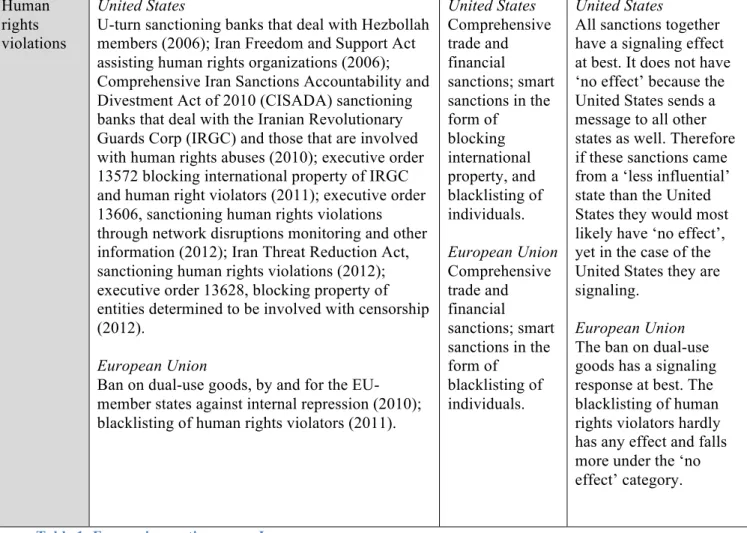
Sanctions to Iran are constantly changing, but of all the sanctions in place the most pressuring ones are issued for non-proliferation purposes and human rights issues. In table 1 the appropriate sanctions against Iran are outlined in terms of sender states, types of sanctions, and the effectiveness thereof 3. Overall the sanctions,
through the mechanisms listed below have caused for a signaling effect (not effective) for human rights purposes, and a constraining effect (partially effective) for the non-proliferation sanctions. The human rights sanctions are only signaling because Iran has been made aware that the human rights violations are not internationally accepted, but human rights are continuously violated (examples of human rights violations are detailed under opposition). The Human Rights Watch reports a surge in death penalties and executions, as well as a stagnation of the freedom of speech (Human Rights Watch, 2014). The non-proliferation sanctions are constraining because Iran
3 Both the United States as the European Union utilize more sanctions against Iran. Noted here are
entered into the Joint Plan of Action to monitor and regulate its nuclear development in turn for some relieving of sanctions (detailed further under type of sanction and commitment). This Plan, allowing for an easement of sanctions in return of controlled and reduced nuclear power, constraints Iran in its nuclear aspirations, but it does not stop it completely.
Behavior receiver state
Economic sanction from sender state Type of sanction Judgment of
effectiveness
Nuclear aspirations
United States
Executive order 13382 sanctioning WMD proliferators (2005); Iranian Sanctions Act (ISA) which sanctions foreign firms for doing business with Iran previously ISLA (2006);
Comprehensive Iran Sanctions Accountability and Divestment Act of 2010 (CISADA) targeting Iran’s energy and financial sectors (2010); executive order 13590 targeting Iran’s oil sector by sanctioning foreign firms that equip Iran with investments in oil, gas, or petroleum sector (2011); US Patriot Act, section 311, limiting Iran’s access to the US financial system (2011); National Defense Authorization Act, sanctioning foreign banks that deal with Iran’s Central Bank (2011); executive order 13599, freezing Iran’s central bank assets abroad (2012); executive order 13622, sanctioning foreign financial institutions purchasing oil, petroleum, petrochemical products from Iran (2012); Iran Threat Reduction Act, sanctioning banks in the energy sector (2012); National Defense Authorization Act sanctioning those who provide help to Iran’s sectors of energy, shipbuilding, shipping, port sectors, and those who provide semi-finished metals (2012); Nuclear Iran Prevention Act, sanctioning the Central Bank of Iran for oil purchases (2013).
European Union
Ban on dual-use goods, by and for the EU-member states to prevent nuclear Iran (2010); SWIFT cut-off (2012); oil embargo, also targeting precious metals and freezing the international assets of Central Bank of Iran (2012); additional sanctions including a ban on natural gas,
exporting sensitive materials to Iran, WMD development, shipbuilding, and oil storage capabilities (2012). United States Comprehensive trade and financial sanctions European Union Comprehensive trade and financial sanctions United States Stand-alone sanctions are hardly effective (such as the United States sanctioning the Iranian Central Bank), yet sanctions that target foreign firms and entities doing business with Iran are moderately effective. Thus, stand-alone sanctions have a signaling effect, while sanctions with another entity have a
constraining effect. Not one sanction in itself is very effective, the combination thereof is.
Human rights violations
United States
U-turn sanctioning banks that deal with Hezbollah members (2006); Iran Freedom and Support Act assisting human rights organizations (2006); Comprehensive Iran Sanctions Accountability and Divestment Act of 2010 (CISADA) sanctioning banks that deal with the Iranian Revolutionary Guards Corp (IRGC) and those that are involved with human rights abuses (2010); executive order 13572 blocking international property of IRGC and human right violators (2011); executive order 13606, sanctioning human rights violations through network disruptions monitoring and other information (2012); Iran Threat Reduction Act, sanctioning human rights violations (2012); executive order 13628, blocking property of entities determined to be involved with censorship (2012).
European Union
Ban on dual-use goods, by and for the EU-member states against internal repression (2010); blacklisting of human rights violators (2011).
United States Comprehensive trade and financial sanctions; smart sanctions in the form of blocking international property, and blacklisting of individuals. European Union Comprehensive trade and financial sanctions; smart sanctions in the form of
blacklisting of individuals.
United States
All sanctions together have a signaling effect at best. It does not have ‘no effect’ because the United States sends a message to all other states as well. Therefore if these sanctions came from a ‘less influential’ state than the United States they would most likely have ‘no effect’, yet in the case of the United States they are signaling.
European Union The ban on dual-use goods has a signaling response at best. The blacklisting of human rights violators hardly has any effect and falls more under the ‘no effect’ category.
Table 1: Economic sanctions upon Iran
5.2 China
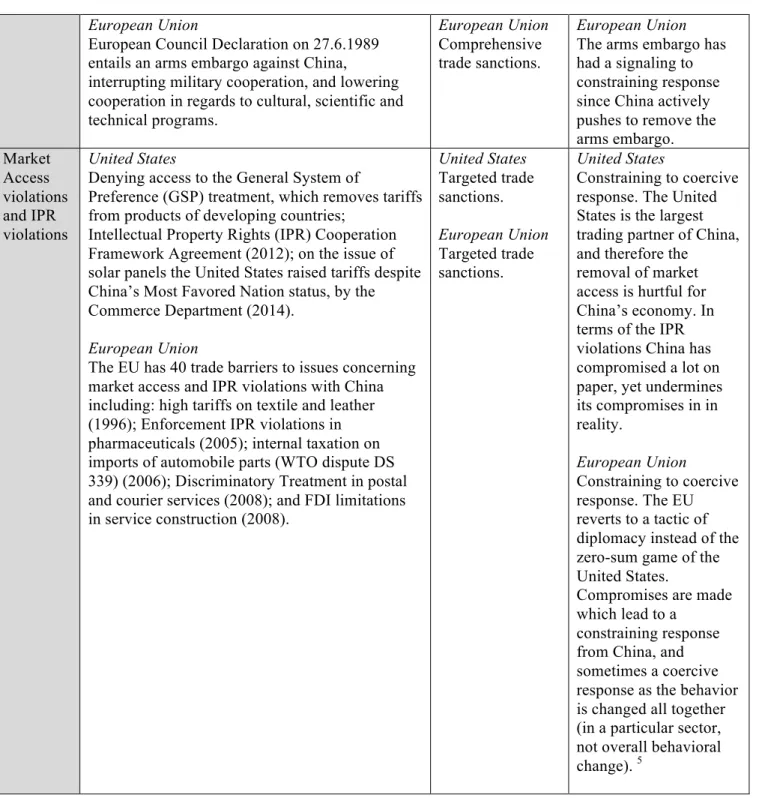
The timeline of sanctions for China begins in 1989 when China could already be classified as a cooperative authoritarian state (it moved into that category in the post Mao area). The economic sanction against China of both parties consists of an arms embargo that was implemented after the events on Tiananmen Square in 1989. In 1997 several European Union states wanted to reconsider this trade sanction in the context of the European Union to normalize relations with China (Spiri, 2014). Although the scope of the sanction has been limited the measure is still in place. In table 2 the appropriate sanctions against China are discussed in terms of sender states, type of sanction, and the effectiveness thereof 4. Overall the sanctions,
4 Throughout the thesis a few market access and intellectual property violations shall be discussed.
through the mechanisms listed below have caused for a signaling to constraining effect (not effective to partially effective) for human rights purposes, and a
constraining to coercive effect (partially effective to effective) for the market access and intellectual property rights (IPR) sanctions. The human rights issue is still as prominent as in 1989, which outlines a signaling effect, yet China actively tries to remove the arms embargo from the European Union (further detailed under
commitment), thus China is constrained in its arms purchases. The market access and IPR sanctions have a constraining to coercive effect. In certain cases these sanctions limit China’s ability to continue with their current behavior, China needs to find new solutions or come to a mutual understanding, or a coercive effect in which China alters its behavior (further detailed throughout the mechanisms of budget, type of sanction, commitment, and dependence).
Behavior receiver state
Economic sanction from sender state Type of sanction Judgment of
effectiveness
Human rights violations
United States
Tiananmen Square economic sanctions that fall under Arms Export Control Act, which
established public notice 1109 (ban on munitions export), and amendment 126:1 to the International Traffic in Arms Regulations government
regulations which imposes an arms embargo including denying licenses of exports and imports of defense articles and defense services (starting in 1989 after the Tiananmen Square incidents); the Consolidated Appropriations Act
post-Tiananmen Square entail that U.S. representatives have to vote “no” or abstain in international institutions when it comes to China (except for those that meet basic human needs); also under the Consolidated Appropriations Act the funding from the United States into the United Nations Population Fund (UNFPA) may not be used for a country program in China.
United States Comprehensive trade and financial sanctions. United States
Signaling effect only. The trade sanctions have signaled their intentions, but have not stopped or limited China’s
behavior. China has historically not been dependent on the United States to provide them with arms, and there is little effect to these sanctions. The financial sanctions have had a signaling effect as well, but also have not stopped or limited China’s behavior.
http://www.wto.org/english/tratop_e/dispu_e/dispu_by_country_e.htm. and
European Union
European Council Declaration on 27.6.1989 entails an arms embargo against China,
interrupting military cooperation, and lowering cooperation in regards to cultural, scientific and technical programs.
European Union Comprehensive trade sanctions.
European Union The arms embargo has had a signaling to constraining response since China actively pushes to remove the arms embargo. Market Access violations and IPR violations United States
Denying access to the General System of
Preference (GSP) treatment, which removes tariffs from products of developing countries;
Intellectual Property Rights (IPR) Cooperation Framework Agreement (2012); on the issue of solar panels the United States raised tariffs despite China’s Most Favored Nation status, by the Commerce Department (2014).
European Union
The EU has 40 trade barriers to issues concerning market access and IPR violations with China including: high tariffs on textile and leather (1996); Enforcement IPR violations in pharmaceuticals (2005); internal taxation on imports of automobile parts (WTO dispute DS 339) (2006); Discriminatory Treatment in postal and courier services (2008); and FDI limitations in service construction (2008).
United States Targeted trade sanctions. European Union Targeted trade sanctions. United States
Constraining to coercive response. The United States is the largest trading partner of China, and therefore the
removal of market access is hurtful for China’s economy. In terms of the IPR violations China has compromised a lot on paper, yet undermines its compromises in in reality.
European Union
Constraining to coercive response. The EU reverts to a tactic of diplomacy instead of the zero-sum game of the United States.
Compromises are made which lead to a
constraining response from China, and sometimes a coercive response as the behavior is changed all together (in a particular sector, not overall behavioral change). 5
Table 2: Economic sanctions upon China
5 Discussed above are the primary sanctions upon Iran and China, not the only sanctions. Sanctions
Chapter 6: Domestic factors: budget and opposition
6.1 Budget
Theory on economic sanctions states that the budget of a state is an important aspect to consider in the effectiveness of economic sanctions; if the economy of a state is impacted by sanctions the government will feel pressured to take action to remove such sanction. The cooperative authoritarian state thrives on the international trade, and will have plenty trading partners and strategic economic alliances among the sender states. The cooperative authoritarian state will not want to risk those partnerships and alliances in a potential economic sanction dispute. Thus, in the cooperative authoritarian regime one expects a quick impact in the budget when sanctions are imposed, and a quick response to solve the issue from the target state. Expected is that the non-cooperative authoritarian state is able to withstand sanctions longer because its budget is not impacted as much; expected is fewer trade relations with the sender states. The economic sanctions may even cause a ‘rally around the flag’ behavior in its citizens if the budget is affected, but the government finds a way to turn it to their advantage. Theory then suggests that the non-cooperative
authoritarian regime will face less financial damage due to the economic sanctions, thus faces fewer reasons to comply. To award effectiveness to the economic sanctions the budget of the target state should be impacted by the sanction in the following five years6.
6.1.1 Iran
Prior to the oil embargo of the European Union the budget of Iran has historically not been impacted by the economic sanctions that have been placed upon the state. In fact
6 Ideally the budget should be impacted much sooner, but theory shows that the first round of sanctions
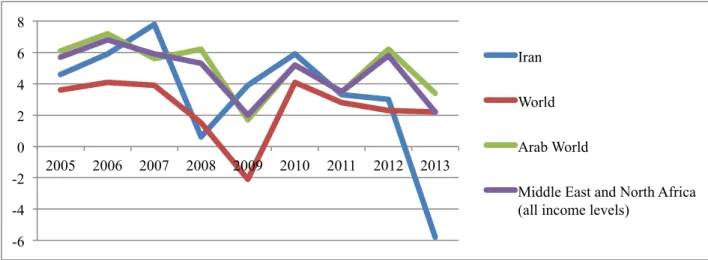
Iran, until recently, has been a rather profitable state. However, when one looks at Iran’s GDP growth at the moment it currently experiences a negative GDP growth: -5.8% (Worldbank, 2014). Since 2010 sanctions on Iran are targeting “Iran’s ability to sell crude oil on the world market, to import refined petroleum products, and make it more difficult for Iran’s Central Bank and other financial institutions to engage in transactions abroad” (Belfer Center, 2014). It seems that has had an impact on Iran’s GDP growth, and overall budget of the state. A further discussion on the impact of the oil embargo and its effectiveness on GDP growth and GDP per capita is needed, including a review of public opinion on the sanctions and its impact, and a short discussion on the lack of impact of human rights sanctions on the budget.
First, as figure 1 shows the oil embargo has had a large impact on the budget of Iran. The economy of Iran is heavily dependent on the oil sector; “crude oil account for nearly 80% of Iran’s total exports, and oil exports are approximately half of the government’s income” (Barkhordar, Saboohi, 2013). In the period from 2002 to 2008 the average oil price grew four times its original price, and therefore oil
GDP per capita figures, in figure 5, shows the same downwards trend after 2011.
Inflation has also risen severely since 2010 (Arab Times, 2014). In 2013 inflation was approximately 30% and unemployment around 20% (Bowers, 2013). Although in 2013 domestic practices of a “convoluted multiple-exchange-rate regime and suppression of currency trading” helped to avoid a repetition of the spiral hyperinflation of 2012 (Hanke, 2014).
Figure 4: GDP growth Iran comparative
Formulated from figures of the Worldbank, 2014
-6 -4 -2 0 2 4 6 8
2005 2006 2007 2008 2009 2010 2011 2012 2013
Iran World Arab World
Middle East and North Africa (all income levels)
0 1000 2000 3000 4000 5000 6000 7000 8000
2005 2006 2007 2008 2009 2010 2011 2012 2013
Figure 5: GDP per capita Iran. Figures in US Dollars
Secondly, this type of economic sanctions affects the government, as the budget of the state declines, yet it also affects the general population. Contrary to smart sanctions comprehensive sanctions are most likely to negatively affect the general population in a much larger capacity than it negatively affects the
government. In 2011, the upper classes regarded the economic sanctions to have the least negative impact on economy, whereas the most poor regarded the sanctions as most negatively (Elson, Nader, 2011). In 2011 most Iranian’s wanted to see a continuation of the nuclear program. Interestingly enough, this has not changed in 2013. In 2013 85% of Iranians claim that the economic sanctions have negatively affected their livelihood, and for 50% the economic sanctions have impacted them very negatively (Loschky, 2013). However, when asked who was to blame for the crippling economic sanctions most of them (46%) answered the United States, a mere 13% blamed the Iranian government, and an even lower amount (6%) faulted the Western European states and the United Nations (Loschky, 2013). However, a total 96% argued that Iran being a nuclear power is worth enduring economic sanctions (somewhat agree or fully agree) (Zogby Research, 2013). Thus, what can be concluded from these polls is a form of ‘rally around the flag’ concept. The Iranian population agrees that Iran should be able to be a nuclear power, despite the pain it has caused the budget. Blame is focused on the sender states, not the potential wrongdoings of the government.
The human rights sanctions have not had an impact on the budget of Iran. It is possible that some entities (via blacklisting) have felt the negative consequences of the human rights sanctions, but the overall budget of the state has not diminished due to these sanctions. Logically blacklisting, and financial sanctions against
In short, the budget of Iran has been negatively affected by the economic sanctions. However, nationalism and overall prestige has taken the upper hand even for those directly economically affected, to endure the economic sanctions in favor of continuing the nuclear aspirations. The general population is less likely to
demonstrate this ‘rally around the flag’ idea in regards to human rights and
democratization. However, in terms of human rights and democratization the sender states have economic sanctions in place that are far less crippling to the economy (see type of sanction).
6.1.2 China
In China the 1989 sanctions have not had an impact on the budget of the state during following decades. The arms embargo limits China’s abilities to purchase goods that may be used in producing arms, yet China can obtain arms from Russia. Market access and IPR sanctions could affect the budget, but they do not either. The trend that China’s budget is not affected by the economic sanctions can be traced through GDP growth historically, and contemporary.
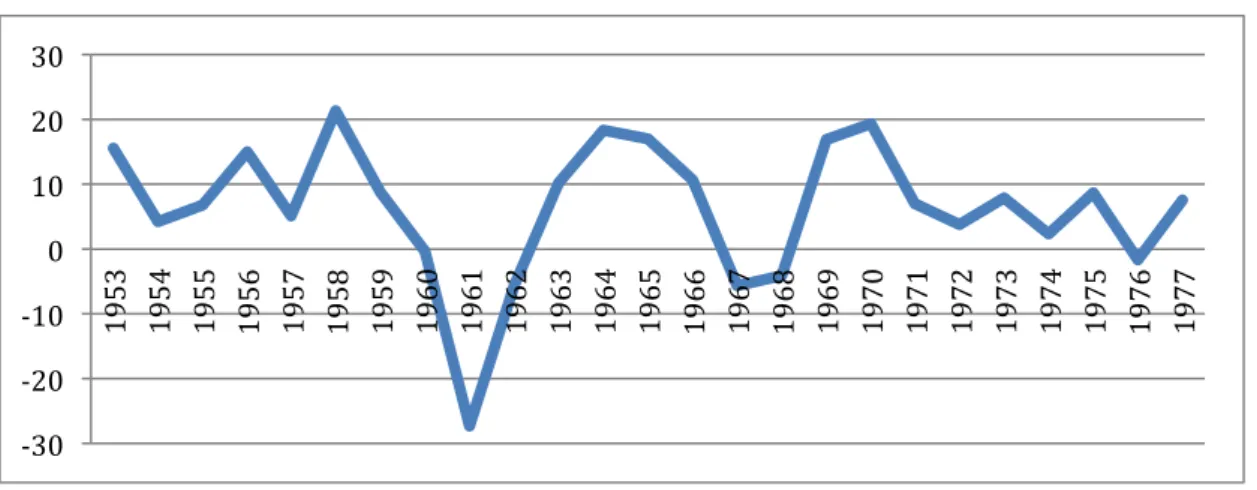
First, as seen in figure 6 GDP growth in China is historically a volatile
practice. China’s volatile GDP growth started to become relatively stable since 1996 (Askari et all, 2003). The volatility of the GDP growth in China does not come from
-‐30 -‐20 -‐10 0 10 20 30
1953 1954 1955 1956 1957 1958 1959 1960 1961 1962 1963 1964 1965 1966 1967 1968 1969 1970 1971 1972 1973 1974 1975 1976 1977
an impact of the economic sanctions; to assess this a closer look at the year 1961, 1967, and 1976 is needed. In 1961 the United States used an all-encompassing embargo against China, and the communist block. In 1960 the United States had a total of 193.4 million USD in exports to the communist block; 143.1 million to Poland, 39 million to Russia, and 3.9 to East Germany (CIA, 1961). Therefore, the economic sanctions of the United States against China were well in force in 1961. However, due to the strong ties with the communist block it is most likely that China’s sudden drop in GDP growth came from other factors than the economic sanctions of the United States. Domestically, in 1961, China has implemented the Great Leap Forward, which came to a drastic end in 1961. The best explanation for the sudden drop in GDP growth therefore is not the economic sanctions by the United States, but rather the domestic policy of the Great Leap forward combined with famine, and drought in 1961. In 1967 the drop was due to another domestic practice: the Cultural Revolution, and in 1976 Mao had died and his successor Deng Xiaoping was to revolutionize China by the Four Modernizations. Historically economic sanctions had no effect on the budget of the state, trade was conducted with other nations, and a negative GDP growth was due to domestic practices.
GDP per capita, in figure 8, shows the correlating positive view of growth.
The human rights sanctions appear not to have an impact on the budget of the government. The market access and IPR sanctions also do not appear to have an impact on the budget of the state, but it does have an effect. A contemporary example is the high tariffs placed on the Chinese solar power cells. This sanction of the United States has diminished sales, and thereby revenue, for several Chinese companies (Goldpinath and Gold, 2014). Although the NPD Solarbuzz market research group argues that the decline in Chinese solar panels is exaggerated: via outsourcing the Figure 7: GDP growth China comparative
Formulated from figures from the Worldbank, 2014
-3 -1 1 3 5 7 9 11 13 15
2005 2006 2007 2008 2009 2010 2011 2012 2013
China World
East Asia & Pacific (all income levels
0 1000 2000 3000 4000 5000 6000 7000 8000
2005 2006 2007 2008 2009 2010 2011 2012 2013
Figure 8: GDP per capita China Figures in US Dollars
diminished group of Chinese companies are listing record numbers of sales (NPD Group, 2014). It appears that the market access and IPR sanctions do not greatly impact the budget of the state either due to solutions found by China, or via mutual compromises (further detailed under the mechanism commitment)
In short, the economic sanctions have not substantially impacted the GDP growth and GDP per capita of China. Domestic policies of China have had a more significant impact. An explanation for this occurrence is China’s international
cooperation. It was not until the 1980s that China became a state that can be classified as a cooperative authoritarian state. Prior to the 1980s China relied mostly on its domestic production of goods and on the help of the communist block. The United States’ embargo led to more international isolation for China, yet it meant that China relied more on its allies in East Europe and Russia (Askari et all, 2003). It was not until the 1980s when China became the cooperative authoritarian state, with more international relations and partnerships, but also with fewer ‘harsh’ economic sanctions imposed on them.
The mechanism of budget does not show the causal relationship to the theory as it was expected in the cooperative authoritarian state. In China the budget is hardly impacted by the economic sanctions, except for the occasional market access or intellectual property violation that causes for fewer exports and revenue to the government. As will be detailed under the international headings, these market access violations may pressure China in to alter its behavior as it can damage China’s exports (therefore its budget). These issues are often quickly resolved. Therefore, while the mechanism of budget appears to not have an impact on the effectiveness of economic sanctions in China, the threat of it may have an impact (more on this in the international
the literature; it pressures the government for changes. Mostly the general population is affected: the rich are least affected by the sanctions, and the poor the most. Yet, by keeping the sanctions in place eventually the government felt its severity as well.
6.2 Opposition
Economic sanction theory also suggests that opposition plays an important role in the effectiveness of economic sanctions. Unlike prior theory the factors of repression and loyalty to the government in place shall be taken into account with the opposition instead of analyzed separately; as they not truly separate. The opposition as a variable to analyze the effectiveness of the economic sanctions is, according to Wallensteen (2000), one of the two important factors of the “dual grip solution”. The cooperative authoritarian regime has more international influences operating within the state as well as international influences operating upon its citizens. The international influences are likely to be of influence upon the opposition to the government in a cooperative authoritarian regime. It may be possible that the cooperative authoritarian regime allows for some controlled opposition to show its international partners it is not completely anti-democratic. Expected is that opposition to the government is more likely to play a role in the cooperative authoritarian state than in the non-cooperative authoritarian state. For the mechanism of opposition to contribute to the effectiveness of economic sanction the opposition parties should respond to the economic sanctions within a year of the sanctions7.
7 This is a rather broad time frame, but certain sanctions are increased over time, while others
6.2.1 Iran
Iran’s major factions in domestic politics can be classified into three groups: conservatives, reformists, and radicals (Clarke, 2013). The conservatives seek stability in the region, and want to preserve the current regime (Clarke, 2013). The reformists seek to improve Iran’s relations with the region, while also seeking to improve relations with Europe and the United Sates (Clarke, 2013). The radicals, including former president Mahmoud Ahmadinejad, are in favor of nuclear power, and have ties to the Revolutionary Guard Corps, which “has led to an alignment of the conservatives and the reformists against the radicals” (Clarke, 2013).
In Iran there is a link between the opposition and their help with effective non-proliferation economic sanctions. In 2013 Iran’s elections showed a victory for the reformist Rouhani. Rouhani pledged to ease the non-proliferation sanctions (BBC, 2013). On November 23rd of 2013 a deal was constructed between the P5 +1 (the United States, the United Kingdom, China, Russia, France, and Germany) and Iran (ADL, 2014). Iran would “put severe restrictions on its nuclear program” (including inspections from IAEA), while the P5+1 agreed to “suspend sanctions on
petrochemical exports, trade in gold and precious metals…” as well as not imposing new sanctions (ADL, 2014). Therefore, what seemed impossible before the elections, was possible with a shift in domestic politics. What the results are in actual figures in regards to the nuclear development in Iran remains to be seen, yet a first agreement has been made possible. Despite this relative success the ongoing human rights violations in Iran have made the opposition rather an unfair practice: during
The main opposition party (between 5000 and 10000 members) is the National Council of Resistance, or MEK, which has a past linked with terrorism (in 2012 Hillary Clinton removed them from the FTO list). Under the leadership of Maryan Rajavi it argues that Iran is “spreading radical fundamentalism by attaining nuclear weapons for the purpose of eliminating opponents” (Al Arabiya, 2014). This
standpoint is interesting because the party usually concerns itself with human rights issues, women issues, and an integration of Iran into the global community (Masters, 2014). The party even condemns the sender states of economic sanctions for their inability to note the human rights violations, but rather their focus on the nuclear proliferation of Iran (Lord Carlile of Berriew, 2014). Yet, now the deal has been brokered with the sender states in regards to the nuclear proliferation of Iran, the focus for the opposition groups seems to be more on nuclear Iran as well. There is some fear with the government of Iran in regards to this party. There is a fear that they are seeking youth support by targeting students (Lord Carlile of Berriew, 2014). However, most of the party members in Iran are locked up, and most of the party members that are not currently detained are abroad.
to riot the youth to turn against them.
The role of opposition seems to have some effect in Iran on the nuclear proliferation issue. It is important to distinguish between the human rights issues and the nuclear proliferation issue. The criteria of opposition seems to have a link with non-proliferation measures; opposition is aware that they can mobilize youth, the government fears that connection, and a new president of Iran brokers a deal for an easement of economic sanctions. However, the National Council of Resistance is also heavily focused on human rights issues, yet as they are not faced with harsh economic sanctions the new president of Iran has not (yet) made an agreement for those. Thus, while there is a link between opposition and the effectiveness of the economic sanctions in Iran, it is most likely not the strongest mechanism to facilitate the effectiveness economic sanctions.
6.2.2 China
In contrast to theoretical expectations, opposition does not play a substantial role in the effectiveness of economic sanctions in China. The lack of effectiveness is a result of the absence of a significant opposition in China. The lack of this type of opposition is easily traced through a historical approach to opposition, the contemporary
approach, and the levels of repression that make opposition nearly impossible. First, historically China has seen some opposition movements, which were staged or had no real power. Prior to China’s status as a cooperative authoritarian state, pre-1970s, there were several interest organizations that the general population could join such as the Women’s Federation, the Peasant Association, and the
the Cultural Revolution of 1966 – 1969, and both were heavily encouraged by Mao Zedong (Chan, 2013, p.132). However, true opposition to the regime was not seen since 1949 when Mao Zedong’s party took office.
Second, contemporary China experiences a lot of resistance, from 8700 cases of resistance in 1993 to 10 times that amount in 2005 (87000) (Cai, 2008). In 2003 there was a total of 3900 incidents involving an attack on the state itself (Cai, 2008). When there is a case of resistance the regime has four different options to respond: concessions, concessions with discipline, repression, or tolerance. In a case study of 78 resistance issues against the state repression was the one most opted for (54 times), 10 times concessions, 10 times concessions with discipline, and only in 4 cases did the Chinese government opt for tolerance (Cai, 2008). In these cases punishment was “sought after for a total of 584 citizens: 308 were detained, 21 arrested, and 255 were sentenced to jail” (Cai, 2008). Interestingly it is mostly the local government that acts upon these forms of resistance with the help of the central government at times. China is heavily decentralized, yet leaders in lower forms of government are appointed by the high-level officials of the central government which allows for isolation in the resistance movements, does not directly challenge the central government, and it is often of short-term (Cai, 2008).
organized into an interest group or a political party that can function as an opposition, nor does the resistance last long.
Third, it is difficult for opposition to arise in China because repression is common as one of the two central objectives for the regime; economic growth, and the repression of pro-democratic forces (Pei, 2014). An example of such a repression is the arrest of Cao Haibo who was charged with violations of Chinese law and sentenced to 8 years in prison in 2012 for starting a pro-democratic movement. Cao Haibo had tried to create a pro-democratic party called the "China Republican Party”, which had only been in existence one day when he was arrested (NBCnews, 2012). Bo Xilai, a political leader who in the past had a chance to rise through the ranks, was given a show trial and sentenced to life imprisonment (Human Rights Watch, 2014). Another example is Xu Zhiyong, the intellectual leader of the New Citizens
Movement (civil rights activists that call on public officials to disclose their assets) who was detained as well (Human Rights Watch, 2014). Repression also finds its way into other aspects in China such as the curtailing freedom of information via the media and the internet. The Xi Jinping administration issued harsher restrictions on dissent: including two legal documents which allow for easier processing of criminal charges against activists and Internet critics (Human Rights Watch, 2014).
Interestingly enough the theory of economic sanctions, again, appears not to have a strong hold in the cooperative authoritarian state. Opposition is able to rise in Iran, yet in China it is subdued quickly. China has more repression and less opposition to the government. It could easily be tied into the budget factor: in China the general population is much less affected by economic sanctions. The general population hardly faces any consequences from the arms embargo and only certain employees and entities occasionally ‘feel the sting’ of from the market access and IPR violations. However, the resistance to the government does show that the general population in China is concerned with the human rights status in their state. The sanctions could tie into this form of opposition and facilitate opposition in terms of human rights
concerns. Yet, the sanctions are not enhanced, not altered, nor diminished. Neither sender party utilizes the possibility of the opposition (more on the lack of
enhancement of the sanctions in the international mechanisms). In this cooperative authoritarian state the domestic mechanisms have very little impact on the
effectiveness of economic sanctions. Similarly to the mechanism of budget Iran follows the theory: opposition plays a part in the effectiveness of sanctions. The dual-grip solution seems to be working in Iran: external pressure on the budget from the sender states, and internal pressure from opposition (the new stance on the policy via the new Iranian president, and via the fear of opposition parties’ influence).
Chapter 7: International factors: type of sanctions, commitment, and dependence
7.1 Type of sanctions
Hufbauer, Schott, Elliott, and Oegg (2007) point out that smart sanctions could work in any authoritarian state because they specifically target a group or a leader.
However, it is usually more difficult to find information on where to target non-cooperative authoritarian states because there are fewer international relations, making sender states less aware of specific information on the government and its partners, which is needed to implement smart sanctions. If the sender state
implements economic sanctions without sufficient information on the target state it will be a guess which economic sanction will have an impact on the target state. Therefore, the economic sanctions will most likely be less effective in the non-cooperative authoritarian regime because it is more difficult to assess which types of sanctions will warrant the target state to comply and alter its policy. Moreover, it will also be more difficult to find suitable areas that the sender state may target to elicit behavioral change as it will have fewer relations with the non-cooperative
authoritarian state. Furthermore, it is also important to look at the timing of the economic sanctions as Major has pointed out (Major, 2012). The sender states are not only required to assess the right type of sanction, but also the right timing of that sanction. It will be more difficult to assess both the type of sanction needed and the timing of the sanction regarding the non-cooperative authoritarian state. The time frame for assessing whether the type of sanction has the desired outcomes should be five years8.
8 Within five years the sanction should have some effect, at least partially effective, otherwise it is
7.1.1 Iran
The type of sanction in Iran has been difficult to assess; the United States and the European Union have tried many different economic sanctions that did not result in the behavioral change they were intended to provoke. The United States has almost completely banned all relations with Iran. The following paragraphs will assess the unilateral sanctions from the United States, and the multilateral sanctions from the European Union (and in partnership with the United States).
Unilateral sanctions are sanctions that are imposed upon one country by a single other, in this case on Iran by the United States. However, as has been discussed in table 1 unilateral sanctions from the United States have generally not been
effective. In 1987 the United States banned all imports of Iranian goods, and exports to Iran is severely limited (Belfer, 2014). The amount of sanctions the United States has imposed on Iran have limited the state’s striking force because any further sanctions will not have much effect to the already nearly non-existent trade between the two countries. One interesting form of sanctions that the United States has imposed is ISA (the Iranian Sanctions Act).
ISA targets Iran’s non-proliferation issue and is very controversial in many other states because it authorizes penalties against foreign firms that engage in certain trade with Iran (Katzman, 2010). The majority of objections come from parent
States is a negative mark against a company and does more harm than good.
However, a major flaw in ISA is that it only constrains investments in Iran, not trade with Iran, and therefore many transactions which are the main target of ISA’s policy remain unscathed. Thus, ISA would appear not to be very effective. However, in 2008 the Iranian deputy Oil Minister said that Iran needed approximately 145 billion USD in new investment over the next 10 years in order to maintain its thriving energy sector (Katzman, 2010). ISA is party responsible for a lack of investments in Iran. Additionally, in regards to the United States’ non-proliferation sanctions against Iran it utilizes the measure of targeting Russia for assisting Iran with its nuclear and ballistic missiles programs (Katzman, 2010). The United States has withheld 60% of any United States assistance to Russia unless it terminated the program (Katzman, 2010). It makes sense that the United States seeks these types of measures, since nuclear help to Iran will not come from the United States nor from the European Union. Iran will look at other partners for this type of assistance. The United States in return tries to isolate Iran by sanctioning any state that is willing to help Iran.
Finally, the only unilateral sanction from the United States that could still directly affect Iran as a unilateral sanction, is a smart sanction that is targeted directly at an individual or a firm; most likely those close to the government. This type of sanction is used for both human rights violations and non-proliferation issues with Iran (see table 1). Smart sanctions are regarded as very promising since it directly impacts the government. However, in the United States’ case it is not very promising because it is not an appropriate ‘punishment’. The United States uses smart sanctions to limit individuals’ access to the United States or have their assets abroad frozen9.
The reason why this is not very effective is that these are usually entities that already
have very little business in the United States, and are not likely to visit the United States.
In regards to multilateral sanctions there is a difference between trade
sanctions and financial sanctions. The trade sanctions are outlined as European trade sanctions, whereas the financial sanctions shall be outlined as an initiative from the United States, which has spread throughout the world.
First, the trade sanctions from the European Union are exactly the right type of sanction to warrant a coercive policy for Iran’s non-proliferation issue. The oil
embargo of the European Union was a harsh economic sanction for Iran’s budget. The European Union was able to target Iran where it would be felt the hardest, their main export and source of income, oil. Although some critics argue that the European Union lacks in implementing sanctions because it only has jurisdiction over its member states and not all companies listed in Europe as well as the European union not having enough resources to audit behavior and enforce actions (Jacobson, 2008). On the latter argument against effective European sanctions the amount of resources differ to track and enforce actions; Germany has much more resources on tracking down violations to Italy for instance (Jacobson, 2008). Therefore the European Union has chosen the correct type of sanction, it has hit Iran in its most vulnerable industry, yet the European Union itself may not be the best sender for these sanctions.
Second, the United States Under Secretary of the Treasury, Stuart Levey, has been targeting foreign banks to stop dealing with Iran for its proliferation issues (Katzman, 2010). This sanction includes a clause that requires the United States to vote against all international loans to Iran. As a result the IMF, among other