Ovariectomy results in inbred strain-specific increases in
anxiety-like behavior in mice
Sarah Adams Schoenrock1,2,*, Daniel Oreper1,*, Nancy Young3, Robin Betsch Ervin3, Molly
A. Bogue4, William Valdar1, and Lisa M. Tarantino1,5,‡
1Department of Genetics, School of Medicine, University of North Carolina, Chapel Hill, NC
2Neurobiology Curriculum, School of Medicine, University of North Carolina, Chapel Hill, NC
3Department of Psychiatry, School of Medicine, University of North Carolina, Chapel Hill, NC
4The Jackson Laboratory, Bar Harbor, Maine
5Division of Pharmacotherapy and Experimental Therapeutics, Eshelman School of Pharmacy,
University of North Carolina, Chapel Hill, NC
Abstract
Women are at an increased risk for developing affective disorders during times of hormonal flux, including menopause when the ovaries cease production of estrogen. However, while all women undergo menopause, not all develop an affective disorder. Increased vulnerability can result from genetic predisposition, environmental factors and gene by environment interactions.
In order to investigate interactions between genetic background and estrogen depletion, we performed bilateral ovariectomy, a surgical procedure that results in estrogen depletion and is thought to model the post-menopausal state, in a genetically defined panel of 37 inbred mouse strains. Seventeen days post-ovariectomy, we assessed behavior in two standard rodent assays of anxiety- and depressive-like behavior, the open field and forced swim tests.
We detected a significant interaction between ovariectomy and genetic background on anxiety-like behavior in the open field. No strain specific effects of ovariectomy were observed in the forced swim assay. However, we did observe significant strain effects for all behaviors in both the open field and forced swim tests.
This study is the largest to date to look at the effects of ovariectomy on behavior and provides evidence that ovariectomy interacts with genetic background to alter anxiety-like behavior in an animal model of menopause.
‡Corresponding author Department of Genetics, University of North Carolina, 120 Mason Farm Road, CB7361, Chapel Hill NC 27516, Phone: 919-843-7292, [email protected].
*Denotes joint first authorship
HHS Public Access
Author manuscript
Physiol Behav
. Author manuscript; available in PMC 2017 December 01. Published in final edited form as:Physiol Behav. 2016 December 01; 167: 404–412. doi:10.1016/j.physbeh.2016.09.026.
A
uthor Man
uscr
ipt
A
uthor Man
uscr
ipt
A
uthor Man
uscr
ipt
A
uthor Man
uscr
Keywords
ovariectomy; anxiety; depression; inbred mouse strains; menopause; estrogen depletion
1.0 INTRODUCTION
The lifetime prevalence of having at least one major depressive episode for women is 22%; almost twice the incidence observed in men [1]. Women are also at a significantly increased lifetime risk for developing generalized anxiety disorders compared to men [1].
Furthermore, it has been shown that women, in particular, are at an elevated risk for affective disorders such as depression and anxiety during stages of life marked by drastic fluctuations in endogenous estrogen levels – at the onset of menses, during the perinatal and postpartum period and at menopause [2, 3].
During menopause, the ovaries stop production of estrogen, resulting in a decline in
circulating estrogen levels [4]. While all women undergo menopause, not all will experience changes in mood. The risk of experiencing disturbances in mood during menopause has been estimated to be as high as 47% for natural menopause and 38% for surgical menopause [5]. Many factors lead to increased vulnerability during this sensitive time including genetic predisposition, environmental factors and complex interactions between the two.
Disentangling the effects of genetics and the environment on increased risk for mood disorders in the human population has been hampered by the complexity of human
neuropsychiatric diseases, considerable environmental variability, lack of access to relevant (brain) tissue and ethical barriers inherent in human studies. Therefore, a tractable
experimental model is necessary to move this research forward.
Inbred mice have been used for many years to model complex human diseases [6]. As an experimental population, inbred mouse strains offer many advantages: 1) fixed
homozygosity resulting in a stable genetic reference population, 2) availability of full sequence data for many inbred strains, 3) substantial genetic and phenotypic variation across strains and 4) the ability to control or manipulate environmental variables on a fixed genetic background to study challenges such as ovariectomy (OVX) [7].
One commonly used rodent model of estrogen depletion includes bilateral removal of the ovaries, or OVX, resulting in a decline in circulating estrogen levels mimicking human menopause and postmenopausal periods [8, 9]. Previous studies have shown that OVX in rodents results in increased anxiety [9, 10] and depressive-like behavior [8, 9, 11-14] and estrogen replacement reverses these effects [8, 12, 14-16]. Strain-specific differences in OVX-induced behavioral changes in animal models of anxiety and depression have also been observed [11] and highlight the usefulness of examining differences across inbred strains to assess the effects of genetic background on behavioral responses to OVX.
Inbred strain surveys are a useful first step toward understanding the genetic architecture of complex traits and determining the extent to which genetic background contributes to phenotypic variance. We assessed the effect of OVX on anxiety- and depressive-like behaviors in 37 genetically diverse inbred mouse strains. We identified significant strain
A
uthor Man
uscr
ipt
A
uthor Man
uscr
ipt
A
uthor Man
uscr
ipt
A
uthor Man
uscr
effects for all behaviors, and effects of OVX on locomotion, exploratory and anxiety-like behavior in the open field and percent immobility in the forced swim test. This is the largest study to date that assesses the effects of OVX on anxiety- and depressive-like behavior in a wide range of inbred mouse strains. It is also the largest reported strain survey of depressive-like behavior in the forced swim test. These data provide evidence for the role of genetic background interacting with OVX to affect anxiety-like behavior and may provide a means to begin to assess genetic influences on the vulnerability to develop an affective disorder during the postmenopausal period. Moreover, these data also provide a starting point by which to study the underlying genetics of both depression- and anxiety-related behaviors in a rodent model.
2.0 METHODS AND MATERIALS
2.1 Animals
Female mice from 37 inbred strains were purchased from The Jackson Laboratory (Bar Harbor, Maine) and transported to the University of North Carolina (UNC) at 5-7 weeks of age. Mice were housed 3-5 to a cage by strain and maintained on a 12-hour light-dark cycle (lights on at 7:00 A.M.). Food (Pico rodent chow 20; Purina, St. Louis, MO, USA) and water were provided ad libitum. Mice were allowed to acclimate to the facility for at least one week prior to surgery.
All procedures were approved by the UNC Institutional Animal Care and Use Committee and followed the guidelines set forth by the National Institutes of Health (NIH) Guide for the Care and Use of Laboratory Animals.
2.2 Ovariectomy and sham surgeries
Animals were anesthetized with a 1.2% solution of tribromoethanol (Sigma-Aldrich, St. Louis, MO) administered by intraperitoneal injection at a dose of 125-250 mg/kg. A dorsal midline incision was made in the skin caudal to the posterior border of the ribs. An incision was made in the muscle and the fat pad located just beneath the muscles was pulled out to expose the ovary. The fallopian tube was clamped off, the ovary removed and muscle and skin were sutured (Med Rep Express, Prescott, AZ). This process was performed bilaterally. Buprenorphine HCl (Patterson Veterinary, Devens, MA) was administered subcutaneously at a dose of 0.05 mg/kg of body weight after surgery and as needed during the recovery period. Animals recovered for 17 days prior to behavioral testing. Verification of a complete bilateral OVX was performed at the conclusion of the study by dissection. The procedure for the sham surgery mice (SHAM) was identical to OVX excluding clamping and tying off the fallopian tube and removal of the ovary.
2.3 Behavioral study design
Behavioral testing occurred 17 days after OVX surgery based on evidence from the literature showing behavioral effects in inbred mice at this post-surgical interval [11]. Mice were a mean age of 78 days (± 7 days standard deviation) at the onset of testing. All behavioral testing was performed during the light part of the light/dark cycle between 8:00 A.M. and 12:00 P.M. The open field assay was performed first, followed two days later by the forced
A
uthor Man
uscr
ipt
A
uthor Man
uscr
ipt
A
uthor Man
uscr
ipt
A
uthor Man
uscr
swim test. Mice were tested in 46 different batches over 2 years. Each batch contained multiple strains and no single strain was tested in only one batch. The average number of mice tested per strain in the open field was 9 (range 5-20) for both SHAM and OVX mice. The average number of mice tested per strain in the forced swim test was 8 (range 5-17) for both SHAM and OVX. Numbers of mice tested individually by strain are listed in
Supplemental Tables 1-2 for open field and forced swim respectively. C57BL/6J mice are overrepresented as they served as an ongoing control group across the entirety of the experiment. Other strains varied in number due to their availability from the Jackson Laboratory within the timeframe of the project.
2.4 Behavioral testing
2.4.1 Open field—The open field (Versamax Animal Activity Monitoring System, AccuScan Instruments Inc., Columbus, OH, USA) was 42 × 42 × 30 cm consisting of a white Plexiglas floor and clear Plexiglas walls. There were 16 photocells on each side of the arena that allowed for tracking of both horizontal and vertical (rearing) activity. The arena was in a sound-attenuating chamber to control ambient noise and light within the apparatus. Mice were placed in the open field arena for 10 minutes and a number of behavioral measures were recorded and analyzed in five 2-minute bins using the Versamax activity monitor and analyzer software system. These behavioral measures included locomotor behaviors measured as total distance traveled (cm), time spent in movement (seconds), center distance (cm), margin distance (cm), exploratory behavior (vertical movements or rearing) and anxiety-like behavior (percent time spent in the 9 square inch central zone of the arena).
2.4.2 Forced swim test—The forced swim test is a commonly used measure of depression-like behavior in rodents. Mice were placed for 6 min into a 25 cm high glass-polycarbonate cylinder that was 17 cm in diameter (Noldus, Wageningen, The Netherlands) and filled halfway with water maintained at room temperature (26-28°C). Test sessions were video recorded and analyzed using Noldus Ethovision 7.0 software. Immobility, defined as no movements other than those required for staying afloat, was scored for the entire 6 min test period, similar to previously published studies [17-19]. Mice from the C58/J strain were not tested in the forced swim test due to their inability to remain above water.
2.5 Statistical analysis
2.5.1 Correlation of Behaviors—Correlational analysis on the 6 variables measured in the open field and percent immobility in the forced swim test was conducted within each of the two treatments groups to determine the relationship among behaviors, within treatment. A Bonferroni-corrected p value < 0.002 was used to account for multiple tests (21
comparisons within each treatment).
2.5.2 Analysis of OVX and Strain—Three types of effect were studied: the effect of strain on behavior in SHAM mice, the effect of OVX on behavior across all strains, and the effect of strain on behavioral response to OVX. The effect strain in SHAM mice was estimated using data on individual mice. The effects of OVX and the effect of strain on response to OVX were estimated using phenotypic differences between matched pairs. In
A
uthor Man
uscr
ipt
A
uthor Man
uscr
ipt
A
uthor Man
uscr
ipt
A
uthor Man
uscr
both sets of analyses, SHAM-only and OVX response, significance testing and effect estimation were addressed separately: estimation was performed using Bayesian hierarchical modeling, whereas primary tests of significance was judged using stringent frequentist based tests based on permutation.
2.5.3 Strain effects on behavior in SHAM mice—Strain effects on SHAM mice were estimated using the following linear mixed model. For a given behavior, let the phenotype of mouse i be yi, let s[i] denote its strain, where s = 1, ... ,37, and let b[i] denote the
experimental batch in which it was tested, where b = 1, ... ,64. The phenotype was modeled as
Eq 1
where m is the intercept, εi ~ N(0, σ2) is the residual, trans(yi) denotes a normalizing
transformation (see below), and batch and strain are random effects, batchb ~
and as ~ . By modeling strain as a random effect, strain effects were subject to variable shrinkage; this makes the resulting set of effect estimates as whole more accurate and more robust to small or uneven sample sizes (eg, see [20], and more generally, [21]). The transformation trans was chosen to maximize the normality of residuals from Eq 1 and thereby satisfy the assumptions of residual normality: for each phenotype, we considered a range of transformations based on Tukey's ladder [22](but including cube roots), and chose the one for which the estimated residuals ε1, ... , εn were the most normal in a Shapiro-Wilk test. This yielded a square root transformation for movement time; cube root for total distance, margin distance, center distance, and percentage immobility; and identity (no transformation) for the number of vertical movements. All effect estimates based on these phenotypes were reported after transforming back to the original scale.
Estimates of the strain effects and of differences between pairs of strains were obtained using a Bayesian approach, fitting the mixed model above using Markov Chain Monte Carlo (MCMC) through the Gibbs sampling software rjags [23]. For all modeled parameters, priors were diffuse, with fixed effects modeled as, eg, μ ~ N(0, 1002), variance components as, eg, σ ~ Unif(0, 1002), and the outcome measure t(yi) pre-scaled unit variance. Estimates for strain means, m + as (for strain s) and for difference between strain pairs dsr = as – ar (for strains s and r), were reported as posterior means and 95% equal-tailed credible intervals (hereafter, credible intervals) based on 1,000 posterior samples thinned from 10,000 MCMC iterations. In addition, for each strain pair, we calculated a Bayesian “contrast probability”, defined as the minimum of p(dsr > 0 ∥ y) and p(dsr < 0 ∥ y) given data y. To describe the overall extent to which behavior was affected by genetic background we also report
heritability, defined as , for which point and interval estimates were
calculated directly from the MCMC posterior samples of and σ2.
A
uthor Man
uscr
ipt
A
uthor Man
uscr
ipt
A
uthor Man
uscr
ipt
A
uthor Man
uscr
P-values for the inclusion of the strain random effect were obtained using maximum likelihood and the permutation procedure of Fitzmaurice et al [24]. Using the lmer function from package lme4 [25] in R [26], we fitted Eq (1) as the alternative model and Eq (1) without the strain term as the null model to give a likelihood ratio statistic (LRS). The LRS was then translated into a reliable p-value, by repeating these fits 10,000 times where each time the strain identifiers were scrambled and, to eliminate any bias favoring the alternative model on the unscrambled data, the normalizing transformation was recalculated. The permutation-based p-values for all seven behaviors were then subject to the Benjamini-Hochberg false discover rate (FDR) [27].
2.5.4 Strain effects on OVX response—The treatment response to OVX was defined for each phenotype using match pairs. For each SHAM mouse i we identified an OVX mouse i' from the same batch and strain and used these to define the ith matched pair. For each phenotype, we then defined the ith treatment response as
Eq 2
and the effect of OVX and strain on behavior was modeled as
Eq 3
where the intercept t captures the average treatment effect and as ~ describes the strain-specific deviation. Thus, t ≠ 0 indicates an effect of OVX on behavior across strains
whereas indicates that this effect is also modulated by genetic background (ie, a gene-by-treatment effect). Unlike in the SHAM analysis, neither raw nor response variables in Eq 2-3 were subject to transformation. This was both in order to retain interpretability of estimated effects and because, for all phenotypes analyzed, the observed distribution of Δi was already symmetric.
The methods of estimation and significance testing for strain effects on OVX response were similar to that for the analysis of SHAM mice with one notable difference. Due to uneven sampling, many batch-strain combinations had SHAM and OVX mice in unequal numbers, meaning that many 1-1 matchings were possible but that all resulted in unmatched mice being discarded. Of the mice discarded, some were entirely unmatchable, in that an eligible matched pair did not exist (24 out of 697 mice in the open field, 23 out of 619 in the forced swim). Others, however, were discarded only because of the mutual exclusivity of match choice: for example, when three SHAM mice have only two eligible OVX match partners, meaning that one SHAM must be excluded (61 out of 697 in the open field, and 57 out of 619 in the forced swim). To avoid bias due to arbitrary match choice, we therefore repeated our analysis over 500 randomly chosen matchings, each on potentially discarding data from different mice, and combined the results; this was based on Multiple Impute Matched Pairs (MIMP) described by Crowley et al [28]. For the Bayesian estimation of strain effects and
A
uthor Man
uscr
ipt
A
uthor Man
uscr
ipt
A
uthor Man
uscr
ipt
A
uthor Man
uscr
related parameters, we implemented MIMP by repeating the MCMC sampling for every matching and then concatenating the sampled chains.
For the calculation of p-values testing for the existence of a strain effect, we applied the entire permutation procedure to each matching. For each behavior, this produced 500 p-values, from which we selected the median. These median p-p-values, one per behavior, were then subject to FDR as described above.
2.5.5 Comparison with other inbred strain studies—All phenotypic data from this study are publicly available on the Mouse Phenome Database (MPD; http://
phenome.jax.org). Correlations between SHAM data and other inbred strain surveys of open field or forced swim behavior were conducted using strain means downloaded from the MPD. Comparisons were limited to datasets describing open field or forced swim behavior with ≥10 strains in common. Only one forced swim study has been reported in MPD ([29] Gould1: MPD374) with only 5 strains in common so comparisons with that study are not reported here. Pearson product-moment correlation coefficients were computed in SPSS to assess the relationship between inbred strain behaviors measured across different
laboratories. For studies in which both sexes were tested, data were analyzed, and are reported separately, by sex. A Bonferroni-corrected p-value < 0.003 was used to correct for multiple tests.
3.0 RESULTS
3.1 Correlations among open field and forced swim behaviors
All six variables measured in the open field were significantly correlated in both OVX and SHAM treated animals (p<0.002). Forced swim immobility was not correlated with any open field behaviors (Supplemental Table 3).
3.2 Effects of ovariectomy on behavior
Overall effects of treatment on open field and forced swim behavior are shown in Supplemental Table 4. OVX significantly decreased all behaviors in the open field and increased percent immobility in the forced swim test (p<0.001).
3.3 Strain effects
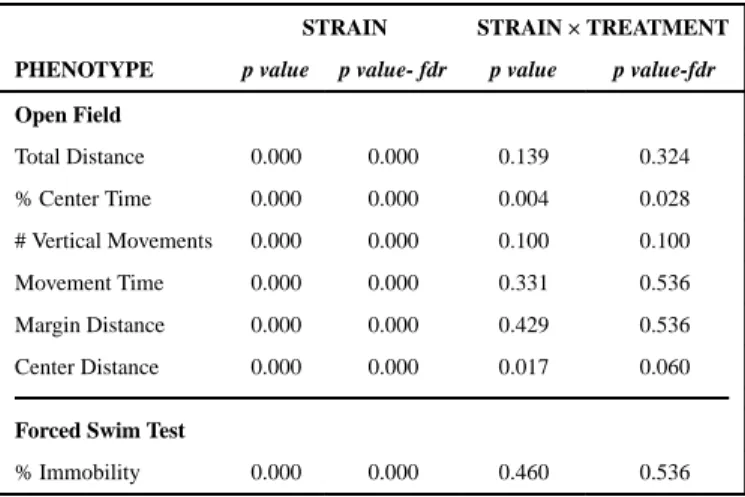
3.3.1 Open Field—Overall strain effects for open field behaviors in SHAM-treated mice are shown in Table 1 and strain means are provided in Supplemental Table 1. Significant strain effects were observed for all behaviors measured in the open field (p<0.001). Strain-by-strain comparisons for each behavior are shown in Supplemental Figure 1 and strain mean distributions are shown in Supplemental Figures 2a-f and highlight the significant differences across most strains studied.
Heritabilities for all open field behaviors are shown in Supplemental Figure 3 and range from 0.58 for margin distance and 0.76 for center distance. (Supplemental Table 1).
A
uthor Man
uscr
ipt
A
uthor Man
uscr
ipt
A
uthor Man
uscr
ipt
A
uthor Man
uscr
3.3.2 Forced Swim Test—Overall strain effects for forced swim immobility are shown in Table 1 and strain means are provided in Supplemental Table 2. Significant strain
differences in forced swim immobility were observed (p<0.001). Strain-by-strain comparisons for percent immobility are shown in Supplemental Figure 1 and the strain mean distribution is shown in Supplemental Figure 2g. Although significant strain differences are apparent, there are far fewer than those observed for open field behaviors.
Heritability for percent immobility in the forced swim test was 0.40 (Supplemental Figure 3; Supplemental Table 2).
3.4 Strain differences in response to ovariectomy
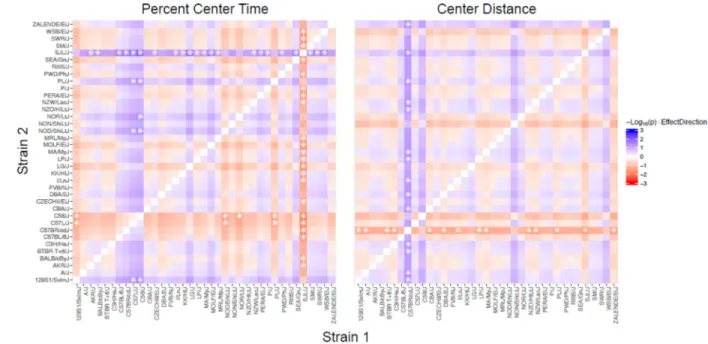
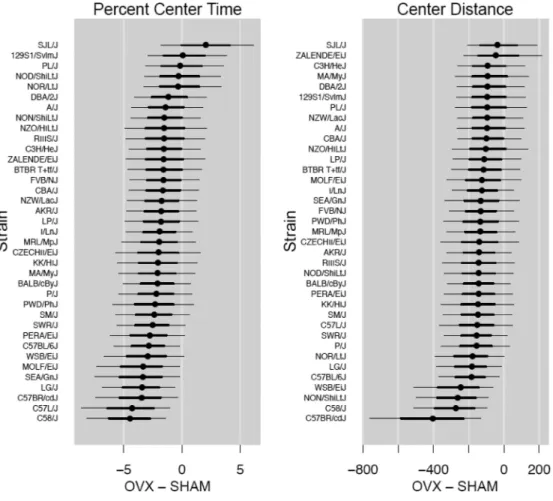
Significant strain by treatment interaction effects were observed for percent center time and center distance in the open field (Table 1; p<0.05). A strain-by-strain comparison assessing significant OVX-induced differences between strains for these behaviors is shown in Figure 1. SJL/J mice that were ovariectomized spent more time in the center of the arena (Figure 2 and Supplemental Figure 1) and consequently, strain effects on OVX response for SJL/J differ from those 23 strains that show reduced time in the center (Figure 1). Moreover, C58/J and C57L/J strains show decreased OVX response for percent center time, and differ appreciably from several other strains as shown in Figure 1. The strain-by-strain comparison of center distance mirrors that of percent center time but to a much lesser extent. Contrasting OVX responses were observed for SJL/J mice in comparison with C57BR/cdJ and C58/J. Zalende/EiJ mice also differed from C57BR/cdJ (Figure 1).
No additional strain effects on OVX responses were observed for open field behaviors or percent immobility in the forced swim test (data not shown).
3.5 Open field correlations with Mouse Phenome Database studies
3.5.1 Locomotor activity and rearing—Locomotor activity and rearing behavior in the open field in SHAM females was significantly correlated (p<0.003) with all other strain surveys examined, regardless of study parameters (i.e. type and size of open field, length of assay, etc) or sex of the animals tested (Table 2).
3.5.2 Percent center time—Percent center time in the open field in both SHAM and OVX females was significantly correlated (p<0.003) with similar data from studies by Miller et al [30], Crowley et al [31] and Wahlsten et al. [32] (Table 2).
4.0 DISCUSSION
These data represent the largest strain survey ever reported on the effects of OVX on anxiety- and depression-like behavior and the largest strain survey ever reported for forced swim behavior. OVX increased anxiety-like behavior in the open field and depressive-like behavior in the forced swim test. Moreover, OVX significantly altered percent center time and distance in the open field in a strain-dependent manner indicating that lack of estrogen interacted with genetic background to affect anxiety-like behavior. The same relationship was not observed in the forced swim test indicating that for this behavior, in this inbred
A
uthor Man
uscr
ipt
A
uthor Man
uscr
ipt
A
uthor Man
uscr
ipt
A
uthor Man
uscr
strain population, genetic background may not be important in determining depressive-like behavior in response to OVX.
4.1 OVX and behavior
The main objective of this study was to examine genetic differences in behavioral responses to OVX. Based on previously published studies showing significant inbred strain differences in depression-like behavior in OVX vs. SHAM mice, we hypothesized that expanding behavioral assessment to include a greater number of strains would result in identification of strains that show increased, decreased and no change in behavioral response to OVX. We did observe genetic background-dependent changes in open field behavior, but not the forced swim test.
4.1.1 Open Field—We observed a significant decrease in all open field behaviors in OVX vs. SHAM mice. This finding is consistent with previous studies that have shown an increase in OVX-induced anxiogenic behavior in mice [10] and rats [9] in the elevated plus maze, another commonly used assay for anxiety-like behavior in rodents. These anxiogenic effects can be reversed with estrogen replacement [33] and strain differences for the protective effects of estrogen have also been reported [34].
Interestingly, we also observed strain-specific effects on open field behavior resulting from OVX. We observed strains for which OVX increased center time and distance as well as the converse (Figure 2). We cannot rule out the possibility that reduced center time simply reflects decreased open field activity in OVX animals. Estrogen is known to increase activity in rodents [35, 36]; therefore an OVX-induced decrease in estrogen could explain decreased activity in the open field. However, estrogen's effect on activity in rodents varies between rats and mice, appears to be context specific (i.e. safe environment (home cage) versus a perceived threatening environment (novel testing apparatus)) and very few inbred strains have been examined [34]. Therefore, it is possible and perhaps likely that strain differences in estrogen-induced locomotor activity exist. In the present data, for example, the strain at the most extreme end of the distribution for OVX-induced increased time in the center of the arena, SJL/J, exhibits absolutely no change in locomotor activity in response to OVX (Supplemental Figure 2A) indicating that these two behaviors may be dissociated. The strain with the most extreme decrease in time in the center of the arena, C58/J, does exhibit decreased locomotor activity in response to OVX, although the decrease is not significant (Supplemental Figure 2A). Since estrogenic effects on locomotor activity are also context specific, one should also consider that activity in response to a novel environment has been described as anxiety-like or emotional behavior [37-39]. Therefore, it may be difficult to uncouple changes in center time from locomotor activity, but both may reflect the animals emotional state.
4.1.2 Forced Swim Test—Based on the proposed role of estrogen depletion in the development of depression during menopause in humans [4, 40] and previously published studies in rodents [11, 41], we hypothesized that OVX would result in both overall and strain-specific increases in immobility in the forced swim test; although we observed a
A
uthor Man
uscr
ipt
A
uthor Man
uscr
ipt
A
uthor Man
uscr
ipt
A
uthor Man
uscr
significant decrease in immobility in response to OVX (Supplemental Table 4), we did not observe any strain by treatment effects.
Similar to our results, previous studies examining the effects of OVX on depressive-like behavior in the forced swim test report increased immobility in mice [8, 11, 12] and rats [9, 13, 14] regardless of strain background.
Inbred strain differences in immobility in the forced swim test in response to OVX have also been reported. Bekku et al. [11] reported increased immobility in C57BL/6J but not DBA/2J following OVX. We also observed that C57BL/6J and DBA/2J lie at opposite ends of phenotypic response to OVX in the forced swim test (Supplemental Figure 4) but the two strains were not significantly different from one another. We did note trends in the data, with some strains showing OVX-induced increases in forced swim immobility (CBA/J and I/LnJ, for example) and others showing no OVX-induced behavioral effects (Supplemental Figure 2G).
Aspects of the forced swim test in general may explain our inability to detect strain by treatment interactions on immobility. We observed large intra-strain variation in both the OVX and SHAM group compared to intra-strain variance observed for open field behavior, indicating that the forced swim assay is more sensitive to extrinsic factors that increase non-genetic variance. High intra-strain variance may have made it more difficult to observe both overall and strain specific effects of OVX and also contributed to the lower heritability observed in the forced swim immobility (Supplemental Table 2, Supplemental Figure 3).
4.2 Inbred strain differences
The most significant observation for both anxiety- and depression-related behaviors was the extensive phenotypic variation across inbred strains regardless of treatment. Significant behavioral differences among inbred mouse strains have previously been reported for both the open field and forced swim assays.
4.2.1 Open Field—The strain differences we observed in open field behavior were concordant with previous studies. A survey of the Mouse Phenome Database (MPD; phenome.jax.org) identified 6 open field studies [30-32, 42-45] that examined at least 10 inbred mouse strains in common with our panel. In all cases, locomotor activity and rearing behavior in open field were significantly correlated across studies. In general, A/J and 129S1/SvlmJ were among the least mobile and MA/MyJ and NOD/ShiLtJ were among the most mobile across studies. A similar pattern for A/J and 129S1/SvImJ rearing behavior was observed across all studies in which this behavior was measured. MA/MyJ and FVB/NJ represented the high extreme of rearing behavior while NOD/ShiLtJ mice were more moderate. Strain similarities in locomotor and exploratory behavior measured across laboratories are not surprising. Landmark studies by Crabbe et al. [46] and Wahlsten et al. [42] compared mouse behavior across laboratories and across decades and concluded that locomotor behavior was fairly stable and replicable. However, other behaviors, including measures of anxiety, are more labile [42, 46, 47].
A
uthor Man
uscr
ipt
A
uthor Man
uscr
ipt
A
uthor Man
uscr
ipt
A
uthor Man
uscr
Time spent in the center of the open field is often used as a primary indicator of anxiety in the open field, although this measure has not been well-validated pharmacologically across inbred mouse strains or even in C57BL/6J mice [38, 48, 49]. Regardless of the
inconsistencies that have been observed for anxiety-like behavior across laboratories, we do see a significant correlation between time spent in the center or, conversely, thigmotactic behavior across all of the open field strain surveys [30, 31] that reported this behavior. The strong correlation across studies for center time in the open field may be due to the
relationship that we, and others, have reported between locomotor behavior and thigmotaxis. The link between the two makes it difficult to separate activity from anxiety, although as previously discussed, changes in activity in response to a novel environment have also been used to define emotionality or anxious behavior [37]. Finally, we are only comparing a single measurement of anxiety-like behavior across different studies. One of the advantages of using inbred strains is the ability to examine the relationship across different behavioral paradigms and this can be accomplished using tools such as MPD although these analyses are beyond the scope of this study.
4.2.2 Forced Swim Test—The forced swim data presented here represent the largest strain survey ever reported in the literature. Previous studies assessing forced swim behavior have examined from 2-9 inbred strains [11, 50-60] that, collectively, represent 17 different inbred strains or substrains. None of the studies include wild-derived strains, thereby limiting genetic and, most likely, phenotypic diversity. Regardless, the majority of these studies do report significant strain differences. C57BL/6 and 129 strains and substrains tend to exhibit the most immobility behavior in the forced swim apparatus in studies that have utilized one, or both strains [50, 51, 53, 54, 56, 58-60] with a few exceptions [11, 52, 55, 57]. However, strain comparisons for immobility varied greatly depending upon which strains were included. Discrepancies in ranking inbred strain behaviors across laboratories could be due to testing differences (i.e. sex, age, handling, previous behavioral testing, and length of testing) and methods for scoring immobility (i.e. automated vs. manual); variables that are thoroughly addressed in Petit-Demouliere et al. [61] and O'Neil and Moore [62]. In this study, C57BL/6J mice are at the higher end of the distribution for immobility, however, several additional strains including PL/J, MRL/MpJ, NOD/ShiLtJ, PERA/EiJ, NON/ShiLtJ, RIIIS/J, SEA/GnJ, A/J and AKR/J show equally high immobility. Of these strains, forced swim behavior has only been reported previously for A/J and AKR/J [50, 57]. A/J has previously shown either similar [57] or less immobility [50] and AKR/J has been reported to have higher immobility [55] compared to C57BL/6J. Of the low immobility strains assessed in our study (PWD/PhJ, MOLF/EiJ, FVB/NJ, MA/MyJ, SM/J and P/J, for example), only FVB/NJ has been reported previously to have the lowest immobility compared to other inbred strains including C57BL/6J and 129 substrains [50, 51]. Therefore, the inbred strain data for forced swim immobility presented here both replicate and significantly expand what is known about this behavior in inbred mice in the existing literature. The extent to which these data correlate with other depression-relevant behavioral assays can be examined across inbred mouse strains although very few strain surveys of other depression-related behaviors have been reported with the exception of the tail suspension test [30, 45, 63-67]. Based on the literature, however, it is likely that strain behavior in various rodent models of depression either results from different underlying mechanisms [68] or that experimental variance that
A
uthor Man
uscr
ipt
A
uthor Man
uscr
ipt
A
uthor Man
uscr
ipt
A
uthor Man
uscr
exists both within and across laboratories will make cross-assay comparisons difficult [42, 46].
4.3 Caveats and future directions
Although our results clearly show a link between OVX and increased anxiety-like behaviors in mice, there are several limitations of our methodology that may reduce translatability to human neuropsychiatric disorders. First, we are using an artificial method of inducing estrogen depletion that may not fully capture the biological complexity of natural
menopause. However, this limitation is mitigated by evidence in the literature showing that the risk of being diagnosed with an affective disorder following artificial menopause (i.e. hysterectomy or oophorectomy) is similar to natural menopause [5, 69-71].
We are also performing OVX in nulliparous mice that are of reproductive age rather than middle- to late-middle age when menopause naturally occurs in humans. Age at onset of menopause has been negatively correlated with risk for depression [70, 72, 73]. In addition, it has been shown in some studies that nulliparity is associated with increased risk for depression in menopausal and post-menopausal women [70, 74]. Both of these factors may bias the study toward increased behavioral effects.
Our study is limited by the use of OVX as a model for post-menopausal depression. Increased rates of depression are also observed during perimenopause and menopause when estrogen levels are still fluctuating [5, 75] and studies of genetic predisposition to develop depression and anxiety disorders during these critical times are warranted as well.
Following ovariectomy, estrogens are rapidly cleared from the circulation by steroidal esterases and there is some evidence that the activity of these esterases varies across
different inbred strains [76]. We cannot rule out the potential for strain differences in rates of estrogen depletion following OVX, although it is not likely that circulating estrogen would persist past 17 days post-OVX. Perhaps more relevant could be estrogen acting in an intacrine or paracrine manner at extragonadal sites - particularly the brain [77]. To our knowledge, there are no studies that have examined differences in estrogen in the brain across different inbred strains. However, the aromatase enzyme that converts androgens into estrogen is present and active in the mouse brain and strain differences in its activity in brain regions that are involved in anxiety and depression-related behaviors have been observed in a limited number of strains [78]. Therefore, we cannot rule out the possibility that strain differences in extragonadal estrogens may be contributing to the observed behavioral effects.
There is also evidence that mice may adapt over time to the behavioral effects of OVX [11] although studies in both rats and mice [10, 79] have reported effects on depressive-behavior after OVX that extend well past our experimental window. However, it is possible that both individual and strain differences in adaptation to OVX explain some of the variability in our data.
Finally, our study was conducted solely on female mice for obvious reasons. We made no attempt to synchronize or record the stages of estrous in our SHAM mice and some of the phenotypic variance we observed may be due to differences in estrous cycle. There is
A
uthor Man
uscr
ipt
A
uthor Man
uscr
ipt
A
uthor Man
uscr
ipt
A
uthor Man
uscr
evidence in the literature that stage of estrous may affect forced swim behavior in rodents [80], although many studies also show that rodent estrous cycles have little effect on data variability [11, 81-84]. However, we cannot rule out strain-specific differences in the role of the estrous cycle on behavior as a potential cause of variability.
Our analysis of strain by treatment effects benefits from our use of matched pairs in defining OVX response. Defining OVX response as the difference between otherwise comparable mice under alternate treatments, we obtain an unconfounded estimate of the causal effect of OVX, and this in turn allows strain effects on behavioral response to ovariectomy to be cleanly separated. Nonetheless, in defining OVX response as the difference between behavioral values on their original scale we target OVX-induced changes on the additive rather than the multiplicative scale; that is, we assume that OVX adds an amount that is approximately constant regardless of an animal's baseline value. In this study, at least, the additive assumption appears to be reasonable, since the strain means estimated for behavior show no apparent relationship with the strain means estimated for OVX response, implying that the two types of effects are indeed separated by the analysis.
5.0 CONCLUSIONS
Individual differences among women exist in the risk for development of an affective disorder during the menopausal period when the ovaries cease production of estrogen. In order to investigate the effects of genetic predisposition, estrogen depletion and their possible interaction on depression- and anxiety-like behaviors, we conducted an inbred strain survey using bilateral OVX as a model of the estrogen depletion. We observed three main findings: 1) OVX resulted in increased anxiety-like behavior in the open field both generally and in a strain-specific manner; 2) OVX increased depressive-like behavior in the forced swim test but strain-specific effects were not apparent and 3) inbred strains differed significantly in behavioral measures in both the forced swim test and the open field.
Collectively, the results of this study provide further evidence that an increased vulnerability to develop a post-menopausal affective disorder is due, at least in part, to the complex interplay between genetic predisposition and estrogen depletion. Strain differences in anxiety-behavior in response to OVX can be studied further to identify the underlying biological and genetic mechanisms.
Supplementary Material
Refer to Web version on PubMed Central for supplementary material.
ACKNOWLEDGEMENTS
Funding for this research was provided by a grant from the Foundation of Hope for Research and Treatment of Mental Illness to LM Tarantino and funding from the National Institute of Drug Abuse (DA028420) and the National Institute on Aging (AG038070) to M Bogue and funding from the National Institute of General Medical Sciences (GM104125) to W Valdar
A
uthor Man
uscr
ipt
A
uthor Man
uscr
ipt
A
uthor Man
uscr
ipt
A
uthor Man
uscr
REFERENCES
1. Kessler RC, Petukhova M, Sampson NA, Zaslavsky AM, Wittchen HU. Twelve-month and lifetime prevalence and lifetime morbid risk of anxiety and mood disorders in the United States. Int J Methods Psychiatr Res. 2012; 21:169–84. [PubMed: 22865617]
2. Altemus M. Sex differences in depression and anxiety disorders: potential biological determinants. Hormones and behavior. 2006; 50:534–8. [PubMed: 16920114]
3. Soares CN. Mood disorders in midlife women: understanding the critical window and its clinical implications. Menopause. 2014; 21:198–206. [PubMed: 24448106]
4. Avis NE, Crawford S, Stellato R, Longcope C. Longitudinal study of hormone levels and depression among women transitioning through menopause. Climacteric. 2001; 4:243–9. [PubMed: 11588948] 5. Alexander JL, Dennerstein L, Woods NF, Kotz K, Halbreich U, Burt V, et al. Neurobehavioral
impact of menopause on mood. Expert Rev Neurother. 2007; 7:S81–91. [PubMed: 18039071] 6. Nguyen D, Xu T. The expanding role of mouse genetics for understanding human biology and
disease. Dis Model Mech. 2008; 1:56–66. [PubMed: 19048054]
7. Tarantino LM, Eisener-Dorman AF. Forward Genetic Approaches to Understanding Complex Behaviors. Curr Top Behav Neurosci. 2012
8. Bekku N, Yoshimura H. Animal model of menopausal depressive-like state in female mice: prolongation of immobility time in the forced swimming test following ovariectomy. Psychopharmacology. 2005; 183:300–7. [PubMed: 16228195]
9. de Chaves G, Moretti M, Castro AA, Dagostin W, da Silva GG, Boeck CR, et al. Effects of long-term ovariectomy on anxiety and behavioral despair in rats. Physiology & behavior. 2009; 97:420– 5. [PubMed: 19321148]
10. Lagunas N, Calmarza-Font I, Diz-Chaves Y, Garcia-Segura LM. Long-term ovariectomy enhances anxiety and depressive-like behaviors in mice submitted to chronic unpredictable stress. Hormones and behavior. 2010; 58:786–91. [PubMed: 20691693]
11. Bekku N, Yoshimura H, Araki H. Factors producing a menopausal depressive-like state in mice following ovariectomy. Psychopharmacology. 2006; 187:170–80. [PubMed: 16788811]
12. Heydarpour P, Salehi-Sadaghiani M, Javadi-Paydar M, Rahimian R, Fakhfouri G, Khosravi M, et al. Estradiol reduces depressive-like behavior through inhibiting nitric oxide/cyclic GMP pathway in ovariectomized mice. Hormones and behavior. 2013; 63:361–9. [PubMed: 23262264]
13. Okada M, Hayashi N, Kometani M, Nakao K, Inukai T. Influences of ovariectomy and continuous replacement of 17beta-estradiol on the tail skin temperature and behavior in the forced swimming test in rats. Jpn J Pharmacol. 1997; 73:93–6. [PubMed: 9032138]
14. Rachman IM, Unnerstall JR, Pfaff DW, Cohen RS. Estrogen alters behavior and forebrain cfos expression in ovariectomized rats subjected to the forced swim test. Proceedings of the National Academy of Sciences of the United States of America. 1998; 95:13941–6. [PubMed: 9811905] 15. Estrada-Camarena E, Fernandez-Guasti A, Lopez-Rubalcava C. Antidepressant-like effect of
different estrogenic compounds in the forced swimming test. Neuropsychopharmacology : official publication of the American College of Neuropsychopharmacology. 2003; 28:830–8. [PubMed: 12637949]
16. Kandi P, Hayslett RL. Nicotine and 17beta-estradiol produce an antidepressant-like effect in female ovariectomized rats. Brain research bulletin. 2011; 84:224–8. [PubMed: 21194557]
17. Eckeli AL, Dach F, Rodrigues AL. Acute treatments with GMP produce antidepressant-like effects in mice. Neuroreport. 2000; 11:1839–43. [PubMed: 10884029]
18. Rosa AO, Lin J, Calixto JB, Santos AR, Rodrigues AL. Involvement of NMDA receptors and L-arginine-nitric oxide pathway in the antidepressant-like effects of zinc in mice. Behavioural brain research. 2003; 144:87–93. [PubMed: 12946598]
19. Zomkowski AD, Hammes L, Lin J, Calixto JB, Santos AR, Rodrigues AL. Agmatine produces antidepressant-like effects in two models of depression in mice. Neuroreport. 2002; 13:387–91. [PubMed: 11930146]
20. Lenarcic AB, Svenson KL, Churchill GA, Valdar W. A general Bayesian approach to analyzing diallel crosses of inbred strains. Genetics. 2012; 190:413–35. [PubMed: 22345610]
A
uthor Man
uscr
ipt
A
uthor Man
uscr
ipt
A
uthor Man
uscr
ipt
A
uthor Man
uscr
21. Gelman, A., Hill, J. Data Analysis Using Regression and Multilevel/Hierarchical Models. 1 ed.. Cambridge University Press; New York, NY: 2006.
22. Tukey, JW. Exploratory Data Analysis. Addison-Wesley; 1977.
23. Plummer M, Stukalov A, Denwood M. rjags: Bayesian Graphical Models using MCMC. :4–6. ed2016.
24. Fitzmaurice GM, Lipsitz SR, Ibrahim JG. A note on permutation tests for variance components in multilevel generalized linear mixed models. Biometrics. 2007; 63:942–6. [PubMed: 17403100] 25. Bates D, Maechler M, Bolker B, Walker S. Fitting Linear Mixed-Effects Models Using lme4.
Journal of Statistical Software. 2015; 67:1–48.
26. Team, RC. R: A language and environment for statistical computing. R Foundation for Statistical Computing; Vienna, Austria: 2016.
27. Benjamini Y, Hochberg Y. Controlling the false discovery rate: a practical and powerful approach to multiple testing. Journal of the Royal Statistical Society. 1995; 57:289–300.
28. Crowley JJ, Kim Y, Lenarcic AB, Quackenbush CR, Barrick CJ, Adkins DE, et al. Genetics of adverse reactions to haloperidol in a mouse diallel: a drug-placebo experiment and Bayesian causal analysis. Genetics. 2014; 196:321–47. [PubMed: 24240528]
29. Can A, Blackwell RA, Piantadosi SC, Dao DT, O'Donnell KC, Gould TD. Antidepressant-like responses to lithium in genetically diverse mouse strains. Genes, brain, and behavior. 2011; 10:434–43.
30. Miller BH, Schultz LE, Gulati A, Su AI, Pletcher MT. Phenotypic characterization of a genetically diverse panel of mice for behavioral despair and anxiety. PLoS One. 2010; 5:e14458. [PubMed: 21206921]
31. Crowley JJ, Adkins DE, Pratt AL, Quackenbush CR, van den Oord EJ, Moy SS, et al.
Antipsychotic-induced vacuous chewing movements and extrapyramidal side effects are highly heritable in mice. The pharmacogenomics journal. 2012; 12:147–55. [PubMed: 21079646] 32. Wahlsten D, Metten P, Crabbe JC. Survey of 21 inbred mouse strains in two laboratories reveals
that BTBR T/+ tf/tf has severely reduced hippocampal commissure and absent corpus callosum. Brain Res. 2003; 971:47–54. [PubMed: 12691836]
33. Walf AA, Frye CA. Estradiol reduces anxiety- and depression-like behavior of aged female mice. Physiology & behavior. 2010; 99:169–74. [PubMed: 19804793]
34. Morgan MA, Pfaff DW. Estrogen's effects on activity, anxiety, and fear in two mouse strains. Behavioural brain research. 2002; 132:85–93. [PubMed: 11853861]
35. Morgan MA, Pfaff DW. Effects of estrogen on activity and fear-related behaviors in mice. Hormones and behavior. 2001; 40:472–82. [PubMed: 11716576]
36. Ogawa S, Chan J, Gustafsson JA, Korach KS, Pfaff DW. Estrogen increases locomotor activity in mice through estrogen receptor alpha: specificity for the type of activity. Endocrinology. 2003; 144:230–9. [PubMed: 12488349]
37. Hall CS. Emotional behavior in the rat I Defecation and urination as measures of individual differences in emotionality. J Comp Psychol. 1934; 18:385–403.
38. Thompson T, Grabowski-Boase L, Tarantino LM. Prototypical anxiolytics do not reduce anxiety-like behavior in the open field in C57BL/6J mice. Pharmacology, biochemistry, and behavior. 2015; 133:7–17.
39. Ramos A, Mormede P. Stress and emotionality: a multidimensional and genetic approach. Neuroscience and biobehavioral reviews. 1998; 22:33–57. [PubMed: 9491939]
40. Schmidt PJ, Rubinow DR. Sex hormones and mood in the perimenopause. Ann N Y Acad Sci. 2009; 1179:70–85. [PubMed: 19906233]
41. Koss WA, Einat H, Schloesser RJ, Manji HK, Rubinow DR. Estrogen effects on the forced swim test differ in two outbred rat strains. Physiology & behavior. 2012; 106:81–6. [PubMed: 22266677] 42. Wahlsten D, Bachmanov A, Finn DA, Crabbe JC. Stability of inbred mouse strain differences in
behavior and brain size between laboratories and across decades. Proceedings of the National Academy of Sciences of the United States of America. 2006; 103:16364–9. [PubMed: 17053075]
A
uthor Man
uscr
ipt
A
uthor Man
uscr
ipt
A
uthor Man
uscr
ipt
A
uthor Man
uscr
43. Wiltshire T, Ervin RB, Duan H, Bogue MA, Zamboni WC, Cook S, et al. Initial locomotor sensitivity to cocaine varies widely among inbred mouse strains. Genes, brain, and behavior. 2015; 14:271–80.
44. Segall SK, Nackley AG, Diatchenko L, Lariviere WR, Lu X, Marron JS, et al. Comt1 genotype and expression predicts anxiety and nociceptive sensitivity in inbred strains of mice. Genes, brain, and behavior. 2010; 9:933–46.
45. Benton CS, Miller BH, Skwerer S, Suzuki O, Schultz LE, Cameron MD, et al. Evaluating genetic markers and neurobiochemical analytes for fluoxetine response using a panel of mouse inbred strains. Psychopharmacology. 2012; 221:297–315. [PubMed: 22113448]
46. Crabbe JC, Wahlsten D, Dudek BC. Genetics of mouse behavior: interactions with laboratory environment. Science. 1999; 284:1670–2. [PubMed: 10356397]
47. O'Leary TP, Gunn RK, Brown RE. What are we measuring when we test strain differences in anxiety in mice? Behav Genet. 2013; 43:34–50. [PubMed: 23288504]
48. Heredia L, Torrente M, Colomina MT, Domingo JL. Assessing anxiety in C57BL/6J mice: a pharmacological characterization of the open-field and light/dark tests. Journal of pharmacological and toxicological methods. 2014; 69:108–14. [PubMed: 24374104]
49. Prut L, Belzung C. The open field as a paradigm to measure the effects of drugs on anxiety-like behaviors: a review. European journal of pharmacology. 2003; 463:3–33. [PubMed: 12600700] 50. Lucki I, Dalvi A, Mayorga AJ. Sensitivity to the effects of pharmacologically selective
antidepressants in different strains of mice. Psychopharmacology. 2001; 155:315–22. [PubMed: 11432695]
51. Voikar V, Koks S, Vasar E, Rauvala H. Strain and gender differences in the behavior of mouse lines commonly used in transgenic studies. Physiology & behavior. 2001; 72:271–81. [PubMed: 11240006]
52. David DJ, Renard CE, Jolliet P, Hascoet M, Bourin M. Antidepressant-like effects in various mice strains in the forced swimming test. Psychopharmacology. 2003; 166:373–82. [PubMed: 12601501]
53. Ducottet C, Belzung C. Correlations between behaviours in the elevated plus-maze and sensitivity to unpredictable subchronic mild stress: evidence from inbred strains of mice. Behavioural brain research. 2005; 156:153–62. [PubMed: 15474660]
54. Sugimoto Y, Kajiwara Y, Hirano K, Yamada S, Tagawa N, Kobayashi Y, et al. Mouse strain differences in immobility and sensitivity to fluvoxamine and desipramine in the forced swimming test: analysis of serotonin and noradrenaline transporter binding. European journal of
pharmacology. 2008; 592:116–22. [PubMed: 18655786]
55. Nikulina EM, Skrinskaya JA, Popova NK. Role of genotype and dopamine receptors in behaviour of inbred mice in a forced swimming test. Psychopharmacology. 1991; 105:525–9. [PubMed: 1685251]
56. Montkowski A, Poettig M, Mederer A, Holsboer F. Behavioural performance in three substrains of mouse strain 129. Brain Res. 1997; 762:12–8. [PubMed: 9262153]
57. Shanks N, Anisman H. Stressor-provoked behavioral changes in six strains of mice. Behavioral neuroscience. 1988; 102:894–905. [PubMed: 3214540]
58. Cervo L, Canetta A, Calcagno E, Burbassi S, Sacchetti G, Caccia S, et al. Genotype-dependent activity of tryptophan hydroxylase-2 determines the response to citalopram in a mouse model of depression. The Journal of neuroscience : the official journal of the Society for Neuroscience. 2005; 25:8165–72. [PubMed: 16148224]
59. Yoshikawa T, Watanabe A, Ishitsuka Y, Nakaya A, Nakatani N. Identification of multiple genetic loci linked to the propensity for “behavioral despair” in mice. Genome research. 2002; 12:357–66. [PubMed: 11875023]
60. Dubocovich ML, Mogilnicka E, Areso PM. Antidepressant-like activity of the melatonin receptor antagonist, luzindole (N-0774), in the mouse behavioral despair test. European journal of pharmacology. 1990; 182:313–25. [PubMed: 2168835]
61. Petit-Demouliere B, Chenu F, Bourin M. Forced swimming test in mice: a review of antidepressant activity. Psychopharmacology. 2005; 177:245–55. [PubMed: 15609067]
A
uthor Man
uscr
ipt
A
uthor Man
uscr
ipt
A
uthor Man
uscr
ipt
A
uthor Man
uscr
62. O'Neil MF, Moore NA. Animal models of depression: are there any? Human psychopharmacology. 2003; 18:239–54. [PubMed: 12766928]
63. Liu X, Gershenfeld HK. Genetic differences in the tail-suspension test and its relationship to imipramine response among 11 inbred strains of mice. Biological psychiatry. 2001; 49:575–81. [PubMed: 11297714]
64. Liu X, Gershenfeld HK. An exploratory factor analysis of the Tail Suspension Test in 12 inbred strains of mice and an F2 intercross. Brain research bulletin. 2003; 60:223–31. [PubMed: 12754084]
65. Lad HV, Liu L, Paya-Cano JL, Parsons MJ, Kember R, Fernandes C, et al. Behavioural battery testing: evaluation and behavioural outcomes in 8 inbred mouse strains. Physiology & behavior. 2010; 99:301–16. [PubMed: 19931548]
66. Trullas R, Jackson B, Skolnick P. Genetic-Differences in a Tail Suspension Test for Evaluating Antidepressant Activity. Psychopharmacology. 1989; 99:287–8. [PubMed: 2508168]
67. Ripoll N, David DJ, Dailly E, Hascoet M, Bourin M. Antidepressant-like effects in various mice strains in the tail suspension test. Behavioural brain research. 2003; 143:193–200. [PubMed: 12900045]
68. Bai F, Li X, Clay M, Lindstrom T, Skolnick P. Intra- and interstrain differences in models of “behavioral despair”. Pharmacology, biochemistry, and behavior. 2001; 70:187–92. 69. Mantani A, Yamashita H, Fujikawa T, Yamawaki S. Higher incidence of hysterectomy and
oophorectomy in women suffering from clinical depression: retrospective chart review. Psychiatry and clinical neurosciences. 2010; 64:95–8. [PubMed: 20416028]
70. Perquier F, Ryan J, Ancelin ML, Mesrine S, Clavel-Chapelon F. Lifetime endogenous reproductive factors and severe depressive symptoms in postmenopausal women: findings from the E3N cohort. Menopause. 2013; 20:1154–63. [PubMed: 24149927]
71. Rocca WA, Grossardt BR, Geda YE, Gostout BS, Bower JH, Maraganore DM, et al. Long-term risk of depressive and anxiety symptoms after early bilateral oophorectomy. Menopause. 2008; 15:1050–9. [PubMed: 18724263]
72. Ryan J, Carriere I, Scali J, Ritchie K, Ancelin ML. Lifetime hormonal factors may predict late-life depression in women. Int Psychogeriatr. 2008; 20:1203–18. [PubMed: 18533067]
73. Wang HL, Booth-LaForce C, Tang SM, Wu WR, Chen CH. Depressive symptoms in Taiwanese women during the peri- and post-menopause years: associations with demographic, health, and psychosocial characteristics. Maturitas. 2013; 75:355–60. [PubMed: 23726260]
74. Harlow BL, Cohen LS, Otto MW, Spiegelman D, Cramer DW. Prevalence and predictors of depressive symptoms in older premenopausal women: the Harvard Study of Moods and Cycles. Arch Gen Psychiatry. 1999; 56:418–24. [PubMed: 10232296]
75. Freeman EW. Associations of depression with the transition to menopause. Menopause. 2010; 17:823–7. [PubMed: 20531231]
76. Lund-Pero M, Jeppson B, Arneklo-Nobin B, Sjogren HO, Holmgren K, Pero RW. Non-specific steroidal esterase activity and distribution in human and other mammalian tissues. Clinica chimica acta; international journal of clinical chemistry. 1994; 224:9–20. [PubMed: 8174283]
77. Simpson ER. Sources of estrogen and their importance. The Journal of steroid biochemistry and molecular biology. 2003; 86:225–30. [PubMed: 14623515]
78. Wozniak A, Hutchison RE, Hutchison JB. Localisation of aromatase activity in androgen target areas of the mouse brain. Neuroscience letters. 1992; 146:191–4. [PubMed: 1491788] 79. Bastos CP, Pereira LM, Ferreira-Vieira TH, Drumond LE, Massensini AR, Moraes MF, et al.
Object recognition memory deficit and depressive-like behavior caused by chronic ovariectomy can be transitorialy recovered by the acute activation of hippocampal estrogen receptors. Psychoneuroendocrinology. 2015; 57:14–25. [PubMed: 25867995]
80. Marvan ML, Chavez-Chavez L, Santana S. Clomipramine modifies fluctuations of forced swimming immobility in different phases of the rat estrous cycle. Archives of medical research. 1996; 27:83–6. [PubMed: 8867373]
81. Becker JB, Prendergast BJ, Liang JW. Female rats are not more variable than male rats: a meta-analysis of neuroscience studies. Biology of sex differences. 2016; 7:34. [PubMed: 27468347]
A
uthor Man
uscr
ipt
A
uthor Man
uscr
ipt
A
uthor Man
uscr
ipt
A
uthor Man
uscr
82. Prendergast BJ, Onishi KG, Zucker I. Female mice liberated for inclusion in neuroscience and biomedical research. Neuroscience and biobehavioral reviews. 2014; 40:1–5. [PubMed: 24456941] 83. Eskelund A, Budac DP, Sanchez C, Elfving B, Wegener G. Female Flinders Sensitive Line rats
show estrous cycle-independent depression-like behavior and altered tryptophan metabolism. Neuroscience. 2016; 329:337–48. [PubMed: 27210075]
84. Kokras N, Antoniou K, Mikail HG, Kafetzopoulos V, Papadopoulou-Daifoti Z, Dalla C. Forced swim test: What about females? Neuropharmacology. 2015; 99:408–21. [PubMed: 25839894]
A
uthor Man
uscr
ipt
A
uthor Man
uscr
ipt
A
uthor Man
uscr
ipt
A
uthor Man
uscr
Figure 1. Contrast plots of strain effects on OVX response for anxiety-like behavior in the open field
Each panel is a matrix of Bayesian contrast probabilities comparing the strain effects on OVX response (ie, OVX – SHAM) across all 37 strains for percent center time and center distance in the open field. Within a panel, the color intensity reflects the evidence for a non-negligible difference between the effect of strain 1 (x-axis) and strain 2 (y-axis). Red shades indicate where the effect is larger in strain 1 than in strain 2, and blue shades indicate the reverse. The contrast probability is smaller when the posterior probability of the strain effect difference is away from zero. Stars denote contrast probabilities < 0.05.
A
uthor Man
uscr
ipt
A
uthor Man
uscr
ipt
A
uthor Man
uscr
ipt
A
uthor Man
uscr
Figure 2. Strain effects on OVX response for anxiety-like behavior in the open field Plot of posterior means and 95% credible intervals (caterpillar plot) for the strain mean effects on OVX response (ie, OVX – SHAM) within each of the 37 strains tested for percent center time and distance moved in the center of the open field. Thick line segments are the 68% (0.16- 0.84) credible interval and thin lines are the 95% (0.025-0.975) credible interval.
A
uthor Man
uscr
ipt
A
uthor Man
uscr
ipt
A
uthor Man
uscr
ipt
A
uthor Man
uscr
A
uthor Man
uscr
ipt
A
uthor Man
uscr
ipt
A
uthor Man
uscr
ipt
A
uthor Man
uscr
Table 1
Strain and strain by treatment effects
STRAIN STRAIN × TREATMENT
PHENOTYPE p value p value- fdr p value p value-fdr
Open Field
Total Distance 0.000 0.000 0.139 0.324
% Center Time 0.000 0.000 0.004 0.028
# Vertical Movements 0.000 0.000 0.100 0.100
Movement Time 0.000 0.000 0.331 0.536
Margin Distance 0.000 0.000 0.429 0.536
Center Distance 0.000 0.000 0.017 0.060
Forced Swim Test
A
uthor Man
uscr
ipt
A
uthor Man
uscr
ipt
A
uthor Man
uscr
ipt
A
uthor Man
uscr
Table 2
Correlation of open field behaviors with data from the Mouse Phenome Database (MPD)
MPD Data Set Reference Sex # of Strains Locomotion Center Time Rearing
Tarantino1 (2015): MPD Wiltshire et al. 2015 M 37
0.739* NR 0.572*
Wiltshire1 (2010): MPD 214 Segall et al. 2010
F 34
0.766* NR 0.814*
M 33
0.820* NR 0.774*
Wiltshire2 (2011): MPD Benton et al. 2012 M 25
0.780* NR NR
Pletcher1 (2007): MPD Miller et al. 2010 M 25
0.875* −0.781* NR
Crowley1 (2010): MPD Crowley et al. 2012 M 21
0.748* 0.804* 0.698*
Wahlsten1 (2003): MPD 108 Wahlsten et al. 2003 and 2006
F 18 0.518
−0.721* NR
M 18 0.478
−0.651* NR
NR = not reported
*