THE RELATIONSHIP BETWEEN TEACHER-STUDENT ASSIGNMENT AND HIGH SCHOOL STUDENT EQUITY IN ONE NORTH CAROLINA SCHOOL DISTRICT
R. Spencer Hawkins
A dissertation submitted to the faculty at the University of North Carolina at Chapel Hill in partial fulfillment of the requirements for the degree of Doctor of Education in the Educational
Leadership Program in the School of Education.
Chapel Hill 2017
ABSTRACT
R. Spencer Hawkins: The Relationship Between Teacher-Student Assignment and High School Student Equity in One North Carolina School District
(Under the direction of Kathleen Brown)
When teacher assignments are optimized for some students but not others, then the high school scheduling process becomes an exercise of inequity. Scholarly research reviewed for this study consistently showed a lack of access to the highest quality teachers possible for students of color and also correlated the achievement of students with their assignment to teachers. In some cases, research reported a causal link specifically between teacher assignments and the racial achievement gap. The purpose of this study was to illuminate a potential contributor to the achievement gap, one heretofore under-emphasized in existing research: the inequitable
assignment of the highest quality teachers to white high school students at the expense of African American and Hispanic students.
to relate congruence between qualitative and quantitative findings, as well as incongruence via the presentation of contradictory data.
ACKNOWLEDGEMENTS
Dr. Kathleen Brown, you are the first person I met in the Ed. Leadership department. Your kindness, patience, guidance, occasional “tough love,” and friendship have made all of this possible. I consider you a lifelong friend, Dr. B. Thank you for pushing me and helping me grow.
I would also like to thank the professors who have deftly guided me through two degree programs, over the past seven years. Specifically, Dr. Fenwick English, Dr. Erik Houck, Dr. Stan Schainker, Dr. Dana Thompson Dorsey, and Dr. Jim Veitch—I wouldn’t have accomplished anything without your accessibility, advice, consideration, and encouragement. Thank you.
Thank you also to my dissertation committee members—Dr. Brown, Dr. English, Dr. Schainker, and Dr. Thompson Dorsey as well as Dr. Kelly Batten for your time, support and consideration. Dr. Batten, you and Dr. Amanda Hartness were incredibly helpful during my research phase (thank you again!).
My principals have supported my journey by providing time to attend class and to write, as well as occasional reminders to sleep and take care of myself throughout this process. Dave Ebert, Phil Holmes, LaVerne Mattocks, and Rick Webber—you mean much more to me than a mere boss/employee dynamic would imply. You are mentors and cherished friends. Thank you.
My parents have been champions of mine over the last seven years too but more importantly, thank you for the sacrifices you made for me while I was at UNC Greensboro. Because of it, I was able to focus on being a college student and not worry about food, rent, car insurance, fraternity dues, tuition, or books. My time there led to my career as an educator. Thank you for your sacrifice and support—I’ll never forget it.
Having said all of that, I actually dedicate this work to the three most important people in my life without whom, I would have had no reason to persevere when times were tough… without whom, this accomplishment would mean very little. I am sorry I have missed so much over the last seven years. I will strive to make that up to you. You mean the world to me.
Hannah, the day you were born was the greatest day of my life. I hope you never forget how incredibly important you are to me. I love you more than you could possibly ever know- nothing will ever change that. Your beauty, natural talent as an artist, dedication as an athlete, and strong performance as a student inspire me and make me unbelievably proud. I am so excited to watch where life takes you, my little girl. I love you <3!
TABLE OF CONTENTS
LIST OF TABLES ... xiii
LIST OF ABBREVIATIONS ... xvii
CHAPTER I: INTRODUCTION ... 1
Overview ... 1
Statement of the Problem/Purpose of the Study ... 3
Research Questions ... 8
Significance of the Research ... 9
Theoretical Framework ... 11
Definitions of Key Terms/Concepts ... 13
Assumptions and Limitations ... 18
Conclusion ... 21
CHAPTER II: LITERATURE REVIEW ... 23
Introduction ... 23
Teacher Quality Characteristics Considered in Equitable Teacher Assignment ... 24
Teacher Experience ... 26
Licensure/Certification ... 33
Advanced Degrees ... 34
Teacher Test Scores ... 37
National Board Certification ... 39
Value-Added Measures ... 42
Teacher Evaluations ... 46
Summary ... 47
Access and Equity Considerations for Teacher Assignment ... 48
The Racial Achievement Gap: Realizing the Impact of Policy on Access and Equity ... 49
Equity Concerns Inherent with Current School Finance Structures and Practices ... 53
Leadership Considerations ... 56
The Critical Nature of Teacher Quality in Ninth Grade ... 56
Teacher Quality and the Impact of Supportive Relationships ... 62
Bourdieu and the Role of Teacher Assignment in Cultural Reproduction ... 64
Social/Cultural Capital Influence on Teacher Assignment ... 65
Conclusion ... 71
CHAPTER III: METHODOLOGY ... 73
Introduction ... 73
Research Purpose ... 73
Conceptual Framework ... 74
Research Questions ... 76
Rationale for a Mixed Methods Approach ... 77
Role of the Researcher ... 80
Site Selection and Participants ... 81
Data Procedures and Collection ... 86
Researcher Bias ... 102
Data Analysis ... 103
Establishing Trustworthiness ... 107
Significance... 111
Conclusion ... 113
CHAPTER IV: RESULTS ... 115
Introduction ... 115
Kali River High School ... 124
Qualitative Findings: KRHS ... 125
Historical Precedent and Power Dynamics in Scheduling ... 126
The Influence of Teacher Capital in Teacher Assignment and Scheduling ... 129
The Influence of Parent Capital in Teacher Assignment and Scheduling ... 133
The Influence of the Achievement Gap and Equity in Teacher Assignment and Scheduling ... 136
Quantitative Findings: KRHS ... 139
KRHS English ... 140
KRHS Math ... 143
KRHS Science ... 145
KRHS Social Studies ... 147
KRHS Quantitative Summary ... 150
Cross-Case Analysis: KRHS... 152
Artist Point High School ... 154
Qualitative Findings: APHS ... 155
Historical Precedent and Power Dynamics in Scheduling ... 156
The Influence of Teacher Capital in Teacher Assignment and Scheduling ... 157
The Influence of the Achievement Gap and Equity in Teacher
Assignment and Scheduling ... 163
Quantitative Findings: APHS ... 166
APHS Math ... 172
APHS Science ... 174
APHS Social Studies ... 177
APHS Quantitative Summary ... 182
Cross-Case Analysis: APHS ... 184
Liberty Square High School... 187
Qualitative Findings: LSHS ... 188
Historical Precedent and Power Dynamics in Scheduling ... 189
The Influence of Teacher Capital in Teacher Assignment and Scheduling ... 194
The Influence of Parent Capital in Teacher Assignment and Scheduling ... 200
The Influence of the Achievement Gap and Equity in Teacher Assignment and Scheduling ... 205
Quantitative Findings: LSHS ... 210
LSHS English ... 211
LSHS Math ... 214
LSHS Science ... 217
LSHS Social Studies ... 222
LSHS Quantitative Summary ... 225
Cross-Case Analysis: LSHS ... 228
Bay Lake County Schools: A Cross-Case Analysis ... 232
CHAPTER V: CONCLUSION... 236
Revisiting the Research Questions... 237
Considerations for Equity of Access... 242
Cultural Reproduction and Equitable Teacher Assignment... 244
Recommendations for Practitioners ... 248
Suggestions for Further Research ... 254
APPENDIX A: ENTRY LETTER... 257
APPENDIX B: DEMOGRAPHIC DATA QUESTIONNAIRE ... 258
APPENDIX C: INTERVIEW QUESTIONS FOR PARTICIPANTS IN MASTER SCHEDULE CONSTRUCTION ... 261
APPENDIX D: ALIGNMENT TABLE OF RESEARCH QUESTIONS, TOPICAL/SEMI-STRUCTURED INTERVIEW QUESTIONS, AND THEORETICAL FRAMEWORK ... 263
LIST OF TABLES
Table 2.1 Most Commonly Used Indicators of Teacher Quality ... 28 Table 2.2 NCLB Achievement Gains Comparison (Black vs. White) ... 52 Table 2.3 Percent Distribution of Revenue for K12 Public Education for 2010—
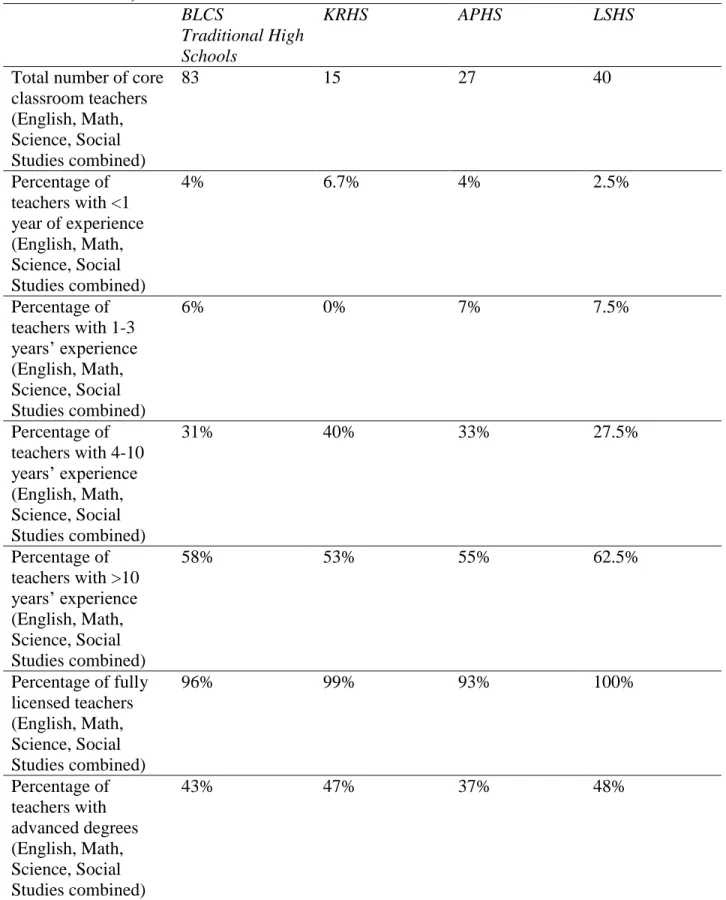
Sample of States (Education Law Center, 2013) ... 54 Table 3.1 Facts and Figures for BLCS High Schools (compiled from data sets
provided by district officials) ... 83 Table 3.2 North Carolina High School Graduation Requirements in Core Subject
Areas ... 88 Table 3.3 Quantitative/Qualitative Data & Sources ... 90 Table 3.4 Relevant North Carolina Teacher Working Conditions Survey Items ... 95 Table 3.5 Alignment of Research Questions with Topical/Semi-Structured
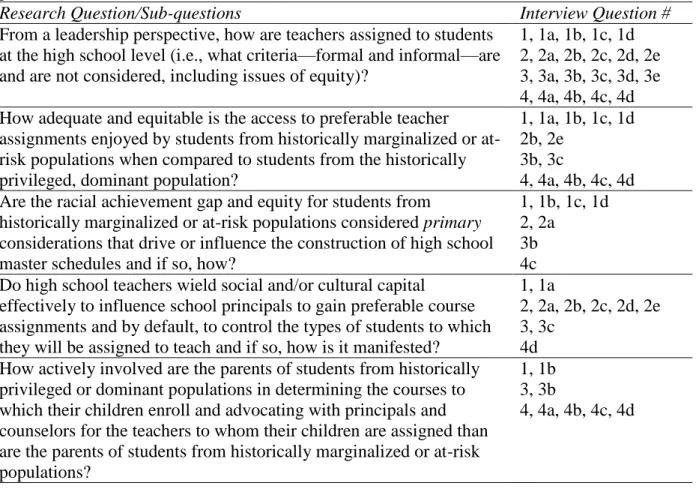
Interview Questions ... 99 Table 3.6 Alignment of Theoretical Framework with Topical/Semi-Structured
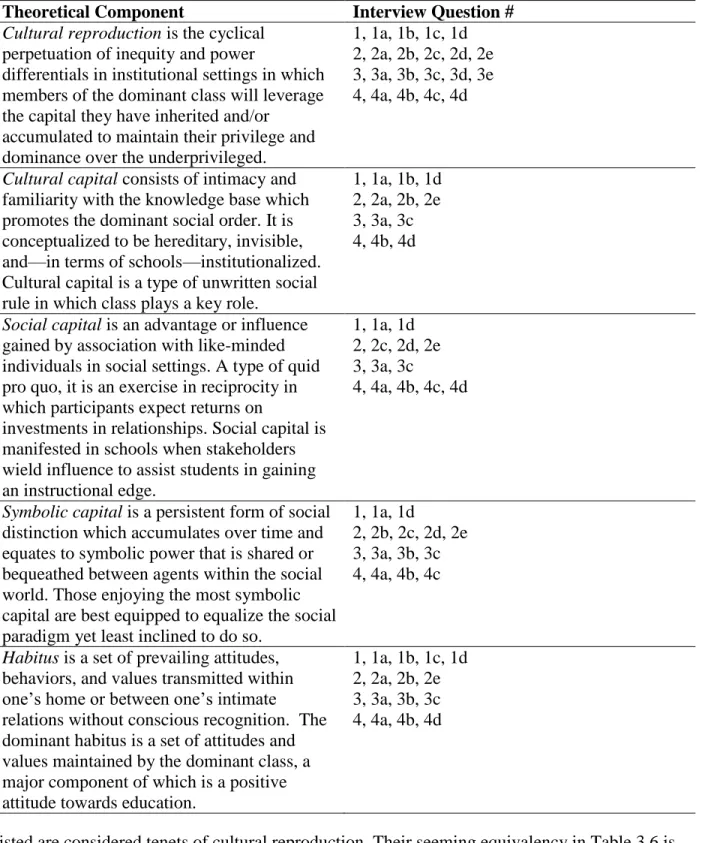
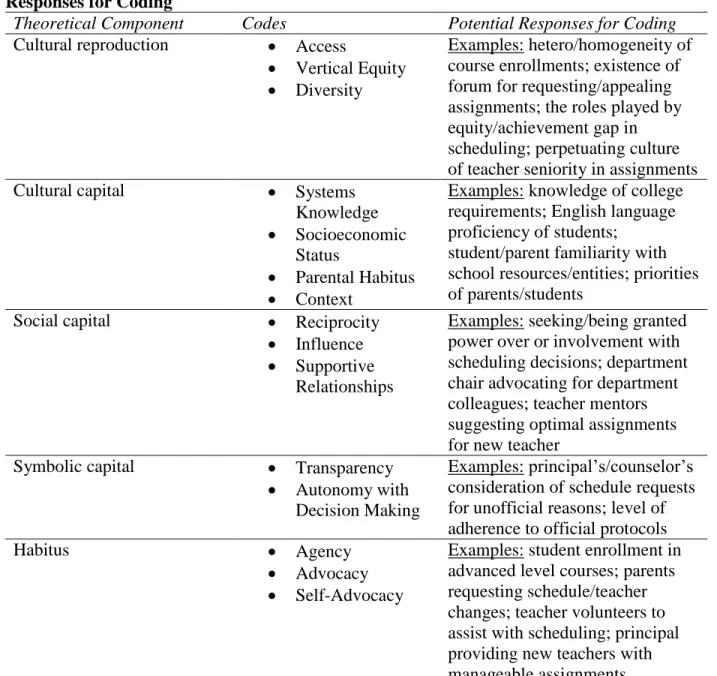
Interview Questions ... 101 Table 3.7 Alignment of Theoretical Components, Predetermined Data Codes and
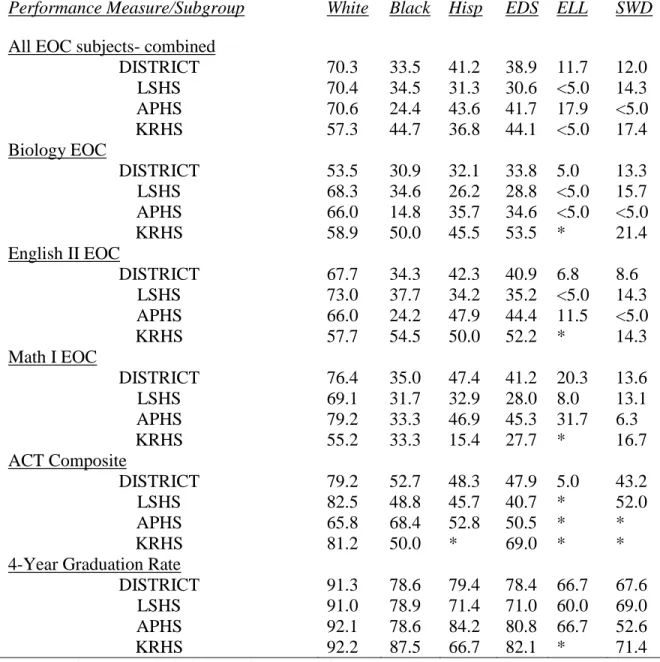
Potential Responses for Coding ... 104 Table 4.1 Performance Data for BLCS High Schools: 2015-2016 (percentages by
subgroup; sourced from NC School Report Card and district data reports) ... 117 Table 4.2 Partial 2016 Teacher Working Conditions Survey Results for BLCS
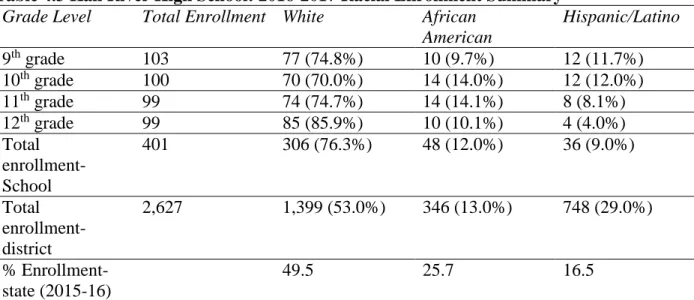
High Schools ... 119 Table 4.3 Kali River High School: 2016-2017 Racial Enrollment Summary ... 124 Table 4.4 Key Themes from KRHS Stakeholder Interviews ... 126 Table 4.5 KRHS Students Percent Proficient on 2016 EOC Performance by
Subgroup ... 137 Table 4.6 KRHS Interview Participants’ References to Terms/Concepts Germane
to Racial Equity... 138 Table 4.7 KRHS English Department Teacher Quality Scores and Student
Demographics ... 141 Table 4.8 KRHS Math Department Teacher Quality Scores and Student
Table 4.9 KRHS Math I Teacher Quality Scores and Student Demographics ... 144
Table 4.10 KRHS Math III Teacher Quality Scores and Student Demographics ... 144
Table 4.11 KRHS Science Department Teacher Quality Scores and Student Demographics ... 145
Table 4.12 KRHS Honors Biology Teacher Quality Scores and Student Demographics ... 147
Table 4.13 KRHS Social Studies Department Teacher Quality Scores and Student Demographics ... 147
Table 4.14 KRHS American History I Teacher Quality Scores and Student Demographics ... 149
Table 4.15 KRHS Honors American History II Teacher Quality Scores and Student Demographics ... 149
Table 4.16 KRHS Combined Core Teacher Quality Scores and Student Demographics ... 150
Table 4.17 KRHS Average Teacher Quality Scores Per Department ... 151
Table 4.18 KRHS Average Class Enrollments- Sample ... 153
Table 4.19 Artist Point High School: 2016-2017 Racial Enrollment Summary ... 155
Table 4.20 Key Themes from APHS Stakeholder Interviews ... 156
Table 4.21 Difference Between APHS and State Average on 2016 EOC Performance by Subgroup... 163
Table 4.22 APHS Interview Participants’ References to Terms/Concepts Germane to Racial Equity... 166
Table 4.23 APHS English Department Teacher Quality Scores and Student Demographics ... 168
Table 4.24 APHS English I Teacher Quality Scores and Student Demographics ... 169
Table 4.25 APHS English II Teacher Quality Scores and Student Demographics ... 170
Table 4.26 APHS 12th Grade English Teacher Quality Scores and Student Demographics ... 171
Table 4.28 APHS Science Department Teacher Quality Scores and Student
Demographics ... 174
Table 4.29 APHS Earth Science Teacher Quality Scores and Student Demographics ... 175
Table 4.30 APHS Biology Teacher Quality Scores and Student Demographics ... 176
Table 4.31 APHS Honors Biology Teacher Quality Scores and Student Demographics ... 176
Table 4.32 APHS Social Studies Department Teacher Quality Scores and Student Demographics ... 178
Table 4.33 APHS World History Teacher Quality Scores and Student Demographics ... 179
Table 4.34 APHS Civics Teacher Quality Scores and Student Demographics-Standard/Honors ... 180
Table 4.35 APHS American History I Teacher Quality Scores and Student Demographics ... 181
Table 4.36 APHS Combined Core Teacher Quality Scores and Student Demographics ... 182
Table 4.37 APHS Average Teacher Quality Scores Per Department ... 183
Table 4.38 APHS Average Class Enrollments—Sample ... 186
Table 4.39 Liberty Square High School: 2016-2017 Racial Enrollment Summary ... 188
Table 4.40: Key Themes from LSHS Stakeholder Interviews ... 189
Table 4.41 LSHS Students Percent Proficient on 2016 EOC Performance by Subgroup ... 206
Table 4.42: LSHS Interview Participants’ References to Terms/Concepts Germane to Racial Equity ... 207
Table 4.43 LSHS English Department Teacher Quality Scores and Student Demographics ... 212
Table 4.44 Comparison of LSHS English Standard and AP Teacher Quality Scores and Student Demographics... 214
Table 4.46 LSHS Math I Teacher Quality Scores and Student Demographics ... 216 Table 4.47 LSMathTeacher8.2 Student Demographics by Course and Section ... 217 Table 4.48 LSHS Science Department Teacher Quality Scores and Student
Demographics ... 218 Table 4.49 Student Demographics of Highest and Lowest Scoring LSHS Science
Teachers ... 219 Table 4.50 LSHS Honors Biology Teacher Quality Scores and Student
Demographics by Section ... 221 Table 4.51 LSHS Biology Teacher Quality Scores and Student Demographics by
Section... 222 Table 4.52 LSHS Social Studies Teacher Quality Scores and Student
Demographics ... 223 Table 4.53 LSHS World History Teacher Quality Score and Student
Demographics ... 224 Table 4.54 LSHS Civics Teacher Quality Scores and Student Demographics... 225 Table 4.55 LSHS Combined Core Teacher Quality Scores and Student
Demographics ... 226 Table 4.56 LSHS Average Teacher Quality Scores Per Department ... 227 Table 4.57 LSHS Average Class Enrollments- Sample... 231 Table 4.58 Teacher Assignment and Scheduling Similarities Among BLCS High
Schools ... 233 Table 4.59 Teacher Assignment and Scheduling Differences Between BLCS High
Schools ... 234 Table 4.60 BLCS Highest/Lowest Teacher Quality Scores and Student
LIST OF ABBREVIATIONS AASA American Association of School Administrators AP advanced placement
APHS Artist Point High School BLCS Bay Lake County Schools DOE Department of Education
EDS economically disadvantaged students ELL English language learners
EOC end of course
EVAAS Education Value-Added Assessment System HMHP high minority/high poverty
KRHS Kali River High School LSHS Liberty Square High School
NAEP National Assessment of Educational Progress NASSP National Association of Secondary School Principals NBCT National Board Certified Teachers
NBER National Bureau of Economic Research
NBPTS National Board of Professional Teaching Standards NCDPI North Carolina Department of Public Instruction
NCEE National Center for Education Evaluation and Regional Assistance NCES National Center for Education Statistics
NCLB No Child Left Behind
CHAPTER I: INTRODUCTION Overview
The synthesis of knowledge and the creation and strengthening of skills are types of learning achievements for students. The instruction of a course curriculum through the delivery of lessons to students and the assessment of skills mastery are tasks expected of teachers. It is a significant responsibility of school leaders to ensure that each student is assigned to a teacher with the skills and training necessary to maximize the student’s learning potential. When teacher/student matches are optimized for some students but not for others then the scheduling process becomes an exercise of inequity. This is a research study the purpose of which was to illuminate a potential contributor to the racial achievement gap, one that was heretofore under-emphasized in existing scholarly research: the inequitable assignment of the highest quality teachers possible to high school students from historically privileged backgrounds—specifically white students—at the expense of students from historically marginalized backgrounds—
specifically African American and Hispanic students.
marginalized students. In a study of teacher sorting in New York, the authors found that non-white, poor and/or ELL students are assigned to less experienced teachers 50% more often than students from privileged backgrounds and four times more likely to be assigned teachers lacking subject certification than are white, non-poor, and non-ELL students (Lankford et al., 2002). Researchers in another study of 29 school districts from across the country serving high percentages of at-risk students concluded that, when compared to students from the majority culture, students in grades 4-8 from historically marginalized populations had less access to effective teaching—a disparity which resulted in a shift of two percentile points in the racial achievement gap (U.S. Department of Education [DOE], 2013).
In Chapter 1 of this research study, a research problem is proffered with a rationale for the study. The statement of the problem and rationale is followed by a research synthesis question germane to 21st century educational leadership practice and theory, the focus of which is teacher assignment. The research question is accompanied by a set of sub-questions that guided a review of existing scholarly literature and was subsequently addressed through the study. A section regarding the potential significance of the research follows the research questions. Contained within this section is a listing of data sources as well as the types of data that was collected and interpreted in the study. A theoretical framework for the study is put forward in the next section, followed by a list of essential terms and concepts defined for purposes of the study. Completing Chapter 1 of this research study is an accounting of research assumptions and limitations relevant to a study of teacher assignment and student equity followed by a summary of the chapter.
include “black and brown,” low-income, and/or ELL students. This simply means that to some extent all students in those subgroups encounter equity challenges, implicit bias, and negative stereotyping in educational and social arenas in a manner that the privileged, dominant and/or white culture does not. Interchangeable terminology and intentional clustering of subgroups should not be misunderstood as an assumption that “black and brown,” low-income, or ELL students necessarily share every quality of each subgroup label (i.e. not every black or brown student is low-income or ELL). Similarly, there is no assumption that all white students are affluent or vice versa. Research simply and clearly demonstrates that advantaged white and/or high-income students do not encounter the sorts of disparities in equity in educational and social arenas as at-risk students of other historically marginalized subgroups. It is the plight and cause of student populations who are at-risk or who have been otherwise historically marginalized for which this research study was constructed.
Statement of the Problem/Purpose of the Study
The landmark court decision Brown v Board of Education in 1954 was the impetus for the modern prioritization at federal, state and local levels to improve educational outcomes for black students. Yet despite many subsequent court decisions and resultant increases in school spending specifically for students of color, a historically static achievement gap has persisted between them and their white peers such that by age 17, the average black student is performing at approximately the 20th percentile of white peers (NBER, 2006). For its report on the
graduates were less than half as college ready in English (35%) than white peers (77%). The report (ACT, Inc., 2012) stated that the racial achievement gap also grows over time. Asian students started out with the highest scores in 8th grade and showed the greatest growth across grades in all four subjects whereas black students exhibited the opposite trend, starting with the lowest scores in 8th grade and showing the least growth across grades in all four subjects (ACT, Inc., 2012).
Singleton and Linton (2006) characterized the achievement gap as one solely of race. The authors reported that black and brown students are outperformed by white students at every income level and that black students are the lowest performing group at every level. They also reported that poor white students actually outperform black and brown students from middle-income families. French sociology scholar and theorist Pierre Bourdieu would suggest that such a phenomenon is a matter of cultural reproduction, a concept which will be detailed later in
Chapter 1.
Except for a brief period of progress in the 1970s and early 1980s, the achievement gap has remained essentially static since the Civil Rights Movement. Despite ample attention given to the achievement gap in funding and policy circles, there have been persistent, commensurate disparities along racial lines in many other social domains including enrollment in and
Acknowledging the lack of success consistently achieved by “throwing money at the problem” or any other prior initiative designed to negate or at least mitigate the racial achievement gap, it is incumbent upon 21st century educators to seek and identify different or underemphasized contributors to the gap.
Pierre Bourdieu (1991) analogized the role played by public education in the achievement gap to Maxwell’s demon, a scientific theory regarding the differences in fortune between faster molecules (students from privileged backgrounds) and slower molecules (students from
historically disadvantaged backgrounds) in their attempts to exit one chamber of gas and enter another in an exercise regulated by a demon (the educational system) who quickly opens and closes the door which inherently advantages the faster molecules. Systemically and procedurally, schools maintain the existing order which includes the perpetuation of the achievement gap between students of privileged backgrounds and students from historically disadvantaged backgrounds (Bourdieu, 1991). With the aforementioned analogy, Bourdieu (1991) stipulated that the role in reproducing the social order that is played by agents in the educational system is not one that is intrinsically conscious or purposeful. Regardless, by maintaining the academic achievement gap, modern schools in essence have played a significant role in maintaining the greater social hierarchy ordering the social classes not much differently than Europe centuries ago when “social borders… separated nobility from gentry and gentry from common people” (Bourdieu, 1991, p. 645). Bourdieu (1991) painted a pessimistic picture of the permanence of the ultimate destiny that the educational system assigns to teenagers for better or worse, and for which there is no appeal. By linking scholastic aptitude with cultural heritage, schools ostensibly establish for students from the dominant class lasting traits of nobility which are further
Riehl, Pallas, and Natriello (1999) in their study of the course scheduling process for at-risk students in urban high schools referred to the process as “one of the most important
administrative routines supporting the core instructional program of the school” (p. 116). There is an element of common sense to the premise that students who are matched with the most highly qualified, effective, well-trained, experienced, and invested teachers will maximize achievement potential more often than students matched with teachers with less experience, less training, and fewer skills. However, if the simplicity of that premise was matched by an equally simple system of assigning students only to the most effective teachers, then the achievement gap between racial and socioeconomic student subgroups might not exist because the learning
potentials of all students would be maximized. Scholarly research (Clotfelter et al., 2006; Feng, 2010; Kalogrides & Loeb, 2013; Lankford et al., 2002) used for this study correlated a
relationship between the achievement of students and the procedural assignment and scheduling of students to teachers with varying degrees of quality or qualifications. In some cases, research (Clotfelter, Ladd, & Vigdor, 2005; DOE, 2013; Kalogrides, Loeb, & Beteille, 2012; NBER, 2006; NCEE, 2014) reported a causal link specifically between student/teacher assignments and the racial achievement gap.
Teacher assignment patterns show a higher likelihood of minority and/or low-income students receiving an inexperienced teacher compared to white or higher income peers (Clotfelter et al., 2005; Kalogrides et al., 2012; NBER, 2006). According to Kalogrides et al., (2012),
There is also a propensity for over-identification in special education for at-risk students, almost as if educators cannot determine what else to do with an underachieving student but label him or her disabled and lower the bar of expectations. Black students are assigned to “special ed” classrooms at higher rates than students of other races and once separated, black students are less likely to be returned to the regular education setting (Johnson, 2002).
It is critical that both education researchers and practitioners focus a clearer lens on the roles played by teacher assignment via the scheduling process in the persistence of the racial achievement gap. Compared to research on many other topics related to student achievement, equity in education, and pedagogical practice, there has been a substantive dearth of prior research pertaining to the teacher assignment process in general, much less research specific to the assignment of teachers to students at the high school level. Calling teacher assignment “an often-neglected factor in teacher labor market decisions,” Feng (2010, p. 312) completed what she identified as “the first large-scale analysis” that linked the impact of teacher assignments to specific student groups and classroom environments with teacher attrition and mobility.
Considering the relative modicum of previous research on teacher-student assignments in public high schools, a very real opportunity exists to contribute research on a topic that’s critical to ensuring student equity and perhaps reducing the racial achievement gap. While the
achievement gap has remained a lowlight in the narrative on modern American education, it is compelling to ponder what theoretically simple remedies might be applied to the problem. It was to that end and in the spirit of discovery and enlightenment that this research study on student equity as it is manifested in the assignment of teachers to students was undertaken.
Research Questions
American culture is rife with stories of high school teachers who inspire students to accomplish greatness and to sometimes rise above unfortunate personal circumstances to maximize potential. Conversely there are stories of pedagogues whose influences,
methodologies, or communications are detrimental or actually harmful to the ultimate well-being of students. New scholarly research specific to the assignment (or “matching”) of high school students to teachers holds relevance to school leaders tasked with achieving the equilibrium necessary to simultaneously raise and maintain student achievement levels, to eliminate achievement gaps between demographic subgroups, and to recruit and retain quality teachers. Thus, the prime research question for this study was:
From a leadership perspective, how are teachers assigned to students at the high school level (i.e., what criteria—formal and informal—are and are not considered, including issues of equity)?
Are the racial achievement gap and equity for students from historically
marginalized or at-risk populations considered primary considerations that drive or influence the construction of high school master schedules and if so, how? Do high school teachers wield social and/or cultural capital effectively to
influence school principals to gain preferable course assignments and by default, to control the types of students to which they will be assigned to teach and if so, how is it manifested?
How actively involved are the parents of students from historically privileged or
dominant populations in determining the courses to which their children enroll and advocating with principals and counselors for the teachers to whom their children are assigned than are the parents of students from historically marginalized or at-risk populations?
How adequate and equitable is the access to preferable teacher assignments
enjoyed by students from historically marginalized or at-risk populations when compared to students from the historically privileged, dominant population?
Significance of the Research
As a social justice champion and as an advocate for students, this researcher assumed a moral obligation to heighten awareness of inequities with student/teacher scheduling, a process which itself can exemplify institutionalized racism. Research (Clotfelter et al., 2005; DOE, 2013; Kalogrides et al., 2012; NBER, 2006; NCEE, 2014; Roza, 2010) on teacher sorting among and within schools supported the researcher’s belief that the school scheduling and teacher
and contributors to the racial achievement gap, deserving of greater attention in leadership and policy circles.
This research study used the students, teachers, and master schedules of the traditional high schools from a single, relatively small district in north central North Carolina as its research subjects. Data sources for the study that offered maximum validity and were germane to
participant schools were those that already existed as a matter of state record. Examples of quantitative data sets appropriate for this research that are compiled and maintained by the North Carolina Department of Public Instruction are North Carolina School Report Cards and EVAAS data for particular high schools or school districts, both of which will be discussed further in Chapters 2 and 3. While it may not offer maximum validity in the scholarly sense, the North Carolina Teacher Working Conditions survey (also discussed further in Chapter 3) is an example of a data set that served as a substantive, school-specific source of supporting data. Another critical data source for each participant school was its master schedule (current for the year the study was being conducted) and demographic data for students enrolled in core courses required for graduation in North Carolina (from these subject areas: English, Math, Science, and Social Studies). A modicum of personnel information related to teacher credentials was obtained from the teachers themselves via an online survey and was pertinent to the study as well (though the teachers self-reported their credentials, the Human Resources department of the participant district filled in very few gaps of missing information). Supplementing the aforementioned quantitative student and personnel data were data collected from qualitative means such as interviews with active agents in the scheduling process at each participant school including principals, assistant principals, counselors, and department chairpersons.
underrated contributor to the racial achievement gap: the role that high school teacher
assignment plays as an exercise in equity. Additionally, outcomes of the research can inform the planning of school leaders and the efforts of policy makers as they work to eradicate the
achievement gap by creating protocols and scheduling structures that will optimize the provision of equitable learning experiences for every high school student.
It is important to note that for the purposes of this research study, the terms equity and equality were not interchangeable. Equality in education could be manifested in the provision of school supplies to students such that each student receives a desk, a binder, and two unsharpened pencils- each item of the same brand, age, quality, size, and color as the others. Equity in
education is achieved when each student receives the type, amount, and level of quality of instruction, scaffolding, and personalization necessary for each student to overcome personal circumstances, achieve proficiency, and maximize individual potential. Equity in public
education is not necessarily or even possibly achieved by the insurance of equality because each student requires differing amounts of support and attention in order to maximize potential. A same-sized slice of a pie for each person is neither fair nor equitable necessarily, depending on many unique factors.
Theoretical Framework
conceptual framework for research that epitomizes the French educator-researcher’s influential work in the sociology of public schooling.
The social world is represented by Bourdieu (1985) as a space, with agents and groups of agents being defined by their social class—the positions of power and influence they hold— within that space. Social space functions as a symbolic space characterized by status groups enjoying different lifestyles (Bourdieu, 1989). There are dimensions to the agents’ distribution within the social space based on total volume of capital and the weight of the different forms of capital (Bourdieu, 1989). Within a group occupying the social space, power may be exerted by a single spokesperson that appears to hold domain over those who are the actual source of the power. One’s perception of the place he occupies in the social space inclines him to accept the social space as it is, rather than to reject or rebel against it:
The sense of one’s place… implies a tacit acceptance of one’s place, a sense of limits… a sense of distances, to be marked and kept, respected or expected. And it does so all the more strongly where the conditions are most rigorous…(Hence the profound realism that generally characterizes the world view of the dominated…) (Bourdieu, 1985, p. 728-729)
Cultural reproduction as conceptualized by Bourdieu (1985; 1986; 1991) is the cyclical perpetuation of inequity and power differentials in institutional settings. Capital as a commodity (in its varied forms) is a primary component of cultural reproduction. Capital can be economic, cultural, social, or symbolic. Agents in the social world wield a power in proportion to their symbolic capital (i.e. the distinction and recognition the agents receive from a group). Those who are dominated within the social space are similarly dominated in symbolic cultural reproduction.
knowledge. Habitus is analogous to the modern sports concept of “the feel for the game,” inherent or subconsciously reflexive knowledge of how to act in a given situation to engineer a successful end result (Bourdieu, 1991). The adoption and adherence to habitus within the
dominant culture provides an immeasurable advantage in educational settings over those lacking memberships in the dominant culture (English & Bolton, 2015; Sullivan, 2002). Access to opportunity is eased, systems are more effectively navigated, and advocacy from others within the dominant culture (especially parents) is practically a given, all of which can contribute to higher quantifiable achievement.
In a study of equity as manifested in systemic school routines and practices such as assigning students to teachers—a process that can have positive or negative long-lasting effects on students—Bourdieu’s Theory of Cultural Reproduction was determined to be an appropriate theoretical lens through which to analyze equity and access to excellence. Bourdieu’s framework effectively allowed for a critical review of the historic motivations of the leaders and agents of educational systems as well as of the “tricks of the trade” used by successful navigators of those systems from the dominant culture.
Definitions of Key Terms/Concepts
What follows is a list (albeit, a non-exhaustive one) of key terms and concepts pivotal to this research study.
educational qualifications” (Bourdieu, 1986, p. 242). The knowledge conveyed through cultural capital provides the ability to effectively and linguistically behave as would the educated members of that social order.
2. Cultural Reproduction: Cultural reproduction as conceptualized by Pierre Bourdieu (1985; 1986; 1991)is the cyclical perpetuation of inequity and power differentials in institutional settings.
[R]eproduction of the structure of the distribution of cultural capital is achieved in the relation between familial strategies and the specific logic of the school institution (Bourdieu, 1991, p. 643)
In systems and structures that are rife with inequalities among and between social groups, the dominant or more privileged group will assume a survivalist mindset and, using a level of cultural capital superior to that possessed by underprivileged groups, will seek to perpetuate their privilege (Macris, 2011).
4. Equity Audit: An equity audit is a tool that can be used by school leaders as a guide for “working toward equity and excellence” in schools (Brown, 2010, p. 5). An equity audit is a systematic method for school leaders to assess the levels of equity or inequity observable or evidenced in key areas of education: programs, teacher quality, and
achievement (Skrla, McKenzie, & Scheurich, 2009). Equity audits use school and district data to locate and address patterns of inequality embedded within school systems and processes (Brown, 2010).
5. Education Value-Added Assessment System (EVAAS): EVAAS is a data set used by NCDPI that provides statistical growth and achievement data (such as is based on state standardized test scores) and can be disaggregated specifically by student, teacher, school, district, or demographic subgroup (such as race or low socioeconomic status). It quantifies the predicted value added by the teacher to student achievement (NCDPI). 6. Habitus: Habitus is a set of prevailing perceptions, attitudes, behaviors, and values
transmitted within one’s home or between one’s intimate relations (Bourdieu, 1989) and is generally established in a person without conscious recognition, as more of a tacit adoption (English & Bolton, 2015). The dominant habitus is a set of attitudes and values maintained by the dominant class, a major component of which is a positive attitude towards education (Sullivan, 2002). Habitus nurtures “a sense of one’s place” as much as it nurtures “a sense of the place of others” (Bourdieu, 1989, p. 19).
black community itself. As with other forms of racism, institutionalized racism can be viewed as “unintentional, colorblind, or disguised in history or ideology” (Williams, 2012, p. 42). Examples of institutionalized racism include inequitable allocation of resources, “tracking” practices that assign students of color to less experienced teachers and burden those students with lower expectations for performance—a trajectory from which they usually don’t escape (Singleton & Linton, 2006).
8. Master Schedule: A master schedule is simply a compilation of all the individual student schedules for a given school. The construction of a master schedule is the formal process during which teachers are assigned to courses and ostensibly assigned to students. In its physical form, the master schedule is a structural template on which classes are generally organized by semester, department, subject, course name/number, period, teacher name, and/or room number. Data pertaining to each class such as demographic numbers for students enrolled in the class (grade levels, sex, races, etc.) might also be included on the master schedule. The National Association of Secondary School Principals (2011)
likened a school’s master schedule to the grading practices of an individual teacher in that the master schedule exemplifies the values, beliefs, and priorities of the school.
9. National Board Certification: National Board Certification is a rigorous, voluntary, peer-reviewed process through which teachers are certified by the National Board of
Professional Teaching Standards (NBPTS) against set standards for professional competency related to content knowledge, commitment to students, participation in learning communities, reflection, and the management and monitoring of student learning (NBPTS, 2016).
11.Social Capital: Bourdieu (1986) defined social capital as a confluence of resources that result from institutionalized relationships or memberships in groups. Members of the groups have credentials by virtue of group membership and an ability to play on credit within the group. Social capital is manifested in educational domains when stakeholders such as parents or teachers wield their influence as accepted members of the given social network to assist students in gaining an instructional edge. This can be seen for example in a brokered accessibility to certain resources for a student that advantages him over his peers (Rew, 2009).
12.Symbolic Capital: Symbolic capital as defined by Bourdieu (1985) is a form of social distinction or recognition which equates to symbolic power that is bequeathed from agents within the social world to one another. Agents enjoying the most symbolic capital are those best equipped to equalize the social paradigm yet least inclined to do so. Capital takes time to accumulate and “contains a tendency to persist in its being” (Bourdieu, 1986, p. 241).
13.Teacher Assignment: Teacher assignment is quite simply the matching of teachers to students or student groups by school leaders during the scheduling process and the construction of the master schedule. At the high school level, teachers are assigned to teach specific courses which by default concurrently assigns them to teach the students who enroll in those courses.
14.Teacher Quality: For purposes of this study and as supported by ample research
Rivkin, Hanushek, & Kain, 2005; Wayne & Youngs, 2003), teacher quality is defined and delineated as matters of:
Years of experience
Full licensure/certification in subjects to which teachers are assigned to teach Level of education as signified by the completion of master’s or doctorate degrees National Board Certification
Teacher certification exam scores Data from value added measurements.
15.Value-Added:Value-added refers to a teacher’s impact on students’ achievement gains, usually based on several years of student test data (NCEE, 2014). Value-added data are often referenced in research and used to inform school leaders and individual teachers themselves regarding the effectiveness of a given teacher’s instruction as well as the growth of individual students.
Assumptions and Limitations
For the purposes of research, assumptions are certain, inherent considerations related to the research topic that should be considered true or at least plausible. The researcher directly acknowledged and articulated these assumptions prior to the conduction of the research study. This study included a few inherent assumptions:
At high schools each spring and summer, it is standard practice for either the
School-specific equity audits of master schedules and fixed data sets (including
but not limited to demographic enrollment data for individual course sections and human resources data regarding professional teaching credentials) will yield information necessary for proving or disproving that students who are racially and/or socioeconomically disadvantaged lack equitable access to preferable teacher assignments.
Participants in interviews are knowledgeable about the process of constructing
master schedules for their schools and related considerations.
Participants in interviews have knowledge and opinions about the factors that
influence teacher assignments and have no reason not to be truthful when responding to questions.
Teachers completing the online survey regarding their own credentials are certain
of their own credentials and have no reason not to be truthful when responding to survey questions.
Neither sufficient access to esoteric school data by the researcher nor the accuracy
of the data (including but not limited to demographic course enrollment data and personnel data regarding teacher credentials) was guaranteed.
Sufficient access at individual high schools to potential interview participants by
the researcher (including but not limited to school administrators, counselors, and department chairpersons) was not guaranteed.
The accuracy of data collected via the online survey germane to teacher
credentials was dependent upon the honesty and accuracy of the teacher completing the survey.
The accuracy of qualitative data collected through interviews at participant
schools was dependent upon the candor, transparency and personal perceptions of research subjects.
The parameters of the study of teacher assignment and scheduling practices were
limited to only high schools and only high schools in one relatively small district in North Carolina. The results of such a study cannot be guaranteed to be
generalizable as an accurate indicator throughout the United States or of assignment and scheduling practices at the elementary and middle grades. The parameters of the study of the assignments of teachers possessing various
indicators of quality were intentionally limited to include only four tangible, specific quality indictors—years of experience, licensure, and possession of advanced degrees and National Board Certification—despite the
The parameters of this study of teacher assignment and scheduling practices
includes an emphasis on the influence of parent capital yet does not attempt to quantify that influence. An intentional choice was made by the researcher to research the influence of parent capital only through qualitative means.
The focus of this study is limited to only one aspect of student equity—teacher
assignment—and only offers cursory or tangential mention to other potential influences on equity including but not limited to: AVID, ESL, and EC programming.
Conclusion
In this introduction to his study of the high school teacher assignment via scheduling protocols, the researcher has stated the research problem to be the persistence of the racial achievement gap in general and of inequities suffered by students of color with regard to teacher assignment more specifically. One intended purpose of the study was the opportunity to
contribute substantive findings on an aspect of student equity and the achievement gap that had been more overlooked in research existing at that point than most other aspects. A research question and a set of substantive, supportive sub-questions were posited that were germane to teacher assignment as well as to the potential considerations that influence the scheduling process. Data sources were identified for the study. The significance of research findings as a means to inform educational leadership practice was suggested.
With its emphasis on cultural habitus and its identification of cultural capital as a tool for systemically perpetuating inequity, Pierre Bourdieu’s theory of cultural reproduction was
clarified. Finally, researcher assumptions toward the study were affirmed and potential limitations of the study were acknowledged. It is the researcher’s fervent hope that the completion and outcomes of the study will lead to more equitable access to pedagogical
CHAPTER II: LITERATURE REVIEW Introduction
“When educators fail to provide an effective, in-school learning environment for
students, the uncontrollable, external mitigating factors have a more devastating impact on their achievement (Singleton & Linton, 2006, p. 212).” Even the most passionate social justice champions and advocates in our schoolhouses cannot control the personal challenges faced by students of color and/or low socioeconomic standing such as poverty, fractured family dynamics, or lived racism. What should and must be within our control is the quality of instruction,
guidance, and investment experienced by such students while at school. As such, the focus of Chapter 2 of this research study was the identification of the characteristics of high quality teachers. Also germane to the focus of this chapter were studies of the access of disadvantaged student groups to teachers with specific professional characteristics that portend excellence or quality—specifically career experience, teaching licensure/certification, advanced degrees, National Board Certification, teacher test scores, and value-added measures—and the student achievement effects that result from such access. Research detailing the key tenets of Pierre Bourdieu’s theory of cultural reproduction and supporting its use as the theoretical framework for this study are also reviewed in Chapter 2.
tangential reference and even ignoring others (including but not limited to: the influence of dual language programs, access to instructional technology, and college enrollment percentages). The following sections are contained in Chapter 2 of this research study:
1. Teacher quality characteristics as predictors of quality 2. Access and equity considerations for teacher assignment
3. Bourdieu and the influence of teacher assignment in cultural reproduction 4. Conclusion
Teacher Quality Characteristics Considered in Equitable Teacher Assignment It is the ethical and moral obligation of school leaders to ensure that every student at risk of falling through the proverbial cracks has access to teachers of the highest possible quality. In Berliner’s (2001) effort to define “high quality teaching,” he distinguished the difference between a good teacher and an effective teacher:
Good is normative. It is what is expected of competent people in a field. In education, good practice might require that: homework will be graded in a
reasonable amount of time; feedback will be given for assignments and soon after tests; polite and private reminders about student conduct are provided before public statements are made; fairness in grading and in classroom experiences are perceived by the students; parents are kept informed of their children’s progress; and so forth. As distinguished from good teaching, effective teaching is about reaching achievement goals. It is about students learning what they are supposed to in a particular class, grade or subject. A teacher of high quality shows evidence of both good and effective teaching. (p. 6)
The value of being assigned a high-quality teacher is definitely quantifiable. Rockoff (2004) found that a one-standard-deviation increase in teacher quality resulted in an increase of
Research proves that students achieve at a higher level when assigned to teachers with certain characteristics (Boyd et al., 2008; Chingos & Peterson, 2011; Clotfelter et al., 2006; Ehrenberg & Brewer, 1994; Wayne & Youngs, 2003) but the degree to which student
achievement is affected by teacher characteristics is somewhat inconclusive. Wayne and Youngs (2003) synthesized the results of 21 studies of the relationship between student achievement and teacher characteristics and were unable to find consistent links between some teacher
characteristics and student achievement. However, their review and synthesis of study data did consistently indicate positive relationships between student achievement and assignment to teachers who graduated from more highly rated undergraduate institutions (as ranked by the Princeton Review’s Gourman Report) and/or assignment to teachers who scored more highly on teacher licensure tests. Their findings also revealed that high school students consistently learn more when assigned to math teachers who hold certification and/or an undergraduate degree in math (Wayne & Youngs, 2003).
In their study of assessment-based accountability policies affecting New York City public schools, Boyd et al. (2008) looked at student achievement effects based on students being
assigned to teachers with varying degrees of several quality indicators including experience and certification (referred to as the most studied indicators in recent research) as well as
competitiveness/quality of teachers’ undergraduate institutions and scores on college entrance and certification exams. As detailed below, the authors found substantially different achievement outcomes between teachers based solely on these quality indicators.
In a study of North Carolina fifth grade teacher-student assignments, Clotfelter et al. (2006) found that the primary teacher characteristics that positively influence student
degrees taught at schools serving higher percentages of white, affluent, or higher achieving students and that within schools, more advantaged students were assigned to more highly credentialed teachers (Clotfelter et al., 2006).
This section will focus on professional characteristics of teachers identified by the
literature as relevant to student equity and achievement: experience, licensure/certification status, advanced degrees, National Board Certification, college admissions and/or licensure test scores, and value-added measures of quality and effectiveness. Other indicators that have been studied but that are not as conclusive in terms of their roles in identifying teacher quality will also be discussed such as the competitiveness of undergraduate institutions from which teachers
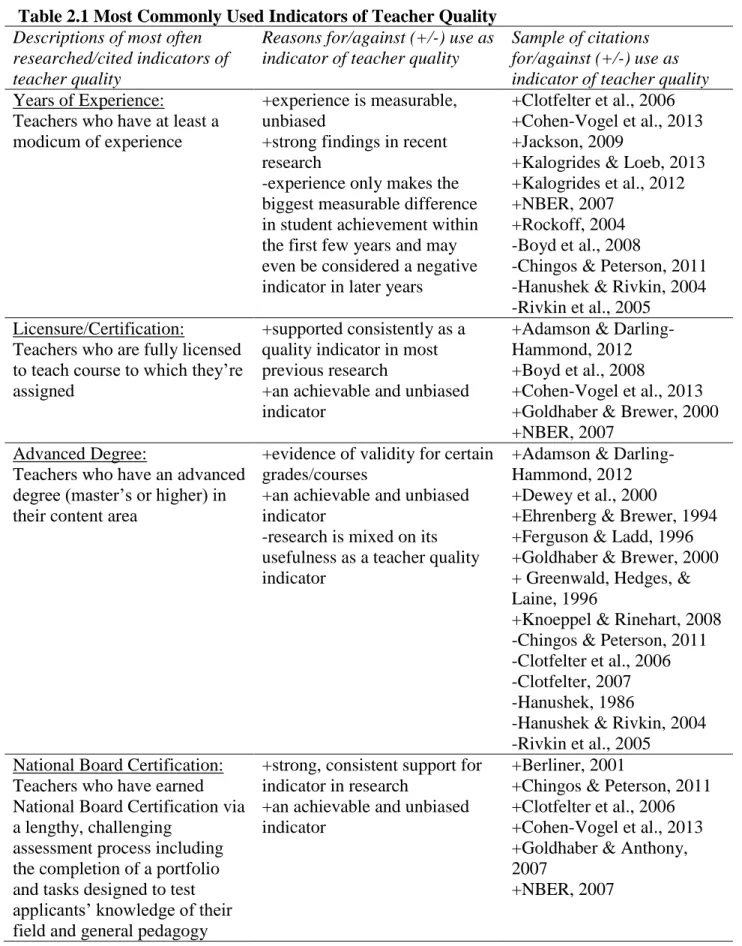
graduate and the outcomes of teacher observations/evaluations. See Table 2.1 for a list of teacher characteristics, reasons for or against their use as indicators of teacher quality, and a sampling of research citations that supported or disavowed their use as quality indicators in this study. Teacher Experience
There is perhaps no teacher quality indicator more widely studied or mentioned in
scholarly education research than teacher experience. There is not significant disagreement about two key factors related to teacher experience: that the majority of students taught by
inexperienced or novice teachers are from historically marginalized backgrounds and that experience correlates positively with achievement. There are however some mixed results regarding how significant of a role experience plays in teacher quality as detailed below. Studies attributed that a propensity of minority or low-income students are assigned to
teachers are assigned black, Hispanic, and/or low-income students more often than experienced teachers, yet are consistently less effective at raising student achievement than experienced teachers (Kalogrides et al., 2012), a finding supported by Boyd et al.’s (2008) study of New York City students. Hanushek and Rivkin presented findings that the majority of the expansion of the racial achievement gap between kindergarten and 8th grade occurs between schools rather than within them, with teacher experience playing a key role in the widening gap (NBER, 2006). Similarly, Cohen-Vogel et al. (2013) in their study of the distribution of teacher quality in Florida school districts found that the percentage of Hispanic students in a school district is significantly and negatively related to the lower-than-average percentage of teachers with three or more years of experience in the same district. Interestingly and perhaps contradictory, the same study found that districts with larger shares of students eligible for free or reduced-price lunch (an indicator of student poverty) appear to average larger percentages of experienced and nationally board certified teachers.
Table 2.1 Most Commonly Used Indicators of Teacher Quality Descriptions of most often
researched/cited indicators of teacher quality
Reasons for/against (+/-) use as indicator of teacher quality
Sample of citations for/against (+/-) use as indicator of teacher quality Years of Experience:
Teachers who have at least a modicum of experience
+experience is measurable, unbiased
+strong findings in recent research
-experience only makes the biggest measurable difference in student achievement within the first few years and may even be considered a negative indicator in later years
+Clotfelter et al., 2006 +Cohen-Vogel et al., 2013 +Jackson, 2009
+Kalogrides & Loeb, 2013 +Kalogrides et al., 2012 +NBER, 2007
+Rockoff, 2004 -Boyd et al., 2008
-Chingos & Peterson, 2011 -Hanushek & Rivkin, 2004 -Rivkin et al., 2005
Licensure/Certification:
Teachers who are fully licensed to teach course to which they’re assigned
+supported consistently as a quality indicator in most previous research
+an achievable and unbiased indicator
+Adamson & Darling-Hammond, 2012 +Boyd et al., 2008
+Cohen-Vogel et al., 2013 +Goldhaber & Brewer, 2000 +NBER, 2007
Advanced Degree:
Teachers who have an advanced degree (master’s or higher) in their content area
+evidence of validity for certain grades/courses
+an achievable and unbiased indicator
-research is mixed on its usefulness as a teacher quality indicator
+Adamson & Darling-Hammond, 2012 +Dewey et al., 2000
+Ehrenberg & Brewer, 1994 +Ferguson & Ladd, 1996 +Goldhaber & Brewer, 2000 + Greenwald, Hedges, & Laine, 1996
+Knoeppel & Rinehart, 2008 -Chingos & Peterson, 2011 -Clotfelter et al., 2006 -Clotfelter, 2007 -Hanushek, 1986
-Hanushek & Rivkin, 2004 -Rivkin et al., 2005
National Board Certification: Teachers who have earned National Board Certification via a lengthy, challenging
assessment process including the completion of a portfolio and tasks designed to test applicants’ knowledge of their field and general pedagogy
+strong, consistent support for indicator in research
+an achievable and unbiased indicator
+Berliner, 2001
+Chingos & Peterson, 2011 +Clotfelter et al., 2006 +Cohen-Vogel et al., 2013 +Goldhaber & Anthony, 2007
Teachers’ Scores on Tests: Teachers who scored more highly on college entrance exams and/or on certification exams
+research consistently correlates higher teacher test scores with higher student achievement and lower scores with lower student achievement +research consistently shows teachers with lower scores are assigned to at-risk students -scores may be inaccessible due to confidentiality with
personnel records
-SAT/ACT scores may not be universally accessible due to age of scores or teachers
+Boyd et al., 2008
+Chingos & Peterson, 2011 +Clotfelter et al., 2006 +Cohen-Vogel et al., 2013 +Jackson, 2009
+NBER, 2007
EVAAS/Value-Added: Student-specific, quantifiable data for the value added by the teacher based on growth from the previous year
+emphasis on teacher’s ability to influence student growth vs. student proficiency
+quantifiable indicator
-teacher/student matching can skew results
-validity/reliability concerns
+Boyd et al., 2008 +DOE, 2013 +NCEE, 2014 +NCDPI, 2016 -Kupermintz, 2003 -Lockwood, McCaffrey, Hamilton, Stecher, Le, and Martinez, 2007
- Loeb, Soland, & Fox, 2014 -Ravitch, 2010
Teacher Evaluations:
Teachers who perform well as evidenced by supervisory classroom observations and supervisory evaluations
+used by the state of North Carolina in its evaluation process
+may reflect relevant (albeit more qualitative) aspects of teacher quality not captured by student test scores
-lack of reliable measurability and correspondence with other indicators
-potentially influenced by subjectivity and/or bias -dearth of recent/current substantive scholarly research
+Jacob & Lefgren, 2008 +Rockoff & Speroni, 2010 -Milanowski, 2004
Undergraduate Institution: Teachers who attended more selective/competitive/highly rated colleges or universities
-recent research shows only a weak relationship with student achievement if it exists at all
+NBER, 2007 -Boyd et al., 2008
Rockoff (2004) used data on student test scores and teacher assignment to study the impact of teachers on student achievement and found that teacher experience is positively linked to reading test scores. Ten years of teaching experience can be predicted to raise vocabulary and comprehension test scores by 0.15 and 0.18 standard deviations respectively (Rockoff, 2004). He also found that two years of teaching experience appear to raise scores significantly for math computation—by approximately 0.1 standard deviations (Rockoff, 2004).
In their study of teacher-student matching with North Carolina fifth graders, Clotfelter et al. (2006) found that novice teachers are associated with the lowest student test scores. Students being assigned to highly experienced teachers resulted in math test scores approximately one-tenth of a standard deviation higher and reading scores slightly less than one-one-tenth of a standard deviation higher (Clotfelter et al., 2006).
The costs of being assigned an elementary school teacher with little to no experience are substantially higher for black students than for their white peers. The coefficients indicate that being assigned a novice teacher reduces achievement by -0.15 standard deviations for black students and by -0.08 standard deviations for white students from what it would be with a teacher with at least two years of prior experience (NBER, 2006). In another study of the effect of
Research (Clotfelter et al., 2003; Feng, 2010; Jackson, 2009; Kalogrides & Loeb, 2013) shows that the scheduling of minority and/or disadvantaged students to novice teachers occurs in every conceivable assignment dynamic: across districts, within schools, and within levels of courses within schools. Pulling data from “two complementary and… widely used national data sets,” Feng (2010) found that novice teachers generally “taught in schools with low-performing, minority, or ELL students from economically disadvantaged backgrounds” (p. 312). Within schools, novice teachers were more likely to teach larger shares of “low-performing, unruly students and students from disadvantaged backgrounds” (Feng, 2010, p. 312) than more
experienced colleagues. Utilizing empirical data from the North Carolina Department of Public Instruction through the North Carolina Education Research Data Center at Duke University, Clotfelter et al. (2003) found that black 7th grade students in North Carolina were 54% more likely to be assigned a novice math teacher than white 7th grade students and 38% more likely to be assigned a novice English teacher. This corresponds with the trend of distribution of students by levels of courses. In the state’s two largest districts—Wake and Mecklenburg—regardless of course level (remedial or standard), 7th grade black students were far more likely to be assigned a novice English or math teacher than white students (Clotfelter et al., 2003). Clotfelter et al.’s study (2003) is supported by Jackson (2009) who, in a study of the correlation of teacher quality and the end of student busing in Charlotte (the largest city in the state), found that schools which experienced an increased enrollment of black students concurrently suffered a decrease in the proportion of experienced teachers.
historically marginalized backgrounds are assigned more often to novice teachers and that they share classes with lower achieving and similarly less privileged peers than white and/or non-poor students in the same grade within the same school (Kalogrides & Loeb, 2013).
Research (Boyd et al., 2008; Chingos & Peterson, 2011; Hanushek & Rivkin, 2004; Rivkin et al., 2005) has found that while teacher experience does correlate positively with student achievement, there is a ceiling in terms of its positive impact on student outcomes. In their study which drew connections between education policy initiatives and various bodies of research on teacher characteristics and student outcomes, Hanushek and Rivkin (2004) found very little measurable achievement gains following the first few years of teaching—a finding that was supported by Rivkin et al. (2005) in their study of the impact of teacher quality on student outcomes in Texas. Boyd et al. (2008) studied the effects of differing amounts of teacher experience—as well as other quality indicators—on student achievement in New York City schools and found that teachers transitioning from complete inexperience to having just one year of teaching experience accounted for the largest experience-related gain in achievement—about 0.06 standard deviations (Boyd et al., 2008). Studying value-added reading and math test data of students in Florida (grades 4-8) for eight school years, Chingos and Peterson (2011) found an initial bump in teacher effectiveness after the first couple of years of on-the-job training but the results were modest—and even negative (declines after a few years in elementary math, after about 15 years in elementary reading, and steady declines in middle grades reading and math)— after that.
historically marginalized backgrounds was attributable to characteristics other than experience. Among 4th and 5th grade math teachers in high poverty schools, there was a difference in effect size (value added) of 0.11 between teachers of the top and bottom quintiles based on indicators excluding experience. Omitting experience as a factor in predicting achievement, the authors found that there was still an 11% difference of a standard deviation in achievement gains between the top and bottom quintiles of teachers—approximately twice the gains attributable to achievement gains associated with completion of the first year of experience (Boyd et al., 2008). The effects of other teacher quality indicators popular in scholarly research are detailed below. Licensure/Certification
The intent of teacher licensure or certification is to guarantee a basic level of competency, quality, or skill of school teachers (National Commission on Teaching and America’s Future [NCTAF], 1996). To demonstrate the relevance of teacher certification to student outcomes, Goldhaber and Brewer (2000) studied standardized math assessment results of 12th grade high school students whose assigned teachers either lacked certification or held probationary, emergency, or private school certification as compared with the results of students assigned to teachers holding standard certification in their subject area. Assignment of students to teachers who held a standard math certification resulted in at least a 1.3-point increase
were assigned to teach accounted for a reduction of 0.042 standard deviations. In a study of how funding disparities result in inequitable distribution of teacher quality in California and New York, Adamson and Darling-Hammond (2012) found that the percentage of teachers lacking full certification is significantly correlated to the percentage of students failing state English and math tests in New York and poorer state test performance in California.
In state after state, students from historically marginalized backgrounds are three to ten times more likely to be taught by teachers who are uncertified or teaching outside of their field of preparation than students of privilege (Darling-Hammond, 2010). Regarding the assignment of disadvantaged students specifically to teachers holding certification in their assigned subjects, Lankford et al. (2002) reported that 17% of non-white students in New York State were taught by teachers who lack certification in the subjects they were assigned to teach compared with 4% of white students. Similarly, Cohen-Vogel et al. (2013) in their study of collective bargaining agreements between teacher unions and school districts in Florida found that teachers in districts with high percentages of black and/or Hispanic students are less likely to be fully certified. Is the mere obtainment of a bachelor’s degree sufficient enough to provide quality instruction? The next section details research germane to the value of students being assigned to teachers who hold advanced degrees.
Advanced Degrees
When it comes to using the level of a teacher’s education as a reliable indicator of teacher quality, the results were decidedly mixed but—similar to experience and
quality indicators including graduate education of teachers and teacher experience had no
correlation with student achievement. Similarly, in their study which connected education policy initiatives with various bodies of research on teacher characteristics and student outcomes, Hanushek and Rivkin (2004) found that “a master’s degree has no systematic relationship to teacher quality as measured by student outcomes” (p. 14). Surprisingly, Clotfelter et al. (2006) in their study of teacher-student matching with North Carolina fifth graders found a “consistently negative effect” on achievement for students assigned to a teacher with a master’s degree than for students whose teachers did not possess a master’s degree leading to the suggestion that “teachers with master’s degrees are less effective than those without” (p. 799). Studying value-added reading and math test data of students in Florida (grades 4-8) for 8 school years, Chingos and Peterson (2011) found that holding a master’s degree did not correlate positively with teacher effectiveness. In a study of the links between teacher credentials and student
achievement, Clotfelter, Ladd and Vigdor (NBER, 2007) analyzed data on students and teachers in North Carolina over a ten-year span and similarly concluded that there was no statistically significant effect on student achievement as a result of teachers holding master’s degrees and in some cases, there was a statistically negative effect—a result mirrored by Rivkin et al. (2005) in their study of the impact of teacher quality on student achievement that utilized data from Texas students and teachers.