
Self-interrupted synthesis of sterically hindered
aliphatic polyamide dendrimers
Davit Jishkariania,1, Christopher M. MacDermaidb,1, Yam N. Timsinaa,1, Silvia Gramaa, Syeda S. Gillania, Masoumeh Divara, Srujana S. Yadavallic, Ralph-Olivier Moussodiaa, Pawaret Leowanawata, Angely M. Berrios Camachoa, Ricardo Walterd,2, Mark Goulianc, Michael L. Kleinb,3, and Virgil Perceca,3
aRoy and Diana Vagelos Laboratories, Department of Chemistry, University of Pennsylvania, Philadelphia, PA 19104-6323;bInstitute of Computational
Molecular Science, Temple University, Philadelphia, PA 19122;cDepartment of Biology, University of Pennsylvania, Philadelphia, PA 19104-6313
anddDepartment of Preventive and Restorative Sciences, School of Dental Medicine, University of Pennsylvania, Philadelphia, PA 19104-6030
Contributed by Michael L. Klein, February 7, 2017 (sent for review January 18, 2017; reviewed by Ezequiel Perez-Inestrosa and Donald A. Tomalia)
2,2-Bis(azidomethyl)propionic acid was prepared in four steps and 85% yield from the commercially available 2,2-bis(hydroxymethyl) propionic acid and used as the starting building block for the divergent, convergent, and double-stage convergent–divergent iter-ative methods for the synthesis of dendrimers and dendrons con-taining ethylenediamine (EDA), piperazine (PPZ), and methyl 2,2-bis(aminomethyl)propionate (COOMe) cores. These cores have the same multiplicity but different conformations. A diversity of syn-thetic methods were used for the synthesis of dendrimers and den-drons. Regardless of the method used, a self-interruption of the synthesis was observed at generation 4 for the dendrimer with an EDA core and at generation 5 for the one with a PPZ core, whereas for the COOMe core, self-interruption was observed at generation 6 dendron, which is equivalent to generation 5 dendrimer. Molecular modeling and molecular-dynamics simulations demonstrated that the observed self-interruption is determined by the backfolding of the azide groups at the periphery of the dendrimer. The latter conformation inhibits completely the heterogeneous hydrogena-tion of the azide groups catalyzed by 10% Pd/carbon as well as homogeneous hydrogenation by the Staudinger method. These self-terminated polyamide dendrimers are enzymatically and hydrolytically stable and also exhibit antimicrobial activity. Thus, these nanoscale constructs open avenues for biomedical applications.
dendrons
|
ethylenediamine core|
piperazine core|
antimicrobials|
nanomedicineA
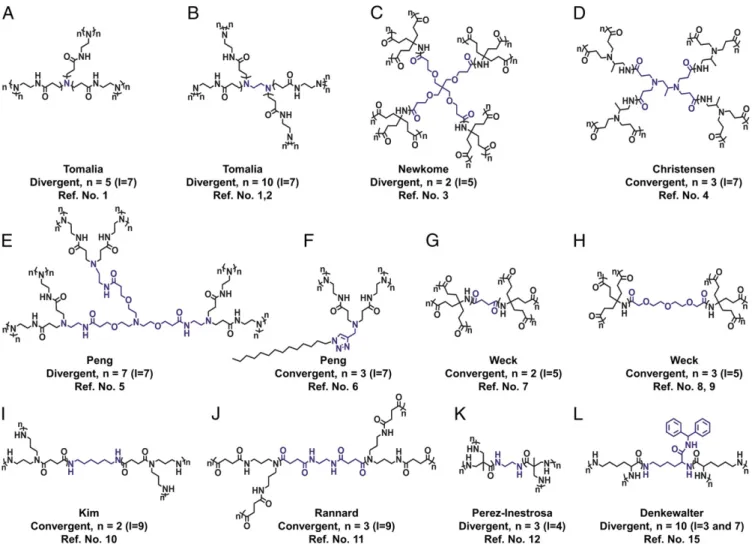
liphatic polyamide (1–14) and peptide (15) dendrimers are complex monodisperse, functional compounds (16) synthesized by iterative divergent (1), convergent (17), and double-stage con-vergent–divergent (18) methods. Their nanoarchitecture emerges by increasing their generation number from ellipsoidal or disk-like 2D to 3D globular constructs (16, 19–25). Their core and branch mul-tiplicities, as well as branch cell segment length (l), determine the generation number at which dendrimers become globular (19–21). Dendrimers synthesized by divergent iterative methods are expected to contain their functional groups, which increase in number with core and branch multiplicities as well as with their generation number, at the periphery of their 2D or 3D architectures (16, 19, 21). Dendrons and dendrimers produced by convergent strategies contain one functional group at their apex, whereas the rest of them are at their periphery (16, 17, 20, 23–25). Ultimately at a certain generation, dendrons also become globular dendrimers with their functional group from the apex becoming encapsulated at the core of the globular object (22–25). The large concentration of functional groups at the periphery of the globular object in-spired a diversity of functions of biomedical interest that are not accessible with their linear homologs (26–31). Biomedical utility has propelled the field of aliphatic polyamide dendrimers to an unprecedentedly high level of expectations (26–31). Simultaneous with the interest in biomedical applications, it was predicted that a dense surface packing state generated by the presence of allfunc-tional groups on the periphery of the dendrimer would provide a critical packing state, above which a sterically inhibited reaction rate would be observed (32). Above this critical packing state, the lower reactivity of the functional groups on the periphery would provide globular dendrimers with incompletely reacted functional groups, thus generating an imperfect dendrimer struc-ture (1, 2). Indeed, the most investigated, and best-elucidated, aliphatic polyamide [polyamidoamine (PAMAM)] dendrimer discovered and commercialized by Tomalia (Fig. 1) has been shown to exhibit an inhibited reaction rate of its functional groups at generations 4–7 as well as display a significant decrease in re-action rate at generations 7–8, although it could be synthesized with an imperfect structure up to generation 12 (2). Moreover, all other aliphatic polyamide dendrimers have been reported for only relatively low generations, without any explanation (Fig. 1).
This decrease in functional group reactivity on the surface of dendrimers was also explained by backfolding of peripheral groups (33, 34). Regardless of the mechanism that controls re-activity, the efficacy of a biomedical application is likely corre-lated with the reactivity of the peripheral functional groups of the dendrimer because incomplete interactions or reactions would generate, by analogy with iterative synthesis of higher dendrimer generations, an imperfect biologically active conju-gated product. Herein, we report the divergent, convergent, and double-stage convergent–divergent iterative synthesis of a steri-cally hindered aliphatic polyamide dendrimer (12) by a diversity
Significance
Hydrolytically and enzymatically stable nanoscale synthetic constructs, with well-defined structures that exhibit antimi-crobial activity, offer exciting possibilities for diverse applica-tions in the emerging field of nanomedicine. Herein, we demonstrate that it is the core conformation, rather than pe-riodicity, that ultimately controls the synthesis of sterically hindered aliphatic polyamide dendrimers. The latter self-interrupt at a predictable low generation number due to back-folding of their peripheral groups, which in turn leads to well-defined nanoarchitectures.
Author contributions: D.J., C.M.M., Y.N.T., S.S.Y., R.W., M.G., M.L.K., and V.P. designed research; D.J., C.M.M., Y.N.T., S.G., S.S.G., M.D., S.S.Y., R.-O.M., P.L., and A.M.B.C. per-formed research; D.J., C.M.M., Y.N.T., S.G., S.S.Y., R.-O.M., P.L., M.G., M.L.K., and V.P. contributed new reagents/analytic tools; D.J., C.M.M., Y.N.T., S.G., S.S.G., M.D., S.S.Y., R.-O.M., P.L., M.G., M.L.K., and V.P. analyzed data; and D.J., C.M.M., Y.N.T., S.G., S.S.Y., R.W., M.G., M.L.K., and V.P. wrote the paper.
Reviewers: E.P.-I., University of Malaga; and D.A.T., NanoSynthons LLC. The authors declare no conflict of interest.
1D.J., C.M.M., and Y.N.T. contributed equally to this work.
2Present address: Department of Operative Dentistry, University of North Carolina,
Chapel Hill, NC 27599-7450.
3To whom correspondence may be addressed. Email: [email protected] or mlklein@
temple.edu.
This article contains supporting information online atwww.pnas.org/lookup/suppl/doi:10. 1073/pnas.1700922114/-/DCSupplemental.
CHE
MISTRY
PNAS
of synthetic methods. Unexpectedly, self-interruption of the syn-thesis of this dendrimer was discovered at a generation that is determined by the conformation rather than the multiplicity of its core.
Results and Discussion
Selecting the Aliphatic Poly(amide) Dendrimer and the Synthesis of Its Building Block. The most sterically congested dendrimer reported to date (Fig. 1) (12) was selected to evaluate the re-activity of its functional groups as a function of generation number and core structure and compare it with nonsterically hindered aliphatic polyamide dendrimers.
This sterically hindered aliphatic polyamide dendrimer is expec-ted to provide an amplification effect of the reactivity of similar functional groups available in less sterically hindered dendrimers. This sterically hindered aliphatic polyamide is also synthetically at-tractive because it was originally prepared from the inexpensive and commercially available 2,2-bis(hydroxymethyl)propionic acid AB2 building block (1in Fig. 2) (12), which was previously used in the divergent iterative synthesis of five generations of aliphatic polyester dendrimers (35, 36) that are commercially available (37), as well as in the synthesis of amphiphilic Janus dendrimers that self-assemble in biomedically interesting dendrimersomes (38, 39).
The starting material for the iterative synthesis of the current ali-phatic polyamide dendrimer is the AB22,2-bis(azidomethyl)propionic acid (compound 7 in Fig. 2) that was previously obtained in 66% yield via the three reactions steps involving1,2, and3(Fig. 2) (12). Attempts to improve the low yield of this synthesis failed.
Modification of this synthesis led to a more efficient four steps procedure involving1,4,5, and6to produce7in 85% yield while reducing the overall reaction time from 92 to 38 h (Fig. 2) and performing all steps under milder reaction conditions.
The carboxylic group of 7 was activated as an ester of 1-hydroxybenzotriazole (HOBt) either by the direct esterification of 7 with HOBt in the presence of N,N′ -dicyclohexylcarbodii-mide (DCC) and a catalytic amount of 4-dimethylaminopyridine (DMAP) to produce9in 92% yield or by the esterification of8in the presence of Et3N to generate9in only 69% yield. Amidation of EDA followed by iterative reduction/amidation steps produced consistently four generations of dendrimers in up to 20% higher yields than the acid chloride methods (Fig. 2). However, the re-duction of G4(EDA)N3generated by the HOBt-activated method could not be accomplished.
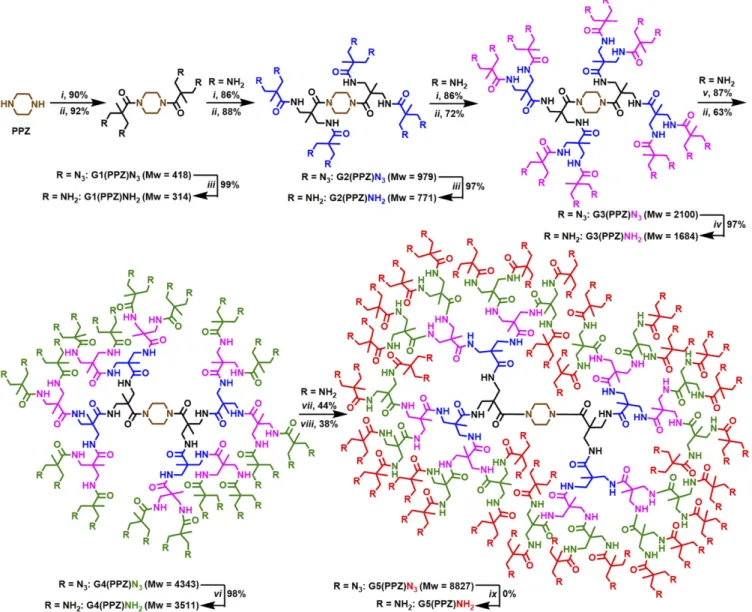
Divergent Synthesis of Five Dendrimer Generations with a Piperazine Core.Disubstituted EDA and piperazine (PPZ) exhibit the same multiplicity but different conformations (43–45). The same core multiplicity with different conformations was not previously in-vestigated in the synthesis of dendrimers (1, 2, 16, 46). The di-vergent iterative methods based on the acid chloride 8 and the HOBt ester9of 7were both used in the synthesis of polyamide dendrimers. High yields (63–92%) were obtained for the first four generations with both methods (Fig. 3). However, by contrast with
the EDA core that allowed the synthesis of only four generations, the PPZ generated five generations of dendrimers. G5(PPZ)N3was obtained in 44–38% yield with both methods. Attempts to hydro-genate G5(PPZ)N3to G5(PPZ)NH2failed.
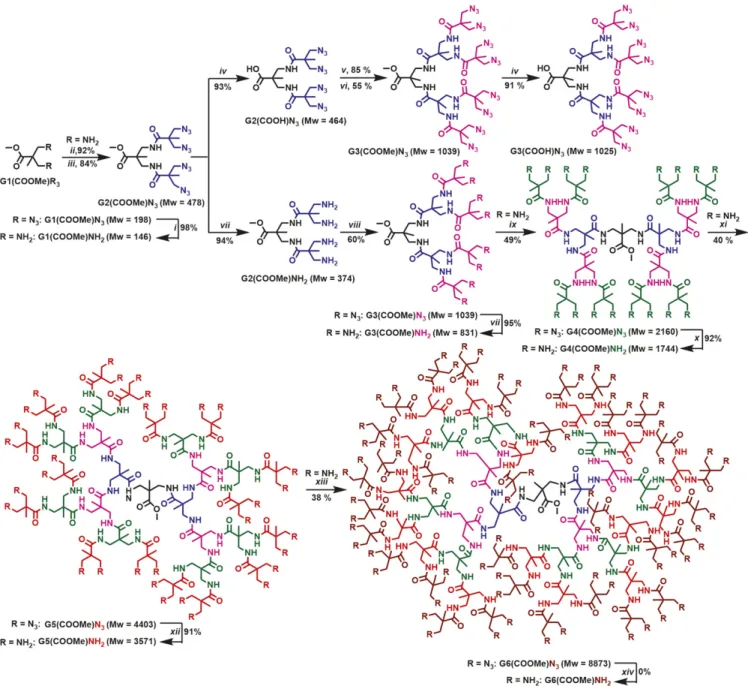
Divergent Synthesis of Six Dendron Generations.The focal point of the polyamide dendrons was generated by the reduction of the azide groups of G1(COOMe)N3(compound 6 from Fig. 2) to NH2to generate G1(COOMe)NH2in 98% yield (Fig. 4). Ami-dation of G1(COOMe)NH2 with 9 (Fig. 2) or with8 (Fig. 2) produced G2(COOMe)N3 in 92% and 84% yield, respectively (Fig. 4). Hydrolysis of the methyl ester of G2(COOMe)N3 pro-duced G2(COOH)N3 in 93% yield (Fig. 4). Activation of the COOH group of G2(COOH)N3as HOBt ester or as acid chlo-ride followed by amidation with G1(COOMe)N3 produced G3(COOMe)N3(85% and 55% yields), which was hydrolyzed to G3(COOH)N3(91% yield) (Fig. 4).
Reduction of the azide groups of G2(COOMe)N3 to G2(COOMe)NH2(94% yield) followed by its amidation with9 produced G3(COOMe)N3 (60% yield), which was reduced to G3(COOMe)NH2(95% yield) and amidated with9to generate Fig. 2. Synthesis of 2,2-bis(azidomethyl)propionic acid, its carboxylic acid-activated forms, and the divergent synthesis of four generations of aliphatic polyamide dendrimers containing ethylenediamine (EDA) core. Reagents and conditions: (i) SOCl2, dimethylformamide (DMF) (23 °C, 18 h, reflux, 24 h); (ii)
H2O, 7 M NaOH (0 °C, 2 h); (iii) NaN3, DMF:H2O (9:1) (80 °C, 48 h); (iv) MeOH, Amberlyst-15 (reflux, 5 h); (v) methanesulfonyl chloride (MsCl), triethylamine
(Et3N), CH2Cl2(0–23 °C, 7 h); (vi) NaN3, DMF (90 °C, 24 h); (vii) NaOH, MeOH/THF/H2O [1/1/1 (vol/vol/vol)] (50 °C, 2 h); (viii) SOCl2, CH2Cl2(3 h, reflux); (ix)
1-hydroxybenzotriazole (HOBt), Et3N, CH2Cl2(0 °C, 0.5 h, then 23 °C, 12 h); (x) HOBt,N,N’-dicyclohexylcarbodiimide (DCC), 4-dimethylaminopyridine (DMAP),
CH2Cl2(23 °C, 1 h, then 35 °C, 2 h); (xi)8, Et3N, CH2Cl2(–78 °C, 0.5 h, then 23 °C, 12 h); (xii)9, Et3N, CH2Cl2(23 °C, 24 h); (xiii) 10% Pd/C [10% (wt/wt)], H2
(120 psi) (23 °C, 2 h); (xiv) 10% Pd/C [30% (wt/wt)], H2(120 psi) (23 °C, 3 h); and (xv) 10% Pd/C [80% (wt/wt)], H2(120 psi) (23 °C, 3 h).
CHE
MISTRY
PNAS
G4(COOMe)N3(49% yield) that was reduced to G4(COOMe)NH2 in 92% yield. Repeating this amidation/reduction iteration on G4(COOMe)NH2 produced G5(COOMe)NH2 in 40% yield. Amidation of G5 with9produced G6(COOMe)N3in 38% yield. All attempts to reduce the azide groups of G6(COOMe)N3to G6(COOMe)NH2 failed. This is not surprising because the G6(COOMe)N3 dendron is equivalent to a G5 dendrimer that contains at the focal point the methyl ester of 2,2-bis(aminomethyl) propionic acid (Fig. 4).
This focal point has the same multiplicity as EDA (Fig. 2) and PPZ (Fig. 3) except that it contains an additional tetrahedral carbon isolating the methylenic units from EDA or PPZ (Fig. 4).
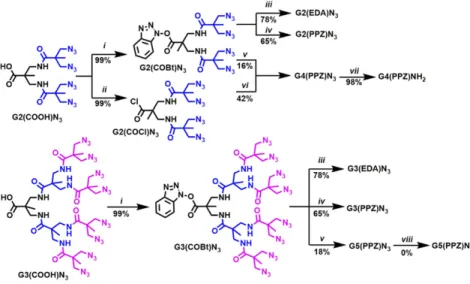
Accelerated Double-Stage Convergent–Divergent Synthesis of Three EDA Generations and Five PPZ Generations of Dendrimers. An accelerated double-stage convergent-divergent synthesis was also used for the synthesis of dendrimers containing EDA and PPZ at their core (Fig. 5). G2(COOH)N3(Fig. 4) was activated both as HOBt ester and as acid chloride (both in 99% conversion and used without purification) (Fig. 5), whereas G3(COOH)N3(Fig. 4) was activated only as HOBt ester (99% conversion and used
without purification). These activated compounds were reacted with EDA and PPZ to produce G2(EDA)N3 (78% yield), G2(PPZ)N3(65% yield), G3(EDA)N3(78% yield), and G3(PPZ)N3 (65% yield) (Fig. 5). Amidation of G2(PPZ)NH2(Fig. 3) with G2(COBt)N3and G2(COCl)N3generated G4(PPZ)N3in 16% and 42% yields (Fig. 5).
Finally, G3(COBt)N3was reacted with G2(PPZ)NH2to produce G5(PPZ)N3in 18% yield. Repeated attempts to reduce the azide groups of G5(PPZ)N3to generate G5(PPZ)NH2did not succeed.
Structural Analysis of Dendrimers and Dendrons.Structural analysis of all dendrimers and dendrons prepared by divergent and accelerated double-stage convergent–divergent methods by a combination of 500-MHz 1H-NMR (SI Appendix, Figs. S1 and S2), 126-MHz13C-NMR spectroscopy (SI Appendix, Figs. S3 and S4), gel permeation chromatography (GPC) (Fig. 6A), and ma-trix-assisted laser desorption/ionization time of flight (MALDI-TOF) (Fig. 6B) demonstrated perfectly monodisperse com-pounds with molar masses equal to their theoretical values. This demonstrates that, although the reactivity of the azide and amine groups from their periphery may decrease while the generation Fig. 3. Divergent synthesis of five generations of aliphatic polyamide dendrimers containing piperazine (PPZ) core. Reagents and conditions: (i)9, Et3N,
CH2Cl2(23 °C, 24 h); (ii)8, Et3N, CH2Cl2(–78 °C, 0.5 h, then 23 °C, 12 h); (iii) 10% Pd/C [15% (wt/wt)], H2(120 psi) (23 °C, 3 h); (iv) 10% Pd/C [20% (wt/wt)], H2
(120 psi) (23 °C, 3 h); (v)9, Et3N, CH2Cl2(23 °C, 48 h); (vi) 10% Pd/C [50% (wt/wt)], H2(120 psi) (23 °C, 8 h); (vii)9, Et3N, CH2Cl2(23 °C, 72 h); (viii)8, Et3N, CH2Cl2
number increases, there is a generation number at which at least the azide groups become completely inactive toward heteroge-neous hydrogenation catalyzed with 10% Pd/C as well as ho-mogeneous hydrogenation by the Staudinger reaction. This lack of reactivity produces a self-interruption of the dendrimer syn-thesis process. Notably, this generation number is controlled by the structure of the core even when the multiplicity of the core is identical. This demonstrates that the conformation of the core is either as important or even more important than its multiplicity.
Molecular Modeling and Molecular-Dynamics Simulations of Azido-Terminated Dendrimers. Long-timescale fully atomistic molecu-lar-dynamics simulations, based on state-of-the-art force fields,
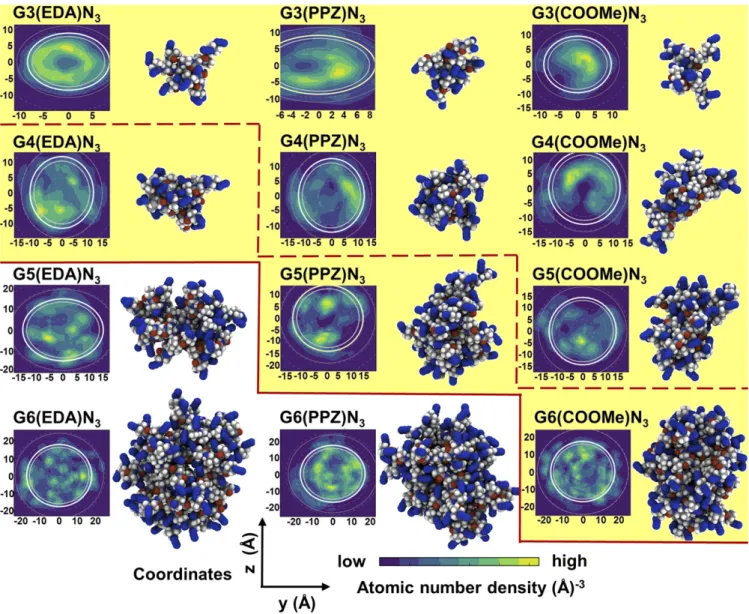
demonstrate that the observed decrease in reactivity of the den-drimer’s peripheral groups is commensurate with increasing se-questration of these groups and an overall compactness of the dendrimer. Calculated atom number densities and radial distribu-tion funcdistribu-tions (Figs. 7 and 8) indicate that an increasing number of terminal groups are backfolded into the dendrimer interior or are trapped in invaginations created on the dendrimers surface.
The calculated radius of gyration of the peripheral groups
Rg(N3), demarcated by the solid white line in the density con-tours of Fig. 7, is only slightly greater than the radius of gyration of the dendrimer (inner gray line), but always much less than that of its calculated radius of solvent accessible surface area (rSASA, outer gray line), indicating a tightly compact structure.
Fig. 4. Synthesis of the methyl ester of 2,2-bis(aminomethyl)propionic acid, the convergent synthesis of three generations, and the divergent synthesis of six generations of aliphatic polyamide dendrons. Reagents and conditions: (i) 10% Pd/C [10% (wt/wt)], H2(120 psi), MeOH (23 °C, 3 h); (ii)9, Et3N, CH2Cl2(23 °C,
24 h); (iii)8, Et3N, CH2Cl2(–78 °C, 0.5 h, then 23 °C, 12 h); (iv) NaOH, THF/MeOH/H2O [1/1/1 (vol/vol/vol)] (50 °C, 2 h); (v) DCC, HOBt, CH2Cl2(23 °C, 6 h, then
35 °C, 2 h), then G1(COOMe)NH2, Et3N, CH2Cl2, (23 °C, 24 h); (vi) SOCl2, CH2Cl2(reflux, 4 h), then G1(COOMe)NH2, Et3N, CH2Cl2(–78 °C, 0.5 h, then 23 °C, 15 h);
(vii) 10% Pd/C [10% (wt/wt)], H2(120 psi), MeOH (23 °C, 2 h); (viii)9, Et3N, CH2Cl2(23 °C, 24 h); (ix)9, Et3N, CH2Cl2(23 °C, 48 h); (x) 10% Pd/C [20% (wt/wt)], H2
(120 psi), MeOH (23 °C, 2 h); (xi)9, Et3N, CH2Cl2(23 °C, 48 h); (xii) 10% Pd/C [30% (wt/wt)], H2(120 psi), MeOH (23 °C, 2 h); (xiii)9, Et3N, CH2Cl2(23 °C, 48 h); and
(xiv) 10% Pd/C [80% (wt/wt)], H2(120 psi), MeOH (23 °C, 2 h).
CHE
MISTRY
PNAS
This ratio,Rg(N3)/rSASAis always less than 1 and decreases as the dendrimer generation increases, indicating a propensity of the outer groups to compact into the dendrimer structure, rather than expand into the bulk solvent. This presumably leads to the observed decrease and eventual cessation of their reactivity. Furthermore, and most importantly, this ratio is also dependent on the chosen core type, with the Rg(N3)/rSASA decrease per generation being most pronounced for the EDA core, followed by that of PPZ and finally COOMe. Thus, the computations fully support the observation that the chosen core type influences the reactivity of the peripheral groups, with the most rigid core having the most pronounced effect. Last, the calculated radial distribution functions,ρ(r) show a nonzero probability of finding terminal groups (Fig. 8, solid teal line) backfolded into the dendrimer. Calculated 3D atom number densities (Fig. 7, yellow hotspots) indicate buried terminal groups as well.
Given the observed compactness of the dendrimer’s structure, we wondered whether reactants could penetrate into the den-dritic interior to react with the buried terminal groups. Using a spherical probe with various radii, the surface areas of the model dendrimers were calculated. Because the square root of the
surface area of a sphere is linearly proportional to the probe radius, any computed deviations from linearity between these values indicate penetration by the probe into the dendrimer in-terior. Only a smaller probe can penetrate into surface invagina-tions, leading to an apparent increase in surface area. Deviations are indeed observed with probe radii less than∼3 Å (Fig. 9) be-ginning with the fourth-generation dendrimer and are more pro-nounced at smaller probe radii and larger dendrimer generations.
This suggests that, in order for reactants to penetrate the surface of the dendrimer, they must have an apparent radius less than ∼3 Å, or about the average distance between two oxygen atoms in bulk water. Couple this with the likelihood for the reactant molecule to at least partially desolvate to penetrate, and the observed decrease in reactivity of the terminal groups becomes quite clear.
Antimicrobial Properties of Dendrimers and Susceptibility to Enzymatic and Chemical Hydrolysis.Naturally occurring peptides as well as synthetic mimics including peptoids are known to exhibit antimi-crobial activities (47–53). To test for potential antimicrobial ac-tivity of the present aliphatic polyamide dendrimers terminated with amine, cell viability assays using resazurin were performed. Fig. 5. Accelerated double-stage convergent–divergent synthesis of three EDA generations and five PPZ gener-ations of aliphatic polyamide dendrimers. (i) HOBt, DCC, CH2Cl2(23 °C, 1 h, then 35 °C, 5 h); (ii) SOCl2, CH2Cl2
(reflux, 4 h); (iii) EDA, Et3N, CH2Cl2(23 °C, 24 h); (iv) PPZ,
Et3N, CH2Cl2(23 °C, 24 h); (v) G2(PPZ)NH2, Et3N, CH2Cl2
(23 °C, 12 h); (vi) G2(PPZ)NH2, Et3N, CH2Cl2(–78 °C, 0.5 h,
then 23 °C, 12 h); (vii) 10% Pd/C [50% (wt/wt)], H2
(120 psi) (23 °C, 8 h); (viii) 10% Pd/C [80% (wt/wt)], H2
(120 psi) (23 °C, 8 h).
Fig. 6. GPC traces (A) of Gn(EDA)N3(n=1–4) and Gn(PPZ)N3(n=1–5) dendrimers and Gn(COOMe)N3(n=1–6) dendrons and MALDI-TOF spectra (B) of
Gn(EDA)NH2(n=1–3) and Gn(PPZ)NH2(n=1–4) dendrimers and Gn(COOMe)NH2(n=2–5) dendrons. Calc. and Obs. are the molecular weights calculated and
Resazurin is a redox indicator dye, which provides a readout for bacterial cell growth and viability (54). The minimal inhibitory concentration (MIC) is measured as described in Methods. G4(PPZ)NH2 was found to be active against all Gram-positive bacteria that were tested (Bacillus subtilis, Bacillus cereus, Micro-coccus luteus, andStaphylococcus aureus—seeSI Appendix, Table S2, for MIC estimates). G2(PPZ)NH2did not display antibacterial activity at concentrations up to 1,024μg/mL.
To test susceptibility to enzymatic hydrolysis, polyamide den-drimers G2(PPZ)NH2, G4(PPZ)NH2, and G4(PPZ)N3 were treated with a broad-spectrum protease, proteinase K (EC 3.4.21.64) (55), which is a serine protease with a broad specificity toward peptide substrates, and analyzed by 1H NMR and MALDI-TOF (Methods). All three dendrimers were found to be stable against enzymatic degradation (MethodsandSI Appendix). The hydrolytic stability of these dendrimers was tested for 24 h at 23 °C and 80 °C under base-catalyzed conditions for G4(PPZ)N3 and for G3(EDA)NH2 under acid-catalyzed conditions.
Un-expectedly, no hydrolysis was observed under any of these con-ditions (MethodsandSI Appendix). The enzymatic and hydrolytic stability of these aliphatic polyamide dendrimers make them likely candidates for biomedical applications.
Conclusions
Sterically hindered aliphatic polyamide dendrimers are expected to amplify the dependence of the reactivity of their peripheral functional groups on their core structure and generation number. Understanding this reactivity–core structure–generation de-pendence is important to elucidate the synthesis of such con-structs for potential applications in nanomedicine. Toward this goal, a study of the divergent, convergent, and double-stage convergent–divergent iterative synthesis of the most sterically hindered polyamide dendrimer known to date (12) was per-formed in gram quantities (Fig. 10) with three different cores (EDA, PPZ, COOMe) having the same multiplicity but different conformations.
Fig. 7. Two-dimensional slices of the 3D average atom number densities (in atoms per cubic angstrom) of the terminal N3groups, and molecular renders for
Gn(EDA)N3(n=3–6), Gn(PPZ)N3(n=3–6) dendrimers, and Gn(COOMe)N3(n=3–6) dendrons. Continuous red line marks the maximum generation number
synthesized for the azide dendrimers with EDA, PPZ, and COOMe cores. Dotted red line marks the maximum generation number of the azide dendrimers that could be hydrogenated to the corresponding amines. In the molecular renders, carbon atoms are colored gray; nitrogen, blue; oxygen, red; and hydrogen, white. The number density contours are centered on the dendrimer’s center of mass (x=0,z=0) and look along thexaxis. Dashed gray lines demarcate radial separations of 5 Å. The solid lines denote calculated properties: the radius of gyration (Rg) of the dendrimer (inner gray line), theRgof the terminal N3groups
(thick white line), and the radius of the solvent-accessible surface area (rSASA) (outer gray line).
CHE
MISTRY
PNAS
A four-step synthesis in high yield, short reaction time, and under mild reaction conditions of the starting compound [2,2-bis(azidomethyl)propionic acid obtained from the commercial 2,2-bis(hydroxymethyl)propionic acid] was elaborated to facili-tate this study. Unexpectedly, the conformation rather than the multiplicity of the core provided self-interruption of the iterative synthesis at a predictable generation number. These results ex-pand on previous work that predicted and demonstrated a change in the reactivity of the functional groups for less sterically hindered polyamide dendrimers such as PAMAM (1, 2, 32). Molecular modeling and molecular-dynamics simulations dem-onstrated that this self-interruption is likely due to the back-folding of the functional groups on the dendrimer periphery. The steric hindrance of these aliphatic polyamide dendrimers makes them behave like peptoids (53) rather than as peptides of
β-amino acids, and consequently they are both enzymatically and hydrolytically stable. While demonstrating self-interruption syn-thesis of sterically hindered aliphatic polyamide dendrimers, these experiments also provided quantitative mechanistic in-sights into the De Gennes self-limiting growth and dense packing parameters (32). This combination of function together with their gram quantity synthesis, and their antimicrobial properties,
make these dendrimer nanoarchitectures interesting candidates for nanomedicine.
Methods
Synthesis of Dendrimers and Dendrons.Dendrimers and dendrons were syn-thesized by divergent, convergent, and double-stage convergent–divergent iterative methods starting from the commercially available 2,2-bis(hydroxy-methyl)propionic acid. Details of their synthesis and structural analysis methods and data are available inSI Appendix.
In Silico Modeling and Molecular-Dynamics Simulations.The monomers used in constructing models of the dendrimer macromolecules were taken from ref. 12. The molecules were described by the Amber GAFF forcefield (56) except for the terminal azido group for which parameters were used from previous work (57). Fully atomistic molecular-dynamics simulations were performed using NAMD 2.11 (58). The NPT ensemble was applied with a temperature of 300 K and a pressure of 1.0 atm. Methanol was used as a solvent and was described using the Amber force field. A time step of 1 fs was used. Tra-jectories of each of the 18 systems (3 cores, 6 generations each) were col-lected for a minimum of 100 ns, of which the last 20 ns was used for analysis. Dendrimer rmsd and autocorrelation functions of the square of the radius of gyration were used to establish equilibrium and relevant decorrelation Fig. 8. Radial distribution functionsρ(r) of (A) Gn(EDA)N3(n=3–6), (B) Gn(PPZ)N3(n=3–6) dendrimers, and (C) Gn(COOMe)N3(n=3–6) dendrons. The
calculations were done using the dendrimer and dendron center of mass as a reference (r=0 Å). The unit value forρ(r) is expressed in atoms per cubic angstrom and quantifies the number of atoms in the volume element given by 4πr2. The abbreviations in the legends stand for the following: ALL, Gn(EDA/
PPZ/COOMe)N3dendrimer or dendron; AmMPA, 2,2-bis(aminomethyl)propionic acid repetitive units; AzMPA, 2,2-bis(azidomethyl)propionic acid unit; CORE,
times. The VMD software package (59) was used to perform the following analyses: the radial distribution function, autocorrelation function, radius of gyration, solvent-accessible surface area, fractal dimension, and aspect ra-tios. The MD analysis package (60) was used to calculate the 3D atomic densities. Thorough accounts of the modeling and simulation details are available inSI Appendix.
Cell Viability Assays Using Resazurin.Cell viability assays to determine MICs were performed using resazurin based on established protocols (61). Satu-rated cultures of the strains to be tested were grown in Mueller Hinton broth (MHB) (Difco) at 37 °C with aeration for 16–18 h. The cultures were then diluted 1:100 in fresh MHB and allowed to grow to an optical density at 600 nm (OD600) of∼0.2. A 2×dilution scheme of the test dendrimer was
prepared in MHB in a 96-well clear microtiter plate such that the final concentrations were 0, 1, 2, 4, 8, 16, 32, 64, 128, 256, 512, and 1,024μg·mL−1
in a 50-μL volume. Five microliters of 0.675% resazurin stock solution was added to each well containing the dendrimer solution. Cultures grown to
OD600were diluted 1:100 fold and 50μL of cells were added to each well.
The plate was placed on a shaker for 15 min, followed by stationary in-cubation at 37 °C for 16–18 h. ForM. luteus, the incubation was carried out for∼48 h as the strain grows slowly at 37 °C. Resazurin turns from blue to pink color as a function of cell growth. A MIC value was determined by the lowest concentration of dendrimer at which there was no color change. All estimates were derived from at least three independent trials.
Proteinase K Digestion.Proteinase K digestions of the dendrimers terminated with an amine group were performed as follows: 5 mg of the dendrimer G2(PPZ)NH2or G4(PPZ)NH2was added to 5 mg of proteinase K in a
micro-centrifuge tube and resuspended in 200 μL of 30 mM Tris·HCl, pH 8. A control for proteinase K without addition of dendrimer was included. The tubes were incubated at 37 °C overnight. Following∼16 h at 37 °C, the above reactions were dehydrated at room temperature in a Speedvac to facilitate analysis of samples by NMR and MALDI-TOF. All of the
Fig. 10. Gram-scale synthesis of G4(PPZ)NH2using the 1H-benzo[d][1,2,3]triazol-1-yl-2,2-bis(azidomethyl)propanoate,9.
Fig. 9. Square root of solvent-accessible surface area (SASA) as a function of probe radiuspfor (A) Gn(EDA)N3(n=1–6) and (B) Gn(PPZ)N3(n=1–6)
dendrimers, and (C) Gn(COOMe)N3(n=1–6) dendrons. Color code: blue (n=1), green (n=2), gray (n=3), red (n=4), orange (n=5), and yellow (n=6).
Deviations from linearity indicate probe sizes necessary to penetrate the dendrimer surface and explore small cavities and surface invaginations. For gen-erationsn=4–6, probe sizes less thanr∼3 Å are required for penetration, suggesting that reactants must be at least this small to interact with the se-questered 2,2-bis(azidomethyl)propionic acid (AzMPA) groups.
CHE
MISTRY
PNAS
dendrimers were recovered, and their structures were confirmed by NMR and MALDI-TOF.
ACKNOWLEDGMENTS.This work was supported by National Science Foun-dation Grants DMR-1066116 and DMR-1120901 (to V.P.), the P. Roy Vagelos Chair at the University of Pennsylvania (to V.P.), the Humboldt Foundation (V.P.), the Joseph and Josephine Rabinowitz Award for Excellence in
Re-search from the School of Dental Medicine at the University of Pennsylvania (to V.P. and R.W.), National Science Foundation Grant DMR-1120901 (to M.L.K. and M.G.), and National Institutes of Health Grant R01-GM080279 (to M.G.). Computer time was provided through National Science Foundation Grant ACI-1614804, the Petascale Computing Resource Allocations allocation baeg, and generous support from the National Center for Supercomputer Applications (C.M.M. and M.L.K.).
1. Tomalia DA, et al. (1985) A new class of polymers: Starburst-dendritic macromole-cules.Polym J17(1):117–132.
2. Tomalia DA, Naylor AM, Goddard WA (1990) Starburst dendrimers: Molecular-level control of size, shape, surface chemistry, topology and flexibility from atoms to macroscopic matter.Angew Chem Int Ed Engl29(2):138–175.
3. Newkome GR, Yao Z, Baker GR, Gupta VK (1985) Cascade molecules: A new approach to micelles. A [27]-Arborol.J Org Chem50(11):2003–2004.
4. Pittelkow M, Christensen JB (2005) Convergent synthesis of internally branched PAMAM dendrimers.Org Lett7(7):1295–1298.
5. Liu XX, et al. (2009) PAMAM dendrimers mediate siRNA delivery to target Hsp27 and produce potent antiproliferative effects on prostate cancer cells.ChemMedChem4(8): 1302–1310.
6. Liu X, et al. (2011) Structurally flexible triethanolamine core PAMAM dendrimers are effective nanovectors for DNA transfection in vitro and in vivo to the mouse thymus. Bioconjug Chem22(12):2461–2473.
7. Yoon K, Goyal P, Weck M (2007) Monofunctionalization of dendrimers with use of microwave-assisted 1,3-dipolar cycloadditions.Org Lett9(11):2051–2054. 8. Ornelas C, Broichhagen J, Weck M (2010) Strain-promoted alkyne azide cycloaddition
for the functionalization of poly(amide)-based dendrons and dendrimers.J Am Chem Soc132(11):3923–3931.
9. Ornelas C, Pennell R, Liebes LF, Weck M (2011) Construction of a well-defined mul-tifunctional dendrimer for theranostics.Org Lett13(5):976–979.
10. Kim C, et al. (2001) Supramolecular assembly of amide dendrons.J Am Chem Soc 123(23):5586–5587.
11. Rannard S, Davis N, McFarland H (2000) Synthesis of dendritic polyamides using novel selective chemistry.Polym Int49(9):1002–1006.
12. Ruiz-Sanchez AJ, et al. (2015) Synthesis of all-aliphatic polyamide dendrimers based on a 3,3′-diaminopivalic acid scaffold.Polym Chem6(16):3031–3038.
13. Mesa-Antunez P, et al. (2016) Fluorescent BAPAD dendrimeric antigens are efficiently internalized by human dendritic cells.Polymers (Basel)8(4):111.
14. Newkome RG, Shreiner DC (2007) Poly(amidoamine), polypropylenimine, and related dendrimers and dendrons possessing different 1→2 branching motifs: An overview of the divergent procedures.Polymer (Guildf)49(1):1–173.
15. Denkewalter RG, Kolc JF, Lukasavage WJ (1983) Macromolecular highly branched homogeneous compound. US Patent 4,410,688.
16. Rosen BM, et al. (2009) Dendron-mediated assembly, disassembly, and self-organization of complex systems.Chem Rev109(11):6275–6540.
17. Hawker CJ, Fréchet JMJ (1990) Preparation of polymers with controlled molecular architecture. A new convergent approach to dendritic macromolecules.J Am Chem Soc112(21):7638–7647.
18. Wooley KL, Hawker CJ, Fréchet JMJ (1991) Hyperbranched macromolecules via a novel double-stage convergent growth approach.J Am Chem Soc113(11):4252–4261. 19. Naylor AM, Goddard WA, III, Kiefer GE, Tomalia DA (1989) Starburst dendrimers. 5.
Molecular shape control.J Am Chem Soc111(6):2339–2341.
20. Percec V, Cho W-D, Mosier PE, Ungar G, Yeardley DJP (1998) Structural analysis of cylindrical and spherical supramolecular dendrimers quantifies the concept of mon-odendron shape control by generation number.J Am Chem Soc120(43):11061–11070. 21. Maiti PK, Cagin T, Wang G, Goddard WA, III (2004) Structure of PAMAM dendrimers:
Generations 1 through 11.Macromolecules37(16):6236–6254.
22. Percec V, et al. (2000) Design and structural analysis of the first spherical mono-dendron self-organizable in a cubic lattice.J Am Chem Soc122(17):4249–4250. 23. Rosen BM, et al. (2009) Predicting the structure of supramolecular dendrimers via the
analysis of libraries of AB3and constitutional isomeric AB2biphenylpropyl ether
self-assembling dendrons.J Am Chem Soc131(47):17500–17521.
24. Percec V, et al. (2006) Synthesis and retrostructural analysis of libraries of AB3and
constitutional isomeric AB2phenylpropyl ether-based supramolecular dendrimers. J Am Chem Soc128(10):3324–3334.
25. Percec V, Cho W-D, Ungar G, Yeardley DJP (2001) Synthesis and structural analysis of two constitutional isomeric libraries of AB2-based monodendrons and supramolecular
dendrimers.J Am Chem Soc123(7):1302–1315.
26. Esfand R, Tomalia DA (2001) Poly(amidoamine) (PAMAM) dendrimers: From bio-mimicry to drug delivery and biomedical applications. Drug Discov Today6(8): 427–436.
27. Duncan R, Izzo L (2005) Dendrimer biocompatibility and toxicity.Adv Drug Deliv Rev 57(15):2215–2237.
28. Lee CC, MacKay JA, Fréchet JMJ, Szoka FC (2005) Designing dendrimers for biological applications.Nat Biotechnol23(12):1517–1526.
29. Kannan RM, Nance E, Kannan S, Tomalia DA (2014) Emerging concepts in dendrimer-based nanomedicine: From design principles to clinical applications.J Intern Med 276(6):579–617.
30. Svenson S, Tomalia DA (2005) Dendrimers in biomedical applications—reflections on the field.Adv Drug Deliv Rev57(15):2106–2129.
31. Svenson S (2015) The dendrimer paradox—high medical expectations but poor clinical translation.Chem Soc Rev44(12):4131–4144.
32. De Gennes PG, Hervet H (1983) Statistics of“Starburst”polymers.J Phys Lett44(9): L-351–L-360.
33. Lescanec RL, Muthukumar M (1990) Configurational characteristics and scaling be-havior of starburst molecules: A computational study. Macromolecules 23(8): 2280–2288.
34. Mourey TH, et al. (1992) Unique behavior of dendritic macromolecules: Intrinsic vis-cosity of polyether dendrimers.Macromolecules25(9):2401–2406.
35. Ihre H, Hult A, Söderlind E (1996) Synthesis, characterization, and1H NMR
self-dif-fusion studies of dendritic aliphatic polyesters based on 2,2-bis(hydroxymethyl)pro-pionic acid and 1,1,1-tris(hydroxyphenyl)ethane.J Am Chem Soc118(27):6388–6395. 36. Ihre H, Padilla De Jesús OL, Fréchet JMJ (2001) Fast and convenient divergent syn-thesis of aliphatic ester dendrimers by anhydride coupling.J Am Chem Soc123(25): 5908–5917.
37. García-Gallego S, Nyström AM, Malkoch M (2015) Chemistry of multifunctional polymers based on bis-MPA and their cutting-edge applications.Prog Polym Sci48: 85–110.
38. Percec V, et al. (2010) Self-assembly of Janus dendrimers into uniform den-drimersomes and other complex architectures.Science328(5981):1009–1014. 39. Peterca M, Percec V, Leowanawat P, Bertin A (2011) Predicting the size and properties
of dendrimersomes from the lamellar structure of their amphiphilic Janus den-drimers.J Am Chem Soc133(50):20507–20520.
40. König W, Geiger R (1970) [A new method for synthesis of peptides: Activation of the carboxyl group with dicyclohexylcarbodiimide using 1-hydroxybenzotriazoles as ad-ditives].Chem Ber103(3):788–798. German.
41. Batz H-G, Franzmann G, Ringsdorf H (1972) Model reactions for synthesis of phar-macologically active polymers by way of monomeric and polymeric reactive esters. Angew Chem Int Ed Engl11(12):1103–1104.
42. El-Faham A, Albericio F (2011) Peptide coupling reagents, more than a letter soup. Chem Rev111(11):6557–6602.
43. Jhon MS, Cho U-L, Kier LB, Eyring H (1972) Molecular orbital studies of ethylenedi-amine conformations.Proc Natl Acad Sci USA69(1):121–123.
44. Boiocchi M, et al. (2004) The influence of the boat-to-chair conversion on the de-metallation of the nickel(II) complex of an open-chain tetramine containing a pi-perazine fragment.Dalton Trans2004(4):653–658.
45. Paital AR, et al. (2009) Structure and dimensionality of coordination complexes cor-related to piperazine conformation: From discrete [CuII
2] and [CuII4] complexes to a
μ1,3-N3−bridged [CuII2]nchain.Dalton Trans2009(8):1352–1362.
46. Tomalia DA, Khanna SN (2016) A systematic framework and nanoperiodic concept for unifying nanoscience: Hard/soft nanoelements, superatoms, meta-atoms, new emerging properties, periodic property patterns, and predictive Mendeleev-like nanoperiodic tables.Chem Rev116(4):2705–2774.
47. Zasloff M (2002) Antimicrobial peptides of multicellular organisms.Nature415(6870): 389–395.
48. Fernandez-Lopez S, et al. (2001) Antibacterial agents based on the cyclicD,L-α-peptide architecture.Nature412(6845):452–455.
49. Porter EA, Wang X, Lee HS, Weisblum B, Gellman SH (2000) Non-haemolyticβ -amino-acid oligomers.Nature404(6778):565.
50. Hamuro Y, Schneider JP, DeGrado WF (1999) De novo design of antibacterialβ -pep-tides.J Am Chem Soc121(51):12200–12201.
51. Tew GN, et al. (2002) De novo design of biomimetic antimicrobial polymers.Proc Natl Acad Sci USA99(8):5110–5114.
52. Kuroda K, DeGrado WF (2005) Amphiphilic polymethacrylate derivatives as antimi-crobial agents.J Am Chem Soc127(12):4128–4129.
53. Chongsiriwatana NP, et al. (2008) Peptoids that mimic the structure, function, and mechanism of helical antimicrobial peptides. Proc Natl Acad Sci USA 105(8): 2794–2799.
54. Fields RD, Lancaster MV (1993) Dual-attribute continuous monitoring of cell pro-liferation/cytotoxicity.Am Biotechnol Lab11(4):48–50.
55. Ebeling W, et al. (1974) Proteinase K fromTritirachium albumLimber.Eur J Biochem 47(1):91–97.
56. Wang J, Wolf RM, Caldwell JW, Kollman PA, Case DA (2004) Development and testing of a general amber force field.J Comput Chem25(9):1157–1174.
57. Carvalho ATP, Fernandes PA, Ramos MJ (2007) Parameterization of AZT—a widely used nucleoside inhibitor of HIV-1 reverse transcriptase.Int J Quantum Chem107(2): 292–298.
58. Phillips JC, et al. (2005) Scalable molecular dynamics with NAMD.J Comput Chem 26(16):1781–1802.
59. Humphrey W, Dalke A, Schulten K (1996) VMD: Visual molecular dynamics.J Mol Graph14(1):33–38, 27–28.

![Fig. 10. Gram-scale synthesis of G4(PPZ)NH 2 using the 1H-benzo[d][1,2,3]triazol-1-yl-2,2-bis(azidomethyl)propanoate, 9.](https://thumb-us.123doks.com/thumbv2/123dok_us/8264247.2189355/9.877.62.812.77.319/gram-scale-synthesis-using-benzo-triazol-azidomethyl-propanoate.webp)
