DEMOCRACY ON THE BALLOT: DIRECT DEMOCRACY IN CALIFORNIA AND THE UNITED KINGDOM
Cory Louis Breaux
A thesis submitted to the faculty at the University of North Carolina at Chapel Hill in partial fulfillment of the requirements for the degree of Master of Arts in the Department of Political
Science, Concentration TransAtlantic Studies.
Chapel Hill 2018
Approved by: John D. Stephens Rahsaan Maxwell
ABSTRACT
Cory Louis Breaux: Democracy on the Ballot: Direct Democracy in California and the United Kingdom
(Under the direction of John D. Stephens)
ACKNOWLEDGEMENTS
I would like to give my sincere thanks to my advisor for this project, Dr. John Stephens, and to the readers Dr. Rahsaan Maxwell and Dr. Robert Jenkins. It has been a pleasure hearing your feedback and I greatly appreciate all you have done to make this a finished product. Additionally, I would like to thank all of the faculty and staff involved with the TransAtlantic Masters program at both UNC and the University of Bath, who work tirelessly to create such a fantastic program and a seamless experience on both sides of the Atlantic. Lastly, I would like to express my appreciation for all of my TAM classmates, who brought so many different
TABLE OF CONTENTS
LIST OF FIGURES ...vii
LIST OF ABBREVIATIONS ... viii
INTRODUCTION AND THEORY ... 1
Introduction ... 1
Majoritarian and Consensus Models of Democracy ... 3
Types of Referendums and Models of Democracy... 9
Referendums and Deliberative Democracy ... 14
Voter Choice in Referendums ... 16
CASE STUDY: BALLOT INITIATIVES IN CALIFORNIA ... 20
CASE STUDY: REFERENDUMS IN THE UK ... 23
DISCUSSION AND CONCLUSION ... 26
Discussion ... 26
Conclusion ... 29
LIST OF FIGURES
LIST OF ABBREVIATIONS
EC European Commission
ECI European Citizens’ Initiative EEC European Economic Community
EU European Union
SNP Scottish National Party
UK United Kingdom
INTRODUCTION AND THEORY Introduction
While all democratic governments share a common belief in what Abraham Lincoln described as a “government not only by but for the people,” the precise institutional details of such a government vary greatly between democracies (Lijphart 2012, 1). One such institutional variation lies in the inclusion of direct democratic institutions in the political process – while some democracies have created institutions that give the final and exclusive decision-making power to elected legislatures, others have chosen to give citizens direct input in the legislative process (Qvortrup 2013). These institutions have taken a number of forms, including advisory referendums, ballot initiatives and legislative vetoes (Gregorczuk 1998).
Though some European states have codified direct democratic institutions and make frequent use of them, referendums have become increasingly common on an ad-hoc basis in states that do not have a long-established tradition of direct democratic institutions. In particular, ballot questions relating to EU policy issues and EU treaties “have become the norm” across Western Europe, as lawmakers have turned to their constituents to seek consent for actions taken at the European level (Kaufmann 2004, 3). At both the domestic and supranational level,
political elites have increasingly utilized referendums as a “safety valve for releasing popular pressure” in the face of the rise of populist politics1 across Europe, which can be seen as a reflection of an increasing dissatisfaction in political institutions both at the national and
European level (S. B. Hobolt 2012, Topaloff 2017, 127). In particular, during 2016, multiple high-profile referendums occurred that fundamentally changed the European political landscape, the most notable example of which was British voters electing to leave the EU in June of that year.
On the other side of the Atlantic, direct democracy has played a significant role in the American political system. The country’s founders, fearing that “unrestrained majorities could become a mob and be as great a threat to liberty as any tyrant,” did not include any direct democratic institutions at the national level (Bailey 2015, 4). Beginning largely in the Progressive Era at the turn of the twentieth century, some individual states have chosen to include various direct democratic institutions. One of the most well-studied examples of American direct democratic institutions is the state of California, which has some of the most robust direct democratic institutions in the country (Braunstein 2004).
Though direct democratic institutions can be considered a strategy used by governments to give citizens greater influence in the political arena, they are inherently majoritarian by nature, and may serve to limit the input of minority groups on the political process, and craft a system that is less consensus-based and more majoritarian (Lijphart 2012).
Majoritarian and Consensus Models of Democracy
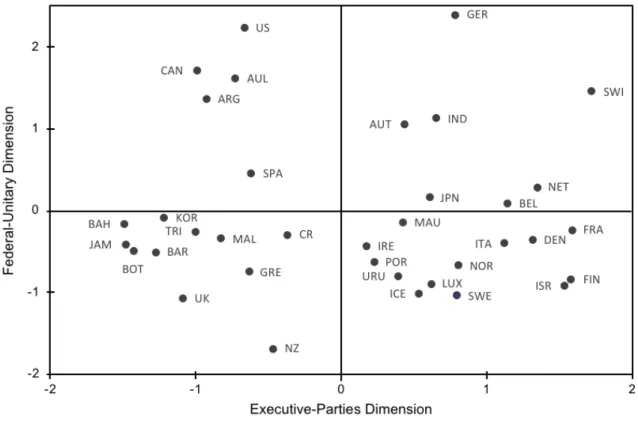
In his book Patterns of Democracy, Arend Lijphart analyzes democratic institutions across 36 different countries, and determines that there are ten major institutional differences between these states, clustered into “two clearly separate dimensions” – the executives-parties dimension and the federal-unitary dimension (Figure 1) (2012, 3). Using these two dimensions, Lijphart argues that democratic governments can then be categorized as following either a majoritarian (also called Westminster) model or a consensus model of democracy (Ibid.).
potential for policy change is that the majoritarian model has “low potential for policy consensus,” and even the possibility of “elective dictatorship” where the policy goals of the minority are ignored completely (Hailsham 1978, Strohmeier 2015, 313).
Figure 1: Lijphart’s dimensions of democracy
Dimension Variable Majoritarian
democracy Consensus democracy
Executive-parties Party system Two-party system Multi-party system Cabinets Single-party majority
cabinets
Power-sharing multi-party coalitions Executive-legislative
relationship
Dominant executive Executive-legislative balance of power Electoral system Disproportional
first-past-the-post system
Proportional representation Interest groups Informal pluralist
interest group interaction
Coordinated and ‘corporatist’ interest group interaction Federal-unitary Federal unitary
dimension Unitary and centralized government Federal and decentralized government Unicameralism-bicameralism dimension Concentration of power in a unicameral legislature
Division of power between two equally strong but differently constituted houses Constitutional
amendment
Flexible constitution that can be amended by simple majorities
Rigid constitutions that can be changed only by extraordinary majorities
Legislative supremacy
Legislature has the final word on the constitutionality of legislation
Legislation subject to a judicial review of their constitutionality by a supreme or constitutional court Central bank Dependent on the
executive Independent central bank
Adapted from Matthews (2011), Lijphart (2012)
Despite being considered a prototypical example of the Westminster model, in the
Westminster model – or whether it still fits the model at all (Bogdanor 2001, 143, Strohmeier 2015). The (failed) referendum proposing the UK switch from a first-past-the-post system to an alternative vote system in 2011, as well as the devolution of powers in the UK from Westminster to the constituent nations of North Ireland, Scotland, and Wales have been notable recent shifts away from the majoritarian archetype that the Westminster system is purported to be (Qvortrup 2012). Strohmeier observes that though these reforms, coupled with electoral results, have led to a shift towards greater consensus on both dimensions, both he and Lijphart agree that “the
contemporary Westminster system is still a majoritarian one” (Lijphart 2012, Strohmeier 2015, 313).
The second model of democracy identified by Lijphart is the consensus model of
democracy, which challenges the majoritarian idea that “majorities should govern and minorities should oppose” (2012, 30). This model is frequently used in heterogeneous democracies,
“emphasizes consensus instead of opposition,” and is exemplified in the governmental
institutions of Switzerland, Belgium at the national level, and the EU at the supranational level (Lijphart 2012, 32). For consensus model democracies, Lijphart identifies ten characteristics along the two dimensions, all of which contrast sharply with those of majoritarian democracies (Ibid.). Along the executive-parties dimension: 1) executive power-sharing in broad coalition cabinets, 2) executive-legislative balance of power, 3) multiparty systems, 4) proportional representation, and 5) interest group corporatism; and along the federal-unitary dimension: 1) federal and decentralized government, 2) strong bicameralism, 3) constitutional rigidity, 4) judicial review, and 5) central bank independence. Unlike the majoritarian system, because there are larger numbers of so-called veto players and “high degree of consensus” is needed for
status quo in consensus systems; each individual party acts as a veto player, which is then compounded by the presence of the bicameral legislative system that typically characterizes consensus models (Fischer 2014, 357, Tsebelis 2002).
It is important to point out that the models in Lijphart’s typology are not entirely mutually exclusive, and particular governments may have institutions that are a mixture of the two models. For instance, as discussed earlier, many aspects of the UK’s model of majoritarian democracy have shifted towards the consensus model in recent years (Matthews 2011,
Strohmeier 2015). Another example of mixed institutions is the US, where a strong federal system with a bicameral legislature, rigid constitution and robust judicial review exists alongside a two-party system with a strong executive, single-party majority cabinets, and a first-past-the-post voting system. Using quantitative measurements of the ten variables, Lijphart is able to produce a two-dimensional map of the democratic models, showing the diversity and nuance of democratic institutions (Figure 2). In the figure, the horizontal axis represents executives-parties dimension, and the vertical represents the federal-unitary dimension, where high values indicate consensus and low values indicate majoritarianism, with each unit being one standard deviation from the mean score (Lijphart 2012).
Given the respective features of majoritarian and consensus democracies, conventional wisdom would suggest that “majoritarian democracy is better at governing… [while] consensus democracy is better at representing – in particular, representing minority groups and minority interests” (Lijphart 2012, 274). Lijphart, however, demonstrates that – in terms of economic measurements – there is only a small difference between the performance of the two models, meaning that “the conventional wisdom is clearly wrong in claiming that majoritarian
democracies perform better than their majoritarian counterparts in terms of representation and what he describes as “the kindness and gentleness of their public policy orientations” – referring to social welfare, environmental protections, criminal justice and foreign aid (2012, 288, 295). The federalist institutions of consensus democracies, according to Lijphart, also have “obvious advantages for large countries and for countries with deep religious and ethnic divisions” (2012, 295).
Figure 2: Two-dimensional conceptual map of democratic models2
Source: Lijphart (2012, 234)
In addition to the differences in policy outcomes between majoritarian and consensus democracies, the two systems have varying effects on how their citizens perceive democracy. Norris observes that democratic institutions, by their very nature, “consistently rule some groups
into, and some groups out of, the decision-making process,” and as a result, there is a link between electoral success, satisfaction and institutional confidence (1999, 234). Institutional confidence is, in turn, linked to positive policy outcomes, institutional stability, and government performance (Miller and Listhaug 1999, Norris 1999). Accordingly, Anderson and Guillory demonstrate a link between the institutional model and the level of satisfaction amongst their citizens:
We find that people on the losing side in an electoral competition show lower levels of satisfaction with the system than do those on the winning side. Moreover, there is an interaction between the institutional environment and a person's status as part of the political majority or minority. Losers in systems that are more consensual display higher levels of satisfaction with the way democracy works than do losers in systems with majoritarian characteristics. Conversely, winners tend to be more satisfied with democracy the more a country's political institutions approximate pure majoritarian government. (1997, 66)
This link between institutional model and citizen satisfaction is further investigated by Bernauer and Vatter, who find that the correlation between citizen satisfaction and model of democracy based on Lijphart’s dimensions is relatively modest (2012). Consequently, they propose the addition of an additional dimension for analysis, the cabinets-direct democracy dimension, based on the presence of “consensual direct democracy” and varying with cabinet type (Bernauer and Vatter 2012, 459, Vatter and Bernauer, 2009). Based on their analysis, Bernauer and Vatter (2012) determine that an institutional dimension based on direct democracy may play a larger role in satisfaction than either the federal-unitary or executive-parties
Types of Referendums and Models of Democracy
The findings that referendums may increase citizen satisfaction in the same manner that a consensus-based democracy does goes against the conventional wisdom that referendums are the “most extreme majoritarian method of decision-making” in a democracy (Lijphart 2012, 221). Since they (typically) only offer a binary choice, referendums are unable to “measure intensities or beliefs or work things out through discussion and discovery… [and can] be more dangerous than representative assemblies to minority rights” (Butler and Ranney 1978, 36). Nevertheless, it is possible, as Marxer and Pállinger observe, for referendums to be used in fostering consensus “when they have an anti-majoritarian character,” which typically occurs when the referendum is initiated by “those representing minority views,” or if a referendum can be used for “putting a brake on the political decision-making process” (2009, 35). Lijphart agrees, observing that for constitutional amendments in particular, referendums are an opportunity for dissatisfied minorities “to launch a campaign against the proposed amendment” (2012, 221).
In order to delineate in which circumstances referendums act as a majoritarian or consensus based device, and to facilitate their analysis of direct democracy as an additional dimension of democratic institutions, Vatter and Bernauer establish a typology of referendums, ranging from high to low “governmental control” (2009, 338). Plebiscites exist at the high control end of the spectrum, where the ruling government is able to control both the agenda and initiation of the referendum, are called in situations where a decision is sent “to the people to win a new mandate for a controversial policy,” and can only be triggered by ruling majorities
ruling government has control over neither the agenda nor triggering of the referendum (Vatter and Bernauer 2009, 338). Small minorities of either voters or political elites trigger each of these forms of referendum. Between high and low levels of governmental control are mandatory referendums, referendums required by a nation’s constitution for certain decisions, and allows the ruling government to “control the agenda… [but] it does not have much control over its initiation” (Ibid.).
Though the conditions by which referendums are triggered are important, the conditions of passage and failure are equally important, as Vatter describes:
In order to achieve a more accurate taxonomy of the numerous forms of direct democracy, we need to ask not only who initiates the referendum, but also who has ultimate decision-making authority. So far, we have considered the potential influence of governmental majority and non-governmental minorities only in terms of the initial stages of the decision-making process. We therefore need to continue by considering the rights of majorities and minorities during the final decision phase. … [Considering] the substantial difference between referendum decisions requiring qualified majorities, and those which can proceed on the basis of a simple majority. (2009, 129)
Consequently, plebiscites and mandatory referendums are seen as a majoritarian device, because “minorities are excluded from their initiation and belong to the ‘losers’ in the absolute sense, after decisions have been made” (Vatter 2000, 174). On the other hand, optional
As an additional precaution, regardless of the level of governmental control, provisions for referendums often qualify the majority needed for passage, which helps mitigate the risk of “potentially tyrannical policy outcomes favored only by a slim majority of the voters (i.e., 50 percent plus one)” (Lewis 2012, 2). These qualifications can take a number of forms, ranging from ‘double majority’ rules – requiring a majority of voters in a majority of regions (such as states or districts) – to turnout requirements or majorities greater than a simple majority of 50 percent (Vatter 2009).
When the decision rules are taken into account with the level of governmental control, referendums can be classified into a “Majoritarian-Consensus” taxonomy (Vatter 2009, 130). As shown in Figure 3, this taxonomy helps assess the majoritarian and consensus characteristics of various types of referendums – referendums located in the upper left of the table (i.e., high governmental control with a simple majority decision rule) are the most majoritarian, while referendums in the lower right (i.e., low governmental control with a qualified majority decision rule) are the most consensus-based.
Figure 3: Vatter’s taxonomy of referendums
Decision rule Governmental control Government-initiated (high control) Constitutionally required (medium control)
Initiated by a minority of voters or MP (low control)
Simple majority Plebiscite (e.g. UK, France) Mandatory referendum (e.g. Spain, Austria) Optional referendum (e.g. Denmark)
Simple majority and quorum of participation
Plebiscite (e.g.
Netherlands) Mandatory referendum (e.g. Ireland, Denmark) Optional (e.g. Sweden) and abrogative referendum (e.g. Italy)
Qualified majority
No example Mandatory referendum (e.g. Australia,
Categorizing a referendum based on the governmental control and the majority needed to pass it is only one approach, however. The justifications political elites have for supporting referendums can be grouped into three categories, which can be used to categorize referendums. As described by Gideon Rahat, the first category is avoidance, where a referendum is used as a method “to transform decision making and avoid the blame and responsibility for its outcome” (2009, 102). Alternatively, avoidance can be used “when a party attempts to address voters who generally tend to favour… a particular policy that does not fit its own position, the party may try to neutralize this problem by promising to conduct a referendum” (Ibid.). The second category of justification is addition, where elites conduct a referendum despite having the majority (or majorities) necessary, in order to “further legitimize a decision,” or to empower the enacting party (Ibid.). Legitimization of an issue or policy by voters is perhaps the most common reasoning to enact a referendum across Europe (Hobolt 2012; Kissane 2009; Qvortrup 2014). Rahat’s third category is contradiction, where a referendum is used to contradict decisions made in other forums, with either a promotional – promoting a rejected policy – or a protective – preserving the status quo – intent (2009, 103). It should be noted that these three categories are not exclusive of each other; a referendum may exist within more than one category. A notable example of this is the 1975 UK referendum on membership in the European Community, where although a majority of Labour Party supported membership, a referendum was called to avoid intra-party conflict and legitimize the decision on membership. Furthermore, the anti-EC minority of the Labour Party supported the referendum in the hope voters would override the majority vote from Parliament (Rahat 2009, 103).
Although referendums and other direct democratic institutions are not inherently ‘populist’ (at least in the sense that populism is defined for this paper), populist groups have increasingly employed referendums to advance their political goals. Bjørklund situates the increased use of direct democracy since the 1970s as part of a larger trend of challenging political elites,
particularly through voter-driven referendums, which fits into the populist narrative (2009). Direct input from voters has been viewed as a way to “improve the quality of policy-making,” by allowing the people to hold what is effectively a veto over decisions made by parliaments (Funk and Gathmann 2013, 300, Kissane 2009). Furthermore, voters’ initiative referendums allow for a relatively small number of citizens to wield a large amount of power. At the EU level, the ECI requires petitions with at least one million signatures (coming from at least seven member states) to be heard by the European Parliament. Kaufmann notes that one million signatures represents merely 0.2 percent of all EU citizens, which can be seen as an excellent opportunity for citizens to have their voices heard, although he also observes that the ECI does not necessarily mean legislation will be proposed in the European Parliament, nor does it necessarily trigger a popular vote on the issue (2012). Referendums can also be used to give minority groups – including political, ethnic or cultural minority groups, amongst many others – a greater influence in political systems, at both national and supranational levels. This can be seen within the
Referendums and Deliberative Democracy
The surge in the use of referendums has led to tension between the principles of direct and deliberative democracy. Although the two systems are not necessarily in conflict with each other, the nature of referendums – which place an emphasis on votes – can put them in conflict with deliberative democratic techniques and institutions – which place emphasis on ‘voice’ (LeDuc 2015). Deliberative democracy is a theory that promotes public discussion, based on “mutual justification of political arguments,” as a central element of democracy, in order to overcome some of the problems of majoritarian democracy (Setälä 2009). Deliberative
democracy has been successfully promoted through institutions known as “mini-publics,” which are small representative groups of ordinary citizens (Goodin and Dryzek 2006).
Lawrence LeDuc discusses the relationship between referendums and deliberative
vote,” there is an element of subjectivity to definition of ‘clear,’ and overly complex referendum issues can result in voters using “short cuts” in establishing a position, impeding the deliberative process (2007, LeDuc, 2015). Another area where direct and deliberative democracy can
conflict, information, has some similarities with the above issues of clarity. In post-referendum polls, voters often report that they felt that they were not well informed enough about the issue. This has been an especially salient problem in referendums on complex proposals, such as European treaties or constitutions, and feeds into the issue of voter short cuts and problems of clarity. Information can also impact deliberation when referendum campaigns make use of negative campaigning or disinformation, “particularly in a short campaign involving an issue on which there has been little prior deliberation”, since “genuinely deliberative democracy requires that all arguments be heard equally” (LeDuc 2015, 145). The final area where direct and
deliberative democracy can conflict is participation. Turnout is likely the most significant participation-based issue, and although some issues surrounding turnout have already been discussed in this paper, LeDuc makes two points regarding turnout not already discussed in this paper: first, he argues that a minimum amount of participation is needed for deliberation, and that turnout is directly connected to the legitimacy of the referendum; LeDuc also observes that turnout quotas have been used in some referendums as a method to achieve this minimum
participation, but stresses that high voter turnout is not necessarily the same thing as engagement and deliberation. Secondly, he notes that turnout and participation are not issues that should be considered in a vacuum, and that they are directly influenced by the other factors previously discussed, such as the nature of the campaign, information levels, and politics.
competence and a sense of political responsibility” (Setälä 2009, 3). In order to solve this lack of competency, each group advocates that competency can be improved if the public is given a greater role in governance. The two groups have differences in the role that people should hold, however. Direct democracy advocates argue that the public should hold greater power in
decision-making, particularly through referendums, while advocates for deliberative democracy argue that greater public deliberation is a preferred way to make the people more competent. But as referenced earlier, and as Goodin and Dryzek show, direct democracy and deliberative
democracy are not mutually exclusive practices (2006).
Voter Choice in Referendums
Proponents of direct democratic initiatives argue that voters are competent, should be trusted to directly make decisions and that doing so would enhance civic education and awareness (Cronin 1989). Conversely, critics of direct democracy state that voters are not properly motivated to reflect deeply on political issues, and thus referendums do not lead to effective participation or outcomes (Setälä 2009). Public support for referendums is high, and correspondingly, the number of referendums is increasing, victories for those who support direct democracy (Schuck and de Vreese 2015). However, voting patterns and the manner in which referendum campaigns are conducted seem to indicate that concerns of some critics may be manifesting themselves in the run up to and aftermath of referendums.
One of the core issues of direct democracy is the idea that voters are competent enough to make decisions in referendum voting. There has been significant growth in the use of
and expanding mass media led to increased political skills, while simultaneously, new political issues, “such as environmentalism, lifestyle questions, and immigration” has contributed to a trend of voter de-alignment, as increasing numbers of individuals “felt competent to make their political decisions independently of cues from political parties” (2009, 121-122). An additional consequence of the emergence of the New Politics approach has been an increase in single-issue voters; subsequently, despite having greater access to information regarding issues, voters have become more detached from the larger context of political issues, to the detriment of political deliberation.
The increased role of mass media and the growth of single-issue voters have had
significant influence in referendum campaign tactics. Media outlets play a role in disseminating information, and therefore also play a role in influencing the outcome of a referendum vote. Marcinkowski suggests that the media, along with campaign groups, can influence the outcome of a vote, by changing the way they interpret and highlight an issue (2007). As a result of this, the focus and context of referendum campaigns can evolve beyond the original issue that a political party or group originally intended. Furthermore, owing to the very nature of a
beneficial as it allows more voices to enter the conversation and shifts focus towards the issue that the referendum is attempting to address (2015).
Complete government neutrality is not a likely scenario in any referendum campaign, and political parties almost always take a public stance in the run-up to the vote. Sara Hobolt shows that party stances can have a considerable, albeit indirect, impact on voting behavior in
referendum campaigns, demonstrating that voters take cues from the parties they support when voting on a policy issue and acting as “pivotal information providers,” although it should be noted that voters also take cues from the media and other elites (2006, 642). Party stances are far from the only factor influencing the development of voters’ opinions, however, and only in situations where campaigns reinforce previously held opinions do party affiliations play a significant role; discussions and discourse during the campaign play a larger role when referendum concerns an issue that is unfamiliar to voters (LeDuc 2009). Furthermore,
referendum campaigns often focus their efforts not on voters who have strong opinions of one party or side of the issue, but instead on ‘undecided’ voters. The attempt to simplify complicated political issues into a ‘yes’ or ‘no’ answer can lead to voters feeling as if they do not have
enough information to properly make a decision, which can lead to an inherent advantage to the ‘no’ side, particularly if it represents maintenance of the status quo (LeDuc 2009).
currently in power. Garry, Marsh and Sinnott find that voter choices in the EU primarily follow the issue-voting hypothesis, although the level of satisfaction with the ruling government does play a smaller role (2005).
Voter choice in referendums is influenced by a myriad of factors not already discussed, including anti-establishment rhetoric, party division, ideological division, segmentation of issues, altered campaign discourse, and turnout (LeDuc 2009). Turnout is a factor worth noting, as turnout in referendums tends to be lower than in general elections but has been shown to fluctuate significantly in different referendums. Additionally, the results of referendums can be influenced by seemingly insignificant factors; Matsusaka demonstrates that in the United States, ballot order and length can have an effect on the outcome of referendums: although the location at which a ballot proposition only has a marginal effect on the outcome, ballot length can have a much more significant impact on results (2016). Other factors have been implicated in
undesirable referendum outcomes, such as the weather – in the case of Colombia’s referendum on a peace deal with the FARC military group (Taub and Fisher 2016). It is worth stating that none of these factors should be considered in a vacuum; the results of any given referendum result from an interaction of these and other factors unique to that particular issue, and it is not possible to determine and quantify all of the influences on voter choice in a particular
CASE STUDY: BALLOT INITIATIVES IN CALIFORNIA
The California ballot initiative system dates back to 1911, when an amendment to the state constitution creating a ballot initiative system was approved, giving Californians “a powerful tool to bypass the Legislature and Governor” (Bowen 2011, 253). The movement to approve a ballot initiative system stemmed from a desire to “seize control of a government perceived to be under control of excessive corporate influences,” namely the Southern Pacific Railroad (Braunstein 2004, 26). The amendment approved included four primary institutions, as detailed by Lee:
(1) initiative constitutional amendments proposed by popular petition and submitted to the voters; (2) the direct statutory initiative, statutes proposed by petition and submitted to the voters; (3) the indirect statutory initiative, statutes proposed by petition, submitted to the legislature and, failing of passage by that body, to the electorate (repealed in 1966); and (4) the referendum, the suspension of the enforcement of a law until it has been referred to the voters and approved by them. (1979, 69-70)
Since its creation in 1911, California’s ballot initiative system has become the gold standard across the country, with greater use of initiatives and referendums than any other state between 1964 and 2000 (Braunstein 2004). Between 1912 and 2016, 1,952 petitions for ballot initiatives were circulated, of which 19 percent (376) qualified for the ballot. Of the proportion of petitions that were approved for the ballot, 35 percent (132) were approved by voters and became law.3 Though some initiatives were passed the first time they appeared on the ballot,
others, with issues ranging from taxes to women’s rights, have been voted down and requalified for the ballot multiple times before ultimately being approved by voters (Bowen 2011).
According to the 2017 Statewide Initiative Guide published by the California Secretary of State, the state constitution outlines a specific procedure that must be followed for an initiative to qualify for the ballot. First, a petitioner must draft the text of the proposed law, submit it to the state Attorney General and pay a $2000 deposit. For the most part, “any matter that is a proper subject of legislation can become an initiative measure,” but each initiative must address only one issue (California Secretary of State 2016, i). After being certified by the Secretary of State, petitions must be circulated around the state and a specified number of signatures from registered voters be collected, totaling 5 percent of votes cast in the previous gubernatorial election for statute initiatives, or 8 percent for constitutional amendment initiatives. Upon collection of the required number of signatures, the initiative is considered “eligible” for the ballot, and after verification of those signatures, the Secretary of State certifies that the initiative has qualified for the ballot. The initiative will then be placed on the ballot during the next statewide general election, and if approved by a simple majority of voters (i.e., 50 percent plus one), the initiative becomes law the day after the election.
legislation in the country,” received 46.5 percent of the vote, and again in 2016, when 57 percent of voters voted in favor of legalization (Biggers 2014, 3, McGreevy 2016).
Additionally, though they are relatively rare, numerous controversial and discriminatory initiatives have been approved through the system: in 1920 voters approved an initiative that “prohibited ownership of land by corporations controlled by persons ineligible for
naturalization,” a proposal targeted at the state’s growing Japanese agricultural communities (Cronin 1989, 93). Moreover, controversial initiatives continue to appear on California ballots: as HoSang details, despite the state’s reputation as one of the most liberal in the country, during the 1990s several controversial initiatives were passed by California voters, “banning public education and public services for many immigrants (1994), repealing affirmative action
programs (1996), outlawing bilingual education (1998), and toughening criminal sentencing for adults and juveniles (1994, 2000)” (2010, 11).
Despite the fact that California’s initiative system has allowed numerous controversial and, at times discriminatory, proposals to become law, other checks and balances that
CASE STUDY: REFERENDUMS IN THE UK
In contrast with the robust direct democratic institutions found in the state of California, the UK lacks a codified, systematic procedure for holding referendums. Despite this, since the 1970s “Referendums have become part of the constitutional tapestry” in the British electoral system, gaining popularity at multiple levels of government throughout the country to settle questions ranging from devolution of powers to regional parliaments, constitutional reform, and local taxation (Qvortrup 2006, 59). Additionally, beginning with Harold Wilson’s referendum on European Economic Community (EEC) membership in 1975, British political leaders have utilized the referendum in relation to issues regarding European integration, often at the behest of “those who sought to prevent or limit British involvement with Europe,” culminating with the Brexit vote in June of 2016 (Bogdanor 2005, 694, S. B. Hobolt 2016).
In addition to their use in settling issues regarding the EU, British politicians have increasingly used referendums when addressing changes to the UK’s unwritten constitution. As a “prototypical” example of Lijphart’s majoritarian model of democracy, the UK’s constitution is not a single written and codified document, but instead utilizes a “series of statutes, laws and norms that developed over centuries in an evolutionary fashion” (Cotton and Fontana 2018, 3-4). This institutional setup, combined with the principle of parliamentary sovereignty that is central to the Westminster model of government fosters an environment that is permissive for
(Bogdanor 2001, 145). As a result, since 1997 referendums have become the norm when British political leaders wish to make changes to the country’s basic statues, particularly in regards to electoral reforms, which are now expected to “be preceded by a referendum” (Qvortrup 2012, 108, Strohmeier 2015). Former Prime Minister Tony Blair is largely responsible for the shift from referendums only being called to address “unique and exceptional” issues like membership in the European Community to addressing issues such as constitutional reform (Bogdanor 2001, 144); in 1996 he argued that referendums could be used “to give citizens a veto over proposals to change their system of government, and to give legitimacy to the changes to which they do agree” (55).
As a part of the aforementioned changes to the unwritten constitution, proposals for the devolution of powers from the unitary parliament in Westminster to regional parliaments in London, North Ireland, Scotland, and Wales have been an issue where referendums have been consistently used in the UK (Qvortrup 2006). The first pair of such referendums – on the
devolution of power to regional parliaments in Scotland and Wales – occurred in 1979, and both were defeated (Ibid.). These referendums, along with later (successful) devolution referendums during the 1990s were part of the Labour Party’s – the only party to make use of referendums until the 2011 Alternative Vote referendum – electoral strategy, designed to help ensure power in Westminster, quell rising support for the Scottish National Party (SNP), and reduce intra-party disagreement over the topic of devolution (Cotton and Fontana 2018, Qvortrup 2006).
DISCUSSION AND CONCLUSION Discussion
When comparing the direct democratic institutions of California and the UK, one of the most substantial differences between the two systems is the legal background in each case. In California, the procedure for calling a referendum or placing an initiative on the ballot is prescribed by the state constitution. In line with the American system of government, the California state constitution exists as a unified formal document that requires relatively exceptional circumstances to change – a feature typical of Lijphart’s consensus democracy (Braunstein 2004). Contrasting with this is the British system, which has an informal, unwritten constitution and does not prescribe a specific procedure for referendums. As a result, any direct democratic measures must be authorized by Parliament, giving political minorities little
opportunity to fight for change.
Direct democratic institutions in California and the UK represent two opposing sides of Vatter and Bernauer’s taxonomy of referendums (2009). While the California system, where “a small minority of voters” has the power to propose an initiative, is representative of low
governmental control, referendums in the UK, which can only be called by “the ruling majority” are a typical example of direct democracy with a high level of governmental control (Ibid., 338). In this regard, British referendums have served as a majoritarian device, while Californian
initiatives function to foster consensus.
with referendums that have majoritarian features (Vatter 2009). In California, however, judicial review of statutes passed through the ballot initiative system serves to filter out at least some referendums that might be discriminatory and is considered by Lijphart to be characteristic of consensus-based democracy (Cronin 1989, Lijphart 2012). Though California’s ballot initiatives have a number of consensual characteristics, the state’s optional referendums, approved by the state legislature and requiring a simple majority of voters to pass, are substantially more majoritarian in nature. Additionally, as mentioned earlier, there have been situations where British referendums have included a turnout requirement – a decision more closely linked to consensus-based features – but these referendums do not represent what is typical in the British case (Qvortrup 2006).
Despite their typological differences, the two direct democratic systems share referendum campaign characteristics also seen in other systems of government that utilize direct democratic institutions. In both cases, voter choice is a concern, albeit for different reasons.
In California, there has been substantial research that suggests that “campaign spending is the best predictor of the success of ballot measures,” giving individuals and groups with greater financial resources a substantial advantage through the entire initiative process from start to finish (Braunstein 2004, 75). Bowen highlights this discrepancy, noting that “while some initiatives qualify for statewide ballot through heroic grassroots efforts, others are funded almost entirely by a single well-heeled business or individual,” as tactics like paid signature-gatherers are used in order to help proposals qualify for the ballot (2011, 254, Braunstein 2004). This discrepancy continues into the campaign, where groups with greater financial resources have greater agenda-setting ability, influencing the debate for or against a proposal and reducing the ability for neutral deliberation during the campaign (LeDuc 2015).
Although the UK’s direct democratic institutions do not leave an opportunity for well-financed interest groups to propose initiatives directly, voters’ choices during referendum campaigns can be impacted by outside groups in much the same way as in California. Additionally, since referendums in the UK have a high level of government control and are closely linked to the ruling party in Parliament, the second-order voting effects may come into play. Hobolt points out that during and after the Brexit referendum campaign, a “key argument for Leave voters is lack of trust in David Cameron and his government” (2016, 1263).
Conclusion
After several high-profile referendums in recent years, the role of direct democracy in representative democratic systems has come under increased scrutiny. California and the UK, two systems with markedly different direct democratic institutions were selected as case studies to explore the how Lijphart’s majoritarian and consensual models of democracy are impacted by direct democracy (2012). In each system, the institutions had both majoritarian and consensual features, though the British system of government – a prototype of the majoritarian democracy – tended to have fewer consensual and anti-majoritarian features. The presence of referendums did have an impact on the political process in both cases, however the mixed majoritarian and
consensual features in the two systems lends support to Vatter and Bernauer’s suggestion that referendums may in fact function as a third dimension of democracy (2009).
In both cases, the direct democratic institutions created opportunities for negative impacts on the deliberative democratic process. Although the circumstances are somewhat different, voter choice is an issue in both cases, as referendum campaigns give an opportunity for interest groups to use financial resources to alter the tone of the campaign and influence the debate before the vote. Furthermore, in the case of California, interest groups or individuals with significant financial resources can utilize the ballot initiative system to circumvent the state legislature and place proposals directly on the ballot. Meanwhile, in the UK, second-order voting can impact the results of referendums, with the side of the issue supported by more popular and trusted politicians or parties performing better than side supported by less popular and trusted politicians or parties.
2014, Bernauer and Vatter 2012). The topics discussed here could be researched further by expanding the scope of case studies used. The inclusion of the UK as a case study presented limitations to the conclusions drawn, as the country makes very limited use of direct democracy in the policymaking process. The addition of a case like Switzerland, which represents a more purely consensual democracy according to Lijphart’s taxonomy, in addition to utilizing
WORKS CITED
Anderson, Christopher J., and Christine A. Guillory. 1997. "Political Institutions and Satisfaction with Democracy: A Cross-National Analysis of Consensus and Majoritarian Systems." American Political Science Review 91 (1): 66-81.
Bailey, Lonce H. 2015. "Introduction: Progressivism and Its Critics." In In Defense of the
Founders Republic: Critics of Direct Democracy in the Progressive Era, edited by Lonce H. Bailey and Jerome M. Mileur, 1-14. New York: Bloomsbury Academic &
Professional.
Bernauer, Julian, and Adrian Vatter. 2012. "Can't get no satisfaction with the Westminster model? Winners, losers and the effects of consensual and direct democratic institutions on satisfaction with democracy." European Journal of Political Research 51 (4): 435-468.
Biggers, Daniel R. 2014. Morality at the Ballot. Cambridge: Cambridge University Press.
Bjørklund, Tor. 2009. "The surge of referendums and the New Politics approach." In
Referendums and Representative Democracy, edited by Maija Setälä and Theo Schiller, 117-135. London: Routledge.
Blair, Tony. 1996. "Democracy's second age." The Economist, September 14: 55-58.
Bogdanor, Vernon. 2001. "Constitutional reform." In The Blair Effect, edited by Anthony Seldon, 139-158. London: Little, Brown and Company.
—. 2005. "Footfalls echoing in the memory. Britain and Europe: the historical perspective." International Affairs 81 (4): 689-701.
Bowen, Debra. 2011. "The California Initiative Process at its Centennial." California Western Law Review 47 (2): 253-258.
Butler, David, and Austin Ranney. 1978. Referendums: A Comparative Study of Practice and Theory. Washington: American Enterprise Institute for Public Policy Research.
California Secretary of State. 2016. "2017 Statewide Initiative Guide." December. Accessed February 18, 2018. http://elections.cdn.sos.ca.gov/ballot-measures/pdf/statewide-initiative-guide.pdf.
—. 2016. "Initiative Totals by Summary Year 1912 - 2016." Accessed February 18, 2018. http://elections.cdn.sos.ca.gov//ballot-measures/pdf/initiative-totals-summary-year.pdf.
Cotton, Ross, and Cary Fontana. 2018. "Political parties at critical junctures: explaining the decisions to offer referendums on constitutional change in the United Kingdom." Contemporary British History 1-27.
Council of Europe. 2007. "Code of Good Practice on Referendums." Venice Commission. http://www.venice.coe.int/webforms/documents/default.aspx?pdffile=CDL-AD(2007)008-e.
Cronin, Thomas E. 1989. Direct Democracy. Cambridge: Harvard University Press.
Crum, Ben. 2007. "Party Stances in the Referendums on the EU Constitution." European Union Politics 8 (1): 61-82.
Dewan, Torun, and Arthur Spirling. 2011. "Strategic Opposition and Government Cohesion in Westminster Democracies." American Political Science Review 105 (2): 337-358.
Fischer, Manuel. 2014. "Coalition Structures and Policy Change in a Consensus Democracy." Policy Studies Journal 42 (3): 344-366.
Font, Joan, and Elisa Rodríguez. 2009. "Intense but useless?" In Referendums and
Funk, Patricia, and Christina Gathmann. 2013. "Voter Preferences, Direct Democracy and Government Spending." European Journal of Political Economy 32: 300-319.
Garry, John, Michael Marsh, and Richard Sinnott. 2005. "'Second-order' versus 'Issue-voting' Effects in EU Referendums." European Union Politics 6 (2): 201-221.
Goodin, Robert E., and John S. Dryzek. 2006. "Deliberative Impacts: The Macro-Political Uptake of Mini-Publics." Politics and Society 34 (2): 219-244.
Gregorczuk, Helen. 1998. "Citizen Initiated Referendums: Republican Innovation or Scourge of Representative Democracy?" Griffith Law Review 7 (2): 249-273.
Hailsham, Quentin Hogg. 1978. The Dilemma of Democracy. London: Collins.
Hobolt, Sarah B. 2006. "How Parties Affect Vote Choice in European Integration Referendums." Party Politics 12 (5): 623-647.
—. 2012. "Citizen Satisfaction with Democracy in the European Union." Journal of Common Market Studies 50 (S1): 88-105.
—. 2016. "The Brexit Vote: a divided nation, a divided continent." Journal of European Public Policy 23 (9): 1259-1277.
HoSang, Daniel Martinez. 2010. Racial Propositions: Ballot Initiatives and the Making of Postwar California. Berkeley: University of California Press.
Kaufmann, Bruno. 2004. "A Comparative Evaluation of Initiative & Referendum in 32 European States." In Direct Democracy in Europe, edited by Bruno Kaufmann and M. Dane
Waters, 3-10. Durham: Carolina Academic Press.
—. 2012. "Transnational Citizens' Initiative - How Modern Direct Democracy can make the European Union a Better Place for Minorities." In Direct Democracy and Minorities, edited by Wilfried Marxer, 230-244. Wiesbaden: Springer VS.
LeDuc, Lawrence. 2009. "Campaign tactics and outcomes." In Referendums and Representative Democracy, edited by Maija Setälä and Theo Schiller, 139-159. London: Routledge.
—. 2015. "Referendums and deliberative democracy." Electoral Studies 38: 139-148.
Lee, Eugene C. 1979. "The initiative and referendum: how California has fared." National Civic Review 68: 69-76.
Lewis, Daniel. 2012. Direct Democracy and Minority Rights. New York: Routledge.
Lijphart, Arend. 2012. Patterns of Democracy. 2nd. New Haven: Yale University Press.
Marcinkowski, Frank. 2007. "Beyond Information and Opinion." In Direct Democracy in Europe, edited by Zoltán Tibor Pállinger, Bruno Kaufmann, Wilfried Marxer and Theo Schiller, 94-107. Wiesbaden: Springer VS.
Marxer, Wilfried, and Zoltán Tibor Pállinger. 2009. "Stabilizing or destabilizing? Direct-democratic instruments in different political systems." In Referendums and
Representative Democracy, edited by Maija Setälä and Theo Schiller, 34-55. London; New York: Routledge.
Matsusaka, John G. 2016. "Ballot order effects in direct democracy elections." Public Choice 167: 257-276.
Matthews, Felicity. 2011. "Constitutional stretching: coalition governance and the Westminster model." Commonwealth & Comparative Politics 49 (4): 486-509.
McGreevy, Patrick. 2016. "Californians vote to legalize recreational use of marijuana in the state." Los Angeles Times. November 8. Accessed February 18, 2018.
Miller, Arthur, and Ola Listhaug. 1999. "Political Performance and Institutional Trust." In Critical Citizens: Global Support for Democratic Government, edited by Pippa Norris, 204-216. Oxford: Oxford University Press.
Norris, Pippa. 1999. "Institutional Explanations for Political Support." In Critical Citizens: Global Support for Democratic Government, edited by Pippa Norris, 217-235. Oxford: Oxford University Press.
Qvortrup, Matt. 2006. "Democracy By Delegation: the Decision to Hold Referendums in the United Kingdom." Representation 42 (1): 59-72.
—. 2012. "Voting on Electoral Reform: A Comparative Perspective on the Alternative Vote Referendum in the United Kingdom." The Political Quarterly 83 (1): 108-116.
—. 2013. Direct democracy: A comparative study of the theory and practice of government by the people. Manchester: Manchester University Press.
—. 2014. "Referendums in Western Europe." In Referendums Around the World: The Continued Growth of Direct Democracy, edited by Matt Qvortrup, 43-64. London: Palgrave
Macmillan.
Rahat, Gideon. 2009. "Elite motives for initiating referendums." In Referendums and
Representative Democracy, edited by Maija Setälä and Theo Schiller, 98-116. London: Routledge.
Schiller, Theo. 2012. "The Emergence of Direct Democracy - a Typological Approach." In Direct Democracy and Minorities, edited by Wilfried Marxer, 33-46. Wiesbaden: Springer VS.
Schuck, Andreas R.T., and Claes H. de Vreese. 2015. "Public support for referendums in Europe: A cross-national comparison in 21 countries." Electoral Studies 38: 149-158.
Setälä, Maija. 2009. "Introduction." In Referendums and Representative Democracy, translated by Maija Setälä and Theo Schiller, 1-14. London: Routledge.
Strohmeier, Gerd. 2015. "Does Westminster (still) represent the Westminster model? An analysis of the changing nature of the UK’s political system." European View 14: 303-315.
Taub, Amanda, and Max Fisher. 2016. "Why Referendums Aren't as Democratic as They Seem." The New York Times. October 4.
http://www.nytimes.com/2016/10/05/world/americas/colombia-brexit-referendum-farc-cameron-santos.html.
Topaloff, Liubomir. 2017. "The Rise of Referendums: Elite Strategy or Populist Weapon?" Journal of Democracy 28 (3): 127-140.
Tsebelis, George. 2002. Veto Players. Princeton: Princeton University Press.
Vatter, Adrian. 2000. "Consensus and direct democracy: Conceptual and Empirical Linkages." European Journal of Political Research 38: 171-192.
—. 2009. "Lijphart expanded: three dimensions of democracy in advanced OECD countries?" European Political Science Review 1 (1): 125-154.