TASTE TEXTING: USING BEHAVIORAL ECONOMICS AND MOBILE HEALTH TO INCREASE HIGH SCHOOL LUNCH PARTICIPATION
Tosha Woods Smith
A dissertation submitted to the faculty at the University of North Carolina at Chapel Hill in partial fulfillment of the requirements for the degree of Doctor of Philosophy in the Department
of Nutrition in the Gillings School of Global Public Health.
Chapel Hill 2016
ABSTRACT
Tosha Woods Smith: Taste Texting: Using Behavioral Economics and Mobile Health to Increase High School Lunch Participation
(Under the direction of Alice Ammerman)
In 2010, the federal Healthy Hunger Free Kids Act enacted strict new standards on school lunch. As a result, school lunch is healthier than ever. These new standards have already been associated with improved diet quality and weight status of school lunch
participants. However, school lunch participation is declining nationally and is especially low among high school students. Research suggests that long lines during short lunch periods are a substantial barrier to school lunch participation. To improve high school lunch participation, we developed Taste Texting, a web-based, behavioral economics-informed program that allows students to pre-order school lunch from their computers or mobile phones and retrieve meals from kiosks, thereby bypassing lunch lines. This study combines mixed methods formative research and a multiple-baselines evaluation of the Taste Texting program in two high schools with identical menus in Chapel Hill and Carrboro, North Carolina (n = approx 2300 students). In AIM 1, we used a series of focus groups (n= 8 groups; 60 students) and surveys (n ~440) to identify the social norms surrounding school lunch and perceived barriers to school lunch participation. In AIM 2, we use longitudinal, student-ID linked transaction data and a multinomial logistic regression model to estimate associations between student-level
Thanks to Alice Ammerman, for your kindness and patience.
ACKNOWLEDGEMENTS
To Sharon Schilling, who first preached to me the Gospel of Education: I think that a completed PhD evidences that I’m a believer, despite my lingering doubts.
To my parents, Skip and Diane Davis, and to my siblings Jennifer, Lisa, and Walt: thanks for building a family culture of public service and for inviting me to be a part of it. Being a Davis is one of the greatest privileges of my life, and one that I never could have imagined or designed. I love each of you.
To Erin Flynn Wade: I don’t think I have ever known someone to treasure family as much as you do. Your glad, persistent, and practical support led me to this finish line. I could not have done this without you. Thank you.
To Kevin and Tammi Smith: your home and your spirits are a refuge for us. You are like the strong cedar in which we make our nest (Psalm 104): always safe, stable, supportive. For your patient support, your guidance, and your affection, I am so grateful.
To Elizabeth Bodner: for our history, for your persistent sister-ing, for your grace, your joy, and your generous affection, I am grateful.
To Ben Sammons, a friend closer than a brother: your friendship is one of mine and David’s greatest treasures. Our brother, thanks for your sweet presence in our life, and for your tireless prayer. We love you.
To Zoe Clementine Joanne and Ari Benedict Davis: by far, you two are my greatest achievements, and to be your Mama is my best joy. The sacrifices that you have already made to have a Mama with a PhD are real. I hope that this lesser achievement pays dividends in your lives that we cannot yet see. No matter what happens next, know that I treasure our family more than any other achievement, any job, or being Dr. Somebody. I love you more than I can say.
To David, my Bridegroom, the Husband of my youth, my Champion: this, especially, is where words fail (but tears do not). I cannot be so eloquent as you would be with all of this gratitude that I have for you, but I long to press into your heart how precious, how life-giving and life-sustaining your support has been. Your tireless, patient forbearance with this process and your unswerving belief in me and my talent, your insistence that I can do this (and that I ought to), your enthusiasm for my gifts…the list is too long. It all undoes me. Never in my life has someone been so convinced of my greatness. I hope you’re right, and I hope this was worth it. With my whole heart: thank you.
To my Abba, the Lover of my Soul: since my life makes no sense apart from the context of your grace, I trust that it is no secret that you are the source of any good that I have ever been or done. For this opportunity to serve and to learn and to grow, I am grateful. For the awful hardship that this was, I am grateful. For the promise that there is a new normal coming (ala Romans 8:24) and for your persistent kindness to me when I refused to wait and to work for it with patience (ala Romans 8:25), I am grateful. I have never been as grateful as I ought to be, but I am grateful. Take this degree and this life and employ them to help me and others
discover and describe a world in which science is used in service of neighbor, to the delight of your own heart.
TABLE OF CONTENTS
LIST OF TABLES
... xi
LIST OF FIGURES
... xii
CHAPTER 1: INTRODUCTION
... 1
1.1. Specific Aims
... 2
CHAPTER 2: LITERATURE REVIEW
... 4
2.1. Benefits of school lunch
... 4
2.2. School lunch more important for lower income students
... 6
2.3. New regulations ensure healthier lunches
... 6
2.4. School lunch healthier than meals brought from home
... 7
2.5. The Challenge: Low School lunch participation
... 9
2.6. Factors affecting school lunch participation
... 11
CHAPTER 3: HOW TASTE TEXTING WORKS
... 13
3.1. Program and study site overview.
... 13
3.2. Study schedule overview.
... 13
3.3. Study Partners
... 14
3.5. User registration and informed consent
... 15
3.6. Messaging, ordering, and payment procedures
... 16
3.7. Back-end operations
... 17
3.8. Laptop and cell phone ownership among high school students
... 18
3.9. Theoretical framework: Behavioral economics
... 19
CHAPTER 4: PERCEPTIONS OF SCHOOL LUNCH AND
BARRIERS TO PARTICIPATION
... 24
4.1. Introduction
... 24
4.2. Background
... 24
4.3. Methods
... 25
4.4. Results
... 31
4.5. Discussion
... 58
CHAPTER 5: SOCIODEMOGRAPHIC FACTORS ASSOCIATED
WITH SCHOOL LUNCH PARTICIPATION
... 61
5.1. Introduction
... 61
5.2. Methods
... 62
5.3. Results
... 65
5.4. Discussion
... 71
CHAPTER 6: TASTE TEXTING IMPACT ON
SCHOOL LUNCH PARTICIPATION
... 75
6.2. Background
... 75
6.3. Methods
... 76
6.4. Results
... 81
6.5. Discussion
... 88
CHAPTER 7: SUMMARY OF FINDINGS
... 92
7.1. Perception of school lunch food is largest
... 92
7.2. School lunch paying status most important predictor.
... 93
7.3. Participation patterns stable throughout school year.
... 94
7.4. Time spent waiting in line is poor intervention target.
... 95
7.5. Preordering increases school lunch participation for some
... 96
7.6. Study Strengths and Limitations
... 96
7.7. Conclusion
... 97
APPENDIX 1: FOCUS GROUP DISCUSSION GUIDE
... 98
APPENDIX 2: BASELINE SURVEY (AIM 1)
... 101
APPENDIX 3: SAMPLE STATA CODE FOR AIM 2 ANALYSES
... 113
APPENDIX 4: EXAMPLE TASTE TEXTING* USER INTERFACES
... 114
REFERENCES
... 117
LIST OF TABLES
TABLE 1.FOCUS GROUP PARTICIPANT CHARACTERISTICS ... 33
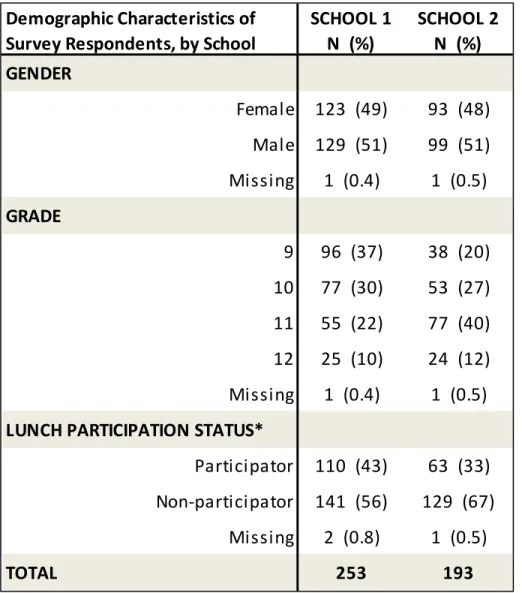
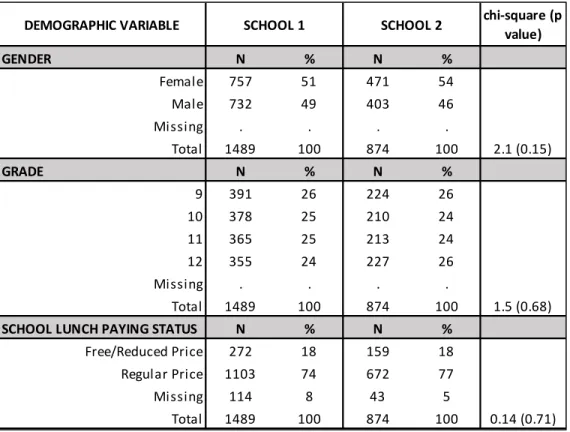
TABLE 2.DEMOGRAPHIC CHARACTERISTICS OF SURVEY RESPONDENTS. ... 48
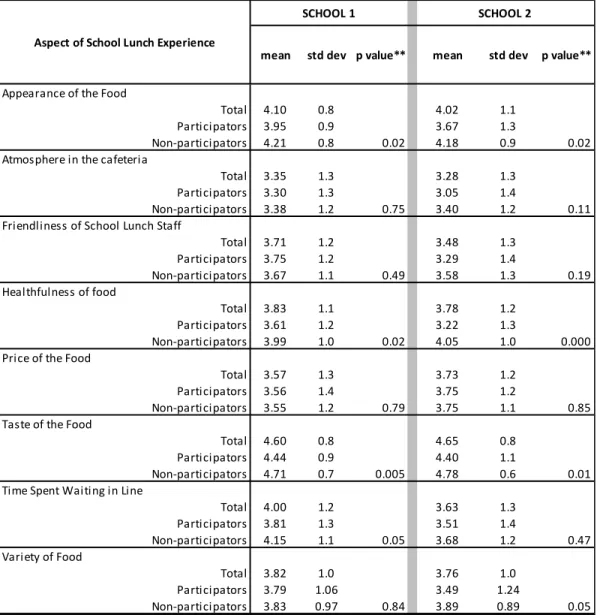
TABLE 3.RESPONSES TO:“WHEN YOU THINK ABOUT SCHOOL LUNCH,
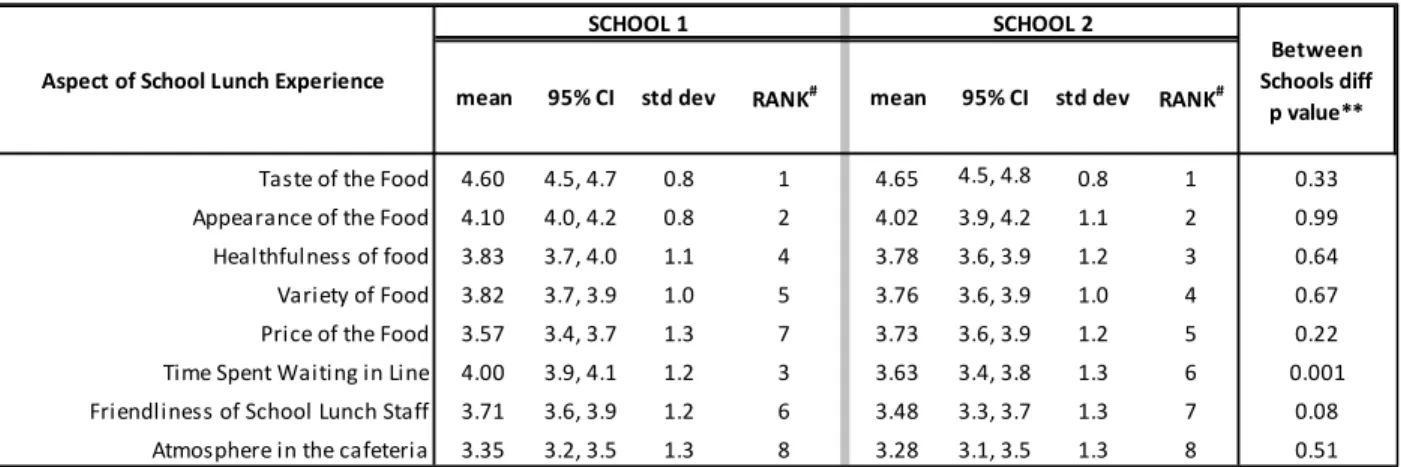
HOW IMPORTANT ARE EACH OF THE FOLLOWING ASPECTS TO YOU?”* ... 49
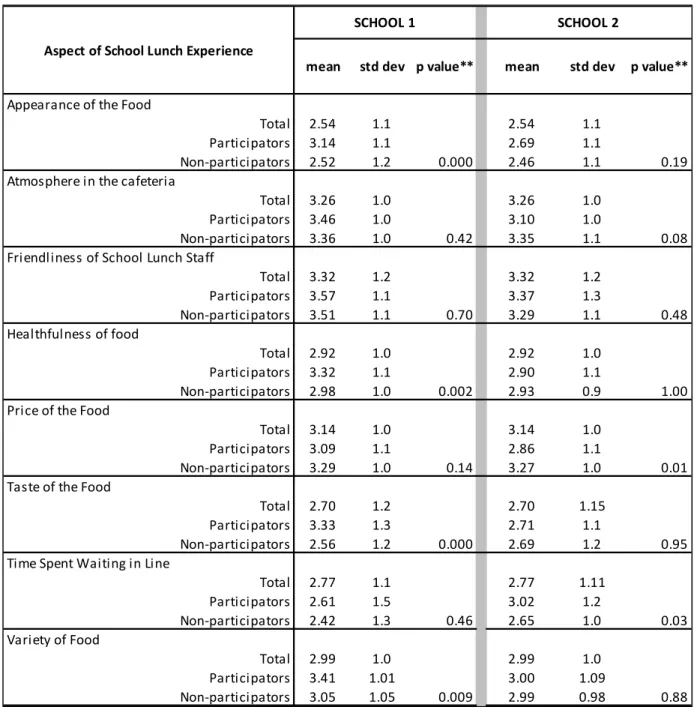
TABLE 4.RESPONSES TO:“PLEASE RATE THE CURRENT STATE OF
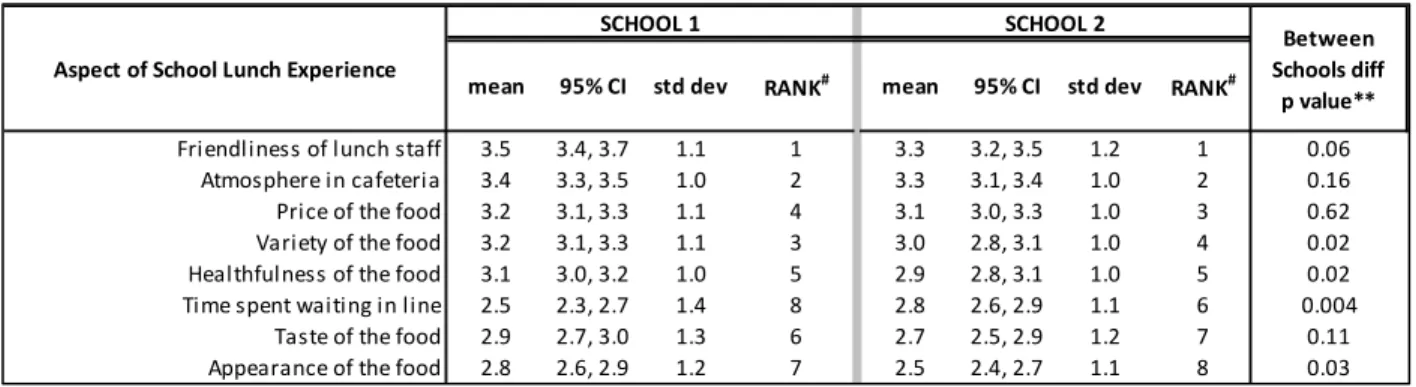
SCHOOL LUNCH IN EACH OF THE FOLLOWING AREAS”* ... 50
TABLE 5.RESPONSES TO:"WHEN YOU THINK ABOUT SCHOOL LUNCH, HOW
IMPORTANT ARE EACH OF THE FOLLOWING ASPECTS TO YOU?"* ... 51 TABLE 6.RESPONSES TO:"PLEASE RATE THE CURRENT STATE OF SCHOOL
LUNCH IN EACH OF THE FOLLOWING AREAS"* ... 53
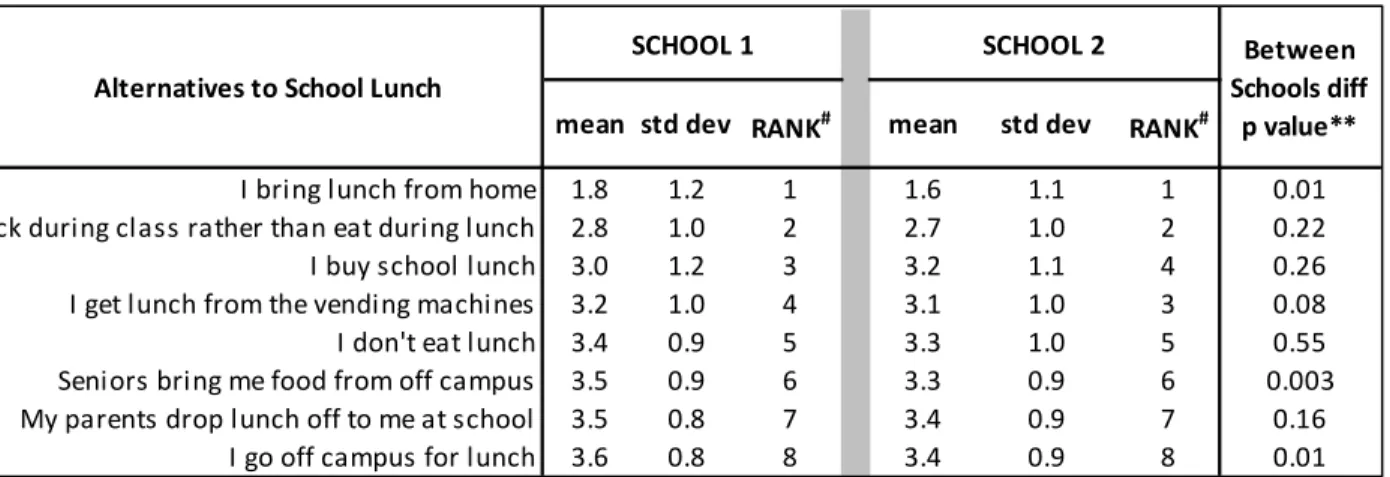
TABLE 7.RESPONSES TO:"WHAT DO YOU NORMALLY EAT FOR LUNCH
WHEN YOU ARE AT SCHOOL?"* BY SCHOOL. ... 54
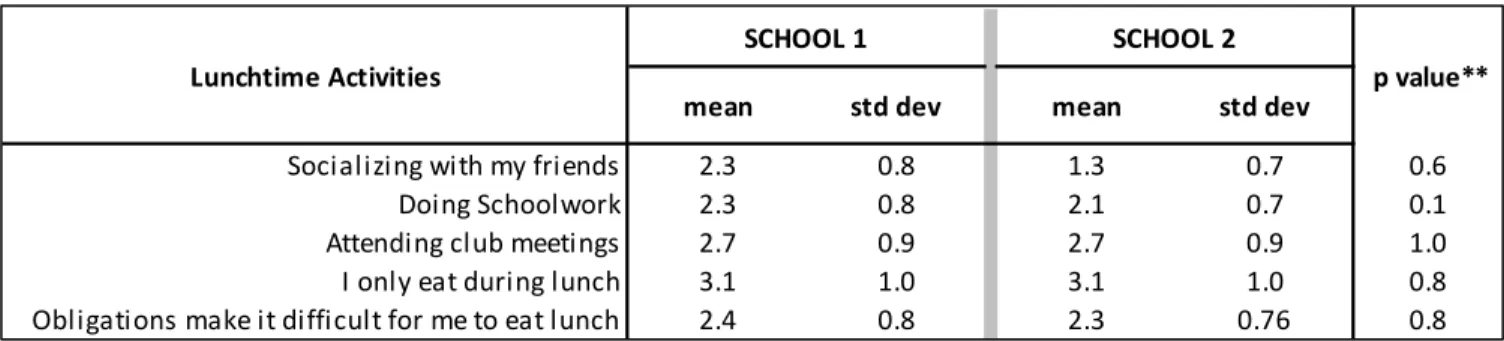
TABLE 8.RESPONSES TO:"HOW DO YOU NORMALLY SPEND YOUR LUNCH PERIOD?"* ... 55
TABLE 9. DEMOGRAPHIC CHARACTERISTICS BEFORE EXCLUDING STUDENTS
FROM THE DATASET. ... 66
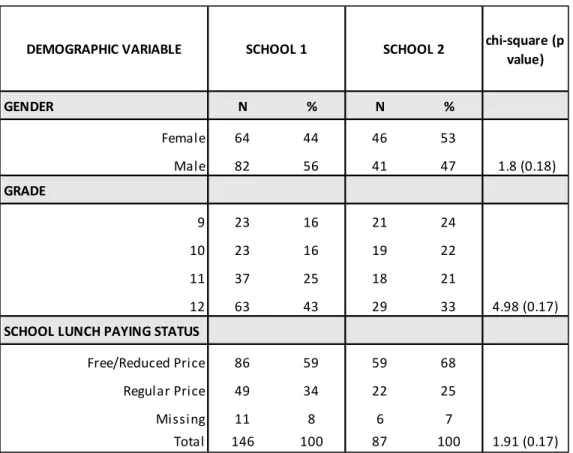
TABLE 10. DEMOGRAPHIC CHARACTERISTICS OF STUDENTS
EXCLUDED FROM ANALYSIS.* ... 67
TABLE 11.DEMOGRAPHIC CHARACTERISTICS OF STUDENTS
WHO REMAINED IN THE DATASET.* ... 68
TABLE 12.SOCIODEMOGRAPHIC FACTORS ASSOCIATED
WITH BASELINE LUNCH PARTICIPATION* ... 69
TABLE 13.SOCIODEMOGRAPHIC FACTORS ASSOCIATED WITH LUNCH PARTICIPATION
AMONG STUDENTS PAYING REGULAR PRICE FOR SCHOOL LUNCH* ... 71
TABLE 14.SOCIODEMOGRAPHIC FACTORS ASSOCIATED WITH LUNCH PARTICIPATION
AMONG STUDENTS RECEIVING FREE OR REDUCED PRICE SCHOOL LUNCH* ... 71
TABLE 15.DEMOGRAPHIC CHARACTERISTICS AND BASELINE LUNCH
PARTICIPATION* OF PROGRAM REGISTRANTS. ... 83
TABLE 16.MEAN PERCENTAGE OF LUNCHES* PRE-ORDERED DURING
LIST OF FIGURES
FIGURE 1.CHANGES IN MEAN SCHOOL LUNCH PARTICIPATION FOR
REGISTERED TASTE TEXTING USERS AT SCHOOL 1. ... 85
FIGURE 2.CHANGES IN MEAN SCHOOL LUNCH PARTICIPATION FOR
REGISTERED TASTE TEXTING USERS AT SCHOOL 2. ... 86
FIGURE 3.EXAMPLE DAILY EMAIL ANNOUNCEMENT ... 114
FIGURE 4.POST LOGIN LANDING PAGE (ENTRÉE SELECTION) ... 115
CHAPTER 1: INTRODUCTION
In 2010, the federal Healthy Hunger Free Kids Act (HHFKA) enacted strict new
standards for school lunch.1 The HHFKA mandated increased portions of fruits and vegetables, whole grains, and low fat dairy and gradual reductions in sodium while establishing an age-appropriate calorie maximum for the first time in history. As a result, school lunch is healthier than ever. These new standards have already been associated with improved diet quality2 and weight status3 of school lunch participants. Indeed, research suggests that students who eat school lunch often have better diet quality than those who do not,4–6 as school lunch is often healthier even than meals brought from home.7–11 School lunch is particularly essential for low-income children12 as research shows that the new standards have made healthy foods more accessible for low-income students at school than they are at home.2 Likewise, school lunch may be especially important for high school students, whose chosen alternatives to school lunch likely involve vending machines, fast food, convenience stores, or meal skipping.13
However, school lunch participation is declining and is especially low among high school students.14–16 Low high school lunch participation rates mean that students are missing an important contribution to a healthy diet and that school food operators are struggling to remain solvent while providing healthy, affordable meals despite fewer customers. Low overall school lunch participation also likely stigmatizes school lunch, making school lunch untouchable for students who pay full price for school lunch, and a source of shame for students who qualify for free and reduced price lunch.17,18
high school level. Limited research suggests that long lunch lines during short lunch periods make school lunch participation inconvenient, and research suggests that this lack of
convenience may be a substantial barrier to school lunch participation.15,19 Additionally,
conversations with local stakeholders including staff, students, administration, and school food service professionals in the local school district suggests that long lunch lines are a local problem which likely affects school lunch participation. To address this issue, we developed
Taste Texting, a web-based, behavioral economics-informed mobile health program that
encourages school lunch participation by allowing students to pre-order school lunch from their phones or computers and bypass cafeteria lines to retrieve their healthy school lunch from kiosks located apart from the cafeteria. The current study is a pilot test of the Taste Texting program in two high schools with identical menus in Chapel Hill and Carrboro, North Carolina (n = ~2300 students). This pilot study fills an important gap in our understanding of student
perceptions of high school lunch and tests a simple, theory-based solution to the critical problem of low high school lunch participation.
1.1. Specific Aims
This study uses a strategic combination of qualitative and quantitative research methods and electronic student-ID linked cafeteria sales transaction data to accomplish the following aims:
AIM 1: Identify the social norms surrounding school lunch and perceived barriers to school lunch participation using focus groups and surveys.
knowledge about why students do or do not participate in school lunch and informed the implementation and marketing of Taste Texting in each school.
AIM 2: Determine baseline lunch participation patterns and estimate associations between student-level demographic variables and school lunch participation over time.
This formative aim uses retroactively gathered student-ID linked cafeteria transaction data matched to student-level demographic data to determine school-wide lunch purchasing patterns and relationships between student-level demographic variables and school lunch participation over time during the baseline period.
AIM 3: Determine whether Taste Texting increases school lunch participation.
This program evaluation aim uses prospectively gathered student-ID linked cafeteria transaction data to determine whether participation in the Taste Texting program increases school lunch participation at 4, 6, and 8 weeks post initial program engagement.
Though low school lunch participation is a problem that affects millions of high school students and the schools that serve them, very little is known about what motivates students to
CHAPTER 2: LITERATURE REVIEW
2.1. Benefits of school lunch
diet quality scores than non-participants, owing to the fact that they consumed more milk, less saturated fat, and less sodium than children who did not participate in school lunch.5 In 2011, Gosliner et al collected dietary data on 5365 low-income 7th and 9th graders in California and found that school lunch participants were more than twice as likely to consume fruits and vegetables (FV) at lunch than non-participants.20 Though the Gosliner study does not involve a nationally representative sample, the sample size coupled with dietary data makes a compelling case for the association between school lunch and FV consumption.
In 2009, two additional studies used nationally representative data from the third School Nutrition Dietary Assessment study (SNDA III) and found mixed effects of school lunch
participation on student diet. Briefel et al found that while school lunch participants consumed less energy dense meals and fewer calories from sugar sweetened beverages than
non-participants, school lunch participants’ consumption of low-nutrient, energy dense foods such as french fries and baked goods was higher than that of non-participants.21 Likewise, Clark et al found that while school lunch participation was associated with reduced dietary inadequacy, school lunch participation was also associated with higher intakes of fat and sodium relative to non-participants.22 However, these studies were conducted before the implementation of the new school lunch standards.
To our knowledge, since 2009, only two studies using nationally representative datasets have estimated entirely negative associations between NSLP participation: Schanzenbach (2009) and Millimet et al (2009) both used a nationally representative dataset from the Early Childhood Longitudinal Study-Kindergarten cohort (ECLS-K) and found that participation in school lunch during kindergarten was associated with a higher likelihood of being overweight or obese in third grade.23,24 However, as pointed out by Gundersen et al, both the Schanzenbach and Millimet studies both employ regression discontinuity designs, which enforce sharp income-based cutoffs between participants and nonparticipants for the sake of comparison, an
error or for the nonrandom selection into NSLP participation.25 In short, the Schanzenbach and Millimet studies do not adequately account for the fact that the low-income students are more likely to self-select to participate in school lunch programs and also far more likely than their higher-income peers to be obese in general.26,27 Additionally, it is important to note that each of these studies (Schazenbach et al and Millimet et al) examined the association between school lunch participation and weight status, rather than participation and dietary quality. However, dietary quality is likely more proximally impacted by school lunch participation than is weight status, as weight status is influenced by myriad factors which go unmeasured in both studies.
2.2. School lunch more important for lower income students
Research suggests that the positive contribution of school lunch toward diet quality is even more important for low-income students, who are at higher risk of diet related diseases.26 For instance, Robinson-O’Brien et al found that low-income children with low daily fruit and vegetable (FV) intake consumed a higher proportion of their daily FV at school by participating in school lunch, suggesting that school lunch is an important opportunity for students who may not either have access to or be consuming these foods at home.12 Similarly, Hanson et al (2013) used data from the 2003-2008 NHANES studies to examine the relationship between diet quality and school lunch participation, finding that low-income students who consumed school lunch had higher diet quality indices than low-income non-participants.5 Likewise, Gundersen et al used data from 2001-2004 NHANES studies to examine the effect of receipt of free and reduced price school lunches on food insecurity, poor health, and obesity and found that school lunch participation among low-income children was associated with improved health outcomes relative to low-income non-participants.25
2.3. New regulations ensure healthier lunches
Kids Act improved nutritional standards for school lunch by mandating increased portions of fruits, vegetables, and whole grains, mandating lower-fat dairy offerings and imposing restrictions on total calories and sodium. Limited recent research demonstrates that these standards have already improved both the diet quality and weight status of school lunch
participants. For instance, in 2013, Dan Taber and colleagues used a nationally representative sample of 4870 8th grade students from 40 states and found that in states with nutritional standards for school lunch that met or exceeded the new USDA standards, the disparity in obesity rates between low-income student participants in school lunch and higher-income non-participants was 12 percentage points smaller than in states that did not have regulations similar to the new standards in place. Importantly, the study also found “little evidence” that students responded to the new regulations by buying more competitive foods.3 In a similar study published in 2013, Taber also found that nutritional standards that met or exceeded the new USDA regulations were associated with higher FV intake among school lunch participants, and that the relationship was strongest among students with the least home access to FV,
suggesting again that school lunch is an important opportunity to provide access to healthy foods, since participants are willing to eat healthy foods at school even if they do not have regular access to those foods at home. Additionally, Cohen et al (2014) measured school lunch selection, consumption, and plate waste before and after implementation of the new standards in 4 urban, low-income elementary schools and found that fruit selection increased by 23% and vegetable consumption increased by 16.2% after the new standards were implemented,
suggesting that the standards may influence both the selection and consumption of healthy foods at lunch.28
2.4. School lunch healthier than meals brought from home
et al conducted parent-assisted dietary recalls on 129 elementary school children in suburban Minneapolis and found that the children who regularly ate school lunch had higher intakes of protein, calcium, and vitamins A, D and K and lower intakes of energy, fat, carbohydrate, vitamin E and sugar than students who regularly brought lunches from home.8 In 2012, Johnston and colleagues observed the lunch choices of 2107 2nd graders from 7 different elementary schools in Texas and found that packed lunches contained far more sugar in the form of sugar sweetened beverages and desserts than school lunch.7 This finding is similar to that of Dr. Kiya Duffey and colleagues who conducted 1314 lunch observations among pre-K and Kindergarten students in 3 schools over a consecutive 5-day period and found that among the 561 packed lunches they analyzed, 41.7% contained no fruits or vegetables, 41.2%
contained a sugar sweetened beverage, and 61.1% contained a sugary dessert.11 In a related study, Duffey et al report than packed lunches from the same observations contained
significantly more total energy, fat, saturated fat, sugar, Vitamin C and iron and less protein, sodium, fiber, Vitamin A and Calcium than packed lunches.10 Likewise, in 2015, Caruso and Cullen observed packed lunches from elementary and middle school children from 12 different schools in Texas and found that 90% of the packed lunches in their sample contained sugar sweetened beverages, sugary desserts, or snack chips and that overall, packed lunches contained more sodium and fewer fruits, vegetables, and milk than school lunch.
high school students’ lunches, then there is no reason to assume that parent-packed lunches for high school students are any more nutritious than the lunches that parents are packing for younger children. If students are packing their own lunches, then we feel that there is even less reason to assume that those lunches are nutritionally comparable to a healthy school lunch, as many studies that have investigated the longitudinal diet quality of children have found that overall diet quality decreases with age29,30, a fact that is often attributed to children expressing more autonomy over their dietary choices and perhaps failing to choose foods that are as healthy as their parents used to choose for them. Additionally, as high school students exercise more autonomy than younger students in the forms of increased spending money and
transportation, it is hypothesized that the alternatives to school lunch include not only lunches brought from home, but fast food, convenience store fare, vending machine products, or meal skipping – none of which are likely to compare favorably with a healthy school lunch.
2.5. The Challenge: Low School lunch participation
National school lunch participation has been declining, and is especially low at the high school level.15,31 As of 2009, national high school lunch participation was 38.6%.31 However, at the high schools involved in this pilot study, school lunch participation rates are especially low. As of Fall 2013, the overall lunch participation rates at the intervention and delayed control schools were 17.5% and 19.8%, respectively.
for the School Nutrition Association, an organization representing more than 55,000 school food service personnel nationwide, was quoted saying, "A concern that our [school food personnel] members have when you look at declining participation in the school meal program is the possibility that there are going to be kids who feel like they don't want to go to the cafeteria because only the poor kids go to get their lunches there."13
Lastly, low school lunch participation is a significant challenge for food service programs that must meet the costly new nutritional standards despite having fewer customers. After many of the new regulations were implemented in the Fall of 2012, the Government Accountability Office (GAO) surveyed and visited school food operations nationwide to gauge how well the school food operators were able to implement the new regulations. The result of this effort is a report in issued in January 2014 stating that school food operators cited “many challenges” to complying the new regulations, chief among them being “managing food costs”.16 In April 2014, the head of The School Superintendents Association, a national organization representing over 10,000 school districts nationwide, sent an open letter to the USDA expressing growing concern that the standards mandated by the Healthy Hunger Free Kids Act, “place(s) ever-‐increasing strain on school district budgets.”34 The GAO report also finds that in the school year during which the regulations were first implemented (2012-13), school lunch participation declined drastically nationwide, driven by the fact that 1.6 million full-price paying students ceased participating in school lunch that year. The report cites the new regulations as directly
choose for meals, and they are no longer obligated to make provisions for low-income students who may be unable to pay for school lunch. Clearly, there is a need for interventions to help maintain or increase school lunch participation at the high school level so that school food operators who serve federally compliant meals do not do so at financial risk.
2.6. Factors affecting school lunch participation
It is likely that factors related to school lunch participation are different for high school students, who have more autonomy and more non-school food lunch options are different than those of elementary and middle school students.39 Still, very little research has been conducted to investigate why so few high school students participate in school lunch. To our knowledge, the only national-scale investigation of school food perceptions at the high school level is a 2010 study published by the Asperin et al, which used focus groups from all USDA regions in the country to develop a survey for high school students that measures the degree of satisfaction with school food service and the barriers to and motivations for participating in high school lunch. Their investigation found that, in general, there are two types of school food participants at the high school level: those who participate frequently (3 times per week or more) and those who participate rarely (8 times per month or fewer). The survey that Asperin et al developed and validated to investigate why high school students do not participate in school lunch found that students who do not currently participate in school lunch would be encouraged to
The study sample included schools with both relatively high and relatively low overall lunch participation rates. Importantly, the study found that students cited convenience of school lunch as the primary motivator for or barrier to participating in school lunch, and that this was the case whether or not the students attended a high participation school or a low participation school.19 Informal interviews, anecdotal data, and observations of local high school lunch periods suggest that time spent in line is likely a key barrier to school lunch participation for local high school students. In each of the two local high schools involved in this pilot study, the entire student body eats lunch during a single lunch period. This means that 900 – 1500 students all eat lunch during a 45-minute period. This creates very long cafeteria lines. Indeed, preliminary
observations of the lunch period at the intervention school in the Spring of 2014 found that some cafeteria lines still persisted halfway into the lunch period, which left students with fewer than 25 minutes to eat lunch. Long lunch lines during limited lunch periods are more than inconvenient. Long cafeteria lines during short lunch periods mean that students who do receive school lunch have limited time to eat it, which may contribute to overconsumption.40 One working paper by economists at Georgia State University suggests that not having enough time to eat lunch may be an issue for students. Using data from the national SNDA III study, they found that every 10-minute increase in a school lunch period was associated with a 1.86 percentage point drop in the likelihood of being overweight and a 0.194 reduction in BMI, suggesting that having more time to eat at lunch is healthier for students.41
CHAPTER 3: HOW TASTE TEXTING WORKS
3.1. Program and study site overview.
Taste Texting is a web based mobile health program that allows students to pre-order school lunch from their cellphones or computers and retrieve pre-ordered lunches from kiosks located apart from the cafeteria, thereby skipping long lunch lines. In this study, we used a multiple baselines study design to evaluate the impact of the Taste Texting program
participation on student-level school lunch participation in two public high schools in North Carolina. The two high schools involved in this pilot study are located in the same school district, share the same school food vendor, and have identical daily school lunch menus. As of October 2014, School 1 had an average daily attendance of 1489 students, School 2 had an average daily attendance of 874 students. Research that has explored the factors affecting lunch participation in younger students have found that qualifying for free or reduced price lunch significantly influences lunch participation, and we hypothesize that the same is true for high school students. As such, it is important to note that as each of the schools in this study, 18% of the student body qualified for free or reduced price lunch, which is far lower than both the national average (38%) and the statewide average for North Carolina (41%).42
3.2. Study schedule overview.
multiple baselines study design. Beginning in February 2015, the program start dates were as follows:
1. FEB 4, 2015: Program begins for 11th and 12th grade students at School 1 (group 1) 2. MAR 2, 2015: Program begins for 9th and 10th grade students at School 1 (group 2) 3. MAR 4, 2015: Program begins for 11th and 12th grade students at School 2 (group 3) 4. MAR 25, 2015: Program begins for 9th and 10th grade students at School 2 (group 4) This staggered start was necessary from an analytical perspective, but it was also useful in preventing the school food service staff from becoming overwhelmed once the program launched at their site. The program ended at both sites on May 22, 2015, such that the total program run time at School 1 was 12 weeks (with some students being eligible to use the program for 10 weeks) and 10 weeks at School 2 (where half of the student body was eligible to use the program for 8 weeks).
3.3. Study Partners
This pilot study was conducted as part of a partnership with the local school district, Chapel Hill Carrboro City Schools (CHCCS), UNC Chapel Hill, and Chartwells, a corporate school food vendor that handles food service for the entire school district. Both Chartwells and CHCCS provided student-level data for this study.
The Institutional Review Board (IRB) at the University of North Carolina at Chapel Hill, reviewed and approved all of the methods and materials for this project and the project and supervised all project operations conducted by both UNC and RTI project personnel. In addition to UNC IRB approval, the school district conducted its own review of the project methods and materials and issued an independent approval.
3.4. Spring 2013 Proof-of-concept study
days, during which 59 high school students used Taste Texting to order 269 school lunches, with only 2 reported lunch order errors (error rate < 1%). On post-program surveys, half of the respondents reported that Taste Texting was easy to use and that the program heavily
influenced their decision whether to eat school lunch on any given day. These limited data are encouraging but insufficient to estimate the larger and longer-term impact of Taste Texting on school lunch participation or the feasibility of scaling the program from a food service
perspective. The current study is a larger pilot test of the Taste Texting program in two local high schools (~2300 students) with identical menus. This study will transition the technological infrastructure of the Taste Texting platform from a text message-based platform to a web-based platform that allows many more users to use the system simultaneously and will allow us to examine the impact of this scaled up program on individual-level school lunch participation.
3.5. User registration and informed consent
rather than actual student ID numbers. The school district is the sole custodian of the key which links project IDs to actual student ID numbers, and none of the UNC or RTI personnel
associated with this project have access to that key.
3.6. Messaging, ordering, and payment procedures
Once a student registered an account with Taste Texting and the program launched for their grade level in their school, they began to receive daily messages that prompted them to use the program to order lunch. More detail about the content and frequency of messages is included in Chapter 6 below, but generally, email messages were sent in the evening to prompt students to pre-order lunch for the following school day and text messages were sent in the morning to prompt students to pre-order lunch for that school day. The messages – both email and text – prompted students to visit the Taste Texting website, which was branded as
“Lunch101” in the schools, to place their order. Each school in the study had their own specific Lunch 101 website (Screenshots of the program are available in APPENDIX 4), and students had to sign in using the email address and password that they used to establish their account.
Pre-ordering was only offered one day at a time, and pre-orders for lunch had to be received by 10am on the day of lunch. Only federally reimbursable lunches, which consist of an entrée and mandatory fruit and vegetable side items, were offered for purchase via Taste Texting. The entire school lunch menu was available for pre-order, and there were no items that were only available via Taste Texting or on the usual line. Once a student’s Taste Texting order was complete, the student received a confirmation message on-screen, but not via email or text message, since student feedback from the earlier proof-of-concept study indicated that fewer messages were strongly preferred.
Chapter 6 below, program adoption was such that one kiosk per site was sufficient for the duration of the program.
The student did not pay for the meal until the meal is retrieved from the kiosk, due to federal regulations that stipulate that a food service staff person must “lay eyes” on the student and the meal in order to charge for the meal and for the meal to count as a reimbursable lunch. All Taste Texting transactions were conducted using student IDs and the same electronic point-of-sale (POS) system used to receive and record payment for the rest of each cafeteria’s
transactions, such that every meal sold using Taste Texting was tracked via student ID numbers in the same manner as the rest of the school’s cafeteria transactions. Technically, it was
possible for student to preorder a lunch and then fail to retrieve and pay for it. However, this issue only happened twice during the entire duration of the program, and in the 2012 proof-of-concept study, we did not find that this was a common problem.
Additionally, each of the schools included in this study have campus-wide wireless internet that is free for all students, and both students, staff and administrators at both schools report that students are allowed to use their cellphones while at school.
3.7. Back-end operations
directed to visit the site for their school. All Taste Texting menus were loaded into the program’s website on a weekly to monthly basis by the site’s developer, Area101, Inc.
Each Taste Texting order consisted of a federally reimbursable lunch, which includes an entrée plus a minimum of 1 fruit or vegetable side item and milk. If a student attempted to place an order without the required components, the system would register an error message that identified the specific problem and directed the student to remedy it. On each school day that the program ran, once the 10am ordering deadline was met, the school food service personnel at each site retrieved a report of all of the Taste Texting orders for that day, sorted by entrée. The school food service then prepared the meals and stored them at the kiosk for pickup. The Taste Texting kiosks were outfitted with climate control equipment that kept hot food hot and cold food cold and a POS-outfitted cash register to accept payment. At each site, the Taste Texting kiosk was staffed by a single food service operator.
3.8. Laptop and cell phone ownership among high school students
However, there may be other mitigating factors such as internet access at home or school, and while Taste Texting is accessible by any internet-capable device, we expect that most users will access the site via a smartphone while at school. As such, we verified with administrative officials at both schools that a) each site has a wireless internet connection that students are able to use during the school day, b) students are allowed to bring and use their cellphones on campus during the school day, and c) our formative research for this project inquired directly about smartphone ownership and internet use among students and found that over 90% of the survey respondents at both of the schools represented in this study reported owning a smartphone that they use to access the internet daily while at school (see Chapter 4 below)
3.9. Theoretical framework: Behavioral economics
Researchers have been calling for an increase in the use of behavioral economic principles to inform nutrition related interventions43, 44 owing in part to the fact that behavioral economics principles are often operationally inexpensive and easily evaluated. The
development of Taste Texting is informed by 4 main principles of behavioral economics: pre-commitment, active choice/customization, incentivizing behavior change with convenience, and exerting implicit rather than explicit influence over the target behavior.
3.9.1. Pre-commitment
posits that self-control is an exhaustible resource that diminishes as individuals perform cognitively demanding tasks. For instance, in a 1999 experiment conducted by Shiv and Fedorikhin, adult subjects were randomized into two groups: one group that was given a
cognitive task and another that was not given a cognitive task. Both groups were given a choice between fruit salad or chocolate cake as a snack. The adults who had been subjected to the cognitive task were significantly more likely to choose the cake than their less cognitively depleted peers, and the authors suggest that these results are due to the affect that cognitive exertion makes subsequent decisions less rational and more impulsive.47 This is an important consideration for school lunch as students are often making lunch decisions in a crowded lunchroom after a full morning of class. Taste Texting utilizes a pre-commitment strategy by prompting the user to pre-order school lunch early in the school day and apart from sensory stimuli such as sights and smells of energy dense competitive or ala carte foods during a time of the day that is likely less stressful than a crowded lunchroom.
3.9.2. Active Choice
fruit with lunch consumed it.49 In a similar experiment conducted by Just and Wansink, middle school students attending a summer camp were randomized into two groups: one group of 120 students was told that they must select carrots with their lunches while a second group of 120 student were asked if they wanted carrots or celery with their lunches. In the group in which carrots were mandated, only 69% consumed any of the carrots, whereas in the group that was given a choice, 91% of them consumed the carrots that they chose.44 Likewise, Hakim and Meissen (2013) found that forcing an active choice resulted in a 15% increase in consumption of both fruits and vegetables in elementary and middle school students’ lunches.50 The proposed mechanism for the association between choice and action is that increases awareness of present options and supports autonomy by giving individuals a sense of ownership surrounding their decisions. Several investigators have suggested that this autonomy becomes more important to older students who want to exert more control over their decisions.32 Taste Texting utilizes active choice by prompting students to customize their entrees using a set of pre-determined options, ensuring that each student has as much control as possible over determining the makeup of their lunch entrée.
3.9.3. Convenience
Behavioral economic theory also asserts that even relatively small changes in convenience can precipitate significant changes in behavior.51 Researchers have tested the effects of this principle in school lunchrooms by slightly rearranging the items offered on a school lunch line44, or by creating express lunch lines exclusively for health options.52 An
places a disproportionate amount of value on things that benefit one now versus in the future.53 According to this theoretical construct, convenience is a powerful motivator for behavior change by creating immediate benefits for healthy behaviors that usually have longer-term benefits. Taste Texting utilizes convenience to encourage school lunch participation by allowing students to skip long cafeteria lines to retrieve preordered lunches from kiosks located just outside the cafeteria. In this way, Taste Texting mitigates the most inconvenient factor associated with school lunch participation.
3.9.4. Choice framing
Behavioral economic theory also asserts that exerting an implicit influence on target behaviors or decisions is often more effective than exerting explicit influence on those same behaviors or decisions.54 This principle, sometimes called libertarian paternalism, preserves an individual’s ability to choose a less desirable behavior while incentivizing more desirable behaviors and/or de-incentivizing less desirable behaviors. This is an important principle as many individuals equate choice with freedom and react negatively to explicit restrictions on choice. A good example of this negative reactance is student response to chocolate milk bans in schools. Researchers recently evaluated the effects of a similar chocolate milk ban in 11 public elementary schools in Oregon, finding that the ban was associated with a 10% decrease in total milk sales, a 6.8% decrease in the proportion of students participating in school lunch altogether, and an increased milk waste rate as 29.4% of the white milk cartons selected during lunch were thrown away untouched.55 In contrast, Smith et al in 2011 sought to increase
CHAPTER 4: PERCEPTIONS OF SCHOOL LUNCH AND BARRIERS TO
PARTICIPATION
4.1. Introduction
To identify perceptions of school lunch and perceived barriers to school lunch participation among students at two public high schools in North Carolina. We conducted 8 focus group discussions with 60 students at two public high schools. Focus group findings were used to design a survey that was completed by 398 students, or approximately 20% of the student body at each school. When asked about the food and the non-food aspects of the school lunch experience, students expressed strongest feelings about school lunch food. Student perceptions of school food are largely negative and include the perceptions that the food is foreign, of poor quality, lacking in variety, and worth neither the time nor the money required to obtain it. Of the non-food aspects that were investigated, time spent waiting in line was the most significantly perceived barrier to participation, but more for students in one of the two schools. Students’ collective perception that school lunch food is undesirable is the most significant barrier to school lunch participation among public high school students in this sample.
4.2. Background
standards may be improving student nutrition2,3, they may also be exacerbating the downward trend in participation as students demonstrate less preference for healthier foods.16,45,46 This downward trend is particularly problematic as healthier lunches are more expensive to produce, placing an additional burden on school lunch providers who were already struggling to remain solvent while serving federally compliant meals to a declining customer base. Citing their inability to remain solvent while serving meals that meet the new healthy school lunch standards, a small but growing number of school food vendors have opted out of the federal program altogether.34,35,47 Opting out of the federal lunch program means a lack of regulation – school lunch program that opt out of the federal lunch program can serve whatever they choose, charge whatever they want, and are under no obligation to make provisions for low-income students. Thus, an understanding of the barriers and facilitators to school lunch participation among high school students is critical, yet little is known about high school students’ perceptions of school lunch or their usual lunchtime behaviors.
4.3. Methods
4.3.1. Overview of study methods
students) served as the intervention school (School 1) while the second high school (School 2, n ~ 850 students) served as the delayed control school.
The present study used a series of focus groups and a pen-and-paper survey to address 4 formative research questions: 1) What are students’ current perceptions of school lunch (both the food and non-food aspects), including barriers to and facilitators of participation? 2) What are students’ usual lunch behaviors, including what students normally eat for lunch and how the usually spend their lunch hour? 3) What are students’ suggestions for improving the lunch experience in their school, including improvements to both the food and non-food aspects of school lunch? 4) What are students’ initial reactions to the concept of a web-based system for pre-ordering school lunch? Focus groups were conducted prior to finalizing the pen-and-paper survey, such that the results of focus group discussions were used to refine survey questions and response options.
4.3.2. Focus group methods
4.3.2.1. Recruitment, scheduling, and participation incentives
but was enforced to minimize any potential discomfort that may be experienced by students who were usual participants in school lunch in case school lunch participation was stigmatized in their school. Tenth and 11th grade students were prioritized for focus group participation because focus group discussions were held in the Fall shortly after 9th grade students would have arrived and because 12th grade students were allowed to travel off campus for lunch. The target participation was 5 to 10 students per group, and students were contacted a few at a time by email or text message (depending on their indicated preference) until focus groups were scheduled to capacity. Focus group participants were given a $10 restaurant gift card and a lunch of pizza and drinks provided by the school cafeteria during the focus group.
4.3.2.2. Focus group content
A total of eight focus groups were planned: 4 per school (2 groups with usual school lunch participants, 2 with usual school lunch non-participants). All focus groups were conducted on each school’s campus during the lunch hour in the Fall of 2014 and led by the same
facilitator (Smith). The focus group guide was written to address the following research
questions: 1) What are students’ perceptions of school lunch? (both the food and the non-food aspects of school lunch were of interest) 2) What are students’ usual lunch behaviors? (both what they normally eat for lunch and how they spend their lunch hour) 3) What are students suggestions for improving school lunch (both the food and the non-food aspects of school lunch) and 4) what are students initial reactions to the pre-ordering concept? To investigate this last research question, at the very end of each focus group, the Facilitator mentioned that the school was preparing to implement a new program that would allow students to pre-order school
students had for implementing the program, and asking for suggestions for potential marketing avenues for advertising the program.
Additionally, each group was asked the questions 1) “how do you normally hear about things happening at school?” and 2) “If you were in charge of the school lunch program here and you had improved school lunch and wanted people to try the new, improved school lunch, how would you get people to try it?” (the focus group guide used for this study can be found in APPENDIX 1)
4.3.2.3. Analysis of focus group data
Focus group discussions were audio recorded and then transcribed verbatim. Very little formal research has been conducted to examine high school students’ perceptions of school lunch food and their perceived barriers to school lunch participation. As such, there are very few hypotheses to govern the focus group data collection effort and therefore all of the focus group coding was inductive rather than deductive. After reading through all of the focus group transcripts, the facilitator drafted an initial codebook. Two coders then independently applied the codes to the same set of transcripts (1/4 of all transcripts) and met weekly to discuss code applications, resolve discrepancies, and to revise the codebook until target agreement was met. Inter-rater code application agreement was determined by calculating Cohen’s kappa statistic and a Pooled Kappa according to the method outlined in Vries et al (2008), where acceptable agreement is achieved at pooled Kappa >= 0.61,51 though the target agreement for this study was set at Pooled Kappa = 0.7. Once target agreement was reached, the coders independently analyzed the remaining focus group transcripts. Two investigators then read the coded
identified. All focus group data were analyzed using Dedoose (version 6.0.21, Los Angeles, CA)
4.3.3. Survey methods
Focus group results were used to refine questions and response options for a paper-based survey that was designed to assess perceptions of school lunch, usual lunchtime behaviors, student opinion about the planned pre-ordering program and information thought to be important for guiding the implementation of the preordering program at each school. Immediately after participating in the focus group, focus group participants completed an early prototype of the survey and offered feedback on both the questions and response options. The final paper survey was 24 questions long, though a few questions had several subparts. The survey was to be completed independently by students during their lunch period and was designed to require 15 or fewer minutes to complete. The survey included demographic questions (3 items), questions that assess perceptions of school lunch (5 items), usual
lunchtime food and activities (3 items), the respondent’s current relationship to the school lunch program and preference for a pre-ordering system (3 items), how students receive information about school events (2 items), cell phone ownership/use (3 items) and social media preferences and interaction with school on social media (5 items). The survey also included one optional open-ended question that solicited any additional thoughts on school lunch that the respondent may have that would not have been covered by the other questions, including any suggested improvements they may have.
and as non-participators if they reported never buying school lunch, and all survey responses were analyzed by school and participation status.
The survey asked students to use a 5-point Likert scale to quantify how important each of the following 8 aspects of school lunch is to them: the healthfulness of the food, the taste of the food, the appearance of the food, the variety of the food offered, time spent waiting in line, the price of the food, the friendliness of the school lunch staff, and the atmosphere in the cafeteria. The response options included: “5 = very important”, “4 = somewhat important”, “3 = neither important nor unimportant”, “2 = somewhat unimportant”, and “1 = not important at all”. These aspects of school lunch were included because they were mentioned during the focus group discussions. Respondents were then asked students to rate the current state of their school’s lunch on each of those aspects using the following Likert-type response options: “5 = excellent”, “4 = good”, “3 = average”, “2 = below average”, and “1 = poor”.
Students’ usual lunch food was assessed by a asking respondents to indicate how often they did each of the following 8 things for lunch while at school: “I buy school lunch”, “I get lunch from the vending machines”, “I go off campus for lunch”, “I bring lunch from home”, “My parents drop lunch off to me at school”, “Seniors bring me food from off campus”, “I don’t eat lunch”, “I snack during classes rather than eating lunch”, using response options 1 = “Often”, 2 = “Sometimes”, 3 = “Rarely”, 4 = “Never”.
additional time cost), a survey question was added to assess whether this was an issue for a larger proportion of the student body at each school.
The survey also briefly assessed each student’s relationship with the school lunch program by asking whether the student knows who to approach with specific complaints or suggestions about school lunch, and since we were assuming that most students who use the program will access it from their phones, the survey used 3 questions to assess cell phone ownership and usage. For survey items with Likert scale responses we calculated mean response values, 95% confidence intervals and used Wilcoxon rank sum tests to determine whether any of the observed differences in survey responses by school or participation were statistically significant at an alpha equal to 0.05.
At both schools, the finalized paper survey was distributed by researchers during the school lunch period. Survey completion was incentivized by a drawing to win one of ten $25 Amazon gift cards. Survey data were analyzed using Stata (version 11.2, College Station, TX)
4.4. Results
4.4.1. Focus Group Results: Demographics of Study Participants
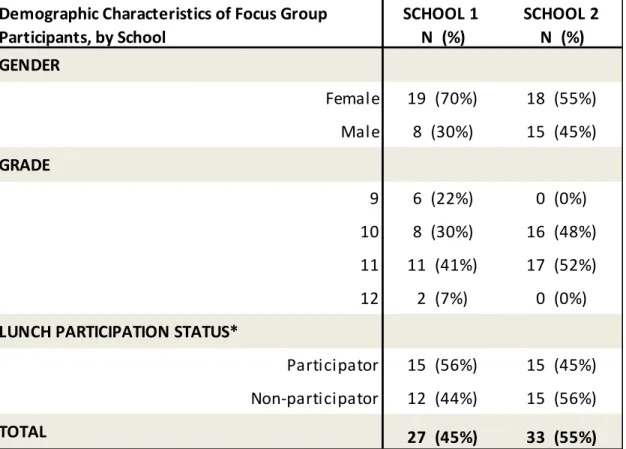
reply, 44 students scheduled participation and 33 students attended one of four focus group discussions (16% of those interested, 46% of all contacted students). Focus group discussion size ranged from 5 to 10 students per group with an average of 7 students per group. Table 1 summarizes the demographic information for all focus group participants.
Table 1. Focus group participant characteristics by school
*Students were classified as participators if they reported usually buying lunch 1 or more times per week; non-participators were those who reported never buying school lunch
At both schools, all focus group discussions occurred during the lunch period, which was approximately 50 minutes long. Initial focus group discussions averaged approximately 45 minutes in duration, which meant that the discussions spilled over into the class period immediately after the lunch period, at which point the School 1 administration requested that researchers limit focus group duration to just the lunch period. Thus, subsequent groups were conducted more quickly, such that overall focus group duration was approximately 32 minutes across both schools.
A final codebook and target agreement were achieved after coders independently analyzed 4 transcripts, resulting in double coding of half of all the transcripts. The final calculated inter-rater reliability for code application across all transcripts was 0.75. Coded
SCHOOL 1
SCHOOL 2
N (%)
N (%)
GENDER
Female
19 (70%)
18 (55%)
Male
8 (30%)
15 (45%)
GRADE
9
6 (22%)
0 (0%)
10
8 (30%)
16 (48%)
11
11 (41%)
17 (52%)
12
2 (7%)
0 (0%)
LUNCH PARTICIPATION STATUS*
Participator
15 (56%)
15 (45%)
Non-‐participator
12 (44%)
15 (56%)
TOTAL
27 (45%)
33 (55%)
transcripts were independently read for themes, and consensus themes are matched to the study’s research questions.
4.4.1.1. Focus Group Results: Themes in Students’ Baseline Perceptions of School
Lunch
Though the opinions on both the food and non-food aspects of school lunch were common across participation status and school, the students’ opinions about school lunch were overall the most frequently and strongly stated. There was very little disagreement in focus group discussions and no differences in focus group results were noticed between participation status or by school.
4.4.1.2. Themes: Students’ Perceptions of School Lunch food
Students’ thoughts about school lunch food were overwhelmingly negative. Key themes that emerged included the perceptions that school lunch food is: 1) Foreign or mysterious, looking and smelling unappealing 2) Of poor quality rather than “real” or fresh 3) Of inadequate variety, containing the same menu items day after day, and 4) Not worth either the time or the money required to obtain it. In relation to themes 1 and 4, students often made direct
comparisons between school lunch food and restaurant food, in which restaurant food was perceived to be preferable to school lunch food.
The most prominent theme arising in this particular study is the students’ common description of school lunch food as foreign, mysterious, or “not real”, often suggesting that one was unable to discern what a school lunch entrée was just by looking at it or that the entrée did not look or smell familiar or appealing:
One thing, the cafeteria does not always smell very good. So it’s not very enticing to want to come and buy food if it smells really kind of gross. - (School 1, Group 1, Non-participator)
When you think about exactly what you’re eating and then you don’t know what it is, because it really does not look like what you think it is, like if you look at the chicken strips on the like little salad bar, it don’t look, it does not look like chicken. It looks like cat tail or something weird.” (School 1, Group 2, Participator)
--
I agree with [participant] number 9…a lot of times you don’t even know what you’re eating.” (School 2, Group 7, Non-participator)
--
I mean, none of the meat is real at all. I wouldn’t be surprised if it was cardboard or human or whatever [Laughter] - (School 2, Group 6, Participator)
--
Another related perception is that school lunch entrees are poor quality, originating from pre-processed frozen or canned ingredients that are haphazardly reheated in microwaves, all of which the students consider to be negative. Additionally, many students perceived that school food ingredients are often recycled or reused, such that each day’s unsold food is repackaged and offered on several subsequent days before it is finally discarded. This perceived
recycling/reusing of food is seen as something that affects both food quality and safety: Participant 1: And I think they should make real food because I feel like this is like coming straight out the freezer, like microwaveable food.
P2: It’s barely even heated up sometimes.
P1: Yeah.
P3: Right. (School 1, Group 4, Participators)
--
--
Everything is frozen and heated up. It’s not real meat. It’s just a mess. - (School 1, Group 1, Non-participator)
--
P1: Like, for instance, you have chicken patties, like chicken sandwiches and then the next
day, we have chicken parmesan. [Laughter]
P2: It’s chicken parmesan…
P3: …and the chicken parmesan is the same chicken that I ate yesterday on that sandwich
with that stale bread. So it’s kind of like I seen that meat yesterday but you’re going to try to fool me by putting cheese [Laughter] and some sauce and it has hardened already — (School 1, Group 2, Participators)
--
Another theme in the students’ perception of school lunch food was the perception that school lunch offered the same menu options day after day and that those options grew more
unappealing as the students progressed in grade level:
So I think that should just tell the cafeteria people a lot like, you know, the longer you’ve been here, the food gets nastier and nastier.
(School 1, Group 1, Non-participator) --
Like Freshmen year, the food wasn’t that bad. It was okay and now it’s just horrible. - (School 2, Group 7, Non-participator)
--
Another theme in the students’ perception of school lunch food is that many students perceive that school lunch food is worth neither the price that is being charged for it, nor the time that is required to wait in line for it:
Oh, the process of getting school food is long…long and it’s just, it’s not worth the wait because the food is not that good. - (School 1, Group 1, Non-participator)
--
And I, when I like first like bought lunch my Freshmen year, it was like $3.00 for like a slice a pizza and I was like, “That’s not worth it,” so I, I stopped buying lunch. - (School 1, Group 4, Non-participator)
--
I mean, it’s super-pricey for what it is. Like if you don’t have discounted lunch, it’s like $4.00 for a lunch, so I think that’s like way overpriced for what we get. - (School 2, Group 6, Participator) --
P1: Also, not to repeat what [participant] number 2 said earlier, it’s not like, even if you are really hungry and you want to like wait in line and stuff, by the time you get there, it’s not worth all the time…depending on the lines, it can take like almost the whole lunch period just waiting.
P2: Yeah.
P3: Especially the sandwich line. - (School 1, Group 1, Non-participators)
--
And I think because, well, some stuff they may think it’s not worth their money. - (School 2,
Group 5, Non-Participator, In response to the question “what is one reason why someone may
not eat school lunch”)
At any point in the discussions when restaurants were mentioned, the examples of desired restaurants were always national, branded chain restaurants such as Subway, Panera, and Chick-Fil-A. At any time when a participant discussed restaurant food, they seemed to assume that their positive opinion is one that most of their peers share, and many participants expressed strong agreement with positive perceptions of restaurant food:
I honestly don’t think that kids are ever going to like school lunch just because of all the things that we’ve said, like it’s just straight up not good. So I think that if it were possible to have a day, like one day a week where we had Chick-Fil-A bring in sandwiches or something where a student had to pay for it, like maybe the price would be raised a little bit but honestly, because people like I mean, everybody likes restaurants, so I think that that would appeal to students more. (School 2, Group 5, Non-participator)
--
if they [kids at school] see something like a brand like Subway, okay, you know, or Chick-Fil-A, you know it’s going to be good. (School 1, Group 3, Non-participator)
--
P1: Well, my cousin…when she was here, they had a Subway in the lunch, like in the
cafeteria and so I think that by like putting something that like people know and people like— because, you know, like I know I like Subway. So that way people like will say, “I know I’ll like it, so I’ll wait in line for it,” instead of just like going to get like the mystery meat.
P2: And also, the school will make a profit off that, everybody would buy Subway. That line
would be ridiculous.
P3: Uh-huh [yes] (School 1, Group 1, Non-participators)
--
4.4.1.3. Themes: Students’ perceptions of non-food aspects of school lunch
Students’ shared perceptions on the non-food aspects of school lunch comprised only a fraction of the discussion, and were likewise mostly negative. About the non-food aspects of school lunch, two common themes emerged: 1) a shared perception that the cafeteria lines were long and that the cafeteria was crowded such that the logistics of obtaining school lunch are complicated and burdensome 2) a perception of school lunch staff as antagonistic. These negative, shared perceptions of the non-food aspects seemed to reinforce other negative perceptions of the school lunch experience:
And I think that sometimes the lines are really long and people have things to do during lunch, so they don’t want to wait around as long to get their food. (School 1, Group 2, Participator) --
It’s also not a very enjoyable experience, like there’s a lot of shouting, there’s a lot of playing, just not like enjoyable stuff going on” (School 2, Group 8, Participator, talking about the atmosphere in the cafeteria and the lunch lines during the lunch period)
--
P1: I think that the atmosphere in the cafeteria would improve if they had nicer cafeteria
ladies. Well, I mean, that’s just my opinion. I had a issue with a cafeteria lady, well, like she’s like a register lady, like she was yelling at me and I was like, because she’s like, like not all of them are rude. There is one that likes me.
P2: There’s some nice ones but, but the rest of them are very stingy and rude.
Several Participants: Yeah. (School 1, Group 4, Participators) --
And the lunch ladies are really mean. They like snap at you. (School 2, Group 7,
When I’ve walked by the lines or anything, the people attending the lines are not always very nice and sometimes they yell at you, even if you’re not in line. (School 1, Group 1, Non-participator)
4.4.1.4. Themes: Students’ usual lunchtime behaviors
Despite the fact that half of the focus groups at each of the schools were comprised of students who self-reported eating school lunch with some regularity (i.e. usual participants), not many students admitted to eating school lunch, or if they did mention eating school lunch, admitted to buying school lunch only because they felt that they didn’t have any other choice.
Most people still tend to eat it because they have nothing else to eat. (School 1, Group 3, Non-participator)
--
When I think about school lunch I just automatically think like it’s nasty and I mean I can only force myself to eat it when I’m like on the verge of starving. (School 1, Group 1,
Non-participator)
When asked what students eat for lunch if they do not eat school lunch, most