RE-EVALUATING PLUTON/VOLCANO CONNECTIONS AND IGNEOUS TEXTURES IN LIGHT OF INCREMENTAL MAGMA EMPLACEMENT
Ryan Douglas Mills
A dissertation submitted to the faculty of the University of North Carolina at Chapel Hill in partial fulfillment of the requirements for the degree of Doctor of Philosophy in the Department of Geological Sciences.
Chapel Hill 2012
ABSTRACT
RYAN DOUGLAS MILLS: Re-evaluating pluton/volcano connections and igneous textures in light of incremental magma emplacment
(Under the direction of Drs. Drew Coleman and Allen Glazner)
Zircon U/Pb geochronologic data collected within the past ten years indicate that plutons are emplaced incrementally over time periods of 105 to 106 annum at magma accumulation rates on the order of 10-4-10-3 km3/a. Although incremental emplacement of magmas is now widely accepted, evaluation of the wide-ranging effects on
pluton-volcano connections and the generation of magma diversity has just begun.
Magma emplacement rates calculated for large ignimbrites (10-2 km3/a) are higher than most estimates for plutons (10-4-10-3 km3/a). Thermal models for magma
ACKNOWLEDGEMENTS
I gratefully acknowledge the support of my two advisors, Drs. Drew Coleman and Allen Glazner. Their vigor helped me navigate the occasional turbulent waters of
graduate studies. I also appreciate the time and thoughts of my Ph.D. committee members: Drs. Alan Boudreau, Jonathan Lees, Kevin Stewart, and Lara Wagner. I am quite grateful to have worked with Jackie Ratner who was a co-author on the publication of chapter 3 of this dissertation. The science presented in chapter 2 was aided by
thoughtful comments and reviews by Drs. Matt Zimmerer, Peter Lipman, and Bill McIntosh. My Ph.D. work was enhanced by conversations with fellow graduate students Mike Ackerson, Dr. Jesse Davis, Ryan Frazer, Kayla Ireland, Dr. Russ Mapes, Josh Rosera and Michael Tappa. I especially want to thank former office mate Scott Bennett for field assistance in Colorado and lending his excellent scientific perspective to my work.
Funding for these projects was provided by the National Science Foundation, the Geological Society of America, Sigma Xi, and the Martin Fund at UNC.
TABLE OF CONTENTS
LIST OF TABLES……….………...x
LIST OF FIGURES……….………...xi
Chapter I. INTRODUCTION………..………..1
II. TEMPORAL AND CHEMICAL CONNECTIONS BETWEEN PLUTONS AND IGNIMBRITES FROM THE MOUNT PRINCETON MAGMATIC CENTER……….……….4
Abstract……….………...4
Introduction……….4
Geologic Background……….……….7
Methods……….……….10
Elemental chemistry………....………...10
Lead, neodymium, and strontium isotope chemistry………..………..10
Hafnium in zircon chemistry………..………..10
U/Pb analyses………...………12
Results……….…………...13
Major- and trace-element chemistry………...………..…13
Whole rock radiogenic istotope chemistry……….……….18
Neodymium……….………18
Lead………..……….………18
Hafnium isotopic compositions of zircon………..………...……22
U/Pb zircon geochronology………..………...22
Wall Mountain Tuff……….………….……24
Mount Princeton Quartz Monzonite………..…..24
Mount Aetna Quartz Monzonite………..….26
Tuff dike………..…….26
Northern ring dike………...……….26
Badger Creek Tuff………...……….…….26
Mount Antero Leucogranite………...26
Discussion……….27
Origins of the Mount Princeton magma system……….27
Ages of the tuffs………..……..27
Assembly of the Mount Princeton Quartz Monzonite………...………28
Assembly of the Mount Aetna Quartz Monzonite………...……...30
Relation of the Wall Mountain Tuff to the Mount Princeton batholith…...33
Plutonic remnants of the Wall Mountain Tuff………33
Origin of the Badger Creek Tuff……….………35
Relationship between the Badger Creek Tuff and the Mount Princeton batholith……….36
Implications for connections between plutons and ignimbrites………...….37
III. EXPERIMENTAL EVIDENCE FOR CRYSTAL COARSENING AND FABRIC DEVELOPMENT DURING TEMPERATURE
CYCLING……….47
Abstract……….……….47
Introduction………...47
Methods……….……….50
Results……….………...52
Discussion……….56
Temperature oscillation in natural systems………….………...56
Crystal growth………...………...57
Magmatic fabric………..……….58
Conclusions………...58
IV. EXPERIMENTAL STUDY OF TEMPERATURE CYCLING ON COARSENING OF PLAGIOCLASE AND OLIVINE IN AN ALKALI BASALT……….………...60
Abstract……….……….60
Introduction………...60
Experimental methods……….………..62
Starting materials………..………..62
Experimental procedure………...……….64
Analyses of experiment products……….…...66
Crystal size analyses………..68
Results……….………...69
Qualitative texture variability……….………69
Plagioclase growth rate………...……….74
Olivine growth rate……….………74
Discussion……….78
Destruction of nuclei at constant temperature………...78
Effect of temperature cycling on nuclei destruction…………...………..80
Estimating and comparing growth rates………...…...81
The role of temperature cycling in coarsening igneous textures………...82
Effect of amplitude on coarsening………..….82
Effect of period on coarsening………...82
Model for coarsening by temperature cycling…………..…………...84
Geologic implications………..………85
Conclusions………...85
LIST OF TABLES
Chapter 2
Table 1. Major- and trace-element geochemistry of plutonic and
volcanic rocks from the Mount Princeton magma center…….……….….40
Table 2. Lead, neodymium and strontium isotopic data of plutonic and
volcanic rocks from the Mount Princeton magma center…...………43
Table 3. Hafnium-in-zircon data of plutonic and volcanic rocks from
the Mount Princeton magma center………...………...44
Table 4. Zircon U-Pb data of plutonic and volcanic rocks from the
Mount Princeton magma center………..………...46 Chapter 4
LIST OF FIGURES
Chapter 2
Figure 1. Overview map of central Colorado……….………6
Figure 2. Geologic map of the Mount Princeton batholith……….………9
Figure 3. Selected major-element variation diagrams of plutonic and volcanic rocks from the Mount Princeton magma center…...………14
Figure 4. Rare-earth element geochemistry of plutonic and volcanic rocks from the Mount Princeton magma center………..………...16
Figure 5. Trace-element variation diagram of quartz monzonite samples from the Mount Princeton magma center normalized relative to tuffs…………..………..17
Figure 6. Strontium isotopic data of plutonic and volcanic rocks from the Mount Princeton magma center………...19
Figure 7. Neodymium isotopic data of plutonic and volcanic rocks from the Mount Princeton magma center………...20
Figure 8. Lead isotopic data of plutonic and volcanic rocks from the Mount Princeton magma center………...21
Figure 9. Hafnium-in-zircon data of plutonic and volcanic rocks from the Mount Princeton magma center………...23
Figure 10. Zircon U-Pb data of plutonic and volcanic rocks from the Mount Princeton magma center………...25
Figure 11. Plot of Ar-Ar eruption ages of ignimbrites from central Colorado and U-Pb ages of Mount Princeton Quartz Monzonites………...………..31
Chapter 3 Figure 1. Six photos from a magma analog experiment………....49
Figure 2. Schematic diagram and picture of experimental setup………..……..51
Figure 3. Plot of crystal size versus time……….…..………53
Figure 5. Plot of crystal size distribution of ammonium thiocyanate crystals……...…...55 Chapter 4
Figure 1. Plot of a subset of experimental temperature profiles……….63 Figure 2. Histogram of fragment size in the starting material……….65
Figure 3. Backscattered electron images and digitized objects of two experiments…....67 Figure 4. Backscattered electron images of three static temperature experiments…..….70 Figure 5. Log-log plot of volume crystal density of plagioclase versus time……….71
Figure 6. Plots of plagioclase crystal number density and growth rates
versus amplitude………...………..72
Figure 7. Plots of plagioclase crystal number density and growth rates versus period...73 Figure 8. Plot of crystal size distributions of plagioclase from four experiments……...75
Figure 9. Plots of growth rate estimates of olivine versus growth rate estimates
of plagioclase from experiments………...………...…………..76
Chapter 1
INtrODUCtION
Since the recognition that plutonic rocks originated as crystallized magmas (rather than metasomatic alteration of sedimentary rock), mapped plutons have been interpreted to represent the frozen remains of large magma chambers. Thus, much of how we interpret the igneous rock record – from the scale of the links between batholiths and volcanic rocks to the scale of rock textures and mineral chemistries – has its foundation on the concept of rapidly assembled high melt-fraction magma bodies in the crust. Data collected within the past ten years, however, are challenging this fundamental concept in igneous petrology.
It is now evident from U/Pb geochronology that plutons are emplaced incrementally
over time periods of 105 to 106 annum (a) at magma accumulation rates on the order of 10-4
- 10-3 km3/a (Coleman et al. 2004; Matzel et al. 2006; Michel et al. 2008; Tappa et al. 2011;
Davis et al. 2012). Thus, large plutons take longer to construct than small plutons. Although incremental emplacement of magmas is now widely accepted, evaluation of the wide-ranging effects on pluton-volcano connections and the generation of magma diversity has just begun (e.g. Glazner et al. 2008; Tappa et al. 2011).
Magma emplacement rates calculated for large ignimbrites (10-2 km3/a; Schmitz and
Bowring 2001; Crowley et al. 2007) are higher than most estimates for plutons (10-4 - 10-3
km3/a). Thermal models for magma emplacement in the crust (e.g. Annen 2009) predict this
rate disparity and suggest that magma emplacement rates of 10-2 km3/a or greater are needed
pluton emplacement and ignimbrite generation overlap in time? Or are they distinct events? Is the chemistry of the ignimbrite compared to the plutons suggestive of crystal-liquid sepa-ration?
Thermal models also indicate that pluton emplacement must be episodic with only small fractions (<5%) of mobile magma existing at any one time (e.g. Annen 2009). This makes it nearly impossible to produce large-scale chemical and textural zoning in plutons by crystal-liquid separation, which challenges many hypotheses. For example, forming large-scale mineral fabrics in plutons by gravitational settling or syn-emplacement flow (e.g. Zak et al. 2007) is impossible if only small fractions of the pluton are liquid at any one time. The episodic emplacement of plutons also leads to temperature cycling of the magma. Interesting-ly, textures of ice have been shown to coarsen during temperature cycling (e.g. Donhowe and Hartel 1996; Colbeck 1982) and Johnson and Glazner (2010) hypothesized that temperature cycling produced megacrysts of K-feldspar in the Cathedral Peak Granodiorite. However, no experimental work on magmas has tested this hypothesis.
Chapter 2
teMpOraL aND CheMICaL CONNeCtIONS BetWeeN pLUtONS aND IGNIMBrIteS FrOM the MOUNt prINCetON MaGMatIC CeNter
aBStraCt
The Mount Princeton magmatic center, located in central Colorado, consists of the epizonal Mount Princeton batholith, the nested Mount Aetna caldera, and volumetrically minor leucogranites. New CA-TIMS U/Pb zircon ages indicate the majority of the Mount Princeton batholith was emplaced during a period of regional ignimbrite quiescence. The
structurally highest unit of quartz monzonite yields a 206Pb/238U age of 35.80 ± 0.10 Ma and
the youngest dated unit of the quartz monzonite is a porphyritic unit that yields a 206Pb/238U
age of 35.37 ± 0.10 Ma. Using the exposed, dated volume of the quartz monzonite and new
geochronology yields an estimated pluton filling rate of 0.0016 km3/a. This rate is
compa-rable to accumulation rates published for other plutons, and orders of magnitude slower than fluxes necessary to support accumulation of large eruptible magma volumes. Geochronologic data for the two large ignimbrites spatially associated with the batholith indicate a complete temporal disconnect between pluton building and explosive eruption of magma. The Wall Mountain Tuff erupted from a source in the same geographic area as the Mount Princeton batholith at 37.3 Ma (Ar/Ar sanidine), but no structural evidence of a caldera or temporally associated plutonic rocks is known. The Badger Creek Tuff erupted at 34.3 Ma (Ar/Ar sanidi-ne) during the formation of the Mount Aetna Caldera in the southern portion of the batholith.
rocks of similar age to the Badger Creek Tuff are an extra-caldera dike with a 206Pb/238U age
of 34.57 ± 0.08 Ma, a ring dike with a 206Pb/238U age of 34.48 ± 0.09 Ma and a pluton with a
206Pb/238U age of 34.60 ± 0.13 Ma. Major- and trace-element data from the plutons and
ignim-brites are inconsistent with significant shallow level fractionation. The small-volume intrusi-ons related to the eruption of the Badger Creek Tuff are chemically similar to the ignimbrite and show no signs of crystal-liquid separation in the shallow crust.
Radiogenic isotope data (Hf, Nd, Pb and Sr) from the batholith and associated ignim-brites indicate a change in source of the magmas from 37 to 30 Ma. Magmatism progressed from partial melts of fertile crust to partial melts of depleted lower crust and/or upper mantle.
INtrODUCtION
al. 2005; Annen et al. 2006; Yamamoto 2007; Tappa et al. 2011).
These end-member models predict testable, different temporal and chemical relati-onships between ignimbrites and plutonic rocks. An upper crustal crystal-liquid separation model predicts synchronous development of the ignimbrite (volcanic) and plutonic com-ponents of the magma system. However, because the crystal residue portion (pluton) of the system crystallizes prior to extraction and crystallization of the liquid portion (ignimbrite) a small discrepancy in crystallization ages is predicted between the two. The alternative hypothesis does not require a temporal connection between the ignimbrite and plutonic rocks and predicts a disconnect between ignimbrite and pluton generation that is a function of the change in magma flux through time.
If plutons represent crystal cumulates then the chemistries of volcanic and plutonic rocks are inextricably linked: neither is representative of the source magma composition, and there should be predictable relationships between them. However, if upper crustal crystal-liquid separation is negligible, the plutonic and volcanic rocks should be chemically similar. If so then the bulk chemistry of both rock types is representative of the source magma and can be used to understand the chemical evolution of the system. These differences become increasingly important further back in the geologic record where it is rare to preserve co-genetic volcanic and plutonic rocks.
Leadville
Colorado Springs
eastern extent of the Wall Mountain Tuff
extent of the Antero Formation and Badger Creek tuffs
Mount Princeton batholith
39º
38º
105º 106º
Mount Aetna caldera
San Luis valley Arkansas River valley
Grand Junction
Denver
Greeley
approximate extent of the Colorado Mineral Belt (COMB)
area of main
figure
CO
San Juan volcanic field
Thirtynine Mile volcanic field Tertiary plutonic rocks
Tertiary volcanic rocks
valleys formed along Rio Grande Rift
GeOLOGIC BaCkGrOUND
Shortly after cessation of Laramide compression (late Eocene-early Oligocene), a magmatic center was active in central Colorado. Palinspastic reconstructions (Atwater and Stock 1998; McQuarrie and Oskin 2010) place this magmatism approximately 1,200 km from the paleotrench along the western boundary of the North American plate. The calc-alkaline geochemistry and linear distribution of the magmatic belt along with overall space-time patterns of magmatism in the western U.S. (Coney and Reynolds 1977) led researchers to suggest that the magmatism was related to flat slab subduction. However, debate exists on whether these magmas were generated in a subduction setting (Mutschler et al. 1987).
Extensive pyroclastic deposits, epizonal plutons and mapped calderas (Lipman 2007; Lipman and McIntosh 2008) record the migration of late Paleogene magmatism in central Colorado from the Sawatch Range in the north to the San Juan volcanic field in the south
(Fig. 1). The >1,000 km3 (Lipman 2007) 37.3 Ma (McIntosh and Chapin 2004; Zimmerer and
McIntosh in prep) Wall Mountain Tuff is the largest ignimbrite preserved in the Thirtynine Mile volcanic field. Overall preserved areal distribution of the Wall Mountain Tuff is 10,400
km2 (Fig. 1; Epis and Chapin 1975; Shannon 1988). Convergence of paleovalleys containing
the tuff toward geographic Mount Princeton led several researchers to hypothesize that the source of the Wall Mountain Tuff was the Mount Princeton batholith (Shannon 1988, McIntosh and Chapin 2004; Lipman 2007), the largest Tertiary plutonic body exposed in Colorado (Fig. 1; Tweto 1979; Shannon 1988; Toulmin and Hammarstrom 1990). However, significant difference in initial whole-rock Sr isotopic ratios between the Wall Mountain Tuff and the batholithic rocks led Campbell (1994) to question this correlation.
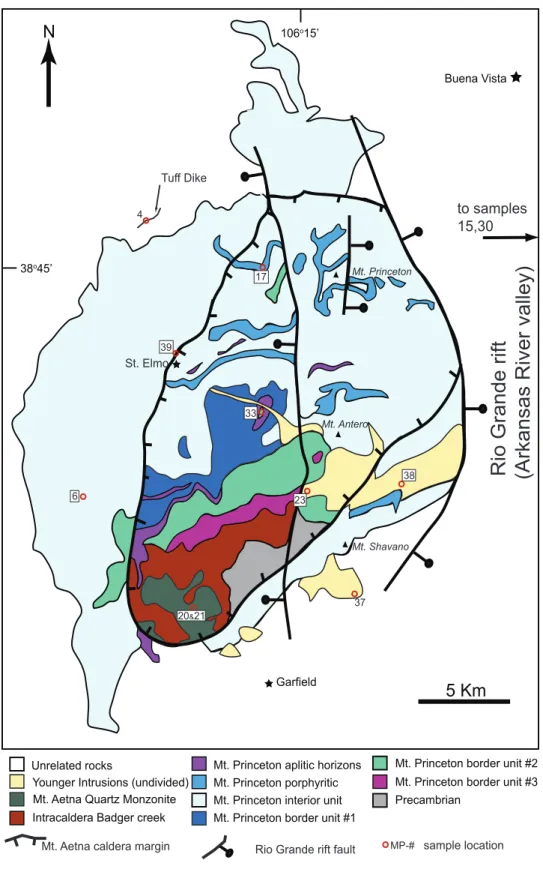
compositio-nally diverse border units. Interior and border units are collectively referred to as Mount Princeton Quartz Monzonite (Fig. 2). Imprecise Th-Pb geochronology, compositional zoning, the large number of continuous textural horizons and the lack of cross-cutting relationships led Shannon (1988) to conclude that the Mount Princeton batholith was emplaced, chemi-cally differentiated, and crystallized as a single, large magma body.
The younger Mount Aetna caldera collapse structure complicates the interpretation of the geologic history of the Mount Princeton batholith. The central portion of the batholith subsided into the Mount Aetna cauldron during the eruption of the crystal-rich dacitic Badger Creek and Antero tuffs (Shannon 1988) at 34.3 Ma (McIntosh and Chapin 2004; Zimmerer and McIntosh in prep). The Badger Creek and Antero tuffs are indistinguishable in age and chemistry (McIntosh and Chapin 2004), and for simplicity in this paper we will refer to the tuffs collectively as the Badger Creek Tuff. Evidence for the caldera includes the preservation of intracaldera tuff in the southern portion of the structure, and ring shears and associated ring dikes that extend to the north (Fig. 2; Shannon 1987; Toulmin and Hammarstrom 1990). One of the northern dikes is distinctive because it is preserved outside the mapped caldera boundaries (Fig. 2) and is characterized by the preservation of structures typically attributed to ignimbrites (e.g. flattened pumice). This unit is informally called the tuff dike (Shannon 1988), because of its appearance and distinct cross-cutting relationship with Precambrian wall rocks. The Mount Aetna Quartz Monzonite stock, adjacent to the intracaldera tuff in the southern portion of the batholith, locally grades into a porphyritic ring dike (Shannon 1987; Toulmin and Hammarstrom 1990). The ring dikes and stock are interpreted to have intruded shortly after caldera collapse (Shannon 1987; Campbell 1994).
N
5 Km
Precambrian Mt. Princeton interior unit
Mt. Princeton porphyritic
Mt. Princeton border unit #1
Mt. Princeton border unit #2 Mt. Princeton border unit #3 Mt. Princeton aplitic horizons
Intracaldera Badger creek Mt. Aetna Quartz Monzonite Younger Intrusions (undivided) Unrelated rocks
106o15’
38o45’
Mt. Aetna caldera margin Rio Grande rift fault MP-# sample location Garfield
Buena Vista
St. Elmo
Mt. Antero
Mt. Shavano Mt. Princeton
39
20&21
38 33
23
37
Tuff Dike
4
17
Rio Grande rift (Arkansas River valley)
to samples 15,306
magmatism in the area coincident with Rio Grande rifting (Shannon 1988).
MethODS
elemental chemistry
Samples were ground to a powder using a steel jaw crusher and a ceramic shatterbox. Rock fragments from the tuffs that were powdered were scrutinized using a handlens to limit the amount of lithic material in the powders. Powders were analyzed for major- and traceele-ment concentrations by Activation Laboratories (Ontario, Canada). Samples were dissolved by lithium metaborate/tetraborate fusion. Major-elements and Sc, Be, V, Sr, Zr, and Ba were analyzed by ICP-OES and all other trace-elements were analyzed by ICP-MS.
Lead, neodymium, and strontium isotope chemistry
Whole-rock powder was dissolved and cations were separated for isotopic analysis following methods outlined by Miller et al. (1995). Isotopic ratios for Pb, Nd and Sr were obtained on the VG Sector 54 thermal ionization mass spectrometer at the University of North Carolina at Chapel Hill. Mass fractionation correction of 0.12%/amu as determined by replicate analyses of NBS-981 was used for Pb isotopic ratios. Isotopic ratios for Nd
were normalized to 146Nd/144Nd = 0.7219 and replicate analyses of standard JNdi yielded
143Nd/144Nd = 0.512109 (n = 27). Isotopic ratios for Sr were normalized to 86Sr/88Sr =
0.1194 and replicate analyses of standard NBS-987 yielded 87Sr/86Sr = 0.710269 (n = 37).
Isotope ratios were corrected to initial values using elemental data obtained from Activation Laboratories (this study) and crystallization ages obtained by ID-TIMS U/Pb zircon analyses (this study) or by LA-ICP-MS U/Pb zircon analyses (Zimmerer and McIntosh in prep).
hafnium in zircon chemistry
zircons were imaged on the scanning electron microscope at the University of North Carolina at Chapel Hill. Cathodoluminescence images were obtained and used to avoid obvious
inherited cores during laser analysis.
The Hf isotopic composition of zircon was analyzed by in-situ laser ablation-multicollector-inductively coupled plasma-mass spectrometry (LA-MC-ICPMS) methods using a New Wave Nd:YAG UV 213-nm laser coupled to a Thermo-Finnigan Neptune MCICP-MS with 9 Faraday collectors housed at Washington State University. The laser was operated at both 5 and 10 Hz pulse rate (depending on the thickness of the zircon) with a 40
mm spot. The carrier gas consisted of purified He with small quantities of N2 to minimize
oxide formation and increase sensitivity. Analyses consisted of 60 1-second measurements in static mode, with cups measuring masses 171, 173, 175, 176, 177, 178, 179, 180 and 182. The largest obstacle in LA-MC-ICP-MS Hf isotopic analysis is the isobaric interference of
176Yb and 176Lu on 176Hf. We corrected for these by monitoring interference free isotopes of
Lu and Yb and using the known isotopic composition of these elements to determine the
contributions of 176Yb and 176Lu to the total mass 176 signal. Whereas the contribution of Lu
is minor, the contribution of Yb is large enough (approximately 2 - 15% of the total signal on mass 176) that the mass bias relationship for Yb needs to be carefully considered. The ideal way of determining Yb mass bias is to compare the measured ratio of interference-free Yb isotopes to their known ratio, but this is often difficult in practice due to the low signal
intensities on 171Yb and 173Yb. Thus, we assumed a linear relationship between Hf and Yb
mass bias, described as: bYb = x*bHf. The value for x was determined by analyzing the
zircon standards 91500 (176Yb/177Hf ~ 0.03), FC1 (176Yb/177Hf ~ 0.10), and R33 (176Yb/177Hf ~
0.15) and adjusting the x value to best fit the known 176Hf/177Hf values determined on
chemi-cally purified solutions of these zircon standards. The x value and modified 176Yb/173Yb were
then used to calculate the Hf isotopic composition of the unknowns.
the difficulty in correcting for the Yb interference, instrumental bias, and matrix effects. Although it is difficult to assess the full uncertainty on a given measurement, we
conserva-tively estimate the total uncertainty to be approximately ± 2 eHf units (2σ), based on the
reproducibility of analyses of the zircon standards.
Hf isotope results are presented in eHf units, using CHUR values of 176Hf/177Hf
= 0.282785 and 176Lu/177Hf = 0.0336 (Bouvier et al. 2008) and a decay constant value of
1.867e-11/a (Scherer et al. 2001; Söderlund et al. 2004).
U/pb analyses
Samples were crushed using a jaw crusher and a disc mill. Zircon was isolated using standard density (water table and heavy liquids) and magnetic separation techniques. Individual grains were selected using a binocular microscope to represent the range of size and morphology present in the populations. Selected zircon grains were thermally annealed for 48 hours at 900ºC, then chemically abraded for 14 hours at 220ºC in order to eliminate volumes affected by radiation damage and to remove inclusions (Mundil et al. 2004; Mattinson 2005). Depending on the size of the zircon grains and the Pb concentration, fractions consisting of 1 to 3 individual grains were selected for analysis.
Zircon fractions were spiked using a 205Pb-233U-236U tracer (Parrish and Krogh 1987)
and dissolved following a procedure modified after Krogh (1973) and Parrish (1987). Uranium and Pb were isolated using HCl anion exchange column chromatography procedu-res modified after Krogh (1973).
Isotope ratios of both U and Pb were determined by thermal ionization mass spec-trometry (TIMS) on a VG Sector 54 mass spectrometer at the University of North Carolina
at Chapel Hill. Uranium was run as a metal after loading in graphite and H3PO4 on single
Re filaments. Lead was loaded in silica gel on single Re filaments. All data were collected using the Daly detector in peak switching mode. Mass fractionation for Pb was determined to be 0.15%/amu over a wide temperature range based on multiple analyses of the NBS-981
ratio (a known constant from the 205Pb-233U-236Utracer) and assuming linear fractionation. Data processing and age calculations were completed using the PbMacDat spreadsheet that is based on the reduction algorithms Schmitz and Schoene (2007). Decay constants used were
238U = 0.155125 x 10⁻⁹ ± 0.16598 x 10⁻¹⁴ a-1, and 235U = 0.98485 x 10⁻⁹ ± 0.13394 x 10⁻¹³ a-1
(Steiger and Jäger 1977). All errors are reported at 2σ uncertainty and consider analytical
and decay-constant uncertainties. Corrections for initial Th/U disequilibrium (Schmitz and Bowring 2001) were made using [Th] and [U] data for the host rocks (Table 1) following the procedure outlined by Mattinson (1973).
reSULtS
Major- and trace-element chemistry
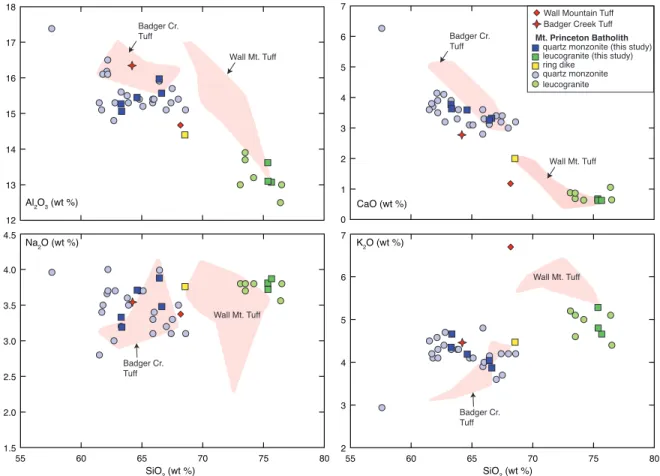
Geochemical analyses of plutonic rocks from the Mount Princeton batholith (Table 1) generally agree with previously published data (Toulmin and Hammarstrom 1988; Campbell 1994). The Mount Princeton Quartz Monzonite units and the Mount Aetna Quartz Monzonite
range from 63 to 67 wt% SiO2 and major-oxide concentrations negatively correlate with SiO2
(CaO, MgO, etc., Fig. 3) except Na2O and K2O which are positively correlated or do not
correlate (Fig. 3). The leucogranites from the batholith range from 75 to 76 wt% SiO2 (Fig.
3) and are depleted in all other major-elements, except Na2O and K2O, relative to the other
rocks in the batholith.
Major-element data for both the Badger Creek Tuff sample and the Wall Mountain Tuff sample generally agree with data from Campbell (1994) for the two units (Fig. 3), although there is significant spread in the data for the tuffs (Campbell 1994) that likely is the results of varied crystal content in the samples and winnowing of fine ash during eruption.
Our analysis of the Badger Creek Tuff has 64 wt% SiO2 or 67 wt% SiO2 when
renorma-lized without volatiles (LOI = 5.4 wt%). Campbell (1994) analyzed samples fall within a
range from 62 to 67 wt% SiO2 (Campbell 1994). The chemistry of the Badger Creek Tuff
Wall Mt. Tuff Wall Mt. Tuff
Badger Cr. Tuff Badger Cr.
Tuff
Wall Mt. Tuff Badger Cr.
Tuff Badger Cr.
Tuff
Wall Mt. Tuff
55 60 65 70 75 80
2 3 4 5 6
7 K2O (wt %)
Wall Mountain Tuff Badger Creek Tuff Mt. Princeton Batholith
quartz monzonite leucogranite
quartz monzonite (this study)
55 60 65 70 75 80
1.5 2.0 2.5 3.0 3.5 4.0 4.5
Na2O (wt %)
leucogranite (this study)
SiO2 (wt %)
0 1 2 3 4 5 6 7
CaO (wt %) 12
13 14 15 16 17 18
Al2O3 (wt %)
SiO2 (wt %) ring dike
Monzonite and the Mount Aetna Quartz Monzonite for most major-elements (Fig. 3). Our analysis of the Wall Mountain Tuff is within the range of Campbell (1994) for all
major-elements except SiO2 (we obtained lower concentrations; 68 wt% vs. 69-75 wt%) and K2O
(we obtained higher concentrations 6.71 vs. 5.38 to 6.43 wt%; Campbell, 1994; Fig. 3). The
high concentration of K2O may reflect some minor alteration.
Rare-earth element (REE) patterns (Fig. 4) for the Mount Princeton and Mount Aetna quartz monzonites and Badger Creek Tuff samples are similar and show LREE enrichment, minor negative Eu anomalies, and slight MREE depletion (Fig. 4). The Wall Mountain Tuff has a pattern similar to the quartz monzonites and the Badger Creek Tuff, but the overall concentrations of the REE are elevated with La at 400 times chondrite (Fig. 4). The leuco-granites have a different REE pattern that is characterized by lower overall concentrations of REE (La around 100 times chondrite), a pronounced negative Eu anomaly, and a well-defined scoop-shape.
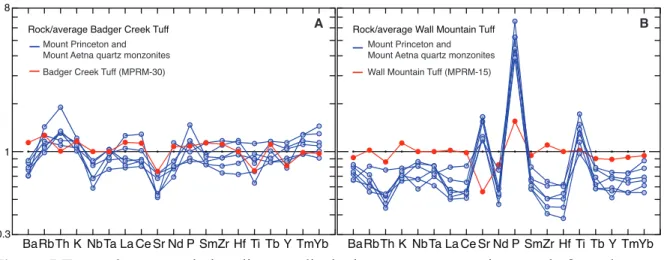
Zirconium concentrations in the Wall Mountain Tuff (~ 500 ppm) are higher than the quartz monzonites (Fig. 5) and the Badger Creek Tuff , which have Zr concentrations ranging from ~150 to 300 ppm. The concentration of Zr in the leucogranitic portion of the batholith is lower (approximately 100 ppm). The Zr/Hf ratios of the quartz monzonite rock samples range from 36 to 39, similar to, or slightly higher than the chondritic value of 36.3 (Sun and McDonough 1989). Both the Badger Creek and Wall Mountain tuffs have slightly elevated Zr/Hf ratios of 43 and 40, respectfully. The leucogranites have extremely low Zr/Hf ratios (25 to 29) relative to other rocks analyzed and the chondritic value.
Alkali trace-element (Rb, Sr and Ba) concentrations in the quartz monzonite portion of the batholith are rather homogeneous (Fig. 5) with no clear trend with crystallization age
or SiO2. The leucocratic portion of the batholith is depleted in Sr and Ba and enriched in Rb
10 100
20 30 40 50 60 70 80 200 300 400
La Ce Pr Nd Pm Sm Eu Gd Tb Dy Ho Er Tm Yb Lu
Mt. Princeton Quartz Monzonite Badger Creek Tuff
Mt. Aetna Quartz Monzonite
leucogranites ring dike
5
Wall Mountain Tuff
C
sample/C
chondriteFigure 5 Trace-element variation diagram displaying quartz monzonite sample from the Mount Princeton batholith normalized relative to the average values for Badger Creek Tuff (Campbell 1994; A) and the average values of Wall Mountain Tuff (Campbell 1994; B). Additionally, our analyses of Badger Creek Tuff and Wall Mountain Tuff are shown for comparison.
BaRbTh K NbTa La CeSr Nd P SmZr Hf Ti Tb Y TmYb Rock/average Wall Mountain Tuff
Mount Princeton and Mount Aetna quartz monzonites Wall Mountain Tuff (MPRM-15)
A B
1
BaRbTh K NbTa La CeSr Nd P SmZr Hf Ti Tb Y TmYb Rock/average Badger Creek Tuff
8
0.3
Whole rock radiogenic isotope chemistry
Strontium
The sample of the Wall Mountain Tuff we analyzed has an initial 87Sr/86Sr value of
0.7094 (Table 2; Fig. 6), which is within the range of values obtained by Campbell (1994) for
the tuff. The three Mount Princeton Quartz Monzonite samples have initial 87Sr/86Sr values
ranging from 0.7074 to 0.7078 with no correlation with crystallization age (Fig. 6). Both
Mount Aetna Quartz Monzonite samples have initial 87Sr/86Sr values of 0.7073 (Fig. 6). The
Badger Creek Tuff also has an initial 87Sr/86Sr value of 0.7073 (Fig. 6), which is within the
range of values obtained by Campbell (1994) for the Badger Creek Tuff. The leucogranites
have a large range in initial 87Sr/86Sr values ranging from 0.7043 (Mount Antero) to 0.7080
(North Fork).
Neodymium
Neodymium isotopic ratios for quartz monzonites from the Mount Princeton batholith
are fairly homogenous (eNd from -9.91 to -9.08), and the leucogranites are only slightly more
negative (eNd from -10.11 to -10.44; Table 2; Fig. 7). The Badger Creek Tuff has an eNd of
-9.03, similar to, but slightly more radiogenic than the intermediate rocks in the batholith.
The Nd in the Wall Mountain Tuff is less radiogenic than any of the intrusive rocks (eNd =
-10.66; Fig. 7).
Lead
Initial Pb isotopic ratios for the Badger Creek Tuff (206Pb/204Pb = 18.42, 207Pb/204Pb =
15.58, and 208Pb/204Pb =38.28) and Wall Mountain Tuff (206Pb/204Pb = 18.02, 207Pb/204Pb = 15.6
and 208Pb/204Pb = 38.22; Table 2; Fig. 8) are the next most radiogenic of the samples analyzed.
The quartz monzonite units have rather homogenous Pb isotopic compositions and show little correlation between the different isotopic ratios (Fig. 8). The range in values for the quartz
60 65 70 75 80
SiO2 (wt %)
0.704 0.705 0.706 0.707 0.708 0.709 0.710
87 Sr/ 86 Sr
i
Mount Princeton Quartz Monzonite Badger Creek Tuff
Mount Aetna Quartz Monzonite leucogranite
A
30 31 32 33 34 35 36 37 38
age (Ma) 0.704
0.705 0.706 0.707 0.708 0.709 0.710
87 Sr/ 86 Sr
i
B
Wall Mountain Tuff
Figure 6 87Sr/86Sr
i plotted against SiO2 (A). 87Sr/86Sri plotted against age (B) of the sample
30 31 32 33 34 35 36 37 38
age (Ma)
-11.0 -10.5 -10.0 -9.5 -9.0 -8.5
ε
Nd
(t)
60 65 70 75 80
SiO2 (wt %)
-11.0 -10.5 -10.0 -9.5 -9.0 -8.5
Mount Princeton Quartz Monzonite Badger Creek Tuff
Mount Aetna Quartz Monzonite leucogranite
Wall Mountain Tuff
ε
Nd
(t)
A
B
Figure 8208Pb/204Pb
i plotted against 206Pb/204Pbi (A) and 207Pb/204Pbi plotted against 206Pb/204Pbi
(B) for quartz monzonites, leucogranites, Badger Creek Tuff and the Wall Mountain Tuff.
206Pb/204Pb
i
208 Pb/ 204 Pb
i
207 Pb/ 204 Pb
i
A
B
206Pb/204Pb
i
Mount Princeton Quartz Monzonite Badger Creek Tuff
Mount Aetna Quartz Monzonite leucogranite
Wall Mountain Tuff
17.50 17.70 17.90 18.10 18.30 18.50
15.45 15.50 15.55 15.60
17.50 17.70 17.90 18.10 18.30 18.50
from 38.02 to 38.11) is slightly less radiogenic than the two tuffs (Fig. 8). The leucogranites have significantly less radiogenic Pb isotopic compositions than the intermediate composition
portion of the batholith (206Pb/204Pb from 17.53 to 17.72, 207Pb/204Pb from 15.48 to 15.51 and
208Pb/204Pb from 37.57 to 37.68). Calculated initial whole rock Pb isotopic ratios are in
agree-ment with feldspar Pb isotopes from similar units (Stein 1985).
hf isotopic compositions of zircon
The range in eHf(t) obtained from zircon from the Wall Mountain Tuff is -11.14 to
-17.14 (Table 3; Fig. 9) and the weighted mean is -12.94 with a MSWD of 3.10. Excluding
the most negative eHf(t) value of -17.14 (obtained from an inherited core) yields a weighted
mean of 12.59 (MSWD = 1.67) that we accept as the magmatic value. The Mount Princeton
and Mount Aetna Quartz Monzonite zircons yielded a total range in eHf(t) from -9.43 to
-13.92 (Fig. 9). The range in weighted mean eHf(t) for individual Mount Princeton Quartz
Monzonite samples is -11.68 to 12.04 and for the Mount Aetna Quartz Monzonite samples it is -12.46 to -12.49 (Fig. 9). Zircons from the tuff dike yield a similar weighted mean (-12.73) as the Mount Aetna Quartz Monzonite (Fig. 9). The weighted mean for the Badger Creek Tuff is -11.36. The 3 leucogranite samples all have less negative weighted means, which range from -9.59 to -10.54 and the overall range from individual zircons in the leucogranite samples is -7.23 to -13.10 (Fig. 9).
U/pb zircon geochronology
Zircons from dated samples contain few inclusions and lack visible inherited cores. All fractions reported are concordant within uncertainty (considering analytical and decay-constant uncertainties; Table 4) after the application of a Th correction. We use the weighted
mean 206Pb/238U age as the best estimate for the crystallization age of the samples (Fig. 10).
Figure 9 LA-ICP-MS Hf-in-zircon analyses for plutonic rocks from the Mount Princeton batholith and the Wall Mountain Tuff, Badger Creek Tuff, and tuff dike. Samples are ordered from oldest to youngest based on ages from this study and Zimmerer and McIntosh (in prep).
Mount Princeton Quartz Monzonite MPRM-33 W.M. = -11.77
MSWD = 1.99 Mount PrincetonQuartz Monzonite MPRM-17 W.M. = -12.04 MSWD = 1.08
Mt Antero Leucogranite MPRM-23 W.M. = -10.54 MSWD = 5.83 California
Leucogranite MPRM-38 W.M. = -10.48 MSWD = 5.38 North Fork
Leucogranite MPRM-37 W.M. = -9.59 MSWD = 19.94 Mount Aetna
Quartz Monzonite MPRM-20 W.M. = -12.49 MSWD = 6.69 Mount Aetna Quartz Monzonite MPRM-21 W.M. = -12.46 MSWD = 4.83
tuff dike MPRM-4 W.M. = -12.68 MSWD = 3.57 Mount Princeton
Quartz Monzonite MPRM-6 W.M. = -11.68 MSWD = 4.63 Wall Mountain Tuff
MPRM-15 W.M. = -12.94 MSWD = 3.10
-4
-8
-12
-16
-20 -6
-10
-14
-18
Decreasing Age
ε
Hf(t)Badger Creek Tuff MPRM-30 W.M. = -11.36 MSWD = 0.93
important to pinpoint the youngest zircon growth, which mandates the use of single grains or tips of grains (Crowley et al. 2007). However, we adopted a multi-grain analytical strategy because we were generally concerned with zircon growth during the crystallization history of the magmas; larger fractions helped circumvent the problem of low U concentrations in
sampled zircons. We are confident that our weighted mean 206Pb/238U ages are not skewed by
Pb-loss due to the chemical abrasion pre-treatment procedure, which has been convincingly demonstrated by prior studies to eliminate zircon domains affected by Pb-loss (Mundil et al. 2004; Mattinson 2005). Moreover, our interpretations do not hinge on deciphering the growth systematics of individual zircon grains.
Wall Mountain Tuff
One sample from the densely welded Wall Mountain Tuff (MPRM-15; Fig 1) was collected for zircon geochronology. All U/Pb data that was obtained for this sample was normally discordant and produced a poorly-defined mixing array between approximately 37 Ma and approximately 1.4 Ga. Because the new zircon growth around 37 Ma incorporated very little U, the older, radiogenic Pb-rich component dominated the Pb signal. No zircon age is interpreted for this sample.
Mount Princeton Quartz Monzonite
Three samples from the Mount Princeton Quartz Monzonite units were analyzed (MPRM-6, MPRM-17, and MPRM-33; Fig. 2). MPRM-33 was collected from close to the structural top of the batholith in one of the border units. Zircons from MPRM-33 have low [U] resulting in low radiogenic Pb:common Pb ratios. Six concordant fractions yield a
weigh-ted mean 206Pb/238U age of 35.80 ± 0.09 Ma (Fig. 10). MPRM-6 was collected outside of the
Mount Aetna collapse structure from the interior unit of the Mount Princeton batholith. The
weighted mean 206Pb/238U age for seven concordant fractions is 35.47 ± 0.07 Ma (Fig. 10).
36.0
35.8
35.6
35.4
35.2
35.0
34.8
34.6
34.4
206
Pb/
238
U age (Ma)
(MPRM-33)
35.80 ± 0.09 Ma 35.47 ± 0.07 Ma(MPRM-6) 35.37 ± 0.10 Ma(MPRM-17)
Mount Princeton Quartz Monzonite Mount Aetna Quartz Monzonite (MPRM-21)
34.95 ± 0.04 Ma 34.60 ± 0.13 Ma(MPRM-20) 34.57 ± 0.08 Ma(MPRM-4) tuff dike
(MPRM-39) 34.48 ± 0.09 Ma
ring dike
(MPRM-30) 34.47 ± 0.05 Ma Badger Creek Tuff
between the interior unit and border (roof) units (Fig. 2). MPRM-17 yields a weighted mean
206Pb/238U age of 35.37 ± 0.10 Ma (Fig. 10).
Mount Aetna Quartz Monzonite
Two samples from the Mount Aetna Quartz Monzonite were analyzed (MPRM-20 and MPRM-21; Fig. 2). MPRM-21 was collected from the porphyritic portion of the
intru-sion and yields a weighted mean 206Pb/238U age of 34.95 ± 0.04 Ma (Fig. 10). MPRM-20 was
collected from the fine-grained portion of the intrusion and yields a weighted mean 206Pb/238U
age of 34.60 ± 0.13 Ma (Fig. 10).
Tuff dike
One sample (MPRM-4; Fig 2) from the altered tuff dike located north of the batholith was collected and analyzed. Data from four concordant fractions yield a weighted mean
206Pb/238U age of 34.57 ± 0.08 Ma (Fig. 10).
Northern ring dike
One sample from the northern ring dike (MPRM-39; Fig. 2) was collected and
analy-zed. Five concordant fractions give a weighted mean 206Pb/238U age of 34.48 ± 0.09 Ma (Fig.
10).
Badger Creek Tuff
One sample from the outflow of the Badger Creek Tuff (MPRM-30; Fig. 1) was
collected and analyzed. Five concordant fractions yield a weighted mean 206Pb/238U age of
34.47 ± 0.05 Ma (Fig. 10).
Mount Antero Leucogranite
One sample from of the Mount Antero Leucogranite (MPRM-23; Fig. 2) was
DISCUSSION
Origins of the Mount princeton magma system
Farmer and DePaolo (1984) listed two possibilities for the source of metaluminous Cenozoic magmas in central Colorado based on Nd and Sr isotopic ratios: 1) partial melting of mafic lower crust and 2) interaction of mantle-derived melts with felsic lower crust. Based on Nd isotopic ratios and REE concentrations Stein and Crock (1990) proposed that the metaluminous quartz monzonites in the Colorado Mineral Belt were generated by partial melting of the lower crust with limited, if any, mantle input. Our initial isotopic ratios (Figs 6, 7, 8, 9) agree with previously obtained values (Stein 1985; Campbell 1994) for rocks from the Mount Princeton magmatic center. Because young lower crust and lithospheric mantle are difficult to distinguish isotopically we infer that the source of the magmas was likely lower crust based on the lack of mafic magmas produced at the Mount Princeton magmatic center. However, the nature of the lower crust was likely modified by input from the lithospheric mantle throughout the history of Cenozoic magmatism.
ages of the tuffs
Pervasive inheritance problems precluded the possibility of determining a precise U/ Pb zircon age for the Wall Mountain Tuff. Consequently, we accept the Ar/Ar age of 37.25 ± 0.08 Ma determined by Zimmerer and McIntosh (in prep) as the best estimate for the eruption age. The age of the Wall Mountain Tuff is sufficiently greater than any of the other units we discuss here that the uncertainty associated with comparing U/Pb and Ar/Ar ages is insignificant.
The Badger Creek Tuff yielded zircons with simple systematics resulting in a
weigh-ted mean 206Pb/238U age of 34.47 ± 0.05 Ma (Fig. 10). This age agrees with the sanidine Ar/Ar
eruption age of 34.26 ±.06 Ma (Zimmerer and McIntosh in prep) when uncertainties in the decay constants are considered.
ages is highly variable (see review by Costa (2008)) for different magmatic systems and does not appear to scale with eruption volume (Reid 2008). Whereas some ignimbrites show minimal discrepancies of less than 15% of the age (Reid and Coath 2000; Bindeman et al. 2001; Simon and Reid 2005; Crowley et al. 2007) other ignimbrites have discrepancies greater than 15% and up to 50% of the age (Brown and Fletcher 1999; Schmitt et al. 2003). The variable ages in eruptive units is usually attributed to magma residence, indicating a long-lived crystal-liquid system capable of precipitating zircon over hundreds of thousands of years; however, remobilization of previously solid material is also possible. The 0.6% discrepancy between the U/Pb and the Ar/Ar for the Badger Creek Tuff is insignificant for interpretations made here. In order to compare equivalent ages we accept the U/Pb age of the tuff for discussion below.
assembly of the Mount princeton Quartz Monzonite
The Mount Princeton plutons are all classified as quartz monzonite but there is textu-ral and chemical variability that led Shannon (1988) to distinguish multiple phases. Although we only dated three samples of the quartz monzonite, our sampling strategy was designed to maximize spatial and textural coverage of the plutons. In addition, Zimmerer and McIntosh (in prep) dated samples from a broader geographic area of the Mount Princeton Quartz Monzonite. They interpret eight samples ranging in Ar/Ar biotite age from 35.78 to 35.23 Ma to represent the interval of crystallization of the Mount Princeton Quartz Monzonite. Biotite ages and zircon ages agree within uncertainty for mapped units defined by Shannon (1988), which is to be expected for fast cooling epizonal plutons. Therefore, we accept the range in zircon ages to be indicative of the assembly time for the Mount Princeton Quartz Monzonite, approximately 430 ka.
Aetna caldera (Shannon 1988). The oldest biotite ages (35.78 and 35.72 Ma; Zimmerer and McIntosh in prep) were obtained from another border (roof) unit that is also interpreted to be close to the top of the batholith (Shannon 1988). The geochronologic data support the hypothesis that magma cooled and crystallized adjacent to the roof and subsequent intrusions crystallized below the upper border units. The data may also be consistent with top-down construction of the pluton (Menand 2008; 2011); however, the limited data are not necessa-rily as convincing for this as documented elsewhere (Michel et al. 2008; Morgan et al. 2008; Tappa et al. 2011).
The sample that yielded the intermediate age for the Mount Princeton Quartz Monzonite (MPRM-6; 35.47 Ma; Fig. 10) is from the largest mapped unit (Fig. 2) of Shannon (1988), referred to as the “interior unit.” Biotite ages for samples from this unit range from 35.56 to 35.23 Ma (Zimmerer and McIntosh in prep), indicating that zircon crystallization in part of the unit preceded that recorded in the sample we dated (35.47 Ma), probably by 100 to 200 ka. We interpret the increased scatter in the data for MPRM-6 (relative to the other samples in this study) to be the result of incorporation of zircon from slightly older portions of the intrusive system as inferred for many other plutons (e.g. Miller
et al. 2007). The oldest fraction from MPRM-6 yields a 206Pb/238U age of 35.61 Ma (Fig. 10),
which we suggest is the best estimate for the beginning of crystallization of the interior unit of the Mount Princeton Quartz Monzonite.
to suggest that these may represent conduits for fluids escaping during emplacement of the leucogranites. Furthermore, the pulses of heat and/or volatiles (Glazner et al. 2011) that reset the biotite ages may be responsible for textural coarsening (Higgins 1999; Johnson and Glazner 2010) in the porphyritic facies.
Given the zircon age range of 430 ka, the area of exposure of 450 km2 (Shannon
1988) and the exposed vertical thickness of 1.5 km, we calculate an integrated magma flux
of 0.0016 km3/a for the Mount Princeton Quartz Monzonite. Thermal models indicate that
magma flux of at least 0.01 km3/a is necessary to produce enough magma to feed a super
eruption of at least 450 km3 (Annen 2009). Thus, the integrated flux is too low to produce
a super eruption, but magma flux may have been much higher over shorter timescales. However, the lack of ignimbrites in the Thirtynine Mile volcanic field (McIntosh and Chapin 2004) within the age range for the Mount Princeton Quartz Monzonite (Fig. 11) indicates that no known ignimbrite eruptions were associated with the construction of the Mount Princeton Quartz Monzonite.
assembly of the Mount aetna Quartz Monzonite
The Mount Aetna Quartz Monzonite is the intrusion, or set of intrusions, closest in age to the Badger Creek Tuff, and locally cuts the intracaldera tuff (Toulmin and
Hammarstrom 1990). The two dated samples from the Mount Aetna Quartz Monzonite have varied textures and give distinctly different age results. Zircon fractions from the porphyritic
sample (MPRM-21) produced consistent results: a weighted mean 206Pb/238U age of 34.95 Ma
±0.04 Ma (Fig. 10), with little observed inheritance. In contrast, zircon from the fine-grained sample (MPRM-20) show significant age spread yielding large uncertainty in the weighted
mean 206Pb/238U age (34.60 ± 0.13 Ma). We assume that Pb-loss has been mitigated by
chemical abrasion (Mundil et al. 2004; Mattinson 2005) and propose that the older fractions in the fine-grained sample represent antecrysts (Miller et al. 2007). Therefore, the age of the youngest fraction (34.48 Ma) is likely closest to the true emplacement age.
(MPRM-Figure 11 Plot of Ar/Ar sanidine ages (McIntosh and Chapin 2004; recalculated using FC-2 = 28.201 Ma, Kuiper et al. 2008) for ignimbrites preserved in the Thirtynine Mile volcanic
field and zircon 206Pb/238U ages from the Mount Princeton Quartz Monzonite (MPRM-33,
MPRM-6, MPRM-17).
33
34
35
36
37
38
39
age (Ma)
ignimbrites
20) is older or younger than the Badger Creek Tuff due to the large spread in fraction ages (inheritance) and the large uncertainty on the pooled age. However, U/Pb data from the porphyritic sample (MPRM-21) indicate the zircon crystallized approximately 500-700 ka before zircon crystallization in, and eruption of, the tuff, and field evidence indicates that the Mount Aetna pluton elsewhere cross cuts the tuff. The two most likely explanations for the disagreement between the zircon age from the porphyritic sample and the field relationships are: 1) zircon in the porphyritic Mount Aetna Quartz Monzonite is dominantly remobilized zircon from earlier intrusions (Klemetti and Cooper 2007), or 2) the Mount Aetna Quartz Monzonite stock is a complex, diachronous set of intrusions that accumulated over at least 500 ka.
Remobilization of the 34.95 Ma Aetna pluton 500-700 ka after intrusion is consistent with the observation that it locally cuts the Badger Creek Tuff. In this interpretation, the Aetna pluton is the penecontemporaneous source of the Badger Creek tuff, and the fine- grained facies of the pluton is the chilled margin of the porphyritic facies (Shannon 1988). However, it is difficult to reconcile this interpretation with the 1) lack of evidence for young zircon growth in the porphyritic facies, particularly since the presumed chilled margin is dominated by young zircon growth, and 2) lack of 34.95 Ma zircon in either the chilled margin or the Badger Creek Tuff. Although the spread in the U/Pb data for the fine-grained sample may be related to mixing of 34.95 Ma zircons with young zircon (< 34.4 Ma) there is no evidence for a 34.95 Ma component in the Badger Creek Tuff U/Pb data.
relation of the Wall Mountain tuff to the Mount princeton batholith
The Wall Mountain Tuff (37.25 Ma; Zimmerer and McIntosh in prep) is the largest
rhyolitic ignimbrite preserved in the Thirtynine Mile volcanic field. Its size (1,000 km3),
inscrutable geochronology (Shannon 1988; Friedrich et al. 1998) and paleovalley fill distribu-tion led many to suggest that the source of the ignimbrite was the Mount Princeton batholith (Tweto 1979; Shannon 1988; Lipman 2007). Our geochronology for the Mount Princeton batholith (35.82 to 30.25 Ma) indicate that presently exposed units of the batholith are too young to be directly related to the genesis of the Wall Mountain Tuff. In addition, our whole-rock isotopic analyses confirm the assertion made by Campbell (1994) on the basis of Sr isotopes, that the Wall Mountain Tuff had a different source than the Mount Princeton Quartz Monzonite.
Shannon (1988) and Lipman (2007) predicted that the relationship between the Mount Princeton Quartz Monzonite and the Wall Mountain Tuff was strong evidence for significant crystal/liquid fractionation in the upper crust because the Wall Mountain Tuff is more felsic than the Mount Princeton Quartz Monzonite. Lipman (2007) suggested that differentiation in the upper crust produced felsic caps that erupted and are now preserved as ignimbrite sheets in the Southern Rocky Mountain volcanic field and that some plutons represent the more mafic crystal cumulates left behind in the crust. At least in the case of the Wall Mountain Tuff and the Mount Princeton batholith there is no evidence to support this hypothesis: geochronologic and geochemical data contradict any direct connection between the tuff and the batholith.
plutonic remnants of the Wall Mountain tuff
(Feldman 2010), appears to be too far north to reconcile with the paleovalley fill of the tuff. Another potential source location is to the west, in the Elk and West Elk Mountains. However, present data on multiple stocks in the Elk and West Elk Mountains indicate that the magmatism in this area post-dates the Wall Mountain Tuff by several million years (Obradovich et al. 1969; Garcia 2011). Thus, there are no known plutonic equivalents of the tuff. Furthermore, if the source caldera for the Wall Mountain Tuff was located in the same geographic area as the Mount Princeton batholith as suggested by geomorphic data, it must have been at a structurally higher level that was completely eroded shortly after the caldera forming eruption.
To evaluate the possibility that the Wall Mountain Tuff was derived through shal-low fractional crystallization from plutonic rocks eroded from above the exposed Mount Princeton batholith, we estimate the volume of plutonic rock that must have been removed. The best estimate for the crystallization depth of the Mount Princeton Quartz Monzonite is 3 km (Hammarstrom and Zen 1986), which establishes a minimum thickness of the Wall Mountain magma system. The maximum calculated exhumation rate for the Mount Princeton Quartz Monzonite is 1.5 mm/a (Hammarstrom and Zen 1986), which is based on the
deposition of the Badger Creek Tuff on the Mount Princeton Quartz Monzonite at 34.3 Ma. If this rate is applied to the amount of time between the eruption of the Wall Mountain Tuff (37.3 Ma) and the oldest age of the Mount Princeton Quartz Monzonite (35.8 Ma) then an additional 2.25 km of the magma system could have possibly been present at the time of the eruption of the Wall Mountain Tuff. This places an upper limit on the thickness of the Wall Mountain magma system of 5.25 km. Lipman (2007) estimated the area of the Wall Mountain
Tuff caldera at 350 km2 which establishes a upper estimate of total magma volume of 1,800
km3. The eruptive volume of the tuff is estimated to be 1,000 km3, leaving a maximum
residual (but now eroded) pluton volume of 800 km3. Thus the greatest intrusive extrusive
estimated all variables above to maximize pluton volume. Thus, if the Wall Mountain Tuff was derived from above the presently exposed Mount Princeton batholith, we suggest that it was fairly efficiently evacuated from the upper crust leaving behind little magma to crystal-lize as plutons.
Origin of the Badger Creek tuff
The trap-door style Mount Aetna caldera formed during the eruption of the Badger Creek Tuff and a network of ring dikes and tuff dikes (cutting Precambrian wall rocks) are correlated with the eruption of the tuffs (Shannon 1988; Toulmin and Hammarstrom 1990). Zircon U/Pb ages for the ring dike (34.48 ± 0.09 Ma), tuff dike (34.57 ± 0.08 Ma) and fine-grained Mount Aetna Quartz Monzonite (34.60 ± 0.13 Ma) overlap with the zircon age of the Badger Creek Tuff (34.47 ± 0.05 Ma; Fig. 10) and are all older than the sanidine Ar/ Ar eruption age of 34.26 ± 0.06 Ma for the Badger Creek Tuff (Zimmerer and McIntosh in prep).
If uncertainties in the U and K decay constants are propagated through the error cal-culation, the zircon ages for the dikes and fine-grained Mount Aetna Quartz Monzonite and
the Badger Creek Tuff overlap at 2σ with the sanidine Ar/Ar age for the Badger Creek Tuff.
systems and prolonged zircon growth in the magma chamber.
relationship between the Badger Creek tuff and the Mount princeton batholith
Despite the discrepancy with the U/Pb and Ar/Ar ages, the fine-grained Mount Aetna
Quartz Monzonite, ring dike and tuff dike all have 238U/206Pb zircon ages equivalent to the
Badger Creek Tuff, consistent with the correlation of the dikes with the Badger Creek Tuff by Shannon (1988). The fine-grained portion of the Mount Aetna Quartz Monzonite is che-mically similar to the Badger Creek Tuff (Figs. 3, 4, 5); however, a large portion of the quartz monzonite from the batholith is chemically similar to the Badger Creek Tuff (Figs. 3, 4, 5). The ring dike is slightly more felsic than any analyzed sample of the Badger Creek Tuff (Fig. 3). Chemical modification of the ring dike by late stage magmatic fluids travelling through the ring fracture could have altered the chemistry, or the ring dike may represent a more felsic zone of the Badger Creek magma chamber that is not observed in the sampled portions of the intracaldera tuff or the outflow sheet. The tuff dike is highly altered so it is not possible to test whether it is chemically similar to the Badger Creek Tuff.
Implications for connections between plutons and ignimbrites
Zircon U/Pb ages from plutonic rocks from the Mount Princeton batholith and associated ignimbrites indicate a temporal disconnect between pluton emplacement and caldera-forming eruptions (Fig. 11). Because the caldera system is defined by eruption of two significant-volume ignimbrites, it does not fit neatly into the waxing/ignimbrite/waning stage model defined by Lipman (2007). What is clear, however, is that the majority of the batholith was emplaced between eruption of the Wall Mountain Tuff and the Badger Creek tuffs, and that there is no identified ignimbrite in the region that is the same age as the most volumetri-cally significant plutonic rocks (Fig. 11).
Because the plutonic rocks in the Princeton batholith region are not temporally associated with large-volume volcanism, the relatively low flux of magma that characterizes intra-ignimbrite magmatism - including waxing and waning stages elsewhere (e.g. Tappa et al. 2011), apparently favors pluton construction. According to this hypothesis, low-flux magmas generally stall in the upper crust and build plutons incrementally. These plutons most likely support small to moderate sized, steady state eruptions of magma (e.g. Claiborne et al. 2010) with no caldera formation. In contrast, the high magma flux modeled (Annen 2009) for super eruptions and documented by zircon geochronology of ignimbrites (Schmitz and Bowring 2001; Simon and Reid 2005; Crowley et al. 2007) results in nearly complete eruption of the rising magma (Tappa et al. 2011). Importantly, if ignimbrite eruption domina-tes the volume of rock preserved in the volcanic record, but is essentially absent from the plu-tonic record, the existing estimates of the intrusive:extrusive rock ratio (Smith 1979; Spera and Crisp 1981; White et al. 2006) likely reflect long-term averages, and have no relevance to magma chamber dynamics. The temporal disconnect between accumulation of large plutons and eruption of large ignimbrites means that the volume of intrusive rock preserved in one environment cannot be used to estimate the volume of extrusive rock that should be preser-ved in the other, and vice versa (e.g. Lipman 2007; de Silva and Gosnold 2007).
magmatic centers (> 50Ma) will preserve an apparent disconnect between episodes of plu-tonism and volcanism because ignimbrites will dominate the preserved volcanic record, and there will be little, if any, temporally correlative plutonic rocks. For example, Glazner (1991) noted a mismatch in the timing of volcanic and plutonic episodes in the Mesozoic Sierra Nevada arc. There, the sparse volcanic rocks that are preserved are dominated by ignimbrites (e.g. Saleeby et al. 1990; Barth et al. 2011) that erupted between episodes of significant pluton assembly. He attributed this mismatch to the angle of plate convergence, with episodes of oblique convergence favoring plutonism because plutons could intrude in releasing bends along strike-slip faults. Here we propose a tectonic connection to the mismatch as well, but suggest it may be tied to changes in magma flux. During periods of low flux, plutonism dominates. During periods of high flux, ignimbrite eruption, which leaves almost nothing in the plutonic record, dominates.
If large volcanic eruptions are not supported by large pluton volumes, then the bulk geochemistry of ignimbrites, and the origin of zonation in plutonic rocks and ignimbrites need not be the result of shallow crustal processes. Clemens et al. (2010) attributed chemical variations seen at varied scales in silicic plutons and volcanic deposits to changes (physical and chemical) in the lower crust source through time. This hypothesis is supported by the work of Tappa et al. (2011) who showed that the silicic cap of the zoned Rio Hondo pluton could not be liquid derived from deeper, more mafic portions of the pluton because the silicic cap predated the more mafic parts of the pluton. These authors hypothesized that the zoning was a result of temporal variation in the composition of the magmas feeding the shallow plutons. Similar zoning could form in an ignimbrite if the flux of magma from the source was high enough (Tappa et al. 2011).
Finally, the model presented distinguishes the plutonic rock record from the ignim-brite record. However, it simultaneously reinforces the temporal and chemical connections between the plutonic rock record and “typical” volcanic rocks. Although eruption of 5000
centers (Crisp 1984). Temporally, the waxing and waning stages of magmatism dominate even in the ignimbrite-rich Southern Rocky Mountain volcanic field. Although the waxing and waning magmas may be poorly represented (relative to the ignimbrites) in older magma-tic centers, we suggest that their temporal evolution is well preserved in the pluton record. The chemical evolution of the system is also likely recorded in the plutonic material because whole rock chemistry of plutonic rocks and volcanic rocks are not unique (Mills et al. 2008). Thus, for ancient magmatism, the plutonic rock record could provide the best insight into source evolution and, consequently, the chemical evolution of Earth’s crust.
CONCLUSIONS
1) Emplacement of large plutons at the Mount Princeton magma center occurred during
periods marked by a lack of ignimbrite eruptions (Figs. 10, 11).
2) Small plutons that are coeval with ignimbrite eruption at the Mount Princeton magma
center are chemically similar to the ignimbrite (Fig. 5) and show no signs of crystal-liquid separation.
3) Magma flux estimate for the Mount Princeton Quartz Monzonite is 0.0016 km3/a
which is too low to produce super eruptions.
4) The source of the magmas at Mount Princeton migrated from felsic lower crust to
T
able 1
Whole-rock major
-element concentrations (wt. %)
Sample name SiO 2 Al 2O 3 Fe 2O 3(T) MnO MgO CaO Na 2O K 2O T iO 2 P 2O 5 LOI T otal
Mount Princeton Quartz Monzonite
MPRM-6 63.29 15.27 5.30 0.063 1.78 3.77 3.33 4.35 0.665 0.27 1.70 99.79 MPRM-17 66.63 15.57 4.09 0.080 1.29 3.32 3.48 3.87 0.515 0.21 1.16 100.20 MPRM-33 63.34 15.06 5.70 0.106 2.1 1 3.63 3.19 4.66 0.773 0.23 1.04 99.83 Mount
Aetna Quartz Monzonite
MPRM-20 66.43 15.97 4.28 0.084 1.22 3.26 3.88 4.04 0.580 0.27 0.71 100.70 MPRM-21 64.61 15.45 4.44 0.086 1.46 3.59 3.71 4.19 0.620 0.34 0.92 99.39 ring dike MPRM-39 68.54 14.40 3.39 0.126 0.93 2.00 3.76 4.47 0.436 0.20 1.13 99.38 leucogranite MPRM-23 75.35 13.62 1.08 0.066 0.16 0.63 3.81 5.28 0.136 0.05 0.33 100.50 MPRM-37 75.67 13.07 1.13 0.061 0.22 0.62 3.87 4.66 0.135 0.06 0.40 99.91 MPRM-38 75.38 13.10 1.17 0.071 0.18 0.68 3.72 4.80 0.158 0.06 0.22 99.55 W
all Mountain T
T
able 1 continued
Whole-rock trace-element concentrations (ppm)
Sample name Sc Be V Cr Co Ni Cu Zn Ga Ge As Rb Sr Y Zr Nb Mo Ag In Sn Sb Cs Ba
Mount Princeton Quartz Monzonite
MPRM-6 10 2 99 < 20 10 < 20 10 40 20 1.5 6 124 491 24.7 199 14.2 < 2 < 0.5 < 0.1 2 1.3 4.6 951 MPRM-17 7 2 74 < 20 1 1 < 20 10 70 21 1.7 < 5 1 13 610 21.1 180 16.4 < 2 1.2 < 0.1 2 0.8 2.4 1037 MPRM-33 1 1 2 109 40 16 20 20 70 21 1.6 < 5 164 463 26.4 287 19.7 < 2 1.2 < 0.1 3 0.7 2.7 957 Mount
Aetna Quartz Monzonite
MPRM-20 7 3 58 30 6 < 20 20 150 22 1.4 < 5 133 651 24.1 269 20.5 < 2 < 0.5 0.1 30 0.4 2.1 1 151 MPRM-21 7 3 73 < 20 10 < 20 20 70 23 1.4 < 5 122 654 20.2 224 16.3 < 2 < 0.5 < 0.1 2 < 0.2 1.4 1074 ring dike MPRM-39 5 3 34 < 20 6 30 50 220 20 1.0 6 145 476 18.3 224 21.1 < 2 2.3 0.1 3 1.2 3.3 1 189 leucogranite MPRM-23 4 6 8 < 20 2 < 20 < 10 < 30 23 2.4 < 5 293 1 1 1 15.0 109 51.0 < 2 < 0.5 < 0.1 3 0.6 2.8 387 MPRM-37 6 7 9 < 20 2 < 20 < 10 < 30 23 2.6 < 5 393 95 17.2 87 36.6 < 2 < 0.5 < 0.1 8 0.7 4.6 274 MPRM-38 3 5 10 < 20 2 < 20 10 50 21 2.2 < 5 237 124 14.9 121 35.1 < 2 < 0.5 < 0.1 3 0.6 3.0 408 W
all Mountain T