
arXiv:1108.2131v1 [hep-ph] 10 Aug 2011
Hendrik van Hees
Institut f¨ur Theoretische Physik, Goethe-Universit¨at Frankfurt, Germany, Frankfurt Institute for Advanced Studies (FIAS),
Ruth-Moufang-Str. 1, D-60438 Frankfurt, Germany
Charles Gale
Department of Physics, McGill University, 3600 University Street, Montreal, Canada H3A 2T8
Ralf Rapp
Cyclotron Institute and Department of Physics & Astronomy, Texas A&M University, College Station, Texas 77843-3366, USA
(Dated: September 11, 2018)
We update our calculations of thermal-photon production in nuclear collisions at the Relativis-tic Heavy-Ion Collider (RHIC). Specifically, we address the recent experimental observation of an elliptic flow of direct photons comparable in magnitude to that of pions, which is at variance with expectations based on quark-gluon plasma (QGP) dominated photon radiation. Our thermal emis-sion rate is based on previous work, i.e., resummed leading-order QGP emisemis-sion and in-medium hadronic rates in the confined phase. These rates are nearly degenerate at temperatures close to the expected QCD-phase change. The rates are convoluted over an improved elliptic-fireball expansion with transverse- and elliptic-flow fields quantitatively constrained by empirical light- and strange-hadron spectra. The resulting direct-photon spectra in central Au-Au collisions are characterized by hadron-dominated emission up to transverse momenta of ∼2-3 GeV. The associated large elliptic flow in the hadronic phase mitigates the discrepancy with the measured photon-v2 compared to scenarios with QGP-dominated emission.
I. INTRODUCTION
Dileptons and photons are the only particles which es-cape the interior of the fireball created in ultrarelativistic heavy-ion collisions (URHICs) unaffected. Their produc-tion, on the other hand, is rooted in the strongly inter-acting medium and thus illuminates the latter’s prop-erties, see Refs. [1–3] for reviews. Recent highlights of electromagnetic observables in URHICs include “mea-surements” of the in-medium vector-spectral function via dileptoninvariant-mass spectra at the SPS [4–6] and of the medium temperature via direct photons at RHIC [7]. It is well known that the thermal component in the ob-served electromagnetic spectra results from a convolution of the temperature- and density-dependent emission rate over the entire space-time history of the expanding fire-ball in URHICs. From the interplay of decreasing tem-perature and increasing three-volume in the course of the fireball expansion, it can be fairly well established that photon and dilepton emission in the low-energy regime, q0.1 GeV1, are dominated by the hadronic phase. At
energies beyond ∼ 1 GeV, the situation is less clear, since the competition between hadronic and QGP sources will be sensitive to additional ingredients [10], e.g., the relative strength of hadronic and QGP emission rates,
1
The energy variable, q0, encompasses both mass (M) and
transverse-momentum (qt) dependencies,e.g.,q0= (M2+q2t)1/2
forqz= 0.
the phase-transition temperature (which formally demar-cates the space-time dependence of the two sources) and the transverse flow (inducing a blue shift to higher qt
which is more pronounced in the later hadronic phase)2.
In this context, recent measurements of the elliptic flow of direct photons (i.e., after the subtraction of long-lived hadron decays, mostlyπ0, η
→γγ) in semicentral Au-Au collisions [11] have revealed remarkable results. It has been found that the pertinent flow coefficient, v2γ(qt),
is as large as that of charged pions up to momenta of qt ≃ 3 GeV (albeit the photon data carry somewhat
larger error bars). This result is difficult to reconcile with a dominant QGP emission source. Primordial photons from binaryN-N collisions, whose emission is expected to be isotropic, will further reduce the total direct-photon v2. Current model calculations [12–14] using a
hydrody-namically expanding medium with QGP and hadronic radiation, as well as primordial photons, underpredict the experimentally measuredv2 by a factor of∼5 (∼3
when accounting for the maximal systematic error in the measurement). The question thus arises what could be missing in these calculations.
In the present paper we re-examine several aspects related to thermal photon emission from the hadronic medium. Since thev2 in the hadronic phase of URHICs
is large, an augmented hadronic component is a natural
2
Note that the blue-shift distortion does not apply to dilepton
invariant-mass spectra if a finite detector acceptance can be fully corrected for.
candidate to improve the description of thermal-photon emission at RHIC and thus reduce the discrepancy with thev2 data. First, we note that typical hydrodynamical
evolutions with first-order phase transitions tend to un-derestimate the radial (and possibly elliptic) flow built up in the fireball at the end of the QGP phase. This was borne out of a recent phenomenological analysis of light-and strange-hadron spectra using blast-wave parameteri-zations of the respective sources at thermal and chemical and freezeout (withTch≃100 MeV andTfo≃180 MeV,
respectively) [15]. In particular, the observed universal-ity in kinetic-energy scaling of thev2of light and strange
hadrons, together with an earlier decoupling of multi-strange hadrons (as inferred from theirpt spectra),
sug-gests that most of the hadronicv2 is indeed of partonic
origin [16]. Second, for the thermal emission rates from hadronic matter we use our previous results of Ref. [9], which, in particular, include contributions from baryons which are known to be important from dilepton calcu-lations [10], even at RHIC [17]. Finally, we take into account chemical off-equilibrium effects in the hadronic phase, i.e., effective chemical potentials for pions, kaons, etc., which can further augment the hadronic compo-nent in thermal-photon spectra (e.g., typical processes like πρ → πγ are enhanced by a pion fugacity to the third power).
Our paper is organized as follows. In Sec. II we briefly recall our input for the thermal-photon rates as taken from Ref. [9], as well as for the primordial contribution, which we check againstppdata. In Sec. III we update our description of the thermal fireball evolution by construct-ing (a time evolution of) flow fields which is consistent with the empirical extraction at chemical and thermal freezeout. In Sec. IV we evolve the rates over the fire-ball evolution and discuss the resulting photon-qt
spec-tra, in particular the composition of the thermal yields. In Sec. V we present our results for the direct-photon v2 in comparison to the recent PHENIX data [11] and in
light of other model results. Finally, Sec. VI contains our conclusions.
II. PHOTON SOURCES
The photon spectrum resulting from a heavy-ion (or pp) reaction is usually referred to as inclusive photons. The subtraction of long-lived final-state decays leads to the notion of direct photons, which are the ones of inter-est in the present context. For direct photons, we further distinguish the radiation of thermal photons (Sec. II A), characterized by an equilibrium-emission rate to be inte-grated over the space-time evolution of the medium, and a non-thermal component emanating from primordial in-teractions prior to thermalization (Sec. II B).
A. Thermal Emission
In the present work we adopt the thermal emission rates of photons as developed and compiled in Ref. [9].
For QGP radiation we use the numerical parameteri-zation of the complete leading-order inαs rate as given
in Ref. [18]. The main input for the QGP rate is the strong coupling “constant” for which we take an expres-sion with temperature-dependent one-loop running at the scale ∼ 2πT, αs(T) = 6π/27 ln(T[GeV]/0.022). This
amounts to values of around 0.3 in the relevant tempera-ture regime,T = 1-2Tc, which turns out to be consistent
with recent estimates from the (perturbative) Coulomb term in in-medium heavy-quark free energies [22].
The basis of the thermal emission rate in hadronic mat-ter forms the electromagnetic correlation function com-puted in Refs. [9, 23] using hadronic many-body the-ory with effective Lagrangians. It has been successfully used [1] in the interpretation of dilepton data at the SPS [4, 5] and has been carried to the photon point in Ref. [9]. It includes a rather extensive set of meson and baryon resonances in the interaction of the isovec-tor current with a thermal heat bath of hadrons. It has been augmented by additional meson-exchange re-actions in a meson gas which become important at pho-ton momentaq&1 GeV,e.g.,π, ω, and a1exchange in
π+ρ→ π+γ as well as strangeness-bearing reactions (e.g., π+K∗ → K+γ) [9]. An important element in
constraining the hadronic vertices to empirical informa-tion, such as hadronic and radiative decay branchings, is the (gauge-invariant) introduction of vertex form fac-tors. The latter lead to a substantial reduction of the hadronic emission rate with increasing photon momen-tum, which is essential for quantitative descriptions of hadronic emission rates at the momenta of experimental interest (qt .3.5 GeV for thermal radiation). Without
vertex form factors, hadronic photon rates should not be considered reliable for momentaq≥1 GeV. We do not include here additionalππBremsstrahlung contributions (ππ→ππγ) as evaluated in Refs. [24, 25]. This source is important at low momenta,qt.0.5 GeV, put plays no
role in the region of interest of the present investigation (qt≥1 GeV).
The resulting total hadronic and QGP emission rates were found to be remarkably close to each other for tem-peratures around the putative transition temperature, Tc ≃ 180 MeV. This is appealing from a conceptual
point of view in terms of a possibly continuous matching of the bottom-up and top-down extrapolated hadronic and QGP rates, respectively. It is also welcome from a practical point of view, since it much reduces the uncer-tainties associated with identifying the medium in the fireball as hadronic or partonic, which, in the case of a cross-over, may not even be well defined. If QGP and hadronic rates are significantly different across Tc,
ap-preciable uncertainties in the calculated photon spectra have been found as a result of this ambiguity [14].
0 1 2 3 4 5 6 7 8
q
t[GeV]
10-7 10-6 10-5 10-4 10-3 10-2 q 0 d σ γ /d 3 q [mb GeV -2 ] pQCD param. 2.5 x pQCD par. PHENIX param.PHENIX
|y|<0.35
pp s
1/2=200GeV
FIG. 1: (Color online) Empirical fits to the direct-photon spectrum measured by PHENIX [28] in p-p collisions at √s = 200 GeV; dash-dotted line: power-law fit [28], solid and dashed line: xt-scaling ansatz [29] with and withoutK factor, respectively.
B. Non-Thermal Sources
After subtraction of final-state decays, the main source other than “thermal” radiation from the interacting medium is associated with “primordial” photons pro-duced upon first impact of the nuclei via binaryN N col-lisions. Primordial photon spectra are usually estimated from the direct contribution in pp collisions, where no significant reinteractions are expected. This is supported by the generally good agreement of the measured photon spectra with next-to-leading order (NLO) perturbative QCD (pQCD) calculations [26] for primordial produc-tion. In the following we will adopt a simple power-law fit performed by the PHENIX collaboration [7, 27] to their ppdata [7, 28], cf. Fig. 1. Figure 4 in Ref. [7] re-veals that the NLO pQCD calculations are slightly below the PHENIX parameterization in the relevantqtrange of
∼1-7 GeV. Therefore, we will alternatively estimate the primordial contribution via a xt-scaling motivated
pa-rameterization [29], upscaled by aK-factor of 2.5 to best match the PHENIX pp data for qt = 5-8 GeV. This
fit produces a slightly smaller yield of photons with mo-mentaqt= 1-5 GeV compared to the PHENIX fit and is
thus very similar to the NLO pQCD calculations. In principle, photons can also be radiated off fast-moving partons (jets) interacting with the medium. The combined elliptic flow of this source is expected to be close to zero [19]. We therefore subsume this source in our primordial contribution (whose fragmentation part, e.g., is expected to be reduced in the medium), which is a posteriori justified by an adequate description of the spectral yields in Au-Au collisions once thermal radiation is implemented.
III. FIREBALL AND TRANSVERSE-FLOW
FIELD
The continuous emission of photons throughout the evolution of a heavy-ion reaction causes their elliptic-flow signal to be more sensitive to its time evolution than that of hadronic final states. Therefore, a calculation of the photon-v2requires special care in constructing a realistic
time evolution of both radial and elliptic flow (the for-mer affects the spectral weight of photon emission at a given time snapshot). In principle, hydrodynamic models are believed to be able to accomplish such a task; how-ever, current uncertainties including initial conditions (e.g., fluctuations and initial flow fields), viscosity correc-tions and the coupling to hadronic cascades in the dilute stages render this a challenging task, which has not been completed (yet). In the present paper we take a more pragmatic (and simple) approach which nevertheless ac-curately captures two experimentally established snap-shots of the fireball evolution, namely the flow fields at chemical freezeout atTch≃170 MeV and kinetic
freeze-out at Tfo ≃ 100 MeV. The latter is well determined
by the transverse-momentum (pt) spectra and elliptic
flow of light hadrons (π,K,p) [30–32], while the former can be extracted from spectra and flow of multi-strange hadrons[16, 31, 33]. A detailed fit of these snapshots us-ing an elliptic blast-wave source has been performed in Ref. [15], which was also shown to be compatible with the empirical constituent-quark number and transverse kinetic-energy (KET) scaling of the elliptic flow of light
and strange hadrons. We use these results to improve a previously constructed expanding elliptic fireball [34] so that its evolution passes through these benchmarks at the end of the mixed phase and at thermal freezeout. Representative examples of the resulting multi-strange (φ mesons) and light-hadron (π,p) spectra andv2at
chemi-cal and thermal freezeout, respectively, are illustrated in Fig. 2.
Concerning initial conditions, we assume an initial lon-gitudinal fireball size of z0 = 0.6 fm corresponding to
cτ0≃z0/∆y≃0.33 fm (∆y ≃1.8) as our default value
for both 0-20% and 20-40% centrality classes. With to-tal entropies of S = 7900 and 3600 (assumed to be conserved), this translates into (average) initial tempe-ratures of T0 ≃ 355 MeV and 325 MeV, and
charged-hadron multiplicities of dNch/dy ≃610 and 280,
respec-tively, adjusted to recent STAR data [32].
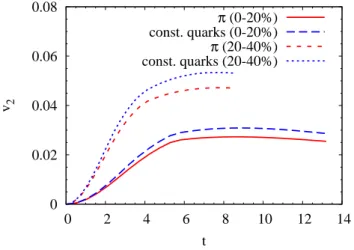
The time evolution of the inclusive elliptic flow is shown in Fig. 3. The observed KET scaling of light and
multi-strange hadrons is the main constraint which re-quires a rather rapid increase of the bulkv2, and a
sub-sequent leveling off shortly after chemical freezeout. The final values of ∼2.5% and ∼5% for the pion-v2 are
ad-justed to experimental data [31].
Another important aspect in our medium evolution is the implementation of chemical freezeout, i.e., the use of effective meson (and baryon) chemical potentials to pre-serve the obpre-served hadron ratios in the fireball
expan-10-3 10-2 10-1 100 101 102 103 0 1 2 3 4 1/(2 π pt ) d 2 N/dp t dy (GeV -2 ) pT (GeV) PHENIX π+ (av. 0-20%) PHENIX p (av 0-20%) π ell. fireball (0-20%) p ell. fireball (0-20%) 0 0.1 0.2 0.3 0.4 0 1 2 3 4 5 v2 pT (GeV) PHENIX π- + K- (0-20%) PHENIX p (0-20%) PHENIX π0 (0-20%) π ell. fireball (0-20%) p ell. fireball (0-20%) 10-3 10-2 10-1 100 101 0 1 2 3 4 1/(2 π pt ) d 2 N/dp t dy dN/dp t (GeV -2 ) pT (GeV) STAR φ (av. 0-20%) φ ell. fireball (0-20%) 0 0.1 0.2 0.3 0.4 0 1 2 3 4 5 v2 pT (GeV) STAR φ (0-80)% STAR φ (10-40%) STAR φ (0-5%) ell. fireball (0-20%)
FIG. 2: (Color online) Snapshots of pt spectra and v2 for pions and protons (upper panels), as well as φ mesons (lower panels), following from our fireball evolution in 0-20% Au-Au(√s= 200AGeV) collisions at thermal and chemical freezeout, respectively. Theπandpcurves are for direct emission only (no resonance feeddown) with absolute normalization while theφ yield is (re-) normalized to the data. Data are from Refs. [16, 43, 44].
0 0.02 0.04 0.06 0.08 0 2 4 6 8 10 12 14 v2 t π (0-20%) const. quarks (0-20%) π (20-40%) const. quarks (20-40%)
FIG. 3: (Color online) Time evolution of the inclusive elliptic flow for 0-20% and 20-40% Au-Au(√s=200 AGeV) collisions within our fireball model, evaluated with either constituent-quark or pion content of the medium.
sion at temperatures betweenTchandTfo. We do this as
described in Ref. [35], which was adopted in our previ-ous work [9]. Most of the hydrodynamic evolutions used for photon calculations at RHIC to date assume chem-ical equilibrium throughout the hadronic phase. This assumption likely leads to an appreciable underestimate of the thermal hadronic component in the observed pho-ton spectra, and thus of its contribution to the direct-photon elliptic flow. For example, typical meson anni-hilation processes such as π+ρ → π+γ (proceeding through t- and s-channel π, ω and a1 exchanges), are
augmented by an initial pion fugacity,z3
π = exp(3µπ/T)
(in Boltzmann approximation), whereµπ ≃100 MeV in
the vicinity of thermal freezeout,Tfo ≃100 MeV. This
implies a significantly larger enhancement in photon pro-duction in the later hadronic stages relative to the con-servation of the hadron ratios for which the chemical po-tentials are introduced. In other words, the faster cool-ing of the fireball in chemical off-equilibrium relative to the equilibrium evolution is overcompensated in the lead-ing photon-production channels due to a “high” power of pion densities.
IV. DIRECT-PHOTON SPECTRA
We start the comparison of our theoretical calculations of direct photons to data at RHIC with the absolute yields in the transverse-momentum (qt spectra). Let us
first illustrate the quantitative effect of updating the ra-dial expansion starting from our original predictions in Ref. [9].3 In the latter, a transverse acceleration of the
fireball surface of aT = 0.053c2/fm had been assumed,
which, together with a fireball lifetime of 15 fm/c, leads to a surface velocity of βs ≃ 0.62 and a freezeout
tem-perature of Tfo = 108 MeV for Au-Au collisions in the
0-20% centrality bin (Npart= 280 andNcoll= 765). The
pertinent photon spectra, displayed in the upper panel of Fig. 4, closely resemble the results of Fig. 12 in Ref. [9].4
A window of QGP-radiation dominance is present for qt≃1.5-3 GeV.
The situation changes somewhat with an update per-formed in 2007 triggered by the analysis of NA60 dilep-tons at the SPS, specifically in the context of their qt
-spectra. The fireball acceleration was increased toaT =
0.08-0.1c2/fm to better reproduce hadron spectra, which
also allowed for a significantly improved description of the slope parameters in the dilepton qt spectra [10]. It
was also checked that the agreement with the WA98 direct-photon spectra at SPS [36], as found in Ref. [9], was not distorted (see,e.g., Fig. 23 in Ref. [1]). At RHIC, the pertinent fireball of lifetime τ ≃15 fm/c results in a freezeout temperature ofTfo= 98 MeV with a surface
transverse flow of βs = 0.77. The consequences for the
direct-photon spectra, using the same thermal emission rates and fireball chemistry as before, are illustrated in the middle panel of Fig. 4: while the spectral distribution of the QGP radiation is barely affected, the hadronic ra-diation spectrum becomes noticeably harder, thus shift-ing the crossshift-ing with the QGP part up toqt≃1.8 GeV.
In combination with an improved estimate of the pri-mordial emission, adjusted to then available PHENIXpp data, the QGP window shrinks appreciably, with a max-imum fraction of ca. 42% of the total atqt≃2.1 GeV.
Finally, recent systematic analyses of light-hadron
3
For simplicity we will use for this purpose a cylindrically sym-metric fireball (nov2) and apply an average boost of 70% of
the fireball surface flow to the photon spectra in the rest frame, hβi= 0.7βs.
4
We note that in Figs. 12 and 13 of Ref. [9] the contribution labeled “Hadron Gas” only includes the in-mediumρspectral function part, not the meson-gas contributions also calculated in there. Unfortunately, we recently realized that the spectral function part in the photon spectra at RHIC and LHC (Figs. 12 and 13 in Ref. [9]) was computed with the spin-averagedρ prop-agator,Dρ= (2DTρ+DLρ)/3, which, at the photon point (where
the transverse part,DT
ρ, should be used), is by a factor of 2/3
too small. It was done correctly in the rate plots and for the SPS calculations shown in Ref. [9]. In the present work we refer to the “Hadron Gas” emission as the sum of spectral-function and meson-gas contributions. 0 1 2 3 4 5
q
t[GeV]
10-6 10-5 10-4 10-3 10-2 10-1 100 101 q 0 dN γ /d 3 q [GeV -2 ] Hadron GasQGP (T 0=350MeV) pQCD param. Sum (a T=0.053)PHENIX
|y|<0.350-20% Au-Au
0 1 2 3 4 5q
t[GeV]
10-6 10-5 10-4 10-3 10-2 10-1 100 101 q 0 dN γ /d 3 q [GeV -2 ] Hadron Gas QGP (T 0=350MeV) 2.5 x pQCD param. Sum (aT=0.08)PHENIX
|y|<0.350-20% Au-Au
0 1 2 3 4 5q
t[GeV]
10-6 10-5 10-4 10-3 10-2 10-1 100 101 q 0 dN γ /d 3 q [GeV -2 ] Hadron Gas QGP (T0=350MeV) 2.5 x pQCD param. Sum (aT=0.12)PHENIX
|y|<0.350-20% Au-Au
FIG. 4: (Color online) The impact of an increasingly strong radial flow in an expanding fireball model on direct-photon spectra in 0-20% central Au-Au collisions at RHIC. The transverse fireball acceleration increases from 0.053/fm (up-per panel, corresponding to Ref. [9]) via 0.08 (middle panel; see Refs. [1, 10]) to 0.12/fm (lower panel). The same QGP and hadronic emission rates have been used in all cases, while the primordial contribution has been upscaled in the middle and lower panel. As a benchmark, we also show the pertinent PHENIX data [7].
10-6 10-5 10-4 10-3 10-2 10-1 100 101 102 0 1 2 3 4 5 q0 dN/d 3 q (GeV -2 ) pT (GeV)
0-20% Au-Au, |y|<0.35 hadron gas QGP primordial total PHENIX 0 0.05 0.1 0.15 0.2 0.25 0 1 2 3 4 5 v2 pT (GeV) PHENIX dir γ (BBC) PHENIX dir γ (RXN) model (a) model (b) 10-6 10-5 10-4 10-3 10-2 10-1 100 101 102 0 1 2 3 4 5 q0 dN/d 3 q (GeV -2 ) pT (GeV)
20-40% Au-Au, |y|<0.35 hadron gas QGP primordial total PHENIX 0 0.1 0.2 0.3 0.4 0.5 0 1 2 3 4 5 v2 pT (GeV) PHENIX dir γ (BBC) PHENIX dir γ (RXN) model (a) model (b)
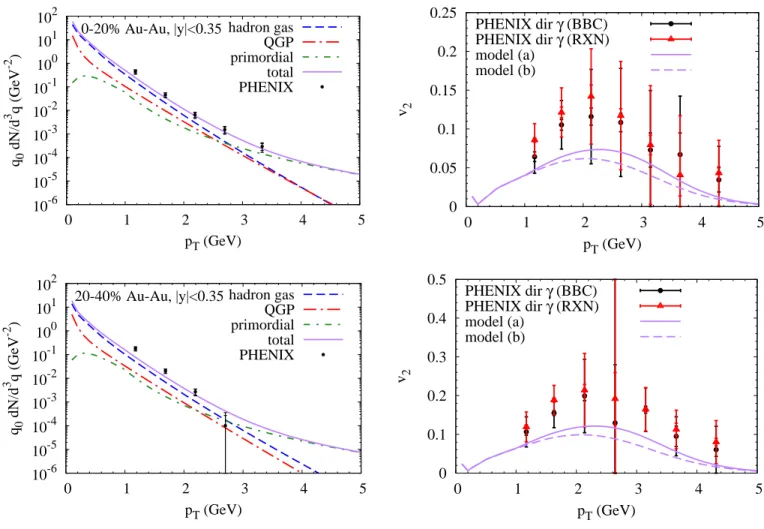
FIG. 5: (Color online) Comparison of our calculated direct-photon spectra (left panels) and their elliptic-flow coefficient (right panels) from an elliptically expanding fireball model with QGP and hadronic radiation, supplemented with primordial emission, to PHENIX data [7, 11] in 0-20% (upper panels) and 20-40% (lower panels) central Au-Au(√s= 200AGeV) collisions. Models (a) and (b) in the right panels refer to the use of the pQCD parameterization and the PHENIX fit for primordial production, respectively (in the left panels, only model (a) is displayed).
harder expansion, to reach a thermal freezeout configu-ration at Tfo ≃ 90-95 MeV and hβi ≃ 0.59 for central
Au-Au collisions. This can be achieved in the fireball model by a further increase of the acceleration to aT =
0.12c2/fm at a slightly reduced lifetime ofτ
≃14 fm/c. As expected, for the direct-photon spectra this implies a further hardening of the hadronic emission and thus an additional squeezing of the QGP window to a small region around qt ≃ 2.4 GeV, cf. lower panel of Fig. 4.
The increasing transverse flow of the three fireballs also seems to improve the description of the PHENIX direct-photon spectra, although that was not the objective of this exercise.
The final (third) fireball setup has been refined by im-plementing realistic ellipticities and an explicit linearly increasing flow profile in the transverse boost of the pho-ton emission rate. The corresponding comparisons to hadronic data have been discussed in the previous sec-tion. The resulting direct-photonqtspectra from thermal
QGP and hadronic sources, supplemented with anNcoll
-scaled primordial contribution, are compared to PHENIX data in the 0-20% and 20-40% centrality classes of Au-Au(√s = 200AGeV) in the two left panels of Fig. 5. The more central data set is fairly well reproduced, even though there appears to be a slight underestimation of the datum at the lowest qt ≃ 1.2 GeV. The inclusion
of the full transverse-flow profile leads to a further hard-ening of the hadronic component relative to the lower panel in Fig. 4, while the QGP component is essentially unaffected, even at the highest qt (continuing the
con-stant trend of the three panels in Fig. 4). This means that the high-qtQGP radiation is entirely determined by
the earliest radiation, where no flow has built up yet; the subsequent QGP flow cannot overcome the softening due to the decreasing temperature. This further implies a significant dependence of the high-qt QGP yield on the
thermalization time (a quantitative example will be dis-cussed at the end of Sec. V). On the other hand, hadronic
10-6 10-5 10-4 10-3 10-2 10-1 100 101 102 0 1 2 3 4 5 q0 dN/d 3 q (GeV -2 ) pT (GeV)
0-20% Au-Au, |y|<0.35 hadron gas QGP primordial total PHENIX 0 0.05 0.1 0.15 0.2 0.25 0 1 2 3 4 5 v2 pT (GeV) PHENIX dir γ (BBC) PHENIX dir γ (RXN) model (a) model (b)
FIG. 6: (Color online) Same as Fig. 5 for 0-20% Au-Au collisions, but with a QGP contribution evaluated for a reduced thermalization time ofτ0≃0.17 fm/ctranslating into an average initial temperature ofT0≃445 MeV.
emission only sets in atTcwhen there is already
substan-tial flow in the system, and thus even at high momenta the hadronic spectra are sensitive to the fireball flow field. In the 20-40% centrality bin, the discrepancy between the theoretical yields and the data becomes somewhat more severe, hinting at a missing relatively soft source (and therefore suggestive for the later hadronic phase). One speculation at this point could be related toω→π0γ
decays. These have been subtracted by the PHENIX col-laboration employing mt scaling of the ω spectra with
π0’s [27], assuming ω/π0 = 1, as found in pp
mea-surements [37], as well as in 0-92% Au-Au collisions for pt>4 GeV. If, however, ω mesons at lower pt become
part of the chemically equilibrated medium in heavy-ion collisions, one expects their multiplicity at given mt to
be up to 3 times larger, due their spin degeneracy. In this case there might be a direct-photon component in the Au-Au data at low qt ≤ 2 GeV due to some
frac-tion of final-stateω →π0γ decays which have not been
subtracted (and which would carry largev2). This
possi-bility may be worth further experimental and theoretical study.
It is quite remarkable that the hadronic yield domi-nates over the QGP one over the entire plotted range. This will have obvious ramifications for the v2 of the
direct photons, which is larger in the hadronic phase. The sub-leading role of the (early) QGP component fur-ther implies that the effects of initial-state fluctuations on thermal-photon production [20, 21] are diminished.
To examine the dependence of the QGP yield on the thermalization time, we have conducted calculations with a factor-2 reduced initial longitudinal size, z0 = 0.3 fm,
corresponding toτ0≃0.17 fm/cas used,e.g., in Ref. [14],
cf. Fig. 6. The QGP spectra in 0-20% Au-Au collisions increase over the z0 = 0.6 fm calculation by a factor of
1.6, 2.7 and 4.8 atqt= 2, 3 and 4 GeV, respectively, and
turn out to be in fair agreement (within ca. 30%) with the hydrodynamic calculations reported in Ref. [14]
(us-ing smooth initial conditions). The significance of this increase mostly pertains to momenta,qt>2 GeV, where
a small “QGP window” reopens, but it does not signifi-cantly affect the description of the experimental yields.
To further characterize the nature of the direct-photon excess (i.e., beyond thepp-scaled primoridial emission), we evaluate the effective slope parameters, Teff, of our
thermal spectra. We recall that PHENIX extracted the effective slope of the excess radiation in their data as Teff = 221±19stat±19systMeV [7]. In Fig. 7 we compare
this range with the temperature evolution,T(τ), of our fireball; they only overlap inside the QGP phase. How-ever, when accounting for the flow-induced blue shift, as estimated by the schematic expression for a massless par-ticle,
Teff ≃T
s 1 +hβi
1− hβi , (1)
the overlap with the experimental window is shifted to significantly later in the evolution, mostly for a flow-ing hadronic source with a restframe temperature of T ≃ 100-150 MeV. This suggests a reinterpretation of the experimental slope as mainly hadronic in origin, which, as we will see in Sec. V below, is further sup-ported by thev2 data. An explicit fit of the slope to our
total thermal spectrum from the elliptic fireball (with T0 = 355 MeV) in the range qt ≃ 1−3 GeV yields
Teff ≃240-250 MeV, which is at the upper end of the data
(consistent with the slight underestimate of the lowest-qt
datum; also note that the use of the average,hβi= 0.7βs
in Eq. (1), tends to underestimate the actual slopes, es-pecially at highqt and βs; we noted that already when
going from the spectra in the lower panel of Fig. 4 to the full results in the upper left panel of Fig. 5). Higher initial temperatures are less favorable, since they result in a further increase of the slope,e.g., by 10-15 MeV for T0= 445 MeV.
0 5 10 τ-τ0 [fm/c] 0 0.05 0.1 0.15 0.2 0.25 0.3 0.35 0.4 [GeV] temperature T slope Teff PHENIX slope βs [c] / 10 0-20% Au-Au(s1/2=200AGeV)
FIG. 7: (Color online) Time dependence of the effective slope parameter of thermal-photon radiation emitted from our fire-ball for 0-20% Au-Au collisions (solid (blue) line, given by QGP and hadronic sources forτ−τ0.3 fm/cand&6fm/c, respectively), using Eq. (1) withhβi= 0.7βs. For comparison, we plot the effective slope extracted by PHENIX from their data (horizontal line with dashed lines indicating the experi-mental error) [7], and the “true” temperature in the thermal restframe (long-dashed line). Also shown is the surface flow velocity of the fireball (dash-dotted line).
V. DIRECT-PHOTON ELLIPTIC FLOW
With a fair description of the photon qt spectra at
hand, we proceed to the calculation of the direct-photon elliptic flow as a function of transverse momentum, v2(qt). The results for the 0-20% and 20-40% centrality
classes of Au-Au collisions at RHIC are again compared to PHENIX data, see upper- and lower-right panel of Fig. 5, respectively. The shape of our calculated v2(qt)
matches the measurements rather well, but our maxi-mum value of ca. 7.5% (12%) is below the central values of the 0-20% (20-40%) data. Our results are a factor of 3-4 larger than existing calculations using hydrodynamic expansions, and reach into the lower end of the (mostly systematic) experimental uncertainties. The main differ-ences compared to the hydro calculations are the follow-ing: our equilibrium hadronic rates [9] are significantly larger than in previous studies, our hadronic phase in-cludes meson-chemical potentials and lasts longer (both due to a smaller Tfo as dictated by data and a slightly
largerTchas used in our previous calculations [9, 17, 35]),
and our bulk elliptic flow is built up faster than in standard (ideal) hydro calculations (recall that only a small increase of the v2 during the hadronic phase
fa-cilitates its KET-scaling properties of multi-strange and
light hadrons [15]; also note that a more rapid expansion in the QGP and transition region has been identified as an important ingredient to solve the “HBT puzzle”[39]). The combined effect of these four points is a thermal source which is dominated by hadronic emission carrying most of the finally observed elliptic flow from its begin-ning on, i.e., forT ≤Tc. For the reduced thermalization
time ofτ0= 0.17 fm/cthe maximalv2drops by ca. 15%
tovmax
2 ≃6.3%, cf. right panel in Fig. 6.
In the present work, we have assumed a critical temper-ature ofTc≃180 MeV, which is in line withNf = 2 + 1
flavor lattice calculations reported, e.g., in Ref. [40]. However, very recent lattice data [41] (as well as ear-lier ones [42]) indicate that Tc could be as low as
155-160 MeV and therefore one should ask what impact this could have on our results. A pertinent study has been done in the context of dilepton production at SPS en-ergies [10]. When varying the critical temperature by
±15 MeV around the default value ofTc= 175 MeV, the
QGP emission spectra in the intermediate-mass region (M &1 GeV) vary by up to±50% (less at higher masses where the contribution from earlier phases increases). At the same time, the hadronic emission part varies by ap-proximately the same amount in the opposite direction, so that the total yield roughly stays the same while the relative QGP and hadronic partition varies appreciably. We expect similar effects for the photonqtspectra. If one
still requires the multi-strange hadron spectra to freeze out atTc, we expect that the v2 in the hadronic phase
does not significantly change withTc. However, since for
smallerTc the hadronic contribution to the direct
pho-ton yields is reduced, so should be the total (weighted) v2. For example, if for the 0-20% centrality class the
QGP−hadronic partition of 1/3−2/3 at qt ≃ 2 GeV
changes to 1/2−1/2, we estimate that v2(qt) is lowered
from 7% to 6%.
VI. CONCLUSIONS
We have updated and extended our calculations of thermal-photon spectra at RHIC by constructing an im-proved elliptic fireball expansion which is quantitatively constrained by bulk-hadron data. In particular, we have implemented the notion of sequential freezeout by repro-ducing an empirical extraction of radial and elliptic flow from multi-strange and light-hadron data at chemical and kinetic decoupling, respectively. The fireball evolution has been combined with existing photon emission rates in the hadronic and QGP phases to obtain thermal-photon spectra in Au-Au collisions at RHIC. Supplemented with a primordial component estimated fromppcollisions, we have compared our calculations to spectra andv2 of
di-rect photons as recently measured by the PHENIX col-laboration. Due to a large medium flow (as required by hadron data), relatively large hadronic photon rates (approximately degenerate with QGP rates aroundTc),
and effective chemical potentials to conserve the observed hadron ratios, we have found that the hadronic medium outshines the QGP for most of the momenta where ther-mal radiation is relevant. This, in turn, leads to a ma-ximal elliptic flow coefficient ofv2≃10% in semicentral
Au-Au, which is a factor of ∼ 3 increased over previ-ous estimates based on QGP-dominated emission. Con-sequently, the discrepancy with the PHENIXv2 data is
reduced appreciably. Our results are corroborated by evaluating the effective slope parameters of the radiation from the thermal source, which have the largest overlap with the experimental value of Teff ≃ 220 MeV in the
(flowing) hadronic phase. Initial QGP temperatures of aboveT0≃400 MeV are increasingly disfavored by both
the slope andv2data. Further scrutiny is needed whether
these results can be confirmed in dynamical space-time models, i.e., in hydrodynamical and transport simula-tions, and what the quantitative impact of the transition temperature is (using, e.g., the (3+1)D viscous hydro-dynamics of Ref. [45]). The prevalence of the hadronic emission in our calculations reiterates the necessity of a good understanding of the strongly coupled hadronic phase in heavy-ion collisions. With these considerations, a satisfactory explanation of the (surprisingly?) strong direct-photonv2 signal at RHIC might be possible. The
extension of thev2studies to virtual photons (aka
dilep-tons) would also be illuminating. First phenomenological studies of this observable have been initiated [46, 47] and are also planned within our framework.
Acknowledgments
We thank G. David and M. He for valuable discus-sions. The work of RR is supported by the US National Science Foundation under grant no. PHY-0969394 and by the A.-v.-Humboldt foundation. The work of HvH is supported by the Hessian LOEWE initiative through the Helmholtz International Center for FAIR. CG is funded by the Natural Sciences and Engineering Research Coun-cil of Canada.
[1] R. Rapp, J. Wambach and H. van Hees, inRelativistic Heavy-Ion Physics, edited by R. Stock and Landolt B¨ornstein (Springer), New SeriesI/23A, 4-1 (2010); [arXiv:0901.3289[hep-ph]].
[2] C. Gale, inRelativistic Heavy-Ion Physics, edited by R. Stock and Landolt B¨ornstein (Springer), New Series I/23A, 6-3 (2010); arXiv:0904.2184 [hep-ph].
[3] J. Alam, S. Sarkar, P. Roy, T. Hatsuda and B. Sinha, Annals Phys.286, 159 (2001).
[4] R. Arnaldiet al.[NA60 Collaboration], Phys. Rev. Lett. 96, 162302 (2006).
[5] D. Adamovaet al.[CERES/NA45 Collaboration], Phys. Lett. B666, 425 (2008).
[6] R. Arnaldiet al.[NA60 Collaboration], Eur. Phys. J. C 61, 711 (2009); H.J. Spechtet al.[NA60 Collaboration], AIP Conf. Proc.1322, 1 (2010).
[7] A. Adareet al.[PHENIX Collaboration], Phys. Rev. Lett.104, 132301 (2010).
[8] S. Turbide, C. Gale, E. Frodermann and U. Heinz, Phys. Rev. C77, 024909 (2008).
[9] S. Turbide, R. Rapp and C. Gale, Phys. Rev. C69, 014903 (2004).
[10] H. van Hees and R. Rapp, Nucl. Phys. A806, 339 (2008).
[11] A. Adareet al.[PHENIX Collaboration], arXiv:1105.4126 [nucl-ex].
[12] R. Chatterjee, E.S. Frodermann, U.W. Heinz and D.K. Srivastava, Phys. Rev. Lett.96, 202302 (2006). [13] F.M. Liu, T. Hirano, K. Werner and Y. Zhu, Phys. Rev.
C80, 034905 (2009).
[14] H. Holopainen, S. R¨as¨anen and K.J. Eskola, arXiv:1104.5371 [hep-ph].
[15] M. He, R.J. Fries and R. Rapp, Phys. Rev. C82, 034907 (2010).
[16] B.I. Abelevet al.[STAR Collaboration], Phys. Rev. Lett.99, 112301 (2007).
[17] R. Rapp, Phys. Rev. C63, 054907 (2001).
[18] P.B. Arnold, G.D. Moore and L.G. Yaffe, JHEP0112, 009 (2001).
[19] S. Turbide, C. Gale and R. J. Fries, Phys. Rev. Lett. 96, 032303 (2006).
[20] M. Dion, C. Gale, S. Jeon, J. F. Paquet, B. Schenke and C. Young, arXiv:1107.0889 [hep-ph].
[21] R. Chatterjee, H. Holopainen, T. Renk and K. J. Eskola, arXiv:1106.3884 [hep-ph].
[22] F. Riek and R. Rapp, Phys. Rev. C82, 035201 (2010). [23] R. Rapp and J. Wambach, Eur. Phys. J. A6, 415
(1999).
[24] D.K. Srivastava, Phys. Rev. C71, 034905 (2005). [25] W. Liu and R. Rapp, Nucl. Phys. A796, 101 (2007). [26] L.E. Gordon and W. Vogelsang, Phys. Rev. D48, 3136
(1993).
[27] G. David, private communcation.
[28] S.S. Adleret al.[PHENIX Collaboration], Phys. Rev. Lett.98, 012002 (2007).
[29] D.K. Srivastava, Eur. Phys. J. C22, 129 (2001). [30] A. Adareet al.[PHENIX Collaboration], Phys. Rev.
Lett.98, 162301 (2007).
[31] B.I. Abelevet al.[STAR Collaboration], Phys. Rev. C 77, 054901 (2008).
[32] B.I. Abelevet al.[STAR Collaboration], Phys. Rev. C 79, 034909 (2009).
[33] S. Afanasievet al.[PHENIX Collaboration], Phys. Rev. Lett.99, 052301 (2007).
[34] H. van Hees, V. Greco and R. Rapp, Phys. Rev. C73, 034913 (2006).
[35] R. Rapp, Phys. Rev. C66, 017901 (2002).
[36] M.M. Aggarwal et al. [WA98 Collaboration], Phys. Rev. Lett.85, 3595 (2000).
[37] S.S. Adleret al.[PHENIX Collaboration], Phys. Rev. C 75, 051902 (2007).
[38] A. Adareet al., arXiv:1105.3467 [nucl-ex]. [39] S. Pratt, Phys. Rev. Lett.102, 232301 (2009). [40] M. Chenget al., Phys. Rev. D81, 054504 (2010). [41] A. Bazavov and P. Petreczky, arXiv:1107.5027 [hep-lat]. [42] S. Borsanyi, Z. Fodor, C. Hoelbling, S.D. Katz, S. Krieg,
C. Ratti and K K. Szabo [Wuppertal-Budapest Collaboration], JHEP1009, 073 (2010).
[43] S. S. Adleret al.[ PHENIX Collaboration ], Phys. Rev. Lett.91, 182301 (2003).
[44] S. S. Adleret al.[ PHENIX Collaboration ], Phys. Rev. C69, 034909 (2004).
[45] B. Schenke, S. Jeon and C. Gale, Phys. Rev. C82, 014903 (2010).
[46] R. Chatterjee, D. K. Srivastava, U. W. Heinz and C. Gale, Phys. Rev. C75, 054909 (2007).
[47] J. Deng, Q. Wang, N. Xu and P. Zhuang, arXiv:1009.3091 [nucl-th].
![FIG. 1: (Color online) Empirical fits to the direct-photon spectrum measured by PHENIX [28] in p-p collisions at](https://thumb-us.123doks.com/thumbv2/123dok_us/9087969.2400869/3.918.97.431.74.333/color-online-empirical-direct-spectrum-measured-phenix-collisions.webp)


![arxiv: v1 [hep-ph] 10 Dec 2020](data:image/gif;base64,R0lGODlhAQABAIAAAP///wAAACH5BAEAAAAALAAAAAABAAEAAAICRAEAOw==)