WHITE PAPER
Using Big Data to Drive Business Transformation:
Learning From the Big Data Innovators
Sponsored by: SAP and Intel
Philip Carter Alys Woodward November 2014
IDC OPINION
The recent news that the German police in the state of Bavaria are using Big Data technologies to attempt to predict crimes before they take place conjures memories of the "precogs" program that was a part of Steven Spielberg's sci-fi crime thriller Minority Report. In reality, by leveraging a variety of factors such as time, place, and real estate in the residential area combined with
powerful software-based algorithms, it is becoming clearer that "predictive policing" (based on real-time and predictive analytics) can potentially change the way that criminal activity can be
prevented. As such stories start to become more commonplace, organizations (both public and private) can truly transform and innovate by leveraging Big Data to take a forward-looking view of the business or organization, as opposed to constantly looking in the rear-view mirror. IDC's research has consistently shown that an organization's ability to drive this level of transformation based on Big Data is directly correlated to its organizational maturity. As such, the organizations that are more mature in terms of their strategy for Big Data, their use of Big Data technologies, and the processes and people they put in place to leverage the technologies will derive the most business value from their Big Data projects.
To help organizations understand their own maturity, IDC has put in place a Big Data Maturity Model that provides guidance for organizations of all sizes interested in advancing along the five maturity stages of the framework to maximize benefits derived from Big Data and analytics (BDA). Using this Maturity Model as a reference point, IDC recently interviewed 531 organizations across Europe that have adopted or intend to adopt some form of business analytics technology. The objective was to identify a set of companies that exhibit an advanced level of maturity as it relates to the broader Big Data domain. Of the 531 organizations interviewed, we have identified 30 organizations that fit into this category of advanced organizations in terms of Big Data Maturity — which we call "Big Data Innovators." This white paper will use these organizations as a reference point to highlight seven characteristics of the 30 identified organizations that we believe are most critical to drive a technology-led transformation leveraging Big Data and analytics. More
importantly, we will examine the role of IT in this transformation. From the survey, only 28% of organizations interviewed believe that the IT department is fully integrated within business transformation and innovation.
Interestingly, 77% of the IT executives believed that supplying the business with Big Data and analytics capabilities will improve the ability of IT to play a more significant role in enabling business transformation. It is also clear that the IT department is critical in delivering business transformation among the Big Data innovators, and within the Big Data and analytics space, they have a major focus on predictive and real-time analytics in order to achieve this.
SITUATION OVERVIEW — WHAT'S NEW WITH BIG DATA?
With 72% of respondents seeing ROI on typical Big Data analytics projects of less than 12 months, we are seeing mainstream organizations moving beyond just experimenting with Big Data and analytics technologies, with more examples of production environments emerging, and real business benefits being derived from these projects. As Big Data moves into the mainstream, it's much less about defining with Big Data, but more about understanding what's new with Big Data versus the traditional datawarehousing and business analytics world.
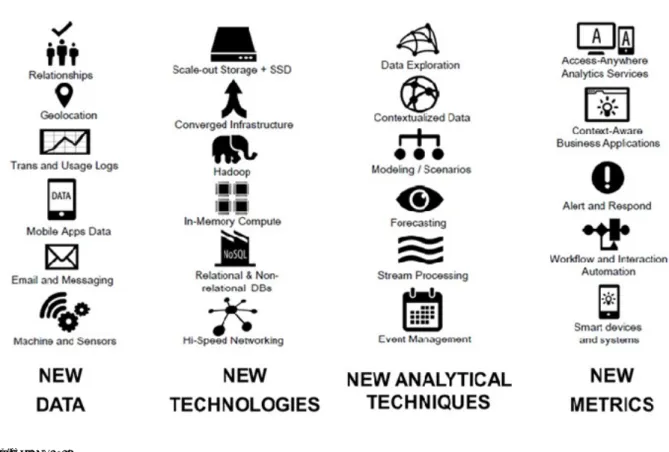
Figure 1 highlights some of the new elements of Big Data.
FIGURE 1
The New Elements of Big Data
Source: IDC, 2014
Firstly, we are seeing large amounts of new "data" — mainly semistructured or unstructured — that organizations have the opportunity to bring into their broader information management strategy. Most of this new data is external to the organization and there is understandably a huge amount of it. To deal with this, new technologies are being leveraged, particularly in the form of Hadoop (18% adoption, according to the survey), NoSQL and in-memory computing, frequently running on converged infrastructure with scale-out storage combined with SSD and high-speed networking capabilities.
European
organizations are really starting to see the value from Big Data and analytics, with 72% of
respondents seeing ROI on a typical Big Data analytics project being less than 12 months.
This in turn is driving new types of analytical techniques, which are primarily predictive and
forward-looking in nature, and allowing a range of new metrics and approaches to be leveraged so that business executives can ask a whole new range of questions that were previously not
possible.
We are moving into a new world where the data scientists are not constrained by what and how much data they can access, where business executives are driving the analytics initiatives (not IT), and where business users are empowered to make actionable decisions in real time — in this new world, the real value comes into play. As a result, we are seeing a whole range of new use cases that are more predictive and real time in nature as organizations start to leverage more advanced analytics technologies as well as new data management capabilities (such as in-memory computing).
Figure 2 highlights the most common use cases currently being adopted, or the ones that will be in the next six months.
18% of
organizations indicate that they are using Hadoop as part of their data management approach for Big Data.
FIGURE 2
Big Data Analytics Use Cases
It is clear from this figure that the way in which Big Data and analytics technologies are used by organizations varies quite significantly across different industries, different data sources, and different data characteristics. The survey showed that a wide range of use cases for Big Data and analytics are in production. Despite the wide range of use cases surveyed — 28 in total — even the least widespread use case ("react when an influential customer comments on your product on social media") is already implemented in 21% of the organizations surveyed. What is clear to see is that these use cases become more and more industry and domain specific as we move into the Big Data and analytics world. There is also a much more significant focus on predictive and real-time analytics. This in turn requires a range of new skills. And the bigger question is how do we turn these use cases into real business results? IDC believes that this is directly linked to an organization's Big Data and analytics maturity. As such, the organizations that are more mature in terms of their strategy for Big Data, their usage of Big Data technologies, the processes and people that they put in place to leverage the technologies will derive the most business value from their Big Data projects.
Defining a Path to Improved Big Data & Analytics: IDC's Maturity Model
The growing focus on Big Data and analytics solutions as a basis for competitive advantage is both an opportunity and a challenge for most organizations. Not only do executives and decision
makers throughout organizations need access to information, they also need the ability to analyze and act on it in a timely manner. Many organizations, however, do not yet have the competency or maturity to address the range of technology, staffing, and process requirements needed to
capitalize on Big Data assets and to deploy analytics pervasively to optimize operational, tactical, and strategic decisions. What organizations often do is focus only on one specific measure, which creates an imbalance in the organizationwide ability to support or automate decision-making processes.
To assist organizations in assessing their current capabilities and to evaluate gaps in reaching higher levels of BDA maturity and competence, IDC has developed a BDA maturity framework that identifies five stages and five critical measures as well as the outcomes and actions required for organizations to effectively move through the maturity model stages. The five measures against which the model assesses organizations' competencies are data, people, process, technology, and intent.
The five maturity stages are ad hoc, opportunistic, repeatable, managed, and optimized. The stages are described below:
Ad hoc. The primary BDA goal of organizations at the ad hoc stage is to provide decision makers with access to information. This can involve the use of query, reporting,
dashboard, and search software to simply expose a defined data set to end users. The systems lack integration, dedicated technology, and broad adoption.
Opportunistic. Organizations at the opportunistic stage are mainly focused on providing data analysis, but the data will typically lack support from appropriate data preparation and management technology and will be based on incomplete historical data. The analysis typically involves the use of multidimensional analysis, query, reporting, and content analytics tools.
Repeatable. Organizations at the repeatable stage are involved in recurring, budgeted, and funded BDA projects with business-unit-level stakeholder buy-in. They are aiming to provide comprehensive insights based on data from multiple internal and external
multidimensional analysis, query, reporting, content analytics, and predictive analytics tools and the underlying information management technology.
Managed. Organizations at the managed stage experience the emergence of BDA program standards. Their primary BDA goal is to provide actionable insight to a range of decision makers within the organization. BDA capabilities are utilized to answer what happened and why it did.
Optimized. Organizations at the optimized stage ensure continuous and coordinated BDA process improvement and value realization. They have an enterprisewide, documented, accepted BDA strategy; executive support; and budgeted as well as ad hoc funding (to address unforeseen opportunities). They are able to provide foresight to decision makers throughout the enterprise and to relevant external stakeholders. Analytics continue to be deployed operationally through business processes, resulting in predictive capabilities to capitalize on new opportunities and to mitigate risk.
Identifying the "Big Data Innovators"
Using this maturity model as a reference point, IDC recently interviewed 531 organizations across Europe that have adopted or intend to adopt some form of business analytics technology. The objective was to identify a set of companies that exhibit an advanced level of maturity as it relates to the broader Big Data domain.
Figure 3 highlights how the 531 organizations map to the various stages of maturity outlined above. From this figure it is clear that Big Data and analytics maturity does vary across these organizations, with IDC's benchmarking assessment showing that most organizations (approximately 63%) are sitting at stage 2 of IDC's Big Data Maturity Model. This stage is
characterized by opportunistic or uncoordinated approaches to Big Data and analytics projects, so there is still plenty of work to be done — especially in terms of improving skills, better data
FIGURE 3
Transforming for Big Data: Identifying the Innovators
Source: IDC, 2014
Of the 531 organizations interviewed, we have identified 30 organizations that fit into the category of advanced organizations in terms of Big Data Maturity (primarily in the managed phase
highlighted as the green "dots" in Figure 3). In this white paper, using these organizations as evidence, we aim to determine the characteristics of the 30 identified organizations that are most critical to drive a technology-led transformation leveraging Big Data and analytics. For the rest of this document, we will label these organizations "Big Data innovators."
Characteristics of the Big Data Innovators
Based on their feedback, below is a summary of the key characteristics exhibited by those organizations as it relates to their Big Data and analytics initiatives.
1. Big Data Innovators See Technology-Led Transformation as an Essential
Part of Their Broader Strategy
In an increasingly digitized world, technology has already transformed some industries beyond recognition — this is especially true of media and telecommunications. Other industries are feeling the benefits of digitization, such as retail, financial services, and manufacturing. Many CEOs are wondering whether a Netflix, Uber, or Amazon is going to digitally disrupt their business model. The question is, to what extent are European organizations driving transformation from
Note: Each dot represents one of the 531 organizations interviewed, and there is some level of overlap.
Low Low High
High
technology? Europeans are relatively cautious and prefer to make sure that technologies will relate specifically to business benefits, rather than taking a leap of faith.
In fact only 12% of the 531 respondents see technology-led transformation as essential. All 30 of the Big Data innovators fit into this category, but the overall number does vary significantly between countries — 19% of U.K. organizations say that technology-led transformation is an essential part of their strategy, but only 7% of Dutch organizations say the same. Figure 4 shows agreement with the statement "technology-led transformation is an essential part of our strategy," by country.
FIGURE 4
Technology-Led Transformation in Europe by Country
Q: Technology-led transformation is an essential part of our strategy. Strongly agree/agree responses
Source: IDC, 2014
IDC believes that the first step for any organization toward rolling out a successful Big Data and analytics strategy is to put technology at the forefront of any broader technology transformation.
2. The Big Data Innovators Believe That Supplying the Business with Big
Data Analytics Capabilities Will Improve the Ability of IT to Play a More
Significant Role in Enabling Business Transformation
IT departments have an image problem — only 28% of organizations interviewed believe that the IT department is fully integrated within business transformation and innovation. This is where Big Data and analytics can help, as it constitutes a key enabler for IT departments looking to support the business in this way.
Interestingly, 77% of the IT executives believed that supplying the business with Big Data and analytics capabilities will improve the ability of IT to play a more significant role in enabling
0% 5% 10% 15% 20%
business transformation. Of the remaining 23% of respondents, 15% believed that this is not the case yet, but it will be in the future. Hence, IDC believes that Big Data and analytics could well be the key enabler for IT departments looking to play a more integrated role in business
transformation and innovation.
FIGURE 5
The Impact of Big Data and Analytics on IT's Role in Transformation
Q: Do you believe that supplying the business with Big Data analytics capabilities will improve the ability of IT to play a more significant role in enabling business transformation?
Source: IDC, 2014
3. For All Big Data Innovators, Management Is Involved in Promoting and
Encouraging the Use of Big Data and Analytics Solutions
IDC's research has long indicated that not only is executive sponsorship key to getting Big Data and analytics projects started and funded, but non-executive management involvement is also vital for the ongoing adoption of the technology, which leads to maturity over time. Starting projects off is important, but driving everyday usage is done when management asks to see evidence from the data and analytics system, and uses the insights it delivers on a regular basis, driving usage from direct reports.
The survey results showed a dramatic difference between lower maturity and higher maturity levels for both executive and non-executive management: higher maturity organizations on average had double the proportion of executive management involved in promoting and encouraging use of the Big Data and analytics system, and 38% more non-executive management involved.
Figure 6 shows the survey results for management involvement in Big Data and analytics. 0% 5% 10% 15% 20% 25%
FIGURE 6
Management Involvement in Big Data & Analytics in Europe
Q: How involved are the following managers in promoting and encouraging the use of your organizations Big Data Analytics solutions?
Source: IDC, 2014
4. Big Data Innovators Tend to Have an Enterprise Budget in Place for Big
Data and Analytics Activities
Higher maturity organizations have a number of different ways of working than those with lower maturity. One such difference relates to budgets. As organizations mature, their budgets are set in an increasingly more planned, centralized, and strategic way. The most mature organizations set an enterprise budget for Big Data and analytics projects and supplement it with discretionary budget as required. This need for discretionary additional budgets is an important difference between information-related projects and infrastructure- and application-related projects. Information requirements are not static; they change as business requirements change. Gaining the best value from Big Data and analytics means combining enterprisewide budget and planned rollouts with the ability to spin up new projects for new requirements in the short term.
Figure 7 shows how budgets are set for Big Data and analytics projects in Europe by maturity level. 0% 10% 20% 30% 40% 50% 60% 70% 80% 90% 100%
Big Data innovators Other Western Europe Executive management Non-executive management
FIGURE 7
Budgets for Big Data and Analytics in Europe
Q: How does your organization fund and budget its Big Data analytics activities?
Source: IDC, 2014
5. The Majority of Big Data Innovators Deliver ROI on a Typical Big Data
Project Deployment in Less Than Six Months
All IT systems strive to improve the time to ROI; bringing benefits to the business more quickly improves every financial justification of a system. However, it is even more important for Big Data and analytics that the system delivers fast benefits. This is because of the dynamic nature of information requirements; they appear, and are sometimes urgent, and need to be fulfilled.
A Big Data and analytics system that takes too long to deliver insights will soon be replaced; not by newer, more dynamic systems, unless the organization has a specific understanding of why the system didn't deliver. Rather, systems that can't respond in time could be replaced by shadow IT where business users have created their own solutions, which likely exclude important IT
considerations like scalable infrastructure, data quality, and data consistency. Worse, they can be replaced by "gut feel" or instinct-driven decisions, which can lead to less transparency, less logic, and less repeatability in decision-making processes.
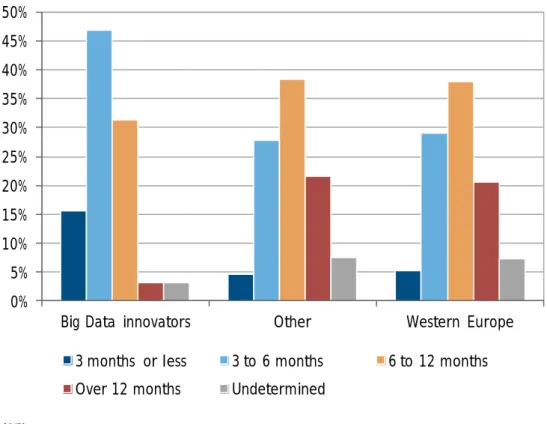
The more mature organizations found faster ROI on average; 37% achieved ROI in three to six months, compared with 25% of the lower maturity organizations. A quarter of the lower maturity organizations took over 12 months to show ROI, but only 13% of the higher maturity took this long.
0% 5% 10% 15% 20% 25% 30% 35% 40% 45%
Big Data innovators Other Western Europe With ad hoc, unbudgeted funds reallocated from other sources With project-by-project budgets as individual opportunities With business unit level budget set across several projects With annual enterprisewide budget
To launch a successful Big Data and analytics project, IDC recommends identifying a clearly defined project with measurable KPIs. Focus on achieving slightly quicker ROI with successive projects to demonstrate improvement in the speed to value.
Figure 8 shows ROI achieved by maturity level.
FIGURE 8
Time to ROI for Big Data and Analytics in Europe
Q: What is the average time to ROI of a typical Big Data project deployment?
Source: IDC, 2014
6. Big Data Innovators are Externally Oriented and Focus on Profitable
Innovation
We asked the Big Data innovators about the key drivers that are forcing their organizations to evolve to get a sense of the priorities that they are focusing on. Figure 9 highlights the top 3 responses. 0% 5% 10% 15% 20% 25% 30% 35% 40% 45% 50%
Big Data innovators Other Western Europe 3 months or less 3 to 6 months 6 to 12 months Over 12 months Undetermined
FIGURE 9
Key Drivers Forcing Change
Q: What are the top 3 drivers that are forcing your organization to evolve its business?
Note: Results reflect the responses from Big Data innovators only.
Source: IDC, 2014
The feedback provides some insight into the areas that Big Data innovators, particularly compared with the rest of the respondents, noted as their top drivers — which was basically to focus on improving operational efficiency. IDC believes that given the level of disruption in the industry at the moment, companies need to embark on driving innovation with an external focus on the market (given the potential competitive threats from emerging digital disruptors). Obviously profitability needs to be the ultimate objective, but the combination of the three makes a good triangle to drive the right level of business outcomes — something that the Big Data innovators have clearly picked up on.
7. Big Data Innovators Show Significantly Higher Adoption of New Data
Management Technologies and Predictive Analytics Approaches to Deal
With Big Data Than Their Peers
Figure 10 compares the level of adoption of key Big Data technologies by the Big Data innovators versus their peers in the industry. In terms of the new data management approaches (such as in-memory databases, columnar databases, Hadoop, NoSQL, and Open Source Big Data platforms), one can see a 10% difference in the level of adoption.
More interestingly, there is close to 30% difference in terms of adoption of predictive analytics capabilities. This shows clearly that the Big Data innovators are looking to deliver more predictive and real-time types of analytics to drive competitive advantage as highlighted by the different use cases in Figure 2. IDC believes that the combination of these two sets of technologies will be critical to delivering the new wave of use cases that are emerging linked to the Big Data
phenomenon. Clearly these need to be effectively put in place in line with the various dimensions of IDC's Big Data Maturity Model outlined earlier (i.e., people, process, intent, and data), but they will increasingly form the foundation of the organization's approach to collecting, storing,
managing, and analyzing Big Data moving forward.
FIGURE 10
Technology Adoption for Big Data
Q: What types of data management or business analytics approaches are utilized in your organization for Big Data? (New Big Data technologies represent average percentage usage across in-memory databases, columnar databases, Hadoop, NoSQL, and Open Source Big Data platforms)
Source: IDC, 2014
FUTURE OUTLOOK AND RECOMMENDATIONS
Greater adoption of Big Data and analytics drives further use; we call this the "snowball" effect. Organizations have much to learn when they start on the journey toward analytical maturity:
What is contained in their data, and what data quality and consistency challenges exist How keen and competent their business users are to get hands on with data and build their
own reports
How open executive management is to the increased use of data for decision making, and to what extent they are willing to back this with funding
What technology and skills exist in the organization that are needed to support not only the Big Data and analytics system itself but additional functions like data integration,
infrastructure support, and scalability management
How they can integrate the insights they garner from the system into core business processes where they can benefit business operations on a day-to-day basis
0% 10% 20% 30% 40% 50% 60% 70%
Western Europe Others Big Data innovators
New Big Data technologies (in-memory, columnar, NoSQL, and Hadoop) Advanced analytics for predictive analysis or data mining
Many organizations find that their progress up the maturity curve is not smooth; projects may fail for reasons relating to any individual maturity dimension, or due to a combination. Organizations need to see project failures as opportunities to learn how to improve, not proof that they can never succeed with Big Data and analytics; they need to analyze the lessons learnt from their failure, define a new project, and attempt to continue to advance. All the most mature organizations have project failures to report, but they continued to improve in maturity in spite of these failures, because gaining value from information is not a project — it is a journey.
IDC recommends the following actions and activities to organizations looking to improve their adoption and maturity of Big Data and analytics.
Put in place a "dynamic" Big Data strategy. This may already be in place, but a Big Data strategy needs to be treated as a very dynamic and transparent concept, with constant updates from various stakeholders (from IT, the analytics team, business executives, and users) across the organization. It will require the leveraging of best practices from a leading department or business unit and replicating that approach into new areas. IT will need to be involved to ensure that the right governance model and integration capabilities are put in place up front. For example, in a recent discussion with a large bank, it became clear that a successful Big Data analytics project focused on risk-adjusted profitability for large corporate transactions could not be integrated with its existing CRM system because IT had not been involved from the outset. The Big Data strategy needs to address all five dimensions highlighted previously (intent, data, people, process, technology) and, most importantly, needs to be signed off and supported by a C-level business executive. Every Big Data project needs a clear desired business outcome and business case.
Getting the expected outcome and business case agreed to from the outset will shape all decisions going forward on your approach to BDA. Securing buy-in from line-of-business and IT, and maintaining expectations as the project progresses, is far easier when both sides have agreed on the expected outcomes. As part of this, there is a requirement to consolidate the budget for the Big Data project across the wider organization, but with the flexibility of ad hoc funding for specific projects (potentially driven by identified business units) where appropriate. Where budgeting is uncoordinated and investments are done at the departmental or even business unit level, the organization will end up with multiple disparate Big Data technologies and skill sets. Once the budgeting approach is in place, each new Big Data project will require a business case which defines the outcomes in terms of revenue gains, cost reduction, risk reduction, or another metric that can be used to determine how much investment is required. Using a standard calculation to estimate the ROI will allow executive sponsors to support the initiative, or not. Measuring ROI requires a high level of discipline to establish an "as is" state of the business and compare this with the post-deployment state. Though some organizations indicate that an ROI evaluation is not required for new Big Data projects, or that it is too difficult to do, it is a useful basis to secure future funding for new projects.
Set up a Big Data competency center. If you already have a datawarehousing or business analytics competency center in place, then the Big Data competency center can be the next iteration of that function. If not, you should look to create this group and ensure that it includes stakeholders from IT, business, and analytics functions. It should preferably sit in the business, under the COO or CEO if appropriate. This entity should bring together all components of a Big Data strategy including stakeholders, technology architecture, analytical skills, and vendor and service management. This will help raise the profile of Big Data projects internally and should be the driver for the strategy and budgeting process highlighted above. The competency center should also set goals around moving the organization to new levels of maturity by focusing on the five dimensions of Big Data readiness (intent, data, people, process, technology).
CONCLUSION
This document has outlined how Big Data has the potential to change the way that organizations operate and compete in their respective industries. Not only is there new data to analyze, but new technologies, new analytical techniques, and new metrics are also being put in place. As a result a whole range of new types of new use cases are emerging — and they are increasingly predictive and real time in nature. Enterprises looking to capitalize on this emerging opportunity need to develop a sense of self-awareness as it relates to their organizational Big Data maturity. We have identified 30 Big Data innovators that we believe are on the right path in this respect.
As a summary, here are the seven key characteristics of those organizations that we believe form the basis of defining initial best practices in this emerging domain:
1. Big Data innovators see technology led transformation as an essential part of their broader strategy.
2. Big Data innovators believe that supplying the business with Big Data analytics capabilities will improve the ability of IT to play a more significant role in enabling business
transformation.
3. For all Big Data innovators, management is involved in promoting and encouraging the use of Big Data and analytics solutions.
4. Big Data innovators tend to have an enterprise budget in place for Big Data and analytics activities.
5. The majority of Big Data innovators deliver ROI on a typical Big Data project deployment in less than six months.
6. Big Data innovators are externally oriented and focus on profitable innovation. 7. Big Data innovators show significantly higher adoption of new data management
technologies and predictive analytics approaches to deal with Big Data than their peers. As part of this, IDC believes that Big Data represents a major opportunity for the IT department to deliver a new level of transformation to the business that continues to be the Holy Grail for all CIOs. Ultimately, success will be defined by an effective level of collaboration across IT, the business, and analytics groups. This way, concepts that were previously thought to be pure science fiction — like "predictive policing" for a criminal agency as outlined in the introduction — will become a reality.
METHODOLOGY
IDC conducted a survey on behalf of SAP and Intel. The survey was conducted in September and October of 2014. The respondent base was 531 individuals in a range of organizations across the following regions of Europe, distributed as indicated in Figures 11 to 14.
FIGURE 11
Survey Demographics by Country
Source: IDC, 2014
FIGURE 12
Survey Demographics by Job Role
Source: IDC, 2014 France (20.0%) Germany (21.0%) Neth. (19.0%) Nordics (19.0%) U.K. (21.0%) Total n = 531 CIO/CTO (18.0%) Head of IT (17.0%) VP of IT (6.0%) IT director (16.0%) IT manager (36.0%) Other (7.0%) Total n = 531
FIGURE 13
Survey Demographics by Organization Size
Source: IDC, 2014
FIGURE 14
Survey Demographics by Industry
Source: IDC, 2014 100–499 employees (35.0%) 500–999 employees (28.0%) 1,000+ employees (37.0%) Total n = 531 Banking (11.1%) Discrete manufact. (17.2%) Financial services (14.1%) Insurance (8.1%) Retail (24.2%) Telco (15.2%) Utilities (10.1%) Total n = 531
APPENDIX
This appendix contains further country and vertical level information.
FIGURE 15
Big Data and Analytics Maturity in 2014 by Country
Source: IDC, 2014 0 20 40 60 80 100
France Germany Neth. Nordics U.K.
(%)
FIGURE 16
Big Data and Analytics Maturity in 2014 by industry
Source: IDC, 2014 0 20 40 60 80 100 Finance Discrete
mfg. Retail Telcos Utilities
(%)
About IDC
International Data Corporation (IDC) is the premier global provider of market intelligence, advisory services, and events for the information technology, telecommunications and consumer technology markets. IDC helps IT professionals, business executives, and the investment community make fact-based decisions on technology purchases and business strategy. More than 1,100 IDC analysts provide global, regional, and local expertise on technology and industry opportunities and trends in over 110 countries worldwide. For 50 years, IDC has provided strategic insights to help our clients achieve their key business objectives. IDC is a subsidiary of IDG, the world's leading technology media, research, and events company.
IDC U.K.
Chiswick Tower
389 Chiswick High Road
London W4 4AE, United Kingdom 44.208.987.7100
Twitter: @IDC
idc-insights-community.com www.idc.com
Copyright Notice
This IDC research document was published as part of an IDC continuous intelligence service, providing written research, analyst interactions, telebriefings, and conferences. Visit www.idc.com to learn more about IDC subscription and consulting services. To view a list of IDC offices worldwide, visit www.idc.com/offices. Please contact the IDC Hotline at 800.343.4952, ext. 7988 (or +1.508.988.7988) or [email protected] for information on applying the price of this document toward the purchase of an IDC service or for information on additional copies or Web rights.