Survivorship Care for Older Adults with Cancer: U13 Conference
Report
Emily J. Guerard, MDa, Ginah Nightingale, PharmDb, Keith Bellizzi, PhD MPHc, Peggy
Burhenn, MS CNS AOCNSd, Ashley Rosko, MDe, Andrew S. Artz, MD MSf, Beatriz
Korc-Grodzicki, MD PhDg, Beverly Caninh, William Dale, MD PhDi, and Betty Ferrell, PhD FAANj
aUniversity of North Carolina at Chapel Hill, Division of Hematology and Oncology 170 Manning
Drive Campus Box 7305 Chapel Hill, NC 27599-7305 USA
bJefferson College of Pharmacy, Thomas Jefferson University 901 Walnut Street Suite 946,
Philadelphia, PA 19107-5233 USA
cUniversity of Connecticut, Human Development and Family Studies, 348 Mansfield Road, Unit
2058 Storrs, CT 06269 USA
dCity of Hope, Professional Practice Leader in Geriatric Oncology
eOhio State University, Division of Hematology
fUniversity of Chicago, Section of Hematology and Oncology
gMemorial Sloan Kettering Cancer Center, Geriatrics Service, Department of Medicine
hCancer and Aging Research Group Patient Advocacy
iUniversity of Chicago, Department of Medicine, Section of Geriatrics and Palliative Medicine and
Hematology/Oncology
jCity of Hope, Division of Nursing Research and Education
Abstract
Older adult cancer survivors currently account for almost 60% of all cancer survivors. The number of older cancer survivors will continue to increase as the population ages and as patients’ live longer after a cancer diagnosis. As part of cancer center accreditation, the American College of Surgeons Commission on Cancer® (CoC) has placed great importance on survivorship care planning. While the CoC has set standards for general survivorship care, there is sparse evidence on how to best care for older adult cancer survivors. Concern exists among the medical community
Corresponding Author: Emily J. Guerard MD, 170 Manning Drive, Campus Box 7305, Chapel Hill, NC 27599, Phone:
+1-919-843-7199, Fax: +1-919-966-6735, [email protected].
Publisher's Disclaimer: This is a PDF file of an unedited manuscript that has been accepted for publication. As a service to our
customers we are providing this early version of the manuscript. The manuscript will undergo copyediting, typesetting, and review of the resulting proof before it is published in its final citable form. Please note that during the production process errors may be discovered which could affect the content, and all legal disclaimers that apply to the journal pertain.
Disclosures and Conflict of Interest Statements
The authors have no conflicts of interest to disclose.
HHS Public Access
Author manuscript
J Geriatr Oncol
. Author manuscript; available in PMC 2017 July 01.Published in final edited form as:
J Geriatr Oncol. 2016 July ; 7(4): 305–312. doi:10.1016/j.jgo.2016.06.005.
A
uthor Man
uscr
ipt
A
uthor Man
uscr
ipt
A
uthor Man
uscr
ipt
A
uthor Man
uscr
that survivorship care plans could increase paperwork without improving outcomes. Given the diverse and unique needs of older adult cancer survivors, the inter-professional team provides a structure and process for survivorship care built around the particular needs of older adults. The Cancer and Aging Research Group (CARG), in partnership with the NIA/NCI, held a U13 conference in May 2015 in part to discuss survivorship care for older adults with cancer. This report discusses four themes that emerged from one section of the conference: (1) survivorship care is a process that continually evolves to meet the needs of older adults; (2) older adult cancer survivors have unique needs and care plans should be tailored to meet these needs; (3) the inter-professional team is ideally suited to structure survivorship care of older adults; (4) patient advocacy must be encouraged throughout the cancer care continuum. As evidence based survivorship practices develop, the unique needs of older adults need to be given substantial attention.
Keywords
older adult; elderly; survivorship; cancer survivor; survivorship care plan; inter-professional team; multi-disciplinary
Introduction
The National Coalition for Cancer Survivorship (NCCS) defines a cancer survivor as any person diagnosed with cancer, from the time of initial diagnosis until the end of life.[1] In 2012, there were nearly 14 million cancer survivors in the United States[2] with an estimated 60% of these survivors over 65 years old.[3] By 2020, the number of older adult cancer survivors is expected to increase to 11 million, accounting for about two-thirds of all cancer survivors.[3] The reason for the increase in the number of older adult cancer survivors is two-fold: (1) the population is aging and the older adult population is expected to increase from 40.3 million in 2010 to 74 million by 2030[4] and (2) older adults are surviving longer after a cancer diagnosis.[5] In recent years, the NCCS has expanded its definition of a cancer survivor to include family, caregivers, and friends affected by a patient with cancer.[1] If this broader definition is used, the raw number of cancer survivors is likely exponentially larger. This expanded definition has important implications for survivorship care for older adults with cancer, as many rely on caregivers, family, and friends throughout the cancer care continuum.
Given these trends, the American College of Surgeons Commission on Cancer® (CoC) includes survivorship care planning as a requirement for accreditation since treatment for cancer often leaves behind residual short- and long-term physical, functional and psychosocial consequences. While it is important to understand and manage treatment-related effects at any point across the cancer care continuum, these lingering issues are even more complex in older adults. Aging itself can present a set of challenges, such as increases in blood pressure, compromised immune function, decrease in reserve capacity, and other physiologic decrements.[6] Moreover, the experience of cancer in older adults often is superimposed on existing health conditions, including heart disease, arthritis, diabetes and geriatric syndromes.[7, 8] The extent to which these normative age-related changes and
co-A
uthor Man
uscr
ipt
A
uthor Man
uscr
ipt
A
uthor Man
uscr
ipt
A
uthor Man
uscr
existing comorbid conditions affect treatment and survivorship issues in older adults is relatively unknown.
Several national organizations, as well as the cancer advocacy community, have recognized the unique needs that adult cancer survivors may face following treatment.[9] As a result, for hospitals and cancer centers wishing to maintain the American College of Surgeons
Commission on Cancer® (CoC) accreditation, beginning January of 2015, the CoC mandated delivery of treatment summaries and survivorship care plans for patients completing treatment. These are documents that detail a patient’s cancer and treatment history as well as a follow-up care plan, which is given to the patient and to other healthcare providers.[10] The CoC cites the Institute of Medicine (IOM) report from 2006, “From Cancer Patient to Cancer Survivor: Lost in Transition”, as the basis for this new requirement. [11] The CoC requires that the survivorship care plans be prepared by the patient’s primary oncologist and be given to the patient on completion of cancer-directed therapy. While this is a welcomed step in the right direction, research on the efficacy of treatment summaries and care plans in relation to improved health outcomes and quality of care is only beginning to emerge. This new CoC requirement has raised questions within the oncology community about how to implement these care plans in the most effective and efficient way to improve patient care. Many healthcare providers fear that survivorship care plans could increase paperwork without improving patient outcomes.[12] Because 60% of cancer survivors are over the age of 65,[3] as the body of evidence for best practices develops, the unique needs and issues of older adults should be given significant consideration.
The objectives of this article are to present findings from the U13 conference entitled “Design and Implementation of Interventional Studies to Improve or Maintain Quality of Survivorship in Older and/or Frail Adults with Cancer”. The U13 conference was a grant-funded cooperative conference held in Chicago in May of 2015 to advance geriatric oncology research. Given the growing number of older adult cancer survivors coupled with new requirements for survivorship care, one section of the U13 conference was dedicated to discussing survivorship care for older adults with cancer. This report addresses four themes that emerged from the conference:
1. Survivorship care is a process that continually evolves to meet the needs of older adults.
2. Older adult cancer survivors have unique needs during survivorship and care plans should be tailored to meet these needs.
3. The inter-professional team is ideally suited to structure survivorship care for older adults
4. Patient advocacy must be encouraged throughout the cancer care continuum.
Survivorship Care for Older Adults
While the CoC has recommended that care plans be in the form of a formal document, there is concern that survivorship care plans will become a cumbersome document that has little
A
uthor Man
uscr
ipt
A
uthor Man
uscr
ipt
A
uthor Man
uscr
ipt
A
uthor Man
uscr
impact on survivorship outcomes.[12] While survivorship care plans may include an associated summary document, U13 conference attendees believe it is important to emphasize that survivorship care should be a process that is centered on the patient. An example of the survivorship care process is shown in Figure 1. The survivorship care process should begin with an assessment of the patient’s needs. Some patients may need a geriatric assessment (GA) to identify their survivorship needs. Then, an inter-professional team can develop a survivorship care plan for older adult survivors based on the GA, which is individualized to the patient’s needs. Once a survivorship care plan has been initiated, it is important to track the patient’s progress and identify when the patient’s needs change, so that the inter-professional team can adjust the survivorship care plan accordingly.
While the use of survivorship care plans in older adults with cancer may ultimately improve the quality of care and health outcomes for survivors, questions remain about the most appropriate model of care for older adults during survivorship. While different models have been proposed, including shared care, primary care physician only, or specific survivorship clinics, there is little solid evidence to guide best practices. The shared care model
incorporates inter-professional team members with each member’s role varying over time based on the needs of the patient.[13] The survivorship care process (Figure 1) that incorporates the inter-professional team can also be viewed as a survivorship model of care but warrants further investigation before implementation. Future research and practice should consider testing the inclusion of inter-professional teams within survivorship models of care for older adults. There is no one-size-fits-all solution due to the variables in resources and support in the older adult population, but the inclusion of inter-professional teams in the care-planning process may prove vital to the efficacy of these efforts.
Survivorship Care: Unique Considerations
One in four older adults with cancer have five or more comorbid conditions.[14] While survivorship care plan standards call for the assessment and documentation of treatment-related symptoms and late health effects, it may be just as important to assess coexisting health problems, and include a GA as part of the care planning process. A second concern among older adults is polypharmacy. Older adults with cancer on average take nearly 10 different medications[15] and many older adults are often unsure of the reasons for their medications.[16] Polypharmacy leads to poor adherence, medication errors, drug-drug interactions, and adverse drug reactions, all of which can affect the treatment experience. Accurate and comprehensive medication documentation may be an important addition in survivorship care modification for older adults with cancer. A third concern is that the older population is increasingly more heterogeneous as well as becoming more ethnically and culturally diverse. As such, health-care providers creating care plans for older adults should be trained in culturally competent care and be sensitive to the beliefs, desires, and wishes of this population. The inclusion and consideration of the family, friends, and caregivers is important. Some older adults may wish to have their spouse/partner, another family member, and/or a friend be an integral part of the survivorship care process. While older adults are becoming increasingly technologically savvy, offering available options as to the mode of information delivery may be important. While the healthcare system is moving rapidly towards electronic medical records and going paperless, some older adults may still prefer to
A
uthor Man
uscr
ipt
A
uthor Man
uscr
ipt
A
uthor Man
uscr
ipt
A
uthor Man
uscr
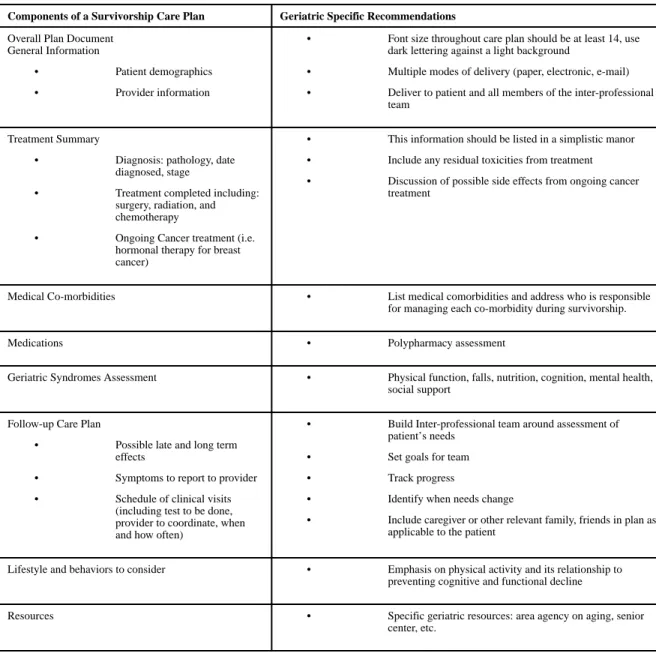
have a paper copy of their survivorship care plan. Whichever the mode of delivery, issues related to readability, including survivorship care plan font-size need to be addressed for an older population. See Table 1 for suggested geriatric specific recommendations for
survivorship care plans.
The maintenance of function is vital for older cancer survivors. Nurses are centrally involved in assessing functional status prior to the cancer diagnosis and assisting survivors with realistic plans to maintain activity and resume function during the course of survivorship. Activity is also vital to addressing the common and sustained problems of fatigue and weight gain following treatment. Nurses and all clinicians can be involved in referring survivors to physical or occupational therapy to assist with energy conservation and to maintain function.[16, 17]
Several organizations – including the American Society of Clinical Oncology (ASCO), LIVESTRONG®, Minnesota Cancer Alliance, NCCS, and the American Cancer Society -- have developed survivorship care plan resources for providers and cancer centers. The survivorship care plan should be delivered to all inter-professional team members, especially the primary care providers, who will likely oversee care coordination for the older cancer survivor. With advances in electronic medical records and technology, the challenge of distribution to appropriate healthcare providers may be attenuated.
Inter-Professional Survivorship Care Team
Emerging literature supports the concept that older adults have improved outcomes when a diverse team of professionals provide healthcare.[18, 19] Because many older adults often face a myriad of health issues, healthcare is often provided by a fragmented group of providers. Substantial adjustments in the current model of cancer care delivery are required to ensure that the healthcare received by older adults is well coordinated, comprehensive, and focused on individuals’ goals and preferences. These goals, inherent to a team-based approach to care, are extremely important during survivorship. Inter-professional teams are an important part of patient-centered care. Team-based care is defined by the IOM as “The provision of health services to individuals, families, and/or their communities by at least two health clinicians who work collaboratively with patients and their caregivers to the extent preferred by each patient to accomplish shared goals within and across settings to achieve coordinated, high quality care”.[20]
The patient is always at the center of all inter-professional teams, which should be tailored to meet an older patient’s needs. In addition, it must be understood that a patient’s needs may change over time. Therefore, the team should adjust to meet those needs in caring for the patient. Next, are two patient care examples that demonstrate how to build a patient-centered inter-professional team around a patient’s survivorship needs.
Patient One
A 78-year-old woman with a history of Stage IIA hormone-receptor positive, HER2 negative breast cancer, status post lumpectomy and radiation therapy is receiving adjuvant hormonal therapy with exemestane for the past 6 months. She continues to have generalized fatigue,
A
uthor Man
uscr
ipt
A
uthor Man
uscr
ipt
A
uthor Man
uscr
ipt
A
uthor Man
uscr
which she attributes to her radiation therapy. She also has significant anxiety about the possibility of a cancer recurrence. A brief geriatric assessment demonstrated that she has no deficits in her physical function, minimal medical comorbidity, significant anxiety, and poor social support; she is the primary caregiver for her disabled husband, leading to significant caregiver burden. During survivorship, this patient would benefit from inter-professional team care. Her inter-professional team could include a medical oncology provider, a primary care provider, a mental health professional, a social worker, and patient advocates. A nurse team member would also be valuable in discussing activity and exercise interventions.
Patient Two
An 81-year-old man has multiple medical comorbidities including mild cognitive impairment, congestive heart failure, chronic obstructive pulmonary disease, non-insulin dependent type 2 diabetes mellitus, and mild peripheral neuropathy. He is being treated for hormone-sensitive bone-only metastatic prostate cancer with leuprolide injections. He has had two falls without significant injury in the past 6 months. The patient feels this is due to poor balance and dyspnea on exertion after walking one block. The geriatric assessment identified that he has significant deficits in his physical function, instrumental activities of daily living impairment, and significant weight loss. He is at high risk for further falls. His daughter, who works full-time and cares for her three children, is his primary caregiver; she lives nearby and visits several times per week. This patient’s inter-professional team could include a medical oncology provider, geriatrician, nurses, nutritionist, social workers, home health care team, and physical and occupational therapy. In addition to the patient’s needs, the caregiver’s needs and concerns should be addressed, because of the critical role she plays in her father’s overall care.
It is clear from these examples that a high-quality inter-professional survivorship care team includes health professionals with specialized training in oncology (i.e., medical oncologists, radiation oncologists, and surgical oncologists), primary care physicians, and allied health professionals, including registered and advanced practice nurses, physician assistants, psychosocial support professionals, pharmacists, dieticians, rehabilitation specialists, clinical research coordinators and palliative care clinicians.[21] Each of these health professionals is considered an integral part of the cancer care team because each member represents and contributes a unique and broad range of knowledge, skills, and expertise in order to facilitate high-quality, survivorship care. Caregivers and family members are also critical components of this patient-centered survivorship care team. The patient-centered inter-professional survivorship care team is shown in Figure 2. The core set of principles common to high-functioning inter-professional teams includes shared goals, clear roles, mutual trust, effective communication, and development of measurable processes and outcomes. The goal and objective of the inter-professional team is to provide competent, high-quality, comprehensive care that is aligned with each patient’s goals.[21]
The core function of the inter-professional survivorship care team is to communicate clearly, educate one another, and develop clear expectations and accountability for each team member’s roles and responsibilities in order to deliver and promote coordinated, patient-centered care. In this way, each team member has a voice at the point of decision-making
A
uthor Man
uscr
ipt
A
uthor Man
uscr
ipt
A
uthor Man
uscr
ipt
A
uthor Man
uscr
and has the opportunity to contribute to the care of the patient. Table 2 depicts an example of some of the roles and responsibilities of each team member. Additional cancer care team members may include patient navigators, direct care workers (i.e. nurse aides, home health and home care aides), and patient advocates. Patient navigators are essential to making inter-professional care teams truly patient-centered, because older adults with cancer, especially frail older adults, may have more difficulty than other patients navigating the healthcare system to make appointments, obtain records, and travel to testing and/or consultation locations.[22, 23]
Typically, the medical oncologist is initially considered the formal team leader during acute cancer treatment. However, different team leaders may evolve over the cancer continuum depending on the patient’s condition and overall healthcare needs. One of the most critical functions of an inter-professional cancer care team is to develop and maintain team
processes that promote collaboration. The ideal collaborative relationship between members of the team is “shared care” where each member is involved in the patient’s care throughout the cancer care continuum. However, team members role may fluctuate over time depending on the needs of the patient and the status of their disease.[13] Building a high-quality, inter-professional survivorship care team allows members to function in a collaborative
environment with other healthcare professionals whose expertise complements their own.
Cancer care is undergoing significant transformation in the delivery of services, and inter-professional team-based care offers an approach in which management decisions are aligned with the patient’s needs, values, and goals. Given the fluctuating and diverse needs of older patients during survivorship, the inter-professional team provides the ideal platform to care for older adult cancer survivors. The inter-professional team is part of the survivorship care process that is outlined in Figure 1. It is imperative that we assess the effectiveness of inter-professional survivorship care teams by conducting well-designed research studies that measure patient-reported outcomes and/or perform quality improvement audits to evaluate team processes for providing high-quality survivorship care.
There are limitations to team based survivorship care. Inter-professional survivorship care is complex and requires multiple layers of coordination. The team may need one member to be dedicated to coordinating referrals and ensuring that re-evaluation of the plan of care occurs on a regular basis. Since some older adults may need multiple members of the
inter-professional team during survivorship, there remains a question as to who will pay for all these services. In addition, inter-professional survivorship care generally leads to multiple provider appointments, which could become exhaustive and impractical, especially for older patients. Future research needs to be done to better understand the best model or models of survivorship care for older adults.
Patient Advocacy
In addition to being at the center of all inter-professional care teams, patients play a very important role as patient advocates. Patient advocates can contribute their experience in the broader spectrum of issues for a better understanding of the needs of individual patients. They can identify and/or interpret patient concerns, which are often not expressed or are
A
uthor Man
uscr
ipt
A
uthor Man
uscr
ipt
A
uthor Man
uscr
ipt
A
uthor Man
uscr
misunderstood. Because patient advocacy can take several different forms -- including direct contact with patients coping with cancer, raising public awareness, participating as
stakeholders in research, and addressing health policy issues – patient advocates bring a unique perspective to the team.
Patient advocates perform essential roles in research. They can humanize the science, interpret the findings for the lay community, build public support for research including clinical trials, identify ethical concerns surrounding research, and assist with disseminating findings in culturally sensitive ways. It is significant that funders, such as the Patient-Centered Outcomes Research Institute (PCORI), have recognized the important role patient advocates play in research, and they now require active engagement from patient advocates or other stakeholders throughout the research process. All of that experience provides patient advocates with the skills to be an integral member of the survivorship care team.
Involvement of patient advocates is essential for balanced monitoring of the efficacy of survivorship care plans and determining the future directions of survivorship research.
Conclusions
With the increasing number of older adult cancer survivors, it is important to understand how to best care for older adults during survivorship. While the CoC has recommended survivorship care plans in the form of a formal document, the participants in the U13 conference group view survivorship care as more than a document. Survivorship care is a process. Given the complexity and heterogeneity of older adults with cancer, the inter-professional team is ideally suited to structure survivorship care to the older patient’s needs. The inter-professional team includes a wide array of members, but an individual patient’s team may include only selected members based on an assessment of the individual’s needs. Compared to younger adults, older cancer survivors have unique needs such as
polypharmacy and medical comorbidity and these unique considerations need to be a part of the survivorship care process.[14, 15] Patient engagement and patient advocacy are vital to the success of survivorship care for older adults. Finally, there is very little evidence in the literature on how to best care for older adult cancer survivors and this report should serve as a call to action for older adult survivorship research.
Acknowledgments
This work was funded by a U13 AG038151 from the National Institute on Aging. The work was also funded by the American Cancer Society and a Patient-Centered Outcomes Research Institute (PCORI) Program contract (4634). The work received support from the James Wilmot Cancer Institute (WCI), the Alliance for Clinical Trials in Oncology (National Cancer Institute of the National Institutes of Health under Award Numbers U10CA18082 and 1UG1CA189823), and UG1 CA189961 from the National Cancer Institute. This work was made possible by the generous donors to the WCI geriatric oncology philanthropy fund. All statements in this report, including its findings and conclusions, are solely those of the authors, do not necessarily represent the official views of the funding agencies, and do not necessarily represent the views of the Patient-Centered Outcomes Research Institute (PCORI), its Board of Governors or Methodology Committee.
References
1. National Coalition for Cancer Survivorship. [cited 2015 August 31] Available from: http:// www.canceradvocacy.org/.
A
uthor Man
uscr
ipt
A
uthor Man
uscr
ipt
A
uthor Man
uscr
ipt
A
uthor Man
uscr
2. Institute, N.C. [cited 2015 August 17] SEER Stat Fact Sheets: All Cancer Sites. Available from:
http://seer.cancer.gov/statfacts/html/all.html
3. Parry C, et al. Cancer survivors: a booming population. Cancer Epidemiol Biomarkers Prev. 2011; 20(10):1996–2005. [PubMed: 21980007]
4. Bureau, U.S.C. 2014 National Population Projections. Available from: http://www.census.gov/ population/projections/data/national/2014.html
5. de Moor JS, et al. Cancer survivors in the United States: prevalence across the survivorship trajectory and implications for care. Cancer Epidemiol Biomarkers Prev. 2013; 22(4):561–570. [PubMed: 23535024]
6. Boss GR, Seegmiller JE. Age-related physiological changes and their clinical significance. West J Med. 1981; 135(6):434–440. [PubMed: 7336713]
7. Bellizzi KM, Rowland JH. Role of comorbidity, symptoms and age in the health of older survivors following treatment for cancer. Aging Health. 2007; 3(5):625–635.
8. Extermann M. Interaction between comorbidity and cancer. Cancer Control. 2007; 14(1):13–22. [PubMed: 17242667]
9. McCabe MS, et al. American Society of Clinical Oncology statement: achieving high-quality cancer survivorship care. J Clin Oncol. 2013; 31(5):631–640. [PubMed: 23295805]
10. Stricker CT, O'Brien M. Implementing the commission on cancer standards for survivorship care plans. Clin J Oncol Nurs. 2014; 18(Suppl):15–22. [PubMed: 24480658]
11. Hewitt, M.; Greenfield, S.; Stovall, E. From Cancer Patient to Cancer Survivor: Lost in Transition. Institute of Medicine: National Academic Press; 2006.
12. Hewitt ME, et al. Perspectives on post-treatment cancer care: qualitative research with survivors, nurses, and physicians. J Clin Oncol. 2007; 25(16):2270–2273. [PubMed: 17538172]
13. Cohen HJ. A model for the shared care of elderly patients with cancer. J Am Geriatr Soc. 2009; 57(Suppl 2):S300–S302. [PubMed: 20122034]
14. Leach CR, et al. The complex health profile of long-term cancer survivors: prevalence and predictors of comorbid conditions. J Cancer Surviv. 2015; 9(2):239–251. [PubMed: 25319681] 15. Nightingale G, et al. Evaluation of a pharmacist-led medication assessment used to identify
prevalence of and associations with polypharmacy and potentially inappropriate medication use among ambulatory senior adults with cancer. J Clin Oncol. 2015; 33(13):1453–1459. [PubMed: 25800766]
16. Farrell B, et al. Reducing polypharmacy in the elderly: Cases to help you "rock the boat". Can Pharm J (Ott). 2013; 146(5):243–244. [PubMed: 24093027]
17. Morgan B, Tarbi E. The Role of the Advanced Practice Nurse in Geriatric Oncology Care. Semin Oncol Nurs. 2016; 32(1):33–43. [PubMed: 26830266]
18. Terret C, et al. Multidisciplinary approach to the geriatric oncology patient. J Clin Oncol. 2007; 25(14):1876–1881. [PubMed: 17488986]
19. Zulian GB. Geriatric medical oncology in the care of elderly cancer patients. Crit Rev Oncol Hematol. 2002; 41(3):343–347. [PubMed: 11880210]
20. Mitchell, P., et al. Core principles and values of effective team-based care. Washington DC: Institute of Medicine; 2012.
21. Levit, L., et al. Deliviering High-Quality Cancer Care: Charting a New Course for a System in Crisis. Institute of Medicine: National Academics Press; 2013.
22. Mandelblatt JS, Yabroff KR, Kerner JF. Equitable access to cancer services: A review of barriers to quality care. Cancer. 1999; 86(11):2378–2390. [PubMed: 10590381]
23. Manderson B, et al. Navigation roles support chronically ill older adults through healthcare transitions: a systematic review of the literature. Health Soc Care Community. 2012; 20(2):113– 127. [PubMed: 21995806]
A
uthor Man
uscr
ipt
A
uthor Man
uscr
ipt
A
uthor Man
uscr
ipt
A
uthor Man
uscr
Figure 1.
Survivorship Care Process for Older Adults
A
uthor Man
uscr
ipt
A
uthor Man
uscr
ipt
A
uthor Man
uscr
ipt
A
uthor Man
uscr
Figure 2.
Patient-Centered Inter-Professional Team Members Adapted from Reference 21
*Friends, Family, Community as relevant to the patient ^Research Team may not be available in all clinical locations
A
uthor Man
uscr
ipt
A
uthor Man
uscr
ipt
A
uthor Man
uscr
ipt
A
uthor Man
uscr
A
uthor Man
uscr
ipt
A
uthor Man
uscr
ipt
A
uthor Man
uscr
ipt
A
uthor Man
uscr
ipt
Table 1
Geriatric Specific Recommendations for Survivorship Care Plan
Components of a Survivorship Care Plan Geriatric Specific Recommendations
Overall Plan Document General Information
• Patient demographics
• Provider information
• Font size throughout care plan should be at least 14, use dark lettering against a light background
• Multiple modes of delivery (paper, electronic, e-mail)
• Deliver to patient and all members of the inter-professional team
Treatment Summary
• Diagnosis: pathology, date diagnosed, stage
• Treatment completed including: surgery, radiation, and chemotherapy
• Ongoing Cancer treatment (i.e. hormonal therapy for breast cancer)
• This information should be listed in a simplistic manor
• Include any residual toxicities from treatment
• Discussion of possible side effects from ongoing cancer treatment
Medical Co-morbidities • List medical comorbidities and address who is responsible for managing each co-morbidity during survivorship.
Medications • Polypharmacy assessment
Geriatric Syndromes Assessment • Physical function, falls, nutrition, cognition, mental health, social support
Follow-up Care Plan
• Possible late and long term effects
• Symptoms to report to provider
• Schedule of clinical visits (including test to be done, provider to coordinate, when and how often)
• Build Inter-professional team around assessment of patient’s needs
• Set goals for team
• Track progress
• Identify when needs change
• Include caregiver or other relevant family, friends in plan as applicable to the patient
Lifestyle and behaviors to consider • Emphasis on physical activity and its relationship to preventing cognitive and functional decline
Resources • Specific geriatric resources: area agency on aging, senior
A
uthor Man
uscr
ipt
A
uthor Man
uscr
ipt
A
uthor Man
uscr
ipt
A
uthor Man
uscr
ipt
Table 2
Examples of Inter-Professional Healthcare Team Members Roles and Responsibilities
Health Profession Roles and responsibilities
Medical Oncology Providers
Develops an individualized treatment plan based on the goals established by the patient and recommendations of the inter-professional care team
• Recommend antineoplastic regimens and follows treatment progress
• Order laboratory and radiographic assessments
• Recommend referrals (i.e. Radiation Oncology, Surgery, Palliative Care)
Geriatricians and Primary Care Physicians
Conducts a comprehensive evaluation and assessment plan for multi-morbidity management based on the goals established by the patient and recommendations of the inter-professional care team
• Screen for geriatric syndromes (falls, functional impairment, cognition, etc)
• Provides longitudinal follow up across the cancer care continuum
• Recommend referrals (i.e. Physical/occupational therapy, rehabilitation)
Nurses and Advanced Practice Nurses
Conducts a comprehensive assessment and participates in cancer and comorbidity disease management
• Conduct functional status screening tests
• Assists with coordination of referrals (i.e. Physical/occupational therapy)
Provides patient, family, and caregiver education and support regarding symptoms, medications and other quality of life concerns
Psychosocial Support Professionals
Conducts an assessment of the psycho-social needs of the patient and the family/caregivers
• Recommends treatment as applicable and link patient and family/caregivers to resources and services (i.e. transportation, home health care, medical equipment, financial and insurance resources)
• Provides counseling and ongoing support through referrals (i.e. support groups, psycho-educational programs, counseling sessions)
Pharmacists Conducts a comprehensive medication evaluation and assessment
• Conducts comprehensive evaluation of all medications (prescription, non-prescription, herbals/ supplements)
• Recommends medication modifications (i.e. discontinuation of potentially inappropriate medications, reduce polypharmacy/medication complexity)
• Identifies potential chemotherapeutic toxicities, dose adjustments and drug-drug interactions
Dieticians Conducts a comprehensive evaluation and assessment of the nutritional needs of the patient
• Provides nutrition counseling and education
• Identifies patients at risk for malnutrition and links patient and family and caregivers to resources and services (i.e. Meals on wheels)
Patient Advocate Serves as a liaison between the patient and the other healthcare team members
• Helps identify and/or interpret patient concerns, which are often not expressed or are misunderstood
• Helps empower patients to be an active participant in decision making
A
uthor Man
uscr
ipt
A
uthor Man
uscr
ipt
A
uthor Man
uscr
ipt
A
uthor Man
uscr
ipt
Health Profession Roles and responsibilities
Other Stakeholders