Use of Biologic Therapy by Pregnant Women With Inflammatory
Bowel Disease Does Not Affect Infant Response to Vaccines
Dawn B. Beaulieu,
*
,aAshwin N. Ananthakrishnan,
‡,aChristopher Martin,
§Russell D. Cohen,
kSunanda V. Kane,
¶and Uma Mahadevan
#*Division of Gastroenterology, Hepatology, and Nutrition, Vanderbilt University Medical Center, Nashville, Tennessee;‡Division of Gastroenterology, Massachusetts General Hospital and Harvard Medical School, Boston, Massachusetts;§Division of Gastroenterology and Hepatology, Department of Medicine, University of North Carolina, Chapel Hill, North Carolina;kSection of Gastroenterology, Hepatology and Nutrition, University of Chicago Medicine, Chicago, Illinois;¶Division of Gastroenterology and Hepatology, Mayo Clinic, Rochester, Minnesota;#Division of Gastroenterology, University of California–San Francisco, San Francisco, California
BACKGROUND & AIMS: In women with inflammatory bowel diseases (IBDs), exposure to immunomodulator or biologic therapy has not been associated with adverse events during pregnancy or outcomes of newborns. We investigated whether exposure of patients to these agents during pregnancy affects serologic responses to vaccines in newborns.
METHODS: We collected data from the Pregnancy in IBD and Neonatal Outcomes registry, which records outcomes of pregnant women with diagnosis of IBD receiving care at multiple centers in the United States, from 2007 through 2016. Serum samples collected from infants at least 7 months old were analyzed for titers of antibodies toHaemophilus influenzae B(HiB) or tetanus toxin; mothers completed a survey of vaccine practices and outcomes from July 2013 through October 2016. Umbilical cord blood samples from 33 infants were assayed for concentration of biologic agents. Vaccination response was compared between infants born to mothers exposed to bio-logic therapy (infliximab, adalimumab, certolizumab pegol, golimumab, natalizumab, vedoli-zumab, or ustekinumab—either as a single agent or in combination with an immunomodulator, at any time between conception and delivery) and infants born to unexposed mothers.
RESULTS: A total of 179 women completed the vaccine survey (26 biologic unexposed, 153 exposed to a biologic agent). We found no significant difference in proportions of infants with protective antibody titers against HiB born to exposed mothers (n[42, 71%) vs unexposed mothers (n[ 8, 50%) (P [.41). We also found no difference in the proportion of infants with protective antibody titers to tetanus toxoid born to exposed mothers (80%) vs unexposed mothers (75%) (P[ .66). The median concentration of infliximab in cord blood did not differ significantly between infants with vs without protective antibody titers to HiB (P[.30) or tetanus toxoid (P[.93). Mild reactions were observed in 7/40 infants who received rotavirus vaccine and whose mothers had been exposed to biologic therapies.
CONCLUSIONS: Vaccination of infants against HiB and tetanus toxin, based on antibody titers measured when infants were at least 7 months old, does not appear to be affected by in utero exposure to biologic therapy.
Keywords:Infliximab; Neonate; Immunization; Rotavirus.
I
nCrohnflammatory bowel diseases (IBDs), such as’s disease and ulcerative colitis, frequently affect men and women in their reproductive years. Because of the progressive, relapsing-remitting course of disease, many patients with IBD require immunosup-pressive and biologic therapy to obtain disease control. Achieving and maintaining adequate disease control is important to optimize pregnancy outcomes because active disease is associated with an increase in adverse pregnancy outcomes.1 The impact of such medications on fertility, pregnancy, and infant outcomes are ofparamount importance to both the patients and the treating clinician. There have been multiple retrospective
a
Authors share co-first authorship.
Abbreviations used in this paper:HiB,Haemophilus influenzae B; PIANO, Pregnancy in Inflammatory Bowel Disease and Neonatal Outcomes; TNF, tumor necrosis factor.
Most current article
© 2018 by the AGA Institute 1542-3565/$36.00
studies that have failed to show an association between anti–tumor necrosis factor (TNF) therapy and adverse outcomes or congenital malformations in the IBD popula-tion.2,3 However, some biologics can cross the placenta and be present in the infant for the first several months of life.4There are limited data on the long-term impact of this exposure on the development of the neonatal im-mune system. The 2010 case report of the death of an in-fant born to a mother on biologic therapy who was administered the Bacillus–Calmette–Guerin vaccine at 3 months remains at the forefront and drives the pursuit for continued safety in our infants born in the era of bio-logic therapy.5
Studies have quantified the anti-TNF drug concen-tration in the mother and infant and have shown that measurable drug concentration can persist in the infant for up to 12 months.4,6This persistence of drug has led to recommendations for avoiding live vaccines in infants during the time when they may have detectable con-centrations of biologic drug. However, no alterations have been recommended for inactivated vaccines under the assumption that they are both safe and effective despite exposure to maternal immunosuppression. Studies in adults with IBD have shown that individuals on immunosuppression, particularly combination immunomodulator-biologic therapy, have significantly lower rates of response to inactivated vaccines including pneumococcal and influenza vaccines.7–9 It is unknown whether an infant exposed to biologic and immuno-modulator therapy in utero and/or with detectable bio-logic concentration in thefirst year of life will mount an appropriate response to inactivated vaccines.
The Pregnancy in Inflammatory Bowel Disease and Neonatal Outcomes (PIANO) registry is one of the largest prospective registries of maternal and childhood out-comes in IBD. It focuses on both pregnancy outout-comes and early childhood health and development. The aims of this study were to measure infant response to vaccina-tions at 1 year of age and determine if maternal immu-nosuppression exposure affects vaccine response. In individuals in whom the serum concentration of biologic drug was available at birth, we aimed to examine if a higher drug concentration at birth was associated with an attenuated response to vaccination.
Methods
Study Cohort
The population for this study consisted of women enrolled in the Crohn’s and Colitis Foundation PIANO registry, an ongoing prospective multicenter registry initiated in 2007. This prospective registry approached women with an established diagnosis of IBD receiving care at 1 of 30 centers throughout the United States. Upon obtaining informed consent, women provided detailed information regarding their demographics and
characteristics of their IBD, including current and past treatments. Enrollment could occur at any point during pregnancy and participating women were followed up prospectively throughout each trimester of pregnancy, and at delivery. Children born to these mothers were followed up every 4 months in thefirst year of life, and then annually until the age of 4 years. To date, there have been 1564 patients enrolled in the PIANO registry. The survey on vaccine responses was administered to women who had an infant at least 12 months of age between July 2013 and October 2016. Among 211 such women, 179 completed the vaccine survey (85%) and were included in this analysis. In the United States, during the first year of life, the Centers for Disease Control and Prevention recommends hepatitis B vaccines at birth, age 1 to 2 months, and age 6 months; diphtheria–tetanus–pertussis, Pneumococcal, inactivated polio vaccine, and rotavirus at age 2, 4, and 6 months; Haemophilus influenzae B(HiB) at 2, 4, and 12 months; and measles, mumps, and rubella at age 12 months. There were 261 infants who were at least 7 months of age during this period; 50 mothers agreed to test for vaccine titers in their infants. Although women could be enrolled during more than 1 pregnancy in PIANO, there were no multiple enrollees in this vaccine substudy.
For this study, women and infant pairs were classified into 2 groups. The biologic-exposed group consisted of those infants in whom the mother had been exposed to any biologic therapy (infliximab, adalimumab, certolizu-mab pegol, golimucertolizu-mab, natalizucertolizu-mab, vedolizucertolizu-mab, or ustekinumab), either as a single agent or in combination with an immunomodulator at any time between conception and delivery. The no-biologic comparator population consisted of infants whose mothers had been on mesalamine, antibiotics, steroids, immunomodulator monotherapy (azathioprine or 6-mercaptopurine), or received no therapy between conception and delivery.
Vaccination Questionnaire and Titer
Measurement
depend on optimal T-helper and B-cell responses. Prior studies have reported that between 90% and 100% of children who completed the primary series achieved protective antitoxin titers against tetanus toxoid10,11and HiB.12–14 Women also were asked specifically if the rotavirus vaccine was administered, and, if not, the reason for skipping the vaccine. Information was obtained about completion of the primary immunization series and reasons for missed vaccines.
Cord blood and/or infant serum was assayed for concentrations of infliximab, adalimumab, certolizumab pegol, vedolizumab, or ustekinumab from a subset of women enrolled in the study. Maternal, cord, and infant serum were collected on the day of birth (0.5–2 mL blood required per sample). If the infant had a detectable concentration of biologic drug at birth, the site co-ordinators contacted the mother to obtain additional infant samples at months 3 and 6, as appropriate. Maternal and cord blood samples were collected into tiger-top tubes and from the baby into a gold-top tube. The specimens then were packaged by hospital phle-botomy staff or a nurse and shipped ambient to Pro-metheus Laboratories, Inc (San Diego, CA). Serum concentrations of all drugs were determined at Prome-theus Laboratories, Inc, by mobility shift assay as pre-viously described.15 The assays for infliximab, adalimumab, and vedolizumab have been validated and are in routine clinical use.
Statistical Analysis
All statistical analyses were performed at the Data Management Center at the University of North Carolina at Chapel Hill. Continuous variables were summarized using means and SDs and compared using the t test, whereas categoric variables were expressed in pro-portions and compared using the chi-square test with the Fisher exact modification when appropriate. Rates of adequate vaccination response to tetanus toxoid and HiB were compared across the biologic-exposed and unex-posed groups. Univariate logistic regression was per-formed to quantify the effect of medication exposure on adequate vaccination response, with a 2-sided P value less than .05 indicating statistical significance. Analyses were repeated excluding certolizumab pegol users given the known minimal transplacental transfer of this agent. Nonparametric tests were used to compare the median cord levels of infliximab between vaccine responders and nonresponders. The study was approved by the Institutional Review Board at each participating institution.
Results
The study population included 179 women from the PIANO registry who completed the vaccination survey. The mothers’ mean age was 31.6 years and the mean
disease duration at the time of pregnancy was 9.5 years (Table 1). Two-thirds (67%) had Crohn’s disease (n¼120). One third of women each were in theirfirst (n ¼ 67; 37%) or second pregnancy (n ¼ 55; 31%), while 24 women (13.4%) were in their fourth or subsequent pregnancy. Most women had inactive (77%) or mild disease activity (18%) at the time of pregnancy. Eleven women (6%) were on no immuno-suppressive therapy, 15 women (8%) were on immu-nomodulator therapy, and the remaining women were on biologics either as monotherapy (116; 65%) or in combination with an immunomodulator (37; 21%). There was no statistical difference in the mean age, type of IBD, smoking status, gravidity, or disease ac-tivity across the 2 groups (Table 1). Vaccine titers were available to infants born to 50 women. Characteristics of mothers with available vaccine titers are shown in
Table 2. Among the 42 biologic-exposed patients, 27 were on infliximab, 7 were on adalimumab, 3 were on certolizumab, 2 each were on natalizumab and uste-kinumab, and 1 was on vedolizumab. Eight infants born to women on immunomodulators alone or no immunosuppressive therapy formed the comparator population.
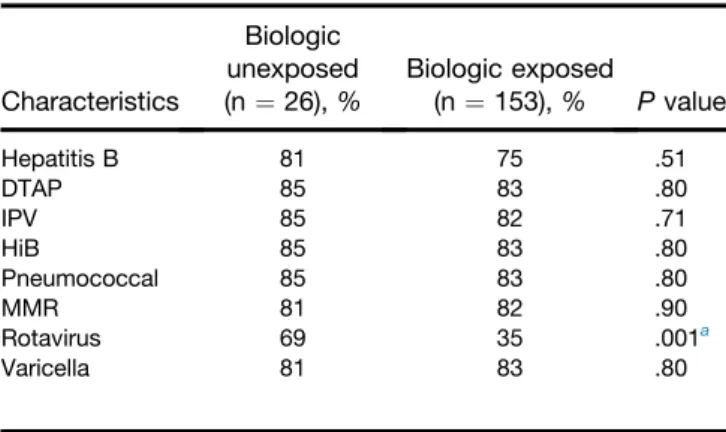
Table 3 describes the percentages of women in each subgroup whose infants received the scheduled vaccinations during their first year of life. Most infants in both groups received hepatitis B, diphtheria–tetanus–pertussis, inactivated polio, HiB, pneumococcal, measles-mumps-rubella, and varicella vaccines. Infants born to women on biologic mono-therapy or combination mono-therapy (35%) were significantly less likely to have received the rotavirus vaccine compared with those on no immunosuppression (P ¼.001). Among biologic-exposed infants, the rate of receiving the rotavirus vaccine was lower in women on combination therapy (16%) compared with those on biologic monotherapy (41%; P ¼ .006). A majority of the women who reported skipping the rotavirus vaccines for their infants did so on their doctors’advice (n ¼ 72), with only 2 and 3 women, respectively, reporting skipping the dose because of personal prefer-ence or concern for side effects.
CI, 0.45–11.33; tetanus: 1.60; 95% CI, 0.25–10.36). Among the 42 women on biologic therapy, 10 were on combination therapy with an immunomodulator. There was no difference in the proportion with adequate serologic response to either HiB (69% vs 78%) or tetanus (84% vs 67%) between the biologic mono-therapy and combination mono-therapy groups, respectively.
Both groups had response rates similar to infants born to mothers on no immunosuppression.
Serum drug concentrations were available for 29 infants (20 infliximab, 6 adalimumab, and 1 each for certolizumab, ustekinumab, and vedolizumab) and 33 cord blood samples (23 infliximab, 6 adalimumab, 2 ustekinumab, and 1 each for vedolizumab and certoli-zumab). For tetanus toxoid, there was no difference between the rates of response in infants with unde-tectable (50%), therapeutic (3–10 mcg/mL; 100%), high (10.1–20 mcg/mL; 83%), and very high (>20 mcg/mL) biologic concentrations (P¼.37). Similarly, there was no association between response to HiB across the same 4 categories (50%, 83%, 100%, and 59%, respectively; P ¼ .22). Because infliximab was the most commonly used biologic, we performed a subgroup analysis of women on this therapy. There was no association be-tween infliximab concentration in cord blood and ade-quacy of immune response to HiB or tetanus vaccines (Figure 2). The median cord blood infliximab concen-trations were similar between infants with an adequate (24.3 mcg/mL; interquartile range, 14.0–42.7 mcg/mL) or inadequate immune response to HiB (43.0 mcg/mL; interquartile range, 28.5–53.3) (P ¼ .31). Similarly, for tetanus toxoid, there was no difference in the median infant cord level between those with (31.4 mcg/mL) and without (41.5 mcg/mL) an adequate immune response (P ¼.93).
Infants born to 43 of the women on biologics (19 infliximab, 12 certolizumab, 7 adalimumab, 1 infliximab and certolizumab, and 1 ustekinumab) received the rotavirus vaccines. Among infants of 40 women for whom these data were available, 7 (17.5%) reported a reaction to the vaccine. Of these, 6 infants had a fever (5 infliximab, 1 adalimumab) and 1 had diarrhea (on infliximab). There was no correlation between infant drug concentration at birth and the likeli-hood of a reaction to the rotavirus vaccine (Table 4).
Table 2.Characteristics of Women With Available Infant Vaccine Titers
Characteristics
Biologic exposed (n¼42)
Biologic unexposed
(n¼8)
Mean age,y(SD) 31.7 (3.4) 30.6 (4.4)
Mean disease duration,y(SD) 10.4 (5.6) 5.3 (2.3) Type of IBD (%)
Crohn’s disease 30 (71.4) 4 (50.0)
Ulcerative colitis 11 (26.2) 4 (50.0)
IBDU 1 (2.4) 0 (0.0)
Ever smoker (%) 5 (11.9) 2 (25.0)
Disease activity (%)
None 34 (81.0) 5 (62.5)
Mild 8 (19.0) 3 (37.5)
Medication use, N (%)
Biologics 42 (100.0) 0 (0.0)
Immunomodulators 10 (23.8) 2 (25.0)
Mesalamine, steroids, antibiotics, or no therapy
N/A 6 (75.0)
IBDU, IBD unspecified; N/A, not applicable.
Table 3.Proportion of Infants Receiving at Least 1 Dose of Each of the Vaccines
Characteristics
Biologic unexposed (n¼26),%
Biologic exposed
(n¼153),% Pvalue
Hepatitis B 81 75 .51
DTAP 85 83 .80
IPV 85 82 .71
HiB 85 83 .80
Pneumococcal 85 83 .80
MMR 81 82 .90
Rotavirus 69 35 .001a
Varicella 81 83 .80
DTAP, diphtheria, tetanus, pertussis; IPV, inactivated polio vaccine; MMR, measles, mumps, rubella.
a
In the United States, during thefirst year of life, the Centers for Disease Control and Prevention recommend hepatitis B vaccines at birth, 1 to 2 months, and 6 months; diphtheria-tetanus-pertussis, pneumococcal, and inactivated polio vaccine at 2, 4, and 6 months; HiB at 2, 4, and 12 months; MMR at 12 months; and rotavirus at 2, 4, and 6 months.
Table 1.Characteristics of Included Patients
Characteristics
Biologic exposed (n¼153)
Biologic unexposed
(n¼26)
Mean age,y(SD) 31.4 (4.6) 33.1 (3.2)
Type of IBD, N (%)
Crohn’s disease 107 (69.9) 13 (50.0)
Ulcerative colitis 43 (28.1) 11 (42.3)
IBDU 3 (2.0) 2 (7.7)
Mean duration of disease,y(SD) 8.9 (6.0) 13.2 (7.6) Smoking status, N (%)
Never 112 (73.2) 18 (69.2)
Former/current 41 (26.8) 8 (30.8)
Gravidity, N (%)
1 54 (35.3) 13 (50.0)
2 47 (30.7) 8 (30.8)
3 32 (20.9) 1 (3.8)
4 20 (13.1) 4 (15.4)
Disease activity, N (%)
None 117 (77.0) 19 (79.2)
Mild 26 (17.1) 5 (20.8)
Moderate 8 (5.3) 0 (0.0)
Severe 1 (0.7) 0 (0.0)
Medication use, N (%)
Biologics 153 (100.0) 0 (0.0)
Immunomodulators 37 (24.2) 15 (57.7)
Mesalamine, steroids, antibiotics, or no therapy
N/A 11 (42.3)
Discussion
The impact of medications used for the management of maternal IBD on the health and development of infants historically has not been studied systematically. With data showing that in utero exposure to some biologics leads to persistence of drug concentrations for up to a year, there is a need for robust examination of this effect on infant immune response. By using data from a rigorously followed up prospective cohort of pregnant women with IBD, we show that the rates of adequate serologic response to HiB and tetanus vaccines were
similar among infants born to women on biologic ther-apy compared with those who were not biologic users during pregnancy. There was also no association between cord blood or infant serum concentrations of biologics and adequacy of vaccine titers. In a small subset of infants exposed to maternal biologic therapy, rotavirus vaccine was administered without serious adverse reactions and with mild events occurring at a rate similar to that expected in the general population, suggesting a need for further studies in this population.
There is a significant body of literature examining the effect of immunosuppression on response to vaccination in patients with IBD, primarily in response to the infl u-enza vaccine.9 Mamula et al9 studied 80 children (51 with IBD) who received a single dose of the inactivated influenza vaccine. Compared with healthy controls, nearly all of whom (89%–100%) developed protective titers to 3 different influenza virus antigens, only 33% to 85% of patients with IBD showed protection for all 3 antigens. The reduced serologic response was more striking in patients on combination therapy. Some studies identified similar rates of initial response, but reduced persistence of the seroprotective titers at 2 years.16In adult IBD patients, Melmed et al3showed that those on combination anti-TNF immunomodulator ther-apy had lower rates of response to the pneumococcal polysaccharide vaccine (45% vs 80% with no immuno-suppression). Dezfoli et al17 showed lower rates of response to the tetanus vaccine in patients on combi-nation therapy with anti-TNF and immunomodulator compared with those on no immunosuppression.
Examination of the adequacy of vaccine response in infants born to women on biologic therapy attained additional impetus, with emergence of data suggesting persistence of detectable biologic concentrations in in-fants for many months after delivery. A prospective observational cohort by Julsgaard et al4 showed that infliximab concentration could persist for up to 12 months and adalimumab for 9 months after birth. In contrast, certolizumab pegol, by virtue of being a
Figure 2.Association between the cord blood concentration of infliximab and the response to HiB or tetanus toxoid vaccines. (A) HiB. The median infliximab cord blood levels in infants with adequate and inadequate serologic response to HiB were 24.3 and 43.0 mcg/mL, respectively (P¼.30). (B) Tetanus toxoid. The median infliximab cord blood levels in infants with adequate and inadequate serologic response to tetanus were 31.4 and 41.5 mcg/mL, respectively (P¼.93).
polyethylene glycolylated FaB immunoglobulin, does not bind to the neonatal Fcg receptor responsible for transplacental transfer and was not found in infant or cord blood.18In this context, it is reassuring to note that in our study, infants exposed to maternal biologic (or immunomodulator therapy) had similar rates of sero-logic response to HiB or tetanus vaccines compared with infants of unexposed women in our cohort. However, the overall rates of adequate response to HiB and tetanus in our cohort, 67% and 80%, respectively, were lower than noted historically. Prior studies reported that between 90% and 100% of children who completed the primary series achieved protective antitoxin titers against tetanus toxoid10,11 or HiB.12,13 Two reasons could explain the lower rates of response observed in our cohort: a possible immunosuppressive effect of maternal IBD itself or the impact of in utero exposure to maternal immu-nosuppressive and biologic use, which our small sample size prevents us from distinguishing.
Despite the recommendations to avoid live vaccines in infants born to mothers on biologic therapy, infants born to 43 women on biologics received the rotavirus vaccine with just fewer than 1 in 5 developing a minor reaction. This is comparable with the rates of fever (42%) or diarrhea (19%) reported in the healthy infants in the general population in the Vesikari et al19 publi-cation that included more than 34,000 infants. In addi-tion, it has been reported that thefirst dose of rotavirus vaccine given after 3 months of age in healthy infants was associated with an increased risk of intussuscep-tion.20,21 Prior studies of infants with severe immuno-deficiency have shown severe live vaccine associated reactions22and Cheent et al5described a case of severe, disseminated Bacillus–Calmette–Guerin infection result-ing in death after vaccination at 3 months in an infant exposed to maternal infliximab. In a systematic review, Croce et al23 described the safety of live vaccines in 21,082 patients on immunosuppressive therapy for immune-mediated disease (majority of study sample) or organ transplantation, most of whom received the herpes zoster vaccine. Local or systemic reactions were infre-quent, occurring in 1.3% of the cohort. However, none of the reports described patients receiving the rotavirus vaccine. Despite our data suggesting a lack of severe side effects with the rotavirus vaccine in these infants, in the absence of robust evidence, one should continue to avoid live vaccines in infants born to mothers on biologic
therapy (excluding certolizumab) during thefirst year of life or until drug clearance is confirmed. With the growing availability of tests, one conceivably could test serum drug concentration in infants, and, if undetectable, consider live vaccination at that time, if appropriate for the vaccine, particularly in infants most likely to benefit from such vaccines.
We acknowledge several limitations to our study. Although this was a large study of vaccination response in infants of mothers on immunosuppressive and biologic medications, the number of children, particularly on no immunosuppression, was small and thus provided limited statistical power. However, of note, a few prior studies on vaccine responses in individuals with IBD had only modestly larger sample sizes (60–64 patients) and showed a statistically significant reduction in serologic response in immunosuppressed individuals. In addition, inclusion in this study relied on the willingness of mothers to subject their healthy, unaffected infants to invasive blood draws at older than 7 months of age, which was an understandable practical constraint, limiting sample size. We assessed the serologic response to only 2 vaccines, chosen because they provide a window into immune re-sponses to protein and protein–polysaccharide vaccines. Drug levels were analyzed at a single time point (birth) given the smaller number of patients with levels available at 3 and 6 months. Because the vaccines are administered at multiple time points, measurement of infant infliximab levels at each of these doses would be impractical. There is a need for future studies to examine the sustainability of response to vaccination in such infants.
In conclusion, despite the growing body of literature showing that both conventional immunomodulator therapy with thiopurines (6-mercaptopurine, azathio-prine), TNFa antagonists, anti-integrin, or anti-interleukin 12/23 therapies are low risk during pregnancy and are not associated with congenital anomalies and pregnancy outcomes, the short- and long-term impacts on immune response in the infant has yet to be determined. This study was a large prospective study that looked at infants exposed to maternal immu-nomodulator or biologic use and infant vaccine response. In our infants, maternal immunosuppression use was not associated with lower rates of response to tetanus or HiB vaccines compared with unexposed infants of mothers with IBD, however, overall rates of response were lower than historically reported. In a limited cohort of exposed
Table 4.Characteristics of Infants Born to Mothers on Biologic Therapy Who Received the Rotavirus Vaccine
Biologic therapy Number Proportion with reaction, N (%) Type of reaction Biologic level in infant,mcg/mL
Infliximab 19 6 (32) Fever (n¼5)
Diarrhea (n¼1)
Diarrhea: 72 mcg/mL (at birth; 5 mcg/mL (at 3 mo) No reactions: 44, 11, 42, 28, 22, and 69 mcg/mL
Adalimumab 7 1 (14) Fever (n¼1) No reaction: 14, 7 mcg/mL
Certolizumab 12 0 (0) - No reaction: 5 mcg/mL
infants given the rotavirus vaccine, there was no asso-ciation with significant adverse reactions.
References
1. Kammerlander H, Nielsen J, Kjeldsen J, et al. The effect of disease activity on birth outcomes in a nationwide cohort of women with moderate to severe inflammatory bowel disease. Inflamm Bowel Dis 2017;23:1011–1018.
2. Nielsen OH, Loftus EV Jr, Jess T. Safety of TNF-alpha inhibitors during IBD pregnancy: a systematic review. BMC Med 2013; 11:174.
3. Melmed GY, Agarwal N, Frenck RW, et al. Immunosuppression impairs response to pneumococcal polysaccharide vaccination in patients with inflammatory bowel disease. Am J Gastroenterol 2010;105:148–154.
4. Julsgaard M, Christensen LA, Gibson PR, et al. Concentrations of adalimumab and infliximab in mothers and newborns, and effects on infection. Gastroenterology 2016;151:110–119. 5. Cheent K, Nolan J, Shariq S, et al. Case report: fatal case of
disseminated BCG infection in an infant born to a mother taking infliximab for Crohn’s disease. J Crohns Colitis 2010; 4:603–605.
6. Sheibani S, Cohen R, Kane S, et al. The effect of maternal peripartum anti-TNFalpha use on infant immune response. Dig Dis Sci 2016;61:1622–1627.
7. Andrisani G, Frasca D, Romero M, et al. Immune response to influenza A/H1N1 vaccine in inflammatory bowel disease pa-tients treated with anti TNF-alpha agents: effects of combined therapy with immunosuppressants. J Crohns Colitis 2013; 7:301–307.
8. Fiorino G, Peyrin-Biroulet L, Naccarato P, et al. Effects of immunosuppression on immune response to pneumococcal vaccine in inflammatory bowel disease: a prospective study. Inflamm Bowel Dis 2012;18:1042–1047.
9. Mamula P, Markowitz JE, Piccoli DA, et al. Immune response to influenza vaccine in pediatric patients with inflammatory bowel disease. Clin Gastroenterol Hepatol 2007;5:851–856.
10. Christenson B, Bottiger M. Immunity and immunization of chil-dren against tetanus in Sweden. Scand J Infect Dis 1991; 23:643–647.
11. Ramsay ME, Corbel MJ, Redhead K, et al. Persistence of anti-body after accelerated immunisation with diphtheria/tetanus/ pertussis vaccine. BMJ 1991;302:1489–1491.
12. Heath PT. Haemophilus influenzae type b conjugate vaccines: a review of efficacy data. Pediatr Infect Dis J 1998;17:S117–S122. 13. Schauer U, Stemberg F, Rieger CH, et al. Levels of antibodies specific to tetanus toxoid, Haemophilus influenzae type b, and pneumococcal capsular polysaccharide in healthy children and adults. Clin Diagn Lab Immunol 2003;10:202–207.
14. Yeh SH, Ward JI, Partridge S, et al. Safety and immunogenicity of a pentavalent diphtheria, tetanus, pertussis, hepatitis B and polio combination vaccine in infants. Pediatr Infect Dis J 2001; 20:973–980.
15. Wang SL, Ohrmund L, Hauenstein S, et al. Development and validation of a homogeneous mobility shift assay for the
measurement of infliximab and antibodies-to-infliximab levels in patient serum. J Immunol Methods 2012;382:177–188. 16. Launay O, Abitbol V, Krivine A, et al. Immunogenicity and safety
of influenza vaccine in inflammatory bowel disease patients treated or not with immunomodulators and/or biologics: a two-year prospective study. J Crohns Colitis 2015;9:1096–1107. 17. Dezfoli S, Horton HA, Thepyasuwan N, et al. Combined
immu-nosuppression impairs immunogenicity to tetanus and pertussis vaccination among patients with inflammatory bowel disease. Inflamm Bowel Dis 2015;21:1754–1760.
18. Mahadevan U, Wolf DC, Dubinsky M, et al. Placental transfer of anti-tumor necrosis factor agents in pregnant patients with
in-flammatory bowel disease. Clin Gastroenterol Hepatol 2013; 11:286–292; quiz e24.
19. Vesikari T, Matson DO, Dennehy P, et al. Safety and efficacy of a pentavalent human-bovine (WC3) reassortant rotavirus vaccine. N Engl J Med 2006;354:23–33.
20. Buttery JP, Standish J, Bines JE. Intussusception and rotavirus vaccines: consensus on benefits outweighing recognized risk. Pediatr Infect Dis J 2014;33:772–773.
21. Murphy TV, Gargiullo PM, Massoudi MS, et al. Intussusception among infants given an oral rotavirus vaccine. N Engl J Med 2001;344:564–572.
22. Patel NC, Hertel PM, Estes MK, et al. Vaccine-acquired rotavirus in infants with severe combined immunodeficiency. N Engl J Med 2010;362:314–319.
23. Croce E, Hatz C, Jonker EF, et al. Safety of live vaccinations on immunosuppressive therapy in patients with immune-mediated inflammatory diseases, solid organ transplantation or after bone-marrow transplantation - a systematic review of random-ized trials, observational studies and case reports. Vaccine 2017;35:1216–1226.
Reprint requests
Address requests for reprints to: Ashwin N. Ananthakrishnan, MD, MPH, Crohn’s and Colitis Center, Massachusetts General Hospital, Harvard Medical School, 165 Cambridge Street, 9th Floor, Boston, Massachusetts 02114. e-mail:[email protected]; fax: (617) 726-3080.
Acknowledgments
The authors acknowledge the valuable contributions of the participants and the research staff of the Crohn’s and Colitis Foundation Pregnancy in Inflammatory Bowel Disease and Neonatal Outcomes registry.
Conflicts of interest
These authors disclose the following: Ashwin Ananthakrishnan has served on scientific advisory boards for Abbvie, Takeda, and Merck; Dawn Beaulieu has served as a consultant for Abbvie; Russell Cohen has served on the speaker’s Bureau for Abbvie and Takeda, has served as a consultant/on the advisory board/on the scientific advisory board for Abbvie, Celgene, Entera Health, Hospira, Janssen (Johnson & Johnson), Pfizer, Sandoz Biopharmaceuticals, Takeda, and UCB Pharma, has been the principal investigator for clinical trials for Astra-Zeneca, Celgene, Gilead Sciences, Medimmune, Mesoblast Ltd, Osiris Therapeutics, Pfizer, Receptos, RedHill Biopharma, Sanofi-Aventis, and UCB Pharma; Sunanda Kane has served as a consultant for Abbvie, Janssen, Samsung Bioepis, 11 Health, and Spherix Global Health, has received research funding from UCB, and has served on the GI Specialty Board for ABIM; and Uma Mahadevan has served as a consultant for Abbvie, Janssen, UCB, and Takeda. The remaining author discloses no conflicts.
Funding