EXAMINING MEASURES OF INSTABILITY, SEXUAL DEBUT, AND DEPRESSION
SCREENING AMONG ADOLESCENTS IN ZIMBABWE
Erica Haney
A dissertation submitted to the faculty of the University of North Carolina at Chapel Hill in partial fulfillment of the requirements for the degree of Doctor of Philosophy in the Department of
Maternal and Child Health in the Gillings School of Global Public Health.
Chapel Hill 2014
© 2014 Erica Haney
ABSTRACT
Erica Haney: Examining measure of instability, sexual debut, and depression screening among adolescents in Zimbabwe
(Under the direction of Kavita Singh)
The overall goal of this dissertation is to better understand early sexual debut and
depression among adolescents living in Zimbabwe in order to avert the main causes of mortality among this age group – HIV and self inflicted harm.
Paper one highlights the effects household and individual measures of instability have on the timing of sexual debut among a sample of 2,374 Zimbabwean adolescents aged 15-19. Using multivariate cox regression, our results suggest that household instability (>50%
membership changes in the past year), depression, and school dropout were significantly associated with earlier ages of sexual debut. Living in a household with a recent death
decreased the rates of ever having sex with each year of age. Secondary education or higher was associated with lower rates of ever having sex with each year of age among females and higher rates of ever having sex with each year of age among males. These findings emphasize the importance of considering household vulnerability when assessing adolescent sexual risk.
among young adults based on these revisions to the SSQ. Using a multivariate logistic
regression model we isolated particular characteristics to test their association with the odds of being misclassified as non-depressed based on the conventional SSQ cut point. Findings
ACKNOWLEDGEMENTS
I would like to express my special appreciation and thanks to my advisor Dr. Kavita Singh - you have been a tremendous mentor for me. Thank you for encouraging my research and providing numerous opportunities to grow as a social scientist. Your advice on both research, as well as on my career have been priceless. Your willingness for collaboration and consistent encouragement played a major role in my experience here at Carolina as a doctoral student. I would also like to thank my committee members, Dr. Carolyn Halpern, Dr. Ilene Speizer, Dr. Audrey Pettifor, and Dr. Chirayath Suchindran for serving as my committee members despite hectic schedules and multiple obligations. Thank you for your insightful comments and suggestions. I would also like to thank Dr. Simon Gregson and his team for allowing me to utilize the Manicaland HIV Prevention Project data set. Without this, I would have been unable to pursue this dissertation topic. My family and friends have been an incredible cornerstone over the last four years, reminding me of unique skills that would be (and continue to be) a contribution within the field of public health. Shoshana Goldberg- thank you for being a cheerleader and my lone standing almost-cohort member. Chinelo Okigbo – thank you for muscling through HPM course work with me. Dad- thank you for pestering me and telling me to hurry up. Mom – thank you for giving me hugs when I needed them and finally buying into this whole “higher-education” thing. Most importantly I would like to thank my fiancé, Lou Metcalf. His unwavering cheerleading, editing, and tolerance were essential for my successful
TABLE OF CONTENTS
LIST OF TABLES ... viii
LIST OF FIGURES ...ix
LIST OF ABBREVIATIONS ...x
CHAPTER 1: INTRODUCTION ...1
Specific Aims ...2
Background ...4
Theoretical Framework...12
Methods ...13
Conclusion………..………..……...……….……15
References……….……….……….……17
CHAPTER 2: THE ROLE OF HOUSEHOLD AND INDIVIDUAL INSTABILITY IN THE TIMING OF SEXUAL DEBUT AMONG ZIMBABWEAN ADOLESCENT...25
Introduction ...25
Methods………...31
Results………...34
Discussion………...38
Conclusions……...43
References………..….…...……….……51
CHAPTER 3: ONE SIZE DOES NOT FIT ALL: PSYCHOMETRIC PROPERTIES OF THE SHONA SYMPTOM QUESTIONNAIRE (SSQ) AMONG ADOLESCENTS AND YOUNG ADULTS IN ZIMBABWE.……….……….……….58
Introduction………...58
Results...66 Discussion………...70
Conclusion...74
References……….….…..…………...………..……….……85 CHAPTER 4: CONCLUSION...91
Programmatic Implications...91
Methodological Implications………...93
Study Limitations……...94
LIST OF TABLES
Table 2.1. Variable derivation………..………..………...…...……..57 Table 2.2. Household and individual summary statistics associated with ever
having sex………..…..………..…………..………..………..59 Table 2.3. Hazard ratios of ever having sex among non-married adolescents
ages 15-19, stratified by gender.…………...…61 Table 3.1. Variable derivation………..……….………...……..75 Table 3.2. Summary statistics associate with depression between adolescents
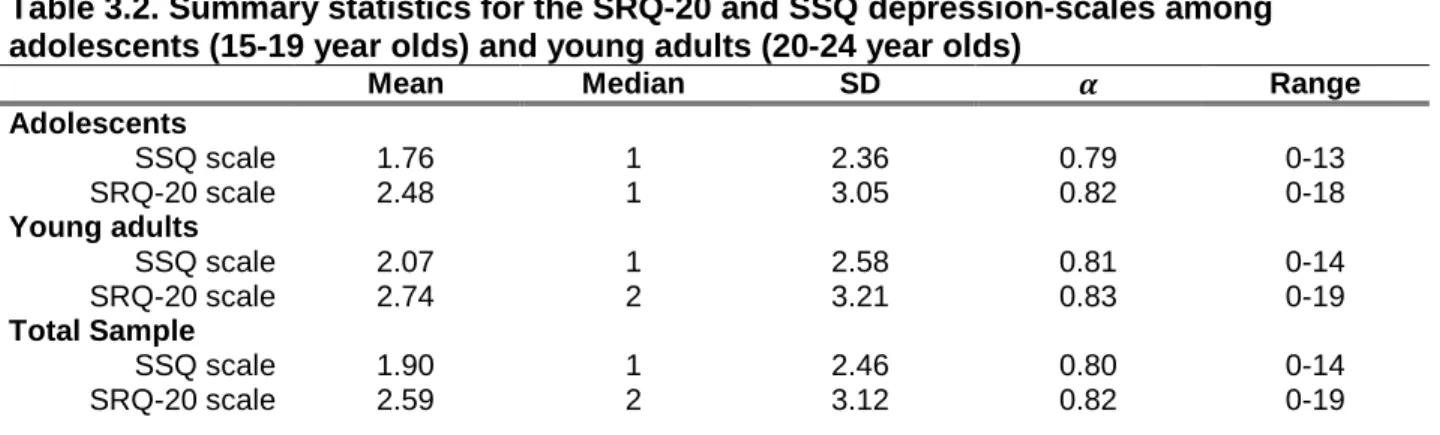
(15-19 year olds) and young adults (20-24 year olds)……….………….76 Table 3.3. Summary statistics of key variables among adolescents
(15-19 year olds) and young adults (20-24 year olds)…………....………...…..….77 Table 3.4. Comparison of proportions of adolescents (15-19) and young
adults (20-24) with depression by socio-demographic
characteristic based on the SRQ-20 and SSQ scales: Bivariate
analysis………...…..…78 Table 3.5. Comparison of depression classification using the SRQ-20 and
SSQ scales………...79 Table 3.6. Performance indices for the SSQ against the SRQ-20, stratified
by age group………...……….…..…..80 Table 3.7. Symptom profile based on depression status, stratified by age
group and depression scale………..……..……….………...81 Table 3.8. Parameter estimates (odds ratio) of being classified as a false
LIST OF FIGURES
Figure 1.1. Conceptual model of factors associated with early sexual debut………….…..……....3 Figure 1.2. Diagram main constructs of the Stress and Coping Theory…...…...…...………13 Figure 1.2. Map of Manicaland ZImbabwe………...………..……..……14 Figure 2.1. Kaplan Meier estimates for failure among females based on household
instability………...……..…..41 Figure 2.2 Kaplan Meier estimates for failure among females based on
depression………..………..………42 Figure 2.3 Kaplan Meier estimates for failure among males based on
LIST OF ABBREVIATIONS AIDS Acquired Immune Deficiency Syndrome
AUC Area under the curve
CIS-R Clinical Interview Schedule - Revised DIS Diagnostic Interviewer Schedule DHS Demographic Health Survey
DSM-IV Diagnostic and Statistical Manual of Mental Disorders 4th edition HIV Human Immune Deficiency Virus
HOH Head of household KM Kaplan Meier
NPV Negative predictive value PPV Positive predictive value PSE Present State Examination ROC Receiver operator curve SRQ-20 Self-reported Questionnaire 20 SSA Sub-Saharan Africa
CHAPTER 1
INTRODUCTION
INTRODUCTION
The adolescent period (defined by the World Health Organization (WHO) as ages 10-19) is one of rapid growth and development- physical, mental, emotional, sexual, and social(1). There is a wide range of changes experienced during this time including hormonal changes and maturation, academic progression, increasing responsibilities within the home, and acquisition of new roles including romantic partnerships. Adolescents are beginning to learn that their behaviors have consequences, albeit at varying degrees. Many adolescents navigate this developmental stage with few problems, making the necessary adjustments and adaptations. Others do not. Adolescent maladjustment and instability are illuminated by two of the three leading causes of death among adolescents and young people in low and middle-income countries - HIV/AIDS and self-inflicted injury. Both are largely driven by behavioral choices and are completely preventable through 1.) early identification of those most at-risk and 2.) skill development to support healthy coping and maturation (2).
stratification of the adolescent sample will also allow us to determine how these key variables affect girls and boys sexual behaviors differently. Chapter three will assess the performance of the Shona Symptom Questionnaire (SSQ) – a depression screening tool - to determine if it is effectively capturing depression among Zimbabwean adolescents (15-19 years olds) and young adults (20-24 years old). It will also evaluate how key sociodemographic measures are
associated with being incorrectly classified as not depressed among this population. Chapter four concludes with programmatic recommendations and policy implications for future
adolescent health research based on findings from these analyses. SPECIFIC AIMS
Study one
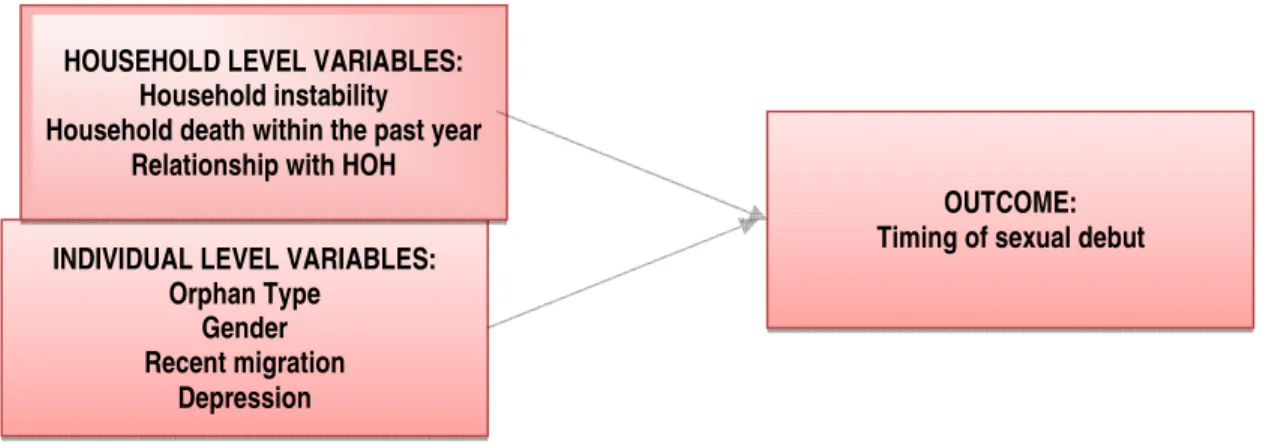
The conceptual model guiding study one is presented in Figure 1.1.
Aim 1: To describe and test for household level characteristics associated with the
timing of sexual debut among a sample of 15-19 year olds living in Zimbabwe.
Hypothesis 1.1 Adolescents living in greater levels of household instability will sexually debut at
earlier ages than adolescents living in lower levels of household instability.
Hypothesis 1.2 Adolescents living in households with a recent household death will sexually
debut at earlier ages than adolescents living in a household without a recent household death. Hypothesis 1.3 Adolescents living in a non-parent headed household will sexually debut at
earlier ages than adolescents living in a parent-headed household.
Aim 2: To describe and test for individual level characteristics associated with the timing
of sexual debut among a sample of 15-19 year olds living in Zimbabwe.
Hypothesis 2.1 Orphans will sexually debut at earlier ages than non-orphans.
Hypothesis 2.2 Adolescents who have recently migrated will sexually debut at earlier ages than
adolescents who have not recently migrated.
Hypothesis 2.3 Adolescents classified as depressed based on the WHO Self-Reported
Aim 3: To assess how the timing and pattern of sexual debut differs between adolescent
girls and boys in Zimbabwe.
Hypothesis 3.1 Girls will sexually debut at earlier ages than boys.
Hypothesis 3.2 Girls experiencing any of the key household and individual variables will sexually
debut at earlier ages than girls not experiencing any of the household or individual variables.
Figure 1.1. Conceptual Model for Aims 1-3
Study two
Aim 4: To assess the performance of the SSQ scale using SRQ-20 as the gold
standard/criteria for defining depression among adolescents (15-19 year olds) and youth
(20-24 year olds) in Zimbabwe and explore differences based on gender.
Hypothesis 4.1 The cut point for the SSQ will need to be refined to a lower level from its
traditional cut point of eight or more positive responses out of 14 questions in order to improve the performance indices including the specificity, sensitivity, kappa value, and AUC score. Hypothesis 4.2 The performance indices will provide evidence that revised cut points should be
the same for both genders across both age groups.
Aim 5: To explore the influence of sociodemographic factors associated with being
misclassified as false negatives using the SSQ with a cut point of eight or greater OUTCOME:
Timing of sexual debut INDIVIDUAL LEVEL VARIABLES:
Orphan Type Gender Recent migration
Depression
HOUSEHOLD LEVEL VARIABLES: Household instability Household death within the past year
positive responses for adolescents and young adults.
Hypothesis 5.1 There will be systematic misclassification of depression based on key variables
using the SSQ compared to the SRQ-20 gold standard criteria among adolescents and young adults.
Aim 6: To explore the influence of sociodemographic factors associated with being
misclassified as false negatives using the SSQ with a modified cut point of five or greater
positive responses for adolescents.
Hypothesis 6.1 The systematic misclassification of adolescents will disappear using the revised
SSQ cut point. BACKGROUND
High-risk behaviors are common among adolescents, particularly those who are poorly adjusting to changes and evolving responsibilities. Desire for independence as well as
expansion of identity are natural stages in adolescent development. The pubertal period can heighten sensitivities to external influences and social factors, including family cohesion and peer networks, which can significantly influence decision-making processes including relationship formation and sexual exploration. Adolescents who are adjusting poorly to rapid changes may adopt maladaptive behaviors to cope with life and to cultivate feelings of control. Common maladaptive behaviors include heightened risk-taking behaviors – particularly early sexual debut. Delaying age of sexual initiation and helping adolescents healthily cope with the unique challenges of this developmental period will protect them against one of the greatest health threats of their generation in sub-Saharan Africa (SSA) – HIV infection.
has been shown to be associated with additional sexual risk-taking behaviors including poor condom utilization, high-risk partner selection, and sexual concurrency (5-9). This is primarily due to adolescents’ lack of knowledge about HIV prevention as well as their low self-efficacy in negotiating both sex and condom use (10,11). Delaying sexual debut can allow adolescents the necessary time they need to obtain important prevention knowledge and to develop essential skills to sustain abstinence and other manifestations of sexual responsibility.
Depression is common among adolescents who feel they are not integrating into their social context, who have experienced multiple or significant stressful events, or who experience high levels of ambiguity about their future (9,12-18). Depression rates have been estimated at 4-8% among adolescents globally with substantial increases over time (19). Adolescents with depression are at greater risk for self-harm, conduct disorders and delinquency, and high-risk behaviors such as substance use and early sexual debut (20-22). Some estimates suggest that early–onset depression has a 60–70% risk of continuing into adulthood (23). Depending on the severity, chronic depression can challenge one’s ability to maintain a job, support a family, and integrate fully into society. All of these downstream effects pose serious concerns as
adolescents transition into adulthood. This is significant given that nearly one fifth of the world’s inhabitants are adolescents (24).
Contextual factors are largely responsible for poor health outcomes among adolescents (9,13-17,25-34). As such, it is necessary to understand the social and environmental factors associated with risk taking behaviors during this turbulent period. Research has shown that adolescents around the world who live in a structured social environment with positive
The Zimbabwean context of instability
Adolescents in regions of the less developed world are at risk for developmental maladjustment due to the volatile social, political, economic, and health climate. Zimbabwe, in particular, is a country that has recently undergone a severe economic decline, with exorbitant levels of inflation and high rates of unemployment (60%) (35). The country has suffered an outpouring of skilled health workers that has significantly affected the population’s ability to obtain adequate health care, including access to necessary drugs. The erosion of the health care sector coupled with a rising poverty rate has caused a decline in many health indicators including malnutrition and communicable diseases (36). Increasing household dependency rates, political choices restructuring the agricultural sector, and drought have made food insecurity a reality for many families in Zimbabwe (37). As HIV rates slowly decline, Zimbabwe is still among the worst HIV/AIDS affected countries in SSA with 15% of the total population HIV positive. The country maintains a six percent HIV infection rate among 15-24 year olds. A gender-based risk disparity for HIV exists with adolescent females (15-24) almost twice as likely to be infected than adolescent males (15-24,32). Low national-level life expectancy rates
(males: 53; females: 55) due in large part to HIV-related deaths, leave many youth without one or both parents (38). Approximately 1.4 million orphans reside in Zimbabwe, almost 80% of whom have lost one or both parents due to AIDS (39,40).
distribution of wealth and high rates of unemployment, catapult households into poverty or add strain to households that are already poor.
Adolescents are often transferred to extended families in rural areas where child-rearing costs are lower (45-47). Both out-migration and in-country migration have transformed
traditional family structures and previous perceptions about who fulfills income-earning roles within households (48). Born from survival needs and intensifying household poverty, adolescents may be withdrawn from school to assume age-inappropriate roles such as
becoming income earners for their family or to be caregivers for ill family members (48-54). The ubiquitous household instabilities across Zimbabwe including both in and out migration, poverty, and survival responses give rise to uncertainty and aggravating feelings of insecurity among adolescents who need a connected, stable environment where they can thrive developmentally and avert risk taking and psychosocial distress.
Study one
Key household measures of instability
Social, economic, and epidemiological factors in SSA have continued to influence family stability.
Household instability
Relationship with head of household (HOH)
Cross-generational, extended, or foster families are common in Zimbabwe (46,50,63). US-based studies on this phenomenon have revealed that closer caregiver relationships create stable contexts that minimize adolescents’ risk taking that include seeking out alternative intimate relationships (32,64-66). Adolescents in regions heavily burdened by the HIV-epidemic who are taken in by extended family members are often treated differently from the caregiver’s biological children, especially when households were impoverished. Limited research in SSA suggests young people living with non-parental HoH reported poor caregiver-adolescent
relationships and demonstrated higher risk sexual behaviors than those living with intact
parent-headed households (51,67,68). Recent household death
Some studies in Kenya and Zimbabwe speculated that sexual activity serves as an
emotional outlet for adolescents coping with loss and subsequent hardships (21,69). A recent systematic review of risk and protective factors for adolescent reproductive health in developing countries found that the death of a parent was consistently associated with early sexual debut among adolescents in SSA (70). This is likely due to adolescents being faced with the reality of mortality, grief, feelings of uncertainty, and stress accumulation (13). Furthermore, caregivers within households with a recent death may experience high levels of stress due to caring for several dependents. This can cause emotional disconnection from adolescent household members during their grieving process. This is often seen among grandparents who suffer the loss of a child while being expected to contribute to both household productivity and childrearing (71).
Key individual measures
homestead in the past year (yes/no), and depression (yes/no) characterized by a positive
response to eight out of twenty questions on the Self Reported Questionnaire (SRQ-20). Gender
The gender gap among adolescents infected by HIV is severe with females representing
75% of the infections worldwide (3). Studies focused on examining HIV infection among southern African adolescents aged 15-24 found girls were between two and ten times more likely to be HIV positive than their male counterparts(72-75). Zimbabwe also has a gender-based risk disparity for HIV with adolescent females (15-24) experiencing infection rates almost twice that of adolescent males (15-24,32).
Orphanhood
Several studies have shown that the death of a mother or father broadly affects adolescent emotional and behavioral well-being (41,67,76,77). Bereaved adolescent orphans display elevated sexual risk taking (21). Studies suggest that orphans report early ages of sexual debut (7,34,53,69,78-80) and have a heightened risk for HIV (46,69,70,78,81). This paper will disentangle some of the mechanisms responsible for this association and will determine if they are unique to orphanhood or pervasive among all adolescents. Residential migration
Migration has been shown to have varying effects on adolescent sexual risk taking. Some studies suggest that it is the frequency and timing of the move that negatively impacts sexual risk taking and early sexual debut (82-84). Others suggest it is the reason for and type of migration (urban/rural) that is responsible for sexual risk taking (85). In highly mobile
frequent and important source of additional trauma (86). In addition, the serial loss of adult figures and caregivers such as parents, teachers, or mentors is likely to create a sense of insecurity or abandonment. Some studies suggest that early onset of intercourse may be a means of coping with the life changes such as migration or as a way to gain attention during difficult periods (82). Residential change can also include exposure to new ideas and social norms, which can increase negative peer influence regarding sex (87).
Depression
US-based studies of adolescents have documented that poor psychosocial well-being increases risky behaviors, including earlier sexual debut, higher numbers of lifetime sexual partners, concurrent partnerships, non-use of contraception, risky partner selection, and
transactional sex (32,33,88-94). Only minimal attention has been given to this association within the context of the HIV epidemic in SSA (21,69,83). In three studies among adolescents and young adults (ages 12-26) living in SSA, authors found a strong linear correlation between psychosocial distress and sexual risk, including but not limited to early sexual debut (20,69,83). Study two
Risk factors for depression
Depression has been shown to be a growing concern among adolescents living in SSA as the programmatic and research focus shifts from basic survival needs to broader aspects of psychosocial well-being. Depression is associated with a litany of poor health outcomes across the life span such as suicide, physical symptoms, behavioral problems, and a range of mental health disorders.
to be particularly challenging for adolescents who are uprooted from their existing social systems and placed in an environment ridden with new elements to which they are unaccustomed (12).
Adolescent depression in Zimbabwe
Understanding psychosocial distress among adolescents is particularly relevant in Zimbabwe, where the burden of disease linked with depression is likely severe given its catastrophic economic and political situation, weakened healthcare infrastructure, chronic and widespread poverty, and reverberating effects of the HIV epidemic. Adolescents living in HIV-affected communities are often faced with multiple experiences of loss and hardship
(8,47,76,100). In addition to the contextual and social effects of HIV, the threat of becoming infected can be a significant source of anxiety, depression, and hopelessness among
adolescents and young adults, who are becoming infected with the disease at faster rates than any other age group (4,101). Long-term stress accumulation coupled with their unique
developmental stage positions adolescents at risk for affective disorders including depression. Selecting an appropriate depression screening tool
To date studies have utilized a litany of different scales to assess measures of emotional well-being, with each scale varying in their level of reliability and validation for the unique sub-population of adolescents (83,102,103). This inconsistency makes comparability across populations and settings a challenge. This dissertation addresses this gap by comparing two depression scales previously used in Zimbabwe – the 20-item World Health Organization (WHO) Self-Reporting Questionnaire (SRQ-20) and the 14-item Shone Symptom Questionnaire (SSQ) to determine how suitable these scales are for Zimbabwean adolescents (104-106).
into appropriately measuring the psychosocial health of this population. By obtaining a more complete understanding of the most commonly used depression screening tools and the risk characteristics for misclassification among this age group, we will be better equipped to develop interventions and refine existing psychosocial services for vulnerable adolescents by addressing the individual and contextual circumstances that contribute to long-term depression and by protecting against subsequent maladjustment behaviors.
THEORETICAL FRAMEWORK
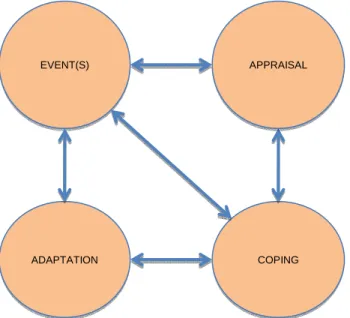
This study draws from Lazarus and Folkman’s theory of stress and coping and Cohen and Willis’s concept of social support as a stress buffer (107,108). The model suggests stress and coping are bidirectional and arise during an individual’s interaction with his/her contextual environment. Contextual and situational factors that define the predictability or normality of an event will either facilitate or restrain an individual’s coping ability. Events that are perceived as highly severe cause adolescents to feel helpless, vulnerable, and unstable. Figure 1.2 outlines the interrelatedness of the main constructs from this framework.
Figure 1.2. Diagram of Main Constructs of the Stress and Coping Theory EVENT(S)
ADAPTATION COPING
The model posits that a factor such as the loss of a parent, family turbulence and instability, or migration can lead to acute and chronic stress among adolescents. Compounding events such as school discontinuation, household composition changes or death in the home, and increased poverty are likely to decrease adolescents’ feeling of control over an event(s), requiring increased efforts of personal coping in order to maintain a sense of internal and external equilibrium. Due to the incomplete psychological development of an adolescent, it is unlikely that he or she will be prepared to deal with severe life-changing events. It is expected that many adolescents will adopt maladaptive coping mechanisms such as early sexual debut and depression. If an adolescent feels that s/he is in a stable and supportive household, the more likely s/he will be able to effectively cope with life’s challenges and avert risk-taking
behaviors such as early sexual debut (109). METHODS
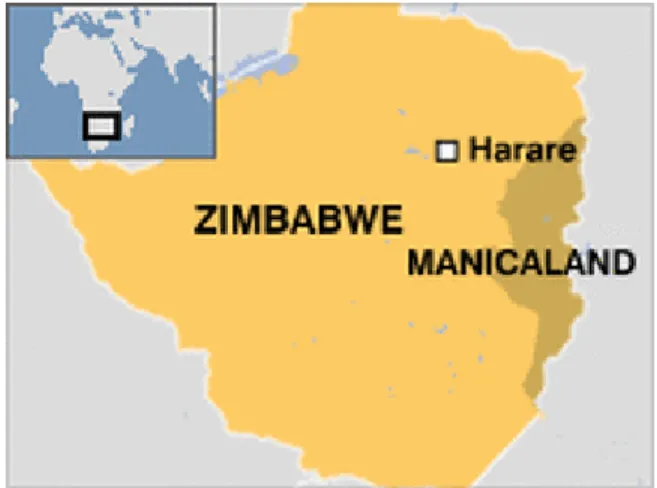
Figure 1.3. Map of Manicaland, Zimbabwe
Study Sample.
Two adolescent health outcomes were studied: timing of sexual debut and depression. The dataset used to assess the timing of sexual debut included 2,374 non-married adolescents (15-19 years old) across 1,986 households who had a complete data on the outcome and each of the key variables and covariates. The dataset for depression included a sample of 2,768 adolescents (15-19 years old) and 2,027 young adults (20-24 years old) who report complete data on both depression-screening items. For analysis of characteristics associated with a false negative depression score, the sample was reduced to 2,715 adolescents and 1,954 young adults due to missing data on key predictor variables.
Statistical analysis.
Methods utilized for both outcomes are defined below and within Chapters two and three.
Study one
variables. Multivariate cox regression was employed using STATA version 12 with the goal of finding the best fitting model to describe the relationship between the timing of sexual debut and the set of independent explanatory variables (110). The sample was stratified by gender to disentangle the differential effects of the key variables on the timing if sexual debut for boys and girls. Findings were reported as hazard rates (HR) accompanied by 95% confidence intervals (CI).
In some cases, multiple adolescents resided within the same household, violating the assumption of independence of error and homogeneity of slopes found in ordinary regression models. This violation results in autocorrelation, subsequently biasing the estimates of the true effect of the independent variables on the outcomes of interest. In order to correct for this, the vce command was used in STATA in order to cluster at the household level. This allowed us to provide accurate and efficient estimates on the extent by which the outcome varied across households.
Study two
Study two assessed the correlation between the two depression scales, stratified by age groups (15-19 years old; 20-24 years old) in order to determine how strongly the scales as a
whole related to one another. The SSQ was calibrated against the SRQ-20 to examine the performance indices of the SSQ based on various cut points for classification using the SRQ-20 as the criterion measure. A multivariate logistic regression model was implemented using the key sociodemographic variables to test their association with the odds of being misclassified as non-depressed based on 1.) the conventional SSQ cut point of eight or greater positive
responses and 2.) a modified cut point of five or greater positive responses to the 14 question scale.
CONCLUSION
productive members of society. Often individual behavior change programs overlook the contextual dilemmas that may perpetuate risk. For many years, adolescent-targeted prevention efforts largely focused on health education approaches. There is now increasing interest in
REFERENCES
(1) World Health Organization. Adolescent Development. 2014; Available at:
http://www.who.int/maternal_child_adolescent/topics/adolescence/dev/en/. Accessed February 11, 2014.
(2) Patton GC, Coffey C, Sawyer SM, Viner RM, Haller DM, Bose K, et al. Global patterns of mortality in young people: a systematic analysis of population health data. Lancet 2009 Sep 12;374(9693):881-892.
(3) UNAIDS. 2010 Report on the Global AIDS Epidemic. 2010. (4) UNFPA. State of World Population. 2004.
(5) Pettifor AE, van der Straten A, Dunbar MS, Shiboski SC, Padian NS. Early age of first sex: a risk factor for HIV infection among women in Zimbabwe. AIDS 2004 Jul 2;18(10):1435-1442. (6) Palermo T, Peterman A. Are female orphans at risk for early marriage, early sexual debut, and teen pregnancy? Evidence from sub-Saharan Africa. Stud Fam Plann 2009 Jun;40(2):101-112.
(7) Nyirenda M, McGrath N, Newell ML. Gender differentials in the impact of parental death: Adolescent's sexual behaviour and risk of HIV infection in rural South Africa. Vulnerable Child Youth Stud 2010 Sep;5(3):284-296.
(8) Akwara PA, Noubary B, Lim Ah Ken P, Johnson K, Yates R, Winfrey W, et al. Who is the vulnerable child? Using survey data to identify children at risk in the era of HIV and AIDS. AIDS Care 2010 Sep;22(9):1066-1085.
(9) Mkandawire P, Tenkorang E, Luginaah IN. Orphan Status and Time to First Sex Among Adolescents in Northern Malawi. AIDS Behav 2012 Jan 6.
(10) Wingood GM, Reddy P, Lang DL, Saleh-Onoya D, Braxton N, Sifunda S, et al. Efficacy of SISTA South Africa on sexual behavior and relationship control among isiXhosa women in South Africa: results of a randomized-controlled trial. J Acquir Immune Defic Syndr 2013 Jun 1;63 Suppl 1:S59-65.
(11) Hendriksen ES, Pettifor A, Lee SJ, Coates TJ, Rees HV. Predictors of condom use among young adults in South Africa: the Reproductive Health and HIV Research Unit National Youth Survey. Am J Public Health 2007 Jul;97(7):1241-1248.
(12) Richter, L., Foster, G. and Sherr, L. Where the heart is: Meeting the psychosocial needs of young children in the context of HIV/AIDS. 2006.
(13) Kaggwa EB, Hindin MJ. The psychological effect of orphanhood in a matured HIV
(14) Skovdal M, Ogutu VO, Aoro C, Campbell C. Young carers as social actors: coping
strategies of children caring for ailing or ageing guardians in Western Kenya. Soc Sci Med 2009 Aug;69(4):587-595.
(15) Mueller SC, Hardin MG, Korelitz K, Daniele T, Bemis J, Dozier M, et al. Incentive effect on inhibitory control in adolescents with early-life stress: an antisaccade study. Child Abuse Negl 2012 Mar;36(3):217-225.
(16) Onuoha FN, Munakata T. Inverse association of natural mentoring relationship with distress mental health in children orphaned by AIDS. BMC Psychiatry 2010 Jan 16;10:6.
(17) Killian B, Durrheim K. Psychological Distress in Orphan, Vulnerable Children and Non-Vulnerable Children in High Prevalence HIV/AIDS Communities. Journal of Psychology in Africa 2008;18(3):421-429.
(18) Stoddard SA, Henly SJ, Sieving RE, Bolland J. Social connections, trajectories of hopelessness, and serious violence in impoverished urban youth. J Youth Adolesc 2011 Mar;40(3):278-295.
(19) Sabate E. Depression on Young People and the Elderly. 2004.
(20) Nduna M, Jewkes RK, Dunkle KL, Shai NP, Colman I. Associations between depressive symptoms, sexual behaviour and relationship characteristics: a prospective cohort study of young women and men in the Eastern Cape, South Africa. J Int AIDS Soc 2010 Nov 15;13:44. (21) Puffer ES, Drabkin AS, Stashko AL, Broverman SA, Ogwang-Odhiambo RA, Sikkema KJ. Orphan Status, HIV Risk Behavior, and Mental Health Among Adolescents in Rural Kenya. J Pediatr Psychol 2012 Sep;37(8):868-878.
(22) Birmaher B, Ryan ND, Williamson DE, Brent DA, Kaufman J. Childhood and adolescent depression: a review of the past 10 years. Part II. J Am Acad Child Adolesc Psychiatry 1996 Dec;35(12):1575-1583.
(23) Weller EB, Weller RA. Depression in adolescents growing pains or true morbidity? J Affect Disord 2000 Dec;61 Suppl 1:9-13.
(24) Department of Child and Adolescent Health and Development, World Health Organization. Broadening the horizon: Balancing protection and risk for adolescents. 2002.
(25) Bhargava V. Adoption in India: Policies and Experiences. New Delhi, India: Sage Publications; 2005.
(26) Cluver L, Bowes L, Gardner F. Risk and protective factors for bullying victimization among AIDS-affected and vulnerable children in South Africa. Child Abuse Negl 2010 Oct;34(10):793-803.
(28) Makame V, Ani C, Grantham-McGregor S. Psychological well-being of orphans in Dar El Salaam, Tanzania. Acta Paediatr 2002;91(4):459-465.
(29) Baptiste D, Tolous- Sham M, Miller, S., McBride, C., McKay M, Paikoff R. Predictors of parental monitoring and sexual risk taking among urban African American youth. Journal of Child and Family Studies 2007;16:261-274.
(30) Bhana A, McKay MM, Mellins C, Petersen I, Bell C. Family-based HIV prevention and intervention services for youth living in poverty-affected contexts: the CHAMP model of collaborative, evidence-informed programme development. J Int AIDS Soc 2010 Jun 23;13 Suppl 2:S8.
(31) McBride CK, Paikoff RL, Holmbeck GN. Individual and familial influences on the onset of sexual intercourse among urban African American adolescents. J Consult Clin Psychol 2003 Feb;71(1):159-167.
(32) DiClemente RJ, Crittenden CP, Rose E, Sales JM, Wingood GM, Crosby RA, et al. Psychosocial predictors of HIV-associated sexual behaviors and the efficacy of prevention interventions in adolescents at-risk for HIV infection: what works and what doesn't work? Psychosom Med 2008 Jun;70(5):598-605.
(33) Paxton KC, Robinson WL. Depressive symptoms, gender, and sexual risk behavior among African-American adolescents: implications for prevention and intervention. J Prev Interv
Community 2008;35(2):49-62.
(34) Cluver L, Gardner F, Operario D. Psychological distress amongst AIDS-orphaned children in urban South Africa. J Child Psychol Psychiatry 2007 Aug;48(8):755-763.
(35) Kawewe, S. M., & Dibie, R. The impact of economic structural adjustment (ESAP) on women and children: Implications for social welfare in Zimbabwe. Journal of Sociology and Social Welfare 2002;27(4):79-486.
(36) Osika, J., Altman, D., Ekbladh, L., Katz, I., Nguyen, H., Rosenfeld, J., Williamson, T., Tapera, S. Zimbabwe Health System Assessment November 2010.
(37) Gwatirisa P, Manderson L. "Living from day to day": food insecurity, complexity, and coping in muTare, Zimbabwe. Ecol Food Nutr 2012;51(2):97-113.
(38) World Health Organization. Global Health Observatory Data Repository: WHO African Region: Zimbabwe statistics summary (2002 - present). 2013; Available at:
http://apps.who.int/gho/data/node.country.country-ZWE. Accessed February 11, 2014.
(39) UNICEF & UNAIDS. Africa's Orphaned and Vulnerable Generations: Children Affected by AIDS. 2006.
(40) 2008 Report on the global AIDS epidemic. 2008.
(42) Urassa M, Boerma T, Ng'weshmia J, Isingoc R, Schapinka D, Kumogolad Y. Orphanhood, child fostering and the AIDS epidemic in rural Tanzania*. Health Transition Review 1997;volume 7(supplement 2):141-153.
(43) Howard BH, Phillips CV, Matinhure N, Goodman KJ, McCurdy SA, Johnson CA. Barriers and incentives to orphan care in a time of AIDS and economic crisis: a cross-sectional survey of caregivers in rural Zimbabwe. BMC Public Health 2006 Feb 9;6:27.
(44) Kuo C, Operario D, Cluver L. Depression among carers of AIDS-orphaned and other-orphaned children in Umlazi Township, South Africa. Glob Public Health 2012;7(3):253-269. (45) Ntozi JP, Mukiza-Gapere J. Care for AIDS orphans in Uganda: findings from focus group discussions. Health Transit Rev 1995;5 Suppl:245-252.
(46) Foster G, Shakespeare R, Chinemana F, Jackson H, Gregson S, Marange C, et al. Orphan prevalence and extended family care in a peri-urban community in Zimbabwe. AIDS Care 1995;7(1):3-17.
(47) Ansell N, Young L. Enabling households to support successful migration of AIDS orphans in southern Africa. AIDS Care 2004 Jan;16(1):3-10.
(48) P. O. Oburu. Social Adjustment of Kenyan Orphaned Grandchildren, Perceived Caregiving Stresses and Discipline Strategies used by their Fostering Grandmothers. Department of Psychology, Göteborg University, Sweden: Department of Psychology, Göteborg University; 2004.
(49) Heymann J, Kidman R. HIV/AIDS, declining family resources and the community safety net. AIDS Care 2009;21 Suppl 1:34-42.
(50) Heymann J, Earle A, Rajaraman D, Miller C, Bogen K. Extended family caring for children orphaned by AIDS: balancing essential work and caregiving in a high HIV prevalence nations. AIDS Care 2007 Mar;19(3):337-345.
(51) Nyambedha EO, Wandibba S, Aagaard-Hansen J. Changing patterns of orphan care due to the HIV epidemic in western Kenya. Soc Sci Med 2003 Jul;57(2):301-311.
(52) Abebe T, Skovdal M. Livelihoods, care and the familial relations of orphans in eastern Africa. AIDS Care 2010 May;22(5):570-576.
(53) Cluver L, Gardner F, Operario D. Poverty and psychological health among AIDS-orphaned children in Cape Town, South Africa. AIDS Care 2009 Jun;21(6):732-741.
(54) Andrews G, Skinner D, Zuma K. Epidemiology of health and vulnerability among children orphaned and made vulnerable by HIV/AIDS in sub-Saharan Africa. AIDS Care 2006
Apr;18(3):269-276.
(56) Wu L. Effects of Family Instability, Income, and Income Instability on the Risk of a Premarital Birth. 1996 American Sociological Review;16:386-406.
(57) Cynthia Osborne C, McLanahan S. Partnership Instability and Child Well-Being. Journal of Marriage and Family 2007;69(4):1065-1083.
(58) Miller BC, Benson B. Family Relationships and Adolescent Pregnancy Risk: A Research Synthesis. Developmental Review 2001;21:1-38.
(59) Duryea S, Lam D, Levison D. Effects of Economic Shocks on Children's Employment and Schooling in Brazil. J Dev Econ 2007 Sep;84(1):188-214.
(60) Wu T, Thomson E. Race Differences in Family Experience and Early Sexual Initiation: Dynamic Models of Family Structure and Family Change. Journal of Marriage and Family 2001;63(3):682-696.
(61) Dimbuene ZT, Defo BK. Timing of Premarital Intercourse in Bandjoun (West Cameroon) Does Family Environment Matter? SAGE Open 2013 January-March:1-15.
(62) Goldberg R. Family Instability and Sexual Debut in Western Kenya. 2010 Paper presented at the Annual Meetings of the American Sociological Society, Atlanta.
(63) Littrell M, Boris NW, Brown L, Hill M, Macintyre K. The influence of orphan care and other household shocks on health status over time: a longitudinal study of children's caregivers in rural Malawi. AIDS Care 2011 Dec;23(12):1551-1561.
(64) Han WJ, Miller DP, Waldfogel J. Parental work schedules and adolescent risky behaviors. Dev Psychol 2010 Sep;46(5):1245-1267.
(65) Nappi CM, Thakral C, Kapungu C, Donenberg GR, DiClemente R, Brown L, et al. Parental monitoring as a moderator of the effect of family sexual communication on sexual risk behavior among adolescents in psychiatric care. AIDS Behav 2009 Oct;13(5):1012-1020.
(66) Babalola S, Tambashe BO, & Vondrasek C. Parental factors and sexual risk-taking among young people in Côte d’Ivoire. . African Journal of Reproductive Health 2005;9:49-65.
(67) Case A, Paxson C, Ableidinger J. Orphans in Africa: parental death, poverty, and school enrollment. Demography 2004 Aug;41(3):483-508.
(68) Rwenge M. Sexual Risk Behaviors Among Young People In Bamenda, Cameroon. International Family Planning Perspectives 2000;26(3):118-130.
(69) Nyamukapa CA, Gregson S, Lopman B, Saito S, Watts HJ, Monasch R, et al.
HIV-associated orphanhood and children's psychosocial distress: theoretical framework tested with data from Zimbabwe. Am J Public Health 2008 Jan;98(1):133-141.
(71) Bock J, Johnson SE. Grandmothers' productivity and the HIV/AIDS pandemic in sub-Saharan Africa. J Cross Cult Gerontol 2008 Jun;23(2):131-145.
(72) Campbell C, Foulis CA, Maimane S, Sibiya Z. The impact of social environments on the effectiveness of youth HIV prevention: a South African case study. AIDS Care 2005
May;17(4):471-478.
(73) Luke N. Age and economic asymmetries in the sexual relationships of adolescent girls in sub-Saharan Africa. Stud Fam Plann 2003 Jun;34(2):67-86.
(74) Pronyk PM, Harpham T, Morison LA, Hargreaves JR, Kim JC, Phetla G, et al. Is social capital associated with HIV risk in rural South Africa? Soc Sci Med 2008 May;66(9):1999-2010. (75) Hargreaves JR, Morison LA, Kim JC, Busza J, Phetla G, Porter JD, et al. Characteristics of sexual partnerships, not just of individuals, are associated with condom use and recent HIV infection in rural South Africa. AIDS Care 2009 Aug;21(8):1058-1070.
(76) Nyamukapa CA, Foster, G.' & Gregson, S. Orphans’ household circumstances and access to education in a maturing HIV epidemic in eastern Zimbabwe. Journal of Social Development in Africa 2003 July 2003;18(2):7-7-32.
(77) Bicego G, Rutstein S, Johnson K. Dimensions of the emerging orphan crisis in sub-Saharan Africa. Soc Sci Med 2003 Mar;56(6):1235-1247.
(78) Kang M, Dunbar M, Laver S, Padian N. Maternal versus paternal orphans and HIV/STI risk among adolescent girls in Zimbabwe. AIDS Care 2008 Feb;20(2):214-217.
(79) Thurman TR, Brown L, Richter L, Maharaj P, Magnani R. Sexual risk behavior among South African adolescents: is orphan status a factor? AIDS Behav 2006 Nov;10(6):627-635. (80) Operario D, Pettifor A, Cluver L, MacPhail C, Rees H. Prevalence of parental death among young people in South Africa and risk for HIV infection. J Acquir Immune Defic Syndr 2007 Jan 1;44(1):93-98.
(81) Birdthistle I, Floyd S, Nyagadza A, Mudziwapasi N, Gregson S, Glynn JR. Is education the link between orphanhood and HIV/HSV-2 risk among female adolescents in urban Zimbabwe? Soc Sci Med 2009 May;68(10):1810-1818.
(82) Baumer EP, and South S. Community Effects on Youth Sexual Activity. Journal of Marriage and Family 2001;63:540-554.
(83) Langhaug LF, Pascoe SJ, Mavhu W, Woelk G, Sherr L, Hayes RJ, et al. High prevalence of affective disorders among adolescents living in Rural Zimbabwe. J Community Health 2010 Aug;35(4):355-364.
(85) Sambisa W, Stokes SC. Rural/Urban Residence, Migration, HIV/AIDS, and Safe Sex Practices among Men in Zimbabwe. 2006 Rural Sociology Volume 71, Issue 2, pages 183–211, June 2006;71(2):182-211.
(86) USAID/Zambia Displaced Children and Orphans Fund. Results of the Orphans and Vulnerable Children Head of Household Baseline Survey in Four Districts in Zambia 2002 October 2002.
(87) Brockerhoff M, Biddlecom AE. Migration, Sexual Behavior and the Risk of HIV in Kenya. International Migration Review 1999;33(4):833-856.
(88) Malow RM, Rosenberg R, Donenberg G, Devieux JG. Interventions and Patterns of Risk in Adolescent HIV/AIDS Prevention. Am J Infect Dis 2006;2(2):80-89.
(89) DiClemente RJ, Wingood GM, Crosby RA, Sionean C, Brown LK, Rothbaum B, et al. A prospective study of psychological distress and sexual risk behavior among black adolescent females. Pediatrics 2001 Nov;108(5):E85.
(90) Jessor R. Risk behavior in adolescence: a psychosocial framework for understanding and action. J Adolesc Health 1991 Dec;12(8):597-605.
(91) Jewkes RK, Dunkle K, Nduna M, Jama PN, Puren A. Associations between childhood adversity and depression, substance abuse and HIV and HSV2 incident infections in rural South African youth. Child Abuse Negl 2010 Nov;34(11):833-841.
(92) Mazzaferro KE, Murray PJ, Ness RB, Bass DC, Tyus N, Cook RL. Depression, stress, and social support as predictors of high-risk sexual behaviors and STIs in young women. J Adolesc Health 2006 Oct;39(4):601-603.
(93) Seth P, Raiji PT, DiClemente RJ, Wingood GM, Rose E. Psychological distress as a
correlate of a biologically confirmed STI, risky sexual practices, self-efficacy and communication with male sex partners in African-American female adolescents. Psychol Health Med 2009 May;14(3):291-300.
(94) Ramrakha S, Caspi A, Dickson N, Moffitt TE, Paul C. Psychiatric disorders and risky sexual behaviour in young adulthood: cross sectional study in birth cohort. BMJ 2000 Jul
29;321(7256):263-266.
(95) Cluver LD, Orkin M, Gardner F, Boyes ME. Persisting mental health problems among AIDS-orphaned children in South Africa. J Child Psychol Psychiatry 2011 Aug 30.
(96) Pelton J, Forehand R. Orphans of the AIDS epidemic: an examination of clinical level problems of children. J Am Acad Child Adolesc Psychiatry 2005 Jun;44(6):585-591.
(97) Atwine B, Cantor-Graae E, Bajunirwe F. Psychological distress among AIDS orphans in rural Uganda. Soc Sci Med 2005 Aug;61(3):555-564.
(99) Cluver LD, Orkin M, Gardner F, Boyes ME. Persisting mental health problems among AIDS-orphaned children in South Africa. J Child Psychol Psychiatry 2012 Apr;53(4):363-370. (100) Heuveline P. Impact of the HIV epidemic on population and household structure: the dynamics and evidence to date. AIDS 2004 Jun;18 Suppl 2:S45-53.
(101) Patel V, Flisher AJ, Hetrick S, McGorry P. Mental health of young people: a global public-health challenge. Lancet 2007 Apr 14;369(9569):1302-1313.
(102) Mavhu W, Berwick J, Chirawu P, Makamba M, Copas A, Dirawo J, et al. Enhancing psychosocial support for HIV positive adolescents in Harare, Zimbabwe. PLoS One 2013 Jul 23;8(7):e70254.
(103) Chi P, Li X. Impact of Parental HIV/AIDS on Children's Psychological Well-Being: A Systematic Review of Global Literature. AIDS Behav 2012 Sep 13.
(104) Patel V, Simunyu E, Gwanzura F, Lewis G, Mann A. The Shona Symptom Questionnaire: the development of an indigenous measure of common mental disorders in Harare. Acta
Psychiatr Scand 1997 Jun;95(6):469-475.
(105) World Health Organization. A user's guide the Self-Reporting Questionnaire (SRQ-20). 1994.
(106) Harding TW, de Arango MV, Baltazar J, Climent CE, Ibrahim HH, Ladrido-Ignacio L, et al. Mental disorders in primary health care: a study of their frequency and diagnosis in four
developing countries. Psychol Med 1980 May;10(2):231-241.
(107) Lazarus, R., & Folkman, S. Stress, appraisal, and coping. New York: Springer; 1984. (108) Cohen S, Wills TA. Stress, social support, and the buffering hypothesis. Psychol Bull 1985 Sep;98(2):310-357.
(109) Cooper ML, Shapiro CM, Powers AM. Motivations for sex and risky sexual behavior among adolescents and young adults: a functional perspective. J Pers Soc Psychol 1998 Dec;75(6):1528-1558.
CHAPTER 2
THE ROLE OF HOUSEHOLD AND INDIVIDUAL INSTABILITY ON THE TIMING OF SEXUAL DEBUT AMONG ZIMBABWEAN ADOLESCENTS
INTRODUCTION
Early sexual debut (i.e., vaginal intercourse) during adolescence leads to a wide range of adverse outcomes in sub-Saharan Africa (SSA), including unintended pregnancies, unsafe abortions, sexually transmitted infections (STIs), and HIV/AIDS (1-5). Everyday, more than 6,000 young people between 15 and 24 years of age are infected with HIV (6). Youth in SSA are hardest hit by the epidemic, experiencing some of the highest rates of HIV in the world. Over half of all new HIV infections occurring worldwide are among adolescents and young adults in this region (7). As such, early sexual debut remains a serious public health issue (8). This study intends to contribute to the literature by exploring household and individual stability measures thought to contribute to sexual debut among adolescents living in Zimbabwe. The 2010 Demographic Health Survey (DHS) reported a mean age of first sex of 18.9 among girls and 20.6 among boys (9). Therefore for the purposes of this paper we identified early sexual debut as having initiated sex at or before the age of 19.
Theoretical framework
This study draws from Lazarus and Folkman’s (1984) theory of stress and coping and Cohen and Willis’s (1985) concept of social support as a stress buffer (10,11). The model suggests stress and coping are bidirectional and arise during an individual’s interaction with his/her contextual environment. Contextual and situational factors that define the predictability or
household composition. Events that adolescents perceive as highly severe can cause feelings of being helpless, vulnerable, and unstable. Social support is thought to provide necessary resources (emotional, informational, or physical) to bolster one’s ability to handle the stressful event (10-11).
The model posits that an event such as the loss of a parent, family turbulence and instability, or migration can lead to acute and chronic stress among adolescents. Compounding events such as school discontinuation, household composition changes or death in the home, and increased poverty are likely to decrease adolescents’ feeling of control over the event(s), requiring increased efforts of personal coping in order to maintain a sense of internal and external equilibrium. Due to the incomplete psychological development of an adolescent, it is unlikely that he or she will be prepared to deal with severe life changing events such as a household death. It is expected that many adolescents will adopt negative coping mechanisms such as denial, avoidance, and behavior misconduct. Early sexual debut, our outcome of interest, is a likely maladaptive bi-product for individuals who have not developed positive coping techniques. We postulate that the presence of one or a combination of these household-level characteristics will negatively impact adolescents’ abilities to cope with stress both in and out of their home environment. Alternatively, the presence of stability and household support will bolster their coping abilities and lessen their reliance on maladaptive and risky behaviors. The more integrated an adolescent is within his/her household, the more likely s/he will be able to effectively cope with life’s challenges and avert risk taking behaviors such as early sexual debut (12).
Household-level risk factors
sexual behavior, household-level factors have been relatively neglected. This paper will
examine how three household-level characteristics (household instability, relationship with head of household, and recent household death) relate to adolescent sexual risk.
Household instability
Family structure influences the development of relationships with household members. Changes in household membership are common in Africa where individuals move to obtain employment, marry, attend school, provide support to families in need, or as a result of family dissolution following the death of a household head. Shifts in household membership can increase adolescents’ stress as they adjust to new routines, situations, relationships, and responsibilities (16). There is a litany of research exploring the effect of household composition on sexual risk of adolescents within the US, mostly pertaining to divorce, remarriage, and changes in the formation and termination of cohabiting relationships (17-19). Findings from these studies suggest that individuals from intact families fare better than those from disrupted families (20). Furthermore, research has shown that multiple changes in family structure have greater negative effects on a child’s well-being (i.e. behavioral, emotional, and cognitive outcomes) compared to a single change or no changes at all (17,21).
In a recent study in Cameroon Dimbuene and Defo found that youth (ages 12-24) were 31% more likely to have premarital sex if they had experienced a change in family configuration during pre-adolescence (22). Using life history calendars, Goldberg found that Kenyan
adolescents who had changes in their primary caregiver were more likely to initiate sex early (<18 years of age) (23). This correlation was weaker if the caregiver dissolution occurred at younger ages. This paper will build from these findings to assess how household membership stability affects adolescent sexual behaviors in Zimbabwe where the population is highly mobile. It is expected that Zimbabwean youth with a large proportion of household membership
Relationship with Head of Household (HoH)
Many youth throughout Zimbabwe, orphans and non-orphans alike, live with cross-generational, extended, or foster families (24-26). Studies reveal that young people living with non-parental HoH demonstrate riskier sexual behaviors than those who live with parents. The more distantly related the child is with the HoH the stronger this association (22,27-30). US-based studies on this phenomena have revealed that closer caregiver relationships, including higher levels of perceived support, create stable family contexts that minimize adolescents’ risk taking that includes seeking out alternative intimate relationships from peers or unrelated adults (15,31-33).
Studies indicate that non-parent caregivers provide inadequate levels of guidance and communication about sex to non-biological children (20,34,35). Inadequate sex education can result in both low levels of knowledge about sexual risks and poor self-efficacy involving sexual decisions. A study by Rwenga et al. among a sample of Cameroon adolescents corroborates this hypothesis. Researchers found that youth who lived with only one parent, a distant relative, or non-relative caregiver were 1.6 times more likely than those in two-parent households to be sexually active (30). We expect based on these findings that Zimbabwean adolescents living in households with non-related or distantly related caregivers will sexual debut at younger ages. Recent household member death
Adolescents living in a household with a chronically ill member are faced with the reality of mortality, grief, feelings of uncertainty, and stress accumulation due to greater household responsibilities and potentially age-inappropriate care-taking duties (39). A study among South African youth found that girls living in a household with an HIV positive sick member in the past 12 months were significantly more likely to see themselves at risk of contracting HIV than those who did not live with a sick member (40). Opposing results were found in a study utilizing Kenyan Demographic and Health Surveys (KDHS) whereby adolescents ages 15-17 living with an HIV-infected household member had a 60% increased odds of initiating sex (41). These limited findings warrant further investigation on the effects a household member death has on adolescents’ sexual debut patterns.
Individual-level risk factors
In this paper, we are also interested in individual-level factors and their association with HIV risk. The key individual factors of interest include orphan status, gender, recent migration, and depression. Orphan status and gender have been shown consistently in the literature to predispose adolescents to greater sexual risk taking (3,14,38,42-44). Less established, although of burgeoning interest, are measures of individual instability that can motivate adolescents to seek inclusion and emotional connectivity (18,23,45,46). We posit that early sexual debut is one way by which adolescents attempt to cope with these forms of instability.
Gender
age of sex tended to be lower than males. Based on this differential, we stratified the data in order to disentangle the unique risk factors for both male and female sexual debut patterns. Orphan Status
In additional to gender, empirical evidence from several studies has repeatedly shown that the death of a mother or father can have varying effects on adolescent risk behaviors (27,52-54), including risk for early sexual debut. Early sexual debut among orphans has been linked with higher rates of STI infection, including HIV, often as a result of low condom use (1-5).
Migration
Very few SSA studies have examined the role of migration on adolescent sexual risk. Sambisa and Stokes reported that among Zimbabwean youth ages 15-24, migrants to rural areas were less likely to practice abstinence and monogamy than non-migrants, while urban migrants were less likely to use a condom during sex (55). In another study Luke et al.
investigated how dimensions of residential change (timing, age at move, and number of moves) affected the timing of premarital sex among Kenyan youth. Luke found that migration during early adolescence (<13 years old) was a risk factor for early sexual debut (<18 years old), while moves among older adolescence was a protective factor (56). Both multiple moves and recent residential change protected older adolescents against debuting early, while those with the fewest number of residential changes had the earliest onset of sexual initiation. This paper will determine if the same pattern between residential mobility and timing of sexual debut seen among Kenyan young adults holds in Zimbabwe.
Depression
epidemic seen in SSA. In one of the few studies examining the association between depression and sexual debut in SSA, Nduna et al. found that depressed youth aged 15-26 living in South Africa were more likely to engage in sexual risk than non-depressed youth. Depressed females were more likely to have an older partner (> three years), to have two or more episodes of abuse (physical or sexual), and to engage in transactional sex at higher rates compared to non-depressed females (63). Nyamukapa et al. reported the same pattern linking depression and sexual debut among small sample of 12-18 year olds orphans in Zimbabwe with greater risk among girls compared to boys (64). This paper intends to refine this important but limited body of knowledge by utilizing a larger sample of 15-19 year old Zimbabwean adolescents to
examine whether depression is associated with the timing of sexual debut. Focus of this Study
This paper examines the emotional, physical, and contextual measures of instability in order to assess how they contribute to sexual risk taking among adolescent girls and boys (aged 15-19) living in Zimbabwe. A comprehensive understanding of how one’s family and household influences relate to sexual behaviors has the potential to improve the scope and effectiveness of adolescent reproductive health interventions in SSA. This paper contributes to the literature by 1.) assessing the association of household measures of instability and
individual characteristics on the timing of sexual debut among a sample of 15-19 year olds living in Zimbabwe, and 2.) determining how the timing and pattern of sexual debut differs between adolescents girls and boys in Zimbabwe.
METHODS
Sample selection and eligibility
survey (n=14,464). The sample for the present study was limited to 2,374 non-married
adolescents ages 15-19 (males: 1297; females: 1077) with complete survey data across 1,986 households. Married adolescents were excluded since we could not determine the timing of the union and whether their first sex act occurred prior to marriage or following marriage. For this paper we are specifically interested in sexual risk outside of a marital union.
Surveys and rosters include information on socio-demographic and socio-economic characteristics, household composition, orphan status, sexual behaviors, migration, mortality, fertility, individual-level psychosocial determinants, knowledge about HIV, and uptake of HIV/AIDS treatment and services. Adolescents were linked to a unique household-level
identification to allow analysis of household-level factors. Institutional Review Board approval for this analysis was obtained from the University of North Carolina at Chapel Hill.
Measures
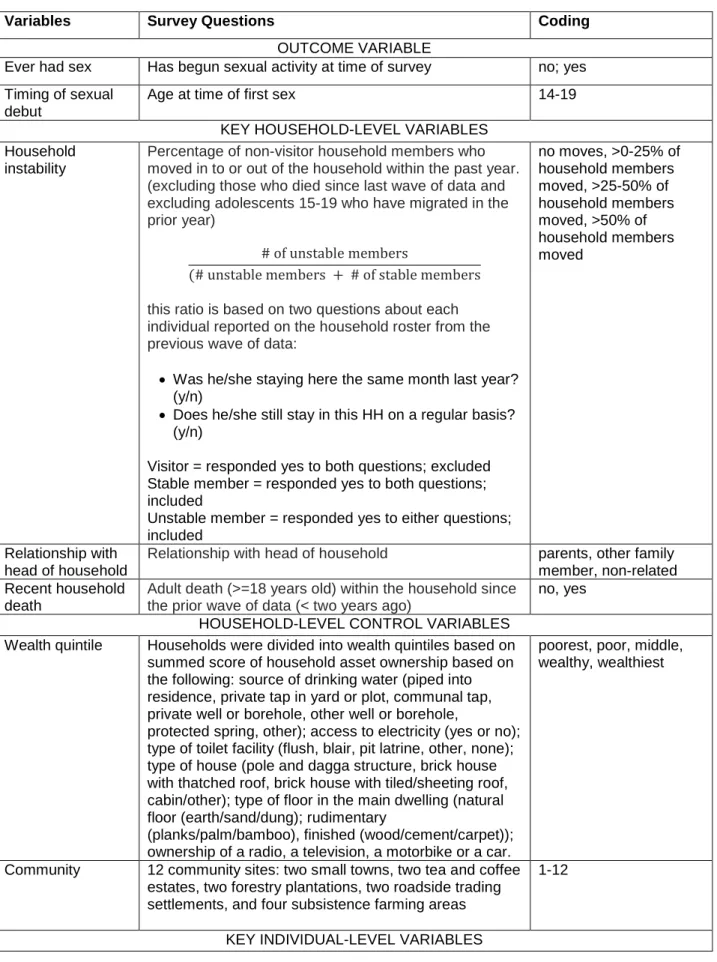
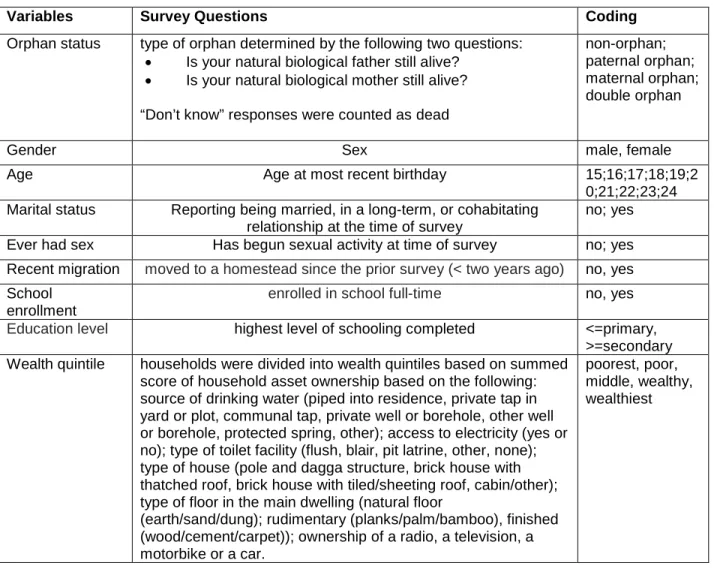
Table 1 describes the derivation for each variable. To determine the timing of sexual debut, respondents were asked, "How old were you (in years) when you had sex for the first time?"
The three key household-level variables of interest were household instability (no changes in household membership in the past year, 1-25% of household members changed within past year, 26-50% of household members changed within the past year, > 50% of
household members changed within the past year), current relationship with head of household (parents, other family members, non-related), and recent household death (yes, no).
The four key individual-level variables of interest were orphan status (non-orphan, maternal orphan, paternal orphan, and double orphan), gender (male/female), recent migration from their prior homestead in the past two years (yes/no), and depression as characterized by
depression, anxiety, and psychosomatic complaints (65,66). Although initially intended for primary health care settings, the SRQ-20 has also been used as a screening tool within community settings.
Additional control measures include household wealth (poorest, poor, middle, wealthy, wealthiest), the specific community where the respondent lived at the time of the survey (n=12), school enrollment (yes/no), and education level (primary school or less, secondary school or
beyond).
Statistical Analysis
We first examined the frequencies, means, and standard deviations of all independent variables, stratified by gender. Next, we provided Kaplan-Meier (KM) failure curve estimates to characterize trends in the timing of sexual debut by key variables, stratified by gender. These curves allow us to assess the cumulative probability of ever having sex over the period of 15-19 years old measured at one-year intervals. Next we conducted log rank tests of equality which allowed us to test whether the difference in survival times between categories of key variables were statistically different or not, irrespective of other independent variables. P-values for log rank tests are provided in the respective KM graphs. Lastly we built multivariate cox regression models to examine sexual debut hazard ratios based on different time-invariant household and individual-level variables, stratified by gender. All analyses were conducted in STATA version 12 (67). Findings were reported as hazard rates (HR) accompanied by 95% confidence
intervals (CI). Exposure to the event (ever having sex) was defined in units of age. Adolescents in the sample were considered to have failed (achieved the outcome) when they had sex at 19 or below, justified by the high age of sexual debut reported by Zimbabwean adolescents in the most recent DHS (9). Those who reported never having sex at the time of the survey were right censored.
subsequently biasing the estimates of the true effect of the independent variables on the outcomes of interest. In order to correct for this, the vce clustering command was used in
STATA, providing accurate and efficient standard error estimates of household-level influences. RESULTS
Sample Characteristics
Table 2 provides summary statistics. A total of 2,914 adolescents were involved in the study (males: 1,596; females: 1,318). Six percent (n=159) of the total sample reported ever having sex (males: 5%; females: 6%). The mean age of the total sample was 16.6. The mean age of sex was 18.03 years of age (males: 18.1; females 17.9).
Nearly half of the total sample (42%) reported no household member changes (males 43%; females 41%) while 6% reported more than half of their household members changing since the prior survey (males 5%; females 6%). Of the total sample two-thirds (66%) lived with their parents (males 68%; females 64%), 32% lived with other relatives (males 31%; females 34%), and 2% lived with a non-relative (males 1%; females 2%). Nearly one quarter of the total sample reported a recent household death (males 23%; females 21%). Wealth was almost evenly distributed across quintiles with a slightly higher proportion of the sample in the wealthiest quintile (males 26%; females 29%).
Half the sample was orphaned with almost no differences observed between genders (males: 27% paternal 5% maternal and 19% double; females: 27% paternal 5% maternal and 16% double). A small percentage of the sample reported recent migration (7%) with more movement among females than males (males: 6%; females 10%). Depression incidence was low among the sample (males 6%; females 8%). Over two-thirds (71%) of the sample was currently enrolled in school at the time of the survey (males 70%; females 72%). More males than females completed secondary school (males 31%; females 21%).
Bivariate Analysis
household and individual variables found to have significant associations with timing of sexual debut, stratified by gender. Figure 1 indicates that household instability was associated with a greater cumulative probability of ever having sex for females only (at age 17: no changes: 6%; >0-25% membership changes: 6%; >25-50% membership changes: 8%; >50% membership changes: 28%, p<0.01). Figures 2 and 3 indicate depression was associated with a greater cumulative probability of ever having sex for both genders (at age 19: depressed female 20% vs. non-depressed females 13%, p<0.01; depressed males: 20% vs. non-depressed males: 10%, p<0.05). KM and log rank tests revealed non-significant differences in the timing of sexual debut based on living in a household with a recent death, relationship with HoH, orphan status, and recent migration for both males and females (p>0.05).
Figure 2.2. Kaplan Meier estimates for failure among females based on depression
Multivariate Cox Regression
Table 3 presents the multivariate cox regression analysis of household and individual-level characteristics associated with timing of sexual debut, stratified by gender. Looking at household-level variables, having more than 50% of household membership changes in the past year was significantly associated with increasing rate of ever having sex within each year of age for the entire sample (Hazard Ratio (HR) 1.93, 95%CI: 1.06-3.50) and for females (HR 2.63, 95%CI: 1.13-6.15). Interestingly, living in a household with a recent death was protective against ever having sex: adolescents with a recent household death had a 36% lower hazard rate of ever having sex within each year of age compared with adolescents without a recent household death. When stratified by gender the significance of this association disappeared but remained in the same direction.
Examining the association of the timing of sexual debut and key individual-level
variables, we found adolescents who reported being depressed had significant increases in the rate of ever having sex with each year of age (HR 1.98, 95%CI 1.19-3.29). Again, this
association disappeared among gender-stratified groups possibly due to shrinking sample size and rarity of the event. School enrollment was the strongest predictor of timing of sexual debut and the only predictor that was significant across both genders. Among the full sample
and migration were not significant predictors for the timing of sexual debut for the sample as a whole or for the stratified groups.
DISCUSSION
Decades of research exist on the impact of individual-level vulnerabilities on adolescent health and risk-taking behaviors in the US and other developed countries. Only recently
researchers have begun to focus on the effects household measures of instability have on adolescents living in SSA. Our study contributes to this growing body of research by suggesting that multiple household factors are associated with the timing of adolescent sexual debut but not always in the expected direction or at the expected strength. Our research reveals that high levels of household membership changes and depression (among the full sample and female sample), and school discontinuation (among all groups) were factors positively associated with earlier ages of sexual debut, while a recent household death and a secondary education or higher was associated with later ages of sexual debut (among the full sample and female sample respectively). These findings suggest that emotional, social, and household instabilities among adolescents living in HIV-affected regions have wide-reaching implications to health and risk behaviors with particularly negative effects among girls.