TRANSNATIONAL CONTENTIOUS POLITICS: THE ROLE OF DIASPORAS IN CIVIL CONFLICT
Lucia Ellen Bird
A dissertation submitted to the faculty of the University of North Carolina at Chapel Hill in partial fulfillment of the requirements for the degree of Doctor of Philosophy in the
Department of Political Science in the College of Arts and Sciences.
Chapel Hill 2019
Approved by: Navin Bapat Anna Bassi Mark Crescenzi Stephen Gent
ABSTRACT
Lucia Ellen Bird: Transnational Contentious Politics: The Role of Diasporas in Civil Conflict (Under the direction of Navin Bapat)
Diasporas are increasingly relevant transnational nonstate actors in international politics, including civil conflicts. Extant scholarship has examined the determinants and consequences of external support to civil conflict actors. However, the majority of this research focuses on traditional support from active, or state, sponsors. This dissertation endeavors to expand this vein of scholarship to include diasporas’ influence on contentious politics in their homelands by asking three interconnected questions. First, why do foreign diasporas participate in civil conflicts by providing financial, material, or political support to militant groups in diasporas’ homelands? I argue that diasporas’ participation in homeland civil conflicts depends on their level of host state integration. Specifically, I find empirical evidence to support my argument that moderately integrated diasporas are both willing and able to support homeland militants. Second, under what conditions does diaspora
participation in homeland contentious politics escalate violence versus facilitate peace? Using a formal model, I find that the probability of peaceful resolution to conflicts in diasporas’ homelands is directly related to the degree of optimism diasporas have regarding the quality of the deal produced by negotiations between homeland conflict actors. I also provide
ACKNOWLEDGMENTS
My experience as a PhD student at UNC-Chapel Hill affirms Norman Vincent Peale’s claim that “the more you practice the art of thankfulness, the more you have to be thankful for.” During this time, I have been fortunate to experience the mentorship, guidance, and kindness of the faculty in the Department of Political Science, my advisor and committee in particular; my family; and my friends. I would first like to express my deepest appreciation to Navin Bapat, my advisor and friend, who ensured that I left our discussions with more
questions than answers but also inspired the curiosity and supplied the tools to find the answers. Additionally, this project would not have been possible without the support of Anna Bassi (and her family), who encouraged me to aspire to lofty goals and always listened to (and improved) my first attempts at presentations. I would also like to sincerely thank Mark
Crescenzi, who never fails to imbue students with the need to, first, tell the story and then address about the data. I am deeply indebted to Stephen Gent, whose feedback on formal modeling reminds me to make sure my theory connects to the real world. I am also very grateful to Cameron Ballard-Rosa, who always asked exactly the right questions to tie the strands of my theory together. Finally, I would like to extend my sincere gratitude to Tom Carsey for his dedication to enriching the lives of his students through inspiring teaching, rigorous research, and active engagement in the Department of Political Science and the Odum Institute.
My family never wavered in their support of my efforts in this program, even when I doubted myself. My mother, Lucia Nugent, played a decisive role in serving simultaneously as editor, advisor, and strategist by reading and revising my papers; finding bugs in my code; and giving excellent advice about classes, research, and life throughout the program. Thanks very much for giving me so much more than “half of what I need.” I also sincerely appreciate the continuing support of my stepfather, Paul Nugent, who always “happened to pick up” a trip to RDU at exactly the right time so that we could play tennis and have dinner at the Carolina Club. Additionally, my father, Vic Bird, and stepmother, Kay Harley, were especially helpful during this time by asking relevant questions about my research, listening patiently to my professional and personal grievances, and offering useful advice. I also gratefully
acknowledge the patient encouragement of my siblings, Maria, Chris, and Alex, and our family dogs, Beau and Zuzu, who kept me grounded during this program and reminded me of what was really important: family, love, and food.
TABLE OF CONTENTS
LIST OF TABLES . . . viii
LIST OF FIGURES . . . x
CHAPTER 1: INTRODUCTION . . . 1
Methodology . . . 5
Dissertation Outline . . . 5
CHAPTER 2: MOTIVATIONS OF DIASPORA PARTICIPATION IN HOMELAND CIVIL CONFLICT . . . 6
Introduction . . . 6
Diasporas and Host State Integration . . . 7
Diaspora Integration and Homeland Politics . . . 10
Data and Methods . . . 14
Analysis . . . 26
Conclusion . . . 32
CHAPTER 3: DIASPORA SUPPORT IN INTRASTATE CONFLICT . . . 35
Introduction . . . 35
The Role of Diasporas in Intrastate Conflict . . . 37
A Model of Diaspora Support in Intrastate Conflict . . . 41
Equilibrium Solutions . . . 45
Theoretical Implications . . . 53
Empirical Predictions . . . 54
Data and Methods . . . 55
Conclusion . . . 72
CHAPTER 4: DETERMINANTS OF HAWKISH ATTITUDES AMONG DIASPORA MEMBERS . . . 75
Introduction . . . 75
Microfoundations of Attitude Development . . . 76
Moral Foundations of Diaspora Members’ Hawkish Attitudes . . . 80
Data and Methods . . . 83
Analysis . . . 92
Conclusion . . . 99
CHAPTER 5: CONCLUSION . . . 104
Why do diasporas intervene in homeland civil conflicts? . . . 104
How does diaspora support affect conflict termination? . . . 105
Why do some diaspora members become hawkish? . . . 107
Final Remarks . . . 108
APPENDIX A: SUPPORTING INFORMATION FOR CHAPTER 2 . . . 109
APPENDIX B: SUPPORTING INFORMATION FOR CHAPTER 3 . . . 119
Formal Model . . . 119
Quantitative Test . . . 134
APPENDIX C: SUPPORTING INFORMATION FOR CHAPTER 4 . . . 138
LIST OF TABLES
1 Host State Integration Status and Factors Influencing Homeland Participation . 11
2 Major Variables of Interest in Dataset of Primary Model . . . 15
3 Summary Statistics of Dichotomous Dependent Variable: Diaspora Support . . 16
4 Identification of Frequency of OECD Host States in Primary Model . . . 18
5 Summary Statistics of Continuous Independent Variable in Primary Model . . 21
6 Examples of Diasporas at Different Ranges of Integration . . . 23
7 Summary Statistics of Continuous Control Variables . . . 23
8 Logistic Regression Results . . . 27
9 Correlation between Independent and Control Variables in Primary Model . . . 31
10 Variance Inflation Factors . . . 31
11 Percent and Expected Percent of Observations Correctly Predicted . . . 32
12 Model Parameters and Ranges . . . 43
13 Major Variables of Interest in Dataset . . . 57
14 Summary Statistics of Continuous Control Variables . . . 65
15 Negative Binomial Regression Results . . . 67
16 Correlation between Independent and Control Variables . . . 70
17 Variance Inflation Factors . . . 71
18 Major Variables of Interest in Dataset . . . 84
19 Summary Statistics of Binary Dependent Variable . . . 85
20 Items Used to Measure Moral Foundations in Survey . . . 85
21 Summary Statistics of Binary Control Variables . . . 88
22 Summary Statistics of Continuous Control Variable . . . 91
23 Logistic Regression Results . . . 93
24 Correlation between Independent and Control Variables . . . 98
26 Percent and Expected Percent Correctly of Observations Correctly Predicted
by Logistic Regression Model . . . 99
27 Major Variables of Interest in Dataset in Secondary Analysis . . . 109
28 Identification of Frequency of OECD Host States in Secondary Analysis . . . . 109
29 Correlation between Independent and Control Variables in Secondary Analysis 109 30 Sources of Diaspora Support Associated with Militant Groups I . . . 111
31 Sources of Diaspora Support Associated with Militant Groups II . . . 112
32 Sources of Diaspora Support Associated with Militant Groups III . . . 113
33 Types of Diaspora Support . . . 114
34 Summary Statistics of Continuous Independent and Control Variables in Secondary Analysis . . . 114
35 Logistic Regressions Results with U.S.-based Diasporas . . . 115
36 Logistic Regression with Fixed Effects Results . . . 116
37 Logistic Regressions Results with Battle Deaths Control Variable . . . 117
38 Logistic Regression Results with Alternative Measures of Diaspora Support (Primary Model) . . . 118
39 Equilibria across Cases . . . 133
40 Included CEDS Actors . . . 134
41 Included CEDS Actions . . . 134
42 Summary Statistics of Dependent and Independent Variables . . . 134
43 Poisson Regression Results . . . 135
44 Negative Binomial Model with Alternative Control Variables Results . . . 136
LIST OF FIGURES
1 Types of Outside Support, 1991-2000 . . . 9
2 Frequency of Types of Diaspora Support . . . 17
3 Frequency of Diaspora Incomes in Primary Model . . . 20
4 Regime Types among Homelands . . . 24
5 Logistic Regression Estimates . . . 28
6 Predicted Probability of Diaspora Support Conditional on Diaspora: Native Income Ratios . . . 29
7 ROC Plots . . . 33
8 Types of Outside Support, 1991-2000 . . . 38
9 Diaspora Support in Civil War . . . 42
10 Unique Cases to Solve . . . 47
11 Case 2 Continuum . . . 53
12 Cases Surviving Both Assumptions . . . 54
13 Frequency of Cooperation between Homeland Conflict Actors . . . 58
14 Frequency of Types of ATFP Press Releases . . . 59
15 Frequency of Attitudes Identified by ATFP Press Releases . . . 61
16 Frequency of Israeli Militarized Operations into Palestinian Territory . . . 62
17 Distribution of Political Party of Israeli Prime Minister . . . 63
18 Distribution of Leadership in Gaza Strip . . . 64
19 Negative Binomial Coefficient Estimates . . . 69
20 Expected Count of Cooperative Interactions . . . 70
21 DHARMa Scaled Residual Plots . . . 72
22 Summary Statistics of Ordinal Control Variables . . . 90
23 Logistic Regression Estimates . . . 95
25 Predicted Probabilities Associated with Homogenizing Morals . . . 97
26 ROC Plot . . . 100
27 Distribution of Diaspora Incomes over Time in Primary Model . . . 110
28 Predicted Probability of Diaspora Support Conditional on U.S.-based Diaspora:Native Income Ratios . . . 110
29 ROC Plots for Primary and Secondary Models Excluding Key Independent Variables . . . 115
30 Complete List of Cases . . . 119
31 Cases Surviving Assumption . . . 120
32 Equilibrium Offers within Intervals . . . 120
33 Case 1 Continuum . . . 121
34 Case 2 Continuum . . . 125
35 Case 3 Continuum . . . 129
36 ATFP Attitude Distribution over Time . . . 135
37 Expected Count of Cooperative Interactions, Primary Model . . . 137
38 Predicted Probability of Hawkish Attitude Conditional on Morals and Education Level . . . 138
39 Predicted Probability of Hawkish Attitude Conditional on Morals and Political Informedness . . . 138
40 Predicted Probability of Hawkish Attitude Conditional on Morals and Religiosity . . . 139
CHAPTER 1: INTRODUCTION
Why do diasporas, or subsocietal groups living abroad rather than in their countries of origin, participate in contentious politics in their homelands, and how does this participation influence outcomes of civil conflicts in diasporas’ homelands? For a recent example, consider the Syrian diaspora since the start of the civil war in Syria in 2011. In Syria, the protests of the Arab Spring eventually culminated in a civil war between dictator Bashar al-Assad and opposition forces, composed of secular citizens and Islamist radical armed groups (Carey, 2018). Diaspora participation in the Syrian civil war, most visible in the arrival in Syria of foreign fighters from various countries throughout the world, has internationalized and
exacerbated this conflict.1 In addition to the Syrian diaspora that existed prior to the civil war, more than five million Syrians have become refugees in foreign countries, producing a new Syrian diaspora (Syria Emergency, 2018).
While many Syrian refugees reside in neighboring states, this new diaspora is also dispersed globally throughout Europe and North America. In Western, developed states, Syrian diaspora members have legal freedoms and access to financial and material resources that were previously unavailable. For example, members of the Syrian American diaspora have lobbied the U.S. Government to intervene militarily or condemn human rights violations committed by the Syrian government against civilians (Alloush, 2018). In addition to such political aid, individual Syrian American diaspora members have provided material support in the form of foreign fighters, such as Syrian American Ahmad Abousamra, who joined the precursor organization to IS and then managed social media for IS (Jenkins, 2014;Official: American May Be Key in ISIS Social Media Blitz, 2014; Cruickshank, 2017).
Foreign diaspora intervention has influenced the dynamics of the Syrian civil war by
attempting to alleviate the asymmetric distribution of power between the Syrian government and opposition groups.2 The impact of the Syrian diaspora is not a unique political
phenomenon; diasporas have taken on roles in conflicts across varying temporal and geographic contexts. For example, the Irish American diaspora contributed financial and material support, such as firearms, to operatives in the Provisional Irish Republican Army during the Troubles in Ireland (Byman, 2006). Similarly, prior to the terrorist attacks on the World Trade Center in the U.S., the Sri Lankan diaspora provided political and material aid, also in the form of weapons, to the Tamil Tigers to improve their capacity against the Sri Lankan government (Chalk, 2008).
These empirical examples demonstrate the significance of diaspora participation in civil conflicts. While extant literature evaluates the role of active support from state sponsors to civil conflict actors, a dearth of research, especially using quantitative or formal methods, focuses on diaspora sponsors’ impact on civil wars. Prior scholars use qualitative case studies to illustrate the motivations and influence of diasporas’ decisions to intervene in homeland conflicts. Thus, this literature lacks generalizable, replicable findings regarding diaspora participation in homeland contentious politics. Under what conditions do diasporas intervene in civil wars in their homelands by sending financial, material, or political aid? What is the impact of such diaspora support on negotiations between homeland conflict actors? Why do some individual diaspora members develop a tolerance or even preference for violent conflict in their homelands?
In this dissertation, I aim to answer these questions. Diasporas’ integration experience in their homelands and preferences toward contentious politics influences whether and how they intervene in conflicts in their homelands. Some diasporas assimilate into their host states to take advantage of the educational, professional, and economic opportunities available; however, others attempt to intervene in homeland conflicts to influence conflict duration and termination. Additionally, while some diasporas prefer the continuation of homeland conflicts, others prefer its peaceful resolution. These distinct preferences determine diasporas’ effects
on negotiations between conflict actors in diasporas’ homelands. Moreover, individual diaspora members develop these different preferences on homeland conflicts based on preexisting values and belief systems. In the remainder of this introductory chapter, I will summarize the empirical chapters of this dissertation, briefly discuss the methodological approaches I use to answer the aforementioned research questions, and conclude with an outline for the remainder of the dissertation.
In the second chapter, I consider why foreign diaspora groups, which often emigrate in pursuit of improved opportunities abroad, participate in homeland conflicts by providing financial, material, and diplomatic aid to militant groups in their homelands. The rational choice framework predicts that diasporas should optimize on the educational, professional, and political opportunities in their host states to maximize their welfare, but diaspora
members integrate into their host state at varying rates. Though diasporas may become either fully incorporated into mainstream society or remain completely separated, some diasporas experience segmented assimilation in their host states. This moderate range of integration produces diasporas with both the capacity and motivation to send valuable resources to militants in the diaspora’s homeland. In the Syrian case, the new diaspora produced by the civil war is experiencing this moderate range of integration. Syrian diaspora members’ median household income in the U.S. is $52,000 as compared the the median household income of $55,000 for natives in the U.S. This indicates that, while Syrians are approaching income parity with natives in the U.S. and thus have useful resources for Syrian opposition militants, they have not quite achieved economic equality with natives or complete integration into the U.S. In line with theoretical expectations, Syrian American diaspora members are currently more likely to support homeland militants.3
The third chapter includes a formal model that evaluates the impact of diaspora participation on homeland civil conflicts. Diasporas may take on different roles in conflict: some prefer peaceful settlements that end conflict, but others favor conflict continuation or
escalation. My formal model analyzes how these peace- and conflict-preferring diasporas may influence the outcomes of homeland civil wars. I argue that diasporas’ attitudes regarding the outcome of negotiations drive the solution to this model. This makes a novel theoretical contribution to the bargaining literature. Theoretically, conditions exist under which diaspora actors may force homeland militants to reject a settlement that would bring peace, even when this deal should be preferable to war. When diaspora groups are more pessimistic regarding the outcome of negotiations, hawkish diasporas may induce militants to reject peace to credibly signal strength to the homeland government. Regardless of diasporas’ expectations, the probability of negotiations between homeland civil war actors increases as the homeland government’s capacity declines. A durable peace, in which militants with both hawkish and dovish diasporas sponsors accept the deal, is most likely when the homeland government’s capacity is relatively low and diasporas are optimistic about the outcome of negotiations. In the case of the Syrian civil war, the majority of Syrian diaspora members remain pessimistic about the outcome of the conflict and the quality of peace following the termination of the conflict (Hindy and Ghaddar, 2017). The diaspora’s lack of confidence about the credibility of the Syrian government or the utility of a deal between the opposition and the government contributes to the failure of a negotiated settlement to end the conflict.
In the fourth chapter, I explore why diaspora members develop dovish versus hawkish preferences regarding homeland contentious politics. Using insights from political
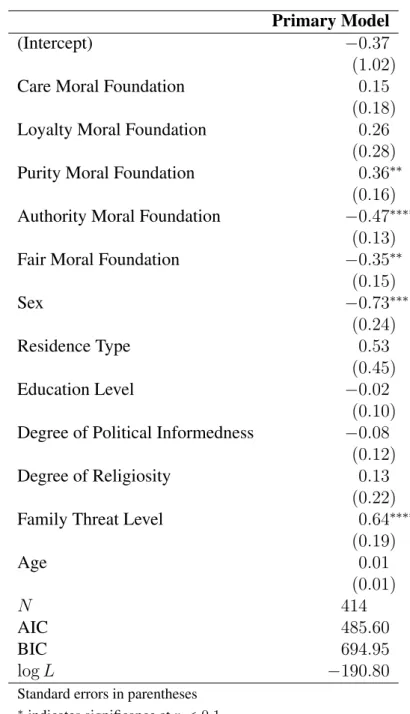
psychology on the micro-level determinants of support or tolerance for violence, I identify hypotheses related to individuals’ moral foundations. I argue that diaspora members that highly valueidentity-preservingmorals of care, loyalty, and purity are likely to have hawkish preferences regarding homeland conflicts. Diaspora members that esteemhomogenizing morals, which include authority and fairness, are less likely to be hawkish. The Syrian diaspora demonstrates a tendency to support hawkish foreign policies, including militarized intervention by Western host states, regarding the civil conflict in their homeland (Moss, 2016). While comprehensive survey data concerning the moral foundations of the most recent Syrian diaspora do not exist, the transnational diaspora displays many of the identity
and medical care, through diaspora organizations such as Hand in Hand for Syria, to Syrians remaining in the conflict zone (Ahsan, 2013). Similarly, the Syrian diaspora boasts powerful kinship connections and much intra-group loyalty, as evidenced by the migration of new Syrian immigrants toward countries, such as Germany, with large preexisting Syrian diaspora populations (Sasnal, 2015).
Methodology
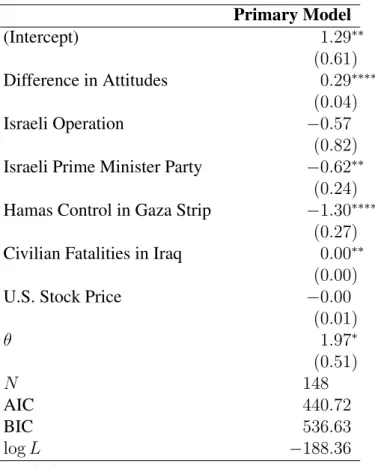
To analyze diaspora participation in contentious politics in their homelands, I use statistical analyses and formal modeling. In Chapter 2, I use a new dataset that encompasses diasporas’ varying integration levels into their hosts states and presents a new measure of diaspora participation in conflicts in their homelands. In Chapter 3, I devise a game theoretic model to evaluate the impact of diasporas on civil conflict termination in their homelands. I empirically evaluate the hypothesis derived from my model using statistical analyses of data from 2003 to 2015 regarding the Israeli-Palestinian conflict. Specifically, I employ the Computation Event Data System (CEDS) Levant Event Data, which provides information on conflict resolution or cooperation between Palestinian and Israeli actors, and original data I collected using press releases from an American Palestinian diaspora organization. Finally, I quantitatively analyze the validity of the direct relationship I predict between identity
preserving morals and hawkish attitudes among diaspora members using data from the third wave of the Arab Barometer, which covers the years 2012-2014.
Dissertation Outline
CHAPTER 2: MOTIVATIONS OF DIASPORA PARTICIPATION IN HOMELAND
CIVIL CONFLICT
“I’m a biology major at the University of North Texas. I’m a senior with a minor in physics, chemistry and Arabic...I hope my country Syria will be free.”4
Introduction
Omar Kattan, a Syrian American diaspora member, abandoned a comparatively comfortable lifestyle and professional aspirations in dentistry to join the Islamic State (IS) (Engel, Plesser, Connor and Schuppe, 2016). Kattan, who grew up in Indiana and then moved to Texas with his Syrian American family, was an active, social student before graduating from the University of North Texas, where he participated in intramural sports and community service and worked toward his ultimate goal of becoming a professor of dentistry (Ayala, Fancher and DeBruijn, 2016). Instead of continuing to integrate into the United States (U.S.) and take advantage of the educational and professional opportunities available in his host state, Omar opted to actively participate in the civil conflict in his family’s homeland. While some diaspora members have opted to contribute by becoming foreign fighters, others have sent financial donations that have strengthened IS’s military capacity (Shatz, 2014). Omar’s decision to physically join IS’s ranks represents an extreme case of the puzzle motivating this paper: why would diaspora members opt to reengage with their homelands in lieu of taking advantage of the economic and political opportunities and (typically higher) living standards present in diasporas’ host states?
I argue that segmented assimilation, or a moderate level of integration, into the host state produces diaspora members that are most likely to participate in transnational
contentious politics by aiding homeland conflict actors. Diasporas’ decision to provide such
passive support is a function of their motive and capacity to mobilize on behalf of militants engaged in homeland civil conflicts. Diasporas that are fully incorporated into their host states may have resources that would benefit homeland conflict actors, but they lack the motivation to send aid. Conversely, diasporas that are fully dissimilated from their host states are likely to be motivated to provide passive support, but lack the necessary resources. Diasporas that experience segmented assimilation, however, have a resource base that is sufficient to provide assistance to militants and maintain a strong enough tie to homeland politics to inspire motive.
I will next address the relevant literature on foreign support to insurgencies in civil war. Then, I will develop my theoretical framework accounting for why diasporas that
experience segmented assimilation are those most likely to provide passive support. I will test this argument using logistic regression on a global dataset of diaspora participation from 2000 to 2009. Finally, I will conclude by discussing the academic and policy-relevant implications of this study.
Diasporas and Host State Integration
First, I explore the term “diaspora.” Broadly, diasporas have been defined as a sect of the population living abroad rather than in their states of origin, which I refer to as diasporas’ “homelands” (Connor, 1986). Further clarification efforts by scholars resulted in specific explanations for why diasporas reside abroad and how they interact with their “host states,” the term I use to refer to diasporas’ new countries of residence, and homelands. Safran (1991) accounts for their residence in host states by noting that diaspora members or their ancestors have been dispersed from one particular original location to more than one host state. This dispersal may be profit-seeking, such as to pursue professional opportunities or new trade routes, or due to more traumatic events, such as substate violence in the homeland (Cohen, 2008). Furthermore, diaspora members typically possess a “collective memory” of an
“idealized” version of the homeland, its people, and its history, which may produce an interest in return among diaspora members (Cohen, 2008). Thus, diasporas may maintain
share certain cultural, religious, linguistic, and ideological similarities (Sheffer, 2007, 1986). The nature of the relationship between the host state and diaspora remains under debate, with some scholars arguing that diasporas will struggle to integrate into their host states and so remain isolated from mainstream society (Safran, 1991). Other scholars, however, suggest that diasporas may eventually become fully incorporated into host states (Cohen, 2008; Putnam, 2007).5
The Kurdish diaspora, the “world’s largest nation without a state,” exemplifies a typical diaspora (Caryl, 2015). While an estimated thirty million Kurds reside in the ancestral Kurdish homeland that is currently divided between four traditional states (Turkey, Iran, Iraq, and Syria), around 870,000 Kurds live in Western Europe, the U.S., and Canada (Ember, 2005;The Kurdish Diaspora, 2017). Kurds moved abroad to pursue economic opportunity, often as “guest workers” to Western European countries, and political freedom, as a result of repression experienced by nationalizing states and the defeat of Kurdish self-governance movements (Ember, 2005). Additionally, in the vein of Anderson’s (1991) “long distance nationalism” in which diaspora members and homeland residents can share and contribute to language, religious practices, and cultural traditions without living in the same space, the transnational Kurdish diaspora reconstructs the homeland by consuming Kurdish media, which characterizes eastern Turkey as “Northern Kurdistan” and the Turkish state as an “occupier” (Keles, 2015). Furthermore, diaspora Kurds have engaged in efforts to develop homeland institutions through initiatives including the creation of a Kurdish legislature, the National Congress of Kurdistan, and multinational diaspora protests following the Turkish capture of the Kurdish nationalist leader Ocalan (Ember, 2005). Moreover, though linguistic heterogeneity exists due to the division of the Kurdish homeland, Kurds have maintained a common cultural identity through shared music, theatrical productions, and literature based on their national experiences (The Kurdish Diaspora, 2017). Finally, some Kurdish diaspora members have experienced racism, exploitation, and alienation in their host states; however, other Kurds have successfully integrated professionally, academically, and socio-economically
(Ember, 2005).
While diaspora scholars have identified some patterns in relationships between
diasporas and their host states, this relationship demands further examination due to its impact on diaspora participation in homeland politics. Passive support, which is aid from
transnational nonstate actors including diasporas, nongovernmental organizations, and
transnational crime networks, occurs nearly as frequently as active sponsorship by states. The relative frequencies of these types of support are displayed in Figure 1 (Byman, Chalk,
Hoffman, Rosenau and Brannan, 2001).6 Though the subject of state sponsorship has received much scholarly attention, a theory of the conditions under which diasporas take on a role in homeland conflicts is lacking (Salehyan, 2007; San-Akca, 2016; Byman, 2013). States may intervene in civil conflicts to undermine state rivals (Saideman, 2002; Maoz and San-Akca, 2012), to pursue geostrategic interests related to security or economic objectives (Regan, 2000; San-Akca, 2009), or to benefit conflict actors with which the state shares ideological or ethnic ties (Saideman, 2012; Byman et al., 2001).
Fig. 1:Types of Outside Support, 1991-2000
Active Passive
Frequency of Types of Outside Support
Types of Outside Support to Insurgencies, 1991−2000
Frequency
0
10
20
30
40
50
60
Transnational nonstate actors, specifically foreign diasporas, represent an opportunity for further progress in scholarship on foreign support for intrastate conflict actors.
International political economy (IPE) scholars have incorporated alternative foreign sponsors by investigating the role of remittances in policymakers’ decisions regarding exchange rate regimes (Singer, 2010). Conflict scholars, however, have yet to formally analyze or
empirically test, using cross-national data, the role of diasporas in civil wars.7 The puzzling phenomenon of diaspora members’ choice to reengage in homeland conflicts that they could avoid, due to their residence abroad in host states, requires further explanation.
To participate in homeland civil conflicts, diasporas must have both the motivation and the capacity to send aid to conflict actors. Diaspora participation occurs as a function of a diaspora’s integration into the host state, which underlies their motivation to reconnect with homeland conflicts actors and capacity to send useful resources home. Drawing upon insights from sociology, diasporas may experience a range of integration in host states, from complete dissimilation to full incorporation into the mainstream society of the host state. The moderate range of integration, referred to by sociologists as segmented assimilation, is the most likely phase of integration to produce diasporas with both the motivation and capacity to intercede in homeland politics.
Diaspora Integration and Homeland Politics
Diaspora members’ experience of integration into the host state exists along a continuum. This continuum ranges from dissimilation, in which diasporas are intentionally differentiated from the mainstream population in the host state due to homeland ties or socioeconomic inequality (Yinger, 1981), to incorporation, in which immigrants accept host state processes, practices, and relationships and simultaneously abandon homeland culture and connections (Zhou, 2012). Incorporated diaspora members also participate in the political institutions of the host state and obtain jobs in the primary market sector rather than “enclave economies,” which are typically located in an area densely populated by the diaspora and
characterized by professional specialization in certain sectors (Portes and Manning, 1986). At the moderate range of integration is segmented assimilation, in which original diaspora members and their descendants assimilate into the marginalized groups of the host state, such as previously excluded immigrants, criminals, or gangs, rather than the mainstream (Gans, 1992; Portes and Zhao, 1993; FitzGerald, 2014).8 This moderate level of integration produces a mixed experience for diasporas, in which their members are allowed some, but not total, access to social, political, and economic opportunities in the host state. While
segmented assimilation may include immigrants that are “upwardly mobile,” others experience “downward mobilization” and remain socially ostracized and economically disadvantaged (Zhou, 2012). The lack of economic opportunity may result from a scarcity of resources available to the state, which forces the diaspora to turn inward to obtain goods and services from ethnic elites, further undermining the relationship between diaspora members and the host state (Wimmer, 2002). I argue that the type of integration that diasporas
experience influences their transnational interactions with the homeland, as illustrated by Table 1.
Table 1:Host State Integration Status and Factors Influencing Homeland Participation
Range of Integration
Factor Dissimilation Segmented Assimilation Incorporation
Capacity X X
Motive X X
The diaspora’s level of integration influences whether diasporas are incentivized to participate in homeland contentious politics. The decision to engage in homeland civil wars depends on two factors: the diaspora’s capacity to send resources to the homeland and the diaspora’s motivation to provide assistance to militants in the homeland. This capacity and motivation framework parallels work by Most and Starr (2015), which emphasizes the impact on war of opportunity, the environmental and structural conditions surrounding actors, and willingness, the microlevel strategies undertaken by actors to pursue their interests. First,
diasporas must obtain the necessary financial, material, or human resources to send to
homeland militants. This resource availability is determined by the openness of the economic market in the host state, as well as the ease with which immigrants can obtain academic and professional training. Additionally, diasporas must have the opportunity to send aid to the homeland, which depends on whether the host state is incentivized to intervene to stop foreign flows of resources. The host state’s intervention depends on its interests, capacity, and regime type.9 When the host state is politically or strategically aligned with the diaspora or the militant group the diaspora sponsors, diaspora aid is likely to be permitted. Also, the level of host state capacity determines the effectiveness of policies designed to prevent or facilitate the flow of diaspora aid. Last, democratic host states are more likely to provide legal, political, and economic freedoms that allow diasporas to support homeland conflict actors than autocratic host states, which repress their populations so that homeland identities cannot be maintained nor resources sent abroad (Safran, 2007).10
Second, diasporas must be motivated to send aid to militants fighting the homeland government. To stimulate this motivation, diaspora members must first be sufficiently informed on the political and economic developments in their homeland. This requires freedom of information in the host state and open communication between individuals in the homeland and host state. If this information is publicly available, diaspora members may develop and maintain strong loyalties to ethnic groups in the homeland. In addition to
freedoms related to the media and expression, host states can also enact policies that highlight ethnic differentiation, such as implementing policies of segregation or structuring political representation according to ethnic groups (Nagel, 1986). When host states emphasize distinctions between the diaspora and mainstream population, diasporas are less likely to
integrate into the host society and more likely to contribute to homeland conflicts. In addition to developing identity ties to the homeland, the diaspora must be incentivized to challenge the existing status quo, which, in the case of civil war, usually occurs when opposition to the homeland government exists and is in need of support from foreign diaspora members.11
At the two extremes along the integration continuum, differentiation and incorporation, homeland participation is unlikely. When diasporas are completely
differentiated, they are unlikely to have the capacity to contribute to homeland conflict actors even though diaspora members are likely to identify with the homeland and so be motivated to assist the militants. Thus, while dissimilated diasporas may be driven to support militants in their homelands, their lack of resources renders their impact meaningless. Diasporas that are completely incorporated into the host state, while likely capable of providing resources to homeland conflict actors, typically identify more strongly with the host state and so lack the motivation to send aid to homeland militants. Rather than investing in risky homeland conflicts, incorporated diasporas expend their resources on efforts to further assimilate into the host state by obtaining higher education; professional certifications; and other
socioeconomic markers of success, such as home ownership. These efforts are frequently accompanied by an acceptance of host state values and culture and abandonment of homeland connections. Thus, while incorporated diasporas have the means to assist militants, they lack the will.
Conversely, segmented assimilation occurs when diasporas experience a confluence of factors that simultaneously enhances their capacity to mobilize to support the militants and stimulates their interest in the homeland intrastate conflict. Segmented assimilation produces diasporas with some capacity to obtain useful resources to support homeland militants since they are moderately integrated. Furthermore, these diaspora members are also excluded from complete political, economic, and social incorporation due to structural conditions in the host state, which produces a motivation to maintain or develop homeland connections.12 In
11For example, the diaspora may be interested in improving the welfare of the homeland population by removing a repressive regime in power.
addition to this exclusion experience, diasporas experiencing segmented assimilation were incentivized to exit their homeland, but failed to have or obtain links with other successful immigrants abroad. This indicates that diaspora members at these moderate levels of
integration are likely to be interested in challenging the homeland status quo and motivated to support militants opposing the government. Thus, the segmented assimilation experience is most likely to produce conditions that lead to diaspora contributions to militants groups in the homeland. This argument is summarized in the following hypothesis:
H1: Diasporas that experience segmented assimilation in the host state are more likely to
provide aid to homeland militants.
Data and Methods
Data
I test the hypothesis using an original dataset composed of a subset of the universe of cases identified by Cunningham, Gleditsch, and Salehyan’s Non-state Actors in Armed Conflict Dataset (NSA) (2009). These data are at the dyad-conflict level, which I expand to the dyad-year level. I subset the NSA data to match original data that I gather to determine diasporas’ relative levels of integration into host states. I identify diasporas’ relevant host states using the World Bank’s Global Bilateral Migration Data (Ozden, Parsons, Schiff and Walmsley, 2011).
The data available regarding the key explanatory variable in my theory, the diaspora’s degree of integration into their host states, limit the range of potential host states that can be included in this statistical analysis. Because I operationalize the economic dimension of integration by measuring diasporas’ human capital, the universe of potential host states in this analysis includes members of the Organisation for European Economic Co-operation
(OECD), which provide data on immigrants’ earnings and professions (Waters, Tran, Kasinitz and Mollenkopf, 2010). Using the Global Bilateral Migration Data, my primary model defines the diaspora’s host state as the state with the largest diaspora population.13 While my main
produce a hierarchy in the host state, such as racial inequality in the criminal justice system in the U.S. (Hackett, 2018).
analysis considers host states with the largest diaspora population, diasporas may exist in multiple host states. To alleviate concerns related to defining the diaspora’s host state as the state with the largest diaspora population, I conduct a secondary analysis in which the host state is defined as the state with the median size of diaspora population (from the universe of potential OECD hosts).
I identify individual diasporas’ levels of economic integration into their host states using data on diaspora members’ incomes from the Database on Immigrants in OECD Countries (DIOC), the U.S. American Community Survey, and the Pew Research Center.14 These data are available from 2000 forward, so my dataset includes the conflicts from the NSA dataset and information on diasporas’ integration into their host states from OECD countries from 2000 to 2009.15 In total, 475 observations comprise this new dataset. Table 2 describes key variables of interest for three dyad-year observations from the dataset used in my primary model, and Table 27 in Appendix A describes key variables of interest for three observations in the secondary model.16 Little problematic correlation exists in the primary or secondary model data.17
Table 2:Major Variables of Interest in Dataset of Primary Model
Dyad Host Year Dia. Sup Inc. Rat. (Inc. Rat.)2 ln(Home GDP) Home Reg. Host Glob. Dist. Sri Lanka-LTTE Canada 2000 1 0.81 0.65 10.96 2 90.96 13789 India-Naxalites U.K. 2004 0 1.39 1.94 14.73 3 87.92 12106
Israel-Hamas U.S. 2009 1 1.03 1.07 12.01 3 79.93 9449
of immigrants from the homeland, are OECD members. Furthermore, more than one half (51%) of diasporas have an OECD state as one of their top three emigration destinations in terms of population size.
14The incomes are reported annually in current U.S. dollars for the U.S. and monthly in nominal local currency for each of the OECD states. SeeAmerica Community Survey (ACS)(2017);Median Household Income Among U.S. Hispanic Origin Groups, 2013(2015);Database on Immigrants in OECD Countries (DIOC)(2017) for more details. I create a ratio of diaspora to native median incomes for each observation.
15Please note that the host state data from the Global Bilateral Migration Data, which is provided in nine year increments, limit the range of years, as population data are not available from this source after 2009.
16The primary model includes data for the diaspora’s host state defined as the state with the largest diaspora population.
Dependent Variable
The dependent variable of interest in this analysis is diaspora interaction with militants in their homelands, specifically, whether diasporas support militants. I measure passive
support from diasporas using a dichotomous variable that indicates whether militants received aid from diasporas in a given year. I gather data for diaspora support using a number of sources, including the NSA dataset (Cunningham, Gleditsch and Salehyan, 2009), the UCDP External Support Dataset (H¨ogbladh, Pettersson and Themn´er, 2011), San-Akca’s Nonstate Armed Groups (NAGs) Dataset (2016), and other qualitative sources.18 I positively code this binary variable if any of the aforementioned sources show diaspora support to militants. Table 3 indicates that fewer militant groups receive some form of diaspora support than do not.
Table 3:Summary Statistics of Dichotomous Dependent Variable: Diaspora Support
Number of Dyad Years Percentage of Dyad Years
No diaspora support 279 58.7%
Diaspora Support 196 41.3%
To ensure that passive support from diaspora sponsors occurred in the dyad-years identified by the NSA and NAGs dataset, I use qualitative sources, including case studies and historical accounts such as Byman’s Outside Support for Insurgencies, 1991-2000; the Dynamic Analysis of Dispute Management data; and the Mapping Militant Organizations project.19 Furthermore, I positively code diaspora support in a yearly observation when militants receive any one of three types of support from diasporas: financial, political, or military aid.20 Financial support refers to money sent from members of transnational diaspora communities to militants in the homeland that sustains the group or enhances the militants’ capacity for violence, such as Eritrean diaspora communities that raised money for the conflict efforts of the Eritrean People’s Liberation Front (EPLF) in the 1970s
18Please see Tables 30-32, located in Appendix A, for a complete list of the sources associated with each observation.
19See Byman et al. (2001); Mullenbach (2017);Mapping Militant Organizations(2017) for more details. I include immigrant and refugee communities in my definition of “diaspora.”
(Schmitz-Pranghe, 2010). Political support refers to lobbying by diaspora members in their host states to raise awareness of the plight in their homeland, which the militants are often striving to rectify. For example, the transnational Armenian diaspora groups lobby their host governments on behalf of Nagorno-Karabakh separatists in Azerbaijan (Rieff, 1997). Military support refers to diaspora members’ provision of arms, intelligence, sanctuary (for example, hosting militants in refugee camps), and fighters that directly amplifies militants’ ability to wage war. Sri Lankan diaspora communities located in India, Malaysia, Europe, and North America sent unsophisticated weapons to LTTE fighters in the 1970s and 1980s (Liberation Tigers of Tamil Elam, 2015). Figure 2 displays the frequency with which diasporas send each type of support, and the most common type of diaspora support is financial.
Fig. 2:Frequency of Types of Diaspora Support
Financial Military Political
Frequency of Diaspora Support Types
Type of Diaspora Support
Number of Dy
ad−Y
ears
0
50
100
150
200
Independent Variables
I argue that diaspora members’ level of integration into the host state determines their homeland participation. Specifically, I argue that the moderate range of integration, in which diasporas experience segmented assimilation, is the most likely to produce homeland-oriented diaspora members. Several dimensions of segmented assimilation exist: social, such as
immigrants and their eligibility for state entitlements; and economic, which refers to
diasporas’ human capital as measured by earnings, income, and degree of professionalization (Waters et al., 2010). To obtain a measure of segmented assimilation that is unique to a particular diaspora, I operationalize integration as diasporas’ human capital in their host states. Specifically, I create a continuous variable that is a ratio between diasporas’ and natives’ incomes in host states using data from the U.S. American Community Survey, the Pew Research Center, the Database on Immigrants in OECD Countries (DIOC), and the International Labor Organization of the UN (ILO).21To operationalize segmented
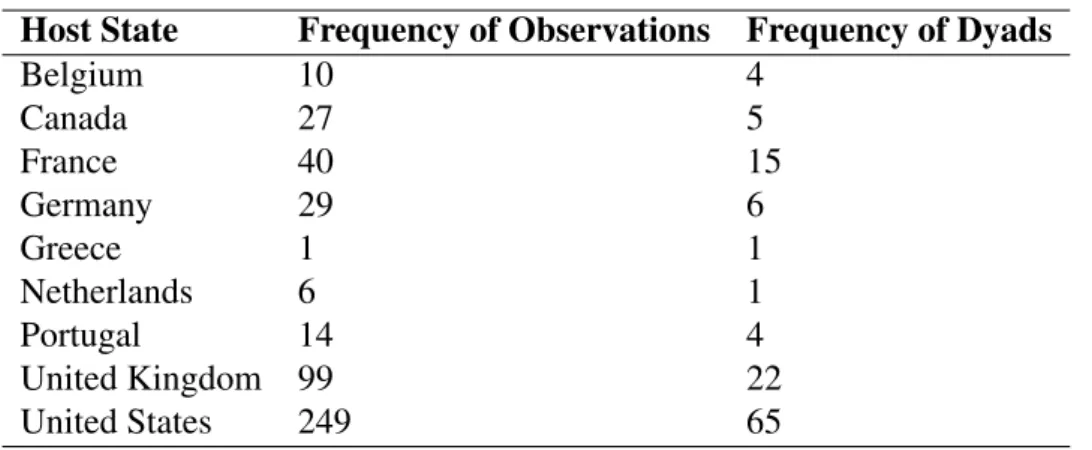
assimilation, I gather data from diasporas’ host states, as identified by the Global Bilateral Migration Data. The universe of host states for the primary analysis is identified in Table 4, and Table 28 in Appendix A describes the universe of host states for the secondary analysis.22
Table 4:Identification of Frequency of OECD Host States in Primary Model
Host State Frequency of Observations Frequency of Dyads
Belgium 10 4
Canada 27 5
France 40 15
Germany 29 6
Greece 1 1
Netherlands 6 1
Portugal 14 4
United Kingdom 99 22
United States 249 65
The U.S. provides yearly information in the American Community Survey (ACS) on diasporas’ median incomes.23 For each year in my analysis, I create a ratio by comparing the diaspora’s median income to the natives’ median income in the U.S.24 Additionally, I use data
21SeeAmerica Community Survey (ACS)(2017);Median Household Income Among U.S. Hispanic Origin Groups, 2013(2015);Database on Immigrants in OECD Countries (DIOC)(2017);Mean nominal monthly earnings of employees by sex and economic activity (Local Currency)(2017) for more details.
22Table 4 indicates the frequency of host states defined as hosting the majority of the diaspora. Table 28 in Appendix A includes the host states defined as those hosting the median populations of diasporas.
23SeeAmerica Community Survey (ACS)(2017) for more details. Typically, the ACS provides the information on respondents’ race, so I assume this takes into account both recent immigrants and diaspora members more broadly.
from the Pew Research Center to gather income data on Central and South American diasporas in the U.S., which are not individually reported in the ACS.25
In addition to the U.S., several OECD countries represent host states of diasporas, as illustrated by Table 4.26 Little granulated data on income of immigrants, differentiated by native country, exist in individual OECD states. Instead, OECD states have reported economic and educational data on immigrants, differentiated by country of origin, in the Database on Immigrants in OECD countries (DIOC) since 2000. While median incomes are not
specifically reported in the DIOC, diaspora members residing in OECD states provide
information on their sectors of occupation, categorized according to the International Standard Classification of Occupations.27
To determine the level of integration of a diaspora group in an OECD host country (that is not the U.S.), I identify the largest occupational sector associated with the relevant immigrant group. I then identify the average monthly wage earned in each occupational category from the International Labor Organization of the UN.28Much like the
operationalization of the independent variable for diasporas in the U.S., I create a ratio composed of the mean monthly income for the primary sector of diasporas relative to the mean monthly income in the diasporas’ OECD host states using data from the ILO.29Figure 3
the income for the years prior to 2005 included in my analysis.
25See Median Household Income Among U.S. Hispanic Origin Groups, 2013 (2015) for more details. Hispanic median incomes are available, but I am interested in country-level diaspora incomes. For robustness, I compare data from the Pew Research Center on specific diaspora incomes to continent-level values that I have for immigrants in these years, and they are very similar (Median Family Income of Recent Immigrant Arrivals, 2015).
26The U.S. represents the OECD host state for more than half of the diasporas included in my sample.
27SeeISCO-08 Structure, index correspondence with ISCO-88(2016) for more details.
28SeeMean nominal monthly earnings of employees by sex and economic activity (Local Currency)(2017) for more details. Canada, which is a host state for several diaspora groups, does not report income statistics in the ILO data. I identify average annual earnings in Canada from the Survey of Labour and Income Dynamics by Statistics Canada (Average annual earnings of women and men, by occupation, 2008).
illustrates the frequency with which incomes are earned by various diasporas.30
Fig. 3:Frequency of Diaspora Incomes in Primary Model
Frequency of Incomes among Diasporas
Diaspora Income Level (Nominal local currency)
Frequency of Diaspor
a Income Le
v
els
0 20000 40000 60000 80000
0
50
100
150
200
The ratio of diaspora to native income is an appropriate measure to operationalize the concept of segmented assimilation. This ratio indicates the degree to which the diaspora has successfully taken advantage of opportunities in the host state. When the ratio is low, diasporas are more likely to be dissimilated from the host state. Conversely, I expect that, as the ratio rises, diasporas approach incorporation into the host state. Segmented assimilation occurs at the moderate range of integration between the ratio levels associated with
dissimilation and incorporation.31 I expected the upper range of segmented assimilation to occur as diaspora members approach income equality with natives, represented by a ratio value of 1, and the lower range to occur one standard deviation below income parity,
represented by a ratio of 0.7. Summary statistics of this continuous independent variable are displayed in Table 5 for the primary model and Table 34 (in Appendix A) for the secondary model. Table 6 includes examples of diasporas across differing ranges of integration.
To provide empirical validity for this measure, consider the income ratio value for three diasporas across different years and host states. First, the Karen diaspora from Myanmar
30I provide a distribution of diaspora incomes over time in Figure 27 in Appendix A.
Table 5:Summary Statistics of Continuous Independent Variable in Primary Model
Minimum Mean Median Standard Deviation Maximum
Income Ratio 0.30 1.00 0.80 0.30 1.60
primarily resides in the U.S., and the value of the income ratio between this diaspora and natives in the U.S. is 0.59.32 This value, 0.59, is relatively low on the diaspora to native income ratio range, indicating a diaspora’s experience of dissimilation. Dissimilation occurs when diasporas are specifically differentiated from the mainstream population in their host states, which may be due to socioeconomic inequality, host state policies, or the nature of ties maintained with the homeland. Karen diaspora members lack significant economic resources and face social prejudice in their host state. For example, the majority (65%) of diaspora members have only attained a high school education or less, 35% live in poverty, and just 28% are proficient in English (Burmese in the U.S. Fact Sheet, 2015).33 Additionally, Karen
diaspora members are not exempt from the prejudices faced by other immigrants due to Americans’ skepticism regarding the refugee status of this diaspora and fears regarding increased competition in the labor market (Winn, 2017). These socioeconomic disadvantages result in the dissimilation experienced by Karen diaspora members.
Second, the majority of the Chechen diaspora from Russia resides in Germany. The value of the income ratio between Chechen diaspora members and natives in Germany is 0.82, which is in the moderate range of the spectrum of integration.34 This indicates the Chechen diaspora’s experience of segmented assimilation in Germany. According to the International Labour Organization, Chechens diaspora members primarily work in the craft sector in areas such as machinery repair and maintenance, textile production, and construction (International Standard Classification of Occupations, 2004). While this provides useful economic resources for Chechen Germans, they still have not quite achieved economic parity with German
32This reflects the 2000 value, but this value does not change drastically over time in the data.
33Among natives in the U.S., conversely, only 41% or fewer have obtained only a high school education, and only 15% live in poverty (Burmese in the U.S. Fact Sheet, 2015). Additionally, 70% of all Asian immigrants are proficient in English (Burmese in the U.S. Fact Sheet, 2015).
natives, who primarily work in the services sector in areas such as banking, business, and administration (Dauth, Findeisen and S¨udekum, 2017). Moreover, Chechens in Germany emigrate from a country with an emerging market economy (Russia), according to the International Monetary Fund, which scholars argue likely widens the wage gap between natives and immigrants (Beyer, 2017). Finally, Chechens experience social isolation due to religiously motivated policies implemented by the Chechen community and alienation by the mainstream German population (Rochowanski, 2013). This produces lower socioeconomic outcomes due to the Chechen diaspora’s lack of valuable relationships with German natives, who can provide immigrants with useful information regarding the labor market (Kanas, Chiswick, van der Lippe and van Tubergen, 2012). Thus, the Chechen diaspora experiences segmented assimilation in Germany.
Third, the Filipino diaspora in the U.S. has become primarily incorporated into the mainstream population. The income ratio of Filipinos to natives in the U.S. is 1.51, which is a relatively high value on the range of integration.35 Incorporated diasporas typically accept host state processes, practices, and relationships while allowing connections with the
homeland to weaken. Members of incorporated diasporas frequently participate in the primary labor market and participate in host state political institutions. Filipinos typically obtain high levels of education, with half or more of this diaspora obtaining a bachelor’s degree (Filipino Immigrants in the United States, 2018). This academic achievement yields professional and financial success for Filipino diaspora members, with 67% working in the primary labor market in the management, business, science, and arts sectors (Filipino Immigrants in the United States, 2018).36 The Filipino diaspora in the U.S., therefore, represents a diaspora that experiences a high level of integration, or incorporation.
In addition to the ratio of diaspora to native incomes, I include a squared term of this ratio. Diasporas must have the capacity to support militants in the homeland, so I expect the ratio of incomes, which represents economic integration of diasporas into their host states, to
35This reflects the 2006 value, but the ratio is fairly stable over time.
Table 6:Examples of Diasporas at Different Ranges of Integration
Dissimilation Segmented Assimilation Incorporation
Diaspora Karen American (0.59) Chechen German (0.82) Filipino American (1.51) Type Somalian American (0.35) Tamil Canadian (0.81) Acehnese Dutch (1.49) Iraqi American (0.58) Eritrean American (0.78) Indian British (1.39)
be positively associated with diaspora support. However, motivation is also required for diasporas to participate in homeland conflicts, which I argue drops when diasporas become incorporated into their host states. Thus, I expect a point of economic integration to exist at which diasporas no longer provide aid to homeland conflict actors. I therefore include the squared term to allow for the parabolic relationship I expect between diaspora integration and participation in homeland civil wars.
Control Variables
I include some control variables on which to condition my independent variables of interest. First, I include a variable representing state capacity in the homeland, which I operationalize using gross domestic product (GDP), a measure commonly employed by scholars to indicate state strength (for example, Fearon and Laitin 2003). I condition my analysis on state capacity because an alternative explanation for diaspora support might be diasporas’ interest in shoring up weak militants against a very powerful homeland
government. I obtain GDP data from Gleditsch’s Expanded Trade and GDP Data (Gleditsch, 2002). GDP, the values of which I take the natural log of due to the skewed nature of the data, proxies the homeland government’s capacity to fight the militants, with whom the diaspora share some affinity. Summary statistics for the continuous control variables are displayed in Table 7 for the primary model and Table 34 (in Appendix A) for the secondary model. I expect that the probability of diaspora aid to homeland militants increases with the strength of the homeland government.
Table 7:Summary Statistics of Continuous Control Variables
Minimum Mean Median Standard Deviation Maximum
ln(Homeland GDP) 7.00 11.80 11.90 1.90 15.20
Dist. from Home to Host State 475.00 8674.60 9449.00 3799.50 14227.00
Host State Globalization 70.50 82.90 80.40 4.30 91.00
government.37 This measure is important to consider in my analysis as the diaspora’s
perception of the regime type in the homeland likely influences whether the diaspora decides to support opposition that challenges the regime, but is outside the scope of my integration based theory. I gather these data measuring homeland government regime type from the Polity IV Project (Marshall and Cole, 2014). I transform the raw Polity scores into a regime type score by identifying homelands with scores between -10 and -6 as autocracies, -5 and 5 as anocracies, and 6-10 as democracies (Marshall and Cole, 2014). As indicated by the distribution of regimes types displayed in Figure 4, the majority of homeland regimes are classified as democratic, followed closely by anocratic. I expect this variable to be inversely related to diaspora’s propensity to support homeland militants.
Fig. 4:Regime Types among Homelands
Autocracy Anocracy Democracy
Distribution of Homeland Regime Types
Regime Type
Number of Dy
ad−Y
ears
0
50
100
150
200
250
Third, I include a measure that indicates the distance between the diaspora’s homeland and host state. Multiple potential explanations relating this variable to diaspora support exist. For example, the proximity between diaspora’s host state and homeland may influence the diaspora’s desire to provide aid to homeland militants to avoid the negative consequences of an undesirable government staying in power in a neighbor of the diaspora’s host state.
Conversely, a diaspora that lives in a host state far from the homeland may be more inclined to
send support due to strong emotions of guilt, empathy, or responsibility. These explanations, however, are outside of the scope of my theory. I obtain the data on distance between the homeland and host state using Gleditsch’s distance between capital cities dataset (Gleditsch and Ward, 2001). In line with the former of the aforementioned explanations, I expect the relationship between the distance and diaspora aid to be direct.
Finally, I include a variable that indicates the degree of globalization present in the diaspora’s host state, which may influence diaspora members’ capacity and motivation to participate in homeland civil wars. Globalization refers to the flows of people, information, ideas, capital, and goods across conventional state borders (Nye and Keohane, 1971). An alternative theory to the integration-based framework that I propose is that diasporas’ decision to aid homeland militants is influenced by the level of globalization present in the host state. I measure globalization using the 2017 KOF Index of Globalization (Dreher, 2017).
Specifically, I use the social globalization dimension of the index, which is defined as the proliferation of concepts, information, and individuals across conventional state boundaries and measured as communication that crosses borders; access to Internet, TV, and foreign press; and proximity of domestic to international culture (Dreher, 2017).38 This social
dimension of globalization is appropriate given that diaspora members’ ability to connect with friends and family in the homeland is the key explanatory factor in this alternative theoretical framework. Because the universe of diasporas’ host states consists of OECD member states from 2000 to 2009, the majority of the hosts experience high levels of globalization. I expect that the probability of diaspora support increases with the host state’s level of globalization.
Methods
To test the validity of my hypothesis that segmented assimilation produces diaspora members that are more likely to support homeland militants, I employ generalized linear models using logistic regression. The primary model evaluates my theory as it applies to host states, identified as those OECD member states that contain the largest diaspora population. The secondary model includes host states as defined by the OECD member state with the
median size of the diaspora population. Both the primary and secondary models in this analysis can be broadly specified as:
Diaspora Supportdlst =β0+β1Income Ratiodst+β2(Income Ratiodst)2+
β3ln(Homeland GDP)lt+β4Homeland Regimelt+
+β5Distance between Homeland and Host Statels+
+β6Host State Globalizationst +
whered=diaspora
l=homeland
s=host state
t=year
Analysis
As previously mentioned, I employ logistic regression models to test my theory that the diaspora’s level of integration into its host state influences the probability with which the diaspora supports homeland conflict actors. The results of these tests, which are displayed in Table 8, broadly support my theoretical framework.39 First, I report the noteworthy results of my primary and secondary logistic regression models. These two models differ in that the primary model’s data are drawn from OECD host states with the largest population of diaspora members while the secondary model includes data gathered from OECD host states with median diaspora populations.
In both of these models, the income ratio is positively and statistically significantly related to diasporas’ provision of aid to homeland militants. Additionally, the squared income ratio is negatively and statistically significantly related to diaspora participation in homeland conflicts, which indicates the presence of a concave curve. Both of these variables behave as predicted by my theory. The indicator for homeland state capacity, the natural log of gross
Table 8:Logistic Regression Results
Primary Model: Secondary Model:
Majority Diaspora Host Median Diaspora Host
(Intercept) −20.14∗ −1.04
(3.78) (2.23)
Income Ratio 18.45∗∗∗∗ 9.67∗∗∗∗
(2.93) (2.20)
(Income Ratio)2 −11.42∗∗∗∗
−3.56∗∗∗∗
(1.56) (0.98)
ln(Homeland GDP) −0.02 −0.07
(0.07) (0.06)
Homeland Regime Type 0.72∗∗∗∗ 0.14
(0.21) (0.20)
Distance between Homeland and Host State 0.00∗∗∗ −0.00
(0.00) (0.00)
Host State Globalization 0.13∗∗∗∗ −0.05∗∗
(0.04) (0.02)
N 438 438
AIC 437.98 538.13
BIC 552.29 652.44
logL −190.99 −241.07
Standard errors in parentheses
∗indicates significance atp <0.1
∗∗indicates significance atp <0.05 ∗∗∗indicates significance atp <0.01
∗∗∗∗indicates significance atp <0.001
domestic product (GDP) in the homeland, is negatively but not statistically significantly related to diasporas’ provision of aid to militants in the homeland. The regime type of the homeland, operationalized based on a classification of Polity scores in the homeland, is directly and statistically significantly related to the probability with which diasporas support homeland militants, which is contrary to my expectation. The direct relationship may result from the higher probability with which diasporas may become informed about, and
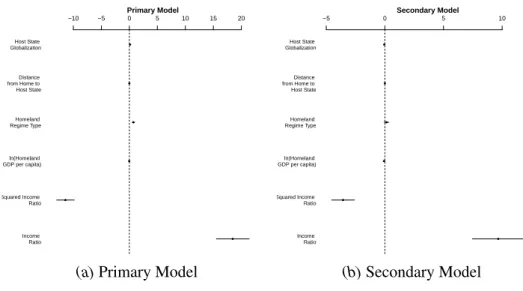
consequently act upon, the political events in their homelands if the regime is transparent enough to allow information to flow across borders. I provide an illustration of the results by plotting the coefficients associated with the primary and secondary models in Figure 5.
Fig. 5:Logistic Regression Estimates
Primary Model
−10 −5 0 5 10 15 20
Income Ratio Squared Income Ratio ln(Homeland GDP per capita) Homeland Regime Type Distance from Home to Host State Host State Globalization ● ● ● ● ● ●
(a)Primary Model
Secondary Model
−5 0 5 10
Income Ratio Squared Income Ratio ln(Homeland GDP per capita) Homeland Regime Type Distance from Home to Host State Host State Globalization ● ● ● ● ● ●
(b)Secondary Model
income ratio remains negative and statistically significant. I also run the primary and secondary models with host state, homeland, and year fixed effects, the results of which are displayed in Table 38 in Appendix A. The results of the fixed effects models are consistent with the primary and secondary models’ results. I additionally run the primary and secondary models with a variable that controls for conflict intensity, operationalized as battle deaths per conflict-year, and the results hold (Lacina and Gleditsch, 2005). However, the limited nature of data collection on battle deaths reduces my dataset by 37%, so my main models exclude the number of battle deaths as a control variable.40 Last, I include robustness tests, the results of which are displayed in Table 38 of Appendix A, in which the dependent variable is measured as each separate component of diaspora support (financial, military, and political). The results from the primary and secondary models hold when the dependent variable is measured as financial and military, but not political, aid from diasporas. Thus, the variables associated with economic integration behave largely as expected in the main models and alternative
specifications.
Because I employ logistic regression, I also present the predicted probabilities associated with the results of the primary and secondary models in Figure 6.41 The key
40I present the results of this additional test in Table 37 in Appendix A.
Fig. 6:Predicted Probability of Diaspora Support Conditional on Diaspora: Native Income Ratios
0.4 0.6 0.8 1.0 1.2 1.4 1.6
0.0
0.2
0.4
0.6
0.8
Probability of Support by Income Ratios
Ratio of Incomes
Pr(Suppor
t f
or Militants)
Point Estimate 95% Confidence Interval Income Ratio Mean
(a)Primary Model
0.4 0.6 0.8 1.0 1.2 1.4 1.6 1.8
0.0
0.2
0.4
0.6
0.8
Probability of Support by Income Ratios
Ratio of Incomes
Pr(Suppor
t f
or Militants)
Point Estimate 95% Confidence Interval Income Ratio Mean
(b)Secondary Model
variables in my models, the income ratio and squared income ratio, achieve statistical
significance, so I interpret the substantive implications by considering the associated predicted probabilities. Figure 6 illustrates the effects of integration levels, operationalized as the ratio of incomes between diaspora members and natives in the host state, on the probability of diaspora aid to militants (in my primary model). Probability of diaspora support, displayed on the y-axis, is bounded between 0 and 1. The x-axis displays the ratio of incomes between the diaspora and natives in the host state. The low range of ratios indicates diasporas experiencing dissimilation, the moderate range represents diasporas’ experience of segmented assimilation, and the high range illustrates incorporated diasporas.42
The level of integration that diaspora members experience in their host states is the key variable outlined by my theoretical framework. Specifically, I argue that diasporas
experiencing segmented assimilation are those more likely to participate in homeland conflicts by providing aid to militants. Fully incorporated or dissimilated militants, conversely, are less likely to support militants since they lack either the motivation or resources to do so. The predicted probabilities associated with my primary and secondary models provide evidence in support of this integration-based hypothesis.
In Figure 6, the solid blue line represents the probability of support by integration