The Situational Judgment Test Validity Void: Describing Participant Response Processes
Michael David Lee Wolcott
A dissertation submitted to the faculty at the University of North Carolina at Chapel Hill in partial fulfillment of the requirements for the degree of Education in the Learning Sciences
and Psychological Studies program in the School of Education.
Chapel Hill 2018
Approved by: Gregory J. Cizek Thurston Domina Robert Hubal
© 2018
ABSTRACT
Michael David Lee Wolcott: The Situational Judgment Test Validity Void: Describing Participant Response Processes
(Under the direction of Dr. Gregory J. Cizek)
Situational judgment tests (SJTs) are used to measure components of professional competence that cannot be assessed via traditional tests of knowledge and skill. Despite their popularity, there is a significant gap in the validity evidence and research on the response process to support how SJTs measure their intended constructs. This study evaluated an SJT to examine: (1) the factors that influence the response process, (2) the role of experience, (3) the role of contextual features, and (4) whether individuals attempt to identify the construct being assessed. Thirty
ACKNOWLEDGEMENTS
Thank you to all of those who made this dissertation possible. First, thank you to my dissertation advisor, Dr. Gregory Cizek, and committee members, Dr. Thurston Domina, Dr. Robert Hubal, Dr. Jacqueline McLaughlin, and Dr. Adam Meade. They each provided invaluable insight throughout this process. In addition, I want to thank my classmates and outstanding educators I have been fortunate to work with at the UNC School of Education; you all have been an inspiration and constant source of support in my growth as an educational researcher.
Additional thanks to Dr. Jacqueline McLaughlin, who has served as an exceptional mentor and role model while working at the UNC Eshelman School of Pharmacy. Her support, along with assistance from Dr. Tom Angelo and Dr. Scott Singleton, aided my transition into the social sciences and I am grateful for the opportunity to work under their guidance. I also want to thank Provost Robert Blouin for launching this partnership between the Schools and for encouraging me to pursue this path. Dr. Mary Roth McClurg and Dean Dhiren Thakker also deserve special thanks for providing me with the opportunities to advance my training at the UNC Eshelman School of Pharmacy. Thank you to Dr. Jacqueline Zeeman for assisting with this research and to the faculty who helped design this SJT. Moreover, thank you to Nikki Lobczowski—you inspire me each day to do my best and we challenge one another to reach our fullest potential; you have been my guide throughout this process as a classmate, co-researcher, co-presenter, and best friend—I can never thank you enough. I also thank my parents, family, and phriends for
TABLE OF CONTENTS
Page
LIST OF TABLES ... xiii
LIST OF FIGURES ... xvi
Chapter 1: Introduction ... 1
Health Professions and the Non-Cognitive Dilemma ... 1
Situational Judgment Tests ... 6
Debate Surrounding the Situational Judgment Test ... 7
The Precarious Position of Situational Judgment Tests ... 11
Purpose and Research Questions... 12
Summary ... 14
Chapter 2: Literature Review ... 16
Theoretical Basis of the Situational Judgment Test ... 17
Validity Evidence for Situational Judgment Tests ... 23
Test content. ... 24
Internal structure. ... 26
Relationships with Other Variables. ... 28
Consequences of testing. ... 29
Cognitive / response processes. ... 30
Evaluating Response Processes in Assessments ... 33
Defining the Construct of Interest – Empathy ... 37
Chapter 3: Methods ... 44
Instrument Design ... 44
Interpretation and use argument... 45
Construct definition. ... 45
Content specification. ... 46
Format specifications ... 47
Response instructions... 47
Response format... 48
Test length and time. ... 51
Item development... 51
Subject matter expert recruitment. ... 52
Item writing. ... 53
Item review. ... 55
Item selection. ... 56
Participants and Recruitment ... 59
Data Collection Procedures ... 62
Participation and consent. ... 62
Test and survey administration. ... 63
Think-aloud interviews. ... 63
Cognitive laboratory interviews. ... 64
Data Preparation Procedures ... 66
SJT performance data and survey responses. ... 66
Interview data... 67
Data Analysis Procedures... 67
QCAE scoring and analysis ... 69
SJT performance data and analysis. ... 70
SJT scoring... 70
Psychometric analysis ... 72
Cognitive interview coding. ... 74
Think-aloud interview coding. ... 78
Cognitive and think-aloud interview data analysis. ... 79
Addressing the Research Questions ... 79
Summary ... 82
Chapter 4: Results ... 83
Summary of SJT Instrumentation Development ... 84
Sample Characteristics from SJT Administration ... 85
Student characteristics. ... 85
Pharmacist characteristics. ... 87
QCAE results. ... 87
Relationship of the QCAE to other variables. ... 88
Psychometric Properties of this SJT... 90
RQ1: Factors and Strategies Involved in the SJT Response Process ... 93
Data analysis summary. ... 94
Prevalence and distribution of codes. ... 95
Distribution of codes by item classification and participant type. ... 97
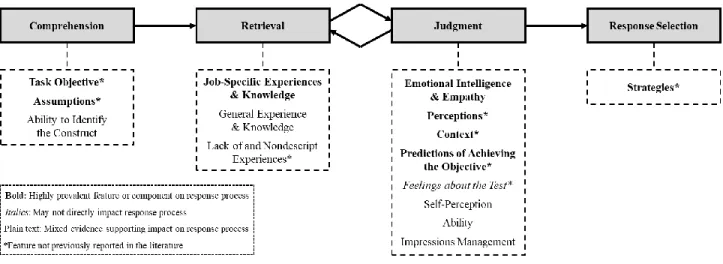
Proposed model of SJT response processes. ... 99
Comprehension Component... 101
Task objective identification and response prediction. ... 101
Retrieval Component. ... 105
Judgments Component. ... 105
Judgments of emotional intelligence and empathy. ... 106
Judgments of self-perception, ability, and impressions management. ... 108
Judgment perceptions. ... 110
Response selection. ... 111
Response selection strategies. ... 112
Participant reflections about SJT processes. ... 114
Summary of RQ1. ... 115
RQ2: Role of Experience in SJT Response Processes ... 115
Data analysis summary. ... 116
Prevalence and distribution of codes related to experience and knowledge. ... 117
Prevalence according to item characteristics and participant type. ... 117
Prevalence according to SJT item. ... 119
Salient features of experiences and knowledge. ... 121
Description of job-specific experiences. ... 121
Description of general experiences. ... 123
Description of job-specific knowledge. ... 123
Description of general knowledge. ... 124
Description of nondescript experiences and knowledge. ... 124
Description of lack of experience and knowledge. ... 125
References to experiences and knowledge in think-aloud interviews. ... 125
Summary of RQ2. ... 126
RQ3: Role of Setting in SJT Response Processes ... 126
Perceived impact of a change in item setting... 127
Impact of setting based on item characteristic and participant type. ... 128
Impact of setting based on SJT item. ... 129
Description and distribution of the setting features. ... 132
Pertinent setting features based on SJT item. ... 135
References to setting features in think-aloud interviews. ... 135
Summary of RQ3. ... 136
RQ4: Role of the Ability to Identify the Construct in SJT Response Processes ... 136
Data analysis summary. ... 137
Frequency that empathy was the identified construct. ... 137
Frequency that empathy was identified by item characteristic and participant type. .. 138
Frequency that empathy was identified based on SJT item. ... 139
Other constructs identified by participants. ... 140
Challenges with identifying constructs. ... 140
Summary of RQ4. ... 142
Summary ... 143
Chapter 5: Discussion ... 144
Significance and Implications of Results ... 144
Discussion of the psychometric properties of this SJT. ... 144
Discussion of RQ1. ... 146
Discussion of RQ2. ... 149
Discussion of RQ3. ... 152
Discussion of RQ4. ... 155
Concluding remarks and implications of the results. ... 158
Difficult to define professional competence using strictly unidimensional constructs. .... 159
Poor understanding of construct gradients and interpreting results. ... 161
When to account for participant characteristics. ... 162
Limited interpretations when using a single assessment strategy. ... 163
Challenges with Research on Response Processes ... 164
Response process research as an emerging field. ... 164
Response process research requires multiple methodologies. ... 165
Response process research necessitates models, which can vary. ... 165
Challenges with Designing and Conducting Research on SJTs ... 166
Resource intensive process. ... 166
Awareness of contextual features that affect design and participant responses. ... 167
Variation in response formats and scoring strategies. ... 169
Lack of best practice recommendations. ... 169
Limitations of the Present Research Design ... 170
Limitations of the research methodology. ... 170
Limitations of SJT content and format. ... 172
Limitations of the participant sample. ... 172
Future Research ... 173
Modifications to the research design of this study... 174
Confirmation and evaluation of SJT response process models. ... 175
Connection of SJT performance to observed behaviors. ... 175
Evaluation of SJTs as longitudinal assessment strategies. ... 176
Evaluation of SJT design features that impact performance. ... 177
Summary ... 177
APPENDIX B. ITEM REVIEW SESSION HANDOUT ... 181
APPENDIX C. SITUATIONAL JUDGMENT TEST ... 182
APPENDIX D. RECRUITMENT EMAILS... 186
APPENDIX E. PARTICIPANT CONSENT DOCUMENT ... 187
APPENDIX F. SJT ITEM AND INTERVIEW DISTRIBUTION PER PARTICIPANT ... 189
APPENDIX G. QUESTIONNAIRE OF COGNITIVE AND AFFECTIVE EMPATHY ... 190
APPENDIX H. STUDENT PARTICIPANT DEMOGRAPHIC SURVEY ... 191
APPENDIX I. PHARMACIST PARTICIPANT DEMOGRAPHIC SURVEY ... 192
APPENDIX J. THINK-ALOUD INTERVIEW SCRIPT ... 193
APPENDIX K. COGNITIVE INTERVIEW SCRIPT ... 194
APPENDIX L. FINAL CODEBOOK ... 195
APPENDIX M. PARTICIPANT SJT PERFORMANCE DATA ... 196
APPENDIX N. HEAT MAP OF CODE DISTRIBUTION... 197
LIST OF TABLES
Table Page
1. Professional Attribute Framework ... 3
2. Common Approaches for Measuring Professional Competence ... 5
3. Sample SJT Formats ... 49
4a. Subject Matter Expert Demographics ... 53
4b. Subject Matter Expert Demographics ... 53
5. SJT Item Evaluation Criteria Based on the Subject Matter Experts ... 58
6. Summary of SJT Item Content ... 59
7. Summary of Data Collection and Data Analysis Procedures with Associated Research Questions ... 61
8. QCAE Scoring Summary ... 69
9. Ranking SJT Item Score Matrix ... 71
10. Interview Coding Strategy and Rater Agreement ... 76
11. Participant Characteristics by Participant Type ... 86
12a. Spearman’s Rank Correlation Coefficients of the QCAE to Other Variables ... 89
12b. Point Biserial Correlations of the QCAE to Other Variables ... 89
13. SJT Item Psychometrics Based on All Participant Responses ... 90
14. SJT Item Psychometrics by Item and Participant Classifications Based on All Participant Responses ... 92
15. Correlation Matrix of SJT Items ... 93
16. Most and Least Prevalent SJT Response Process Codes Based on Interview Type ... 97
17a. Most Prevalent Codes During Cognitive and Think-Aloud Interviews Organized by Item Classification and Participant Type ... 98
18. Categories of Comprehension Task Objectives Identified by Participants ... 102 19. Frequency of References to Comprehension Task Objectives Based on Interview Type
Organized by Item Classification and Participant Type ... 103 20. Categories of Comprehension Assumptions Made by Participants During Comprehension
... 104 21. Frequency of References to Comprehension Assumptions Based on Interview Type
Organized by Item Classification and Participant Type ... 104 22. Frequency of References to Judgment Emotional Intelligence Based on Interview Type
Organized by Item Classification and Participant Type ... 107 23. Frequency of References to Judgment Affective and Cognitive Empathy Organized by
Item Classification and Participant Type ... 107 24. Perceptions that Influenced Participant Judgments ... 110 25. Frequency of References to Judgment Perceptions Based on Interview Type Organized by Item Classification and Participant Type ... 111 26. Strategies Used During Participant Response Selection ... 113 27. Frequency of References to Response Selection Strategies Based on Interview Type
Organized by Item Classification and Participant Type ... 113 28. Features of Participants Reflections about SJT Processes ... 114 29. Frequency of Participants who Reported Job-Specific or General Experiences and
Knowledge during Cognitive Interviews Organized by Item Characteristics and Participant Type ... 119 30a. Frequency of Participants who Reported Job-Specific or Nondescript Experiences and
Knowledge in Cognitive Interviews Organized by SJT Item ... 120 30b. Frequency of Participants who Reported General or a Lack of Experiences and
Knowledge in Cognitive Interviews Organized by SJT Item ... 120 31. Features of the Experiences and Knowledge Referenced by Participants during this SJT
32. Frequency and Comparison if a Change in Setting Affects Response Selections by Item Characteristic and Participant Type ... 128 33. Frequency of When a Change in Setting Affects Response Selection by SJT Item and How the Response Changes by Participant Type ... 130 34. Factors about the Item Setting Perceived to Influence SJT Responses Grouped by
Category ... 133 35. Examples of the Setting that Affect Responses by SJT Item ... 134 36. Frequency and Comparison of Participants Identifying Empathy as the Construct Being
Assessed by Item Characteristic and Participant Type and the Correlation to Score on the Item ... 138 37. Frequency that Participants Identified Empathy as the Construct Being Assessed by SJT
LIST OF FIGURES
Figure Page
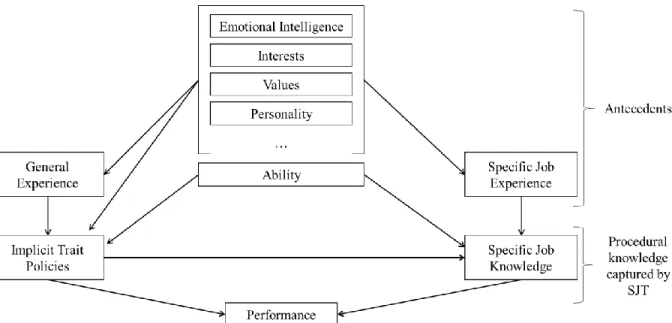
1. Model of knowledge determinants and antecedents of situational judgment tests ... 17
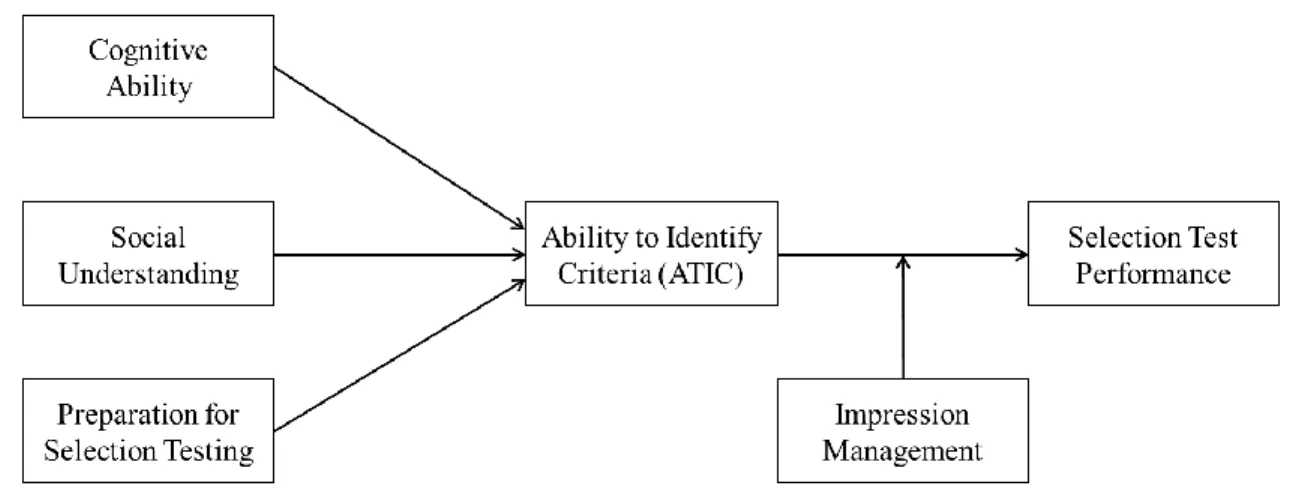
2. Model of ability to identify criteria in selection tests ... 22
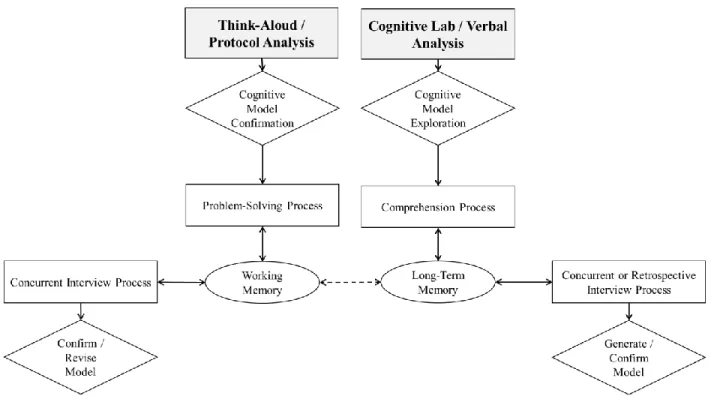
3. Differential measurement objectives for think-aloud interviews and cognitive laboratory interviews ... 35
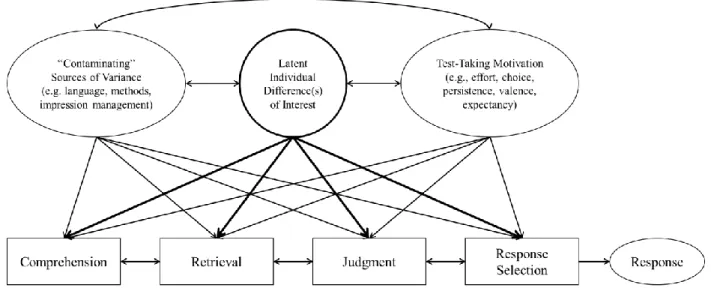
4. A model of SJT response processes ... 36
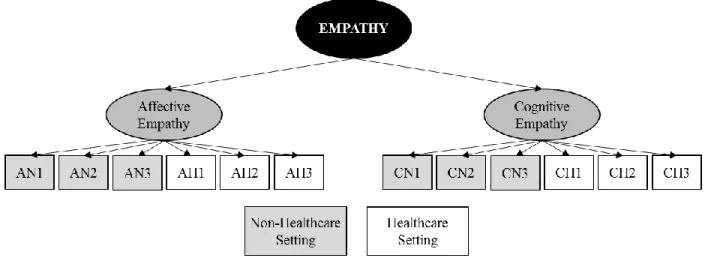
5. Map of SJT items, settings, and the associated construct components. ... 46
Chapter 1: Introduction Health Professions and the Non-Cognitive Dilemma
For decades health professions education has focused on the attainment of clinical knowledge as the dominant indicator of practitioner competence (Berwick & Finkelstein, 2010). This notion, however, has become less appealing due to the dramatic evolution of medicine over the years. Advances in technological capabilities as well as constant changes to our
understanding of the human body have created an expansive field of knowledge that is difficult to understand, let alone master, during a student’s time in school. The current drive in health professions educational reform is to prepare future healthcare providers with the knowledge, skills, and abilities to handle complex, ill-defined problems and situations encountered in practice (Cooke, Irby, & O’Brien, 2010; Irby, 2011).
A critical element of health professions educational reform is a paradigm shift that academic performance–the previous indicator of competence–is now a necessary, but not sufficient, quality of a competent clinician (Patterson et al., 2016). This shift has contributed to greater emphasis on the remaining aspects of performance, which are attributes of a separate entity known as professional competence. Professional competence is distinctly different than clinical competence, which refers to the knowledge and skills related to diagnosis, clinical decision making, and treatment management (Miller, 1990; Neufeld & Norman, 1985).
clinical knowledge, skills, and abilities (Epstein & Hundert, 2002; Farrington et al., 2012). The research presented here focuses on professional, rather than clinical, competence.
In health professions education, the term non-cognitive often refers to the interpersonal, intrapersonal, psychosocial, and behavioral knowledge, skills, and abilities necessary to
effectively deliver healthcare. As stated, these are often broadly classified under an expansive domain labeled professional competence (Bardes, Best, Kremer, & Dienstag, 2009; Epstein & Hundert, 2002). Example qualities include a practitioner’s motivation, integrity, empathy, confidence, and self-regulation. Understanding of and appreciation for how each of these qualities contributes to effective patient care is the minimum expectation of beginning
practitioners; beyond this, practitioners should aspire to master knowledge, skills, and abilities related to professional competence throughout the course of their career (Levine & Cayea, 2015).
A review of the literature suggests there are variable conceptualizations of professional competence (Epstein & Hundert, 2002; Goldstein et al., 2006; Li, Ding, Zhang, Lie, & Wen, 2017). Of those discovered, the Professional Attributes Framework (see Table 1) offers a
comprehensive outline of the proposed knowledge, skills, and abilities that comprise professional competence. Originally developed in the United Kingdom (UK), the framework is based on observational studies of first-year physicians. Importantly, it outlines the professional attributes physicians are expected to master and is applicable to the range of health professions. This framework is specifically used in selection procedures for the Foundation Programme—the UK’s equivalent to graduate training in the United States (Patterson, Ashworth, Kerrin, & O’Neill, 2013). Standardized assessments for selection into the Foundation Programme, for example, target five of the eight sub-domains determined to be most salient: (1) patient focus (i.e.
as a team, (4) commitment to professionalism, and (5) effective communication. Table 1
Professional Attribute Framework (adapted from Patterson, Ashworth, Kerrin, & O’Neill, 2013)
Constructs/Sub-Domains Definition Example Behaviors/Scenarios
Patient focus (i.e. empathy)
Ensures patient is the focus of care. Demonstrates understanding and appreciation of the needs of all patients, showing respect at all times. Takes time to build relationships with patients, demonstrating courtesy, empathy and
compassion. Works in partnership with patients about their care.
Identifying patient’s views and concerns
Considering patient needs outside of your own Empathizing with the patient
Coping with pressure (i.e. adaptability)
Capability to work under pressure and remain resilient. Demonstrates ability to adapt to changing circumstances and manage uncertainty. Remains calm when faced with confrontation. Develops and employs appropriate coping strategies and demonstrates judgement under pressure.
How to respond when you make a mistake
Dealing with confrontation Seeking help
Working effectively as part of a team
Capability & willingness to work effectively in partnership with others and in multi‐disciplinary teams. Demonstrates a facilitative, collaborative approach, respecting others’ views. Offers support and advice, sharing tasks appropriately. Demonstrates an understanding of own and others’ roles within the team and consults with others where appropriate.
Recognize and value other staff members
Consult with colleagues about workflow and expectations Offer assistance to support colleagues
Commitment to professionalism
Displays honesty, integrity and awareness of confidentiality & ethical issues. Is trustworthy and reliable. Demonstrates commitment and
enthusiasm for role. Willing to challenge
unacceptable behavior or behavior that threatens patient safety, when appropriate. Takes responsibility for own actions.
Issues of confidentiality Challenging inappropriate behavior
Commitment to learning
Effective communication Actively and clearly engages patients and colleagues in equal/open dialogue. Demonstrates active listening. Communicates verbal and written information concisely and with clarity. Adapts style of communication according to individual needs and context. Able to negotiate with colleagues & patients effectively.
Gathering information and communicating intentions Negotiation skills
Listening and communicating with different populations
Organization and planning*
Manages and plans workload effectively, displaying efficient time management and delivering tasks on time. Able to prioritize effectively and re‐prioritize where appropriate. Is conscientious and maintains accurate records.
Effective time management Prioritize tasks effectively Maintains accurate records Manages plans and workload Problem solving and
decision making*
Demonstrates an ability to assimilate a range of information and identify key issues. Engages with the wider issues and thinks creatively to solve problems and reach appropriate decisions. Is proactive and demonstrates initiative. Is able to attend to detail.
Makes informed decisions Demonstrates initiative Assimilate and integrate information
Attention to details Self-awareness and
insight**
Demonstrates awareness of the boundaries of their own competence and willing to seek help when required, recognizing that this is not a weakness. Exhibits appropriate level of confidence and accepts challenges to own knowledge.
Seek help when needed Admit a lack of knowledge Recognize boundaries of competence Accepts challenges Accepts mistakes Learning and professional development***
Demonstrates desire and enthusiasm for continued learning, takes responsibility for own development. Willing to learn from others and from experience. Is open and accepting of feedback. Demonstrates a desire and willingness to teach others.
Enthusiasm to learn Learns from experience and mistake
Accepts feedback
Notes: *Considered implicit to the situational judgment test methodology (not included as a construct) **Considered to be integral to coping with pressure (subsequently consolidated)
Where students learn about these sub-domains is an emerging topic in the health professions: it was often assumed that developing professional competence was part of the hidden curriculum within the health professions (Hafferty, O’Donnell, & Baldwin Jr., 2015). More recently, the health professions are making these skills explicit and integrating them within their curricula to ensure they are acquired during their education and practice experiences
(Goldstein et al., 2006).
Although assessment of professional competence is increasingly popular in the health professions, it remains a formidable challenge (Ferguson & Lievens, 2017; Patterson, Cleland, & Cousans, 2017; Ratanawongsa et al., 2006). Assessment of professional competence, although identified as relevant, often remains a secondary criterion for evaluation compared to the development of clinical knowledge, skills, and abilities (Kane, Clauser, & Kane, 2017). Moreover, assessment of professional competence is difficult because these sub-domains can overlap substantially, have variable definitions, and are not all considered equally important across the professions (Hays, 2013). Overall, the prioritization of other skill sets, inconsistency in the definitions, and mixed relationships among the sub-domains of interest has led to a fragmented field advancing in multiple directions.
(Patterson, Cleland, & Cousans, 2017). The assessment approaches adopted and evaluated in the health professions fields have greatly improved the variety of instruments available to analyze sub-domains of professional competence (Li, Ding, Zhang, Liu, & Wen, 2017).
The importance of evaluating professional competence has also diffused beyond selection to describe growth throughout curricula, predict academic and practice performance, and identify areas for personal improvement (Cowart, Dell, Rodriguez-Snapp, & Petrelli, 2016; Goss et al., 2017; Persky, Greene, Anksorus, Fuller, & McLaughlin, 2017). The current challenge is
distinguishing which assessment strategies offer valid data in describing participant professional competence while balancing administrative and feasibility limitations. Table 2 summarizes key characteristics of approaches commonly used to measure professional competence in health professions education in addition to their strengths and weaknesses.
Table 2
Common Approaches for Measuring Professional Competence
Single Construct Questionnaires Personality Assessments (Hojat, Erdmann, & Gonnella, 2013) Multiple Mini Interview (Rees et al.,
2016) Situational Judgment Tests (Patterson, Zibarras, & Ashworth, 2015) Content
Variable based on the instrument (e.g., Jefferson scale of empathy, emotional intelligence, etc.)
Questions oriented to quantify levels of personality traits (e.g., the NEO Big 5, HEXACO, etc.)
Scenarios are oriented to evaluate a construct of interest (e.g. adaptability, integrity, empathy)
Scenarios are
designed to evaluate a construct of interest (e.g. adaptability, integrity, empathy)
Format
Questionnaire / survey completed by the individual
Questionnaire / survey completed by the individual
Individuals discuss their response to a scenario with a rater
Examinees select or rank optimal responses to a presented scenario
Scoring Process
Variable; points related to presence of a quality / attribute
Variable; points related to presence of a quality / attribute
Rater scores the individual based on observed discussion
Variable; points assigned based on consensus with a key
Advantages
- Often short / brief instruments - Focuses on a specific construct
- Substantial research - Generally stable construct
- Numerous uses
- High validity & reliability
- Can assess multiple constructs at once
- Moderate validity & reliability
- Can assess multiple constructs at once
Disadvantages
- Potential for faking - Requires multiple surveys if various skills
- Variable quality
- Often require commercial licenses - May oversimplify personality traits - Can be lengthy
- Resource intensive - Potential for faking - Influence of rater bias
Situational Judgment Tests
Of the assessment strategies described in Table 2, situational judgment tests (SJT) are a recent addition that has attracted substantial interest. SJTs originated in personnel selection to evaluate skills beyond cognitive ability, which was previously used to predict occupational performance (Campion, Ployhart, & MacKenzie Jr., 2014; Chan & Schmitt, 2002). SJTs were first characterized as a low-fidelity simulation (Motowidlo, Dunnette, & Carter, 1990) intended to measure how potential employees would respond to scenarios encountered on the job. Motowidlo and colleagues (1990) contributed to the initial evidence supporting that SJTs could measure unique skill sets different from cognitive ability–which could inform hiring decisions.
Growing interest in SJTs is due to its similarity with multiple mini-interviews (MMIs), which are used extensively in health professions education and selection (Patterson et al., 2016). During both an SJT and MMI, a participant is presented with a scenario commonly-encountered in practice and is requested to describe how to respond. A key difference between MMIs and SJTs is that an MMI includes an interaction that is evaluated by an interviewer, whereas an SJT is administered electronically or as a paper-and-pencil test. MMIs, therefore, are sometimes viewed unfavorably because they involve subjective scoring techniques, are highly resource intensive, and are administratively complex (Rees et al., 2016). As a result, SJTs are being investigated as a complementary assessment methodology for large-scale testing of professional competence, especially in the setting of graduate and postgraduate admissions (Koczwara et al., 2012; Patterson et al., 2016).
developers (Weekley & Ployhart, 2006) along with a question (i.e., test item) about the scenario and multiple response options that represent potential actions. Each action is evaluated by the examinee, who is asked to address the likelihood they should perform the action or who is asked to evaluate the effectiveness of the action. Items are designed to capture the knowledge of the examinee in selecting the most appropriate response options that would be consistent with the expectations of the job, which are tied to the constructs being measured. The constructs of interest targeted by an SJT will vary based on the job (e.g. management, healthcare, etc.); the common goal, however, is to measure participant attributes such as professional competence that are different from qualities such as cognitive ability.
At the end of an SJT, participants are assigned a score based on how well their response selections align with a key. The key used to score performance on an SJT can be developed by aggregating response data from subject matter experts (e.g. experienced clinicians), known as a
rational key, or from the most common examinee responses, known as an empirical key. The use of a rational key is the prominent scoring method in SJT research (De Leng et al., 2017). High scores indicate a participant has high levels of the trait being evaluated (i.e. knowledge
pertaining to the construct or constructs of interest), which is inferred by how close examinee performance matches that of a job expert when they approach the same tasks.
Debate Surrounding the Situational Judgment Test
complete an SJT. This section outlines reasons for this debate, the predominant opinions, and the impacts on current SJT research.
A hallmark of this debate is understanding the role of instrument design strategies in ensuring SJTs produce high-quality data. Difficulty reaching consensus among researchers is due considerably to the versatility of SJTs as instruments, which is also one of the benefits of using SJTs. For instance, users can tailor an SJT design process to fit their needs based on test
developer preferences or context-specific requirements. A consequence of this, however, is that comparison across SJTs is often problematic and it is difficult to ensure SJT design processes meet quality standards (McDaniel, Hartman, Whetzel, & Grubb, 2007; Patterson, Zibarras, & Ashworth, 2016). Currently, researchers are encouraged to maximize reliability and validity of the data by incorporating design principles supported by evidence (Lievens & Patterson, 2011; Lievens, Peeters, & Schollaert, 2008; McDaniel, Morgenson, Finnegan, Campion, & Braverman, 2001; McDaniel & Nguyen, 2001); these principles are described in greater detail in Chapter 3 to inform SJT design for this research.
SJT design is critical because it influences the interpretation of individual performance and empirical findings. Originally, SJTs were presumed to produce quality measures of the constructs of interest because the scenarios were generated from on-the-job reports or experts agreed the situations were consistent with practice (McDaniel, Whetzel, Hartman, Nguyen, & Grubb, 2006). Upon further psychometric analyses, however, SJTs came to be seen as
if performance was an artifact of attributes unbeknownst to the researcher, such as an interaction of multiple constructs or poorly designed test items.
Lievens (2017) argues that SJTs can be designed purposefully to measure a construct of interest: an approach he calls construct-driven SJTs. This approach to SJT design incorporates scenarios generated from practice experiences while also integrating theoretical and empirical understanding of the sub-domains of professional competence. In other words, scenarios and response options are crafted to tap into salient features of the construct of interest based on evidence in the literature of what components of the construct should be present if we are truly measuring that construct. This approach is intended to create SJT items that are unidimensional and more consistent with theoretical underpinnings—a consideration that was frequently ignored in prior SJT research.
Moreover, the construct-driven approach to SJT development parallels the evidence-centered design approach that was founded in educational assessment (Mislevy, Almond, & Lukas, 2003; Riconscente, Mislevy, & Corrigan, 2016). Both methodologies stress the importance of a systematic approach in defining the construct to be tested, outlining the components, and ensuring alignment between test items and the construct of interest. The
research described here utilized the construct-driven approach to develop scenarios and response options consistent with theoretical elements of the construct of interest to ensure an SJT
measures the intended construct; the extent to which there is measurement fidelity to the construct of interest was evaluated through investigation of participants’ response processes, outlined in subsequent chapters.
diversity in SJT methodology has led to difficultly in forming a theoretical framework that elucidates what contributes to SJT performance. As previously described, an SJT is designed to have participants reflect on their knowledge and experiences to inform their decision-making processes as they select an action intended to produce a desirable outcome. Currently, this response process is believed to be influenced by participant ability, interests, personality, values, emotional intelligence, and job-specific as well as general knowledge and experience (Lievens & Motowidlo, 2016).
The extent to which these factors influence SJT performance is highly dependent on design features, which is described in greater detail in the following chapters. The setting or contextual information provided in an SJT item, for example, has been an area of recent focus. Lievens and Motowidlo (2016) argue SJTs may not be as situational as previously suspected. They argue the item setting can be stripped from an SJT item and not dramatically influence examinee performance, which implies the setting may not be critical. This argument, however, had not been sufficiently explored. It is plausible SJT questions may not draw on job-specific knowledge or the setting may not influence the recall or decision-making process engaged to select an appropriate course of action.
Moreover, research has begun to explore the examinee’s ability to identify criteria
Overall, the research presented here explored how these attributes (i.e. job-specific knowledge, item setting, and the ability to identify the construct) could influence the response process and provided additional evidence regarding their roles in SJT performance.
The Precarious Position of Situational Judgment Tests
Escalating interest in SJTs initially eclipsed efforts to generate supporting evidence for its use as an assessment strategy in the health professions. Gessner and Klimoski (2006) noted the interest in and potential of SJTs as useful instruments overshadowed the necessary investigations describing theoretical underpinnings of SJTs. Moreover, there were inadequate attempts to establish validity evidence that distinguished what constructs were assessed and the elements involved in response processes; given the enthusiasm SJTs are now heavily used without sufficient evidence to support its systemic use (Sorrel et al., 2016). Overall, questions remain about the quality of data an SJT produces and a deeper understanding of what is being measured (e.g. the construct of interest and associated cognitive processes) is needed.
Although these concerns may seem trivial to those outside the measurement specialty, SJT use can be consequential. SJTs are being applied more often in high-stakes environments such as selection into health professions education and postgraduate training; the
mismeasurement of attributes in these arenas may have serious consequences for examinees in addition to the wellbeing of others. It is imperative that assessments informing high-stakes decisions have sufficient validity evidence to support their interpretation and use (Caines, Bridglall, & Chatterji, 2014).
Most validity evidence supporting SJT score interpretations is generated using
exclusive emphasis on quantitative validity evidence, however, limits a comprehensive
understanding of the cognitive processes involved when completing SJT items. Considering an SJT is intended to measure a decision-making or judgmental process, there are various processes that are assumed to take place that have not been thoroughly described in the literature. A void exists in the literature regarding SJT response processes that could be explored further with appropriate methodologies.
SJTs incorporate complex, contextualized situations and a host of responses that can vary substantially based on the constructs of interest being assessed. Emerging research on assessing similar, complex skills demonstrates that alignment and design of instruments to evaluate these knowledge, skills, and abilities is challenging but not insurmountable (Erickan & Oliveri, 2016). It is possible to accomplish measurement of these attributes by outlining the intricacies and connections of constructs to be assessed, the processes individuals are expected to engage, and the meaning of the findings (Geisinger, 2016). Care and colleagues (2016) recommend
deconstructing how individuals approach problems from a cognitive and social perspective, which is paramount as it applies to SJTs. A greater understanding of the response processes and attributes that influence those processes addresses a component of the many challenges
associated with SJTs; however, it can also greatly inform SJT design and research to ensure it yields valid inferences about the intended constructs being assessed.
Purpose and Research Questions
American Psychological Association [APA], & National Council on Measurement in Education [NCME], 2014) identify evidence based on response processes as a crucial element of validity evidence for assessments that require complex thinking or decision-making. Validity evidence to support a claim that the assessment measures the intended construct and to confirm examinees interpret the assessment appropriately is critical but has been neglected in SJT research. Additional research is needed to explore the response process examinees engage in during an SJT to thoroughly describe what elements of knowledge, skills, and abilities are activated in this process.
The purpose of this study was to address a gap in the validity evidence supporting SJTs in assessing constructs of interest. This study focused on generating evidence of response processes to an SJT measuring one construct that is typically of interest in health professions training: empathy. This research provides a prototype for exploring and describing response processes when using construct-driven SJTs with the intent of applying the methodology to SJTs measuring other constructs of interest in the future. The research questions included:
RQ1: What factors and strategies are involved in the cognitive processes when examinees respond to SJT items?
RQ2: What is the role of job-specific experiences (i.e. student or experienced clinicians) in the response process to SJT items?
RQ3: What is the role of the setting presented in SJT items in the response process (i.e. the influence of healthcare specific setting or non-healthcare specific setting)?
Due to the limited evidence regarding the response processes when completing an SJT, the research questions were exploratory in nature and there were minimal hypotheses about the findings. With regards to the first research question, it was anticipated that components
pertaining to the theoretical underpinnings of SJTs (e.g. values, interest, ability, prosocial behaviors, etc.) may be evident in the response process of examinees. Although this may not be made explicit by participants, the goal was to probe participants to better understand how they believed these factors may contribute. For the second research question, it was suspected that greater job-specific experiences would influence response processes in that individuals would recall these experiences more often to address the presented situations and pick an optimal response that draws more heavily from those experiences. The third research question was intended to describe whether the setting presented in the item was able to influence response process. Prior research would suggest the setting is not a critical element and this work was expected to clarify this further as it pertains to response processes (Krumm et al., 2015;
Rockstuhl et al., 2014). The final research question was to initiate an understanding of whether participants can identify the construct of interest being measured and the potential influence on response processes. It was suspected individuals would include this aspect in their response, although it was unclear if this would be at the forefront of or influences their thought processes. Summary
The use of SJTs in the health professions is a rapidly growing phenomenon as an approach to measure professional competence, which is difficult to capture and often resource intensive to measure using other methodologies. Despite its popularity as a tool and expansive research in industrial and organizational psychology, there remain deficits in the validity
Chapter 2: Literature Review
Four areas of research inform the background and design of this research study. First, an overview of the theoretical basis of SJTs is provided to describe elements hypothesized or demonstrated to influence examinee performance. Second, a review of pertinent validity evidence supporting SJTs is presented to identify gaps with an emphasis on what is to be addressed through this research. Third, a summary of research on complex response processes used during assessments will outline the potential response processes examinees may engage with when completing an SJT.
Fourth, the chapter concludes with a brief review of the theoretical and empirical understanding of the construct evaluated in this study: empathy. Empathy was selected as the construct of interest for this research because there is substantial evidence that empathy expressed by health care professionals enhances patient satisfaction, comfort, and trust, which can contribute to positive patient outcomes (Kim, Kaplowitz, & Johnson, 2004; Reiss et al., 2008). Moreover, Quince and colleagues (2016) suggest that empathy is becoming as important in healthcare as clinical competence.
Theoretical Basis of the Situational Judgment Test
The resurgence of SJTs has led to a greater focus on its theoretical underpinnings (Lievens & Motowidlo, 2016). In general, there are a host of antecedents that influence SJT performance regardless of the construct being evaluated or the context of the test. The theoretical model has been refined over the years with the most prominent being a model crafted by Lievens and Motowidlo (2016). In this model, shown in Figure 1, they identify attributes such as
emotional intelligence, interests, values, personality traits, cognitive ability, and experiences (both general and specific to the job) as critical precursors to informing decision making processes on an SJT. Recognizing these antecedents was significant to this research as the aim was to describe the response process during an SJT to determine how these antecedents may influence the response process and subsequently be described during participant interviews. The antecedents are assumed to or have been shown to relate to SJT performance; therefore, these elements will be included in the coding schemes described in Chapter 3 and inform qualitative data analysis.
The consensus has been that SJTs measure procedural knowledge regarding effective actions in response to scenarios presented on a test (Clevenger, Pereira, Wiechmann, Schmitt, & Harvey, 2001; McDaniel & Nguyen, 2001). Procedural knowledge in this setting refers to knowledge about how to respond to a scenario not necessarily whether individuals possess an ability to carry out the response in person. In addition, procedural knowledge could include when or how to apply that knowledge based on the presented scenario.
Motowidlo and Beier (2010) advanced this theory based on the understanding of knowledge acquisition (Beier & Ackerman, 2005; Hambrick, 2003) to suggest that procedural knowledge includes two types: general domain knowledge and specific job knowledge. General domain knowledge refers to the appreciation of the costs and benefits of expressing a trait (i.e. following a certain action) in response to a scenario. General domain knowledge reflects the fundamental socialization processes and personal dispositions that are not obtained through job-specific experiences. Specific job knowledge can be learned only through that particular job or jobs like it (Lievens & Motowidlo, 2016). With respect to the health professions, this could include other service-oriented jobs such as human resources, teaching, social services, or public safety. Each of these knowledge antecedents plays a role in SJT and job performance; a study by Motowidlo and Beier (2010) showed both components predict job performance equally well.
Another important theoretical element is the relationship of general domain knowledge to
appropriate) is often mediated by other characteristics of the individual such as personality, values, interests, and experiences (Motowidlo, Hooper, & Jackson, 2006).
During an SJT, people who have higher tendencies for agreeableness may gravitate towards response options that appear to be more agreeable. This could introduce construct-irrelevant variance if agreeableness was not considered to be a component of the construct of interest. The relationships of ITPs to general domain knowledge and SJT performance has been essential in understanding observed relationships between personality and SJT performance. ITPs are presumed to vary across individuals, similar to personality traits.
A series of three studies by Motowidlo, Hooper, and Jackson (2006) confirmed there was a positive albeit weak relationship between ITPs measured by SJTs to certain personality
attributes. Their series of three studies included the development of an SJT for managers that had response options tailored to target extraversion, agreeableness, and conscientiousness. Their hypothesis was that participants would identify a response option as more effective if it was consistent with their personality traits; in other words, a person who is more extraverted would be more likely to rate a response option as highly effective if that response option was related to or expressed elements of extraversion. Two of the three studies included 196 undergraduates and showed the average correlation between ITPs and the associated personality traits (measured using the NEO Five-Factor Inventory) was .31 for agreeableness and .37 for extraversion; however, there was no significant relationship with conscientiousness.
assistants on the level of agreeableness and extraversion the participant displayed in their
response. Individual differences in ITPs for agreeableness predicted agreeable behaviors with an average correlation of .33; the findings of the three studies suggested that ITPs can be related to personality traits and be expressed to varying degrees during work-related simulations and SJTs.
Another theoretical element is the extent to which SJTs are truly situational. The findings that general domain knowledge and specific job knowledge relate equally to SJT performance suggest that SJTs could be considered tests of general domain knowledge instead of situationally specific knowledge (Lievens & Motowidlo, 2016).
A collection of studies by Krumm and colleagues (2015) evaluated the effect of
situational stems on SJT performance and showed inclusion of the situation descriptions may not be necessary for a majority of SJT items. In their first study, 436 participants (students and working people) were given a 35-item SJT intended to measure knowledge, skills, and abilities related to teamwork, such as conflict resolution, collaborative problem solving, communication, and goal setting. SJT items were modified to have a version with and without elaborate situation descriptions. The performance on the respective SJT items was compared and determined that the situation descriptions were not necessary for approximately 71% of the items.
descriptor has a significant role. For instance, thirty percent of the items assessing job-specific knowledge and skills of pilots could not be answered without the situational descriptors. The researchers argue this may be related to context-specific courses of actions; in other words, certain actions may be warranted based on specific contextual cues that have to be provided in the situational descriptors. Therefore, the setting may play a role for certain constructs.
Overall, the findings suggest that general domain knowledge is sufficient to solve a majority of SJT items and the label SJT may be a misnomer (Lievens & Motowidlo, 2016). That conclusion is still highly debated, however (Fan, Stuhlman, Chen, & Weng, 2016; Harris, Siedor, Fan, Listyg, & Carter, 2016; Harvey, 2016; Melchers & Kleinmann, 2016). The present research is positioned to explore that question by describing the extent to which general experiences are retrieved in SJT response processes compared to job specific experiences.
Personnel selection research has recently described a new element that may play a critical role in the theoretical understanding of assessments intended to evaluate decision-making
processes of candidates: the ability to identify criteria (ATIC). ATIC refers to a candidate’s capacity to distinguish which construct is being evaluated in these types of scenarios (Griffin, 2014; Kleinmann et al., 2011). ATIC is believed to mediate participant responses by serving as a filter to guide their selections based on their cognitive ability, social understanding, and
preparation for the testing, as shown in Figure 2.
the candidate interacted one-on-one with an interviewer (i.e. actor) in a simulated scenario designed to measure constructs such as empathy, integrity, and adaptability. Candidates were scored by the interviewer on a 7-point scale with 1 indicating poor overall performance on the station and 7 representing an outstanding performance. At the end of each interview station candidates were asked to write down the main quality the interviewer was assessing. The candidate answers to this question were rated by two judges on a scale of 0 (low fit) to 3 (high fit) with the construct that was measured according to the MMI development committee. There was a significant weak positive correlation (.33) between ATIC and MMI scores; overall, the findings suggest that ATIC may be an influential component in selection assessment
performance.
Figure 2. Model of ability to identify criteria in selection tests (adopted from Griffin, 2014)
The model presented by Griffin (2014) also notes the significance of impression
that seem consistent with the mission and vision of the job setting or those that seem like an option the supervisor would choose instead of what he or she feels is best. Impression management is congruent with faking effects discussed later in this chapter.
Thus far, SJT researchers have yet to investigate how the ATIC contributes to individual performance, if at all. During an SJT, for example, it is likely that a person reads the scenario and thinks of plausible options based on their interpretation of what the question is asking them to do (e.g. empathize by staying late after work, adapt by responding to an emergent need, etc.). If the examinee is unable to discriminate between these constructs, he or she is less likely to respond to the question correctly; therefore, this can be a critical element in the response process. In the research proposed here, participants will be asked directly about what construct they believe is being assessed by each item and how that influences their decision-making process. It is also unknown if participants explicitly identify these constructs on their own or if recognition only emerges through specific probing. In addition, there may be differences in whether identification of the construct is more inherent with expert clinicians than with novices. This research aims to begin the exploration of these questions.
Validity Evidence for Situational Judgment Tests
These different sources of evidence contribute to the interpretation and use argument (IUA), which outlines the inferences connecting observed performance on the test to the proposed interpretations and use of the test scores (Kane, 2013). In other words, the IUA
describes how test scores relate to the degree of mastery of the knowledge, skills, and abilities in the targeted domain. Of note, the focus of this research is to generate validity evidence in support of test score interpretation; therefore, there will be minimal emphasis on score use. There exists a smattering of validity evidence across these five sources of validity evidence that has been informative in supporting SJT score interpretation; however, these data are often fragmented and highly variable based on SJT design and context as discussed in the previous chapter (Christian, Edwards, & Bradley, 2010; Weekley & Ployhart, 2006). The following sections outline pertinent validity evidence relevant to SJTs according to the five sources suggested by the Standards. The review is not exhaustive; it focuses on major gaps in the validity evidence that can be addressed by this research.
Subject matter experts are frequently involved in the development of SJT scenarios, potential response options, and scoring keys based on their experiences (Christian, Edwards, & Bradley, 2010). Additional resources from employees can also be used to inspire test developers to create content relevant to the field such as job analyses, task inventories, and critical incident reports (Campion, Ployhart, & MacKenzie Jr., 2014). In general, this approach to SJT
development has provided consistent evidence that the test content is highly related to the aspects of job performance considered relevant to the subject matter experts and applicants (McDaniel, Whetzel, Hartman, Nguyen, & Grubb, 2006).
Applicant reactions to SJTs are often positive and participants feel the scenarios reflect attributes of the job they are likely to experience (Bauer & Truxillo, 2006; Truxillo, Bauer, Campion, & Paronto, 2002). These reactions are attributed to the use of real-life example
scenarios as well as the presentation mode of some SJTs (e.g. videos) that add a sense of realism and a sense of content alignment with job expectations. The contextual elements (i.e. setting) in SJT items are important for supporting test content validity evidence; however, it was previously highlighted there is debate whether SJTs need to be heavily situational. Lievens and Motowidlo (2016) argue that SJTs are capable of measuring job-specific and general domain knowledge independent of the setting. The present research will explore how setting influences the response process and the knowledge retrieved when taking an SJT.
experienced practitioners to define the appropriate response options to a scenario does not imply those are the best responses from a psychological, emotional, or social perspective.
It is recommended researchers develop SJTs that are cognizant of our theoretical
understanding of social and behavioral constructs to ensure the elicited responses are consistent with evidence of what should be measured when evaluating those constructs. Lievens (2017) describes the construct-driven SJT as an approach to ensure greater alignment of the test with the construct being evaluated. He argues the items should be checked for their level of agreement with the theoretical understanding of the constructs (e.g. factor structures, definitions of the constructs, consistency with other measurements used to evaluate that construct). The presented research incorporated the construct-driven SJT design approach to ensure an SJT was measuring the appropriate elements of the tested constructed.
Internal structure. Standards 1.13, 1.14, and 1.15 (AERA, APA, & NCME, 2014) describe sources of validity evidence regarding how subsections or components of a test are unique as well as related to one another. Historically, the consensus has been that SJTs were often intentionally multidimensional because they measured a variety of constructs
simultaneously that were highly related and difficult to distinguish from one another (Lievens, Peeters, & Schollaert, 2008). Psychometric techniques based on classical test theory have typically been used to analyze SJT performance data and the results have often been unremarkable. As might be expected, there was often evidence of multiple factors, but the structure could vary based on design principles, the context, or the constructs being assessed (Christian, Edwards, & Bradley, 2010).
identified 33 coefficients that ranged from .43 to .94. This summary, however, did not control for the number of SJT items or response instructions; the data simply summarized the coefficients as part of a larger meta-analysis with minimal interpretation. As a result, Catano and colleagues (2012) conducted a more extensive meta-analysis. Their review identified 39 published studies from 1990 to 2011; these studies included a total of 45,062 SJT responses and 56 reliability coefficients. The studies included SJTs that ranged from 3 to 60 items in length and did not have a consistent type of response instruction. The meta-analysis corrected for sampling error to account for sample sizes and the weighted mean corrected r was .46. Overall, these findings show the internal consistency coefficients for SJTs were weak, especially considering their use in high-stakes decisions.
Again, the weak validity evidence on the internal structure of SJTs is attributable to the traditional design approach. Without a clearly defined domain, the design of SJTs could target various constructs that rarely minimized content overlap leading to poor internal consistency and complex factor structures. As described previously, construct-driven SJTs can address this deficiency in the validity evidence much how the evidence-centered design approach has been instrumental in improving educational assessments (Riconscente, Mislevy, & Corrigan, 2016). A construct-driven SJT is focused on creating items that are unidimensional because they target a specific construct instead of large domains of knowledge as was done previously (Guenole, Chernyshenko, & Weekly, 2017). Insights from psychologists as well as theoretical and
Relationships with Other Variables. Standards 1.16 through 1.24 (AERA, APA, & NCME, 2014) highlight the source of validity evidence involving the relationship of
performance on SJTs relative to performance on other instruments or criteria for evaluation. SJT research in this area has been extensive in terms of describing what is measured. In the context of personnel selection, SJTs are often compared to job performance criteria to determine the
incremental validity of SJTs versus other traditional measures in employee selection (e.g. interviews, assessment centers, etc.). SJTs have consistently shown to provide incremental validity above and beyond cognitive ability and personality measures in selection settings
(Clevenger, Pereira, Wiechmann, Schmitt, & Schmidt-Harvey, 2001; Weekly & Ployhart, 2005). The correlation of SJT performance with other attributes has been extensively studied but has yielded mixed results. SJT performance data is often evaluated for the degree of correlation with measures of cognitive ability, Big Five personality assessments, questionnaires measuring other constructs of interest, as well as rater assessments of performance on the job or in
simulated scenarios (Guenole, Chernyshenko, & Weekly, 2017). In general, correlations of these measures with SJT tend to be relatively low but often statistically significant. The correlations, however, can vary substantially among studies based on the context, design, and constructs assessed by an SJT.
McDaniel and colleagues (2001), for example, showed SJT performance had a
of SJT performance to personality traits showed agreeableness (r = .25), conscientiousness (r = .26), and emotional stability (r = .31) to have low positive correlations with performance (McDaniel & Nguyen, 2001).
Evidence supporting the relationship between SJT performance and other constructs has been problematic. A content analysis conducted by Christian and colleagues (2010) reported that approximately one-third of the research literature on SJTs does not indicate the intended
constructs measured or authors do not provide enough information about the constructs to reliably evaluate how well the relationships to other measures support the validity of SJT score interpretations. Of note, the research was limited due to feasibility constraints and the research questions to be addressed to investigating the relationship of SJT scores to a select number of variables.
Consequences of testing. Standard 1.25 (AERA, APA, & NCME, 2014) describes the need for evidence to address intended and unintended consequences of testing, which is particularly significant as SJTs are being used in the health professions to inform high-stakes decisions such as admissions or residency placement (Patterson et al., 2016). Cizek (2015) argues that consequences relate to validity evidence supporting the justification of test use, which is separate from validity evidence supporting interpretation of test results (i.e. the focus of this research). In his framework, he suggests validity evidence justifying test use can be derived from four sources, including consequences, alternative options, costs, and fairness.
the responses can be faked (Lievens, Buyse, Sackett, & Connelly, 2012; Lievens, Peeters, & Schollaert, 2008; McDaniel & Nguyen, 2001; Whetzel & McDaniel, 2009;). Nguyen, Biderman, and McDaniel (2005) showed that SJTs tend to be more difficult for individuals who fake positive responses that would be more socially desirable depending on the item format. This quality makes SJTs highly favorable for use in admissions and selection decisions. Overall, the impact of testing on emotional well-being, influence on decision-making processes, and other consequences has not been developed in the literature but should be considered in future explorations.
Of note, the focus of the research was not to directly contribute to validity evidence related to consequences of test use defined by the Standards (AERA, APA, & NCME, 2014) or validity evidence for test use in general as desired by Cizek (2015). Evidence regarding the responses processes, however, may inform research agendas on the consequences of SJT testing if participants comment on potential consequences of performing poorly or their desire to provide positive responses.
Cognitive / response processes. Standard 1.12 (AERA, APA, & NCME, 2014)
of these processes can inform SJT design by identifying how design elements impact the response as well as awareness of individual attributes that may introduce construct-irrelevant variance into the score. In summary, there is little known about the response processes governing how individuals interact and respond to SJT items (Sorrel et al., 2016). This has been a neglected area of SJT for decades and serves as the primary focus for this research.
A review of the literature identified two studies that have reported on SJT response processes; however, both studies investigated elements of the response process as a minor component of their overarching research. As a result, these studies provide limited response process evidence for SJTs in general. First, a study by Krumm and colleagues (2015) aimed to identify the types of general domain knowledge test takers used when completing SJT items about teamwork without situational descriptors. Forty participants, including students and employees, were requested to think-aloud as they completed 18 SJT items that were designed to measure teamwork skills (e.g. conflict resolution, collaborative problem-solving,
communication). The think-aloud interviews were coded to identify the strategies participants used to evaluate response options. It was hypothesized that participants would compare response alternatives or make a general evaluation of the response behavior to determine the best
Another study by Rockstuhl and colleagues (2015) used think-aloud procedures with 12 international managers in a multi-national study to describe the response process of multicultural SJTs. Participants were asked to think aloud about how they would respond to four SJT items that were presented as brief video vignettes. They discovered approximately 82% of comments about that SJT related to one of three categories: (1) intentions (e.g. what someone in the scenario wanted to do), (2) emotions (e.g. strong feelings about the situation), or, (3) thoughts (e.g. describing plans, actions, or ideas). The results were important as they identified what participants often thought about during the response process. The limitation, however, is that these elements were not combined to identify how this process was consistent across examinees (i.e. a consistent model of responding to SJT items) or how this process was aligned with the construct being measured (i.e. if the utterances suggested the test was tapping into the desired knowledge, skills, and abilities).
These studies are the only examples found in the literature that involved think aloud protocols or cognitive interviews to explore SJT response processes. Overall, these efforts have not been sufficient. As described, the focus of each study was very specific and did not
significantly contribute to the holistic understanding of the process by which participants
formulate their response to SJT items. Krumm’s study (2015) was the best attempt in describing these processes compared to Rockstuhl (2015) who simply summarized the content of the utterances made by participants. There were no explicit connections to the theoretical
Evaluating Response Processes in Assessments
Describing SJT response processes is a formidable challenge due a combination of poorly specified constructs and to the poor understanding of the cognitive processes engaged during the examination (Ployhart, 2006). The knowledge, skills, and abilities measured by an SJT are inherently complex; they include the integration and coordination of various practices, core concepts, as well as major ideas of the domain to determine the best response to a task or challenge (Nichols & Huff, 2017). Moreover, Ercikan and Pellegrino (2017) argue a critical reason for evaluating examinee response processes is to ensure the tasks tap into the intended knowledge and skills instead of assuming it occurs. Understanding participant response processes is, therefore, essential to interpreting scores from instruments intended to measure these abilities. This section outlines how examinee responses processes can be evaluated and offers a review of pertinent frameworks that will be applicable in analyzing SJT response processes.
domain-specific and, therefore, change depending on the setting (Pellegrino, Chudowsky, & Glaser, 2001).
Problem-solving processes include either weak methods or strong methods depending on the necessity of context. Weak methods, described by Newell and Simon (1972) are applicable in domain-general problem-solving processes. These can include procedures such as creating analogies or trial and error. Weak methods are important because they are often engaged when solving novel problems regardless of the level of expertise of the problem solver. Conversely,
strong methods are applicable only in domain-specific problem-solving processes. These procedures include specific algorithms that pertain to a particular domain such as mathematics, scientific reasoning, or reading comprehension (Leighton & Gierl, 2011).
When it comes to assessing complex thought processes, evidence must demonstrate that test takers use cognitive processes in a coordinated fashion that is consistent with the theoretical and empirical expectations (Nichols & Huff, 2017). Evaluating cognitive response processes is often elaborate and can vary based on the context or the tasks being assessed. Evidentiary sources investigating cognitive response processes often include think-aloud procedures and cognitive interviews, each of which is used as part of an overall cognitive task analysis, in these cases to create verbal reports that can be annotated and analyzed to describe these response processes. Leighton (2017) outlines how each of these approaches can be used to explore as well as confirm cognitive response processes (see Figure 3).
A foundational perspective of assessing cognitive processes refers to research on
the task characteristics and respondent behaviors to describe the interplay between cognitive and communicative processes necessary for response to survey items. Tourangeau, Rips and Rasinski (2000) proposed a four-step process that participants use when completing a survey: (1)
comprehension, (2) retrieval, (3) judgment, and (4) response selection. During comprehension, the examinee usescognitive processes to read, interpret, and understand the purpose of the question. Next, the retrieval phase includes accessing long-term memories and knowledge relevant to the scenario and proposed problem. A judgment is formed by the examinee based on a complex integration of memories, knowledge, experiences, and other antecedents (Brooks & Highhouse, 2006). Finally, the examinee selects a response that is most consistent with their judgment.
Figure 3. Differential measurement objectives for think-aloud interviews and cognitive laboratory interviews (adopted from Leighton, 2017)