THE INVENTION OF MAGIC IN THE AGE OF AUGUSTUS
Patrick James Dombrowski
A dissertation submitted to the faculty at the University of North Carolina at Chapel Hill in partial fulfillment of the requirements for the degree of Doctor of Philosophy
in the Department of Classics.
Chapel Hill 2018
© 2018
ABSTRACT
Patrick James Dombrowski: The Invention of Magic in the Age of Augustus (Under the direction of James B. Rives)
This dissertation provides the first systematic analysis of the development of the Roman concept of magic as expressed in extant Latin literature down to the Augustan era. Using digital corpora of Latin texts, it identifies key points of convergence in terminology and argues that a distinctive Roman concept of magic first emerges in Augustan poetry. A general introduction discusses the prior scholarship on magic in Latin literature and outlines the methodology used to quantify and analyze collocations of key terminology. The resulting data is presented in the appendices that follow the dissertation’s conclusion.
Chapter 1 examines six key word families (carmen, uenenum, superstitio, saga, deuotio, and magus), each in its own section, tracing their development from the earliest sources down to the last decades of the first century BCE. It specifically examines the many nuances of meaning and conceptual associations that accompany each word family and influence the development of the concept of magic.
Horace laid the foundations for the subsequent construction of magic. The second section examines in depth the elegies of Tibullus and Ovid in which, I argue, a distinctive Roman concept of magic first emerges. The third section discusses the appearance of magic in the great epics of Vergil and Ovid, while the fourth examines its absence in contemporary prose texts. The final section looks at the associations that developed between magic, gender, and social marginality.
For mom, and dad, and Melissa.
ACKNOWLEDGEMENTS
I give thanks first and foremost to James Rives, my advisor, without whose guidance this dissertation would not exist. Our weekly meetings over the past three summers provided the structure and motivation that I needed to persevere with an often-delayed project. I must also thank Sharon James, my M.A. thesis advisor and dissertation committee member, whose mentorship carried me through the many ups and downs of my graduate career. Special thanks goes also to Zola Packman, who first taught me to love Latin more than a decade ago.
I am also very grateful to Ray Samuels, my faculty mentor at Enloe Magnet High School, who made my transition to public education as painless as possible. His seemingly endless supply of wisdom and humor helped make a Herculean task much more manageable. Further thanks are due to Nabeel Kandah, Adriana Quesada, and Loreta Youssef for their daily support. The boundless enthusiasm of my students has also been a continual source of inspiration—and, yes, you can finally call me Dr. D!
as well as specialist knowledge about comedy, elegy, and women. I also benefitted greatly from the encouragement and distraction of Jake Gellar-Goad, Rebecca Stephen, and David Wiltshire.
PREFACE
Ancient authors and works are abbreviated as in the OLD, OCD, and LSJ. All texts that I have quoted or cited with any frequency, including editions of fragmentary authors, are listed in the bibliography. For consistency, I have modified all texts’ spelling conventions to replace lowercase V with lowercase U, so that the noun “poison,” for instance, is not venenum but uenenum.
TABLE OF CONTENTS
LIST OF FIGURES ... xi
INTRODUCTION ...1
CHAPTER 1: The Foundation of Magic ...24
Carmen ...25
Venenum ...39
Superstitio ...55
Saga ...66
Deuotio ...73
Magus ...96
Conclusion ...102
CHAPTER 2: The Invention of Magic ...104
Vergil and Horace: Eclogues, Epodes, and Satires ...106
Elegy: Propertius, Tibullus, and Ovid ...116
Epic: Aeneid and Metamorphoses ...136
Prose Authors ...140
Conceptual Associations: Gender and Social Marginalization ...150
CHAPTER 3: The Expansion of Magic ...168
Further Developments of Literary Magic ...171
The Impact of Literary Magic on Real World Situations ...187
CONCLUSION ...213
APPENDICES ...217
Appendix A: Combined Collocation Data ...217
Appendix B: Carmen-Family Collocations ...222
Appendix C: Venenum-Family Collocations ...241
Appendix D: Superstitio-Family Collocations ...255
Appendix E: Saga-Family Collocations ...258
Appendix F: Deuotio-Family Collocations ...259
Appendix G: Magus-Family Collocations ...264
BIBLIOGRAPHY ...266
Abbreviations ...266
Digital Corpora ...267
Editions of Ancient Authors ...267
LIST OF FIGURES
INTRODUCTION
The study of magic in the ancient Greek and Roman world has its origins in the publication of several key corpora in the late 19th and early 20th centuries. The texts of a large number of curse tablets were published by Richard Wünsch and Auguste Audollent, and a collection of papyrus texts containing formulas and recipes of varying length was edited by Karl Preisendanz.1 For the first time, a wealth of
documentary evidence on ancient magic was made widely available to scholars. At the same time, new theoretical frameworks for the study of magic were being
1 Curse tablets (called by scholars κατάδεσμοι or defixiones) are thin sheets of lead
inscribed with names and short texts that are often folded, pierced by nails, and then deposited in tombs, wells, or other significant locations. For an overview, see Gager (1992: 3–30) and, with more detail, Ogden (1999: 1–90). For examples of texts in translation on representative topics such as love, law, and business, see the various chapters of Gager (1992).
proposed in the field of anthropology by Edward Tylor and James Frazer.2 Both took
an evolutionary approach to the development of human culture, regarding “magic” as a characteristic of the most primitive societies that was abandoned in favor of religion and ultimately science.
The scholarship that resulted from these foundational works generally fell into one of two types. The first of these were simply collections of passages, primarily from literary texts, with varying degrees of interpretation framing them.3 Even when such
studies engaged in analysis, they tended to view magic as a monolithic and universal concept that did not change over time.4 The second type of study, assuming that
“magic” was a degenerate form of religion, examined the new documentary evidence in order to uncover the original or “pure” strain of religion buried beneath.5 Others
2 Originally two volumes, Frazer’s The Golden Bough was ultimately expanded to
twelve volumes in its third edition (1906–1915) and has since been abridged a number of times.
3 For example, Heim (1892) collected over two hundred examples of incantations in
both Greek and Latin, separating them into categories (e.g., euocationes morborum, minae, similia similibus) with some minimal commentary. Such studies remain useful, because they are often exhaustive in their compilation of the source material.
4 So, for example, Tavenner (1916), despite objections that he himself acknowledges,
defines the Roman concept of magic by using passages from Pliny the Elder, pseudo-Quintilian, and St. Augustine—authors separated by several centuries as well as the enormous cultural influence of Christianity.
5 An example of such a reconstruction involves the so-called “Mithras Liturgy” (PGM
approached the issue from the opposite direction, attempting to identify elements of magic that persisted into later Roman religious practice.6 In neither case, however,
was magic studied for its own sake: it was simply a means to an end—a better understanding of religion. Despite later advances in the anthropology of magic, the Frazerian triangulation of magic, religion, and science remained the standard interpretive model in classical studies for the better part of the twentieth century.7
Only in the late 1980s and early 1990s did ancient magic truly become a topic of inquiry in its own right.8 English-language translations of the Greek magical papyri
and selected curse tablets were published by Hans Dieter Betz and John Gager
of Mithraic ritual. For an overview of the scholarship on this text since Dieterich as well as a useful bibliography, see Alvar Ezquerra (2010).
6 For example, Burriss (1928) examined public rituals of the Roman state, such as the
Lupercalia and Fordicidia, for their supposedly magical origins. Burriss later (1930) turned his attention to Roman prayers, which he characterized as fundamentally magical incantations except for the invocation of a distinct deity.
7 For theoretical advances in the anthropology of magic, see, e.g., Malinowski (1935),
who examined the function of magic as an attempt to control inexplicable natural phenomena among the Trobriand people of New Guinea, and Evans-Pritchard (1937), who studied the ideology of accusations of witchcraft among the Azande people of Africa. Graf (1997: 1–19) and Collins (2008: 1–24) offer useful summaries of these theoretical developments; the latter is more clearly laid out.
8 The earlier works of Garosi (1976) on magic in the Roman world and Tupet (1976)
respectively, which made these sources available to an even wider range of scholars.9
Christopher Faraone and Dirk Obbink published the first edited volume on the topic, Magika Hiera, a landmark work that challenged the traditional magic-religion dichotomy of Frazer and redirected the focus of scholars toward functionalist and ideological approaches to magic that had been developed by anthropologists.10 The
first synthesis of the various threads of these recent magical studies was written by
9 Betz has since been updated and expanded in a second edition (1992). Kotansky
(1994) published an edition of a large number of Greek amulets (lamellae or phylacteries) that includes translations and commentary. Two English-language sourcebooks have also been produced, combining selections from literary and non-literary sources: Luck (1985) and Ogden (2002), both since updated with second editions (2006 and 2009, respectively).
10 Further edited collections and conference volumes have since appeared and remain
Fritz Graf; it remains the standard introductory text despite later additions by Matthew Dickie and Derek Collins.11 A steady stream of publications has followed.12
This outpouring of new scholarship brought greater theoretical sophistication and more focused approaches to the study of magic as a social force and as a literary conceit. In the study of ancient law, scholars have moved away from the idea of a monolithic concept of magic that was universally condemned, towards a more nuanced appraisal of magic as constructed by specific legal texts.13 The study of magic
has also benefited from and contributed to the field of gender studies, with examination of the gender politics present in magical spells and particular focus on
11 The English translation of Graf (1997) is an updated and expanded version of the
initial French publication (1994). Graf’s selection of material is somewhat idiosyncratic, providing a sampling rather than an exhaustive survey of the available material. Dickie (2001) is more thorough, with a focus on practitioners, but takes a highly positivist approach to the sources. Collins’ (2008) survey of Greek magic includes a chapter on Roman law. A new synthetic survey by Radcliffe Edmonds is forthcoming.
12 Calvo Martínez (2001) provides a useful bibliography organized by topic rather than
alphabetically. Much more exhaustive bibliographies can be found in Brillet & Moreau (2000) and Fabrini (2006). See also Gordon & Marco Simón (2010: 1–4).
13 For an example of the former in the realm of Roman law, see Pharr (1932). More
the emerging concept of the witch in classical antiquity.14 Scholars have also been
more critical in distinguishing between the discourse of magic in literary texts and actual magical practice; I shall turn to this topic in more detail shortly.15
One of the central debates in recent years has been the use of the term ‘magic’ in modern scholarship.16 Some have questioned whether ‘magic’ is a useful or indeed
valid term of scholarly inquiry, arguing that it is too burdened with western European conceptual baggage to be used as a universal category. Most, however, have opted to continue to use the term as a scholarly convenience, while acknowledging the various ideological pitfalls its use presents. Consequently, a second issue is raised concerning the precise definition of the word ‘magic’ itself. There are two positions: either scholars use their own definition of magic and apply it to antiquity (the so-called etic approach, to use anthropological terminology) or they treat as magic only what the
14 For the role of gender in Greek erotic magic, see especially Faraone (1999), but also
Winkler (1990, 1991). For the witch, see Stratton (2007), Stratton & Kelleres (2014). This topic will be discussed in greater detail in the following chapters.
15 See especially Gordon (2009), but also Kippenberg (1997), Stratton (2007: 15–18), and
Gordon & Marco Simón (2010: 5–14). For similar work on the discourse of superstition, see Smith & Knight (2008).
16 Some of the key works, which are cited to time and time again in this debate,
ancient Greeks and Romans labeled ‘magic’ (the emic approach). Scholarly consensus has, for the most part, come down on the side of the emic approach and the examination of Greek and Roman concepts of magic. However, the lack of ancient terminology that corresponds to English ‘magic’ means that almost all work on ancient magic is to some extent necessarily etic.
The attention of earlier scholarship on ancient magic was focused largely on the Greek material from the eastern Mediterranean. This is, in many ways, understandable, as the majority of our documentary evidence—the magical papyri and curse tablets—is written in Greek and comes from the Greek-speaking east. Greek literature likewise has a long history of depicting magical phenomena, beginning with Homer.17 It has been only recently, in the past ten to twenty years, that attention has
been given directly to Roman magic in the Latin west as a subject separate from comparison to Greek antecedents. This shift has been precipitated by the availability of new corpora of Latin curse tablets and recent archaeological finds in Rome and northern Europe.18 The study of Roman magic likewise has its seminal conference
17 For example, the hunting injury on Odysseus’ leg that identifies him to his nurse
was said to have been healed by a “song” (ἐπαοιδῇ δ᾽ αἷμα κελαινὸν | ἔσχεθον, 19.457– 458).
18 For the Latin curse tablets, see especially Kropp (2008), which includes a digital
volume, Magical Practice in the Latin West, edited by Richard Gordon and Francisco Marco Simón, which charted new directions for the study of a specifically Roman concept of magic.
One of these new directions is the examination of ancient discourse on magic— that is, not as a stable cross-cultural phenomenon but as a constructed category, a way of describing behaviors rather than a distinctive set of behaviors. The recognition of magic as a discourse is not new; since the re-emergence of the study of magic in the past several decades, many scholars have discussed its discursive nature.19 Key to this
discussion is an understanding of the terms of the discourse itself—the words that the Romans used to describe their concept of magic. Considerable attention has been given to the Greek term μάγος and its cognates, but more recently there has been a focus specifically on the Latin term magus.20 Brief, broader surveys of the terminology
of the Roman discourse on magic often serve as introductions to larger works.21 But
19 The pioneering work of Garosi (1976) argued for a more nuanced approach that
acknowledged the different ways that the ancients used the concept ‘magic’ (specifically referring to the opposing views of Apuleius and his accusers). For more recent discussions, see above n. 15.
20 The seminal study of the Greek term is that of Nock (1933). Bremmer (1999) is more
recent and comprehensive but extends only to the 4th century BCE. See also Rives (2009). For the Latin term, the most exhaustive discussion is Rives (2010), but see also the more general surveys of Graf (1997: 36–41, 49–56); Dickie (2001: 130–132); and Stratton (2007: 32–33).
21 See especially Graf (1997: 36–60) on magus, carmen, and uenenum; Dickie (2001: 14–
as yet there has not been a comprehensive study of the specific Latin terms in which the discourse of magic was expressed nor of when this discourse emerged.22
This dissertation therefore aims to study the first and most crucial stage in the process of constructing Roman ‘magic,’ which culminates in the age of Augustus. It does so in several key ways. First of all, it acknowledges that the concept of magic emerges not from individual words in isolation but from their combination and repeated use together—what Stratton (2007: 2) has called a “semantic constellation.”23
Rather than simply define “the discourse” as this constellation, however, I trace its gradual construction over time from a number of initially disparate threads. Foremost among these are five word families that eventually came to comprise the initial core
carmen, uenenum, magus, maleficium, and saga. Works that focus specifically on a single word or word family will be discussed in the appropriate sections of chapter 1.
22 Gordon (1999) locates the development of a “strong view” of magic in the Hellenistic
period. In the specific context of Rome, Dickie (2001) argues for the second century BCE, while Graf (2001) posits the time of Cicero, and Garosi (1976) suggests that a concept of magic is operative by the time of the Augustan poets.
23 “In its origin this discourse employed a combination of terms designating foreign,
vocabulary of the Roman idea of magic: carmen, deuotio, magus, saga, and uenenum.24
The story of the semantic convergence of these terms is the story of the development of a Latin vocabulary for magic.
I have chosen to focus on these particular word families for a variety of reasons, not least of which is their regular inclusion in previous lists of Latin words referring to magical concepts.25 Three of these—the carmen, uenenum, and magus families—
appear in nearly all such studies and therefore became central to my investigation.26 I
chose others, such as the saga and deuotio families, for their ties to categories often associated with magic, namely the ‘witch’ and the ‘curse.’27 A number of terms,
including the maleficus family and words denoting divination experts, are drawn into
24 By “word family” I mean a set of words derived from a common root that all,
because of their shared etymology, apparently refer to a single semantic category. For example, the carmen word family includes not only the noun carmen, but also the related verb cano and its derivatives—cantus, canto, cantator, cantatrix, etc.—all of which share some association to the notion of song. The constituent members of each word family and a discussion of their common roots will be included in a footnote at the beginning of each section of chapter 1.
25 For which see chapter 1 (n. 21).
26 These three word families are also each connected to a parallel Greek concept
(ἐπῳδή, φάρμακον, and μάγος, respectively) that, given Latin literature’s frequent reference to Greek culture, further recommended their inclusion.
27 The deuotio family was also included for its frequent connection to the vast material
the semantic constellation of magic only in later periods and therefore lay outside the scope of my study. I have, however, included one such term. I initially assumed that the superstitio family was associated with the language of magic because of its early link to the saga family, but this connection turned out to be tangential, as superstitio did not play a role in the realization of the saga figure in elegy. Nevertheless, I chose to retain it, partly as an example of a word family that is only later drawn into the semantic constellation of magic and partly because, like magic, it denotes a constructed category used to marginalize religious behaviors and beliefs, and so provides a useful comparandum.
elegy prominently features women of low social status; therefore, magic prominently features women of low social status. Whether this accurately describes the reality of magical practices in the Roman world is an interesting—but separate—issue.28
Finally, I refine the methodology of traditional lexical studies to examine broader patterns of usage connecting a set of terms.29 Determining the semantic range
of individual terms is only the first step in understanding the larger development of the concept which those terms describe. More important is examining when and how those terms are used together, which amplifies the connotations of each while also creating new associations and meanings. Thus, my focus is not on simple frequency but on the appearance of words in close proximity to one another. Key to such an examination is the availability of electronic resources, especially large digital collections of text that can be searched and analyzed in a systematic way. By means of such resources, I have been able to map collocations chronologically and to identify key points in the convergence of terminology—many of which have not previously
28 Untangling the complex interaction between the imagined and the real is key to our
understanding the discourse of magic. I explore this more fully in chapter 3. For others’ attempts, see n. 15 above.
29 In this I heed the warnings of Smith (2004: 134): “lexical definitions are almost
been recognized as such—and thus the development of the discourse of magic in the Roman world.
A brief description of my methodology: it was first necessary to identify each occurrence of the word families in extant Latin literature through the end of the age of Augustus. I accomplished this by searching and recording occurrences of each word under investigation from the many digital databases and corpora that are now generally available.30 I performed redundant searches across multiple databases in
order to minimize errors and maximize the number of results. Any discrepancies were checked against current critical editions. Texts that were not accessible digitally, particularly those of fragmentary authors, had to be searched the old-fashioned way: by hand.
Once I had compiled a list of all of the occurrences of each word family, I next examined each instance to determine whether any other significant words appeared in close proximity to it. By ‘significant words,’ I mean any word belonging to the same or a different word family, as well as certain related words that appeared with a frequency that is more than coincidental.31 I describe the appearance of two or more
30 A list of these digital corpora can be found in the bibliography.
31 Examples of such words include terms for particular kinds of women (anus and
significant words in close proximity as a ‘collocation.’ I set the following guidelines when identifying such collocations. First, I examine only the ten words that preceded and followed each instance, ignoring enclitics. Second, I regard the co-occurrence of words from the same family as a collocation, because it helps to establish the semantic range of the entire family. Finally, I do not consider the co-occurrence of the same word as a significant collocation.
To illustrate these last two points, consider the word carminibus (70) in the following passage from Vergil’s Eclogues (8.68–71):
ducite ab urbe domum, mea carmina, ducite Daphim. carmina uel caelo possunt deducere lunam;
carminibus Circe socios mutauit Vlixi; frigidus in pratis cantando rumpitur anguis.
therefore assigned a numerical value to each instance of a word based on how many significant words appear around it. I also weighted each word based on its proximity, such that its value is inversely proportional to its distance.32 An example will more
easily illustrate this method of quantification. Consider the word carmen (28) in the following passage from Ovid’s Amores (3.7.25–30):
exigere a nobis angusta nocte Corinnam
me memini numeros sustinuisse nouem. num mea Thessalico languent deuota ueneno
corpora? num misero carmen et herba nocent, sagaue poenicea defixit nomina cera
et medium tenuis in iecur egit acus?
I first identify the ten words that precede it:
10 9 8 7 6 5 4 3 2 1
nouem num mea Thessalico languent deuota ueneno corpora num misero
As well as the ten words that follow it:
1 2 3 4 5 6 7 8 9 10
et herba nocent sagaue poenicea defixit nomina cera et medium
32 Unlike a simple linear progression, this model preferentially weights words that are
Of these words, I consider five significant: Thessalico, deuota, ueneno, herba, and saga. The word herba is only two words away from carmen, saga and ueneno are both four, deuota is five, and Thessalico is seven words away. Each of these words is then assigned a value according to its distance, based on the formula ¹⁄x where x is distance.
When added together (½ + ¼ + ¼ + ⅕ + ¹⁄7) these give a collocation value for the word
carmen of 1.34.33
This collocation value quantifies how close together words are—that is, it represents numerically the clustering of words. A higher collocation value indicates a greater degree of clustering: more words packed more closely together. If we assume that words placed more closely together on the page are also more closely linked in the mind—that is, if we can associate physical with conceptual proximity—then the collocation value can also serve as a measure of the degree to which a word participates in the meaning evoked by the other words around it. It is worth pointing out that my quantitative methodology is meant as a complement to, not a replacement for, old-fashioned close reading.
What remained was to use these collocation values to compare authors and individual works in order to pinpoint those that were most significant for my study.
33 These collocation values, organized chronologically and separated by word-family,
But simply comparing the sums of the collocation values in two works can be misleading. For example, Tibullus’ first book of elegies has a combined collocation value of 15.99 and Ovid’s Metamorphoses has a value of 16.89.34 One might be tempted
to conclude from this data that Ovid’s work is slightly more significant than Tibullus’, because it contains more collocations. Such a conclusion, however, ignores the fact that Tibullus’ book of ten poems is significantly shorter than Ovid’s fifteen book magnum opus.
Therefore, I divided the total collocation value of each work by its length in number of words.35 The resulting percentage represents the amount of clustering in a
work relative to its length and thus allows for a meaningful comparison of works. Returning to the example from above, we find that Tibullus’ first book of elegies, which contains about 5,200 words, has a value of 0.31%. Ovid’s Metamorphoses, on the
34 The combined collocation values for each author and work, as well as the total
values for each word family in them, can be found in appendix A.
35 It proved impossible to analyze fragmentary texts in this way. First of all, it is
other hand, which is nearly sixteen times longer, has a value of 0.02%.36 What this
means in practical terms is that, although both works have roughly the same collocation value, those collocations are packed into a much smaller space in Tibullus and make up a greater percentage of the total work. This strongly suggests that Tibullus’ first book of elegies is, in fact, much more significant than Ovid’s Metamorphoses for studying the development of the discourse of magic.
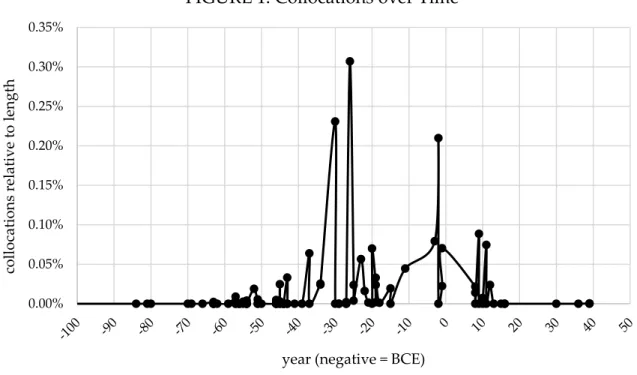
At this point it is useful to examine some of the broad trends in the data, as these shaped the direction of my study. Let us first look at a simple chronological chart, which plots the collocation value of each work against its date of publication (as closely as that can be determined):
36 In practical terms, this means that for every 100 words in Tibullus 1, we can expect
This clearly shows that, beginning in the 50s BCE, there was a gradual increase in the collocation of the word families under investigation—that is, these words were used in close proximity to one another with increasing frequency. This gradual development was punctuated by two spikes of activity: one in the late 30s and early 20s BCE, in the early Augustan period, and another some two decades later in the last years BCE.37 The data give a clear chronological scope for the investigation of the
development of the Roman discourse of magic; I therefore focus most of my attention
37 It should be noted that these chronological trends are not simply a product of the
abundance of texts in these periods. If this were the case, we should expect to see much higher collocation values in, for example, the early 2nd century BCE with Plautus’ and Terence’s comedies or in the 50s and 40s BCE during the peak of Cicero’s literary production. The fact that the data do not correspond precisely to these trends suggests that something more than mere survival of texts is at work.
0.00% 0.05% 0.10% 0.15% 0.20% 0.25% 0.30% 0.35% col loca tions re la tiv e to le ng th
on the second half of the first century BCE, with special attention to the Augustan period, and include earlier material primarily to establish the meanings of word families prior to their later convergence.38
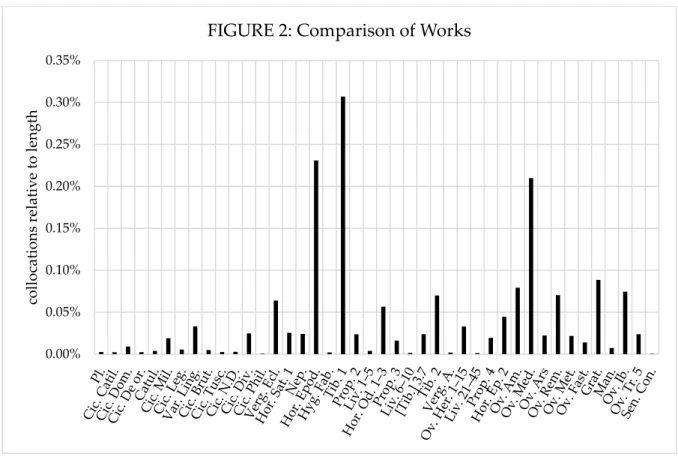
Even after narrowing the focus to the late first century BCE, the sheer abundance of texts remains daunting. Here the ability to compare the collocation values of different authors and texts becomes crucial:39
38 Note that this is the same time period identified as significant by both Garosi (1976)
and Graf (2001). My analysis adds quantitative evidence to their qualitative assessment.
39 Unlike in the previous chronological chart, here I have omitted texts that have no
The authors and works are arranged in roughly chronological order, but the what is important is not a sense of progression but identifying which texts have collocation values that are significantly higher than others. Several immediately stand out: Horace’s Epodes, Tibullus book 1, and Ovid’s Medicamina. The fragmentary nature of Ovid’s text, however, artificially skews its importance, and from a developmental standpoint, the earlier texts of Tibullus and Horace are more significant.40 Other texts
40 Although only one hundred lines survive, its original length has been estimated to
be between 500 and 800 lines (Watson 2001: 457). Even the more conservative of these estimates would significantly reduce its collocation value (from 0.210% to 0.042%).
0.00% 0.05% 0.10% 0.15% 0.20% 0.25% 0.30% 0.35%
col
loca
tions
re
la
tiv
e
to
le
ng
th
that stand out include Vergil’s Eclogues, Horace’s Odes, Ovid’s Amores and Ibis, and Grattius’ Cynegetica. It is immediately apparent that poetry rather than prose is central to the development of the discourse of magic, and that lyric and elegiac poetry are more important than other genres such as epic or didactic. These conclusions help to provide structure to my more focused examination of the texts of the Augustan period.
In chapter 1, I examine the six key word families (carmen, uenenum, superstitio, deuotio, saga, and magus) each in its own section, tracing their development from the earliest sources through the middle of the first century BCE, when the first collocations begin to occur. I specifically investigate the many nuances of meaning and conceptual associations that attend each word family and that ultimately contributed to the development of the discourse of magic.
largely unaffected by the developments in poetry, while the fifth delves deeper into the fundamental associations with gender and social marginalization that magic came to have.
In chapter 3, I look briefly ahead to the later development of the concept of magic in two distinct sections. In the first, I examine the further development of the literary concept of magic through Lucan’s Bellum Ciuile and Apuleius’ Metamorphoses, with particular focus on the new associations with violence and secrecy. In the second section, I take up Tacitus’ Annals and Apuleius’ Apology to investigate how the literary concept of magic intersects with the “real” world through accusations of magic and the shaping of the audience’s perception of such accusations.
CHAPTER ONE
The Foundation of Magic
Carmen
The uses of the carmen family are far too varied and numerous to allow for an exhaustive survey, and such completeness would be neither useful nor desirable for the task at hand.1 Instead, a brief survey of the most common uses of the carmen family
will suffice to establish the semantic range that these words occupy. From this wide range of meanings, one sense, that of “efficacious utterance,” can be singled out as particularly important for the development of a Roman concept of magic. Three salient features will merit further attention. First, hostility is not an inherent characteristic of the carmen family, although it can describe hostile actions. Second, Latin authors link this hostile use of the carmen family to similar concepts in the Greek mythic tradition, particularly those surrounding Circe and Medea. Third and finally,
1 All words in this family are based on the Latin root *can- which derives from the
this use of the carmen family is collocated with the uenenum family in the works of Cicero—a crucial stage in the development of the Roman concept of magic.
In the broadest possible terms, the carmen family denotes “song,” that is, the production of melodious or rhythmic sound by humans or animals. In the case of humans, the source can be either vocal or instrumental. From the latter comes the notion that the instruments themselves can sing, which is then extended to other inanimate objects. Because poetry emerged from a tradition of sung performance, the carmen family also denotes such verbal compositions, both in their original performative context as well as in written form.2 Thus, the carmen family describes a
wide range of aural productions, from wordless birdsong and music to lyrical song and poetry, including the more specific labels that may be applied to them according to genre or subject (e.g., hymn, dirge, prayer).
One particular strand in the use of the carmen family focuses on the artificial (in the sense of artfully crafted) quality of the utterances being described. So, lessons learned by rote from a teacher are called carmina, those who give formulaic procedural
2 I provide only a handful of references, for these uses are numerous and may be
statements in the law courts are called cantores, and rumors and popular sayings are described using the verb canto.3 What distinguishes these examples from mere
random noise or everyday speech is the presence of some kind of structure that lends the utterance an added layer of meaning or significance. It is the repetitive and formulaic nature of the lesson, the law formula, and the rumor—that is, their form rather than their substance—that separates them from more mundane, spontaneous utterances.4
Perhaps as a result of such purposeful structure, carmen-family utterances are thought to have concrete effects on the world—that is, they are “efficacious utterances.”5 To carry on with the examples given above, the specific form of the
3 For a teacher’s lessons, see e.g., Cic. De or. 1.245 and Leg. 2.59. For cantores in the
courts, see e.g., Mur. 26 and De or. 1.236. And for popular sayings and rumors, see e.g., Cato orat. 8.96 Malcovati = Fronto Fer. Als. 2 and Ann. max. 6 FRHist = Gell. NA 4.5.5.
4 Cf. Cicero’s argument that the Sibylline Oracles cannot be the product of a divinely
inspired, oral tradition because of the presence of carefully constructed acrostics and other signs of deliberate artistry (est enim magis artis et diligentiae quam incitationis et motus, Div. 2.111–112). Habinek (2005) explores carmen as ritualized speech in depth and examines its social, political, and cultural implications.
5 Desport (1942) identifies two key elements that define carmen: the formal
teacher’s lesson creates a lasting impression of the knowledge in the hearer’s memory. The repetition of the rumor creates and manipulates opinion, reputation, and social standing. And the recitation of the legal formula actually enacts the motion or procedure that is spoken. The formulaic language of Roman prayer likewise creates the contract that binds both humans and gods. It is this idea of efficacious utterances in particular that is critical to understanding the role of the carmen family in the development of Roman magic.6
The earliest evidence for such a use of the carmen family comes from the Twelve Tables, written around the middle of the 5th century BCE. The texts of these laws are necessarily reconstructed from later sources, but their archaic linguistic style (albeit with some updated orthography) and the consistency across such widely varying sources suggest that the original texts may well have been preserved.7 Two passages
are of interest to the present discussion, both of which come from Tabula 8. The first
suggests a new class of speech acts: transformatives. Versnel (2002) examines the paradoxical power of nonsense words in magical formulas.
6 Graf (1997: 41–46), identifies the carmen family as an early designator of magic but
only in the form of the malum carmen mentioned in the Twelve Tables. Stratton (2007: 30–31), likewise identifies two connotations of the word carmen in a magical context, one positive (charm) and one negative (curse). Dickie (2001: 14–16) identifies carmen family words as generally focused on the spoken element of magical practice, whereas the uenenum family marks those whose skills tended toward physical substances.
7 For a general discussion of how the text of the Twelve Tables can be reconstructed,
concerns the composition or performance of a “bad carmen” (qui malum carmen incantassit … <quiue> occentassit carmen<ue> cond<issit>, 8.1), while the second deals with influencing crops by means of a carmen (qui fruges excantassit… ?quiue? alienam segetem pellexeri<t>, 8.4).8 Although the precise nature of these laws remains uncertain,
they nevertheless reflect the fundamental assumption that certain utterances— represented here by the words carmen, incanto, occento, and excanto—can have an immediate effect on the real world.9 The power of such utterances was considered
serious enough to merit attention among Rome’s first written law code.
In order to understand better what the forms excanto and occento signify, it is useful to examine their uses elsewhere in early Latin literature, particularly in the comedies of Plautus. A tantalizing but infuriatingly brief fragment from the beginning of Bacchides describes one character’s belief that another could “sing out anyone’s heart” (nam credo quoiuis excantare cor potes, Bac. fr. 19).10 It is unclear whether excanto
8 On the sources and reconstruction of the text of these laws, see Crawford (1996: 677–
679; 682–684)
9 For the specific relationship between magic and the law of the Twelve Tables see
Graf (1997: 41–43), Kippenberg (1997: 144–147), Gordon (1999: 253), Collins (2008: 142– 145), and especially Rives (2002), who offers a useful and much-needed reconsideration of these laws, arguing that they were not in origin laws against “magic.”
10 For ease of reading, I translate carmen family verbs with the deliberately broad and
should be understood literally—in which case the heart would be physically removed—or figuratively as referring to arts of persuasion or enticement. The text of the Twelve Tables suggests both meanings: excanto is paired with the figurative pellicio, but the crops must also be enticed literally to move. A later example from Varro confirms this interpretation: after failing to “sing out” something from an altar, the people instead snatch it down.11 The implication is that singing and snatching are
two different means to the same end: the removal of something from the altar.12 The
Plautine fragment is therefore bit of comic hyperbole, and the humor relies on the audience’s understanding of both the literal and figurative meanings of excanto.
The meaning of excanto is more elusive due to the fragmentary nature of our sources. The passages containing occento, on the other hand, are much more substantial. There are three examples of occento in Plautus, and all three describe individuals singing at a door that blocks them from the object of their desire. In Curculio (145–157), the young man Phaedromus sings at the door of the leno’s house
11 “When they see that by singing they cannot sing [it?] out from the altar, they begin
to pull [it?] down” (ubi uident se cantando ex ara excantare non posse, deripere incipiunt, Var. Sat. Men. 151 Lindsay = Non. 102.11).
12 A fragment of Lucilius is relevant here: qua ego nunc <huic> Aemilio prae-| canto atque
in an attempt to reach Planesium. In Mercator (404–411), Demipho disingenuously explains to his son Charinus that the beautiful girl he’s brought home can’t be his mother’s ancilla, because she would attract crowds of young men who would sing at their door. And in Persa (564–573), Toxilus tries to convince the leno Dordalus to buy a girl from him because she will attract lots of customers who will sing at his door. (What would be an annoyance for a private household is good business for the leno!)
In Curculio, we even have a text of Phaedromus’ song (145–157):13
Ph. quid si adeam ad fores atque occentem? Pal. si lubet, nec ueto nec iubeo quando ego te uideo inmutatis moribus esse, ere, atque ingenio.
Ph. pessuli, heus pessuli, uos saluto lubens, uos amo, uos uolo, uos peto atque opsecro, gerite amanti mihi morem, amoenissumi, fite causa mea ludii barbari,
sussilite, opsecro, et mittite istanc foras quae mihi misero amanti ebibit sanguinem. hoc uide ut dormiunt pessuli pessumi nec mea gratia commouent se ocius! respicio nihili meam vos gratiam facere.
st, tace, tace. Pal. taceo hercle equidem. Ph. sentio sonitum: tandem edepol mi morigeri pessuli fiunt.
Ph. What if I were to approach the doors and sing at them?
13 Moore (2005) discusses the similarities between Phaedromus’ song and the
Pal. If you want. I’m not saying yes or no, master, since I see that your character and disposition have changed.
Ph. Door-bolts—hey! door-bolts—I happily greet you. I love you, I want you, I ask and beseech you: obey me as a lover, most pleasant of door-bolts. Become for my sake barbarian dancers: leap up, please, and send outdoors that woman who sucks blood from me, a miserable lover. Look here: how these worst of door-bolts sleep and don’t move themselves more quickly for my sake! I see that you don’t value my goodwill at all. Shh! Quiet, quiet!
Pal. I am quiet, dammit.
Ph. I hear a noise: by the gods at last the door-bolts begin to obey me!
The purpose of Phaedromus’ address is neither to convince the leno to release Planesium nor to encourage the girl to come out herself. Rather the song intends to make the door-bolts themselves unlock in response to blandishments and prayers. Demipho and Toxilus must certainly refer to the same kind of songs in Mercator and Persa, respectively. Just like excanto examined above, occento describes the use of words to bring about changes in the world without the use of physical force. In each case, the change that the song attempts to bring about is contrary to the natural tendencies of the object (e.g., the heart’s remaining in the body, the object’s remaining on the altar, the door’s remaining closed). It is likely that this same meaning can be read back onto the uses of excanto and occento in the Twelve Tables, which intended to prohibit particularly hostile or damaging uses of such “efficacious utterances.”
Pam. graphicum mortalem Antiphonem! ut apologum fecit quam fabre!
Epi. etiam nunc scelestus sese ducit pro adulescentulo.
dabitur homini amica, noctu quae in lecto occentet senem.
Pam. namque edepol aliud quidem illi quid amica opus sit nescio.
Pam. Antipho’s the picture of a person! How craftily he constructed his story!
Epi. Even now the bastard thinks he’s a youth. The old man will get a lover-girl… to sing at him in bed at night!
Pam. Yep! Gods, I don’t know why else he would even need a lover-girl.
The joke, of course, is that the girl can do nothing for Antipho but sing. Despite his youthful lust, Antipho’s age has rendered him impotent. But what exactly does occento mean in this context? There is no obvious reason why the girl would “sing at” Antipho antagonistically (as in the songs directed at doors) nor what the intended result would be. If the song is meant to arouse Antipho sexually (i.e., to cause his “bolt” to “leap up”), it could hardly be considered hostile! Regardless of the song’s intended results, however, what matters is that here occento must at the very least be understood as neutral if not actually beneficial.
Cato the Elder provides a clear example of the carmen family being used to describe an unambiguously beneficial utterance in the following procedure for treating a dislocated limb (Agr. 160):14
14 For discussions of this passage as it relates to magic, see especially Tupet (1976: 169–
luxum si quod est, hac cantione sanum fiet. harundinem prende tibi uiridem p. iiii aut quinque longam, mediam diffinde, et duo homines teneant ad coxendices. incipe cantare (in alio s. f.15 “moetas uaeta daries
dardaries asiadarides una petes” usque dum coeant) “motas uaeta daries dardaris astataries dissunapiter,” usque dum coeant. ferrum insuper iactato. ubi coierint et altera alteram tetigerint, id manu prehende et dextera sinistra praecide; ad luxum aut ad fracturam alliga: sanum fiet. et tamen cotidie cantato (in alio s. f. uel luxato uel hoc modo “huat hauat huat ista pista sista dannabo dannaustra”) †et luxato† uel hoc modo: “huat haut haut istasis tarsis ardannabou dannaustra.” If there is any dislocation, it will be healed by this cantio. Take a green reed four or five feet long and split it down the middle; two people should hold it to the hips. Begin to sing: (another manuscript reads: “moetas uaeta daries dardaries asiadarides una petes” up until they meet) “motas uaeta daries dardaris astataries dissunapiter” up until they meet. Brandish a sword over it. When they meet and one touches the other, grasp it with the hand and cut right and left; bind it to the dislocation or fracture: it will heal. Nevertheless, sing every day, (another manuscript reads: either for the dislocation or in this way “huat hauat huat ista pista sista dannabo dannaustra”) and for the dislocation or in this way “huat haut haut istasis tarsis ardannabou dannaustra.”
It is worth pointing out, first of all, how this passage reflects the perceived power of words. Cato calls not only the spoken words but the entire process a cantio and thus privileges the verbal component over the physical. The presence of the uoces magicae— the so-called “nonsense” words that accompany this and many other ancient ritual
15 The phrase in alio s. f., repeated twice in the formula, is an abbreviation of in alio
formulas—indicate that words did not even need to be intelligible in order to be effective.16 Unlike the hostile uses of excanto and occento examined above, here
carmen-family words (cantio and canto) are used in the beneficial context of healing, an outcome that is presumably very much desired. Even the underlying tactics of the song are positive: the focus is on the creation of healing rather than on attacking or driving out the injury. These examples show that the carmen family is neither intrinsically hostile nor intrinsically beneficial; such judgments depend upon the context in which particular words are used.
The carmen family can also be found in literary contexts describing the supernatural abilities possessed by certain Greek mythic figures. The historian Cn. Gellius reportedly describes the power of Circe to change a person’s appearance using the word carmen (Gel. hist. 18 FRHist = Solin. 2.28):17
16 Pliny the Elder mentions Cato’s cantio but seems reluctant to reproduce the formula
itself because of mixed opinions about such carmina (NH 17.267, 28.21, 28.29). For a succinct overview of uoces magicae, see especially Ogden (1999: 46–50). Graf (1991: 191–195) argues that uoces magicae generally take the place of the credentials included in a more normative prayer and thus are used to establish the authority of the speaker. Versnel (2002: 113–122) undertakes a much deeper interrogation of the meaning of meaninglessness in magical texts. For the ancient debate about uoces magicae in late antique theurgy, see especially Addey (2011). Where it is possible to identify them, these words tend to be the names of eastern deities. See, for example, Bohak (2003) for examples of Hebrew names and phrases used in magical formulas.
17 As so often with fragmentary texts, it is not clear precisely which words are Gellius’
Cn. Gellius Aeetae tres filias dicit, Angitiam, Medeam, Circen: Circen Circeios insedisse montes, carminum maleficiis uarias imaginum facies mentientem; Angitiam uicina Fucino occupauisse, ibique salubri scientia aduersus morbos resistentem, cum dedisset homines uiuere, deam habitam; Medeam ab Iasone Buthroti sepultam, filiumque eius Marsis imperasse.
Gnaeus Gellius says that Aeetes had three daughters: Angitia, Medea, and Circe. Circe settled in the Circeian mountains, imitating various appearances of figures with the evil-doing of her songs. Angitia occupied the area near the Fucine Lake and, opposing diseases with health-giving knowledge, was considered a goddess in that place since she had given the people life. Medea was buried by Jason at Buthrotum, and her son ruled the Marsians.
Here, the power of words is explicitly stated (Circe creates forms using carmina), but it is also linked to a tradition of efficacious utterances already operative in the Greek world.18 This fragment reflects the Roman appropriation of a Greek tradition: Circe
comes to settle in Italy, as does the son of Medea. But by linking Circe and Medea to
certainly belong to Solinus. However maleficium in the sense of “misdeed, crime, harm, fraud” is certainly current in the 1st century BCE, and the phrase maleficiis
carminum may be understood as maleficis carminibus. On this passage, see also Tupet (1976: 197–199).
18 The Greek equivalent to Latin carmen is generally understood to be ἐπῳδή (or
Angitia and the Marsians, who are not Greek but Italian, Gellius fuses Greek mythic tradition with a native Italian phenomenon.
The ancient Marsians were widely believed to have peculiar powers over snakes, including the ability to make them explode with mere words.19 The Marsians
and other central Italic peoples also worshiped a historical goddess called Angitia.20
Her name suggests a connection with snakes (anguis), but in Gellius she is described as a healing goddess. The association of snakes with healing, however, is not uncommon in the ancient world (cf. Aesculapius), and the morbi that Angitia combats could well be snake bites (though Gellius’ salubris scientia is a far cry from exploding snakes). The association of Angitia and the Marsians with Aeetes and his daughters, however, is a literary conceit. Its purpose is to offer an aetiology for the Marsians’ extraordinary ability by linking them, through Angitia, to other supernaturally powerful figures such as Circe and Medea. The Marsians’ abilities are thus explained and, in a sense, legitimized by both their physical and conceptual association with a similar Greek tradition of efficacious utterances.
19 iam disrumpetur medius, iam, ut Marsus colubras | disrumpit cantu uenas cum extenderit
omnes (Lucil. 575–576 Marx = Non. 201.21).
20 Dench (1995: 154–174), explores the cult of Angitia among the peoples of the central
What remains in this section is to examine briefly when and how the carmen family participates in the construction of the Roman concept of magic. The crucial first step appears in the works of Cicero, where the carmen family first appears together with a word from the uenenum family, (which will be discussed in the next section). Cicero recounts the following anecdote about C. Scribonius Curio, an orator whose memory failed him in the middle of a trial (Brut. 217):21
memoria autem ita fuit nulla, ut aliquotiens, tria cum proposuisset, aut quartum adderet aut tertium quaereret; qui in iudicio priuato uel maximo, cum ego pro Titinia Cottae perorauissem, ille contra me pro Ser. Naeuio diceret, subito totam causam oblitus est idque ueneficiis et cantionibus Titiniae factum esse dicebat.
Moreover, he had such a bad memory that several times, after he had laid out three points, he would either add a fourth or forget the third. In an extremely important private trial, when I had concluded my speech in defense of Titinia, the wife of Cotta, he spoke against me in defense of Servius Naevius. Suddenly he forgot the entire case and said that it happened because of the ueneficia and cantiones of Titinia.
As in all the previous examples, here the use of a carmen-family word (cantio) emphasizes the power of words to effect real change in the world. Like the use of excanto in Plautus and carmen in Gellius, Titinia’s cantio is directed against a person (Curio) and is meant to produce an unwanted result (memory loss). This is, therefore,
a hostile use of the carmen family. Furthermore, the plausibility of Curio’s accusation relies on a shared cultural acceptance that words can and do produce changes such as a lapse in memory. Indeed, Cicero may doubt this specific claim, but he does not discredit the notion itself. Presumably others would have believed Curio or claims like his. The potential difficulty of either proving or disproving such an accusation would have made it an especially attractive option for an individual confronted with a sudden and inexplicable change in present circumstances. And, as I will discuss more fully below, the association with ueneficium is not accidental, but reflects a conceptual congruence in the 1st century BCE linking efficacious utterances to similarly efficacious substances.22
Venenum
The words belonging to the uenenum family can be divided into two groups: the basic, uncompounded forms (uenenum, ueneno) and those forms compounded with the verb facere (ueneficus, uenefica, ueneficium).23 The basic forms will be treated
22 Stratton (2007: 31) also recognizes the importance of the collocation of carmen and
uenenum, which suggests “the combined or juxtaposed use of herbal and verbal technologies.”
23 An adjective ueneficus, -a, -um is attested only once (uenefice uir, Pl. Rud. 1112), if one
Proto-Indo-first, establishing their semantic range as describing “efficacious substances.” Two features of the uenenum family in particular will merit further investigation. First, although uenenum-family words often describe lethal substances, lethality is not a necessary characteristic of such substances. Second, just as with carmen-family words, Latin authors link the uenenum family to related concepts in the Greek tradition, particularly those associated with Circe and Medea. Once the semantic range of the basic forms has been established, I will show that the compounded forms have a similar range but with the addition of a marked connection to illegality. Finally, I will return to Cicero’s anecdote about Curio’s memory loss, revealing the full significance of the collocation of the carmen and uenenum families.
Words of the uenenum family have a fairly clear and consistent meaning throughout the literature of this period. They describe “efficacious substances,” that is, substances that produce changes in the objects to which they are applied.24 This
European root *wenhx- “desire, strive to attain,” which is also the source of Latin Venus, ueneror, and uenia as well as modern English wish (OLD s.v. uenenum; Mallory & Adams 2006: 341).
24 Although authors of this period never define precisely what a uenenum is, the 2nd
meaning is admittedly rather broad, but in practice, uenenum-family words are used to describe only a few types of substances that produce specific effects. The most common of these effects is death, which has led to the erroneous assumption that all uses of the uenenum family refer to lethal substances (i.e., poisons).
It is used in this sense as early as the second century BCE, in a fragment attributed to the historian C. Sempronius Tuditanus, who describes how the Carthaginians gave a slow-acting poison to the captured Roman general Regulus to ensure that he would return from his mission to Rome.25 Natural philosophers such
as Lucretius use uenenum-family words to describe deadly plants, venom produced by certain animals (especially snakes and snake-like creatures), and the noxious gases that seep out of the ground in the so-called Avernian places.26 And the works of Cicero
teem with examples of uenenum-family words denoting substances used to kill for personal and political gain.27
25 “A poison… not quick-acting but of the kind which brings on death gradually”
(uenenum… non praesentiarum, sed eiusmodi quod mortem in diem proferret, Semp. Tud. 8 FRHist = Gell. NA 7.4.1).
26 For examples of plants that are deadly to humans, see Lucr. 4.640 and 5.900. Of
poisonous snakes, see Cic. Har. 50, the anonymous fragment (perhaps by Accius?) of a Philoctetes at Cic. Fin. 2.94, and the description of Clodius as a viper at Tusc. 2.19. Lucretius similarly describes the snake-like hydra at 5.27. For the poisonous gases found in Avernian places, see Lucr. 6.820–827.
27 The speeches Pro Cluentio and Pro Caelio famously involve uenenum as material to
As an extension of this meaning, the uenenum family is used by these same authors in a related but more metaphorical sense to describe anything that harms or destroys something else. Lucretius refutes Empedocles’ theory of the four elements by explaining that the elements are poisonous to each other and would be annihilated if brought together (1.759–762). Catullus equates books of bad poetry with poisons (14.17–19) and even claims to have caught a cold after reading one of Sestius’ speeches, because it was so full of poison (44.10–15). And both Cicero and Sallust highlight the destructive potential of certain vices by describing them as poisons (Cic. Amic. 89; Sall. Cat. 11). This metaphorical usage also extends to the verb ueneno, particularly to the use of the past participle. In Plautus’ Rudens, the enslaved Gripus describes a rusty spit as “poisoned” as it falls apart in his hand (1300–1302). Cicero says that false accusations are as destructive as a “poisoned weapon” (Quinct. 2) and that loyalty may be bought with “poisoned gifts” (Phil. 13.35). Such figurative uses assume that the predominant association of the uenenum family is of a substance that is literally lethal.
But the uenenum family is not limited only to those substances that produce death or destruction. One fairly benign way that an “efficacious substance” can affect
an object is by changing its color. A fragment of the early 1st century BCE poet Cn. Matius describes treating pieces of cloth with purple dye. The act of dyeing itself is described by the verb ueneno, which in context is synonymous with imbuo.28 And we
have already seen the uenenum family implicated in Curio’s sudden loss of memory. Even if death does result from the using of an “efficacious substance,” that is certainly not always the intended outcome. Varro describes a certain Servius Clodius who contracted gout while in exile for plagiarizing his father-in-law. In order to rid himself of the disease, he applied some manner of substance (uenenum), which did not cure his affliction. In fact, it had the opposite effect—it necrotized his feet!29 What was
meant to act as a beneficial medicine instead proved to be harmful or hardly better than the disease itself. The nature of “efficacious substances” is ambiguous, and their potentially dramatic effects are sometimes difficult to predict.30
28 “Now the cut cloth, saturated with dye, which he treated, soaking them in the
purple mussel” (iam tonsiles tapetes ebrii fuco, | quos concha purpura imbuens uenenauit, Mat. poet. 13 Blänsdorf = Gell. NA 20.9.3).
29 Seruius, cum librum soceri nondum editum fraude intercepisset et ob hoc repudiatus pudore
ac taedio secessisset ab urbe, in podagrae morbum incidit; cuius impatiens ueneno sibi perunxit pedes et enecuit ita, ut parte ea corporis quasi praemortua uiueret (Varro gram. 320 Funaioli = Suet. Gram. 1).
30 Graf (1997: 46–49) discusses the uenenum family mostly as it pertains to Roman law,
Some of the earliest extant uses of uenenum-family words describe even more extraordinary effects than these. Just as with the carmen family, Latin authors link the uenenum family to supernatural abilities familiar from the Greek mythic tradition. A fragment of Pacuvius’ tragedy Niptra describes Circe’s transformation of Odysseus’ shipmates as brought about by “efficacious substances.”31 Pacuvius’ use of the noun
uenenum is presumably meant to evoke the Greek term φάρμακον, which has a similar semantic range and is often used when describing Circe.32 The same is true of Medea,
whose abilities are invoked by the unnamed cook in Plautus’ Pseudolus as part of his boastful advertisement for Ballio’s birthday feast (866–873):33
Coq. habe modo bonum animum. Bal. quaeso qui possum doce bonum animum habere qui te ad me adducam domum?
Coq. quia sorbitione faciam ego hodie te mea, item ut Medea Peliam concoxit senem, quem medicamento et suis uenenis dicitur, fecisse rursus ex sene adulescentulum,
item ego te faciam. Bal. eho, an etiam es ueneficus?
Coq. immo edepol uero hominum seruator [magis].
practitioners as poisoners. Stratton (2007: 31), ascribes the same ambiguity to the uenenum family (potion and poison) as she did to the carmen family.
31 “She who bent the hearts of my allies with uenena” (quae | meum uenenis flexit socium
pectora, Pac. trag. 275–276 Warmington = Serv. auct. ad Aen. 5.28)
32 For a discussion of the semantic range of φάρμακον, see Pharr (1932: 272–274),
Scarborough (1991: 139–140), Graf (1992: 276–277), Collins (2008: 59).
Coq. Oh, cheer up!
Bal. Please tell me, how can I “cheer up” when I’m letting you into my house?
Coq. Because today with my soup I’m going to make you the same as Medea made Pelias, when she boiled up the old man and (so it’s said) with her medicine and uenena turned him from an old man back into a strapping youth—I’m going to do just the same to you.
Bal. What? Are you a ueneficus too?
Coq. No no no… more a savior of mankind!
Plautus also draws on the Greek tradition of associating Thessaly with supernatural powers.34 In Amphitruo, the titular hero blames the near total ruin of his
household, and especially his marriage, on his troublesome doppelganger, who is actually Jupiter in disguise (Am. 1039–1044):
Am. perii miser.
quid ego <faciam>, quem aduocati iam atque amici deserunt? numquam edepol me inultus istic ludificabit, quisquis est; [nam] iam ad regem recta me ducam resque ut facta est eloquar. ego pol illum ulciscar hodie Thessalum ueneficum,
qui peruorse perturbauit familiae mentem meae.
Am. I’m dead. What will I do, when supporters and friends are already abandoning me? By the gods, that man—whoever he is— won’t ridicule me without paying for it. I’ll go straight to the king now and explain how it happened. Gods, I’ll get even with that Thessalian ueneficus, who so completely confounded my household’s mind.
Amphitruo’s use of a uenenum-family word to describe Jupiter and his actions depends upon the acknowledgment that such “efficacious substances” could actually cause the kind of insanity that Amphitruo describes. And, although the hijinks are heightened for comedic effect, the mental confusion and physical transformation effected by Jupiter and Mercury are consistent with uses of the uenenum family
34 More will be said about specific associations between Roman magic and Thessaly
elsewhere in Latin literature. But the addition of the qualifier Thessalian draws on a Greek tradition—an ethnic one—which not only reinforces the accusation (since Thessaly is the proverbial heartland of supernatural powers) but makes it more damning because of the overtones of the foreign and the strange. Such Greek traditions, and the Roman audience’s ability to recognize and engage with them, will be critical to the further development of a uniquely Roman concept of magic.
The basic words in the uenenum family describe a range of “efficacious substances,” from clothing dye and foot ointment to the deadliest poisons. It therefore follows that the compound forms (ueneficus, uenefica, ueneficium) should have a similar semantic range, with a shift in focus from the substances themselves to their manufacture and use. Although the compound words of the uenenum family show the same variety of lethal and non-lethal substances, there is a pronounced tendency for ueneficium to be associated with the Roman judicial sphere and specifically with concepts of criminality.
One of the earliest literary use of ueneficium occurs in a fragment of Cato preserved by Quintilian, in which the orator is reported to have said that no adulteress is not also a uenefica.35 The equation is one of character rather than of literal fact. What
35 “If an adulteress defends herself on a charge of ueneficium, does she not seem to be
Cato is noting is a similarity between the two actions, both of which involve deception and secret hostility, traits that the Romans commonly attribute to women.36 On this
basis, Cato suggests that any woman accused of adultery must also be capable of ueneficium. Whether one agrees with Cato’s argument is beside the point. What is important is that, by the mid-second century BCE, ueneficium can be described as a criminal charge. Cato’s use of the term ueneficus during his defense of L. Autronius is further indication that the term was current and being used in a public context.37
Clear evidence for a legal charge of ueneficium is described in a fragment of L. Calpurnius Piso Frugi, a historian of the late second century BCE, preserved by Pliny the Elder.38 C. Furius Cresimus was a freedman who worked a small but prosperous
5.11.39). It should be noted that, in Cato’s time, neither adultery nor ueneficium were as yet crimes in the public sense.
36 The Romans famously rejected deceptive military tactics such as assassination
during the Pyrrhic War. When Pyrrhus’ doctor offers to poison him, the Romans instead warn Pyrrhus of the plot out of a sense of honor (Plu. Pyrrh. 21).
37 uenefici postridie iussisti adesse in diem ex die; non ausi recusare (Cato orat. 8.207
Malcovati = Prisc. GL 2.482). It is unclear to whom Cato is speaking. In Roman judicial oratory, the second person generally refers to the jurors, but here it is likely that Cato has turned to speak directly to his opponent(s). Their number is uncertain because of the lack of agreement between the singular verb iussisti and the plural uenefici.
38 C. Furius Cresimus e seruitute liberatus, cum in paruo admodum agello largiores multo