Required Reading. A Master’s Paper for the M.S. in L.S degree. July, 2019. 77 pages. Advisor: Ronald E. Bergquist
This study examined the required reading list of junior enlisted Marines. The study analyzed the extent the books on the primary level enlisted Marine Corps reading list reflected both resilience and the Marine Corps values of honor, courage, and commitment through content analysis. It also looked at how enlisted Marines were interacting with the books on the reading list through a month long circulation study across 29 Marine Corps libraries to determine which books were being borrowed most frequently and interviews to hear enlisted Marines’ thoughts on the reading list and the Marine Corps’ values in their own words.
Honor, courage, commitment, and resilience were heavily present in each book on the required reading list, making the list highly effective in terms of displaying the values the Marine Corps has declared to be so essential. The frequency and relatively even
distribution of the four themes in all of the books negated large popularity gaps between the books Marines chose to borrow. Interviews with five junior enlisted Marines
revealed they had an overwhelmingly positive response to the reading list in terms of enjoying and learning from the required reading list books, while four out of five of the Marines found the books they read to be relatable to their own experience. The
interviews also revealed that the Marines were not only finding the Marine Corps values reflected in the books they read, but also many additional values as well.
Headings:
Reading interests of military personnel Soldiers' libraries
“THE PROBLEM WITH BEING TOO BUSY TO READ IS THAT YOU LEARN BY EXPERIENCE THE HARD WAY”: AN INVESTIGATION INTO PRIMARY LEVEL
ENLISTED MARINE CORPS REQUIRED READING
by
Jennifer L Kirby
A Master’s paper submitted to the faculty of the School of Information and Library Science of the University of North Carolina at Chapel Hill
in partial fulfillment of the requirements for the degree of Master of Science in
Library Science.
Chapel Hill, North Carolina July 2019
Approved by
Introduction ... 2
Literature Review... 5
Honor ... 5
Courage... 6
Commitment ... 6
Resilience ... 7
Research Questions ... 10
Methods... 12
Content Analysis ... 12
Circulation Study ... 15
Semi-Structured Interviews ... 17
Results ... 20
Content Analysis ... 20
Circulation Study ... 39
Semi-Structured Interviews ... 41
Analysis... 46
Conclusion ... 48
Future Research ... 52
Bibliography ... 54
Appendix A ... 62
Military Reading ... 62
Appendix B ... 64
Marine Corps Values ... 64
Appendix C ... 66
Resilience in War ... 66
Appendix D ... 67
More on the Commandant’s Reading List – Going beyond Nonfiction ... 67
Appendix E ... 68
James Amos’ Letter on the Commandant’s Professional Reading List ... 68
Appendix F... 70
The Full Enlisted Commandant’s Reading List ... 70
Appendix G ... 73
Interview Guide Questions ... 73
Appendix H ... 74
Quotes ... 74
Appendix I ... 75
Introduction
In 1989 the first Marine Corps Commandant’s reading list was introduced by General Al Gray as a challenge to Marines of every rank to rededicate themselves to the study of their profession (Amos, 2012). Its goal was to take a fighting force whose mission is to defend the United States at home and abroad by land, sea, and air and make it even better (U.S. Marine Corps, 2019). The Marine Corps is known for their high standard of excellence and history of military innovation and leadership (U.S Marine Corps, 2019). In General Gray’s mind, reading was a means of preparing for the future, particularly in combat, just as important as physical conditioning (Amos, 2012).
The idea behind the program boils down to the fact that Marines fight better when they fight smarter. James Mattis, retired Marine Corps general, wrote in a famous 2003 email on the importance of reading, “The problem with being too busy to read is that you learn by experience the hard way. By reading, you learn through others’ experiences, generally a better way to do business, especially in our line of work where the
consequences of incompetence are so final for young men” (Personal communication, November 20, 2003).
is required to read a minimum of five books from it each year. Completing the reading requirement goes into their fitness report and proficiency and conduct marks.
The reading list is broken down into five levels for both enlisted Marines and officers corresponding to ranks. Marines are supposed to attempt to read all titles within their level prior to proceeding to a higher level. The research will focus on the primary level enlisted reading list which is for the youngest, most junior Marines who have the rank of private, private first class, or lance corporal. 40% of Marines fall into this category (Headquarters Marine Corps Marine & Family Programs, 2017).
There are eight books on the list – Chesty, Ender’s Game, Rifleman Dodd, The Last Stand of Fox Company, The Marines of Montford Point, On Call in Hell, Ready
Player One, and The Warrior Ethos. At first glance the books on the list appear to be a
hodgepodge. Three are fiction and five are nonfiction. There is a biography, a memoir, two science fiction novels, both a fictional and a true war narrative, a military history book, and an examination of the warrior code of honor. Their publication dates range from 1932 to 2007. These books have been specifically chosen as a teaching tool for Marines however and are meant to reflect Marine Corps values.
Literature Review
Honor
Retired Marine Marion Sturkey wrote in his book, Warrior Culture of the U.S. Marines, that honor requires each Marine to exemplify the ultimate standard in ethical
and moral conduct. Because honor is many things, it requires many things. It requires much more than just never lying, cheating, and stealing. It means each Marine needs to cling to an uncompromising code of personal integrity, never sullying the reputation of the Corps he belongs to (Sturkey, 2001). The official Marine Corps publication on values reinforces this sentiment. It states that honor means constant and consistent adherence to right, legal and ethical conduct (U.S. Marine Corps, 1998/2016, p. 2-2). Honor means doing what is right at all times and making decisions that are in the best interest of the military (Bonn, 2005).
The Marine Corps defines honor as the ultimate code for representing the
Courage
Sturkey (2001) defines courage as honor in action. It is moral strength, the will to heed the inner voice of conscience, and the will to do what is right regardless of the conduct of others. Just like honor, courage requires adherence to a higher standard and mental discipline. It is a willingness to take a stand for what is right in spite of adverse consequences and it has sustained Marines during the chaos, perils, and hardships of combat throughout history. The Marine Corps calls courage the heart of its values. They define it as the ingrained mental, moral, and physical strength that allows for the mastery of fear in order to do what is right, lead by example, and make tough decisions under stress and pressure (Headquarters Marine Corps, n.d.).
Courage requires self-discipline, patriotism, and loyalty in order for Marines to resist opposition and face danger (U.S. Marine Corps, 1998/2016, p. 2-3). It is often manifested as valor in actions small and large, whether it is boldness and determination in facing danger in war or bravery in the important fights of daily life. The recruiting
website explains how courage means, “Marines never give in, never doubt; Marines answer the call with no fear, no hesitation; Marines face down all threats no matter the enemy; Marines take down all threats no matter the battle” (U.S. Marine Corps, 2019).
Commitment
or personal plans. Being selflessly committed to serving the country first means that each day Marines miss being at their children’s births, seeing their baby’s first words, and watching their baby’s first steps. Marines will miss birthdays, holidays, and
anniversaries all because of a dedication to a higher cause. The welfare of the country and the Marine Corps is more important than any individual Marine (U.S. Marine Corps, 1998/2016, p. 2-3). Full commitment means “duty above self” (U.S. Marine Corps, 1998/2016, p. 2-2).
Sturkey (2001) defines commitment as total dedication to the Marine Corps and the country. The selfless determination of commitment means Marines should never give up, give in, or accept second best. The Marine Corps defines commitment as the spirit of dedication that leads to professionalism and mastery of the art of war, promoting the highest order of discipline and an unrelenting determination to achieve a standard of excellence in every endeavor (Headquarters Marine Corps, n.d.). Commitment means working towards absolute excellence is necessary to support the team and the team’s mission (U.S. Marine Corps, 1998/2016, p. 2-3). When a retired Marine veteran named Jake Wood who founded a major disaster relief organization discussed the sense of purpose he experienced in the Marines, he stated, “We’ve all dedicated ourselves to something bigger than ourselves” (U.S. Marine Corps, 2019).
Resilience
combat (2008). He explains it as the tremendous capacity within service members to not only endure, but thrive, all grounded within a positive psychological framework that affirms the human spirit (Jarrett, 2008). It has also been defined as:
• The capacity to successfully adapt or change in the face of adversity (Pietrzak et
al., 2010)
• Finding positive meaning and growth in adverse situations (Pickering,
Hammermeister, Ohlson, Holliday, & Ulmer, 2010)
• Strengths that protect against developing mental illnesses in response to trauma
(Hoge, Austin, & Pollack, 2007)
• Rebounding from adversity without acting in harmful ways (Siebert, 2005) • The ability to thrive when challenged and to bend without breaking (Sheehy,
2010).
The common threads between these definitions are an emphasis in adaptive coping, personal control, hardiness, and social support (Simmons & Yoder, 2013). Adaptive coping is the ability to withstand and adapt to change as it occurs, and grow from the adversity (Simmons & Yoder, 2013). Meanwhile, personal control is the belief that individuals have control over their lives and the things that affect their lives
(Simmons & Yoder, 2013), while hardiness consists of positive personal characteristics such as commitment, control, and challenge (Kobasa, Maddi, & Kahn, 1982). Finally, social support is the network of people that supports an individual in their time of need (Simmons & Yoder, 2013),
Research Questions
Since these values make up the foundation of the Marine Corps (Sturkey, 2001), it is important to ask how a major military learning tool is displaying them. This research will perform a content analysis of the primary level enlisted Marine Corps required reading list to look into the literature in terms of the values the Marine Corps itself has declared to be so essential. The research will analyze the books’ representations of war and the military to answer the following questions:
RQ1: To what extent does the reading list reflect the Marine Corps’ core values of
honor, courage, and commitment?
RQ2: To what extent does the reading list reflect resilience?
RQ3: How do the themes of honor, courage, commitment, and resilience run
through the reading list?
Just as important as uncovering what the primary level enlisted Marine Corps required reading list is showing its readers is discovering who is reading it, and what some of those individuals think about it. Therefore, the research will include a month-long circulation study across the Marine Corps libraries to track all primary level enlisted books that are borrowed.
RQ4: Which books are enlisted Marines reading most frequently?
RQ5: How effective do enlisted Marines feel the books are in terms of enjoyment,
education, and relatability?
RQ6: How representative do enlisted Marines feel the books are of Marine Corps’
Methods
Content Analysis
Content analysis has evolved from formerly counting the number of times specific words appeared to a new focus on “the presence, meanings and relationships of . . . words and concepts, then mak[ing] inferences about the messages” (Busch et al., 2005). The research is focused on interpreting these more abstract meanings and relationships.
The data in content analysis studies provide useful evidence for testing hypotheses and answering research questions (White & Marsh, 2006). The data also convey messages (White & Marsh, 2006). The content analysis in this paper used a combination of definitions to notate when the texts were conveying acts of honor, courage, commitment, and resilience.
those who reproduce the study will still arrive at the same inferences, despite the fact other coders will use different subjective perceptual and reasoning processes (Potter & Levine‐Donnerstein, 1999). The definitions used for the coding schemes below set the clear standard for how the coding was done, ensuring its credibility and trustworthiness (Noble & Smith, 2015).
Data Collection - Definitions of Terms
The coding for honor uses both the Oxford English Dictionary and the Merriam Webster Dictionary definitions. The Oxford English Dictionary defines honor as “The
quality of knowing and doing what is morally right” (n.d.). Merriam-Webster defines it as synonymous with “integrity” or “a keen sense of ethical conduct” (n.d.). Acts of honor were coded as instances in which a character makes a sound ethical choice, in scenarios where there is no clear reward for the character to do so beyond the character’s moral principles and sense of what is right and wrong.
Meanwhile, the Oxford English Dictionary defines courage as “The ability to do something that frightens one; bravery” (n.d.). It also defines it as “strength in the face of pain or grief (Courage, n.d.). Acts of courage were coded as instances in which the character is experiencing fear yet takes action despite it.
Coding for commitment uses the Oxford English Dictionary definition of “The state or quality of being dedicated to a cause, activity, etc.” (n.d.). Acts of commitment were coded as instances in which characters act due to dedication to a cause they feel is bigger than themselves.
adversity, trauma, tragedy, threats or even significant sources of stress (para. 4)’’, as well as the Oxford English Dictionary which defines resilience as “The capacity to recover quickly from difficulties; toughness” (n.d.). When the texts showed examples of characters adapting well or recovering quickly immediately following a scene of a trauma, tragedy, threat, significantly stressful event, or major difficulty it was coded as resilience.
Each quote that falls into one of the above definitions was placed into a
spreadsheet. At the conclusion of the coding, both a quantitative analysis and qualitative analysis were performed.
Data Analysis
The coding process used to find relevant quotes was based in Grounded Theory, meaning the theory developed was “grounded in data systematically gathered and
analyzed” (Strauss & Corbin, 1994). The definitions described above served as the rubric for analyzing the texts. The process started with open coding - breaking down,
validated and the final refinement of what honor, courage, commitment, and resilience meant in writing occurred (Strauss & Corbin, 1990).
Once all eight books were successfully coded, an in-depth analyses looking at multiple aspects was performed. The quantitative analysis determined the frequency with which the themes and values appeared in each of the books. The counts were meant to determine which values the Marine Corps reading list is emphasizing the most to its readers. The majority of the analysis was qualitative however. Even in the narrow definitions chosen for honor, courage, commitment, and resilience, there were many ways they were displayed as these values were brought to life in the books.
Circulation Study
Circulation statistics are considered the oldest and most common measure of library use (Fialkoff, 2002). Dinkins (2003) notes that circulation studies can be a vital way to assess users’ needs and reading preferences. Circulation studies can be thought of as a form of automated structured observation, also called systematic observation.
Systematic observation uses predetermined categories as a guide to record the activities people take in their natural environments (Glazier, 1985), in this case the Marine Corps libraries. Systematic observation is regarded as a major tool of science and it requires explicit methodology that precisely specifies what is being observed and recorded (Michaels, 1983).
Circulation studies do come with limitations that are simply inherent in categorical systems however. Michaels (1983) notes that since all categories are
only tracking the number of times the books from the primary level enlisted reading list were borrowed from the Marine Corps libraries, it was not possible to note when other important acts occur, such as primary level enlisted Marines borrowing required reading list books outside their rank level, or more complex acts such as comments Marines make on their initial expectations of the books they have chosen. In addition, circulation studies do not capture all book use, including books that are read in the library and books borrowed outside of what the integrated library system can record, such as the Marine Corps digital libraries. Factors such as these are why Luzius (2004) emphasizes that the statistics taken from circulation studies must be handled with caution. It is also important to note that Marine Corps base libraries are not the only place Marines can borrow
reading list books for free. Many units have their own professional reading libraries (Marine Corps Association, n.d.). The circulation study provided only a small imperfect snapshot of the required reading habits of enlisted Marines, but it provided useful insights nevertheless.
Data Collection
There are 29 Marine Corps libraries around the world, and each of these libraries are part of the same Marine Corps library system and share an integrated library system1. The circulation study ran over a one-month period from April 23, 2019 to May 23, 2019. It counted the total check-outs of all physical copies of primary level enlisted books and audiobooks across the 29 locations.
Data Analysis
The data collected brought many new insights. It showed the statistics on which primary level enlisted reading list books Marines are reading, broken down by library. The total check-outs from all Marine Corps libraries were combined and calculated for each book to determine which books were the most popular. When used in conjunction with the content analysis, it was able to show which values enlisted Marines are most frequently being exposed to, based on their reading choices.
Semi-Structured Interviews
Semi-structured interviews are the most common type of interview (Elliot, Fairweather, Olsen, & Pampaka, 2016). They are more open than structured interviews, allowing new ideas to be introduced (Elliot et al., 2016). Semi-structured interviews are more flexible as well, providing opportunities to adapt questions, change order, and ask extra unplanned questions to explore and clarify the interviewee’s responses (Elliot et al., 2016). The ability to stray from the predetermined set of questions allowed the collection of more thorough, rich responses from the Marines being interviewed.
Roulston (2014) notes that problematic interview reactions are still common however, such as the interviewee providing minimal answers and refusing to elaborate on topics, but these difficult interactions can be informative in and of themselves. These interactional problems were minimized though by building rapport during the interview, establishing mutual understanding, posing questions that were understood, and
Data Collection
Five Marines were used for the interviews, all selected through nonprobability sampling. It was a convenience sample of enlisted Marine stationed at Camp Lejeune and Marine Corps Air Station New River who have been in the service for under four years. All interviews were audio recorded through an application on a personal cellphone with the permission of the interviewees and transcribed.
The interviews consisted of three main sections – the background of the Marine, the experience they have had with the books they read, and a reflection on their view of Marine Corps values. The first part of the interview asked their rank, how long they have been in the Marine Corps for, why they joined the Marine Corps, and what their
occupational specialty is. The second part of the interview asked which books from the required reading list they have read, whether they enjoyed them or learned from them, and how much the books they read related to their own experience. The third part asked the Marines to describe the Marine Corps’ values in their own words and their thoughts on whether they think the books they read are representative of those values, and, if so, in what ways. The primary questions that were asked are stated in the interview guide listed in Appendix F.
Data Analysis
The data analysis looked at the specific experiences the Marines interviewed had with the books they have read. It attempted to group the comments made about how enjoyable the books were, the lessons learned from them, and how much the Marines were able to relate them to their own experiences into broad categories to get a general gage on the books’ overall effectiveness in those areas.
The data analysis did the same thing with comments made about how
representative the Marines interviewed feel the books they read are in terms of their own ideas about the Marine Corps values. When common themes arose in how the interview participants described the Marine Corps’ values, the analysis was able to compare those themes to those the content analysis uncovered. The analysis was able to analyze how Marines themselves describe the Corps’ values compared to how those values are displayed in the books.
The responses from the initial background questions allowed for an even deeper level of analysis as the responses can be compared with consideration to the Marines’ length of service, reasons for joining, and career paths. The length of time individuals have been Marines and the jobs that they perform are experiences in themselves and will affect how Marines view the books and relate them to their own life. Reasons for joining the Marine Corps can sometimes be a reflection of Marines’ personal values and
Results
Content Analysis
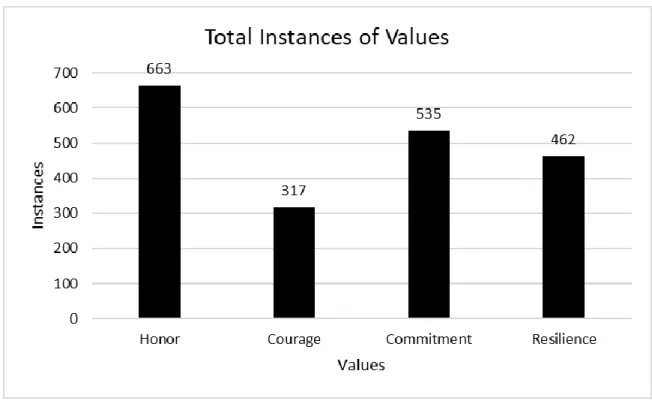
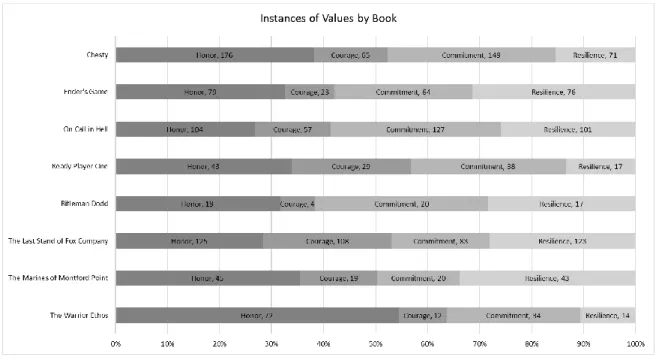
The content analysis revealed that all three Marine Corps values were heavily present in all books on the primary level enlisted reading list, as was the value of resilience.
Figure 1. Total Instances of Honor, Courage, Commitment, and Resilience across the Eight Books.
Honor
honorable actions made up a significant portion of all eight books. It is fitting that it is so common within the Marine Corps reading list due to the fact that honor is the military value that embodies all the others (Gibson, 2013).
Honorable action can be some of the most difficult action to take. Choosing to act honorably is what turned ordinary characters into extraordinary heroes. The books
frequently present the reasons behind why characters choose to act honorably and these reasons were often just as impressive and important as the acts themselves.
Honorable actions took place for reasons that went beyond the individual. In the books there was a full time responsibility to uphold the reputation of the Marine Corps and maintain the standards it has maintained throughout the world (Hoffman, 2001, p. 476), “on duty or off, in uniform or not” (Jadick, 2007, p. 62). Honor is something that is taught in the service (Pressfield, 2011, p. 14) and the Marine Corps does not try to kid its Marines about the costs of honor – Marines are told they are going to get hurt and go through hell, but they are taught that “it is a proud thing, a glorious thing, to fight as Marines have always fought, without counting the cost” and there are much worse things than wounds or death (Hoffman, 2001, p. 450).
There was a deep responsibility to more than just the service. The books tell of those who gave to their country because of a sense of duty (Hoffman, 2001, p. 495) without any type of reward, not even something as simple as a medal (Forester, 1932/2010, p. 207) or glory, just for the knowledge that duty was done (Forester, 1932/2010, p. 53). Take the men of Montford Point2 who showed what unconditional
duty meant as they fought to liberate people who had more liberty than themselves
(McLaurin, 2007, p. 102) and willingly gave their lives for people who never respected or cared about them (McLaurin, 2007, p. 181).
Honorable actions were often done because of a desire to do good in the world. There were Marines in the Korean War who saw it as their mission to restore peace (Drury, 2009, p. 317) and many of the Marines in Iraq believed that failure to engage would cede control of the region to terrorists and lead to the collapse of a struggling democracy (Jadick, 2007, p. 106). In Ender’s Game, Ender Wiggins went to battle school out of the belief it could save the lives of everyone on the planet and preserve the billions of connections between people (Card, 1997, p. 171). In Ready Player One, Wade Watts was willing to stand up to one of the most dangerous and powerful men, take major risks, and dedicate his life to preserving the freedom of an online world that was
considered the one thing that made people’s lives bearable (Cline, 2011, p. 139). The impact honor had in the books was far reaching and incredible. McLaurin’s The Marines of Montford Point told of how the proud service of the first African
lives to bring battlefield medicine to where the fight was saved the lives of thirty Marines who would have otherwise died (Jadick, 2007, p. 243) and the men of Fox Company saved the lives of 8,000 Marines through their actions (Drury, 2009, p. 314).
Ethical, moral action takes many forms within the books. Its forms range from compassion to giving credit to others. Honor was seen by characters embracing equality and fairness and practicing patience, honesty, and respect. Over and over though it took the form of looking out for others. It means comforting a mother who has lost her son (Jadick, 2007, p. 265), supporting family (Hoffman, 2001, p. 9), and giving others a place to stay (Cline, 2011, p. 23). It was often simple things that ended up making a big
difference, such as letting others read letters when they did not get one themselves (McLaurin, 2007, p. 75), feeding and taking care of a paralyzed Marine (Drury, 2009, p. 274), shouldering part of a load another struggling Marine is carrying until they feel reinvigorated enough to take it back (Hoffman, 2001, p. 147), “adopting” the family of a Marine who was killed in combat (Jadick, 2007, p. 241), and using free time to teach and help others (Card, 1997, p. 57). Honor frequently went beyond looking out for others to the point of selflessness though which the characters put the lives of others before their own, such as Rifleman Dodd facing starvation to give a stranger his food (Forester, 1932/2010, p. 24) or HN Joel Lambotte throwing his body on top of a Marine during a RPG hit (Jadick, 2007, p. 40).
Honor did not stop when dealing with the enemy. According to Pressfield (2011), “The Warrior Ethos . . . mandates respect for the enemy. The foe is granted full honor as a fighting man and defender of his home soil and values . . . today’s enemy [is]
characters were willing to learn from their enemy and give honor where it was due, even in defeat (Card, 1997, p. 127). The corpsmen in Fallujah saved the lives of those who had killed their friends and despite the blood, pain, and loss they had caused the insurgents were given the same level of care as the Marines received (Jadick, 2007, p. 227). The individuals in the books were even able to forgive their former enemies without
resentment despite being put through the unimaginable such as Corporal Picket who was held as a prisoner of war by the Chinese in North Korea for 999 days, enduring
starvation, torture, dysentery, and the burials of many of his fellow prisoners (Drury, 2009, p. 310).
Despite the impressive actions the characters took throughout the books, they remained humble. Many would not even discuss the amazing actions they took (Forester, 1932/2010, p. 206). They would instead turn the attention and praise to others as Captain Barber who led Fox Company’s six-day stand did to other outnumbered Marine and Army units in the Korean War (Drury, 2009, p. 313), Chesty Puller did by refusing to mention his achievements instead praising those such as his friend for work as a public school teacher (Hoffman, 2001, p. 225), and Gunnery Sergeant Ryan Shane did by insisting despite his heroism that he was just a small dot on the map while a lot of other great people were doing phenomenal things (Jadick, 2007, p. 263).
expected to, the characters acted with honor – such as Chesty Puller always staying up front in order to boost his men’s morale despite being a senior commander, Ender Wiggins working as hard as anyone at the tasks involved in setting up a new
self-sustaining economy despite being a worldwide hero (Card, 1997, p. 220), and Alexander the Great choosing to fight on the front lines so much so that the entire front of his body was covered in scars despite being king (Pressfield, 2011, p. 25).
The honor demonstrated in the books through actions led to another side of honor, the reputation that comes from being honorable. The books showed how the legacies of the men and women who chose to take honorable actions continued to live on. The memories of those who sacrificed their lives will always “gleam brightly . . . for each is of heroic mold and rich in those qualities of understanding and leadership that sparked in the men under them the best that their men could give, in darkling decades when the best was what their country had to have.” (Hoffman, 2001, p. viiii). In the words of Chesty Puller, “A soldier, unless he is dishonest, can never leave his children much in the way of wealth. But he can leave them a rich heritage of courage, of loyalty, of service to his country.” (Hoffman, 2001, p. 451).
Courage
Although courage was the value with the least occurrences, its instances in the books were some of the most powerful. It was especially prevalent in The Last Stand of Fox Company. Like honor, acts of courage had drastic impacts.
This is why even though Chesty Puller had “as much fear . . . as the average man” he maintained a fearless façade for the good of his men (Hoffman, 2001, p. 168), his cavalier attitude in the face of enemy fire steadying his hard-pressed men and increasing their confidence (Hoffman, 2001, p. 156) and why Captain Barber of Fox Company had at times remained upright behind his men in their foxholes (Drury, 2009, p. 233). There were also those that overcame fear knowing that not doing so would not only fail their men, but also themselves and their families (Jadick, 2007, p. 41). Others did it
unconsciously, allowing instinctive reactions (Forester, 1932/2010, p. 49) and training (Jadick, 2007, p. 41) to take over and beat back the fear.
It was important that the characters won their battle against fear because they faced some very dangerous situations. Amazingly, the characters were often so brave that they not only entered these dangerous situations, they actually wanted to enter them. Important causes led to a desire to leave safety and risk death (Cline, 2011, p. 50), whether it was the Montford Point Marines who “understood the dangers of combat, and feared combat, but feared even more the possibility that racism would deny them the opportunity to experience it” (McLaurin, 2007, p. 118) or the corpsman who understood the risks of bringing a medical aid station close enough to the city to take mortar fire, rocket fire, and even raiding parties of insurgents, yet still wanted to be right in the middle of the city, as near to the front lines as he could get (Jadick, 2007, p. 162). In the words of Plutarch, “The Spartans do not ask how many are the enemy but where are they” (Pressfield, 2011, p. i).
were rushing toward certain death (Cline, 2011, p. 335). The bravery that was displayed once in combat made up the majority of the instances of courage in the books. The fighting often came down to hand-to-hand combat, whether it was in the War of 1812 against the British (McLaurin, 2007, p. 2), during the invasion of Saipan on D-Day (McLaurin, 2007, p. 123), on Bloody Nose Ridge at the Battle of Peleliu (Hoffman, 2001, p. 281), or in the hills of North Korea (Drury, 2009, p. 89). Even when the combat was not hand-to-hand, the enemy was still often at incredibly close ranges, with shooting happening at the point blank range (Drury, 2009, p. 82), sometimes so close aiming was not even necessary (Drury, 2009, p. 85). No matter the type of fighting, the grim and brutal realities of war were faced with courage and tenacity (McLaurin, 2007, p. 12)
There was a willingness to take risks (Card, 1997, p. 196). Without courage the Marines of Fox Company would not have been willing to run out unarmed into the open view of the enemy in order to resupply themselves with ammunition (Drury, 2009, p. 202) nor would Marines helping the Gendarmerie forces in Haiti have been willing to infiltrate enemy camps in disguise (Hoffman, 2001, p. 33). Courage allowed intrepid young Marine lieutenants and sergeants to stand exposed on a barren ridge to direct the fire of their units during the Matanikau Offensive (Hoffman, 2001, p. 176). It also allowed the Marines in Fallujah to enter the houses where insurgents had holed up in hiding without cover, even when the insurgents had every advantage, from dozens of angles to fire from to countless options for booby traps and corners from which to launch final, desperate grenade and AK-47 attacks (Jadick, 2007, p. 215).
rescuing wounded Marines, yet these acts were very common. Marines such as Sergeant Peach lost their lives attempting to rescue their brothers, even when rescue attempts seemed futile (Drury, 2009, p. 4). Marines were rescued no matter how bad the enemy fire pinning them down was (Drury, 2009, p. 24). The rescuers own wounds were often not enough for them to seek safety themselves (Jadick, 2007, p. 218). Fear did not stop Marines from running out into the line of fire for rescues – fear from feeling sparks kicking up all around and rounds snapping past one’s head was not a priority when there were people to save (Jadick, 2007, p. 38). The courage displayed in the rescues was remarkable, whether it was the Haitian officer who fought through a large enemy force to bring an American lieutenant to safety (Hoffman, 2001, p. 29) or the Marines in the Korean War who scoured the ice and the banks of the Chosin under fire to bring in hundreds of soldiers (Hoffman, 2001, p. 397).
Courage did not stop off the battlefield. Courage was also displayed by putting on a strong face for the enemy despite being terrified (Cline, 2011, p. 274), refusing to be intimidated (Card, 1997, p. 80), speaking up and protesting the orders of those with a much higher rank when necessary (Forester, 1932/2010, p. 205), and choosing to go into the unknown (Card, 1997, p. 53). As Pressfield (2011) stated, some say that fear of death and the imperative to survive are the strongest instinct of all, implanted by nature in all living creatures, but warrior ethos evolved to counter the instinct of self-preservation (p. 12). These books show what that means in action.
Commitment
was Rifleman Dodd. The characters in the eight required reading list books showed what intense dedication can mean and accomplish.
Commitment was a constant for those in the books. It did not stop during
challenges. When it comes to warfighting, it was nearly impossible to deter troops from succeeding in their missions. In the words of one Marine, the technology the other side possesses has little impact as long as Marines are trained to march 30 miles a day with a pack, hit whatever they shoot at with any weapon they are trained to use, and have the commitment and the will to fight (Hoffman, 2001, p. 315). On Guadalcanal, when the high rates of fire had boiled away the water in the cooling jackets of the guns the men were told to urinate in them to keep them going (Hoffman, 2001, p. 189). In Nicaragua, the devastating rain and mud on the hilly jungle paths did not stop a unit from keeping its hard pace (Hoffman, 2001, p. 76). During the Battle of Peleliu heavy casualties did not stop units from attacking on time (Hoffman, 2001, p. 280). General Patton expressed the belief that, “A commander, once ashore, must conquer or die” and General Lem
Shepherd, one of the most respected Marine division commanders of World War II, would reflect the same philosophy by saying, “We will attack and attack vigorously, and we will continue to attack until the enemy is annihilated” (Hoffman, 2001, p. 295).
company of Marines are the perfect example of the incredible commitment that was often needed. The brutal, icy ridgeline climb through sometimes waist-deep snow left the weakened Marines crawling up the slope on their hands and knees, yet they pressed on (Drury, 2009, p. 262). In the words of Andrew Wiggins, one of the nation’s first African American Marines, “Nothing is going to stop us, and this is the way we face the
situation” (McLaurin, 2007, p. 75).
Commitment often meant holding on through nonstop assaults. During the Battle for Henderson Field, the Marines looked at the debris of war – hundreds of bodies, broken weapons, ripped-open ammunition containers, lost equipment, dirty bandages, bits of uniforms, and lengths of broken barbed wire – and immediately responded to it by reorganizing their men and resupplying ammunition (Hoffman, 2001, p. 190). These committed men then proceeded to repulse each of the many assaults that followed (Hoffman, 2001, p. 192). It was the same case at the Chosin Reservoir. When the commander of Fox Company was offered the option to lead his company off the hill keeping the Toktong Pass open, his response vowing to hold would become seared in the legacy of the Marine Corps (Drury, 2009, p. 189). The men of Fox Company,
outnumbered by at least ten to one, would endure five days of nearly continuous Chinese attacks (Drury, 2009, p. 273)
also did not stop men from trying to return to future battles. Gunshot wounds and severe concussions could not stop Marines from returning at Iwo Jima (Drury, 2009, p. 24) nor could shrapnel wounds stop Marines from returning at Fallujah (Jadick, 2007, p. 212). In the words of a Marine who led the defense of Fox Hill in North Korea, “One bullet doesn’t stop a man” (Drury, 2009, p. 313).
Commitment meant the characters did much more than just their assigned duties. Even when tasks assigned were limited in scope, individuals in the books did not let that stop them from trying to make a much bigger impact (Hoffman, 2001, p. 458). Not content to merely do his assigned duties, one Marine officer would actually beg his seniors to let him operate in the field when he could spare the time (Hoffman, 2001, p. 67). Commitment also did not stop when characters were off work and duty. The dedicated individuals in the books were constantly looking for ways to improve and better themselves for their cause. Even when being transported in cramped ships, Marines made the most of their free time by gathering in nooks and crannies for lectures on first aid and squad tactics, or spending hours reviewing the operation of their weapons and cleaning them (Hoffman, 2001, p. 333).
Those in the books kept their minds on work when they were off work. In their minds, they would list things they have learned (Card, 1997, p. 68), wring the lessons out of what went wrong (Jadick, 2007, p. 159), and come up with new ideas (Card, 1997, p. 140). For some their minds were always on battles, and not just the particular lessons of previous battles but also on what could be done if the enemy had reacted differently, and these individuals would live with past battles and future battles both, waking and
They would study the history of men and battles of the past (Hoffman, 2001, p. 451) through books (Hoffman, 2001, p. 333) and videos (Card, 1997, p. 167). Good was not good enough for those in the books (Jadick, 2007, p. 158).
Commitment caused many in the books to dedicate extensive time to their cause. Some gave up all of their free time all together to train. From morning to night, there were individuals who worked themselves to the point of exhaustion (Card, 1997, p. 63). There were also individuals who would study twelve hours a day, seven days a week (Cline, 2011, p. 64). Commitment also meant making plenty of personal sacrifices. Characters willingly gave away decades of their life (Card, 1997, p. 186). Many quit college to enlist (Hoffman, 2001, p. 154). They volunteered to deploy and leave behind their loved ones (Jadick, 2007, p. 32). Duty came before bliss (Hoffman, 2001, p. 119).
There was no doubt the individuals in the books were fully committed. The Marine Corps was some people’s whole life (Hoffman, 2001, p. 67), meaning “more than self-preservation, religion, or patriotism” (Hoffman, 2001, p. 507). The causes the characters were committed to really were seen as a form of religion, even a god (Card, 1997, p. 180). It was even more than that though. Regiment was home (Forester, 1932/2010, p. 205). Fellow service members were considered family (McLaurin, 2007, p. 147). The acts of commitments show how important the things characters were dedicated to were to them.
Resilience
remarkably well. The characters found their own ways to cope with difficulties and tragedies. They chose not to focus on the bad and even accept it. The characters remained strong during and after their hardships, making the best of their situations and finding ways to improve them. Amazingly, despite all the characters went through they were able to find joy and humor after their hardships, and eventually find healing.
The books provided an inner window into how characters were able to mentally process the difficulties they faced. Some Marines were able to watch bodies being stacked up and see the people they know getting killed yet still not think about death (McLaurin, 2007, p. 160). Not focusing on the negative took many forms in the books. When things were impossible, characters made the decision not to waste any regrets over those things (Forester, 1932/2010, p. 166). Even during devastating developments, characters were able to remain calm (Cline, 2011, p. 166). Heartbreaking turns were able to be taken philosophically (Hoffman, 2001, p. 425). This way of thinking was often necessary. The battalion commander of the Marines in Fallujah had to keep his emotions in check and focus on winning the battle, which in turn meant not focusing too much on casualties (Jadick, 2007, p. 188). Remaining focused when things went wrong allowed the things that needed to be done to be accomplished (Cline, 2011, p. 223).
The perspective maintained made a huge difference. Forester (1932/2010)
nothing to do with happiness (p. 173). Because the soldier never stopped to think about happiness it could be said that he was happy.
Perspective meant the characters could find things to be grateful for even in the worst of times. One severely wounded Marine refused to feel sorry for himself – all he had to do was look next to him at a fellow Marine laying paralyzed with a bullet in his spine (Drury, 2009, p. 193). The terrible things the characters endured did not stop them from experiencing joy or enjoying beauty. Jokes (Drury, 2009, p. 218) and smiles (Card, 1997, p. 50) were a common occurrence even in the worst of times. A Marine who spent years as a prisoner of war said he will never forget the beauty of the hills and mountains of the place he was held captive (Drury, 2009, p. 311). Optimism was frequent as well. Even when situations seemed hopeless, such as the Korean War campaigns where it was known heavy losses would be sustained, Marines were able to keep the faith that “after the darkness comes the light” and they would make it through even the toughest circumstances (Hoffman, 2001, p. 404).
The resilience the characters kept up also meant they could accept the bad. The ways of war were something many characters adjusted too, even though they were ugly. One character saw war as a natural state and was willing to accept the horrible death-filled landscape as its natural result (Forester, 1932/2010, p. 200). Another was able to accept the demise of a fellow Marine whose body ended up mutilated by the enemy (Hoffman, 2001, p. 39) and simply said, “Those who live by the sword must die by the sword” when offered condolences about his brother’s death (Hoffman, 2001, p. 263). Acceptance did not mean resignation though (Forester, 1932/2010, p. 168). Bad
what they had (Card, 1997, p. 116), improvised when they had to (Jadick, 2007, p. 173), and constantly looked for ways to improve their position (Jadick, 2007, p. 176).
One of the most important aspects of the characters’ resilience is that they did not stop when things got hard. When characters struggled, they did not let it bother them, and instead chose to keep plugging on (Hoffman, 2001, p. 21). Even when the road was long and hard, they continued to work towards their goals with perseverance (Hoffman, 2001, p. 49). When anxiety and fear would creep into characters’ heads during combat they were able to push those emotions back and continue on (Jadick, 2007, p. 18). When things went wrong instead of despairing characters would simply make new plans
(Forester, 1932/2010, p. 57). In the words of Forester, “There are many who give up, and many who procrastinate, but there are some who go on” (1932/2010, p. 170), and there were many extraordinary characters who were able to go on after their hardships.
during difficult times (Jadick, 2007, p. 129), such as the men who served together in Iraq who continue to stay in touch and look out for each other during their paths to recovery (Jadick, 2007, p. 254). Resilience was often something that was shared and could be spread.
The characters were able to adapt to their situations. Many were able to become used to extreme situations (Cline, 2011, p. 198). Once characters adapted, they thrived. Going through hard times made the characters realize that they could handle whatever hard times would come in the future (McLaurin, 2007, p. 60). Jadick called this the “silver lining” of extreme experiences – once an individual has gotten through something that person is better equipped to get through it again (2007, p. 85). It did not take long before the nervous and “trigger happy” Marines who were new to war got over their initial fear once they had the chance to taste actual combat – “to get the feel of their weapon, to kill, to be fired at, to hear the noise of battle” – and become amused by new arrivals going through the same process (Hoffman, 2001, p. 158).
Some characters even embraced their hardships. As Pressfield said, “Marines take a perverse pride in having colder chow, crappier equipment and higher casualty rates than any other service” (2011, p. 50). In the eyes of one of the Montford Point Marines, his experience in the Marine Corps toughened him up, yet he still feels his time in the service was a privilege (McLaurin, 2007, p. 180). Another agreed he will also always cherish his memories in the service knowing enduring that segregation and coming through its challenges made him a stronger person (McLaurin, 2007, p. 180).
found ways to heal and recover from all that they endured. Each person has their own ways of dealing with the things they saw in war (Jadick, 2007, p. 244). For some that meant refusing to carry around hate (Jadick, 2007, p. 228). Many threw themselves into the things that mattered to them, such as family and work, in order to remain focused on the future and keep moving forward (Jadick, 2007, p. 244). Plenty of characters would end up going to school after they got out of the service (McLaurin, 2007, p. 182). They found new passions (Hoffman, 2001, p. 503), new careers that they loved (Jadick, 2007, p. 249), and new ways to make a difference (Jadick, 2007, p. 263).
It has been said that what separates Marines among all elite U.S. forces is their capacity to endure adversity (Pressfield, 2011, p. 50). The words of a Gunnery Sergeant awarded the Bronze Star for his heroism in Fallujah on moving forward sum up what the many instances of resilience in the books helped show - “As long as you're not dead, as long as you've still got a breath in your body, you got no reason to fail, especially as a Marine” (Jadick, 2007, p. 264).
Circulation Study
Figure 3. Total Check Outs across a Month Long Period.
The total check out numbers across the 29 Marine Corps libraries in the circulation study from April 23, 2019 to May 23, 2019 are as follows:
• Rifleman Dodd: 40
• Chesty: 57
• On Call in Hell: 59
• The Marines of Montford Point: 67
• The Warrior Ethos: 78
• The Last Stand of Fox Company:97
• Ender’s Game: 221
There was a dramatic difference in which books from the primary level enlisted required reading list Marines chose to borrow during the month-long period studied in 2019. There was a sharp jump in the number of check outs the two most popular books had compared with the rest of the books on the reading list. The two science fiction choices on the list, Ender’s Game and Ready Player One were at least twice as likely to be borrowed over any of the other six books on the reading list. The fact that Ready Player One was nearly nine times as likely to be borrowed as Rifleman Dodd really
Semi-Structured Interviews
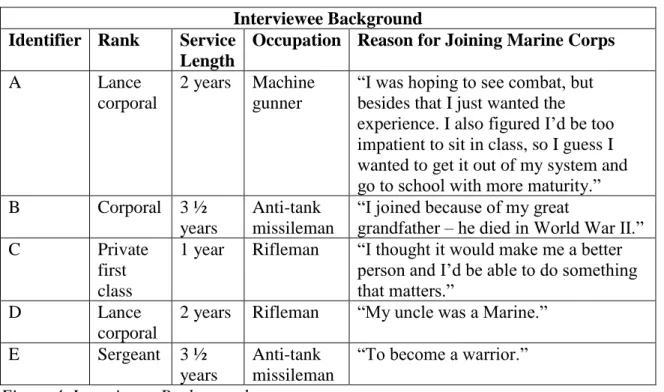
Interviewee Background Identifier Rank Service
Length
Occupation Reason for Joining Marine Corps
A Lance
corporal
2 years Machine gunner
“I was hoping to see combat, but besides that I just wanted the experience. I also figured I’d be too impatient to sit in class, so I guess I wanted to get it out of my system and go to school with more maturity.”
B Corporal 3 ½
years
Anti-tank missileman
“I joined because of my great
grandfather – he died in World War II.”
C Private
first class
1 year Rifleman “I thought it would make me a better person and I’d be able to do something that matters.”
D Lance
corporal
2 years Rifleman “My uncle was a Marine.”
E Sergeant 3 ½
years
Anti-tank missileman
“To become a warrior.” Figure 4. Interviewee Background.
All of the Marines interviewed read at least one book from the primary level required reading list. Yet four of the five Marines also chose to read books from the required reading list outside of the primary level, both from the “Commandant’s Choice” section and from above their grade level. The full enlisted required reading list is in Appendix F.
Figure 5. Interviewee Reading Choices
Interviewee Reading Choices Identifier Books Read
A All Quiet on the Western Front, Ender’s Game, Gates of Fire. The Killer
Angels, Starship Troopers, MCDP-1 Warfighting, With the Old Breed
B Battle Cry, Ender’s Game, Gates of Fire
C The Warrior Ethos
D Ghost Fleet, The Last Stand of Fox Company, Outliers
E Ender’s Game, Gates of Fire, The Last Stand of Fox Company, Left of
Enjoyment
All of the Marines interviewed enjoyed the required reading list books they read. In the words of one lance corporal, even the driest read he chose – the official Marine Corps publication on Warfighting – was still “a decent read.” That same lance corporal praised the other required reading books he chose as books he “really enjoyed.”
Education
All of the Marines learned something from the books they read. They learned about tactics and factors of war from official educational publications like MCDP-1. The Last of Fox Company taught tactics like how “a well laid out defense can overcome
superior numbers.” One Marine not only enjoyed reading All Quiet on the Western Front, he also learned history from it. It was the same with Killer Angels, With the Old
Breed, and Gates of Fire, all of which taught “how war was fought in the past.” Another
Marine got both an impactful history lesson on the Korean War in The Last Stand of Fox Company and a preview of what could be possible in the future in Ghost Fleet. Marines
Relatability
The questions on the books’ relatability received mixed responses. One Marine said that even though the books he read were “great”, he could not quite relate to them. He said the books did not translate over very well to his experience in the Marine Corps. The majority did find something they could relate to though. There was a Marine who found something he could easily relate to in each book he read. This Marine found Starship Troopers to be the most relatable, citing characters that “thought and acted like
we do” with “gung ho” troopers who “want to go fight, despite the hardships of war”. He felt similarly about Ender’s Game, mentioning conflicts between the soldiers during training. Other books like Gates of Fire, With the Old Breed, and Killer Angels “seemed a bit different because of the time gap and the cultures at the time”, yet “the general ‘warrior’ type themes were still there”. Another Marine made similar comments about the relatability of the characters in The Last Stand of Fox Company. Other Marines were able to relate the books they read to the training they received. The Marine who read The Warrior Ethos was already taught many of its ideals through his time in the Marine
Corps. One Marine who read Ender’s Game said “the protagonist essentially uses maneuver warfare to defeat his enemies, just like the the Marine Corps.” When it comes to the ethical side of training, On Killing “talks about how the military makes it
Value Representation
The Marines saw both the Marine Corps values and many different values as well in the books they read. When asked whether the books they read were representative of the Marine Corps values, all five Marines said yes. They saw honor in Gates of Fire when the Spartans stayed knowing they would die after all of the other warriors had left, all because honor compelled them to sacrifice themselves for the greater good; They saw courage as they read about different battles; They saw commitment in Ender’s Game when the main character stuck with his mission and kept winning battles despite all he had to deal with, “fighting even when he was extremely fatigued.” One Marine said in The Last Stand of Fox Company, the captain displayed all of the values - “honor, courage,
and commitment in his defense of the hill . . . against the Chinese and Koreans.” As another Marine said on the variety of books that he read, “each different faction showed courage and commitment, and each had their own form of honor code.”
There were plenty of additional values the Marines saw in the books besides honor, courage, and commitment. One “big one” was efficiency, “in the way each military force went about business.” Another was patriotism. It was said this was especially prevalent in Starship Troopers, “where extreme patriotism was a common value.” Yet another one was respect, since “most characters eventually gained a respect for their enemy, whether due to their proficiency or because characters could relate to them like in All Quiet on the Western Front.” Integrity and determination were also brought up, along with strength and dedication. A Marine stated, “the captain in The Last Stand of Fox Company showed strength and perseverance in front of his marines to help
Analysis
The content analysis showed honor, courage, commitment, and resilience ran through all of the reading list books and that they were displayed in many different ways. The content analysis also showed that each value was present in all of the books in
relatively similar proportions. This is important because the circulation study showed a wide popularity gap between which primary level enlisted reading books were checked out. When it comes to exposing readers to Marine Corps values and resilience this divide had little impact however. No matter which book Marines read, they were exposed to multiple instances of honor, courage, commitment, and resilience.
The interviews would also add an additional layer of complexity as they showed primary level enlisted Marines were choosing many required reading list books outside of the primary level, from higher levels as well as from the “Commandant’s Choice” section of the reading list. Despite this divergence Marines still brought up examples of the Marine Corps values in books outside of the primary level list. This showed that even when they went outside their level, they still found honor, courage, and commitment. The important thing was only that they were reading.
Conclusion
The paper introduced honor as the ultimate standard in ethical and moral conduct, an uncompromising code of personal integrity which meant each Marine who acted by it would never sully the reputation of the Corps (Sturkey, 2001). The specific themes and ways the books displayed it were through characters choosing action over words, compassion, confidence, a crisp presentation, dedication, a desire to challenge self, a desire to go above and beyond duty, a desire to prove self, dignity, discipline, a duty to a higher cause, embracing difficulty, equality, excellence, experience, fairness, faith, forgiveness, going above and beyond, high standards on and off duty, honesty, honor above all else, having a huge impact, humanity to the enemy, humility, kindness, leadership and leading by example, legacy, looking out for others, loyalty, military and Marine Corps honor, morals, obedience, patience, pride, putting forth everything, putting others first, refusing to show weakness, refusing help, refusing surrender, reputation, respect, righting wrongs, sacrifice, self-respect, sticking together, strength of character, strongly held virtues, thanking men, unconditional duty not returned or rewarded, and valor.
fear, overcoming fear, purposely entering dangerous situations, remaining calm during combat, performing rescues during danger, running into combat, and sticking with dangerous situations.
Meanwhile, commitment was introduced as total dedication to the Marine Corps and the country, meaning never giving up, giving in, or accepting second best (Sturkey, 2001). This was displayed through commitment that extends beyond work hours and assigned duties, commitment through impossible odds, commitment to men, commitment undeterred by challenges, complete commitment to commanders, dedicating extensive time to causes, dedication through difficult times, dedication through injury, dedication to excellence, determination in the face of impossible odds, commitment stronger than family and religion, focusing only on missions, going above and beyond in combat, lifelong commitment, making hard choices and personal sacrifices for the cause, no rest, overcoming barriers, persistence until the mission is complete, pride, purposely entering dangerous situations, refusal to stop during difficult situations, refusal to surrender or retreat, service above self, making the ultimate sacrifice, unwavering commitment, and willingness to take extreme action.
ignoring pain, improving negative situations, joy during and after hardship, keeping a strong face despite pain, learning and growing from hardship, looking at the positive side of bad situations, maintaining perspective, making difficult decisions and following through, making light of situations, making the best of bad situations, having no self-pity, not focusing on the negative, overcoming adversity, refusing to quit during challenges, strength after hardship, success after hardship, and taking action after hardship.
During the interviews Marines described the Marine Corps values as “what guides Marines to do what’s right” and “general guidelines for Marines to follow . . . to make sure everyone is on the same page and shares common values when working together and making decisions”. They also described it as “an all encompassing ethics system that teaches people how and why to do the right thing for the right reasons” and “a standard set of morals that all Marines have in common allowing for a tighter bond” and helps them “separate what’s right and wrong”. The books displayed these guiding values many different ways and the Marines interviewed picked up on them, no matter which reading list books they chose. According to the official Marine Corps publication on values, the Marine Corps values are “cornerstones in building Marines” (U.S. Marine Corps,
Future Research
Military reading is a subject that is not frequently studied, and this research only looked into a small aspect of it. There is much more that can and should be done. The Marine Corps’ Commandant's Professional Reading List is an important military learning tool and deserves to be studied as one. Ideally, the research should be both expanded upon and revisited.
There are many ways the research could be expanded. To start with, the Marine Corps Commandant’s reading list is much more than the eight books from the primary level enlisted list. The Commandant’s reading list is broken down into 11 levels and there are currently 98 books on the Commandant’s reading list. It is meant for both officer and enlisted Marines of all ranks. Marine Corps reading deserves to be looked at on all of its levels across all ranks for officers as well as enlisted.
Revisiting the research is especially important because the Marine Corps
Commandant’s reading list is not static. It is constantly changing. New books are added and old books are removed. The Commandant routinely sends out revisions to the list. As the reading list evolves and changes over time, revisiting the research will provide a comparison between new books that are selected and the books that were on the reading list at the time this paper was written.
Bibliography
Amos, J. F. (2012). Reading in the Marine Corps . . . Thirty year old body and 5000-year-old mind. White Letter No. 4-12. Retrieved from
https://www.pendleton.marines.mil/Portals/98/Docs/HS_BN/S3/essay_contest.pdf
Bonn, K. (2005). Army officer's guide (50th ed.). Mechanicsburg, PA: Stackpole Books. Bonanno, G. A. (2005). Resilience in the face of potential trauma. Current Directions in
Psychological Science, 14, 135–138. http://dx.doi.org/10
.1111/j.0963-7214.2005.00347.x
Bonanno, G. A., and Mancini, A. D. (2012). Beyond resilience and PTSD: Mapping the heterogeneity of responses to potential trauma. Psychological Trauma: Theory, Research, Practice, and Policy, 4, 74 – 83. http:// dx.doi.org/10.1037/a0017829
Cacioppo, J. T., Reis, H. T., and Zautra, A. J. (2011). Social resilience: The value of social fitness with an application to the military. American Psychologist, 66(1), 43–51. https://doi-org.libproxy.lib.unc.edu/10.1037/a0021419
Card, O. S. (1997). Ender's game. New York: TOR.
Clarity, T. (2016). Read to lead. United States Naval Institute. Proceedings, 142(9), 70-71. Retrieved from http://libproxy.lib.unc.edu/login?url=https://search-proquest-com.libproxy.lib.unc.edu/docview/1817102509?accountid=14244
Commitment. (n.d.). In Oxford English Dictionary. Retrieved from
https://en.oxforddictionaries.com/definition/commitment
Corbin, J., and Strauss, A. (2008). Basics of qualitative research (3rd ed.): Techniques and procedures for developing grounded theory. Thousand Oaks, CA: SAGE
Publications, Inc. doi: 10.4135/9781452230153
Courage. (n.d.). In Oxford English Dictionary. Retrieved from
https://en.oxforddictionaries.com/definition/courage
Dinkins, D. (2003). Circulation as assessment: Collection development policies evaluated in terms of circulation at a small academic library. College and Research
Libraries,64 (1), 46-53.
Drury, B. and Clavin, T. (2009). The last stand of Fox Company: A true story of U.S. Marines in combat. New York: Grove Press.
Elliot, M., Fairweather, I., Olsen, W., and Pampaka, M. (2016). Semi-structured
interview. In A Dictionary of Social Research Methods.: Oxford University Press, Retrieved 23 Mar. 2019, from
http://www.oxfordreference.com.libproxy.lib.unc.edu/view/10.1093/acref/978019
1816826.001.0001/acref-9780191816826-e-0373.
Fialkoff, F. (2002). The circulation trap. Library Journal, 127 (13), p. 68.
Forester, C. S. (2010). Rifleman Dodd: A novel of the Peninsular Campaign. Kessinger Publishing. (Original work published 1932).
Gibson, S. (2013, March 8). The code of honor; know it, embrace it. Retrieved from
https://www.army.mil/article/98038/the_code_of_honor_know_it_embrace_it
Glazier, J. (1985). Structured observation: How it works. College & Research Library News, 46(3), 105–108.
Grossman, D. and Christensen, L. W. (2008). On combat: The psychology and physiology of deadly conflict in war and in peace. Millstadt, IL: Warrior Science Pub.
Grossman, D. (1995). On killing: The psychological cost of learning to kill in war and society. Boston: Little, Brown.
Headquarters Marine Corps Marine and Family Programs. (2017). The Marine Corps demographic update. Retrieved from
https://www.usmc-mccs.org/mccs/assets/File/2017%20Demographics%20Booklet%20Jun(1).pdf
Headquarters Marine Corps. (n.d.). What are the marine corps values? Retrieved from
https://www.hqmc.marines.mil/hrom/New-Employees/About-the-Marine-Corps/Values/
Heinlein, R. A. (1959). Starship troopers. New York: G.P. Putnam's Sons.
Hoffman, J. (2001). Chesty: The story of Lieutenant General Lewis B. Puller, USMC. New York: Random House.
Hoge, E. A., Austin, E. D. and Pollack, M. H. (2007), Resilience: research evidence and conceptual considerations for posttraumatic stress disorder. Depression and Anxiety, 24: 139-152. doi:10.1002/da.20175
Honor. (n.d.). In Oxford English Dictionary. Retrieved from
https://en.oxforddictionaries.com/definition/honour
Howell, A. (2015). Resilience, war, and austerity: The ethics of military human enhancement and the politics of data. Security Dialogue, 46(1), 15-31. doi:10.1177/0967010614551040
Jadick, R. and Hayden, T. (2007). On call in Hell: A doctor's Iraq War story. New York: NAL Caliber.
Jarrett, T. (2008). Warrior resilience training in Operation Iraqi Freedom: Combining rational emotive behavior therapy, resiliency, and positive psychology. U.S. Army Medical Department Journal, 32–38. Retrieved from
https://auth-lib-unc-edu.libproxy.lib.unc.edu/ezproxypass:[_]auth.php?url=http://search.ebscohost.co
m.libproxy.lib.unc.edu/login.aspx?direct=true&db=mth&AN=35600236&site=eh
ost-live&scope=site
Kobasa, S., Maddi, S., and Kahn, S. (1982). Hardiness and health: A prospective study. Journal of Personality and Social Psychology, 42, 168–177. doi:10.1037/0022‐
3514.42.1.168
Lauterborn, D. (2015). Interview: General James Mattis on educating warriors. (2015, 07). Military History, 32, 14-15. Retrieved from
http://libproxy.lib.unc.edu/login?url=https://search-proquest-com.libproxy.lib.unc.edu/docview/1675260237?accountid=14244
Luzius, J. (2005) A look at circulation statistics, Journal of Access Services, 2:4, 15-22, doi: 10.1300/J204v02n04_03