RANK REDUCTION OF CONFORMAL BLOCKS
Michael Schuster
A dissertation submitted to the faculty at the University of North Carolina at Chapel Hill in partial
fulfillment of the requirements for the degree of Doctor of Philosophy in the Department of
Mathematics.
Chapel Hill
2016
ABSTRACT
Michael Schuster: Rank Reduction of Conformal Blocks
(Under the direction of Prakash Belkale)
Let
X
be a smooth, pointed Riemann surface of genus zero, and
G
a simple, simply-connected
complex algebraic group. Associated to a finite number of weights of
G
and a level is a vector
space called the space of conformal blocks, and a vector bundle over M
0,n. We show that, assuming
ACKNOWLEDGEMENTS
I am immensely grateful to my advisor Prakash Belkale for his patience, guidance, generosity,
and encouragement in the preparation of this dissertation and throughout my graduate career. I
also thank Shrawan Kumar for helpful discussions about loop groups; Vikraman Balaji for useful
clarifications on parahoric group schemes; and Angela Gibney and Swarnava Mukhopadhyay for
helpful comments about the exposition, and potential applications to conformal blocks divisors. I
would also like to thank the faculty and staff in the UNC-CH math department for their dedication
to my education and professionalism. In particular, I would like to thank Pat Eberlein and Richard
Rimanyi for introducing me to geometry, and Laurie Straube for all the administrative help she has
given me.
TABLE OF CONTENTS
LIST OF TABLES . . . .
ix
Introduction . . . .
1
0.1
Reduction rules on the regular faces . . . .
1
0.1.1
Regular faces of the multiplicative polytope . . . .
2
0.1.2
Main theorem for degree zero walls . . . .
3
0.1.3
Reductions on positive degree faces . . . .
5
0.1.4
Conformal blocks over stacks of parahoric bundles . . . .
6
0.2
Outline of proof of the main theorem . . . .
7
0.2.1
Modifications for general weights off the alcove wall
. . . .
8
0.2.2
Weights on the alcove wall and parahoric bundles . . . .
9
0.3
Outline of the dissertation . . . .
10
0.4
Notation and conventions . . . .
11
Chapter 1. Preliminaries on the multiplicative polytope and conformal blocks
.
13
1.1
The multiplicative polytope and quantum cohomology . . . .
13
1.1.1
The additive eigencone and the multiplicative polytope
. . . .
13
1.1.2
Quantum cohomology of
G/P
and the multiplicative polytope
. . . .
15
1.1.3
Degeneration of cohomology products and irredundant inequalities . . . .
16
1.2
Conformal blocks . . . .
18
1.2.1
The additive eigencone and tensor representation invariants . . . .
19
1.2.2
Conformal blocks as spaces of coinvariants . . . .
19
1.2.3
Conformal blocks as generalized theta functions . . . .
21
Chapter 2. Parahoric bundles . . . .
24
2.1.1
Moduli spaces on the boundary of
A
. . . .
25
2.2
Parahoric bundles
. . . .
26
2.2.1
Basic definitions . . . .
27
2.2.2
Parahoric group schemes, bundles, and associated loop groups
. . . .
29
2.2.3
Parahoric bundles as quotients of equivariant bundles
. . . .
30
2.3
Relative flag structures for parahoric bundles . . . .
31
2.3.1
Special fibers of parahoric group schemes . . . .
32
2.3.2
The image of parahoric subgroups in
C
G(
τ
) . . . .
34
2.3.3
Relative flag structures
. . . .
36
2.4
Line bundles on stacks of parahoric bundles . . . .
38
Chapter 3. Beginning of the proof of the reduction theorem: Stacks of
P
-reductions 41
3.1
Universal reduction stacks . . . .
42
3.1.1
Stacks of
P
-reductions . . . .
45
3.1.2
Smoothness of
Z
. . . .
46
3.1.3
Irreducibility of
Z
. . . .
47
3.2
Lifting families of
P
-reductions . . . .
48
3.2.1
Bun
ΓY,G(
τ
)
−
∼→
Bun
Gin terms of transition functions . . . .
48
3.2.2
Construction of
C →
Bun
ΓY,G;P(
τ
;
τ
u,
0)
. . . .
49
3.2.3
Proof of Theorem 3.2.1
. . . .
52
3.3
Properness over the semistable locus . . . .
54
Chapter 4. Conclusion of the proof of the reduction theorem . . . .
58
4.1
Reduction to the Levi subgroup
L
⊆
P
. . . .
58
4.2
Reductions to
L
0and completion of the proof of the main theorem . . . .
62
Chapter 5. Examples
. . . .
68
5.1
Rank reduction in type A . . . .
68
5.1.1
Level one conformal blocks
. . . .
70
5.1.2
Specific examples . . . .
73
5.2
Examples in type C
. . . .
76
LIST OF TABLES
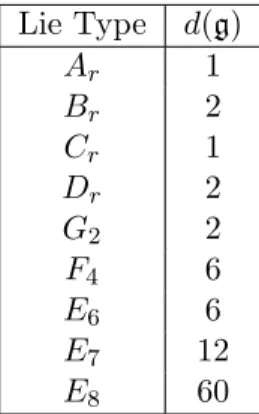
1.1
Minimal Dynkin indices . . . .
23
INTRODUCTION
Let
G
be a simple, simply connected algebraic group over
C
of rank
r
. Choose a maximal torus
T
and Borel subgroup
B
of
G
. Let
K
⊆
G
be a maximal compact subgroup. Let
g
be the Lie
algebra of
G
, and
h
⊆
g
the Cartan subalgebra associated to
T
. Let
α
1, . . . , αr
∈
h
∗be the simple
roots of
g
, and let
θ
be the highest root. Then the
fundamental alcove
A
is defined as follows:
A
=
{
µ
∈
h
|
θ
(
µ
)
≤
1
, α
i(
µ
)
≥
0 for all
i
}
.
The
multiplicative polytope
is defined as
∆
n=
{
~
µ
∈ A
n|Id
∈
C
(
µ
1)
· · ·
C
(
µ
n)}
,
where
C
(
µ
) denotes the conjugacy class of exp(2
πiµ
) in
K
. This subset was shown to be a convex
polytope in [39] using symplectic methods.
The set
A
nalso parametrizes other objects, such the holonomy of flat
K
-bundles, line bundles
over certain moduli spaces, and vector spaces from physics called
conformal blocks
. For each of
these there is a corresponding existence problem solved by the multiplicative polytope. Conformal
blocks also form vector bundles over families of stable pointed curves, and in genus zero these vector
bundles correspond to nef divisors on the moduli space M0
,nof genus zero stable pointed curves.
Fakhruddin recently proved formulas for conformal blocks divisors in terms of boundary divisors,
generating interest in using conformal blocks divisors to study the geometry of M0
,n[17]. The goal
of this dissertation is to study conformal blocks and their associated divisors when
~
µ
is on a face of
the multiplicative polytope.
0.1
Reduction rules on the regular faces
such that
A
1· · ·
A
n= Id and each
A
iis block diagonal of the same dimensions. See Knutson’s proof
[31] of a similar result for Hermitian matrices.
More recently, factorization results have been proven for Littlewood-Richardson coefficients, first
for SL
n+1by King, Tollu, and Toumazet [30], then in all types by Roth [44]. The assumption on the
weights is that they lie on a face of the
additive eigencone
, which is an analogue of the multiplicative
polytope for Lie algebras. Ressayre has generalized Roth’s result to general branching coefficients
[42].
In this dissertation we show that a similar result holds for
conformal blocks
in all Lie types.
Conformal blocks are vector spaces originally arising in conformal field theory. They were later
shown to be isomorphic to spaces of global sections of line bundles on the moduli stack of
parabolic
bundles
over a smooth curve
X
- denoted Parbun
G- therefore giving a description of conformal
blocks as
generalized theta functions
.
0.1.1
Regular faces of the multiplicative polytope
The problem of finding the inequalities defining the faces of ∆
nhas a long history. The general
form of the answer is that the inequalities are parametrized by certain cohomology products in
the cohomology ring of Grassmannians
G/P
. It was first solved for SL2
by Biswas [12], then by
Agnihotri and Woodward for SL
n[1] and independently by Belkale in [6]; Belkale furthermore
reduced the inequalities to an irredundant set. Teleman and Woodward [53] found inequalities
defining ∆
nin general type, and more recently Belkale and Kumar [10] reduced these inequalities
to an irredundant set, building on their work on the additive eigencone [9] and Ressayre’s proof of
the irredundancy of Belkale and Kumar’s inequalities in [43].
More precisely, the cited works study the
regular
faces of ∆
n, that is, the faces that pass through
the interior of
A
n. These faces correspond to a set of irredundant inequalities determining ∆
n.
Teleman and Woodward showed that ∆
nis determined by a set of inequalities parametrized by
(small) quantum cohomology products in QH
∗(
G/P
) of the form
σu
1∗ · · · ∗
σu
n=
q
d
[
pt
] for all
maximal parabolics
P
. In [10] Belkale and Kumar define a degeneration of the quantum product
~0
that selects a subset of the inequalities determining ∆
n. Belkale and Kumar show that this set
Theorem 0.1.1.
([10]) The multiplicative polytope
∆
n⊆ A
nis determined by the following
inequalities: for any maximal parabolic
P
, and Schubert classes
σu
1, . . . , σu
nsuch that
σ
u1~0
· · ·
~0
σ
un=
q
d
[
pt
]
any
~
µ
∈
∆
nmust satisfy
n
X
i=1
ωP
(
u
−i 1µi
)
≤
d,
where
ω
Pdenotes the fundamental weight associated to
P
. This set of inequalities is irredundant.
For a precise definition of
~0
and further discussion of its relationship with the multiplicative
polytope, see section 1.1.
0.1.2
Main theorem for degree zero walls
For the remainder of the introduction, assume
X
∼
=
P
1. Conformal blocks take as input a choice
of distinct points
p
1, . . . , pn
∈
X
, a finite number of dominant, integral weights
λ
1, . . . , λn
∈
h
∗, and
an integer
`
called the level, and produce a finite dimensional vector space denoted
V
†g,~λ,`
(
X, ~
p
).
The dimension of the space of conformal blocks does not depend on the choice of points, and so
generally we will suppress the pointed curve in our notation. Conformal blocks are defined as
certain invariants related to the pointed curve of a tensor representation of the affine Kac-Moody
Lie algebra associated to
G
(see section 1.2).
Now to weights
λ
1, . . . , λ
nand a level
`
we can associate points of the fundamental alcove
µi
=
κ(λ`i)∈ A, where
κ
:
h
∗ ∼−
→
h
is the isomorphism induced by the (normalized) Killing form.
Then the space
V
†g,~λ,`
has positive dimension (possibly after scaling the weights and level) if and only
if the tuple (
µ
1, . . . , µn
) lies in the multiplicative polytope. This is only true when the genus of
X
is
0; otherwise conformal blocks are always nonzero after sufficient scaling (see [53]). We say that the
weight data
w
~
= (
λ
1, . . . , λ
n, `
) associated to a conformal block is on a facet of the multiplicative
polytope if the associated (
µ
1, . . . , µ
n) is on the facet.
Now assume
w
~
is on the regular facet of the multiplicative polytope associated to the cohomology
product
σ
u1~0
· · ·
~0
σ
un= [pt]
∈
QH
torus
T
of
G
, and let
L
0= [
L, L
]. Then
L
0is semisimple and simply connected, and therefore is
isomorphic to a product of simple groups; for simplicity we assume that there are two factors:
L
0∼
=
G
1×
G
2. Then our main theorem gives an isomorphism betweenV
†g,~λ,`
and conformal blocks
associated to
G
1and
G
2, which together have one less rank thanG
.
Theorem 0.1.2.
For weight data
w
~
= (
λ
1, . . . , λ
n, `
)
in the multiplicative polytope, lying on the
facet corresponding to
σu
1~0
· · ·
~0
σu
n= [
pt
]
∈
QH
∗
(
G/P
)
, we have a natural isomorphism of
conformal blocks
V
g, ~†w∼
=
V
g†1, ~w1
⊗ V
†g2, ~w2
where
w
~
1and
w
~
2are the restrictions of following weight data to
g
1and
g
2:
1. Weights
u
−11λ
1, . . . , u
−n1λ
n.
2. Levels
m
1`
and
m
2`
, where
m
1and
m
2are the Dynkin indices of
g
1and
g
2in
g, respectively.
Remark
0.1.3
.
The Dynkin indices
m
1and
m
2for simply-laced groups are always equal to 1.
Remark
0.1.4
.
In fact we prove the above theorem for products
σu
1∗ · · · ∗
σu
n= [pt] and weights
satisfying the corresponding inequality given in Theorem 0.1.1. For
G
= SL
r+1this is no
generaliza-tion since the degenerated quantum product is the same as the usual one. However in other Lie
types this is a weaker assumption than the one stated above, and the weights will lie on a face that
is either not regular or not a facet.
Remark
0.1.5
.
In chapter 5 we restate this theorem for the groups SL
r+1and Sp
2r, and give a
number of examples for those groups.
A simple argument shows that we can extend this isomorphism to conformal blocks
bundles
,
which are vector bundles
V
w~over the moduli space M
0,nof genus zero stable pointed curves with
n
marked points, such that the fiber over (
X, p
1, . . . , p
n)
∈
M
0,nis the dual of the space of conformal
blocks, denoted
V
g, ~w. The proof uses the fact that in genus 0 these bundles are globally generated,
and Roth’s reduction theorem for invariants [17, 44].
Corollary 0.1.6.
With the same assumptions as above, we have an isomorphism of conformal
blocks bundles on
M
0,n:
Therefore the divisors
D
g, ~wgiven by the first Chern classes of these vector bundles satisfy the relation
D
g, ~w=
rk
(V
g2, ~w2)
·
D
g1, ~w1+
rk
(V
g1, ~w1)
·
D
g2, ~w2Finally, since the inequality associated to
σ
u1~0
· · ·
~0
σ
un= [pt] does not depend on the level
`
, we can increase
`
and the weight data will still be on the corresponding regular facet of the
multiplicative polytope. In fact these faces also define a cone called the
additive eigencone
(see
section 1.1). It is well known that at high enough level conformal blocks become isomorphic to
spaces of invariants
A
g,~λ:= (
Vλ
1⊗ · · · ⊗
Vλ
n)
g
. Therefore as a final corollary we get Roth’s reduction
theorem for tensor product invariants:
Corollary 0.1.7.
([44]) Given weights
~
λ
lying on a facet of the additive eigencone corresponding
to
σu
1~0
· · ·
~0
σu
n= [
pt
]
, we have a canonical isomorphism of invariants:
A
g,~λ∼
=
A
g1,~λ1⊗
A
g2,~λ2,
where
λ
~
1,
~
λ
2are given by the restrictions of
u
i−1λi
to
g
1and
g
2.
0.1.3
Reductions on positive degree faces
We also obtain reductions on the positive degree regular facets of the multiplicative polytope,
however the statement is more complicated. We continue with the notation from the previous
section. To the Levi subgroup
L
⊆
P
we assign a degree
kL
, which is the size of the kernel of the
isogeny
Z
0→
L/L
0, where
Z
0is the connected component of the identity of
L
. In [10], Belkale and
Kumar showed the existence of a cocharacter
µ
Plying in the fundamental alcove of
L
, such that
|
ω
P(
µ
P)|
= 1, where
ω
Pis the fundamental weight associated to
P
. Finally, let
d
0be the smallest
integer such that
d
+
d
0ω
P(
µ
P)
≡
0 (mod
k
L). Then by adding
d
0points to our pointed curve and
twisting using the cocharacter
µ
P, we obtain a rank reduction theorem for weight data on positive
degree facets (see Proposition 4.2.3 for more details).
Theorem 0.1.8.
For weight data
w
~
= (
λ
1, . . . , λ
n, `
)
in the multiplicative polytope, lying on the
facet corresponding to
σ
u1~0
· · ·
~0
σ
un=
q
conformal blocks
V
g, ~†w∼
=
V
g†1, ~w1
⊗ V
†g2, ~w2
where
w
~
1and
w
~
2are the restrictions of following weight data to
g
1and
g
2:
1. The first
n
weights are
u
−11λ
1, . . . , u
−n1λn
.
2. The last
d
0weights are
`µ
∗P, where
µ
∗Pis the dual with respect to the Killing form.
3. The levels are
m
1`
and
m
2`
, where
m
1and
m
2are the Dynkin indices of
g
1×
g
2in
g.
Remark
0.1.9
.
This result of course has no classical analogue for spaces of invariants. Furthermore
Example 5.1.9 shows that this isomorphism does not extend to conformal blocks vector bundles in
general. It would be interesting to know if there is a relationship between these bundles.
0.1.4
Conformal blocks over stacks of parahoric bundles
To prove these reduction theorems, we use the fact that spaces of conformal blocks can be
canonically identified with spaces of generalized theta functions. More precisely, there is a line
bundle
L
w~over the moduli stack of parabolic bundles Parbun
Gsuch that H
0(Parbun
G,L
w~)
∼
=
V
†
g, ~w
.
Parabolic bundles are principal
G
-bundles together with extra data over each point
p
i, see section
1.2 for a precise definition. For arbitrary weight data, we need to work over a generalization of the
stack of parabolic bundles: the moduli stack of parahoric bundles.
Parahoric bundles are torsors over a smooth group scheme
G →
X
determined by the choice
of weight data
w
~
. Moduli stacks of parahoric bundles are the natural setting in which work with
conformal blocks as generalized theta functions when the weight data is on the affine wall of the
alcove
A. When
G
= SL
r+1, parahoric bundles can be identified with parabolic vector bundleswhere the underlying vector bundle has nonzero degree. For a general group, parahoric bundles can
be more exotic.
Remark
0.1.11
.
To be more precise, the parahoric group schemes in the above theorem are the
parahoric group schemes associated to the split group
G
(
K
), where
K
=
k
((
z
)) is the field of formal
Laurent series, and
G
is a simply connected linear algebraic group over
C
. We do not prove this
theorem for non-simply connected groups or attempt to generalize to quasi-split groups.
0.2
Outline of proof of the main theorem
Now we outline the proof of the reduction theorem. A more precise outline is given at the
beginning of chapter 3, after parahoric bundles have been introduced. The proof is simplest when
the weight data
w
~
lies in the interior of the alcove, and the degree of the wall is zero. Assume that
the weights lie on a degree zero facet of the multiplicative polytope corresponding to a cohomology
product
σu
1~0
· · ·
~0
σu
n= [
pt
]
∈
QH
∗
(
G/P
).
Now let Parbun
Gbe the moduli stack of parabolic bundles with full flags over (
X, p
1, . . . , pn
).
To our weight data
w
~
we can associate a line bundle
L
w~over Parbun
G. Then the space of conformal
blocks
V
g, ~†wcan be identified with the space of global sections of
L
w~. The first step is to show that
the following morphism of stacks induces an isomorphism of spaces of global sections of
L
w~via
pullback by
Parbun
G ι←
−
Parbun
L(0)
,
where the parabolic
L
-bundles are degree 0, and
ι
is given by extension of structure group and by
twisting the flags over each
pi
by
ui
. The twisting by the
ui
’s makes the pullback
ι
∗L
w~isomorphic
to
L
w~0where
w
~
0is the weight data described in the reduction theorem.
Therefore we want to show that global sections of
L
w~over Parbun
L(0) extend to global sections
of Parbun
Guniquely. To show this we use a method originally due to Ressayre [43]: we use another
stack
C, with morphisms
π
:
C →
Parbun
G, and
ξ
:
C →
Parbun
L(0).
C
Parbun
GParbun
L(0)
π ξ
ι
birational (see [10]). The morphism
ξ
in terms of vector bundles
W
⊂
V
and flags
F
i•in type A is
given by (
V, W, F
i•)
7→
W
⊕
V /W
together natural induced flags on
W
⊕
V /W
; this morphism is
surjective. While the above diagram is not 2-commutative, the pullbacks of
L
w~via
π
and
ι
◦
ξ
can be
identified over
C. This identification depends on the weight data
w
~
being on the facet corresponding
to
σu
1~0
· · ·
~0
σu
n= [
pt
].
The next step of the proof is to show that
π
is proper over the semistable locus of Parbun
Gwith
respect to
L
w~. Starting with a one parameter family of semistable parabolic bundles
E →
X
×
C
and a family of
P
-reductions of parabolic degree 0 over the punctured curve
C
∗, we embed and
complete the family of
P
-reductions inside a Hilbert scheme. Then properness follows from a
no-ghosts theorem proved by Holla and Narasimhan in [27]. Finally, we use Zariski’s main theorem
to show the pullback of global sections of
L
via
π
induces an isomorphism, and finish the reduction
H
0(Parbun
G,L
w~)
−
∼→
H
0(Parbun
L(0)
,
L
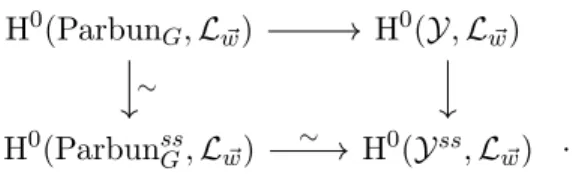
w~0) with a simple diagram chase. For more details about the
stack
C
and the proof of the properness of
π
over the semistable locus, see chapter 3. For the details
about
ι
and
ξ
, and the reduction of conformal blocks to Parbun
L(0), see the beginning of chapter 4.
Finally, we need to reduce to the derived subgroup
L
0= [
L, L
] to finish the proof of the reduction
theorem. Again, we use a morphism of stacks
Parbun
L(0)
ι0
←
−
Parbun
L0where
ι
0is given by extension of structure group. Then by a straightforward argument in section 7
of [10], since
w
~
is on the facet corresponding to
σ
u1~0
· · ·
~0
σ
un= [
pt
],
ι
0
induces an isomorphism
H
0(Parbun
L(0)
,
L
w~0)
−
∼→
H
0(Parbun
L0,
L
w~0), finishing the proof of the reduction theorem, since
H
0(Parbun
L0,
L
w~0) can be identified with a product of conformal blocks. This step requires more
care when
d >
0; for details see the discussion in chapter 4.
0.2.1
Modifications for general weights off the alcove wall
proper over Parbun
G. To overcome this issue, we need to enlarge
C
to a stack
Y
which contains
P
-reductions that are certain specializations of
P
-reductions in
C. More precisely, the relative
Schubert positions
w
1, . . . , wn
of a
P
-reduction in
Y
all satisfy
wi
≤
ui
, where
≤
denotes the Bruhat
ordering, and
u
1, . . . un
are as above. Then
Y
is defined as the stack containing specializations of
parabolic degree 0 with respect to
w
~
(see section 2.1 for the definition of parabolic degree). Note
that every
P
-reduction in
C
has parabolic degree zero. Then by the same methods as above, the
morphism
Y →
Parbun
Gis proper over the semistable locus.
While enlarging
C
allows us to prove the properness result we need, unfortunately there is no
extension of
ξ
:
C →
Parbun
L(0) to
Y. However, we can define a morphism
ξ
:
Y →
Parbun
L(
Q
~
L,
0),
where Parbun
L(
Q
~
L,
0) is the stack of parabolic
L
-bundles with partial flags, i.e. flags
f
i∈
L/Q
L,
for a parabolic subgroup
Q
L. These morphisms fit into the following diagram
Y
Parbun
GParbun
G(
Q
~
)
Parbun
L(
Q
~
L,
0)
πξ
p
ι
Parbun
G(
Q
~
L) is the stack of parabolic
G
-bundles with partial flags,
p
is the natural projection
morphism, and
ι
is as in the previous section. It follows from the definition that the morphism
p
has
connected and projective geometric fibers, and from this it is easy to see that the pullback of global
sections of any line bundle induces an isomorphism. The proof of the reduction to Parbun
L(
Q,
~
0)
then follows essentially as above. Finally, using a morphism
ι
0: Parbun
L0(
QL
~
)
→
Parbun
L(
Ql,
~
0)
we finish the proof of the reduction theorem in this case.
0.2.2
Weights on the alcove wall and parahoric bundles
For weights on the alcove wall descending to partial flags is not enough. In type A this can be
resolved using the shifting technique in [7]. Given a parabolic vector bundle
V
e
= (
V, F
i•), for each
point
pi
one can define a shifting operation, yielding a new parabolic bundle
V
e
0whose underlying
vector bundle has degree one greater than
V
. This induces an isomorphism of stacks of parabolic
bundles Sh
i: Parbun(
d
)
∼
−
→
Parbun(
d
+ 1).
of pulling back
L
~λ,`over Parbun(
d
+ 1) to Parbun(
d
) is to act on
λ
iby an
n
throot of unity
corresponding to an element of the center of
G
. (Roots of unity act by automorphisms on the
fundamental alcove of
G
.) Then if
λi
is on the alcove wall, by shifting enough times it is possible to
move the weight off the alcove wall. If
λi
was on
k
chamber walls and the alcove wall, the effect of
shifting is that
λi
is now on
k
+ 1 chamber walls, and off the alcove wall. Shifting over each
pi
as
needed, by working with positive degree vector bundles we can prove the reduction result in general
using the above method for weights off the alcove wall.
In general type, the center of
G
is not large enough for shifting as described above to work. The
solution is to descend to stacks of parahoric bundles, which are torsors over Bruhat-Tits group
schemes. Let
A
=
k
[[
z
]] and
K
=
k
((
z
)). Then to any weight data
w
~
we can associate parahoric
subgoups
P
1, . . . ,
P
n⊆
G
(
k
((
z
))), which determine a Bruhat-Tits group scheme
G →
X
. Let Bun
Gbe the moduli stack of
G-torsors. There is a natural morphism Parbun
G→
Bun
G, and conformal
blocks descend to this stack (cf. Theorem 0.1.10). When the weights are off the alcove wall this is
just descent to partial flags since in this case Bun
G∼
= Parbun
G(
Q
~
). On the alcove wall,
G-bundles
are more exotic. Then the main diagram used to reduce down to the Levi
L
is the following.
Y
Parbun
GBun
GBun
GL(0)
π ξ
p
ι
The stack
Y
again is an enlargement of
C, and the morphisms in this diagram are defined in a way
analogous to the case for partial flags. Parahoric bundles thus allow us to prove Theorem 0.1.2 for
any weights
w
~
, following the strategy when the weights were assumed to be off the alcove wall. For
more details on the construction of
Y
in the parahoric case, and proof of the properties of
π
and
ξ
,
see chapter 3; we carry out the above strategy to prove the reduction theorem for arbitrary weight
data and degree in chapter 4.
0.3
Outline of the dissertation
In chapter 2 we review the work of Balaji and Seshadri on parahoric bundles, semistability
of parahoric bundles, and their moduli spaces, and prove Theorem 0.1.10. To show this we
study the closed fiber of the Bruhat-Tits group schemes, and identify the fibers of the morphism
Parbun
G→
Bun
Gas certain flag varieties determined by the weight data.
In chapter 3 we start with an outline of the proof of the reduction theorem in terms of equivariant
bundles. We then construct
Y
, and show that
π
:
Y →
Bun
Gis proper over the semistable locus.
Key to the properness proof is the lifting of families
P
-reductions of parabolic bundles to equivariant
G
-bundles over a ramified cover
Y
→
X
. This process in general is discontinuous, but it is sufficient
to assume that the family of
P
-reductions is of constant relative position.
In chapter 4 we use the results of the previous chapters to prove our main result as outlined
above. We also prove that when
d
= 0, we get an isomorphism of conformal blocks bundles.
Finally, in chapter 5, we restate our main theorem for
G
= SL
r+1and Sp
2rand give some
examples.
0.4
Notation and conventions
Let
X
be a smooth, connected and projective curve over
k
=
C
of genus
g
, and
p
1, . . . , p
nbe
distinct points in
X
. Starting in chapter 3, we will assume
X
∼
=
P
1. Assume we have sufficiently
points to make the automorphism group of this pointed curve finite. All schemes and algebraic
stacks are defined over
k
. For a morphism of algebraic stacks
f
:
X → Y
, we say
f
is representable
if it is representable by schemes.
Let
G
be a simply connected simple algebraic group over
k
. Fix a Borel subgroup
B
, and a
maximal torus
T
. Let
W
=
N
(
T
)
/T
be the Weyl group. For a standard parabolic
P
⊇
B
let
U
=
U
Pbe its unipotent radical, and let
L
=
L
Pbe the Levi subgroup of
P
containing
T
, so that
P
is a semi-direct product of
L
and
U
. Then
B
L=
B
∩
L
is a Borel subgroup of
L
. We denote the
Lie algebras of the groups
G
,
B
,
P
,
U
,
L
,
B
Lby
g
,
b
,
p
,
u
,
l
, and
b
L, respectively, and we denote
by
h
the Cartan subalgebra of
g
corresponding to
T
.
Let
R
⊆
h
∗be the set of roots of
g
with respect to the Cartan algebra
h
, and let
R
+be the set
of positive roots (fixed by
b
). Let ∆ =
{
α
1, . . . , αr
}
be the set of simple roots, where
r
is the rank of
using angle brackets
h
,
i; assume it is normalized so that
h
θ, θ
i
= 2, where
θ
is the highest root. The
isomorphisms
h
→
h
∗h
→
h
∗induced by the Killing form we will denote by
κ
. Define the coroots
α
1∨, . . . , α
∨r∈
h
∗as
α
∨i=
2αihαi,αii
, and the fundamental weights
ωi
∈
h
∗
by
h
ωi, αj
i
=
δij
. Let
h
+and
h
∗+be the dominant Weyl chambers, and Λ+
⊆
h
∗+be the semigroup of dominant integral weights.
For a parabolic
P
, let ∆
Pbe the associated set of simple roots, and let
RL
be the set of roots of
l
with respect to
h
. If
P
is maximal, we will usually denote the excluded root and fundamental
weight as
α
Pand
ω
P, respectively. Let
U
αdenote the root group in
G
associated to
α
.
For any positive root
β
we will denote the associated reflection by
s
β. Let
{
s
1, . . . , s
r} ∈
W
be the generating set of simple reflections. For a parabolic subgroup
P
let
W
Pbe the associated
Weyl group, which is also the Weyl group of
L
. For every coset in
W/W
Pthere is a unique minimal
length representative. Let
W
Pbe the set of minimal representatives. For any
w
∈
W
, we denote by
l
(
w
) its length. The symbols
<, >,
≤
,
≥
will denote the Bruhat ordering in
W
.
For any
u
∈
W
Plet
Cu
=
BuP
⊆
G/P
be the Schubert cell associated to
u
and
Xu
=
BuP
the
associated Schubert variety. Let
Zu
⊆
Xu
be the nonsingular locus. We denote by
σu
∈
H
0(
G/P
)
the Poincare dual of the homology class associated to
X
u.
Let
λ
1, . . . , λ
nbe dominant integral weights and
`
be a positive integer. We call the tuple
~
w
= (
λ
1, . . . , λ
n, `
) the
Kac-Moody weight data
associated to
λ
1, . . . , λ
nand
`
. The integer
`
is will
be called the
level
. Given a weight
λ
and a level
`
such that
h
λ, θ
i ≤
`
, we can associate a point of
the fundamental alcove
µ
=
κ
(
λ
)
`
and a dominant weight of the associated affine Kac-Moody algebra
ˆ
λ
= (
`
− h
λ, θ
i)
ω
0+
λ.
CHAPTER 1: PRELIMINARIES ON THE MULTIPLICATIVE POLYTOPE
AND CONFORMAL BLOCKS
In this expository chapter we introduce the main objects of interest in this dissertation. First
we review the definition of the multiplicative polytope, and recall how the quantum cohomology
of generalized Grassmannians
G/P
parametrize the faces of the polytope. We also relate the
multiplicative polytope to the additive eigencone, and describe how integral points of this cone
are related to invariants of tensor representations of
G
. In section 1.2, we give two definitions
of conformal blocks: first as spaces of coinvariants, then as spaces of generalized theta functions.
Conformal blocks are parametrized by the multiplicative polytope in the same way spaces of
invariants are parametrized by the additive eigencone.
1.1
The multiplicative polytope and quantum cohomology
In this section we explain in more detail the definition of the multiplicative polytope, the
inequalities defining its faces, and its classical analogues. As part of describing the faces we will also
discuss the small quantum cohomology ring of the flag varieties
G/P
, and the degeneration of this
ring that Belkale and Kumar used to describe the irredundant inequalities of the polytope.
1.1.1
The additive eigencone and the multiplicative polytope
First we describe the additive eigencone associated to
G
, which is a kind of classical analogue
of the multiplicative polytope. The study of this problem goes back at least to Horn [18]. Let us
first consider the algebra
k
of Hermitian matrices. Every Hermitian matrix
A
has a unique set
of real eigenvalues, which we denote by
(
A
). Then the group
K
of unitary matrices acts on
k
eigenvalues
µ
1, . . . , µ
n∈
h
+do there exist Hermitian matrices
A
1, . . . , A
nsuch that
(
A
i) =
µ
iand
A
1+
· · ·
+
An
= 0?
We can generalize this to any Lie type as follows. Let
B
⊆
G
be a Borel subgroup containing
a maximal torus
T
, and let
K
⊆
G
be a maximal compact subgroup such that
i
h
Ris the Lie
algebra of a maximal torus of
K
, where
h
Ris a real form of the Lie algebra
h
of
T
. Then as for
Hermitian matrices one can define an eigenvalue map
:
k
/K
→
h
+, whereK
acts on its Lie algebra
k
by the adjoint action. The eigenvalue problem is then: for which
µ
1, . . . , µ
n∈
h
+do there exist
A
1, . . . , A
n∈
k
such that
(
A
i) =
µ
iand
A
1+
· · ·
+
A
n= 0? Fixing
n
, it is well known that the
set of tuples (
µ
1, . . . , µ
n) satisfying this statement forms a full-dimensional convex polyhedral cone
Γ
n(
G
)
⊆
h
n+, called the
additive eigencone
. For more details and references, see Kumar’s survey on
this problem [33].
The multiplicative polytope is defined in a similar way. In type A, Hermitian matrices are
replaced with unitary matrices, which have eigenvalues with complex norm 1. One can identify the
eigenvalues of a unitary matrix
A
with a unique point in the
fundamental alcove
A
of
G
, defined as
A
=
{
µ
∈
h
+|
θ
(
µ
)
≤
1}
.
So as above, we have a well-defined eigenvalue map
:
K/
Ad
K
→ A. The multiplicative eigenvalue
problem is then: for which
µ
1, . . . , µ
n∈ A
do there exist
A
1, . . . , A
n∈
K
such that
(
A
i) =
µ
iand
A
1· · ·
A
n= Id? In general type one can also define an eigenvalue map
, and the multiplicative
eigenvalue problem is defined in the same way. One can show that the set of tuples (
µ
1, . . . , µ
n)
satisfying this statement forms a full-dimensional convex polyhedron ∆
n(
G
)
⊆ A
ncalled the
multiplicative polytope
(see [39]).
There is a close relationship between the additive eigencone and the multiplicative polytope.
Firstly, we have ∆
n(
G
)
⊆
Γ
n(
G
). Conversely, for any
~
µ
∈
Γ
n(
G
), there is a positive integer
`
such
1.1.2
Quantum cohomology of
G/P
and the multiplicative polytope
Since the multiplicative polytope is a convex polyhedron, it is defined by a unique set of
irredundant linear inequalities. The inequalities are parametrized by products in the small quantum
cohomology ring of the flag varieties
G/P
, where
P
is a maximal parabolic. In type A these are
the complex Grassmannians. Let us begin by reviewing the general type combinatorics of the
cohomology of
G/P
.
For any flag variety
G/P
there is a canonical cell decomposition into
Schubert cells
. The Schubert
cells are parametrized by cosets in
W/WP
, where
W
is the Weyl group of
G
, and
WP
is the Weyl
group of
P
. These cosets each have a unique (minimal length) representative, the set of which is
denoted
W
P. We denote by
Cw
the Schubert cell corresponding to
w
∈
W
P, and by
σw
∈
H
∗(
G/P
)
the Poincar´
e dual of the homology class of
C
w. It is well known that the cohomology ring H
∗(
G/P
)
is generated by the Schubert classes
σ
w, and therefore the cohomology ring is determined by the set
of positive numbers
c
wu,vsuch that
σu
·
σv
=
X
w∈WP
c
wu,v·
σ
∗w.
The small quantum cohomology ring of
G/P
is defined as follows. Let
X
=
P
1and fix 3 distinct
points in
X
: say
p
1, p
2, p
3∈
X
. Then for any
d
≥
0 and
w
1, w
2, w
3∈
W
P, the
Gromov-Witten
invariant
h
σw
1, σw
2, σw
3i
dis defined as the number of degree
d
maps
f
:
X
→
G/P
such that
f
(
pi
)
∈
giCw
ifor generic
gi
∈
G
, where the invariant is zero in the case that there are an infinite
number of such maps. Additively the quantum cohomology ring is just QH
∗(
G/P
) = H
∗(
G/P
)[
q
],
where
q
is an indeterminant. The quantum product is then defined in terms of the Gromov-Witten
invariants:
σ
w1∗
σ
w2=
X
d≥0 w3∈W P
q
dh
σ
w1, σ
w2, σ
w3i
d·
σ
∗w3
where
σ
∗wis the unique class such that
σ
w·
σ
w∗= [pt]. Since the image of a degree zero map
f
:
X
→
G/P
is just a point, by the uniqueness of
σ
w∗it follows that
h
σ
w1, σ
w2, σ
w3i
0=
c
w3
Theorem 1.1.1.
([53]) For any maximal parabolic
P
⊆
G
, and any product
σ
w1∗ · · · ∗
σ
wn=
q
d
[pt],
a point
~
µ
∈
∆
n(
G
)
must satisfy
n
X
i=1
ωP
(
w
−i 1µi
)
≤
d,
where
ωP
is the fundamental weight associated to
P
. The multiplicative polytope
∆
n(
G
)
in the
n
-fold
alcove
A
nis determined by the above inequalities.
Corollary 1.1.2.
For any maximal parabolic
P
⊆
G
, and any product
σw
1· · ·
σw
n=
[pt], a point
~
µ
∈
Γ
n(
G
)
must satisfy
n
X
i=1
ωP
(
w
−i 1µi
)
≤
0
.
The additive eigencone
Γ
n(
G
)
in
h
n+is determined by the above inequalities.
While the above inequalities indeed determine the multiplicative polytope, they are not
irredun-dant. The facets (codimension-one faces) intersecting the interior of
A
ncorrespond to a subset of
the products
σ
w1∗ · · · ∗
σ
wn=
q
d
[pt]. In the next section we will explain how the inequalities are
reduced to an irredundant set. To facilitate discussion about the geometry of the multiplicative
polytope, we make the following definitions.
Definition 1.1.3.
The linear faces of
A
are called the
(Weyl) chamber walls
, and the affine face is
called the
alcove wall
. A point in
A
nis on a chamber or alcove wall if at least one
µ
i
in (
µ
1, . . . , µ
n)
is on a chamber or alcove wall. A
regular face
of ∆
n(
G
) is a face that intersects the interior of
A
n.
If a regular facet of ∆
n(
G
) corresponds to a product
σ
w1∗ · · · ∗
σ
wn=
q
d
[pt] in QH
∗(
G/P
), we say
that the facet is
degree
d
and
of type
P
.
1.1.3
Degeneration of cohomology products and irredundant inequalities
It remains to describe the irredundant set of inequalities corresponding to the regular facets
of ∆
n(
G
). The solution is to
degenerate
the cohomology product described above so that the
to define a degenerate quantum product that gives rise to an irredundant set of inequalities for the
multiplicative polytope [10].
The degeneration is based on the idea of
Levi-movable intersections
. Let Λ
w=
w
−1Cw
. Then if
σw
1· · ·
σw
n=
k
[pt], there exists, by Kleiman’s transversality theorem, generic
p
1, . . . pn
∈
P
such
that
T
i
pi
Λ
iis transverse at the identity
e
∈
G/P
. A product is Levi-movable if we can find
l
1, . . . , ln
in the Levi subgroup
L
of
P
such that
T
i
li
Λ
iis transverse at
e
. The restriction to Levi-movable
products reduces the above set of inequalities for the additive eigencone to an irredundant set in all
types.
Belkale and Kumar show that the condition of being Levi-movable is an algebraic condition and
can be expressed completely in terms of weights of
G
. For any
w
∈
W
P, define
χ
was
χw
=
X
β∈(R+\R+
L)∩w−1R+
β.
Alternatively,
χ
wcan be shown (see [32, 1.3.22.3]) to be equal to
ρ
−
2
ρ
L+
w
−1ρ
, where
ρ
and
ρ
Lare one-half the sums of the positive roots of
G
and
L
, respectively. Also, let
x
1, . . . , x
r∈
h
be the
dual basis of
α
1, . . . , α
r. Then Belkale and Kumar proved the following theorem.
Theorem 1.1.4.
([9])
Suppose that
σw
1· · ·
σw
n=
k
[pt]
. Then the following inequality holds
((
n
X
i=1
χ
wi)
−
χ
1)(
x
P)
≤
0
and the product is Levi-movable if and only if this inequality is satisfied with equality.
For
u, v, w
∈
W
P, let
AP
(
u, v, w
) = (
χ
1−
χu
−
χv
−
χw
)(
xP
). Then we can define a deformation of
the normal cohomology product as follows. Additively we extend the cohomology ring to H
∗(
G/P
)[
τ
],
where
τ
is an indeterminant. The product is given by
σu
σv
=
X
w∈WP
τ
AP(u,v,w)·
c
w∗u,v
·
σw
where
σ
∗w=
σw
∗. This product gives H
∗(
G/P
)[
τ
] the structure of a commutative ring. Finally by
Remark
1.1.5
.
Belkale and Kumar prove that the product
0coincides with the usual cohomology
product when
G/P
is
cominiscule
, which includes all Grassmannians, and Lagrangian Grassmannians,
among other flag varieties. In general, a flag variety
G/P
is cominiscule if
αP
appears with coefficient
1 in the highest root
θ
of
G
.
A similar approach gives a deformation and degeneration of the quantum cohomology product.
For
u, v, w
∈
W
Pand
d
≥
0, let
AP
(
u, v, w, d
) = (
χ
1−
χu
−
χv
−
χw
)(
xP
) +
2
g
∗d
h
α
P, α
Pi
.
Then the deformed quantum product is given by
σw
1~
σw
2=
X
d≥0 w3∈W P
τ
AP(u,v,w,d)q
dh
σw
1
, σw
2, σw
3i
d·
σ
∗w3
.
By setting
τ
equal to zero, we get the product
~0. In [10], Belkale and Kumar show that this
product coincides with the usual quantum product when
G/P
is cominiscule. Their main theorem is
that Levi-movable quantum products
σ
u1~0
· · ·
~0
σ
un=
q
d
[
pt
] exactly parametrize the irredundant
regular facets of the multiplicative polytope, which we stated as Theorem 0.1.1 in the introduction.
1.2
Conformal blocks
1.2.1
The additive eigencone and tensor representation invariants
Recall that for any dominant integral weight
λ
∈
Λ+
of
G
, there is a unique associated irreducible
finite dimensional representation
V
λ. Consider the following problem: for a tuple of such weights
(
λ
1, . . . , λ
n), when does the tensor representation
V
λ1⊗· · ·⊗
V
λnhave a non-trivial invariant subspace
A
~λ= (
V
λ1⊗ · · · ⊗
V
λn)
G
? Remarkably, there is a very close connection between this problem and
the additive eigenvalue problem.
Consider the following modification of the tensor invariants problem. For any dominant integral
weight
λ
and integer
N >
0, we can scale
λ
by
N
to get another dominant integral weight
N
·
λ
.
Then the
saturated tensor problem
is: for which tuple of weights (
λ
1, . . . , λn
) does there exist a
positive integer
N
such that
A
N~λ6=
{0}? Let Γ
n(
G
) be the set of all such tuples of weights. This
question is solved by the additive eigencone in the following way. The Killing form defines an
isomorphism
κ
:
h
∗ ∼−
→
h
. Then (
λ
1, . . . , λ
n)
∈
Γ
n(
G
) if and only if (
κ
(
λ
1)
, . . . , κ
(
λ
n)) is in the
additive eigencone. For more details and references, see [33].
Finally, we want to associate the above representation theory with some geometry, which is
analogous to the theta function description of conformal blocks discussed below. Let
B
⊆
G
be a
Borel subgroup. Then
G/B
is a projective space called a generalized (full) flag variety. For any
weight
λ
, the Borel-Weil theorem states that there is an equivariant line bundle
L
λon
G/B
such
that the space global sections H
0(
G/B, Lλ
) is isomorphic to the irreducible representation
V
λ∗, where
we let
G
act on the global sections in the obvious way, and
∗
indicates the dual. More generally, if
we have a tuple of weights
~
λ
= (
λ
1, . . . , λ
n), then the tensor representation (
V
λ1⊗ · · · ⊗
V
λn)
∗
can
be realized as global sections of a line bundle
L
~λover
X
=
Q
nG/B
. Letting
G
act diagonally on
X
, the line bundle
L
~λdescends to the quotient stack [
X/G
], and the space of global sections of
L
~λover [
X/G
] is exactly the dual of the space of invariants
A
~∗λ.
1.2.2
Conformal blocks as spaces of coinvariants
for background on Kac-Moody algebras, see [29].
Let
K
=
C
((
z
)) be the field of formal Laurent series with complex coefficients. Let ˆ
g
=
(
g
⊗
K
)
⊕
C
·
c
. The bracket for ˆ
g
is given by
[
X
⊗
f, Y
⊗
g
] = [
X, Y
]
⊗
f g
+
c
· h
X, Y
iRes(
g
·
d
f
)
where
X, Y
∈
g
,
f, g
∈
K
, the product
h
,
i
is the normalized Killing form, and Res(
g
·
d
f
) is the
residue of
g
·
d
f
. The vector
c
is central. This Lie algebra is a subalgebra of the completion of the
untwisted affine Kac-Moody Lie algebra associated to
G
. Given a dominant integral weight
λ
, and
an integer
`
such that
`
(
λ
)
≤
`
, there is a unique associated simple ˆ
g
-module
H
λ,`. Given a tuple of
weights (
λ
1, . . . , λ
n) and a level
`
, we write
H
λ,`~=
H
λ1,`⊗ · · · ⊗ H
λn,`.
The curve
X
, along with a collection of distinct points
p
1, . . . , p
n∈
X
determines an action on
H
~λas follows. Let
X
∗=
X
\ {
p
1, . . . , p
n}. Then any function
f
∈ O(
X
∗) determines
f
1, . . . , f
n∈
K
by taking its Laurent series at each point. Thus given
X
⊗
f
∈
g
(
X
∗), we get an element
X
⊗
f
iof
the loop algebra
g
⊗
K
⊆
ˆ
g
for each
i
. The action of
g
(
X
∗) on
H
~λis given in the obvious way:
(
X
⊗
f
)(
v
1⊗ · · · ⊗
v
n) =
nX
i=1
v
1⊗ · · · ⊗
(
X
⊗
f
i)
v
i⊗ · · · ⊗
v
n.
Then the space of conformal blocks is defined as follows.
Definition 1.2.1.
For any tuple of weights (
λ
1, . . . , λ
n) and level
`
, the
space of conformal blocks
V
~†λ,`
(
X, ~
p
) is defined as
V
~†λ,`