The handle
http://hdl.handle.net/1887/67540
ho
lds various files of this Leiden University
dissertation.
Author:
Geambasu, A.
Title:
Simple rule learning is not simple : studies on infant and adult pattern perception
and production
Simple Rule Learning is Not Simple
Studies on Infant and Adult
Published by
LOT phone: +31 30 253 6111
Trans 10 e-mail: [email protected]
3512 JK Utrecht http://www.lotschool.nl
The Netherlands
Cover illustration: Copac (Tree), by Mircea Nechita
ISBN: 978-94-6093-310-3 NUR: 616
Simple Rule Learning is Not Simple
Studies on Infant and Adult
Pattern Perception and Production
Proefschrift
ter verkrijging van
de graad van Doctor aan de Universiteit Leiden, op gezag van Rector Magnificus Prof.mr. C.J.J.M. Stolker,
volgens besluit van het College voor Promoties te verdedigen op dinsdag 11 december 2018
klokke 12.30 uur
door
Andreea Geambas
,u
Promotiecommissie: Prof. Dr. LouAnn Gerken (University of Arizona) Prof. Dr. Janet Grijzenhout
Acknowledgements . . . ix
1 Introduction 1 1.1 Artificial grammar learning . . . 2
1.2 Domain specificity . . . 3
1.3 Repetition . . . 4
1.4 Familiarity . . . 6
1.5 Ecological validity . . . 7
1.5.1 Variability . . . 7
1.5.2 Task and instruction . . . 8
1.5.3 Grammar complexity . . . 9
1.6 Summary . . . 9
2 Rule learning in infants in the speech and general auditory domains 11 2.1 Abstract . . . 11
2.2 Introduction . . . 12
2.2.1 The present work . . . 14
2.3 Experiment 1 . . . 16
2.3.1 Methods . . . 16
2.3.2 Results . . . 19
2.3.3 Discussion . . . 24
2.4 Experiment 2 . . . 24
2.4.1 Methods . . . 24
2.4.2 Results . . . 25
2.4.3 Discussion . . . 27
2.5 Experiment 3 . . . 29
2.5.1 Methods . . . 29
2.5.2 Results . . . 31
2.6 Combination of the 3 experiments . . . 32
2.6.1 Results . . . 33
2.7 General Discussion . . . 34
2.7.1 Repetition biases . . . 35
2.7.2 Future work . . . 36
2.8 Appendices . . . 37
2.8.1 Appendix A . . . 37
2.8.2 Appendix B . . . 38
3 Rule learning in infants in the visual domain 41 3.1 Abstract . . . 41
3.2 Introduction . . . 42
3.3 Method . . . 44
3.3.1 Participants . . . 44
3.3.2 Stimuli . . . 44
3.3.3 Procedure . . . 46
3.4 Results . . . 47
3.4.1 Data pre-processing . . . 47
3.4.2 Overall analysis . . . 48
3.4.3 Analysis per condition . . . 51
3.5 General Discussion . . . 54
3.5.1 Conclusion and future work . . . 55
3.6 Appendices . . . 57
3.6.1 Appendix A . . . 57
3.7 Acknowledgements . . . 57
4 Patterns in infant babbling 59 4.1 Abstract . . . 59
4.2 Introduction . . . 60
4.3 Language and Corpora Selection . . . 61
4.4 Corpus Data Collection . . . 62
4.5 Results . . . 63
4.5.1 Analysis . . . 65
4.6 General discussion . . . 70
4.7 Acknowledgements . . . 72
5 Rule learning in adults in the speech domain 73 5.1 Abstract . . . 73
5.2 Introduction . . . 74
5.3 Experiment 1 - Undirected familiarization . . . 77
5.3.1 Methods . . . 77
5.3.2 Results . . . 80
5.3.3 Reported strategies . . . 83
5.3.4 Discussion . . . 83
5.4.1 Methods . . . 83
5.4.2 Results . . . 84
5.4.3 Discussion . . . 85
5.5 Experiment 3 - Implicitly directed testing . . . 85
5.5.1 Methods . . . 85
5.5.2 Results . . . 86
5.5.3 Discussion . . . 87
5.6 Experiment 4 - Feedback training . . . 87
5.6.1 Methods . . . 87
5.6.2 Results . . . 88
5.6.3 Discussion . . . 89
5.7 Overall analysis . . . 89
5.7.1 Stimulus variability . . . 89
5.7.2 Training length . . . 90
5.7.3 Reported strategies . . . 90
5.8 General Discussion . . . 91
5.8.1 Variation . . . 92
5.8.2 Feedback . . . 93
5.8.3 Instruction . . . 93
5.9 Conclusion . . . 94
5.10 Acknowledgements . . . 95
6 Rule learning with Lindenmayer grammars 97 6.1 Abstract . . . 97
6.2 Introduction . . . 98
6.3 Experiments 1 and 2 . . . 101
6.3.1 Methods and materials . . . 101
6.3.2 Descriptive statistics and results . . . 103
6.3.3 Discussion . . . 104
6.4 Experiment 3 . . . 107
6.4.1 Methods and materials . . . 107
6.4.2 Participants . . . 107
6.4.3 Stimuli . . . 107
6.4.4 Materials . . . 108
6.4.5 Procedure . . . 108
6.4.6 Analysis of the data . . . 109
6.4.7 Results . . . 109
6.4.8 Discussion . . . 113
6.5 General Discussion . . . 113
6.6 Acknowledgments . . . 115
6.7 Appendices . . . 115
7 Conclusion 117
7.1 Thesis summary . . . 117
7.2 Domain specificity . . . 119
7.3 Repetitions . . . 120
7.4 Familiarity . . . 122
7.5 Ecological validity . . . 122
7.5.1 Variability . . . 123
7.5.2 Task and instruction . . . 123
7.5.3 Grammar complexity . . . 125
7.6 Conclusion . . . 126
References . . . 127
References 127 Summary . . . 139
Samenvatting . . . 143
Thank you....
...to my supervisor and promotor Claartje Levelt for always encouraging me in my work, even when it felt like I wasn’t achieving anything, for making me comfortable to share my thoughts and have an open dialogue, work related or otherwise. Thank you for the example you set of being a successfully and healthily balancing academic and non-academic life, and smiling through it all.
...to my project mates and dear friends Raquel Garrido Alhama and Michelle Spierings, two brilliant researchers with whom I’ve been lucky enough to be able to enjoy collaboration, exchanges of ideas, stimulating conferences, and perhaps most importantly, good meals and lots of laughs and hugs. I could not have dreamed up better peers in the project. I can only hope we can work together again in the future.
...to my co-promotor Carel ten Cate and to Jelle Zuidema for your feedback, direction, knowledge, and guidance throughout this project. And for the nice company as well.
...to my committee members for your work in reading and commenting on my thesis and for your feedback.
...to my officemate for three years, Marieke Meelen, who made those first three years of this journey so bright and sunny.
...to Marijn van ’t Veer, my colleague, then lab assistant, then officemate...thank you for your invaluable assistance in running some of the experiments in Chap-ter 2 as well as some work that didn’t make it into this thesis, and for generally keeping the lab running smoothly.
...to Thijs Schama for programming the infant experiments, and to Jos Pacilly for building a beautiful new baby lab and for the invaluable support in getting that up and running. Thank you also to Monique Bisschop for your help as lab assistant during my first year.
...to Christina Bergmann and Helen Buckler who kindly welcomed me in Ni-jmegen to introduce me to the world of infant language acquisition research and methods.
...to my wonderful collaborators, local and international, who are co-authors in each relevant chapter but also deserve a mention here. To everyone who welcomed me so warmly to the MARCS Institute in Sydney, especially Paola Escudero, Samra Alispahic, Rosmin Dadwani, Varghese Peters. I learned a great deal. Andrea Ravignani, your enthusiasm is always contagious. Daan van Renswoude, Ingmar Visser, and Maartje Raijmakers, thank you for co-authoring a paper that may never have had a chance at publication without your work and perspective.
...to all the lovely the students who conducted their minor projects, intern-ships, BA and MA theses with me and with Claartje, without whom this work would have taken at least twice as long: Astrid Gilein, Mirjam Bahlmann, Naomi Nota, Isabella Jordanoska, Renske Jacobs, Rabia Mahboeb, Johanne Rauwenhoff, Gosse Minnema, Floor Bonsel, Gijsbert Westland, Marjolein Mal-jaars, Lisa Kennedy, Yvette Spoolder, Sofja Volkova, and to Claire van Leeuwen, Mariska Scheel, and Laura Toron each of whom co-authored a chapter (paper).
...to the organizers and attendees of the Lorentz Workshop Comparative Biol-ogy of Language Learning (2017) for putting the wind back in my sails.
...to my paranymphs Marieke Meelen and Josefine Karlsson. I was lucky enough to have both of you in my life since day one of this journey, and I could not have done it without your emotional support, discussions, and laughter until the end.
...to my aunt and uncle, for your love.
...to my parents who have always encouraged and supported me in everything.
CHAPTER
1
Introduction
Human language is an acquired symbolic system of communication and thought. When acquiring language, (hearing) infants must learn a great deal, including the sound inventory of their language, how those sound categories may be bined in their native language to make words, and how the words may be com-bined into well-formed phrases. Along the way, they are also simultaneously learning the meanings and referents of these words and utterances. How in-fants are able to learn this complex system has been the focus of much research throughout the history of (psycho-)linguistics and developmental psychology
going back centuries (W. Levelt, 2013). Howdo infants make the mental leap
from their specific input to the ability to understand and produce an infinite number of utterances? What kinds of cognitive mechanisms are involved in learning the structures underlying language and are those mental mechanisms uniquely suited for learning language, or are they shared with other mental capacities? These are questions that will be addressed in this thesis using the tool of artificial grammar learning tasks.
The work presented here focuses on better understanding the biases infants and adults may have when learning rules, in both perception and production, whether these biases are domain-general or specific to language, how they may change in adulthood, and how they may interact with task-specific factors and attention. The experiments were developed as part of a larger project studying similar biases and learning mechanisms in birds (Spierings, 2016) and devising computational models of rule learning (Alhama, 2017).
artificial grammar learning tasks, particularly with infants. A detailed outline of the thesis will follow, summarizing the biases and specificity of rule learning that will be addressed in each chapter.
1.1
Artificial grammar learning
At the most basic level, the task infants are facing when acquiring their native language involves discovering both discrete units, like phonemes and words, and the rules that regulate the ways in which these units can be combined. Despite what this highly simplified definition of language acquisition may suggest, it is a daunting task. Nevertheless, infants are highly sensitive to linguistic input, and already begin to perceive and process aspects of speech and language in the womb (Moon, Cooper, & Fifer, 1993). Speech perception experiments have revealed that soon after birth, infants already have the prosodic knowledge to discriminate their mother’s language from languages with a different prosodic structure (Christophe & Morton, 1998), and can soon use statistical informa-tion in language to discover discrete units such as phoneme categories (Maye, Werker, & Gerken, 2002). How humans, particularly young infants, are subse-quently able to form larger combinatorial units, such as words and sentences, from these discrete items is one of the main questions of linguistic research.
Over the past fifty years, beginning with work from Reber (1967), artificial language learning (ALL) or artificial grammar learning (AGL), paradigms have been important tools for studying our ability to extract discrete units from the speech stream, and to discover the rules combining them. The grammars used in AGL tasks may vary in their complexity and naturalness, but both the discrete units of which they are composed, and their structure, are typically selected such that potential confounds that can lead to solving the task in ways unrelated to the research question – which may appear in natural languages – are minimized. As such, AGL paradigms have been crucial in discovering learning abilities and limitations on learning across age groups, across species, and across domains (e.g., Knowlton & Squire, 1996; Perruchet & Pacteau, 1990; Gómez, 1997).
sta-tistical learning mechanism for learning fixed units, infants have an algebraic rule learning mechanism, where "algebraic" refers to the ability to extrapolate X and Y variables from the familiarization stimuli, allowing for combinations of novel syllables as long as they obey the combinatorial rule as a whole.
Marcus et al.’s (1999) work was seminal in the field of infant AGL, paving the way for novel experiments using variations on this testing paradigm and using different types of stimuli. Subsequent work focused on how these alge-braic representations are formed (e.g., Gerken, 2006; Gerken & Bollt, 2008; Gerken, 2010), and on whether this type of learning was domain-specific (as claimed in Marcus, Fernandes, & Johnson, 2007) or domain-general (as claimed in Saffran, Pollak, Seibel, & Shkolnik, 2007). However, nearly two decades af-ter the original publication of Marcus et al.’s initial paper, our understanding of the ability to learn these abstract rules is still lacking, and basic questions about perceptual biases that might influence learning, the domain-specificity of the process, and factors that might facilitate or hinder the learning pro-cess are still not answered adequately. Many extensions on the Marcus et al. paradigm have appeared in the literature, offering almost as many different accounts of the type of stimuli that facilitate, or lead to, learning, e.g., speech (Gerken, 2006, 2010; Gerken, Dawson, Chatila, & Tenenbaum, 2015), familiar stimuli (Saffran et al., 2007), stimuli with a communicative function (Ferguson & Lew-Williams, 2016), redundant stimuli (Thiessen, 2012), multimodal stim-uli (Frank, Slemmer, Marcus, & Johnson, 2009), surprising stimstim-uli (Gerken et al., 2015). However, despite several notable extensions on the work, the original findings were never replicated exactly. In fact, the literature gives us reason to believe that exact replication of this work is quite difficult. Most concretely, a footnote in Gerken’s (2006) paper states that replication with the same age group and same grammars failed. The fact that there are no successful exact replications of the original work motivated the work conducted in the chapter 2 of this thesis. This was initially aimed at an extension of the Marcus study, but when this failed, we attempted to replicate the study as closely as possible. When this replication attempt failed, the focus of the thesis shifted to the study of a variety of factors that may influence (primarily) Marcus-type rule-learning abilities in infants as well as adults. The specific factors and themes that will be examined in this thesis are presented below, and the chapters in which these factors feature will be indicated.
1.2
Domain specificity
tones, timbres, or animal sounds were not able to learn the rule and generalize it to novel input in the same domain. However, if the infants were exposed to sung syllables, they could generalize the rule to novel sung syllables. In addition, the infants could transfer a rule learned on the basis of speech stimuli to test stimuli consisting of non-linguistic tones, timbres, and animal sounds. These findings indicate that rule learning is facilitated by speech, and that rules learned with speech stimuli can be transferred to non-linguistic stimuli. The authors thus argue that there may be a special role for speech in the ability to learn algebraic rules.
Others, however, have shown evidence of rule learning in the visual domain as well, albeit with limitations. Johnson, Fernandes and Frank (2009) tested eight and 11-month-olds on visual stimuli consisting of sequentially-presented triads of shapes. Although some learning was possible in this domain, Johnson et al. found limitations on generalization depending on whether the familiar-ization grammar contained an immediate repetition at the beginning (XXY), at the end (XYY), or not at all (XYX). The eight-month-olds could not dis-criminate the grammars when trained on triads with an early repetition (XXY) or a non-adjacent repetition (XYX). This age group only succeeded when they were trained on triads with a late repetition (XYY) and tested with inconsistent XYX stimuli. Infants at the age of 11 months could learn from familiarization stimuli with both early and late repetitions (XXY and XYY), but could still not learn from XYX familiarization stimuli. The early learning bias for late repetition patterns in visual stimuli is also found in Rabagliati, Senghas, John-son, and Marcus (2012), where the stimuli were videos of sign language signs. The authors found that infants at 7.5 months old were able to generalize XYY but not XXY rules to novel input. Saffran et al. (2007), however, showed that infants could learn from both XYY and XYX visual stimuli if familiarization triads consisted of pictures of dogs or cats.
While rule learning in infants thus seems to be possible in non-linguistic domains, there appear to be limitations that need to be further explored, re-lating to repetition and the role of stimulus familiarity.
1.3
Repetition
Perception
factors aiding in the acquisition of simple statistics and rules during acqui-sition, which they have labeled Perceptual or Memory Primitives (POMPs). Infants in both speech and visual learning experiments seem more able to learn patterns involving immediate repetition than other patterns. Above, we dis-cussed the visual rule learning work of Johnson et al. where infants could only learn from familiarization stimuli in XYY (8-month-olds) and XXY (11-month-olds) repetition patterns, but not from a non-adjacent repetition pattern XYX. The sensitivity to repetition patterns appears to be present already at birth: in a study using Near-infrared spectroscopy (NIRS), newborns showed more brain oxygenation in response to stimuli organized in the XYY pattern than to stimuli organized in a control pattern XYZ, while they did not show such a differential activation when the pattern XYX was pitted against XYZ (Gervain et al., 2008). It thus seems that, although these Marcus-type grammars appear at first glance equally simple, there is a hierarchy of learnability with respect to these Marcus-type rules, with XYY being the simplest, followed by XXY and XYX.
Learning of rules that do not involve immediate repetition may require extra support. Frank et al. (2009) show that five month old infants can learn both XYX and XYY rules when they are presented with congruent speech and visual information. They could not generalize the rules when they were instantiated only in the speech or in the visual domains. In this case, not only is the visual rule learning aided by speech, but rule learning in speech at this very early age is made possible by the presence of congruent visual information. Although the repetition bias can be overcome given the right input and learning circumstances, it nevertheless remains a strong perceptual bias throughout life. Adults in Marcus grammar learning tasks (Endress, Dehaene-Lambertz, & Mehler, 2007; Chen et al., 2015) and in more complex rule learning paradigms fall back on this POMP to help them generalize to novel input (Endress et al., 2005). The role of repetition is explored in chapters 2 and 3 of this thesis.
Production
syl-lable productions (Stark, 1980; Oller, Yeni-Komshian, Kavanaugh, & Ferguson, 1980; Roug, Landberg, & Lundberg, 1989). Others have identified the entirety of this period as one of reduplication (Koopmans-Van Beinum & van der Stelt, 1986). There seems to be a general consensus with respect to the fact that certain sounds are produced and combined earlier than others by infants, and with respect to a rough time-course of when that happens. However, the data on which these stages have been based have come from a few babies, most of whom were acquiring English, and large-scale corpus analyses to back up these proposed stages are missing (cf. Lipkind et al., 2013).
With our study of the corpus of infant speech available in the CHILDES database, presented in chapter 4, we investigate these developmental stages in longitudinal babbling data from infants from eight different languages. Our aims were both to frame our perceptual findings within the context of what is going on in infants’ production during the same period, and to check whether the proposed stages were generalizable to a wider range of languages. Results from the analysis of two-, three-, and four-syllable utterances show asymme-tries between patterns including and not including immediate repetitions, with patterns including non-adjacent repetitions (XYX) being very infrequent.
1.4
Familiarity
While it is evident that repetition is one of the key factors governing how and whether infants learn and generalize rules, we also know that infants are able to learn far more complex rules than only those containing immediate repetitions. Other factors should therefore also be at play. Some authors have
hypothesized that speech is not special per se, but that infants learn rules
best on the basis of what is familiar to them (Saffran et al., 2007), and that they invoke rules to make stimuli less "surprising" (Gerken, 2010; Gerken et al., 2015). But the term "familiarity" is not well-defined. At which level stimuli should be familiar to infants for them to be able to take advantage of familiarity and to generalize rules is an empirical question. Familiarity may refer to specific items and whether they have been heard or seen before (e.g., specific phonemes, syllables, tones, shapes, or pictures). It may also refer to a more linguistic familiarity; for example, with respect to picture stimuli, it can refer to whether the participant has a lexical representation for the picture.
Saffran et al. (2007) argue that the success of the infants in this study can be attributed to the fact that infants are familiar with dogs and cats at this young age, and that pictures thereof are therefore categorizable for them. Learning with shapes is difficult because young infants have typically not yet been ex-posed to shapes as such. According to Saffran et al. it is the familiarity of speech that facilitates rule learning with speech stimuli, not the fact that speech is in the linguistic domain.
Yet the question remains, at what level were the dogs and cats in Saffran et al. familiar? Since infants are indeed often familiar with dogs and cats from very early on, they might even have an early lexical label for them (Bergelson & Swingley, 2012). If this is the case, it might mean that the visual rule learning task in Saffran et al. was more linguistic than intended. We thus hypothesized that if the reason for success in the Saffran et al. study was the fact that the infants’ lexical knowledge facilitated categorization of the stimuli, rule learning may still be specific to language.
Chapters 2 and 3 both address issues related to differences in learning abilities as a result of the familiarity of the stimuli. In chapter 2, where we focus on rule learning in Marcus grammars from auditory stimuli, we use both speech (familiar) and birdsong (unfamiliar) stimuli. In chapter 3 we attempt to disentangle familiarity at the item level, i.e., stimuli "being familiar" from familiarity at the lexical level, i.e., stimuli "being lexically specified," by com-paring the performance of 12- to 14-month-olds on a visual rule learning task in three conditions. In one condition the visual training stimuli consisted of images of familiar objects that were also typically lexically familiar to 12- to 14-month-olds; in another condition the images were of familiar objects that were typically not lexically familiar to 12- to14-month-olds; in the third condi-tion images of nonsense objects were used, which were thus unfamiliar at both levels.
1.5
Ecological validity
1.5.1
Variability
Natural language contains a great deal of variability at all levels of input. The role of variability in language learning has therefore been studied in exper-imental settings too. Rost and McMurray (2009), for example, showed that 14-month-olds’ learning of minimal pair words was improved if the words were produced by multiple speakers. Gómez (2002) showed that both adults and infants learned a non-adjacent dependency rule more reliably when the famil-iarization stimuli contained a large number of different units in-between the two units constituting the non-adjacent dependency. Gerken (2006) found that while nine month olds who were presented with a subset of four different tri-ads from the Marcus et al. (1999) stimuli could generalize, infants who were
presented with either XXdi or XdiX triads did not generalize to novel stimuli.
In this case, they learned the specific rule of XXdi or XdiX. Having a single
item in the Y position (i.e., no variability) thus seems to impede the creation of a Y variable, necessary for rule generalization.
In this thesis, the role of variability in the learning of Marcus-type rules is addressed in two ways, namely by paying attention to the phonological vari-ability of the training stimuli (in chapter 2), and by varying the amount of different familiarization triads (in chapter 5).
Regarding phonological variability, the syllables used in the triads in Mar-cus and colleagues’ original study, as well as in later extensions (e.g., Gerken, 2006) showed very little phonological variability: the familiarization stimuli contained only two different vowels, both of which were front vowels. Three of the four familiarization consonants had a coronal place of articulation, while all test consonants were stops. Four of the 12 triads had identical vowels when
syllables were combined (wilili, wididi, lewewe, dewewe). One triad had
iden-tical consonants when syllables were combined (wiwewe). While infants in this
experiment did show evidence of learning and generalization, the stimuli are hardly representative of the type of variety of phonemes and syllables found in natural language; we tried to remedy this in our extensions of the Marcus et al. paradigm in chapter 2.
Regarding amount of variability at the triad level, Gerken (2010) showed
that when infants were first familiarized with the specific XXdi rule and
sub-sequently familiarized with five extra trials, two of which followed the XXdi
1.5.2
Task and instruction
The last two chapters of the thesis, chapter 5 and chapter 6, discuss experiments performed with adult participants.
There have been few examples investigating Marcus-type rule learning in adults. This may be because we can successfully test adults with much more complex input, as has been shown from a wealth of experiments (e.g., Fitch & Hauser, 2004; Friederici, Bahlmann, Heim, Schubotz, & Anwander, 2006; Reber, Kassin, Lewis, & Cantor, 1980), which are summarized in more de-tail in the introductions of chapters 5 and 6. While Marcus-type rule learning has been shown to be successful in adults (Christiansen, Conway, & Curtin, 2000; Endress et al., 2007; Sun, Hoshi-Shiba, Abla, & Okanoya, 2012; Chen et al., 2015), adult participants in this task seem to be highly susceptible to the way the task is presented to them. In Christiansen et al. (2000)’s successful replication, adults needed to be instructed that they were participating in a pattern recognition task; they were unsuccessful otherwise (Christiansen, per-sonal communication). There is reason to believe that for adults, rule learning and generalization may hinge on how they are instructed about the type of task they have to perform, and on whether they receive feedback or not during the familiarization or test phase of the experiment, particularly when it comes to simple grammars. While more complex grammars have been found to be more easily learned implicitly (Reber, 1976), simpler grammars, in which a variety of different strategies can be applied, may require the participants’ attention to be directed to relevant features more explicitly. In natural language acquisition (e.g., in second language learning tasks), we also know that adults typically struggle with learning grammar in an implicit manner. Chapter 5 of this thesis systematically explores the effects of both task instruction and the type of task on the rule learning abilities of adults.
1.5.3
Grammar complexity
Properties of the grammar itself form another aspect that can influence learn-ing. As mentioned above, adults are able to learn more complex grammars than Marcus-style grammars. Therefore, at first glance, it is surprising that adults might only be able to learn these simple grammars under specific task and instruction conditions. On the other hand, Marcus-style algebraic rules, and particularly the XYX rule, hardly reflect naturally-occurring phenomena in natural languages (see also the general discussion in chapter 2).
by memorization of surface forms, and their underlying hierarchical rules par-allel structures found in human language. For this reason, Saddy (2009) and Shirley (2014) began to explore these grammars with promising results. While adults in Shirley’s work could discriminate the L-systems from non-L-system foils during testing, it was not clear on what basis this discrimination was tak-ing place; the L-systems in the experiments were composed of two syllables,
bi and ba, and according to the authors the surface manifestations of these
grammars produced a rhythmic pattern that participants may have used to discriminate the L-system grammar from a foil grammar. In chapter 6, we ex-tend on this work and attempt to disentangle the roles of task (continuing in the line of chapter 5), grammar complexity, and rhythm. Using rhythmic sounds instead of syllables, we touch on the issue of domain generality of rule learning (brought up in chapters 2 and 3 with infants), and we explore whether Lindenmayer grammars, being closer to natural language grammars, could be a promising alternative artificial grammar to the Marcus-style grammar for future rule learning studies.
1.6
Summary
With few exceptions (Dawson & Gerken, 2009; Johnson et al., 2009), empiri-cal work on rule learning has been geared towards showing what infants can do, rather than providing a detailed pattern of successes and failures across ages.
(Frank & Tenenbaum, 2011)
CHAPTER
2
Rule learning in infants in the speech and general
auditory domains
This chapter has been submitted and is under revision as Geambas,u, A., van
Renswoude, D., Visser, I., Raijmakers, M., & Levelt, C.C. (under revision). Marcus et al. (1999) revisited: which mechanism underlies infants’ abstraction of algebraic rules?
The chapter was the first attempt within an interdisciplinary project to estab-lish a baseline for rule learning in young infants in the speech and the general auditory domains.
2.1
Abstract
to the original Marcus et al. (1999) study. Across the three experiments, using two different paradigms and using exposure and testing stimuli of gradually fewer degrees of difference from the original study, we were unable to repli-cate the results of Marcus et al. (1999). We show that indeed learning of these seemingly simple rules is, in fact, quite difficult and may be subject to specific constraints. Our findings showing a consistent preference for triads containing adjacent repetition line up squarely with the theory of perceptual or memory primitives (POMPs) of Endress et al. (2009), who have proposed that much of the artificial grammar learning findings can be explained through the re-cruitment of domain-general cognitive processes, including the sensitivity for edges and for repetitions (Mehler, Nespor, & Peña, 2008). This sensitivity has been found across species, domains, and age groups. Our results add support to the theory that repetitions, especially at edges, are highly salient for young learners.
2.2
Introduction
Learning and representing rules lies at the heart of understanding cognition and cognitive development. Rule learning is implicated in reasoning, in causal learning, in social learning, and in language learning (Bunge & Zelazo, 2006). Specifically in the domain of language and language acquisition, the ability to generalize combinatorial rules allows us to learn and apply properties of language structure beyond the input.
From a young age and without explicit instruction, infants are able to pick up on the regularities in their linguistic input related to frequencies, posi-tions, and combinatorial possibilities of sounds within words, and words within phrases. Very young infants have been found to use statistical properties of language to learn about relevant categories and units. Infants between six and nine months of age have been shown to use the phonotactic patterns in their native language to recognize what is or is not a likely word in the language (Jusczyk & Luce, 1994). Between six and 7.5 months, they are also able to extract monosyllabic words from fluent speech (Jusczyk & Aslin, 1995), and at eight months, they can use transitional probabilities to extract multisyllabic words (Saffran et al., 1996).
as proof that infants have the ability to learn algebraic rules, quickly abstract-ing structure beyond their input.
Marcus and colleagues have since argued that speech is special when it comes to learning and generalizing such rules, as opposed to other domains, such as the visual domain (Frank et al., 2009), the general auditory domain (Marcus et al., 2007), or even the context of sign language (Rabagliati et al., 2012). Marcus et al. (2007) found that while 7.5-month-old infants were unable to learn to generalize the simple Marcus rules when they were formed of tones produced by musical instruments, they were able to apply such rules to the tone test stimuli when they had first been learned on the basis of speech stim-uli. The authors concluded that speech might facilitate rule learning (or rule generalization) in domains where infants might otherwise not acquire rules. In a similar vein, Rabagliati et al. (2012) found that hearing infants at the same age were able to learn XYY, but not XXY, when the rules are composed of visual presentations of sign language signs. The authors concluded that the asymmetric results indicate that learning these patterns in a different domain is difficult and that speech may be special, at least to hearing children who are learning from speech (as opposed to non-hearing children for whom sign might be special). Frank et al. (2009) found that five-month-old infants could only learn an XYX or XYY pattern from multimodal, concordant exposure to vi-sual and speech stimuli. Learning from either of the unimodal speech or vivi-sual conditions did not occur, indicating that even with speech, the mechanisms for generalization are not yet available to such young infants unless they are supported by redundant information.
This work also suggests that rules composed of adjacent repetitions are learned more easily.
In the speech domain, Kovács and Endress (2014) showed a similar finding in a rule learning experiment with seven-month-olds in which various syllables were used to create XYX-, XYY-, and XXY-structured words that were sub-sequently organized hierarchically within either XYY- or XXY-structured sen-tences. They found that infants could learn the sentence patterns containing adjacent repetitions, but not those containing non-adjacent repetitions. Their work also shows that sensitivity to adjacent repetitions may be an important cue for generalization.
Despite these extensions on the original Marcus et al. (1999) paradigm, the only published replication using the same stimuli and paradigm is presented in Gerken (2006). However, this study still did not constitute a true replication and contains a number of differences with Marcus and colleagues’ original work. Gerken could not replicate the original findings with seven-month-olds but was able to do so with nine-month-olds. In addition, the results of Marcus et al. (1999) could only be replicated when an early repetition grammar was used (XXY), instead of the original late repetition grammar (XYY); pilot testing contrasting XXY and XYY yielded no learning and a "marginal" preference for XYY. With respect to the stimuli, Gerken used only one block of four triads in the familiarization as opposed to the 16 in Marcus et al., and only four triads in the test as opposed to three blocks of the four triads as Marcus et al. did. A footnote reveals that using the full set of 16 familiarization triads failed to replicate (when testing XYY vs. XXY). Finally, unlike Marcus et al. , Gerken found a familiarity effect instead of novelty effect.
The mixed findings in experiments that vary in different ways from the original Marcus et al. (1999) experiment are not trivial, as they indicate that the original findings may not be robust or may only hold under specific conditions. The question remains of under what conditions infants are able to learn such rules and what types of cues they may be sensitive to.
2.2.1
The present work
In the Speech condition, we created natural recordings1 of a number of
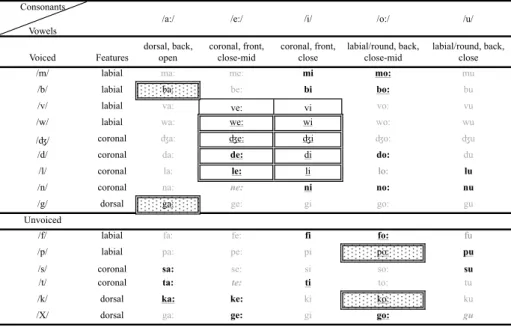
syllables. We hypothesized that the type of learning shown in Marcus et al. (1999) should only be enhanced when using natural speech. We thus took care to balance the syllables’ phonological features with the intention of being more representative of natural speech than Marcus et al.’s (1999) set, which uses a very limited set of sounds. Some examples of the limitations include the fact that familiarization triads were composed of only two vowels, /e/ and /i/, both of which are front vowels, that all test consonants are stops, that all
famil-iarization syllables and three of the four test syllables are homorganic2, that
three of the four familiarization consonants are coronal, that four triads had
identical vowels when syllables were combined (wilili, wididi, lewewe, dewewe),
and that one triad had identical consonants when syllables were combined (
wi-wewe). Table 2.1 shows syllables used in Marcus et al. (1999) as compared to
the syllables used in our experiments.
In the Song condition, we aimed to directly test the findings of Marcus et al. (2007) that speech is special by testing learning in a non-speech condition
with auditory stimuli found in nature3.
In both conditions, we tested infants with a variety of test trial types, in-cluding previously-heard syllables in novel combinations maintaining the origi-nal ordiorigi-nal positions within triads (Combination), previously-heard syllables in novel positions (Place), and completely novel syllables (Generalization). With these three types of testing conditions, we aimed to draw comparisons between
the abilities of infants, adults (Geambas,u, Spierings, ten Cate, & Levelt, in
prep.), and birds (Spierings & ten Cate, 2016) within a larger comparative project. While zebra finches were able to apply the learned rule only to fa-miliarized sounds (Combination), budgerigars were able to apply the learned rule at all levels (Spierings & ten Cate, 2016). We expected the infants in this experiment would also be able to do this: if algebraic learning has occurred, variables are formed for X and Y items and a rule is formed for how to combine them, irrespective of the familiarity and positions of syllables. However, this experiment failed to deliver evidence of learning. Due to the complex nature of the experiment, we simplified the test and honed in on Generalization items using only speech stimuli in Experiment 2. When this experiment also failed to show evidence of learning, we conducted Experiment 3, a failed attempt at a close replication of Marcus et al.’s original study. In next sections of this paper
1Since we used natural birdsong we decided to use natural speech stimuli as well. In
addition, Saffran and Wilson (2003) pegged the high drop out rate in their experiment on the disinterest of the infants in synthetic synthesized speech. Thus, natural recordings were considered more likely to engage the infants in the task.
2Homorganic sounds are those that share place of articulation. For example, coronal
consonant /d/, and coronal, close-mid, front vowel /e:/ share the feature of being produced with the coronal part of the tongue in the front of the mouth, making /de:/ a homorganic syllable. Infants produce homorganic syllables first (C. C. Levelt, 1994) and prefer these sounds over non-homorganic ones early in development (ter Haar & Levelt, 2018).
3Birdsongs were also used for the purpose of cross-species comparison work conducted
Table 2.1: Syllable chart of possible consonant and vowel combinations. Syllables boxed with double lines were used in Marcus et al. (1999)’s experiment. Syllables with in boxes with polka dot fill were used for as test syllables in Marcus et al. (1999). Familiarization and test syllables were varied for each participant in our experiments. Syllables in bold were used in our experiments 1 and 2. Syllables with boxes with single lines replaced syllables /dZi/ and /dZe/ in our Experiment 3. Homorganic syllables used in the experiments are underlined. Unused syllables are grayed out.
Consonants
Vowels
/a:/ /e:/ /i/ /o:/ /u/
Voiced Features dorsal, back, open coronal, front, close-mid coronal, front, close labial/round, back, close-mid labial/round, back, close
/m/ labial ma: me: mi mo: mu
/b/ labial ba: be: bi bo: bu
/v/ labial va: ve: vi vo: vu
/w/ labial wa: we: wi wo: wu
/ʤ/ coronal ʤa: ʤe: ʤi ʤo: ʤu
/d/ coronal da: de: di do: du
/l/ coronal la: le: li lo: lu
/n/ coronal na: ne: ni no: nu
/g/ dorsal ga: ge: gi go: gu
Unvoiced
/f/ labial fa: fe: fi fo: fu
/p/ labial pa: pe: pi po: pu
/s/ coronal sa: se: si so: su
/t/ coronal ta: te: ti to: tu
/k/ dorsal ka: ke: ki ko: ku
we describe the three experiments in detail and present both a frequentist and Bayesian analysis of the data.
2.3
Experiment 1
In Experiment 1, we extended on the foundation of Marcus et al.’s (1999) study. We exposed two age groups (six- and nine-month-old infants) to one of two patterns (XYX or XXY), in a Song or a Speech condition, and tested their ability to apply the learned rule to various levels of novelty during test.
2.3.1
Methods
Stimuli
Speech condition. Because the stimuli used in the original Marcus et al.
(1999) study were phonologically limited, in the Speech condition, we expanded the group of syllables used as exposure and test stimuli. We balanced the num-ber of syllables that used voiced and unvoiced consonants, and the numnum-ber of syllables composed of homorganic and not homorganic sounds. In addition, our triad combinations differed from Marcus et al.’s in that all syllables could be used as either an X or Y item, as long as triad followed the rule.
The stimuli in the Speech condition consisted of natural recordings of consonant-vowel (CV) syllables made by a phonologically trained female native speaker of Standard Dutch (C.C.L.). The original CV recordings were manip-ulated such that each syllable was approximately 400 ms in total duration, all vowels were similar in length, and all consonants of the same class (stops, frica-tives) were similar in length (vowel duration values taken from Koopmans-van
Beinum, 1980). A total of eight unique syllables were selected4, and each
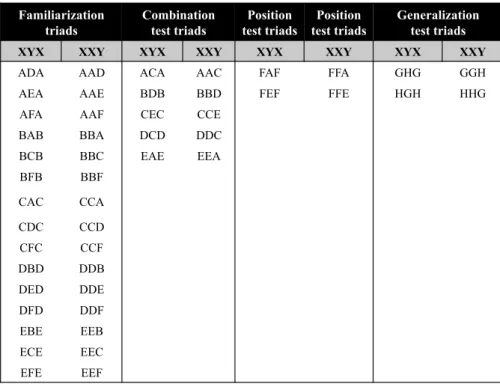
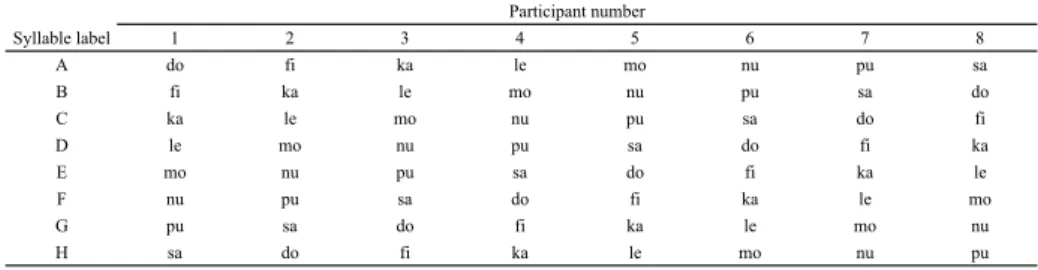
sylla-ble was assigned to a letter A through H, in eight different randomizations (see Appendix A1 for a table of all syllables and to which letter they corresponded to in each randomization). These randomizations were made such that infants’ performances could not be subject to biases or preferences for specific syllables. The syllables were combined into triads by concatenating three CV syllables as shown in Table 2.2 (see also Appendices B1 and B2 for a complete list of triads per randomization for the familiarization and test phases respectively). The CV syllables within a triad were separated by 100 ms silent pause. This created triads approximately 1.4 seconds in duration. Both the familiarization and test strings were concatenated with a one second pause separating each triad. Each triad’s pitch was standardized at a constant 125 Hz such that pitch sounded natural for a female voice and would not highlight any specific sylla-ble in the triad, thus providing no supporting information with respect to the structure of the triad.
4Eight syllables could be selected so as to match the number of unique zebra finch song
Table 2.2:Each letter A through H was assigned to a unique syllable. Syllables were then combined to form 30 familiarization triads and 18 test triads, half of which followed the XYX pattern and half of which followed the XXY pattern. To avoid influence of preference for specific sounds, each infant heard one of the possible eight combinations (see Appendices A1, B1, and B2).
Familiarization triads
Combination test triads
Position test triads
Position test triads
Generalization test triads
XYX XXY XYX XXY XYX XXY XYX XXY
ADA AAD ACA AAC FAF FFA GHG GGH
AEA AAE BDB BBD FEF FFE HGH HHG
AFA AAF CEC CCE BAB BBA DCD DDC BCB BBC EAE EEA BFB BBF
CAC CCA
Song condition. Stimuli used in the Song condition were also composed of natural recordings of eight zebra finch song elements produced in the Lei-den University Institute of Biology. The duration of each element was between approximately 35 and 86 ms. As in the speech condition, triads were concate-nated with 100 ms between each element, and strings were concateconcate-nated with a one second silent pause between triads. Also as in the Speech condition, all elements could be used as either an X or a Y, as long as the triad followed the rule. Song triads ranged in duration from approximately 400 ms to 560 ms including pauses.
Participants
A total of 19 six-month-olds and 20 nine-month-olds were tested in the Speech condition; 29 six-month-olds and 27 nine-month-olds were tested in the Song condition.
Infants were recruited via the municipality of Leiden. Parents were briefed on the intention of the study and subsequently gave their informed consent for their infants’ participation. Parents and infants were compensated for their voluntary participation with reimbursed travel costs and a gift of a book.
Infants were removed from analysis for the following reasons: experimenter
or technical errors (n=6), birth more than three weeks pre-term5 (n=7), and
excessive fussiness (n=4).
Sixteen infants were bilingual to some extent, ranging from hearing some foreign language from a grandparent to having at least one parent who spoke a foreign language to them regularly. Most of the bilingual infants only partic-ipated in the Song condition such that the speech stimuli would not be more foreign to them than for the rest of the subject group. The three bilingual in-fants who were tested in the speech condition had Dutch mothers and heard Dutch most of the time.
While Marcus et al. (1999) tested seven-month-old infants, we tested six-and nine-month-olds. In testing on either side of this age, we expect to see a developmental difference in generalization abilities.
Procedure
Infants were tested in the Visual Fixation Procedure (VFP; Cooper & Aslin,
1990) using E-Prime software (E-Prime 2.0, Psychology Software Tools, Inc.,
2012). While the VFP testing method is different from the Headturn Preference Procedure (HPP) used in Marcus et al. (1999), both methods rely on the same principle that infants will continue to look towards a visual stimulus for as long as they are attending to the auditory stimulus playing at the same time (E. K. Johnson & Zamuner, 2010).
The experiment consisted of an initial attention grabber, a familiarization phase, and a testing phase. The experiment began with the infants being seated
on a caregiver’s lap in a sound-attenuated booth. Caregivers wore tight-fitting headphones that played a mixture of music and backwards speech to mask the auditory stimuli of the experiment. This ensured that caregivers would not reflexively respond to the auditory stimuli and unwittingly influence the be-havior of the infant. The experiment began with an initial attention grabber, composed of a video of green LED lights, to draw the infant’s attention to the center. Once the infant looked towards the attention grabber for two continu-ous seconds, the familiarization phase would begin. The familiarization phase consisted of an approximately two-minute (1 minute 53 seconds) continuous exposure phase. The continuous auditory stream included three repetitions of 15 different triads. While the auditory stimuli played, infants saw a video of a flashing red light on the screen directly in front of them to maintain their attention. Once the familiarization stream ended, the attention grabber played again. Once the infant looked towards the attention grabber for two seconds, the testing phase began. During the testing phase, infants saw the same video of flashing lights as during the familiarization. However, in contrast to the fa-miliarization phase, the test trials only played while the infant was looking. Infants could look to a trial for a maximum time of 15 seconds, after which the trial would automatically end. If the infant looked away during the trial for more than two seconds continuously, the trial would automatically stop and an attention grabber would begin until the infant again focused to center for two continuous seconds.
During the test phase, infants heard three different types of test triads. The first, we refer to as Combination triads, which were made up of syllables infants had heard during familiarization but which were now rearranged into previously unheard combinations. The second, we refer to as Place triads, composed of syllables in which the X test item had only been heard in the Y position during the familiarization. The third type of test type we refer to as Generalization triads. These were, as in the original Marcus et al. (1999) experiment, triads composed of syllables which had not been heard during the familiarization phase. Half of all test triads followed the pattern of the familiarization phase (consistent test items), and half followed the opposite pattern (inconsistent test items). The test items were presented in an unblocked manner and randomized per participant. The test phase included 18 total test trials (see Table 2.2 and Appendix B2) resulting in a test phase of approximately 10 to 15 minutes.
A video camera recorded the infants behavior for offline coding and allowed the experimenter to react to the infants’ behavior online. Infants’ behavior was
coded offline by a coder blind to the stimuli using ELAN software (ELAN
2.3.2
Results
Data preprocessing
Apart from the inclusion and exclusion of outliers, there are many decision to be made regarding the preprocessing of infant looking data. For instance, it is common practice to exclude looking times (LTs) that are shorter than the time it takes for one repetition of the stimulus to play (Ferguson & Waxman, 2015; Saffran & Wilson, 2003). Following the latter model, the data is analyzed with-out LTs shorter than 1.5 seconds for the speech and shorter than 0.5 seconds for the sound stimuli (10% of the data).
Another consideration is that there are LTs that exceed the 15 second presentation time of the stimuli (3% of the data). These LTs could be caused by infants not responding to the stimuli but simply staring (or, in the case of the Headturn Preference procedure, reflect a preference for one side of the booth). Ideally, only data points reflecting a preference would be kept and staring behavior would be omitted. However, this distinction cannot be made based on the data, and the literature provides no clear way to handle such cases, although removal of LTs reaching the maximum trial duration have been removed in previous studies (Bernard & Gervain, 2012; Gervain & Werker, 2013). We therefore decided to report the analyses both with and without LTs above 15 seconds.
In all experiments, data was first analyzed using repeated measures ANOVA (labeled ’Frequentist analysis’ per experiment) and subsequently using Bayesian paired samples t-tests (labeled ’Bayesian analysis’ per experiment). In addition to the more commonly-used frequentist analyses, we choose to include Bayesian analyses as they allow us to quantify relative evidence of competing hypotheses (Wagenmakers, Morey, & Lee, 2016). That is, a certain hypothesis (H1) can be more likely than another hypothesis (H0) or vice versa, given the data. In our studies H0 and H1 are clearly defined: "Infants will show preferential looking based on the test grammar’s inconsistency with the familiarization grammar" (H1) or "Infants Infants will not show preferential looking based on the test grammar’s inconsistency with the familiarization grammar" (H0). An addi-tional benefit of this procedure is that null-results can be interpreted, since in a Bayesian analysis, H0 can be ’x’ times more likely than H1 given the data. Such an interpretation is impossible with frequentist analyses, since the truth of the null-hypothesis is an assumption of frequentist analyses (Cohen, 1994).
Frequentist analysis
Combination
Consistent F(1, 28)=0.80,p=.37 Age:Consistent F(1, 28)=1.72,p=.19 Sex:Consistent F(1, 28)=0.33,p=.56 Training:Consistent F(1, 28)=1.96,p=.17 Consistent F(1, 44)=0.12,p=.72 Age:Consistent F(1, 44)=0.03,p=.86 Sex:Consistent F(1, 44)=0.03,p=.84 Training:Consistent F(1, 44)=0.17,p=.67 Consistent F(1, 28)=0.94,p=.33 Age:Consistent F(1, 28)=1.49,p=.23 Sex:Consistent F(1, 28)=0.42,p=.51 Training:Consistent F(1, 28)=2.20,p=.14 Consistent F(1, 44)=0.19,p=.65 Age:Consistent F(1, 44)=0.03,p=.84 Sex:Consistent F(1, 44)=0.59,p=.44 Training:Consistent F(1, 44)=0.66,p=.42
Generalization
F(1, 26)=0.06,p=.80
F(1, 26)=0.01,p=.89
F(1, 26)=0.06,p=.79
F(1, 26)=3.09,p=.09
F(1, 42)=0.26,p=.60
F(1, 42)=4.02,p=.05
F(1, 42)=0.59,p=.44
F(1, 42)=5.88,p=.01
F(1, 26)=0.06,p=.80
F(1, 26)=0.01,p=.89
F(1, 26)=0.06,p=.79
F(1, 26)=3.09,p=.09
F(1, 41)=0.68,p=.41
F(1, 41)=1.98,p=.16
F(1, 41)=0.83,p=.36
F(1, 41)=6.05,p=.01
Place
F(1, 28)=0.00,p=.96
F(1, 28)=0.15,p=.70
F(1, 28)=0.19,p=.66
F(1, 28)=0.27,p=.60
F(1, 42)=4.50,p=.03
F(1, 42)=0.57,p=.45
F(1, 42)=0.44,p=.51
F(1, 42)=0.70,p=.40
F(1, 27)=0.01,p=.89
F(1, 27)=0.22,p=.63
F(1, 27)=0.32,p=.57
F(1, 27)=0.15,p=.69
F(1, 42)=2.24,p=.14
F(1, 42)=0.09,p=.75
F(1, 42)=2.11,p=.15
F(1, 42)=0.13,p=.71
Speech
Speech
Song
Song
LT > 15 allo
w
ed
LT > 15 omitted
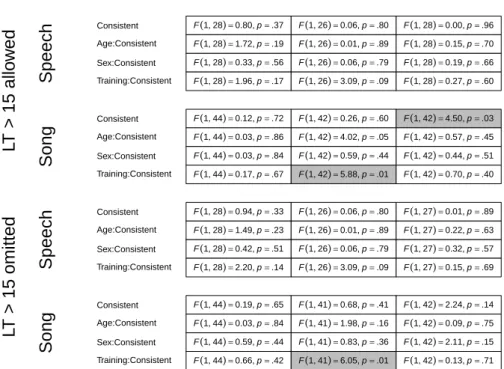
Figure 2.1:Multiverse ofp-values for Experiment 1.
assessed, creating 48p-values to evaluate. This expansion is called the data
mul-tiverse (Steegen, Tuerlinckx, Gelman, & Vanpaemel, 2016) and is very common in many psychological experiments, although it is almost never made explicit that there were so many outcome options. In order to increase transparency we
decided to report all results. Figure 2.1 highlights p-values below .05 in gray
and clearly shows an overall failure to replicate earlier findings (Gerken, 2006; Marcus et al., 1999). The only significant main effect (if we do not consider multiple comparison issues) occurs in the Place testing trials in the Song con-dition, and is in the opposite direction: LTs are longer during consistent than inconsistent trials. The significant interaction effects between training and
con-dition are visualized in Figure 2.2 with error bars of±1 standard error. These
effects indicate that infants have a preference for adjacent repetition (i.e., a preference for XXY versus XYX), independent of familiarization grammar.
Bayesian analysis
Familiarization
Looking time (s)
LT > 15 allowed
4 5 6 7 8 9 10
XXY XXY XYX XYX
Consistent Inconsistent
Familiarization
Looking time (s)
LT > 15 omitted
4 5 6 7 8 9 10
XXY XXY XYX XYX
Consistent Inconsistent
Figure 2.2: Interactions of familiarization and test grammars in Experiment 1. The left panel shows results when LTs of longer than 15 seconds are allowed in the analysis, while the right panel shows results when LTs of longer than 15 seconds are omitted from analysis. inclusions or omission did not change the pattern of results: infants familiarized with XXY look longer to the consistent test grammar, while infants familiarized with XYX look longer to the inconsistent test grammar.
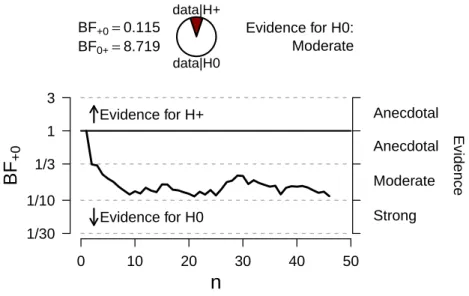
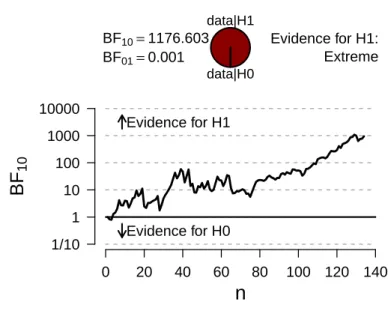
Yet it would certainly help our understanding of infants’ behavior if we could interpret these null effects. The Bayesian framework provides the possibility to accumulate evidence in favor of the null hypotheses and interpret how likely the null hypothesis is in comparison to other hypotheses (Jeffreys, 1961). This is possible by calculating Bayes Factors (BFs), which indicate how many times more likely one hypothesis is over another. In this case, we use BFs to quantify how much more likely the null hypothesis (that looking times are equal for both the consistent and inconsistent sounds) is than the alternative hypothesis (that infants look longer when they hear inconsistent sounds).
0 5 10 15 20 25 30 35 1/30
1/10 1/3 1 3
Anecdotal
Anecdotal
Moderate
Strong
Evidence
B
F
+0
n
Evidence for H+Evidence for H0 BF+0=0.237 BF0+=4.222
data|H+
data|H0
Evidence for H0: Moderate
Figure 2.3:Sequential analyses for Experiment 1 for the speech stimuli in the generalization conditions with LTs longer than 15 seconds allowed.
0 10 20 30 40 50
1/30 1/10 1/3 1 3
Anecdotal
Anecdotal
Moderate
Strong
Evidence
B
F
+0
n
Evidence for H+Evidence for H0 BF+0=0.115 BF0+=8.719
data|H+
data|H0
Evidence for H0: Moderate
more likely than the alternative hypothesis as all BFs are greater than 1. Also
note that the highest BFs can be found in the cells with lowestp-values. This
may seem counter-intuitive, but is the case because the small effects that are found are in the opposite direction. Infants look longer when consistent patterns are presented than when inconsistent patterns are presented, providing more evidence against a preference for inconsistent sounds.
Table 2.3:Bayes Factors that indicate how much more likely H0 (that infants do not have a preference) is than H1 (that infants have a preference for inconsistent sounds), presented for three conditions (Combination, Generalization, Place), two types of stimuli (Speech, Song), and two types of preprocessing options (with and without looking times longer than 15 seconds).
Combination Generalization Place
Speech, all LT 9.23 4.22 5.47
Song, all LT 4.70 8.72 18.38
Speech, LT<15 9.56 4.22 5.78
Song, LT<15 4.31 10.26 15.08
2.3.3
Discussion
The analysis did not show evidence of differential looking to consistent or in-consistent test patterns overall except in the specific case of Place test items in the Song condition if LTs over 15 seconds were allowed. If those long looking times were removed the effect was no longer found, indicating that it was not a strong effect to begin with. No other main effects were found.
There were, however, interaction effects between the familiarization pat-tern and the consistency of the test patpat-tern. Infants preferred the XXY patpat-tern, independent of the pattern with which they were familiarized.
2.4
Experiment 2
2.4.1
Methods
Stimuli
The stimuli in Experiment 2 differed from those used in Experiment 1 only with respect to the test items used. In this experiment, only the generalization items, GGH, GHG, HHG, and HGH were used in test (see Table 2.2 and Appendix B2). Because we found no difference with respect to the use of speech or song in Experiment 1, during this experiment, only speech stimuli were used.
Participants
We tested 25 six-month-olds and 22 nine-month-olds. Recruitment and com-pensation was identical to Experiment 1.
Infants were removed from analysis for the following reasons: technical errors (n=5) and excessive fussiness (n=1). Ten of the infants in this experiment were exposed to another language in addition to Dutch, with all infants having one Dutch parent and being exposed to Dutch both in- and outside the home.
Procedure
The procedure was identical to Experiment 1, with the exception of the type and number of test trials. Four generalization test items were used, two that were consistent with the training pattern, and two that were inconsistent with the training pattern. These four test trials were repeated three times, for a total of 12 test trials (cf. Marcus et al., 1999).
2.4.2
Results
Data preprocessing
As in Experiment 1, LTs that were shorter than the duration of one triad (1.5 seconds) were excluded (4% of the data). Again, there were LTs that exceed the 15-second presentation time of the stimuli (6% of the data) and we report the analyses both with and without these LTs.
Frequentist analysis
Consistent F(1, 36)=0.04,p=.841 Age:Consistent F(1, 36)=0.55,p=.461 Sex:Consistent F(1, 36)=0.77,p=.383 Training:Consistent F(1, 36)=9.13,p=.004
Consistent F(1, 36)=0.61,p=.438 Age:Consistent F(1, 36)=1.16,p=.288 Sex:Consistent F(1, 36)=0.13,p=.710 Training:Consistent F(1, 36)=8.70,p=.005
LT > 15 allo
w
ed
LT > 15 omitted
Figure 2.5:Multiverse ofp-values for Experiment 2.
2.6 with error bars of ±1 standard error. As in Experiment 1, infants seemed
to have a preference for patterns including adjacent repetitions (XXY).
Bayesian analysis
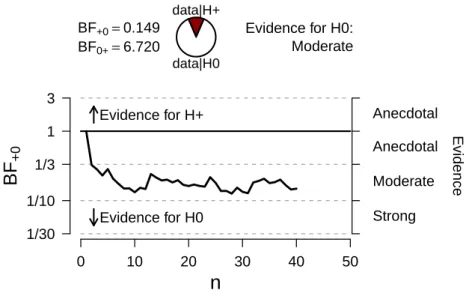
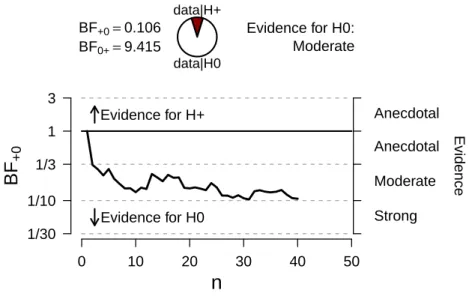
To help our understanding of the null effect we also performed a sequential Bayesian analysis, using BFs to quantify how much more likely the null hy-pothesis is than the alternative hyhy-pothesis. Figures 2.7 and 2.8 shows how evidence accumulates in favor of the null hypothesis for both the data with and without LTs longer than 15 seconds included.
2.4.3
Discussion
Familiarization
Looking time (s)
LT > 15 allowed
7 8 9 10 11 12
XXY XXY XYX XYX
Consistent Inconsistent
Familiarization
Looking time (s)
LT > 15 omitted
7 8 9 10 11 12
XXY XXY XYX XYX
Consistent Inconsistent
Figure 2.6:Interactions of familiarization and test grammars in Experiment 2.
0 10 20 30 40 50
1/30 1/10 1/3 1 3
Anecdotal
Anecdotal
Moderate
Strong
Evidence
B
F
+0
n
Evidence for H+Evidence for H0 BF+0=0.149 BF0+=6.720
data|H+
data|H0
Evidence for H0: Moderate
0 10 20 30 40 50 1/30
1/10 1/3 1 3
Anecdotal
Anecdotal
Moderate
Strong
Evidence
B
F
+0
n
Evidence for H+Evidence for H0 BF+0=0.106 BF0+=9.415
data|H+
data|H0
Evidence for H0: Moderate
Figure 2.8: Sequential analyses for Experiment 2 with LTs longer than 15 seconds not allowed.
independent of which pattern they had been exposed to. While this is an inter-esting result consistent with the idea that infants may have a bias for adjacent repetitions, it does not replicate the results of Marcus et al. (1999) and does not show clear evidence of the ability to learn rules.
After failing to show rule learning in two experiments using the same fa-miliarization phase and procedure, we identified several points on which our experiment differed from the original Marcus et al. (1999) study that may have negatively impacted the ability of infants to learn or to show their learning. First, our carefully controlled stimuli may have introduced a high level of vari-ability which did not allow the infants to learn the rule quickly enough. This may have been due to the fact that our stimuli were phonologically complex as compared to those used in Marcus et al. The presence of more heterorganic syllable patterns in our stimuli might have attracted attention to the syllable structure rather than to the pattern.
Lewis, 2005) showed that the first step in solving an AGL task was to learn that there were categories in the grammar. Gómez and Gerken (2000) also argued that being able to make abstract categories is crucial for language learning and productivity.
In addition to the differences with respect to the stimuli, we used a different experimental paradigm. While VFP and HPP are based on the same principle of looking-while-listening, there may be differences with respect to how active the infant has to be in each task, the HPP being slightly more active (details below).
With these considerations in mind we ran a third experiment to try to replicate Marcus et al. (1999) as closely as possible, using similar stimuli and a similar procedure.
2.5
Experiment 3
2.5.1
Methods
Stimuli
In this experiment, the stimuli were similar to those used in Marcus et al.’s (1999) Experiments 2 and 3, with two small exceptions. As our infant partici-pants were Dutch native speakers, a Dutch (rather than an American English) synthesizer was used to create the syllables (synthesized in Praat; Boersma &
Weenink, 2007). In addition, the voice affricate/dZ/present in syllablesji and
je does not exist in Dutch. Because there are no voice affricates in Dutch, these
syllables were replaced with with voiced fricative /v/ to producevi andve. The
triads used are shown in Table 3.
Participants
We tested 30 monolingual Dutch seven-month-old infants. Recruitment and compensation was identical to Experiments 1 and 2.
Infants were removed from analysis for the following reasons: technical errors (n=5), excessive fussiness (n=6), being born more than 3 weeks pre-term (n=1), and parental decision to stop the experiment (n=2).
Procedure
Table 2.4:Familiarization and test items following the XYY and XYX pattern respectively.
XYY XYX
dedidi dedide
deveve devede
delili delide
dewewe dewede
vididi vidivi
viveve vivevi
vilili vilivi
viwewe viwevi
ledidi ledile
leveve levele
lelili lelile
lewiwi lewile
wididi widiwi
wiveve wivewi
wilili wiliwi
wiwewe wiwewi
bapopo bapoba
kogaga kogako
Familiarization
Test
grabber was a wide-angle video camera (Go Pro Hero 3), which allowed the experimenter to view and react to the infant’s behavior and which recorded the experiment for off-line coding. Directly above the side lights were speakers, hidden below white sheets of fabric to minimize distraction away from the lights.
The experiment began with an attention grabber. As in the previous two experiments, when the infant focused on the attention grabber for two seconds, the familiarization phase began. During this phase, the familiarization stream, consisting of 16 triads repeated three times in different randomizations, played uninterrupted for approximately two minutes (1 min 46 sec). In addition, the side lights were illuminated when the infants looked at them and were extin-guished when the infant looked away, in order to familiarize the infants with the fact that the lights were contingent on their attention. This was done in-dependently of the auditory stream.
towards the flashing side light, the auditory test stimuli started to play. As in Experiments 1 and 2, the test stimuli would continue playing as long as the infants looked, for a maximum of 15 seconds. When the infants looked away for less than two seconds, the auditory stimuli would briefly pause, but would resume if the infants turned back within that time window. If the infants looked away for more than two seconds, the auditory stimuli and the blinking light would stop, the trial would end, and the attention grabber would begin again. This repeated until the infants finished the test phase, or until the caretaker or experimenter determined that an infant was too fussy (not orienting to atten-tion grabber for an extended period of time) or distressed (crying or screaming while ignoring the lights). As in Experiment 2, the test phase consisted of four generalization test items, two corresponding to a pattern consistent with the familiarization and two corresponding to a pattern inconsistent with the famil-iarization. These four test items were repeated for three blocks, and randomized per block, totaling 12 test trials.
2.5.2
Results
Data preprocessing
As this was a replication, we used the same procedure as Marcus et al. (1999), LTs shorter than the duration of the stimuli were omitted (3% of the data) and LTs longer than 15 seconds were kept (16% of the data).
Frequentist analysis
A repeated measures ANOVA with consistency, training and their interaction on the mean looking times did not yield a significant main effect for consistency
[F(1,14) = 1.74, p= .208)]. There was a near-significant interaction effect
be-tween training and condition [F(1,14) = 4.05,p= .064, see Figure 2.9]. Infants
who were trained with XYX had a preference for inconsistent trials, whereas infants trained with XYY had a preference for consistent trials. This implies an overall preference for XYY over XYX, similar to the results of Experiments 1 and 2, where there was a preference for XXY over XYX.
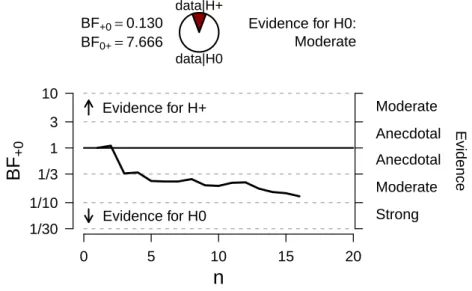
Bayesian analysis