The mechanics and behavior of Cliff Swallows during tandem flights
Ryan M. Shelton
A thesis submitted to the faculty at the University of North Carolina at Chapel Hill in partial fulfillment of the requirements for the degree of Masters of Science in the Department of
Biology.
Chapel Hill 2014
ABSTRACT
Ryan M. Shelton: The mechanics and behavior of Cliff Swallows during tandem flights (Under the direction of Tyson L. Hedrick)
Cliff Swallows (Petrochelidon pyrrhonota) are highly maneuverable social birds that often forage and fly in large open spaces. Here I used multi-camera videography to measure the three dimensional kinematics of their natural flight maneuvers in the field. Specifically, I
iv
ACKNOWLEDGEMENTS
I would like to thank Tyson Hedrick for mentoring me throughout my Masters, Laura Miller and Kenneth Lohmann for supporting me as committee members, Bill Kier for his willingness to help me with whatever I needed, George Lauder for helping me return to
TABLE OF CONTENTS
LIST OF TABLES……….…………vii
LIST OF FIGURES………..viii
LIST OF SYMBOLS……….……….ix
INTRODUCTION………..…….1
MATERIALS AND METHODS………...4
Swallow Recordings………..…..4
Kinematic Analysis………...…….……..6
Flight Model………..……..…..10
Statistical Analysis……….12
RESULTS………..………13
General Results………...……13
Turn Performance………...……...15
Leader – Follower Comparisons………....16
High Force Outlier………...…..19
DISCUSSION……….………...21
Flight Envelope………..…21
vi
LIST OF TABLES
viii
LIST OF FIGURES
Figure 1 – Camera setup……….……….5
Figure 2 - Structure-from-motion camera calibration.………….……….…...7
Figure 3 – Roll angle………..……..9
Figure 4 - Modified coordinate axes for bird position.………..…10
Figure 5 - Three-dimensional position and speed...…………...………..….……….14
Figure 6 - Turning mechanics………..……..16
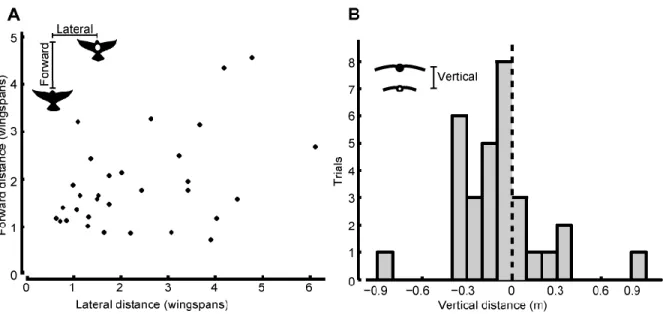
Figure 7 - Bird position……….…….17
Figure 8 - Wingbeat phase offset ………..18
Figure 9 - Ratio of turn direction and speed ……….19
LIST OF SYMBOLS
a Acceleration (m s-2)
CL Coefficient of lift (dimensionless)
F Centripetal force (body weights)
r Radius of curvature (m)
S Wing area (m2)
θ Roll angle (degrees)
u Flight speed (m s-1)
v Velocity (m s-1)
INTRODUCTION
People have always been drawn to the impressive movements of graceful and powerful animals like dolphins and cheetahs. Over the last half century, the advancement of camera technology has allowed scientists to examine with ever-increasing detail the mechanics of how animals like these move. As frame rates and pixel counts have increased, scientists have spent more and more time looking at the diverse locomotion strategies employed throughout the animal kingdom (Biewener, 2003; Dickinson et al., 2000). This thesis will focus specifically on bird flight.
Behaviors in bird, bat, and flying insect species range in complexity from migratory cruising to high- and low-speed maneuvering during courtship, territory defense, and predator-prey interactions. Our understanding of the maneuverability of bats (Iriarte-Díaz and Swartz, 2008; Riskin et al, 2008) and insects (Card and Dickinson, 2008; Combes et al., 2012), along with birds (Tobalske, 2007), has grown rapidly over the last decade with each group developing new methods based on what has worked with other species. Most research to date on the
scope by the size of the experimental space. To overcome these difficulties, and to better
understand the dynamics of high-speed avian flight maneuvers, I used high speed video cameras to quantify flight maneuvers and conspecific interactions in natural environments.
I chose to study Cliff Swallows (Petrochelidon pyrrhonota) because they perform their well-known flight maneuvers in open spaces that permit easy recording with cameras. Cliff Swallows build nests in large colonies each spring in North America and migrate to South
America for the winter (Brown and Brown, 1986). They are highly social passerines that perform many activities in groups including feeding, preening, gathering mud for nest-building, and perching (Emlen, 1952). As aerial insectivores, Cliff Swallows have evolved body and wing shapes consistent with changing direction (turning acceleration), and are therefore considered to be highly maneuverable (Brown and Brown, 1998).
3
This study examines several specific questions related to these free-flight behaviors. What is the performance and maneuvering envelope of freely flying Cliff Swallows? What are the turning mechanics of Cliff Swallows in the field? What are the characteristics of these
MATERIALS AND METHODS Swallow Recordings
5
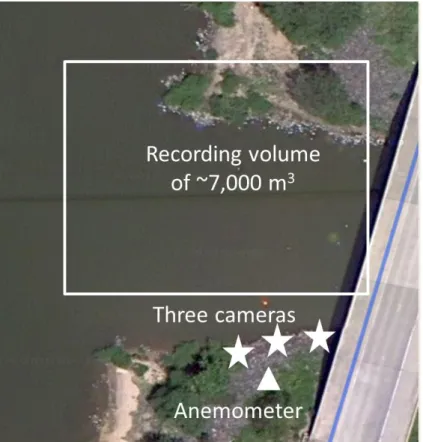
Figure 1. Camera setup. This is a satellite image (Google Maps, 2013) of the field site with stars showing the approximate location of the cameras, a white triangle marking the approximate location of the anemometer, and a white square showing the approximate recording volume.
To collect 3D field flight data in large outdoor volumes I worked with collaborators in the Hedrick lab and in Professor Margrit Betke’s group at Boston University’s Computer Science department to develop a structure-from-motion camera calibration routine which used a wand of known length to set the scale of the scene and provide an initial calibration; this was
implemented as a custom MATLAB (The Mathworks, Natick, MA, USA) routine (Therialt et al., accepted). This preliminary calibration was then refined by adding individual swallows from calibration recordings as points of optical correspondence and applying a bundle adjustment optimization (Lourakis and Argyros, 2009) to the data and camera coefficients. The scene was then aligned to gravity by measuring the acceleration of a rock tossed through the scene,
of direct linear transformation coefficients (DLT) for 3D analysis of bird trajectories (Hedrick, 2008). Camera recording positions varied slightly among trials, but typically set a recording volume of ~7,000 m3. Video data were collected using three synchronized high-speed cameras (N5r, Integrated Design Tools, Inc., Tallahassee, Florida, USA) recording 2336 x 1728 pixel images at 100 Hz. The calibrations had a median DLT residual of 1.23 pixels and a median 95% confidence interval in one dimension of 0.039 m.
I minimized the influence of wind by recording on days with little or no wind (< 1.5 m s -1
). I measured the wind by placing a digital anemometer (HHF142, OMEGA Engineering, Inc, Stamford, Connecticut, USA) on the shoreline near the camera locations elevated between 2 and 6 meters above the water level. The birds were more exposed to wind than the anemometer flying over the exposed lake and at higher elevations. The anemometer was mounted on a gimbal allowing free rotation about the vertical axis; wind velocity was recorded at 1 Hz using a custom data logger which sampled the anemometer output, compass direction via a digital magnetometer and Global Positioning System location and time.
Kinematic Analysis
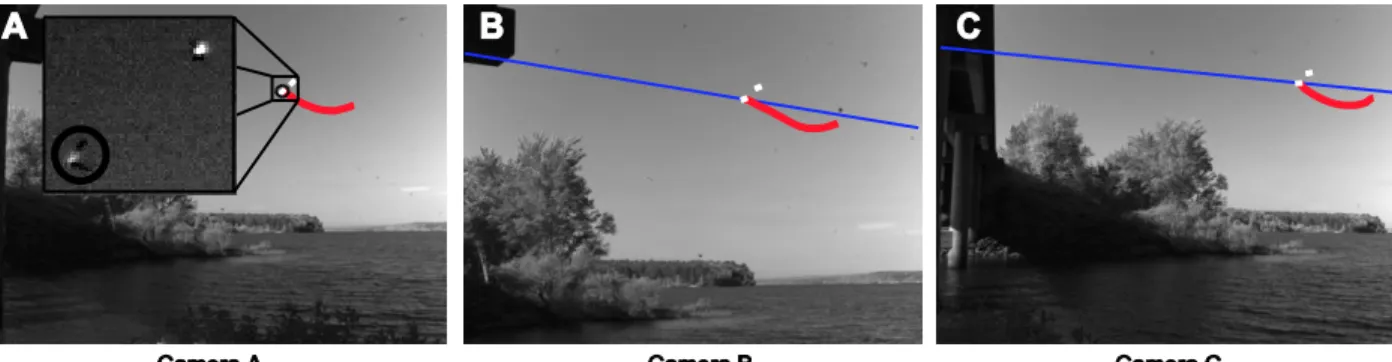
I manually digitized the head of each bird in each frame of each camera to determine the 3D bird positions with respect to time for each trial (Fig. 2) using the MATLAB package
7
data point. Varying the filter frequency did not impact any of our statistical conclusions and introduced only small variations in the data. Results in this paper are from the 1.5 Hz low pass filter unless otherwise noted. Derivatives of position with respect to time were calculated from the spline polynomial; I examined the first and second derivatives – velocity (v) and acceleration (a).
Figure 2. Structure-from-motion camera calibration. Example frames from the three
synchronized cameras (A, B, C) placed along the shoreline to capture different views of the same volume of space. After completing our camera calibration procedure, I digitized the location of a bird in two or more camera views, shown here with the bird located in one camera (marked by the black circle in A) and the epipolar lines, (in blue in B and C) to find the exact 3D location of the bird at that time. The epipolar line defines the ray where the bird could be located in B and C given its location in A. The zoomed insert in A is contrast enhanced. White dots mark the
location of the two digitized birds. The red lines show the flight path of the digitized bird over the preceding 1 second
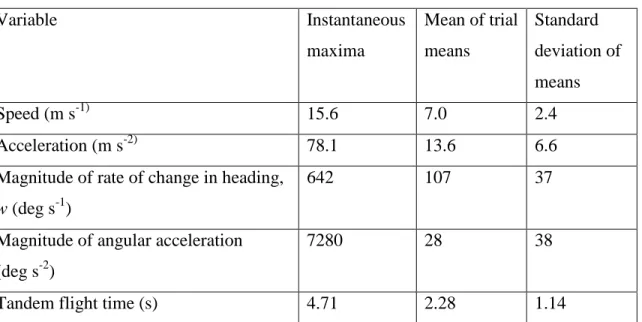
I used the filtered position, v, and a data for all further calculations. I recorded the maximum instantaneous values from all of the data of speed, a, magnitude of rate of change in heading, and magnitude of angular acceleration to document the maximum observed
performance (Table 1). I calculated the mass specific power (not including drag) by
. (1)
specific power from each trial. I then focused on the 10 trials with the largest power for further analysis.
Table 1. Flight Performance
Variable Instantaneous
maxima
Mean of trial means
Standard deviation of means
Speed (m s-1) 15.6 7.0 2.4
Acceleration (m s-2) 78.1 13.6 6.6
Magnitude of rate of change in heading, w (deg s-1)
642 107 37
Magnitude of angular acceleration (deg s-2)
7280 28 38
Tandem flight time (s) 4.71 2.28 1.14
I calculated the instantaneous radius of curvature (r) directly from v and a by
√
(2)
where a is the transpose of a. I then calculated rate of change in heading (w) by
(3)
with u defined as flight speed. I extracted the frame and trial number of each local maxima in the graph of w with respect to time of the lead birds (number of peaks = 144) and tried to digitize the location of the extended wingtips in that frame (± 2 frames) to calculate roll angle (θ). I
9
I added a directional sign (positive = right, negative = left) for w, θ, and F.
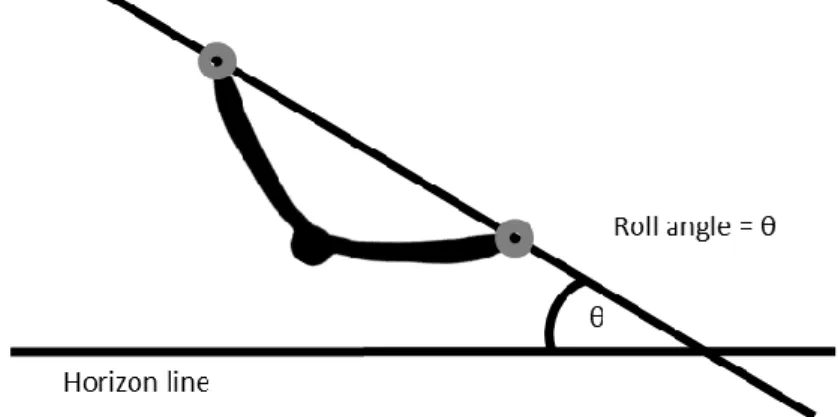
Figure 3: Roll angle. The roll angle was calculated as the angle between the line connecting the two wingtips and the line from one wingtip in the direction of the other wingtip but parallel to the horizontal plane. The wingtips, here marked with grey circles, were digitized at the frame of peak rate of change in heading.
To evaluate the relative body positions of the lead bird with respect to the following bird I defined a second coordinate system (xb, yb, zb) where I rotated and shifted the original
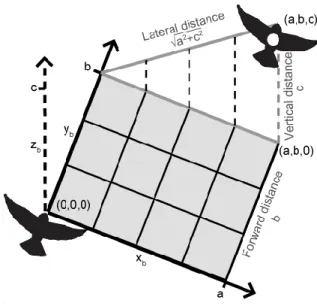
Figure 4: Modified coordinate axes for bird position. To measure the lateral, vertical, and forward distances between the lead and following birds I shifted and rotated the 3D axes of each frame so the following bird was at the origin flying along the yb-axis. The vertical distance is the zb-coordinate of the lead bird (c). The lateral distance is the perpendicular distance from the yb-axis to the lead bird (√ ). The forward distance is yb-coordinate of the lead bird (b).
I calculated the average wingbeat frequency by visually determining the frame number that each bird had its wingtips at their highest point for each wingbeat cycle. Of our 32 tandem flights, only 26 recordings clearly showed at least four consecutive wingbeats for both birds. To evaluate the relative timing of wingbeats of the lead bird and following bird I first evaluated each wingbeat separately. For each following bird wingbeat I calculated the number of frames until the next wingbeat started, set this wingbeat length equal to 360˚, and noted the timing of the start of the lead bird’s downstroke relative to the following bird’s 360˚ wingbeat. For each trial I took the average timing of the lead bird’s downstroke and treated the means from the 26 trials as independent data points.
Flight Model
11
simple fixed-wing banked turns. I made progressively simplifying assumptions to isolate individual mechanisms. I started with the simple flight model of
(5)
with CL = lift coefficient and S = wing area. I then calculated the lateral force F by finding the
component of the lift vector redirected laterally by the roll angle (θ) by
. (6)
If I drop CL S from the equation by assuming that swallows use similar lift coefficient and wing
area among all maneuvers, I am left with
. (7)
Since CL drops out, it is unnecessary to determine what it is a function of. Alternatively, if Cliff
Swallows modulate wing area and lift coefficient to match Lift (i.e. vertical force) to body weight and maneuver only by redirecting Lift, I expect:
(8)
and thus lift proportional to θ after further linearization:
. (9)
As a third alternative, Cliff Swallows may turn by redirecting their Lift inward but also modulate coefficient of lift and wing area to maintain a vertical component equal to body weight. In this circumstance,
(10)
complete models. In addition, I would expect an improved correlation from substituting the horizontal component of centripetal force (by F cos(θ)) for F.
Statistical Analysis
I used several different statistical methods to evaluate our data. To measure the correlations between each paired combination of F, θ, and w I calculated a linear regression, a correlation coefficient (r2), and a p-value. I used a t-test to evaluate the null hypotheses that the lead bird turns toward and away from the following bird in equal portions of time. A t-test was also used to evaluate the null hypothesis that the lead bird and following bird have equal mean velocities. I used MATLAB for these statistics treating each tandem flight as a single
independent trial.
13 RESULTS General Results
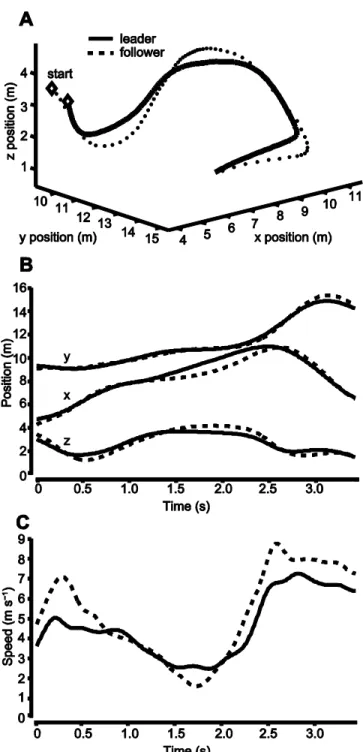
In each recorded tandem flight the following bird copied the movements of the lead bird in 3D space and in the x, y, and z position components independently (e.g. Fig. 5). Copying behavior appeared to be independent of variation in distance travelled, interaction time, elevation change, and turning rate among tandem flights. I recorded the mean and maximum speed,
15 Turn Performance
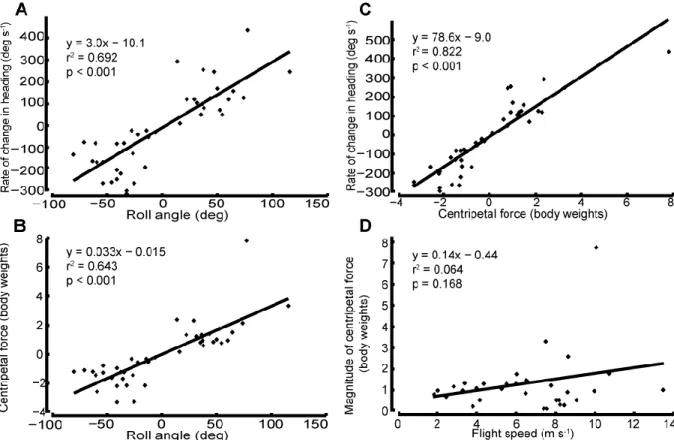
I measured or calculated the roll angle (θ), flight speed (u), rate of change in heading (w), and centripetal force (F) of 42 lead bird turns, and I found strong and significant correlations between θ and w (r2 = 0.69, p <0.001, Fig. 6A), θ and F (r2
Figure 6: Turning mechanics. For 42 turns I compared (A) rate of change in heading with respect to roll angle, (B) centripetal force with respect to roll angle, (C) rate of change in heading with respect to centripetal force, and (D) flight speed with respect to centripetal force. For roll angle, rate of change in heading, and centripetal force, positive = right and negative = left. A, B, and C have high correlations and significant p-values but D has a near zero correlation and is insignificant. Two points of interest include the inverted turn with a roll angle of 116˚ and the centripetal force of 7.8 body weights. Excluding the force outlier from the calculation for D provides the same conclusion (y = 0.024x + 0.921, r2 = 0.010, and p = 0.605).
Leader – Follower Comparisons
17
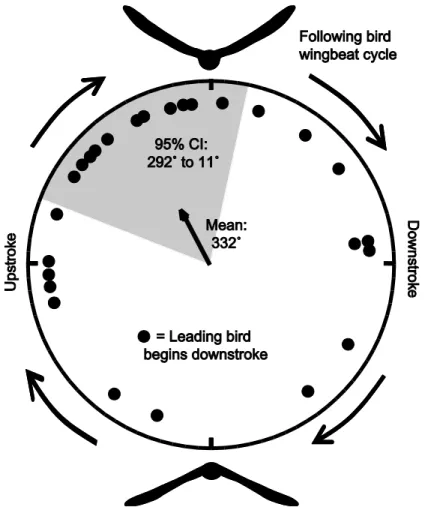
lead bird. Perfect synchronization would be represented by all points positioned at 0°. The non-random distribution (Rayleigh Test; r = 0.38, p = 0.021, n = 26) averaged 332˚ (95% CI: 292˚ to 11˚).
On average, the lead bird turned away from the following bird 65% of the tandem flight (Fig. 9A, t-test, p <0.001). The following bird had a longer flight path and flew 6% faster on average than the lead bird (t-test, p = <0.001, Fig. 9B).
Figure 8: Wingbeat phase offset. Here I show the phase offset of the beginning of downstroke among the follower and leader. The outer circle represents the full wingbeat cycle of the
following bird. For each wingbeat cycle I observed the timing in frames of the start of the lead bird’s downstroke relative to the following bird’s wingbeat cycle. Each dot is the mean timing of the start of the lead bird’s downstroke for a single trial. If the top of this graph is defined as zero degrees and numbers increase clockwise, the mean of the trial means is 332 degrees (r = 0.38, p = 0.021, n = 26) with the shaded region showing the 95% confidence interval. This is a
19
Figure 9: Ratio of turn direction and speed (A) For each trial I measured the ratio of time that the lead bird is turning away from the following bird and found the leader turning away for the majority of time in 27 of 31 trials. The dashed line at 0.5 shows the expected mean if the turn direction was random. The data mean is significantly different from 0.5 by a t-test (mean = 0.65, SE = 0.03, p < 0.001). (B) The ratio of the mean followers speed to mean leaders speed shows that the lead bird is flying faster than the following bird in only 2 of 31 trials suggesting that the following bird is flying faster to adjust to an unpredictable flight path. The dashed line at 1.0 shows the expected mean if both birds had the same mean velocity. These data are significantly different from 1.0 by a t-test (mean = 1.06, SE = 0.01, p < 0.001).
High Force Outlier
I estimated a centripetal force of 7.8 body weights in one turn, more than double any other turn I quantified (Fig. 10). This sequence included a number of factors that may have contributed to the high force measurement: a large θ of 78˚, a fast speed of 14.6 m s-1
21 DISCUSSION
Flight Envelope
Compared to the single turn produced by 7.8 times body weight force, most trials included performance well within the known flight envelope for Cliff Swallows and related species. While Cliff Swallow flight has not been examined in a wind tunnel to the best of our knowledge, I can compare our data to previous research on Barn Swallows (Hirundo rustica). Flight speeds of two Barn Swallows ranged from 3.4 to 14.0 m s-1 in a wind tunnel (Park et al, 2001). I found that the time averaged flight speeds of Cliff Swallows had a similar range and identical maximums (2.8 to 14.0 m s-1) despite differences in wing shape and body size between the two species. Since I measured open-area flights, and birds were free to fly at self-chosen speeds, I can also look at the maximum instantaneous flight speeds over 0.01 second intervals. Cliff Swallows flew at
instantaneous speeds up to 15.6 m s-1. It was surprising that these tandem flights occurred at such a large range of speeds. Given the expectation that these were competitive chases, I would expect most of these flights to maximize their velocity threshold, but that is not what we observed. I will discuss the possible implications of this further in the Tandem Flights section that follows.
in our study were able to descend, using potential energy as well as muscle work to accelerate, and potentially took advantage of other environmental factors like pressure gradients and
vortices. Calculating the mass-specific power output (not including drag, see Eqn 1 in methods) can account for added acceleration due to gravity and provides a more relevant comparison between the different behaviors. Warrick’s Cliff Swallows started from rest and accelerated to 7.26 m s-1 in 4 m, resulting in a mass specific power of 22.8 W kg-1. Swallows in tandem flights, starting from a wide range of speeds, averaged 21.2 ± 4.5 (mean ± SD) W kg-1. This power estimate would increase if I included drag and a full aerodynamic model. Thus, the freely flying swallows exhibited approximately the same mass specific power as was found in the capture and release study of escape accelerations, even though the conditions of these measurements were drastically different. The level acceleration experiment with recently captured wild swallows was designed to elicit maximum performance; the similar results from freely behaving birds suggests that Cliff Swallows may use most, if not all, of their performance envelope on a day to day basis.
The vertical takeoff power outputs of Blue-Breasted Quail (47.0 W kg-1; Askew et al, 2001) and Gray Jay (27.7 W kg-1; Jackson and Dial, 2011) are larger (43.6 g, 68.9 g,
respectively) than our measured Cliff Swallow free-flight power. Aerodynamic and allometric theory would predict that smaller Cliff Swallows should have higher power outputs than the other, larger, species (Pennycuick 1975), which may suggest that our Cliff Swallow values are not maximal. Alternately, since swallows are not acceleration specialists and can often use potential energy to enhance flight maneuvers and prey capture attempts, Cliff Swallows may simply have a lower maximal capability for muscle powered acceleration.
23
(Table 1, Fig. 4). Similar field measurements during high-speed flight have only been reported for the courtship dives of Anna’s hummingbirds, which experienced a gravity assisted centripetal force of 9 body weights on average (Clark, 2009). This is only slightly higher than the 7.8 body weights maximum reported here, but much greater than our median magnitude of centripetal force of 1.0 body weights. It is likely that the number of documented turning kinematics in the literature will rapidly increase over the next 10 years, providing more of a scaling context for these results. However, I was somewhat surprised to find similar maximum flight forces in the natural flight maneuvers of swallows and hummingbirds since the swallows are approximately three-fold larger in mass than the hummingbirds and also differ greatly in ecological niche and typical flight behavior.
I also compared these centripetal forces to experiments on pigeons and cockatoos completing 90˚ turns through L-shaped corridors at low speeds in laboratory maneuvering tests. Pigeons flying at 3.3 m s-1 with a turning radius of ~1.0 m produced a maneuver-averaged centripetal force of 10.9 body weights (Ros et al., 2011); Rose-Breasted Cockatoos making similar turns at 3.01 m s-1 with a radius of 0.92 m produced 9.8 body weights (Hedrick and Biewener, 2007). These larger birds are producing larger forces than our Cliff Swallows which produced less than 2.0 body weights at similar speeds and likely reflect the severe spatial constraints the birds were forced to maneuver under in the laboratory studies.
Turning Mechanics
angle, assuming no change in coefficient of lift. These differences are reasonable given the swallows’ expected ability to vary coefficient of lift and their continued wing flapping through most of the turns. I was unable to determine many details of wing flapping kinematics such as wing extension, stroke amplitude and gait changes.
The basic mechanics of the Cliff Swallow turns were different from those expected for a wing glider. In the methods I derived a simple linearized expression for a simple fixed-wing banked turn to F θ (Eqn 9 in methods). Stepping back two equations in our model to F u2 sin(θ) (Eqn 7 in methods), I expected to see our correlations increase. Instead, when I
25
Finally, our large filming volume precluded us from being able to discern detailed wingbeat kinematics; higher resolution or closer image captures of swallows turning in high speed free flight will be necessary to detail the exact motions of the swallow wings and body that produce F. The maneuvers examined with this model are a subset of the possible flight
maneuvers and turning mechanisms available to swallows. For example, vertical maneuvers were uncommon during tandem flights, and therefore the maneuvering model comparisons are necessarily only tested against approximately level turns in the ~3 to ~16 m s-1 speed range.
Tandem Flights
being driven away more easily and other birds requiring more aggressive pursuit. The offset position of the follower may provide an aerodynamic advantage of reducing flight cost (Portugal et al., 2014), or a behavioral advantage of allowing the follower to be seen or to cut off turns towards the nest. These tandem flights might be part of an escalation process progressing towards physical combat. If so, the birds would attempt to send signals to resolve the conflict with minimal energy loss which would explain why most turns are well below the maximum observed turning force since the maximum force turn observed here imposed a substantial energy cost.
27
between the two phase offset possibilities by extracting the response latency between the leader and follower. However, since the swallows appear to use different tracking strategies depending on context, I cannot use this information to conclusively separate the two possibilities, although a 390° offset is more consistent with typical sensory response times as noted above.
Continuing Research
In this paper I was able to find some clear conclusions about the flight envelope and turning mechanics of Cliff Swallows flying in the field, but there is still a lot to learn about the behavioral component of these tandem flights. While many aspects of these flights appear to be competitive, the evidence is not conclusive. If I could explain the benefit of these tandem flights for each bird we could probably also explain each bird’s strategy, and then further evaluate how effective each bird is at accomplishing its goal. One way to get this data would be to catch several of these birds, attach easy to see anklets, take physical measurements of each bird, identify their sex, release them, and then track their behavioral patterns over a series of days or weeks. This new study could clarify if certain birds are more likely to lead or follow, if each bird performs the behavior with the same frequency, if sex is an important characteristic in these chases, if the same two birds pair off most of the time or if the pairings are more randomly distributed, and if there is a particular physical characteristic that predicts success or failure. Once a more comprehensive behavioral study of tandem flights was complete, other
REFERENCES
Alexander, D. E. (1986). Wind tunnel studies of turns by flying dragonflies. J. Exp. Biol. 122, 81-98.
Askew, G. N., Marsh, R. L., & Ellington, C. P. (2001). The mechanical power output of the flight muscles of blue-breasted quail (Coturnix chinensis) during take-off. . J. Exp. Biol. 204, 3601-3619.
Biewener, A. A. (2003). Animal locomotion. Oxford University Press.
Brazier, K. T. S. (1994). Confidence intervals from the Rayleigh test. Mon. Not. R. Astron. Soc. 268, 709.
Brown, C. R., & Brown, M. B. (1986). Ectoparasitism as a cost of coloniality in cliff swallows (Hirundo pyrrhonota). Ecology. 67, 1206-1218.
Brown, C. R., & Brown, M. B. (1989). Behavioural dynamics of intraspecific brood parasitism in colonial cliff swallows. Anim. Behav. 37, 777-796.
Brown, C. R., & Brown, M. B. (1998). Intense natural selection on body size and wing and tail asymmetry in cliff swallows during severe weather. Evolution 52, 1461-1475.
Card, G. and Dickinson, M. (2008). Performance trade-offs in the flight initiation of Drosophila. J. Exp. Biol. 211, 341-353.
Clark, C. J. (2009). Courtship dives of Anna's hummingbird offer insights into flight performance limits. Proc. R.Soc.B. 276, 3047-3052.
Collett, T. S., & Land, M. F. (1978). How hoverflies compute interception courses. J. Comp. Physiol. 125, 191-204.
Combes, S.A., Rundle, D.E., Iwsaki, J.M. and Crall, J.D. (2012). Linking biomechanics and ecology through predator-prey interactions: Flight performance of dragonflies and their prey. J. Comp. Physiol. 215, 903-913.
Dickinson, M. H., Farley, C. T., Full, R. J., Koehl, M. A. R., Kram, R., and Lehman, S. (2000). How animals move: an integrative view. Science 288, 100-106.
Emlen, J. T. (1952). Social behavior in nesting cliff swallows. Condor 54, 177-199.
Google Maps (2013). [Highway 751 at Jordan Lake, Chattam, NC] [Satellite map] Retrieved from
29
Ghose, K., Horiuchi, T. K., Krishnaprasad, P. S., & Moss, C. F. (2006). Echolocating bats use a nearly time-optimal strategy to intercept prey. PLoS Biol. 4, e108.
Hedrick, T. L. (2008). Software techniques for two-and three-dimensional kinematic measurements of biological and biomimetic systems. Bioinspir. Biomim. 3, 034001. Hedrick, T. L., & Biewener, A. A. (2007). Low speed maneuvering flight of the rose-breasted
cockatoo (Eolophus roseicapillus). I. Kinematic and neuromuscular control of turning. J. Exp. Biol. 210, 1897-1911.
Iriarte-Díaz, J., Swartz, S. M. (2008). Kinematics of slow turn maneuvering in the fruit bat Cynopterus brachyotis. J. Exp. Biol. 211, 3478-3489.
Jackson, B. E., & Dial, K. P. (2011). Scaling of mechanical power output during burst escape flight in the Corvidae. J. Exp. Biol. 214, 452-461.
Koenker, R., Ng, P., & Portnoy, S. (1994). Quantile smoothing splines. Biometrika, 81, 673-680. Land, M. F. (1993). Chasing and pursuit in the dolichopodid fly Poecilobothrus nobilitatus. J.
Comp. Physiol. A 173, 605-613.
Land, M. F., & Collett, T. S. (1974). Chasing behaviour of houseflies (Fannia canicularis). J. Comp. Physiol. 89, 331-357.
Lourakis, M. I., & Argyros, A. A. (2009). SBA: A software package for generic sparse bundle adjustment. ACM Trans. on Math. Software. 36, 1-30.
Olberg, R. M., Worthington, A. H., & Venator, K. R. (2000). Prey pursuit and interception in dragonflies. J. Comp. Physiol. A, 186. 155-162.
Olberg, R. M., Seaman, R. C., Coats, M. I., & Henry, A. F. (2007). Eye movements and target fixation during dragonfly prey-interception flights. J. Comp. Physiol. A. 193, 685-693. Park, K. J., Rosén, M., & Hedenström, A. (2001). Flight kinematics of the barn swallow
(Hirundo rustica) over a wide range of speeds in a wind tunnel. J. Exp. Biol. 204, 2741-2750.
Pennycuick, C. J. (1975). Mechanics of flight. In Avian Biology, vol. 5 (ed. D. S. Farner and J. R. King), pp. 1–75. New York: Academic Press.
Portugal, S. J., Hubel, T. Y., Fritz, J., Heese, S., Trobe, D., Voelkl, B., Hailes, S., Wilson, A. M., Usherwood, J. R. (2014). Upwash exploitation and downwash avoidance by flap phasing in ibis formation flight. Nature, 505, 399-402.
Riskin, D. K., Willis, D. J., Iriarte-Díaz, J., Hedrick, T. L., Kostandov, M., Chen, J., Laidlaw, D. H., Breuer, K. S., Swartz, S. M. (2008). Quantifying the complexity of bat wing
kinematics. J. Theor. Biol. 254, 604-615.
Ros, I. G., Bassman, L. C., Badger, M. A., Pierson, A. N., and Biewener, A. A. (2011). Pigeons steer like helicopters and generate down-and upstroke lift during low speed turns. Proc. Natl. Acad. Sci. U.S.A., 108, 19990-19995.
Swaddle, J. P. (1997). Within-individual changes in developmental stability affect flight performance. Behav. Ecol. 8, 601-604.
Tobalske, B. W. (2007). Biomechanics of bird flight. J. Exp. Biol. 210, 3135-3146.
Tobalske, B., and Dial, K. (1996). Flight kinematics of black-billed magpies and pigeons over a wide range of speeds. J. Exp. Biol. 199, 263-280.
Therialt, D. H., Fuller, N. W., Jackson, B. E., Bluhm, E., Evangelista, D., Wu, Z., Betke, M., Hedrick, T. L. (accepted). A method for accurate multi-camera field videography. J. Exp. Biol.
Ward, S., Möller, U., Rayner, J. M. V., Jackson, D. M., Bilo, D., Nachtigall, W., and Speakman, J. R. (2001). Metabolic power, mechanical power and efficiency during wind tunnel flight by the European starling Sturnus vulgaris. J. Exp. Biol. 204, 3311-3322.
Warrick, D. R. (1998). The turning-and linear-maneuvering performance of birds: the cost of efficiency for coursing insectivores. Can. J. Zool. 76, 1063-1079.
Warrick, D. R., Dial, K. P., and Biewener, A. A. (1998). Asymmetrical force production in the maneuvering flight of pigeons. Auk 115, 916-928.