The Utility of College Awareness Programs for Middle School Students: An Evaluation of the First Look Program at UNC Chapel Hill
Morgan M. May
Senior Honors Thesis School of Education
University of North Carolina at Chapel Hill November 3, 2014
Contents
Introduction 3
Literature Review 7
Methodology 27
Results and Analysis 35
Discussion 51
The Utility of College Awareness Programs for Middle School Students:
An Evaluation of the First Look Program at UNC Chapel Hill
The need to attain post-secondary education has been increasing steadily over the years. As the economy has shifted from an industrial economy to one that is based on service,
information, and technology, receiving some form of college degree has become almost necessary. In fact, according to Georgetown University’s Center on Education and the Workforce, 63 percent of job openings will require workers who have at least some college educationby 2018 (Carnevale, Smith, & Strohl, 2010). Receiving a college education has not only become a requirement for a significant percentage of jobs in the economy, but also, it has shown to have profound impacts on many other aspects of ones life including: larger earnings over a lifetime, lower unemployment rates, better health, higher marriage rates, and greater civic involvement (Rose, 2013). In fact, recent data suggests that those with a bachelor’s degree can earn on average 1.5 million dollars more throughout the course of one’s lifetime than those with only a high school degree (Carnevale et. al, 2010). Given the necessity as well as the benefits that a college degree has to offer for future generations, every student should have the
opportunity to pursue a college degree.
According to an ACT policy report on College Readiness, many students have ambitious educational and career aspirations, however, they often lack the basic information about how to fulfill these post-secondary goals (Noeth & Wimberly, 2005). In order to encourage and prepare students to get on the pathway towards attending a degree-granting institution and fulfilling their career goals, many different programs have been developed to increase college access for
One of the first steps to enable college access is to increase the awareness of college opportunities. According to the National College Access Network website, “college access programs are non-profit organizations designed to increase the number of students who pursue education beyond high school. The mission of these organizations is to open doors to
postsecondary education by providing financial counseling, last dollar scholarships, college visits, career guidance, tutoring, and test preparation courses” (“Community-based initiative,” n.d., para. 1). Therefore, programs such as these seek to make students mindful of the college environment by providing information about college or allowing for students to experience college for themselves. College access programs can come in many different shapes, sizes, and forms and can target many different aspects of college. Also, these programs have been
sponsored by many different organizations including: the federal government, state governments, colleges and universities, schools and school districts, foundations and philanthropic
organizations, and private businesses (Perna, 2002). Despite these programs’ differences, their goals appear to be the same. Based on data from the 2012 National Survey of Pre-College Outreach Programs, of all the programs evaluated, the top program goals consisted of: 1) increasing the likelihood of attending college (93% of respondents), 2) increasing college awareness (92% of respondents), and 3) providing exposure to college (91% of respondents) (Swail, Quinn, Landis, & Fung, 2012).
Although promoting college for all in educational reform is prominent, pre-college
historically underrepresented minorities (Swail et. al, 2012). These programs generally work with high school aged students within these marginalized groups to help them prepare for the college admissions tests (SAT/ ACT) and admissions procedures, discover financial aid opportunities to pay for college, find mentors to help them succeed, and show them what real college campuses look like by giving students the opportunity to visit a college campus.
An enduring problem with these college access efforts is that some high school students wait until their junior or senior year to plan for college. By that point, many of these students realize that they did not take the proper high school courses necessary to be accepted into college (Perna, 2002). This creates a gap between those who want to attend college and those who actually enroll in college. In fact, according to data collected in 2006, more than 90% of students reported aspirations to attend some form of college, while actual enrollment in college was only 57% (Kirk, Lewis, Scott, Wren, Nilsen, & Colvin, 2012). While other factors, such as financial aid, may impact their data, a delay or even a late start in college planning remains problematic.
Department of Education recommend that students begin planning for college as early as sixth grade (Noeth & Wimberly, 2005, p. 2).
College awareness in middle school can stimulate important steps towards college access. Intervening early enables students to select high school courses that meet college entrance requirements, provides motivation and incentive for achievement, encourages students to get involved in extracurricular activities within their school community as well as their local community, and helps them begin to think about how they are going to secure financial aid for their college education. Awareness and planning for college at an early age gives students ample amounts of time to properly align themselves with their future educational goals and begin to identify as a college-going student.
Despite the gains that early college awareness programs can have on jumpstarting the college planning process in middle school, the number of pre-college outreach programs actually targeting this age group is minimal. According to the 2012 National Survey of Pre-College Outreach Programs, 65 percent of the programs targeted high school students, while only 38 percent of the programs targeted middle school students (Swail et. al, 2012).
Even within this 38 percent, the amount of programs dedicated solely to middle school students is further limited. When looking at the pre-college outreach programs that were
One early college awareness program that operates within North Carolina’s Institutes of Higher Education solely for upper elementary school and middle school students is the
University of North Carolina at Chapel Hill’s First Look Program. This program’s primary goal is to “ignite a child’s dreams of a college education” (Julian-Fox, 2012, p. 1). It is a one-day college immersion program meant for 5th, 6th, 7th, and 8th grade students and is primarily led by college students at the university.
This research will evaluate the landscape of college awareness programs for middle school students and will both audit the First Look program based on best practices and analyze the existing evaluation data provided by the program. Scholarship surrounding current national college access programming will guide the First Look audit by reviewing First Look’s mission statement and programming documents. Additionally, archival participant questionnaires will be analyzed. This evaluation seeks to assess the effectiveness of the UNC-CH First Look program as an early college awareness program for middle school students. These findings can
specifically enhance the First Look program and the analyses can set direction for broader policy and practice implications for future college access at the middle school level.
Literature Review
In order to properly evaluate the First Look program, a broad understanding of the history, policies, and practices surrounding the context of college access is necessary. Previous research about college access policy and college access programming will be reviewed for theoretical influences, best practices, and effectiveness of programs as a whole.
The Necessity and Benefits of a College Degree
increases since 1972 (Clinedinst, Hurley, & Hawkins, 2011). The increase in high school graduates enrolling in college developed as the demand for highly skilled labor increased. As more highly skilled workers entered the workforce, new technology was developed and a new era of communication and technology dawned. This new era “solidified the importance of education in the education and welfare of our nation,” thus placing a greater emphasis on education (Swail, 2001, p. ix).
Technology. Technology has become ubiquitous and still remains a key part of our economy. This makes the need for a highly skilled and highly educated workforce even greater. According to the Projection of Jobs and Education Requirements through 2018, completed by the Georgetown University Center on Education and the Workforce, the fastest- growing industries in our economy, such as computer and data processing services, require workers with
disproportionately higher education levels, and in general, occupations as a whole are steadily requiring more education (Carnevale et. al., 2010). As our economy evolves and new jobs are created, receiving some form of a college degree will become increasingly necessary. In fact, of the projected 46.8 million job openings created by 2018, nearly two-thirds of them (nearly 63%) will require workers with at least some college education; about 33% will require a bachelor’s degree or better (Carnevale et. al., 2010). In addition to meeting the demands of our job market, a college degree can also have a profound effect on many other aspects of a person’s life
including: their earnings, their job stability, their health, their participation in civic involvement (Baum, Ma, & Payea, 2013).
Education Pays Report, the median earnings of bachelor’s degree recipients without an advanced degree are 65 percent higher than the median earnings of high school graduates (Baum et. al., 2013). Also, Georgetown University’s Projection of Jobs and Education Requirements Report states that the average value of a college degree compared to a high school diploma is about $1 million dollars in additional earnings over one’s lifetime (Carnevale et. al., 2010). Another economic benefit of having a college degree is the rate of unemployment is much lower for those with a four- year degree over those who with a high school diploma. In 2012, the unemployment rate for 25-34 year-olds with four-year college degrees was 4.1 percent, while 11.2 percent of high school graduates in this age range were unemployed (Baum et. al., 2013).
Health and social benefits. Along with the economic benefits, college graduates also experience health and social benefits. Health correlates for college graduates include: lower smoking rates, higher rates of exercise, and lower rates of obesity (Baum et. al., 2013). Also, those who have received a college education are more involved in society. College Board’s research study found that adults with at least a bachelor’s degree have higher voting rates in presidential elections and spend more time volunteering (Baum et. al., 2013). In addition to higher rates of civic participation, those who have received some form of a college degree are less likely to participate in public assistance programs such as Medicaid, School Lunch, and the Supplemental Nutrition Assistance Program (SNAP) formerly known as Food Stamps (Baum et. al, 2013).
Historical Contexts for College Access
The idea of college access is certainly not new. In order to fully comprehend the current college access movement, it is important to first explore the historical foundations of college access policy and college access programming.
College access policy. Policy surrounding college access started out being fairly discriminatory, focusing solely on getting certain groups of people, particularly white, war veterans, to college (Reed, 2001). However towards the mid 1960s and early 1970s, this trend began to shift as new policies were put in place. These profound changes in policy began to embrace the idea of college for all, and as time progressed, policy surrounding college access was not only focused on helping students find the money to pay for college, but also, it began to enact federal programs aimed at empowering students to strive for a college education.
Despite the gains that the GI Bill made, servicemen and their families were the only ones to reap the benefits. Therefore, at that time, access to financial aid for those who were not servicemen was generally not available. The success of promoting further education for veterans helped propel the Higher Education Act of 1965, which was signed by President Lyndon B. Johnson. The passage of this act served as a major turning point for increasing access to higher education, because “it extended need based financial assistance to the general population for the first time” (Brock, 2010, p. 111). In fact, this act was responsible for authorizing insured student loans, which is the main form of financial assistance still in use today (Snyder & Dillow, 2013). In addition to implementing policies that were aimed at providing financial assistance to help increase college access, other federal legislation passed further increased universal access by challenging racial and gender barriers. The Civil Rights Act of 1964 outlawed discrimination based on race in schools, which reversed the exclusion of people of color from certain
universities and colleges (Brock, 2010). Also, Title IX of the Education Amendments of 1972 stated that “no person in the United States shall, on the basis of sex, be excluded from
participation in, be denied the benefits of, or be subjected to discrimination under any education program or activity receiving Federal financial assistance” which includes public institutions of undergraduate higher education (US Department of Labor, 1972, section 1681-a). This
minorities and women from pursuing a college education, thus furthering the measures taken by the federal government in order to make a college education more universally accessible.
The development of college access programming. College access programming has
been in existence since the passing of the Economic Opportunity Act in 1964 amidst the War on Poverty Era (McElroy & Armesto, 1998). During this time period, the federal government created the Federal TRIO programs (TRIO), which were originally established to help provide supplementary academic support to low-income students and students historically
underrepresented in higher education, such as students of color and low-income students (Swail, 2001). In the beginning, the major program under TRIO was Upward Bound. Upward Bound targeted youth between the ages of 13 and 19 who had experienced low academic success and who had parents who did not receive a bachelor’s degree. This program sought to increase the rates at which these students attended and graduated from college by offering support such as help with the college admission process, assistance in preparing for college entrance exams, and tutoring services (McElroy & Armesto, 1998).
It is important to recognize that the federal government has not been the only source of college access program development. Individual state governments as well as community and non-profit organizations have also created programs aimed at increasing college access. Two major programs that were developed throughout the 1980s that are still in existence today are the “I Have a Dream Foundation” and AVID (Advancement via Individual Determination). The “I Have a Dream Foundation” began in 1981 after the program founder visited a low-income school and promised to pay their college tuition, if they graduated high school (I Have a Dream
Foundation, 2008). That one promise made to those students launched an outreach program that provides mentorship to help marginalized students get to college and it also provides financial assistance to help these students pay for college. AVID on the other hand was created in 1980 to provide support services to students and to engage them in a college preparatory curriculum (AVID.org). Many of these college access programs are still around today in addition to many other smaller scale state and local programs that exist nationwide.
These original programs laid the groundwork for college access programming as a whole and have shaped the world of contemporary college access programs that exist today. They have done so by instituting core program components that are still in use by college access programs today, such as providing academic support services, disseminating information about college and the college application process, and providing mentorship to students.
Contemporary Field of College Access
Current college context. Unlike historical notions of higher education, a culture centered on postsecondary education for all is emerging. Therefore, current statistics and data concerning post-secondary education tend to reflect this trend. The number of students enrolling in college overall has been increasing. According to the 2012 Digest of Education Statistics, between 2001 and 2011 the number of students overall enrolling in postsecondary degree granting institutions has increased by 32 percent from 15.9 million to 21 million students (Snyder & Dillow, 2013). This overall increase was also seen in enrollment data for students between the ages of 18 to 25. In fact, between 2001 and 2011 the number of students enrolling in college between the ages of 18 and 25 rose by 35 percent (Snyder & Dillow, 2013). Of the 21 million students enrolled in 2011, 72 percent of these students were enrolled in public
institutions and about 63 percent were enrolled in four-year institutions (Clinedinst, Hurley, & Hawkins, 2012).
In order to develop a deeper understanding of the current college environment, it is important to look at the current demographics that characterize and define this environment. Currently, more women are enrolled in college than men. In fact, of the number of students enrolled in degree-granting institutions in the fall of 2011, 57 percent were female while 38 percent were male, with the other 5 percent not specified (Snyder & Dillow, 2013). Also, projections made by the Department of Education predict that this gender gap will continue to widen until at least 2020 (Clinedinst et. al., 2012).
and lastly 0.9 percent were American Indian or Alaskan natives (Clinedinst et. al., 2012). This data affirms that there is a very substantial gap between the percentage of white students attending college and the percentage of minority students attending college.
Not only is there a racial gap existing in the current college environment, but also there is a gap in college enrollment numbers between high-, middle-, and low-income students. In 2011, of the recent high school completers enrolled in two or four year colleges, 52 percent of low income students were enrolled compared to 67 percent of middle income students, and 82 percent of high income students (Snyder & Dillow, 2013).
Given the substantial gaps in college enrollment numbers between white and minority students and high and low income students, the inequity in college access for minority and low income students needs intervention. Therefore, the most visible form of intervention to date has been national policy and programming that is targeted at increasing access for these particularly vulnerable groups.
Current national policy. Current national policy surrounding higher education has primarily been focused on increasing college access for these particularly vulnerable groups of students by providing financial assistance directly to students from the federal government in the form of grants, loans, and work- study programs. In the fiscal year of 2014, the federal
government will spend $99.7 billion on federal subsidized loans, $23.6 billion on grants, $36.5 billion on tax benefits, and $0.98 billion on work-study programs (Federal Education Budget Project, 2014).
Federal Student Aid (FASFA), Federal Pell Grants, Direct Loan Programs, Trio Programs, GEAR-UP Program and some specific scholarship programs.
The GEAR UP program was designed to increase the number of low-income students who are prepared to enter and succeed in post-secondary education by providing 6-year grants to states and district partnerships, which then provide services at high-poverty middle and high schools (Bausmith & France, 2012). GEAR UP programs are expected to provide many resources to participating students and their families. These resources include: providing information to students and parents such as information on college preparatory courses, cost of college attendance, and financial assistance, offering individualized academic and social support to students, promoting parental involvement in education, encouraging educational excellence, assisting in school reform, and endorsing student participation in rigorous courses (Bausmith & France, 2012).
Currently the 2014 fiscal budget has shown an increase in educational spending that includes: Pell Grant increases, implementing a First in the World grant program, making changes to the FASFA, and increased funding in federal college access programs. The federal
government plans on increasing the Pell Grant from $5,645 to $5,730 per student for the 2014-2015 school year (National College Access Network, 2014). Also, the First World Grant program that is being implemented will provide grants to institutions of higher education to deliver methods of increasing affordability and improving outcomes for low-income students (National College Access Network, 2014). This investment will help the federal government find successful ways to increase college access by making higher education more affordable. Finally, the 2014 budget increased federal funding for TRIO, GEAR UP, federal work-study, and
the current national policy surrounding college access has been primarily focused on providing financial assistance, both to students as well to programs that are aiming to help students get to college.
In addition to providing financial assistance to students enrolling in college and funding programs that promote college access such as GEAR UP, the federal government has also incentivized the use of Common Core Standards throughout the nation as a means of ensuring that “all students graduate from high school with the skills and knowledge necessary to succeed in college, career, and life” beginning in kindergarten and extending through 12th grade (“About the standards,” 2014). In order to do so, 48 state governors and state commissioners of education developed a set of English and Mathematics standards for each grade level K through 12 that each child should master throughout their respective school year. States are able to choose whether or not to adopt these standards, however states are encouraged to implement the Common Core through special incentives given by the federal government to those states who choose to adopt the standards. Despite the controversy surrounding the legitimacy and
effectiveness of these standards, 43 states and four territories have adopted them (“Standards in your state,” 2014). On a statewide level, North Carolina has developed its own set of NC Essential Standards as another accountability measure for student’s knowledge. The creation of these standards on a federal as well as a statewide level aims to boost college readiness and success by emphasizing the skills and knowledge one most learn in elementary, middle, and high school in order to succeed in college.
Contemporary programming is supported by relevant theories and research. These theories and research then play an integral role in defining the key aspects of programming and in designing new programs.
Theory base. Like the college access programs developed earlier in history, today’s college access programs are primarily focused on getting underrepresented populations of students, such as minorities and low-income students, into the realm of higher education. Many of these programs appear to correspond to particular developmental or career theories whether or not they are explicit in their approach.
Social capital theory. The predominant theory base for college access programming is the social capital theory. Social capital in an educational context is “the set of resources that inhere in family relations and community social organization and that are useful for cognitive or social development of a child or a young person” (Vorhaus, 2014, p.187). This theory suggests that minority and low-income students “lack access to “dominant” resources of social capital, which then serves as a barrier to higher education” (Bloom, 2008, p.1). All students have access to some forms of social capital. However, this lack of dominant forms of social capital leads to concerns with college costs and financial aid, academic preparedness for college, aspirations towards college, general knowledge of the college landscape and the college admissions process (Bloom, 2008). Therefore, college access programs are put in place in order to offer resources to help address these concerns and to break down this barrier, thus making college a possibility for all.
Morrell, 2002, p. 106). This process makes it difficult for the students who do not have the same access to this dominant social capital, which is where college access programing becomes crucial. College access programs therefore aim to serve as a hub of resources, knowledge, and associations for students who are not from well off families of the dominant group.
Social cognitive theory. Another theoretical framework that shapes the basis of college access programming is the social cognitive theory. The social cognitive theory is a psychological model developed by Albert Bandura that emphasizes that “learning occurs in a social context and that much of what is learned is gained through observation” (Denler, Wolters, & Benzon, 2014). A primary assumption that is made within this theory is that “a person’s on-going functioning is a product of a continuous interaction between cognitive, behavioral, and contextual factors” (Denler et. al, 2014). Another key assumption made in the social cognitive theory is that “people through forethought, self-reflection, and self-regulatory processes, exert substantial influence over their own outcomes and the environment more broadly” (Denler et. al, 2014). Therefore, college access programming aims to engage these cognitive and contextual factors by giving marginalized groups of students the opportunity to learn about college through first-hand observation, by offering mentoring opportunities with people who have gone to college, and by providing these students with useful information about college. By engaging a student’s
cognitive and contextual factors directly, college access programming indirectly seeks to shape the students’ behavior in order to help them reach their desired educational outcomes.
Aspects of Successful Pre-College Programming Promoting College Access
Conditions for college admission. College access programs seek to help minority and low- income students meet conditions for college admission. According to research by UCLA’s outreach leadership, there are six essential conditions that need to be met in order to gain admission into college and to succeed in the college environment once a student gets there. These conditions include: creating a “college-going culture”, taking a rigorous academic curriculum, having high-quality teachers, receiving intensive academic and college going support, a multicultural, college-going identity, having parental/ community involvement and connections (Oakes et. al., 2002). When this research promotes the idea of a “college- going culture,” it is referring to an environment “in which students find encouragement and help from multiple sources to prepare them with knowledge needed for college success” (McKillip, Godfrey, & Rawls, 2013, p. 530).
UCLA’s Outreach Team helps high school students in the area achieve these goals through two distinct types of programming activities. The first type of programming is “student centered,” while the second type of programming is “school centered” (Oakes et. al, 2002). Student centered programming seeks to help individual students get to college through the use of undergraduate mentors and academic support and advisement (Oakes et. al, 2002). School centered programming seeks to help all students by improving the quality of college preparation in every K through 12 school that has partnered with the university (Oakes et. al, 2002).
financial aid forms, SAT and ACT training, tuition reimbursement or scholarship, and beginning by eighth grade (Perna, 2002). Of these eleven, the five that have been deemed most critical are: the goal of college attendance, college tours visits or fairs, goal of promoting rigorous course-taking, parental involvement component, and beginning by eighth grade (Perna, 2002). Perna also emphasizes the role that colleges and universities can play in helping low-income, first generation, and minority students improve their educational attainment. In fact, urban colleges and universities “have extensive financial, human, intellectual, and organizational resources that may be directed productively” towards helping these underrepresented students (Perna, Harkavy, & Bowman, 2012, p. 63). Therefore, colleges and universities can play an integral role in college access programming.
Although Perna lays out a fairly comprehensive list that highlights the important aspects of effective pre-college outreach programs, Corwin, Colyar, and Tierney (2005) also contribute to this knowledge by sharing nine propositions that reflect curricular and extracurricular
components that have become integral to college preparation programs that aim to assist low-income, minority youth who might not otherwise attend college. These programs provide
By compiling a list of the components that overlapped or were unique within the three major research frameworks presented above, a comprehensive framework with four main themes was derived for the effective components of college access programming. This comprehensive framework suggests that the components of successful college access programming fall within these categories: creating a college-going culture or identity, promoting academic rigor, having a parental involvement component, and mastering specific program components, such as
beginning by a certain grade, involving a research university, program costs related to the benefits, and others.
Table 2.1 Effective Components of College Access Programming Found in Research Authors: Oakes, Rogers, Lipton, &
Morrell (2002)
Perna (2002) & Perna, Harkavy, & Bowman (2012)
Corwin, Colyar, &Tierney (2005) -creating a college-going
culture
-taking a rigorous academic curriculum -having high-quality teachers
-receiving academic & college-going support -creating a college-going identity
-having
parental/community involvement
-the goal of college attendance
-college awareness or exposure
-college visits, tour, and fairs -promoting academic skills -promoting rigorous course-taking -parental involvement component -parental college awareness
-parental assistance with financial aid forms -SAT/ACT training -scholarships or tuition reimbursement
-beginning by 8th grade -involves an urban college or university
-emphasizes student’s cultures -family engagement -use of peer groups -begin no later than ninth grade
-having
knowledgeable counselors
-access to a college preparation
curriculum -involves co-curricular activities -use of mentoring is helpful
-the cost of the program is
positively related to the benefits of the program
College awareness programming. The term college awareness appears to be one of the major components that falls under the umbrella of college access. College awareness “is a systemic understanding of the post-secondary educational system combined with specific
knowledge of the norms, values, and conventions of interactions in the college context” (Conley, 2007, p. 17). Awareness of what college is and the different aspects of college is key to
determining whether one wants to attend college in the future or not. Before having to select college preparatory classes, take standardized tests, and determine how to pay for college, a student has to decide whether or not they even want to attend college. Given that college
awareness falls under the category of college access, college awareness programs should strive to meet similar program components as college access programs, but they should start engaging students at an earlier age. Research has indicated that pre-college awareness and outreach should actually start earlier than high school, which has led to the development of college awareness programs for middle school students (Perna, 2002).
College awareness in middle school. Middle school serves as a crucial time when students begin to formulate ideas about their future educational and occupational aspirations. It is at this stage in life when students can begin to align these aspirations with goals to attain them by setting themselves on the college bound track. Making educational goals a reality generally involves taking college preparatory courses, maintaining good grades, participating in
(Noeth & Wimberly, 2005, p. 2). This early planning begins when “students consider post-secondary education and set educational and career goals” (Noeth & Wimberly, 2005, p. 3).
As far as course planning is concerned, students who begin taking a challenging curriculum in middle school tend to perform better in high school and are better prepared for college (Noeth & Wimberly, 2005). Beginning to take difficult classes starting in middle school can help students develop the proper study habits that will help them succeed throughout high school and beyond. Also, students who are in higher-level classes are likely to obtain information about post-secondary opportunities (Noeth & Wimberly, 2005). In fact, research has indicated that minority and first- generation college students who take higher-level math courses are more likely to attend college (Noeth & Wimberly, 2005).
In addition to course planning, middle school is a time when students begin to explore their postsecondary options. Research completed by ACT of middle and early high school
students indicated that at least 78 percent of these students have begun to think about and explore the types of education, training, and work they might pursue after high school (Noeth &
Wimberly, 2005). This research has also shown that 56 percent of middle and early high school students believe that pre-college programming has been very helpful or a little help in exploring education, training, and work after high school (Noeth & Wimberly, 2005). This data indicates that early educational planning is key to achieving educational aspirations; therefore college awareness programming should be focused on the middle school age group in order to kick-start this college planning as early as possible.
program completion (Perna, 2002). Therefore, evaluation of college access programs may be determined in other ways, such as assessing a program by its ability to encompass all of the components that have been deemed effective by research. Compiling a list of all of the effective program components found in research and then investigating a program in its entirety to determine which elements the program contains and which elements the program is lacking could complete this type of evaluation. This form of evaluation can also be considered an audit of the program. In addition, it may be useful to look at more proximal impacts of programs on students immediately after completing the program.
Originally when Perna completed research in 2002, which examined 1,100 college outreach programs based on the 1999-2000 National Survey on Outreach Programs, she was looking to assess how many of these programs contained the effective components of pre-college outreach. Her results found that 25 percent of programs targeting low income students,
minorities and potential first-generation college students and 30 percent of programs targeting low achieving students have the five critical components of effective pre-college outreach, and only 6 percent of all programs can be characterized as “ideal programs” which contain all eleven of the most important components of effective pre-college outreach (Perna, 2002). This research also found that of the 204 programs that target low-income students and have the five critical components, the programs are less likely to be federal TRIO programs and more likely to be GEAR-UP programs (Perna, 2002).
17 percent of the programs were university funded. Over 90 percent of these programs had goals that included: increasing the likelihood of attending college, increasing college awareness, and providing exposure to college (Swail et. al., 2012). As far as academic services were concerned, 62 percent of these programs offered study-skills training and 56 percent of these programs offered test-taking skills (Swail et. al., 2012). When focusing on non-academic related supports, 87 percent of the programs focused on college awareness and about 75 percent took students on campus visits and tours (Swail et. al., 2012). Effective outreach is not merely focused on the students themselves, but also developing a parental and family support system. According to the National Outreach survey, 67 percent of the programs surveyed had a parental component, although only 20 percent of them are mandatory (Swail et. al., 2012). Examining this data paints a broader picture of what the current pre-college outreach landscape looks like.
Summary
College access programming aims at bridging the educational attainment gaps that currently exist in higher education, by providing financial assistance, resources, and planning to both students as well as their parents who need it, particularly low income, minority, and first generation students and families. Implementing early college awareness programming for middle school students would start the college access process earlier, which ultimately could have a profound impact on the future of postsecondary education.
Methodology
This research was composed of two major parts: a program audit using key First Look programming documents and a secondary data analysis of questionnaires utilized by First Look. The program audit examined documents such as grant proposals, program overviews, program wish lists, campus tour documents, and program PowerPoint presentations. The secondary data analysis focused on previously completed questionnaires by the middle school aged participants. Program Audit
The first aspect of this study was a program audit of First Look. A program audit
rigor, having a parental involvement component, and program specific components; and the program effectiveness measures.
Participating program. The First Look Program at the University of North Carolina at Chapel Hill (UNC-CH) was audited in this research in order to examine its effectiveness as a college access program. The First Look Program more specifically is a college access initiative for 5th through 8th grade students.
Statement of need. The First Look program was developed in response to research stating that college planning should begin as early as sixth grade (Noeth & Wimberly, 2005). Since its beginnings in 2008, this program aims to kick-start the college planning process by giving upper elementary school students and middle school students from all over North Carolina a “first look” at a college campus.
Expectations. According to a First Look grant proposal, this program is a one-day enrichment experience that aims to “show kids what it is like to be a college student and to inspire and motivate them to set their goals on a college degree” (pg. 2). The immediate goal of the program is to show the program participants what it college looks like, to show what
participants need to do in school in order to get into college, and give information about the resources that they can use. The long-term goal of the program is to inspire students to attend college and to receive a college degree.
college, how to get to college, and some website resources. Lastly, there is a question and answer session, in which the middle school students get the opportunity to ask the current college
students any questions that they may have about college. A full agenda for this portion of the program can be found in Appendix B. After the classroom portion, the middle school students and their chaperones receive a walking tour of UNC-CH’s campus by UNC-CH undergraduate students. According to the Middle School tour document (Appendix C), the tour highlights specific buildings and landmarks that are crucial aspects of a college student’s life including: a classroom, the library, and the dining hall. The tour seeks to help the middle school students imagine themselves as college students with the hope that it will become a reality for these students in the future. Although the program and the tour is held at UNC-CH, it is solely focused on getting middle school students excited about attending a college in general, not just UNC-CH or any other North Carolina school (Perotta, 2013).
Resources. Although the director of the program as well as other members of the UNC-CH Visitor’s Center direct and oversee the program, a team of volunteer undergraduate students at UNC-CH carries out the actual program to its entirety. The classroom and campus tour portion of the program is a total of two hours long. The cost of the program is relatively low. According to the First Look wish list, major costs include questionnaire printing fees, classroom rental fees, and First Look wristbands for the program participants.
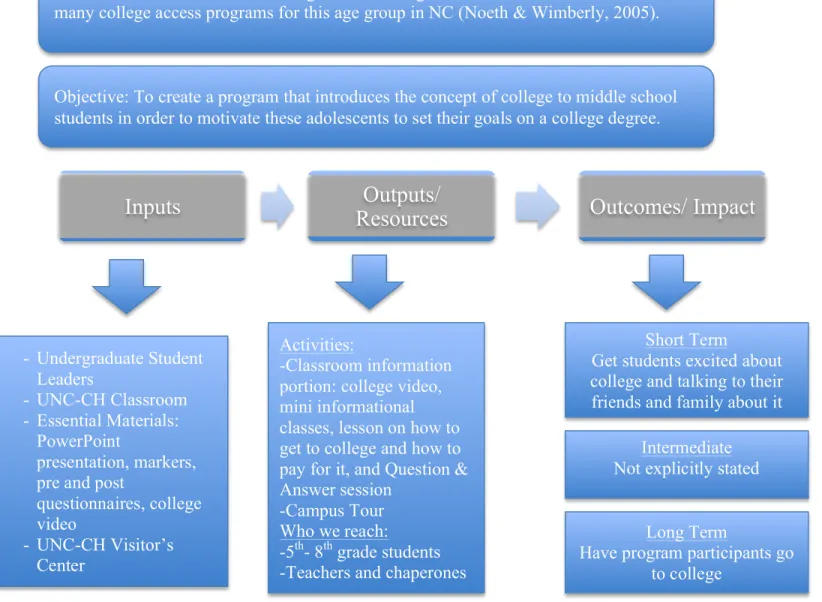
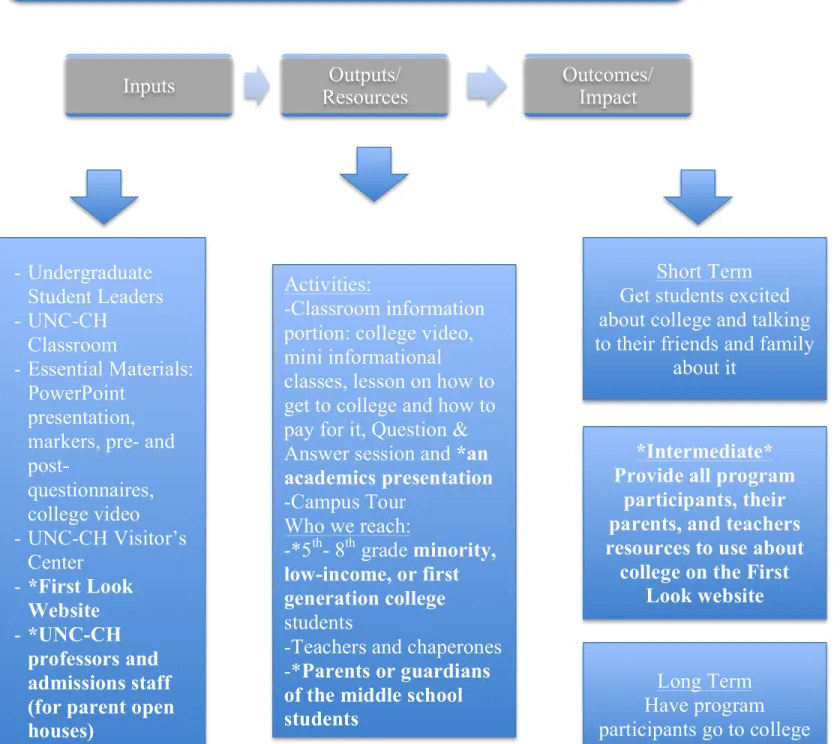
Logic model. A logic model of the current program was created in order to illustrate how the program aims to operate and can be examined on the next page in Figure 3.1. This model aids in the visualization of the main program elements, and can assist in targeting areas where
Figure 3.1 The First Look program logic model
Documents audited. In order to audit the program, this research focused on examining pre-existing documents and data that have already been developed and collected by the First Look Program. Key pieces of information that were reviewed include: a research report on the program, grant proposals, the program wish list, the program description and itinerary, the program application, the program evaluation measures, the website, previously collected
chaperone and teacher evaluations, the program calendar, the power point presentation which is
Inputs
Resources
Outputs/
Outcomes/ Impact
Problem: Research states that college readiness begins in middle school and there are not many college access programs for this age group in NC (Noeth & Wimberly, 2005).
Objective: To create a program that introduces the concept of college to middle school students in order to motivate these adolescents to set their goals on a college degree.
- Undergraduate Student Leaders
- UNC-CH Classroom - Essential Materials:
PowerPoint
presentation, markers, pre and post
questionnaires, college video
- UNC-CH Visitor’s Center
Activities:
-Classroom information portion: college video, mini informational classes, lesson on how to get to college and how to pay for it, and Question & Answer session
-Campus Tour Who we reach:
-5th- 8th grade students -Teachers and chaperones
Short Term
Get students excited about college and talking to their friends and family about it
Intermediate Not explicitly stated
Long Term
shown to the middle school students, and the information concerning the types of schools attending the program throughout the 2011-2012 school year.
Audit analysis. A thorough audit of this data was completed in order to evaluate whether this program executes many of the critical components of college access programming that have been deemed effective by prior scholarly research including: creating a college- going culture or identity, promoting academic rigor, having a parental component, and mastering specific
program components described in the literature review (See Table 2.1). The descriptive program specific information, such as the program power point, the grant proposals, the program
calendar, and other information, was examined in order to determine whether it provided its participants with the key content and information conducive to promoting college access. The program application and the program evaluation measures, specifically the teacher/ chaperone evaluations, were reviewed in order to determine whether they were effective means for selecting schools and for receiving useful feedback on the program. Finally, information about the schools attending the program was attained from the National Center for Education Statistics school lookup database in order to determine whether or not the program has been serving the populations of students that effective college access programming aims to reach.
This audit sought to identify potential areas in need of improvement and suggests modifications for the program in order to help enhance the First Look Program experience and further promote college awareness and access for its middle school participants. This evaluation method and recommendations for the program itself will then derive an effective model of what a one-day college access initiative program should look like for this particular age group. Secondary Data Analysis
A secondary data analysis involves looking at data that has already been collected. It is important to distinguish that the researcher completing the secondary data analysis was not involved in the original data collection. The goal of completing a secondary data analysis is to re-examine or expand upon previous findings or to address new research questions. Secondary data analyses are advantageous to use because they do not require as much time or resources as original data collection which allows the researcher to devote more time to other steps in the research process (Greenhoot & Dowsett, 2012). The secondary data analysis for this study examined questionnaires completed by middle school participants collected by the First Look Program during the 2013-2014 school year. Pre-existing data involved in this research was either publicly available or was provided with permission by the program director Missy Julian-Fox. A description of the available data is described next.
Participants. One hundred and seventy-three eighth grade students from four different middle schools who participated in the First Look program completed pre and post
than white students when examining the school’s overall student population on the National Center for Education Statistics’ website.
To better understand the program participants, information from each school’s profile on the National Center for Education Statistic’s website was utilized (US Department of Education, National Center for Education Statistics, 2011-2012). The alternative school is located in a large city. The racial makeup for the alternative school is 61% black, 15% white, 20% Hispanic, and 4% with two or more races. The school in which the AVID group was from is located in a town inside an urban cluster. The school’s overall racial makeup is 29% black, 42% white, 22% Hispanic, 5% with two or more races, 1% Asian, and less than 1% other. The school that was located in Virginia is in a large city. The racial makeup of this school in Virginia is 60% black, 22% white, 9% Hispanic, 6% with two or more races, and 3% Asian. Lastly, the traditional public school in North Carolina is located in a rural area not far from an urbanized area. It’s racial makeup is 38% black, 35% white 21% Hispanic, 5% with two or more races, 1% Asian, and 1% other.
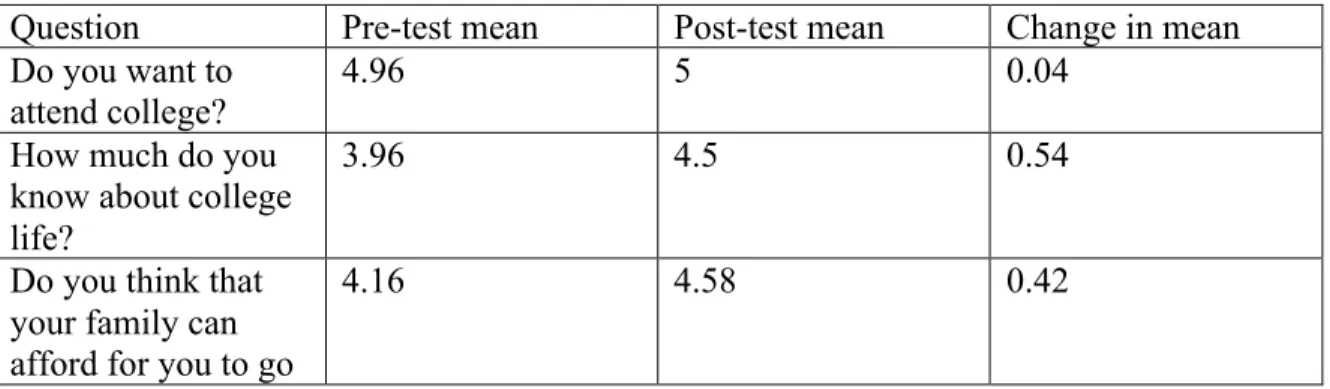
knowledge and disposition about college (question 1 and 2); whereas others assessed the students’ future expectations of college (questions 4 and 5). The question concerning
affordability does not fall under either category (question 3). The students were not asked to put their names on either questionnaire. The use of the pre-post test design was aimed at assessing the impact of the program.
There were a total of 173 pre-tests and 140 post-tests available for secondary analysis. Group A, the alternative school, had 5 pre- and 5 post-tests to examine. Group B, the AVID group, had 54 pre- tests and 44 post-tests. Group C, the school from Virginia, had 25 pre-tests and 24 post-tests. Lastly, group D, the traditional public school group, had 89 pre-tests and 67 postests. The mean values for each answer were calculated, but tests for significance, such as t-tests, cannot be completed due to limitations in data collection. There are no identifiers available for the pre- and post-tests; therefore the pre- and post-tests cannot be grouped together for each individual student. Having no identifiers for the data makes it impossible to determine how each individual student’s answers may have changed individually from before the program to after the program. Therefore, only full group means on pre-post tests can be compared.
significant changes due to the program. Thus, without the significance test, the changes between the mean values are not entirely reliable.
Data collection process. The questionnaires were distributed to the participants two times throughout the First Look Program. The pre-test part was distributed to the students at the very beginning of the program. They were given a marker and asked to complete it right when they walked into the classroom where the first portion of the program was being held. Then, the post- test portion was completed immediately after the undergraduate tour leader finished giving the middle school students their tour of UNC-CH, which is the last activity of the program. Both the pre- and post-tests were collected by the undergraduate tour leaders and returned to the program director.
Data analysis. The information that was accrued by the First Look program through their questionnaire has been analyzed in order to examine certain variables. First, the answers for each of the four schools were examined individually, and then the answers were examined for
overarching trends across all of the school groups. Given that only the means of the answers were provided, the emphasis was placed on examining the changes in means between the pre-test and the post-test. Although participant demographics were not collected, school profiles
provided a proxy to allow some examination of race as a factor in the findings. Further, the unique pre-test question provided data around first generation students for further exploration.
Results and Analysis
Results from the Program Audit
The completion of the program audit assisted in gaining a better understanding of the First Look program as a whole to determine the key components of the program found in the literature that comprise a successful college access program. By delving into the program documents, it identified successful aspects of the program in addition to highlighting areas in need of improvement. The results of the audit are broken down into three main sections: program effectiveness measures, program participants, and effective program components found in
research.
Program effectiveness measures. After looking at how the program evaluates it effectiveness, one of the major findings was that, like many other college access programs, it does not have in place a longitudinal study or long-term evaluation of what the students learned or whether or not they attended college or take additional steps that may allow for college access.
Lastly, the data that has been accrued through this questionnaire is not coded in any way, therefore making it impossible to track individual student progress after participating in the program. It is clear that unlike the current questionnaire used in the program, reliable and valid surveys (e.g., including factor analysis) that code and track relevant demographic or school factors is needed.
In addition to student pre- and post-questionnaires, the program at one point used to collect teacher and chaperone evaluations by sending them paper evaluations through the mail after the school group had participated in First Look (see Appendix F). These types of
longitudinal data are useful, however, there were not any evaluations collected for the 2013-2014 school year. When looking at the evaluations from past years, they indicated that the
free-response portion yielded the most thorough and helpful suggestions, instead of the Likert scale questions, because often times when people would circle low numbers for certain questions they would not give any comments, suggestions, or feedback on how to improve these low numbers.
Program participants. Of the 34 groups to attend the First Look program last school year, 28 were found on the NCES website. Out of the 28 schools attending, 57.1% of the school groups attending came from schools with over 50% white students, thus leaving the other 42.9% of the school groups attending having less than 50% white students. Although the overall racial distribution of the school might not fully represent the racial makeup of the attending school groups themselves, it gives a general idea of the composition of the group.
Effective research-based components. Of the 23 effective components found in research and cited in the literature review (Table 2.1), First Look appears to include 13
were discussed in the literature review, the 23 components have been grouped into those four major themes: 1) creating a college- going culture or identity, 2) promoting academic rigor, 3) having parental involvement component, and 4) mastering specific program components. Within each of the following categories, a description and evidence will be given of how the First Look program did or did not meet a component found in research.
Creating a going culture or identity. As cited in the literature review a college-going culture can be defined “as one in which students find encouragement and help from multiple sources to prepare them with knowledge needed for college success” (McKillip et. al., 2013, p. 530). When examining the First Look program, it met four out of the six research components involving creating a college-going culture or identity.
The components that the First Look program successfully met in this category were: 1) receiving college-going support, 2) the goal of college attendance, 3) a college visit, and 4) college awareness or exposure. The program provides students with college- going support by using multiple different sources of knowledge to help provide them with the information about college that they need for success. These sources, which are discussed in the First Look
information, resources, and experiences on a college campus in order to make them feel like the program supports their desire to attend college.
There is also some evidence to suggest that the program meets the goal of college attendance. The main goal of the program, which was found in multiple sources including: the First Look Overview (2013) and the First Look Grant Proposal (2012), states that the program “is designed to inspire and motivate kids to set their goals on a college degree.” Therefore, the program seeks to meet this goal by introducing students to the concept of college through an informational session about college life in a college classroom and through a tour of a college campus. By participating in the information session and the tour, the program hopes to show the diversity of interests and experiences on a college campus as a way of emphasizing “that college is a possibility for all students” (Perotta, 2013).
Since the program takes place at UNC-CH, the program in itself is a campus visit; however the campus tour further enriches this campus visit. According to the Middle School Tour document, the tour is a 35-minute walking route that shows the students a college lecture hall, a library, the Old Well (a landmark on the UNC-CH Campus), the student union, the football stadium, and many other historical buildings and statues that can be found on campus.
students, these middle school students are able to experience the environment, the food choices, and college social dynamics of the dining hall firsthand (First Look Grant Proposal).
Despite the inclusion of certain elements, the program fails to ensure that the teachers bringing their students to the program have college access knowledge, and the program also fails to emphasize individual students’ cultures. The program does not have any method in place to test teacher knowledge of college access of those teachers who are bringing their students to the program. In addition, there are not any screening or informational questions asked about teachers in the application process. Lastly, there is not any form of follow- up with the teachers after the program to make sure that they are also promoting college access for all of their students once they return to their classrooms.
The program also does very little to emphasize student’s individual cultures. Although undergraduate program leaders might try to present and describe many different aspects of college and college activities, such as various clubs, intramural sports, musical and singing groups, in order to make the middle school students feel like there is something at college for them, the middle school students’ interests, beliefs, and hobbies are not really discussed or brought up throughout the program.
portion of the presentation. During this portion of the presentation, there is one slide that is titled “Push yourself” (Appendix I). It encourages students to figure out what the college entrance requirements are, while also encouraging students to “study hard, turn in all assignments on time, and get good grades”. Besides that PowerPoint slide, academic rigor is not specifically
mentioned at any other point within the program. There is no evidence that the program offers any information on the need for SAT or ACT scores or information related to how to study or training for these tests or any scholarships to its program participants. These findings suggest an overall lack of emphasis in regards to the program participant’s academic affairs.
Parental involvement component. The First Look program does not have a specific parental involvement component for just parents. The only way in which parents are actively involved with the program is by serving as chaperones for the middle school students. It is also important to highlight that no follow-up information is given to the student’s parents after their child has participated in the First Look program. Also, like previously mentioned, the lack of website for the First Look program prevents the program from being able to provide these parents with key resources that could further college access and college awareness.
Given the fact that a small number of parents are actively involved in the program in addition to the fact that no follow-up information is given to the parents after their students participate in the First Look program, the program lacks overall parental college awareness and parental assistance with college forms.
One of the major components of this category is whether or not the program begins by 8th grade. Given that this program is targeted solely at the middle school population, the First Look program does meet this goal. By examining the First Look program schedule for the 2013-2014 school year, the number of groups within each grade level was delineated. During the 2013-2014 school year, there were seven 5th grade groups, one 6th grade group, three 7th grade groups, fourteen 8th grade groups, and nine 6th through 8th grade groups. These findings further illustrate First Look’s commitment to this age group.
Another program specific component emphasizes the program’s involvement with an urban college or university. The First Look program’s involvement with the University of North Carolina at Chapel Hill (UNC-CH) is crucial to the program’s success. Not only because the program is operated by the UNC-CH Visitor’s center, but also because the program utilizes UNC-CH’s campus and UNC-CH students in order to serve as a model of what college looks like for these middle school students.
prepare a 10-minute mini-lesson to teach a small group of middle school students. Then, one of the experienced guides takes the tour guide trainees on a campus tour that highlights all of the key parts of the tour including: a classroom, a library, the student union, the Old Well, the historical landmarks on McKorkle place, and the football stadium. During the second training session, the new guides must share how they plan to make their lesson “engaging and interactive” in addition to having their “tour script committed to memory and ready to deliver” a tour to an experienced guide (M. Julian-Fox, personal communication, January 19, 2014). Lastly, First Look program guides are either UNC-CH Visitor’s Center staff, Carolina Covenant scholars, and North Carolina Teaching Fellows from the UNC-CH school of education, or other undergraduate students. However, other undergraduate students, who are not within one of those organizations, must complete the First Look Guide Application and be selected by the program director, Julian-Fox, before they can participate (Appendix J). Selecting guides from specific, reputable on-campus organizations or through an application process enhances the chances of having well prepared guides.
In addition to having knowledgeable guides, the First Look program expects their
undergraduate program leaders to serve as mentors. Although the extent to which mentorship can be achieved within two-hours is somewhat limited. As the First Look Overview states “the personal student- to- student connection is fundamental.” Therefore, the undergraduate tour guides are encouraged to share their honest advice and experiences about college, while also answering questions during the interactive question and answer session.
does it entail, which is addressed in the classroom portion of the program, and brings it alive by allowing middle school students to tour a college campus and even eat in the dining hall
alongside other college students. The First Look Overview asserts this form of active participation when stating that “students spend their time on campus with college students, talking, learning, and eating with them. They experience the culture of college by what they see, hear, and feel.” (pg.1).
The First Look program also emphasizes the importance of peer groups by dividing the middle school students into groups of their peers and spreading them out among the tour guides. It is within these groups that students hear about a certain aspect of college and they also tour UNC-CH’s campus together. Throughout the program, the middle school students are
encouraged to ask as many questions about college life as they would like to know. Therefore, students within each tour group are able to feed off of and learn from their other peer’s questions and comments.
Lastly, the program alone is free for school groups to attend; however lunch in the dining hall is $8.33 per student. Despite the fee for lunch, the relative costs of the program appear to be positively related to the benefits. The cost of the program is tied into the Visitor Center’s
funding, and according to the First Look Wish List the estimated cost of operations each year was around $23,560. The cost of operations covers a program administrative assistant, the campus classroom rental, the pre- and post-questionnaire printing costs, and participant
wristbands. It is very hard to compare the actual cost of the program to the program’s benefits. However, this program is significant in that it has the potential to benefit many middle school students by exposing them to the aspects of college life in order to inspire them to align
by teaching them leadership skills, confidence to speak in front of groups of middle school students, and offers them the opportunity to learn more about their school.
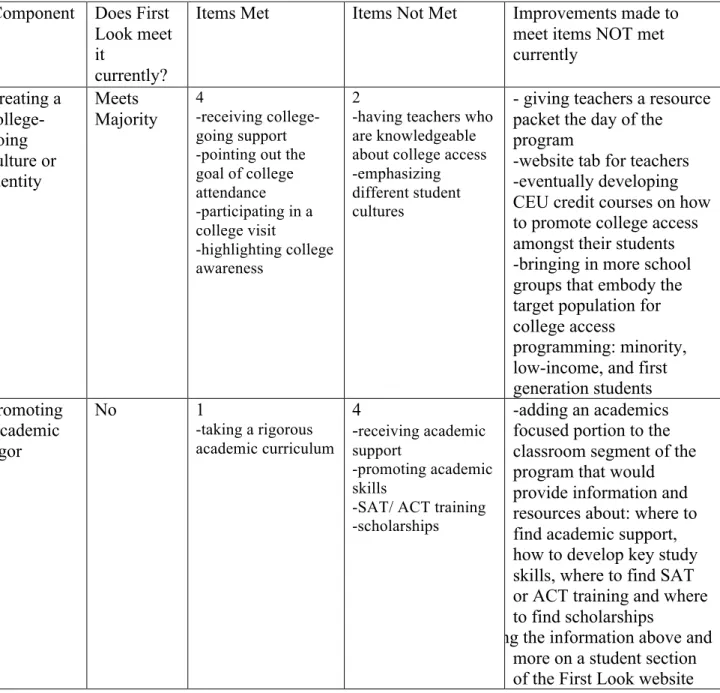
Summary.Based on these findings, the First Look Program meets the majority of the creating a college-going culture or identity components described in the literature, and the program fully meets the program specific components described in the literature. This is
impressive considering that the program is incredibly short term when compared to many college access programs. However, the program does not meet the promoting academic rigor
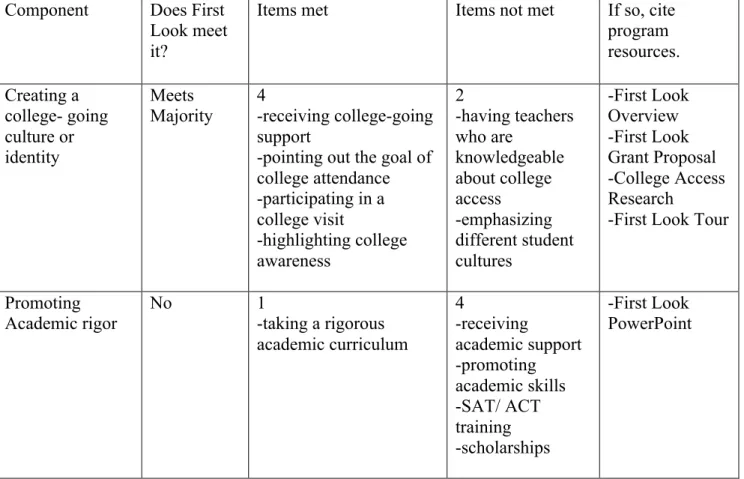
components or the parental involvement components. An overall breakdown of these results can be found below in Table 4.1.
Table 4.1 Research components analysis for First Look Component Does First
Look meet it?
Items met Items not met If so, cite
program resources. Creating a college- going culture or identity Meets Majority 4 -receiving college-going support
-pointing out the goal of college attendance -participating in a college visit -highlighting college awareness 2 -having teachers who are knowledgeable about college access -emphasizing different student cultures -First Look Overview -First Look Grant Proposal -College Access Research
-First Look Tour
Promoting Academic rigor
No 1
Parental Involvement Component
No 0 3
-involving parents -providing
parental college awareness
-assisting families and students with college
applications and financial aid forms
None
Program Specific Components
Yes 7
-starting by 8th grade -placing students in peer groups for tours
-involving a college -having knowledgeable counselors as guides -highlighting co-curricular activities -utilizing guides as mentors
-highlighting cost related to benefits
0 -First Look
Overview -College Access Research Report -First Look Tour Guide
Application -First Look Wish List
Results from Secondary Data Analysis
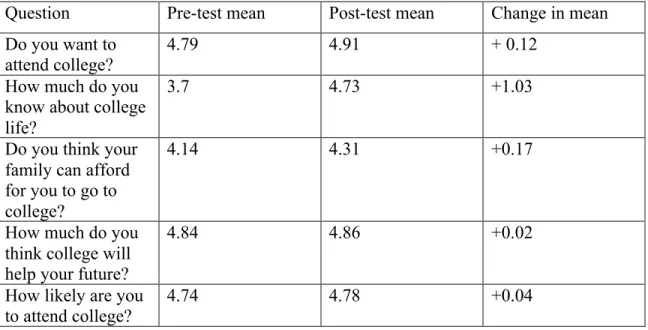
After examining the questionnaires that the First Look Program collected, it appears that the most profound change between the two questionnaires was the perceived knowledge about college. However, the First Look program only calculated the means of the pre- and post- test answers, they did not calculate the statistical significances of the means. Therefore, although the data appears to suggest promise, the significance of this trend cannot be validated. Thus, further investigation would be required in order to assert the real significance of the change.
mean was the students’ perception of their families’ ability to pay for college, which had increased by 0.17 (pre= 4.14, post= 4.31). The means for the remaining questions concerning whether or not the students wanted to attend college, how much they thought college will help their futures, and how likely they are to attend college all increased as well. However, the increases were minimal: 0.12, 0.02, and 0.04 respectively. A complete summary and breakdown of the changes in means between the pre- and the post-test questions can be found below in Table 4.2. While the data available does not allow for significance testing, the change in means provides some optimism for further investigation.
Table 4.2 Overall changes in mean between the pre- and post-test answers Pre-test n=173, post-test n=140
Another important result to emphasize was the total number of first generation college students attending the program. Out of the 173 pre-tests, only 11 students reported that they knew no one in their family who had gone to college. This result indicates that only 6.4% of the participants from these schools were first generation college students. Given that college access
Question Pre-test mean Post-test mean Change in mean Do you want to
attend college?
4.79 4.91 + 0.12
How much do you know about college life?
3.7 4.73 +1.03
Do you think your family can afford for you to go to college?
4.14 4.31 +0.17
How much do you think college will help your future?
4.84 4.86 +0.02
How likely are you
programming is supposed to be aimed at targeting this population, this may have limited the impact of the program.
Trends by school. The most significant trend found when disaggregating data by school was the school group with the largest number of first generation college students, group D, and the school group coming from the school with the largest percentage of minority students, group A, had the largest changes in mean for their answers between the pre- and the post-test.
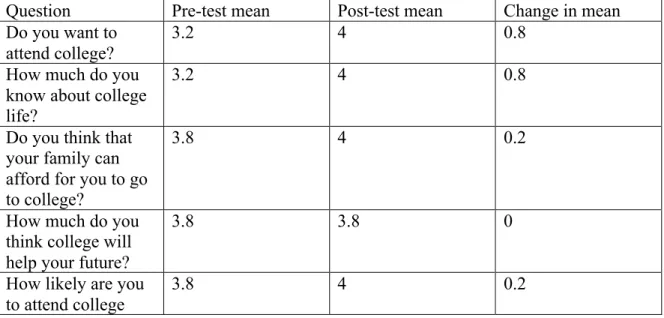
Group D had 7 out of the total 11 first generation college students in their group. This group was tied for the largest change in mean for knowledge about college at 0.8, and they also had some of the largest changes in means for the questions concerning future expectations: how much do you think college will affect your future (0.09) and how likely are you to attend (0.06). A summary of the changes in mean for each question is displayed in Table 4.3
Table 4.3 Changes in mean between pre- and post-test answers for school group D Pre-test n=89, post-test n=67
Question Pre-test mean Post-test mean Change in mean Do you want to
attend college?
4.80 4.92 0.12
How much do you know about college life?
3.62 4.42 0.8
Do you think that your family can afford for you to go to college?
4.12 4.25 0.13
How much do you think college will help your future?
4.83 4.92 0.09
How likely are you to attend college
4.74 4.8 0.06