FACTORS UNDERLYING NATURAL REWARD DEVALUATION BY COCAINE: EFFECTS OF DOSE AND EXERCISE
Jennifer Green Stevenson
A dissertation submitted to the faculty at the University of North Carolina at Chapel Hill in partial fulfillment of the requirements for the degree of Doctor of Philosophy in the Department
of Psychology (Behavioral Neuroscience).
Chapel Hill 2015
ii © 2015
iii ABSTRACT
Jennifer Green Stevenson: Factors underlying natural reward devaluation by cocaine: effects of dose and exercise
(Under the direction of Regina M. Carelli)
iv
vi
ACKNOWLEDGEMENTS
vii PREFACE
viii
TABLE OF CONTENTS
LIST OF FIGURES ...xi
LIST OF ABBREVIATIONS...xii
CHAPTER 1: GENERAL INTRODUCTION...1
Cocaine Addiction: Neurobiological Mechanisms ….…...2
Cocaine Addiction: Craving and Negative Affective State...3
Drug-Induced Devaluation of Natural Rewards...6
Cocaine Dose-Response...7
Environmental Enrichment...9
Goals of the dissertation...11
Specific Aims ...12
CHAPTER 2. EXAMINATION OF COCAINE DOSE IN A PRECLINICAL MODEL OF NATURAL REWARD DEVALUATION BY COCAINE...15
Introduction ...15
Methods...16
Results ...19
Phase 1: Taste Reactivity .……….19
Phase 2: Cocaine Self-Administration………...20
Discussion ...22
ix
Introduction ...24
Methods...27
Data Analysis……….29
Results ...31
Pre-Abstinence………...31
Abstinence………..35
Post-Abstinence……….35
Relationship between Wheel Running, Self-Administration, and Negative Affective State………37
Discussion ...39
Negative Affective State Develops Prior to Drug Abstinence...………40
Why wheel running exposure did not reverse negative affect: Possible explanations...………41
Concluding remarks………...43
CHAPTER 4. EFFECTS OF VOLUNTARY WHEEL RUNNING ON THE DEVELOPMENT OF COCAINE-INDUCED NEGATIVE AFFECT IN A RODENT MODEL………...………...45
Introduction ...45
Methods...47
Results ...50
Wheel Running..………50
Phase 1: Taste Reactivity………...51
Phase 2: Cocaine Self-Administration………...55
Relationship between taste reactivity and motivation to consume cocaine……...56
x
Effects of voluntary wheel running on cocaine seeking and taste reactivity....….60
Why wheel running exposure did not change the motivation to seek cocaine…..62
Concluding remarks………...63
CHAPTER 5. GENERAL DISCUSSION ...65
Summary of experiments ...65
Effects of cocaine dose on preclinical model of natural reward devaluation………65
Effects of voluntary wheel running on an established cocaine-induced negative affective state……….………68
Voluntary wheel running prior to acquisition of our preclinical model of natural reward devaluation……….………69
General Discussion and relevance of findings ...70
Negative Affective State/Withdrawal..………..70
Potential treatment for cocaine addiction………..72
Future Directions ...73
Concluding remarks ...76
xi
LIST OF FIGURES
Figure 2.1 Schematic diagram of task timeline and taste reactivity across doses……….………18
Figure 2.2 Correlations between self-administration behaviors, cocaine dose and aversive taste Reactivity...………...21
Figure 3.1 Experimental Timeline………...28
Figure 3.2 Taste Reactivity Prior to Abstinence...32
Figure 3.3 Cocaine Self Administration Prior to Abstinence...33
Figure 3.4 Motivation to seek cocaine prior to abstinence …………..………...34
Figure 3.5 Wheel Running Activity………...……...34
Figure 3.6 Taste Reactivity Post-Abstinence……….36
Figure 3.7 Relationship between Wheel running and Cocaine Self-Administration and Taste Reactivity..………...……...…………...37
Figure 3.8 Cocaine Self-administration Post-Abstinence………...………...38
Figure 3.9 Motivation to seek Cocaine Post-Abstinence………...………39
Figure 4.1 Experimental Timeline...49
Figure 4.2 Wheel Running Activity...51
Figure 4.3 Appetitive Taste Reactivity...52
Figure 4.4 Appetitive Taste Reactivity as a function of group ...53
Figure 4.5 Aversive Taste Reactivity …...………...54
Figure 4.6 Aversive Taste Reactivity as a function of group...55
Figure 4.7 Cocaine Self-administration across test days………...56
Figure 4.8 Load-up presses across test days...57
Figure 4.9 Load-up presses across test days as a function of group ...58
xii
LIST OF ABBREVIATIONS
ANOVA Analysis of Variance
BLA Basolateral Amygdala
DSM-V Diagnostic Statistical Manual, Fifth Edition
EE Environmental Enrichment/Environmental Condition EMG Electromyography
EX Exercise
Fig Figure FR-1 Fixed ratio 1 IC Isolated Condition INT Inter-press Interval LCD Liquid Crystal Display m/week Meters Per Week NAc Nucleus Accumbens rev/week Revolutions Per Week SC Social Condition SED Sedentary
1 CHAPTER 1
GENERAL INTRODUCTION
Cocaine is one of the oldest known psychoactive addictive drugs (Volkow 2010). According to the Foundation for a Drug Free World, cocaine is the second most traded drug in the world (Foundation For a Drug Free World 2015). Current statistics show that international confiscations of cocaine have increased slightly within the past year (United Nations Office on Drug and Crime 2014), with the largest quantities intercepted in South America, followed by North America. Interestingly the National Survey on Drug Use and Health (2013) reported that cocaine use has declined significantly since cocaine’s height in popularity during the 1980s.
However, since 2008 there are over 600,000 new cocaine users per year that are 12 years and older, which indicates that cocaine continues to be used in the current population.
Cocaine addiction is characterized by cycles of compulsive drug use, abstinence, loss of control over drug intake, and relapse (Koob 2008, Koob and Le Moal 2008, Koob and Volkow 2010) despite adverse consequences (Diagnostic and Statisitcal Manual of Mental Disorders 2013). Research has helped in the understanding of how cocaine produces high hedonic impact (Koob and Le Moal 2002). Hedonic impact or “liking” for sensory pleasures is a critical aspect of reward, and excessive ‘liking’ (i.e. high hedonic impact) of particular rewards such as drugs of
2
way, hedonics contribute to cocaine abuse. Currently there are no effective medications to change the hedonic impact or craving that is placed on cocaine. Although some medications have been considered, either they have shown high abuse potential (Sofuoglu 2010, Amato et al. 2011) or they have not been effective in reducing craving for cocaine (Fox and Sinha 2014). Effective treatments are needed, but developing pharmacological treatments for addiction is difficult because of the underlying neurobiology varies over time as the disease progresses (Lynch et al. 2013). Thus investigators continue to search for the optimal treatment for cocaine
addiction by examining the neurobiological mechanisms that may be involved in the disease. Cocaine Addiction: Neurobiological Mechanisms
3
The NAc is anatomically situated to process reward-related information and influence goal-directed behaviors (Green 2012). The NAc receives limbic information from a variety of cortical and subcortical structures including the basolateral amygdala, prefrontal cortex, and hippocampus (Ghitza et al. 2004, Koob and Volkow 2010). In turn, the NAc sends efferent projections through the ventral pallidum to thalamic, brainstem somatomotor, and autonomic effector sites (Ghitza et al. 2004). Given this anatomy, the NAc has been described as a ‘limbic motor interface’ that integrates information about memory, drive and emotion, and influences
goal-directed behavior (Mogenson et al. 1980). The NAc is comprised of two primary subregions that include the core and shell that have slightly different afferent and efferent projections indicating that they contribute differently to reward related behaviors. For example, the NAc shell receives limbic inputs from the basolateral amygdala (BLA) and ventral subiculum (major output region of the hippocampus) while the NAc core receives similar inputs from the BLA and parahippocampal regions of the hippocampus (Ito and Hayen 2011). Animal research has shown that reinforcing stimuli increase levels of dopamine in the nucleus accumbens, thus increasing the neural activity in that region (Wise 2006, Schultz 1998, Phillips et. al. 2003).
Cocaine blocks dopamine transporters, thus preventing this transmitter from being “recycled” (i.e., taken back up into neurons that release it), and causing excessive amounts of
dopamine in the synapse. It is believed that the excessive amount of dopamine is responsible for cocaine’s euphoric effects (Nestler 2005). Given the increased amount of dopamine in the
synapse, it has been suggested that cocaine’s euphoric effects last longer than the euphoric effects elicited by other reinforcers (i.e. food) (Di Chiara and Bassareo 2007).
4
The dual affect model (Baker et al. 1987) and the elaborated model of desire (Kavanagh et al. 2005) predict that craving for the drug can produce negative and positive affective states. In the dual affect model of craving developed by Baker and colleagues (1987) both negative and positive affective states are associated with drug craving/seeking behavior. Negative affect in addicts can be triggered by cues associated with the drug, by drug withdrawal, and by information that the drug is not available. Positive affect in addicts can be triggered by small doses of the drug, by cues paired with the drug, and by information that the drug is available. Over a history of drug use, addicts typically go through multiple cycles of withdrawal that is alleviated by drug self-administration. These experiences promote learning to take drugs to avoid the aversive aspects associated with withdrawal (Tiffany 1990, Tiffany 2010).
In addition, addicts learn to take drugs to relieve negative mood states associated with everyday life. In fact a study conducted by Robbins and colleagues (2000) illustrated the impact of negative mood state associated with withdrawal on cocaine seeking. These investigators examined negative and positive mood states of cocaine dependent outpatients who served as subjects in their study. Subjects were exposed to non-drug cues (i.e. instructional audiotape) and cocaine cues (i.e. cocaine paraphernalia) in a laboratory setting. Next, the subjects rated their moods before and after the cues were presented. The subjects self-reported mood states did not change with the presentation of the non-drug cues. However, following the presentation of drug cues, their negative mood states increased.
5
dependent subjects versus a demographically matched non-addicted control group. These investigators presented 5 minute images of stressful situations, drug/alcohol related situations, and neutral-relaxing situations and then requested the subjects to rate their craving, anxiety, and emotion. Abstinent cocaine dependent subjects reported significantly higher craving, anxiety, anger, fear, and sadness ratings as compared to controls in response to stressful and drug/alcohol related situations. This finding suggest that abstinent cocaine dependent individuals are more susceptible to negative emotions and cocaine craving following both stress and cocaine cue presentations.
6
findings highlight the importance of investigating factors controlling natural reward devaluation and the emergence of negative affective states in addiction.
Drug-Induced Devaluation of Natural Rewards
An animal model was developed in the Carelli laboratory to study natural reward devaluation by cocaine and the associated emergence of negative affective states in rats (Wheeler et. al. 2008, Wheeler et. al. 2011). This model is based on the finding that rats exhibit stereotyped oromotor responses to palatable and unpalatable taste stimuli when these stimuli are
infused directly into the oral cavity. The oromotor responses correspond to the hedonic valence
of the taste stimuli. Importantly, these oral facial responses, termed taste reactivity, reflect not
only innate taste preferences but also conditioned changes in affect (Grill and Norgren 1978,
Wheeler et. al. 2008). Rats exhibit appetitive taste reactivity (i.e., licks, lateral tongue
protrusions) during infusion of a sweet tastant such as saccharin, and aversive taste reactivity
during intraoral infusion of a bitter tastant, such as quinine. In an initial study using this approach
(Wheeler et. al. 2008), a sweet taste cue (saccharin) was intraorally delivered in discrete intervals
(i.e., 30, 3.5 s infusions, given every minute across 30 minutes). Immediately after the tastant
infusion phase, a lever was inserted in the chamber and animals could press the lever to obtain an
intravenous infusion of cocaine (i.e. during a 2 hr self-administration phase). Thus, the discrete
taste cue signaled impending but delayed cocaine availability. Wheeler et al (2008) hypothesized
that this ‘‘drug waiting’’ period during the infusion of the tastant allowed a strong association to
develop between the taste and delayed drug, and enabled the emergence and expression of a negative affective state as measured by taste reactivity.
7
of the anterior digastric muscle, a jaw muscle coupled to licking (Roitman et al. 2005, Roitman et al. 2010). They showed that rats initially exhibit appetitive taste reactivity during intraoral infusion of the sweet tastant. However, repeated pairing of a sweet tastant with delayed administration of cocaine results in an aversive state that is reflected in behavior. That is, animals exhibit aversive taste reactivity to the sweet which corresponds to aversive movements (gapes) evident in EMG recordings. Critically, this negative affective state increases motivation to consume cocaine. Specifically, aversive taste reactivity (gapes) was significantly correlated with cocaine loading responses (presses during the first 5 min of the session) and latency to the first press during self-administration. Rats that exhibited the most gapes showed the greatest number of load up responses and the fastest latency to initiate responding for cocaine once self-administration was available. Importantly, this aversive state was reflected in a shift in the activity of distinct populations of neurons and dopamine release events in the NAc, a brain region important for processing reward related information (Wheeler et. al. 2011, Wheeler et. al. 2008). Collectively, these findings suggest that conditioned taste cues elicit a cocaine-need state that is aversive, is encoded by a distinct subset of NAc cells and rapid dopamine signaling, and promotes cocaine seeking, even following 1 month abstinence from the drug (Carelli and West 2014).
Cocaine Dose-Response
8
inverse relationship between response rate and magnitude of cocaine reinforcement (dose per infusion) (Pickens and Thompson, 1968a, Woods and Schuster, 1968). Decreasing the dose of cocaine increases the amount of operant responding for the drug.
Drug self-administration procedures typically involve a single unit dose of a drug infused through a catheter line contingent upon the subject performing an operant response (i.e., lever press). Increasing the concentration of the drug alters behavioral responding and is often described by an ascending dose response curve (Zimmer et. al. 2011). When given a choice, animals have shown that higher doses, to a point, are typically preferred (Lynch et al. 1998, Ward et al. 2005, Zimmer et al. 2011) over lower doses.
9
session produces a dose response curve that is similar to that seen in rats given multiple doses across sessions over days (Martin et al. 1996, Emmett-Oglesby et. al. 1993).
Environmental Enrichment
An important research area with clinical relevance focuses on the effects of environmental enrichment (EE) as a means to prevent continued drug use. EE in rodents involves exposure of animals to surrounding stimuli (i.e. toys, access to a running wheel, social interaction, and larger spaces) used to enhance sensory, cognitive, and motor behaviors (Grimm et al. 2008, Solinas et al. 2008). EE has been shown to reduce the reinforcing effects of psychostimulants such as amphetamines and cocaine (Bardo et al. 2001, Chauvet et al. 2009, Solinas et al. 2009, Puhl et al. 2012). In addition, investigators have suggested that EE influences brain development by way of neuroanatomical and neurochemical changes in the reward circuit (Stairs and Bardo 2009, Puhl et al. 2012). For instance, Solinas and colleagues (2009) reported that mice reared in an EE exhibited lower levels of the early immediate gene zif-268 expression in the NAc. Given this evidence, investigators have hypothesized that exposure to EE promotes brain development in animals that may prevent drug abuse vulnerability.
10
rats as compared to the IC rats earned fewer infusions at the 0.006mg/kg, and 0.02mg/kg doses under fixed ratio-1 and progressive ratio schedules of reinforcement, respectively. At the other doses there were no significant differences in behavioral responding between the groups. Further, Gipson et. al. (2011) examined if EE exposure during development would protect against escalation (i.e. increase in drug intake across a 6h session) of cocaine self-administration at two doses (0.1 and 0.5 mg/kg/infusion). They reported EE prevented the escalation of cocaine self-administration only at the lower dose. These findings suggest an enriched environment may have protective effects, but only at lower doses of psychostimulants.
11
enriched environment. These results indicate enrichment is helpful in attenuating reinstatement, but this effect may be brief with no extended benefit over time.
Results from these studies indicate that environmental enrichment can provide protection against repeated drug use, drug sensitization, and reinstatement. Nevertheless, more research is needed to discover at which point EE might be most effective. In particular, there is very little known about whether EE might alter other aspects of reward, such as the devaluation of natural rewards. Devaluation of natural rewards appears to be a consequence of delayed access to drug administration (Grigson et. al. 2002, Wheeler et al. 2008, Wheeler et al. 2011, Puhl et al. 2012). Puhl et. al. ( 2012) reported that EE exposure during adulthood reduced the incentive value for cocaine, but was unable to prevent the devaluation of a natural reward that predicted cocaine self-administration. There could be a number of factors why devaluation of a natural reward continued to occur. In the Puhl studies, rats were exposed to EE during adulthood. Perhaps, EE would have been more effective if exposure took place during childhood or adolescence. Also, Puhl et al (2012) only examined one dose of cocaine, 0.167mg/kg/infusion, perhaps the effect would be seen at other doses or with other types of enrichment (i.e. exposure only to a running wheel instead of only to novel objects).
Goals of the Dissertation
12
influence this process. Aim 1 of this dissertation will examine if the development of the negative affective state and motivation to consume the drug in this preclinical model is cocaine dose-dependent. Additional studies will manipulate aspects of the rats’ environment (specifically by providing access to a running wheel in their home cages), either following (Aim 2) or prior to (Aim 3) taste-drug pairings to determine if exercise alters, or attenuates, the development of the negative affective state and motivation to consume the drug that normally occurs in this model. Each of these factors is considered in more detail below.
Specific Aims
Aim 1. To examine the effects of cocaine dose on natural reward devaluation by cocaine. In the
Carelli laboratory, an animal model was developed to study natural reward devaluation by cocaine and the associated emergence of negative affective states in rats (Wheeler et. al. 2011; Wheeler et. al. 2009; Wheeler et. al. 2008). In this model a sweet taste cue (saccharin) is intraorally delivered in discrete intervals (i.e., 30, 3.5 s infusions) every minute across a 30
minute period. Immediately after the tastant infusion phase, a lever is inserted in the chamber
and animals can press it for intravenous cocaine (i.e. during a 2 h self-administration phase).
Normally, rats exhibit appetitive taste reactivity (i.e., licks) during intraoral infusion of a sweet
tastant such as saccharin, and aversive taste reactivity (i.e., gapes) during intraoral infusion of a
bitter tastant such as quinine. As expected, in our model, rats elicit appetitive taste reactivity on
13
only one unit dose of cocaine (0.33mg/inf, or approximately 1 mg/kg) was examined. Given the differences in behavioral responding for intravenous cocaine that normally occurs across dose (Carelli and Deadwyler 1996), the objective of the present aim is to determine if the development of the negative affective state (gapes) in our model systematically varies as a function of cocaine dose during the self-administration phase. I predict that the development of aversive taste reactivity in our model will be dose-dependent. That is, I hypothesize that rats will elicit the least aversive responses to the saccharin tastant paired with the lowest cocaine dose and the greatest aversive responses to the saccharin tastant paired with the highest cocaine dose during the self-administration phase.
14
In aim 2, I will examine if access to a running wheel in the rats’ home cage following repeated saccharin-cocaine pairings can reverse or attenuate the negative affective state (and increased motivation for drug) established in the preclinical model.
Aim 3. To examine if voluntary wheel running in the animals’ home cage prior to taste-drug
15 CHAPTER 2
EXAMINATION OF COCAINE DOSE IN A PRECLINICAL MODEL OF NATURAL REWARD DEVALUATION BY COCAINE
Introduction
Cocaine addiction is characterized by cycles of drug use, abstinence, and resumption of drug taking (relapse). Embedded in the addiction cycle is the development of negative affective states (i.e. dysphoria, irritability, anhedonia) as well as the devaluation of natural rewards (Koob et al. 1998, Koob and Volkow 2010). During prolonged drug abstinence, cocaine addicts typically report increased feelings of negative affect, particularly when exposed to drug cues. This aversive condition often leads to craving and relapse, with the later believed to ‘correct’ for this negative emotional state (Risinger et al. 2005, Grigson 2008, Koob and Volkow 2010, Nyland and Grigson 2013).
16
(Grill and Norgren 1978, Wheeler et al. 2008). Rats exhibit appetitive taste reactivity (i.e., licks, lateral tongue protrusion) during intraoral infusion of a sweet such as saccharin and aversive taste reactivity (i.e., gapes) during infusion of a bitter tastant (e.g., quinine). In this model, the sweet (saccharin) is intraorally delivered in discrete 3.5s intervals (once a minute over 45min, phase 1) and is immediately followed by access to cocaine self-administration for 2h (phase 2). We showed that the initially palatable saccharin solution became unpalatable as the tastant became associated with impending, but delayed, opportunity to self-administer cocaine. It was hypothesized that this ‘‘drug waiting’’ period, when the tastant was infused, allowed for a
strong association to develop between the taste and delayed drug access, and enabled the emergence and expression of a negative affective state as measured by taste reactivity (Wheeler et al. 2008, Wheeler et al. 2011, Carelli and West 2014). Further, rats that exhibited the most aversive responses in phase 1 were the most motivated to consume cocaine in phase 2 once it was available. Thus, this negative affective state that is reflected by aversive taste activity in phase 1 appears to be ‘corrected’ by cocaine consumption during self-administration in phase 2.
Here, we build upon that work and examine the negative affective state and increased motivation to consume cocaine as a function of cocaine dose during self-administration. We hypothesize that the negative affective state that develops in this model is cocaine dose-dependent (i.e., the number of aversive gapes will increase with increasing dose of drug).
Methods
17
water access (30 ml/day). Food was available ad libitum. Animal procedures were conducted in accordance with the National Institutes of Health Guidelines for the Care and Use of Laboratory Animals (2011), and were approved by the University of North Carolina at Chapel Hill Institutional Animal Care and Use Committee (IACUC).
Surgeries: Rats were anesthetized with a ketamine hydrochloride (100mg/kg) and xylazine (20mg/kg) mixture and surgically implanted with intra-oral cannulae and an intravenous catheter in a single surgery, as described previously (Roitman et al. 2008, Wheeler et al. 2008). Intravenous catheters for self-administration were purchased from a commercial source (Access Technologies, Skokie, IL) and inserted into the jugular vein using established procedures (Carelli and Deadwyler 1996, Wheeler et al. 2008).
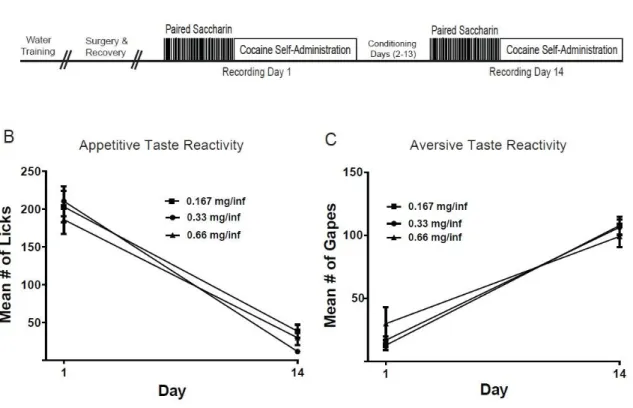
Experimental Design: Training and test sessions were conducted in a Plexiglas chamber (Med Associates, Inc., St Albans, VT) housed within a commercial sound-attenuated cubicle. Figure 2.1A shows the experimental design. Initially, mildly water-deprived (30ml/day) rats were trained to press a lever for water; they underwent surgical procedures as described above. One week later, rats received 14 daily conditioning sessions during which the behavioral task was conducted in two phases/day: 1) intra-oral tastant infusions and 2) cocaine self-administration. In phase 1, rats received discrete intraoral saccharin infusions, delivered in 3.5s
intervals (0.15% saccharin solution, 200 µl/infusion). A total of 45 tastant infusions (trials; 1
18
(67db, 1 kHz) and house light (25W) stimulus. Lever presses during the 20s post response period had no programmed consequences. Three doses of cocaine were examined (0.16, 0.33 and 0.66 mg/inf) in a between-subjects design. The same flavor of 0.15% saccharin was used in phase 1 across all three cocaine doses (groups). Cocaine hydrochloride was obtained from the National Institute on Drug Abuse.
Figure 2.1. Schematic diagram of task timeline and taste reactivity across doses. (A) Schematic diagram of task. See text for details on task procedure. Mean number of licks (B) and gapes (C) during saccharin infusions (phase 1) on the first and last days of the taste-drug pairings as a function of cocaine dose. Note that the animals exhibited a significant decline in appetitive taste reactivity and a significant increase in aversive taste reactivity across days that were not cocaine dose-dependent.
19
6s following infusion onset that matched a “triangle” shape for a duration exceeding 90ms were counted as aversive. Instances in which the tongue protruded and crossed the midline were counted as appetitive.
Cocaine Self-Administration: Cocaine self-administration was examined across training days. On the last day of training (day 14), the average number of lever presses, latency to the first lever press, and average number of cocaine load-up presses were examined across cocaine doses using separate one-way ANOVAs. Load-up behavior was defined as rapid lever pressing in the beginning of the session in which the average inter-press interval (INT) during load-up was less than half the average INT during the remainder of the session.
Data Analysis: Changes in the total number of lever presses during self-administration across the 14 days of training were examined as a function of cocaine dose using a 2-way mixed design ANOVA. Changes in the average number of licks (appetitive taste reactivity) and average number of gapes (aversive taste reactivity) were compared on day 1 versus day 14 as a function of dose using separate 2-way mixed design ANOVAs. Pearson product correlation coefficients examined relationships between aversive taste reactivity on day 14 to the: 1) total number of load-up presses, 2) total number of lever presses, and 3) latency to the first lever press during self-administration. Statistical analyses of all behavioral data were performed using commercially available software (Statstica, Tulsa, OK).
Results
Phase 1: Taste Reactivity
20
indicate that appetitive taste reactivity was lower on day 14 compared to day 1 across all rats independent of cocaine dose (Figure 2.1B). A two-way mixed design ANOVA on aversive taste reactivity revealed a significant main effect of day (F1,21=135.42, p<0.001), but no significant main effect of dose (F2,21=1.901, p>0.05) and no significant day X dose interaction (F2,21=0.0682, p>0.05). The results indicate that aversive taste reactivity increased for all rats across training days (on day 14 compared to day 1), independent of cocaine dose (Figure 2.1C).
Phase 2: Cocaine self-administration
All rats acquired self-administration across the 14 training days. A two-way mixed design ANOVA on cocaine self-administration revealed a significant main effect of day (F13,20=2.6202, p<0.01), and main effect of dose (F2,20=48.2084, p<0.001) but no significant dose X day interaction (F26,260=1.00, p>0.05). Next, we examined aspects of self-administration behavior on day 14 across the three cocaine doses. First, we determined if the total number of lever presses during the self-administration phase varied as a function of cocaine dose. A one-way ANOVA revealed a significant main effect of cocaine dose (F2,21= 21.6180 p<0.05) on lever pressing for cocaine. Post hoc tukey tests revealed that rats pressed the lever significantly less as the dose of cocaine increased (Figure 2.2A). Second, a one-way ANOVA revealed a non-significant trend toward a decrease in latency to the first press as a function of cocaine dose (F2,21= 1.50, p > 0.05, Figure 2.2B). Finally, a one-way ANOVA revealed a significant main effect of cocaine dose (F2,21 = 8.287, p<0.05) on load-up behavior (Figure 2.2C). Post hoc tukey tests revealed that as cocaine dose increased, the number of load-up presses decreased.
21
finding is cocaine dose-dependent, Pearson correlation coefficients were conducted. The results revealed that the number of load-up presses was correlated with the number of aversive responses (gapes) when all doses were combined (r2=0.55, p<0.05, Figure 2.2D) and for each individual cocaine dose (0.167 mg/inf: r2=0.88, p<0.05; 0.33 mg/inf: r2= 0.91, p<0.05; 0.66 mg/inf: r2= 0.63, p<0.05). There were no significant correlations between aversive responses and mean number of lever presses (all doses combined, r2=0.07, p>0.05; 0.167 mg/inf r2=0.11; 0.33 mg/inf r2=0.028; 0.66 mg/inf r2=0.0006), or latency to first press (all doses combined r2=0.10, p>0.05; 0.167 mg/inf r2=0.12; 0.33 mg/inf r2=0.000035; 0.66 mg/inf r2=0.31).
22
number of load-up presses (C) as a function of cocaine dose on day 14. (D) Mean number of load-up presses is significantly correlated with aversive taste reactivity (gapes) across all cocaine doses (r2 = 0.74) and for all individual doses (see text for details). *p< 0.05 compared to 0.167mg/inf; **p< 0.05 compared to 0.167 and 0.33mg/inf.
Discussion
The main objective of the present study was to determine if the negative affective state that develops in the preclinical model of natural reward devaluation by cocaine is dose-dependent. The current findings replicate earlier work by showing that rats exhibited a shift from appetitive to aversive taste reactivity as the tastant came to predict impending but delayed cocaine availability (Wheeler et al. 2008, Wheeler and Carelli 2009, Wheeler et al. 2011). Here, we extend those findings and show that once this aversive state develops (day 14), it does not vary as a function of cocaine dose during the self-administration phase, consistent with Cason and Grigson (2013).
self-23
administration phase in phase 2 (i.e., load-up behavior) reflects the animals attempt to achieve an optimal level of drug in their system to overcome the aversive state that develops in phase 1. Indeed, prior studies have shown that the rate of self-administration responding is linked to achievement and maintenance of an optimal level of drug (Pettit and Justice 1989, Pettit and Justice 1991), perhaps reflective of a hedonic set point (Koob and Caine 1999, Koob and Volkow 2010). Although the emergence of negative affect in this preclinical model is not cocaine dose-dependent, the present findings also show that load-up behavior may reflect a correction of this aversive state that is observed across cocaine dose.
24 CHAPTER 3
EFFECTS OF VOLUNTARY WHEEL RUNNING ON AN ESTABLISHED COCAINE-INDUCED NEGATIVE AFFECTIVE STATE IN A RODENT MODEL
Introduction
Cocaine addiction is characterized by cycles of drug use, abstinence, and resumption of drug taking (relapse). Embedded in the addiction cycle is the development of negative affective states (i.e. dysphoria, irritability, anhedonia) as well as the devaluation of natural rewards (Koob et al. 1998; Koob and Volkow 2010). During prolonged drug abstinence, cocaine addicts typically report increased feelings of negative affect, particularly when exposed to drug cues. This aversive condition often leads to craving and relapse, with the later believed to ‘correct’ for this negative emotional state (Risinger et al. 2005; Grigson 2008; Koob and Volkow 2010; Nyland and Grigson 2013).
25
licks, lateral tongue protrusion) during infusion of a sweet tastant such as saccharin and aversive taste reactivity (i.e., gapes) during intraoral infusion of a bitter tastant, such as quinine. In the initial study by the Carelli laboratory using this approach (Wheeler et al. 2008), a sweet taste cue (saccharin) was intraorally delivered in discrete intervals (i.e., 30, 3.5 s infusions, given every minute across 30 minutes). Immediately after the tastant infusion phase, a lever was inserted in the chamber and animals could press it for intravenous cocaine (i.e. during a 2 hr self-administration phase). Thus, the discrete taste cue signaled impending but delayed cocaine availability. The Carelli laboratory hypothesized that this ‘‘drug waiting’’ period when the tastant was infused allowed for a strong association to develop between the taste and delayed drug, and enabled the emergence and expression of a negative affective state as measured by taste reactivity.
An important research area with clinical relevance focuses on the effects of physical activity, specifically exercise, as a means to prevent continued drug use (Greenwood et al. 2011, Lynch et al. 2013). Exercise has been shown to reduce the reinforcing effects of psychostimulants such as amphetamines and cocaine (Smith et al. 2008, Smith and Lynch 2011, Lynch et al. 2013). For instance, Smith et. al. (2011), reported that rats with access to a running wheel for 6 weeks self-administered significantly less cocaine and showed less escalation of cocaine intake over time as compared to sedentary rats. There are similar reports of an attenuation of methamphetamine (Engelmann et al. 2014) and alcohol consumption (Hammer et al. 2010, Brager and Hammer 2012) in rats that had access to a running wheel for an extended period.
26
2010, Sanchez et al. 2013, Peterson et al. 2014, Peterson et al. 2014). For instance, Lynch et. al. (2010) using a reinstatement model, examined if 2h/day access to a running wheel during a 14 day abstinence period would reduce cocaine seeking in Sprague-Dawley rats. The authors reported that aerobic exercise signficantly reduced lever presses during extinction and reduced cocaine seeking in response to cocaine-associated cues. Similar results were reported for the effects of voluntary wheel running on nicotine seeking (Sanchez et al. 2013). Furthermore, Peterson et. al. (2014) reported that even though 2h/day access to a running wheel was effective in reducing cocaine seeking, 6h/day and 24h/day access during abstinence almost abolished subsequent cocaine seeking in male Sprague Dawley rats. This suggests that exercise not only has the potential to reduce drug seeking, it appears to do so in an access-dependent manner (i.e., the more access to the running wheel the higher attenuation in drug seeking). Further, Thanos and colleagues examined long-term (6 weeks) forced exercise (placed on treadmill for 1 or 2h daily) in rats on cocaine cue-induced reinstatement and sensitization (Thanos et al. 2013). The authors reported that rats exposed to forced exercise exhibited a significant reduction in cue-induced reinstatement and behavioral sensitization. These findings indicate that exercise, voluntary or forced, reduces the reinforcing effects of cocaine and may be protective against drug addiction.
27
taste reactivity and less motivation to seek cocaine. These findings would indicate that exercise can reverse or attenuate the negative affective state that develops in our preclinical model.
Methods
Subjects: Male, Sprague-Dawley rats (Harlan), aged 90-120 days and weighing approximately 300-375 grams were used (n=18). Animals were housed individually in standard polycarbonate cages (19 x 10.5 x 8 in) and maintained on a 12:12h light-dark cycle (lights on at 7:00 a.m.). During training and testing, animals were restricted to no less than 85% of their preoperative body weight by limiting water access (30 ml/day). Food was available ad libitum. Animal procedures were conducted in accordance with the National Institutes of Health Guidelines for the Care and Use of Laboratory Animals (2011), and were approved by the University of North Carolina at Chapel Hill Institutional Animal Care and Use Committee (IACUC).
Surgeries: Rats were anesthetized with a ketamine hydrochloride (100mg/kg) and xylazine (20mg/kg) mixture and surgically implanted with intra-oral cannulae and an intravenous catheter in a single surgery, as described previously (Roitman et al. 2008, Wheeler et al. 2008). Intravenous catheters for self-administration were purchased from a commercial source (Access Technologies, Skokie, IL) and inserted into the jugular vein using established procedures (Carelli and Deadwyler 1996, Wheeler et al. 2008).
28
week later, rats received 14 daily conditioning sessions during which the behavioral task was conducted in two phases/day: 1) intra-oral tastant infusions and 2) cocaine self-administration. In phase 1, rats received discrete intraoral saccharin infusions, delivered in 3.5s intervals (0.15% saccharin solution, 200 µl/infusion). A total of 45 tastant infusions (trials; 1 trial/min) were
Figure 3.1. Experimental Timeline. Schematic diagram of task. See text for details on task procedure.
29
rats were placed back in the experimental chamber for a single test session. The test session was conducted in two phases as described above: 1) intra-oral tastant infusions (45, 3.5 s infusions per minute; over 45 mins) and 2) cocaine (0.33 mg/inf) self-administration (2 hrs). Taste reactivity was recorded: 1) on the first (day 1) and last (day 14) training days before the 7 week abstinence period and 2) during the one test session after abstinence. Self-administration behavior was recorded before, and if catheters remained patent, following the 7 week abstinence period. Wheel revolutions were recorded daily by the experimenter from a LCD counter (placed on the side of each wheel). Cocaine hydrochloride was obtained from the National Institute on Drug Abuse.
Data Analysis:
Taste Reactivity: Taste reactivity was analyzed in a frame by frame analysis using digital video recordings. Appetitive and aversive taste reactivity were counted using the procedure developed by Grill and Norgren (1978). Briefly, mouth movements expressed in the 6s following infusion onset that matched a “triangle” shape for a duration exceeding 90 ms were counted as
30
Cocaine Self-Administration: Behavioral measures of cocaine self-administration included the average number of lever presses, latency to the first lever press, and average number of cocaine load-up presses. Load-up behavior was defined as rapid lever pressing in the beginning of the session in which the average inter-press interval (INT) during load-up was less than half the average INT during the remainder of the session. Cocaine self-administration was examined during the two week training period prior to abstinence as follows. Changes in the total number of lever presses during self-administration across the 14 days of training were examined across all animals using a one-way repeated measures ANOVA. On the last day of training (day 14), Pearson product correlation coefficients were calculated to examine relationships between aversive taste reactivity and number of load-up presses across all animals, as well as those destined for the EX or SED groups.
Cocaine self-administration was examined during the test session conducted immediately after the 7 week abstinence period as follows. First, we compared between groups using unpaired t-tests the mean number of lever presses and load-up presses on the test session following abstinence. Pearson product correlation coefficients examined relationships across groups between aversive taste reactivity during the test session following abstinence to # load-up presses.
31
Statistical analyses of all behavioral data were performed using commercially available software (Statstica, Tulsa, OK and GraphPad Prism, La Jolla, CA).
Results
Pre-Abstinence
Phase 1: Taste Reactivity
32
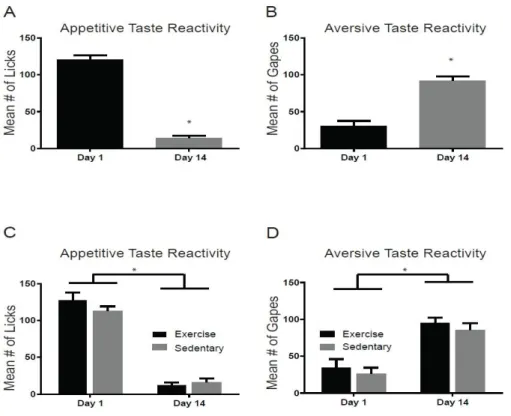
Figure 3.2. Taste Reactivity Prior to Abstinence. Development of negative affective state prior to abstinence. Mean number of licks (A) and gapes (B) during saccharin infusions (phase 1) on the first and last days of the taste-drug pairings prior to abstinence across all rats. Mean number of licks (C) and gapes (D) separated by impending group assignment (Exercise vs Sedentary), prior to abstinence. * p < 0.05.
Phase 2: Cocaine self-administration
33
Figure 3.3. Cocaine Self Administration Prior to Abstinence. Total number of lever presses for intravenous cocaine (0.33 mg/inf) during cocaine self-administration phase across training. * p < 0.05 for day 1 compared to days 5, 7, 8, 9, 10, 12, 13, and 14. + p < 0.05 for day 2 compared to days 8, 10, and 14.
Next, we examined aspects of self-administration behavior on day 14 (last day before abstinence). First, we determined if the total number of lever presses during the self-administration phase varied as a function of impending group assignment. A t-test revealed no significant effect of group (t16= 1.87 p>0.05) on lever pressing for cocaine (data not shown). Likewise, no significant difference in latency to the first press as a function of group was observed (t16= 1.04, p>0.05; data not shown). Finally, a t-test revealed no significant main effect of group (t16 = 1.30, p>0.05) on load-up behavior (data not shown). These findings indicate that there were no pre-existing differences in self-administration behavior on day 14 between rats that were then divided into EX and SED groups.
34
coefficients were conducted here to determine if animals in the present study showed similar motivation to seek cocaine following 14 days of training in our preclinical model. The results revealed that the total number of load-up presses was significantly (positively) correlated with the number of aversive responses (gapes) across all rats (r2=0.431, p<0.01, Figure 3.4A). That is, rats that exhibited the most gapes on Day 14, showed the largest number of load-up responses indicating higher motivation for the drug once the lever was available. Further, this relationship held before abstinence for animals destined for the EX (r2=0.774, p<0.01, Figure 3.4B) or SED (r2= 0.692, p<0.01, Figure 3.4C) groups.
35 Abstinence: Wheel Running
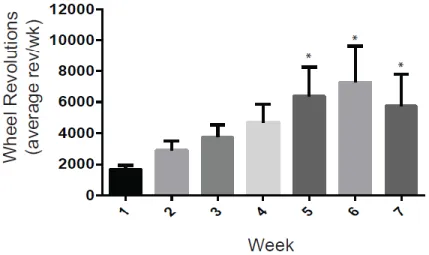
Wheel running steadily increased from week 1 through week 7 for the EX group (Figure 3.5). A one-way ANOVA revealed a significant main effect of wheel running across the 7 week period (F6,8= 13.81, p<0.0001). Post-hoc Tukey test revealed that average wheel running for weeks 5, 6 and 7 were significantly higher than wheel running during week 1 (p <0.05). During the 7th week abstinence period, rats with exposure to the running wheel (EX) ran an average of 5,734 rev/week (6,305 meters/week), with a range across rats from 991 rev/week (1,090 m/week) to 19,957 rev/week (21,946 m/week).
Figure 3.5. Wheel Running Activity. Wheel running across 7 weeks of abstinence. Average number of wheel revolutions per week significantly increased during weeks 5, 6 and 7, compared to week 1. *p < 0.05.
Post-Abstinence
Taste Reactivity
36
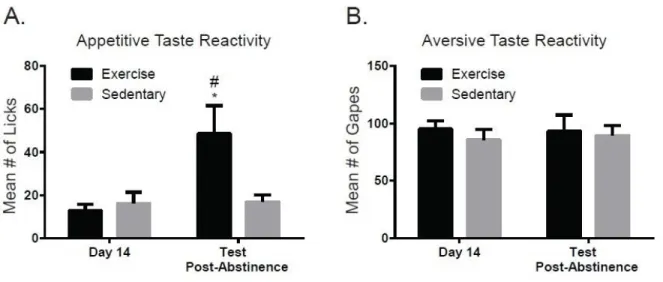
groups. A two-way mixed design ANOVA on appetitive taste reactivity across groups revealed a significant main effect of day (F1,16= 7.97, p<0.05), no significant main effect of group (F1,16= 2.79, p>0.05), but a significant day X group interaction (F1,16= 7.31, p<0.05). A post-hoc Tukey test revealed that appetitive taste reactivity for the EX group on the test day following abstinence was higher than SED on the same test day post-abstinence as well as EX and SED on day 14 prior to abstinence (Figure 3.6A). These findings indicate that a significant increase in appetitive taste reactivity at test in animals with access to a running wheel during abstinence. However, a two-way mixed design ANOVA on aversive taste reactivity revealed no significant main effect of day (F1,16=0.02, p>0.05), no significant main effect of group (F1,16=0.39, p>0.05), and no significant day X group interaction (F1,16=0.38, p>0.05), (Figure 3.6B). The results indicate that aversive taste reactivity did not decrease following abstinence for the EX group, inconsistent with a potential reversal of the negative affective state by exercise.
37
Relationship between Wheel Running, Self-Administration, and Negative Affective State
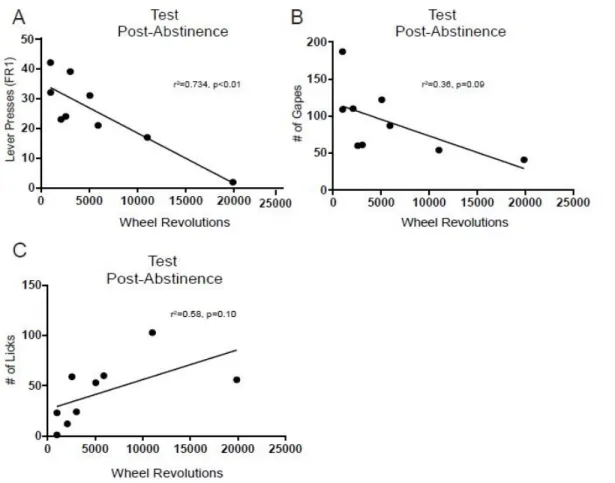
Prior studies show that exercise reduces the reinforcing effects of cocaine (Smith et. al. 2008, Smith et. al. 2011, Lynch et. al 2010, and Smith and Lynch 2012). Specifically, animals that exhibited the least cocaine seeking behavior, showed the most wheel running. Pearson correlation coefficients were conducted here to determine if the EX rats in our study also showed a reduction in cocaine seeking on test day. The results revealed that the total number of lever presses after abstinence was negatively correlated with wheel running (r2=0.734, p<0.01, Figure 3.7A). That is, the more the EX rats ran, the less drug they self-administered cocaine.
38
abstinence (A). A trend toward a significant correlation between number of wheel revolutions and the mean # of gapes (B) and # of licks (C) was also observed.
To further examine if wheel running experience had a protective effect on the development of negative affect in our preclinical model, additional analyses were completed. First, we examined if the number of wheel revolutions during week 7 was correlated with either appetitive or aversive taste reactivity during the test session following abstinence. Although there was trend toward significance, wheel running was not correlated with aversive responses (r2=0.36, p=0.09, Fig 3.7B). Likewise, although appetitive taste reactivity appeared to increase with increased wheel running, the two were not significantly correlated (r2= 0.58, p= 0.10, Fig 3.7C). Next, we determined if the total number of presses and load up presses on the test day after abstinence varied as a function of group. A t-test revealed no main effect of group (t16= 1.26, p>0.05) on mean number of lever presses for cocaine (Fig 3.8A). However, EX rats exhibited significantly less load-up presses than sedentary rats (t16= 2.39, p<0.05, Figure 3.8B) on the test day after abstinence.
39
As noted above, the results revealed that prior to abstinence rats that exhibited the most aversive taste reactivity on the last taste-drug pairing displayed the highest level of load-up presses for cocaine, regardless of impending group assignment (Figure. 3.4). Here, Pearson correlation coefficients were conducted to determine if these animals continued to show similar motivation to seek cocaine or if exposure to wheel running in the EX group had a protective effect (that is, the expression of the negative affective state was attenuated following abstinence). The results revealed that the number of load-up presses at test was correlated with the number of aversive responses (gapes) for each group (EX: r2=0.949, p<0.0001, Figure 3.9A; SED: r2= 0.791, p<0.01, Figure 3.9B). These findings indicate that even though the EX rats showed less load-up behavior following abstinence (Fig 3.8B), load-up behavior remained significantly correlated with aversive gapes, suggesting that exercise did not completely alter the enhanced motivation for cocaine following abstinence evident in our preclinical model.
Figure 3.9. Motivation to seek Cocaine Post-Abstinence. During the single post abstinence test session, mean # of gapes was significantly correlated with # load-up presses for the EX (A) and SED (B) rats.
40
The main objective of the present study was to determine if access to a running wheel during abstinence would reverse or reduce the negative affective state that develops in our preclinical model of natural reward devaluation by cocaine. Although our data indicate a trend toward a protective effect, these results were not strong. Exercise rats exhibited a significant increase in appetitive taste reactivity following abstinence and this increase was significantly higher than the SED rats (Fig 3.6). In addition, EX rats exhibited significantly lower load-up behavior following abstinence as compared to SED rats (Fig 3.8) indicating access to a running wheel reduces the motivation to seek cocaine. However, the same EX rats did not show a significant reduction in aversive taste reactivity (Fig.3.6), and continued to exhibit a positive correlation between the aversive state (i.e. gapes) and load-up presses. These findings indicate exercise has a subtle effect in attenuating the negative affective state after it has developed in our preclinical model.
Negative Affective State Develops Prior to Drug Abstinence
41
of a negative affective state and increased motivation to consume cocaine in our preclinical model.
Effects of voluntary wheel running on cocaine seeking and taste reactivity
Voluntary wheel running in rodents can serve as an alternative non-drug reinforcer, and with extended use reduces the reinforcing effects of drugs (Smith et. al. 2008, Smith et. al. 2012, Zlebnik et. al. 2010). Smith et. al. (2012) reported that wheel running prior to cocaine reinstatement reduced drug-seeking during extinction, and drug-primed and cue-induced reinstatement. In addition, Smith and colleagues (2008) reported that the more the rats used the wheel the less motivated they were to seek cocaine. Here, we replicated this finding by showing that the EX rats that exhibited the most wheel running behavior during abstinence lever pressed the least for cocaine, and were less motivated to seek cocaine once it was available, compared to SED rats. Further, following exposure to the running wheel, EX rats significantly increased appetitive responses to the saccharin taste and exhibited less load-up responding than SED rats. In addition, there was a trend toward a significant correlation between wheel running, more appetitive and less aversive taste reactivity responses during the test session. However, access to a running wheel did not alter the relationship between the aversive state and load-up presses. Collectively, these results indicate that exposure to a running wheel during an extended abstinence period (7 weeks) has slight protective effects in the expression of the negative affective state and motivation to consume the drug.
Why wheel running exposure did not reverse negative affect: Possible explanations
42
cocaine self-administration induces an ‘incubation of craving’ effect in which rats show increased responding during extinction following 1 month abstinence from cocaine (Lu et. al. 2004, Pickens et. al. 2011). Indeed, research from our laboratory confirms an incubation of craving effect in that rats given one month abstinence from cocaine exhibit increased lever pressing during extinction compared to rats only given 1 day abstinence from the drug (Hollander and Carelli 2005, Hollander and Carelli 2007). Further, recent research in our laboratory also reveals an incubation of the negative affective state in our preclinical model (Carelli and West 2013). Here, a significant increase in aversive responses correlated to more drug seeking (during extinction) following 1 month abstinence. Given this ‘incubation’ effect then, it may be the case that the lack of a strong effect of EX in the current study may be related to an underlying incubation of craving effect evident during abstinence. That is, exercise may have not been able to reverse the negative affective state here because it was incubating (increasing) and thereby ‘competing’ with any protective effect that may have occurred with
exercise.
43
(Puhl et al. 2012) examined if Sprague Dawley rats exposed to environmental enrichment (i.e. social housing and novel objects) showed altered avoidance of a saccharin cue that was paired with the opportunity to self-administer cocaine. These investigators reported that environmentally enriched animals continued to avoid the saccharin cue even though the same rats failed to acquire cocaine self-administration at a high rate, and had higher latencies to the first press as compared to controls. As such, the lack of a strong reduction or reversal of the negative affective state in the present study may be because the saccharin cue itself became devalued (and therefore difficult to reverse) as a direct consequence of exercise, independent of its pairing with cocaine.
Finally, it is possible that EX rats in our study continued to exhibit drug-induced devaluation of the taste cue following abstinence because they were in a state of withdrawal. Withdrawal symptoms in humans are initiated early in drug use and their magnitude increases as their addiction gets worse. Aversive drug-withdrawal symptoms are typically associated with increases in addicts’ reported desires and intended drug consumption (Baker et. al. 1987, O’Brien 1976, Wikler 1980). Further, addicts report that negative affect is the motive for drug
seeking and relapse (Wetter et. al. 1994, Baker et. al. 2004). Indeed, relapse to cocaine seeking behavior can be motivated by drug-priming, environmental cues, and negative affect (Thanos et al. 2013). It is possible that EX rats continue to exhibit drug-induced devaluation of the taste cue following abstinence, because the drug-associated cue continued to elicit a negative affective state related to drug withdrawal.
Concluding remarks
44
45 CHAPTER 4
EFFECTS OF VOLUNTARY WHEEL RUNNING ON THE DEVELOPMENT OF COCAINE-INDUCED NEGATIVE AFFECT IN A RODENT MODEL
Introduction
Research has shown that regular exercise (i.e. physical activity) can reduce drug-seeking behavior in humans (Field et. al. 2001) and animals (Smith et. al. 2012, Lynch et. al. 2013). Although there is no evidence of a causal effect of exercise on the rates of initiation of drug use, there are studies with adolescents that report a negative association between drug taking and physical activity. Epidemiological studies report teens who exercise regularly are less likely to use drugs (Field et al., 2001, Kirkcaldy et al., 2002, Ströhle et al., 2007 and Iannotti et al., 2009) and have fewer risk factors that are associated with the development of addictive disorders (Collingwood et al., 1991 and Collingwood et al., 2000) as compared to their peers who do not exercise regularly. In addition, Bock et. al. 1999 investigated the acute effects of physical activity on negative affect and craving for nicotine. These investigators found that exercising at least 3 times/week, with each session lasting between 30-40 minutes, attenuated cravings for cigarettes and negative affect as compared to the control group (no exercise).
46
and cue-induced reinstatement (Cosgrove et. al. 2002). There have been limited studies that have focused on the ability of physical activity to influence the establishment of regular patterns of cocaine self-administration (i.e. acquisition) in animals. Smith et. al. (2011) tested male Long-Evan rats following 6 weeks of either access (Exercise) or no access (Sedentary) to voluntary wheel running on acquisition to cocaine seeking. After 6 weeks, rats were implanted with intravenous catheters and placed in an operant chamber for 2hours/day for 15 consecutive days. Exercise rats lever pressed less for cocaine across training days as compared to the sedentary rats. Other investigators (Lacy et. al. 2014) examined physical activity on acquisition of self-administration of cocaine, heroin, and combinations of both drugs. They reported that access to a running wheel reduced the acquisition of drug seeking across heroin, cocaine, and cocaine/heroin combinations. These findings indicate access to a running wheel reduces the acquisition to drug seeking. As such, these reports suggest that physical activity may be used as a preventative treatment for substance abuse (Smith and Lynch 2012).
cocaine-47
seeking behavior. We predict that exposure to a running wheel in the rats’ home cage prior to
taste-drug training will prevent, or at least attenuate, the development of aversive taste reactivity to the sweet taste that predicts impending, but delayed cocaine self-administration. In addition, we predict a relationship between wheel running, and aversive taste reactivity and lever presses for intravenous cocaine. That is, we hypothesize that the more the animals wheel run, the less they will exhibit aversive responses and the less they will lever press for cocaine.
Methods
Subjects: Male, Sprague-Dawley rats (Harlan), aged 60-90 days at arrival to facility, weighed approximately 320-450 grams by the start of the experiment (n=19). Animals were housed individually and maintained on a standard 12:12hr light-dark cycle (lights on at 7:00 a.m.). During training and testing, animals were restricted to no less than 85% of their preoperative body weight by limiting water access (30 ml/day). Food was available ad libitum. Animal procedures were conducted in accordance with the National Institutes of Health Guidelines for the Care and Use of Laboratory Animals (2011), and were approved by the University of North Carolina at Chapel Hill Institutional Animal Care and Use Committee (IACUC).
48
49
revolutions (i.e. Exercise) were recorded daily by the experimenter from a LCD counter (placed on the side of the wheel). Cocaine hydrochloride was obtained from the National Institute on Drug Abuse.
Figure 4.1. Experimental Timeline. Schematic diagram of task. See text for details on task procedure.
Taste Reactivity: Taste reactivity was analyzed in a frame by frame analysis using digital video recorded on days 1, 7, and 14. As in prior chapters, appetitive and aversive taste reactivity were counted using the procedure developed by Grill and Norgren (1978). Briefly, mouth movements expressed in the 6s following infusion onset that matched a “triangle” shape for a
duration exceeding 90ms were counted as aversive. Instances in which the tongue protruded and crossed the midline were counted as appetitive.
50
Wheel Running: Wheel revolutions were recorded daily during the 7 week habituation period prior to the initiation to our preclinical model. In addition, wheel revolutions were recorded daily during training (i.e. weeks 8 and 9).
Data Analysis: Changes in wheel running behavior over the 9 weeks of exposure was examined using a one-way ANOVA. The average number of licks (appetitive taste reactivity) and average number of gapes (aversive taste reactivity) were examined on days 1, 7 and 14 of training on the task separated by group using separate one-way ANOVAs. To compare appetitive and aversive taste reactivity on the same test days across groups 2-way mixed design ANOVAs were completed. Changes in the mean number of lever presses during cocaine self-administration across test days 1, 7, and 14 were examined as a function of group using a 2-way mixed design ANOVA. Pearson product correlation coefficients examined relationships between the number of lever presses for intravenous cocaine on day 14 and exercise output (wheel revolutions, 7th week). In addition, mean load-up presses on test days 1, 7 and 14 were examined for each group using separate one-way ANOVAs, and compared across groups using a 2-way mixed design ANOVA. Finally, pearson product correlation coefficients examined relationships between aversive taste reactivity on days 7 and 14 and the total number of load-up presses on days 7 and 14. Statistical analyses of all behavioral data were performed using commercially available software (Statstica, Tulsa, OK and GraphPad Prism, La Jolla, CA).
Results
Wheel Running
51
7 week period (F8,9 = 10.74, p<0.0001). Post-hoc tukey test revealed that average wheel running for weeks 3, 4, 5, 6 and 7 were significantly higher than wheel running during week 1 (p <0.05). During the 7th week period, rats with exposure to the running wheel (EX) ran an average of 34,414 rev/week (37,843 meters/week), with a range across rats from 6,876 rev/week (7,561 m/week) to 52,731 rev/week (57,985 m/week). Wheel running declined significantly (p<0.05) from week 7 to weeks 8 and 9 once the rats were introduced to our preclinical model.
Figure 4.2. Wheel Running Activity. Wheel running across training. Average number of wheel revolutions per week significantly increased during weeks 3, 4, 5, 6 and 7, compared to week 1. In addition, mean wheel revolutions during weeks 8 and 9 were significantly less than week 7. *p < 0.05 as compared to week 1. +p<0.05 as compared to week 7.
52
First, we examined the development of appetitive taste reactivity separated by group (i.e. EX or SED) across days 1, 7, and 14 of training. A one-way ANOVA on appetitive taste reactivity for the SED rats revealed a significant main effect of day (Figure 4.3A; F2,8= 45.31, p<0.0001) in which appetitive taste reactivity decreased significantly from day 1 to days 7 and 14. The same was found for EX rats (Figure 4.3B; F2,9= 32.22, p<0.0001). Further, a two-way mixed design ANOVA on appetitive taste reactivity across groups revealed a significant main effect of day (F2,17= 68.41, p<0.0001), a significant main effect of group (F2,17= 8.499, p<0.01), but no significant day X group interaction (F2,17= 0.563, p>0.05), (Figure 4.4). These findings indicate that rats in both groups reduced appetitive behavior towards the saccharin tastant that predicts delayed cocaine self-administration. However, EX rats exhibited more appetitive responses compared to the sedentary rats indicating prior access to a running wheel has an effect in altering the positive affective state in our preclinical model.
53
Figure 4.4. Appetitive Taste Reactivity as a function of group. Mean number of licks for Sedentary and Exercise rats across test days 1, 7, and 14 as a function of group.
54
significantly less gapes than SED rats on day 14. These findings indicate that exercise attenuated aversive responses to the saccharin tastant that predicts delayed cocaine self-administration.
Figure 4.5. Aversive Taste Reactivity. Aversive taste reactivity across test days. Mean number of gapes for Sedentary (A) and Exercise (B) rats during saccharin infusions (phase 1) on test days 1, 7, and 14. *p<0.0001 for SED. *p<0.01 for EX.
55
task, prior access to a running wheel reduces aversive responding to the saccharin tastant that predicts impending cocaine self-administration.
Figure 4.6. Aversive Taste Reactivity as a function of group. Mean number of gapes for Sedentary and Exercise rats across test days 1, 7, and 14 as a function of group (A). Aversive taste reactivity on day 14 was negatively correlated with wheel revolutions during week 7 (B).
Phase 2: Cocaine self-administration
56
(r2= 0.6062, p=0.008). These findings indicate that prior access to a wheel for 7 weeks reduces lever responding for cocaine in well-trained rats.
Figure 4.7. Cocaine Self-administration across test days. Mean number of lever presses for cocaine (0.33 mg/inf) during self-administration phase across test days 1, 7, and 14 (A). Lever pressing responses for cocaine self-administration for test day 14 was negatively correlated with wheel revolutions during week 7 (B).
Relationship between taste reactivity and motivation to consume cocaine
57
compare load-up behavior across groups, we completed a two-way ANOVA that examined main
Figure 4.8. Load-up presses across test days. Mean number of load-up presses during the cocaine self-administration phase across test days for Exercise (A) and Sedentary (B) rats.
58
Figure 4.9. Load-up presses across test days as a function of group. Mean number of load-up presses during the cocaine self-administration phase across test days as a function of group.