Rational Design of High Performance Conjugated Polymers for
Organic Solar Cells
Huaxing Zhou,
†Liqiang Yang,
‡and Wei You
*
,†,‡†Department of Chemistry, University of North Carolina at Chapel Hill, Chapel Hill, North Carolina 27599-3290, United States ‡Curriculum in Applied Sciences and Engineering, University of North Carolina at Chapel Hill, Chapel Hill,
North Carolina 27599-3287, United States
ABSTRACT: The research on the polymer-based solar cells (PSCs) has attracted an increasing amount of attention in recent years because PSCs pose potential advantages over mainstream inorganic-based solar cells, such as significantly reduced material/fabrication costs, flexible substrates, and light weight of finished solar cells. The research community has made great progress in the field of bulk heterojunction (BHJ) polymer solar cells since its inception in 1995. The power conversion efficiency (PCE), a key parameter to assess the performance of
solar cells, has increased from 1% in the 1990s to over 8% just recently. These great advances are mainly fueled by the development of conjugated polymers used as the electron-donating materials in BHJ solar cells. In this Perspective, we first briefly review the progress on the design of conjugated polymers for polymer solar cells in the past 16 years. Since a conjugated polymer can be arbitrarily divided into three constituting componentsthe conjugated backbone, the side chains, and the substituentswe then focus on the rational design of conjugated polymers by separately discussing the influence of each component on the physical and photovoltaic (PV) properties of these polymers. Special attention is paid to the design of donor− acceptor type low-band-gap polymers because this approach is prevailing in the literature with its unique features. In doing so, we strive to extract useful rules for the rational design of conjugated polymers with predictable properties. We conclude by proposing future research opportunities to achieve even higher PCEs for PSCs.
1. INTRODUCTION
1.1. Background. Polymer solar cells (PSC) have attracted an increasing amount of attention in the research community due to the potential advantages of PSC over inorganic-based solar cells, including low cost, light weight, and fast/cheap roll-to-roll production.1−7 Typically, p-type semiconductor (i.e., electron DONOR, such as conjugated polymers) and n-type semiconductor (i.e., electron ACCEPTOR, such as fullerene derivatives) are blended in a bulk heterojunction (BHJ) configuration as the core component for PSC.3 The inter-penetrated network of BHJ offers two advantages: (a) it minimizes the traveling distance of excitons (electron−hole pair generated upon light absorption) to the DONOR/ACCEPTOR (D/A) interface and concurrently maximizes the D/A interfacial area, thereby ensuring the exciton dissociation at the D/A inter-face to generate maximum free charge carriers; (b) it offers charge transport pathways to facilitate the charge collection at electrodes, completing the conversion of the photon energy to electrical energy (i.e., photovoltaic effect). In a complete BHJ solar cell, the active layer is sandwiched between a transparent anode (typically tin-doped indium oxide, ITO) and a metal cathode (Figure 1). Additionally, a thin layer of poly(3,4-ethylenedioxythiophene)−poly(styrenesulfonate) (PEDOT: PSS) is generally applied in between the ITO and the active layer to improve the electrical contact between the ITO and the active layer and to adjust energy levels.8
The power conversion efficiency (PCE) of polymer solar cells has improved rapidly from below 1% to over 8% in the past 16 years.9This impressive accomplishment is mainly achieved by the molecular engineering of the structure of conjugated polymers (as the DONOR materials),10−12assisted by limited successes in derivatizing the fullerenes (as the electron ACCEPTOR).12−18
Because of the limited solubility of buckminsterfullerene (C60) in common organic solvents, a fullerene derivative, [6,6]-phenyl-C61-butyric acid methyl ester (PC61BM), has been used as
Received: July 18, 2011 Revised: November 11, 2011 Published: January 11, 2012
a standard and efficient ACCEPTOR material in PSC. The photoinduced charge transfer from the conjugated polymer to PC61BM occurs quantitatively on the picosecond time scale with exciton dissociation rate near unity,3 a unique feature inherited from the original C60.19Although some other high perfor-mance fullerene derivatives have also been developed over the years,12−18,20 the relatively cheap and commercially available PC61BM is still widely applied as the standard ACCEPTOR material. In recent years, PC71BM, a C70analogue of PC61BM, was used in some research groups to increase PCE because of its better light absorption in the visible region.15In this Perspective, we will focus on the rational design of conjugated polymers under the assumption that PC61BM/PC71BM is used as the electron ACCEPTOR. The seemingly narrow topic of conjugated polymer-based solar cells in fact covers a much wider range of active research thrusts, ranging from materials synthesis, physical chemistry (e.g., exciton behavior and morphological study of active layers), to device physics and involves multiple disciplines (chemistry, physics, and engineering). Therefore, interested readers should refer to other related reviews to grasp a more comprehensive picture of the extremely active and productive field of polymer solar cells.10,12,21−33Finally, to avoid confusion, donor and acceptor are generally referred to as building units for the design of polymers, while DONOR and ACCEPTOR with all letters capitalized are reserved to represent the DONOR polymer and ACCEPTOR (e.g., fullerene) in the BHJ blend, respectively.
1.2. A Brief History of the Development of Con-jugated Polymers for Polymer Solar Cells. The rather short history of BHJ solar cells can be roughly divided into three phases from the perspective of the conjugated backbones of DONOR polymers. Phase one centered on poly(phenylene vinylene)s (PPV), such as poly[2-methoxy-5-(2′ -ethylhexyloxy)-1,4-phenylenevinylene] (MEH-PPV) and poly[2-methoxy-5-(3′,7′ -dimethyloctyloxy)-1,4-phenylenevinylene] (MDMO-PPV). Power conversion efficiency as high as 3.3% was achieved in PPV-based BHJ solar cells with PC61BM as the ACCEPTOR material, mainly through the application of chlorinated solvents to tune active layer morphologies.34,35A high open-circuit voltages (Voc) up to 0.82 V was obtained as a result of the relatively low highest-occupied molecular orbital (HOMO) energy level of−5.4 eV of MDMO-PPV; however, the large band gap of MDMO-PPV limited the short-circuit current density (Jsc) to 5−6 mA/cm2. Therefore, in phase two, a smaller-band-gap polymer, regioregular poly(3-hexylthiophene) (rr-P3HT), was thoroughly investigated.27 P3HT-based BHJ devices provide a noticeably higher current density (over 10 mA/cm2), attributed to its lower band gap (1.9 eV) as well as to its increasedπ-stacking and crystallinity which yields a higher hole mobility.36−38Upon optimization of the active layer morphology via thermal38 or solvent annealing,39 an impressive PCE of 5% was achieved.27,40Unfortunately, the high HOMO (−5.1 eV) energy level of P3HT has restricted theVocto
∼0.6 V in its related BHJ solar cells with PC61BM as the ACCEPTOR, which consequently limits the overall efficiency.
Presently in phase three, numerous polymer backbones have been reported. HighVocover 1 V,41−43highJscover 17.3 mA/cm2,5 and fill factor (FF) over 70%44,45 have been demonstrated in different polymer-based BHJ solar cells. If all these impressive values could be combined in one polymer solar cell, it would give a PCE as high as 12%! However, due to the interplay of polymer properties such as energy levels and band gap and their correlation with Voc and Jsc, highest Voc and highest Jsc cannot be concurrently obtained.46 In order to achieve the highest possible PCE, one needs to carefully balance
theVocandJscvia judicious control over physical properties of a conjugated polymer (i.e., in pursuit of“ideal polymers”).
1.3. Required Properties for Ideal Polymers. To design ideal polymers as the DONOR in polymer-based BHJ solar cells with high PCE (PCE =Voc×Jsc×FF/Pin), the following issues need to be carefully addressed.
a. Open-Circuit Voltage (Voc). Vocis tightly correlated with the energy level difference between the HOMO of the DONOR polymer and the LUMO of the ACCEPTOR (e.g., PC61BM).47 In theory, polymers with low-lying HOMO levels would exhibit higherVoc. However, the HOMO level of the DONOR polymer cannot go too low. This is because generally a minimum energy difference of∼0.3 eV between the LUMO energy levels of the DONOR polymer and the ACCEPTOR is required to facilitate efficient exciton splitting and charge dissociation. When PC61BM with a LUMO level of−4.2 eV is used as the ACCEPTOR, the lowest possible LUMO level of the DONOR polymer would be near −3.9 eV. Continuously lowering the HOMO level of the DONOR polymer would inevitably enlarge the band gap of the polymer, diminishing the light absorbing ability of the DONOR polymer (thereby a lowJsc). The origin ofVocis still under intense debate, and recent data indicate thatVocis decided by a couple of other factors besides just the HOMO level of the polymer.48,49 Furthermore, bulkiness of side chains, interchain distances, and morphology of active layer have also been demonstrated to have a noticeable effect on theVoc.
50
b. Short-Circuit Current (Jsc). The theoretical upper limit for
Jsc of any excitonic solar cell is decided by the number of excitons created during solar illumination. Ideally, the absorption of the active layer should be compatible with the solar spectrum to maximize the exciton generation. Since PC61BM has a poor absor-ption in the visible and near-IR region where most of the solar flux is located, the DONOR polymer has to serve as the main light absorber. Roughly 70% of the sunlight energy is distributed in the wavelength region from 380 to 900 nm;51hence, an ideal polymer should have a broad and strong absorption in this range, which requires the polymer band gap to be 1.4−1.5 eV. A narrower band gap polymer could absorb more light, which would increase theJsc; however, continuing to lower the band gap would require an increase of the HOMO level of the DONOR polymer (since the LUMO level cannot be lower than−3.9 eV with PC61BM as the ACCEPTOR for efficient exciton splitting and charge dissociation)21 and would reduce theVoc.
If one assumes a fill factor of 0.65, an external quantum efficiency of 65%, and an optimal morphology, one can approximate the over-all PCE from the optical band gap and the LUMO/HOMO of the DONOR polymer in a polymer:PC61BM BHJ solar cell (Figure 2).
47
It is clearly seen that a PCE of 10% can be achieved by an“ideal” polymer with an optimal band gap of 1.5 eV and a HOMO level around−5.4 eV.
Though the experimentally determinedVoccan be very close to the predicted value based on the measured HOMO level of the polymer, the actualJscextracted from a polymer solar cell is usually significantly lower than the theoreticalJscdue to a number of loss mechanisms (e.g., monomolecular or bimolecular recombina-tion) during the charge generation, transport, and extraction.22,51 Thus a few other desirable features need to be included to mitigate these losses, such as high molecular weight, high charge mobility, and optimized active layer morphology, all of which will help improve the actualJsc.
c. Fill factor (FF). From a semiconductor photovoltaic device point of view, a highFFrequires a small series resistance (Rs) and a large shunt resistance (Rsh),52 both of which are
significantly impacted by the morphology of the polymer/ fullerene blend. Thus, the morphology of the active layer should be optimized to promote charge separation and favorable transport of photogenerated charges in order to maximize theFFand the attainableJsc.
Finally, besides high PCE, solution processability (offered by side chains) and long-term stability of polymer solar cells (related with both materials and encapsulation) are of equal importance for future application and commercialization.
In short, the properties desired for a high performance polymer are (1) good solubility, (2) high molecular weight, (3) HOMO level around −5.4 eV, (4) LUMO level around
−3.9 eV, (5) high hole mobility, (6) optimal morphology, and (7) long-term stability.
2. MOLECULAR ENGINEERING OF CONJUGATED POLYMERS FOR POLYMER SOLAR CELLS
2.1. Structural Features of Conjugated Polymers: A Bird’s Eye View. A typical conjugated polymer used as the electron DONOR in polymer solar cells is illustrated in Scheme 1.
Generally, a conjugated polymer can be arbitrarily divided into three constituting components: the conjugated backbone, the side chains, and the substituents. The conjugated backbone is the most important component because it dictates most of the PSC-related physical properties of the conjugated polymer, such as energy levels, band gap, and inter/intra molecular interactions. Hundreds of different backbones have been reported so far;10−12 however, the design of polymer backbones has been quite empirical. As a result, the discovery of high performance polymers is
rather serendipitous. Therefore, the rational design of conjugated backbone (i.e., the repeating units) is of utmost importance in the further development of polymer solar cells. On the other hand, side chains play a crucial role in improving the molecular weight, solubility, and processability of conjugated polymers. Furthermore, these side chains can adjust intermolecular interactions and allow proper mixing with PC61BM to form the desired morphology. However, these insulating side chains also dilute the chromophore density and disturbπ-stacking of polymer backbones, which could thwart the light absorption and charge transport. In addition, improper attachment of side chains may introduce steric hindrance and twist the conjugated backbone, which could lead to a large band gap, low charge carrier mobility, and poor photovoltaic properties. Finally, there are increasing evidence showing that the shape and length of side chains have noticeable impact on the photovoltaic properties of conjugated polymers.
Lastly, substituents (such as F and CN) are generally used as fine-tuning methods to tweak the physical properties of conjugated polymers, particularly the electronic properties (energy levels, band gap, mobility, etc.). Since photovoltaic properties of conjugated polymers are very sensitive toward their electronic properties, sometimes substituents can have important influence on the photovoltaic performance of related conjugated polymers.
2.2. Rational Design of Conjugated Polymer Back-bones. All reported conjugated backbones for PSC can be arbitrarily classified into a few categories based on the constitution of the repeating unit, namely (a) homopolymer, (b) donor− acceptor polymer, (c) quinoid polymer, and (d) other types of polymers, as shown in Figure 3.
The repeating unit of the homopolymer usually consists of a single aromatic unit or fused aromatics. The physical properties of these polymers are largely determined by the intrinsic properties of the constituting single or fused aromatics, with appreciable contribution from steric hindrance between these repeating units. Thus, most of the homopolymers have large band gaps (>1.9 eV), which limit the light absorption of these materials. In addition, very often the aforementioned steric hindrance forces the adjacent repeating units off the desired coplanarity of these units, negatively impacting the band gap and the crystallinity of the polymer, thereby diminishing photovoltaic properties of related BHJ devices.40,53,54 The best polymer of this type is the regioregular P3HT with PCE over 5% after thorough optimizations.27,38,40
On the other hand, it is fairly easy to construct low-band-gap polymers with tunable energy levels via the donor−acceptor (D−A) approach. The repeating unit of D−A polymers comprises of an electron-rich “donor” moiety and an electron-deficient“acceptor”moiety. The internal charge transfer between the“donor”and the“acceptor”moieties leads to the observed low band gap.55This strategy was first proposed in 199356,57and best illustrated by Tour et al. by using a copolymer of 3,4-amino-thiophene and 3,4-nitro3,4-amino-thiophene to reach a band gap of 1.0 eV, as shown in Figure 3.58 The internal charge transfer (ICT) intrinsic with the D−A structure leads to more desirable double-bond characteristic between repeating units. Therefore, the conjugated backbone adopts a more planar configuration to facilitate the π-electrons delocalization along the conjugated backbone, leading to a smaller band gap. One unique feature of the D−A polymers is that the HOMO and LUMO energy levels are largely localized on the donor moiety and the acceptor moiety, respectively (though HOMO is more delocalized along the D−A structure).33,59 This feature offers an important advantage ofindividuallytuning the band gap and energy levels of the conjugated polymer. For example, a smaller band gap can
Figure 2. Calculated energy-conversion efficiency of P3HT and an “ideal” polymer, assuming FF and IPCE at 65%. Reprinted with permission from ref 47. Copyright 2006 Wiley-VCH Verlag GmbH & Co. KgaA.
be obtained by copolymerizing a more electron-rich donor moiety and a more electron-deficient acceptor moiety, whereas the HOMO and LUMO levels can also be adjusted by varying the electron-donating ability of the donor moiety and the electron affinity of the acceptor moiety.59 Most of the conjugated polymers for PSC reported so far are based on this D−A concept, with several of them showing over 7% efficiency in their BHJ cells.45,60−63
“Quinoid” polymers employ a different approach to effectively lower the band gap. Typically two aromatic units are fused in a particular geometry to take advantage of the larger value of resonance energy of the first aromatic unit (e.g., benzene, 1.56 eV) over the second unit (e.g., thiophene, 1.26 eV), so that the second aromatic unit (e.g., thiophene) tends to dearomatize to adopt a quinoid structure. Since the quinoid resonance form is lower in energy than the aromatic form, stabilizing the quinoid form will effectively reduce the band gap of related conjugated polymers. Figure 4 shows a few successful
examples, including poly(benzo[c]thiophene) (Eg = 1.1 eV),64 poly(thieno[3,4-b]pyrazine (Eg= 0.95 eV),65and poly(thieno[3,4
-b]thiophene) (Eg= 0.8−0.9 eV).66,67The major drawback of these fused systems lies in their relatively high-lying HOMO energy levels, which explains that low-band-gap copolymers synthesized by
alternating these prequinoid monomers with other aromatic rings such as thiophenes and fluorenes showed low Vocin BHJ solar cells.68−73Further engineering the substituents on these conjugated backbone can lower the HOMO levels,74−77 thereby leading to impressive efficiency numbers (over 7%).74,78
Rather than inserting electron-deficient acceptor moieties into the conjugated backbone to lower the band gap, the bridge polymer attaches them as the pendant groups to the backbone, aiming to optimize the absorption and conserve/promote the isotropic charge transport without any interruption by these acceptor moieties.79,80There are only a few examples of these bridge polymers with limited success.79−81One challenge for this type of polymers is the understanding and control of the active layer morphology.
The so-called“double-cable”approach was designed with the hope of“building in”well-defined nanostructure/morphology, rather than going through an arduous struggle in controlling the morphology in typical BHJ cells of polymer/fullerene blends. This “double-cable” design covalently links electron acceptors such as fullerenes (ACCEPTOR cable) to electron DONORS such as the conjugated backbones (DONOR cable). The advantages of this design include (i) a larger DONOR− ACCEPTOR interfacial area when compared with a typical BHJ structure, (ii) absence of undesirable large phase separation, (iii) relatively stable morphology, and (iv) variation of the chemical structures of the DONOR and the ACCEPTOR and length of the spacer between them, allowing to fine-tune the electronic interaction among the double-cable components.82,83 Several materials of this “double-cable” design have been demonstrated in polymer solar cells.84−89 However, the PCE of such devices is still at a very low level, likely due to fast recombination of opposite charges, ineffective interchain charge transport, and low ACCEPTOR content.90,91
Because of the aforementioned advantages, the versatility in design, and the popularity of the D−A polymers,we will focus on the design of donor−acceptor polymers in this Perspective.
2.3. A “Weak Donor−Strong Acceptor” Approach
toward Ideal Polymers. As discussed in section 1.3, the ideal
Figure 3.Different types of conjugated polymers with representative structures: (a) homopolymer; (b) donor−acceptor polymer; (c) quinoid
polymer; (d) other types.
Figure 4.Aromatic and quinoid forms of poly(benzo[c]thiophene) (a), poly(thieno[3,4-b]pyrazine (b), and poly(thieno[3,4-b]thiophene) (c). Reprinted with permission from ref 7. Copyright 2010 American Chemical Society.
conjugated polymer for BHJ solar cells should have a low-lying HOMO energy level to ensure a highVocand a narrow band gap to maximize theJsc. Because the D−A polymers offer the unique feature of almost independently tuning the energy levels and the band gap, a“weak donor−strong acceptor”strategy has been proposed to maintain a low HOMO energy level via the
“weak donor”and to result a narrow band gap by employing a
“strong acceptor”via ICT (Figure 5).59In addition, the charge
mobility, molecular interaction, and stability of a conjugated polymer can also be optimized by appropriate backbone design. In the following sections, we will categorize various electron-donating units and electron-accepting units from the literature based on their structural features. The goals are to (a) sum-marize structure−property relationships of these units, and (b) identify principles that can facilitate future designs.
2.3.1. Selection of Donor Units. To design a suitable donor unit, first and foremost is to control its electron-donating ability, which has a large impact on the HOMO level and the band gap of conjugated polymers. Fused conjugated units are generally employed, since an appropriate fusion of a few single aromatic units can not only tune the electronic properties but also impact the charge mobility and intermolecular interactions of related conjugated polymers.
2.3.1.1. Fused Three Rings: Control over the Energy Levels. Figure 6a summarizes a few fused conjugated units with three rings. For example, fluorene is one of the most popular donor units used in D−A polymers for PSC due to a few notable features of the polyfluorenes, such as good thermal and chemical stability, high charge carrier mobility, and high absorption coefficients. In addition, the synthesis and alkylation of fluorene unit are readily accessible.95−98 Furthermore, the central fused five-membered ring structure of the fluorene eliminates the otherwise severe steric hindrance of adjacent benzene units. Also, the alkyl chains are usually anchored on the 9-position of the fluorene, which does not add any
additional steric hindrance. All these lead to a planar backbone of fluorene-related conjugated polymers, improving the inter-molecular interaction and stacking of conjugated polymers.
Electronically, the fluorene unit is a very weak electron donor because of the relatively electron-deficient benzene units.99 Therefore, most fluorene-based conjugated polymers have low HOMO levels around−5.5 eV.74,100−103 As a result, Voc of polyfluorene-based BHJ solar cells are generally around 1 V (Table 1).100,102 However, these polymers usually have relatively large band gaps, which are not ideal for efficient light harvesting. To address this band-gap challenge, the thiophene analogue of the fluorene, cyclopentadithiophene (CPT) unit by fusing two thiophene units, was developed.104The CPT unit is much more electron-rich than the fluorene; thus, the ICT between the CPT donor unit and the acceptor unit is much stronger, leading to a significantly decreased band gap of related polymers (e.g., 1.4 eV).104−106 The Jsc of CPT-based polymers can reach up to∼17 mA/cm2by optimizing the morphology with additives, which is among the highest Jsc in polymer solar cells.5,93 Unfortunately, the electron-rich nature of the CPT raises the HOMO of CPT-based polymers to around−5.2 eV; therefore, a smallVocis generally observed (0.5−0.6 V).
Comparison between the fluorene and the CPT leads to the conclusion that a weak donor with electron-donating ability in between CPT and fluorene would be desirable toward the ideal polymer of both a low HOMO energy level and a narrow band gap. One natural choice is to fuse the benzene unit and the thiophene unit, such as the BDT unit (and its isomers). Both
Figure 5.“Weak donor−strong acceptor”concept and energy levels. Adapted with permission from ref 59. Copyright 2010 American Chemical Society.
Table 1. Summary of Band Gaps, HOMO Levels, and Photovoltaic Properties of Conjugated Polymers in Figure 6b
polymer band gap (eV) HOMO (eV) Voc(V) Jsc(mA/cm2) FF PCE (%) ref
PFDTBT 1.9 −5.7 1.04 4.66 0.46 2.2 92
PCPDTBT 1.4 −5.3 0.62 16.2 0.55 5.5 93
PBnDT-DTffBT 1.7 −5.5 0.91 12.91 0.61 7.2 61
PDTPn-BT 2.1 −5.6 0.31 0.75 0.37 0.09 94
BDT isomers have a benzo core in the center and two flanking thiophene rings. BDT units offer two advantages: the necessary alkylation (to improve the solubility of resulting polymers) can be fulfilled on the center benzene ring, and the two flanking thiophene units render much less steric hindrance with adjacent acceptor units, leading to a more planar backbone. The differences of the isomers are on the linking position of these three subunits and symmetry of the molecule (to be discussed later in section 2.3.1.4). Both of the isomers exhibit weaker electron-donating ability compared with that of the CPT. Therefore, the HOMO levels of some BDT-based polymers are closer to the ideal HOMO energy level.6,45,61,107Together with a relatively narrow band gap, a few BDT-based polymers have demonstrated PCE over 6% in their BHJ cells.45,61,107 Particularly, BHJ PV devices based on PBnDT-DTffBT has been shown with aVocaround 0.9 V and aJscover 12 mA/cm2, leading to a PCE over 7%.61
Further decreasing of electron-donating ability of the donor unit can be realized by changing the benzo unit to the pyridine unit or switching thiophene units to thiazole units as exemplified in Figure 6. Polymers based on both of the units show significantly decreased HOMO levels.94,108 However, dithienopyridine (DTPn)-based polymers exhibit decreasedVoc
along with decreasedJscdue to their larger band gaps. Possible
reasons are non-ideal polymer−PC61BM interaction and poor exciton dissociations.94
Further tuning of the electron-donating ability and other physical properties of these donor units can be achieved via modifying specific atoms of the donor units (Figure 7 and Table 2).
Replacing the center (the only sp3) carbon atom of the CPT unit with silicon has been thoroughly studied by Brabec and co-workers.112,113Since carbon and silicon have similar electron negativity and outer layer electronic structure (s2p2), CPT and silol dithiophene have a similar electron-donating ability. This explains the fact that HOMO levels and band gaps of the Si-bridged polymer (Si-PCPDTBT) and the C-Si-bridged polymer (PCPDTBT) are nearly identical. However, the larger silicon atom and the longer C−Si bond modify the geometry of the fused dithiophene unit, allowing a better stacking of the polymer backbone. This helps improve hole and electron mobilities of Si-PCPDTBT/PC71BM blend, a factor of 2−3 higher than those of the PCPDTBT/PC71BM blend. Further indication for the better stacking of Si-PCPDTBT can be found from the absorption spectra of polymer thin films. In spite of similar band gaps between Si-PCPDTBT and PCPDTBT, a strong aggregation peak is present around 750 nm in the case of Si-PCPDTBT. This is confirmed by grazing incidence X-ray study (Figure 8). A pronounced diffraction peak at 5.2°(17 Å), typical for alkyl chains separating the backbones, and a weak
Figure 7.(a) Structures of donor units fused by bridging atoms. (b) Chemical structures of related copolymers.
Table 2. Summary of Band Gaps, HOMO Levels, and Photovoltaic Properties of Conjugated Polymers in Figure 7b
polymer band gap (eV) HOMO (eV) Voc(V) Jsc(mA/cm2) FF PCE (%) ref
Si-PCPDTBT 1.4 −5.3 0.57 17.3 0.61 5.9 5
C-PCPDTBT 1.3 −5.3 0.37 15.5 0.48 2.7 5
PSiF-DBT 1.82 −5.4 0.90 9.5 0.51 5.4 109
PDTP-DTDPP 1.13 −4.90 0.38 14.87 0.48 2.7 110
PCDTBT 1.9 −5.5 0.88 10.6 0.66 6.1 4
PGFDTBT 1.8 −5.6 0.79 6.9 0.51 2.8 111
P-Ge 1.69 −5.6 0.85 12.6 0.68 7.3 62
peak at around 20° corresponding to the backbone π−π stacking are observed in thin films of Si-PCPDTBT. These data support a much ordered stacking of backbone and side chains of Si-PCPDTBT. Importantly, this enhanced aggregation reduces the formation of charge-transfer complexes114 and increases the formation of free charge carriers. Thus, this seemingly small change from carbon to silicon leads to pronounced increases on both the Voc(from 0.37 to 0.57 V) and the Jsc (from 15.5 to 17.3 mA/cm2) under the same processing condition, with a PCE of 5.9% achieved for Si-PCPDTBT (vs 2.7% for Si-PCPDTBT).5
However, changing the bridging atom of the fluorene from carbon to silicon has a strong effect on the electron-donating ability and energy levels of related polymers (PFDTBT vs PSiF-DBT).109 Furthermore, silafluorene-based polymers have higher electroluminescent efficiency, thermal stability, and slightly larger hole mobility.115Therefore, a largerJschas been demon-strated with a little drop onVoc, and a PCE over 5% has been realized for a silafluorene-based polymer.109
On the other hand, pyrrole is much more electron-rich than the cyclopentadiene (the center structural unit of the CPT). By replacing the bridging carbon atom of the CPT unit with a nitrogen atom, the resulting dithienopyrrole unit should have a stronger electron-donating ability than that of the CPT.116This leads to a more pronounced ICT between the dithienopyrrole and the acceptor unit; therefore, a decreased band gap is generally observed for dithienopyrrole-based polymer when compared with those of CPT-based D−A polymers. The FET mobility of dithienopyrrole-based polymers is slightly increased due to an enhanced polymer chain planarity and chain−chain interaction.117However, because of the electron-rich nature of the dithienopyrrole, the HOMO levels of dithienopyrrole-based polymers are elevated to around 5.0 eV,110,116,118which would lead to significantly decreasedVocand environmental instability of related solar cells. In addition, since only one side chain is allowed on the N atom, a long and bulky alkyl chain is required to render reasonable solubility in common organic solvents. In general, these long and bulky side chains have negative impacts on the PV properties (further discussion will be pro-vided in section 2.5.2). Nevertheless, a highJscof 14.87 mA/cm2 and a respectable total efficiency of 2.7% were demonstrated for a dithienopyrrole-based polymer in its BHJ solar cells with PC71BM, despite a Vocof just 0.4 V.
110
However, substituting the center carbon in the fluorene unit with a nitrogen (i.e., converting the fluorene into the carbazole) received more success for a number of reasons. First, since
fluorene unit itself is relatively electron-deficient (compared with the CPT), the addition of an electron-donating nitrogen would slightly increase the electron density of the resulted carbazole unit. Therefore, the HOMO energy levels of carbazole-based D−A polymers would increase, closer to the ideal HOMO level (Figure 5). Second, the polycarbazoles have been successfully used in polymer LED119and FET,120demonstrating excellent p-type transport properties. Third, the carbazole unit is fully aromatic and not too electron rich, offering a decent chemical and environmental stability.121 Therefore, it is not surprising that a carbazole-based polymer (PCDTBT) has been demonstrated with aVocof 0.88 V, a Jsc of 10.6 mA/cm2, and an impressiveFFaround 66%, leading to an overall PCE over 6% in its BHJ cells with PC71BM.4
Other hetreoatoms have also been explored as the bridging atoms (Figure 7). For example, germafluorene-containing polymers have been reported.111 Germanium is in the same group (group 14 on the periodic table) with C and Si, but with a larger radius. The optical band gap and the HOMO level of polygermafluorene are similar to those of poly(silafluorene)s, indicating a similar electron-donating ability of the germalfuor-ene. Interestingly, polymers based on germafluorene do not show as good PV performance as poly(silafluorene)s, largely because of a decreasedVoc, in spite of lower HOMO levels than these of poly(silafluorene)s. Similarly, dithienogermole with Ge as the bridging atom was also reported by Amb et al.62Similar energy levels and band gaps were reported for silol− dithiophene-and dithienogermole-based copolymers. Both copolymers exhibit great photovoltaic properties with PCEs over 6% in inverted BHJ solar cells with PC71BM as the acceptor.
2.3.1.2. High Level of Fusion: Ladder Type Donors. Inspired by the success of fused three rings, high level of fusion of the aromatic units on the conjugated backbone has also been actively explored because it can facilitateπ-electron delocalization to increase the effective conjugation length, offering an effective method to reduce the band gap, in addition to controlling energy levels (Figure 9).122,123 Moreover, the resulting coplanar geo-metries and rigid structures can suppress the rotational disorder around interannular single bonds and lower the reorganization energy, which in turn can enhance the charge mobility.124−126This high level of fusion can be achieved by either covalently fastening adjacent aromatic units in the backbone (i.e., ladder type) or by fusing three or more aromatic units into an enlarged conjugatedπ unit. However, excessively strong interchain π−π stacking interactions arising from this high degree of coplanarity could make the conjugated polymers insoluble and unprocessable.127
For example, the poly(fluorene) and the poly(CPT) discussed above can be considered as fused poly(phenylene) and poly(thiophene), respectively. Besides the benefits such as band gap reduction and charge mobility enhancement, the symmetry of these alkylated fused thiophene units eliminates any possible regioregularity issue of poly(3-alkylthiopene)s, which could decrease effectiveπ-conjugation of the conjugated backbone.53,54
The higher level of fusion can help increase environment stability of related polymers and fix possible isomerization of conjugated polymer backbones. For example, in the poly-(phenylenevinylene) (PPV), the photo-oxidation via [2 + 2] cycloaddition of excited-state singlet oxygen and vinylene group would result in an irreversible chain scission with consequent reduction of the conjugation length and a blue-shifted absorption.130,131 To address the issue of the easy oxidation of the vinyl linkage, Song et al. cyclized the vinylene group with
adjacent benzene units using two 5-membered rings with carbon as the bridge.128 This conversion of PPV into ININE copolymers would prevent backbone scission by singlet oxygen. Thus, polymers containing ININE show significantly enhanced UV−vis and PL stability after irradiation with white light in air. More ladder-type donor units by fusing three or more adjacent units have been developed (Figure 9).43,132−138In addition to the advantages mentioned above for these fused systems, these ladder-type systems may additionally lead to broader, more intense absorption bands which will result in enhanced solar light harvesting. Furthermore, for every repeating unit in the ladder-type donor containing polymers, there are more positions to attach solubilizing chains, which may provide a better solution processability of the related polymers.43 Some typical ladder-type donor units are summarized in Figure 9. All the constructing subunits are just benzene and thiophene rings. With different bridging atoms, the electronic properties of these ladder-type donors can be adjusted as discussed above. The highest PCE over 6% with a highVoc of 0.85 V has been achieved by a conjugated polymer containing ladder-type donor unit TPT with a low HOMO level of 5.36 eV (Table 3).129
2.3.1.3. High Level of Fusion: Fused Conjugation over Three or More Aromatic Units. Another method to achieve the high level of fusion is to fuse three or more aromatic units into an enlarged conjugated unit with extendedπ-conjugation (Figure 10). Similar to ladder type systems, these extended
π-conjugation systems feature enforced planarity and more effective π-electron delocalization, which can lead to broader light absorption and improve π−π interactions between polymer chains in thin solid films to enhance the charge carrier mobility.140 In addition, the HOMO energy levels of
related polymers can be tuned through adjusting the fused aromatic moieties within these polycyclics.
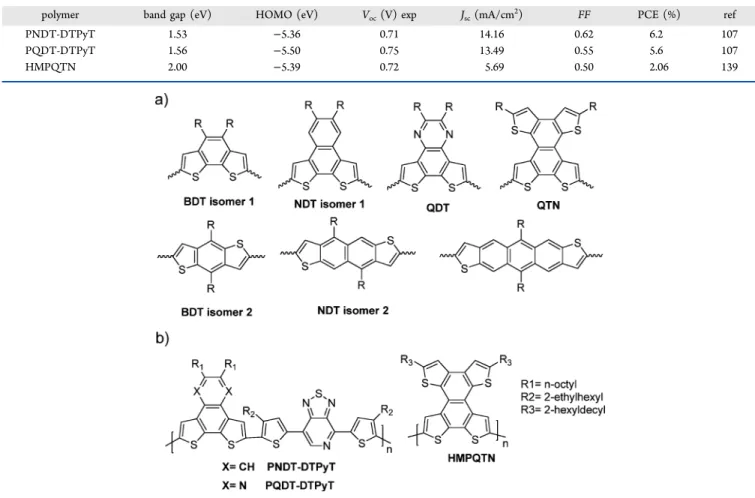
For example, replacing the benzene core of benzodithio-phene (BDT isomer 1) with a more electron-deficient naphthalene core leads to the naphthalenedithiophene (NDT isomer 1). NDT-based polymers exhibit both small band gaps and low HOMO levels.141 Noticeably, a NDT-based polymer (PNDT-DTPyT) exhibited a largeJscof 14.16 mA/cm2and a decentVoc of 0.71 V, with a PCE of 6% in its BHJ solar cells (Table 4).107To further decrease the electron-donating ability of the donor unit for a deeper HOMO level, dithienoqui-noxaline (QDT) with a more electron-deficient quinoxline core was designed. Indeed, QDT-based polymers exhibited enhancedVoc, but smallerJsc, in related BHJ solar cells due to decreased HOMO levels but concomitantly larger band gaps when compared with those of NDT analogues.46,107,141 In another example, quadrathienonaphthalene (QTN) with an even larger pancake-like π-conjugation prompts better electron delocalization, molecular interaction, and hole mobility. There-fore, the QTN-based polymers exhibit smaller band gaps and slightly decreased HOMO levels. The homopolymer of QTN has a band gap of 2.0 eV, and an efficiency over 2% was demonstrated.139
Besides cyclic extension of the conjugation, linear extension on the donor unit has also been explored to adjust energy levels and enhance molecular interaction and charge mobility. However, there are only a few reported cases due to synthetic difficulties of these units (structures on the second row of Figure 10a).142−146 Further, it is quite a challenge to attach solubilizing chains on these linearly extended aromatic systems. Nevertheless, some unique properties of this type of donor units do exist. For example, these donor units have very stiff backbones, long
Figure 9.(a) Chemical structures of ladder-type donor units. (b) Chemical structures of related copolymers.
Table 3. Summary of Band Gaps, HOMO Levels, and Photovoltaic Properties of Conjugated Polymers in Figure 9b
polymer band gap (eV) HOMO (eV) Voc(V) Jsc(mA/cm2) FF PCE (%) ref
PININE-DTBT 1.84 −5.45 0.47 5.93 0.43 1.88 128
PTPTBT 1.57 −5.36 0.85 11.2 0.67 6.41 129
effective π-conjugation length, good environment stability, and moderate electron-donating properties. They usually have strongπ-stacking, which allows effective overlap ofπ-orbitals; thus, they are good candidates for OFET applications with excellent charge carrier mobilities. These high mobilities also render related polymers promising candidates for PSC. In addition, the distance between side chains can be adjusted by varying the number of (unalkylated) fused aromatics between alkylated ones, which allows tuning of the intercalation of PC61BM.
147,148
Interestingly, sometimes unfused rings offer additional advantages, especially when these unfused additional aromatic units are pendant to the conjugated backbone, without introducing steric hindrance to the backbones.6,149 Figure 11
provides two such examples where these pendant thiophene units are not coplanar with the conjugated donor units on the
polymer main chain. However, these pendant thiophene units would prohibit excessive π-stacking of polymer backbones; thus, they can be used to adjust molecular interaction and active layer morphology. Reducedπ-stacking would also lead to better solubility of the conjugated polymers. Unlike these insulating alkyl chains, these aromatic rings can potentially help the charge transport. In addition, polymers containing these unfused rings exhibit significantly increased Voc in BHJ solar cells.6,149 The same enhancement has also been reported in small molecule solar cells and systematically studied.48
2.3.1.4. Symmetry of Donor Units. As already alluded in the previous discussion, fused aromatics often lead to isomers. In this scenario, symmetry of the molecule plays an important role. Recent studies have indicated that symmetry of the monomers and the related curvature of the polymer chains have large impacts on HOMO levels and charge mobility of conjugated polymers.
A comprehensive investigation on the impact of the symmetry was recently completed with the linear- and angular-shaped naphthodithiophenes (NDTs) (Figure 12).150,151Takimiya et al. discovered that NDTs of angular shapes (NDT3 and NDT4) showed lower HOMO levels and larger band gaps than their linear counterparts (NDT1 and NDT2).151Interestingly, when it comes to the mobility, NDTs of centrosymmetry (NDT1, NDT3, and NDT4) have enhanced mobilities than that of the NDT of axis symmetry (NDT2). Further, NDT4 with sulfur atoms facing outward presumably has a larger intermolecular orbital overlap through sulfur-involved nonbonding contact than that of NDT3 with sulfur atoms embedded in the bay region, which explains the observed higher mobility of NDT4.
Table 4. Summary of Band Gaps, HOMO Levels, and Photovoltaic Properties of Conjugated Polymers in Figure 10b
polymer band gap (eV) HOMO (eV) Voc(V) exp Jsc(mA/cm2) FF PCE (%) ref
PNDT-DTPyT 1.53 −5.36 0.71 14.16 0.62 6.2 107
PQDT-DTPyT 1.56 −5.50 0.75 13.49 0.55 5.6 107
HMPQTN 2.00 −5.39 0.72 5.69 0.50 2.06 139
Figure 10.(a) Chemical structures of polyaromatic donor units. (b) Chemical structures of related copolymers.
Lower HOMO levels are also observed in polymers containing angular-shaped NDTs. In addition, stacking of polymer chains is much stronger in polymers containing NDTs of centrosymmetry than in polymers with NDTs of axis symmetry. However, the mobility of polymers are affected by other factors than just the shape and symmetry of the donor unit (NDT).150A different mobility rank was summarized for these polymers containing NDT and two thiophene units (PNDT3BT > PNDT4BT > PNDT1BT > PNDT2BT). This difference in mobility rank between the polymers and NDT molecules can be related to the curvature of the backbone of these polymers. As shown in Figure 12, though NDT1 has a linear shape and NDT3 has an angular shape, the PNDT3BT could adopt a pseudostraight-shaped backbone (rather than a zigzag-shaped one in the case of PNDT1BT), which would lead to an effective packing of PNDT3BT into most highly ordered structure among all these four polymers, thereby the highest mobility. Similar results were reported by Müllen and co-workers, who also studied the impact of the shapes and curvature of the molecules on mobilities.152,153
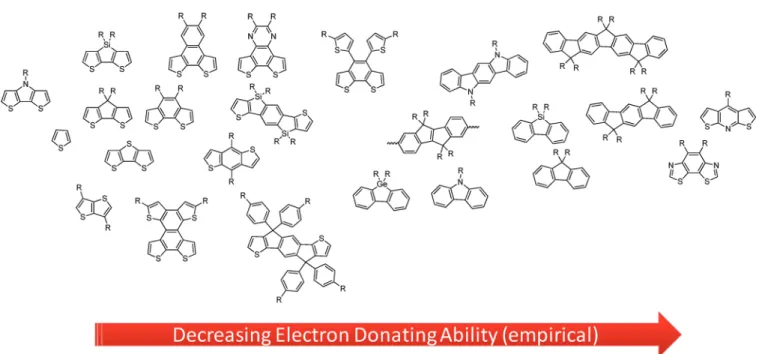
To conclude this discussion on the donor units, Figure 13 shows an empirical electron-donating ability trend of representative donor units. This donor unit trend is based on the comparison of oxidation potentials and band gaps of polymers with identical acceptor units. Due to the influences of other factors, such as steric hindrance and significant differences on π-stacking, this trend may vary. Generally, a
“weak donor”with moderate electron donating ability is needed to create polymers with ideal HOMO levels around −5.4 eV. High mobility, proper intermolecular interaction, enhanced
π-electron delocalization, and bonding geometry also need to be taken into consideration in order to design high perform-ance conjugated polymers.
2.3.2. Design of Acceptor Units. Similar to the donor units, the acceptor units are of equal importance in controlling the energy levels and band gaps of conjugated polymers. However,
compared with the great variety of donor units reported (e.g., a few successful examples discussed in previous section), the design and synthesis of functional acceptors only received moderate success. Nevertheless, several novel acceptor units have been developed, which contributed significantly to the enhanced photovoltaic performance of related polymers.
Perhaps the most commonly employed acceptor unit is the 2,1,3-benzothiadiazole (BT). Because of its strong electron-accepting ability and commercial availability, BT has been very popular in constructing low-band-gap conjugated poly-mers.93,104,154 Moreover, these two N atoms in the thiadiazole ring could possibly form hydrogen bonding with adjacent units (e.g., the hydrogen atom on the thiophene ring), leading to a more planar backbone. With all these good features, many polymers with a BT acceptor unit have shown low band gaps and good photovoltaic properties.5,104,154 The best example comes from a conjugated polymer copolymerizing dithienosilole (Si-PCPDTBT) with the BT unit, which exhibited a band gap of 1.37 eV and thereby aJscof 17.3 mA/cm2, with a PCE up to 5.9% in its BHJ devices.5
Adding one thienyl group on both sides of the BT converts BT into di-2-thienyl-2,1,3-benzothiadiazole (DTBT) (Figure 14),4,41,42,109,155−157 which has a few more advantages when compared with the original BT unit. First, the two flanking thienyl units relieve the otherwise possibly severe steric hindrance between the BT unit and donor aromatic units (especially when benzene based aromatics are used).128 Thus, the synthesized donor−acceptor polymers adopt more planar structures, thereby reducing the band gap by enhancing the D−A conjugation. In addition, a more planar conjugated backbone facilitates the chain−chain interactions among polymers in the solid state, improving the charge carrier (usually hole) mobility. Second, while the electron-accepting BT unit maintains the low band gap, the two electron-rich, flanking thienyl units would help improve the hole mobility, since thiophene-based polymers (such as P3HT) have shown noticeably high hole mobility.158Third, the
Figure 12. (a) Four isomeric naphthodithiophenes: naphtho[2,3-b:6,7-b′]dithiophene (NDT1), naphtho[2,3-b:7,6-b′]dithiophene (NDT2), naphtho[1,2-b:5,6-b′]dithiophene (NDT3), and naphtho[2,1-b:6,5-b′]dithiophene (NDT4). (b) Chemical structures of the naphthodithiophene-based semiconducting polymers. (c) Optimized backbone structures of the polymers PNDT1BT, PNDT2BT, PNDT3BT, and PNDT4BT. The side chains were replaced with methyl groups to simplify the calculation. Reprinted with permission from refs 150 and 151. Copyright 2011 American Chemical Society.
BT unit has limited positions for addition of solubilizing chains or substituents, and attaching these units would likely introduce steric hindrance. To this end, these flanking thienyl units can provide more possible positions for further modification of electronic properties and solubility of conjugated polymers, with minimal steric hindrance involved if properly introduced.159 However, due to the electron-rich nature of these thienyl units, in some cases, the two flanking thienyl units slightly increase the HOMO levels of the conjugated polymers when compared with BT-based polymers.128,132
Similar to the design of donor units (Figure 7), the electron affinity of acceptors can also be fine-tuned by varying specific atoms. Figure 15 lists a series of such units which can be treated as structurally related with the BT. For example, replacing the sulfur atom of the BT unit with a nitrogen atom, the electron-accepting ability of the triazole is significantly reduced when compared with that of the BT. It is because the lone pair on the middle nitrogen atom of the triazole unit is more basic than the lone pairs on the sulfur of the BT and is more easily donated into the triazole ring, making it relatively electron-rich when compared with the original BT. Thus, conjugated polymers incorporating triazole unit usually show a larger band gap around 2.0 eV (Table 5).45On the other hand, the electron-accepting ability of the quinoxaline (Qx) is in between the triazole and BT. One advantage of Qx is that it can be alkylated to improve the solubility of conjugated polymers without introducing steric hindrance.160 In addition, alkylated benzo units can be introduced to the periphery of the Qx instead of alkyl chains, which provides additional control to adjust molecular interactions and may increaseVocand charge mobility.161,162 Benzoxadiazole (BX), the oxygen containing analogue to the BT unit, has very similar electron-accepting
ability to that of BT. Thus, polymers containing the BX unit have very similar HOMO and LUMO levels to those of BT-based analogues. Interestingly, these BX-BT-based polymers usually do not perform as well as these BT-based analogues, possibly due to lower mobilities of these BX-containing poly-mers.106,156,163 Lastly, the selenium analogue of the BT unit, 2,1,3-benzoselenadiazole (BSe), demonstrates many interesting properties in photoelectronic devices.160,164 In general, BSe-based polymers exhibit smaller band gaps and lower HOMO and LUMO levels (from CV).69,165,166 However, the photo-voltaic properties of BSe-based polymers are restricted by the weak absorption of the active layer and the imbalance in the hole and electron transport of the active layer which may result from bad morphology.
In most of the high performance D−A conjugated polymers reported, close to ideal HOMO energy levels were achieved (e.g.,−5.4 eV), which lead to an observed open-circuit voltage (Voc) as high as 0.92 V.6,45,61 However, very often the band gaps of these materials are still larger than the proposed 1.5 eV of ideal polymers, resulting in mediocre short-circuit currents (Jsc). In order to further improve the efficiency, a smaller band gap is needed to achieve a higher Jsc while the low HOMO energy level should still be maintained (for a high Voc). According to the proposed approach of “weak donor−strong acceptor”, one should incorporate“strong acceptors”with large electron deficiency in the conjugated backbone to lower the LUMO levels, thereby decreasing the band gap of related polymers. We will elaborate on this concept by discussing several such strong acceptors.
One such example is the dithienylthiadiazolo[3,4-c]pyridine (DTPyT), which differs from the original DTBT by only one atom (Figure 16). Compared with benzene, pyridine is
π-electron deficient. Therefore by replacing the benzene in the BT unit with pyridine, the new acceptor, thiadiazolo[3,4-c ]-pyridine (PyT), would be one such stronger acceptor. Polymers incorporating DTPyT unit were first reported by Leclerc et al.,156 and their PV performances were then enhanced up to 6.3% by You et al. (Table 6)107by copolymerizing with“weak donors”to adjust energy levels and attaching solubilizing chains
Figure 14.Chemical structures of BT and DTBT acceptor units.
to improve the molecular weight and the film morphology. All the DTPyT-containing polymers reported by You and co-workers showed noticeably reduced LUMO levels, slightly reduced HOMO levels, and thus smaller band gaps than those of their DTBT counterparts. The smaller band gap signi-ficantly improves the observed Jsc of the related BHJ devices, while the low HOMO energy level maintains the high Voc. Therefore all three polymers (PNDT-DTPyT, PQDT-DTPyT, and PBnDT-DTPyT) achieved high efficiency numbers in their BHJ devices, demonstrating the great utility of DTPyT acceptor moiety in designing high performance solar cell materials.
Similarly, tetrazine (Tz) which has a very high electron affinity has also been used as a strong acceptor to construct low-band-gap polymers with over 5% efficiency achieved.167 When incorporated into D−A conjugated polymers, both HOMO and LUMO levels of Tz-based copolymers are lower than those of BT-based copolymers, indicating a stronger electron affinity of the Tz unit. Interestingly, the Tz unit shows more impact on HOMO levels than on LUMO levels, which is different from most acceptor units. This results in slightly broader band gaps of Tz-based polymers when compared with these of BT-based polymers.
Isoindigo is a symmetrical and perfect planar π-conjugated molecule consisting of two indolin-2-one units, which are strongly electron withdrawing.168,170,171A few conjugated polymers based on isoindigo units possess near-ideal low HOMO levels around
−5.4 eV and low LUMO levels around −3.9 eV. However, relatively low PCE up to 3% was obtained, with a largeVoc of 0.9 V but a lowJscaround 5 mA/cm2.168
Further improvement can be anticipated by choosing proper donor units and side chains as well as by improving the active layer morphology.
Structurally similar to isoindigo, pyrrolo[3,4-c ]pyrrole-1,4-dione (DPP) has also been used in a number of D−A conjugated polymers in the past 3 years.1,44,118,169,172−176 Low
band gaps around 1.3 eV are generally obtained, which is beneficial forJsc; however, HOMO levels of DPP-based polymers are significantly elevated when compared with those of their analogues with other acceptors, possibly due to these two flanking electron-donating thienyl units. Nevertheless, efficiency numbers as high as 5.5% were reported for DPP-based polymers.169,176 The thieno[3,4-c]pyrrole-4,6-dione (TPD) unit was recently intensively explored. The symmetric and planar structure of TPD could improve the electron delocalization, enhancing the polymer chain−chain interactions and increasing the hole mobility. Similar to DPP and isoindigo, electron-withdrawing amide groups render TPD a strong acceptor. It was first incorporated in BnDT-based copolymers by Leclerc and co-workers.177The resultant copolymer not only has a small band gap (thereby a potentially high Jsc), also maintains a low HOMO energy level of −5.56 eV. Therefore a high Voc of 0.85 V was achieved in the BHJ device with PC71BM as the acceptor. Along with a Jsc of 9.81 mA/cm2 and a FF of 0.66, a PCE of ∼5.5% was obtained. It is particularly worth mentioning that Leclerc et al. obtained these impressive values from devices with an active area of 1.0 cm2. Achieving high efficiencies on devices of large area is advantageous for real world application of PSC because efficiencies obtained on areas smaller than 0.2−0.3 cm2may become strongly substrate size-dependent, in addition to the possible overestimation of theJsc
from a very small area device. Similar polymers with identical conjugated backbone but having different solubilizing chains were independently reported by Jen’s group and Xie’s group with PCEs varying from 3.42% to 4.79% after certain optimization.178,179Fréchet and co-workers later did a detailed study on the impact of these side chains on the TPD−BDT copolymer.180PCEs up to 6.8% were reported just by varying the side chains of the conjugated backbone. More recently, TPD-based polymers of efficiency as high as 7.3% were reported by Amb et al. and Tao and co-workers.60,62,63,181In their studies, the TPD acceptor was copolymerized with fused bithiophene with different bridging atoms. All of these copolymers exhibit high PCEs over 6% in BHJ solar cells, which indicates a great potential of TPD unit in constructing novel materials for PSC.
However, acceptors should not be too electron withdrawing. As discussed earlier, the LUMO of the conjugated polymer should be at least 0.3 eV larger than the LUMO of the n-type material to facilitate efficient exciton dissociation. Too strong an acceptor in the D−A polymer would lead to too low a LUMO level and the inability to split excitons at the interface between the polymer and fullerenes. Thus, no photocurrent or extremely smallJscwould be observed. Several examples include benzo[1,2-c:4,5-c′]bis([1,2,5]thiadiazole) (BBTD),182 [1,2,5]-thiadiazolo[3,4-g]quinoxaline,183,184 pyrazino[2,3-g ]quinoxa-line,185and [1,2,5]thiadiazole[3,4-d]pyridazine.186
2.4. Substituents. Though the energy levels and band gap of a conjugated polymer are mainly determined by the selection of conjugated aromatic units (e.g., D and A in D−A polymers),
Table 5. Summary of Band Gaps, HOMO/LUMO Levels, and Photovoltaic Properties of Conjugated Polymers in Figure 15b
polymer band gap (eV) HOMO (eV) LUMO (eV) Voc(V) exp Jsc(mA/cm2) FF PCE (%) ref
PBnDT-HTAZ 1.98 −5.29 −2.87 0.70 11.14 0.55 4.30 45
PCDTQx 2.02 −5.46 −3.42 0.95 3.0 0.56 1.8 156
PCDTBT 1.88 −5.45 −3.60 0.86 6.8 0.56 3.6 156
PCDTBX 1.87 −5.47 −3.65 0.96 3.7 0.60 2.4 156
H11 1.52 −4.88 −3.33 0.55 1.05 0.32 0.18 69
Figure 15. (a) Chemical structures of trizole, Qx, BT, Bx and BSe units. (b) Chemical structures of related copolymers.
substituents can be used to further tune energy levels, band gaps, molecular interaction, and even morphology.
Using archetypical PPV as the model polymer, the substituent effect on conjugated polymers was systematically studied by Bredas and Heeger with the valence effective Hamiltonian (VEH) method (Figure 17).187 Attaching
electron-donating methoxy groups to the benzene unit of the PPV would raise the HOMO energy level when compared with the original PPV (with similar LUMO level). This effect was also observed experimentally.188 When switching to the electron-withdrawing group (such as cyano), stabilization on
both HOMO and LUMO levels would be expected. However, calculations found that the band gaps of the cyano PPVs would be larger than that of PPV because of the asymmetry in the stabilization of the HOMO and LUMO levels by the cyano substituent. Furthermore, the position of the cyano (either on the phenylene or on the vinylene) affects the energy levels and band gap. When cyano was added on the vinylene, the calculated LUMO level was noticeably lower than that of the analogue with cyano on the phenylene, with less difference on the HOMO energy levels. The authors attributed this effect to the different number of π-electrons on the vinylene and phenylene. Since vinylene unit only has two π-electrons whereas phenylene unit has six, substitution on the vinylene would introduce a relatively larger perturbation to the conjugated backbone, further lowering the LUMO level. All these results presented above indicate that electron-donating substituents (such as methoxy) would have a more significant impact on the HOMO level, while electron-withdrawing ones (such as cyano) would affect more strongly on the LUMO level. Therefore, by attaching both methoxy group and cyano group on the phenylene and the vinylene part of PPV, respectively, the resulting polymer exhibited a similar HOMO level with that of the methoxy PPV and a similar LUMO with that of the cyano PPV, leading to a significantly decreased band gap.189This result is in good agreement with the proposed “weak donor−strong acceptor” strategy to design ideal polymers.59
Another interesting substituent is the fluorine. Fluorine is the smallest electron-withdrawing group with a van der Waals radius of 1.35 Å and a Pauling electronegativity of 4.0. Fluorinated organic molecules exhibit a series of unique features such as great thermal and oxidative stability,190 elevated resistance to degradation,191 enhanced hydrophobicity, and
Table 6. Summary of Band Gaps, HOMO/LUMO Levels, and Photovoltaic Properties of Conjugated Polymers in Figure 16b
polymer band gap (eV) HOMO (eV) LUMO (eV) Voc(V) exp Jsc(mA/cm2) FF PCE (%) ref
PBnDT-DTPyT 1.51 −5.47 −3.44 0.85 12.78 0.58 6.3 107
PCPDTTTz 1.68 −5.34 −3.48 0.75 12.2 0.59 5.4 167
PTI-1 1.60 −5.85 −3.88 0.89 5.4 0.63 3.0 168
PDPPTPT 1.53 −5.35 −3.53 0.80 10.3 0.65 5.5 169
P-Ge 1.69 −5.6 NA 0.85 12.6 0.68 7.3 62
Figure 16.(a) Chemical structures of some“strong acceptor”units. (b) Chemical structures of related copolymers.
high lipophobicity in perfluorinated substances.192In addition, these fluorine atoms often have a great influence on inter- and intramolecular interactions via C−F···H, F···S, and C−F···πF interactions.191,193 Applying fluorine substitution in the D−A polymers was investigated by You and co-workers in two recent studies.45,61In one report, they added two fluorine atoms to the commonly employed benzothiadiazole (BT), converting BT into fluorinated benzothiadiazole (ffBT) (Figure 18).61 The
ffBT-based polymer showed decreased HOMO and LUMO levels but a similar band gap when compared with those of its nonfluorinated analogue. Preliminary PV tests on BHJ devices demonstrated both increasedVoc(0.91 V) andJsc(12.9 mA/cm2). Together with an also enhanced fill factor of 0.61, an im-pressive PCE of 7.2% was thus obtained without special treatments. In another related study, BnDT-based copolymers (PBnDT-FTAZ) with 5,6-difluoro-2H-benzo[d][1,2,3]triazole (FTAZ) as the acceptor unit was synthesized.45This polymer exhibited a medium band gap of 2.0 eV when compared with that of the DTBT-based polymer due to the weaker electron affinity of the FTAZ unit. Surprisingly, in spite of a band gap of∼2.0 eV, the
Jsc of PBnDT-FTAZ based BHJ solar cells could reach over 12 mA/cm2(depending upon the thickness of the active layer), which can be explained by the high molecular weight and the large hole mobility of PBnDT-FTAZ. The BHJ devices based on PBnDT-FTAZ consistently showed a higherFFandJscthan those of devices based on the polymers without fluorine substituents (PBnDT-HTAZ) at comparable thicknesses. A peak PCE of 7.1% was obtained in BHJ devices of PBnDT-FTAZ:PC61BM without annealing or any additives. Remarkably, PBnDT-FTAZ:PC61BM solar cells can still achieve over 6% efficiency even at an unpre-cedented thickness of 1μm (of the active layer).
Besides the study on the fluorine substituent effect in D−A polymers, the fluorine atom has also been applied in quinoid polymers. For example, Yu and co-workers studied a series of polymers based on fluorinated thienothiophene (TT).74,78,194,195 As expected, the substitution of electron-withdrawing fluorine
onto the polymer backbone reduced the HOMO energy levels of polymers when compared with the nonfluorinated analogues. Furthermore, this structural modification optimized the polymers’ spectral coverage of absorption and their hole mobility as well as their miscibility with PC71BM. All these contributed to an enhanced polymer solar cell performance up to 7.4%, which is one of the highest efficiencies within the literature reports.74,78 Further, using the original conjugated backbone (BnDT-TT) as the subject of study, Son et al. showed that the incorporation of the fluorine onto various positions of the polymer backbone significantly affected the performance of related solar cells (Figure 18).76 Depending upon which hydrogen of the conjugated backbone is substituted by the fluorine, PCE of corresponding BHJ devices can vary from 2.3% to 7.2%. They also observed that fluorination of the BnDT unit lowered both the HOMO and LUMO levels of the conjugated polymer but widened the band gap. Finally, perfluorination of the polymer backbone led to a poor compatibility of the polymer with PC71BM; thus, poor solar cell performance was observed. In addition, the authors found that perfluorination of the polymer backbone resulted in poor photochemical stability against singlet oxygen attack.76 These interesting effects of substituents on physical properties of conjugated polymers are still under active investigation.
2.5. Side Chains. For conjugated polymers used in organic solar cells, solubilizing side chains are required to allow solution processability, which is the key feature for future low-cost mass production of these flexible solar cells. Without solubilizing chains, the conjugated backbone would adopt a more planar structure, thereby facilitating the chain−chain interactions among polymers and leading to unprocessable “bricks”. In addition to imparting the solubility to conjugated polymers, side chains have been discovered to play important roles in certain key properties of conjugated polymers, such as molecular weight, inter- and intramolecular interactions, charge transport, and active layer morphology.50In this section, these recently emerged understandings of the side-chain effect will be discussed, followed by the suggested guidelines of designing solubilizing chains.
2.5.1. Position. It is well-known that decorating the polymer backbone with side chains can effectively improve the solubility of the polymer, which is a crucial prerequisite toward achieving high molecular weight of the resulting conjugated polymer. However, substituting the small hydrogen atoms on these aromatic units with rather big alkyl or alkoxy chains often result in significant steric hindrance between these aromatic units on the conjugated backbone. For example, a computational simulation revealed that severe steric hindrance introduced by these alkyl/alkoxy chains on the DTBT would lead to a twisted conjugated backbone in polymers incorporating the substituted DTBT.196 Therefore, the hole mobilities of the polymers incorporating such substituted DTBT were noticeably lower than that of the polymer with unsubstituted DTBT, which accounted for a smallerJsc in the former case.
196
In an earlier study, the homopolymers of alkylated DTBT were prepared by Jayakannan et al. by varying alkyl chains on either 3- or 4-positions of the thienyl groups.197 Though relatively high molecular weight polymers were obtained, the steric hindrance introduced by these alkyl chains in these polymers led to much larger band gaps than that of the homopolymer of unsubstituted DTBT.198Later, Wang et al. synthesized a series of internal donor−acceptor type of copolymers containing benzothiadiazole (BT) and four thiophenes incorporating side
Figure 18.Chemical structures of fluorine atom containing acceptor units and conjugated polymers.
chains on different position as shown in Figure 19.199Despite indentical alkyl side chains, the positions where these alkyl side
chains are attached to different thiophene rings have significant influence on the physical properties and photovoltaic performance of resulting polymers. Positioning these alkyl chains close to the fluorene renders large steric hindrance during polymerization, which results in a significantly lower molecular weight of PFO-M2 and consequently a poor PV performance of related BHJ cells when compared with 1.82% for PFO-M1 and 2.63% for PFO-M3 based BHJ solar cells.
Most recently, You and co-workers systematically inves-tigated what effect the side-chain positions had on the optical, electrochemical, and photovoltaic properties of conjugated polymers using PBDT-DTBT as the model polymer (Figure 20).159
These three polymers with alkyl chains attached on DTBT have similar molecular weights (much higher than that of PBDT-DTBT without alkyl chains on DTBT), thereby minimizing the potential complication from the influence of different molecular weights. Thus, all observed differences in properties (optical, electrochemical, and photovoltaic) can be ascribed to the difference in where these side chains were placed. They quantitatively measured the steric hindrance introduced by these alkyl chains by calculating the dihedral angles between two thienyl groups with the center BT unit as well as with the donor BDT. There is only a slight increase of the dihedral angle between the 4-substituted thienyl group and the BDT unit in PBDT-4DTBT when compared with the original PBDT-DTBT,
indicating a minimum steric hindrance introduced by the 4DTBT. Moreover, the DFT calculation showed that the electron density is delocalized in the HOMO of PBDT-4DTBT, similar to that of PBDT-DTBT. This results in an almost negligible dif-ference between the HOMO energy level of PBDT-DTBT and that of PBDT-4DTBT. On the other hand, moving these alkyl chains away from the vicinity of BDT unit in the case of PBDT-3DTBT and PBDT-DTsolBT decreases the steric hindrance between substituted DTBT and BDT unit, recovering small numbers on the dihedral angle 3. However, greater steric hindrance is formed between the thienyl groups and the center BT unit, as shown by a dramatic numerical increase in the dihedral angles 1 and 2. This severe steric hindrance essentially breaks the conjugation at the linkages between these thienyl groups and the BT, thereby rendering large band gaps for these two polymers (2.21 eV for PBDT-3DTBT and 2.48 eV for PBDT-DTsolBT).
The thorough investigation of this library of structurally related polymers clearly indicates that attaching alkyl chains on the 4-positions of these thienyl groups (i.e., 4DTBT) only introduces minimum steric hindrance into the related D−A polymer. Therefore, PBDT-4DTBT maintains almost identical band gap and energy levels when compared with those of PBDT-DTBT. However, these additional side chains offer a high molecular weight and excellent solubility of PBDT-4DTBT, the latter leading to a more uniform mixture with PC61BM with better control on the film morphology. All these features of PBDT-4DTBT contribute to a noticeably enhanced efficiency (up to 2.2%) of PBDT-4DTBT-based BHJ cells, significantly higher than that of PBDT-DTBT-based devices (0.7%).
2.5.2. Shape and Length. Even when the side chains are
“properly” anchored on the conjugated backbone, the length and shape of these side chains also have a noticeable (sometimes substantial) impact on the properties of resulting conjugated polymers. Gadisa et al. completed a comparative investigation on the photovoltaic properties of BHJ devices based on a series of poly(3-alkylthiophene)s of butyl (P3BT), pentyl (P3PT), and hexyl (P3HT).200FF of 0.529, 0.624, and 0.675 were obtained from solar cells based on P3BT:PC61BM (1:0.8), P3PT:PC61BM (1:1), and P3HT:PC61BM (1:1), respectively. Bipolar measurements made by field-effect transistors showed a decrease in the hole mobility and an increase in the electron mobility with increasing alkyl chain length, which is attributed to the an increase in the degree of phase separation. The longer side chains facilitate the clustering of PC61BM molecules and establish fast electron-percolation pathways, leading to improved electron mobility. Since holes and electrons exhibit well-balanced mobilities in the case of P3HT:PC61BM, a better fill factor was observed.
In another study, Egbe et al. grafted different side chains to the backbone of a series of anthracene-containing poly(p -phenyl-eneethynylene)-alt-poly(p-phenylenevinylene) (PPE−PPV) copolymers to tune theπ−π stacking ability of the materials (Figure 21).201Polymers with octyloxy substitution close to the AnE units (ab, ad, ae) arrange in a stacked manner, whereas asymmetric (cc) or branched side chain substitution (bb, ba) near the AnE unit yields less organized or even amorphous polymers. The best performance of 3.14% was achieved from BHJ devices based on ab ANE-PV which shows both stacking ability and biggestπ−πstacking distance of 0.386 nm as opposed to 0.380 nm for the other polymers in this series. Lower efficiency values were obtained for the BHJ devices based on amorphous polymersbaand bb, due to a high miscibility of components in the active layer resulting in insufficient percolation paths for the
Figure 19.Chemical structures of PFO-M1, PFO-M2, and PFO-M3.

![Figure 4. Aromatic and quinoid forms of poly(benzo[c]thiophene) (a), poly(thieno[3,4-b]pyrazine (b), and poly(thieno[3,4-b]thiophene) (c).](https://thumb-us.123doks.com/thumbv2/123dok_us/8325953.2207693/4.938.152.792.98.453/figure-aromatic-quinoid-thiophene-thieno-pyrazine-thieno-thiophene.webp)