RESPONSE PREVENTION OR RESPONSE PERMISSION?
A RANDOMIZED CONTROLLED TRIAL OF THE “JUDICIOUS USE OF SAFETY BEHAVIORS” DURING EXPOSURE THERAPY
Shannon M. Blakey
A dissertation submitted to the faculty at the University of North Carolina at Chapel Hill in partial fulfillment of the requirements for the degree of Doctor of Philosophy in the Department
of Psychology and Neuroscience (Clinical Psychology).
Chapel Hill 2018
Approved by
ABSTRACT
Shannon M. Blakey: Response Prevention or Response Permission? A Randomized Controlled Trial of the “Judicious Use of Safety Behaviors” during Exposure Therapy
(Under the direction of Jonathan S. Abramowitz)
Safety behaviors (i.e., actions performed to prevent, escape, or minimize feared catastrophe and/or associated distress) are typically eliminated during exposure therapy for clinical anxiety (i.e., response prevention). Yet some experts have called for the strategic and “judicious use” of safety behaviors during exposure to improve treatment
acceptability/tolerability without diminishing its efficacy. Empirical findings regarding this debate are mixed and existing work is subject to several methodological limitations. The current randomized controlled trial incorporated longitudinal design and multimethod assessment to compare the efficacy and acceptability of traditional exposure and response prevention (E/RP) and exposure with judiciously used safety behaviors (E/JU). Adults with DSM-5 spider phobia (N = 60) were randomized to four twice-weekly sessions of E/RP or E/JU. Self-report and behavioral measures were administered at pretreatment (PRE), posttreatment (POST), and 1-month follow-up (F/U). Participants exhibited large effects on all measures from PRE to POST with no change from POST to F/U. There were no significant group differences on primary or secondary outcomes. Exploratory analyses suggest that safety behaviors promote swifter behavioral approach toward feared stimuli but interfere with facets of inhibitory learning.
ACKNOWLEDGEMENTS
I would like to extend my heartfelt gratitude to: Dr. Jonathan Abramowitz for his supervision and mentorship; Drs. Donald Baucom, Stacey Daughters, Kristen Lindquist, and Adam Radomsky for their valuable input on the study design; Drs. Christopher Wiesen and Joshua Clapp for their statistical consultation; Jennifer Buchholz, Sarah Jessup, Kimberly Pentel, Addie Jeffs, and Rachel Greene for their excellent work as study therapists; Ann Chapin
Meekins, Melissa Nance, Jacob Arett, Tate Overbey, Megan Lanier, Claire Stark, and Rachel Silver for their assistance with data collection and entry; Susan Blakey, Brett Blakey, Brittany Blakey, Grant Gardner, Charlotte Peck, and Catherine Lee for their emotional support; and Bosco and Bania for their service in the treatment of 60 community members with spider phobia.
TABLE OF CONTENTS
LIST OF TABLES ... vii
LIST OF FIGURES ... viii
Introduction ... 1
Explanatory Models of Exposure Therapy ... 2
Safety Behaviors and Clinical Anxiety ... 4
Safety Behaviors Interfere with Exposure Therapy ... 6
Safety Behaviors Elicit Misattributions of Safety ... 6
Safety Behaviors Disrupt Therapeutic Information Processing ... 7
Safety Behaviors Interfere with Inhibitory Learning ... 8
Judiciously Used Safety Behaviors Enhance Exposure Therapy ... 11
Safety Behaviors Enhance Exposure’s Acceptability and Tolerability ... 11
Safety Behaviors Promote Approach Behavior ... 13
Safety Behaviors Facilitate Inhibitory Learning ... 14
Limitations of Previous Safety Behavior Research ... 16
Study Aims and Hypotheses ... 18
Method ... 20
Participants ... 20
Trial Design and Randomization... 21
Procedure ... 21
Measures... 26
Data Analytic Strategy ... 30
Results ... 31
Treatment Dropout ... 31
Primary Outcomes ... 32
Secondary Outcomes ... 33
Exploratory Analyses (Exposure Process Variables) ... 34
Discussion ... 35
APPENDIX A: TREATMENT FIDELITY STRATEGIES... 49
LIST OF TABLES
LIST OF FIGURES
RESPONSE PREVENTION OR RESPONSE PERMISSION?
A RANDOMIZED CONTROLLED TRIAL OF THE “JUDICIOUS USE OF SAFETY BEHAVIORS” DURING EXPOSURE THERAPY
Substantial research documents the efficacy and effectiveness of exposure-based cognitive-behavioral therapy (i.e., “exposure therapy”) in the treatment of anxiety-related conditions such as generalized anxiety disorder (GAD), illness anxiety disorder (i.e., hypochondriasis), obsessive-compulsive disorder (OCD), panic disorder, agoraphobia, posttraumatic stress disorder (PTSD), social anxiety disorder, and specific phobia (Olatunji, Cisler, & Deacon, 2010). The core feature of exposure therapy is the repeated and prolonged confrontation of anxious patients with feared situations/stimuli. Although exposure therapy is the first-line intervention for clinical anxiety (American Psychiatric Association [APA] 2013;
Explanatory Models of Exposure Therapy
Despite empirical support for exposure’s effectiveness, its underlying mechanisms of change are not fully understood. One explanatory model of exposure therapy draws from experimental animal and human research on basic learning processes (Craske et al., 2008; Craske, Treanor, Conway, Zbozinek, & Vervliet, 2014; Laborda & Miller, 2012; Lang, Craske, & Bjork, 1999; Myers & Davis, 2007). This inhibitory learning framework posits that fear-based associations (e.g., spiders are aggressive) are not “unlearned” during exposure, but instead forced to compete with safety-based associations formed during treatment (e.g., spiders are not
aggressive). Following repeated successful exposure trials, a phobic stimulus is associated with both its original excitatory (danger) meaning and its new inhibitory (safety) meaning. Thus, the aim of exposure therapy from this perspective is to help patients generate and strengthen inhibitory associations relative to older, fearful associations.
Importantly, excitatory learning is context-independent, meaning that learned fear of a particular stimulus in one context easily generalizes to other contexts. Inhibitory learning, in contrast, is context-dependent; learned safety does not generalize as easily because inhibitory associations are inferior in strength and accessibility to excitatory associations after a context shift (Bouton, 2002). Accordingly, inhibitory learning theory emphasizes the need to
decontextualize (i.e., generalize) inhibitory associations by repeatedly violating expectancies in diverse contexts. Although the importance of conducting exposure in multiple contexts has long been understood, inhibitory learning theory advocates for using novel therapeutic strategies (e.g., introducing variability into exposure tasks; Craske et al., 2014; Jacoby & Abramowitz, 2016) to help patients generalize inhibitory associations outside the therapeutic context.
Though not altogether incongruous with other explanatory models of exposure therapy (Clark, 1999; Foa, Huppert, & Cahill, 2006; Foa & Kozak, 1986; Foa & McNally, 1996;
Safety Behaviors and Clinical Anxiety
Safety behaviors are overt or covert actions performed to prevent, minimize, or escape a feared catastrophe and/or associated distress (e.g., Telch & Lancaster, 2012). To illustrate, a woman with a fear of enclosed spaces may avoid attending parties (i.e., prevent feeling trapped), repeatedly tell herself “relax” at parties (i.e., minimize her anxiety associated with being in an enclosed space), or leave a party after it becomes “too crowded” (i.e., escape the enclosed space and associated distress). Safety behaviors are functionally distinct from nonpathological safety maneuvers (e.g., adhering to an elevator’s passenger limit) or adaptive coping (e.g., telling oneself “it’s okay if I feel trapped;” Thwaites & Freeston, 2005). That is, whereas attempts to remain safe when faced with actual threat are adaptive, performing such behaviors in the absence of threat is unnecessary and may even exacerbate psychopathology (Helbig-Lang & Petermann, 2010).
It is understood that safety behaviors contribute to the development and maintenance of clinical anxiety (for a review, see Helbig-Lang & Petermann, 2010); accordingly, patients’ safety behaviors are traditionally eliminated as soon as possible during treatment (i.e., response
prevention). This is because safety behaviors are thought to prevent the correction of mistaken threat-related beliefs by (a) absorbing finite attentional resources available to process and encode disconfirmatory information during exposure ( e.g., Sloan & Telch, 2002) and (b) causing
expectancies by attenuating the discrepancy between the predicted versus actual outcome when confronting a feared situation/stimulus, (b) generalization of safety-based associations by
contextualizing inhibitory learning to specific contexts, and (c) development of distress tolerance by precluding patients from learning that they can persist despite their distress.
Yet some have questioned the clinical convention of response prevention during exposure therapy. Specifically, Rachman, Radomsky, and Shafran (2008) proposed the judicious use of safety behaviors: the careful and strategic incorporation of safety behaviors during exposure, with an emphasis on the earlier or more challenging stages of treatment. Proponents of the judicious use of safety behaviors highlight their several possible advantages. For example, Rachman and colleagues (2008) argued that permitting safety behaviors during exposure might enhance treatment acceptability and tolerability without diminishing its efficacy. Others have suggested that safety behaviors facilitate exposure by (a) accelerating the rate at which patients approach exposure stimuli and/or (b) promoting closer approach to exposure stimuli (e.g., Hood, Antony, Koerner, & Monson, 2010). From the lens of inhibitory learning theory, it is also possible that safety behaviors maximize opportunities to violate negative expectancies by
stimulating patients to conduct more (or more challenging) exposures than they would otherwise be willing to attempt. Furthermore, safety behaviors might help generalize inhibitory
Safety Behaviors Interfere with Exposure Therapy
Substantial research shows exposure with response prevention is associated with superior outcomes relative to exposure in which safety behaviors are permitted (Meulders, Van Daele, Volders, & Vlaeyen, 2016, for a review). Several theories have been offered to explain why safety behaviors reduce exposure’s effectiveness. Specifically, the use of safety behaviors during exposure is thought to (a) elicit misattributions of safety, (b) disrupt therapeutic information processing, and (c) interfere with inhibitory learning.
Safety Behaviors Elicit Misattributions of Safety
In his misattribution of safety hypothesis, Salkovskis (1991) posited that when anxious patients’ feared catastrophes do not occur in the context of safety behaviors, patients credit their safety behaviors for positive outcomes rather than modifying their threat-related beliefs. Despite being the most commonly cited explanation for why safety behaviors interfere with exposure, scant research has directly assessed safety attributions following exposure in relation to safety behavior use. Nevertheless, indirect evidence does support Salkovskis’s hypothesis.
follow-up. Findings suggest that attributing successful exposure outcomes to external rather than internal factors interferes with long-term fear extinction. However, this study was limited by its use of a nonclinical sample, short follow-up period, and lack of idiographic attribution data.
Other researchers have invoked Salkovskis’s (1991) misattribution of safety hypothesis to explain greater reductions in catastrophic beliefs when safety behaviors were prevented, versus permitted (Kim, 2005; Salkovskis, Clark, Hackmann, Wells, & Gelder, 1999; Wells et al., 1995). Given these studies’ lack of ideographic attribution data, however, they only partially support the misattribution of safety hypothesis. That is, because these studies did not ask participants to report exposure outcome attributions (e.g., “the reason I didn’t shake uncontrollably was because I clasped my hands while reading in public”), Salkovskis’s (1991) hypothesis awaits continued empirical investigation.
Safety Behaviors Disrupt Therapeutic Information Processing
Information processing-based arguments (e.g., Sloan & Telch, 2002) posit that safety behaviors interfere with exposure by absorbing finite attentional resources. Specifically, if attentional focus is directed toward performing a safety behavior during an exposure, a patient may fail to simultaneously process that his or her fears are exaggerated (e.g., Clark, 1999).
Kamphuis and Telch (2000) offered evidence that safety behaviors interfere with exposure therapy by depleting attentional resources. In their study, claustrophobic
instructions), or a no-instruction exposure control condition. Results showed that participants in the guided threat reappraisal condition experienced the greatest improvements at posttest and 2-week follow-up, purportedly because they were better able to process corrective information.
Using a similar claustrophobia exposure paradigm, Sloan and Telch (2002) compared the effects of threat-related safety behavior use (e.g., opening a small window in the chamber to bring in fresh air), guided threat reappraisal (instructions to focus on evidence that challenged threat-related beliefs), and no instructions on exposure outcomes. Results showed that
participants in the guided threat reappraisal condition reported the greatest disconfirmation of threat estimates during a follow-up behavioral approach task (BAT). Regrettably, neither Kamphuis and Telch (2000) nor Sloan and Telch (2002) measured the extent to which safety behaviors disrupted attentional focus on belief testing. Future studies examining the extent to which safety behaviors siphon attention from challenging threat expectancies during an exposure trial are needed.
Safety Behaviors Interfere with Inhibitory Learning
Inhibitory learning theory implicates additional mechanisms through which safety behaviors might impede exposure. Specifically, safety behaviors could prevent the (a) violation of negative expectancies and (b) generalization of inhibitory associations across contexts. Although little safety behavior research has been conducted from this framework, there is some evidence that safety behaviors interfere with inhibitory learning processes.
using a public restroom by placing a tissue barrier between his skin and bathroom surfaces might be less surprised by his not becoming ill than a man who touches bathroom surfaces without such protection. Because greater expectancy violations result in more powerful inhibitory learning (Baker et al., 2010), any safety behavior that attenuates the discrepancy between a patient’s anticipated and actual exposure outcome ought to be prevented.
Lovibond and colleagues (2009) used a four-phase conditioning paradigm to test whether safety behaviors prevent the violation of negative expectancies. In the first phase, two visual stimuli (A and C) were followed by electric shock, yet B was not, forming “safety” associations with stimulus B and “danger” associations with stimuli A and C. In the second phase,
participants could press a button to cancel the impending shock after the presentation of stimulus A. In the third phase, stimulus C was presented six times, never once followed by shock. During this phase, participants in the experimental condition could press the button after seeing stimulus C (i.e., perform a safety behavior), but the control group could not. In the final phase,
participants were individually presented with stimuli A, B, and C, after which they provided shock expectancy ratings on a 0 (“certain no shock”) to 100 (“certain shock”) scale. Results showed that stimulus C shock expectancies were higher for the experimental group than the control group. The authors concluded that stimulus C was protected from extinction in the experimental group because pressing the button eliminated the “discrepancy between what is expected (nothing) and what actually occurs (nothing)” (Lovibond et al., 2009, p. 716). The clinical implications of this study are clear: safety behaviors might preclude inhibitory learning by preventing the maximal violation of negative expectancies for harm during exposure trials.
Participants screened for fear of anxious arousal were randomized to standard IE (three IE trials with inter-trial relaxation periods [i.e., safety behaviors; Arch & Craske, 2011]), basic IE (three IE trials without safety behaviors), intensive IE (IE without safety behaviors and delivered until threat likelihood expectancies fell to 5%), or an expressive writing control. Consistent with the supposition that safety behaviors diminish inhibitory learning during exposure, participants receiving intensive IE experienced significantly greater improvement on primary outcomes at posttreatment and 1-week follow-up. Furthermore, the superior efficacy of intensive IE was fully mediated by greater improvement in negative expectancies and fear toleration. However, this study’s findings are limited by its use of a subclinical sample and single-session design.
Safety behaviors prevent generalization of inhibitory learning. Safety behaviors could also interfere with long-term exposure outcome by contextualizing inhibitory associations
(Craske et al., 2014). Research shows that not only is fear extinction less generalizable than fear conditioning, but it is especially vulnerable to changes in context (Bouton, 2002, 2004).
Considering that the goal of exposure therapy is to provide patients with unconditional learned safety, safety behaviors should be discouraged if they restrict inhibitory learning to certain contexts.
Radomsky, & Zysk, 2011). In contrast, other studies show that participants who perform safety behaviors during exposure maintain gains (Hood et al., 2010) and generalize learning to novel BATs (van den Hout, Reininghaus, van der Stap, & Engelhard, 2012). Therefore, the claim that safety behaviors definitively contextualize inhibitory learning is tenuous and deserves additional research.
Judiciously Used Safety Behaviors Enhance Exposure Therapy
Accumulated research demonstrates that safety behaviors do not always undermine exposure’s efficacy (e.g., Parrish, Radomsky, & Dugas, 2008). In fact, some argue that the judicious use of safety behaviors carries therapeutic advantages, such as enhancing treatment acceptability/tolerability and promoting approach behavior (e.g., Rachman et al., 2008). It is also possible that safety behaviors facilitate inhibitory learning during exposure, though research on the judicious use of safety behaviors from this perspective is scant.
Safety Behaviors Enhance Exposure’s Acceptability and Tolerability
Citing unacceptable treatment refusal and dropout rates, some experts have argued that the judicious use of safety behaviors might increase the likelihood that patients consent to and complete exposure therapy (Rachman et al., 2008). To test the possibility that strategically incorporating safety behaviors enhances treatment acceptability/tolerability without diminishing its efficacy, Milosevic and Radomsky (2013a) compared perceptions of exposure therapy among a sample of CBT-naïve undergraduates and anxious community members. Participants read one of four vignettes: (a) exposure therapy with a cognitive (belief testing) rationale with the
immediate response prevention. Results showed that a cognitive rationale including the judicious use of safety behaviors received the highest endorsement, acceptability, and predicted adherence ratings and lower ratings of anticipated discomfort in both groups. Similar findings emerged in another undergraduate sample (Levy, Senn, & Radomsky, 2014).
Although these studies provide preliminary evidence that the judicious use of safety behaviors enhances treatment acceptability, they are limited by their vignette design and frequent use of nonclinical samples. Most exposure protocols outline at least one session devoted to providing psychoeducation and a persuasive treatment rationale before initiating exposure and response prevention in order to increase acceptability of an objectively challenging treatment (e.g., Abramowitz, 2013; Barlow et al., 2011). Given that the vignettes in the aforementioned studies did not include this degree of psychoeducation, it is unclear whether the brief
descriptions used in these studies elicited ecologically valid treatment perceptions. To address some of these limitations, Levy and Radomsky (2014) examined the acceptability of contamination exposure delivered with or without instructions to use rubber gloves. Results showed that nonclinical undergraduates using gloves provided higher treatment acceptability and anticipated adherence ratings after the exposure than those in the no safety behavior condition. However, because no rationale was offered regarding the use of gloves—and participants conducted only a single exposure session—it is unclear whether the judicious use of safety behavior might enhance treatment acceptability, adherence, or outcomes among treatment-seeking patients receiving a full course of exposure therapy with adequate psychoeducation.
Moreover, it is important to delineate treatment acceptability and treatment likability, as anxious individuals are able to tolerate, accept and benefit from treatment they nevertheless rate as slightly aversive (Deacon et al., 2013). Additional research examining safety behaviors’ effects on treatment acceptability/tolerability in a more ecologically valid context would be useful.
Safety Behaviors Promote Approach Behavior
The judicious use of safety behaviors could also facilitate new learning by (a)
accelerating the rate at which patients approach exposure stimuli and/or (b) promoting closer approach to exposure stimuli (e.g., Hood et al., 2010). For instance, Milosevic and Radomsky (2008) studied snake fearful undergraduates randomized to a 45-minute exposure session with or without safety gear (e.g., gloves, goggles), assessing behavioral approach in 5-minute intervals and at 10 minutes posttreatment. Results showed that although there were no significant differences in BAT distance between groups at the end of treatment or at 10 minutes
posttreatment, participants in the safety behavior condition were able to get significantly closer to the snake during the first 15 minutes of the exposure. This pattern of findings was replicated by Milosevic and Radomsky (2013b), who showed that spider fearful participants encouraged to use similar safety gear approached a spider more closely during the first five minutes than did participants without safety gear.
Two studies examined the effects of safety behaviors on behavioral approach in a contamination context. Levy and Radomsky (2014) showed that nonclinical undergraduates randomized to exposure with gloves completed significantly more contamination BAT steps (ranging from “approach and smell from within three feet” to “touch with both hands, then rub together”) compared to those conducting exposure without gloves. Differentiating safety behaviors based on function, Goetz and Lee (2015) compared the effects of using preventative safety behaviors (using a tissue as a barrier between skin and contaminants), restorative safety behaviors (using hand sanitizer after each touch with a contaminant), and no safety behaviors during exposure. Results showed that the restorative safety behavior group completed more posttreatment BAT steps than the other groups, who did not significantly differ from each other. However, the use of nonclinical samples, identical BAT and treatment stimuli, and lack of follow-up assessments limit these studies’ findings.
Not all research has found that safety behaviors facilitate approach toward feared stimuli (Deacon et al., 2010; Hood et al., 2010; Milosevic & Radomsky, 2008, 2013b). These mixed findings are puzzling and challenge the argument that safety behaviors enhance behavioral outcomes. Considering that previous research largely relied on single-session designs and limited follow-up assessments, a longitudinal study on this topic is needed.
Safety Behaviors Facilitate Inhibitory Learning
Safety behaviors allow for the violation of negative expectancies. It has been argued that safety behaviors motivate patients to engage in exposure tasks they are otherwise unwilling to attempt (van den Hout et al., 2012). It follows that safety behaviors allow for opportunities to violate negative expectancies by stimulating patients to conduct more (or more challenging) exposures. Another way safety behaviors may help generate inhibitory associations is by strategically guaranteeing positive exposure outcomes. Specifically, if a feared situation (e.g., drowning one’s newborn) is impossible in the context of concurrent safety behaviors (e.g., requiring a spouse’s presence while bathing the newborn), then an inhibitory association (e.g., “I won’t drown my baby”) can be made. This argument is consistent with the work of Bandura and colleagues (1974, p. 57), who noted that the “arrangement of protective conditions that reduce the likelihood of feared consequences” may expedite anxiety treatment.
No experimental work has shown that the judicious use of safety behaviors optimizes inhibitory learning via the violation of negative expectancies during exposure. However, studies that found significant differences in behavioral approach as a function of safety behavior use do offer indirect support for this idea (e.g., Goetz & Lee, 2015). Empirical research directly testing the effect of safety behaviors on threat expectancies and expectancy violations is needed.
Rachman and colleagues (2008, p. 171) suggested that “when problems are encountered in transferring the reduction of fear from the clinic to the patient’s home, generalization can be facilitated by the use of safety behavior.” For example, if a woman with social phobia will engage in “small talk” with neighbors without advance mental rehearsal, but is reluctant to engage in spontaneous conversation with her work supervisor, she could be encouraged to mentally rehearse her conversation before speaking with her supervisor to help her test her social fears in a new context. In this way, safety behavior might decontextualize inhibitory associations by making novel contexts less threatening. To fully generalize inhibitory associations, however, exposure tasks should eventually be completed without the safety behaviors initially required (Craske et al., 2014). Indeed, the eventual fading of safety behaviors over treatment is consistent with the judicious use of safety behaviors as originally formulated (Rachman et al., 2008).
Limitations of Previous Safety Behavior Research
single-session interventions threaten the ecological validity of study findings.1 More importantly, single-session experiments also preclude examination of the judicious use of safety behaviors as originally defined: the careful and strategic use of safety behavior applied “in a limited manner and only for a limited period, especially in the early stages of treatment” (Rachman et al., 2008, pp. 171). Although one study examined the relative effects of participant- versus experimenter-initiated safety behavior fading in a sample of undergraduates with subclinical contamination fear, fading occurred over the course of a single session, which involved 20 consecutive trials of touching a contaminated object (e.g., a partly filled garbage basket) with 30-second inter-trial delay periods (Levy & Radomsky, 2016). Longitudinal studies allowing for the fading of safety behaviors over multiple exposure sessions would afford a more precise test of the judicious use of safety behaviors approach, which could better inform clinical practice.
Another limitation of related work regards the method of outcome assessment in previous studies. Accumulated research shows that fear reduction (i.e., habituation) during exposure is not a reliable predictor of long-term outcome (e.g., Baker et al., 2010; Craske et al., 2008); however, most previous safety behavior studies relied on pre- to post-exposure fear ratings as primary outcome measures (for notable exceptions, see Deacon, Kemp, et al., 2013; Milosevic & Radomsky, 2013b). Studies using multi-method assessment of multiple indices of exposure success might better explicate the consequences of using safety behaviors during exposure (Campbell & Fiske, 1959). Measuring processes related to inhibitory learning (e.g., negative expectancies for harm) would further enhance our understanding of if—and how—safety behaviors influence exposure outcomes.
Relatedly, despite the importance of assessing the durability of extinction learning beyond immediate posttreatment (Craske et al., 2008, 2014), most studies conducted to date lacked follow-up assessment or relied on very brief follow-up periods (e.g., 10 minutes;
Milosevic & Radomsky, 2008). Although practical constraints (e.g., limited financial resources) are valid obstacles in experimental research, lack of sufficient long-term assessment data
nevertheless poses a limitation that ought to be addressed in future studies. To enhance the validity and clinical utility of safety behavior research, studies including a follow-up period of at least one month would be helpful (Maruish, 2004).
The judicious use of safety behaviors is a controversial thesis; moreover, practicing therapists are left without clear direction, given that inconsistent study findings carry
contradictory clinical implications. Further complicating matters, experimental studies of the effects of safety behaviors during exposure are methodologically limited and little research speaks to the ways in which safety behaviors influence inhibitory learning during treatment. Given the growing popularity of the inhibitory learning model of exposure therapy and the possibility for the judicious use of safety behaviors to either enhance or undermine exposure’s efficacy, a longitudinal study including multimethod assessment and measures of inhibitory learning processes is needed.
Study Aims and Hypotheses
safety behaviors (i.e., strategically incorporating safety behaviors at the start of treatment but eventually fading them out; Rachman et al., 2008), (b) improving assessment methodology (i.e., using multi-method assessment of several indices of exposure success and gathering long-term follow-up data), (c) enhancing ecological validity (e.g., extending the number and duration of exposures), and (d) incorporating measures of cognitive-behavioral processes thought to underlie inhibitory learning. In light of the research reviewed above, several hypotheses were made regarding the short- and long-term treatment effects:
1. Primary outcomes: We predicted that the E/RP participants would demonstrate greater improvement in spider phobia than the E/JU participants along self-report and behavioral symptom measures at follow-up (but not posttreatment).
2. Secondary outcomes: We predicted that treatment acceptability/tolerability ratings would be higher for E/JU participants, relative to E/RP participants, before beginning exposures (but not at posttreatment or follow-up). We also predicted that the E/RP participants, relative to E/JU participants, would report lower peak distress and greater distress tolerance during an in vivo behavioral task at follow-up (but not at posttreatment). 3. Exposure process variables: Exploratory analyses were conducted to compare self-reported (a) negative expectancies, (b) attentional focus, and (c) exposure outcome attributions (i.e., attributions of safety) across the three exposure trials, as well as to examine the (d) relative rate of behavioral approach and exposure goal completion
belief testing would be greater across exposure trials for E/RP participants relative to E/JU participants, (c) E/JU participants would make more safety behavior-related exposure outcome attributions than would be expected by chance, and (d) E/JU participants would be more likely to reach their exposure goal and would reach their exposure goal more quickly than the E/RP participants.
Method
Participants
A sample of 60 adults with DSM-5 spider phobia participated in this study. The target enrollment was determined by a-priori power analyses (G*Power 3.1.9.2; Faul, Erdfelder, Buchner, & Lang, 2009) calculating the sample size needed to provide 80% power to detect a small to medium hypothesized effect at α = .05 using a repeated measures ANOVA test. Previous studies using similar experimental paradigms have used comparable sample sizes (ranging from 11 to 63 per condition; Powers, Smits, & Telch, 2004; Sy, Dixon, Lickel, Nelson, & Deacon, 2011; Wolitzky & Telch, 2009). The sample was mostly (85.0%, n = 51) female and had a mean age of 31.52 years (SD = 13.10). Most participants (68.3%, n = 41) self-identified as White or Caucasian, 20.0% (n = 12) self-identified as Black or African American, 6.7% (n = 4) self-identified as Asian or Asian American, and 3.3% (n = 2) self-identified with another racial background. Two participants (3.3%) self-identified as Hispanic/Latino/Latina.
follow-up visit. Eligibility criteria included (a) at least 18 years of age, (b) presence of DSM-5 spider phobia, (c) English fluency, and (d) willingness to attend and audiotape all study sessions. Interested individuals were deemed ineligible if they (a) completed 10 or more steps on the pretreatment BAT or reported (b) spider or bee allergies, (c) a previous trial of exposure-based CBT for any anxiety problem, (d) current alcohol or substance use disorder, (e) lifetime symptoms of mania or psychosis, or (f) current suicidal ideation.
Trial Design and Randomization
This study followed a two-arm, parallel-group randomized controlled study design. Participants were randomized to either E/JU or E/RP. Randomization was achieved prior to initial participant recruitment via a random number generator (http://www.random.org) with the condition that an equal number of participants (n = 30) be randomized to each condition. Pre-determined condition allocation was listed in an Excel spreadsheet and concealed with a cell masking color. The study’s principal investigator screened participants, enrolled participants, and assigned participants to study interventions by listing participant ID codes on the condition assignment Excel spreadsheet (that was already masked to conceal condition assignment) in the order in which participants completed the initial phone screening. Only the participant’s therapist viewed the allocated condition by temporarily lifting the cell mask immediately before the first treatment session.
Procedure
assigned conditions, to provide informed consent and complete the PRE assessment (see “Measures,” below). Individuals who completed at least ten steps on the BAT at PRE were deemed ineligible, provided with referral information and the principal investigator’s contact information, and dismissed. Individuals who completed fewer than ten steps on the BAT at PRE were enrolled in the study (i.e., allocated to the pre-determined condition). Immediately after the PRE, the participant’s therapist delivered Session 1 of either E/RP or E/JU. Immediately after Session 4, participants met a condition- and hypothesis-blind research assistant to complete the posttreatment (POST) assessment. Shortly after the POST assessment, the principal investigator contacted the participant to schedule the 1-month follow-up (F/U) visit, during which time the participant completed a final assessment with a condition- and hypothesis-blind research assistant, was compensated, and debriefed. This study was approved by the university’s
Institutional Review Board and was registered at http://www.clinicaltrials.gov (NCT03233113).
Intervention and Materials
Procedures common to both conditions. Participants in both conditions received four twice-weekly, hour-long, individual treatment sessions with a trained exposure therapist. The principal investigator wrote the condition-specific treatment manuals (see Supplemental
Session 1 involved functional assessment, psychoeducation, presentation of the treatment rationale, and treatment planning. First, the therapist conducted a semi-structured interview to understand the maladaptive beliefs, triggers, appraisals, anxiety responses, and safety behaviors associated with the participant’s primary spider-related belief according to a cognitive-behavioral model of clinical anxiety. Next, the therapist provided a rationale for either E/RP or E/JU. In the E/RP condition, participants were told that safety behaviors maintain spider phobia and interfere with phobia treatment because they (a) prevent disconfirmation of mistaken core beliefs and (b) absorb attentional resources necessary to achieve corrective learning. In the E/JU condition, participants were told that safety behaviors alleviate the experience of spider phobia and enhance phobia treatment because they (a) make the anxiety-provoking situation less distressing and (b) enhance one’s ability to remain in the phobic situation for longer or at a closer distance.
Therapists explained to all participants that covert/mental safety behaviors (e.g., distraction, thought-stopping) interfered with exposure treatment and explicitly discouraged participants from engaging in any such strategies. Next, participants identified the (a) primary core belief (i.e., negative expectancy) to be tested during all exposures and (b) the exposure task to be attempted at the next three sessions. To maximize internal consistency, the same task was
conducted to test the same negative expectancy at Sessions 2-4 (participants did not create a fear hierarchy with the therapist or design multiple exposures to test different expectancies).
the difference between a lapse (i.e., a temporary return of some symptoms) and a relapse (i.e., a complete return of all phobia symptoms). To maximize internal consistency, participants were not instructed to conduct additional exposure tasks as “homework” between sessions or during the follow-up period.
Procedures specific to E/JU. Consistent with Rachman and colleagues’ (2008) definition of the judicious use of safety behaviors, participants were told at Session 1 that they would strategically use two safety behaviors at the first exposure, one safety behavior during the second exposure, and no safety behaviors during the third exposure. After identifying the
exposure task to be attempted at the next three sessions, therapists used the Safety Behavior Selection Form (see “Measures,” below) to help E/JU participants choose their preferred safety behaviors. To balance internal consistency and ecological validity, the current study incorporated semi-ideographic safety behaviors. Specifically, E/JU participants chose two of eight available items often used in safety behavior research: eye goggles, a dental visor face shield, a long chemistry apron, a long-sleeve rain jacket, short work gloves, long chemistry gloves, boot/shoe covers, or a 12” clear plastic shield. To minimize risk of contamination between conditions, participants were told that they must use the allocated number of safety behaviors at each session. All participants complied with safety behavior instructions across all exposure trials.
experiential role-plays. Therapists had to demonstrate competency in specific and non-specific clinical skills via audio/video recorded role-play exercises with pilot participants before delivering treatment to enrolled study participants.
Phobic stimuli. Two visually distinct tarantulas were used in this study: an Arizona blonde (Aphonopelma chalcodes) and rose hair (Grammostola rosea) tarantula. To maximize internal consistency, participants conducted exposures to the same tarantula for all treatment sessions. To enhance external validity, the opposite (i.e., novel) tarantula was used for all assessments. To minimize the potentially confounding effect of tarantula breed on study findings, tarantulas were counterbalanced so that approximately half of the sample conducted exposures with each tarantula. Tarantulas were housed in separate terrariums, which were hidden from participant view when not in use.
Treatment fidelity. Based on guidelines published by the Treatment Fidelity Workgroup of the National Institutes of Health Behavior Change Consortium (Bellg et al., 2004; Borrelli et al., 2005), several methodological strategies were used to enhance and monitor the reliability and validity of the study’s intervention. This involved incorporating multiple specific
recommendations during study design, therapist training, treatment delivery, treatment receipt, and treatment skills enactment, where applicable (see Appendix A).
In addition, two hypothesis-blind undergraduate research assistants coded 15% (n = 36) of the recorded treatment tapes, which is in line with Lombard and colleagues’ (2002)
derived from the Beck Cognitive Therapy Scale (Young & Beck, 1980). An additional 9 to 17 items assessing treatment content mapped onto the study treatment manuals’ session-specific content headings. All items were rated on a 0 (poor) to 6 (excellent) scale, or else marked as “not applicable” (i.e., specific component was not delivered). Fidelity coders were trained by the principal investigator and had to demonstrate 100% simple agreement with the principal investigator’s fidelity ratings of four session recordings (one for each session number) before coding tapes independently. Interrater agreement was defined as providing identical scores for nominal ratings and a difference score of ≤ 1 for continuous ratings. Interrater reliability of the current study’s fidelity coders was excellent (simple agreement 98.38%; agreement on 1877 of 1908 coded items). In nearly all instances, therapists received ratings of 5 (very good) or 6 (excellent).
Measures
Primary outcomes.
Fear of Spiders Questionnaire (FSQ; Szymanski & O’Donohue, 1995). The FSQ is an
18-item self-report measure of spider phobia. Participants rate their agreement with each statement (e.g., “If I saw a spider now, I would think it will harm me”) on a scale of 0 (totally disagree) to 7 (totally agree). Possible total scores range from 0 to 126, such that higher scores indicate greater spider fear. The FSQ was administered at the PRE, POST, and F/U assessments. The FSQ has shown high internal consistency, high test-retest reliability, and adequate
Behavioral Approach Task (BAT). A tarantula BAT inspired by spider-related BATs
used in previous research (e.g., Olatunji, Huijding, De Jong, & Smits, 2011; Woody, McLean, & Klassen, 2005) served as the behavioral outcome variable in this study and was administered after self-report measures at the PRE, POST, and F/U assessments. The BAT included 13 rank-ordered steps ranging from standing at the opposite end of a room containing a tarantula enclosed in a closed terrarium covered with a sheet to allowing the tarantula to crawl up one’s bare arm. A participant must have held a BAT step for 10 consecutive seconds for the step to count as completed. BAT scores were recorded as the number of the highest step completed. Total scores range 0 to 13, with higher scores indicating greater behavioral approach. Secondary outcomes.
Treatment Acceptability and Adherence Scale (TAAS; Milosevic, Levy, Alcolado, &
Radomsky, 2015). The TAAS is a 10-item self-report measure of treatment acceptability and tolerability. Participants rate each statement (e.g., “If I participated in this treatment, I would be able to adhere to its requirements”) on a 1 (disagree strongly) to 7 (agree strongly) scale. Six items are reverse-scored such that possible total scores range from 10 to 70, with higher scores indicating greater treatment acceptability/tolerability. The TAAS was administered at the end of Session 1 (after delivery of the treatment rationale), as well as at the POST and F/U assessments. Items were slightly modified at POST and F/U to reflect the point at which the participants completed the scale (e.g., “I was able to adhere to the requirements of this treatment”), as recommended by the scale authors. Internal consistency was acceptable in the current sample (αS1 = 0.70, αPOST = 0.71, αF/U = 0.74).
Peak BAT distress. Immediately after completing each step of the BAT (at each
using a scale of 0 (not at all) to 10 (absolutely/maximally). The highest self-reported values were separately recorded as peak BAT anxiety and peak BAT disgust, which were summed together to form a single peak BAT distress value (possible distress scores range 0 to 20, with higher scores indicating greater peak distress).
In vivo BAT distress tolerance. Immediately after completing the BAT (at each assessment), participants were asked: “Regardless of how intense your distress was, how well did you tolerate your distress? That is, how well were you able to manage whatever emotions and sensations came up during the exercise, even if they were very strong?” Participants verbally reported ratings of in vivo distress tolerance using a 0 (not at all able to tolerate my distress) to 10 (completely able to tolerate my distress) scale.
Exposure process variables.
Negative expectancy for harm. Immediately prior to beginning each exposure,
participants were asked to verbally report how strongly they believed that their negative prediction for harm (i.e., the primary phobic belief being tested during the exposure) would occur, using a scale of 0 (0% certain it will occur) to 100 (100% certain it will occur). Negative expectancy ratings from all three exposures were averaged to yield a single summary score.
Attentional focus on challenging negative predictions. At the halfway point (15-minute
mark) of each exposure, participants were asked to verbally report how much attention they were paying toward testing their negative prediction for harm, versus letting their attention go toward doing or thinking about something else, using a scale of 0 (paying 0% attention to testing belief) to 100 (paying 100% attention to testing belief). Attentional focus ratings from all three
Attributions for exposure outcome. Immediately after each exposure, participants were
asked to verbally self-report their attribution for the exposure’s outcome. Specifically, the therapist asked: “you predicted that [negative prediction] would happen as a result of this exposure, but [actual outcome] happened instead. What do you attribute this to?” Responses were recorded verbatim and later coded to denote the number of times E/JU participants’
responses included an attribution that was explicitly related to the selected safety behaviors (e.g., “the spider didn’t bite me because I was wearing gloves”).
Behavioral approach across exposure trials. All exposure session recordings were coded
to compare the rate of behavioral approach and exposure goal completion between treatment conditions. Nominal (“dummy”) coding was used to denote whether the exposure goal identified at Session 1 was met during at any point during treatment; ordinal coding was used to indicate whether participants first met their goal at Session 2, Session 3, or Session 4.
Diagnostic screening measures.
Anxiety Disorders Interview Schedule for DSM-5 (ADIS-5; Brown & Barlow, 2014).
Because the ADIS-5 was not used as an outcome measure (i.e., it was only used as an initial screening tool), diagnostic reliability was not evaluated in the current study.
Mini International Neuropsychiatric Interview for DSM-5 (MINI; Sheehan, 2015). The
MINI is a brief structured interview that assesses several major DSM-5 disorders. The manic and hypomanic episodes, alcohol use disorder, substance use disorder, and psychotic disorders and mood disorder with psychotic features modules were administered during the initial phone screening to determine initial eligibility to participate. Because the MINI was not used as a dependent measure (i.e., it was only used as an initial screening tool), diagnostic reliability was not evaluated in the current study.
Safety Behavior Selection Form. After identifying the exposure task to be attempted during treatment, participants in the E/JU condition were shown a set of available safety items, given a description of the item’s function (e.g., “this face shield creates a barrier between your face and the spider”), and then asked to verbally provide a rating of the perceived helpfulness of each item on a scale from 0 (not at all helpful) to 10 (most helpful). The item that received the highest rating was used during the first and second exposure tasks; the second-highest rated item was used during the first exposure only. In cases where the two highest-rated items were
redundant (e.g., long chemistry gloves and short work gloves), the first-choice item was selected to be used during the first two exposures and the therapist worked with the participant to find the next most helpful item that the participant wished to use at the first exposure only. Descriptive data for this measure are presented in Table 1.
Data Analytic Strategy
conducted, with condition entered as the between-subjects factor, time entered as the within-subjects factor, and FSQ and BAT scores entered as the individual dependent variables.
Secondary outcome analyses. To examine relative treatment acceptability/tolerability, a 2 (condition) x 3 (time) mixed factorial ANOVA was conducted, with TAAS scores entered as the dependent variable. To test for group differences in BAT-related emotional experiences, two separate 2 (condition) x 3 (time) mixed factorial ANOVAs were conducted, with peak BAT distress and in vivo BAT distress tolerance scores entered as the individual dependent variables.
Exploratory analyses. Two separate independent samples t-tests were used to examine group differences in mean (a) negative expectancies for harm and (b) attentional focus on challenging negative predictions across exposures. A one-sample t-test was used to examine whether the mean number of safety behavior-related exposure outcome attributions reported by E/JU participants was significantly non-zero. Finally, we planned to conduct two chi-square tests of independence to (a) examine differences in exposure goal completion as a function of
treatment condition and (b) compare the relative rate of exposure goal completion between E/RP and E/JU conditions.
Results
Treatment Dropout
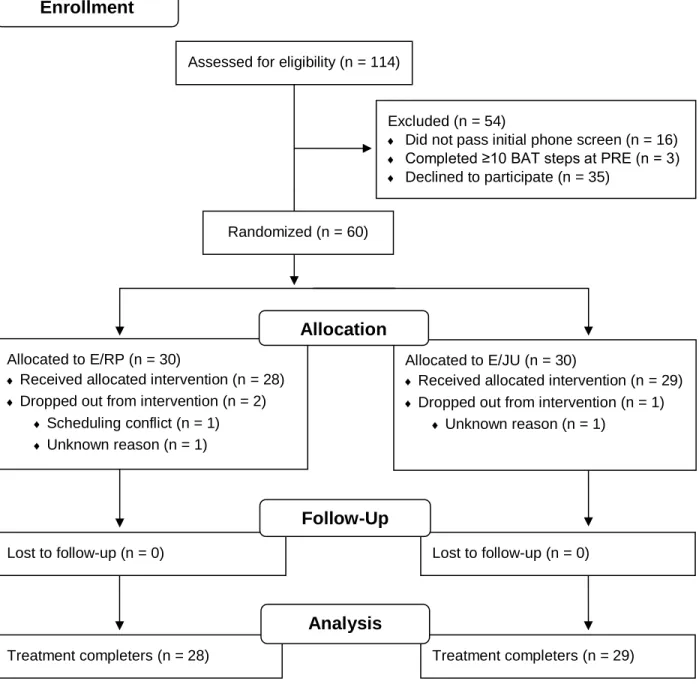
low dropout rate, analyses reported below were conducted using the completer sample only.2 Primary and secondary outcome descriptive data are presented in Table 2.
Primary Outcomes
Self-reported spider phobia symptom severity (FSQ). A 2 (condition) x 3 (time) mixed factorial ANOVA was used to examine the effect of treatment condition on FSQ scores. Results showed that although there was a significant main effect of time, F(2, 110) = 254.20, p < .001, η2 = .82, there was no significant main effect of condition, F(1, 55) = 1.62, p = .208, η2 = .03, and no significant interaction between time and condition, F(2, 110) = 1.27, p = .285, η2 = .02. Follow-up paired samples t-tests indicated that across conditions (i.e., in the entire sample), FSQ scores significantly improved from PRE (M = 90.19, SD = 19.80) to POST (M = 28.56, SD = 21.10), t(56) = 17.25, p < .001, d = 2.28, and from PRE to F/U (M = 30.32, SD = 21.87), t(56) = 16.10, p < .001, d = 2.13, but not from POST to F/U, t(56) = 1.08, p = .287, d = 0.14.
In vivo behavioral approach (BAT steps). A 2 (condition) x 3 (time) mixed factorial
ANOVA was used to examine the effect of treatment condition on completed BAT steps. Results showed that although there was a significant main effect of time, F(2, 110) = 247.52, p < .001, η2 = .82, there was no significant main effect of condition, F(1, 55) = 0.011, p = .919, η2 < .001, and no significant interaction between time and condition, F(2, 110) = 0.264, p = .769, η2 = .01. Follow-up paired samples t-tests indicated that across conditions, BAT scores significantly improved from PRE (M = 6.11, SD = 2.80) to POST (M = 11.44, SD = 2.21), t(56) = 16.42, p < .001, d = 2.18, and from PRE to F/U (M = 11.61, SD = 2.14), t(56) = 16.31, p < .001, d = 2.16, but not from POST to F/U, t(56) = 1.43, p = .159, d = 0.19.
Secondary Outcomes
Treatment acceptability and tolerability. A 2 (condition) x 3 (time) mixed factorial ANOVA was used to examine the effect of treatment condition on TAAS ratings. Results
showed that although there was a significant main effect of time, F(2, 110) = 115.02, p < .001, η2 = .68, there was no significant main effect of condition, F(1, 55) = 0.287, p = .594, η2 = .01, and no significant interaction between time and condition, F(2, 110) = 0.556, p = .575, η2 = .01. Follow-up paired-samples t-tests indicated that across conditions, TAAS scores were
significantly higher at POST (M = 62.11, SD = 6.17) relative to PRE (M = 53.63, SD = 6.34), t(56) = 13.59, p < .001, d = 1.89, and at F/U (M = 61.33, SD = 6.88) relative to PRE, t(56) = 10.82, p < .001, d = 1.43, but not at F/U relative to POST, t(56) = 1.57, p = .123, d = 0.21.
Peak BAT distress. A 2 (condition) x 3 (time) mixed factorial ANOVA was used to examine the effect of treatment condition on peak distress ratings during the BAT assessments. Results showed that although there was a significant effect of time, F(2, 106) = 44.47, p < .001, η2 = .46, there was no significant main effect of condition, F(1, 53) = 0.249, p = .620, η2 = .01, and no significant interaction between time and condition, F(2, 106) = 0.772, p = .465, η2 = .01. Follow-up paired samples t-tests indicated that across conditions, peak BAT distress ratings were significantly lower at POST (M = 7.22, SD = 5.90) relative to PRE (M = 12.98, SD = 5.07), t(54) = 6.88, p < .001, d = 0.93, and at F/U (M = 7.09, SD = 5.41) relative to PRE, t(54) = 7.42, p < .001, d = 1.00, but not at F/U relative to POST, t(54) = 0.729, p = .469, d = 0.10.
In vivo BAT distress tolerance. A 2 (condition) x 3 (time) mixed factorial ANOVA was
= .383, η2 = .02, and no significant interaction between time and condition, F(2, 104) = 0.859, p = .426, η2 = .02. Follow-up paired samples t-tests indicated that across conditions, BAT distress tolerance scores were significantly higher at POST (M = 9.13, SD = 1.32) relative to PRE (M = 6.30, SD = 2.63), t(53) = 7.801, p < .001, d = 1.06, and at F/U (M = 9.06, SD = 1.30) relative to PRE, t(53) = 7.80, p < .001, d = 1.06, but not at F/U relative to POST, t(56) = .125, p = .901, d = 0.02.
Exploratory Analyses (Exposure Process Variables) Exposure process data are presented in Table 3.
Negative expectancy for harm. An independent samples t-test showed that the mean negative expectancy rating across exposure trials was greater for participants in the E/RP condition (M = 45.83, SD = 17.63) than in the E/JU condition (M = 34.91, SD = 18.73), t(55) = 10.93, p = .027, d = 0.57.
Attentional focus on challenging negative predictions. An independent samples t-test did not detect a significant mean difference in attentional focus rating across exposure trials between participants in the E/RP condition (M = 79.02, SD = 20.96) and E/JU condition (M = 84.57, SD = 16.55), t(55) = 5.55, p = .271, d = 0.29.
Attributions for exposure outcome. A one sample t-test showed that the mean number of safety behavior-related attributions made by participants in the E/JU condition (M = 0.31, SD = 0.66) was significantly different from zero and therefore unlikely to be due to chance, t(28) = 0.31, p = .017, d = 0.47.
E/JU = 2). Nor could a chi-square test be used to compare the rate of exposure goal completion between groups, as fewer than 5 participants met their exposure goal for the first time at Session 4 (E/JU = 1). Visual inspection of the data (see Table 3) suggests that participants in the E/JU condition tended to reach their exposure goal earlier in treatment than did participants in the E/RP condition, although every E/RP participant met their exposure goal by the end of treatment.
Discussion
The “judicious use of safety behaviors” during exposure represents an ongoing
controversy with important clinical implications. Previous studies have sought to elucidate the effects of safety behaviors on exposure, but no study on this topic has applied a longitudinal treatment design or delivered exposure from an inhibitory learning framework. Furthermore, although advocates and opponents of response prevention both propose reasonable pathways through which safety behaviors might impede or enhance exposure, few studies have directly assessed these potential mechanisms in addition to symptom outcomes. The current randomized controlled trial was therefore designed to extend previous work surrounding the safety behavior debate by (a) allowing for the incorporation and fading of safety behaviors over the course of treatment, (b) using multi-method assessment of short- and long-term exposure outcomes, (c) increasing the number and duration of treatment sessions to better resemble clinical practice, and (d) incorporating measures of inhibitory learning in a community sample of adults with spider phobia.
Our primary hypothesis—that E/RP participants would demonstrate greater improvement than E/JU participants along self-report and behavioral symptom measures at follow-up but not posttreatment—was not supported. Participants in both conditions evidenced large (and
posttreatment, which were maintained over the follow-up period. Thus, our findings are
inconsistent with research linking safety behavior use to poorer treatment outcome (Helbig-Lang & Petermann, 2010) and lend support to the claim that safety behaviors do not necessarily interfere with exposure (Rachman et al., 2008). However, it is important to bear in mind that whereas previous experiments on this topic (with the exception of Levy & Radomsky, 2016) required participants randomized to a safety behavior condition to use safety behaviors during the entirety of the exposure, our study is the first to systematically fade safety behavior use over the course of multiple exposure sessions. Consequently, our data should be interpreted to suggest that safety behaviors do not preclude symptom improvement as long as they are faded out in time for individuals to confront feared situations/stimuli without the use of any such behaviors.
Regarding secondary outcomes, our hypothesis that treatment acceptability and
full (60-minute) therapy session devoted to psychoeducation, discussing the treatment rationale, and collaborative treatment planning.
It is also important to note that our observed treatment retention (95% completion) is inconsistent with the larger concern, held by some, that exposure faces a “refusal problem” or “unacceptably high” dropout rates. Although this could partially be due to the brevity of our intervention, our data do not lend support to the notion that safety behaviors increase patients’ willingness to agree to and complete exposure. That is, all participants who enrolled in this study consented to exposure, E/RP and E/JU participants perceived treatment to be equally acceptable, all but three participants completed treatment, and all but two participants (both E/JU) succeeded in meeting their exposure goal by the end of the third exposure. Of course, it also bears
mentioning that because all participants voluntarily signed up for this study and gave informed consent, these individuals might not be representative of adults with spider phobia in general. This study’s therapist training sequence also emphasized the importance of (a) providing a convincing and coherent treatment rationale and (b) communicating confidence in participants and the treatment approach as critical components of the intervention. Furthermore, therapists received regular (i.e., at least weekly) supervision, which is not typical of general clinical
practice. Although beyond the scope of the available data, it could be that such therapist-specific factors are more critical predictors of treatment refusal/dropout than are treatment- or participant-related factors (at least in the context of brief interventions for specific phobia). Future research directly assessing the relationship between therapist characteristics, exposure delivery, and treatment acceptability/tolerability would be helpful.
behavioral task at follow-up—was likewise not supported by the data. Specifically, participants in both conditions evidenced significant improvement on both indices from pre- to posttreatment, which did not deteriorate over the follow-up period. Some investigators have suggested that increasing a patient’s ability to tolerate psychological distress tolerance is critical to inhibitory learning (Abramowitz & Arch, 2014; Blakey & Abramowitz, 2016). To our knowledge, this is the first safety behavior study to measure perceived distress tolerance in addition to distress intensity. Future research on safety behaviors (and inhibitory learning models of exposure in general) should continue to examine the importance of distress tolerance to treatment outcome. In light of certain limitations to assessing distress tolerance via self-report (Magidson, Ali, Listhaus, & Daughters, 2013), investigators might further consider alternative approaches to measuring this construct in the context of exposure therapy.
Contrary to information processing accounts (Sloan & Telch, 2002), we did not detect a difference in self-reported attentional focus toward belief testing during exposure as a function of safety behavior use. Although our study does not provide support for the claim that safety
behaviors interfere with a patient’s ability to process disconfirmatory information when
confronting feared situations/stimuli, attentional focus ratings may have been biased in this study due to participant demand characteristics or inaccurate estimations of an automatic cognitive process. Future research on this proposed explanation for safety behaviors’ deleterious effects should incorporate objective (and perhaps implicit) measures of directed attention.
Our results are in line with the often-cited proposition that patients are prone to misattribute the non-occurrence of a feared exposure outcome to safety behaviors (e.g., “that spider did not bite me because I was wearing gloves”; Salkovskis, 1991). Specifically,
participants in the E/JU condition made more safety-behavior related attributions than would be expected by chance, which suggests that individuals performing safety behaviors during
exposure therapy do not entirely conclude that their fear-based predictions are exaggerated and/or irrational. Thus, one clinical implication of the current study is that therapists should explicitly frame a successful exposure outcome as discordant with the preconceived expectancy, making sure that their patients “give credit where credit is due” (i.e., not to a safety behavior) following a successful exposure task.
Results were somewhat consistent with previous research suggesting that anxious individuals can more quickly approach feared situations/stimuli when using safety behaviors (e.g., Hood et al., 2010). The degree to which differential rates of approach affect ultimate exposure success, however, appears negligible. Whereas as all E/RP participants met their
goal at any point during treatment and two additional E/JU participants were only able to reach their goal when using safety behaviors (i.e., they met their goal within the first two exposure sessions but did not meet their goal during the final exposure session, when safety behaviors were completely faded). Some experts (Jacoby, Abramowitz, Blakey, & Reuman, 2018) have argued that anticipatory anxiety regarding building up to more challenging exposure tasks (e.g., attempting to complete a previously achieved task but this time without safety behaviors) itself can cause patient dropout or decreases in self-efficacy. Therefore, a therapist should carefully consider whether it is in their patient’s best interest to approximate exposure goal completion via the strategic use of anxiety-reducing behaviors as opposed to budgeting an additional session (or sessions) for patients to attempt their exposure goal without the use of such behaviors.
On a broader level, our results are in line with the substantial body of research on the efficacy of exposure therapy for clinical anxiety; primary outcome effect sizes ranged from 2.13 to 2.28 (well above the recognized Cohen’s d cutoff value of 0.80 designating a “large” effect) and the sample did not exhibit relapse on any outcome measure at follow-up. These findings underscore the therapeutic potency of direct confrontation with feared (yet safe)
This study had several strengths, including the use of distinctive treatment and assessment stimuli, recruitment of a clinical sample, and solicitation of input on study design from both E/RP and E/JU experts. More importantly, this study built upon the body of existing work by incorporating important methodological features such as longitudinal design,
multimethod assessment, and measurement of psychological mechanisms relevant to inhibitory learning. Using a longitudinal design not only enhanced ecological validity (i.e., multiple sessions of exposure more closely resembles naturalistic treatment programs than do single-session paradigms), but also allowed for the first test of fading “judiciously used” safety behaviors as initially defined (Rachman et al., 2008).
At the same time, findings from this study should be understood within the context of several limitations. First, although this study used a clinical sample of adults recruited from the community, the sample was fairly homogeneous with respect to many demographic variables. Relatedly, we tested our hypotheses in the context of spider phobia; as such, findings may not generalize to other specific phobias or to more complex anxiety-related conditions. It is also worth noting that we compared the novel E/JU approach to a positive control group (i.e., traditional E/RP), but did not include an inactive (i.e., placebo) control group. Therefore, we cannot rule out passage of time and/or non-specific factors (e.g., expectation effects) in the interpretation of our results. Considering the extensive accumulated research demonstrating the efficacy and effectiveness of E/RP (e.g., Choy et al., 2007; Olatunji et al., 2010), however, our lack of an inactive control group is not a major concern.
Another set of limitations regards the way we operationalized the judicious use of safety behaviors in this study. Because this was the first longitudinal test of the “judicious use”
at the expense of external validity. For example, although we allowed for participants to self-select from several safety behaviors to match their personal preferences and/or exposure goal, it is possible that participants would use alternative safety behaviors in naturalistic settings. We also used a standardized safety behavior fading schedule over the course of treatment for participants in the E/JU condition. Although this allowed us to control the “dose” of safety behaviors across exposure sessions, true clinical practice would likely involve more therapist– patient negotiation regarding when and how to fade safety behaviors. In fact, preliminary evidence suggests that allowing patients to determine when to fade safety behavior use is more beneficial than therapist-driven safety behavior fading (Levy & Radomsky, 2016).
research might strive to examine the specific conditions under which safety behaviors are helpful, versus harmful, in the context of exposure.
One final consideration is that we tested the judicious use of safety behaviors—a proposal developed from a cognitive perspective—within an inhibitory learning framework. Although inhibitory learning theory overlaps with cognitive theory in many respects (e.g., a “negative expectancy” within the inhibitory learning model is akin to an “irrational belief” important to cognitive models), these two approaches emphasize different treatment objectives. Whereas cognitive therapy focuses on changing beliefs, inhibitory learning-based exposure therapy focuses on generating and strengthening new beliefs. Thus, although one would not expect empirical findings to vary as a function of the investigators’ theoretical orientation, it is possible that our approach to treatment delivery and assessment prevented us from capturing certain features of E/JU that might have been given greater attention within a cognitive
framework. At the same time, it could be that applying the inhibitory learning model sheds light on previously unconsidered benefits of permitting safety behaviors during exposure. For
example, theory suggests that fluctuations in the learning context (e.g., variable exposure intensity, stimuli, and settings) helps to strengthen inhibitory associations (Craske et al., 2014; Jacoby & Abramowitz, 2016). It is therefore possible that safety behaviors promote inhibitory learning to the extent that they function to introduce variability into exposure, versus
contextualize inhibitory associations.
45
Table 1
Safety behavior selection and helpfulness ratings among E/JU completers (n = 29)
Safety item Helpfulness rating Selected as
most helpful
Selected as second-most helpful
M SD Range n % n %
Long chemistry gloves 8.34 2.73 0-10 22 75.86 1 3.45
Short work gloves 6.41 2.58 0-10 5 17.24 1 3.45
Long-sleeve rain jacket 4.76 3.17 0-10 1 3.45 4 13.79
Plastic shield 3.97 3.35 0-10 1 3.45 11 37.93
Apron 2.72 2.55 0-9 0 0.00 4 13.79
Visor face shield 2.55 3.20 0-9 0 0.00 4 13.79
Boot/shoe covers 2.55 2.93 0-9 0 0.00 3 10.34