A CONTROLLED TRIAL OF TWO NUCLEOSIDE ANALOGUES PLUS INDINAVIR IN PERSONS WITH HUMAN IMMUNODEFICIENCY VIRUS INFECTION
AND CD4 CELL COUNTS OF 200 PER CUBIC MILLIMETER OR LESS
SCOTT M. HAMMER, M.D., KATHLEEN E. SQUIRES, M.D., MICHAEL D. HUGHES, PH.D., JANET M. GRIMES, M.S., LISA M. DEMETER, M.D., JUDITH S. CURRIER, M.D., JOSEPH J. ERON, JR., M.D., JUDITH E. FEINBERG, M.D.,
HENRY H. BALFOUR, JR., M.D., LAWRENCE R. DEYTON, M.D., JEFFREY A. CHODAKEWITZ, M.D., AND MARGARET A. FISCHL, M.D., FORTHE AIDS CLINICAL TRIALS GROUP 320 STUDY TEAM*
ABSTRACT
Background The efficacy and safety of adding a protease inhibitor to two nucleoside analogues to treat human immunodeficiency virus type 1 (HIV-1) infection are not clear. We compared treatment with the protease inhibitor indinavir in addition to zidovu-dine and lamivuzidovu-dine with treatment with the two nu-cleosides alone in HIV-infected adults previously treat-ed with zidovudine.
Methods A total of 1156 patients not previously treated with lamivudine or protease inhibitors were stratified according to CD4 cell count (50 or fewer vs. 51 to 200 cells per cubic millimeter) and randomly assigned to one of two daily regimens: 600 mg of zi-dovudine and 300 mg of lamivudine, or that regimen with 2400 mg of indinavir. Stavudine could be sub-stituted for zidovudine. The primary end point was the time to the development of the acquired immu-nodeficiency syndrome (AIDS) or death.
Results The proportion of patients whose disease progressed to AIDS or death was lower with indina-vir, zidovudine (or stavudine), and lamivudine (6 per-cent) than with zidovudine (or stavudine) and lami-vudine alone (11 percent; estimated hazard ratio, 0.50; 95 percent confidence interval, 0.33 to 0.76; P0.001). Mortality in the two groups was 1.4 per-cent and 3.1 perper-cent, respectively (estimated hazard ratio, 0.43; 95 percent confidence interval, 0.19 to 0.99; P0.04). The effects of treatment were similar in both CD4 cell strata. The responses of CD4 cells and plasma HIV-1 RNA paralleled the clinical results. Conclusions Treatment with indinavir, zidovudine, and lamivudine as compared with zidovudine and lamivudine alone significantly slows the progression of HIV-1 disease in patients with 200 CD4 cells or fewer per cubic millimeter and prior exposure to zi-dovudine. (N Engl J Med 1997;337:725-33.)
From Harvard Medical School, Boston (S.M.H.); the University of Ala-bama at Birmingham, Birmingham (K.E.S.); the London School of Hy-giene and Tropical Medicine, London (M.D.H.); Harvard School of Public Health, Boston (M.D.H., J.M.G.); the University of Rochester, Rochester, N.Y. (L.M.D.); the University of Southern California, Los Angeles (J.S.C.); the University of North Carolina, Chapel Hill (J.J.E.); the University of Cincinnati, Cincinnati (J.E.F.); the University of Minnesota, Minneapolis (H.H.B.); the Division of AIDS, National Institute of Allergy and Infec-tious Diseases, Bethesda, Md. (L.R.D.); Merck and Co., West Point, Pa. (J.A.C.); and the University of Miami, Miami (M.A.F.). Address reprint re-quests to Dr. Hammer at the Division of Infectious Diseases, Beth Israel Deaconess Medical Center, 1 Deaconess Rd., Boston, MA 02215.
Other authors were John P. Phair, M.D. (Northwestern University), Wil-liam Spreen, Pharm.D. (Glaxo–Wellcome), Louise Pedneault, M.D. (Bris-tol-Myers Squibb), Bach-Yen Nguyen, M.D. (Merck), and Jon C. Cook, B.Sc. (AIDS Clinical Trials Group Operations Center).
*The institutions and investigators participating in the AIDS Clinical Trials Group 320 Study are listed in the Appendix.
ROGRESS in the field of antiretroviral ther-apy for human immunodeficiency virus type 1 (HIV-1) infection has brought the end of the zidovudine-monotherapy era,1-3 an
im-proved understanding of the pathogenesis of HIV-1 disease,4-9 demonstrations of the prognostic
impor-tance of plasma HIV-1 RNA quantification,10-17 and
the availability of increasingly potent therapeutic agents. Much of this progress is linked to the intro-duction of the HIV-protease inhibitors, drugs that inhibit the processing of Gag and Gag–Pol polypro-tein precursors and thus prevent the maturation of virions.18-20 Trials of HIV-protease inhibitors have
shown beneficial effects on CD4 cell counts and plas-ma HIV-1 RNA concentrations to a degree not pre-viously described with approved reverse-transcriptase inhibitors.21-26 The most notable findings have
in-volved three-drug combinations that include a po-tent HIV-protease inhibitor and two nucleoside
alogues. Specifically, when patients previously ex-posed to zidovudine who had either 50 to 400 or 50 or fewer CD4 cells per cubic millimeter were treated with indinavir, zidovudine, and lamivudine, plasma HIV-1 RNA concentrations were suppressed to less than 500 copies per milliliter in 85 percent and 65 percent of patients, respectively.24,25 These
findings have raised the important question of the clinical efficacy and safety of a three-drug regimen containing indinavir. We addressed that issue in this study.
METHODS
Study Design and Patients
The AIDS Clinical Trials Group 320 Study was a randomized, double-blind, placebo-controlled trial that compared the three-drug regimen of indinavir (Crixivan), open-label zidovudine (Retrovir) or stavudine (Zerit), and lamivudine (Epivir) with the two-drug regimen of zidovudine (or stavudine) and lamivudine in HIV-infected patients who had no more than 200 CD4 cells per cubic millimeter and at least three months of prior zidovudine therapy. The randomization was stratified according to the CD4 cell count obtained at the time of screening (50 or fewer cells per cubic millimeter as compared with 51 to 200 cells per cubic mil-limeter). The study was designed to enroll 1750 patients, with 40 percent of them in the stratum with 50 or fewer CD4 cells per cubic millimeter. The primary outcome measure in the assess-ment of efficacy was the developassess-ment of a new acquired immu-nodeficiency syndrome (AIDS)–defining event (except when the AIDS-defining event was the development of Pneumocystis carinii pneumonia, in which case both new and recurrent events were ac-cepted as outcome measures) or death; in the assessment of safe-ty, the outcome measure was the occurrence of adverse events (signs, symptoms, or laboratory abnormalities) defined as severe or worse according to the grading scheme of the AIDS Clinical Trials Group.27 The secondary outcome measures studied were
death and changes in CD4 cell counts and plasma HIV-1 RNA concentrations.
The patients, recruited from 33 AIDS Clinical Trials Units and 7 National Hemophilia Foundation sites in the United States and Puerto Rico (see the Appendix), had to be more than 16 years old and had to have laboratory documentation of HIV-1 infec-tion, a CD4 cell count of 200 per cubic millimeter or less within the 60 days before entry into the study, at least 3 months of prior zidovudine treatment, no more than 1 week of prior lamivudine treatment, no prior treatment with protease inhibitors, a Karnof-sky performance score of at least 70, and acceptable laboratory values. The study was approved by the institutional review boards of the participating institutions, and all the patients gave written informed consent.
The patients received open-label zidovudine (200 mg three times daily) and lamivudine (150 mg two times daily) and were randomly assigned to receive indinavir (800 mg) or matching pla-cebo every eight hours. In the first version of the protocol, only patients who could tolerate zidovudine and who had had at least 6 months of prior zidovudine therapy were enrolled, and the sub-stitution of stavudine for zidovudine was permitted in the event of drug-associated toxicity at any point after randomization or if clinical progression of HIV-1 disease occurred that did not fulfill the criteria for a protocol-defined AIDS event at or beyond 24 weeks of study. The dose of stavudine was 40 mg two times daily (or 30 mg two times daily for patients weighing less than 60 kg). A protocol modification in October 1996 reduced the required prior exposure to zidovudine to at least three months and permit-ted patients who could not tolerate zidovudine to enter the study with stavudine substituted for zidovudine at the time of random-ization. Prophylaxis for P. carinii pneumonia was mandated.
Pro-phylaxis for other opportunistic infections was permitted, al-though the use of rifabutin was prohibited.
Patients who had verified AIDS-defining events were offered open-label indinavir therapy with the approval of the study chairs and without having their initial treatment assignments revealed. All potential AIDS-defining events were reviewed in a blinded fashion by the study chair; only those that met the criteria defined in the study protocol were included in the analysis.
Monitoring and Enrollment
The patients were followed at weeks 4, 8, and 16 and every eight weeks thereafter with a clinical assessment and routine lab-oratory monitoring. CD4 cell counts were determined twice at base line and at weeks 4, 8, 24, and 40. Enrollment began in Jan-uary 1996. The study was reviewed twice by a data and safety monitoring board. At the second such review, on February 18, 1997, the comparison of the groups based on data on the patients randomized by January 27, 1997, showed a significant difference between groups that met the prespecified guideline for stopping the study.28 At that time, the board recommended that the
accru-al of patients be terminated and the study closed.
Plasma HIV-1 RNA concentrations were determined retro-spectively in appropriately stored specimens from 190 randomly selected patients. These concentrations were measured twice at base line and at weeks 4, 8, 24, and 40 (Roche Amplicor HIV-1 Monitor assay).29
Statistical Analysis
The times to events were compared between treatment groups by Kaplan–Meier estimates, log-rank tests, and proportional-haz-ards models stratified according to the CD4 cell count obtained at the time of screening (50 or fewer vs. 51 to 200 cells per cubic millimeter).30 Changes in CD4 cell counts over time were
com-pared in a mixed-effects regression model.31 An analysis of
covar-iance adjusted for the screening CD4 cell count and the AIDS Clinical Trials Unit was used to compare changes in the CD4 cell count and the HIV-1 RNA concentration at each measurement.32
With regard to changes in HIV-1 RNA, this calculation used a regression for censored data: concentrations below the limit of quantification, 500 copies per milliliter, were censored.33 Analyses
of all the variables pertaining to efficacy were performed on an intention-to-treat basis that included data on all patients random-ized and all available follow-up data (including that obtained after the discontinuation of the study treatment). In the analyses of ad-verse events, the treatments were compared by a chi-square test; the follow-up data were censored either when a patient began re-ceiving open-label indinavir or 56 days after the permanent dis-continuation of the study treatment, whichever came first, and were restricted to patients for whom the study treatment was dis-pensed. All reported P values are two-sided. P values, estimates of differences between treatments, and 95 percent confidence inter-vals are unadjusted for the repeated interim analyses.
RESULTS
Accrual and Characteristics of the Patients
There were 1156 patients randomized between January 29, 1996, and January 27, 1997. Of these, 439 (38 percent) had 50 CD4 cells or fewer per cu-bic millimeter and 717 (62 percent) had 51 to 200 CD4 cells per cubic millimeter. The base-line char-acteristics of the study patients (Table 1) were well balanced between treatment groups.
Duration of Follow-up and Study Treatment
the duration of follow-up and the percentage of pa-tients lost to follow-up were similar in both treat-ment groups and both CD4-cell strata.
Ten patients did not have any study treatment. Of the remaining 1146 patients, 227 (20 percent) dis-continued the study treatment prematurely, more than seven days before reaching a study end point. The proportion who discontinued the study treat-ment was higher in the group receiving zidovudine (or stavudine) and lamivudine (28 percent) than in the group receiving indinavir, zidovudine (or stavu-dine), and lamivudine (12 percent, P0.001). In the stratum with 50 CD4 cells or fewer per cubic millimeter, the proportions of patients discontinuing the study treatment in the two groups were 32 per-cent and 16 perper-cent, respectively (P0.001), and in the stratum with 51 to 200 CD4 cells per cubic millimeter, these proportions were 26 percent and 9 percent (P0.001). Only 4 percent of patients (10 of 227) discontinued the study treatment pre-maturely because of protocol-defined adverse events: 4 patients assigned to zidovudine (or stavudine) and lamivudine and 6 patients assigned to indinavir, zi-dovudine (or stavudine), and lamivudine. Among the premature discontinuations, 52 percent (117 of 227) were initiated by the patients, and for approximately half these patients the reasons given included a de-sire to seek open-label therapy with protease inhibi-tors, concern about the plasma HIV-1 RNA
concen-tration (on the basis of determinations made outside the study), or both.
Progression of Disease
Ninety-six patients (8 percent) had AIDS-defining events or died (Table 2). Sixty-three patients (11 percent) assigned to zidovudine (or stavudine) and lamivudine had disease progression, as compared with 33 patients (6 percent) assigned to indinavir, zi-dovudine (or stavudine), and lamivudine (P0.001; estimated hazard ratio, 0.50; 95 percent confidence interval, 0.33 to 0.76) (Fig. 1A). There was no sig-nificant difference in the relative effects of the two treatments between the patients with 50 CD4 cells or fewer per cubic millimeter and the patients with 51 to 200 CD4 cells per cubic millimeter. Forty-four patients in the former stratum (20 percent) had AIDS-defining events or died in the group assigned to zidovudine (or stavudine) and lamivudine, as compared with 23 patients (11 percent) in the group assigned to indinavir, zidovudine (or stavu-dine), and lamivudine (P0.005; estimated hazard ratio, 0.49; 95 percent confidence interval, 0.30 to 0.82) (Fig. 1B). In the stratum with 51 to 200 CD4 cells per cubic millimeter, 19 patients (5 percent) had AIDS-defining events or died in the group as-signed to zidovudine (or stavudine) and lamivudine, as compared with 10 patients (3 percent) in the group assigned to indinavir, zidovudine (or
stavu-*Plus–minus values are means SD. Because of rounding, not all columns total 100 percent.
†Values shown are the means of two measurements obtained at least one day apart. Values obtained at screening, which had to be 200 cells per cubic millimeter, were not included in this calculation. ‡HIV-1 RNA was measured in a randomly selected cohort of 190 patients (75 patients with 50 CD4 cells or fewer per cubic millimeter and 115 patients with 51 to 200 CD4 cells per cubic milli-meter).
TABLE 1. BASE-LINE CHARACTERISTICSOFTHE PATIENTS ACCORDINGTO CD4 CELL COUNTATTHE TIMEOF SCREENING.*
CHARACTERISTIC
ALL PATIENTS
(N1156) CD4 COUNTPER CUBIC MILLIMETER 50 CELLS
(N439)
51–200 CELLS
(N717)
Male sex — no. (%) 956 (83) 365 (83) 591 (82)
Age — yr 399 398 409
Race or ethnic group — no. (%) White, non-Hispanic African American Hispanic
Asian Pacific or other
598 (52) 328 (28) 205 (18) 25 (2)
203 (46) 142 (32) 84 (19) 10 (2)
395 (55) 186 (26) 121 (17) 15 (2) Injection-drug use — no. (%)
Hemophilia — no. (%)
184 (16) 36 (3)
67 (15) 16 (4)
117 (16) 20 (3)
Karnofsky score 90 — no. (%) 942 (81) 317 (72) 625 (87)
CD4 count — cells/mm3† 8770 2224 12659
HIV-1 RNA — log10 copies/ml‡ 5.00.6 5.20.5 4.90.7
Months of prior zidovudine therapy, alone or in combination — median (25th, 75th percentile)
dine), and lamivudine (P0.08; estimated hazard ratio, 0.51; 95 percent confidence interval, 0.24 to 1.10) (Fig. 1C).
Overall, 26 patients died (2.2 percent) (Table 2). Eighteen patients (3.1 percent) died in the group as-signed to zidovudine (or stavudine) and lamivudine, as compared with eight (1.4 percent) in the group assigned to indinavir, zidovudine (or stavudine), and lamivudine (P0.04; estimated hazard ratio, 0.43; 95 percent confidence interval, 0.19 to 0.99). There was no significant difference in the relative effects of the two treatments between the two strata. Among the patients with 50 CD4 cells or fewer per cubic millimeter, 13 patients receiving only the two nucle-oside analogues died (5.9 percent), as compared with 5 patients receiving all three drugs (2.3 percent; P0.05; estimated hazard ratio, 0.37; 95 percent confidence interval, 0.13 to 1.04). Among the pa-tients with 51 to 200 CD4 cells per cubic millimeter, five patients assigned to zidovudine (or stavudine) and lamivudine (1.4 percent) died, as compared with three patients assigned to indinavir, zidovudine (or stavudine), and lamivudine (0.8 percent).
A total of 109 of the 1156 patients (9.4 percent) were treated with stavudine instead of zidovudine before the development of an AIDS-defining event or death. None of the three patients who were ini-tially assigned to stavudine had a protocol-defined end point. Among the 106 patients in whom stavu-dine was substituted for zidovustavu-dine after random-ization, 3 (all in the two-nucleoside group) had AIDS-defining events, and none died.
AIDS-Defining Events
In all, there were 91 AIDS-defining events (in-cluding multiple events per patient). Sixty of these occurred among the patients assigned to receive zi-dovudine (or stavudine) and lamivudine, as
com-pared with 31 among the patients assigned to indin-avir, zidovudine (or stavudine), and lamivudine. The most common events were infections with P. carinii,
cytomegalovirus, and Mycobacterium avium com-plex (constituting 25 percent, 20 percent, and 16 percent of events, respectively).
Changes in CD4 Cell Counts
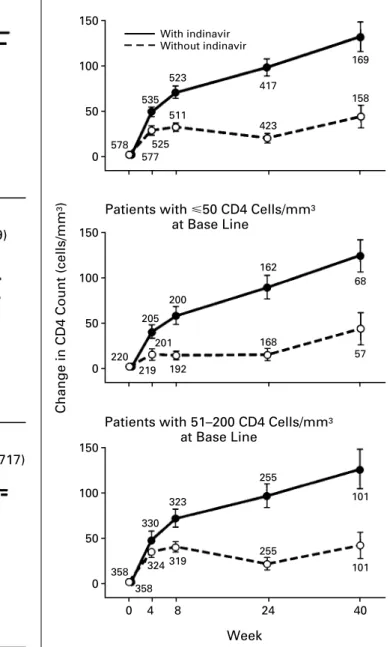
Increased CD4 cell counts that persisted above base-line values were seen in both treatment groups, with superior responses in the group receiving indin-avir. At weeks 4, 8, 24, and 40, the mean CD4 cell count in the patients assigned to zidovudine (or stav-udine) and lamivudine increased by 27, 30, 18, and 40 cells per cubic millimeter, respectively. The corre-sponding mean increases in the patients assigned to indinavir, zidovudine (or stavudine), and lamivudine were 46, 65, 91, and 121 cells per cubic millimeter (Fig. 2A). Thus, the change at week 4 was greater by 19 cells per cubic millimeter (P0.001) in the group that received indinavir, and the difference increased with time (P0.001), to 36, 73, and 82 cells per cu-bic millimeter at weeks 8, 24, and 40, respectively.
The responses of the CD4 cell count to treatment are shown in Figures 2B and 2C. In the group re-ceiving zidovudine (or stavudine) and lamivudine, the early increases from base line — those at weeks 4 and 8 — were smaller in the stratum with 50 CD4 cells or fewer per cubic millimeter than in the stra-tum with 51 to 200 CD4 cells per cubic millimeter. However, the changes from base line in the longer term — those at weeks 24 and 40 — were similar in the two strata. Exploratory analyses of the CD4 cell counts in the two treatment groups when the data were censored at the times patients changed from the treatment to which they were initially assigned showed increases from base line that were similar to those in the intention-to-treat analyses at weeks 4,
*The reference group is the group receiving zidovudine (or stavudine) and lamivudine. †Values were calculated by the log-rank test.
TABLE 2. RATESOF DISEASE PROGRESSION ACCORDINGTO CD4 CELL COUNT ATTHE TIMEOF SCREENING.
VARIABLE
INDINAVIR, ZIDOVUDINE
(OR STAVUDINE),
AND LAMIVUDINE
ZIDOVUDINE
(OR STAVUDINE)
AND LAMIVUDINE
HAZARD RATIO
(95% CONFIDENCE
INTERVAL)* P VALUE†
no. of patients (%)
All patients AIDS or death Death
577 33 (6)
8 (1)
579 63 (11) 18 (3)
0.50 (0.33–0.76) 0.43 (0.19–0.99)
0.001 0.04
50 CD4 cells/mm3 AIDS or death Death
219 23 (11)
5 (2)
220 44 (20) 13 (6)
0.49 (0.30–0.82) 0.37 (0.13–1.04)
0.005 0.05 51–200 CD4 cells/mm3
AIDS or death Death
358 10 (3)
3 (1)
359 19 (5)
5 (1)
0.51 (0.24–1.10) 0.59 (0.14–2.46)
8, and 24 (data not shown). At week 40, the differ-ence between the two treatment groups was smaller in the intention-to-treat analysis than in the cen-sored analysis (difference in mean change, 82 vs. 115 cells per cubic millimeter), suggesting that the dif-ference may have been reduced by the greater pro-portion of subjects who changed treatment in the group receiving zidovudine (or stavudine) and lami-vudine.
Changes in Plasma HIV-1 RNA Concentrations
The responses of the plasma HIV-1 RNA concen-trations to treatment were studied in 190 randomly selected patients. There were persistent decreases from the base-line values in both treatment groups, with significantly better responses in the group whose treatment included indinavir (P0.001 in an area-under-the-curve analysis). At weeks 4, 8, 24, and 40, the mean decreases in plasma HIV-1 RNA
Figure 1. Kaplan–Meier Estimates of the Proportion of Patients
Who Did Not Reach the Primary Study End Point of AIDS or Death.
0.0 1.0 0.8 0.6 0.4 0.2
8
0 16 24 32 40 48
Week
Proportion Surviving without AIDS
0.0 1.0 0.8 0.6 0.4 0.2
Patients with 51–200 CD4 Cells/mm3 (N717)
0.0 1.0 0.8 0.6 0.4 0.2
Patients with 50 CD4 Cells/mm3 (N439) All Patients (N1156)
With indinavir Without indinavir
Figure 2. Mean Changes from Base Line in the CD4 Cell Count.
The number of patients who could be evaluated at each time point is shown. Bars indicate 95 percent confidence intervals.
0 150 100 50
8 4
0 24 40
Week
Change in CD4 Count (cells/mm
3)
Patients with 51–200 CD4 Cells/mm3 at Base Line
Patients with 50 CD4 Cells/mm3 at Base Line
All Patients
With indinavir Without indinavir
358 358 324 319
330 323
255
255
101
101
0 150 100 50
219 220
201
192 205
200
162
168
68
57
0 150 100 50
577
578 525
535 523
511
417
423
169
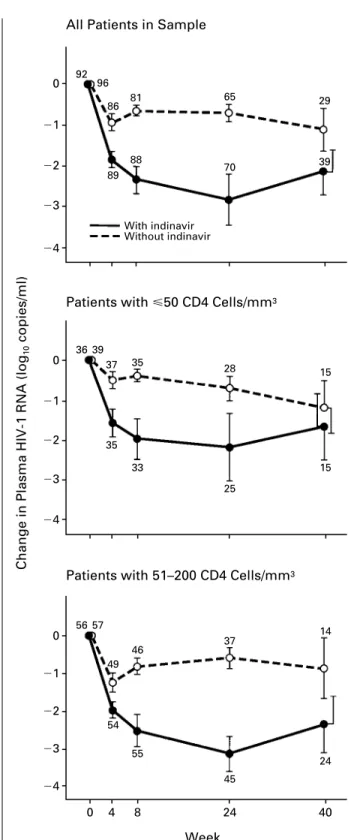
in the group receiving zidovudine (or stavudine) and lamivudine were 0.9, 0.6, 0.6, and 1.0 log10 copies
per milliliter, respectively. The corresponding de-creases in the group receiving indinavir, zidovudine (or stavudine), and lamivudine were 1.8, 2.3, 2.8, and 2.1 log10 copies per milliliter (Fig. 3A). The
changes from base line were significantly greater at each time point in the group treated with indinavir (P0.001 at weeks 4, 8, and 24; P0.007 at week 40). At week 24, the proportion of patients with plasma HIV-1 RNA concentrations of less than 500 copies per milliliter was 9 percent in the two-nucle-oside group, as compared with 60 percent in the group treated with indinavir.
The plasma HIV-1 RNA responses according to the CD4 cell count are shown in Figures 3B and 3C. In the patients with 50 CD4 cells or fewer per cubic millimeter, the decreases in plasma HIV-1 RNA ap-peared to be smaller than those in the patients with 51 to 200 CD4 cells per cubic millimeter. However, conclusions about stratum-specific plasma HIV-1 RNA responses need to be made cautiously because of the small numbers of patients followed through week 40.
Adverse Events
The proportion of patients with signs and symp-toms that were severe (grade 3) or worse (grade 4) in the group receiving zidovudine (or stavudine) and lamivudine was 18 percent, as compared with 21 percent in the group receiving indinavir, zidovudine (or stavudine), and lamivudine (P0.17). The most common symptoms were nonspecific discomfort, malaise, fever, headache, and nausea and vomiting, with no difference in the reporting of symptoms be-tween treatment groups.
The proportion of patients with severe laboratory abnormalities or worse in the group receiving zido-vudine (or stazido-vudine) and lamizido-vudine was 26 per-cent, as compared with 21 percent in the group receiving indinavir, zidovudine (or stavudine), and lamivudine (P0.06). This difference primarily re-flected a difference between the groups in the inci-dence of neutropenia (15 percent and 5 percent, re-spectively; P0.001). In contrast, the proportion of patients with hyperbilirubinemia was 1 percent in the two-nucleoside group, as compared with 6 per-cent in the group treated with indinavir (P0.001), a finding compatible with the known elevation of in-direct bilirubin associated with the use of indinavir. Two percent of the patients in each treatment group had hyperglycemia.
Five patients receiving zidovudine (or stavudine) and lamivudine (1 percent) had episodes of renal colic or nephrolithiasis (irrespective of grade), as compared with 21 patients receiving indinavir, zido-vudine (or stazido-vudine), and lamizido-vudine (4 percent, P0.001). Three of the five patients in the
two-Figure 3. Mean Change from Base Line in the Plasma HIV-1
RNA Concentration.
For this analysis, 190 patients were randomly selected and their HIV-1 RNA concentrations were studied. The number of patients who could be evaluated at each time point is shown. Bars indicate 95 percent confidence intervals.
4
3
2
1 0
0 4 8 24 40
Week
Change in Plasma HIV-1 RNA (Iog
10
copies/ml)
Patients with 51–200 CD4 Cells/mm3 Patients with 50 CD4 Cells/mm3
With indinavir Without indinavir
45 55
54 49 56 57
46 37
24 14 4
3
2
1 0
25 33
35 37 36 39
35
28
15 15 4
3
2
1 0
70 88
89 86 92
96
81 65
nucleoside group in whom renal colic or nephro-lithiasis developed had that condition after discon-tinuing the study treatment and starting open-label indinavir treatment.
Five new diagnoses of diabetes mellitus were re-corded: two in the two-nucleoside group and three in the group treated with indinavir.
DISCUSSION
This study showed the clinical superiority of the three-drug regimen containing indinavir over the two-nucleoside combination in patients previously treated with zidovudine who had CD4 cell counts of 200 per cubic millimeter or less. The proportion of patients whose disease progressed to AIDS or death was reduced from 11 percent to 6 percent by the three-drug combination, a 50 percent reduction (P0.001). The hazard ratios in the study patients as a whole (0.50), those with CD4 cell counts of 50 per cubic millimeter or less (0.49), and those with counts of 51 to 200 per cubic millimeter (0.51) were very similar, suggesting that the effect of treat-ment was similar across the study population, al-though the possibility of differential effects cannot be ruled out. Mortality, low in both groups, was re-duced from 3.1 percent to 1.4 percent with the three-drug regimen (P0.04). Thus, there was evi-dence of a reduction in mortality that was consistent with the reduced risk of progression to the primary outcome measure of AIDS or death.
The rate of loss to follow-up in this study was low (5 percent), and the overall rate of premature dis-continuation of treatment was moderate (20 per-cent). Seventy-nine percent of the 96 AIDS-defining events or deaths occurred while the patients were re-ceiving the study treatment or within seven days of its discontinuation. Although rates of withdrawal from treatment differed between the two study groups, the tendency for patients who withdrew prematurely from the two-nucleoside group to seek treatment with protease inhibitors would tend to narrow the differences between the groups in rates of disease progression and therefore should not affect the con-clusions of the study. Conversely, when a study is ter-minated early because a stopping guideline is used, differences between the treatment groups tend to be overestimated because of random variation.34
How-ever, it is impossible to determine the relative mag-nitude of these effects.
These findings confirm on the basis of clinical end points the results of earlier trials of the combination of indinavir, zidovudine, and lamivudine in patients previously treated with zidovudine, trials that showed that the three-drug combination produces superior responses in plasma HIV-1 RNA concentrations and CD4 cell counts.24,25 The suppression of plasma
HIV-1 RNA to unquantifiable levels in the majority of subjects with this drug combination is
accompa-nied by greater suppression of HIV-1 RNA expres-sion in lymphoid tissue35 and may prevent the
emer-gence of resistance — factors that may add to the clinical benefit now established for this regimen. Our study also found superior responses of CD4 cells and plasma HIV-1 RNA with the three-drug regimen.
We chose the combination of zidovudine and la-mivudine as the control treatment because of the unique interactions between these two agents with respect to mutations conferring resistance, the re-sults of phase 2 trials, the tolerance associated with the regimen, and its widespread use in clinical prac-tice.36-40 The clinical benefit of lamivudine when that
drug is added to previously available nucleoside an-alogues to treat patients with 25 to 250 CD4 cells per cubic millimeter was recently confirmed in the CAESAR trial, in which the risk of AIDS or death was reduced by approximately 50 percent.41 In the
control group in our study, there was a relatively low rate of disease progression, as well as a moderate increase in the CD4 cell count and a decline in plas-ma HIV-1 RNA; these persisted throughout the study, even though it is now recognized that simply adding lamivudine to a preexisting regimen is not a standard clinical approach. The strength of the con-trol group in this study is also an important differ-ence between this study and previously reported studies of other HIV-protease inhibitors that have assessed clinical end points.42,43 In the Abbott
M94-247 trial, ritonavir or placebo was added to stable prior nucleoside-analogue therapy or no therapy.42
In the Hoffmann–La Roche NV14256 trial, a regi-men of saquinavir plus zalcitabine was compared with zalcitabine monotherapy.43 In the context of these
other trials, our study makes it clear that more po-tent therapies, now represented by three-drug regi-mens containing a protease inhibitor, are preferable in patients with advanced disease. The durability of the clinical benefit conferred by indinavir as part of a three-drug regimen has not been fully defined, however.
Improving the use of the currently approved agents to treat HIV-1 infection, and the promising drugs on the clinical horizon,44-46 in the management of
HIV-1 disease remains a challenge.47 However, this
study supports the view that employing well-tolerat-ed regimens of increasing potency will translate into greater clinical benefits for patients with HIV-1 in-fection.
Supported in part by the AIDS Clinical Trials Group, National Institute of Allergy and Infectious Diseases; by the General Clinical Research Center units funded by the National Center for Research Resources; and by Merck and Co. (for institutions enrolling more than 30 patients).
APPENDIX
The following institutions and investigators participated in the AIDS Clinical Trials Group 320 Study: University of North Carolina — T. Lane and J. Horton; University of Cincinnati — D. Neumann and B. Letcher;
University of Puerto Rico — G. Vazquez, M. Cruz-Ortiz, and I. Lopes;
University of Minnesota — C. Kumekawa, R. Schut, and S. Swindells; Wash-ington University — P. Tebas, W. Powderly, and A. Slack; Ohio State Uni-versity College of Medicine — M. Para, R. Fass, and J. Neidig; Northwestern University — J. Pulvirenti and J. Pottage, Jr.; University of Alabama and Emory University — J. Lennox and K. Tamburello; New YorkUniversity Medical Center and Bellevue Hospital — R. Gulick, J. Dowling, and M. La-verty; University of Miami — E. Scerpella and A. Rodriguez; University of Texas at Galveston — R. Pollard, S. Hausrath, and M. Pickthall; Case West-ern Reserve University — B. Gripshover, H. Valdez, and M. Chance;
Howard University — R. Delapenha, J. McNeil, and Y. Butler; Harvard University and Boston Medical Center — L. Jackson-Pope and T. Cooley;
University of Rochester — R. Hewitt and C. Greisberger; University of Cal-ifornia, Los Angeles — R. Mitsuyasu, M. Guerrero, and P. Miller; Indiana University Hospital — K. Fife, H. Nixon, and D. Heise; Meharry Medical College and Vanderbilt University Medical Center — M.A. South, D. Haas, and S. Raffanti; Duke University — C. Hicks, P. Robinson, and K. Shipp;
University of California, San Diego — C. Fegan, T.-C. Meng, and S. Little;
Johns Hopkins University — R. Becker, M. Higgins, L. Apuzzo, and J.B. Jackson; Mount Sinai Medical Center — P. Gerits, H. Mendoza, and D. Mildvan; University of Pennsylvania — R.R. MacGregor, I. Matozzo, and E. McCann; University of Southern California — M. Dube and C. Ol-sen; University of Colorado — D. Kuritzkes, B. Putnam, and D. Torre; Tu-lane University and Louisiana State University — J. Lertora, R. Clark, and M. Beilke; University of Hawaii — S. Souza, M. Millard, and L. Oshita;
Stanford University — T. Merigan, Jr., J. Fessel, and D. Israelski; Memorial Sloan-Kettering Cancer Center — M. Giordano, P. Ristau, and M. Granville; University of Washington, Seattle — A. Collier, R. Vasquez, B. Royer, and R. Coombs; New York University Medical Center and Belle-vue Hospital (pediatricsite) — W. Borkowsky, S. Chandwani, and M. Mint-er; Columbus Children’s Hospital — M. Brady, J. Hunkler, and C. Callaway;
Medical University of South Carolina — G. Johnson and E. Matters; Na-tional Hemophilia Foundation — T. Coates, T. Hofstra, W.-Y. Wong, E. Eyster, S. Seremetis, C. Kessler, S. Stabler, W. Hanna, C. Leissenger, J. Gill, P. Timmons, W.K. Hoots, and M. Cantini; Division of AIDS, Na-tional Institute of Allergy and Infectious Diseases — J. Ioannidis and A. Mar-tinez; Statistical and Data Management Center — K. Kazial; Harvard School of Public Health — S.-H. Liou; Community Constituency Group — H. Chang; Bristol-Myers Squibb — J. Skovronski and L. Dunkle; Merck and Co. — A. Meibohm.
REFERENCES
1.Hammer SM, Katzenstein DA, Hughes MD, et al. A trial comparing nucleoside monotherapy with combination therapy in HIV-infected adults with CD4 cell counts from 200 to 500 per cubic millimeter. N Engl J Med 1996;335:1081-90.
2.The Delta Coordinating Committee. Delta: a randomised double-blind controlled trial comparing combinations of zidovudine plus didanosine or zalcitabine with zidovudine alone in HIV-infected individuals. Lancet 1996;348:283-91.
3.Englund JA, Baker CJ, Raskino C, et al. Zidovudine, didanosine, or both as the initial treatment for symptomatic HIV-infected children. N Engl J Med 1997;336:1704-12.
4.Wei X, Ghosh SK, Taylor ME, et al. Viral dynamics in human immuno-deficiency virus type 1 infection. Nature 1995;373:117-22.
5.Ho DD, Neumann AU, Perelson AS, Chem W, Leonard JM, Markowitz M. Rapid turnover of plasma virions and CD4 lymphocytes in HIV-1 in-fection. Nature 1995;373:123-6.
6.Perelson AS, Neumann AU, Markowitz M, Leonard JM, Ho DD. HIV-1 dynamics in vivo: virion clearance rate, infected cell life-span, and viral generation time. Science 1996;271:1582-6.
7.Havlir DV, Richman DD. Viral dynamics of HIV: implications for drug development and therapeutic strategies. Ann Intern Med 1996;124:984-94.
8.Haase AT, Henry K, Zupancic M, et al. Quantitative image analysis of HIV-1 infection in lymphoid tissue. Science 1996;274:985-9.
9.Fauci AS. Host factors and the pathogenesis of HIV-induced disease. Nature 1996;384:529-34.
10.Katzenstein DA, Hammer SM, Hughes MD, et al. The relation of vi-rologic and immunologic markers to clinical outcomes after nucleoside therapy in HIV-infected adults with 200 to 500 CD4 cells per cubic mil-limeter. N Engl J Med 1996;335:1091-8.
11.Mellors JW, Kingsley LA, Rinaldo CR Jr, et al. Quantitation of HIV-1 RNA in plasma predicts outcome after seroconversion. Ann Intern Med 1995;122:573-9.
12.Mellors JW, Rinaldo CR Jr, Gupta P, White RM, Todd JA, Kingsley LA. Prognosis in HIV-1 infection predicted by the quantity of virus in plasma. Science 1996;272:1167-70.
13.Mellors JW, Munoz A, Giorgi JV, et al. Plasma viral load and CD4 lymphocytes as prognostic markers of HIV-1 infection. Ann Intern Med 1997;126:946-54.
14.Welles SL, Jackson JB, Yen-Lieberman B, et al. Prognostic value of plasma human immunodeficiency virus type 1 (HIV-1) RNA levels in pa-tients with advanced HIV-1 disease and with little or no zidovudine ther-apy. J Infect Dis 1996;174:696-703.
15.Coombs RW, Welles SL, Hooper C, et al. Association of plasma hu-man immunodeficiency virus type 1 RNA level with risk of clinical progres-sion in patients with advanced infection. J Infect Dis 1996;174:704-12.
16.Hughes MD, Johnson VA, Hirsch MS, et al. Monitoring plasma HIV-1 RNA levels in addition to CD4 lymphocyte count improves assessment of antiretroviral therapeutic response. Ann Intern Med 1997;126:929-38.
17.O’Brien WA, Hartigan PM, Daar ES, Simberkoff MS, Hamilton JD, The VA Cooperative Study Group on AIDS. Changes in plasma HIV RNA levels and CD4 lymphocyte counts predict both response to antiretroviral therapy and therapeutic failure. Ann Intern Med 1997;126:939-45.
18.Kohl NE, Emini EA, Schleif WA, et al. Active human immunodeficien-cy virus protease is required for viral infectivity. Proc Natl Acad Sci U S A 1988;85:4686-90.
19.Peng C, Ho BK, Chang TW, Chang NT. Role of human immunode-ficiency virus type 1-specific protease in core protein maturation and viral infectivity. J Virol 1989;63:2550-6.
20.Seelmeier S, Schmidt H, Turk V, von der Helm K. Human immuno-deficiency virus has an aspartic-type protease that can be inhibited by pep-statin A. Proc Natl Acad Sci U S A 1988;85:6612-6.
21.Danner SA, Carr A, Leonard JM, et al. A short-term study of the safe-ty, pharmacokinetics, and efficacy of ritonavir, an inhibitor of HIV-1 pro-tease. N Engl J Med 1995;333:1528-33.
22.Markowitz M, Saag M, Powderly WG, et al. A preliminary study of ri-tonavir, an inhibitor of HIV-1 protease, to treat HIV-1 infection. N Engl J Med 1995;333:1534-9.
23.Stein D, Drusano G, Steigbigel R, et al. Two year follow-up of patients treated with indinavir 800 mg q 8 h. In: Program and abstracts of the Fourth Conference on Retroviruses and Opportunistic Infections, Wash-ington, D.C., January 22–26, 1997:100. abstract.
24.Gulick RM, Mellors JW, Havlir D, et al. Treatment with indinavir, zi-dovudine, and lamivudine in adults with human immunodeficiency virus infection and prior antiretroviral therapy. N Engl J Med 1997;337:734-9.
25.Hirsch M, Protocol 039 (Indinavir) Study Group, Meibohm A, Rawlins S, Leavitt R. Indinavir in combination with zidovudine and lamivudine in ZDV-experienced patients with CD4 cell counts 50 cells/mm3. In: Pro-gram and abstracts of the Fourth Conference on Retroviruses and Oppor-tunistic Infections, Washington, D.C., January 22–26, 1997:207. abstract.
26.Powderly W, Sension M, Conant M, Stein A, Clendeninn N. The ef-ficacy of Viracept (nelfinavir mesylate, NFV) in pivotal phase II/III dou-ble-blind randomized controlled trials as monotherapy and in combination with d4T or AZT/3TC. In: Program and abstracts of the Fourth Confer-ence on Retroviruses and Opportunistic Infections, Washington, D.C., Jan-uary 22–26, 1997:132. abstract.
27. Division of AIDS. Division of AIDS table for grading severity of adult adverse experiences. Rockville, Md.: National Institute of Allergy and In-fectious Diseases, 1996.
28.Peto R, Pike MC, Armitage P, et al. Design and analysis of randomized clinical trials requiring prolonged observation of each patient. I. Introduc-tion and design. Br J Cancer 1976;34:585-612.
29.Mulder J, McKinney N, Christopherson C, Sninsky J, Greenfield L, Kwok S. Rapid and simple PCR assay for quantitation of human immuno-deficiency virus type 1 RNA in plasma: application to acute retroviral in-fection. J Clin Microbiol 1994;32:292-300.
30.Kalbfleisch JD, Prentice RL. The statistical analysis of failure time da-ta. New York: John Wiley, 1980.
31.Laird NM, Ware JH. Random-effects models for longitudinal data. Bi-ometrics 1982;38:963-74.
32.Pocock SJ. Clinical trials: a practical approach. Chichester, England: John Wiley, 1983.
33.The Lifereg procedure. In: SAS/STAT user’s guide. 4th ed. Cary, N.C.: SAS Institute, 1989:997-1025.
34.Hughes MD, Pocock SJ. Stopping rules and estimation problems in clinical trials. Stat Med 1988;7:1231-42.
35.Wong JK, Gunthard HF, Havlir DV, et al. Reduction of HIV in blood and lymph nodes after potent antiretroviral therapy. In: Program and ab-stracts of the Fourth Conference on Retroviruses and Opportunistic Infec-tions, Washington, D.C., January 22–26, 1997:207. abstract.
37.Eron JJ, Benoit SL, Jemsek J, et al. Treatment with lamivudine, zido-vudine, or both in HIV-positive patients with 200 to 500 CD4 cells per cubic millimeter. N Engl J Med 1995;333:1662-9.
38.Katlama C, Ingrand D, Loveday C, et al. Safety and efficacy of lami-vudine-zidovudine combination therapy in antiretroviral-naive patients: a randomized controlled comparison with zidovudine monotherapy. JAMA 1996;276:118-25.
39.Staszewski S, Loveday C, Picazo JJ, et al. Safety and efficacy of lami-vudine-zidovudine combination therapy in zidovudine-experienced pa-tients: a randomized controlled comparison with zidovudine monotherapy. JAMA 1996;276:111-7.
40.Bartlett JA, Benoit SL, Johnson VA, et al. Lamivudine plus zidovudine compared with zalcitabine plus zidovudine in patients with HIV infection: a randomized, double-blind, placebo-controlled trial. Ann Intern Med 1996;125:161-72.
41.CAESAR Coordinating Committee. Randomised trial of addition of lamivudine or lamivudine plus loviride to zidovudine-containing regimens for patients with HIV-1 infection: the CAESAR trial. Lancet 1997;349: 1413-21.
42.Cameron DW, Heath-Chiozzi M, Kravcik S, et al. Prolongation of life and prevention of AIDS complications in advanced HIV immunodeficien-cy with ritonavir: update. In: Volume 1 of the Abstracts of the XI Interna-tional Conference on AIDS, Vancouver, B.C., July 7–12, 1996:24. ab-stract.
43.Salgo M, Beattie D, Bragman K, et al. Saquinavir (Invirase, SQV) vs. HIVID (zalcitabine, ddC) vs. combination as treatment for advanced HIV infection in patients discontinuing/unable to take retrovir (zidovudine ZDV). In: Volume 1 of the Abstracts of the XI International Conference on AIDS, Vancouver, B.C., July 7–12, 1996:24. abstract.
44.Harrigan R, Stone C, Griffin P, et al. Antiretroviral activity and resist-ance profile of the carbocyclic nucleoside HIV reverse transcriptase inhib-itor 1592U89. In: Program and abstracts of the Fourth Conference on Retroviruses and Opportunistic Infections, Washington, D.C., January 22– 26, 1997:67. abstract.
45.Schooley RT, 141W94 International Study Group. Preliminary data from a phase I/II study on the safety and antiviral efficacy of the combi-nation of 141W94 plus 1592U89 in HIV-infected patients with 150 to 400 CD4 cells/mm3. In: Program and abstracts of the Fourth Confer-ence on Retroviruses and Opportunistic Infections, Washington, D.C., Jan-uary 22–26, 1997:206. abstract.
46.Ruiz N, DuPont Merck Study Group. A double-blind pilot study to evaluate the antiretroviral activity, tolerability of DMP 266 in combination with indinavir (cohort III). In: Program and abstracts of the Fourth Con-ference on Retroviruses and Opportunistic Infections, Washington, D.C., January 22–26, 1997:206. abstract.