Use of recombinant activated factor VII for acute bleeding
episodes in acquired hemophilia: final analysis from the
Hemostasis and Thrombosis Research Society Registry
acquired hemophilia study
Alice D. Ma
a, Craig M. Kessler
b, Hamid A.B. Al-Mondhiry
c, Robert Z. Gut
dand David L. Cooper
dThe Hemostasis and Thrombosis Research Society Registry was used to monitor the postapproval use and safety of recombinant activated factor VII (rFVIIa). The objective of this article is to evaluate the data from the Hemostasis and Thrombosis Research Society Registry related to rFVIIa-treated bleeding episodes in patients with acquired hemophilia. For each rFVIIa-treated bleeding episode, the initial dose, total dose, average infused dose, number of doses, and treatment duration were calculated. Efficacy was assessed on a three-point scale. Out of the 166 registered patients with acquired hemophilia, 110 patients were treated for 237 bleeding episodes (139 rFVIIa treated); the majority (70%) were in patients older than 60 years. The most frequently reported bleeding locations were subcutaneous (40%) and mucosal (32%). Subcutaneous bleeding episodes were more commonly reported in women (55% vs. 40% men) and white patients (44 vs. 27% black). Of the 139 rFVIIa-treated bleeding episodes, rFVIIa was used as first-line treatment in 127 bleeding episodes. The median initial dose was 90mg/kg; the median total dose per episode was 333.5mg/kg. Physician-rated efficacy of rFVIIa for each bleeding episode was reported as ‘bleeding stopped’ in 85% of bleeding episodes, ‘bleeding slowed’ in 11% of bleeding episodes, ‘no improvement’ in 4% of bleeding episodes, and was not documented in 1
bleeding episode. One thromboembolic event was reported; transient neurologic symptoms were reported in a 31-year-old postpartum patient after 110 doses of rFVIIa. Adequate hemostasis was provided for most rFVIIa-treated bleeding episodes at doses largely conforming to the package insert. No major safety concerns were reported.
Blood Coagul Fibrinolysis27:753 –760 Copyrightß2016 Wolters Kluwer Health, Inc. All rights reserved.
Blood Coagulation and Fibrinolysis2016,27:753–760
Keywords: acquired, hemophilia A, recombinant factor VIIa, registries
a
Division of Hematology/Oncology, University of North Carolina School of Medicine, Chapel Hill, North Carolina,b
Georgetown Lombardi Comprehensive Cancer Center, Georgetown University Medical Center, Washington, District of Columbia,c
Division of Hematology-Oncology, Penn State Milton S. Hershey Medical Center and Penn State College of Medicine, Hershey, Pennsylvania and
d
Clinical, Medical and Regulatory Affairs, Novo Nordisk Inc., Plainsboro, New Jersey, USA
Correspondence to Alice D. Ma, MD, Division of Hematology/Oncology, University of North Carolina School of Medicine, CB7305, Chapel Hill, NC 27516, USA
Tel: +1 919 966 1996; fax: +1 919 966 6735; e-mail: [email protected]
Received12 May 2015Revised18 September 2015
Accepted26 September 2015
Introduction
Acquired hemophilia is a rare disorder (estimated inci-dence of 1.5 per million per year) marked by the devel-opment of autoantibodies to factor VIII [1]. Patients with acquired hemophilia have a prolonged activated partial thromboplastin time (aPTT) that does not correct with mixing with normal plasma. In addition, patients typi-cally have no previous family or personal history of bleeding. Patients generally present with serious life-threatening hemorrhages (most commonly widespread subcutaneous bleeding episodes) as well as excessive bleeding following trauma, surgery, or cerebral hemor-rhage [1].
Bypassing agents are typically used to treat bleeding episodes in patients with acquired hemophilia and high-titer inhibitors [5 Bethesda units (BU)]. Recom-binant activated factor VII (rFVIIa; NovoSeven, Novo Nordisk A/S, Bagsvaerd, Denmark) is the only Food and
Drug Administration-approved bypassing agent indi-cated for use in patients with acquired hemophilia in the United States. The recommended dose and dose interval is 70 to 90mg/kg every 2 to 3 h until hemostasis is achieved [2].
Recently, several European databases and registries [e.g. United Kingdom Haemophilia Centre Doctors’ Organ-isation (UKHCDO), European Acquired Haemophilia (EACH2) Registry, Surveillance des Auto antiCorps au cours de l’Hemophilie Acquise (SACHA)] have focused on the management of bleeding episodes in patients with acquired hemophilia [3–5]. However, these databases and registries are specific to Europe and may not be representative of clinical practice in the United States. The Hemostasis and Thrombosis Research Society (HTRS) Registry was established as an institutional review board-monitored Web-based platform with informed consent in 1999 to support the society’s
research needs and monitor rFVIIa use after its Food and Drug Administration approval. Acquired hemo-philia surveillance was initiated in October 2006. The HTRS Registry is a multicenter, longitudinal US data-base that was created to study treatment strategies for patients with bleeding disorders, including acquired hemophilia. The objective of this analysis was to evalu-ate the data from the HTRS Registry relevalu-ated to rFVIIa-treated bleeding episodes in patients with acquired hemophilia.
Methods
The HTRS Registry is a longitudinal database of bleed-ing episodes, surgical procedures, and treatments in patients with bleeding disorders developed in 1999 as a joint effort of the then Hemophilia Research Society (HRS) and Novo Nordisk Inc., with the dual purposes of serving as a platform for society-based research on bleed-ing disorders and fulfillbleed-ing the postmarketbleed-ing surveil-lance requirements around rFVIIa. In 2004, the HRS Registry was relaunched as the HTRS Registry and included a new Web-based database with Internet data entry. This retrospective review focuses on data collected on patients with acquired hemophilia with bleeding episodes reported in the HTRS Registry.
Data collection
Acquired hemophilia surveillance was initiated in Octo-ber 2006; however, data on bleeding episodes entered between January 2004 and November 2011 were ana-lyzed by investigators to identify patients with acquired hemophilia who experienced acute bleeding episodes. Data regarding demographic and baseline characteristics, efficacy, and safety were presented for patients treated with rFVIIa. Only demographic and baseline character-istics data were presented for patients who received hemostatic treatments other than rFVIIa.
An acute bleeding form was requested to be completed for each individual bleeding episode. Bleeding episodes were classified by investigators into the following categories based on bleeding type: spontaneous, trau-matic injury, surgical (nondental), dental procedures, and other medical procedures (e.g. venipuncture, diagnostic procedures, injection). Bleeding episodes were also classified based on bleeding location: joint, subcutaneous, muscular, mucosal, and other locations.
Efficacy assessment
Efficacy was recorded for each treatment regimen and included information regarding the product used, dosing, frequency of dosing, and the number of infusions. A dosing regimen was defined as the dose of the drug administered at a particular frequency for a particular number of doses. Information on dosage of rFVIIa was presented as initial dose (the first dose administered for a particular bleeding episode), total dose (the sum of all
doses administered for a particular bleeding episode, including the initial dose), mean dose (the total dose divided by the total number of doses), the total number of doses, and the number of treatment days. The total number of treatment days (including rFVIIa and other hemostatic agents) was also presented.
The HTRS platform did not require a final resolution to every bleeding episode, and as such, it was not uncom-mon for the final treatment to be listed as ‘bleeding slowed’ or ‘no improvement’ despite no further treat-ments being administered or despite ‘bleeding stopped’ having been reported for days before end of treatment. Treatment response was classified by investigators into the following categories, with subclassifications based on review of all treatment data and outcomes for that epi-sode: ‘bleeding stopped,’ ‘bleeding slowed, but not stopped,’ (with additional subclassifications of ‘no additional medications given after rFVIIa,’ ‘additional blood products given after rFVIIa, with bleeding stopped,’ and ‘additional hemostatic agents given, with bleeding stopped’), ‘no improvement’ (with additional subclassifications of ‘no additional medication given after rFVIIa’ and ‘additional hemostatic agents given, with bleeding stopped’), or ‘inadequate rFVIIa trial’ for epi-sodes in which the bleeding did not stop and the rFVIIa dose administered was considered significantly lower (30mg/kg) than the recommended dose stated in the package insert.
For bleeding episodes treated with rFVIIa, additional information, including the initial and subsequent dosing for each bleeding episode, was extensively queried and validated, from which the mean dose per infusion and total rFVIIa dose, number of doses, and treatment duration were calculated.
Safety assessment
Safety assessments were based on the occurrence of adverse events, including thromboembolic events and deaths, which were recorded in adverse event and mortality forms, respectively. Severity (mild, moderate, severe, unknown) of the bleeding episode, duration of treatment, follow-up action, and outcome were reported for each adverse event.
Validated adverse event data for rFVIIa are maintained through the postmarketing surveillance activities in the HTRS Registry. Serious adverse event reports are sub-mitted to the respective manufacturers by the registry. Adverse event data were also queried for any events in patients treated with rFVIIa.
Statistical analysis
analyzed for initial and subsequent dosing, from which the mean and total rFVIIa doses, number of doses, and treatment duration were calculated. Summary statistics were derived for relevant subgroups. Median values and ranges are presented, rather than mean values, because of outlier bleeding episodes and the nonnormal data distribution.
Results
DemographicsOne hundred sixty-six patients with acquired hemophilia were enrolled in the HTRS Registry; the detailed demo-graphics of this population are described elsewhere [6]. Overall, 110 patients were treated for 237 bleeding sodes. Of the 237 bleeding episodes, 139 (58.6%) epi-sodes in 68 patients were treated with rFVIIa (89 episodes treated with rFVIIa alone and 50 episodes treated with rFVIIa and other hemostatic agents and/or blood components). Of the 98 bleeding episodes, treated without rFVIIa, 75 episodes (43 patients) were treated with other hemostatic agents or blood components only, 21 episodes (18 patients) were recorded with no treat-ment for the episode, and 2 episodes (2 patients) had no treatment data recorded. The median (range) age of all registered patients was 70.2 (13–93) years; for rFVIIa-treated patients with bleeding episodes reported, the median (range) age was 73.7 (18–93) years (Table 1). Of the 68 patients with bleeding episodes treated with rFVIIa, 35 were women and 33 men. Overall, 46 (67.6%) patients were white, non-Hispanic and 15 (22.1%) were
black, non-Hispanic. Median age at the time of the bleeding episode was 68.8 years.
Bleeding episodes
The types of bleeding episodes reported by all patients and those treated with rFVIIa are presented in Fig. 1a. The most frequently reported bleeding type was spon-taneous bleeding (69.6%, 165 episodes), followed by traumatic bleeds (17.7%, 42 episodes). The most fre-quently reported bleeding type for rFVIIa-treated bleed-ing episodes was spontaneous bleedbleed-ing (68.4%, 95 episodes). Other bleeding types treated with rFVIIa included traumatic (21.6%), surgical/procedure-related (5.1%), dental (1.4%), and other (2.9%).
The location of bleeding episodes reported by patients with acquired hemophilia for all bleeding episodes and bleeding episodes treated with rFVIIa is presented in Fig. 1b. A single bleeding episode may have more than one bleeding location. Subcutaneous bleeding was most common, occurring in 94 (39.7%) bleeding episodes [53 (38.1%) of rFVIIa-treated episodes]. Other locations for rFVIIa-treated bleeding episodes included the mucosa (32.4%), muscle (20.9%), and joint (15.1%).
Of the 237 bleeding episodes with treatment information, 110 occurred in male patients and 127 in female patients. Overall, the majority of bleeding episodes (n¼158, 67%) occurred in patients who were white and in patients older than 60 years (n¼166, 70%). Subcutaneous bleeding episodes were more commonly reported in men (45 vs.
Table 1 Demographics of patients with acquired hemophilia with bleed episodes treated with rFVIIa
Registered patients with acquired hemophilia
Registered patients with acquired hemophilia with bleeding episodes treated with rFVIIa
Number of patients 166 68
Age at registration (years)
Median (range) 70.2 (13–93) 73.7 (18–93) Sex,n(%)
Male 73 (44.0) 33 (48.5)
Female 83 (50.0) 35 (48.92)
Missing 10 (6.0) 0 (0.0)
Ethnicity,n(%)
White, non-Hispanic 102 (61.4) 46 (67.6)
White, Hispanic 15 (9.0) 4 (5.9)
Black, non-Hispanic 38 (22.9) 15 (22.1)
Black, Hispanic 2 (1.2) 1 (1.5)
Other 4 (2) 2 (3.0)
Unknown 5 (3.0) 0 (0.0)
Functional status at registration,n(%)
Unrestricted 51 (30.7) 16 (23.5)
Full school/work, limited recreation 11 (6.6) 3 (4.4) Limited school/work/activities 59 (35.5) 30 (44.1) Requires assistance, no recreation 27 (16.3) 17 (25.0)
Unknown 18 (10.8) 2 (2.9)
Inhibitor titers, BU
Highest human, anti-VIII,n 126 59 Median (range) 50 (1–2969) 56 (3–2969)
Lowest human, anti-VIII,n 97 42
Median (range) 1 (0–878) 3.3 (0–878) Current human, at the time of the bleed, anti-VIII,n 60 30
35% women) and white patients (44 vs. 27% black); there was no difference based on age. Mucosal bleeding epi-sodes were more common in black patients (49 vs. 25% white), and muscle bleeding episodes more common in white patients (23 vs. 14% black).
Recombinant activated factor VII exposure
The median [interquartile range (IQR)] data for rFVIIa dosing are described in Table 2. The data are not normally distributed because of a few outlier bleeding episodes that used much higher doses of rFVIIa
Fig. 1
69.6%
17.7%
1.7% 1.7% 3.8% 3.8% 1.7%
68.4%
21.6%
1.4% 2.2% 2.9% 2.9% 0.7%
0% 20% 40% 60% 80%
(a)
(b)
Spontaneous Traumatic Dental Surgical, non-dental
Other medical procedure
Other Unreported
Per
centage of bleeding episodes
All bleeding episodes rFVIIa-treated bleeding episodes
39.7%
32.9%
20.1%
11.4% 11.3%
2.5% 2.5% 38.1%
32.4%
20.9%
15.1%
10.1%
2.9%
0.7% 0%
10% 20% 30% 40% 50%
Subcutaneous Mucosa Muscle Joint Other Head Location not indicated
Per
centage of bleeding locations
All bleeding episodes rFVIIa-treated bleeding episodes
(180–270mg/kg) or received more doses than other bleeding episodes, as is evident from the range (1–240 doses) provided. For this reason, the median values are more appropriate and a descriptive measure of the central tendency of the data.
Of the 139 rFVIIa-treated bleeding episodes, rFVIIa was used as first-line treatment in 127 bleeding episodes; rFVIIa was used as second-line treatment in 12 bleeding episodes. Overall, the median (IQR) initial rFVIIa dose was 90 (87.6–100.0)mg/kg, and the mean dose per infu-sion was 90 (87.8–98.7)mg/kg. The median (IQR) total dose per episode was 333.5 (165.8–1382.9)mg/kg admin-istered with a median (IQR) number of 3 (2.0–14.0) injections over 1 (0–2.8) day. Recombinant FVIIa was first-line treatment in 51 of 52 (98.1%) subcutaneous bleeding episodes and 36 of 45 (80.0%) mucosal bleeding episodes (Table 3). The total dose for mucosal bleeding episodes (median, 360mg/kg; IQR, 180.0–1350.0) was lower than that for subcutaneous bleeding episodes (median, 540mg/kg; IQR, 264.1–1477.3).
Concomitant hemostatic medications or blood products
Concomitant hemostatic medications were administered in addition to rFVIIa for the treatment of 50 bleeding episodes (36.0%) (Table 4). The most common concom-itant medications included packed red blood cells (pRBCs) (29 episodes, 20.9%) and FEIBA VH (factor VIII inhibitor bypassing activity, vapor heated; Baxter Healthcare Corporation, Westlake Village, California, USA) [activated prothrombin complex concentrate (aPCC)] (16 episodes, 11.5%). Although pRBCs are a blood product and not considered to be a hemostatic agent, the use of pRBCs may be indicative of the severity of the bleeding episode, and pRBCs were captured in the HTRS Registry as a concomitant blood product.
Efficacy and safety
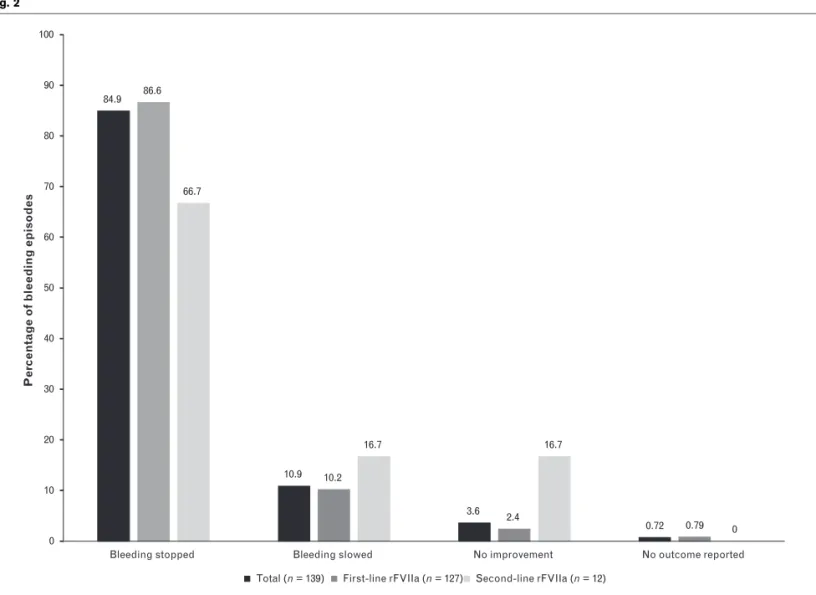
Hemostatic response of bleeding episodes to rFVIIa treatment is presented in Fig. 2. Physician-rated efficacy of rFVIIa for each bleeding episode was reported as ‘bleeding stopped’ in 118 (85%) episodes, ‘bleeding slowed’ in 15 (11%) episodes, and ‘no improvement’ in five (4%) episodes, and was not documented in one episode. Considering that only four of 139 rFVIIa-treated episodes (3%) reported treatment failure and that bleed-ing was stopped after switchbleed-ing to another agent, overall rFVIIa efficacy was 97%. Bleeding stopped in 87% of bleeding episodes when rFVIIa was the first line of treatment compared with 67% when rFVIIa was the second line of treatment.
Five treatment-emergent adverse events were reported for three patients in the HTRS Registry from January 2004 to November 2011. One patient reported extension of a thigh hematoma. One serious adverse event was reported in a 77-year-old man treated with rFVIIa for traumatic subcutaneous bleeding. During treatment, the patient reported moderate anemia, and a red blood cell transfusion was performed. Mild cough and headache were also reported during the bleeding episode. None of the reported treatment-emergent adverse events are con-sidered to be related to rFVIIa treatment based on investigator assessment. No other events have been reported via HTRS after 2008 for patients with acquired hemophilia treated with rFVIIa.
The only thromboembolic event was transient neurologic symptoms (transient ischemic attack) in a 31-year-old post-partum patient after 110 doses of rFVIIa. The woman developed a muscular hemorrhage during a caesarean sec-tion and was treated with fresh frozen plasma (1 ml/kg as needed, to a total of six doses) over a 3-day period, 24 units of pRBCs over an unknown period, and platelets (dosing
Table 2 Median (interquartile range) values for rFVIIa dosing and exposure in treatment of bleeding episodes
Total First-line rFVIIa Second-line rFVIIa
Number of episodes 139 127 12
Initial dose (mg/kg) 90 (87.6–100.0) 90 (87.1–100.0) 90 (90.0–97.0) Dose per infusion (mg/kg) 90 (87.8–98.7) 90 (87.6–98.7) 90 (90.0–97.0) Total dose per episode (mg/kg) 333.5 (165.8–1382.9) 300 (118.7–1345.3) 576.9 (275.3–3430.0) Number of injections (doses) 3 (2.0–14.0) 3 (1.0–13.5) 7 (3.5–25.0) rFVIIa treatment duration (days) 1 (0–2.8) 1 (0–2.5) 1.5 (0.8–4.1) Total treatment duration (days) 1 (0–4.42) 1 (0–4.0) 7.5 (0.8–13.5) rFVIIa, recombinant activated factor VII.
Table 3 Median (interquartile range) values for rFVIIa dosing and exposure in treatment of mucosal and subcutaneous bleeding episodes
Total Mucosal Subcutaneous
Number of episodes 139 45 52
Treatment sequence,n(%)
information unknown), without improvement. Sub-sequently, the patient began treatment with rFVIIa (90mg/kg every 2 h), and the bleeding episode was resolved
after 72 h. Despite resolution of the bleeding episode, rFVIIa treatment regimen was continued for an additional 7 days. The patient developed an acute cerebrovascular accident with weakness in the right leg and upper Babinski reflex. Magnetic resonance imaging revealed multiple small infarcts bilaterally in the frontal lobes. The neurol-ogist reported that it was most likely related to eclampsia and vasculitis given the patient’s medical history.
Discussion
The final analysis of the HTRS Registry represents the second largest data set in acquired hemophilia (the lar-gest in North America) and was the first to examine symptoms by race and ethnicity [6]. Although sub-cutaneous bleeding as a first location for a bleeding episode was uncommon outside of whites, it represents the most common location of recorded bleeding episodes in all race/ethnicity groups. In a recent publication regarding the demographics and management of bleed-ing in patients with acquired hemophilia in Europe (EACH2 Registry), a total of 482 patients experienced at least one bleeding episode [3,7]. Similar to the HTRS
Fig. 2
84.9
10.9
3.6
0.72 86.6
10.2
2.4
0.79 66.7
16.7 16.7
0 0
10 20 30 40 50 60 70 80 90 100
Bleeding stopped Bleeding slowed No improvement No outcome reported
Per
c
entage of bleeding episodes
Total (n = 139) First-line rFVIIa (n = 127) Second-line rFVIIa (n = 12)
Treatment efficacy of rFVIIa. Efficacy for all bleeding episodes treated with rFVIIa (n¼139), bleeding episodes in which rFVIIa was used as first-line
therapy (n¼127), and bleeding episodes in which rFVIIa was used as second-line therapy (n¼12). rFVIIa, recombinant activated factor VII.
Table 4 Concomitant hemostatic medications or blood products
Hemostatic agent Total Number of episodes 139 Concomitant hemostatic medications,n(%) 50 (36.0)
Any concomitant medication except blood products 18 (13.0) Only blood products 20 (14.4) Blood products,n(%) 32 (23.0)
FFP 7 (5.0)
pRBCs 29 (20.9)
Other blood bank products 3 (2.2) PCC/aPCC,n(%) 17 (12.2)
Registry, the most common cause of the first bleeding episode in the EACH2 Registry was spontaneous (77.4%), and the most common location was sub-cutaneous (53.2%) [7]. The UKHCDO study also showed that of 149 patients identified in the United Kingdom, the most common bleeding site was subcutaneous (80%) [5].
Of the 237 bleeding episodes reported in the HTRS Registry, 139 (59%) were treated with rFVIIa (127 first line), with only 16 episodes (11.5%) treated with aPCC. This is similar to the treatment pattern reported in the EACH2 Registry, in which 56.7% of bleeding episodes were treated with rFVIIa and 20.5% with aPCC as first-line therapy [3]. In the EACH2 Registry, 69 patients needed second-line treatment, most commonly due to lack of efficacy of first-line treatment (50 patients) [3]. Second-line therapy included rFVIIa (36.9%), aPCC (23.1%), and FVIII (35.4%) [3]. In the UKHCDO study, 32.9% of patients were treated with aPCC and 31.5% were treated with rFVIIa; however, hemostatic response was not reported [5].
In the HTRS Registry, efficacy was higher when rFVIIa was used as first-line therapy (86.6%) than second-line therapy (66.7%). This is similar to the observed efficacy of rFVIIa in EACH2, in which 91.2% of bleeding episodes responded to first-line treatment with rFVIIa, with fewer bleeding episodes (79.4%) resolving in response to second-line therapy (efficacy by therapy was not provided) [3]. This lower efficacy in second-line treatment may indicate more serious and difficult to treat bleeding episodes. It was also noted in EACH2 that the efficacy of bypassing agents as first-line therapy was higher than that of replacement therapy (91.8% vs. 69.6%,P<0.003) [3].
Dosing of rFVIIa
The current recommended dosing of rFVIIa for the treatment of bleeding episodes in patients with acquired hemophilia is 70 to 90mg/kg every 2 to 3 h until hemostasis is achieved [2]. The median initial dose and mean dose per infusion (90 and 90mg/kg, respectively) with a narrow IQR (87.6 – 100.0 and 87.8 – 98.7mg/kg, respectively) indicate that treatment is generally in line with the rFVIIa package insert. This is also in line with the use of rFVIIa in the EACH2 Registry, in which the median (IQR) dose of rFVIIa was 90mg/kg (84.71 – 102.86mg/kg) [3]. However, the number of doses per bleeding episode was higher in the EACH2 Registry than the HTRS Registry (median 12 vs. 3) [3]. Covariates that might account for differ-ences were not uniformly captured across these two registries, and standardized scales of bleeding episode severity are not available.
The median number of injections of rFVIIa and total dose per episode were higher when rFVIIa was used as
second-line treatment compared with first-line treat-ment, indicating that these bleeding episodes were more difficult to treat. However, rFVIIa may have been used as salvage therapy after blood products, aPCC, and/or antifibrinolytics failed to stop the bleeding, and could also indicate that these bleeding episodes were more serious and therefore required additional doses of rFVIIa to control bleeding. It is also of note that sub-cutaneous bleeding episodes required a higher number of injections of rFVIIa and total dose of rFVIIa, com-pared with mucosal bleeding episodes, indicating that subcutaneous bleeding episodes may be more difficult to treat.
Limitations
As this registry was originally intended in part to track the safety of rFVIIa, the proportion of bleeding episodes treated with rFVIIa (59%) and associated data derived from those bleeding episodes may be somewhat biased and selective. Nevertheless, they certainly indicate that rapid and safe hemostasis can be achieved with rFVIIa in an aging population with acquired hemophilia in whom thrombogenicity is of concern. In addition, as reported previously, only a limited number of sites contributed to the HTRS Registry, and therefore, the data set may be biased toward patients in those regions [6].
Conclusions
The HTRS Registry represents the largest data set in North America that has reported on demographics and bleeding episodes in patients with acquired hemophilia. This analysis of bleeding episodes shows that rFVIIa is an effective treatment option for patients with acquired hemophilia. The lower efficacy and increased number of doses of rFVIIa used in second-line treatment of bleeding episodes is most likely because the bleeding episodes were more severe and difficult to treat. Recom-binant FVIIa is an important treatment option as first-line therapy in patients with acquired hemophilia. There were no new safety issues identified, with one throm-boembolic event (transient neurologic symptoms) occur-ring in a 31-year-old postpartum patient after 110 doses of rFVIIa.
Acknowledgements
Editorial assistance was provided by Amanda Tricarico, PhD, ETHOS Health Communications, Newtown, Pennsylvania, with financial assistance from Novo Nordisk Inc, Princeton, New Jersey, in compliance with international guidelines on Good Publication Practice. The authors received no remuneration of any kind for the development of this manuscript.
Conflicts of interest
the HTRS Registry. There was no compensation pro-vided for authorship or writing of this manuscript. R.Z.G. and D.L.C. are employees of Novo Nordisk.
References
1 Collins P, Baudo F, Huth-Kuhne A, Ingerslev J, Kessler CM, Castellano ME,
et al.Consensus recommendations for the diagnosis and treatment of acquired hemophilia A.BMC Res Notes2010;3:161.
2 NovoSeven RT. (Coagulation Factor VIIa) [package insert]. Bagsvaerd, Denmark: Novo Nordisk A/S, 2014.
3 Baudo F, Collins P, Huth-Kuhne A, Levesque H, Marco P, Nemes L,et al.
Management of bleeding in acquired hemophilia A: results from the European Acquired Haemophilia (EACH2) Registry.Blood2012;120: 39–46.
4 Borg JY, Guillet B, Le Cam-Duchez V, Goudemand J, Levesque H. Outcome of acquired haemophilia in France: the prospective SACHA (Surveillance des Auto antiCorps au cours de l’Hemophilie Acquise) registry.Haemophilia
2013;19:564–570.
5 Collins PW, Hirsch S, Baglin TP, Dolan G, Hanley J, Makris M,et al.Acquired hemophilia A in the United Kingdom: a 2-year national surveillance study by the United Kingdom Haemophilia Centre Doctors’ Organisation.Blood
2007;109:1870–1877.
6 Kessler CM, Ma AD, Al-Mondhiry HAB, Gut RZ, Cooper DL. Assessment of acquired hemophilia patient demographics in the United States: the Hemostasis and Thrombosis Research Society Registry.Blood Coagul Fibrinolysis2015; submitted.
7 Knoebl P, Marco P, Baudo F, Collins P, Huth-Kuhne A, Nemes L,et al.
Demographic and clinical data in acquired hemophilia A: results from the European Acquired Haemophilia Registry (EACH2).J Thromb Haemost