Metal
–
organic layers stabilize earth-abundant
metal
–
terpyridine diradical complexes for catalytic
C
–
H activation
†
Zekai Lin,‡aNathan C. Thacker,‡aTakahiro Sawano,‡aTasha Drake,aPengfei Ji,a Guangxu Lan,aLingyun Cao,bShubin Liu,cCheng Wang band Wenbin Lin *ab
We report the synthesis of a terpyridine-based metal–organic layer (TPY-MOL) and its metalation with CoCl2 and FeBr2 to afford CoCl2$TPY-MOL and FeBr2$TPY-MOL, respectively. Upon activation with NaEt3BH, CoCl2$TPY-MOL catalyzed benzylic C–H borylation of methylarenes whereas FeBr2$TPY-MOL catalyzed intramolecular Csp3–H amination of alkyl azides to afford pyrrolidines and piperidines. X-ray absorption near edge structure (XANES), extended X-ray absorption fine structure (EXAFS), X-ray photoelectron spectroscopy, UV-Vis-NIR spectroscopy, and electron paramagnetic spectroscopy (EPR) measurements as well as density functional theory (DFT) calculations identified M(THF)2$TPY-MOL (M¼ Co or Fe) as the active catalyst with a MII-(TPYcc)2electronic structure featuring divalent metals and TPY diradical dianions. We believe that site isolation stabilizes novel MII-(TPYcc)2(M ¼Co or Fe) species in the MOLs to endow them with unique and enhanced catalytic activities for Csp3–H borylation and intramolecular amination over their homogeneous counterparts. The MOL catalysts are also superior to their metal–organic framework analogs owing to the removal of diffusion barriers. Our work highlights the potential of MOLs as a novel 2D molecular material platform for designing single-site solid catalysts without diffusional constraints.
Introduction
Over the past two decades, metal–organic frameworks (MOFs) have attracted great interest among scientists and engineers owing to their potential in various applications including gas storage and separation,1–6heterogeneous catalysis,7–16nonlinear optics,17,18 chemical sensing,19–21 biomedical imaging,22,23and drug delivery.24,25In particular, MOFs have provided an excel-lent platform for designing single-site solid catalysts for many important organic transformations.26–32 By shutting down intermolecular deactivation pathways via spatial isolation of active sites, MOFs have afforded turnover numbers (TONs) several orders of magnitude higher than their homogeneous analogs.26,29The catalytic performance of MOFs is, however, still limited by the diffusion rates of large substrates and products
within the 3D frameworks.33 Although many strategies have been devised to overcome this diffusion limitation of MOFs, for example, by elongating functional ligands26 or diluting them with catalytically inactive spectator ligands to construct MOFs with larger channels and pores,34only moderate success has been achieved to date. MOFs constructed from elongated ligands tend to suffer from interpenetration as well as frame-work distortion, whereas MOFs built from mixed functional and spectator ligands have diminished atom efficiency.
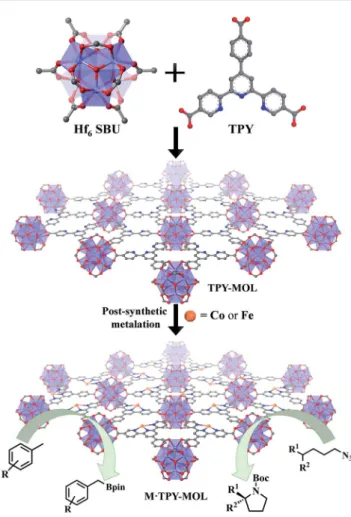
We recently showed that diffusional constraint of MOFs could be lied by reducing one dimension of the MOF crystals to only a few nanometers in thickness to afford a new category of 2D materials, metal–organic layers (MOLs).35 Unlike 3D MOFs, the active sites in ultrathin 2D MOLs are readily acces-sible to substrates during catalytic reactions. On the other hand, MOLs still inherit the heterogeneous nature, ordered structure, and molecular tunability of MOF catalysts,36–38 and have the potential to provide a rare 2D molecular material platform for designing a new class of single-site solid catalysts without diffusional constraints. We report here the synthesis of a new metal–organic layer, TPY-MOL, based on Hf6(m3-O)4(m3 -OH)4(HCO2)6 secondary building units (SBUs) and 40 -(4-car-boxyphenyl)-[2,20:60,200-terpyridine]-5,500-dicarboxylate (TPY) bridging ligands and the metalation of TPY ligands in TPY-MOL with CoCl2and FeBr2to afford highly effective recyclable and reusable MOL catalysts for challenging benzylic C–H borylation aDepartment of Chemistry, University of Chicago, 929 E. 57thSt., Chicago, Illinois
60637, USA. E-mail: [email protected]
bCollaborative Innovation Center of Chemistry for Energy Materials, State Key
Laboratory of Physical Chemistry of Solid Surfaces, Department of Chemistry, College of Chemistry and Chemical Engineering, Xiamen University, Xiamen 361005, PR China
cResearch Computing Center, University of North Carolina, Chapel Hill, North
Carolina 27599-3420, USA
†Electronic supplementary information (ESI) available. See DOI: 10.1039/c7sc03537c
‡These authors contribute equally.
Cite this:Chem. Sci., 2018,9, 143
Received 12th August 2017 Accepted 30th October 2017
DOI: 10.1039/c7sc03537c
rsc.li/chemical-science
Science
EDGE ARTICLE
Open Access Article. Published on 30 October 2017. Downloaded on 23/03/2018 15:18:30.
This article is licensed under a
Creative Commons Attribution 3.0 Unported Licence.
and intramolecular sp3 C–H amination reactions (Fig. 1). Spectroscopic and computational studies identied unprece-dented CoII/FeII-terpyridine diradical complexes as catalytic active sites for the borylation and amination reactions.
Owing to their distinct coordination, redox, and photo-physical properties, terpyridines (tpy) and their metal complexes have been explored for potential applications in manyelds, including polymer science,39,40optoelectronics,41,42 medicinal chemistry,43,44 nanotechnology,45 and molecular catalysis.41,46,47 Although tpy derivatives provide a potentially interesting ligand platform for designing earth-abundant metal catalysts, few examples have been reported in the literature,47–50 in part due to their strong propensity to undergo dispropor-tionation reactions to form catalytically inactive M(tpy)2 complexes.48,49Installation of bulky groups on the 6,600-positions of tpy could prevent such bimolecular deactivation processes in M-tpy catalysts but oen at the expense of their catalytic activ-ities.48By incorporating a tpy derivative into the TPY-MOL, we effectively shut down the disproportionation decomposition pathway without relying on steric protection at the 6,600 posi-tions and obtained highly effective MOL catalysts based on M-tpy complexes (M¼Co or Fe) for benzylic C–H borylation and intramolecular sp3C–H amination reactions. The MOL-based M-tpy catalysts displayed at least 20 times higher catalytic
activity and distinct chemoselectivity in benzylic C–H borylation reactions and 50 times higher TONs in intramolecular sp3C–H amination reactions over their homogeneous analogs.
Results and discussion
Synthesis and postsynthetic metalation of TPY-MOL
TPY-MOL was synthesized in 76% yield by heating a mixture of HfCl4, H3TPY, and formic acid in DMF and water at 120C for 24 h. The PXRD pattern of TPY-MOL matched the simulated pattern based on the (hk0) reections only that are character-istic of 2D MOL structures and aligned well with that of iso-structural BTB-MOL (BTB is 1,3,5-benzenetribenzoate, Fig. 2a).35 Transmission Electron Microscopy (TEM) images showed ultra-thinlms of TPY-MOL whereas the high resolu-tion TEM (HRTEM) images of TPY-MOL showed a clear lattice
Fig. 1 M$TPY-MOLs, constructed from Hf6SBUs and TPY and then metalated with Co and Fe, were used for benzylic C–H borylation and intramolecular sp3C–H Amination reactions, respectively.
Fig. 2 (a) PXRD patterns of TPY-MOL, CoCl2$TPY-MOL, FeBr2$ TPY-MOL, Co(THF)2$TPY-MOL, and Fe(THF)2$TPY-MOL in comparison to simulated PXRD pattern for TPY-MOL; (b) TEM image of TPY-MOL; (c) HRTEM image and fast Fourier transform (FFT) pattern of TPY-MOL; (d) tapping-mode atomic-force microscope (AFM) topographic image of TPY-MOL; (e) height profile along the white line of TPY-MOL.
Open Access Article. Published on 30 October 2017. Downloaded on 23/03/2018 15:18:30.
This article is licensed under a
with the dark spots corresponding to Hf6clusters (Fig. 2b and c). The distances between adjacent spots on the HRTEM image (20.1A) matched well with that between two adjacent Hf˚ 6SBUs (20.0A) in the MOL structural model. Atomic Force Microscopy˚ (AFM) images of TPY-MOL indicated monolayer thickness for many nano-sheets with an average measured thickness of 1.2 nm, corresponding to the van der Waals size of Hf6 SBUs (Fig. 2d and e).
TPY-MOL was readily metalated with CoCl2or FeBr2(THF)2 (1.05 eqv. w.r.t TPY) to afford CoCl2$TPY-MOL or FeBr2$ TPY-MOL with 100% metal loading, as determined by inductively coupled plasma-mass spectrometry (ICP-MS). X-ray absorption near edge structure (XANES) analysis revealed +2 oxidation state for CoCl2$TPY-MOL and FeBr2$TPY-MOL (Fig. 3a and b). The oxidation state assignments were further conrmed by X-ray photoelectron spectroscopy (XPS, Fig. S15, ESI†). Extended X-ray absorption ne structure (EXAFS) tting indicated the coordination of Co(II) to three N atoms of TPY and two chlorides in CoCl2$TPY-MOL and the coordination of Fe(II) to three N atoms of TPY and two bromides in FeBr2$TPY-MOL (Fig. 3c and d). The similarity of EXAFS-derived bond distances in CoCl2
-$TPY-MOL (Co–Nc¼2.090.01A, Co˚ –Nt¼2.160.01A and˚ Co–Cl ¼ 2.28 0.01 A) and crystallographically determined˚
CoCl2$tpy distances (Co–Nc¼2.071A, Co˚ –Nt¼2.139A and Co˚ – Cl¼2.298˚A) validates the EXAFStting results.
Co-TPY-MOL catalyzed benzylic C–H borylation
We rst investigated C–H borylation of m-xylene by Co$ TPY-MOL. Organoboronic compounds are a useful class of inter-mediates for forming carbon–carbon and carbon–heteroatom bonds through coupling reactions. C–H borylation with boron reagents such as B2pin2is one of the most direct and convenient methods for the synthesis of organoboronic compounds. Although C–H borylation with arenes has been developed in the past two decades, benzylic C–H borylation is still rare (Table S7, ESI†).27,51–56 Upon activation with NaEt
3BH, CoCl2$TPY-MOL (0.5 mol%) catalyzed m-xylene borylation with B2pin2 at 100C over 3 days to afford 42% yield of borylated products, with a 4.2 : 1 selectivity favoring the benzylic position (Table 1, entry 1). The borylated products were obtained in 95% yield with a slightly higher selectivity for benzylic borylation (4.6 : 1) when the catalyst loading increased to 1.0 mol% (Table 1, entry 2). The activation of CoCl2$TPY-MOL with NaEt3BH is necessary for the borylation reaction (Table 1, entry 3). Under identical conditions, a TPY-MOF control, which is isostructural to the previously reported BTB-MOF in which 2D layers stack in a staggered arrangement to result in a 3D MOF,35 gave no conversion, likely due to slow diffusion of the substrates and products (Table 1, entry 4). The homogeneous analog gave 2% borylated products with a 5.7 : 1 selectivity favoring the arene C–H bond (Table 1, entry 5). Such moderate arene borylation activity was recently reported for homogenous tpy-Co deriva-tives.49Active site isolation in MOLs thus not only increases the TON by more than 20 times (over the homogeneous analog) but also afforded unusual selectivity of borylation for the benzylic C–H bond.
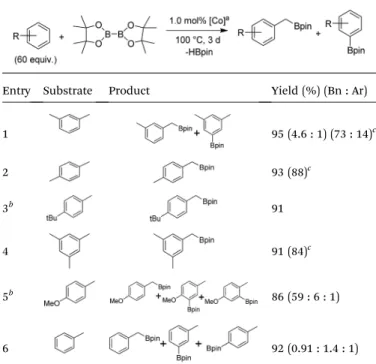
We further investigated the substrate scope for Co(THF)2
-$TPY-MOL catalyzed C–H borylation reactions. Benzylic bory-lated products were produced exclusively forp-xylene, 1-t -butyl-4-methylbenzene, and mesitylene in >90% yields (Table 2, entries 2–4). Forp-methoxytoluene, a high selectivity of 59: 6: 1 was obtained for the benzylic borylated product (Table 2, entry
Fig. 3 (a) XANES spectra of CoCl2, CoCl2$TPY-MOL, Co(THF)2$ TPY-MOL, Co(Bpin)2$TPY-MOL, and Co$TPY-MOL-post; (b) XANES spectra of FeBr2(THF)2, FeBr2$TPY-MOL, and Fe(THF)2$TPY-MOL; (c–f) experimental EXAFS spectra andfits of CoCl2$TPY-MOL,Rfactor¼ 0.006 (c), FeBr2$TPY-MOL,Rfactor¼0.011 (d), Co(THF)2$TPY-MOL,R factor¼0.013 (e) and Fe(THF)2$TPY-MOL, Rfactor¼0.015 (f) inR space showing the magnitude of Fourier transform (black hollow squares, black solid line) and real components (blue hollow squares, blue solid line).
Table 1 Cobalt-catalyzed C–H borylation ofm-xylene
Entry Catalyst Yielda(%) (Bn : Ar)
1 CoCl2$TPY-MOL 42 (4.2 : 1)
2b CoCl
2$TPY-MOL 95 (4.6 : 1)
3c CoCl
2$TPY-MOL 0
4 CoCl2$TPY MOF 0
5 “Homogeneous”CoCl2$tpy 2 (1 : 5.7)
aNMR yield based on CH
3NO2as an internal standard.b1.0 mol% Co.
cWithout the addition of NaEt
3BH.
Open Access Article. Published on 30 October 2017. Downloaded on 23/03/2018 15:18:30.
This article is licensed under a
5). For toluene, borylated products were obtained in 92% yield, but the selectivity for the benzylic borylation product was moderate (Table 2, entry 6). These results indicate the inuence of steric hindrance on the selectivity of benzylic vs.aromatic borylation by Co(THF)2$TPY-MOL.
Co$TPY-MOL was recovered and used for at least 10 times without any loss of activity in C–H borylation of p-xylene (Fig. S32, ESI†). We conducted several tests to demonstrate the heterogeneity of Co$TPY-MOL. First, we showed that the PXRD of Co$TPY-MOL recovered from C–H borylation of p-xylene remained the same as that of freshly prepared Co$TPY-MOL (Fig. S33, ESI†). Second, we used ICP-MS to show that the amounts of Co and Hf leaching into the supernatant during the C–H borylation of p-xylene were only 0.092% and 0.037% respectively. Finally, we observed that the removal of Co$ TPY-MOL from the reaction mixture aer several hours stopped the C–H borylation ofp-xylene (Scheme S2, ESI†).
Identication of the Co(THF)2$TPY-MOL catalyst
We studied the catalytically active species by hydrogen
quanti-cation, infrared (IR), UV-Vis-NIR, XPS, and electron para-magnetic resonance (EPR) spectroscopy, XANES, EXAFS, and density functional theory (DFT) calculations. One equiv. of H2 was generated upon treatment of CoCl2$TPY-MOL with NaEt3 -BH, suggesting the formation of Co(THF)x$TPY-MOL via
reductive elimination of H2from the putative CoH2$TPY-MOL intermediate. This 2-electron reduction process was also conrmed by titration of Co(THF)x$TPY-MOL with ferrocenium
hexauorophosphate which resulted in the generation of two
equiv. of ferrocene w.r.t to CoTPY-MOL (Fig. S6, ESI†). IR spectra showed no characteristic band of N^N, ruling out the coordination of dinitrogen to Co. XANES analysis indicated +2 oxidation state for the Co center (Fig. 3a). This oxidation state assignment was further supported by XPS spectroscopy which gave a Co 2p3/2binding energy of 781.2 eV with the expected shake-up peak for the CoIIcenters (Fig. 4).
The EXAFS spectra at the Co K-edge were well tted with a structural model in which Co coordinates with three N atoms of TPY and two THF molecules (Fig. 3e). Co–N bond distances (Co–Nc¼1.810.02A, Co˚ –Nt¼1.920.02˚A) are shorter than those of the reported [CoI(tpy)2]57(Co–Nc¼2.003˚A, Co–Nt ¼ 2.130˚A), arguing against the +1 oxidation state for Co(THF)2
-$TPY-MOL. Furthermore, Co(THF)2$TPY-MOL has shorter Co–N bond distances than those for CoIICl2$TPY-MOL (Co–Nc¼1.90 0.01 A, Co˚ –Nt ¼ 2.09 0.01 A), but similar Co˚ –N bond distances to a reported low-spin CoII(tpy)(BH
4) complex with the (tpyc)ligand (Co–Nc¼1.810A, Co˚ –Nt¼1.925A).˚ 58The Co–N bond distance analysis thus supports the formulation of the CoII-(tpycc)2electronic structure for Co(THF)2$TPY-MOL.
We used UV-Vis-NIR spectroscopy to discern the diradical nature of TPY ligands in CoTPY-MOLs (Fig. 5). Co(THF)2$ TPY-Table 2 Co$TPY-MOL catalyzed C–H borylation of arenesa
Entry Substrate Product Yield (%) (Bn : Ar)
1 95 (4.6 : 1) (73 : 14)c
2 93 (88)c
3b 91
4 91 (84)c
5b 86 (59 : 6 : 1)
6 92 (0.91 : 1.4 : 1)
a[Co]¼Co(THF)
2$TPY-MOL, NMR yield with CH3NO2as an internal
standard.b4 mol% [Co].cIsolated yields are shown in parentheses.
Fig. 4 Co 2p and Fe 2p XPS spectra of Co(THF)2$TPY-MOL (left) and Fe(THF)2$TPY-MOL (right).
Fig. 5 UV-Vis-NIR absorption spectra of CoCl2$TPY-MOL, Co(THF)2$TPY-MOL, FeBr2$TPY-MOL, and Fe(THF)2$TPY-MOL in THF at 25C.
Open Access Article. Published on 30 October 2017. Downloaded on 23/03/2018 15:18:30.
This article is licensed under a
MOL exhibited two intense, broad bands centered at 552 and 759 nm and a weak but broad band at 1105 nm, indicative ofp top*andp*top*transitions for the reduced tpy ligand.59–63In contrast, these bands are absent in CoCl2$TPY-MOL with the neutral TPY ligand (Fig. 5). The proposed (tpycc)2species was previously observed in reduced M(tpy)2 complexes, such as CrIII(tpy)2, VIV(tpy)2, and TiIV(tpy)2, by Wieghardt and coworkers.62,63However, we are not aware of any example of M-tpy complexes featuring the (M-tpycc)2species.
Our XANES, EXAFS, and XPS results clearly indicate the CoII oxidation state for Co(THF)2$TPY-MOL whose electronic struc-ture is best described as CoII(THF)2$(TPYcc)2-MOL. The (tpycc)2diradical dianion can have either a singlet (S¼ 0) or a triplet (S¼1) ground state, which can potentially be experi-mentally differentiated by EPR spectroscopy. EPR spectroscopy of Co(THF)2$TPY-MOL gave an isotropic signal withgiso¼2.003 at r.t. in toluene suspension. The same MOL sample frozen at 20 K exhibits a stronger isotropic signal withgiso ¼ 2.003,
con-rming that the same species was detected at r.t. and 20 K (Fig. 6). More interestingly, the g value falls in the range of 2.003–2.005,59,64,65where radicals in extended organicpsystems were oen observed. The EPR signal intensity was temperature-dependent, which can betted with the Bleaney and Bowers equation66 typically used for organic diradicals (Fig. 6). The
tting of temperature-dependent EPR signals indicates that the (TPYcc)2diradical has a singlet ground state with singlet-to-triplet energy gap of 0.04 kcal mol1. The observed EPR signal is thus attributed to the thermally populated TPY triplet excited state.67Moreover, a weak signalg
isoz2.04 was observed at 20 K, consistent with low-spin CoIIcenters. Therefore, our EPR data provide strong support to our proposed electronic structure CoII(THF)2$(TPYcc)2-MOL. We have ruled out the possibility of SBU-based free radicals because TPY-MOL treated with NaEt3 -BH exhibited no signal at r.t. or 20 K (Fig. S16, ESI†).
Density functional theory (DFT) calculations and natural population analyses with the B3LYP/6-311G(d) basis set on Co(THF)2$tpy gave a doublet ground state (GS) with high posi-tive charge distribution (1.24) on the Co center and negaposi-tive
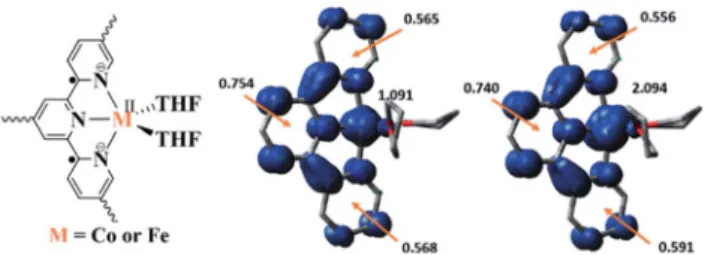
charge distribution (1.34) on tpy (Table S9, ESI†). A compar-ison charge distribution on CoCl2$tpy revealed that the Co center in Co(THF)2$tpy maintains +2 oxidation state. A Mulliken spin population analysis and spin density plot revealed that 0.996 unpaired electron resides on the Co center, affording a ground state with a low-spin CoII, d7doublet (SCo¼1/2) and a tpy diradical dianion singlet (Stpy¼ 0) (Fig. S47, ESI†). The singlet tpy diradical dianion is not expected to give any EPR signal. Interestingly, the energy of quartet state of Co(THF)2$tpy is calculated to be only 0.40 kcal mol1higher than that of the doublet GS. This small energy gap is consistent to that deduced from temperature-dependent EPR signals of Co(THF)2$tpy. The charge distribution of the quartet state is similar to that of the doublet GS with positive charge (1.29) on the Co center and negative charge (1.40) on tpy (Table S9, ESI†). The calculated bond distances are similar between the quartet state and the doublet GS (Table S11, ESI†). A Mulliken spin density pop-ulation and spin density plot of the quartet state revealed the residence of the 1.091 unpaired spin on Co center and 1.887 unpaired spins on tpy, affording a low-spin CoII, d7 doublet (SCo¼1/2) and a tpy triplet diradical dianion (Stpy¼1) (Fig. 7). The energetically accessible low-lying triplet excited state of (tpycc)2 was previously proposed for the hypothetical [ZnII(tpy2)(NH
3)2]0.62DFT calculations thus support the origin of the experimental tpy diradical dianion EPR signal as ther-mally populated quartet state of CoII(THF)
2$tpycc. Moreover, we believe that conjugation of Hf6SBU to TPY can further stabilize TPY diradical dianion and lower the energy difference between doublet and quartet states of CoII(THF)2$TPYcc-MOL.
We also investigated the activation of CoCl2$tpy molecular complex with NaEt3BH. Upon treating CoCl2$tpy in THF with 10 equiv. of NaEt3BH, the mixture turned dark green immediately with concomitant formation of Co nanoparticles as black precipitate (Fig. S7 and S9, ESI†). The solution was ltered through Celite and evaporated to afford Co(tpy)2 (HR-MS calculated for C30H22N6Co [M+]: 525.1238, found: 525.1257).
Mechanistic studies of Co(THF)2$TPY-MOL catalyzed C–H borylation
To gain insight into the mechanism of the C–H borylation reaction, we carried out several experiments. First, we per-formed kinetic isotope effect (KIE) studies in order to afford information on the rate-determining step of the C–H borylation Fig. 6 X-band EPR spectra of Co(THF)2$TPY-MOL (left) and
Fe(THF)2$TPY-MOL (right) suspended in toluene at r.t. and 20 K. Microwave frequency: 9.629 GHz for Co(THF)2$TPY-MOL at r.t.; 9.629 GHz for Co(THF)2$TPY-MOL at 20 K; 9.634 GHz for Fe(THF)2$ TPY-MOL at r.t.; 9.630 GHz for Fe(THF)2$TPY-MOL at 20 K. Insets are temperature-dependent EPR intensity plots and theirfits to the Blea-ney and Bowers equation. Thefitting results gave a singlet to triplet (TPYcc)2energy gap of 0.04 and 0.10 kcal mol1for Co(THF)
2$ TPY-MOL (left) and Fe(THF)2$TPY-MOL, respectively.
Fig. 7 Proposed electronic structure of MII(THF)
2$(TPYcc)2-MOL, M¼ Co or Fe (left); calculated Mulliken spin density distribution and spin density plots (blue: positive; green: negative) of Co(tpy)(THF)2quartet state (middle) and Fe(tpy)(THF)2quintet state (right).
Open Access Article. Published on 30 October 2017. Downloaded on 23/03/2018 15:18:30.
This article is licensed under a
reactions. The initial rates of C–H borylations withp-xylene and
p-xylene-d8 were determined by running parallel reactions in separate vessels, and the comparison of the initial rates gave a KIE value of 2.7 (Scheme S3, ESI†). Such a primary KIE indi-cates the involvement of the C–H bond breaking in the rate-determining step.
Second, we detected the presence of HBpin by gas chromatography-mass spectrometry (GC-MS) at the end of the C–H borylation reactions. Third, we determined the resting state of the catalyst by EXAFS studies. By treating Co(THF)2$TPY-MOL with 20 equiv. of B2pin2, we obtained the Co(Bpin)2$TPY-MOL product in which Co coordinates to three N atoms of TPY and two Bpin groups according to EXAFStting (Fig. S13, ESI†). To determine the resting state of the catalyst, the C–H borylation reaction was stopped at 70% conversion and the organic volatiles were evaporated. EXAFS studies indicated that the remaining residue had the same structure as Co(Bpin)2$TPY-MOL (Fig. S14, ESI†). Finally, EPR spectra of Co(Bpin)2$TPY-MOL did not show any signals corresponding to a TPY-based radical EPR signal (Fig. S16, ESI†), suggesting a typical CoII$TPY complex with negative charge localized on the Bpin ligands.
On the basis of these experimental and calculation results, we propose a catalytic cycle for the C–H active borylation of meth-ylarenes as shown in Scheme 1. The CoCl2$TPY-MOL(I) is acti-vated by NaEt3BH in THF to give the CoH2$TPY-MOL(II) intermediate, which quickly undergoes reductive elimination of H2to produce the CoII(THF)2$(TPYcc)2-MOL(III) catalyst. Oxida-tive addition of B2(pin)2to III results in Co(Bpin)2$TPY-MOL(IV), which is the catalyst resting state for the C–H borylation reac-tions.s-Bond metathesis between IV and methylarene proceeds as a rate-determining step to form Co(H)(Bpin)$TPY(V) and the benzylic borylated product. The reaction of V with B2pin2 regenerates the intermediate IV and forms HBpin as a byproduct
via s-Bond metathesis. The transformation of V to IV could alternatively involve a two-step process of reductive elimination of HBpin from V followed by oxidative addition of B2Pin2to the
intermediate to form IV. We are not able to differentiate between the concerted one-step s-bond metathesis and the two-step reductive elimination/oxidative addition process.
Fe$TPY-MOL catalyzed intramolecular sp3C–H amination
TPY-MOL was also metalated with FeBr2(THF)2 to generate FeBr2$TPY-MOL. Similar to the Co(THF)2$TPY-MOL case, when FeBr2$TPY-MOL was treated with 10 equiv. of NaEt3BH, Fe(THF)2$TPY-MOL was generated along with 1 equiv. of H2.This 2-electron reduction process was also conrmed by titration of Fe(THF)2$TPY-MOL with ferrcenium hexauorophosphate which resulted in the generation of two equiv. of ferrocene. EXAFStting indicates Fe coordinates to three N from TPY and two THF molecules for Fe(THF)2$TPY-MOL (Fig. 3f) while infrared spec-troscopy indicates no coordination of dinitrogen to Fe centers. The oxidation state of Fe(THF)2$TPY MOL was determined to be +2 by XANES analysis since the pre-edge position for Fe(THF)2$ TPY-MOL (7111.6 eV) aligned well with FeBr2(THF)2 (7111.5 eV), FeBr2$TPY-MOL (7111.5 eV) and two reported ve-coordinate species (iPrPDI)FeCl
2(7111.8 eV) and (iPrPDI)Fe(N2)2(7111.9 eV).68 Interestingly, a second feature at 7113.2 eV was observed for Fe(THF)2$TPY-MOL, assignable to the 1s to ligandp* transi-tions. This feature was also seen in a reported (iPrPDI2) FeII(N2)2 species (7114.0 eV). It is worth mentioning that [Fe(tpy)2]n+ (n ¼ 0, 1, 2) were all determined to have FeII centers.69 Furthermore, XPS spectroscopy clearly shows FeII oxidation state for Fe(THF)2$TPY-MOL based on character-istic Fe 2P3/2binding energy of 709.2 eV and shake-up peaks (Fig. 4). The electronic spectrum of Fe(THF)2$TPY-MOL is very similar to that of CoII(THF)2$(TPYcc)2-MOL, indicating the presence of (TPYcc)2 diradical dianion on Fe(THF)2$ TPY-MOL (Fig. 5). Fe(THF)2$TPY-MOL gave an EPR signal with giso ¼2.003 at r. t. in a toluene suspension. The same MOL sample frozen at 20 K exhibited a stronger signal with
giso¼2.003 (Fig. 4). Thetting of temperature-dependent EPR signals indicates that the (TPYcc)2 diradical has a singlet
ground state with singlet-to-triplet energy gap of
0.10 kcal mol1. The observed EPR signal is thus attributed to the thermally populated TPY triplet excited state (Fig. 6).67 Therefore, the EPR data provide strong evidence of our proposed electronic structure of the FeII(THF)2$(TPYcc)2 -MOL catalyst.
DFT calculations and natural population analyses with the B3LYP/6-311G(d) basis set on Fe(THF)2$tpy gave a triplet GS with high positive charge distribution (1.29) on the Fe center and negative charge distribution (1.39) on tpy (Table S10, ESI†). Spin density plot of the GS revealed that 2.013 unpaired electrons reside on the Fe center, affording an intermediate-spin FeII, d6center (SFe ¼ 1), and a tpy singlet diradical dianion antiferromagnetically coupled to each other (Stpy ¼ 0) (Fig. S51, ESI†). The GS of Fe(THF)2$tpy again is not expected to give any organic radical EPR signal, which contradicts our experimental results. We believe that the experimental tpy EPR signal comes from thermal population of the quintet state of Fe(THF)2$tpy which is only 5.26 kcal mol1 higher in energy than that of triplet GS, consistent to our EPR analysis. The charge distribution of the quintet state is similar to Scheme 1 Proposed mechanism for the Co(THF)2$TPY-MOL
cata-lyzed C–H borylation of arenes with B2pin2.
Open Access Article. Published on 30 October 2017. Downloaded on 23/03/2018 15:18:30.
This article is licensed under a
that of triplet GS with positive charge (1.34) on the Fe center and negative charge (1.44) on tpy (Table S10, ESI†). A Mulliken spin population analysis and spin density plot revealed that 2.094 unpaired spins reside on the Fe center and 1.887 unpaired spins on tpy, affording an intermediate-spin FeII, d6compound (SFe¼ 1), and a tpy triplet diradical dianion (STPY¼1) (Fig. 7), which is consistent with our experimental EPR results. The coordination of Hf6 SBUs to TPY is expected to further stabilize TPY diradical dianion and lower the energy difference between triplet and quintet states of FeII(THF)2$(TPYcc)2-MOL.
Upon activation with NaEt3BH, 2 mol% of FeBr2$TPY-MOL catalyzed intramolecular Csp3–H amination of
1-azido-4-phenylbutane (1a) in the presence of two equivalents of
di-tert-butyl dicarbonate (Boc2O) at 90C to form Boc-protecteda -phenyl pyrrolidine (2a) in 89% yield. This level of activity is 9 times as high as that of the MOF control (Table 3, entry 4). Under identical conditions, the homogeneous tpy-Fe catalyst only afforded the product in 3% yield, probably due to the deactivation of tpy-Fe catalystviabimolecular pathways (Table 3, entry 5). Indeed, treatment of FeBr2$tpy with 10 equiv. of NaEt3BH produced a mixture Fe(tpy)2 and Fe nanoparticles; such a disproportionation reaction was previously observed for a series of (PDI)FeBr2complexes.69,70
A higher TON of 76 was achieved when the Fe loading was decreased to 1 mol% (Table 3, entry 2). With a much simpler ligand, Fe$TPY-MOL outperformed Betley's Fe-dipyrrinato homogenous catalyst by 13 times71and our recently reported NacNac-MOF catalysts by 4 times28in TONs. It is worth noting that FeBr2$TPY-MOL, without activation with NaEt3BH, showed low activity (Table 3, entry 3), suggesting that the formation of Fe-nitrene compound might be a key elementary step of the intramolecular Csp3–H amination reaction.71–77
We further explored the substrate scope of intramolecular Csp3–H amination reactions (Fig. 8). At 2 mol% catalyst loading
and in the presence of 2 equiv. of Boc2O, the 2,2-dime-thylpyrrolidine (2b) was formed in 57% yield. Due to reactivity of the vinyl substituent in2c, 5 eq. of Boc2O was required to give modest yield at 2 mol% Fe. Since the MOL catalysts are free from diffusion constraints, substrates with a bulky substituent
such as 3,5-diphenylphenyl was also tolerated and gave 75% yield at 5 mol% Fe and 2 eq. of Boc2O.
Piperidines can also be formedviaC–H amination with the Fe$TPY-MOL catalyst (Fig. 9). For example, 7-azidohept-1-ene was converted to the exclusively six-member ring product 1-Boc-2-vinylpiperidine in 34% yield. By comparison, Betley's Fe-dipyrrinato homogenous catalyst required a stoichiometric equivalent of catalyst to obtain 45% yield. Furthermore, the 1-Boc-2,2-dimethylpiperidine and 1-Boc-2-phenylpiperidine could also be formed from alkyl azides. In these examples, the pyr-rolidine products were also observed.
PXRD pattern of Fe$TPY-MOL catalysts recovered from Csp3–
H amination reactions suggested that the integrity of the MOL was maintained under reaction conditions. ICP-MS of the supernatant showed <0.1% of Fe and <0.1% of Hf had leached into the supernatant. Furthermore, The Fe$TPY-MOL catalyst could be recovered and reused four times (Scheme S4, ESI†).
Conclusions
We have synthesized a terpyridine-based TPY-MOL and meta-lated TPY-MOL with CoCl2and FeBr2to generate M$TPY-MOL Table 3 Iron catalyzed intramolecular C–H amination
Entry Catalyst Yielda(%) TON
1 FeBr2$TPY MOL 89 44.5
2b FeBr
2$TPY MOL 76 76
3c FeBr2$TPY MOL 16 8
4 FeBr2$TPY MOF 10 5
5 “Homogeneous”Fe(tpy)Br2 3 1.5
aNMR yield with MeNO
2as an internal standard.b1 mol% Fe loading.
cWithout addition of NaEt
3BH.
Fig. 8 Substrate scope fora-substituted pyrrolidine synthesis. Reac-tion condiReac-tions:aFe (2 mol%), Boc2O (2 equiv.);bisolated yields.cFe (2 mol%), Boc2O (5 equiv.);dFe (5 mol%), Boc2O (2 equiv.).
Fig. 9 Substrate scope fora-substituted piperidine synthesis.
Open Access Article. Published on 30 October 2017. Downloaded on 23/03/2018 15:18:30.
This article is licensed under a
catalysts for benzylic C–H borylation and Csp3–H amination
reactions. Interestingly, M$TPY-MOL catalysts showed signi -cantly higher activity and different chemo-selectivity than homogeneous and MOF controls. Spectroscopic studies and DFT calculations indicated the formation of unprecedented MOL-stabilized MII-(TPYcc)2species featuring divalent metals and TPY diradical dianions. We believe that the formation of novel MII-(TPYcc)2(M¼Co or Fe) species endows them with unique and enhanced catalytic activities in Csp3–H borylation
and intramolecular amination reactions. Our work demon-strates the ability to engineer MOLs as single-site solid catalysts without diffusional constraints and to elucidate intricate elec-tronic structures of MOL-stabilized metal complexes.
Con
fl
icts of interest
There are no conicts to declare.
Acknowledgements
We thank NSF (DMR-1308229), the University of Chicago Materials Research Science and Engineering Center (DMR-1420709) and the National Natural Science Foundation of the P.R. China (21671162, 21471126) fornancial support and K. Ni, W. Han, M. Piechowicz, Dr A. S. Filatov and Prof. J. Anderson for experimental help. XAFS data were collected at the APS at ANL on Beamline 10BM-A, B, supported by the Materials Research Collaborative Access Team (MRCAT). MRCAT opera-tions are supported by the Department of Energy and the MRCAT member institutions. This research used resources of the Advanced Photon Source, a U.S. Department of Energy (DOE) Office of Science User Facility operated for the DOE Office of Science by Argonne National Laboratory under Contract No. DE-AC02-06CH11357.
Notes and references
1 L. J. Murray, M. Dinca and J. R. Long,Chem. Soc. Rev., 2009, 38, 1294.
2 J. L. Rowsell and O. M. Yaghi,Angew. Chem., Int. Ed., 2005, 44, 4670.
3 J.-R. Li, J. Sculley and H.-C. Zhou,Chem. Rev., 2012,112, 869. 4 N. L. Rosi, J. Eckert, M. Eddaoudi, D. T. Vodak, J. Kim,
M. O'Keeffe and O. M. Yaghi,Science, 2003,300, 1127. 5 K. Sumida, D. L. Rogow, J. A. Mason, T. M. McDonald,
E. D. Bloch, Z. R. Herm, T.-H. Bae and J. R. Long, Chem. Rev., 2012,112, 724.
6 L. Ma, A. Jin, Z. Xie and W. Lin,Angew. Chem., Int. Ed., 2009, 48, 9905.
7 L. Ma, C. Abney and W. Lin,Chem. Soc. Rev., 2009,38, 1248. 8 J. Lee, O. K. Farha, J. Roberts, K. A. Scheidt, S. T. Nguyen and
J. T. Hupp,Chem. Soc. Rev., 2009,38, 1450.
9 A. H. Chughtai, N. Ahmad, H. A. Younus, A. Laypkov and F. Verpoort,Chem. Soc. Rev., 2015,44, 6804.
10 Z. Lin, Z.-M. Zhang, Y.-S. Chen and W. Lin,Angew. Chem., Int. Ed., 2016,55, 13739.
11 P. Ji, T. Sawano, Z. Lin, A. Urban, D. Boures and W. Lin,J. Am. Chem. Soc., 2016,138, 14860.
12 M. Zhao, S. Ou and C.-D. Wu,Acc. Chem. Res., 2014,47, 1199. 13 J. A. Johnson, B. M. Petersen, A. Kormos, E. Echeverria, Y. S. Chen and J. Zhang,J. Am. Chem. Soc., 2016,138, 10293. 14 Q. Han, C. He, M. Zhao, B. Qi, J. Niu and C. Duan,J. Am.
Chem. Soc., 2013,135, 10186.
15 Q. H. Yang, Q. Xu, S. H. Yu and H. L. Jiang,Angew. Chem., Int. Ed., 2016,55, 3685.
16 Y. Z. Chen, Z. U. Wang, H. W. Wang, J. L. Lu, S. H. Yu and H. L. Jiang,J. Am. Chem. Soc., 2017,139, 2035.
17 C. Wang, T. Zhang and W. Lin,Chem. Rev., 2011,112, 1084. 18 O. R. Evans and W. Lin,Acc. Chem. Res., 2002,35, 511. 19 L. E. Kreno, K. Leong, O. K. Farha, M. Allendorf, R. P. Van
Duyne and J. T. Hupp,Chem. Rev., 2012,112, 1105. 20 M. M. Wanderley, C. Wang, C.-D. Wu and W. Lin, J. Am.
Chem. Soc., 2012,134, 9050.
21 Z. Hu, B. J. Deibert and J. Li,Chem. Soc. Rev., 2014,43, 5815. 22 J. Della Rocca, D. Liu and W. Lin,Acc. Chem. Res., 2011,44,
957.
23 W. J. Rieter, K. M. L. Taylor, H. An, W. Lin and W. Lin,J. Am. Chem. Soc., 2006,128, 9024.
24 W. J. Rieter, K. M. Pott, K. M. Taylor and W. Lin,J. Am. Chem. Soc., 2008,130, 11584.
25 C. B. He, K. D. Lu, D. M. Liu and W. B. Lin,J. Am. Chem. Soc., 2014,136, 5181.
26 T. Zhang, K. Manna and W. Lin,J. Am. Chem. Soc., 2016,138, 3241.
27 K. Manna, P. Ji, Z. Lin, F. X. Greene, A. Urban, N. C. Thacker and W. Lin,Nat. Commun., 2016,7, 12610.
28 N. C. Thacker, Z. Lin, T. Zhang, J. C. Gilhula, C. W. Abney and W. Lin,J. Am. Chem. Soc., 2016,138, 3501.
29 T. Sawano, Z. Lin, D. Boures, B. An, C. Wang and W. Lin,J. Am. Chem. Soc., 2016,138, 9783.
30 D. J. Xiao, E. D. Bloch, J. A. Mason, W. L. Queen, M. R. Hudson, N. Planas, J. Borycz, A. L. Dzubak, P. Verma, K. Lee, F. Bonino, V. Crocella, J. Yano, S. Bordiga, D. G. Truhlar, L. Gagliardi, C. M. Brown and J. R. Long,Nat. Chem., 2014,6, 590.
31 J. E. Mondloch, M. J. Katz, W. C. Isley Iii, P. Ghosh, P. Liao, W. Bury, G. W. Wagner, M. G. Hall, J. B. DeCoste, G. W. Peterson, R. Q. Snurr, C. J. Cramer, J. T. Hupp and O. K. Farha,Nat. Mater., 2015,14, 512.
32 R. J. Comito, K. J. Fritzsching, B. J. Sundell, K. Schmidt-Rohr and M. Dinc˘a,J. Am. Chem. Soc., 2016,138, 10232.
33 C. Wang, M. Zheng and W. Lin,J. Phys. Chem. Lett., 2011,2, 1701.
34 T. Sawano, N. C. Thacker, Z. Lin, A. R. McIsaac and W. Lin,J. Am. Chem. Soc., 2015,137, 12241.
35 L. Cao, Z. Lin, F. Peng, W. Wang, R. Huang, C. Wang, J. Yan, J. Liang, Z. Zhang, T. Zhang, L. Long, J. Sun and W. Lin,
Angew. Chem., Int. Ed., 2016,55, 4962.
36 Y. Peng, Y. Li, Y. Ban, H. Jin, W. Jiao, X. Liu and W. Yang,
Science, 2014,346, 1356.
37 R. Dong, M. Pfeffermann, H. Liang, Z. Zheng, X. Zhu, J. Zhang and X. Feng,Angew. Chem., Int. Ed., 2015,54, 12058. 38 P.-Z. Li, Y. Maeda and Q. Xu,Chem. Commun., 2011,47, 8436.
Open Access Article. Published on 30 October 2017. Downloaded on 23/03/2018 15:18:30.
This article is licensed under a
39 A. Wild, A. Winter, F. Schlutter and U. S. Schubert,Chem. Soc. Rev., 2011,40, 1459.
40 G. R. Whittell, M. D. Hager, U. S. Schubert and I. Manners,
Nat. Mater., 2011,10, 176.
41 U. S. Schubert, A. Winter and G. R. Newkome, Terpyridine-based Materials: For Catalytic, Optoelectronic and Life Science Applications, Wiley-VCH, 2011.
42 V. W.-W. Yam, V. K.-M. Au and S. Y.-L. Leung,Chem. Rev., 2015,115, 7589.
43 I. Eryazici, C. N. Mooreeld and G. R. Newkome,Chem. Rev., 2008,108, 1834.
44 A. Winter, M. Gottschaldt, G. R. Newkome and
U. S. Schubert,Curr. Top. Med. Chem., 2012,12, 158. 45 A. Winter, M. D. Hager, G. R. Newkome and U. S. Schubert,
Adv. Mater., 2011,23, 5728.
46 A. Winter, G. R. Newkome and U. S. Schubert,
ChemCatChem, 2011,3, 1384.
47 P. Liu, C.-Y. Zhou, S. Xiang and C.-M. Che,Chem. Commun., 2010,46, 2739.
48 K. Kamata, A. Suzuki, Y. Nakai and H. Nakazawa,
Organometallics, 2012,31, 3825.
49 N. G. L´eonard, M. J. Bezdek and P. J. Chirik,Organometallics, 2017,36, 142.
50 C. Zhang, P. Srivastava, K. Ellis-Guardiola and J. C. Lewis,
Tetrahedron, 2014,70, 4245.
51 T. Furukawa, M. Tobisu and N. Chatani,Chem. Commun., 2015,51, 6508.
52 W. N. Palmer, J. V. Obligacion, I. Pappas and P. J. Chirik,J. Am. Chem. Soc., 2016,138, 766.
53 M. A. Larsen, C. V. Wilson and J. F. Hartwig,J. Am. Chem. Soc., 2015,137, 8633.
54 T. Ishiyama, K. Ishida, J. Takagi and N. Miyaura,Chem. Lett., 2002, 1082.
55 S. Shimada, A. S. Batsanov, J. A. K. Howard and T. B. Marder,
Angew. Chem., Int. Ed., 2001,40, 2168.
56 W. N. Palmer, C. Zarate and P. J. Chirik,J. Am. Chem. Soc., 2017,139, 2589.
57 J. England, E. Bill, T. Weyhermuller, F. Neese, M. Atanasov and K. Wieghardt,Inorg. Chem., 2015,54, 12002.
58 E. J. Corey, N. J. Cooper, W. M. Canning, W. N. Lipscomb and T. F. Koetzle,Inorg. Chem., 1982,21, 192.
59 C. Hamacher, N. Hurkes, A. Kaiser, A. Klein and A. Schuren,
Inorg. Chem., 2009,48, 9947.
60 P. S. Braterman, J. I. Song and R. D. Peacock,Inorg. Chem., 1992,31, 555.
61 R. M. Berger and D. R. Mcmillin, Inorg. Chem., 1988, 27, 4245.
62 C. C. Scarborough, K. M. Lancaster, S. DeBeer,
T. Weyhermueller, S. Sproules and K. Wieghardt, Inorg. Chem., 2012,51, 3718.
63 M. Wang, T. Weyhermuller, J. England and K. Wieghardt,
Inorg. Chem., 2013,52, 12763.
64 J. E. Leffler, An introduction to free radicals, Wiley-Interscience, New York, 1993.
65 G. D. Jones, J. L. Martin, C. McFarland, O. R. Allen, R. E. Hall, A. D. Haley, R. J. Brandon, T. Konovalova, P. J. Desrochers, P. Pulay and D. A. Vicic,J. Am. Chem. Soc., 2006,128, 13175. 66 B. Bleaney and K. D. Bowers, Proc. R. Soc. London, Ser. A,
1952,214, 451.
67 M. Abe,Chem. Rev., 2013,113, 7011.
68 S. C. E. Stieber, C. Milsmann, J. M. Hoyt, Z. R. Turner, K. D. Finkelstein, K. Wieghardt, S. DeBeer and P. J. Chirik,
Inorg. Chem., 2012,51, 3770.
69 B. M. Wile, R. J. Trovitch, S. C. Bart, A. M. Tondreau, E. Lobkovsky, C. Milsmann, E. Bill, K. Wieghardt and P. J. Chirik,Inorg. Chem., 2009,48, 4190.
70 J. England, C. C. Scarborough, T. Weyherm¨uller, S. Sproules and K. Wieghardt,Eur. J. Inorg. Chem., 2012, 4605.
71 E. T. Hennessy and T. A. Betley,Science, 2013,340, 591. 72 E. R. King, E. T. Hennessy and T. A. Betley,J. Am. Chem. Soc.,
2011,133, 4917.
73 R. E. Cowley, N. A. Eckert, S. Vaddadi, T. M. Figg, T. R. Cundari and P. L. Holland, J. Am. Chem. Soc., 2011, 133, 9796.
74 R. E. Cowley and P. L. Holland,Inorg. Chem., 2012,51, 8352. 75 S. Wiese, J. L. McAfee, D. R. Pahls, C. L. McMullin, T. R. Cundari and T. H. Warren, J. Am. Chem. Soc., 2012, 134, 10114.
76 Y. M. Badiei, A. Dinescu, X. Dai, R. M. Palomino, F. W. Heinemann, T. R. Cundari and T. H. Warren,Angew. Chem., Int. Ed., 2008,47, 9961.
77 B. Bagh, D. L. J. Broere, V. Sinha, P. F. Kuijpers, N. P. van Leest, B. de Bruin, S. Demeshko, M. A. Siegler and J. I. D. Vlugt,J. Am. Chem. Soc., 2017,139, 5117.
Open Access Article. Published on 30 October 2017. Downloaded on 23/03/2018 15:18:30.
This article is licensed under a