A Phase 2 Trial of AZD6244 (Selumetinib, ARRY-142886), an Oral
MEK1/2 Inhibitor, in Relapsed/Refractory Multiple Myeloma
Beata Holkova1,2,*, Adriana Zingone7,*, Maciej Kmieciak1, Prithviraj Bose1,2, Ashraf Z. Badros9, Peter M. Voorhees10, Rachid Baz11, Neha Korde7, Hui-Yi Lin12, Jin-Qiu Chen7, Michelle Herrmann7, Liqiang Xi7, Mark Raffeld7, Xiuhua Zhao12, Wen Wan3, Mary Beth Tombes1, Ellen Shrader1, Caryn Weir-Wiggins1, Heidi Sankala1, Kevin T. Hogan1, Austin Doyle8, Christina M. Annunziata7, Martha Wellons1, John D. Roberts1,2, Daniel Sullivan11, Ola Landgren7,†, and Steven Grant1,2,4,5,6,†
1Massey Cancer Center, Virginia Commonwealth University, Richmond, VA
2Department of Internal Medicine, Virginia Commonwealth University, Richmond, VA
3Department of Biostatistics, Virginia Commonwealth University, Richmond, VA
4Department of Microbiology and Immunology, Virginia Commonwealth University, Richmond, VA
5Department of Biochemistry and Molecular Biology, Virginia Commonwealth University,
Richmond, VA
6Institute for Molecular Medicine, Virginia Commonwealth University, Richmond, VA
7Center for Cancer Research, National Cancer Institute, National Institutes of Health, Bethesda,
MD
8Cancer Therapy Evaluation Program, National Cancer Institute, National Institutes of Health,
Bethesda, MD
9Department of Medicine, Greenebaum Cancer Center, University of Maryland, Baltimore, MD
10Department of Medicine, Lineberger Comprehensive Cancer Center, University of North
Carolina, Chapel Hill, NC
11Chemical Biology and Molecular Medicine Program, H. Lee Moffitt Cancer Center, Tampa, FL
12Department of Biostatistics and Biomedical Informatics, H. Lee Moffitt Cancer Center, Tampa,
FL
Abstract
Correspondence: Beata Holkova, Virginia Commonwealth University, PO Box 980037, Richmond, VA 23298-0035. Phone:
804-628-2581; Fax: 804-827-3781; [email protected] or Steven Grant, Virginia Commonwealth University, PO Box 980035, Richmond, VA 23298-0035. Phone: 804-828-5211; Fax: 804-827-3781; [email protected].
*Contributed equally †Contributed equally
HHS Public Access
Author manuscript
Clin Cancer Res. Author manuscript; available in PMC 2017 March 01.
Published in final edited form as:
Clin Cancer Res. 2016 March 1; 22(5): 1067–1075. doi:10.1158/1078-0432.CCR-15-1076.
Author Manuscript
Author Manuscript
Author Manuscript
Purpose—AZD6244 is a MEK1/2 inhibitor with significant preclinical activity in multiple myeloma (MM) cells. This phase 2 study used a two-stage Simon design to determine the AZD6244 response rate in patients with relapsed or refractory MM.
Experimental Design—AZD6244 (75 mg) was administered orally, twice a day, continuously for 28-day cycles. Response was evaluated after 3 cycles.
Results—Thirty-six patients received therapy. The median age was 65 years (range: 43–81) and the median number of prior therapies was 5 (range: 2–11). The most common grade 3 and 4 toxicities included anemia, neutropenia, thrombocytopenia, diarrhea, and fatigue. Three deaths occurred possibly related to AZD6244 (2 due to sepsis, 1 due to acute kidney injury). After AZD6244 discontinuation, 3 additional deaths occurred due to disease progression. The response rate (CR + PR) was 5.6% with a mean duration of response of 4.95 months and median
progression-free survival time of 3.52 months. One patient had a very good partial response (VGPR), 1 patient had a partial response, 17 patients had stable disease, 13 patients had
progressive disease, and 4 patients could not be assessed for response. Pharmacodynamic studies revealed variable effects on bone marrow CD138+ cell MEK1/2 and ERK1/2 phosphorylation. The best clinical response, a prolonged VGPR, occurred in a patient with an MMSET
translocation.
Conclusions—Single-agent AZD6244 was tolerable and had minimal activity in this heavily pre-treated population.
Keywords
Multiple myeloma; clinical trial; mitogen-activated protein kinase 1 and 2 inhibitor
Introduction
Multiple myeloma (MM) is a plasma cell neoplasm that accounts for 10% of all hematologic malignancies. There have been substantial improvements in survival in recent years,
particularly for younger patients (1), much of which may be attributed to the advent of novel therapies (2). Improved response rates in the relapsed/refractory setting, translating to benefits in overall survival, have been seen with the proteasome inhibitor bortezomib (3, 4) and the immunomodulatory drugs thalidomide (5, 6) and lenalidomide (7, 8). Despite these advances, MM generally remains incurable and requires better therapies.
Gene expression profiling has defined 7 molecularly distinct MM subgroups that are associated with different clinical outcomes (9–11). Four of these subgroups are characterized by the presence of recurrent translocations of an oncogene into the heavy chain immunoglobulin locus (IgH) (11, 12). Among these is the MMSET/FGFR3 subgroup (bearing the 4;14 translocation), which is associated with inferior progression-free and overall survival (13).
AZD6244 is a potent, selective, adenosine triphosphate (ATP)-non-competitive inhibitor of activated protein kinase kinase (MEK) 1 and 2 (14). Activation of the mitogen-activated protein kinase (MAPK)/extracellular signal-regulated kinase (ERK) pathway, among others, mediates MM cell proliferation, survival, migration, and drug resistance (15).
Author Manuscript
Author Manuscript
Author Manuscript
Multiple growth signals such as interleukin-6 (16), FGF (17), IGF-1 (18), and RAS (19) converge upon the MEK pathway to enhance the survival, proliferation, and migration of MM cells.
In preclinical studies, AZD6244 inhibited proliferation and survival of human MM cells, regardless of sensitivity to conventional chemotherapy (20), and blocked osteoclast differentiation, function, and cytokine secretion, thereby abrogating paracrine MM cell survival in the bone marrow microenvironment (21). AZD6244 also inhibited tumor growth and prolonged survival in vivo in a human plasmacytoma xenograft model (20).
Phase 1 trials in patients with advanced cancer found the recommended phase 2 dose of the free-base suspension of AZD6244 to be 100 mg (22) and the maximum-tolerated dose of the hydrogen-sulfate capsule to be 75 mg (23), with both doses administered orally twice-daily.
The present trial was prompted by several considerations. First, AZD6244 has shown significant in vivo activity in mouse xenograft models of human MM (20). Second, it has been reported that MM cells overexpressing Maf, either as a consequence of a Maf or an MMSET translocation, may be particularly sensitive to MEK1/2 inhibitors (24). Finally, our group has demonstrated that inactivation of the MEK1/2/ERK1/2 pathway by AZD6244 markedly increases the susceptibility of MM cells to other targeted agents (e.g., Chk1 inhibitors) (25). However, pursuit of this or other combination strategies requires initial assessment of the single-agent activity of AZD6244 in MM. Accordingly, the Southeast Phase 2 Consortium conducted a phase 2 study of AZD6244 in patients with relapsed or refractory MM. The primary objective was to assess the response rate; secondary objectives included assessment of toxicity, progression-free survival, duration of response, and performance of correlative pharmacodynamic studies (e.g., pERK1/2 down-regulation). An additional goal was to determine whether molecularly defined MM sub-types might be particularly responsive to this agent, as observed in preclinical studies (24).
Patients and methods
Drug sources and formulation
AZD6244 hydrogen sulfate was supplied, under a Collaborative Agreement between AstraZeneca Pharmaceuticals and CTEP NCI, as 25-mg hydroxypropylmethylcellulose capsules. Each capsule contained a dispersion of AZD6244 hydrogen sulfate in D-α -tocopheryl polyethylene glycol 1000 succinate (a water-soluble form of vitamin E).
Eligibility criteria
Eligible patients had a confirmed diagnosis of MM with measurable relapsed or refractory disease following at least 2 prior therapies, were at least 18 years of age, and had an Eastern Cooperative Oncology Group (ECOG) performance status of 2 or less.
Additional eligibility criteria included an absolute neutrophil count ≥ 1,000 mm3
(independent of blood cell growth factors), a platelet count of ≥ 75,000 mm3 (independent of
blood cell growth factors or transfusion), a total bilirubin level ≤ 1.5 × the upper limit of normal (ULN), aspartate aminotransferase/alanine aminotransferase < 2.5 × the ULN, a
Author Manuscript
Author Manuscript
Author Manuscript
creatinine level < 3 × the ULN, and a pulse oximetry of ≥ 95% on room air. Prior autologous stem cell transplant (SCT) was allowed, and prior allogeneic SCT was allowed if ≥ 6 months had elapsed since transplant, the patient did not have graft-versus-host disease, and the patient was not on immunosuppressive therapy.
Individuals were excluded from the study if they had known MM of the central nervous system; uncontrolled hypertension or significant cardiovascular disease; other malignancy, unless they had been disease-free for a year or more; uncontrolled intercurrent illness; a left-ventricular ejection fraction of ≤ 45%; refractory nausea and vomiting, chronic
gastrointestinal diseases, or significant bowel resection; or a history of prior MEK-inhibitor use or history of allergic reactions attributed to compounds of similar chemical or biologic composition to AZD6244.
Treatment plan
This was a prospective, multicenter, non-randomized phase 2 study using a Simon two-stage design. AZD6244 capsules were administered at a dose of 75 mg twice-daily, approximately 12 hours apart (total daily dose 150 mg). Treatment cycles were 28 days.
Dose modifications
Doses were omitted and sequentially reduced for treatment-related adverse events, as defined in the protocol. The first dose reduction level was 50 mg twice-daily and the second dose reduction level was 50 mg once-daily. Dose reescalation was not permitted.
Response and toxicity assessment
Adverse events were graded and reported according to National Cancer Institute Common Terminology Criteria for Adverse Events version 4.0. All patients were considered evaluable for toxicity from the time of their first treatment with AZD6244. All treated patients were to be evaluated for response. Response criteria used were from the International Myeloma Working Group Uniform Criteria for Multiple Myeloma (26).
CD138+ cell isolation
In consenting patients, bone marrow samples were obtained before and approximately 24 hours after the first dose of AZD6244. At least 10 mL of bone marrow aspirate was used to isolate CD138+ cells with anti-CD138 magnetic-activated cell separation microbeads (Miltenyi Biotec, San Diego, CA). CD138+ cell purity (≥ 90%) was determined by flow cytometry.
RT-PCR to detect IgH-MMSET
Total RNA was isolated using TRIZOL (Life Technologies, Carlsbad, CA), and
contaminating DNA was removed using DNA-free DNase treatment (Life Technologies). RNA integrity was verified using the RNA Pico Assay on an Agilent 2100 Bioanalyzer (Agilent Technologies, Santa Clara, CA). cDNA synthesis was performed using a High-Capacity cDNA RT Kit (Life Technologies) and validated by detection of c-MYC. PCR amplifications were made with specific primers:
5’-Author Manuscript
Author Manuscript
Author Manuscript
AGCCCTTGTTAATGGACTTGGAGG-3’ (sense), nucleotides 4775–4798 of JH-5’sigmaµ; and 5’-CCTCAATTTCCCTGAAATTGGTT-3’ (antisense), nucleotides 986–964 of
MMSET exon 6. The products of the reaction were separated on a 1.2% agarose gel.
PCR amplification and pyrosequencing
Genomic DNA was isolated using the DNeasy Blood & Tissue Kit on a QIAcube instrument (Qiagen, Valencia, CA). Targeted analyses for BRAF-mutation hotspots at codons 599–601 (27); KRAS at codons 12, 13, and 61 (PyroMark Q24 KRAS v2.0 Kit, Qiagen); and NRAS at codons 12, 13, 18, and 61 were performed using pyrosequencing on a PyroMark Q24 instrument (Qiagen). NRAS pyrosequencing assays were designed using PyroMark Assay Design v2.0 (Qiagen). Genomic DNA was amplified using COLD-PCR (28) to increase mutation-detection sensitivity. Briefly, PCR reactions were conducted in a total volume of 25 µL containing 10-ng genomic DNA template. The resulting PCR product (10 µL) was immobilized on streptavidin-coated Sepharose beads (GE Healthcare, Piscataway, NJ) and prepared for the pyrosequencing reactions, according to the manufacturer’s instructions.
Nano-fluidic proteomic immunoassay (NanoPro)
CD138+ cells were lysed with M-Per buffer (Thermo Fisher Scientific, Rockford, IL) containing phosphatase and protease inhibitors. Approximately 50–72 ng of protein was used per sample, and experiments were performed using a Nanopro1000 instrument (ProteinSimple, Santa Clara, CA), as previously described (29, 30). Various phosphorylated isoforms of MEK and ERK were detected using anti-phospho-ERK (Cell Signaling
Technology, Danvers, MA), MEKpS218/222 (Epitomics, Burlingame, CA), MEKpT292 (Millipore), MEKpT386 (Novus Biologicals, Littleton, CO),
anti-MEKpT394 (Abcam, Cambridge, MA), anti-MEKpS298 (Cell Signaling Technology), and anti-Beta2-microglobulin (Abcam) primary antibodies with HRP-conjugated goat anti-rabbit or goat anti-mouse (Jackson ImmunoResearch Laboratories, West Grove, PA) secondary antibodies. Luminol and peroxide (ProteinSimple) were added to generate chemiluminescent light. The digital images were analyzed and quantified with Compass software
(ProteinSimple). ERK and MEK were normalized to Beta2-microglobulin loading controls.
Statistical analysis
The primary endpoint of this study was overall response rate (stringent complete response [sCR] + complete response [CR] + very good partial response [VGPR] + partial response [PR]) to AZD6244 among patients with relapsed/refractory MM. A true response rate of 20% was considered promising in this population, whereas a true response rate of 5% would not be worthy of further investigation. A Simon two-stage design allowed for early
termination if there was strong evidence that the regimen was inactive. In the first stage, ≥ 1 response in the first 12 patients would lead to accrual of 25 additional patients. If ≥ 4 responses were observed among 37 patients, the treatment would be declared effective. Endpoints were summarized by descriptive statistics (frequency, proportion, median, and/or range). All assays for pharmacodynamics were done in triplicate. Statistical significance was determined using a Student t test and a P value < .05.
Author Manuscript
Author Manuscript
Author Manuscript
Human investigation studies
The study was performed after Institutional Review Board approval in accordance with an assurance filed with and approved by the Department of Health and Human Services. Informed written consent was obtained from each patient before enrollment in the study. This trial is registered at www.clinicaltrials.gov as NCT01085214.
Results
Patient characteristics
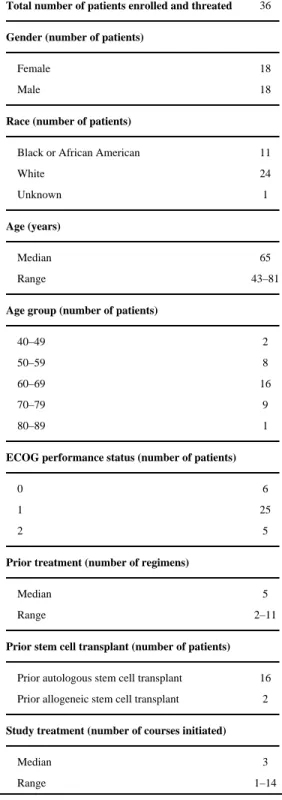
Thirty-seven patients were enrolled. One patient was enrolled but never initiated study therapy. Thirty-six patients, 18 female and 18 male, were treated at 6 study sites. The median age was 65 years (range: 43–81 years). In general, patients were heavily pre-treated with conventional MM therapies. The median number of prior therapies was 5 (range: 2–11) (Table 1).
Patients received a median of 3 cycles of study treatment, with a range of 1–14 cycles per patient. A total of 12 patients consented to correlative testing of bone marrow aspirate, and 11 samples proved sufficient for pharmacodynamic analysis.
Clinical response
For the 36 evaluable patients, the response rate (CR + PR) was 5.6% with a mean duration of response of 4.95 months and median progression-free survival time of 3.52 months. One patient in Stage 1 of the Simon two-stage design experienced a VGPR. This patient had received 4 lines of prior therapy, including an autologous SCT. Assessment after 3 cycles was significant for more than a 50% size reduction of a plasmacytoma by physical exam (from 4 to 0.5 cm), and after cycle 6 a documented VGPR was achieved with a duration of response of 5.06 months. One patient in Stage 2 of the Simon two-stage design experienced a PR after 2 cycles of treatment with a duration of response of 4.83 months. This patient had received 6 lines of prior therapy, including an autologous SCT. Seventeen patients had a best response of stable disease (SD) with a median duration of 2.3 months, 13 had progressive disease (PD), and 4 were not assessed for response. Of the 4 patients not assessed for response, 1 withdrew from the study after cycle 1, 1 discontinued treatment in cycle 1 due to grade 3 neuropathy, and 2 died in cycle 1 before response assessment. All response categories required 2 consecutive assessments (2 cycles).
Toxicities
The most common grade 3 and 4 hematologic toxicities included anemia, neutropenia, thrombocytopenia, diarrhea, and fatigue (Table 2). Additional commonly occurring grade 2 toxicities included increased creatine phosphokinase, limb edema, and acneiform rash (Table 2).
Three grade 5 events occurred during treatment (Table 2). One patient died secondary to acute kidney injury and 2 patients died secondary to infectious complications (sepsis). All 3 deaths were judged to be possibly related to study treatment. Three additional patients died due to disease progression during study follow-up.
Author Manuscript
Author Manuscript
Author Manuscript
Of the 36 patients who received treatment, 10 (28%) received less than 85% of the cycle 1 planned dose (4,200 mg = 75 mg/dose × 2 dose/day × 28 day). Treatment for 5 of these patients was discontinued in the first cycle due to death (2 patients), disease progression (2 patients), and grade 3 neuropathy (1 patient). The other 5 patients received less than 85% of the planned treatment dose due to dose modifications, although each of these patients continued to receive a minimum of a second cycle of treatment.
Candidate genes and pharmacodynamic markers
Analysis of the RAS/ERK/MEK pathway—Whole genome-based sequencing (31) in previous studies of CD138+ bone marrow cells from MM patients detected a high frequency of mutations in genes that modulate activation of the MAPK pathway, particularly the RAS and BRAF genes. To investigate the status of RAS and BRAF, pyrosequencing was
performed using DNA extracted from CD138+ cells isolated from bone marrow aspirates obtained from 10 patients. Three patients carried a mutation in KRAS: #1 (VGPR), #6 (SD), and #10 (PD), and 2 patients carried an NRAS mutation: #2 (PR) and #8 (PD). Mutations in the BRAF gene were found in 1 patient: #9 (PD) (Supplementary Table S1).
MMSET translocation in primary MM tumor cells
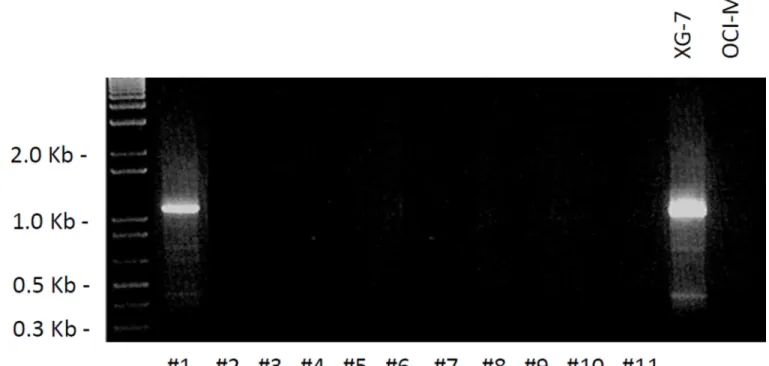
MMSET/FGFR3 and MAF myeloma cell lines are dependent on MEK signaling for growth and survival (24). Among 11 patients, an IgH-MMSET hybrid transcript (indicative of an
MMSET translocation into the immunoglobulin locus) was detected in one patient (#1) using
RT-PCR (Figure 1). This patient, enrolled with an extramedullary plasmacytoma in the inguinal region, had a VGPR after 6 cycles (6 months) of treatment and remained on therapy for an additional 2 cycles (a total of 8 cycles) before experiencing disease progression. The patient’s plasmacytoma decreased by more than 50% after 3 cycles of AZD6244 therapy and was not detectable by physical exam after 6 cycles.
Phospho-MEK1/2 and ERK1/2 isoforms as markers of therapeutic response
Activation of MEK kinase results in phosphorylation of ERK kinase (32). To further investigate the efficacy of MEK inhibition, nanoscale proteomic technology (NanoPro) (29) was employed to analyze the phosphorylation profile of MEK1/2 isoforms in CD138+ cells
from bone marrow samples of 5 patients (#1, #2, #3, #4, and #9) obtained at baseline and approximately 24 hours after initiation of treatment with AZD6244 (Figure 2). Down-regulation of low baseline levels of pT386, pT292, pS298, and pS218/222 MEK1 isoforms (Figure 2A) and pT394, pS222, and pT394 pS226 MEK2 isoforms (Figure 2B) was observed in only 1 of the 5 patients (#3), whose best response was SD.
In addition, levels of mono-phospho-ERK1/2 (pERK1/2) and dual-phospho-ERK1/2 (ppERK1/2) were determined using the NanoPro-immunoassay (Figure 3) in the same samples. In cells from patient #1, who had a positive clinical response to AZD6244 (VGPR), elevated baseline levels pERK1/2 and ppERK1/2 substantially decreased 24 hours after AZD6244 treatment (Figure 3). Cells from patient #2 (PR) exhibited diminished levels of ppERK1 (Figure 3A) and ppERK2 post-treatment (Figure 3C). Additionally, for #4 (SD) down-regulation of ppERK2 (Figure 3C) and pERK2 (Figure 3D) was noted. In #9 (PD), low levels of ppERK2 at baseline were down-regulated 24 hours after AZD6244 treatment
Author Manuscript
Author Manuscript
Author Manuscript
(Figure 3C). pERK1/2 and ppERK1/2 were upregulated in post-treatment samples compared to pre-treatment samples in patient #3 (SD).
Discussion
Therapeutic approaches involving novel targeted pathways continue to be explored for MM. One such approach involves targeting the MEK/ERK cascade, a pathway that mediates proliferation, survival, migration, and drug resistance in MM cells. AZD6244, an inhibitor of MEK1/2, (14) has been shown to induce apoptosis of MM cells in vitro (20) and to inhibit MM cell growth in a human plasmacytoma xenograft model (20). Furthermore, MEK1/2 inhibition has been shown in preclinical studies to potentiate the anti-myeloma activity of both conventional (33, 34) and targeted agents (e.g., Chk1 inhibitors) (35). In addition to these considerations, translocation/up-regulation of the transcriptional activator MAF, which occurs in 30–40% of MM patients, has recently been associated with increased MEK1/2 inhibitor sensitivity (24). Prompted by these findings, and as a follow-up to previously published phase 1 clinical trials of AZD6244 in patients with advanced cancer (22, 23, 36), a phase 2 clinical trial of AZD6244 for the treatment of patients with advanced MM was undertaken. The goals of this study were to obtain an initial estimation of the single-agent activity of AZD6244 in patients with relapsed/refractory MM, and to gain insights into candidate biomarkers and correlative pharmacodynamic indicators that might predict disease responsiveness.
Anemia, neutropenia, thrombocytopenia, diarrhea, and fatigue were the most common grade 3 and 4 toxicities observed. Some unexpected grade 2 toxicities were observed (Table 2). There were 3 grade 5 events that were deemed to be possibly related to study treatment; 2 patients died of sepsis, and one patient died of acute kidney injury. The toxicities observed in this trial were unanticipated based on previously reported studies in solid tumors, with the exception of a recent phase 2 trial employing AZD6244 in metastatic uveal melanoma compared to chemotherapy. In that trial, AZD6244 was associated with greater toxicity compared to chemotherapy (37). Immunosuppression in the present heavily pre-treated patient population, could potentially account for or contribute to the observed grade 3 neutropenias and febrile neutropenias. Based upon these findings, possible considerations for future trials might be to limit the number of prior allowable therapies, to use an alternate dosing schedule, and to intensify supportive measures.
The best clinical response observed among the 36 patients receiving therapy was a VGPR achieved by 1 patient. One other patient had a best response of PR. At the outset of this study, a true response rate of 20% was set as the minimal response needed to warrant further study of AZD6244 as a single agent. Consequently, 4 or more responses would need to be obtained among 37 patients. This threshold was not met, with 2 responses seen among the 36 treated patients. The results of this trial indicate that AZD6244 as a monotherapy has relatively minimal activity in patients with relapsed/refractory MM. Nevertheless, the prolonged VGPR response in a heavily pre-treated patient (e.g., 4 lines of prior therapy including autologous SCT) with an aggressive, poor-prognosis extramedullary
plasmacytoma, and the PR in a patient with 6 lines of prior therapy are noteworthy.
Author Manuscript
Author Manuscript
Author Manuscript
AZD6244 is a highly specific MEK inhibitor that locks MEK in an inactive conformation. In solid tumor cell lines, it has been shown that mutations in RAS or BRAF genes increase sensitivity to MEK inhibition (38, 39). To determine whether RAS or BRAF gene mutations correlate with the clinical activity of AZD6244, the presence of mutations in these genes was monitored in samples from 11 patients. KRAS mutations were detected in 3 patients (27%), NRAS mutations in 2 patients (18%), and BRAF mutations in 1 (9%). These results are consistent with recent whole genome-based sequencing data for 38 patients (31), of which 50% of patients had mutations of RAS and 4% had mutations in BRAF. For patients with KRAS mutations, 1 patient had a best response of VGPR (#1), 1 had SD (#6), and 1 had PD (#10). For patients with NRAS mutations, 1 patient had a PR (#2) and 1 patient had PD (#8). The patient with the BRAF mutation had PD. However, the relatively small number of samples available for analysis, as well as the minimal response rate encountered, made it impossible to determine with certainty the influence of RAS/BRAF mutations on sensitivity to AZD6244 treatment in this trial. Clearly, larger series will be required to establish whether NRAS or KRAS mutations are of value in predicting outcomes in MM patients receiving MEK inhibitor or MEK inhibitor-based regimens.
The recurrent chromosomal translocation t(4;14) is detected in 20% of MM patients and is associated with a shortened overall survival (40). The t(4;14) translocation transposes immunoglobulin heavy chain region enhancer elements to the 5′ end of MMSET to drive its ectopic expression (41). An MMSET translocation, reflected by the presence of the IgH-MMSET hybrid transcript, was detected in a single patient who, significantly, achieved a VGPR in cycle 6 (# 1) (Figure 1). Because of the limited number of MMSET aberrations identified, it is impossible to conclude whether this translocation might be related to a positive clinical outcome. Nevertheless, it is tempting to speculate that patients with this aberration, possibly in association with a KRAS mutation, might be particularly appropriate for MEK-inhibitor therapy. Validation of this notion will clearly require testing in
considerably larger patient cohort.
To investigate the efficacy of MEK inhibition, the phosphorylation profile of MEK1/2 isoforms was analyzed in CD138+ cells obtained from 5 patients (#1, #2, #3, #4, and #9) (Figure 2). Using nanoscale proteomic technology (NanoPro), baseline bone marrow samples were compared to samples obtained 24 hours after initiation of treatment with AZD6244, to measure the response to the MEK inhibition of phosphorylation. NanoPro is a capillary-based iso-electrical immunoassay system that separates proteins according to their charge, and consequently various target protein isoforms can be detected with a single antibody. The capillary platform also allows the use of nanogram amounts of material for protein analysis. Post-treatment down-regulation of phospho-MEK1/2 was not observed, but other studies have yielded similar results (42, 43) wherein up-regulation of p-MEK was reported upon MEK-inhibitor treatment, suggesting negative feedback between ERK and RAF. It has also been reported that Cdk-5 phosphorylation of MEK1 results in the inhibition of MEK1 catalytic activity and the phosphorylation of ERK1/2 (44). Elevated levels of phosphorylated MEK1/2 after treatment with AZD6244 could also potentially reflect the ability of this agent to activate a signaling pathway upstream of MEK.
Author Manuscript
Author Manuscript
Author Manuscript
Pre- and post-treatment pERK1/2 and ppERK1/2 profiles were also analyzed using the NanoPro-immunoassay (Figure 3). In the patient who had a positive clinical response to AZD6244 (VGPR) (#1), levels of pERK1/2 and ppERK1/2 (at baseline) significantly decreased after treatment (Figure 3). For patient #2 (PR) diminished levels of ppERK1 (Figure 3A) and ppERK2 were observed (Figure 3C). Either up-regulation or no change in phospho-ERK1/2 in post-treatment samples compared to pre-treatment samples was observed for the remaining patients. Although samples from the 2 patients (#1 - VGPR and #2 - PR) showed down-regulation of phosphorylated ERK, the number of samples is too small for definitive correlations between phosphorylated ERK status and treatment outcome to be made. In this context, other clinical studies have shown that the presence of activated ERK and the suppression of ERK activation are insufficient to predict outcome of treatment with MEK inhibitors (45). Nevertheless, the present studies document the feasibility of monitoring ERK1/2 phosphorylation status employing the NanoPro-Immunoassay. It is also possible that such correlative studies may be of predictive value in future combination studies involving MEK1/2 inhibitors in MM.
In summary, among this group of relapsed MM patients, single-agent AZD6244 resulted in only minimal responses. Although this study does not support the continued study of AZD6244 as a single agent for the treatment of MM, it is important to note that 2 patients with heavily pre-treated and refractory disease did experience significant responses to this agent. Interestingly, some correlations between responses and ERK1/2 inactivation were detected, although the small sample size and the limited number of responses preclude drawing definitive conclusions. Similarly, limited sample size prevents conclusions from being drawn regarding the single-agent activity of AZD6244 and the presence of either RAS mutations or MMSET translocations, although it is conceivable that with expanded analysis, such correlations might emerge. In addition, while the regimen was reasonably well
tolerated, the incidence of infectious complications was unanticipated based on prior AZD6244 experience, possibly a consequence of the immunosuppression characteristic of MM. Finally, the present results are consistent with emerging evidence that interrupting single signaling pathways, even in the presence of appropriate genetic aberrations, may be unlikely to lead to frequent and/or sustained responses in MM or other malignancies. Instead, the ultimate role of AZD6244 in MM, as in the case for other targeted agents, may lie in rational combination regimens with either conventional cytotoxic or other targeted agents. For example, MEK1/2 inhibitors such as AZD6244 have been shown in both in vitro and in vivo studies in MM to enhance the cytotoxicity of conventional as well as targeted agents such as bortezomib, dexamethasone, lenalidomide, perifosine, and Chk1 inhibitors (33–35). The present results provide a foundation for future consideration of these strategies in relapsed/refractory MM. It is tempting to speculate that the MM patients expressing specific genetic aberrations (e.g., RAS mutations, MAF up-regulation, MMSET translocations) and/or whose cells exhibit inactivation of the MEK1/2/ERK1/2 pathway upon AZD6244 administration might be particularly appropriate settings for such
combination strategies. Validation or refutation of these hypotheses awaits further AZD6244 development.
Author Manuscript
Author Manuscript
Author Manuscript
Supplementary Material
Refer to Web version on PubMed Central for supplementary material.
Acknowledgements
The authors thank all participating patients and their families, the medical and nursing staff, and other investigators and their sites for their participation in this study including: VCU Massey Cancer Center, UMD Greenbaum Cancer Center, UNC Lineberger Comprehensive Cancer Center, H. Lee Moffitt Cancer Center, and Billings Clinic Cancer Center. We also thank Sarah Kolla (VCU) for her assistance with the pharmacodynamic studies; Angela Stephens and Amber Sapp (Moffitt) for their contributions to data management; and Sarah Conine (VCU) for her assistance with manuscript preparation and submission.
Grant Support: The study was supported by SEP2C through NCI/N01 contract HHSN261201100100C, by grants
from the NIH (R01CA93738, R01CA100866, R21CA110953, R01CA167708, P50CA130805 [Lymphoma SPORE], P50CA142509 [Myeloma SPORE], P30CA016059 [Cancer Center Support Grant to Massey Cancer Center; including supporting in part the VCU Biostatistics Shared Resource]), the NIH Intramural Research Program, and an award from the Multiple Myeloma Research Foundation.
Disclosure of Potential Conflicts of Interest: R. Baz reports receiving research funding from Celgene, Millenium,
Sanofi, Karyopharm, and BMS. J. Roberts reports being a local clinical trial principal investigator for Selexys and a consultant for OptumHealth Education. P. Voorhees reports serving on advisory boards for Celgene Corp, Oncopeptides, and Array Biopharma; acting as a consultant for Novartis and Millennium Pharmaceuticals: A Takeda Company; and receiving research support from Janssen, Onyx Pharmaceuticals, GSK, Acetylon, and Oncopeptides.
REFERENCES
1. Brenner H, Gondos A, Pulte D. Recent major improvement in long-term survival of younger patients with multiple myeloma. Blood. 2008; 111:2521–2526. [PubMed: 17901246] 2. Kumar SK, Rajkumar SV, Dispenzieri A, Lacy MQ, Hayman SR, Buadi FK, et al. Improved
survival in multiple myeloma and the impact of novel therapies. Blood. 2008; 111:2516–2520. [PubMed: 17975015]
3. Richardson PG, Barlogie B, Berenson J, Singhal S, Jagannath S, Irwin D, et al. A phase 2 study of bortezomib in relapsed, refractory myeloma. N Engl J Med. 2003; 348:2609–2617. [PubMed: 12826635]
4. Richardson PG, Sonneveld P, Schuster MW, Irwin D, Stadtmauer EA, Facon T, et al. Bortezomib or high-dose dexamethasone for relapsed multiple myeloma. N Engl J Med. 2005; 352:2487–2498. [PubMed: 15958804]
5. Barlogie B, Desikan R, Eddlemon P, Spencer T, Zeldis J, Munshi N, et al. Extended survival in advanced and refractory multiple myeloma after single-agent thalidomide: identification of prognostic factors in a phase 2 study of 169 patients. Blood. 2001; 98:492–494. [PubMed: 11435324]
6. Singhal S, Mehta J, Desikan R, Ayers D, Roberson P, Eddlemon P, et al. Antitumor activity of thalidomide in refractory multiple myeloma. N Engl J Med. 1999; 341:1565–1571. [PubMed: 10564685]
7. Dimopoulos M, Spencer A, Attal M, Prince HM, Harousseau JL, Dmoszynska A, et al. Lenalidomide plus dexamethasone for relapsed or refractory multiple myeloma. N Engl J Med. 2007; 357:2123–2132. [PubMed: 18032762]
8. Weber DM, Chen C, Niesvizky R, Wang M, Belch A, Stadtmauer EA, et al. Lenalidomide plus dexamethasone for relapsed multiple myeloma in North America. N Engl J Med. 2007; 357:2133– 2142. [PubMed: 18032763]
9. Bergsagel PL, Kuehl WM. Molecular pathogenesis and a consequent classification of multiple myeloma. J Clin Oncol. 2005; 23:6333–6338. [PubMed: 16155016]
10. Zhan F, Huang Y, Colla S, Stewart JP, Hanamura I, Gupta S, et al. The molecular classification of multiple myeloma. Blood. 2006; 108:2020–2028. [PubMed: 16728703]
Author Manuscript
Author Manuscript
Author Manuscript
11. Fonseca R, Debes-Marun CS, Picken EB, Dewald GW, Bryant SC, Winkler JM, et al. The recurrent IgH translocations are highly associated with nonhyperdiploid variant multiple myeloma. Blood. 2003; 102:2562–2567. [PubMed: 12805059]
12. Kuehl WM, Bergsagel PL. Multiple myeloma: evolving genetic events and host interactions. Nat Rev Cancer. 2002; 2:175–187. [PubMed: 11990854]
13. Keats JJ, Maxwell CA, Taylor BJ, Hendzel MJ, Chesi M, Bergsagel PL, et al. Overexpression of transcripts originating from the MMSET locus characterizes all t(4;14)(p16;q32)-positive multiple myeloma patients. Blood. 2005; 105:4060–4069. [PubMed: 15677557]
14. Davies BR, Logie A, McKay JS, Martin P, Steele S, Jenkins R, et al. AZD6244 (ARRY-142886), a potent inhibitor of mitogen-activated protein kinase/extracellular signal-regulated kinase kinase 1/2 kinases: mechanism of action in vivo, pharmacokinetic/pharmacodynamic relationship, and potential for combination in preclinical models. Mol Cancer Ther. 2007; 6:2209–2219. [PubMed: 17699718]
15. Podar K, Chauhan D, Anderson KC. Bone marrow microenvironment and the identification of new targets for myeloma therapy. Leukemia. 2009; 23:10–24. [PubMed: 18843284]
16. Ishikawa H, Tsuyama N, Liu S, Abroun S, Li FJ, Otsuyama K, et al. Accelerated proliferation of myeloma cells by interleukin-6 cooperating with fibroblast growth factor receptor 3-mediated signals. Oncogene. 2005; 24:6328–6332. [PubMed: 15940250]
17. Kang S, Dong S, Gu TL, Guo A, Cohen MS, Lonial S, et al. FGFR3 activates RSK2 to mediate hematopoietic transformation through tyrosine phosphorylation of RSK2 and activation of the MEK/ERK pathway. Cancer Cell. 2007; 12:201–214. [PubMed: 17785202]
18. Menu E, Kooijman R, Van Valckenborgh E, Asosingh K, Bakkus M, Van Camp B, et al. Specific roles for the PI3K and the MEK-ERK pathway in IGF-1-stimulated chemotaxis, VEGF secretion and proliferation of multiple myeloma cells: study in the 5T33MM model. Br J Cancer. 2004; 90:1076–1083. [PubMed: 14997210]
19. Hu L, Shi Y, Hsu JH, Gera J, Van Ness B, Lichtenstein A. Downstream effectors of oncogenic ras in multiple myeloma cells. Blood. 2003; 101:3126–3135. [PubMed: 12515720]
20. Tai YT, Fulciniti M, Hideshima T, Song W, Leiba M, Li XF, et al. Targeting MEK induces myeloma-cell cytotoxicity and inhibits osteoclastogenesis. Blood. 2007; 110:1656–1663. [PubMed: 17510321]
21. Breitkreutz I, Raab MS, Vallet S, Hideshima T, Raje N, Chauhan D, et al. Targeting MEK1/2 blocks osteoclast differentiation, function and cytokine secretion in multiple myeloma. Br J Haematol. 2007; 139:55–63. [PubMed: 17854307]
22. Adjei AA, Cohen RB, Franklin W, Morris C, Wilson D, Molina JR, et al. Phase I pharmacokinetic and pharmacodynamic study of the oral, small-molecule mitogen-activated protein kinase kinase 1/2 inhibitor AZD6244 (ARRY-142886) in patients with advanced cancers. J Clin Oncol. 2008; 26:2139–2146. [PubMed: 18390968]
23. Banerji U, Camidge DR, Verheul HM, Agarwal R, Sarker D, Kaye SB, et al. The first-in-human study of the hydrogen sulfate (Hyd-sulfate) capsule of the MEK1/2 inhibitor AZD6244 (ARRY-142886): a phase I open-label multicenter trial in patients with advanced cancer. Clin Cancer Res. 2010; 16:1613–1623. [PubMed: 20179232]
24. Annunziata CM, Hernandez L, Davis RE, Zingone A, Lamy L, Lam LT, et al. A mechanistic rationale for MEK inhibitor therapy in myeloma based on blockade of MAF oncogene expression. Blood. 2011; 117:2396–2404. [PubMed: 21163924]
25. Pei XY, Dai Y, Youssefian LE, Chen S, Bodie WW, Takabatake Y, et al. Cytokinetically quiescent (G0/G1) human multiple myeloma cells are susceptible to simultaneous inhibition of Chk1 and MEK1/2. Blood. 2011; 118:5189–5200. [PubMed: 21911831]
26. Durie BG, Harousseau JL, Miguel JS, Blade J, Barlogie B, Anderson K, et al. International uniform response criteria for multiple myeloma. Leukemia. 2006; 20:1467–1473. [PubMed: 16855634]
27. Xi L, Arons E, Navarro W, Calvo KR, Stetler-Stevenson M, Raffeld M, et al. Both variant and IGHV4-34-expressing hairy cell leukemia lack the BRAF V600E mutation. Blood. 2012; 119:3330–3332. [PubMed: 22210875]
Author Manuscript
Author Manuscript
Author Manuscript
28. Li J, Wang L, Mamon H, Kulke MH, Berbeco R, Makrigiorgos GM. Replacing PCR with COLD-PCR enriches variant DNA sequences and redefines the sensitivity of genetic testing. Nat Med. 2008; 14:579–584. [PubMed: 18408729]
29. Kedei N, Telek A, Czap A, Lubart ES, Czifra G, Yang D, et al. The synthetic bryostatin analog Merle 23 dissects distinct mechanisms of bryostatin activity in the LNCaP human prostate cancer cell line. Biochem Pharmacol. 2011; 81:1296–1308. [PubMed: 21458422]
30. Chen JQ, Lee JH, Herrmann MA, Park KS, Heldman MR, Goldsmith PK, et al. Capillary isoelectric-focusing immunoassays to study dynamic oncoprotein phosphorylation and drug response to targeted therapies in non-small cell lung cancer. Mol Cancer Ther. 2013; 12:2601– 2613. [PubMed: 23979919]
31. Egan JB, Shi CX, Tembe W, Christoforides A, Kurdoglu A, Sinari S, et al. Whole-genome sequencing of multiple myeloma from diagnosis to plasma cell leukemia reveals genomic initiating events, evolution, and clonal tides. Blood. 2012; 120:1060–1066. [PubMed: 22529291] 32. Roskoski R Jr. ERK1/2 MAP kinases: Structure, function, and regulation. Pharmacol Res. 2012;
66:105–143. [PubMed: 22569528]
33. Kim K, Kong SY, Fulciniti M, Li X, Song W, Nahar S, et al. Blockade of the MEK/ERK signalling cascade by AS703026, a novel selective MEK1/2 inhibitor, induces pleiotropic anti-myeloma activity in vitro and in vivo. Br J Haematol. 2010; 149:537–549. [PubMed: 20331454] 34. Rambal AA, Panaguiton ZL, Kramer L, Grant S, Harada H. MEK inhibitors potentiate
dexamethasone lethality in acute lymphoblastic leukemia cells through the pro-apoptotic molecule BIM. Leukemia. 2009; 23:1744–1754. [PubMed: 19404317]
35. Dai Y, Chen S, Pei XY, Almenara JA, Kramer LB, Venditti CA, et al. Interruption of the Ras/MEK/ERK signaling cascade enhances Chk1 inhibitor-induced DNA damage in vitro and in vivo in human multiple myeloma cells. Blood. 2008; 112:2439–2449. [PubMed: 18614762] 36. Jain N, Curran E, Iyengar NM, Diaz-Flores E, Kunnavakkam R, Popplewell L, et al. Phase II study
of the oral MEK inhibitor selumetinib in advanced acute myelogenous leukemia: a University of Chicago phase II consortium trial. Clin Cancer Res. 2014; 20:490–498. [PubMed: 24178622] 37. Carvajal RD, Sosman JA, Quevedo JF, Milhem MM, Joshua AM, Kudchadkar RR, et al. Effect of
selumetinib vs chemotherapy on progression-free survival in uveal melanoma: a randomized clinical trial. JAMA. 2014; 311:2397–2405. [PubMed: 24938562]
38. Yeh JJ, Routh ED, Rubinas T, Peacock J, Martin TD, Shen XJ, et al. KRAS/BRAF mutation status and ERK1/2 activation as biomarkers for MEK1/2 inhibitor therapy in colorectal cancer. Mol Cancer Ther. 2009; 8:834–843. [PubMed: 19372556]
39. Solit DB, Garraway LA, Pratilas CA, Sawai A, Getz G, Basso A, et al. BRAF mutation predicts sensitivity to MEK inhibition. Nature. 2006; 439:358–362. [PubMed: 16273091]
40. Karlin L, Soulier J, Chandesris O, Choquet S, Belhadj K, Macro M, et al. Clinical and biological features of t(4;14) multiple myeloma: a prospective study. Leuk Lymphoma. 2011; 52:238–246. [PubMed: 21261498]
41. Winkler JM, Greipp P, Fonseca R. t(4;14)(p16.3;q32) is strongly associated with a shorter survival in myeloma patients. Br J Haematol. 2003; 120:170–171. [PubMed: 12492597]
42. Meng J, Peng H, Dai B, Guo W, Wang L, Ji L, et al. High level of AKT activity is associated with resistance to MEK inhibitor AZD6244 (ARRY-142886). Cancer Biol Ther. 2009; 8:2073–2080. [PubMed: 19783898]
43. Pratilas CA, Taylor BS, Ye Q, Viale A, Sander C, Solit DB, et al. (V600E)BRAF is associated with disabled feedback inhibition of RAF-MEK signaling and elevated transcriptional output of the pathway. Proc Natl Acad Sci U S A. 2009; 106:4519–4524. [PubMed: 19251651]
44. Sharma P, Veeranna, Sharma M, Amin ND, Sihag RK, Grant P, et al. Phosphorylation of MEK1 by cdk5/p35 down-regulates the mitogen-activated protein kinase pathway. J Biol Chem. 2002; 277:528–534. [PubMed: 11684694]
45. Wang D, Boerner SA, Winkler JD, LoRusso PM. Clinical experience of MEK inhibitors in cancer therapy. Biochim Biophys Acta. 2007; 1773:1248–1255. [PubMed: 17194493]
Author Manuscript
Author Manuscript
Author Manuscript
Translational Relevance
Despite improvements in the survival of patients with multiple myeloma in recent years, relapsed/refractory multiple myeloma remains incurable. The robust preclinical anti-tumor activity demonstrated by the MEK inhibitor AZD6244 and the promising results of a phase 1 study using this drug prompted us to conduct a multicenter phase 2 trial in patients with relapsed/refractory multiple myeloma. The results of this trial reveal minimal single-agent activity in patients with relapsed/refractory multiple myeloma. They also demonstrate the feasibility of employing a nano-fluidic proteomic assay to monitor post-treatment changes in phospho-MEK and -ERK in this setting. Finally, responses in patients with an N/K-RAS mutation or MMSET translocation raise the possibility of predictive biomarkers for the use of this agent in relapsed/refractory multiple myeloma.
Author Manuscript
Author Manuscript
Author Manuscript
Figure 1. RT-PCR assay for the detection of the IgH-MMSET hybrid transcript, associated with the t(4;14) translocation, in CD138+ primary tumor cells
The myeloma cell lines XG-7 (harboring an MMSET translocation) and OCI-MY5 (harboring a MAF translocation) were used as positive and negative controls respectively. An IgH-MMSET hybrid transcript was found in 1 of 11 patients (#1).
Author Manuscript
Author Manuscript
Author Manuscript
Figure 2. MEK1/2 profiles in CD138+ primary tumor cells by NanoPro-immunoassay
Phosphorylation profile of MEK1 (A) and MEK2 (B) isoforms in CD138+ cells by NanoPro-immunoassay. MEK1/2 isoforms at baseline (pre) and 24 hrs after treatment with AZD6244 (post) are shown for each patient. The positions of phosphorylated tyrosine and serine residues are indicated. Quantification in triplicate of the signal is relative to Beta2-microglobulin. Relative signal is shown with standard error bars. * = significantly different from pre-treatment value: P < 0.05.
Author Manuscript
Author Manuscript
Author Manuscript
Figure 3. Mono-phospho-ERK1/2 (pERK1/2) and dual-phosphoERK1/2 (ppERK1/2) profiles in CD138+ primary tumor cells by NanoPro-immunoassay
ppERK1 (A), pERK1 (B), ppERK2 (C) and pERK2 (D) at baseline (pre) and 24 hrs after treatment with AZD6244 (post) are shown for each patient. Quantification in triplicate of the signal is relative to Beta2-microglobulin. Relative signal is shown with standard error bars. * = significantly different from pre-treatment value: P < 0.05.
Author Manuscript
Author Manuscript
Author Manuscript
Author Manuscript
Author Manuscript
Author Manuscript
Author Manuscript
Table 1
Patient enrollment and characteristics
Total number of patients enrolled and threated 36
Gender (number of patients)
Female 18
Male 18
Race (number of patients)
Black or African American 11
White 24
Unknown 1
Age (years)
Median 65
Range 43–81
Age group (number of patients)
40–49 2
50–59 8
60–69 16
70–79 9
80–89 1
ECOG performance status (number of patients)
0 6
1 25
2 5
Prior treatment (number of regimens)
Median 5
Range 2–11
Prior stem cell transplant (number of patients)
Prior autologous stem cell transplant 16
Prior allogeneic stem cell transplant 2
Study treatment (number of courses initiated)
Median 3
Author Manuscript
Author Manuscript
Author Manuscript
Author Manuscript
Table 2
Grade 3, 4, and 5 toxicities possibly, probably, or definitely related to study treatment*
Nature Number of patients (%) (n=36)
Grade 2 Grade 3 Grade 4 Grade 5
Hematologic
Anemia 1 (2.8) 3 (8.3)
Febrile neutropenia 1 (2.8)
Neutrophil count decreased 4 (11.1) 4 (11.1)
Platelet count decreased 1 (2.8) 1 (2.8) 2 (5.6)
White blood cell decreased 2 (5.6) 2 (5.6)
Non-Hematologic
Acute kidney injury 1 (2.8) 1 (2.8)
Adult respiratory distress syndrome 1 (2.8)
Alanine aminotransferase increased 1 (2.8) 1 (2.8)
Arthralgia 1 (2.8)
Aspartate aminotransferase increased 2 (5.6) 1 (2.8)
Creatine phosphokinase increased 4 (11.1) 1 (2.8)
Dehydration 1 (2.8)
Diarrhea 5 (13.9) 4 (11.1)
Dyspnea 1 (2.8)
Edema face 2 (5.6) 1 (2.8)
Edema limbs 4 (11.1)
Fatigue 7 (19.4) 4 (11.1)
Flu-like symptoms 1 (2.8)
Gastroesophageal reflux disease 1 (2.8)
Hepatic failure 1 (2.8)
Hyperkalemia 1 (2.8)
Laryngitis 1 (2.8)
Localized edema 1 (2.8)
Musculoskeletal and connective tissue disorder – other** 1 (2.8)
Myalgia 2 (5.6)
Nausea 2 (5.6)
Papulopustular rash 1 (2.8)
Peripheral sensory neuropathy 1 (2.8) 2 (5.6)
Pruritus 1 (2.8)
Rash acneiform 5 (13.9) 1 (2.8)
Sepsis 2 (5.6)
Skin and subcutaneous tissue disorders – other*** 2 (5.6)
Skin infection 1 (2.8)
Author Manuscript
Author Manuscript
Author Manuscript
Author Manuscript
Nature Number of patients (%) (n=36)
Grade 2 Grade 3 Grade 4 Grade 5
Vaginal inflammation 1 (2.8)
Vomiting 1 (2.8)
*
Data in table represents maximum toxicity grade per patient for each toxicity
**
Rhabdomyolysis
***